Sunday, 12 July 2015

Harper Lee - Go Set A Watchman - review


Review: Harper Lee’s ‘Go Set a Watchman’ Gives Atticus Finch a Dark Side

Michiko Kakutani
10 July 2015

We remember Atticus Finch in Harper Lee’s 1960 classic, “To Kill a Mockingbird,” as that novel’s moral conscience: kind, wise, honorable, an avatar of integrity who used his gifts as a lawyer to defend a black man falsely accused of raping a white woman in a small Alabama town filled with prejudice and hatred in the 1930s. As indelibly played by Gregory Peck in the 1962 movie, he was the perfect man — the ideal father and a principled idealist, an enlightened, almost saintly believer in justice and fairness. In real life, people named their children after Atticus. People went to law school and became lawyers because of Atticus.

Shockingly, in Ms. Lee’s long-awaited novel, “Go Set a Watchman” (due out Tuesday), Atticus is a racist who once attended a Klan meeting, who says things like “The Negroes down here are still in their childhood as a people.” Or asks his daughter: “Do you want Negroes by the carload in our schools and churches and theaters? Do you want them in our world?”

In “Mockingbird,” a book once described by Oprah Winfrey as “our national novel,” Atticus praised American courts as “the great levelers,” dedicated to the proposition that “all men are created equal.” In “Watchman,” set in the 1950s in the era of the Brown v. Board of Education decision, he denounces the Supreme Court, says he wants his home state “to be left alone to keep house without advice from the N.A.A.C.P.” and describes N.A.A.C.P.-paid lawyers as “standing around like buzzards.”

In “Mockingbird,” Atticus was a role model for his children, Scout and Jem — their North Star, their hero, the most potent moral force in their lives. In “Watchman,” he becomes the source of grievous pain and disillusionment for the 26-year-old Scout (or Jean Louise, as she’s now known).

While written in the third person, “Watchman” reflects a grown-up Scout’s point of view: The novel is the story of how she returns home to Maycomb, Ala., for a visit — from New York City, where she has been living — and tries to grapple with her dismaying realization that Atticus and her longtime boyfriend, Henry Clinton, both have abhorrent views on race and segregation.

Though “Watchman” is being published for the first time now, it was essentially an early version of “Mockingbird.” According to news accounts, “Watchman” was submitted to publishers in the summer of 1957; after her editor asked for a rewrite focusing on Scout’s girlhood two decades earlier, Ms. Lee spent some two years reworking the story, which became “Mockingbird.”

Some plot points that have become touchstones in “Mockingbird” are evident in the earlier “Watchman.” Scout’s older brother, Jem, vividly alive as a boy in “Mockingbird,” is dead in “Watchman”; the trial of a black man accused of raping a young white woman, while a main story line in “Mockingbird,” is only a passing aside in “Watchman.” (Interestingly, the trial results in a guilty verdict for the accused man, Tom Robinson, in “Mockingbird,” but leads to an acquittal in “Watchman.”)

Students of writing will find “Watchman” fascinating for these reasons: How did a lumpy tale about a young woman’s grief over her discovery of her father’s bigoted views evolve into a classic coming-of-age story about two children and their devoted widower father? How did a distressing narrative filled with characters spouting hate speech (from the casually patronizing to the disgustingly grotesque — and presumably meant to capture the extreme prejudice that could exist in small towns in the Deep South in the 1950s) mutate into a redemptive novel associated with the civil rights movement, hailed, in the words of the former civil rights activist and congressman Andrew Young, for giving us “a sense of emerging humanism and decency”?

How did a story about the discovery of evil views in a revered parent turn into a universal parable about the loss of innocence — both the inevitable loss of innocence that children experience in becoming aware of the complexities of grown-up life and a cruel world’s destruction of innocence (symbolized by the mockingbird and represented by Tom Robinson and the reclusive outsider Boo Radley)?

The depiction of Atticus in “Watchman” makes for disturbing reading, and for “Mockingbird” fans, it’s especially disorienting. Scout is shocked to find, during her trip home, that her beloved father, who taught her everything she knows about fairness and compassion, has been affiliating with raving anti-integration, anti-black crazies, and the reader shares her horror and confusion. How could the saintly Atticus — described early in the book in much the same terms as he is in “Mockingbird” — suddenly emerge as a bigot? Suggestions about changing times and the polarizing effects of the civil rights movement seem insufficient when it comes to explaining such a radical change, and the reader, like Scout, cannot help feeling baffled and distressed.

Though it lacks the lyricism of “Mockingbird,” the portions of “Watchman” dealing with Scout’s childhood and her adult romance with Henry capture the daily rhythms of life in a small town and are peppered with portraits of minor characters whose circumscribed lives can feel like Barbara Pym salted with some down-home American humor. And it reminds us that “Mockingbird,” the novel, was more concerned with the day-to-day texture of Scout and Jem’s lives and the world of Maycomb than “Mockingbird,” the movie, which focused more closely on Atticus and Tom Robinson’s trial.

The advice Ms. Lee received from her first editor was shrewd: to move the story back 20 years to Scout’s childhood, expanding what are flashbacks in “Watchman,” used to underscore the disillusionment Jean Louise feels with the present-day Atticus, now 72. (“I’ll never believe a word you say to me again. I despise you and everything you stand for.”) Scout’s disillusionment in “Watchman” oddly parallels that of Jem in “Mockingbird,” after Atticus fails to get Tom Robinson acquitted, and Jem realizes that justice does not always prevail.

Another pivotal difference between the two books concerns the decision to make Scout (“juvenile desperado, hell-raiser extraordinary”) the narrator of “Mockingbird” — a decision Ms. Lee executed with remarkable skill, managing the stereoscopic feat of capturing both the point of view of a forthright, wicked-smart girl (who is almost 6 when “Mockingbird” begins) and the retrospective wisdom of an adult.

Somewhere along the way, the overarching impulse behind the writing also seems to have changed. “Watchman” reads as if it were fueled by the alienation a native daughter — who, like Ms. Lee, moved away from small-town Alabama to New York City — might feel upon returning home. It seems to want to document the worst in Maycomb in terms of racial and class prejudice, the people’s enmity and hypocrisy and small-mindedness. At times, it also alarmingly suggests that the civil rights movement roiled things up, making people who “used to trust each other” now “watch each other like hawks.”

“Mockingbird,” in contrast, represents a determined effort to see both the bad and the good in small-town life, the hatred and the humanity; it presents an idealized father-daughter relationship (which a relative in “Watchman” suggests has kept Jean Louise from fully becoming her own person) and views the past not as something lost but as a treasured memory. In a 1963 interview, Ms. Lee, who now lives in her old hometown, Monroeville, Ala., said of “Mockingbird”: “The book is not an indictment so much as a plea for something, a reminder to people at home.”

One of the emotional through-lines in both “Mockingbird” and “Watchman” is a plea for empathy — as Atticus puts it in “Mockingbird” to Scout: “You never really understand a person until you consider things from his point of view.” The difference is that “Mockingbird” suggested that we should have compassion for outsiders like Boo and Tom Robinson, while “Watchman” asks us to have understanding for a bigot named Atticus.

http://www.nytimes.com/2015/07/11/books/review-harper-lees-go-set-a-watchman-gives-atticus-finch-a-dark-side.html?src=me

Friday, 10 July 2015

Omar Shariff RIP

Omar Sharif dies at the age of 83
The star of Doctor Zhivago, Funny Girl and Lawrence of Arabia died of a heart attack in Cairo on Friday, according to his agent

Benjamin Lee
Friday 10 July 2015

Omar Sharif has died at the age of 83. The Egyptian actor, best known for roles in Doctor Zhivago and Lawrence of Arabia, suffered a heart attack in Cairo on Friday, his agent Steve Kenis said.

In May his son revealed the star had been suffering from Alzheimer’s. His son, with ex-wife and fellow actor Faten Hamama, and two grandsons survives him.

He grew up in Cairo and, in an interview with The Independent in 2012, said his mother would play cards with King Farouk and dole out regular beatings.

“By night she would play cards, by day she would give me the slipper,” he said. “She hit me on my backside every day till I was 14. She was an extraordinary woman – she lived till 1998. I was very close to her, even though she beat me all the time!”

Sharif was Oscar nominated for his role in David Lean’s Lawrence of Arabia and went on to win a Golden Globe for his performance. It was his first English language role, after appearing in over 20 Egyptian films.

He spoke about the film to The Guardian in 2012: “When I made this film I thought: “This is a crazy thing. There are no girls, no very famous actors at that time, only men and no action, not a lot of action. Not a lot of fights, not a lot of ...” It was so good because the director was a brilliant man. That’s the truth. David Lean was a great, great man. Great man.”

He soon became a star in Hollywood and followed his breakthrough performance with roles in Behold a Pale Horse alongside Gregory Peck and Anthony Quinn and in the 1965 epic Genghis Khan, playing the title role. In the same year, he reunited with Lean to star in Doctor Zhivago, a role that brought him another Golden Globe.

Sharif also starred alongside Barbra Streisand in Funny Girl and sequel Funny Lady. His decision to work with Streisand angered the Egyptian government given Streisand’s support of the State of Israel.

He admitted to The Guardian in 2004 that not all of his films were favourites. He referred to three as “really bad” since 1972. “To learn bad dialogue is so difficult and so boring,” he said, “and to work with a stupid director who tells you to do the wrong thing, etcetera, it’s just unbearable.”

Sharif worked less in recent years and his last role was in the 2013 drama Rock the Casbah. He has one film still to be released: a short called 1001 Inventions and the World of Ibn Al-Haytham.

In 2003 he was given a one-month suspended prison sentence and a 1,500 euro fine for headbutting a policeman in a Parisian casino. In 2005 he was ordered to attend anger management classes and served two years probation after assaulting a Beverly Hills parking valet. He was caught on video in 2011 apparently slapping a journalist after she attempted to take a photo with him at the Doha international film festival.

Sharif, as well as being an unlikely supporter of Hull City Football Club, was also a world-renowned bridge player, and recently developed an iPhone app. In November 2005, Sharif received UNESCO’s Sergei Eisenstein Medal in recognition of his significant contributions to world film and cultural diversity.

http://www.theguardian.com/film/2015/jul/10/omar-sharif-dies-at-the-age-of-83

Omar Sharif: 'It is a great film, but I'm not very good in it'
It is 50 years since 'Lawrence of Arabia' came to the silver screen. Here, one of the two actors who achieved stardom in the film talks about the anniversary celebrations, his life spent in hotels, his love of liberty, cards, horses and women. 

Rachel Halliburton
Sunday 18 November 2012

The girl who came to seduce Omar Sharif in Dallas carried a small revolver with a mother-of-pearl grip. Dressed in green, as drunk as she was determined, she forced her way into his bedroom and ordered him to take his clothes off. But an essential part of his anatomy, understandably, refused to respond to the threat of a bullet. "Using her free hand," he recounted, "she sought to encourage me. In vain. As it would have been with anyone from Errol Flynn to Johnny ['Tarzan of the Apes') Weissmuller."

On Friday, the 50th anniversary restoration of Lawrence of Arabia was released on Blu-ray. And later this week, Sharif arrives in London to attend a party for the film's costume designer to be held at the V&A. It was the film that launched him as a leading actor and sex symbol – in the ensuing decades, his name would be linked to a string of women including Barbra Streisand and Anouk Aimée – yet when I recount the tale of his fan from Dallas, those famous eyes scrutinise me in mock horror, while the long fingers curl round the first whisky of the evening.

There's no doubt that it's true – it's described in detail in his autobiographical Omar Sharif's Life in Bridge. However, when we meet in the exclusive hotel in Paris where he currently lives, he exclaims: "Darling, I've slept with fewer than 10 women. I don't remember this. I hardly remember what happened last week." Does whisky help his memory at all? "We'll see." He holds his glass up cheerfully. "Let's have a go."

It's a potential game-over moment. But then the stories start to flow. Despite his protests, there's clearly an impressive resilience about the mind and, indeed, the body that first came into the world in Alexandria, Egypt, in April 1932. As an octogenarian, Sharif still possesses that lean, almost angry beauty that marked him out first as a promising Egyptian film star, and then, following his discovery by David Lean, an international screen idol.

All the attributes that were there in his youth remain: the cheekbones like ridges along cliffs, the taunting imperfection of the gap-toothed smile, those eyes whose glittering fury was captured so strikingly by Lean in the scene from Doctor Zhivago where he watches the Cossacks slaughter peaceful demonstrators. I don't need to rhapsodise about the hands, as he does so himself. "See these hands?" He holds them out in front of me. "They are old. But they are soft. Only good for caressing." He carves a suggestive curve in the air.

It takes a certain arrogance to pull off this statement at any age, and Sharif certainly isn't lacking in self‑belief. But despite skating dangerously near the dirty-old-man line, his complex mercurial personality cannot be reduced in this way. There's a mischievous flash in his eye as he says it, the spark of someone who's spent his life seeing what he can get away with. Not least in those trips that he and the Lawrence of Arabia star Peter O'Toole used to take to Beirut, in the short breaks they had once a month when filming in the Jordanian desert.

"We'd drink without stopping for 48 hours … we went hunting girls in every bar, every nightclub," he declared in The Eternal Male, his unashamedly chauvinistic Seventies autobiography. Their hard-partying lifestyle almost put a kibosh on the Hollywood premiere, when they were arrested the night before in the company of Lenny Bruce as he shot up with a hypodermic syringe. "[The producer] Sam Spiegel got us out of jail," Sharif tells me. "He arrived with six lawyers. Of course we were completely terrified."

Despite the rebelliousness and towering ego, Sharif seems extremely malleable when it comes to those he respects. Take the famous – some might say defining – moustache, which wasn't his idea at all, but David Lean's. "I was taken in a plane to the desert to meet David," he relates, "and as we came in to land we could see him sitting all by himself. We landed right next to him, but he didn't move one step. When I got off the plane, he didn't say 'hello'. He simply walked round me to see my profile. Finally, he said 'That's very good, Omar. Let's go to the make-up tent.' I tried on a moustache, and it was decided I would grow one. I've shaved it off for a couple of films, but otherwise I've had it ever since."

At some points, to hear him talk you'd think life began for Sharif only once Lean took him out of Egypt. Yet the man who was born Michael Shalhoub has always lived at the heart of the action, even in his own country. His father, a prosperous timber merchant, increased his wealth when he salvaged barbed wire left behind by the British during the Second World War in the desert, and turned it into nails. As a result, the family moved to an area in Cairo where they soon came to King Farouk's attention.

"My mother used to play cards with King Farouk," Sharif declares. "He believed she brought good luck to him – she was his mascot. He often came round to our house. I was around 10 years old at the time – if I came home and realised he was there, I would just sneak into bed. My mother used to sit up all night." He laughs. "By night she would play cards, by day she would give me the slipper. She hit me on my backside every day till I was 14. She was an extraordinary woman – she lived till 1998. I was very close to her, even though she beat me all the time!"

Certainly the love of cards, despite the beatings, has proved a central dynamic in Sharif's life. Famously, he was one of the world's top 50 bridge players – the Omar Sharif Bridge Circus played exhibition matches all over the world – and he once received a late-night invitation to play with the Shah of Iran and his wife. Does he play now? "No," he says soberly. "I stopped six years ago when I stopped being good enough." He still enjoys his other extravagance, racehorses: "Early next year, I'm taking a horse to Saigon. It's one of the best racehorses in Europe."

Following his meteoric start, the latter part of Sharif's life has been an enigma to his fans. After his marriage to the Egyptian movie star Faten Hamama collapsed during the filming of Doctor Zhivago – "She was the love of my life," he asserts – he has lived what has seemed, especially in recent years, to be a solitary, unsatisfactory existence. "From the age of 31, I have lived in hotels," he says.

He has also cheerfully acknowledged that he has made a lot of films he wasn't proud of to help finance his bridge habit. Though when I ask him which movies he is not so proud of, rather than naming something like Che! (the 1969 flop in which he played Che Guevara), he talks about Lawrence of Arabia.

"I think it is a great film, but I am not very good in it. I also never thought anyone would go to see the film – three hours and 40 minutes of desert, and no girls!" Then there's the unavoidable subject of the recent physical assaults: in 2003 he was convicted of head-butting a police officer in a Paris casino, and last year he apparently hit a female journalist at the Doha Tribeca Festival in Qatar. Of the latter incident, he declares: "I have a small remembrance of this." Of the former, he says: "I said to him 'Vous êtes un con!' They put me in jail for a whole night. It was awful."

It strikes me that Sharif is not so much lonely, as someone who wants to be at liberty to be a loner. He is a law unto himself – though he tells me happily that he's going to see his family (he has one son, and a number of grandchildren) in Cairo at the start of next year, and he's had many strong friendships throughout his life, not least with Hosni Mubarak's wife, Suzanne. "I thought it was right that Mubarak went," he says, "but I always found his wife very intelligent and interesting to talk to." He emphasises that this is a personal and not a political judgement – "I get in trouble when I talk about politics."

His refusal to be pinned down by anyone or anything is exemplified perhaps most clearly by his attitude to religion. Born a Catholic – "I used to go and make confession to the priest. I told him I masturbated. How can that be a mortal sin? Every boy masturbates" – he converted to Islam in order to get married, and technically remains a Muslim to this day. He denies rumours that he recently converted to Kabbalism, but says, "Everyone should have something to believe in. I won't say anything bad about any religion. But your life is your life," he frowns at me, belligerently. It's the most vehement he's been. Then the glare relaxes. He raises his glass and takes a sip of whisky. "All that matters is being happy."

http://www.independent.co.uk/news/people/profiles/omar-sharif-it-is-a-great-film-but-im-not-very-good-in-it-8326440.html

Wednesday, 8 July 2015

Jackson Pollock: Blind Spots at Tate Liverpool

Jackson Pollock 1950 Action Painting
Jackson Pollock review – this is art as nervous breakdown ... and it's majestic
This revolutionary new exhibition is proof that Pollock’s life after 1950 was not, as has previously been painted, just one long alcoholic crisis

Jonathan Jones
Monday 29 June 2015

This is the saddest story you will ever see. In 1950, the great American painter Jackson Pollock stood at the peak of his achievement. His dripped and poured and flicked galaxies of colour attain a majestic beauty in such paintings from that year as Lavender Mist, One: Number 31, 1950 and Autumn Rhythm. Pollock was painting at this moment like his contemporary Charlie Parker played sax, in curling arabesques of liberating improvisation that magically end up making beautiful sense.
Portrait and a Dream, 1953

There is a grace in this art that belies its radical method of creation. Putting canvases on the ground and throwing paint at them seems a recipe for anarchy. Pollock, however, insisted that his art contains “No chaos, dammit!”

It was a brief perfection. Pollock was addicted to alcohol for most of his adult life. It was only after marrying fellow painter Lee Krasner, moving out of New York and finding a doctor who could help him kick the drink that he entered his golden period. But by the end of 1950, it was over. Krasner blamed the sudden death of the doctor he had relied on. Pollock hit the bottle and his painting went to hell.
Number 5, 1952

Or did it? Tate Liverpool has looked into Pollock’s darkness to reveal undiscovered shades. Its important, in fact revolutionary, new exhibition concentrates not on Pollock’s glory days but his years of supposed decline, from 1951 to his death in a car crash in 1956. After an opening room of “classic” drip paintings, it plunges into a heartbreaking journey among the black, blotted, semi-figurative paintings that are usually seen as symptoms of his tragic decline.

Autumn Rhythm (Number 30), 1952

In 1951 Pollock, tortured and stumbling in his private life, shocked and disappointed the New York art world with an exhibition of matted, ugly paintings in an oily black squirted from turkey basters and thickly brushed on to raw canvas that blotted the monotonous blackness. Out of the morass emerge fragments of imagery. Distorted faces, floating breasts, an anguished confrontation of male and female bodies – these paintings tell of a terrible crisis in his life. They are drunken monuments to pain and self-pity.
Jackson Pollock, 'Yellow Islands' 1952
Yellow Islands, 1952

What this exhibition reveals, to my surprise, is that they also happen to be absolutely terrific paintings, great shattered ruins as wondrous as lost cities. Pollock never had entirely rejected meaningful imagery, even at his most apparently abstract. His early art is dense with mythology and Jungian archetypes. In a rare work that opens this show, he drips paint over a photograph of a mother and child. “I choose to veil the image”, as he put it. In other words, the image is there – meaning is there – always. And in his later paintings it breaks out like a sickness.

Man and woman, love and loathing, sex and death – the themes of these scary nervous breakdowns of paintings are stark. Pollock did not really return to traditional figurative art in 1951. Rather he invented a new kind of drawing, as grandiose and free as the abstract swirls from which it takes shape. His crude faces look as if they were drawn by Frankenstein’s monster with a thick felt-tip pen.
Number 14, 1951

There are no second acts in American lives, claimed F Scott Fitzgerald. But Pollock’s life turns out to have a defiant second act. He lost the jazz player’s grace but found instead the ripeness of the blues. In his big, broken painting Portrait and a Dream, his own face contemplates the fleshy sufferings of his dream life. The chaos takes over, and he watches himself lose.
Number One, 1950 (Lavender Mist)

This exhibition casts a brilliant new light on an American tragedy. It is proof that even as Pollock drifted into the swamp of self-destruction, he plucked the strange fruit hanging from its tangled trees.
Jackson Pollock: Blind Spots is at Tate Liverpool until 18 October 2015

http://www.theguardian.com/artanddesign/2015/jun/29/jackson-pollock-blind-spots-tate-liverpool-review-art-as-nervous-breakdown

http://www.tate.org.uk/whats-on/tate-liverpool/exhibition/jackson-pollock-blind-spots

Tuesday, 7 July 2015

Larry Campbell talks Bob Dylan and Paul Simon and Levon Helm and...

Larry Campbell Shares Memories of Bob Dylan, Phil Lesh, Hot Tuna, Paul Simon and More

By Jeff Giles 
May 14, 2015

You may not know him by name, but the odds are good that Larry Campbell has played on some of your favorite records.

Over the course of a distinguished recording career that spans more than 30 years and counting, Campbell has appeared in the studio and onstage with an incredible list of artists — and in an interview with Ultimate Classic Rock, the veteran multi-instrumentalist and producer looks back on some favorite moments.

The reason for his reflective mood? The upcoming release of Larry Campbell & Teresa Williams, an 11-track blend of eight originals and three covers that shines the spotlight directly on Campbell and his longtime musical partner (and wife). With the album’s June 23 arrival just weeks away, he sat down with UCR and looked back over a list of career highlights that includes pivotal moments shared with Bob Dylan, Phil Lesh, Paul Simon, Levon Helm and Hot Tuna.

Bob Dylan

"There are some really iconic moments in my travels, when I find myself on stage playing certain tunes with certain people and I just think 'How the hell did I get here?' I remember a particularly good show with Bob Dylan where the set was paced really well and he was right on and everything was doing good. Huge crowd right there with us. And at the end of the show, we did, for the first time that I played with him, a version of 'Blowin' in the Wind.' You know, this song, when I was a kid, this song was everywhere. It was the anthem of my exposure of the modern folk movement that was going on at that time. I'm talking about a young kid here — 6, 7, 8, around that. And that tune, for many reasons, it was a huge part of musically driving me to where I got to. What it meant lyrically, the melody, and how it brought people together and its role in the civil rights movement back then. And this one night, we ended the show with that song, and it was done in such an emotional way on everybody's part — Bob and everyone in the band. It sort of left the audience stunned. And we finish the tune and I'm just thinking, man, I have arrived! This is the completion of a circle for me, because I was affected by something like this from its source and now, I'm at that source. It was a really eye-opening moment for me."

Phil Lesh

"I was way into the Dead around Workingman's Dead and American Beauty — those were the records that really made me pay attention to those guys. Any tune off of those records really had a lot of meaning for me. At the time, I was in high school and those songs sort of illustrated a life that I wanted to belong to. It had nothing to do with high school you know? Get me the hell out of here. I remember, the first time we sang 'Attics of My Life' with Phil and Theresa and I on his show, I remember just feeling everything that song meant to me back then. When that music represented a whole other way of life that I wanted to enter into, and realizing, 'Well hell, I'm here! I made it!'"

Hot Tuna

"I had seen Reverend Gary Davis on the Pete Seeger show. This was '66 or '67, I guess, and here was this huge blind guy with these huge fingers and this huge guitar, making this otherworldly sound that I didn't even know you could do on the guitar, and it scared me! For lack of a better word, it just scared me that this could exist. I had to find out what this was. I had started playing guitar around that time, maybe sooner, and it was really hard to find Reverend Gary Davis recordings at the time, so I went to the Donnell Public Library in Manhattan and pulled out a couple of his records and you know, tried to get an inkling of what he was doing on the guitar, and it was hopeless. Just hopeless.

"Not too long after that, I'm at the Fillmore and there's Jorma and Jack doing 'Hesitation Blues' and I had progressed on guitar at the time where his 'interpretation' of what Gary Davis was doing on guitar was accessible to me. So I immediately went out and got that Hot Tuna record and spent I don't know how many hours aping Jorma's guitar interpretation of that song. Fast forward, years later, I'm on stage with those guys playing that tune and I guess it was just kind of...these were moments in my childhood and my early development where I was striving for a goal, and realizing that I'd reached these goals.

Paul Simon

"When I was in Bob's band, we did a summer tour with Paul Simon. Simon and Garfunkel was a huge part of my life when I was a kid. I got to know Paul pretty well on that tour and I sat in with him, and I was one of the few people when I was a kid that knew that the solo section on 'The Boxer' was played by a pedal steel. Everyone would say 'No, it's a guitar, no, it's a horn.' No, it's a pedal steel. So at a couple of these concerts with Paul, I sat in and played the pedal steel break on 'The Boxer.'

"You know, the theme I'm trying to say here, is, through hard work — and it is hard work — and luck and love for what I was trying to do, I've been able to meet a lot of the goals that I set for myself as a young musician. Those goals are endless, fortunately, so it's not a bad way to make a living."

Levon Helm

"Here's the most poignant moment I had with Levon: The last show we did before he went into the hospital. You could tell he was hurting, you know? It was at Tarrytown Music Hall, and he played through the whole show. He hadn't been singing for awhile — we'd been handling all the vocals. But he was still playing and giving it everything he had, and the last song of the show was a tune I wrote, 'When I Go Away.' I'd written it for the Dixie Hummingbirds record I produced, and he did it on Electric Dirt, a great version.

"We were still playing it live, and I'd sing it, but I missed his voice in there. We did it that night, and I sing the first verse, I'm about to come in on the second, and from the drums, clear as a bell with strength I couldn't imagine, here comes Levon. It just gave me chills, and the whole place exploded. Oh God, the emotion I was going through. It was like this incredible sadness that he couldn't do this anymore, and the joy that he'd just done it, and the hope that maybe it meant something and maybe he was coming back again ... and the despair of the knowledge that he couldn't."

http://ultimateclassicrock.com/larry-campbell-2015-interview/

Monday, 6 July 2015

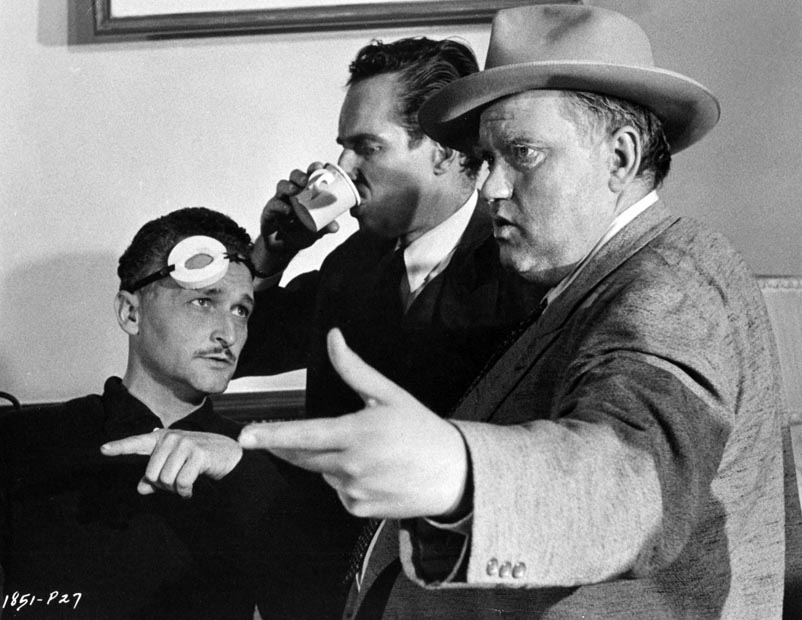
Orson Welles and Touch of Evil


How Orson Welles shattered the Hollywood image
Big, grizzled, with spit and stubble, Orson Welles dismantled the notion of what a movie star should look like. As it returns to cinemas, Michael Newton celebrates his Touch of Evil, the last great film noir of Hollywood’s golden age

Michael Newton
Thursday 2 July 2015

In Jonathan Swift’s Gulliver’s Travels, Gulliver finds himself in the kingdom of Brobdingnag, where the people are 60ft tall. Scale is everything; blown up to gigantic proportions the human face becomes rough, pitted, the seemingly immaculate skin unmasked as imperfect. In the 20th century, Brobdingnag transformed into the picture house, a place for the pygmy public to stare up at the great stars. However, far from seeming less perfect, the enlarged human face seemed more wonderful, smoothed-out by celluloid, unattainable. Yet still strangeness clung to these super-sized persons, those colossal faces.

Welles understood this, and so returned us to the Swiftian vision. In his movies, the human face that cinema loves and dwells on shows its potential for ugliness; blown up to the size of the cinema screen it looks not enchanted and godlike, but all too human and flawed. Time and again, the alienated gaze of his films confronts us with the astonishment of the human face, there in his use of closeups that come in too close. Somehow the angle of vision is off-kilter, and we see only the spit and stubble, the pockmarks and pores. This disabused image of people extends into Welles’s understanding of character. Unlike some Hollywood directors, he never lost sight of the blemishes in the human face and soul. He is one of the few film-makers of the American 1940s and 50s who is never kitsch. His films resist the Lilliputian proportions of a TV or a computer: they belong to the big screen.

Welles’s genius, too, was larger than life, a man with a talent always threatening to burst the bounds of the studio system it was supposed to flourish in. He was not only one of the most striking and inventive film-makers who have ever lived, he was also a curious example of the movie star, operating within mainstream cinema while simultaneously dismantling his audience’s conceptions of what a movie star might be. Just as Welles’s films began with words, with the things that his people say, so his presence rests in large part on the growling, rumbling cello tones of his voice. It is a curiously physical sound, one that summons up the body behind it. That feels apt, for in watching Welles’s work across more than 40 years, from Citizen Kane (1941) to F for Fake (1973), the metamorphosis of that body turns out to be where the attention lingers. On screen Welles embraced the collapse of his own handsomeness – the face’s wrinkles and carved-out lines, the grizzled hair, the ever-expanding waist. In Touch of Evil (1958), Marlene Dietrich fails to recognise Welles in the police detective, Hank Quinlan. Puzzled by the amazing degradation of that body, she lets him know, “You’re a mess, honey”, merely voicing what the audience was likely already thinking. Already in Citizen Kane, Welles had pictured his own ageing; he began his screen-acting career as an old young man, and he reached the summit of it, in Chimes at Midnight (1965), as a young old man, playing Falstaff, that corrupter of youth.

Following the abortive release of Kane and the mutilation by the studio of his next movie, The Magnificent Ambersons (1942), Welles’s career as a director was forever hampered in the US, while his life as an actor – and voice-over narrator - more or less flourished. For a while, he was both a studio problem and an authentic movie star; it delighted the gossip columnists that he was married to another star, the forces’ sweetheart, Rita Hayworth. Soon he fell away from being a leading man and launched into a lifetime of cameos and special appearances, the kind of actor who could salvage a film with a few good scenes. Yet in a clutch of movies – The Lady from Shanghai (1947), The Third Man (1949), Touch of Eviland his Shakespeare films, especially Chimes at Midnight, he is much more than that, being there what he had once been in Citizen Kane, an exemplary version of the compromised person, the perfect embodiment of our imperfection.

Directed by Welles as well as starring him, The Lady from Shanghai is a film noir composed of sweat and sleaze; it begins with a threatened gang-rape, takes us to a man who wants to be murdered and leaves us in a crazy, shattered realm where killing is just an expression of desire. The very inventiveness of the camera here makes the film seem sordid, trapping us inside a place of moral and visual distortion. Only a couple of years after Hiroshima and Nagasaki, the Bomb haunts this movie, lending an everyday story of marriage and murder an apocalyptic darkness. Watching the film, it becomes hard to shrug off the knowledge that people are incomprehensible, their motives obscure, their meaning occluded. At the end, it bewilderingly slips into using Mandarin, while Welles’s character, drugged, watches a Chinese opera, an art form naturally understood by the locals in the audience, but to him that is a baffling confusion. Everyone is ugly in this film, except the leads of course, and especially the sublime Hayworth, though her beauty (at Welles’s insistence – he made her cut off her long red hair) appears a concoction, a made-up peroxide blonde with sculpted eyebrows. As she moves among the drooling, ogling men, her skin looks smooth and clean – as though it has been carved from sugar icing. In this realm of confusion, Welles plays Michael O’Hara, a Hemingwayesque, independent man, a romantic dupe in a world where to be alive is to be in pain. Welles’s Irish accent is (to my British ears) an embarrassment of Dick van Dyke proportions, yet he here conveys as he could so well an injured sensibility, the pudgy naivety of a boy half-grown up into the life of the corrupt.

Though his movies tender a darkened sense of others, in this fabricated world Welles was himself both ringmaster and victim. As an actor, he was at his best playing saloon-bar Candides. Though he often played “villains”, he always brought to such roles a boyish joie de vivre that grants even the blackest characters a youthful unworldliness. He could find innocence in evil, and there is no better example of this than in his wonderful performance as Harry Lime in Carol Reed’s The Third Man (1949).

Lost inside that film, I can still imagine myself, just as I used to as an adolescent, as Holly Martins (played by Joseph Cotten), the feckless, foolish, well-meaning idiot that he is. And perhaps my entire romantic life has been coloured by my teenage admiration for Alida Valli as the elusive Anna. Yet I never dreamed for a moment that I could be Harry Lime, for between him and this viewer lay the unleapable chasm of charm. By some ineffable magic, Lime, like Welles, just makes everything seem such fun. Welles denied that cinema acting should be in essence understated, and indeed the keynote of all his performances is gusto. He was a man who couldn’t turn himself down. Though he never looks stagey and has none of that hitting-the-back-of-the-theatre impact that can make Laurence Olivier look overblown on film, he nonetheless fills the screen, simply by letting us share something of the energy and power that was part of who he was and part of how he performed himself to others.

After years away from Hollywood, Touch of Evil was Welles’s comeback film; in commercial terms, it didn’t work out, but as a movie it’s an amazing piece of work. While The Lady from Shanghai ushers us into strangeness, Touch of Evil places us inside a world of oppression, where bullies thrive and intimidation is the rule. It’s a noir that is genuinely black-hearted, the romantic colours of the genre blooming over only its two fading film stars, the worldly-wise Marlene Dietrich and Welles himself, playing the good bad cop, Hank Quinlan, a man who puts convictions and his hunches over the inconveniences of the law. It’s arguably Welles’s finest performance. He works wonders here; to take only one example, whenever anyone offers him some booze, as a reformed alcoholic he replies brusquely “I don’t drink”, until one time, when all is collapsing, he says it and then catches sight of the whisky glass he has just drained. Then comes the miracle of his performance: somehow Welles registers the jolt of the fact with an entirely blank face, signalling his own fall by apparently making no sign at all.

All Welles’s films feel delirious, replete with a weirdness that breaks up the standard Hollywood fare and shatters it into fragments, into a pattern of visionary shocks. In Touch of Evil, this hallucinatory intensity is especially strong; its beatnik thugs are out of a David Lynch nightmare, and the screen seems as drugged as its victimised heroine, played by Janet Leigh, who, as in Psycho, displays bad luck in choosing motels. Yet the drugs turn out to be not hallucinogens or narcotics, but sodium pentathol, the “truth drug” – much as Welles’s dark imaginings perhaps offer the unvarnished truth about things.

There is a touch of lament, an end-of-season feel about Touch of Evil, the last great film noir of Hollywood’s golden age. The movie contrasts the pianola (“it’s so old, it’s new”) with rock‘n’roll, and the faded glamour of the old stars, Dietrich and Welles, with the virile emptiness of the new guys, such as Charlton Heston. Old Hollywood was busy beginning to die, though maybe only Welles knew it then. From now on, his career lay back in Europe, and, in the 1960s and 70s, he became a great European art-house film director, still creating masterpieces.

Chief among them is his version of Shakespeare’s Henry IV plays, Falstaff: Chimes at Midnight. The film has so much that’s good – John Gielgud as Bolingbroke; one of the greatest, most brutal battle scenes of cinema – but in one respect it seems seriously deficient: it lacks laughter, and laughter is Falstaff’s essence. I believe that despite his humour and his humanity, Welles’s view of the world was too dark to bring out this element in the old fat knight. Yet he truly embodies other equally vital aspects of the character. In conversation with Peter Bogdanovich, Welles declared that everyone acts all the time, and that in each and every conversation we’re busy performing ourselves. Though this has its general application, and its Shakespearean resonances, it nonetheless feels less of a universal statement, more of a self-diagnosis. For Welles and Falstaff have much in common: both of them live as actors on the stage of everyday life, as self-dramatisers, as players.

Watching the entertaining TV programme he made, Around the World With Orson Welles, you see just what a glorious flirt he was, how much he enjoyed acting the role of raconteur. Yet when he talks to a group of Chelsea Pensioners, he looks out of place, where the quiet dignity of the old men, the settled proprieties of their beliefs exposes their interviewer as a man betrayed by his own eloquence. Yet what eloquence it was! Welles is one of the few civilised voices in cinema, a Europeanised American, a preserver of urbane values. There’s a touch of Henry James about him, and of those wide-eyed cynics and sophisticated dreamers Hemingway and Fitzgerald. Talking to the Chelsea Pensioners, one mentions that they are officially “living in independent retirement”. “Great word, ‘independent’,” says one of the old soldiers. “Yes, it is,” says Welles. Everything about the worlds he summoned up in film and in his acting, the uniqueness and humanity of that sustained vision, shows that he meant it.

http://www.theguardian.com/film/2015/jul/02/orson-welles-a-touch-of-class

Saturday, 4 July 2015

Jimmy Webb on Glen Campbell


An update on Glen Campbell
In 2011, Glen Campbell was diagnosed with Alzheimer’s disease and is now being cared for in a home. On his Facebook page, friend and fellow musician Jimmy Webb says that Campbell is loved, cared for and respected at the memory support community.

Jimmy Webb
1 July 2015

I visited my friend Glen Campbell Wednesday in Nashville. Laura (daughter) and (wife) Kim Campbell were there as well. You may be aware that Glen has bravely been living with Alzheimer’s Disease. Along with his strong and courageous wife, they have changed the face of Alzheimer’s forever.

The world watched as Glen traveled from city to city, to continue doing what he loves to do: perform and share his music. Doctors were amazed at how the music and activity appeared to slow the pace of the disease for awhile. With his family, they showed the world that you don’t have to hide when you become ill. They raised awareness and, in turn, funds for Alzheimer’s research.

Glen is currently residing in a memory support community - it reminded me of one of the nice hotels he would stay at while on tour. Kim has found this place for Glen that is safe, where he is cared for 24 hours a day. The ratio of caregivers to residents astounded me - he is never alone. And there are only 17 other residents; his neighbors are former lawyers, doctors, teachers and others who are living with the same challenges that dementia brings. Glen has been my friend for a long time and I love him like a brother. I am sure that Kim has made the right choices for and with my friend of 50 years.

Glen has his private room and bathroom, all decorated by Kim with custom paint, lots of photos, murals and framed memorabilia. The place is bright and clean. He loves color and still wears his blue suede shoes from time to time! The memory center has elaborate arrangements for activities. There are many different rooms and spaces for him to experience each day, each furnished tastefully and safely.

There is an airy screened-in porch where Glen likes to sit and where we visited with him. He has a full time care-er, Brody. Brody is in his early 20s with long blond hair - he looks like a surfer! Brody is patient and kind. He plays the guitar with and for Glen. They sing, they walk around the grounds and converse almost constantly. We instantly fell for Brody and thanked him for the care he gives to Glen and the important breaks he gives Kim so she can rest and work.

Glen has always been a happy guy and a jokester. He still is. For longer than I’d like to remember, he has imitated Donald Duck and during the visit, he did his Donald voice for us. He sings in a low register all the way to high clear notes that are reminiscent of the performances we are all familiar with. He seems almost to go from song to song, under his breath at times. He looked at me after singing one song and said, “that was a good song wasn’t it?” Music is still at the very center of who he is. It is almost as though he is giving a never-ending performance.

The last thing he said to me when it was time for us to go was, “Was it a good one?” like he used to say to me at the end of a concert. That phrase made me think that he recognized me, that and the fact that he said my name to Kim and Laura when I left the room briefly.

He sees his family all of the time; Kim and two of his younger children live just a few minutes away. And his oldest daughter Debby was visiting just the day before.

He is loved. He is cared for. He is respected. And most of all, he has his dignity. We can all be comforted by that.

Yours very truly,

Jimmy L Webb

http://bigozine2.com/feature/?p=1222
glencampbellmusic.com.


Friday, 3 July 2015

Val Doonican RIP

Val Doonican obituary
Singer who entertained viewers for many years as the easygoing host of his own TV show

Dennis Barker
Thursday 2 July 2015

The entertainer Val Doonican, who has died aged 88, had a string of middle-of-the-road hits and was at the heart of family weekend television viewing in the 1960s and 70s. With an easygoing, homely charm that enchanted middle England, he sang and played through two decades of his own TV show and more than 60 years in show business.

Behind the scenes a perfectionist who knew his limitations but always aimed to be “the best Val Doonican possible”, he radiated ease and relaxation. His most famous prop, the rocking chair in which he swayed almost sleepily as he accompanied himself on the guitar, was not a calculated gimmick, but came about by accident. On a show in which he was due to sing early in his career was a young singing/guitar-playing nun. The producer suggested that she use the chair from the studio props department, but the experiment failed, and so Doonican tried it instead.

Born Michael Valentine Doonican, but known as Val, to distinguish him from the many other Michaels in his childhood, he was brought up by poor parents, Agnes and John, in Waterford, Ireland. Val was the youngest of eight children, who slept in one partitioned room. His father was a man with a drink problem but also a great deal of wisdom who, on his deathbed, told the 14-year-old Val that he was not the hero his son thought him to be, and that he would prefer to tell the boy so himself.

At six, Val played in the school band, and later his brother John taught him to play the mandolin. Although his education at De La Salle college, Waterford, ended when his father died, and Val had to go to work in an orange box factory, he was sustained by his musical interests, by the determination of his older siblings and by a belief that life would hold more for him.

He started entertaining at fetes with a friend, Bruce Clarke, who played the piano and guitar. In 1947, the two had their first professional engagement, playing in a seaside hotel. The son of a well-off foundry manager, Clarke was to have a significant influence on Doonican’s rise. He put up the money for both of them to make a promotional record and wrote in to Radio Éireann asking for an audition, which led to their first broadcasts and appearances on a Dublin radio show. Clarke also lent Doonican £20 to buy a Gibson guitar.

The pair became regulars on radio, in the theatre and in dance halls, sometimes as a duo, sometimes as solo artists. But by 1951 the apparently laid-back Doonican was tiring of Dublin and Ireland. He became a member of the Four Ramblers, which took him to England for a regular slot on the BBC radio series Riders of the Range. He wrote the music for their first shows and stayed with them for 10 years.

A frequent performer at US air force bases, on one visit he found his appearance was advertised as the Val Doonican Show. Initially alarmed, he grew to enjoy this star billing. At the end of the 1950s, he wanted another change and joined a concert tour with Anthony Newley, opening in Manchester, where he met his future wife, the cabaret artist Lynnette Rae. They married in 1962 and had two daughters. It was on the Newley tour that his solo act emerged. At one cast party, everyone had to do a turn, and Doonican borrowed a Spanish guitar, perched on a stool and sang an Irish song. Newley asked him if he had ever considered something of the sort on radio or TV.

The influential producer Richard Afton auditioned the singing guitarist and presented him as one of the musical interludes in the radio comedy show Variety Bandbox. When Doonican was given a 15-minute spot for anecdotes and songs, he approached the BBC’s head of light music and explained that he needed a regular engagement to make going solo financially secure. He was rewarded with 13 half-hours.

Radio listeners tended to assume he was an older man; surely no young person would sing numbers such as Paddy McGinty’s Goat or Delaney’s Donkey? On television, too, at a time when pop groups were sporting more outlandish outfits, he would favour old-fashioned patterned sweaters and cardigans, and was known for this knitwear even after he switched to tailored jackets.

In 1963 the impresario Val Parnell saw him at the Jack of Clubs in Soho and gave him a spot on the ITV variety show Sunday Night at the London Palladium. Doonican said that initial eight-minute slot changed his life and later observed: “It took me 17 years to be an overnight success.”

He was often invited back on the show, and also offered a choice of recording contracts. During the boom years of the mid-60s, he had five top 10 hits: Walk Tall (1964), The Special Years (1965), Elusive Butterfly (1966), What Would I Be (1966) and If the Whole World Stopped Loving (1967). His TV show, The Val Doonican Show, which began in 1965, was the launchpad for other rising stars, including the comedian Dave Allen.

Doonican made an unsuccessful foray across the Atlantic in the early 70s and complained that US television had tried to “slick him up”. After The Val Doonican Music Show ended in 1986, he would find much British TV too brash. He took to doing afternoon live shows which, he said, “suit me and my ageing fans ... we can all be home well before bedtime”.

He always insisted that he was not a show-biz person and had gone into the profession because of his love of music. “We are not as important to the outside world as we are sometimes led to believe,” he told the Stage in 2010. “It’s best never to assume that the next engagement will be easy, or that at last you’ve arrived. We are simply a little light relief.”

His records sold in the millions – he recorded more than 50 albums, including Val Doonican Rocks, But Gently (1967), with which he was the first Irish artist to enter the UK albums charts – and he released a video, Songs From My Sketch Book (1990).

He made three Royal Variety Show appearances, won awards including BBC television personality of the year in 1966, and wrote two volumes of autobiography, The Special Years (1980) and Walking Tall (1985). In later years he concentrated more on golf, sketching and painting watercolours, although he continued touring until retirement in 2009.

He is survived by Lynn, their daughters, Sarah and Fiona, and two grandchildren.

• Michael Valentine (Val) Doonican, singer and instrumentalist, born 3 February 1927; died 1 July 2015

http://www.theguardian.com/tv-and-radio/2015/jul/02/val-doonican

Thursday, 2 July 2015

Last night's set lists

At The Habit, York: -

Ron Elderly: -
Can't Help Falling In Love
No Expectations
I'll See You In My Dreams
Sweet Virginia

Da Elderly: -
If I Were A Carpenter
Runaway Train
Love Song
Only Love Can Break Your Heart

The Elderly Brothers: -
The Price Of Love
I Saw Her Standing There
Love Hurts
The Boxer
Then I Kissed Her
Bye Bye Love

On a steamy night in York there were rather less punters out and about than previous weeks but given the humidity it seems the bar takings were not overly affected! So everyone had an enjoyable if alcohol-fuelled evening. Two 'new' songs debuted by yours truly: a Tim Hardin classic and Soul Asylum's minor hit from 1992 (not "the runaway train came down the track and she blew....." if that's what you were thinking)!

The Elderly Brothers will be performing at the Fossgate Festival (York) on Sunday afternoon if you are in town.

Wednesday, 1 July 2015

J. D. Salinger's lawyers in copyright battle...

The party of the first part...

J.D. Salinger Lawyers Fire Back in Copyright Battle
By Andrew Albanese
04 June 2015

In a motion filed in late May, lawyers for the J.D. Salinger Literary Trust said a copyright suit filed against them by Memphis-based indie publisher the Devault-Graves Agency is without merit, and should be dismissed.

The March, 2015 lawsuit accuses the Salinger Literary Trust of “tortiously interfering” with the Devault-Graves Agency's attempts to license foreign editions of its book, J.D. Salinger: Three Early Stories, a collection of three Salinger works that had each lapsed into the U.S. public domain decades ago. The Devault-Graves Agency is seeking damages, and a declaration from the court that the Salinger Literary Trust has no rights to the works in question, and an affirmation that the publisher can sell its collection globally.

The Salinger Literary Trust does not dispute that the stories in question are in the U.S. public domain, having lost protection after their initial 28-year copyrights were not renewed (Congress has since eliminated the requirement to register and renew works). But in their filings, attorneys for the Salinger Literary Trust say that the works are not necessarily in the public domain overseas, and claim that the Devault-Graves Agency's understanding of international copyright is “critically flawed.”

Specifically, Salinger attorneys assail the Devault-Graves Agency's broad reliance on Article 7 of the Berne Convention, known as the “Rule of the Shorter Term.” Article 7 generally mandates that copyright protection abroad cannot exceed the term mandated in a work's country of origin. But Salinger attorneys caution that the terms of the Berne Convention are subject to a number of caveats, including terms of other existing treaties, the specific copyright laws of each member country, as well as each country's unique interpretation of the Berne Convention, which makes the “sweeping, one-size-fits-all declaration” the Devault-Graves Agency seeks if not impossible, then at least infeasible.

“To properly determine the parties’ rights in each potentially relevant country would be extraordinarily complex,” Salinger attorneys argue. "168 countries have signed on to Berne, and an individualized inquiry into the laws of each of those countries would be needed to answer the question that Plaintiff asks this Court to determine in one fell swoop, for the entire world." Accordingly, Salinger attorneys conclude, “these issues are best left to foreign courts.”

Bolstering their argument, Salinger attorneys also filed with the court a copy of a March 31, 2015 order from the Regional Court in Berlin barring publisher Piper Verlag from selling J.D. Salinger: Three Early Stories in Germany—a decision that could stand as a serious blow to the Devault-Graves Agency's chances of success.

In their complaint, Devault-Graves attorneys claim the Salinger Literary Trust "does not own, and has never owned the copyrights" to the stories in question, and notes that a blanket copyright assignment by Salinger to the Salinger Literary Trust shortly before the author's death in 2010 does not include the works, which had already entered the U.S. public domain. But the German court held that since Salinger had clearly intended "an encompassing assignment of rights" to the Trust, that was sufficient under German copyright law for the Trust to subsequently claim rights which Salinger may have been "unaware of," including foreign rights.

"Copyright protection [for the] works in foreign countries was still possible," the German court concluded, rebuking Piper Verlag for "acting negligently," by relying too heavily on the assurances of the Devault-Graves Agency when "the responsibility rested on [Piper Verlag] to exhaustively assure itself" of its rights before publication.

Salinger attorneys argue that at a minimum the German court decision "belies" the contention that the Trust is interfering in Devault-Graves' foreign deals "without any legal basis."

Lawyers for the Salinger Literary Trust also offered a number of other legal arguments to have the case tossed, including a challenge to hearing the case in Tennessee, and requested a hearing. A briefing schedule was not available at press time.

http://www.publishersweekly.com/pw/by-topic/digital/copyright/article/66995-j-d-salinger-literary-trust-fires-back-in-copyright-battle.html