Friday, 20 November 2015

David Bowie at the Neon Social Club, Jarrow

A Jarrow working men's club has launched a recruitment drive - backed by a VIP member.

The Neon Social Club on the Scotch Estate wants fewer cloth caps and more bright circus clothes in the lounge and bar.

Rock icon David Bowie, a committee member, agreed to take part in a promotional video.

He said: "I love to fly in from LA for the meat draw and the bingo of a Sunday.

"But the numbers have been dropping off, so I thought I'd get me best claes on and give the lads a boost."

Catch the Neon promo below

Thursday, 19 November 2015

Last night's set lists

At The Habit, York: -

Ron Elderly: -
Autumn Leaves
The Way You Look Tonight
Can't Help Falling In Love

Da Elderly: -
In The Morning Light
I'm Just A Loser
Into The Light (new song)

The Elderly Brothers: -
You Really Got A Hold On Me
Breaking Up Is Hard To Do
When Will I Be Loved
Love Hurts
Bye Bye Love

Another busy night at The Habit open mic, players outnumbering punters at one point. There was the usual eclectic mix on offer including a young lass debuting on uke and a chap with a loop machine who started off on guitar and changed (mid loop) to mandolin! Yours truly played 3 originals including a debut for Into The Light, written last Sunday and favourably received. 

Wednesday, 18 November 2015

The Importance of Elsewhere: Philip Larkin's Photographs - review

 Philip Larkin
One of a series of self-portraits taken by Philip Larkin on the same day in 1957

The Importance of Elsewhere: Philip Larkin’s Photographs by Richard Bradford – review
Philip Larkin’s astute pictures make a tantalising companion to his verse

Sean O'Hagan
Sunday 15 November 2015

In October 1947, Philip Larkin wrote to his friend Jim Sutton about a recent “act of madness” – he had spent £7 on a camera. The British-made Purma Special had cost him more than a week’s wages, but it was state of the art compared with his previous model, a box camera that had been given to him by his father in 1937, when Larkin was 15.
Philip Larkin
“I am so far awaiting my first roll of results,” Larkin told Sutton in the same letter. “If they are bad, I shall feel I have been rather a fool.”

The results were in fact good, despite the fact that the Purma was, as Larkin put it, “a ‘fast’ camera, that is, best suited to swift scenes in bright sun” and: “I like poor light the best and I don’t think it will do any good in that line.” It seems somehow apt that Larkin, who once said “deprivation is for me what daffodils were for Wordsworth”, should be drawn aesthetically to “poor light” – all the better to see some essence of England by, perhaps? Larkin later graduated to the altogether more classic Rolleiflex, on which he made many of his pensive self-portraits. Throughout, his visual style, like his poetic one, tended towards what the literary critic John Bayley called “a glum accuracy about places and emotions”… and people.
Philip Larkin
The photographs collected chronologically in The Importance of Elsewhere are culled from some 5,000 prints and negatives in the archives of the Hull History Centre. They are not, in the main, groundbreaking. They do, though, trace Larkin’s progress from an amateur enthusiast to a formally astute photographer with a keen eye for composition, whether making portraits of his friends, family, lovers and coterie of literary friends or casting his cold eye over the English countryside. There are moments of peculiar beauty here, mostly to do with his cool observation of English vernacular architecture: an austere Wesleyan chapel in East Yorkshire caught in stark monochrome; tall obelisks casting long shadows in a country graveyard in Oban.

The most Larkinesque series, apart from the many studied self-portraits, centres on the names of Yorkshire villages – Laxton, Faxfleet, Kiplin, Yokefleet. The poetry of place names, familiar from his verse, is here rendered in stark black and white, the silhouettes of buildings looming in the background behind these functional, yet lyrical, signs that nestle on well-tended grassy verges.
Philip Larkin's photograph of Monica Jones
Of Larkin’s lovers, Ruth Bowman, Monica Jones, Patsy Strang and Maeve Brennan are each given a chapter, but it is Monica who emerges most strongly as a forceful presence in his portraits. Whether staring down the lens while curled up on an armchair, wearing horn-rims, jumper and vertically striped tights, or gazing in profile out of the window of her flat in Leicester in the early 1960s, she seems utterly at ease before Larkin’s camera. In contrast, there is a striking portrait of Maeve Brennan, looking up from a book, melancholy and almost Victorian in a high-necked, long-sleeved dress. It was taken shortly after they had agreed to end their relationship and seems to carry all the weight of that decision in its sombreness.
A photograph belonging to Philip Larkin
Larkin also photographed the world around him wherever he went: his chum, Kingsley Amis, at Oxford and beyond, portraits of friends who had been conscripted during the second world war, Orange marches in Belfast in the early 50s, shipyard cranes and shopfronts in Hull a few years later. Here and there, the images and the poems seem to chime: a vibrant street scene in Dublin captures a crowd of children and adults watching a passing parade or funeral. Only one young girl stares suspiciously at Larkin’s camera and you can almost see him though her eyes, a nerdish outsider observing. One wonders if the image was echoed in his late poem, Dublinesque, in which he described how “Down stucco sidestreets,/ Where light is pewter/ And afternoon mist/ Brings lights on in shops/ Above race-guides and rosaries,/ A funeral passes”.
Hilly Amis
A fascinating and tantalising book, then, and one that sheds light on a great poet and tricky human being, who seems to have found, in photography, another altogether less fretful – and perhaps kinder – way of preserving what he experienced.

http://www.theguardian.com/books/2015/nov/15/importance-of-elsewhere-review-philip-larkin-photogaphs-richard-bradford

Sunday, 15 November 2015

Warren Mitchell RIP

Remembering Warren Mitchell: one of Arthur Miller's favourite actors
Martin Chilton pays tribute to the fine actor, who had mixed feelings about playing one of the most notorious bigots on TV

Martin Chilton,
14 Nov 2015

Actor Warren Mitchell, who has died aged 89, will forever be associated with Alf Garnett, the vile old bigot he portrayed on television, stage and film from 1965 to 1998.

Garnett, created by writer Johnny Speight for the television show Till Death Us Do Part, was one of the most influential TV characters of the 20th century and tended to overshadow Mitchell's other acting accomplishments. How many people will know, for example, that Mitchell was one of playwright Arthur Miller's favourite actors?

It's not surprising, however, that Mitchell will be remembered for his portrayal of Alf Garnett, because he was a remarkably splenetic character, perhaps TV's most memorably miserable old git.

Mitchell wasn't even first choice for the role – it had been turned down by Peter Sellers, Leo McKern and Lionel Jeffries – but he made it his own, bringing out the full warped power of a racist, sexist homophobe, whose only loyalties were to the Queen, the Conservative Party and West Ham United. Alf, an East End dock worker, was constantly at war with his "silly old moo" of a wife, his left-wing daughter and his layabout son-in-law, the "Scouse git". The actor won a BAFTA for his portrayal of Garnett.

Writer Speight had originally written the character for a Comedy Playhouse pilot and it was inspired by the racist and sexist characters that he had known around London's Canning Town as a child. Mitchell played the role so well that it was soon clear that part of the audience was actually laughing along to Alf's rants about blacks, immigration and the welfare state. Rather than being a figure of fun, he was increasingly being seen as a voice of reason (his catchphrase was "It stands to reason").

Mitchell knew he was just acting out a role (not least in that he was an ardent Spurs fan in real life) and even though he recognised the subversive intention of Speight's foul-mouthed creation – the fact that Mitchell was Jewish was part of the satire of his anti-Semitic character – not everyone got the joke. "There have been times when I've felt ashamed. When I've been doing Alf to a live audience and he says something like 'Enoch Powell had the right idea' or 'Adolf Hitler had his moments,' and somebody in the audience cheers," Mitchell once lamented.

There's no way a programme with such offensive dialogue would be made today but Mitchell remained convinced that Speight was a writer of the highest order. "I've been lucky, I've worked with all the greatest writers: Shakespeare, Pinter, Speight. Johnny deserves his place with them," Mitchell said.

Mitchell was born Warren Misell on 14 January 1926 and changed his name when he went into acting because nobody could ever pronounce his name correctly. He was partly inspired to become an actor by meeting Richard Burton when they were both RAF cadets at Oxford in the war. He even did a Welsh character for his Royal Academy of Dramatic Art (RADA) audition. "I always thought if you could be Welsh and Jewish you really couldn't miss," Mitchell joked. Until his forties, when Alf came along, Mitchell was a jobbing actor appearing in minor TV roles and on radio in shows such as Hancock's Half Hour.

Although Mitchell is identified almost exclusively with Garnett, he was a very fine theatrical actor. On stage he received extensive critical acclaim for his performances in Harold Pinter's The Caretaker and The Homecoming.

In his theatrical work, Mitchell is most closely associated with Arthur Miller's Death Of A Salesman. Mitchell played Willy Loman four times, including a stage version in Australia where he acted with a young Mel Gibson. In 1979, he won an Olivier Award for Actor of the Year for playing Miller's complex character.

Mitchell once recalled the playwright coming to talk to the Salesman cast at the National. "Arthur Miller said to us, 'You know when we went on tour with the play, the management wanted to change the title. They said, it's death, it really is death to have the word death in the title. They came up with all sorts of other suggestions.' Then he asked us, 'What would you think would be an alternative title?' And somebody in the cast said, 'What about Till Death Us Do Part?' Miller didn't know why everyone was laughing."

Mitchell suffered a stroke in August 2004 but was back on stage a week later, performing in Miller's The Price. To the end, he was an indefatigable old trouper and remained sanguine about having made a success out of such an unpleasant character as Garnett. "I live in the house that Alf built and paid for – so I can't grumble," he said.

Asked recently to sign an autograph of a picture of him as Garnett, the actor obliged saying, "Oh, it's that old sod!"

Saturday, 14 November 2015

Friday, 13 November 2015

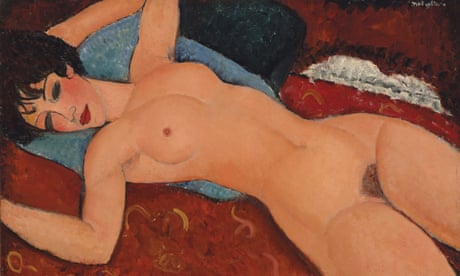
Reclining Nude by Modigliani: a snip at £113 million


Modigliani painting sells to Chinese billionaire for record breaking $170m
Sale to Liu Yiqian, former taxi driver who is one of China’s most ostentatious billionaires, makes painting the second most expensive ever sold at action

Hannah Ellis-Petersen
Tuesday 10 November 2015

A Chinese taxi driver turned billionaire art collector has paid a record-breaking $170m (£113m) for a painting of a nude woman by Amedeo Modigliani at an auction in New York.

Reclining Nude was sold at Christie’s on Monday after a protracted, nine-minute bidding battle, eventually going to Liu Yiqian, who has built a reputation as one of China’s most ostentatious billionaires.

The 1917-1918 painting is considered one of Modigliani’s best-known works and nearly created a scandal when it was first exhibited in Paris. Interest from five buyers pushed the price for Nu Couché far above the previous $71m record auction price for the Italian artist.

The sale also made the painting the second most expensive artwork ever sold at auction and is one of only 10 pieces of art to sell for a nine-figure sum. Nu Couché sold just short of the auction industry’s current overall titleholder, Pablo Picasso’s Women of Algiers (Version O), which sold at Christie’s in May for nearly $180m.

The Chinese collector told the New York Times he planned to exhibit the work in one of the two private museums he owns in Shanghai.

“We are planning to exhibit it for the museum’s fifth anniversary,” Liu said. “It will be an opportunity for Chinese art lovers to see good artworks without having to leave the country, which is one of the main reasons why we founded the museums.”

Liu, 52, may be one of China’s most profligate art collectors but he boasts a classic rags-to-riches story. Having dropped out of school, he started his professional life selling handbags on the street and then drove a taxi. He later went on to make billions on the Chinese stock market in the 1980s and 90s, trading in real estate and pharmaceuticals.

According to the 2015 Bloomberg Billionaires Index, Liu is worth at least $1.5bn.

It is estimated the collector has spent more than $100m on his collection just in the past year. His taste in art ranges from ancient Chinese scrolls and imperial ceramics to contemporary western artists such as Jeff Koons and has so far filled his two museums with more than 2,300 pieces of art. At an auction at Christie’s in Hong Kong in 2014, he bought a 15th-century silk hanging for $45m, setting a new international record for the auction house.

Liu and his wife Wang Wei have raised eyebrows in China for their extravagant spending, particularly in light of President Xi Jinping’s crackdown on corruption in recent years. He was the subject of a recent online scandal after a photograph of him drinking tea out of an antique bowl he had recently purchased for $36m went viral on the internet.

Liu has openly spoken of his ambitions to create a Chinese museum that could rival the Guggenheim or MoMA in New York but has admitted that he has no idea how much his 2,300-strong collection is worth.

In an interview with Bloomberg earlier this year, he said: “It must be a very, very huge figure, but I don’t give it much thought, because I won’t be selling the collection.

“I don’t care about the value, nor do I care about the money I spent buying it in the first place.”

Reclining Nude will be the most expensive piece in Liu’s collection. It had formerly belonged to art historian Laura Mattioli Rossi, daughter of acclaimed Italian collector Gianni Mattioli, and had belonged to the Mattioli family for six decades.

The nine-figure sum is also a far cry from the price paid for Modigliani’s paintings in the Italian artist’s short lifetime. In 1918, the struggling painter tried to sell the whole contents of his studio for just £100 ($150) but apparently could never find a buyer.

http://www.theguardian.com/artanddesign/2015/nov/10/modigliani-painting-reclining-nude-chinese-billionaire

Wednesday, 11 November 2015

Allen Toussaint RIP

How will we remember Allen Toussaint? 'Irreplaceable treasure,' 'consummate pro,' 'massive songwriting talent'

By Keith Spera
Advocate staff writer
10 November 2015

Allen Toussaint, the gentlemanly Rock and Roll Hall of Fame songwriter, producer, pianist and singer whose prolific, multiple-decades career cast him as the Renaissance man of New Orleans music, died of an apparent heart attack following a concert Monday night in Madrid. He was 77.

As a young man, Toussaint was the golden boy of the golden age of New Orleans rhythm and blues, writing and producing signature songs for multiple artists. His hundreds of credits include Ernie K-Doe’s “Mother-in-Law” and “A Certain Girl,” Irma Thomas’ “It’s Raining”and “Ruler of My Heart,” Benny Spellman’s “Lipstick Traces” and “Fortune Teller,” Art Neville’s “All These Things,” Lee Dorsey’s “Ride Your Pony” and Chris Kenner’s “I Like It Like That,” as well as seminal recordings by Aaron Neville, the Meters and Dr. John.

Performers who covered his compositions include the Rolling Stones, The Who, Bonnie Raitt, Boz Scaggs and Phish, among many others. In the years since his acclaimed post-Hurricane Katrina collaboration with fellow songwriter Elvis Costello, Toussaint enjoyed a late-career resurgence as a touring artist.

“He was an irreplaceable treasure of New Orleans, in the ‘immortal’ category with Jelly Roll Morton, Mahalia Jackson, Louis Armstrong, Fats Domino and Professor Longhair,” said Quint Davis, the producer/director of the New Orleans Jazz & Heritage Festival. “He was a one-man Motown. He created an entire era of New Orleans rhythm and blues.”

In his songwriting and conversations, Toussaint could craft a turn of phrase with an elegance and economy that rendered it indelible.

He once said that he tries “to remain as open as I can for inspiration all the time,” but he preferred late-night composing. “I especially like the wee hours of the morning, like 3. It’s quiet. The air is different. I like that time of night for anything.”

A consummate professional, he conducted himself with a gracious ease that embodied the evocative imagery of his original, wistful version of “Southern Nights,” which Glen Campbell later turned into a pop-country smash.

Soft-spoken and mild-mannered, Toussaint cut a stylish figure as he navigated New Orleans in either a two-toned 1974 Rolls-Royce bearing the vanity plate “Piano” or a more contemporary Mercedes-Benz with the license plate “Songs.”

He was a familiar sight at functions and benefits around town. He had been slated to join Paul Simon in New Orleans for a Dec. 8 benefit concert for Le Petit Theatre du Vieux Carre.
“Allen was never not at the height of something,” Davis said. “Everything he did was at such a high level his whole career.”

Taught himself to play

Toussaint was born in 1938. He grew up in the Gert Town neighborhood as the youngest of three children. He taught himself to play the family’s upright piano, influenced heavily by the syncopated style of New Orleans legend Professor Longhair and Ray Charles, whom he heard on the radio. Barely 13, he joined an R&B band called the Flamingos, which featured Snooks Eaglin on guitar.

He dropped out of high school to pursue a career in music. He became a fixture around local recording studios, where he was sometimes asked to mimic the style of Fats Domino and other pianists. He learned much about the art of crafting a song from Dave Bartholomew, Domino’s producer and co-writer.

Toussaint’s first recording under his own name was an instrumental album called “The Wild Sound of New Orleans,” released in 1958 by RCA. He was billed as “Tousan,” reportedly because the record label didn’t think consumers outside New Orleans could pronounce “Toussaint.”

Under the auspices of the Minit and Instant record labels, he soon discovered his true calling: as a songwriter, arranger, producer and accompanist for other artists. At the home he shared with his parents, Naomi and Clarence, and siblings Vincent and Joyce, he often hosted rehearsal and writing sessions that resulted in a remarkable run of regional and national hits. Irma Thomas once recalled that “It’s Raining” was “written in Allen Toussaint’s bathroom.”

Not even a two-year hitch in the Army beginning in 1963 could stem his creativity. Backed by an Army band, he wrote and recorded a breezy instrumental called “Whipped Cream.” Trumpeter Herb Alpert & the Tijuana Brass turned “Whipped Cream” into a massive hit; their recording also served as the theme music for TV’s “The Dating Game.”

Toussaint was well-versed in the business of music. He and business partner Marshall Sehorn formed a production company, Sansu, then built a recording studio, Sea-Saint, in the Gentilly neighborhood that served as Toussaint’s private musical “sandbox.”

He recruited members of the Meters, a pioneering funk band that was working at the Bourbon Street club the Ivanhoe, to serve as Sansu’s and Sea-Saint’s house band. The Meters released a string of classic singles and albums under their own name, even as they backed Dr. John, Lee Dorsey and other acts that Toussaint produced.

His reputation earned him a client roster that reached well beyond New Orleans. He produced the 1974 smash “Lady Marmalade” for the female group LaBelle. Paul McCartney and his band Wings recorded much of their 1975 album ‘’Venus and Mars” album at Sea-Saint. Robert Palmer cut much of his 1974 debut “Sneakin’ Sally Through the Alley” there.

Songs with many lives

Over the decades, many of his songs have lived multiple lives as succeeding generations of artists rediscovered and re-recorded them. His “Fortune Teller” was first recorded by Benny Spellman in 1962. But it would later be covered by the Rolling Stones, The Who, the local band the Iguanas, and Robert Plant and Alison Krauss, who included it on the million-selling, Grammy-winning 2007 album “Raising Sand.”

“Working in the Coal Mine,” originally recorded by Lee Dorsey, would be covered by both the quirky New Wave band Devo and the mother-daughter country duo, the Judds.

Toussaint never publicly criticized the liberties that other artists took with his songs, which generated a steady steam of royalties for him. He once described his original “Southern Nights” as a “message in the trees, along with the breeze, and that whole Southern night feeling, just a nice, soft message. Glen (Campbell) and that bunch stomped it off, ‘one, two, one, two, three.’ I thought that was really fine, that they were innovative enough to do that to it. They heard another drummer.”

By the 1980s, Toussaint’s own recording career had tapered off, though he continued to produce and promote other artists via his NYNO Records label. More recently, he explored instrumental, piano-based jazz, as on his Grammy-nominated 2009 album “The Bright Mississippi.”

His many accolades included the National Medal of Arts, which he received from President Barack Obama during a 2013 awards ceremony at the White House. That same year, he was named an honorary doctor of fine arts by Tulane University, alongside fellow honorees Dr. John and the Dalai Lama.

For most of his career, Toussaint was a reluctant performer, content in his lucrative role as the man behind the curtain. For years, he rarely performed other than at an annual evening concert aboard the riverboat President during Jazz Fest.

That changed following Hurricane Katrina, which he rode out in a downtown hotel as his longtime home in the Gentilly neighborhood was inundated. With his hometown in ruins, he retreated to New York City, where he performed at several benefits for the Katrina relief effort. After sharing stages with him in New York, longtime fan Elvis Costello pitched Toussaint on the idea of a collaborative album.

A new late-life career

In late 2005, they finished what became “The River in Reverse” at Piety Street Studio in the Bywater neighborhood. Released in 2006, “The River in Reverse” kickstarted a new career for Toussaint as a touring artist. He and Costello performed around the world to promote the album, alternating songs from their respective catalogs and their joint album. Toussaint continued to be an enthusiastic performer for the rest of his life.

“He fell in love with performing, which hadn’t been his personality,” Davis said. “That’s what he was doing when his time was up.”

According to Davis, Toussaint was seemingly in good health recently. In late October, he joined Irma Thomas, Buddy Guy, Buckwheat Zydeco, Tab Benoit and dozens of other artists for the Legendary Rhythm & Blues Cruise, which departed from Fort Lauderdale, Florida, for a week’s worth of shipboard performances across the Caribbean.

A week later, he traveled abroad for a brief European tour with his quartet. But while onstage Monday at Madrid’s Teatro Lara, he started feeling ill and began sweating profusely. Nevertheless, Davis said, he returned to the stage for an encore of “Play Something Sweet (Brickyard Blues).” Later that night, he was discovered unresponsive at a hotel. Paramedics reportedly arrived quickly, but Toussaint was pronounced dead en route to a hospital.

Indicative of Toussaint’s status in the broader world of popular music, a litany of marquee acts, from the Rolling Stones to Harry Connick Jr., expressed their condolences on social media as the news of his unexpected passing spread.

In a statement released via Twitter, McCartney said, “Having worked with him in New Orleans, I know what a sweet and gentle guy he was, and a massive songwriting talent. ... His songs will be cherished by people like me who will have fond memories of Allen forever.”

Dr. John, according to his publicist, was “heartbroken” at the loss of his friend. Aaron Neville posted a statement on Facebook that read in part, “I want to first thank him for believing in me during my early days of singing. He produced my first recordings back in 1960 to 1964, on Minit Records. Later, in 1972, he recorded me again with songs like ‘The Greatest Love’ and ‘Hercules.’ He was an icon in the music business.”

Neville went on to call Toussaint, with whom he co-founded New Orleans Artists Against Hunger and Homelessness, “a great humanitarian. ... I know he is loved by a lot of people from New Orleans and around the world for helping them in their careers. He was a great person and a great songwriter and producer. But most of all he was a gentleman. He will be missed by the music world. My heart is sad. His family is in my prayers.”

Davis was in Memphis, Tennessee, the day that city’s most famous resident, Elvis Presley, died. “It was like everybody lost someone in their family.” With Toussaint’s passing, Davis said, “it’s a little like that for New Orleans. We all lost someone who we felt was family.”

Survivors include a son, Clarence “Reginald” Toussaint, who often performed as a percussionist in his father’s band; a daughter, Alison Toussaint LeBeaux, who helped manage her father’s career; and several grandchildren.

Funeral arrangements are pending.

http://www.theneworleansadvocate.com/news/13936351-128/new-orleans-music-icon-allen

Tuesday, 10 November 2015

Phil Woods RIP

Phil Woods, Saxophonist Revered in Jazz and Heard on Hits, Dies at 83

By Nate Chinen
29 September 2015

Phil Woods, an alto saxophonist revered in jazz circles for his bright, clean sound and his sterling technique — and widely heard on songs by Billy Joel, Paul Simon and others — died on Tuesday in East Stroudsburg, Pa. He was 83.

The cause was complications of emphysema, Joel Chriss, his longtime booking agent, said.

Mr. Woods was one of the leading alto saxophonists in the generation that followed Charlie Parker, who had set an imposing new bar for the instrument while defining the terms of bebop. Rigorous, complex and brisk, bebop’s stylistic language would be a constant for Mr. Woods throughout his prolific career, as both a leader and a sideman.

For much of that career, he was a sought-after section player in big bands because of his ability, unusual at the time, to read sheet music with as much breezy authority as he brought to his solos. He recorded with the composer-arrangers Oliver Nelson, Michel Legrand and George Russell, among many others, and helped the trumpeter Clark Terry establish his Big Bad Band.

One of Mr. Woods’s early supporters was Quincy Jones, who in 1956 brought him on a State Department-sponsored tour with the trumpeter and bebop pioneer Dizzy Gillespie. Mr. Woods quickly became a Gillespie protégé, and in some respects a surrogate for Parker, Gillespie’s former front-line partner, who had died in 1955.

Parker’s nickname was Bird, and for a while Mr. Woods was known to some, admiringly if a little back-handedly, as “the new Bird.” The association was solidified when he married Parker’s widow, Chan, in 1957. (That marriage ended in divorce.)

On the recommendation of the producer Phil Ramone, an old classmate at the Juilliard School, Mr. Woods was featured on Mr. Simon’s 1975 album, “Still Crazy After All These Years,” playing a quicksilver bebop cadenza on the song “Have a Good Time.” That same year he played a solo on the Steely Dan tune “Doctor Wu.” And in 1977 Mr. Woods was prominently featured on Mr. Joel’s ballad “Just the Way You Are,” which became a Top 10 hit and won two Grammy Awards.

Philip Wells Woods was born on Nov. 2, 1931, in Springfield, Mass. After inheriting a saxophone at age 12, he began taking lessons at a local music shop and discovered that he was a quick study with a gifted ear. His first hero on the alto saxophone was Benny Carter, followed soon thereafter by Johnny Hodges, a star soloist in the Duke Ellington Orchestra, and then Parker.

While still in high school, Mr. Woods often took the bus to New York City, haunting jazz clubs and studying with the pianist-composer Lennie Tristano. He also studied classical music at Juilliard for four years.

He moved to France in 1968, frustrated with a working life dominated by commercial jingles and other work for hire. He found success almost immediately, touring with a band he called the European Rhythm Machine.

After five years, Mr. Woods returned to the United States an accomplished solo artist. From 1974 on, he led a band with the bassist Steve Gilmore and the drummer Bill Goodwin; in recent years the group has also included Brian Lynch on trumpet and either Bill Charlap or Bill Mays on piano. Mr. Woods also became a mentor to young musicians like the alto saxophonist Grace Kelly, with whom he released an album, “The Man With the Hat,” in 2011.

Mr. Woods won four Grammy Awards, beginning in 1975 with “Images,” an orchestral album he made with Mr. Legrand. In 2007 he was named a National Endowment for the Arts Jazz Master and received a Living Jazz Legend Award from the Kennedy Center.

Mr. Woods, who lived in Delaware Water Gap, Pa., is survived by his wife, Jill Goodwin; a son, Garth; three stepdaughters, Kim Parker and Allisen and Tracy Trotter; and a grandson.

Mr. Woods often declared, with a touch of self-deprecation, that he was more a stylist than an innovator. While he wrote dozens of compositions, they often pointed in the direction of his influences; they include “Charles Christopher” (Parker’s given name) and “All Bird’s Children.”

His final concert, early this month in Pittsburgh, was a tribute to the album “Charlie Parker With Strings.” Backed by a local rhythm section and members of the Pittsburgh Symphony Orchestra, he brought his oxygen tank with him onstage.

http://www.nytimes.com/2015/09/30/arts/music/phil-woods-saxophonist-revered-in-jazz-dies-at-83.html?_r=0

Monday, 9 November 2015

Henry Rollins on Glen Campbell and I'll Be Me...

glencampbell012612.JPG
Alzheimer's can't diminish the greatness of Glen Campbell

Henry Rollins
Thursday 5 November 2015

I recently watched I’ll Be Me, the powerful documentary chronicling music legend Glen Campbell’s 2011 tour and simultaneous walk into the dark night of Alzheimer’s disease.

Not only was it brave for Campbell to hit the road for 151 shows as his condition worsened but it was incredible that his family was with him — on the bus, onstage and at every other point along the way. The film documents the entire family’s struggle, as well as that of Campbell’s road crew, who day by day watch the great man become ever more distant.

There are several scenes in I’ll Be Me that are difficult viewing. The cameras were given unflinching access to the challenges of keeping a show on the road whose key component was, at best, unpredictable. It is ironic that the one who seems to be sweating the details the least is Campbell.

If you’re of a certain age and demographic, Glen Campbell’s voice is quite familiar. My mother had some of his records and played them often. Some of his songs are in my marrow.

As a young person becoming aware of the world, you often know things before they have practical use in your life. One day, something that’s been with you for a long time just falls into place and is now an active ingredient.

One of the first adult realizations I had — that so much of human action is bound to fail, that a lot of life is denial, and that we tell ourselves all kinds of things to get through the night — came to me from listening to Glen Campbell through my mother’s speakers.

I remember her playing Glen Campbell singing “Wichita Lineman,” written by Jimmy Webb. As brief as the lyric is, about a man who is very alone, Campbell is able, with his incredible voice and phrasing, to paint an entire picture of longing, isolation and the pain of a man whose loneliness stretches as long as the wires that disappear into the great distance.

The weight, beauty and sadness of the lyric, and the way Campbell carries it — even when you don’t really get it, simply from not having any time in the adult world, you get it. Years later, you really get it. It hits you like a truck, just how amazing Campbell was at making a song more than a song. It’s the same way Sinatra can hold you in a lyric, making you forget to breathe. You live the words as he’s singing them. Glen Campbell was able to do this again and again.

In I’ll Be Me, the viewer learns just how truly talented Campbell was — and still is. Not only was the younger Campbell in complete control of his voice but he also was a wicked instrumentalist who turned up on some ultra-heavyweight sessions. In old footage, Campbell effortlessly rips guitar solos that are not only melodically colossal but technically perfect. The thing that is almost maddening about it all is that he makes it look so easy. The man was a 100 percent natural.

Proof of this unbelievable level of talent comes in I’ll Be Me’s preshow footage of Campbell struggling with everyday tasks — one of the ravages of Alzheimer’s — then appearing onstage in one sold-out show after another, playing with ease, surrounded by his excellent band, some of whom are family members. His daughter Ashley has that same seemingly effortless, blazing skill. Then, after the show, it is back to the ever-increasing dysfunction, as Campbell’s condition worsens.

Campbell, family and crew battle back as best they can with humor, love and the music, which seems to be the stabilizing constant. The audiences were well aware of the man’s condition and knew what they were in for. On some nights, it was clearly their great affection for him that made the shows possible.

Glen Campbell was able to deliver an almost Trojan horse of heaviness in his interpretation of a lyric. A perfect example is the great Larry Weiss song “Rhinestone Cowboy.” It is a willful negation of life’s hollowness, acknowledging that everything is often a sham, a painted-over dream that fooled the last guy and will now fool you — but you sign up for it anyway. You start out nice but realize that was just naive stupidity. You’ll never make that mistake again, and in surviving, you have to give a lot of yourself away.

It would be hard to find someone who couldn’t see an aspect of themselves in the lyrics of “Rhinestone Cowboy,” but it’s the way Campbell sings it that makes you see it. That’s talent you can’t explain. I challenge any other singer to make that song hit like Campbell does.

The music of Glen Campbell has sold more than 40 million copies and no doubt will continue to be heard. You don’t shift that many records by being merely a good-looking man with some great songs. You have to move people. You have to make music that is as absolute as humanity itself. This is what Campbell did consistently for more than half a century.

While I’ll Be Me is damn sad in parts, it ultimately documents the complete triumph of Glen Campbell. Alzheimer’s is a terrifying, confusing and humiliating disease, to which we outsiders can only bear witness. But as powerful as it is, it will never define Glen Campbell. He wins at life. Completely.

http://www.laweekly.com/music/henry-rollins-alzheimers-cant-diminish-the-greatness-of-glen-campbell-6238497

Saturday, 7 November 2015

Bob Dylan: The Cutting Edge 1965 - 1966 review


Bob Dylan in the recording studio in 1965.
My back pages: how Dylan’s Bootleg Series illuminates his past
As the singer releases every note he taped during his mid-60s peak, it’s time to assess how he has co-opted the unofficial recording to shed light on his creative genius

Richard Williams
Thursday 5 November 2015

Back in the summer of 1969, very little could be cooler than owning a copy of Great White Wonder. This was a set of two 12” LPs packaged in a completely blank white jacket made of cheap card, with plain white labels offering no information on the contents. A jumble of out-takes, demos and radio broadcasts from the entire career – at that point spanning a mere six years – of Bob Dylan, it promised to provide the clues that would help adherents decode the mysteries of the singer’s life and work.

The best part of 50 years later, Dylan has taken the job of providing those clues firmly into his own hands. This month, his official Bootleg Series, launched in 1991, reaches Volume 12 with the most lavish production yet. Under the title The Cutting Edge, it surveys his work during 1965 and 1966, the years when his career as the voice of a generation was at its zenith.

For those with unlimited disposable income, $600 will secure a set of 18 CDs documenting, across 379 tracks, every note he recorded during the era when a pair of singles – Subterranean Homesick Blues and Like a Rolling Stone – and three albums – Bringing It All Back Home, Highway 61 Revisited and Blonde on Blonde – reshaped not just Dylan’s own music but that of just about every rock and pop musician under 40.

Dylan’s record company believes 5,000 people can be persuaded to invest in this premium product, but for obsessives of more modest means, £100 will cover a six-CD version, including an entire disc devoted to the 20 takes that transformed Like a Rolling Stone from a decorous and rather tentative waltz to the raging backbeat-driven sound that stood the world on its ear. There are also more economically priced sets comprising three vinyl LPs or two CDs.

Early in the original bootleg era, some artists dressed down their official live albums to look rough and ready, immediate and “authentic”, with an under-the-counter vibe. Dylan’s Bootleg Series, supervised by Jeff Rosen, his manager for 25 years, goes in the opposite direction, luxuriating in meticulous assembly and handsome design. This is a major money-making enterprise, aimed at a generation of listeners who grew up buying albums and getting shelves built to hold them, fastidiously arrayed in alphabetical order. Mostly men, of course. And men who are still willing to spend their money on such things, not just as a way of retrieving the past but to guard against missing that vital track, hidden away for decades, that might explain everything.

For Dylan, paradoxically, the appearance of each new volume absolves him from an obligation to stuff his concerts with old songs, something he has long hated. As long as he is endorsing the release of such treasure, no one can claim he does not care about his past.

Much of the Bootleg Series – the set of important early acoustic demos, the concert recordings from 1964, 1966 and 1975, the complete Basement Tapes from 1968, which had once formed the core of Great White Wonder – represents a Dylanologist’s dream. Those 20 takes of Like a Rolling Stone can be seen as equivalent to the typescript of TS Eliot’s The Waste Land, covered in the amendments with which Ezra Pound gave his friend’s masterpiece its final form in 1922, or the original version of On the Road, as pounded out by Jack Kerouac on a continuous scroll, unparagraphed, using real names and containing passages deemed too explicit in 1957.

Scholars are always grateful for such material, but Dylan’s Bootleg Series is not just about shedding light on the processes behind familiar work. These albums also represent the only legitimate way of hearing some of his genuine and long-buried masterpieces: the tempered bile of She’s Your Lover Now from 1966, the spectral I’m Not There from 1968, the apocalyptic Blind Willie McTell from 1983, or the majestic eight-minute ’Cross the Green Mountain, written in 2002 for the American civil war movie Gods and Generals. We can hear how his phrasing and tone, a mixture of bitterness and regret, bring to life some lines omitted from the very different official take of Someday Baby in 2006: “When I heard you was cold, I bought you a coat and hat / I think you must have forgotten about that.”
Bob Dylan in recording studio circa 1965-66
Does Dylan himself actually care about the effect of all this? Is he really concerned that we should not miss the chance to hear these unfinished or rejected efforts? When he decided not to include Blind Willie McTell on the album Infidels, to the utter mystification of everyone who quickly pounced on the song via illegal bootlegs, was he expressing his definitive opinion, or is he pleased to have it out in the open now? Or is he just glad to be earning the money that would otherwise go into the bootleggers’ wallets?

There is no way of getting straight answers to these questions. From the beginning of his career, when he circulated a semi-fictitious biography via the PR department of his record label, he was seen as an enigma. The messages of his songs seemed to require deciphering, which was what made Great White Wonder and its immediate successors – Great White Wonder II, Little White Wonder, Stealin’, 24 and Seems Like a Freeze Out – such essential purchases. Not to mention The Albert Hall 1966 Concert, the first to come in a proper sleeve with a photograph on the cover, the disc pressed on purple vinyl, half of it in real stereo (and not from the Royal Albert Hall, in fact, but from Manchester’s Free Trade Hall – another of the little mysteries that fed the trade in Dylan contraband).

That kind of bootlegging quickly spread to include the Rolling Stones, Led Zeppelin and the Beatles, but it never rivalled outright piracy (the counterfeiting of official releases) as a threat to the music business. If anything, it fuelled the industry’s burgeoning prosperity. Those buying Great White Wonder from one of the two or three shops in London that kept it under the counter in 1969 were devoted fans who had already bought Dylan’s entire commercial output, and would continue to do so.

The Grateful Dead and Bruce Springsteen were the first artists to recognise the stupidity of attempting to bring legal sanctions to bear on such loyalty. “All you bootleggers out there in radioland – roll your tapes!” was Springsteen’s cry from the stage as he introduced an unrecorded tune during a concert at the Roxy theatre in Los Angeles in 1978. His gesture of generosity struck down the barrier between the artist and his audience, helping to make him an object of affection as well as admiration.

Dylan was never in the business of dismantling those barriers. Under siege from worshippers and sceptics alike, he held their curiosity at bay. Was it a game, that business of retaining his mystery? Probably not. It seems – and still seemed as he pulled up his hood to make the journey of a few yards from the door of his tour bus to the stage door of the Albert Hall last month – like the response of a man who long ago concluded he had no desire to place himself permanently at the world’s disposal.
Bob Dylan
His conception of being an artist involves an element of the mystery and magic he associated with his own early heroes. No one ever asked the blues singer and guitarist Robert Johnson for an explanation. Johnson was long dead, anyway, by the time anybody might have approached him with a notebook. Had he lived, even into middle age, and been required to explain himself, it would have done nothing for the sense of wonder experienced by a member of the 60s generation listening to Hellhound on My Trail. Dylan himself wasn’t going to die young, but he quickly became intent on doing everything he could to maintain a distance from the endless literal-minded interrogation that could only diminish the emotional complexity of songs such as She Belongs to Me and Tangled up in Blue.

Not that Dylan is incapable of explaining himself. His memoir,published in 2004, was full of insights. This year’s long interview with the magazine of the American Association of Retired Persons (the US equivalent of Saga), given to publicise Shadows in the Night, his album of songs associated with Frank Sinatra, contained a thorough description of his approach to the material, with particular regard to the style of instrumental accompaniment. And if we choose to view the Bootleg Series as another way of Dylan explaining himself, he grants us the freedom to do so.

Eliot and Kerouac were long dead when the facsimile manuscript of The Waste Land and the original version of On the Road were published, in 1971 and 2007 respectively. Whatever his motives, Dylan has chosen a better time to present us with his first drafts: during his own lifetime – and, more pertinently, ours.

The Cutting Edge 1965-1966: The Bootleg Series Vol 12 is out now on Sony Legacy.

http://www.theguardian.com/music/2015/nov/05/my-back-pages-bob-dylan-bootleg-series-illuminates-his-past

Richard Williams' excellent blog http://thebluemoment.com/

Friday, 6 November 2015

Henderson and Kelly: Vampire Hunters

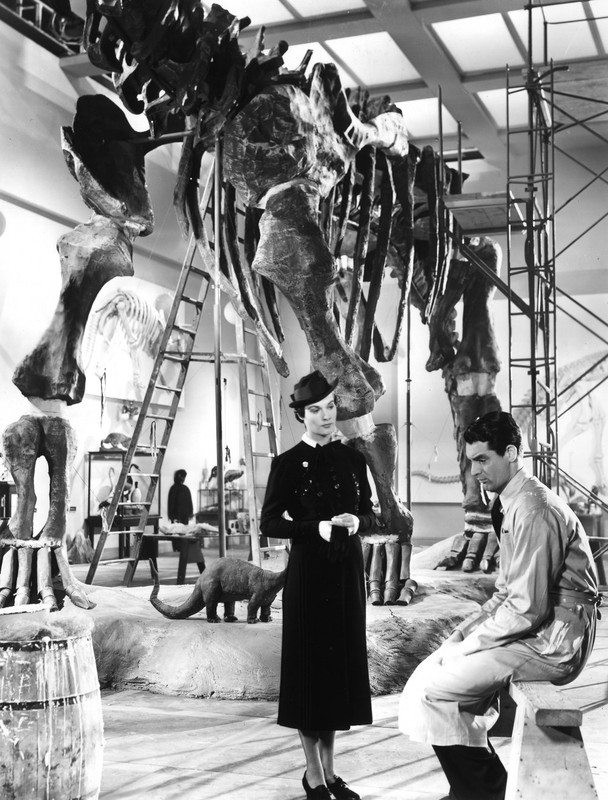
A candid photo taken on set during the great double act's career low, Vampire Hunters (Michael Carreras, 1961), an attempt to boost their fading fortunes by allying themselves with the then popular Hammer monster movie cycle. Both Christopher Lee and Peter Cushing left the country rather than appear in it and the role of Dracula was given to Derek Guyler, whose passport had recently been rescinded.

Hard to believe that a mere two years later, they were back at the top of their game alongside Albert Finney, Julie Christie and Bernard Breslaw in John Schlesinger's bawdy 18th century romp, Waiting For Bardot.

Thursday, 5 November 2015

Last night's set lists

At The Habit, York

Ron Elderly: -
No Expectations
I'll See You In My Dreams
Just My Imagination

Da Elderly: -
Love Song
Let Your Fingers Do The Walking (aka Good Phone)
After The Gold Rush

The Elderly Brothers: -
You Really Got A Hold On Me
Breakin' Up Is Hard To Do
When Will I Be Loved
Medley: Sweet Caroline/Hi Ho Silver Lining
I Saw Her Standing There

After the US tour, it was back to normality at The Habit, which was packed with players and punters. Consequently it was 3 songs each for most of the night, with The Elderly Brothers closing out the open mic session. Ron Elderly debuted The Temptations' Just My Imagination and The Elderlys did likewise with Smokey Robinson's song for The Miracles and Neil Sedaka's No.1; both songs were released in 1962. Let Your Fingers Do The Walking is a Neil Young song from 1984, finally released on 2011's A Treasure.

Wednesday, 4 November 2015

Colin Welland RIP

Colin Welland obituary
Actor and screenwriter who took Hollywood by storm with the 1981 film Chariots of Fire

Dennis Barker
Tuesday 3 November 2015

When Colin Welland, who has died aged 81 after suffering from Alzheimer’s disease, was handed the Oscar for his screenplay of Chariots of Fire in 1982, he waved it in the air like a battle mace and declared: “The British are coming!” In fact, it was some years before another British film received an Academy award. But Welland as a screenwriter had certainly arrived.

Hollywood recognition for Chariots of Fire, which was based on the true story of two athletes in the 1924 Olympics, gave him immense satisfaction. He later wrote that the initial American reaction to the idea had been: who wants a story about two runners from long ago? “When we showed it at Twickenham, a Hollywood producer left after 10 minutes, came back at the end and said that they wouldn’t have anything to do with it. When it won four Oscars, I don’t know where he hid himself.”

Welland was a champion of British talent and complained about a lack of investment in it. His own reputation was based on his versatility as an actor and writer in theatre, television and film. As the English teacher Mr Farthing, in Ken Loach’s film Kes (1969), he won a Bafta for best supporting actor. He became a popular figure after three years (1962-65) in the television police series Z Cars. It was, he recalled, “written by the best writers and had the best directors” – including Loach. Welland’s reputation grew alongside the rise of the political left in the 1970s; his views were inspired by a personal background that he saw as limiting and unfair.

He was born Colin Williams in Leigh, Lancashire, and grew up in Liverpool, the son of Jack, a keen leftwinger and trade unionist, and his wife, Nora. His father forbade mention of Winston Churchill, a controversial figure with the left since his time as home secretary in 1910, and refused to fly the Union Jack on Empire Day, as was common practice at the time. Sometimes theirs was the only house in the street not to do so.

Welland attended Newton-le-Willows grammar school, St Helens, where he was good at acting and art. But he disliked selective education and later said in the Observer that grammar schools were “the epitome of bad education”.

After spells at Bretton Hall College of Education, West Yorkshire, and at Goldsmiths College in London, where he gained a teacher’s diploma in art and drama, he became an art teacher (1958-62). Meanwhile, he would sit in the bar of the New Theatre in Manchester, which was frequented by Granada TV staff, hoping to wangle a job as an assistant floor manager. It never happened, but he was eventually offered a job as an assistant stage manager and actor by David Scase at Manchester Library theatre (1962-64). Welland would joke that not only had he played the lead in Harold Pinter’s The Birthday Party, but he had also swept the stage and managed the props between speaking his lines.

He also tried his hand at radio, presenting the BBC news programme North at Six. Told to speak informally, as if to friends in a pub, he was accused by listeners in Cheshire of not being able to speak the Queen’s English, and lost the job. Meanwhile, though, the acting roles were coming in. After appearing in the Granada TV crime series The Verdict Is Yours, he was given the part of PC David Graham in the BBC’s groundbreaking series Z Cars, and became a familiar face in the nation’s sitting rooms.

The stage work that followed included playing in farce in Johannesburg at £140 a week. He had pangs of conscience about going to South Africa to play before segregated audiences, but comforted himself with the thought that back in Britain he would have a retort to those who argued with him about apartheid: “Yes, but have you ever actually been there?”

In films, too, his Z Cars experience came in handy. He played a detective in the film Villain (1971), about an East End gangster played by Richard Burton. In the meantime, also, he was developing as a writer. In the late 60s he wrote his first play, Bangelstein’s Boys, intended for stage production and built around the life and obscenities of a rugby club outing. It was at a time when the TV campaigner Mary Whitehouse and her supporters were on the attack and theatre managements were cautious. Welland’s own account of the situation was that stage impresarios had laughed loud and long at the experiences of the rugby outing, but then said it was too vulgar.

When the play was produced on ITV’s Sunday Night Theatre in 1969, it proved to be so popular that he stepped up his writing (in longhand in notebooks), creating in 1970 the plays The Hallelujah Handshake for the BBC and – screened a week later on ITV – Roll on Four O’Clock, drawing on his own experiences as a teacher and heightening the frustrations he had felt. Another TV play from that year, Say Goodnight to Your Grandma, was turned into a West End success with its title tweaked to Say Goodnight to Grandma (1973), its blend of political militancy and bawdy humour making it highly fashionable. Its principal character was a wife who fights her jealous mother-in-law, who is always trying to exclude her, by turning up to a party dressed in a football shirt and red knickers, and propositioning every man in sight. Kisses at Fifty (1973), an exploration of middle-aged affairs, won him a Bafta. In 1970, 1973 and 1974 he received the Writers’ Guild awards for best TV playwright.

The Thatcherite and Majoresque 80s and 90s were not the most fruitful ground for Welland, whose political stance was seen by some as becoming old hat, but following on from his writing successes with Yanks (1979), directed by John Schlesinger and starring Vanessa Redgrave and Richard Gere, and Chariots of Fire, he pulled off memorable adaptations for the big screen: A Dry White Season (1989), based on a novel by André Brink and starring Donald Sutherland and Janet Suzman, and War of the Buttons (1994).

As an actor he had always done well in films – in addition to Kes, his appearances included Straw Dogs (1971) and Dancin’ Thru the Dark (1990), directed by Mike Ockrent and written by Willy Russell. On TV, he was in Dennis Potter’s play Blue Remembered Hills (1979).

On stage, he starred in Howard Brenton’s 1988 Royal Shakespeare Company “deconstruction” of Winston Churchill, The Churchill Play, in which he portrayed the great war leader as a less than great politician and a less than perfect man. In one of his final TV roles, he played the Everton manager Harry Catterick in The Fix (1997).

Welland’s columns on sport for the Observer and the Independent proved popular. One included a resounding denunciation of snobbish rules imposed by golf clubs, headlined Beware the Bores and Bigots. His admirers insisted that his broad streak of concern for human decency prevented him from becoming either.

Welland married Patricia Sweeney in 1962. She survives him, along with a son, three daughters and six grandchildren.

• Colin Welland (Colin Williams), screenwriter and actor, born 4 July 1934; died 2 November 2015

http://www.theguardian.com/film/2015/nov/03/colin-welland

Tuesday, 3 November 2015

Art of the Celts - British Museum 2015 review


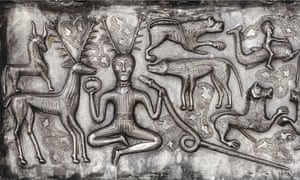
An inner plate from the Gundestrup cauldron, c150-50BC

Celts: Art and Identity review – a wild world of visions and myth
British Museum, London
This exemplary show of Celtic art digs deep into 2,500 years of astounding abstract beauty

Laura Cumming
Sunday 27 September 2015

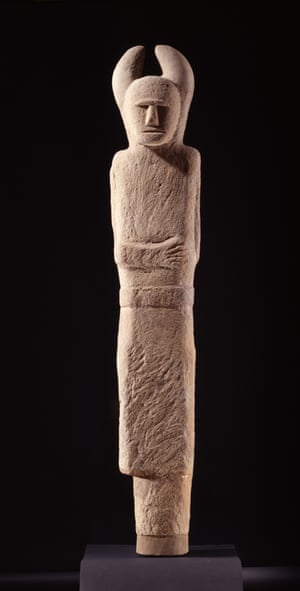
He towers above you with his slit of a mouth and his alien frown, eight feet of glowering blond sandstone. The nose is a wedge, the eyes deep shadows and the brows conjured in a single fierce shelf. One arm is before, the other behind, and it draws you into a mystery. For this horned figure is not one man but two: the statue is Janus-faced.

He looks like nothing on earth, this frightening man with two faces (or was he a god?). Certainly he does not look Celtic. So it is only right that the British Museum’s staggering new blockbuster should open with this 2,000-year-old statue, found in a German field. For it turns out that the Celts are not quite what we thought. We may associate the word “Celtic” specifically with Scotland, Ireland, Wales, Cornwall, the Isle of Man and Brittany, but the name was first used around 500BC by the ancient Greeks, who used it to describe people living all over northern Europe.

Two-faced sandstone figure from Holzgerlingen, Germany, c500-400BC
So it is the sculptor who made the dragon-hinged jug in this show around 400BC in France, and the jeweller who twisted gold into shining bracelets in Germany around the same time. It is the soldier in what is now Bulgaria, whose chariot was fitted with owl-eyed human faces, and all the people who supped from a massive silver cauldron, a bull and a woman warrior at its base, found in a Danish peat bog in 1891.

But do not imagine that this show is some dry revisionist project. From the very start it does what the British Museum does best, which is to unfold our human history through objects. And no matter how improbably vast this new Celtic diaspora may sound, no visitor could fail to see that there is something (perhaps the only thing) that unites so many peoples over more than a millennium – namely, their art.
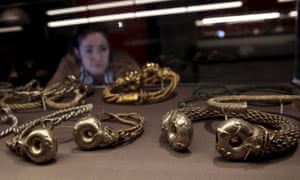
Gold, silver, and copper torcs from the Snettisham hoard on display at the British Museum
Torcs from the Snettisham hoard on display at the British Museum as part of the Celts: Art and Identity exhibition

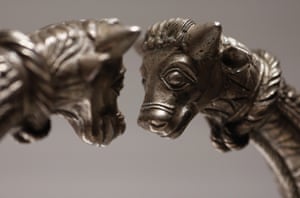
Celtic art is the plait, the knot, the twist, weave and twine; it is the double-headed man or critter. It is ringed crosses, wavy lines, weird animals and serpentine forms; it is the swirling, the ambiguous and the abstract.
Slab of grey sandstone with a cross on one side. From Monifieth, Angus, Scotland, c. AD 800–900. National Museums Scotland

And what an astoundingly strange aesthetic this is. Anyone who has been to Iona and walked from the sea’s edge up to the Celtic cross where pilgrims stopped to pray 1,000 years ago will know the shock of it – the sandstone cross, sheer and knotted, rises high to the sky yet is wafer thin. Like Daniel Burnham’s Flatiron building in New York, so narrow, so fragile, you cannot imagine how it stays upright.
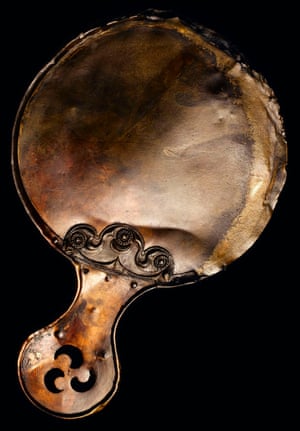
The Balmaclellan mirror from south-west Scotland, AD80-250.

A bronze shield – long, rectangular, undulating like an art nouveau panel – bears the outline figure of a boar. But this is no squat hog; its legs are prodigiously elongated and as elegant as the twining tendrils on nearby flagons. It is pure Charles Rennie Mackintosh.
The Battersea shield. Iron Age, c. 350–50 BC. Found in the River Thames, London, England

Why describe a boar this way? Why depict a horned snake, a cat swallowing its own tail or a dragon with two heads? There is a profound anti-naturalism in Celtic art that insists on exaggeration, that tells you that this is a wild world of visions, myths and fantasies. What could be stranger than the bronze lynchpin that shows three legs whirling like a Catherine wheel, prefiguring the Isle of Man flag a millennium in advance?

There are doubles everywhere – two-faced men, two-headed serpents, two-sided mirrors etched with swaying Celtic triangles. A stone cross from Shetland is carved with early Christian figures, but also a pair of nightmarish hybrids, half-human, half-bird; they could be straight out of Goya’s Caprichos.
A silver ring from Trichtingen, Germany, c200-50BC

The organisers (from the British Museum’s exceptional generation of young curators) are surely right to suggest that these objects are all that remain of lost myths. Consider the immense Gundestrup cauldron, with its reliefs of a female warrior jumping like some Twyla Tharp dancer, a giant dipping another warrior in a smaller cauldron and a helmet taking flight in a bird’s claws. You follow the stories frame by frame, like a graphic novel.

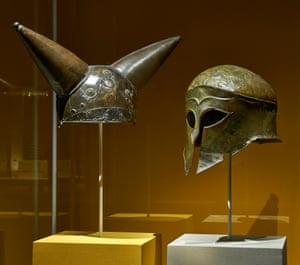
The Celts left no writing – amazing fact – so now imagine, the curators urge, what the intricacies of their lines might have meant. The horned helmet thrown into the Thames near Waterloo 2,000 years ago has a showstopping form – a heavy-metal jester’s hat – but is also minutely inscribed with scrolling incisions and swirls; surely some kind of pictographic language.
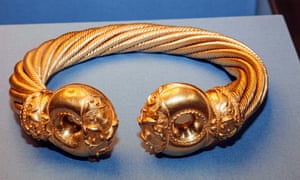
snettisham great torc
The Snettisham Great Torc

It would be hard to overstate the abstract beauty of many treasures. The most exquisite piece of jewellery I’ve ever seen is in Celts – a twisting ribbon of bright gold fashioned into a necklace, so light it could blow away like a leaf. The double-helix twists look so easily made – but they were not. The mystery of their method was only recently deduced by a contemporary goldsmith, who worked out that the gold may have been beaten around the horns of a young animal to get these seashell whorls. And if this sounds magical, another torc here is somehow gilded with mercury.

A horned helmet from the Thames, 200-50 BC alongside a bronze Greek helmet, south-western Greece, around 460BC

Abstraction predominates (you have to look hard for the hidden faces, sometimes no more than an eye or miniscule mouth). A golden snake bracelet from Pompeii, highly realistic, is shown next to a Celtic bracelet from the same era found near Inverness. Its spiral may suggest a coiled snake too, but it tends towards a pure geometry of form, its grave weight a symbol and measure of status.
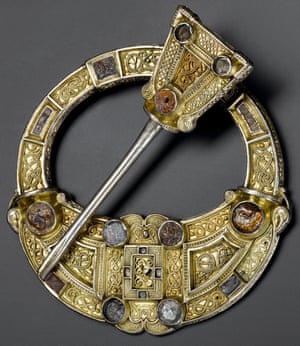
Hunterston brooch from south-west Scotland, AD700-800.
Hunterston brooch from south-west Scotland, AD700-800

What makes this show so exceptional is not just its prodigious range – 2,500 years of art – but its passionate curiosity. Every object, juxtaposition and wall text is presented to inspire new ideas. A sealed bronze canister in a glass case might be meaningless to modern eyes. But here you learn that it was found in a grave, suspended from the belt of a young woman. X-rays show nothing inside. Perhaps it contained a spirit, or had magical powers, or once rattled with dried seeds to make music. The curators’ suggestions are vivid, and yet they allow the object to retain its mystery.

Two enigmatic bronze spoons, shallow and flat, one drilled with a hole, were found carefully buried near a spring. Perhaps people dripped water through the hole from one spoon to the other; perhaps the pattern of droplets predicted the future. Who knows? To see them in this show, in all their strangeness, is to be immediately there by the Cumbrian spring, 2,000 years ago.

Celts is at the British Museum, London until 31 January 2016

http://www.theguardian.com/culture/2015/sep/27/celts-art-and-identity-british-museum-review-wild-world-visions-myth

http://www.britishmuseum.org/whats_on/exhibitions/celts.aspx