Saturday, 17 December 2016

Wednesday night's set lists

At The Habit, York:-

Ron Elderly: -
Make You Feel My Love
Autumn Leaves
Wagon Wheel


Da Elderly: -
Romancing Tonight
Human Highway
Heart Of Gold


The Elderly Brothers: -
Bring It On Home To Me
Sounds Of Silence
No Reply
Yes I Will
Santa Clause Is Coming To Town


It was much busier in The Habit than last week, with several new performers and punters. The new performers included a folk trio of flute, fiddle and guitar and a couple of singer/songwriters. The Elderly Brothers finished off the night with a sixties-laden set, complete with a seasonal finale. The fun continued until closing time with us taking requests (most repeatable!) from the remaining revellers. There will be a short break in posts during the Christmas & New Year, although the Open Mic nights will continue if you fancy calling in. See you in 2017.

Friday, 16 December 2016

Dead Poets Society #20 William Butler Yeats: Towards Break of Day


Towards Break of Day by William Butler Yeats

Was it the double of my dream
The woman that by me lay
Dreamed, or did we halve a dream
Under the first cold gleam of day?
I thought: 'There is a waterfall
Upon Ben Bulben side
That all my childhood counted dear;
Were I to travel far and wide
I could not find a thing so dear.'
My memories had magnified
So many times childish delight.
I would have touched it like a child
But knew my finger could but have touched
Cold stone and water. I grew wild.
Even accusing Heaven because
It had set down among its laws:
Nothing that we love over-much
Is ponderable to our touch.
I dreamed towards break of day,
The cold blown spray in my nostril.
But she that beside me lay
Had watched in bitterer sleep
The marvellous stag of Arthur,
That lofty white stag, leap
From mountain steep to steep.


Tuesday, 13 December 2016

Sacramento Kings 100 - New York Knicks 103

Sacramento Kings 100 - New York Knicks 103
From the Golden 1 Arena, Sacramento.

Richard Perdik
10 December 2016

This must be the equivalent of watching Arsenal in the Premier league. $120 tickets and $13 beers. And the Kings still lost. 

In basketball parlance, it was what is called a "3 point game", which your correspondent took to mean a close game, in which either team could win. Right until the final buzzer. 

So pretty exciting all told, even if the finer points of the sport were somewhat wasted on a Brit.
However, the new $500m Golden 1 Arena is worth a visit. Located in downtown Sacramento, it has breathed life into an otherwise run down area previously known for homelessness. Amongst the scrum of $100 ticket holders flocking towards the game, you can still pass a few homeless people heading in the opposite direction; but this is normal for California. San Francisco currently has a homeless population of between 8-10,000...

Inside the stadium, it felt more like a scene from Hunger Games. Giant screens abound, to introduce the star players and replay the key points. The crowd are whipped into a frenzy. Pretty soon the players will be fighting Mano a Mano, gladiator style. 

Sacramento is an old "cow town". So much so that the fans ring metal cow bells to ramp up the noise levels. Can't see that catching on back home.

As for the game itself, star player DeMarcus Cousins scored 28 of the Kings points tally; they also let a 9 point lead slip in the second quarter, and probably weren't helped by the fact that forward Matt Barnes was left out pending a potential assault charge after a nightclub brawl in the corresponding fixture in New York.
Sounds familiar...?

Monday, 12 December 2016

Bob Dylan's acceptance speech for the Nobel Prize

Image result for bob dylan 2016
Bob Dylan pens Nobel Prize acceptance speech: “That I now join the names on such a list is truly beyond words”
Dylan's speech was read aloud by United States Ambassador to Sweden Azita Raji

Alex Young
10 December 2016

The Swedish Academy honored the 2016 Nobel Prize recipients during a ceremony held in Stockholm on Saturday. Bob Dylan, who was awarded the Nobel Prize for Literature, was not in attendance due to a schedule conflict. He did, however, write a speech which was read, which was read by United States Ambassador to Sweden Azita Raji. Additionally, Patti Smith appeared on his behalf and performed a stunning cover of “A Hard Rain’s A-Gonna Fall” with accompaniment of an orchestra.

Read the full transcript of Dylan’s speech below.

Good evening, everyone. I extend my warmest greetings to the members of the Swedish Academy and to all of the other distinguished guests in attendance tonight.

I’m sorry I can’t be with you in person, but please know that I am most definitely with you in spirit and honored to be receiving such a prestigious prize. Being awarded the Nobel Prize for Literature is something I never could have imagined or seen coming. From an early age, I’ve been familiar with and reading and absorbing the works of those who were deemed worthy of such a distinction: Kipling, Shaw, Thomas Mann, Pearl Buck, Albert Camus, Hemingway. These giants of literature whose works are taught in the schoolroom, housed in libraries around the world and spoken of in reverent tones have always made a deep impression. That I now join the names on such a list is truly beyond words.

I don’t know if these men and women ever thought of the Nobel honor for themselves, but I suppose that anyone writing a book, or a poem, or a play anywhere in the world might harbor that secret dream deep down inside. It’s probably buried so deep that they don’t even know it’s there.

If someone had ever told me that I had the slightest chance of winning the Nobel Prize, I would have to think that I’d have about the same odds as standing on the moon. In fact, during the year I was born and for a few years after, there wasn’t anyone in the world who was considered good enough to win this Nobel Prize. So, I recognize that I am in very rare company, to say the least.

I was out on the road when I received this surprising news, and it took me more than a few minutes to properly process it. I began to think about William Shakespeare, the great literary figure. I would reckon he thought of himself as a dramatist. The thought that he was writing literature couldn’t have entered his head. His words were written for the stage. Meant to be spoken not read. When he was writing Hamlet, I’m sure he was thinking about a lot of different things: “Who’re the right actors for these roles?” “How should this be staged?” “Do I really want to set this in Denmark?” His creative vision and ambitions were no doubt at the forefront of his mind, but there were also more mundane matters to consider and deal with. “Is the financing in place?” “Are there enough good seats for my patrons?” “Where am I going to get a human skull?” I would bet that the farthest thing from Shakespeare’s mind was the question “Is this literature?”

When I started writing songs as a teenager, and even as I started to achieve some renown for my abilities, my aspirations for these songs only went so far. I thought they could be heard in coffee houses or bars, maybe later in places like Carnegie Hall, the London Palladium. If I was really dreaming big, maybe I could imagine getting to make a record and then hearing my songs on the radio. That was really the big prize in my mind. Making records and hearing your songs on the radio meant that you were reaching a big audience and that you might get to keep doing what you had set out to do.

Well, I’ve been doing what I set out to do for a long time, now. I’ve made dozens of records and played thousands of concerts all around the world. But it’s my songs that are at the vital center of almost everything I do. They seemed to have found a place in the lives of many people throughout many different cultures and I’m grateful for that.

But there’s one thing I must say. As a performer I’ve played for 50,000 people and I’ve played for 50 people and I can tell you that it is harder to play for 50 people. 50,000 people have a singular persona, not so with 50. Each person has an individual, separate identity, a world unto themselves. They can perceive things more clearly. Your honesty and how it relates to the depth of your talent is tried. The fact that the Nobel committee is so small is not lost on me.

But, like Shakespeare, I too am often occupied with the pursuit of my creative endeavors and dealing with all aspects of life’s mundane matters. “Who are the best musicians for these songs?” “Am I recording in the right studio?” “Is this song in the right key?” Some things never change, even in 400 years.

Not once have I ever had the time to ask myself, “Are my songs literature?”

So, I do thank the Swedish Academy, both for taking the time to consider that very question, and, ultimately, for providing such a wonderful answer.

My best wishes to you all,

Bob Dylan

http://consequenceofsound.net/2016/12/bob-dylan-pens-nobel-prize-acceptance-speech-that-i-now-join-the-names-on-such-a-list-is-truly-beyond-words/


Bob Dylan Nobel prize speech: this is 'truly beyond words'
Songwriter sends a speech and Patti Smith to the Nobel awards dinner in Sweden rather than attending in person

Vanessa Thorpe and David Connett
The Guardian
Sunday 11 December 2016

Bob Dylan admitted he was stunned and surprised when he was told he had won a Nobel prize because he had never stopped to consider whether his songs were literature.

Dylan, whose speech was read out by the US ambassador to Sweden at the annual awards dinner, said the prize was “something I never could have imagined or seen coming”.

He said from an early age he had read and absorbed the works of past winners and giants of literature such as Kipling, Shaw, Thomas Mann, Pearl Buck, Albert Camus and Hemingway. But said it was “truly beyond words” that he was joining those names on the winners list. “If someone had ever told me that I had the slightest chance of winning the Nobel prize, I would have to think that I’d have about the same odds as standing on the moon,” he wrote.

The announcement that Dylan had won the literature prize caused controversy with critics arguing his lyrics were not literature. On learning he had been awarded the literature prize Dylan said he thought of Shakespeare. “When he was writing Hamlet, I’m sure he was thinking about a lot of different things: ‘Who’re the right actors for these roles? How should this be staged? Do I really want to set this in Denmark?’

“His creative vision and ambitions were no doubt at the forefront of his mind, but there were also more mundane matters to consider and deal with. ‘Is the financing in place? Are there enough good seats for my patrons? Where am I going to get a human skull?’ I would bet that the farthest thing from Shakespeare’s mind was the question: ‘Is this literature?’

“Like Shakespeare, I too am often occupied with the pursuit of my creative endeavours and dealing with all aspects of life’s mundane matters. ‘Who are the best musicians for these songs? Am I recording in the right studio? Is this song in the right key?’ Some things never change, even in 400 years. Not once have I ever had the time to ask myself ‘are my songs literature?’ So, I do thank the Swedish academy, both for taking the time to consider that very question and ultimately, for providing such a wonderful answer.”

Earlier during the awards ceremony a nervous Patti Smith stumbled through Bob Dylan’s A Hard Rain’s A-Gonna Fall in a performance given to mark the handing over of the absent Dylan’s Nobel prize for literature.

Formally presenting the award Horace Engdahl, a Swedish literary critic and member of the Swedish academy behind the prize, responded to international criticism of the choice of a popular lyricist as recipient. In defence of the decision, Engdahl said that when Dylan’s songs were heard first in the 1960s: “All of a sudden, much of the bookish poetry in our world felt anaemic.”

The academy’s choice of Dylan, Engdahl added, speaking in Swedish, “seemed daring only beforehand and already seems obvious”.

And it was an unconventional prize-giving night in more ways than one. Dylan’s failure to attend the august gathering in Stockholm meant that Smith, the American singer famous for her 1975 album Horses and the hit song Because the Night, was attending as his proxy. The occasion proved too much for the singer, 69, who faltered after a few verses.

Forgetting the lyric “I saw a black branch with blood that kept drippin’,” she apologised quietly but profusely to the jewel-bedecked audience and asked if she could start that section of the song again. “I am so nervous,” she explained. Smith was encouraged by applause from the gathered dignitaries and members of the Swedish royal family.

Her performance followed Engdahl’s justificatory speech, which opened with the question: “What brings about the great shifts in the world of literature? Often it is when someone seizes upon a simple, overlooked form, discounted as art in the high sense, and makes it mutate.”

In this way, Engdahl argued, the novel had once emerged from anecdote and letters, while drama had eventually derived from games and performance. “In the distant past, all poetry was sung or tunefully recited,” he said. Dylan had dedicated himself to music played for ordinary people and tried to copy it.

“But when he started to write songs, they came out differently,” Engdahl said. “He panned poetry gold, whether on purpose or by accident is irrelevant … He gave back to poetry its elevated style, lost since the romantics.”

Saturday, 10 December 2016

John Glenn RIP

John Glenn, American Hero of the Space Age, Dies at 95

By John Noble Wilford
The New York Times
8 December 2016

John Glenn, a freckle-faced son of Ohio who was hailed as a national hero and a symbol of the space age as the first American to orbit Earth, then became a national political figure for 24 years in the Senate, died on Thursday in Columbus, Ohio. He was 95.

Ohio State University announced his death. Mr. Glenn had recently been hospitalized at the university at the James Cancer Center, though Ohio State officials said at the time that admission there did not necessarily mean he had cancer. He had heart-valve replacement surgery in 2014 and a stroke around that time.

He had kept an office at the John Glenn College of Public Affairs, which he helped found, and also had a home in Columbus.

In just five hours on Feb. 20, 1962, Mr. Glenn joined a select roster of Americans whose feats have seized the country’s imagination and come to embody a moment in its history, figures like Lewis and Clark, the Wright brothers and Charles Lindbergh.

To the America of the 1960s, Mr. Glenn was a clean-cut, good-natured, well-grounded Midwesterner, raised in Presbyterian rectitude, nurtured in patriotism and tested in war, who stepped forward to risk the unknown and succeeded spectacularly, lifting his country’s morale and restoring its self-confidence.

It was an anxious nation that watched and listened that February morning, as Mr. Glenn, 40 years old, a Marine Corps test pilot and one of the seven original American astronauts, climbed into Friendship 7, the tiny Mercury capsule atop an Atlas rocket rising from the concrete flats of Cape Canaveral in Florida.

The Cold War had long stoked fears of nuclear destruction, and the Russians seemed to be winning the contest with their unsettling ascent into outer space. Two Russians, Yuri A. Gagarin and Gherman S. Titov, had already orbited Earth the year before, overshadowing the feats of two Americans, Alan B. Shepard and Virgil I. Grissom, who had been launched only to the fringes of space.

What, people asked with rising urgency, had happened to the United States’ vaunted technology and can-do spirit?

The answer came at 9:47 a.m. Eastern time, when after weeks of delays the rocket achieved liftoff. It was a short flight, just three orbits. But when Mr. Glenn was safely back, flashing the world a triumphant grin, doubts were replaced by a broad, new faith that the United States could indeed hold its own against the Soviet Union in the Cold War and might someday prevail.

No flier since Lindbergh had received such a cheering welcome. Bands played. People cried with relief and joy. Mr. Glenn was invited to the White House by President John F. Kennedy and paraded up Broadway and across the land. A joint meeting of Congress stood and applauded vigorously as Mr. Glenn spoke at the Capitol.

In his political history of the space age, “…The Heavens and the Earth,” the author Walter A. McDougall described Mr. Glenn’s space mission as a “national catharsis unparalleled.”

“It seemed that he had given Americans back their self-respect,” Mr. McDougall added, “and more than that — it seemed Americans dared again to hope.”

Mr. Glenn was reluctant to talk about himself as a hero. “I figure I’m the same person who grew up in New Concord, Ohio, and went off through the years to participate in a lot of events of importance,” he said in an interview years later. “What got a lot of attention, I think, was the tenuous times we thought we were living in back in the Cold War. I don’t think it was about me. All this would have happened to anyone who happened to be selected for that flight.”

Mr. Glenn did not return to space for a long time. Kennedy thought him too valuable as a hero to risk losing in an accident. So Mr. Glenn resigned from the astronaut corps in 1964, became an executive in private industry and entered politics, serving four full terms as a Democratic senator from Ohio and in 1984 running unsuccessfully for the Democratic presidential nomination.

Finally, 36 years after his Mercury flight, in the last months of his final Senate term, he got his wish for a return to orbit. Despite some criticism that his presence on the mission was a political payoff, a waste of money and of doubtful scientific merit, the hero of yesteryear brought out the crowds again, cheering out of nostalgia and enduring respect as he was launched aboard the space shuttle Discovery on Oct. 29, 1998. At 77, he became the oldest person to go into space.

In retirement from the Senate, Mr. Glenn lived with his wife of 73 years, Anna (he always called her Annie), in a suburb of Washington in addition to Columbus. Ohio State University is the repository of papers from his space and political careers.

“John always had the right stuff,” President Obama said in a statement on Thursday, “inspiring generations of scientists, engineers and astronauts who will take us to Mars and beyond — not just to visit, but to stay.”

John Herschel Glenn Jr. was born on July 18, 1921, in Cambridge, Ohio, the only son of a railroad conductor who also owned a plumbing business, and the former Clara Sproat. A few years later, the Glenns moved to New Concord, a small town in southeastern Ohio with a population of little more than 1,000.

“It was small but had a lot of patriotic feeling and parades on all the national holidays,” Mr. Glenn once said. “Wanting to do something for the country was just natural, growing up in a place like New Concord.”

Like most everyone else there, the Glenns lived through the hard times of the Depression, instilling in their son a rigid moral code based on their own God-fearing example and saw him through an apple-pie boyhood. He played trumpet, sang in the church choir, washed cars for pocket money and worked as a lifeguard. In high school (now named for him), he was an honor student and lettered in football, basketball and tennis.

He still had time to court his high school sweetheart, Anna Margaret Castor, the doctor’s daughter. It did not matter that she stammered; she was his girl, and he loved her. They married in April 1943, and he often called her “the real rock of the family.” From the time they came to public attention, and throughout the turbulence of spaceflight and politics, John and Anna Glenn each seemed the other’s center of gravity.

Not until much later did she undergo intensive therapy that virtually cured her stammer, enabling her even to give speeches in public.

Mr. Glenn is survived by his wife; two children, Carolyn Ann Glenn of St. Paul and John David Glenn of Berkeley, Calif.; and two grandsons, Daniel and Zach Glenn.

Mr. Glenn began his journey to fame in World War II. In 1939, he enrolled at Muskingum College in his hometown to study chemistry, but he took flying lessons on the side. Shortly after the attack on Pearl Harbor on Dec. 7, 1941, he signed up for the Naval Aviation cadet program and after pilot training opted to join the Marines. As a fighter pilot, he flew 59 combat missions in the Pacific, earning two Distinguished Flying Crosses and other decorations.

Mr. Glenn saw more action in the Korean War, flying 90 combat missions and winning more medals. He put his life on the line again as a military test pilot in the early days of supersonic flight. In 1957, just months before the Soviet Union launched its first Sputnik satellite, he made the first transcontinental supersonic flight, piloting an F8U-1 Crusader from Los Angeles to New York in record time: 3 hours 23 minutes 8.4 seconds.

Then, in 1959, newly promoted to lieutenant colonel, he heeded a call for test pilots to apply to be astronauts for the fledgling National Aeronautics and Space Administration. He and six other pilots were selected in April of that year. (The original Mercury 7 included Mr. Glenn, Mr. Shepard, Mr. Grissom, Walter Schirra, Gordon Cooper, Deke Slayton and M. Scott Carpenter. Mr. Glenn was the last surviving one.)

All seven men were eager, competitive and ambitious, but none more so than Mr. Glenn. Tom Miller, a retired Marine general and close friend since they were rookie pilots in World War II, recalled that Mr. Glenn was so determined to be an astronaut that he applied weight to his head to compress his height down to the 5-foot-11-inch maximum for the first astronauts. “He wasn’t going to miss a trick,” Mr. Miller said. “He’d be sitting down reading with a big bunch of books sitting on his head.”

But his determination did not win him the assignment to be the first American astronaut to fly. He had to wait out the suborbital flights by Mr. Shepard and Mr. Grissom in 1961 before his turn came.

In his 1999 memoir, written with Nick Taylor, he admitted he was sorely disappointed when Mr. Shepard was tapped for the first flight. As the oldest and most articulate of the astronauts, Mr. Glenn had attracted a big share of the publicity. He said that he had “worked and studied hard dedicating myself to the program” and that he thought he had a “good shot” at being first. In a letter to a NASA official, Mr. Glenn wrote, “I thought I might have been penalized for speaking out for what I thought was the good of the program.”

At this time, as Mr. Glenn often recalled, he never anticipated that his orbital flight would be the one that most excited the public, satisfying the nation’s hunger for a hero.

Tom Wolfe wrote of that time in the best-selling 1979 book “The Right Stuff,” a phrase for coolness in the face of danger that has passed into the idiom. He described Mr. Glenn as excessively pious, scolding his fellow astronauts about their after-hours escapades while openly lobbying to be the first of them to fly.

“He looked like a balding and slightly tougher version of the cutest-looking freckle-faced country boy you ever saw,” Mr. Wolfe wrote. “He had a snub nose, light-hazel eyes, reddish-blond hair and a terrific smile.”

Mr. Glenn said he liked the book but not the 1983 movie based on it, in which he was portrayed by Ed Harris. “Most of his account was reasonably factual, although I was neither the pious saint nor the other guys the hellions he made them into,” he told Life magazine in 1998. “Hollywood made a charade out of the story and caricatures out of the people in it."

The 1962 space mission came after two months of one postponement after another, sometimes for mechanical problems, often for bad weather. Once Mr. Glenn had to wait six hours, fully suited, in the cramped Friendship 7 capsule before officials called off the launch. But he projected confidence. “You fear the least what you know the most about,” he said.

On the 11th scheduled time, all was “go,” and the rocket lifted off from Pad 14 at Cape Canaveral. “Godspeed, John Glenn,” his fellow astronaut Scott Carpenter said through a microphone at mission control.

The flight stopped the nation in its tracks; people watched on black-and-white television, listened on the radio and prayed.

At the end of the first orbit, an automatic control mechanism failed, and Mr. Glenn took over manual control. He would see three sunsets in a brief time. He puzzled for a while about “fireflies” outside his window. NASA later determined that it was his urine and sweat, which was being dumped overboard and turned to frozen crystals glowing in sunlight.

A faulty warning light signaled that the capsule heat shield, designed to protect it in the fiery descent back to Earth, had come loose and might come off during re-entry. The signal was erroneous, but no one could be sure. Ground controllers ordered that a retrorocket unit attached under the heat shield by metal straps not be jettisoned after firing in order to give added protection and reduce the risk of premature detachment of the heat shield. This was Mr. Glenn’s first real clue that something was amiss.

As Friendship 7 plunged through the atmosphere, the astronaut’s recorded heartbeat raced as one of the metal straps came loose and banged on the side of the capsule.

“Right away, I could see flaming chunks flying by the window, and I thought the heat shield might be falling apart,” he wrote after the flight. “This was a bad moment. But I knew that if that was really happening, it would all be over shortly, and there was nothing I could do about it.”

The capsule splashed down in the Atlantic off the Bahamas, where a Navy destroyer was waiting. Mr. Glenn radioed, “My condition is good, but that was a real fireball, boy.”

In the flush of fame, Mr. Glenn toured the country publicizing the space program, visiting aerospace plants and waving to cheering crowds and signing autographs. But he always had his eye on another flight into space.

He kept asking NASA officials about a new flight assignment and was routinely stonewalled. Not yet, they said. Kennedy’s reservations about risking a hero’s life were disclosed years later.

Frustrated, Mr. Glenn resigned from NASA in early 1964. But an idea for a new career had been planted in his mind.

One night in December 1962, Attorney General Robert F. Kennedy invited the Glenns to dinner at his home in McLean, Va. In the course of the evening, the attorney general suggested that Mr. Glenn run for public office. With the backing of a powerful Kennedy, he might have a good chance at a Senate seat from Ohio in the 1964 election.

Mr. Glenn’s parents happened to be among the few Democrats in New Concord, and Mr. Glenn once recalled that he had developed an abiding interest in political affairs from his high school civics teacher, Harford Steele.

Mr. Glenn eventually took the advice, but had to quit the race after being seriously injured in a bathroom fall. He spent the next decade working as an executive of the Royal Crown Cola Company. He still had the space itch, though, and inquired about a possible place on one of the Apollo missions to the moon, but NASA gave him no encouragement.

“Yeah, I would have liked to go to the moon,” he said in later years. “But I didn’t want to stick around being the oldest astronaut in training just hoping to go to the moon. So I went on to other things, and that was a decision I lived with.”

After Robert Kennedy’s assassination in 1968, Mr. Glenn headed a bipartisan lobbying group called the Emergency Committee for Gun Control. President Lyndon B. Johnson later signed the Gun Control Act of 1968, placing some restrictions on firearms.

In 1970, Mr. Glenn ran again for the Senate, but lost in the Democratic primary to Howard M. Metzenbaum. Mr. Glenn won the primary four years later and breezed to victory in the general election, beginning a 24-year Senate career.

Over the years, Mr. Glenn earned the respect of Senate colleagues as an upright, candid and diligent legislator. Senator Bob Graham, Democrat of Florida, described Mr. Glenn as a “workhorse” who was especially well informed and a forceful voice on defense issues. “When he speaks, you know he’s speaking on a subject of which he has a command and a reason for speaking,” Mr. Graham said shortly before Mr. Glenn’s return to space.

As a senator, Mr. Glenn developed an expertise in weapons systems, nuclear proliferation issues and most legislation related to technology and bureaucratic reform. He generally took moderate positions on most issues, though in his last two terms his voting record became more liberal. He was an enthusiastic supporter of President Bill Clinton.

He drew admiring audiences in his run for the Democratic presidential nomination in 1984, but his wooden speaking style and lack of a cogent campaign message were blamed for his poor showing at the polls. After losses in several states, he dropped out of the race, which former Vice President Walter F. Mondale won before President Ronald Reagan overwhelmed him in the general election.

The one blemish on Mr. Glenn’s squeaky-clean political reputation came in the 1980s, when he was one of five senators present at a meeting with federal regulators concerning accusations of savings and loan association fraud against Charles H. Keating Jr., a former Ohioan. The meeting smacked of impropriety and political pressure. Because Mr. Glenn had no further contact with Mr. Keating, who eventually was sent to prison, the Senate decided that he did nothing deserving discipline.

As a member of the Senate Special Committee on Aging, Mr. Glenn developed the medical rationale used in arguing his case for a return flight in space. He offered himself as a human guinea pig in tests of the physiological effects of space weightlessness, like bone-mass loss and cardiovascular, muscular and immune system changes, and how they seem to be comparable to the usual effects of aging.

Mr. Glenn’s return to space in 1998 drew criticism. But the new-old astronaut was not to be denied, and his heroic image, and reawakened memories of the early space age, attracted launching crowds on a scale not seen since astronauts were flying to the moon.

Still healthy and vigorous, though not as agile as in 1962, Mr. Glenn embarked on his second venture in space, as he said in an interview, to show the world that the lives of older people need not be dictated by the calendar.

In recent years, honors continued to come his way: the Presidential Medal of Freedom, the Congressional Gold Medal and election to the American Academy of Arts and Sciences. The NASA Lewis Research Center in Cleveland was renamed the John H. Glenn Research Center.

In 2012, about a week before the 50th anniversary of the Friendship 7 flight, a reporter found the 90-year-old Mr. Glenn in full voice and clear mind, but regretting that he had sold his airplane the month before. Their aging knees had made it difficult for him and his wife to climb on the wing to get into the cabin of their twin-engine Beechcraft Baron. For years they had flown it on vacations and back and forth to Washington. Though his airplane was gone, Mr. Glenn was pleased to say several times that he still had a valid pilot’s license.

Mr. Glenn was a flier, almost to the end.

In one of the interviews at this time, he was reminded that Mr. Wolfe, the author, had recently judged him “the last true national hero America has ever had.”

Mr. Glenn gave another of his dismissive aw-shucks responses: “I don’t think of myself that way,” he said. “I get up each day and have the same problems others have at my age. As far as trying to analyze all the attention I received, I will leave that to others.”

http://www.nytimes.com/2016/12/08/us/john-glenn-dies.html?_r=0

Friday, 9 December 2016

Dead Poets Society #19 Jack Kerouac: Bus East

Image result for jack kerouac

Bus East by Jack Kerouac

Society has good intentions Bureaucracy is like a friend
5 years ago - other furies other losses -

America's
trying to control the uncontrollable Forest fires, Vice

The essential smile In the essential sleep Of the children Of the essential mind

I'm
all thru playing the American
Now I'm going to live a good quiet life

The
world should be built for foot walkers

Oily
rivers Of spiney Nevady

I
am Jake Cake
Rake
Write like Blake

The
horse is not pleased Sight of his
gorgeous finery
in the dust Its silken
nostrils
did disgust

Cats
arent kind Kiddies anent sweet

April
in Nevada - Investigating Dismal Cheyenne Where the war parties
In fields
of straw
Aimed over oxen At Indian Chiefs
In wild headdress Pouring thru
the gap
In Wyoming plain
To make the settlers
Eat more dust than dust
was eaten In the States From East at Seacoast Where wagons made up To dreadful
Plains
Of clazer vup

Saltry
settlers
Anxious to masturbate The Mongol Sea (I'm too tired in Cheyenne -
No sleep in 4 nights now, & 2 to go)


Thursday, 8 December 2016

Last night's set lists

At The Habit, York: -

Ron Elderly: -
Can't Help Falling In Love
A Good Year For The Roses
You Better Move On
The River


Da Elderly: -
Teach Your Children
I Don't Want To Talk About It
The Road That You're Travellin'
I'm Just A Loser


The Elderly Brothers: -
The Boxer
Things We Said Today
The Price Of Love
When You Walk In The Room
Everybody Knows
I Saw Her Standing There


Probably the quietest night of 2016. Whether people are shopped-out or saving themselves for the excesses to come is unclear, but The Habit was unusually quiet, with only a scattering of punters and players. The 2-song rule was applied as normal but we went around twice for the solo sets listed above. Surprise song of the night - a visitor from Worcestershire (possibly in his mid-60s) struck up with The Nolans' I'm In The Mood For Dancing! with backing, sometimes lead, vocals from 3 ladies in the audience. There was also a fine performance from regular Deb of David Lindley/Jackson Browne's Crow On The Cradle. Things livened up a little after 11pm with folks moving on from other bars which had closed. The Elderly Brothers played the final set of the night to close the open mic at midnight.

Kirk Douglas is 100

Image result for kirk douglas ace in the hole

I am Kirk Douglas! The lust for life of a screen legend at 100

Brian Morton
BBC

28 August 2016

Hero, villain, painter, warrior, boxer, soldier, rebel. As he celebrates his centenary year, Hollywood veteran Kirk Douglas can look back on a career that has spanned decades and expressed itself in a spectrum of characters and genres so broad that it is hard to think of another actor who could hope to match it. With his chiseled looks and distinctive delivery, Douglas built his reputation as a masculine action man, however his subtlety and nuance allowed him to transcend these tough guy roles to take on far richer subjects. With the BFI running an extensive retrospective of Douglas's films, BRIAN MORTON reflects on the life and legacy a true legend of the silver screen.

Drama students used to be taught that the so-called Bad Quartos were probably pirated editions of Shakespeare dictated by disgruntled minor actors who had got their own parts down pat but could only make a hash of the great speeches. Kirk Douglas was never like that, in the sense of never seriously disgruntled, never other than word-perfect right across the script, and never, ever minor.

It’s a playful coincidence that the 400th anniversary of the death of our greatest playwright should also mark the coming centenary of our greatest living screen presence, who despite cheating death in a plane crash, surviving a devastating stroke and suffering multiple onscreen mutilations – an eye in The Vikings, an ear in the Van Gogh biopic Lust For Life, crucifixion in Spartacus – celebrates his 100th birthday in early December.

Douglas was a perfectionist on set, and seldom out of character off it when he was in production.

Not only did he master his own parts, with their shifting motivations, ambiguities and contradictions, he insisted on knowing everyone else’s, frequently going head-to-head with such notorious micro-managers as Stanleys Kubrick and Kramer.

The Scottish actor and former intelligence officer James Donald played Theo Van Gogh to Douglas’s Vincent and co-starred as Egbert in The Vikings.

Donald told my father that Douglas was the most exacting and sometimes exhausting man he’d ever seen before or behind a camera. And yet Douglas always preferred the former.

Even allowing for a heyday when directors and players were as rigidly stratified as officers and men in a POW camp (Donald is best known as the senior Brit in The Great Escape) Douglas’s sheer personal authority and knowledge of the business would surely have allowed him to make pictures of his own should the desire have arisen.

That it did not leaves us with an unanswerable question about how this most commanding but also adaptable of actors – qualities inherited by his much-underrated son Michael – would have framed a drama.

On the surface, Douglas himself seems all about action, his sheer physicality matched by a voice that grinds like a tank track. And yet what is remarkable about his body of work, taken entire, is how delicate and nuanced much of it is.

He said once that being an immigrant in America was to be born an actor; adopting roles was a survival strategy

The relationship between Douglas and the relentlessly one-dimensional Anthony Quinn as Gauguin (or rather Zorba the Painter) in Lust For Life has a curiously feminine quality, which nowadays would have been seized on and foregrounded as bromance and gay subtext but which remains just a shimmer over Vincente Minnelli’s scenario.

Where does this come from? Norman Mailer, another bruiser who in real life exuded a rough courtliness, said that he had spent his early adult years trying to escape from the nice Jewish boy from Brooklyn that he had been.

Douglas grew up even further out of town, in Amsterdam, mid-New York State. He started out as Issur Danielovich, later Izzy Demsky, and only became Kirk Douglas, not for Hollywood but in order to avoid anti-semitism in the US Navy.

Where Fanny Mailer was the major influence on the future writer, so the tough, Yiddish-speaking Bryna Danielovich (and six sisters) were the primary shaping force in Douglas’s life.

Even when he treats woman badly on screen, one senses that he at least understands them, individually and collectively, and that somehow makes his roughness better, and subtly worse. When he formed a production company, Douglas didn’t name it Longship or Gladiator, but Bryna, after his mother.

He studied at the American Academy of Dramatic Arts in New York but showed no particular desire to be Hamlet or Anthony, not when there were, as he put it, American stories to tell, and not when a camera allowed him to inflect even the most macho speech with glimmers of subtlety and humour.

He said once that being an immigrant in America was to be born an actor; adopting roles was a survival strategy.

He called his first venture into autobiography The Ragman’s Son, which was both literally true – Herschel Danielovich took a cart round the streets, calling for cast-offs – but also symbolically appropriate, because Douglas picked up voices, gestures, confrontations, flirtations at the same time.

He broke through as an actor with his screen debut, opposite Barbara Stanwyck. It happened in 1946, making this year another kind of Douglas anniversary, 70 years in the film business.

Movie reference books like to dismiss The Strange Loves of Martha Ivers as an exception, even an aberration, in the Douglas canon, given that he plays a weak and pliant man whose life is governed by a demanding older woman.

On the surface, that’s true, but that early performance remains a key text and perhaps tells a deep psychological truth about one of Hollywood’s most enduring tough men: that everyone has, and possibly fears as well as loves, a mother.

“She taught me how to be a man”, he said, but wouldn’t elaborate. He’d already said enough and Kirk Douglas has never been known to waste a word.

The BFI's Kirk Douglas retrospective runs from 3 September to 4 October 2016.

Wednesday, 7 December 2016

Bob Dylan and Eric Clapton - Not Dark Yet


Clapton. Now there's a name I never associated with this blog...

Tuesday, 6 December 2016

Robert Rauschenberg at Tate Modern - review

Robert Rauschenberg in his Pearl Street studio
Robert Rauschenberg, Pearl Street Studio, c1955

Robert Rauschenberg review – six sensational decades of work finally reveal the man in full
Tate Modern, London
Driven by an insatiable curiosity, the groundbreaking artist took the triumphs and wreckage of American life and turned them into art – and this brilliant show captures his extraordinary range

Adrian Searle
The Guardian
Tuesday 29 November 2016

From first to last, Tate Modern’s Robert Rauschenberg show is almost impossibly rich and rewarding. Paintings made with dirt and paintings of nothing at all, images that encapsulate the achievements and disasters of 1960s America, a stuffed goat that looks like it has been feeding from a painter’s palette, and a mud-bath gurgling liquid cement like a lava pool. The exhibition moves through a life and career at gathering pace, from the early 1950s to the artist’s death in 2008. Room after room arrest us with yet another creative swerve, a shift in medium, scale, formal attack and presence.

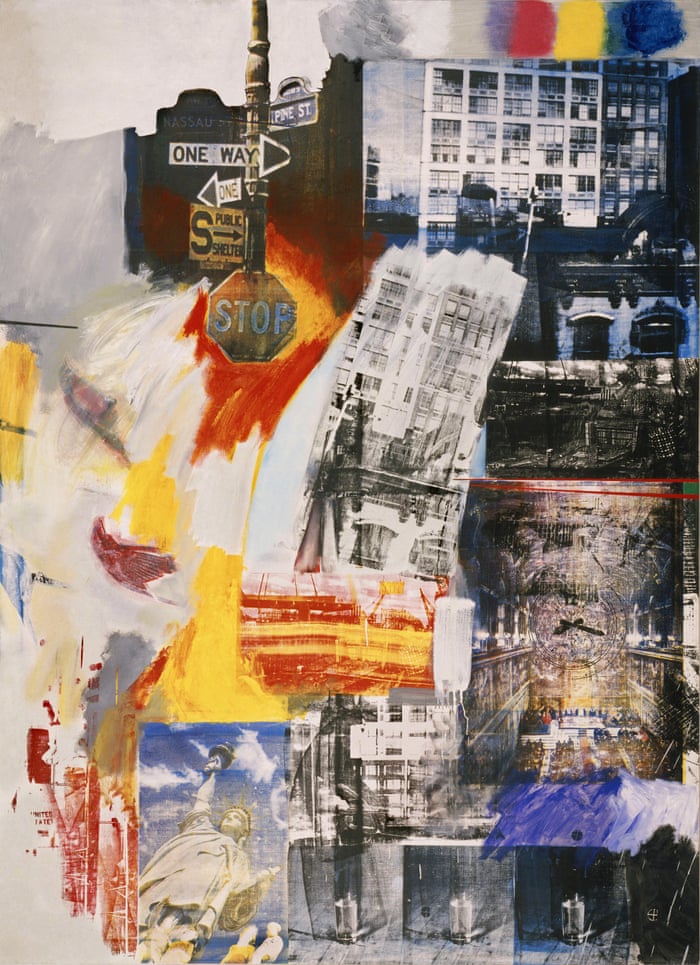
Estate, 1963

In the 1950s, Rauschenberg dragged wreckage from the downtown streets of New York to his cold-water loft and made plangent, sour and lovely art that reflected his surroundings. He got Abstract Expressionist Willem de Kooning, whom he greatly revered, to give him a drawing so he could erase it. He used a car tyre to track a drawing across a scroll of paper, and made blank paintings of uninterrupted rollered-on whiteness that inspired his friend John Cage’s never entirely silent 4’33’, where ambient sounds fall before a silent piano. Rauschenberg’s white painting reflects only light, gathers dust, stands as mute potential. You need only do this once. He made red paintings and black paintings and paintings that combined and complicated the medium in unexpected ways. Each new move was a foil to the last, and he kept on moving.
Robert Rauschenberg, Charlene, 1954, Stedelijk Museum, Amsterdam
Charlene, 1954

Rauschenberg’s early work was inspired by his surroundings, by a trip to Italy with his then lover Cy Twombly, and by the artists and poets he met at Black Mountain College in the late 1940s, including Bauhaus expatriots Josef and Anni Albers. Albers taught the relativity of visual experience – how the experience of colour, for example, was entirely dependant on its surroundings – and this relational approach stayed with Rauschenberg throughout his career. In his art, one thing always leads to another in an endless chain of relations and reactions.

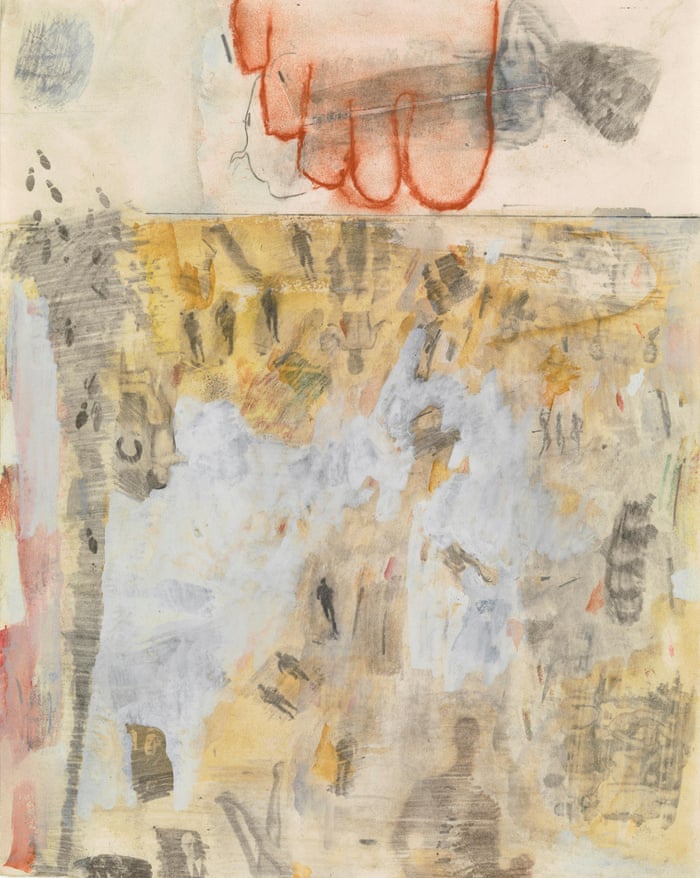
Canto XIV: Circle Seven, Round 3, The Violent Against God, Nature, and Art, from the series Thirty-Four Illustrations for Dante’s Inferno, 1959-60

Just when you think you have the measure of him, he is off again. Weaving and feinting through the years, via artistic collaborations and relationships (with Jasper Johns and Merce Cunningham, with Cage and Warhol, with dancers and scientists), stepping aside from the mainstream and going his own way, Rauschenberg stayed ahead of the pack.

Accounting for the dramatic shifts that accompanied his insatiable curiosity, the exhibition risks incoherence, or diminishing the variety of his art and preoccupations in favour of an abbreviated and smoothed-out pocket-book history. Yet the show maintains surprise, even though he was so prolific that much is missing.
​Robert Rauschenberg Retroactive II 1964, Museum of Contemporary Art (Chicago)
Retroactive II, 1964

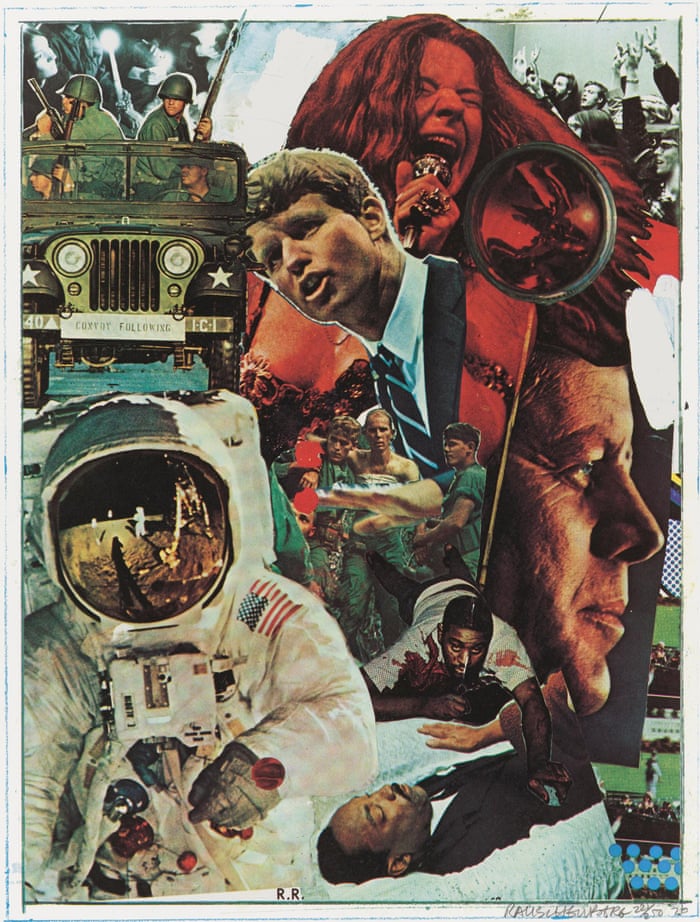
His art used what was around him, repurposing and recontextualising the everyday. Rauschenberg could be downbeat and beat-up, he could be slick and sharp and glossy, or move from the glutinous red paintings to the sheer, glamorous surfaces of the silkscreen paintings, with their blown up images of Jack Kennedy, old masters and astronauts. He adumbrated the flavour of his times.
Robert Rauschenberg, Monogram, 1988-56, Moderna Museet, Stockholm
Monogram, 1955-59

“What was great about the 50s,” remarked American composer Morton Feldman, “is that for one brief moment – maybe say six weeks – nobody understood art.” But somehow Rauschenberg kept definitions at bay throughout his career, allowing himself less the task of understanding than that of making. Sometimes it must have seemed as if his art almost made itself. He never tried to sew things up. That is the unenviable job of exhibitions.
Robert Rauschenberg, Untitled (Spread), 1983, The Robert Rauschenberg Foundation (New York)
Untitled (Spread), 1983

Other Rauschenberg shows have afforded a tighter view; here we see the man in full, or as near as we can get. This retrospective considers the variety and development of Rauschenberg’s art over almost six decades. While his relationships with other artists remain key, it is his own achievement that counts. Never has the phrase “losing yourself in the work”, the ego suspended, felt so appropriate as with Rauschenberg, who said he never had the equivalent of writer’s block. Even when he was caught for years in cycles of drinking and depression, the work went on: umbrellas and parachutes, full-body X-rays, dead radios and stopped clocks, tin cans, dead presidents, dances and pratfalls.

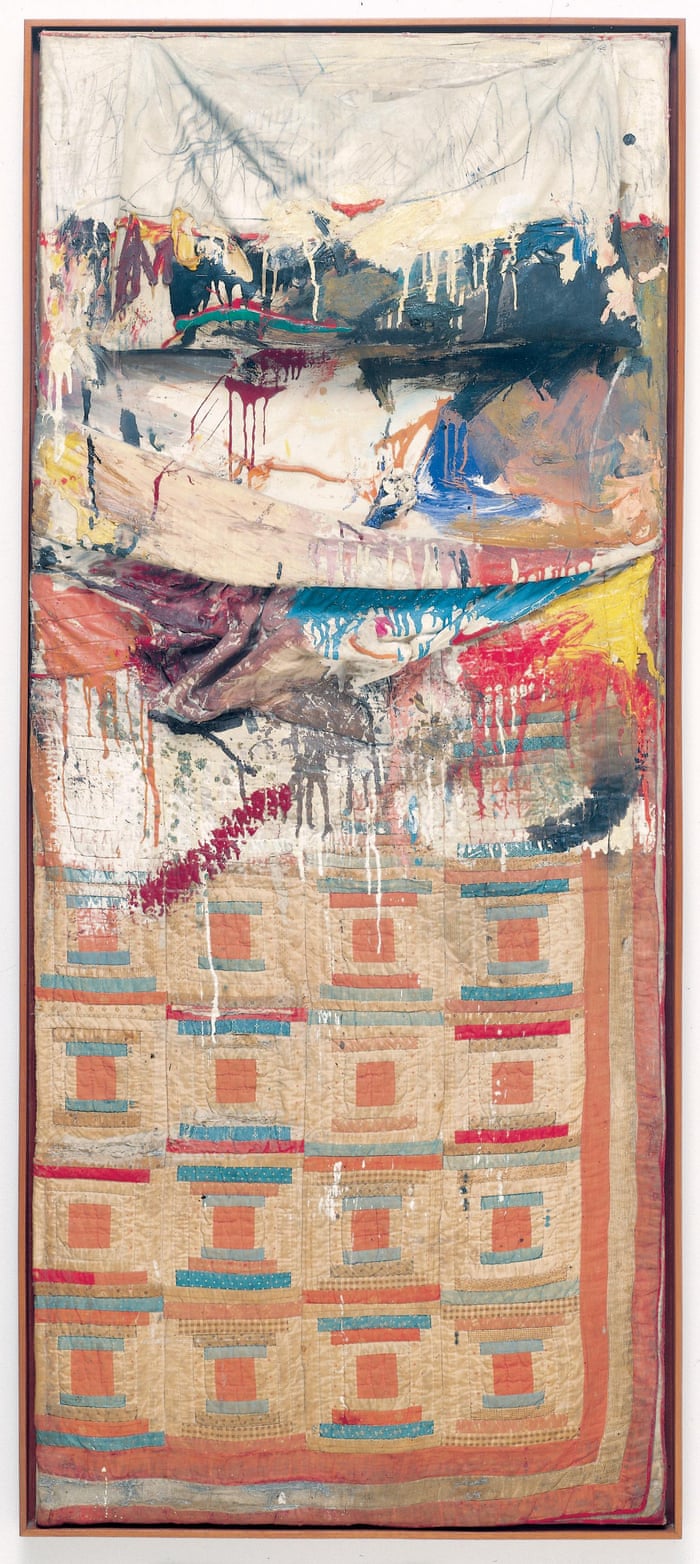
Bed, 1955

There is a painting made with a real sheet, quilt and pillow, like a gloriously squalid and filthy painter’s lie-in. He made paintings incorporating handkerchiefs, parasols; one has a plaster dog tethered to it. There are two almost identical paintings – even the paint smears and drips are the same. The same, but different. I spent ages staring from one to the other. I found myself stuttering between one moment and the next.

Another incorporates a One Way street sign, pointing out of the picture, redirecting our attention away from art and back to real life, a place where illusions end and life begins. Go on doing this sort of thing too long and the gags become boringly rhetorical. So he stopped making them.
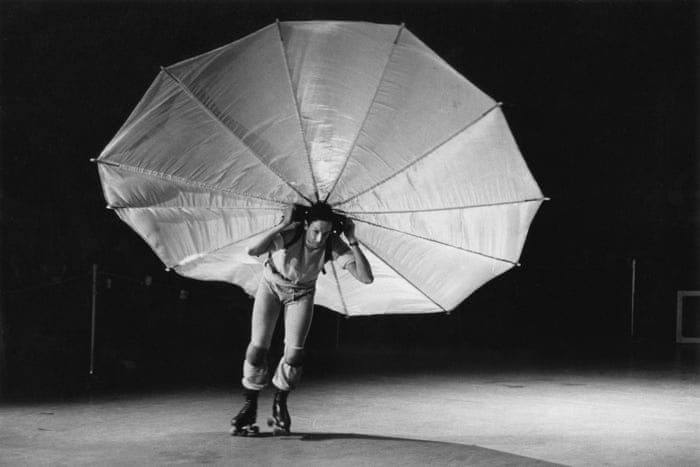
Pelican, from 1963, in which Rauschenberg rollerskated

Rauschenberg’s restlessness and curiosity are invigorating. One minute he is in the studio, the next painting on stage with Merce Cunningham, or careening about in his own dance piece on roller skates, or making an artwork on a microchip to be sent into space. The filmed performances in the show are tantalising glimpses of an art that was lived.

Signs, 1970

Mourning JFK, Martin Luther King and Janis Joplin, he spliced their images with borrowed images of the war in Vietnam, peace protesters and race-riots. Commissioned as a Time magazine cover in 1970, it was rejected, as if the montage were too much. It was the 60s itself that was the problem. After this comes a light-filled room of eviscerated cardboard packaging, opened-up boxes and hanging fabrics, abstractions as lovely and sparse as the earlier works were dense and complicated. Rauschenberg’s works from the 70s seem a deliberate counterpoint, as relaxed as they were terse.

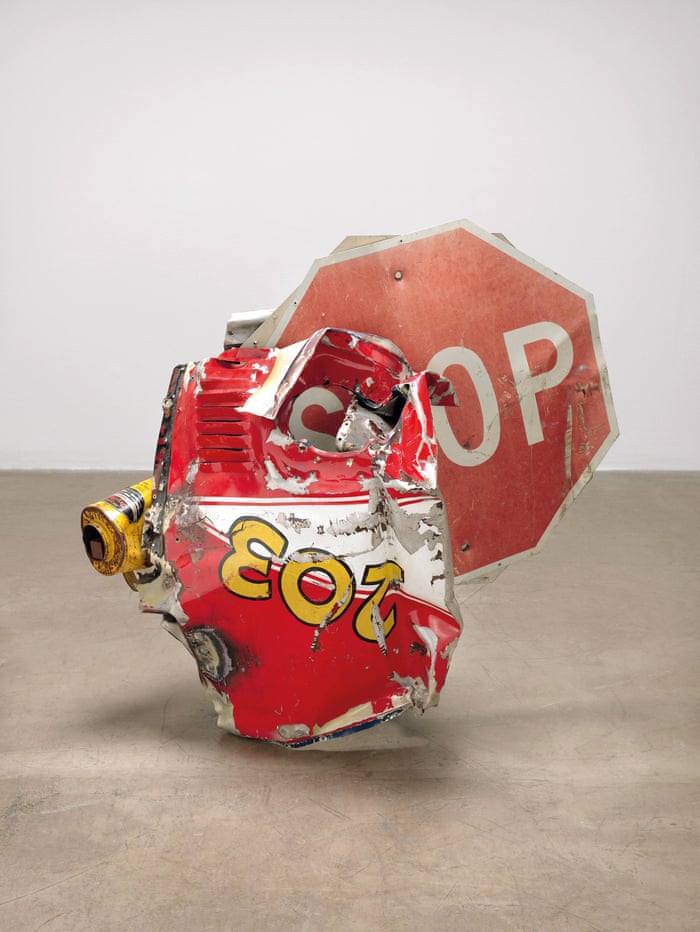
Stop Side Early Winter glut, 1987

Then he starts recomplicating things again, revving up after letting go, travelling, taking photographs, rescuing bits of mangled metal and letting them stand for themselves. The inkjet paintings in the last room, with their juddering montages of photographic imagery, both hark back to the density of his combines and silkscreen paintings, and predict the visual and mental cacophonies of the internet age, which was only just beginning in the artist’s last years.
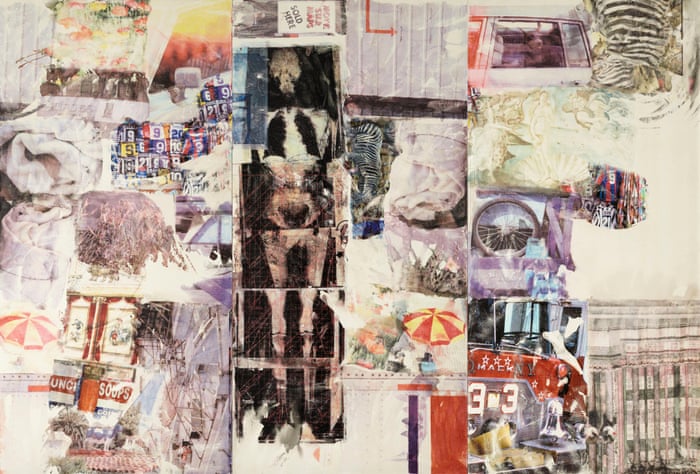
Robert Rauschenberg Mirthday Man [Anagram (A Pun)] 1997

 In one late work a skeleton X-ray is surrounded and besieged by a welter of signs and snapshots: a zebra drinking, a wall calendar’s flurry of expired dates. Rauschenberg’s art is still timely. It’s time.

• Robert Rauschenberg is at Tate Modern, London, 1 December to 2 April.

Monday, 5 December 2016

Los Lobos at The Fillmore 2016 - review

Image result for los lobos at the fillmore 2016
Los Lobos - Fillmore Auditorium, San Francisco, 2nd December 2016

Richard Perdik
4 December 2016

For many years, the hottest ticket in town in San Francisco for the first weekend in December has been the annual Los Lobos Fillmore shows. Now legendary amongst Lobos fans, the shows are a get together where people can celebrate this most under rated and hard working of rock bands.

Your reviewer, an 18 year veteran of these events, has seen many a memorable evening. Back in the day, there was both a Friday and Saturday show, often with different support. Past guests have included Calexico, Dave Alvin and David Lindley.

The last couple of years have seen a single show with LL performing two extended sets, which was the case this year - a potential sensory delight.

The Fillmore is the closest thing to musical history in San Francisco, and it is always a treat to arrive early and view the poster room, replete with posters from the venue's past. Walls are covered with posters from the 60's through to the present day, and including just about every conceivable artist from the Dead, Byrds, Janis Joplin, Jefferson Airplane et al...Taking a look around the audience, it's easy to believe they were present then as well...

The band eventually took the stage through a veritable fog of pot smoke, and from the opening notes of "Will the Wolf Survive?" to the final extended cover of the Grateful Dead's "Bertha", they gave a near flawless performance, laced with little played gems from their back catalogue, as well as a few well chosen covers.

For anyone familiar with LL by way of the hit single La Bamba, it is worth stressing what a multi-faceted band they are, with live performances ranging from traditional acoustic Mexican music through to Ritchie Valens covers and onward into blues laced rock. This show rocked. After all, the core of the band, guitarists Cesar Rosas, David Hidalgo and Louie Perez, along with bass player Conrad Lozano have been together 43 years; newcomer Steve Berlin on sax and keyboard, a mere 32. Touring drummer Bugs Gonzales is probably a couple of generations younger...

Mostly Hidalgo gets the plaudits for his searing lead guitar work, followed closely by Rosas, who in any other band would be the star guitarist. Perez splits his time between drums and guitar, specialising in the jarana, a small Mexican acoustic guitar, whilst Berlin contributes jazz laced sax and keyboard. The heartbeat of the band is the beaming Conrad Lozano, surely the happiest bass player around, pounding his Fender bass. At the end of each set he looks down at his fingers as if to say "how much longer can I do this for?"

By the end of the night, the audience have heard two 1.5 hour sets of intense, focused
playing. The Fillmore shows give the band an opportunity to stretch out and escape the shorter format festival sets; they can indulge in jam sessions and show off a bit. The audience love it of course, and that's why the Fillmore shows are special.

Maybe it was a combination of the pot smoke and tincture, but this was probably the best ever...but then again, I say that every year...

Saturday, 3 December 2016

Andrew Sachs RIP

Image result for andrew sachs guardian
Andrew Sachs obituary
Actor renowned for his role as the hapless Manuel in Fawlty Towers

Dennis Barker
The Guardian
Friday 2 December 2016

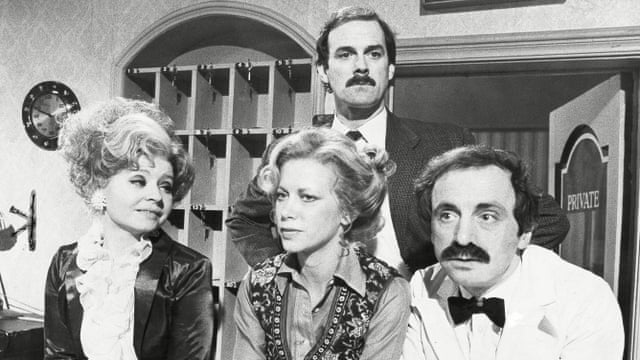
Andrew Sachs, who has died aged 86, was never more effective than when playing a bewildered victim unfailingly eager to please his sometimes equally comic tormentors. The most popular and inspired example came in the role of Manuel, the waiter from Barcelona who spent most of his waking hours being abused by Basil Fawlty (John Cleese) in the BBC’s Fawlty Towers (1975-79). Manuel – short, shoulders sloping in submission – was a star of the television show, which attracted more than 15 million viewers and became a comedy classic.

Sachs was grateful to Manuel for making him famous, but often counted the cost. He tried to persuade Cleese, who co-wrote the series, to stop short of actual violence in rehearsals, but there was still plenty of hitting – often involving a spoon on the head.

One memorable episode had Manuel setting fire to himself and later, as a reprise, emerging from the hotel kitchen with smoke billowing behind him. The “fire” was heat-free, but some of the chemicals used to produce the flameless smoke caused acid burns to his arms. Nonetheless, Sachs still felt that Manuel was the best thing that ever happened to him.

Andreas Sachs was born in Berlin at the time when the Nazis were beginning to persecute Jews. His father, Hans, was a Jewish insurance broker who had been awarded the Iron Cross in the first world war. His mother, Katharina (nee Schrott-Fiecht), a Catholic, decided to remain in Berlin with her children after their father fled to Britain in 1938. She thought that as her son was only half-Jewish he would be safe – a supposition that became increasingly shaky.

The family eventually joined Hans, who died in 1944. Andrew left William Ellis school, north-west London, two years later, then went to a local acting school for just two terms, before making his first professional appearance in 1947 in a seaside repertory production of Ronald Millar’s Frieda at the De La Warr Pavilion, Bexhill-on-Sea, East Sussex.

The play concerned the German bride of a British soldier who finds a mixed reception in the postwar UK. Sachs put the essence of his art down to detachment, an ability to sit on emotional and intellectual fences that had been produced by his birth in Germany and his residence in Britain.

He admitted that he had at first wanted to act in order to be a “star” and only later had discovered that he was motivated to do the work for its own sake. The outcome was a wide range of stage parts, from romps of the No Sex Please: We’re British, Not Now Darling, Dry Rot and Let Sleeping Wives Lie genre to John Mortimer’s touching A Voyage Round My Father, Shakespeare’s Twelfth Night and, for BBC TV, The Tempest, as Trinculo in a 1980 production led by Michael Hordern as Prospero.

After undertaking national service in the Royal Armoured Corps (1949-51), for the next couple of years Sachs was in repertory in Worthing and Liverpool. His first West End appearance was at the Whitehall theatre as Grobchick in John Chapman’s Simple Spymen, which ran for more than 1,200 performances between 1958 and 1961. Recruited by Brian Rix, he gained his introduction to Whitehall farces, which supported him for 20 years until his television work brought him wider fame.

Following Fawlty Towers, he played a vague and bespectacled vicar in the ITV series Lovely Couple (1979). His films included Hitler: The Last Ten Days (1973), Revenge of the Pink Panther (1978) and Consuming Passions (1988).

Sachs was also a writer, contributing sketches to the Yorkshire TV series Took and Co (1977), with Barry Took, but never made a mark in that activity. He wrote radio plays, including one without words, Revenge (1978), in which an escaped prisoner communicates with the audience only by his heavy breathing, running footsteps and other special effects.

His stage play The Stamp Collectors was produced in Worthing in 1977. Another, Made in Heaven, staged at Chichester two years previously, was said by Michael Billington of the Guardian to be the product of random jokiness rather than a sustained comic vision.

Fortunately his acting was better received. His performances in Fawlty Towers gained him the Variety Club of Great Britain award for most promising artist of the year in 1977, although he was no youth. He became a familiar face on television through the 80s and 90s, taking the title role, Alfred Polly, in the BBC version of HG Wells’s comic tale The History of Mr Polly (1980), and in Every Silver Lining (1993), a sitcom in which he played opposite Frances de la Tour.

Detective stories on BBC Radio 4 provided a rich seam. Sachs took the role of GK Chesterton’s Father Brown (1984-86), and played Dr Watson to Clive Merrison’s Sherlock Holmes (2002-10). Radio was a favourite medium of his, and brought the opportunity to play another great scene-stealing subordinate, PG Wodehouse’s Jeeves, valet to the upper-class buffoon Bertie Wooster, played by Marcus Brigstocke, in The Code of the Woosters (2006).

He also supplied the voices for several children’s animations, such as William’s Wish Wellingtons (1994-96), and Asterix and the Big Fight (1989). A popular narrator with a distinctive voice, Sachs can be heard on all five series of BBC’s Bafta award-winning TV show about business life, Troubleshooter, as well as two audiobooks of Thomas the Tank Engine and Friends. In 2000 he reached a new comedy audience by narrating That Peter Kay Thing, a spoof documentary series on Channel 4 created by the Bolton comedian. He also appeared in Coronation Street (2009), playing Norris Cole’s brother, Ramsay, in 27 episodes.

All his roles seemed to be marked by good nature, and this made him a much-liked figure. He retained it even under provocation, when, in 2008, rowdy telephone answering machine messages were left for him by Russell Brand and Jonathan Ross during Brand’s BBC Radio 2 show. At one point Ross shouted out that Brand had “fucked your granddaughter”. The result was recorded and then passed by BBC executives for broadcasting. Sachs was not amused and the public sympathised.

So seriously was the Ross-Brand incident regarded by the BBC top brass that Ross was taken off air for three months, effectively fining him £1.5m from his £6m yearly contract. In the subsequent media inquest, the attitude of Sachs himself was that he really did not know what the telephoning had been about; that he had no personal animosity towards whoever had phoned; and that he had scarcely noticed the whole business since his wife was in hospital at the time. As for suggestions that some newspapers were using him to boost their circulations, he said: “Oh yes, but that’s their job.” He also said: “My profile’s up – great! They did me good. Thank you very much.”

At the time he had written 40,000 words of his autobiography but had only got as far as the age of 14. He said he doubted whether Brand or Ross would play a prominent part in the book. When it appeared in 2014, he drew on a memorable Fawlty Towers line for the title, I Know Nothing!

His final film role came in Quartet, Ronald Harwood’s story set in a home for retired musicians, directed by Dustin Hoffman and released in 2012, the year that Sachs was diagnosed with vascular dementia. His final TV role was in 2015, as Cyril Bishop in EastEnders.

In 1960 Sachs married the actor Melody Lang. She survives him, along with their daughter, Kate, and sons, Bill and John.

• Andrew (Andreas Siegfried) Sachs, actor and writer, born 7 April 1930; died 23 November 2016

Friday, 2 December 2016

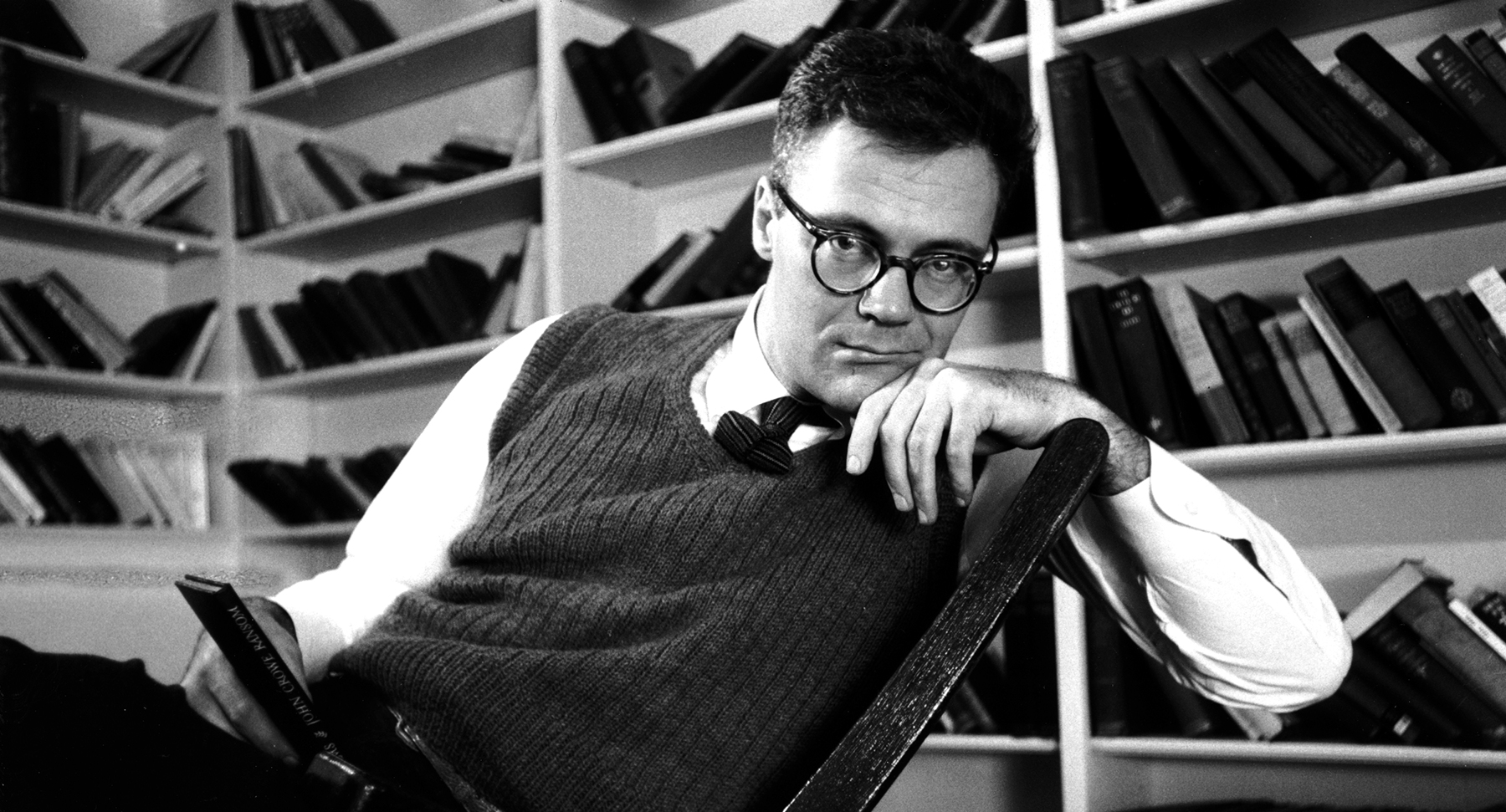
Dead Poets Society #18 Robert Lowell: For the Union Dead

Image result for robert lowell

For The Union Dead by Robert Lowell

Relinquunt Ommia Servare Rem Publicam.

The old South Boston Aquarium stands
in a Sahara of snow now. Its broken windows are boarded.
The bronze weathervane cod has lost half its scales.
The airy tanks are dry.

Once my nose crawled like a snail on the glass;
my hand tingled to burst the bubbles
drifting from the noses of the cowed, compliant fish.

My hand draws back. I often sign still
for the dark downward and vegetating kingdom
of the fish and reptile. One morning last March,
I pressed against the new barbed and galvanized

fence on the Boston Common. Behind their cage,
yellow dinosaur steamshovels were grunting
as they cropped up tons of mush and grass
to gouge their underworld garage.

Parking spaces luxuriate like civic
sandpiles in the heart of Boston.
a girdle of orange, Puritan-pumpkin colored girders
braces the tingling Statehouse,

shaking over the excavations, as it faces Colonel Shaw
and his bell-cheeked Negro infantry
on St. Gaudens' shaking Civil War relief,
propped by a plank splint against the garage's earthquake.

Two months after marching through Boston,
half of the regiment was dead;
at the dedication,
William James could almost hear the bronze Negroes breathe.

Their monument sticks like a fishbone
in the city's throat.
Its Colonel is as lean
as a compass-needle.

He has an angry wrenlike vigilance,
a greyhound's gentle tautness;
he seems to wince at pleasure,
and suffocate for privacy.

He is out of bounds now. He rejoices in man's lovely,
peculiar power to choose life and die-
when he leads his black soldiers to death,
he cannot bend his back.

On a thousand small town New England greens
the old white churches hold their air
of sparse, sincere rebellion; frayed flags
quilt the graveyards of the Grand Army of the Republic

The stone statutes of the abstract Union Soldier
grow slimmer and younger each year-
wasp-waisted, they doze over muskets
and muse through their sideburns…

Shaw's father wanted no monument
except the ditch,
where his son's body was thrown
and lost with his 'niggers.'

The ditch is nearer.
There are no statutes for the last war here;
on Boylston Street, a commercial photograph
shows Hiroshima boiling

over a Mosler Safe, the 'Rock of Ages'
that survived the blast. Space is nearer.
when I crouch to my television set,
the drained faces of Negro school-children rise like balloons.

Colonel Shaw
is riding on his bubble,
he waits
for the blessed break.

The Aquarium is gone. Everywhere,
giant finned cars nose forward like fish;
a savage servility
slides by on grease.


Thursday, 1 December 2016

Last night's set lists


At The Habit, York: -

Ron Elderly: -
Dock Of The Bay
Dedicated Follower Of Fashion
Just My Imagination


Da Elderly: -
Romancing Tonight (new song)
Swinging On A Star
Out On The Weekend


The Elderly Brothers: -
When Will I Be Loved
Bus Stop
Out Of Time
You Really Got A Hold On Me
If I Fell
I Saw Her Standing There


A busy-ish night, certainly for the first 2 hours, when the bar was full; including a dozen or more visitors from Norway. A lass from the Norwegian party got up and played a couple of songs and nearly brought the house down - great stuff! There was also a visitor from Nashville who took the opportunity to flog her CDs. Dave from Leeds performed his self-penned tribute to John Lennon (anniversary on 8 Dec) bookended with the more tasteful lines from Working Class Hero.

Yours truly introduced a new song (written on Monday afternoon - still a bit rough round the edges, but worth finishing properly) and an old favourite "would you like to swing on a star, carry moonbeams home in a jar.....etc".