Friday, 9 January 2015

Rod Taylor RIP

Rod Taylor obituary
Film actor who excelled in tough-guy roles but had a softer side

Ronald Bergan
Friday 9 January 2015

Rod Taylor, who has died aged 84, was a movie star of some magnitude who never achieved superstar status. He co-starred with Doris Day (twice), Jane Fonda, Rock Hudson and John Wayne; had leading roles in films by directors such as Alfred Hitchcock (The Birds, 1963) and Michelangelo Antonioni (Zabriskie Point, 1970); and starred in the perennially popular science-fiction classic The Time Machine (1960). Yet, at the height of Taylor’s career, 20th Century Fox turned him down for the astronaut role in Planet of the Apes (1968), giving it to Charlton Heston, because they considered him a bigger box-office name.

Perhaps Taylor, handsome and with the build of a rugby forward, missed top billing because he was rarely able to demonstrate his flair for playing light comedy, having been too frequently called upon to be stolid and macho – traits that nevertheless made him an ideal action hero in war films and westerns.

He was born in Sydney, Australia, the only child of William Sturt Taylor, a steel construction contractor, and his wife, Mona (nee Thompson), a writer. The name Sturt came from a celebrated forebear, Captain Charles Sturt, a British explorer of the Australian outback in the 19th century. Taylor would make his film debut in a short called Inland With Sturt (1951) about his ancestor.

Taylor attended Parramatta high school in Sydney and studied at East Sydney Technical College before deciding to become an actor on seeing Laurence Olivier in the Old Vic touring company in Australia in 1948. His acting career in his homeland was focused on radio, though he did make two feature films, King of the Coral Sea (1953) and Long John Silver (1954), the latter with Robert Newton doing his famous rolling-eyed interpretation of the title role for the third and last time. Taylor later made an imitation of Newton one of his party pieces.

In 1954, Taylor won an award as best Australian radio actor, which included a paid trip to London via Los Angeles. He stayed in LA with the hope of making it in Hollywood movies. Almost immediately, he got small parts in The Virgin Queen, Hell on Frisco Bay and Top Gun (all in 1955) and a lead in World Without End (1956). The last of these was a rather tacky, loose version of HG Wells’s The Time Machine, with Taylor as a stalwart astronaut entering a time warp – a good rehearsal for his role in the more faithful adaptation four years later.

In 1956, he was screen-tested for the part of the boxer Rocky Graziano in MGM’s Somebody Up There Likes Me (1956), after James Dean, who was to have starred, was killed in a car crash. Although Paul Newman got the role, Taylor impressed the studio enough for them to offer him a significant part in The Catered Affair (aka Wedding Breakfast, 1956) in which, occasionally wearing glasses as a signifier of intellect, he played Ralph, the middle-class fiance of working-class Jane (Debbie Reynolds). “The Brooklyn accent I put on during the test so convinced the producers that I was from New York that they cast me as a Bronx boy. They didn’t know I was just 18 months out of Australia until the movie was half finished,” he said.

In the same year, in Giant, he had a small role as Elizabeth Taylor’s aristocratic English suitor, whom she throws over for a Texas millionaire (Rock Hudson). The two Taylors were together again in Raintree County (1957), she as a southern belle, he as a sleazy politician, the bete noire of a sensitive abolitionist (Montgomery Clift). In Separate Tables (1958), he and Audrey Dalton, as a young honeymoon couple, were closer to the subtle merits of Terence Rattigan’s original stage opus than the rest of the starry cast that included Burt Lancaster, David Niven, Deborah Kerr and Rita Hayworth as guests at a genteel English seaside guesthouse.

Ask Any Girl (1959) gave Taylor, though no Cary Grant, one of his few opportunities to play in a romantic comedy, which he did ably. Here he is delightfully caddish as a businessman who attempts to seduce naive Shirley MacLaine by taking her up to his aunt and uncle’s place in the country for the weekend, and forgetting to tell her they will be alone.

Among his other rare comedies were Sunday in New York (1963), in which the tables are turned when Fonda tries to get him into bed; and two lightweight Day vehicles, Do Not Disturb (1965), in which she pretends to make her husband (Taylor) jealous because she thinks he’s having an affair, and The Glass Bottom Boat (1966), a spy spoof with Taylor as a research scientist who literally hooks Day while she’s swimming in a mermaid suit.

By then Taylor had established himself as a reliable tough-guy leading man in films such as A Gathering of Eagles (1963) and Fate is the Hunter (1964), in both of which he played pilots. He portrayed one of his rare Australian characters, a self-made industrialist secretly adored by his mousy secretary (Maggie Smith) in the jet-set entertainment The VIPs (1963).

However, his role as George Wells, a Victorian inventor, in George Pal’s The Time Machine was among his most memorable and a personal favourite. The film, which won an Oscar for its special effects, follows the valiant, square-jawed Taylor into the horrors of the future, through two world wars and atomic destruction (in 1966), stopping in the year 802,701, when he helps defeat the hideous, underground-dwelling Morlocks. Three years after The Time Machine, Taylor found himself manfully fighting off a swarm of crazed gulls, crows, sparrows, and more in The Birds, after attempting to melt the heart of a young socialite (Tippi Hedren).

Taylor did not seem ideal to play the Irish playwright Sean O’Casey in Young Cassidy (1965), but in it he gave perhaps his best performance, skilfully combining strength and sensitivity. But from 1967 onwards Taylor honed his persona as an action man, with archetypal performances as a hardened professional gunfighter in Chuka (1967), which he also produced; the ruthless army captain sorting out the civil war in the Congo in The Mercenaries (aka Dark of the Sun, 1968); a laid-back gunslinger hired by Wayne in The Train Robbers (1973); and two “heavies”, a sneering cold-blooded killer in The Deadly Trackers (1973) and a wicked entrepreneur at the beginning of the 20th century in Australia in The Picture Show Man (1977). Antonioni wanted Taylor for the nasty capitalist in Zabriskie Point precisely because he could be aloof and steely.

In the 1980s, though he was seen frequently on television, including a 30-episode stint in the soap opera Falcon Crest (1988-90) as Frank Agretti, the long-suffering third husband of Angela Channing (Jane Wyman), the tyrannical owner of the eponymous wine-making estate, Taylor went into semi-retirement. “Pretending to still be the tough man of action isn’t dignified for me any more,” he told an interviewer in 1987. “There comes a time when you’re over the hill and there are plenty of great-looking younger actors who can take your place. The younger they come, the better they get. That’s why Olympic records are broken.”

Quentin Tarantino, a long-time fan of the actor, gave Taylor the cameo role of Winston Churchill in Inglourious Basterds (2009).

Taylor is survived by his third wife, Carol, and a daughter, Felicia, from his second marriage.

• Rodney Sturt Taylor, actor, born 11 January 1930; died 7 January 2015

http://www.theguardian.com/film/2015/jan/09/rod-taylor

Thursday, 8 January 2015

Last night's set lists

At The Habit, York: -

Ron Elderly: -
Autumn Leaves
Make You Feel My Love
Sunny Afternoon
My Girl

Da Elderly: -
I'm Just A Loser
Out Of The Blue
Long May You Run
On The Beach

The Elderly Brothers: -
Walk Right Back
Bird Dog
Crying In The Rain
Never Be Anyone Else But You
Green, Green Grass Of Home

The now customary slow start greeted the first open mic of 2015, yielding solo spots for the Elderlys early on. By close the place was buzzing with plenty of players and punters. There will be no open mics for the next fortnight as The Habit is closing midweek to have the wooden floor replaced.

Wednesday, 7 January 2015

Meeting Dennis Wilson...

Brother Dennis Finally Gets His Due

Michael Fremer

Dennis Wilson didn't sing very well in the conventional sense of the word: his pitch was frequently off, he warbled, his vocal timbre was raspy and calling his range 'limited' would be an overstatement.

Yet his commitment to communicating his feelings, which were often downcast but ever hopeful, overcame has limitations. Still, in order to enjoy this tribute you'll need to come to grips with the fact that Wilson's singing abilities were limited and his mood was bluer than the ocean.

The only Beach Boy who personified the Beach Boy image of sun, surfing, girls, cars and sex (the screaming at Beach Boy concerts was all aimed at Dennis) was the least talented in the conventional sense of the word, yet the artistry that coursed through the Wilson family's genes was present in Dennis who, because of his limited musical training and his troubled temperament, found expression in its rawest, most pure form, as this set demonstrates.

Listen to 'Fairwell My Friend' and you'll know. It's a song dedicated to a friend's father, who had been a member of the fragile singer's support system.

There wouldn't be a Dennis Wilson solo album (the first Beach Boy solo album, released in September of 1977 on James William Guercio's Caribou Records, distributed by Columbia) without the support of his many friends, who participated and contributed not out of pity or sympathy, but because they genuinely believed in his talents. They also knew that without their support there wouldn't be a Dennis solo album: he was simply too broken.

Now this record review will become personal: I met Dennis Wilson once, but before getting to that, looking through the credits I found many familiar names of people I'd not thought about in decades.

Among the guitarists was Ed Tuleja. He had the first Telecaster I'd ever seen live. It was at Cornell in the basement of University Halls #3 my freshman year, 1964. Tuleja was in a group called Oz and the Ends fronted by another freshman, Ozzie Ahlers. The first song I heard them rehearse was called '(Everybody learn to) Master the Bate.' In fact, I recorded it (in stereo) but the damn tape disappeared from my apartment around 1977. I wish I still had it!

I was the first floor's resident audio dweeb and lived across the hall from the group's bassist Peter Truitt, who asked me to help them with their P.A.. They had meager resources and couldn't afford a decent horn-based speaker system. All they could afford was a really crappy Radio Shack dynamic driver-based system that barely cut the vocals through the instrumental din. I felt I'd let them down, but that was all they could afford.

Anyway, Ozzie and Ed were really good players, even back then at 17 or 18, so I'm not surprised they both stayed in music. My most vivid memory of Ed Tuleja was walking down the stairs at the student union, Willard Straight Hall, into the Ivy Room, which at the time was the cafeteria and lunch-time hangout for the entire campus, and hearing for the very first time, The Byrds' version of 'Turn, Turn, Turn.' Both of us melted on the spot as the tune played on the jukebox, barely audible above the noisy cafeteria din. Then we parted and went to our assigned segregated tables in the rigid fraternity hierarchy.

Keyboardist Ron Altbach also was at Cornell and hung around the Oz and the Ends rehearsals. He plays accordion on this Wilson album and his name can be found on other Wilson family projects.

Oh, another familiar name was the late arranger Jimmie Haskell's. Haskell wrote and arranged all of the musical links on the animated film 'Animalypics' that I'd co-written and on which I did voices along with Gilda Radner, Billy Crystal and Harry Shearer.

So how did I meet Dennis Wilson? Well, that's a long, somewhat sordid and embarrassing story that puts no one in a good light, but here goes: I had this troubled friend I'd met at a poker game in L.A. in the early '80s attended by, among others, the rock critic and cultural commentator Richard Meltzer, who I'd met years before in New York.

Meltzer memorably wrote an autobiography, the first sentence of which was 'I wouldn't fuck my mother with a ten foot pole.' Meltzer kept a parrot in his New York apartment that liked to perch on the fireplace mantle. The parrot would just sit there and of course left droppings. The droppings formed a massive (and disgusting!) stalactite that clung to the side of the fireplace, eventually making its way onto the hearth.

Rather than cleaning it up, Meltzer chose to put newspaper paper down on the hearth. Eventually, the guano overflowed onto the wood floor. Meltzer spread more newspaper on the floor to catch the growing guano flow. Why bring up the parrot? Why not? It's not something you see every day and Meltzer wasn't someone you met every day either.

Flash forward a few years to the poker party and this guy I'd never met needed a ride home to Santa Monica, which was near Venice, where I lived. We got back to his place and after looking through his record collection I realized we'd end up friends, which we did, despite his many eccentricities and oddities that I won't go into here.

One night he killed himself in his car (a real Mini-Cooper, of which he had two) in the parking lot at Will

Rogers State Park by putting the barrel of a 357 Magnum in his mouth and pulling the trigger—not before injecting his two dogs with poison.

I found out the next morning because he left a package on my porch before driving to the Pacific Ocean beach front park, containing a long suicide note in which he thanked me for our friendship and instructed me to call all of his friends and inform them of his demise and for us to all meet at his house where we'd find all of his possessions labeled as to who would get what. Not surprisingly, I got all of his records, including his rather extensive Hendrix bootleg collection.

He also left me, in that package containing the suicide note, an ounce of cocaine. Now, back in the early 1980's cocaine was all over Los Angeles (and New York and Boston and') and I'm not going to try and tell you that I'd never seen it or done it because I had.

In fact, when Eric Clapton's Slowhand album was released, the one with J.J. Cale's song 'Cocaine' on it, one of the record label's promo tchotzkes was a cigar box containing a razor blade, a cut off plastic straw and a gram vial with the obligatory chain and coke spoon attached. That's from a major record label!. That's how crazy it was.

Most everyone I knew in the record biz (and out of the record biz) was tooting away on a regular basis. That said, I'd never before seen an entire ounce of the stuff. I told a few friends of mine about it because the last thing I wanted to have sitting around my apartment was an ounce of cocaine, yet I couldn't bring myself to just flush it. I'm not going to lie to you: I did some and in small amounts I enjoyed the lift. I never really got my kicks from the stuff and never got heavily involved. I'm jumpy enough as it is!

I started giving it away to people I knew who would enjoy it. Within a few days of making known to a few friends that I had the stash, I got a knock on my door and there was Dennis Wilson. If that doesn't show you how fucking dangerous and addicting that stuff is—that a well-known guy would knock on the door of a total stranger and humiliate himself to get some free toot—I don't know what would!

I'll never forget the encounter: Wilson charmed his way into my apartment as if we were best friends. I immediately knew why he was there, of course, but he didn't ask for it right away. He began by pouring through my record collection. We played some tunes and talked about music for a while. It was bizarre, it was fun and of course it was pathetic for both of us. Couldn't I have met this charming, vital, terribly lost person some other way? Apparently not.

How could someone who had talent, fame, money, good looks and a lifetime's worth of adventure and had probably screwed more beautiful woman in his life than I could even imagine, end up humiliating himself at my door in search of something as lame as cocaine?

Wilson wasn't feverish about it. He didn't act desperate, though of course, the act of justshowing up at my door was desperation. We played tunes for a while and talked about music and then he did something I'll never forget: I had this cheap Casio keyboard. I mean, it was a two and and a half or three feet long toy with a limited range keyboard fitted with tiny keys and a cheesy built-in drum machine. I'd 'played' it for years and gotten less than zero from it.

In Wilson's hands it became a grand piano, a pipe organ, an instrument capable of great musical expressiveness. He played with that Casio for a good ten or fifteen minutes, during which time I stared at his fingers trying to figure out how he managed to wring so much from so little. It was musical alchemy.

I hadn't paid much attention to Pacific Blue when it was first released, thinking of Wilson as the non-talent in the Wilson family, nor had the music-buying public at the time: the record only made it to #96 on the Billboard charts.

In those few minutes during which Dennis Wilson played the Casio I went from thinking of him as a good looking oaf living in his brother's shadow, to thinking of him as someone possessed of great (if woefully unfulfilled) spirit and musical talent.

I also realized he was performing, not out of generosity, but in the hopes of a reward. I obliged by laying out some lines. I wasn't about to have him leave my apartment with anything that could come back to haunt me, but of course I was wrong.

A year later, on December 28th, 1983 he was gone, the victim of an accidental drowning. He was already lost and drowning when I met him and I know that my tiny 'contribution' had little impact on where he was headed, but it haunts me nonetheless.

This three record, triple gatefold set collects the original Pacific Blue album along with two records' worth of un-issued tracks, some from the Pacific Blue sessions but mostly from a follow up album, Bambu that was never completed. Wilson's support system had crumbled with the sale of Brother recording studio and brother Carl Wilson's estrangement.

While the unreleased Pacific Blue tracks and all of Bambu were mixed recently by John Hanlon, a former studio tech at Brother, who went on to become an engineer, the Bambu material is as Dennis Wilson had left it. Rather than being unsatisfying snippets they stand as testament to both Wilson's talents and his darkness.

This reissue is six sides of mostly sadness, regret remorse and confusion. What made Dennis Wilson such a sad soul? Beats me. Perhaps like his talent and that of his brother, his emotional difficulties were entwined in his genes.

Who was Dennis Wilson? Start with 'Piano Variations on Thoughts of You,' the final track on the final side of this triple LP, six side set. As with those few minutes I spent listening to Wilson play that little Casio keyboard, by the time the final notes fade out at the very end of the three minute piece, you'll begin to know.

Both Brother and Caribou (which eventually burnt down) were studios known for producing great sound. You'll hear it in these recordings.

While Wilson's friends were so eager to help him realize his musical dream that they occasionally overwhelmed his vocal contributions, hearing these tracks all these years later is like opening a time capsule out of pours Dennis Wilson's soul, and if you're of a certain age, some of your own that's been locked away in that very perilous time of deep disillusionment and disappointment for a generation that came of age with so much hope in the air.

Monday, 5 January 2015

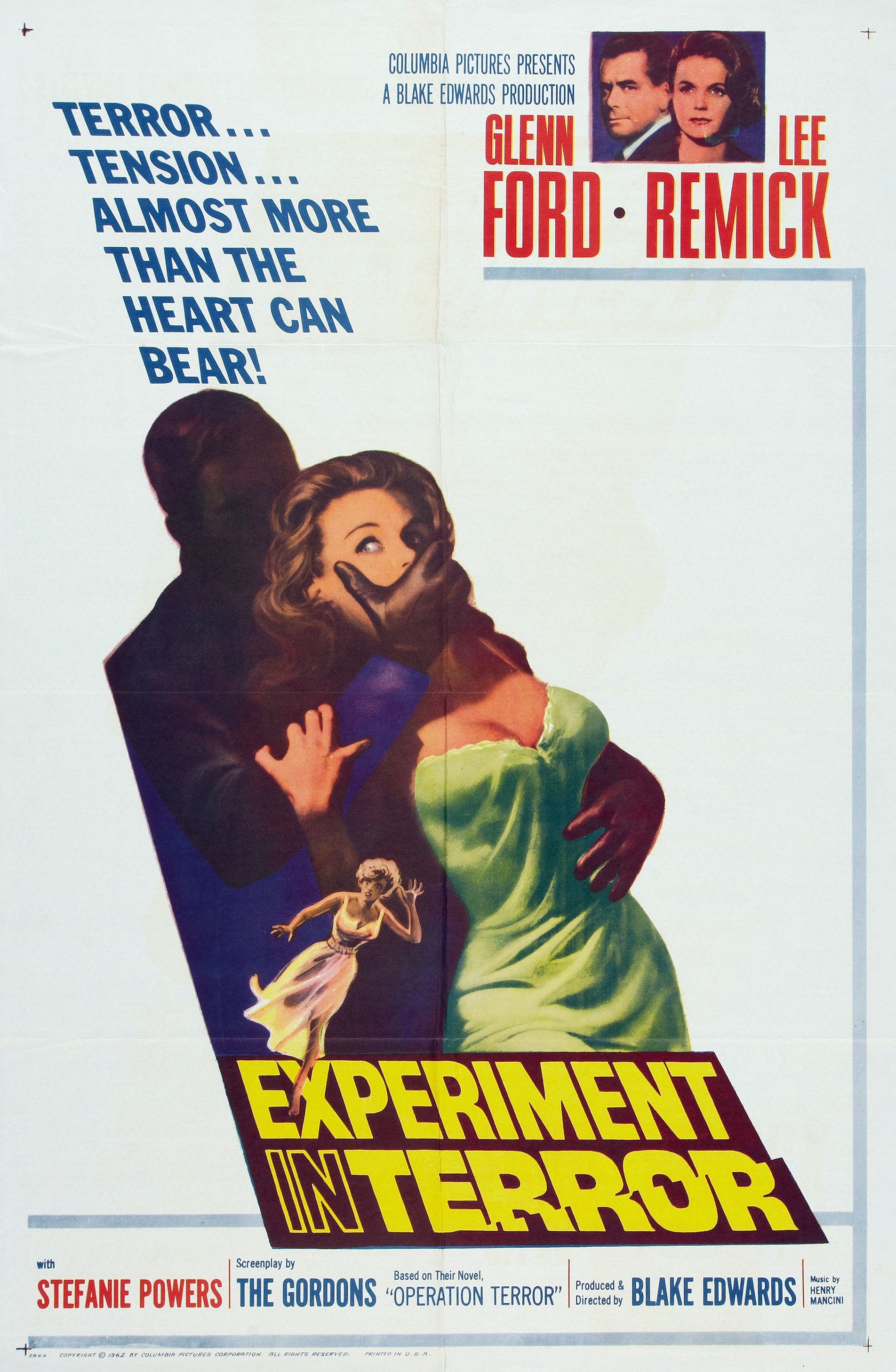
Noir of the Week #3 Experiment in Terror (Blake Edwards, 1962)

Experiment in Terror (1962)

Frank Black
5 January 2015

Mention Blake Edwards and most people will think of the Pink Panther films, a series that started with a nod to the screwball comedies of the thirties and forties and ended up as a sort of bloated, self-indulgent cash-cow for star and director, both of whom struggled to show their true worth in their later films, though both did succeed: Sellers with the intelligently witty Being There (1979) and Edwards with the sophisticated and genuinely funny Victor/Victoria (1982) – though he misguidedly returned to the Panther franchise three times after Sellers’ early death.


Beyond the Panther films, his name conjures up images of Audrey Hepburn in a black figure-hugging dress, smoking sexily with a long cigarette holder in his adaptation of  Truman Capote’s Breakfast at Tiffany’s (1961), but Edwards had a strange career. He made a name for himself with the smart private eye show, Peter Gunn, which ran from 1958-1961. Gunn was an upmarket PI, listening to cool West Coast jazz (the score was by Edwards’ frequent sparring partner, Henry Mancini), charging a standard fee of $1000, some twenty years before Jim Rockford was asking for only $200 a day plus expenses. This wasn’t Edwards’ first foray into this territory; in fact, he developed the Gunn character from his own creation, Richard Diamond, Private Investigator (starring Dick Powell in the radio version (1949-53) and David Janssen on television (1957-1960)).


While his career may be dominated by lighter films, this more dramatic streak runs through works like Mr Cory (1957), Days of Wine and Roses (1962), his excellent elegiac Western, Wild Rovers (1971), The Carey Treatment (1972) and Experiment in Terror (1962).
 
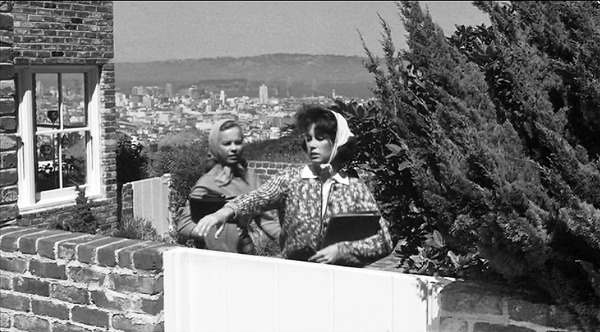
The latter is a neo-noirish thriller set in San Francisco, making excellent use of real locations around the city, not least The Clarendon Heights/Twin Peaks area where the victim/heroine lives and is watched both by the killer and the FBI.


Based on the book, Operation Terror, by Gordon and Mildred Gordon, who also wrote the screenplay, it concerns bank teller Kelly Sherwood (Lee Remick), stalked by an asthmatic killer, Red Lynch (Ross Martin), who – initially at least – is unidentified and who threatens to kill her and her teenage sister Toby (a young Stephanie Powers), unless she helps him rob the bank she works at. 


Despite the fact he knows she has been in contact with FBI agent John Ripley (Glenn Ford), he continues to stalk and torment her until his identity is discovered and the story climaxes in a shootout in a deserted Candlestick Park, following a baseball game.


Here’s the beautifully constructed opening sequence, atmospherically shot by Philip Lathrop and moodily scored by Henry Mancini:


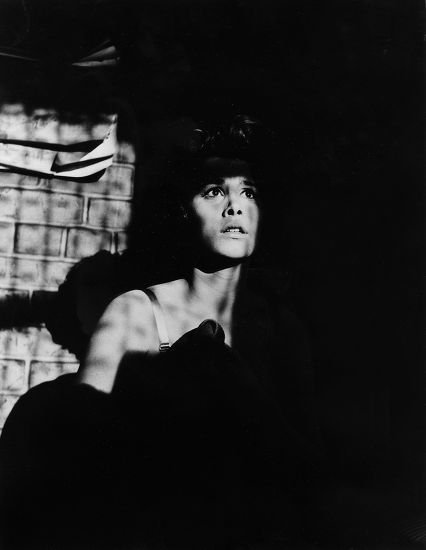
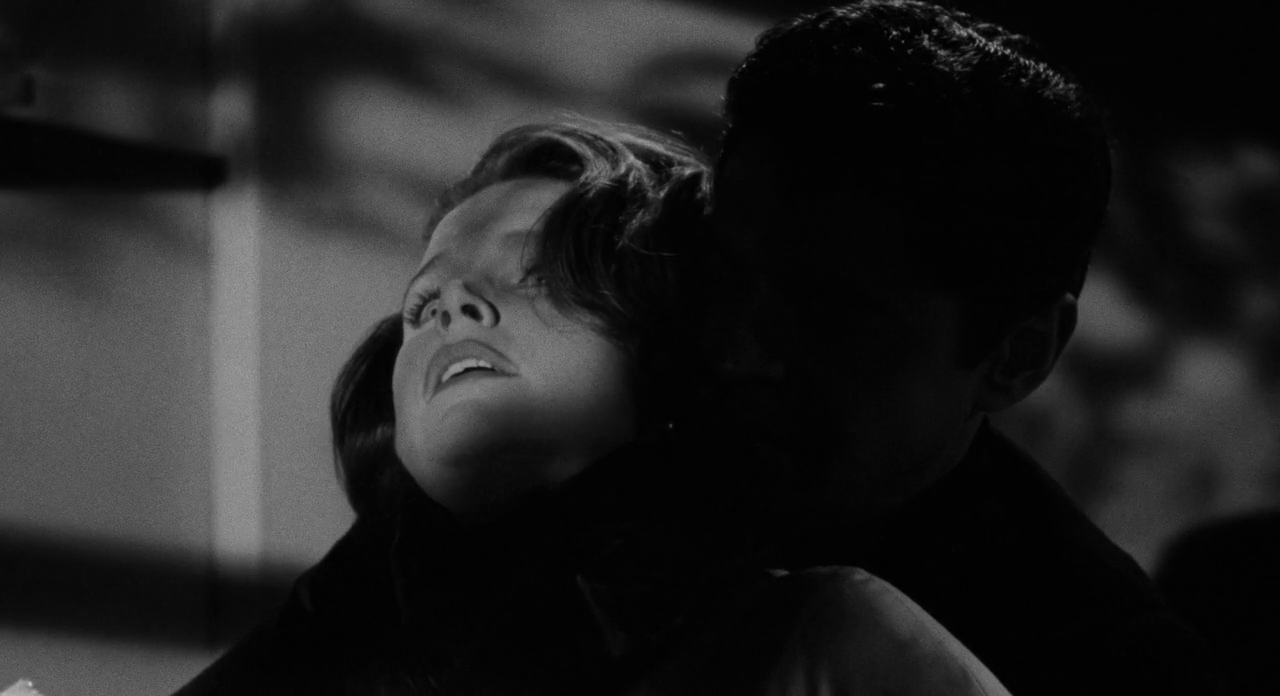
Purists might scoff at this being classified as noir, but it is a thematically dark film as well as one that liberally cops various visual motifs from the genre, like the shadows of blinds that fall across Ford in his office where  he meets a woman who may or may not be about to set him up,  or the garage bathed in chiaroscuro lighting where Kelly first encounters Lynch, a scene which Edwards carefully uses to ratchet up the tension.


Mancini’s jazzy score is used subtly to build up an ominous sense of fear, complementing Edward and Northrup’s visual techniques, whether carefully constructed mise-en-scene, intense close-ups, use of deep focus or abrupt transitions to  jar the audience. 


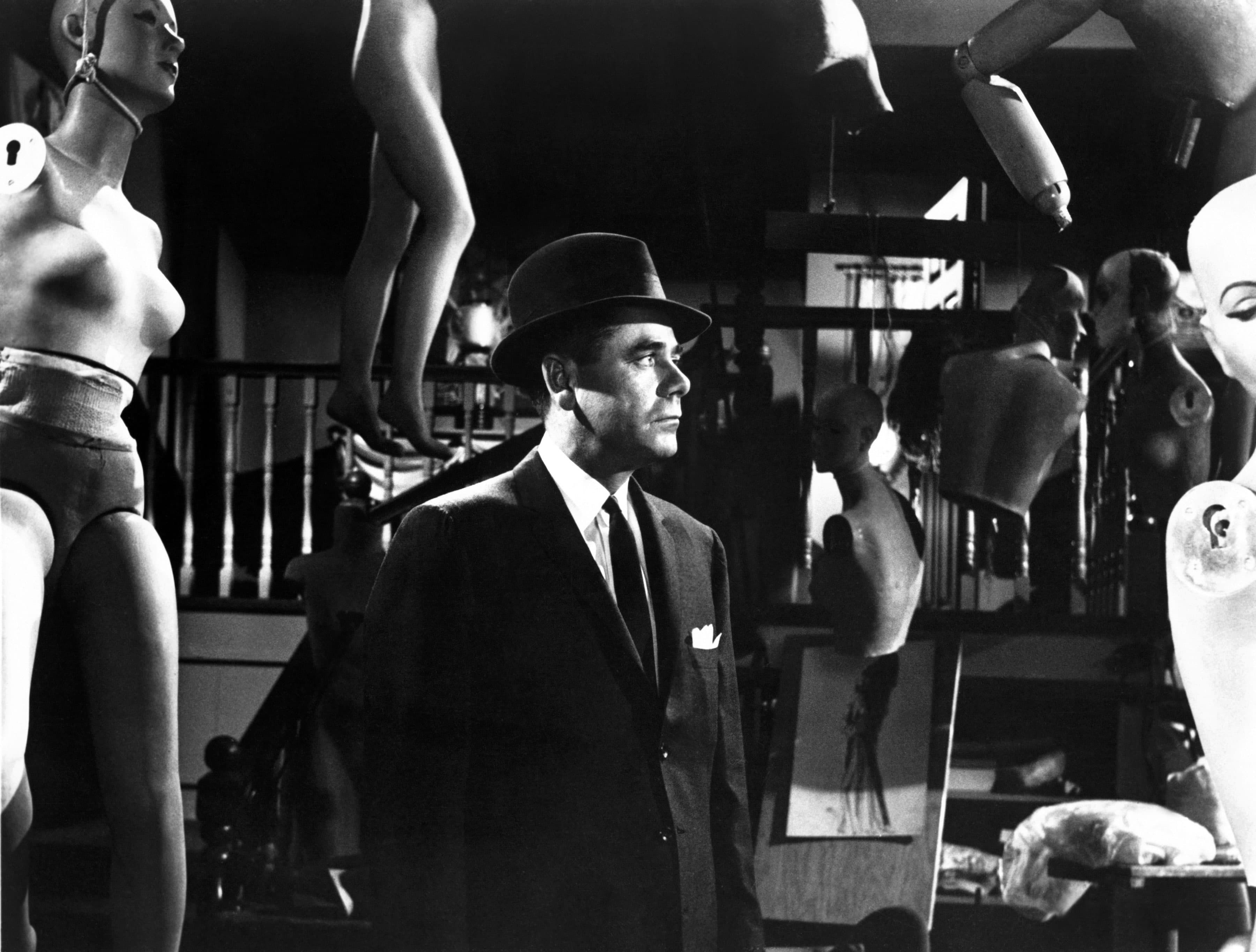
However, certain scenes stand out, most notably the opening in Sherwood’s garage with lighting and canted close-ups leading the audience to expect an assault that is replaced by cold threatening coercion, and the almost surreal scene in Nancy’s (Patricia Huston) apartment, where it is gradually revealed that she shares it with what seem to be hundreds of unclothed mannequins, which are later used effectively to ‘reveal’ her murdered body after she has tried to help Sherwood by going to the FBI.


The FBI agents simply get on with their job in an almost matter of fact Dragnet-manner; while Ford’s character is the smart hero of the piece who, with his colleagues, pieces together the puzzle through research, his performance is deliberately low-key and there is no attempt to involve him in a relationship with the victim, nor do we see anything of his life beyond his work: the narrative focus is on Sherwood and Lynch and the police-work itself. 


Lynch’s character is given a little depth when it is revealed that an Asian-American woman he has been dating will not inform on him because he has been helping her financially because her son is in hospital – though this is not an aspect the film dwells on too much.


This is a stylish, well-paced gripping late noir (or early neo-noir – argue among yourselves), beautifully shot with excellent performances, especially Remick and the understated (and often undervalued) Ford.


Saturday, 3 January 2015

Mark Evanier - The Art of The Simon and Kirby Studio - review


Joe Simon and Jack Kirby

A Fresh Look at Jack Kirby
Diane Jennings
12 December 2014

Jack Kirby (1917-94), raised on the rough-and-tumble Lower East Side of New York, forged the visual language for superhero comic books, a feral but lyric violence and is best remembered for his superhero work for Marvel in the 1960s and for DC in the 1970s. But “The Art of the Simon and Kirby Studio” (Abrams ComicArts) cracks the door on the days in the 1940s and ’50s when Kirby, Joe Simon (1913-2011) and their cadre of artists assembled comic books for publishers throughout the industry. Kirby and Simon had established themselves as successful creators in the early 1940s with comics like Captain America, Boy Commandos and the Newsboy Legion. And after World War II, the Simon and Kirby Studio’s goal was to meet its clients’ demands for more pulp-paper hits.
Simon_KirbyP74
“The Art of the Simon and Kirby Studio” features more than 350 pages of black-and-white art scanned from the originals, including full stories. Kirby and Simon edited, wrote and drew as their studio cranked out westerns and spoofs, romance and horror comics, war and crime books. Many of the images here are Kirby’s work — hyper-muscular bodies thrusting and bursting out of the panels, breakneck pacing — but the book also includes solid efforts by studio artists like Bill Draut, Mort Meskin and Al Williamson.

The highlight here is the nearly 70 pages of Kirby and Simon’s “Boys’ Ranch” from 1950 and 1951. A charming western fantasia in which boys got to play cowboys-and-Indians for keeps, “Boys’ Ranch” featured some of Kirby’s very best early art.

The book gives us fast and furious art from the early days of comics — work done in an almost punklike frenzy — and it’s fascinating to watch Kirby just warming up for his best yet to come: the creation of the Marvel Universe, with Stan Lee and Steve Ditko, and his mind-blowing “New Gods” saga for DC.


Simon_Kirby_P274
The Results of True Collaboration: 'The Art of the Simon and Kirby Studio'

By Jeremy Estes
10 December 2014

Museum in Miniature

As individuals and as a team, the impact and influence of Joe Simon and Jack Kirby on the comic book industry cannot be overstated. Trying to describe it is like wading into a bottomless pool of hyperbole. If they’d stopped working in the ‘40s after their ten-issue run on Captain America that would have been enough, but these two men pivoted as their industry changed, post World War II. Kirby produced art at furious clip, filling pages and pages and even more pages while other artists were still sharpening their pencils. Simon, no slouch at the art desk himself, had a head for business, and helped the studio bearing his and Kirby’s name become one of the premiere producers of content for America’s comic book industry.
Simon_KirbyP194-195
Kirby, of course, became the King, the co-creator—officially listed in print as of October of 2014—of the Fantastic Four, X-Men, Hulk, and countless other Marvel Comics characters and concepts. That work, along with his ‘70s work at DC, tends to obscure his early collaborations with Simon, but Abrams’ The Art of the Simon and Kirby Studio goes a long way toward changing that. This massive book contains stories published in the late ‘40s and early ‘50s and created by the artists at the Simon and Kirby Studio. That studio featured some of the greatest artists in the history of comics—Mort Meskin, Steve Ditko, Al Williamson, Jack Davis—not to mention its founders, who were involved in all stages of the production process, from designing covers to tightening scripts and artwork. Together, Simon and Kirby shared all of the jobs required to create a comic.
Simon_Kirby_P322_323
In his introduction, Mark Evanier, writer and longtime friend of the Kirby family, says the two worked so closely together they couldn’t always tell who had done what what. What was printed in the pages of comics books was the result of true collaboration.
Simon_Kirby_P337
Though it’s difficult to differentiate between Simon and Kirby’s work, in some instances the King is unmistakable. These are primarily westerns, romance, and crime stories, but the cosmic “Kirby dots” the artist later became famous for are lurking somewhere in the rippling blacks he applied to the pages.
Simon_KirbyP38
In this book, however, we’re not reading finished comic pages. Instead, with the cooperation of the estate of Joe Simon, as well as the Jack Kirby Museum and Research Center, the book is filled with beautiful scans of original art. The pages are gray and yellow and speckled with age, but the art remains as sharp as ever. There are half-finished covers, scribbled text acting as placeholders for copy, and rivers of correction fluid winding through the panels.
Simon_KirbyP218
According to Jim Simon, Joe’s son, whose afterword details the book’s origins amid his father’s failing health, the elder Simon maintained a large collection of original art from his entire career, keeping it in both the attic and basement of the family home on Long Island, as well as in frames, flat files, on shelves, and even under the bed in Simon’s Manhattan apartment. That this material survived is a pop culture miracle. It was created at a time when there was no secondary market for original comic art, nor was there any respect for the work as actual art. Here, it’s presented with the respect and admiration it deserves.
Simon_KirbyP30-31
On the story front, this is primarily B-material. Despite introducing characters like the Fly, Fighting American, Stuntman, and the Sandman, the duo never created another character as enduring as Captain America. They did manage to work in nearly every genre available to the comics makers of their day, including westerns, science fiction, crime, horror, and even romance. Simon and Kirby were pioneers of romance comics, practically inventing the genre with their title Young Romance.
Simon_KirbyP175
These stories all look great, but are pretty standard yarns, twist-ending horror and shoot ‘em up crime tales. One Vagabond Prince tale, featuring a Tennyson quoting superhero wearing what amounts to marching band attire, is basically a condensed comic book version of Atlas Shrugged, except here the well-to-do set out to poison the poor rather than keep their magic metal to themselves. The Boys’ Ranch stories, just one of the “kid gang” features Simon and Kirby created during their years together, stand out here, with strong characters like Wabash, Angel, and Clay Duncan, as well as art which captures the grittiness of the best western films. There’s even a two-page spread of Boys’ Ranch art that’s beautifully colored in the pinks and oranges of sunset in big sky country.

The Art of the Simon and Kirby Studio stands out in a sea of classic comics reprints because it’s more than just a collection of stories. Reading this book is like entering the offices of Simon and Kirby and rifling through their files, scouring the slush pile, even breathing in the smoke from one of Kirby’s cigars. It’s a museum in miniature, and like so much else these two artists touched, it’s a wonder to behold.

http://www.popmatters.com/review/188283-the-art-of-the-simon-and-kirby-studio-by-joe-simon-jack-kirby-mark-e/