Showing posts with label Jack Kirby.... Show all posts

Sunday, 8 September 2019

Jack Kirby at 100

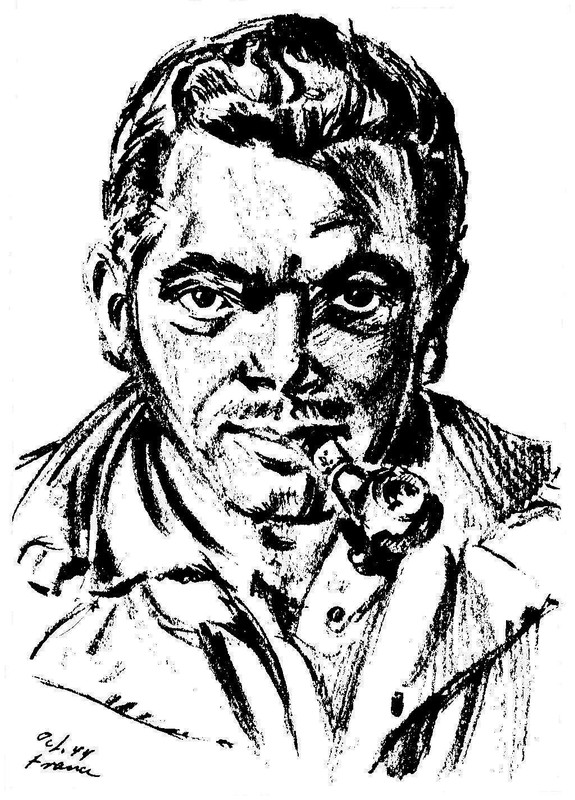
Self-portrait during World War II (kirbymuseum.org)

The persistent influence of Jack Kirby at 100 
Peter Hoskin reflects on the work of a comic book artist who was ‘constantly in search of freedom’

Peter Hoskin
The Times Literary Supplement
31 August 2017

No one spans the history of comic books quite like Jack Kirby. He was there at the dawn of the superhero, now called the Golden Age, to co-create Captain America. He toiled with Stan Lee during the Silver Age of the 1950s and 60s to turn a failing publisher into Marvel Comics, home of the Fantastic Four, the Incredible Hulk, Thor and the X-Men. His departure from Marvel, and work he did subsequently, is regarded as one of the instigating events of the industry’s grittier Bronze Age. His influence persists, even past his death in 1994, through the Modern Age and beyond.
Image result for captain america 1 punching hitler
Kirby would have been 100 years old this week. He was born in New York, on August 28, 1917, as Jacob Kurtzberg, the eldest son of two Jewish-Austrian émigrés. His childhood, therefore, was affected by the Great Depression, and his early adulthood by the war. Kirby’s famous drawing of Captain America punching Adolf Hitler is only one part of his Second World War story. Kirby killed Nazis and saw friends die, as an infantryman in Europe. Like so many of his fellow survivors, he then witnessed the atomic bomb, the Cold War and the rise of counter-cultures and computers.

Kirby’s experience of the twentieth century informs his most singular achievement, his Fourth World saga. This is the grand story, spanning several comic-book titles, that he both drew and wrote for DC Comics after leaving Marvel in 1970. Kirby begins with two familiar DC characters, Superman and Jimmy Olsen, but soon pulls them into an unfamiliar mythology born of his own experiences and imagination. Here, a cosmic war is being fought between the gods of New Genesis and the demonic Darkseid of Apokolips. Humanity is a potential casualty.

The word “holocaust” appears in the Fourth World saga with chilling regularity. So too do death camps, torture devices and atomic blasts. Forever People #3, one of Kirby’s finest single issues, even begins with a quote attributed to Hitler: “That is the great thing about our movement – that these members are uniform not only in ideas, but, even, the facial expression is almost the same!” Underneath stands a crowd of people, all of whom wear the same blank expression, all victims of Darkseid’s Anti-Life propaganda.

But there is light as well as dark in Kirby’s story – particularly when it comes to young people. The heroes of the Fourth World books are typically bohemians from across space-time, with names such as “Beautiful Dreamer” or “Big Bear”. They ride motorcycles down psychedelic highways, talking of love, and are dismissed as hippies by many of the people they encounter. Yet Kirby doesn’t dismiss them. He identifies not just with those who, like him, have fought against the Nazis, but also with those who have grown up, free, afterwards.

Kirby was constantly in search of freedom. By most accounts, he rarely found it. He began to feel imprisoned during his time at Marvel in the 1960s, and his home studio, in which he would work for fourteen hours a day, completing pages at a rate that few other artists could match, was nicknamed “The Dungeon”.
Image result for jack kirby thor
The story of Kirby’s relationship with Stan Lee, and how it soured, is recounted in Sean Howe’s Marvel Comics: The untold story, but it comes down to a simple imbalance. Together, they created superheroes such as the Fantastic Four and Thor, each adding to the collaboration in different and essential ways – yet Lee ended up with the better contracts and more of the fame.

Yet Jonathan Lethem, a vocal fan of Kirby’s, argues in his essay collection The Disappointment Artist that Kirby benefited from working with Lee. As he puts it, “Kirby always wanted to drag the [Fantastic] Four into the Negative Zone – deeper into psychedelic science fiction and existential alienation – while Lee, in his scripting, resolutely pulled them back into the morass of human lives, hormonal alienation, teenage dating problems and pregnancy and unfulfilled longings to be human and normal and loved”. In other words, Lee brought Kirby back down to Earth.

It’s certainly true that undiluted Kirby, the brand that readers got after his move to DC, is almost overwhelming. Back in the 1940s, he had pioneered the most spacious layout in comics, the double-page spread. But now he struggled to stay within its confines. His drawings in the Fourth World books are a riot of thickly-proportioned characters, multi-limbed monsters and impossible machinery. His writing is loud and insistent. It is a style made for deities such as Darkseid – “I am the revelation! The tiger-force at the core of all things!” – not for everyday people.
Image result for darkseid i am, the revelation
Various novelists, including Lethem, Michael Chabon and Michel Faber, have spoken of their admiration for Kirby. Few, if any, have ever written anything that might be described as “Kirby-esque”. In his most recent science fiction novel, The Book of Strange New Things, Faber seems to acknowledge this almost directly. He names a character after Kirby, but that character is off on his own – a space missionary whose story is left purposefully mysterious, and who may have lost himself in an alien society. In this missionary’s absence, the author describes a planetary scene that Kirby would never have drawn: “Nothing fancy or monumental. Square blocks, like British tower blocks, cheap utilitarian housing. Not exactly the diamantine spires of a fantastical city”.

No one can match Kirby, and, in a sense, no one should try. According to his biographer and friend, Mark Evanier, Kirby didn’t have much sympathy for artists who hoped to continue comic-book titles in his tradition. “The Kirby tradition”, he would say, “is to create a new comic.” That is how he ought to be remembered, 100 hundred years after his birth: as an artist who always wanted to go beyond.

Saturday, 3 January 2015

Mark Evanier - The Art of The Simon and Kirby Studio - review


Joe Simon and Jack Kirby

A Fresh Look at Jack Kirby
Diane Jennings
12 December 2014

Jack Kirby (1917-94), raised on the rough-and-tumble Lower East Side of New York, forged the visual language for superhero comic books, a feral but lyric violence and is best remembered for his superhero work for Marvel in the 1960s and for DC in the 1970s. But “The Art of the Simon and Kirby Studio” (Abrams ComicArts) cracks the door on the days in the 1940s and ’50s when Kirby, Joe Simon (1913-2011) and their cadre of artists assembled comic books for publishers throughout the industry. Kirby and Simon had established themselves as successful creators in the early 1940s with comics like Captain America, Boy Commandos and the Newsboy Legion. And after World War II, the Simon and Kirby Studio’s goal was to meet its clients’ demands for more pulp-paper hits.
Simon_KirbyP74
“The Art of the Simon and Kirby Studio” features more than 350 pages of black-and-white art scanned from the originals, including full stories. Kirby and Simon edited, wrote and drew as their studio cranked out westerns and spoofs, romance and horror comics, war and crime books. Many of the images here are Kirby’s work — hyper-muscular bodies thrusting and bursting out of the panels, breakneck pacing — but the book also includes solid efforts by studio artists like Bill Draut, Mort Meskin and Al Williamson.

The highlight here is the nearly 70 pages of Kirby and Simon’s “Boys’ Ranch” from 1950 and 1951. A charming western fantasia in which boys got to play cowboys-and-Indians for keeps, “Boys’ Ranch” featured some of Kirby’s very best early art.

The book gives us fast and furious art from the early days of comics — work done in an almost punklike frenzy — and it’s fascinating to watch Kirby just warming up for his best yet to come: the creation of the Marvel Universe, with Stan Lee and Steve Ditko, and his mind-blowing “New Gods” saga for DC.


Simon_Kirby_P274
The Results of True Collaboration: 'The Art of the Simon and Kirby Studio'

By Jeremy Estes
10 December 2014

Museum in Miniature

As individuals and as a team, the impact and influence of Joe Simon and Jack Kirby on the comic book industry cannot be overstated. Trying to describe it is like wading into a bottomless pool of hyperbole. If they’d stopped working in the ‘40s after their ten-issue run on Captain America that would have been enough, but these two men pivoted as their industry changed, post World War II. Kirby produced art at furious clip, filling pages and pages and even more pages while other artists were still sharpening their pencils. Simon, no slouch at the art desk himself, had a head for business, and helped the studio bearing his and Kirby’s name become one of the premiere producers of content for America’s comic book industry.
Simon_KirbyP194-195
Kirby, of course, became the King, the co-creator—officially listed in print as of October of 2014—of the Fantastic Four, X-Men, Hulk, and countless other Marvel Comics characters and concepts. That work, along with his ‘70s work at DC, tends to obscure his early collaborations with Simon, but Abrams’ The Art of the Simon and Kirby Studio goes a long way toward changing that. This massive book contains stories published in the late ‘40s and early ‘50s and created by the artists at the Simon and Kirby Studio. That studio featured some of the greatest artists in the history of comics—Mort Meskin, Steve Ditko, Al Williamson, Jack Davis—not to mention its founders, who were involved in all stages of the production process, from designing covers to tightening scripts and artwork. Together, Simon and Kirby shared all of the jobs required to create a comic.
Simon_Kirby_P322_323
In his introduction, Mark Evanier, writer and longtime friend of the Kirby family, says the two worked so closely together they couldn’t always tell who had done what what. What was printed in the pages of comics books was the result of true collaboration.
Simon_Kirby_P337
Though it’s difficult to differentiate between Simon and Kirby’s work, in some instances the King is unmistakable. These are primarily westerns, romance, and crime stories, but the cosmic “Kirby dots” the artist later became famous for are lurking somewhere in the rippling blacks he applied to the pages.
Simon_KirbyP38
In this book, however, we’re not reading finished comic pages. Instead, with the cooperation of the estate of Joe Simon, as well as the Jack Kirby Museum and Research Center, the book is filled with beautiful scans of original art. The pages are gray and yellow and speckled with age, but the art remains as sharp as ever. There are half-finished covers, scribbled text acting as placeholders for copy, and rivers of correction fluid winding through the panels.
Simon_KirbyP218
According to Jim Simon, Joe’s son, whose afterword details the book’s origins amid his father’s failing health, the elder Simon maintained a large collection of original art from his entire career, keeping it in both the attic and basement of the family home on Long Island, as well as in frames, flat files, on shelves, and even under the bed in Simon’s Manhattan apartment. That this material survived is a pop culture miracle. It was created at a time when there was no secondary market for original comic art, nor was there any respect for the work as actual art. Here, it’s presented with the respect and admiration it deserves.
Simon_KirbyP30-31
On the story front, this is primarily B-material. Despite introducing characters like the Fly, Fighting American, Stuntman, and the Sandman, the duo never created another character as enduring as Captain America. They did manage to work in nearly every genre available to the comics makers of their day, including westerns, science fiction, crime, horror, and even romance. Simon and Kirby were pioneers of romance comics, practically inventing the genre with their title Young Romance.
Simon_KirbyP175
These stories all look great, but are pretty standard yarns, twist-ending horror and shoot ‘em up crime tales. One Vagabond Prince tale, featuring a Tennyson quoting superhero wearing what amounts to marching band attire, is basically a condensed comic book version of Atlas Shrugged, except here the well-to-do set out to poison the poor rather than keep their magic metal to themselves. The Boys’ Ranch stories, just one of the “kid gang” features Simon and Kirby created during their years together, stand out here, with strong characters like Wabash, Angel, and Clay Duncan, as well as art which captures the grittiness of the best western films. There’s even a two-page spread of Boys’ Ranch art that’s beautifully colored in the pinks and oranges of sunset in big sky country.

The Art of the Simon and Kirby Studio stands out in a sea of classic comics reprints because it’s more than just a collection of stories. Reading this book is like entering the offices of Simon and Kirby and rifling through their files, scouring the slush pile, even breathing in the smoke from one of Kirby’s cigars. It’s a museum in miniature, and like so much else these two artists touched, it’s a wonder to behold.

http://www.popmatters.com/review/188283-the-art-of-the-simon-and-kirby-studio-by-joe-simon-jack-kirby-mark-e/

Sunday, 1 January 2012

They also served...

Some RIPs:

Vaclav Havel: president, playwright, poet and friend of Lou Reed.

http://www.guardian.co.uk/world/2011/dec/18/vaclav-havel

Joe Simon (standing, with Jack Kirby): "one of the architects of the golden age" of the comic book and co-creator (with Kirby) of Captain America, a WASP superhero, written and drawn by two American Jews, to fight Hitler before America even entered the war.
Get the fucker, Cap!

http://www.guardian.co.uk/books/2011/dec/16/joe-simon

Christopher Hitchens: author, essayist, journalist, polemicist, gadfly and "left-wing" intellectual (until he supported the war in Iraq and pissed off a lot of people with more limited defintions of "left" and "right").

http://www.guardian.co.uk/books/2011/dec/16/christopher-hitchens-dies-aged-62

Thursday, 11 November 2010

Thursday, 22 October 2009

Frank Zappa and Jack Kirby


Frank Zappa and Jack Kirby at Frank's place, where the friends and neighbours would meet for a chat and a smoke (cigarettes and cigars, respectively), as remembered by Ahmet Zappa:
http://latimesblogs.latimes.com/herocomplex/2009/10/jack-kirby-and-frank-zappa-a-cosmic-friendship-.html
http://royalflushmagazine.com/2009/10/13/zappa_meets_kirby/

Sunday, 27 September 2009

Jack Kirby in The LA Times


Jack Kirby, the abandoned hero of Marvel's grand Hollywood adventure, and his family's quest
September 25, 2009 8:00 am
This is a longer version of my story that will run Sunday in the Los Angeles Times Calendar section...

You’d be hard-pressed to find a recent comic book that didn’t have the stylish scrawl of the artists somewhere on the cover, but that was not the case when Jack Kirby was making pop culture history back in the 1960s with his wildly kinetic drawings of the X-Men, Hulk and the Fantastic Four.“I think I have a highly unique and unusual style, and that’s the reason I never sign my drawings,” the proud Kirby told an interviewer in 1987, seven years before his death. “Everybody could tell any of my covers a mile away on the newsstand, and that satisfied me.”

The satisfaction was fleeting. The artist may be reverently referred to as “King” Kirby by the pop scholars and younger artists who celebrate his genre-defining work but Kirby is, in some ways, an overlooked figure in the broader view of American culture. He didn’t live to see his creations fly across the movie screen over the last decade and his four children made nothing from those lucrative films, although they are now pursuing legal action to claim some of the future Hollywood wealth. “There is,” daughter Lisa Kirby says, “a bittersweet legacy to my father’s work.”

On a recent afternoon, in Beverly Hills, a different man was autographing a giant lithograph reproducing one of Kirby’s classic Fantastic Four covers. It was Stan Lee, the writer who was Kirby’s most famous collaborator until they became estranged over creative credit, artwork custody and money. An art dealer had brought stacks of limited-edition lithos, some to be priced at $850, to Lee’s Santa Monica Boulevard office along with a check in his pocket to pay the 86-year-old Lee for his autographs.

Lee had written the stories for the classic comics, of course, but considering all the history, it was still odd to see his name etched on the cosmic Kirby tableau from 1966.

“Yes, there was a time when there was some hard feeling on his part, but he got over that and we were friends,” Lee said. “It really is sad that he didn’t get to see all the big movies. None of us could predict that we would get to this point with the films. I don’t dwell on it too much because I’m always so busy doing what I am doing today. Unfortunately the guys back in the day did not make as much as they do today. Years ago also you had artists doing these comics who, well, there was nothing else they could have done. Their style wasn’t right for advertising or magazines like Saturday Evening Post or Collier’s. And as for us writers, well, we weren’t qualified to write for the New Yorker. Comic book writers were considered hacks, and artists weren’t really thought of as much beyond that.”

Lee studied one of the other art pieces, a dazzling revisiting of a Kirby cover for Captain America. "Wow, look at this one." The pieces are being sold by the Santa Monica gallery called Every Picture Tells a Story as part of a new licensing deal with Marvel to create high-end wall art from illustrations that were, in their day, the most gaudy and disposable entertainment imaginable. “As far as I’m concerned,” Lee said with his endless zeal, “it is fine art."

The story of two “hacks,” as Lee would frame it, will be scrutinized much more considering recent events. Last month, the Walt Disney Co. paid $4 billion to scoop up Marvel Entertainment and its vault of florid characters who over the last decade have become Hollywood box-office heroes. Many of the most valuable properties in that vault were created by the wildly prolific tandem of Lee and Kirby in the 1960s; there are two big-budget movies now in the pipeline for Marvel Studios that are based on Lee-Kirby creations (“The Mighty Thor" and “The Avengers”) and a third (“First Avenger: Captain America”) based on the work of Kirby and writer Joe Simon. The Kirby brood watched the Disney deal happen and within days were conferring with attorneys and accelerating their bid to reclaim copyright.

A day after Lee sat signing that artwork, attorneys representing the four children of Kirby sent out 45 notices of termination to Hollywood studios and players with an interest in assorted Marvel films; it was the opening salvo in a legal battle to gain copyright control of certain characters and the name on the legal letterhead was Toberoff & Associates, the same firm that last year won a intriguing victory by reclaiming a share of the copyright for the first Superman story for heirs of that character's co-creator, Jerry Siegel.

Under copyright law, creators or their heirs can seek to regain copyrights they previously assigned to a company 56 years after first publication, so the Kirby family is starting that process now with hopes of gaining an interest or, perhaps, a settlement. Lee, meanwhile, struck assorted deals through the years with Marvel and has been an executive producer on every Marvel film made to date, movies with worldwide box office now in the billions of dollars, and has had prominent cameos in many of them.

Lee is by far the most famous creator in comics history thanks to his longevity, success and a Barnum-like flair for self-promotion. He became a media figure in the 1960s when journalists jotted down his dizzying hyperbole about Marvel’s brightly hued, counterculture ethos. Kirby, laboring at home with far less credit, looked on and chafed about his status as a freelancer, essentially working for Lee, whose family connections by then had taken him to the top of the small and scruffy publishing venture. By 1970, Kirby had had enough and defected to rival DC Comics. Lee would go on to accumulate considerable wealth and fame, sometimes selling comics, sometimes selling his own persona with a long list of splashy but short-lived ventures. Kirby’s fortunes were not as grand; when he talked about his old creations he had the weary tone of a man who long ago watched the family coin collection scatter on a crowded street.

Lee knows that fans like to set up the partners as rivals. Kirby is portrayed as the irascible purist with staggering imagination and Lee reduced to the tireless huckster -- the pop-culture prophet versus the corporate profiteer. From Lee's present vantage point, though, he prefers to look back on their shared tale as the unexpected odyssey of two kids who grew up in a business of cruel deadlines and lowbrow aspirations and found in each other a go-to guy.

“My favorite thing about Kirby’s artwork was his storytelling,” Lee said. “He was really a film director doing comics.”

In that, Kirby was certainly ahead of his time. Comics are a huge part of Hollywood now, thanks to the modern era of computer-generated special effects that, finally, can match the galactic visions and super-powered mayhem that Kirby put to paper in the 1960s. Kirby’s influence is nothing less than massive on several generations of artists and filmmakers.

“There was power in the work of Jack Kirby that changed the way I looked at things,” said Guillermo del Toro, writer-director of “Pan’s Labyrinth.” "There was no one else like him and there never will be."

Nevertheless, Kirby remains a distant second to Lee in name recognition, which Lisa Kirby said rankles. “A lot more people know the name Stan Lee than the name Jack Kirby,” she said. “I’m not putting down Stan Lee’s talents but it’s difficult for us to see that he does dominate the credit. That doesn’t reflect the work or the reality. To see Jack Kirby in small letters and Stan Lee in big letters, that’s hard for us.”

Mike Richardson grew up under the thrall of Kirby's drawings and was inspired to found his own comic-book company, Dark Horse, which has grown into a Hollywood player after seeing titles such as "The Mask," "Hellboy" and "300" jump to the screen. Through the years, he reached out to the Kirby family to help them find some sort of compensation.

"There was a lot of anger in the Kirby family with the way that Jack was treated, more than they will express in public," Richardson said. "There's no way you can say enough about the impact of those Marvel comics in the 1960s. They changed the rules. Lee and Kirby were the Lennon and McCartney of comics and Stan Lee became a well-known figure in popular culture and Jack did not. Neither were as great on their own, it's true, but Jack had decades of work that was really special. To me, there's no doubt that Jack Kirby was the truly brilliant creative genius behind the success of Marvel."

If there’s a battle to come, it’s one Kirby never took on in life.

“Jack didn’t have the resources or the stomach lining to fight Marvel over copyrights, character ownership or past contractual sleights that he believed he suffered,” says Mark Evanier, who was Kirby’s assistant in the early 1970s and later his biographer. “He fought to get back his pages of original art. That was the fight he believed he could win.”

Evanier, now a comics historian and creator, testified in the Siegel suit and it seems certain that he would be in the deposition seat for any Kirby legal case. A longtime friend to Kirby and respectful acquaintance of Lee, he spoke glowingly of the partnership as lightning in a bottle, the zenith of each man’s career.

Kirby contributed mightily to the plots and character creation; the workload at Marvel was so intense in the 1960s that there were no “scripts” handed to Kirby, he would just draw the story and Lee would go back and craft dialogue that fit the action. Still, Evanier said, while it’s now fashionable to view Lee as the lesser figure, he also had the separate success of Spider-Man (with artist Steve Ditko) and set the singular tone and culture of Marvel.

The pair had met in the Roosevelt years. In late 1940, Jacob Kurtzberg, 23, drawing under the name Kirby, had his first taste of real success in the young comics industry, which soared after the debut of Superman in 1938. Kirby and writer Simon’s Captain America was a hit for Timely Comics, which would later morph into Marvel. There was an eager assistant in the office named Stanley Lieber, just 18, who had gotten the job through a family connection (and would later shorten his name).

“In those days they dipped the pen in ink, I had to make sure the inkwells were filled,” said Lee. “I went down and got them their lunch, I did proofreading, I erased the pencils from the finished pages for them.

Whatever had to be done. I remember Jack would always be sitting at a table puffing on his cigar, kind of talking to himself as he was doing those pages.”

Lee’s first credited work was a 1941 Captain America story where the hero threw his shield for the first time. That would become a trademark for decades, suggesting an instant flair for the medium. Kirby left Timely not long after. Years later, with comics in the doldrums, Lee and Kirby would reunite and create a new sort of comic book, with frenetic energy, mutant outsiders and misunderstood monsters. Superman and DC Comics instantly seemed like boring old Pat Boone; Marvel felt like the Beatles and the British Invasion. It was Kirby’s artwork with its tension and psychedelia that made it perfect for the times — or was it Lee’s bravado and melodrama, which was somehow insecure and brash at the same time?

“Jack was the best partner you could ask for, dependable and imaginative,” Lee said, sitting in an office cluttered with all those old heroes and villains. “And it was never dull. Nothing with us was ever dull.”

-- Geoff Boucher

http://latimesblogs.latimes.com/herocomplex/2009/09/jack-kirby-the-forgotten-hero-in-marvels-grand-hollywood-adventure.html

Sunday, 30 August 2009

Jack Kirby explained...


Jack Kirby (born Jacob Kurtzberg August 28, 1917) was one of the most influential and respected comic book artists, writers and creators to have worked in the medium.

Growing up poor in New York City, Kurtzberg entered the emerging comics industry in the 1930s. Although he enrolled at the Pratt Institute in Brooklyn, he only stayed a week and he was largely self-taught and cited as influences, a number of illustrators, like Hal Foster, Alex Raymond and Milt Caniff.

Kurtzberg drew various comic strips under different pseudonyms, such as Jack Curtiss and Curt Davis, before settling on Jack Kirby. Through the late 1930s he worked on various newspaper strips before joining Fleischer animation where helpwd fill scenes between major action sequences in Popeye cartoons, but he didn’t like the factory mindset and left to work in the burgeoning comic books business for a number of companies, including Fox Features, where he met his future partner, Joe Simon, with whom he would create and dvevelop Captain America for Timely Comics in 1941.


After serving in World War II, Kirby returned to comics and, initially reuniting with Simon, contributed to a number of publishers, including Archie Comics and DC Comics, working in a number of genres: crime, romance, science fiction, horror, monster, superhero and western, but perhaps his most acclaimed creation from the pre-Marvel period was the newspaper strip, Sky Masters of the Space Force, inked by Wally Wood.
Kirby wound up at Timely's 1950s version, Atlas Comics, while still working for DC on books like House of Mystry and House of Secrets. When he finally split with DC, he continued to work for Atlas, which later changed its name to Marvel, and, starting with The Fantastic Four in 1961, with writer Stan Lee, he created a number of superhero characters in the early 1960s that led a boom in the industry. Many of Marvel’s key characters were created by Lee and Kirby during the sixties - The Incredible Hulk, The Fantastic Four, The Black Panther, The Silver Surfer, The Mighty Thor, The X-Men, The Avengers, Doctor Doom, The Inhumans, Nick Fury, Galactus – and it remans a bone of contention just how much Kirby contributed to their creation and the plots that were initially credited to Lee.
Despite the high sales and critical acclaim of the Lee-Kirby titles, Kirby felt he was being treated unfairly, getting neither enough credit nor money and he left the company in 1970 for rival DC Comics, where he created his critically successful Fourth World saga spread over several titles. However, these and other titles proved commercially unsuccessful and were canceled, although characters he created and the Fourth World mythos have continued as a significant part of the DC Comics universe.

Kirby’s drawing style, especially for his figures,had always been expressionistic to some extent, but through the late sixties and early seventies, his figure drawing and, occasionally, sense of perspective, became looser, which may have been partially due to eye problems and partially due to the fact that the board used for the orignial art was considerably reduced in size. Unfortunately, while this was happening, othet artists were adopting a more realistic style and to some readers, Kirby’s work looked old fashioned and out of place.

Kirby returned to Marvel briefly in the mid- to late 1970s, creating new characters who still appear in the company’s comics and taking over his own flagship character, Captain America, but his run met with neither critical nor commercial success and he then ventured into television animation and independent comics.
In his later years, Kirby received consderable recognition for his career accomplishments, and is regarded by historians and fans as one of the major innovators and most influential creators in the comic-book medium.

Jack Kirby died in February 6, 1994 his Thousand Oaks, California.

In October 2006, The New York Times noted that Kirby had “created a new grammar of storytelling and a cinematic style of motion. Once-wooden characters cascaded from one frame to another — or even from page to page — threatening to fall right out of the book into the reader’s lap. The force of punches thrown was visibly and explosively evident. Even at rest, a Kirby character pulsed with tension and energy in a way that makes movie versions of the same characters seem static by comparison.”
In the 'Program Notes' for his novel, Carter Beats The Devil, author Glen David Gold says, 'Inspiration came from the unbeatable troika of storytellers: Stan Lee, Jack Kirby and Steve Ditko [artist and plotter for Spider-Man and Doctor Strange]'.
Michael Chabon, in his afterword to his Pulitzer Prize-winning novel The Amazing Adventures of Kavalier & Clay, noted, 'I want to acknowledge the deep debt I owe in this and everything else I've ever written to the work of the late Jack Kirby, the King of Comics.”
See:
http://en.wikipedia.org/wiki/Jack_Kirby
http://twomorrows.com/index.php?main_page=index&cPath=57
http://kirbymuseum.org/blogs/simonandkirby/
http://jackkirbycomics.blogspot.com/
http://kirbymuseum.org/
http://whatifkirby.com/html/creations/creation.html
http://www.povonline.com/Jack%20Kirby.htm
http://www.bpib.com/illustra2/kirby.htm
http://monsterblog.oneroom.org/


The Comics Journal Library Volume I: Jack Kirby, edited by Milo George (Fantagraphics Books; Seattle, 2002)
The Jack Kirby Treasury Volume II, text by Greg Theakston (Eclipse Books; Forestville, California, n.d.)
Kirby: King of Comics, by Mark Evanier (Abrams; New York, 2008)
The Art of Jack Kirby, by Ray Wyman, jr (The Blue Rose Press; Orange, California, 1992)
The Collected Jack Kirby Collector Volumes I-VII, edited by John Morrow (Two Morrows Publishing; Raleigh, North Carolina, 1997-2009)
Origins of Marvel Comics, by Stan Lee (Simon and Schuster; New York, 1974)
Son of Origins of Marvel Comics, by Stan Lee (Simon and Schuster; New York, 1975)
Men of Tomorrow: Geeks, Gangsters, and the Birth of the Comic Book, by Gerard Jones (Heinemann, 2005)