Saturday, 4 March 2017

The Beach Boys' Al Jardine talks about Pet Sounds

Image result for al jardine
The Beach Boys’ Al Jardine on Pet Sounds

Jeff Tamarkin
Best Classic Bands

Al Jardine, who turned 74 on September 3, was an original member of The Beach Boys when the group formed in 1961, but for a time he wasn’t sure if playing music was in his future. Shortly after recording the group’s first single, “Surfin’,” he left for a while intending to pursue a less risky career, only to return in 1963. He remained a Beach Boy throughout the band’s entire run as a major recording act and is currently a member of Brian Wilson’s touring band.

We spoke with Al Jardine in the spring on the 50th anniversary of the Beach Boys’ Pet Sounds, often named the greatest album of all time.

Do you consider Pet Sounds the Beach Boys’ best album?
Al Jardine: Probably artistically, yeah. It was a little ahead of its time. We didn’t have a lot of time to appreciate it because the label was looking for a lot of sales and when it didn’t meet their expectations they took it off the market and quickly put out a best-of album. We really didn’t have a chance to exploit it or perform it. We were basically a hitmaking machine and that was something [Pet Sounds] was difficult to market. They didn’t know what to do with it. Fortunately the public climbed on board and made it happen. I shouldn’t say the public—future generations appreciated it for what it is. The ’70s material that we did post-Pet Sounds is becoming quite popular with new generations of fans. There’s a revivalist thing going on with the Beach Boys right now, which is pretty interesting.

What is it about that music that is so universal?
AJ: It has to be the human voice. Brian’s voicings and his own personal voice as well are so special. The way we came together as a vocal blend was pretty special. And we had great engineering and great producers—Brian, I should say. We met the challenge when we did Pet Sounds. That was a big one. “California Girls” and “She Knows Me Too Well” and “Please Let Me Wonder” are epic moments in recording history to me.

Those last two were B-sides of singles. A lot of the Beach Boys’ B-sides were as good as the hit A-sides.
AJ: We had so many great B-sides. We often put out competitive pieces on the other side. We didn’t have as many number one singles as the Beatles but we might have if we’d put a clunker on the other side.

Where would you rank Pet Sounds among the Beach Boys’ albums? Are there others you like more?
AJ: That’s a style thing. There are different kinds of favorite albums. Pet Sounds was a different direction. I like All Summer Long. It had “Help Me, Rhonda” on it, which was one of my songs. I liked Stack-O-Tracks. Not many people have heard it. It was amazing to hear the tracks without the vocals.

Capitol Records recently released the Pet Sounds (50th Anniversary Collectors Edition) boxed set. Is it aimed at people who grew up with the album?
AJ: I’m not sure. It’s really for the audiophiles. I don’t know. There’s a lot of information on there. You have to enjoy sitting down to four hours of backing tracks—if you’re a real fan you’ll dig it, man. There’s a Blu-ray disc of the audio. There’s one great DVD of us actually singing “Good Vibrations.”

Is it true that “Good Vibrations” was initially intended to be included on Pet Sounds?
AJ: We had a major impasse with Brian with respect to “Good Vibrations.” We all wanted it to be on Pet Sounds and I don’t know if it was a timing thing but Brian told me at the time that he wanted to save it for Smile, the next project, and we disagreed.

Not for the first time and not for the last!

AJ: Generally, if somebody has a pretty strong point of view, we respect that, and we all respected his point of view. It was finished, in our opinion, but in Brian’s mind it wasn’t finished. In any event it was going to be put aside, do it later. Then the label said, “You gotta have a hit single on [Pet Sounds], something with some commercial appeal.” They’re always looking for a hit. “Sloop John B” [which Jardine arranged] had proved itself. So I was responsible for that, I admit it. It may not fit the creative tone of the album but it certainly gave some relief at the end of side one. I took a pretty primitive folk song, which I’d learned in high school, and added a chord or two—I heard the Beach Boy harmonies in there and felt very strongly that we could make a great record. And it worked.

It’s such an odd tale for a top 40 song.
AJ: And antithetical to what we were doing. But when you listen to the production value, it’s astoundingly powerful.
Image result for the beach boys recording pet sounds
What do you remember about the vocal sessions for that album? Was it more arduous than before?
AJ: Are you kidding? [Before] we would just walk in and do our parts and leave but this one we spent three to maybe six months. We were recording Smile and Pet Sounds simultaneously so you can only imagine the stuff we were doing. Within that three- to six-month framework we would alternate between songs and go back and forth and reshape each song until we got them just right. It took awhile. The king of all the re-do’s was “Wouldn’t It be Nice” and “Good Vibrations.” Brian was never quite satisfied with those two and he wanted to get them perfect.

All of those stories that have been going around for 50 years, that the rest of the band was against Pet Sounds, fought Pet Sounds—how much of that is true?
AJ: That’s not accurate. Mike being more of a lyricist, he obviously wanted to question some of the lyrics that he didn’t understand. If you don’t understand something, hey, explain it to me. And actually, he got his way with one of the songs on Pet Sounds, “I Know There’s An Answer.” I liked it both ways [The alternate version was called “Hang On to Your Ego.”] If Brian wants to work with his cousin to make him happy, it is what it is. But as far as not wanting to do it, it was a big leap from where we were. Holy crap—we got home from [touring] Japan, and we’d been gone for a long time. And there was a lot of adjustment. It wasn’t that we didn’t want to do it.

Brian has said that the Beatles and Beach Boys were always in competition. Was that true?
AJ: That’s the story. I don’t even ask Brian that question; I read the same things you guys do. But when I see him I’ll ask him. I’ll say, “Hey, did Rubber Soul really give you that inspiration?” I’m sure it did. I seem to recall the same thing. But we were on the road 150 days a year so we didn’t see Brian that much.

How does it feel to sing these songs now?

AJ: It’s fun. I enjoy sitting back and watching Brian go through the set. He does a real good job.

Do you hear an influence on young bands today from Pet Sounds?
AJ: Absolutely. I think Brian raised the bar. It allows people to play off that ingeniousness that he has. He hears things and phrases things in a way that you wouldn’t expect. It’s the unexpected that makes Brian so amazing. He has a real gift for the left hand on the piano, the bass line. You’d give your right arm for that and he has it on so many different levels: melodies, harmonies, arranging. We didn’t hear that before Brian. Post-Brian you get people emulating him and it’s really cool. Fleet Foxes are a good example. A little different phraseology, but similar.

Friday, 3 March 2017

Dead Poets Society #28 Pablo Neruda: I Do Not Love You Except Because I Love You

Image result for pablo neruda


I Do Not Love You Except Because I Love You by Pablo Neruda

I do not love you except because I love you;
I go from loving to not loving you,
From waiting to not waiting for you
My heart moves from cold to fire.

I love you only because it's you the one I love;
I hate you deeply, and hating you
Bend to you, and the measure of my changing love for you
Is that I do not see you but love you blindly.

Maybe January light will consume
My heart with its cruel
Ray, stealing my key to true calm.

In this part of the story I am the one who
Dies, the only one, and I will die of love because I love you,
Because I love you, Love, in fire and blood.


Thursday, 2 March 2017

Last night's set list

At The Habit, York: -

Love Song
Into The Light


Ron is on holiday, so there was no Elderly Brothers' set. There were already 9 players waiting to play when I walked in at 8:30 and more kept coming as the night progressed. There was a sizeable non-playing audience too, who were appreciative of the wide variety of music on show. We had a new instrumental acoustic duo who played Spanish guitars: their first number was a jam in a Latin-jazz style, the second an improvisation on Stairway To Heaven - great musicianship and a hit with the punters. One of last week's duos returned and again wowed the audience with cool guitar work and spot-on harmonies. My own set was hampered by a voice resembling crushed gravel and I was provided with a shot of Auchentoshan after the first song to get me through the second - very generous! The punters didn't seem to mind, but maybe I should just have done some Tom Waits?

Wednesday, 1 March 2017

America After the Fall: Painting in the 1930s at The Royal Academy - review


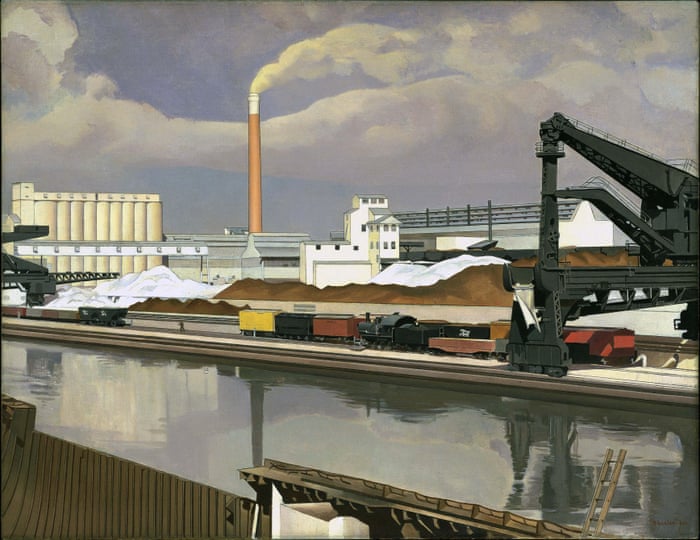
Charles Sheeler - American Landscape

America After the Fall review – upheaval in the home of the brave

Royal Academy, London
Dance marathons, dustbowl farms, brawling sailors, impoverished cotton-pickers … Adrian Searle takes a journey through 1930s America in a gripping show

Adrian Searle
The Guardian
Tuesday 21 February 2017

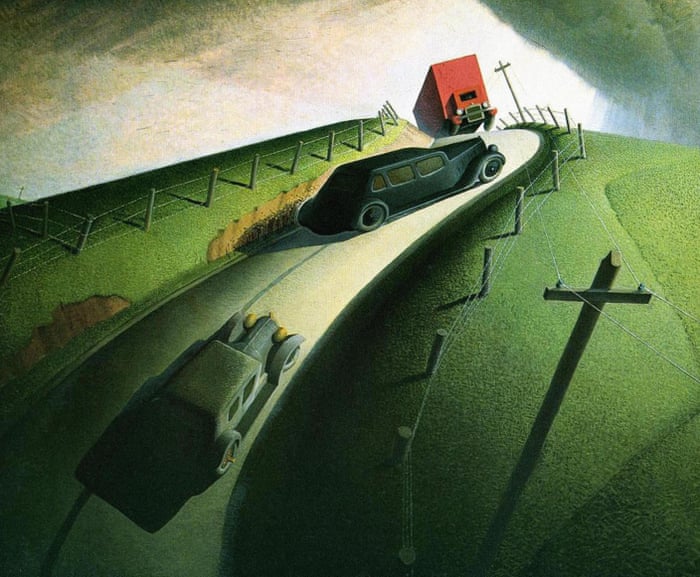
The sedan careers up the hill on a country road, slewing as a truck comes over the rise. We have a death’s-eye view, watching it happen. Everything slows down – a car pootling toward the sedan from behind, the oncoming truck going so fast its wheels have left the road. A storm is moving in, the fence-posts and telegraph poles, like ominous crosses on the hill, rearing.
Grant Wood - Death on Ridge Road

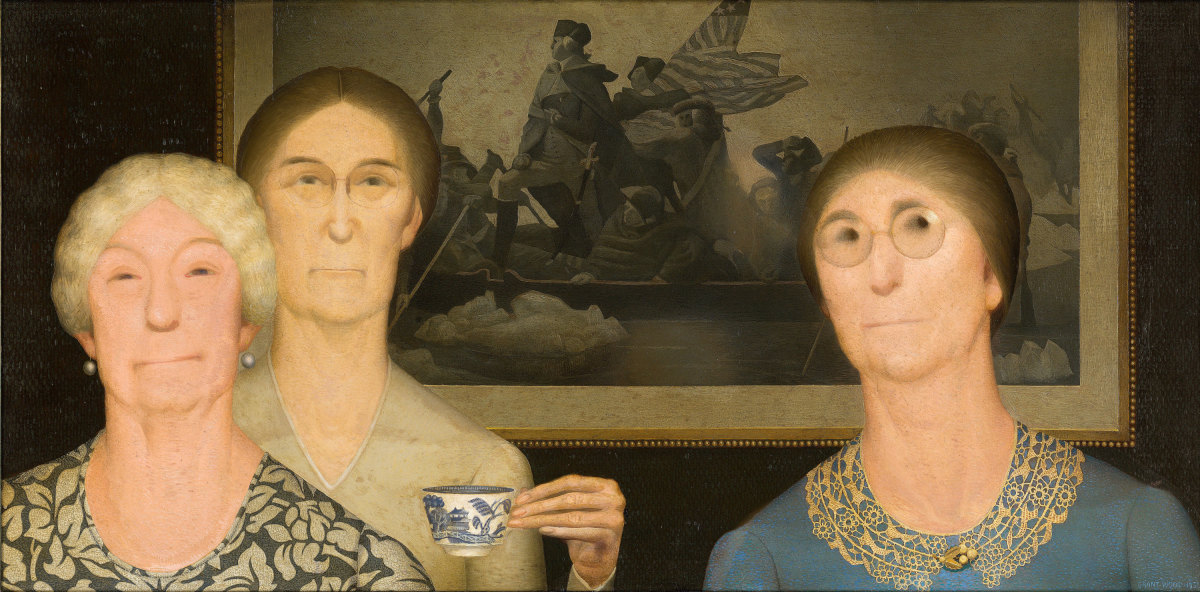
You don’t expect such graphic, cartoon action from Grant Wood, painter of ruralist, idealised farmsteads and small-minded Daughters of the American Revolution. The last time anything exciting happened was when Wood painted Paul Revere galloping through town and hollering, waking everyone up.

Grant Wood - Daughters of the Revolution

Curated by Judith A Barter of the Art Institute of Chicago, and drawn from many US collections, America After the Fall looks at American painting from the Wall Street crash and the great depression to the second world war. In no more than 50 paintings this fascinating show charts the turbulence of American society, its inequalities and divisions, its fears, fantasies and insecurities, during a period of both national and international upheaval. Sound familiar?
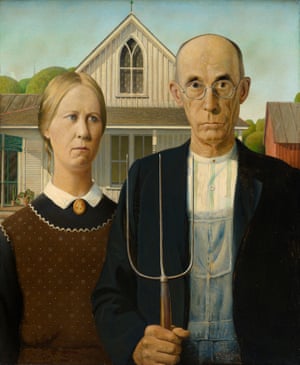
‘The most famous painting in American art’: Grant Wood’s American Gothic (1930) .
Grant Wood - American Gothic

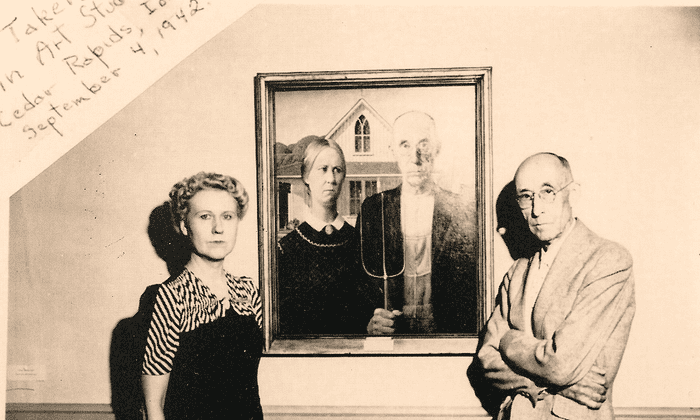
Nothing happens in Wood’s best known painting, American Gothic, now in London for the first time, with that creepy couple standing in front of their farmhouse. The most you get here is a mean look and the shine on the sharpened tips of the old man’s pitchfork. Never mind that the woman in this enigmatic portrait of a suspicious, unfriendly farm couple were actually Wood’s sister and the artist’s dentist, a man doubtless well-acquainted with sharp tools.

The artist’s models, Nan Wood Graham – his sister – and Byron McKeeby – his dentist – pose next to the painting

America in the 1930s was a society in turmoil and transition. The New Deal and public arts projects helped keep things going. New York went to the movies to watch films called Joys of the Flesh and Dangerous Curves, and the streets teemed with gawkers, barkers and floosies, street-walkers and drunks; Reginald Marsh’s paintings are filled with cheap fashions and cheaper thrills, cheap glamour and lots of clamour.

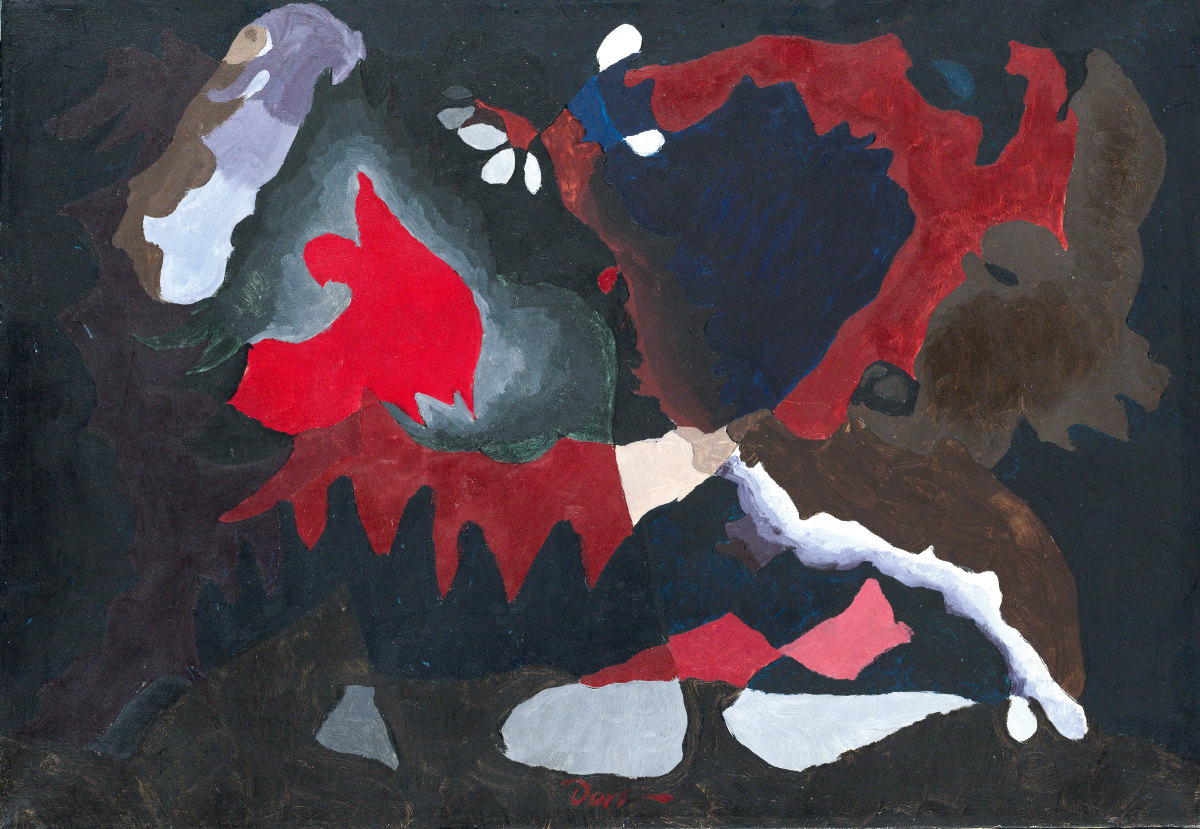
Arthur Dove - Swing Music (Louis Armstrong)
Exhausted dancers drag each other round the floor in Philip Evergood’s 1934 Dance Marathon, staying sentient for the chance of the $1,000 prize. The painting is as beat-up as the dancers. 
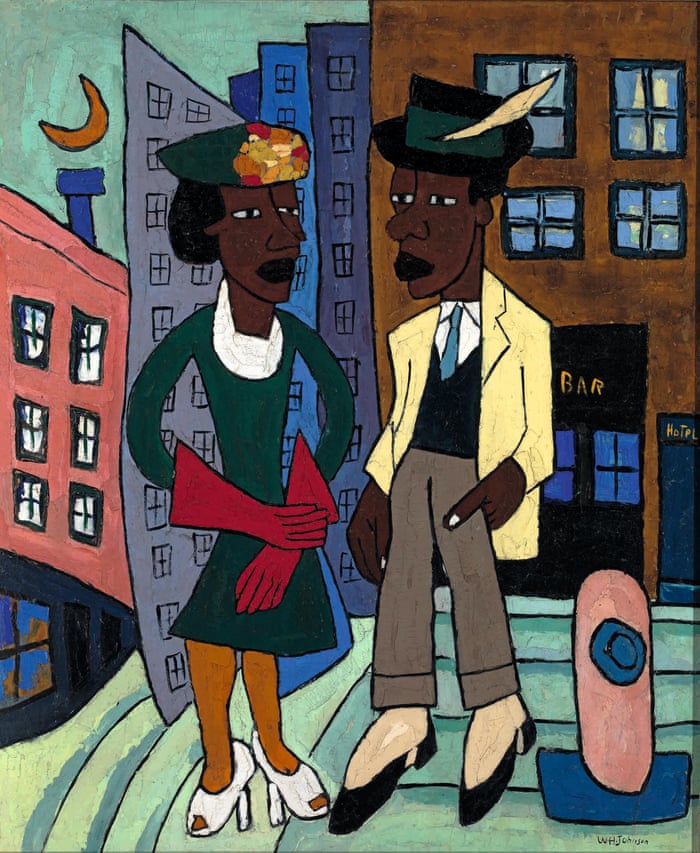
William H. Johnson - Street Life

In William H Johnson’s Street Life, a black Harlem couple are out for the evening under a clunky moon. The painting is all angles and buildings and the woman’s big red gloves and the electric evening.

Charles Green Shaw - Wrigley's

It is the opposite of Charles Green Shaw’s suave geometric towers of the city overlain with a hovering, realistic pack of Wrigley’s gum. This is a city to chew on, an intimation of pop art and the future. Stuart Davis melded New York and Paris in a swanky modernism where new and old jostle amiably.

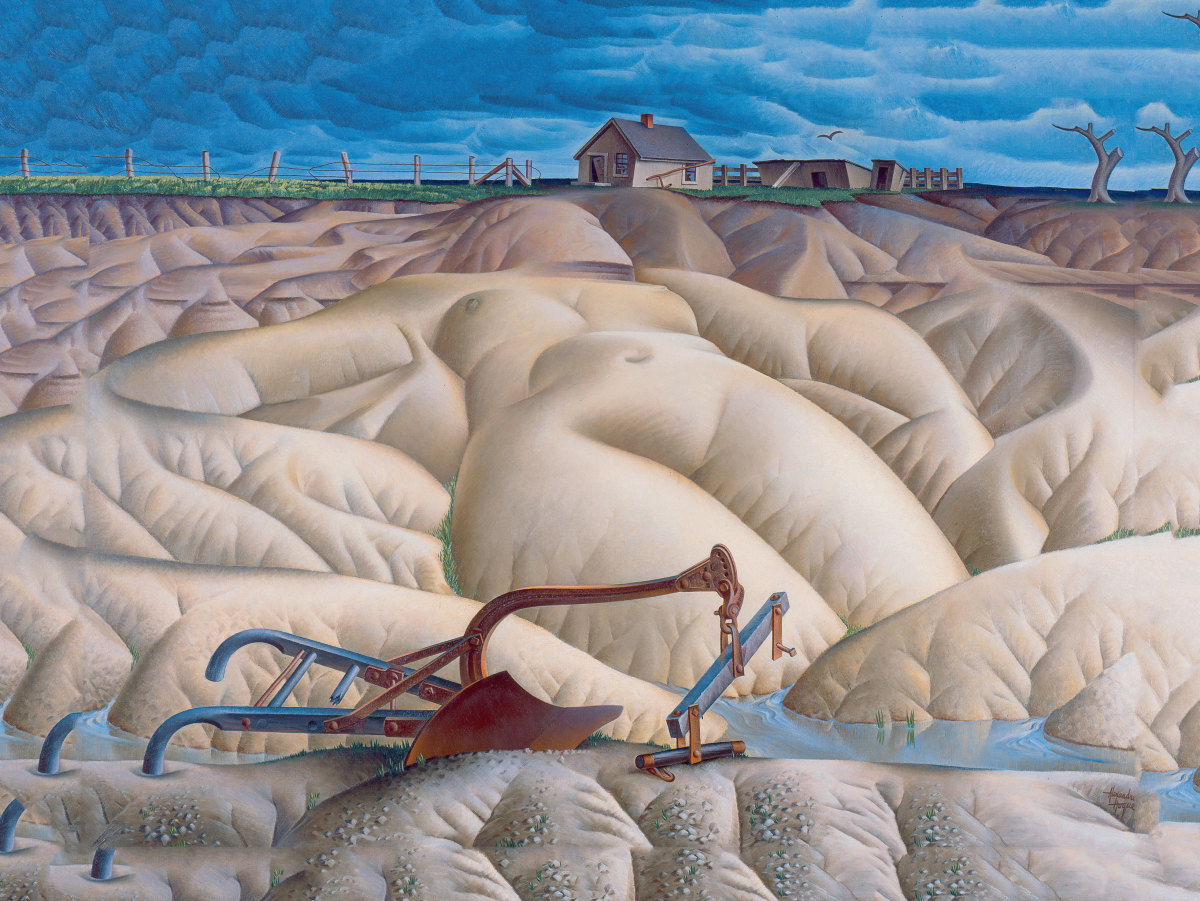
Alexandre Hogue - Erosion No. 2 - Mother Earth Laid Bare

Paul Cadmus started a scandal with The Fleet’s In!, a 1934 painting of sailors on the razz, drunk, bawling, sprawling and cruising with groups of good-time girls and an elegant gay man who offers a sailor a smoke. Thanks, pal. There are bulging crotches and asses, leers and slaps. The US Navy called the painting sordid and depraved. Now, it owns it. What fun this is.

Thomas Hart Benton - Cotton Pickers

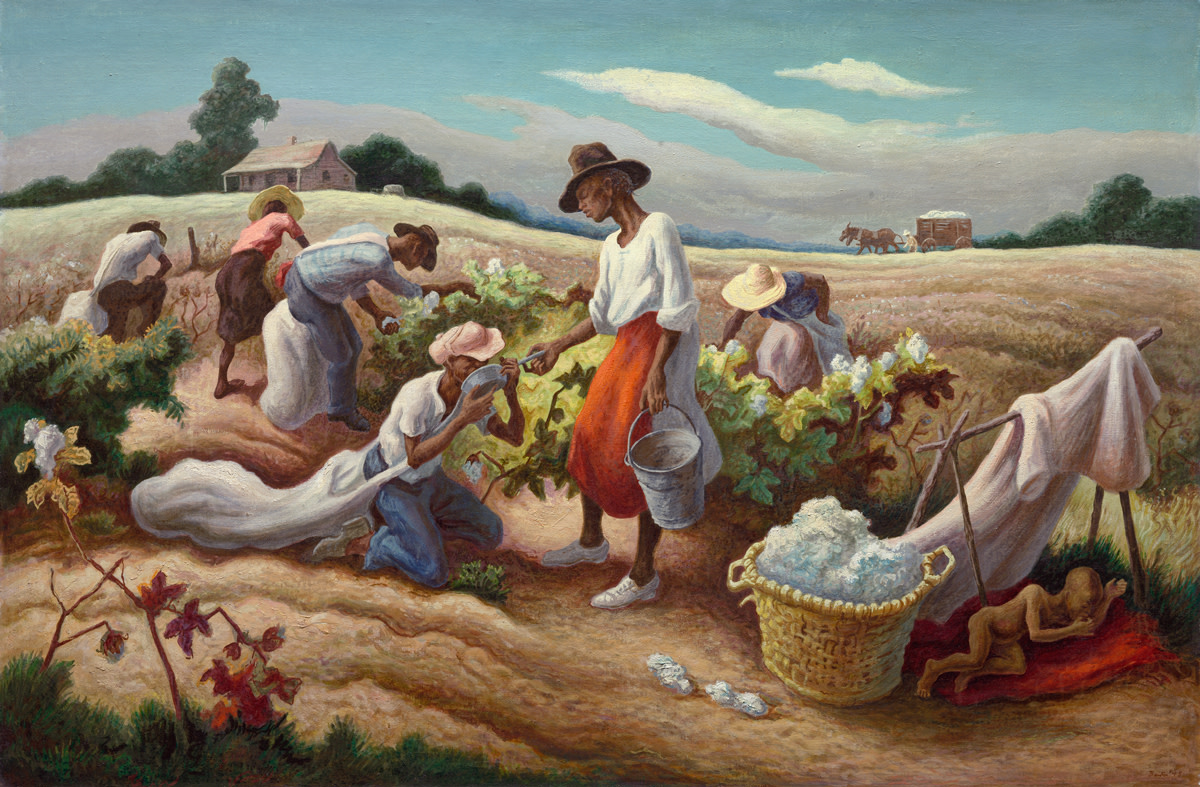
But this show takes sudden swerves. Cadus is a far cry from Joe Jones’s somnolent 1933 image of black roustabouts on a dock, heaving bails under the watchful gaze of a white, beer-gut boss, and Thomas Hart Benton’s impoverished Cotton Pickers, a sickly infant on the ground beside them, under the makeshift shade of a towel.

Georgia O' Keefe - Cow's Skull with Calico Roses

Homely, outdoor church suppers, Thanksgiving dinners prepared in steamy kitchens and nostalgic visions of a land of plenty compete with images of the earth farmed down to the bones, a world eroded. A hawk hovers over broken fences and collapsing barns in the dust bowl, the midwest prairie farms that overproduction and modern farming techniques inadvertently destroyed. In Alexandre Hogue’s rather obvious 1936 painting Mother Earth Laid Bare is a dead vista, the topsoil blown away, revealing a prone woman in humps of dust, a shifting dune.
Edward Hopper - Gas

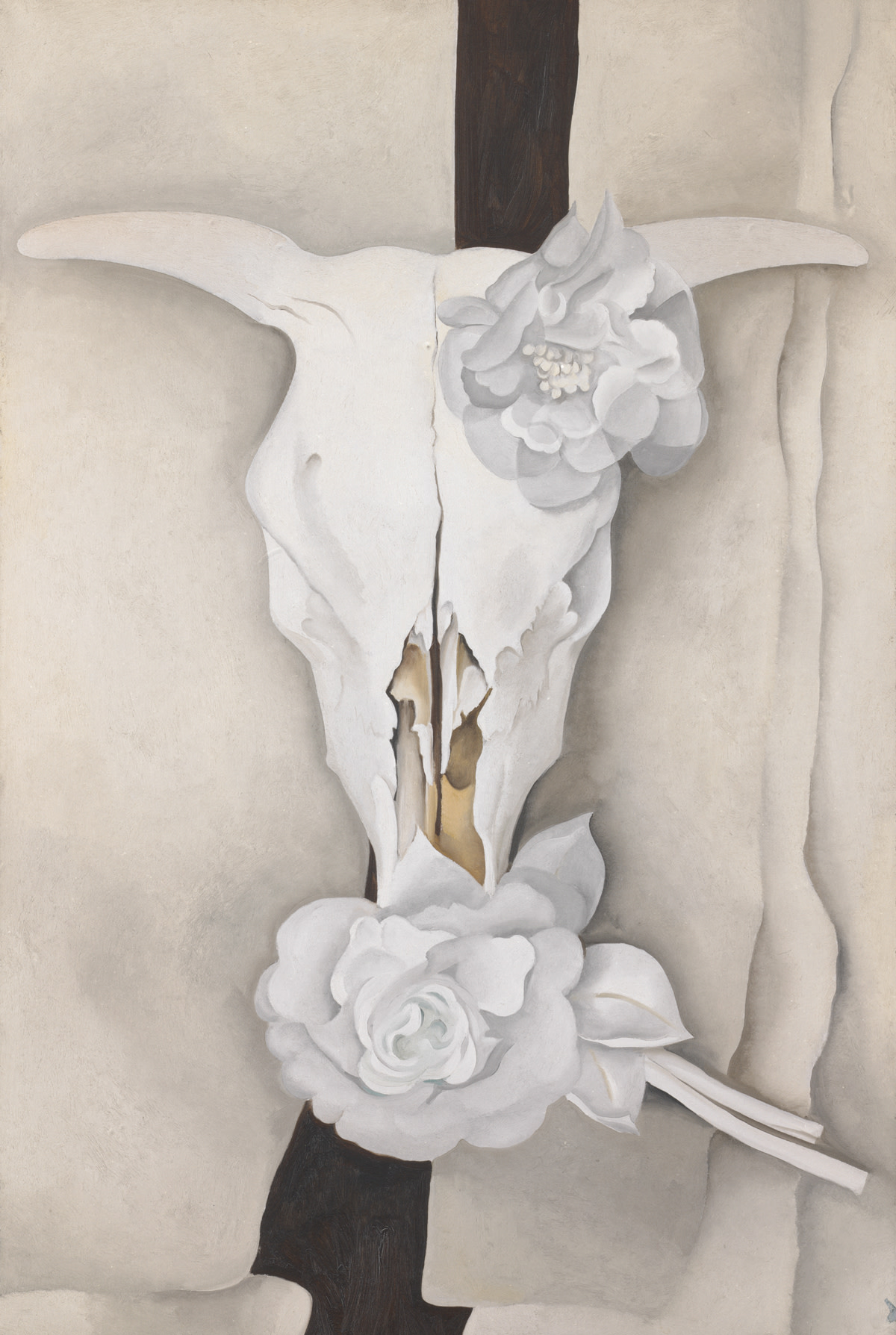
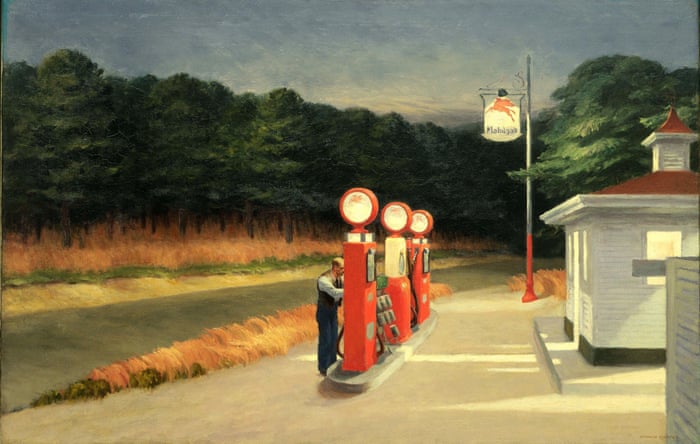
America After the Fall is all the better for its rackety variety. Edward Hopper is here, and a lone Georgia O’Keefe skull painting, but there is much I have never seen before, telling the story of troubled times in a multitude of voices. Towards the end, a lone Jackson Pollock, an inverted self-portrait, looms among seething blooded limbs and fists and eyes. Here’s a house on fire, lit by the Ku Klux Klan, while a black girl lies dead in the foreground. A noose hangs from a branch and a dog howls. American Justice, by Joe Jones, needs no sublety.

Joe Jones - American Justice

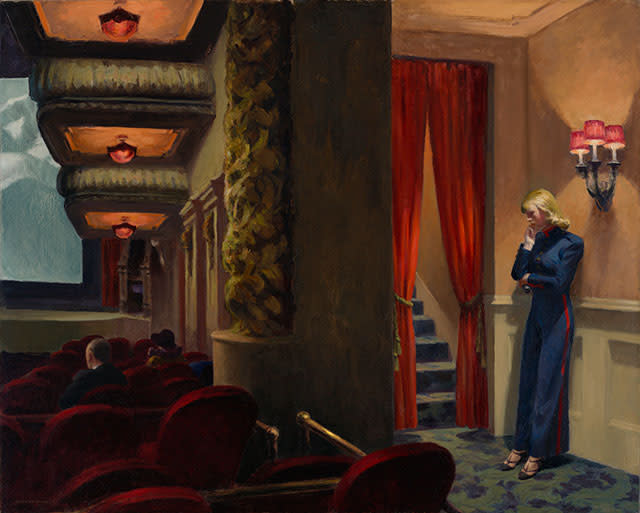
Fascinating stories are attached to many of the works and artists here, for which you will need to buy the excellent catalogue to learn that the first owner of Wood’s car crash painting was songwriter Cole Porter, whose wife’s ex-husband was the first American to kill someone in an auto crash. That the black and white movie playing in Edward Hopper’s wonderful painting of a pensive, bored cinema usherette in the wings of the movie theatre is probably Frank Capra’s 1937 Lost Horizon, in which a plane crash in the Himalayas leads to the discovery of Shangri-La. The stories multiply.

Edward Hopper - New York Movie

America in the 1930s was no lost utopia. While farming collapsed, industry was on the rise. Charles Demuth’s street corner – with its elegant stop lights, the facade of a tobacco factory rising into a sheer blue sky, the bulk of a water tower looming on the roof – manages to be both majestic, impersonal and empty. The title, And the Home of the Brave, taken from the new American anthem, gives us no idyll but a factory wall. It feels a lonely, silent place.


Emptier still were Charles Sheeler’s almost metaphysical industrial zones of river and railroad tracks, the cranes and vast factory complex of Ford’s River Rouge car plant. One lone, tiny figure walks the tracks. There’s no one else to be seen and the air is clear and still. The man is only there to give a measure of the place. Whatever is impending waits and the chimney belches.

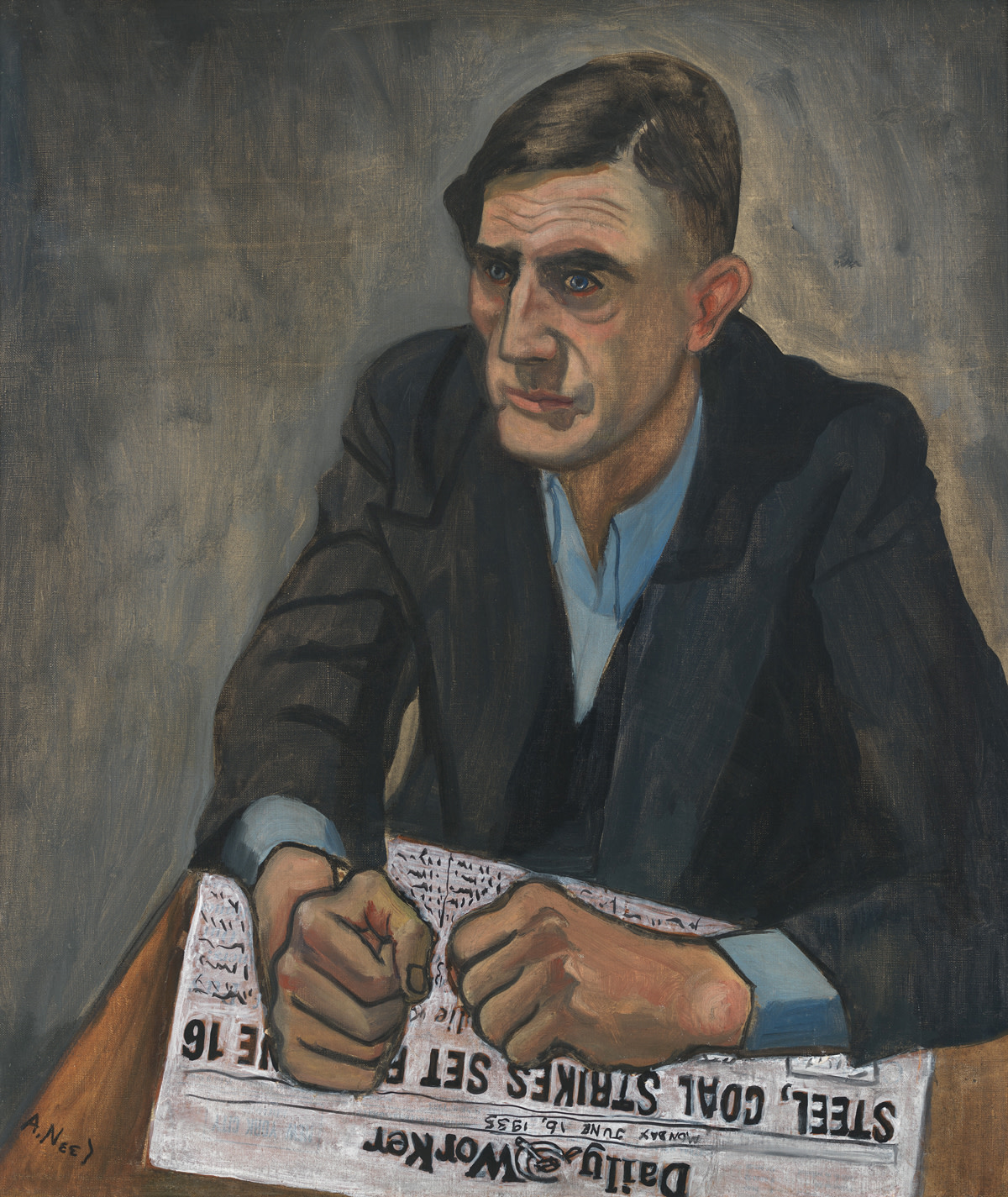
Alice Neel - Pat Whalen

There is terrific range in style and subject matter, outlook and temperament, artistic registers, ambitions and focus here. These are glimpses of the past, but one whose repercussions are felt in the divisions of America today. A terrific foil to the RA’s recently opened Revolution: Russian Art 1917-32 exhibition (whose time frame this show overlaps); and a rejoinder to the sprawling and unfocused Abstract Expressionism show that filled the main galleries last year, America After the Fall has other echoes of the present.

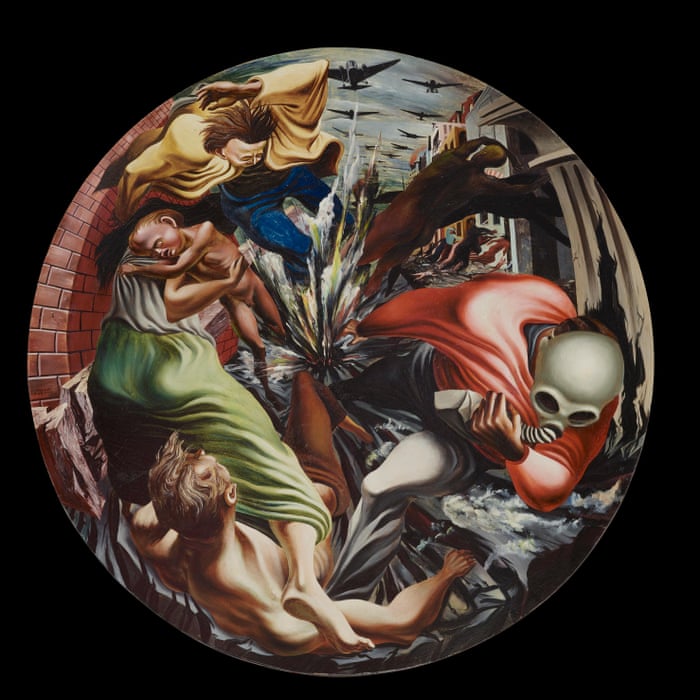
Philip Guston - Bombardment

Hankerings for a past that never was, a culture and certainty that was white, rural and stoic compete with images of black poverty, the aftermath of slavery, black aspiration and the threat of the KKK. Urban and rural America alike suffered the economic deprivations of the 1930s, in a land of crumbling certainties. A vexed relationship to Europe was exacerbated by the rumblings of war abroad. In 1938, O Louis Guglielmi painted Brooklyn Bridge as a blasted wreck, with a woman sitting on a twisted girder, an unexploded bomb protruding from her back. The year before Philip Guston painted the bombing of Guernica, in a tondo of mangled bodies, the German planes flying in.

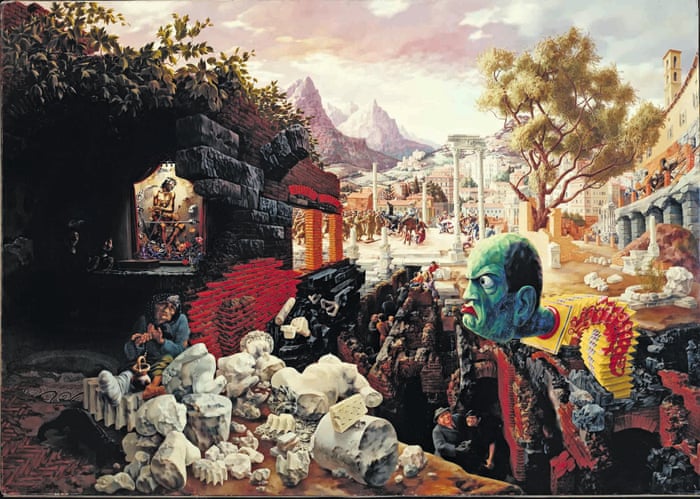
Peter Blume - Eternal City

Peter Blume, an artist who had spent time in Italy in the early 1930s, depicted the Roman Forum as a war zone, with blackshirts fighting the populace, conniving capitalists grinning from a trench, fleeing monks, a green-faced, red-lipped Mussolini as a glowering jack-in-the-box. He reminds me of someone else with a painted face. In a wayside shrine, Christ is surrounded by useless votives and baubles.

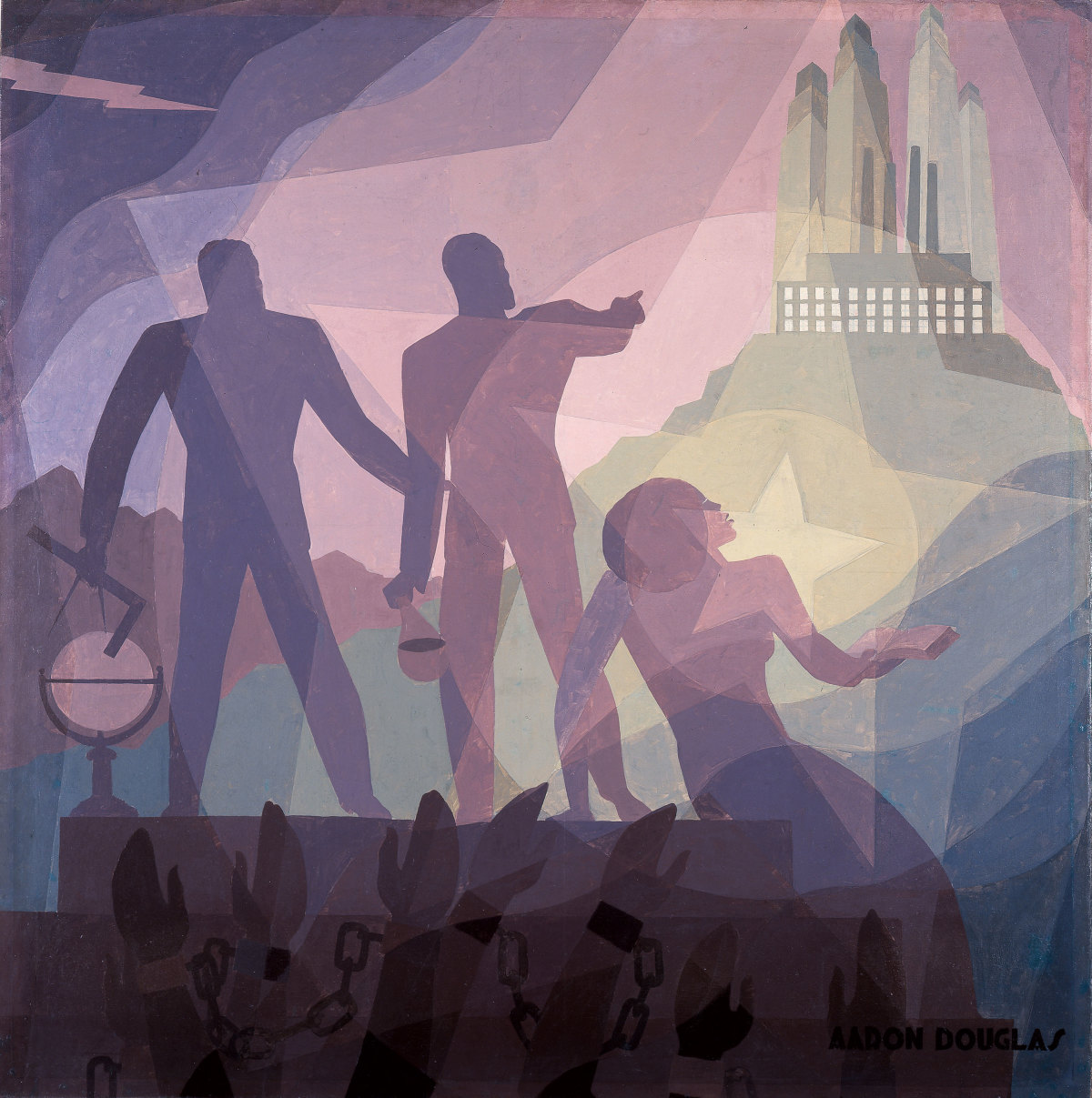
Aaron Douglas - Aspiration

While Blume was painting this, Sinclair Lewis published It Can’t Happen Here, about a presidential contender, Buzz Windrip, who beats Franklin Roosevelt and establishes a repressive dictatorship. Today’s echoes are obvious, the complexities still as enormous. What times.

America After the Fall: Painting in the 1930s is at the Royal Academy, London, from 25 February to 4 June

Tuesday, 28 February 2017

A Disparate Group by Jim McCullough


Over three decades

Phone calls made

Emails exchanged

Absences excused

Plans made

Pubs frequented

All seasons

Through rain, hail or shine

Beers drank

Tales told

Songs sang

Troubles and joys shared

Laughter and tears

World put to rights

Heroes and villains toasted and duly blogged

Members lost and found

Babies born

Friends carried

Here's to The Friday Boys.


Saturday, 25 February 2017

Women Street Photographers on Instagram...


Rome, Italy, by Valentina Matiradonna (@valenonvale)


The female street photographers of Instagram – in pictures
The art of street photography was long dominated by men and the ‘male gaze’, but new project Her Side of the Street celebrates women’s role in the practice

Francesca Perry
The Guardian
Thursday 19 January 2017

Throughout history, women have often been subject to observation and evaluation from men as they walk down city streets – whether ogled as objects of desire or judged for their appearance or even presence in certain spaces. In literary and social history, men have usually been the ones who watch, rather than be watched; the urban observer which 19th-century poet Baudelaire made famous as the “flâneur”.

In her recent book, Lauren Elkin wrote of the “flâneuse”, the woman who reclaimed power by walking through – and writing about – the city streets in defiance of convention, challenging the cultural assumption at the time that women on the street were either sex workers or homeless.

As in the literary tradition, so in the artistic one: the concept of the “male gaze” – depicting the world from a male perspective – historically dominated much of the visual arts. Most early street photographers were men – from Eugène Atget and Henri Cartier-Bresson to Weegee. In time, however, there were exceptions to this rule, notably Vivian Maier and Diane Arbus who became some of the most celebrated street photographers of the 20th century.

Last year, American photographer Casey Meshbesher felt compelled to create a compendium of street photography by women after noticing that very little could be found about the practice online or in print. She founded the blogzine Her Side of the Street focusing on female street photographers, as well as setting up the growing Women Street Photographers community and trying to map female street photographers around the world. “Projects like these are all an important part of the fuel for the fire about women in the arts,” she says, “which in turn is part of a larger flame from a resurgent feminist movement.”

“Underrepresentation of women in the art world is a well-known issue,” she adds. “In street photography, the situation is more acute. Calling this 90% male visibility might be too generous. We have old inherited ideas about what street photography is, originating from a time when sexism really was more dominant. The goal of these projects has been nothing less than to change the game, and I believe it has already begun to do so.”

The Her Side of the Street account on Instagram (@womeninstreet) promotes the work of female street photographers from around the world. Here are some highlights:

Singapore, by Graciela Magnoni

São Paulo, Brazil by Mel Coelho (@melzicah)

Cape Town, South Africa, by Retha Ferguson (@rethaferguson)


Los Angeles, US, by Sonia Kissin (@soniakissin)

Delhi, India, by Graciela Magnoni (@graciela_magnoni)

London, UK, by Linda Wisdom (@lindawisdomphotography)

Shanghai, China, by Steffi Löffler

Toronto, Canada, by Anne Gibson (@annejgibson)

Vilnius, Lithuania, by Roza Vulf (@rozavulf)

Mexico City, Mexico, by Sonia Madrigal (@sonicarol)

The West Bank by Tina Bojlesen (@danish_streettog)

Santa Fe, US, by Adrianne Ryan (@fullgallop)

Geneva, Switzerland, by Alison McCauley (@alisonmccauley)

Tag your Instagram shots with #womeninstreet to contribute to the Her Side of the Street project and follow @guardiancities for more great urban photography from around the world.

Friday, 24 February 2017

Dead Poets Society #27 Lorenzo Thomas: The Leopard


The Leopard by Lorenzo Thomas

The eyeballs on her behind are like fire
Leaping and annoying
The space they just passed
Just like fire would do

The ground have no mouth to complain
And the girl is not braver herself

She is beautiful in her spotted
Leopard ensemble. Heartless so

To keep her fashionalbe in New York
Leopards are dying

Crude comments flutter around her
At lunchtime. She sure look good
She remembers nine banishing speeches

More powerful than this is the seam
Of the leotard under her clothing

Her tail in the leotard is never still
The seam!
She feels it too familiar on her leg
As some crumb says something suggestive

The leopard embracing around her
Is too chic to leap and strike

Her thoughts fall back to last semester’s karate

Underneath, the leotard crouches up on her thigh
It is waiting for its terrible moment!


Thursday, 23 February 2017

Last night's set lists


At The Habit, York: -

Ron Elderly: -
Just My Imagination
Good Year For The Roses


Da Elderly: -
Out Of The Blue
In The Morning Light


The Elderly Brothers: -
Bye Bye Love
Walk Right Back
The Boxer
I Saw Her Standing There


Given the terrible weather and the imminent Storm Doris it was a pleasant surprise to find a rammed The Habit and a surfeit of players. These included several new duos: two boy/girl outfits wowed the audience with excellent harmonies and musicianship including "for our mums and dads" Queen's I Want To Break Free; probably my favourite was a bass/guitar duo who included Rodgers & Hammerstein's My Favourite Things and The Chordettes' Mr Sandman. Occasional regular and Beatles fan, Dave from Leeds put in a fine set with McCartney's Every Night and a spirited I Am The Walrus. The Elderly Brothers closed what had been a most enjoyable evening with the usual mixture of harmony-laden standards from the past.

Just to note that my recorded output, 2 Albums, an EP and a recent single are now available free gratis to listen to on Soundcloud. The 2 songs performed at the open mic Out Of The Blue and In The Morning Light are on the album Out Of The Blue at https://soundcloud.com/ian-ravenscroft-730965203/sets/out-of-the-blue


Wednesday, 22 February 2017

Glen Campbell salutes The Lone Ranger... and Tonto!


There existed (maybe exists) somewhere, footage of Campbell playing this in front of what I recall was an audience of students in the UK in the 70s, complete with projected footage of The Lone Ranger and when Tonto appears, the audience go ape. Wish I could find it...

Tuesday, 21 February 2017

Steely Dan: The Gaucho Story...

Who is the gaucho amigo?

Remembering The Tumultuous Perfection Of Steely Dan’s Chapter-Closing Album “Gaucho”

Gideon Plotnicki
Live for Live Music
21 November 2016

Steely Dan is one of the most important bands to come out of the 70’s. Their unique approach to pop music–a slick combination of jazz, off-center chord progressions, meticulous arrangements, and introspective lyrics–has left an indelible stamp on the world of music. The band essentially created their own genre; they didn’t allow outside influences to change their artistic output, and they maintained a stylistic integrity throughout their career, even apologizing for their own recordings that they felt were sub-par. Starting with 1972’s landmark debut album Can’t Buy A Thrill, Steely Dan released one record per year for the next five years, showing a prodigious work ethic that led to a bevy of classic soft rock albums, four out of five of them going Platinum in the process (1973’sCountdown To Ecstasy only reached Gold status). After releasing perhaps their best record, 1977’s landmark album Aja, the band would retreat into the studio for a lengthy recording process for what would turn out to be the final record of the pinnacle of their career, the wonderfully poppy and secretly dark 1980 album, Gaucho.

Gaucho found the band returning from the success of Aja and life in Los Angeles, but a number of issues bubbled to the surface during their long time in the studio. First and foremost, guitarist and band co-founder Walter Becker‘s girlfriend passed away from a drug overdose while in his home, and her family went on to sue him for $17 Million for introducing her to the drugs that killed her. Becker was eventually found innocent, though he settled with the family for an unknown sum of money. Shortly after this, he was involved in a car accident, shattering his leg and forcing him to use crutches for a long time, while also leading to several infections that left him trapped in the hospital in poor health. He and fellow co-founder Donald Fagen would continue their songwriting process over the phone during this time, slowing things down considerably.

The band would take their famous perfectionism to new levels during the Gaucho recording sessions, as they’d grown accustomed to the dedicated mercenary approach of the session musicians they worked with in Los Angeles on Aja. They returned to their home of New York City and found the musicians they worked with to be less professional, which was a major headache for Becker and Fagen. The band would often force their hired guns to do forty or more takes of the same song in search of the perfect snippet to use in the final recording. The result was a building-blocks approach that caused an inordinate amount of time to go into the recording process. For example, the band hired Mark Knopfler of Dire Straits to play lead guitar on “Time Out Of Mind”, having enjoyed his work on “Sultans of Swing” tremendously. He was brought into the studio for hours and hours of recording, and his final contribution to the record clocks in at only a few seconds.

Gaucho session Drummer Jeff Porcaro (who would go on to find fame and success with his band Toto) told Modern Drummermagazine a bit about the difficult recording process:

“From noon till six we’d play the tune over and over and over again, nailing each part. We’d go to dinner and come back and start recording. They made everybody play like their life depended on it. But they weren’t gonna keep anything anyone else played that night, no matter how tight it was. All they were going for was the drum track.”

Porcaro was replaced by Bernard “Pretty” Purdie and his famed “Purdie Shuffle” on “Babylon Sister”, and eventually a state-of-the-art drum machine nicknamed “Wendel” that was created by a sound engineer to Becker and Fagen’s specifications (Wendel famously received a plaque when Gaucho was certified Platinum). Imagine this as a microcosm for their entire recording process, working through each part on each track individually, performing take-after-take until getting it just right.

On top of their slow approach, when the album was finally ready to go, record label politics got in the way, as the band’s home label ofABC Records was purchased by MCA Records, forcing a delay in any new release from Steely Dan. Furthermore, Fagen and Becker were sued by jazz guitarist Keith Jarrett for copyright infringement, claiming that the album’s title track was too similar to his song “Long As You Know You’re Living Yours”. Fagen would eventually admit to being heavily influenced by the song, and Jarrett was given a co-writing credit on “Gaucho”, a major defeat for a band that was considered to be wholly original and creative in their approach to songwriting.

With all that pre-release drama, it’s amazing that Gaucho even made it to the finish line. Yet, when it was finally released on November 21st, 1980, the album was regarded as a stunning release by many. Rolling Stone gave it 4.5 stars, the New York Times named it the album of the year (over The Talking Heads’ Remain In Light), and the album would reach #9 on the Billboard charts, buoyed by the success of its bouncy lead single “Hey Nineteen”. The album contained a who’s who of famous session musicians, with Steve Gadd, Michael & Randy Brecker, and frequent Steely Dan cohorts Larry Carlton and Michael McDonald all making significant contributions to the record.

The album contains several Steely Dan classics, all of which center on a similar theme of disillusion with fame and success that they picked up in Los Angeles. “Hey Nineteen” captures their nostalgic spirit with perfection, detailing an aging hipster’s questionable pursuit of a nineteen-year-old woman. The album’s opening track, “Babylon Sisters”, is supposedly about a man going through a midlife crisis, picking up two young prostitutes to help him feel better before feeling inadequate in their presence. “Glamour Profession” is the ultimate testament to the perils of the L.A. lifestyle. “Time Out Of Mind” is a blatant tribute to recreational drug use, disguised by a sunny arrangement, bright horns, and awesome harmonies.

On the surface, it was standard Steely Dan, mixing the simple with the complicated, all while maintaining the band’s classic sound. However, the darkness that was driving the band seeped through into the lyrics on Gaucho, and, following Becker’s public dispute with his girlfriend’s grieving family, the band’s troubles were now there for all of their fans to see. Gaucho would be the last Steely Dan’s record for twenty years. Perhaps not a surprise, this time was used by the band to kick their drug habits, normalize their lives, and get back to basics. Their comeback record, Two Against Nature, would lead to an Album of the Year Grammy (controversially beating out Radiohead‘s Kid A and Eminem’s The Marshall Mathers LP), as well as an induction into the Rock ‘n’ Roll Hall Of Fame, cementing the legacy that they left behind with Gaucho all those years ago.

Looking back, Gaucho reflected the band’s faltering ego. The theme of disillusionment rang true with both band members, as they had stopped touring in 1974 and were considered musical hermits by the time 1980 rolled around. Trapped inside their own success and snobby attitudes, the band crumbled, but not before delivering one more perfect album. They wouldn’t have had it any other way.

http://liveforlivemusic.com/features/remembering-tumultuous-perfection-steely-dans-chapter-closing-album-gaucho/

And let's not forget the alternate Gaucho, available if you know someone in the know...

http://bbchron.blogspot.co.uk/2015/07/steely-dan-lost-gaucho-and-outtakes.html