Sunday, 27 November 2016
Saturday, 26 November 2016
Fidel Castro RIP

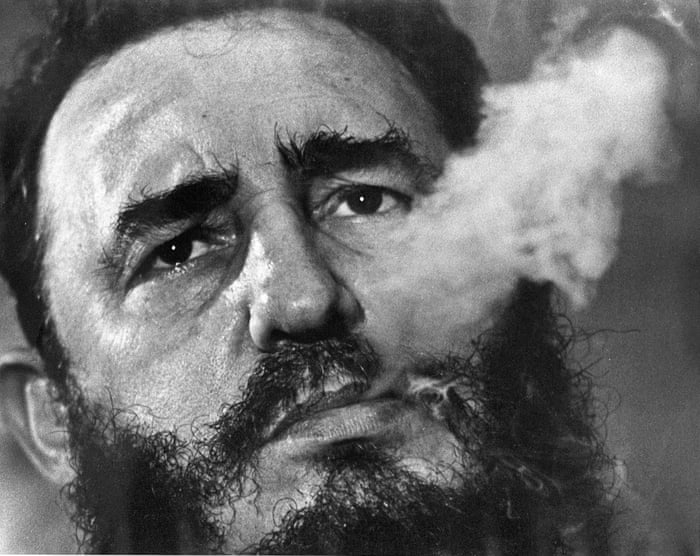
Cuba’s revolutionary leader, Fidel Castro, dies aged 90
The comandante overthrew Batista, established a communist state and survived countless American assassination attemptsRory Carroll
The Guardian
Saturday 26 November 2016
Fidel Castro has died at the age of 90, bringing an end to an era for the country, Latin America and world.
The revolutionary icon, one of the world’s best-known and most controversial leaders, survived countless US assassination attempts and premature obituaries, but in the end proved mortal and died late on Friday night after a long battle with illness.
Given the former president’s age and health problems, the announcement of Castro’s death had long been expected. But when it came it was still a shock: thecomandante – a figurehead for armed struggle across the developing world – was no more. It was news that friends and foes had long dreaded and yearned for respectively.
Castro’s younger brother Raúl, who assumed the presidency of Cuba in 2006 after Fidel suffered a near-fatal intestinal ailment, announced the revolutionary leader’s death on television on Friday night.
“With profound sadness I am appearing to inform our people and our friends across [Latin] America and the world that today, 25 November 2016, at 10.29pm, Fidel Castro, the commander in chief of the Cuban revolution, died,” he said.
“In accordance with his wishes, his remains will be cremated.”
Raúl Castro said that further details of the posthumous tribute would be released on Saturday, concluding his address with the famous revolutionary slogan: “Onwards to victory!”
Castro survived long enough to see Raúl negotiate an opening with the outgoing US president, Barack Obama, in December 2014, when Washington and Havana announced they would move to restore diplomatic ties for the first time since they were severed in 1961.
After outlasting nine occupants of the White House, he cautiously blessed the historic deal with his lifelong enemy in a letter published after a month-long silence.
The thaw in relations was crowned when Obama visited the island earlier this year. Castro did not meet Obama and days later wrote a scathing column condemning the US president’s “honey-coated” words and reminding Cubans of the many US attempts to overthrow and weaken the communist government.
As in life, in death Castro was deeply divisive. The announcement of his death was widely greeted online with celebration and condemnation of a “cruel dictator” and his repressive regime.
Others mourned the passing of “a fighter of US imperialism” and a “charismatic icon”.
In Miami, home to the largest diaspora of expatriate Cubans, people took to the streets celebrating his death, singing, dancing, and waving Cuban flags. As pots and pans were banged in jubilation, there were chants of “Cuba Libre!” (Cuba is Free) and “el viejo murió” (the old man is dead). Previous false reports of Castro’s death have triggered cavalcades of cheering, flag-waving revellers.
Cuba’s Communist party and state apparatus has prepared for this moment since July 2006 when Castro underwent emergency intestinal surgery and ceded power to his brother, Raúl, who remains in charge.
Fidel wrote occasional columns for the party paper, Granma, and made very occasional public appearances – most recently at the 2016 Communist party congress – but otherwise kept a very low profile.
Despite the mixed reactions to his death, one thing all could agree on was that this extraordinary figure had left his mark on history.
More than half a century ago, his guerrilla army of “bearded ones” replaced Fulgencio Batista’s corrupt dictatorship with communist rule which challenged the US and turned the island into a cold-war crucible.
He fended off a CIA-backed invasion at the Bay of Pigs in 1961 as well as many assassination attempts. His alliance with Moscow helped trigger the Cuban Missile Crisis in 1962, a 13-day showdown with the US that brought the world closer to the brink of nuclear war than it has ever been.
The US had long counted on Castro’s mortality as a “biological solution” to communism in the Caribbean but, since officially succeeding his brother in 2008, Raúl has cemented his own authority while overseeing cautious economic reforms, and agreeing the momentous deal to restore diplomatic relations between Cuba and the US in late 2014.
By Raúl’s own admission, however, Fidel is irreplaceable. By force of charisma, intellect and political cunning the lawyer-turned-guerrilla embodied the revolution. Long before his passing, however, Cubans had started to move on, with increased migration to the US and an explosion of small private businesses.
His greatest legacy is free healthcare and education, which have given Cuba some of the region’s best human development statistics. But he is also responsible for the central planning blunders and stifling government controls that – along with the US embargo – have strangled the economy, leaving most Cubans scrabbling for decent food and desperate for better living standards.
The man who famously declared “history will absolve me” leaves a divided legacy. Older Cubans who remember brutal times under Batista tend to emphasise the revolution’s accomplishments. Younger Cubans are more likely to rail against gerontocracy, repression and lost opportunity. But even they refer to Castro by the more intimate name of Fidel.
Since largely vanishing from public view he has been a spectral presence, occasionally surfacing in what became a trademark tracksuit, to urge faith in the revolution. It was a long goodbye that accustomed Cubans to his mortality.
Latin America’s leftist leaders will mourn the passing of a figure who was perceived less as a communist and more as a nationalist symbol of regional pride and defiance against the “gringo” superpower.
Fidel Castro’s funeral and cremation are expected to attract numerous foreign heads of state, intellectuals and artists.
Saturday 26 November 2016
Fidel Castro has died at the age of 90, bringing an end to an era for the country, Latin America and world.
The revolutionary icon, one of the world’s best-known and most controversial leaders, survived countless US assassination attempts and premature obituaries, but in the end proved mortal and died late on Friday night after a long battle with illness.
Given the former president’s age and health problems, the announcement of Castro’s death had long been expected. But when it came it was still a shock: thecomandante – a figurehead for armed struggle across the developing world – was no more. It was news that friends and foes had long dreaded and yearned for respectively.
Castro’s younger brother Raúl, who assumed the presidency of Cuba in 2006 after Fidel suffered a near-fatal intestinal ailment, announced the revolutionary leader’s death on television on Friday night.
“With profound sadness I am appearing to inform our people and our friends across [Latin] America and the world that today, 25 November 2016, at 10.29pm, Fidel Castro, the commander in chief of the Cuban revolution, died,” he said.
“In accordance with his wishes, his remains will be cremated.”
Raúl Castro said that further details of the posthumous tribute would be released on Saturday, concluding his address with the famous revolutionary slogan: “Onwards to victory!”
Castro survived long enough to see Raúl negotiate an opening with the outgoing US president, Barack Obama, in December 2014, when Washington and Havana announced they would move to restore diplomatic ties for the first time since they were severed in 1961.
After outlasting nine occupants of the White House, he cautiously blessed the historic deal with his lifelong enemy in a letter published after a month-long silence.
The thaw in relations was crowned when Obama visited the island earlier this year. Castro did not meet Obama and days later wrote a scathing column condemning the US president’s “honey-coated” words and reminding Cubans of the many US attempts to overthrow and weaken the communist government.
As in life, in death Castro was deeply divisive. The announcement of his death was widely greeted online with celebration and condemnation of a “cruel dictator” and his repressive regime.
Others mourned the passing of “a fighter of US imperialism” and a “charismatic icon”.
In Miami, home to the largest diaspora of expatriate Cubans, people took to the streets celebrating his death, singing, dancing, and waving Cuban flags. As pots and pans were banged in jubilation, there were chants of “Cuba Libre!” (Cuba is Free) and “el viejo murió” (the old man is dead). Previous false reports of Castro’s death have triggered cavalcades of cheering, flag-waving revellers.
Cuba’s Communist party and state apparatus has prepared for this moment since July 2006 when Castro underwent emergency intestinal surgery and ceded power to his brother, Raúl, who remains in charge.
Fidel wrote occasional columns for the party paper, Granma, and made very occasional public appearances – most recently at the 2016 Communist party congress – but otherwise kept a very low profile.
Despite the mixed reactions to his death, one thing all could agree on was that this extraordinary figure had left his mark on history.
More than half a century ago, his guerrilla army of “bearded ones” replaced Fulgencio Batista’s corrupt dictatorship with communist rule which challenged the US and turned the island into a cold-war crucible.
He fended off a CIA-backed invasion at the Bay of Pigs in 1961 as well as many assassination attempts. His alliance with Moscow helped trigger the Cuban Missile Crisis in 1962, a 13-day showdown with the US that brought the world closer to the brink of nuclear war than it has ever been.
The US had long counted on Castro’s mortality as a “biological solution” to communism in the Caribbean but, since officially succeeding his brother in 2008, Raúl has cemented his own authority while overseeing cautious economic reforms, and agreeing the momentous deal to restore diplomatic relations between Cuba and the US in late 2014.
By Raúl’s own admission, however, Fidel is irreplaceable. By force of charisma, intellect and political cunning the lawyer-turned-guerrilla embodied the revolution. Long before his passing, however, Cubans had started to move on, with increased migration to the US and an explosion of small private businesses.
His greatest legacy is free healthcare and education, which have given Cuba some of the region’s best human development statistics. But he is also responsible for the central planning blunders and stifling government controls that – along with the US embargo – have strangled the economy, leaving most Cubans scrabbling for decent food and desperate for better living standards.
The man who famously declared “history will absolve me” leaves a divided legacy. Older Cubans who remember brutal times under Batista tend to emphasise the revolution’s accomplishments. Younger Cubans are more likely to rail against gerontocracy, repression and lost opportunity. But even they refer to Castro by the more intimate name of Fidel.
Since largely vanishing from public view he has been a spectral presence, occasionally surfacing in what became a trademark tracksuit, to urge faith in the revolution. It was a long goodbye that accustomed Cubans to his mortality.
Latin America’s leftist leaders will mourn the passing of a figure who was perceived less as a communist and more as a nationalist symbol of regional pride and defiance against the “gringo” superpower.
Fidel Castro’s funeral and cremation are expected to attract numerous foreign heads of state, intellectuals and artists.
Friday, 25 November 2016
Dead Poets Society #17 Siegfried Sassoon: Suicide in the Trenches
Suicide in the Trenches by Siegfried Sassoon
I knew a simple soldier boy
Who grinned at life in empty joy,
Slept soundly through the lonesome dark,
And whistled early with the lark.
In winter trenches, cowed and glum,
With crumps and lice and lack of rum,
He put a bullet through his brain.
No one spoke of him again.
You smug-faced crowds with kindling eye
Who cheer when soldier lads march by,
Sneak home and pray you'll never know
The hell where youth and laughter go.
Thursday, 24 November 2016
Last night's set lists
Ron Elderly: -
My Home Town
The Way You Look Tonight
I'll See You In My Dreams
Autumn Leaves
Da Elderly: -
Love Song
In The Morning Light
Mellow My Mind
There Stands The Glass
The Elderly Brothers: -
The Price Of Love
Country Roads
You Got It
Yes I Will
Just when you think you've seen it all - only at The Habit open mic night would someone bring a piano!! Said piano just made it through the door, something it had failed to do across the road at the Snickleway Inn - note to performers...always check the width of the doorway before wheeling your piano all the way to the gig!!
All told it was a rather quiet night performer-wise with some folks getting a second chance to play - and there was room for 4 songs each this week. There was a strong showing for the songs of Elton John, David Bowie and Ray LaMontagne. After the open mic finished, The Elderly Brothers kept the audience entertained with unplugged requests including songs by Elvis, Neil Young and The Beatles. Another fun-packed night.
My Home Town
The Way You Look Tonight
I'll See You In My Dreams
Autumn Leaves
Da Elderly: -
Love Song
In The Morning Light
Mellow My Mind
There Stands The Glass
The Elderly Brothers: -
The Price Of Love
Country Roads
You Got It
Yes I Will
Just when you think you've seen it all - only at The Habit open mic night would someone bring a piano!! Said piano just made it through the door, something it had failed to do across the road at the Snickleway Inn - note to performers...always check the width of the doorway before wheeling your piano all the way to the gig!!
All told it was a rather quiet night performer-wise with some folks getting a second chance to play - and there was room for 4 songs each this week. There was a strong showing for the songs of Elton John, David Bowie and Ray LaMontagne. After the open mic finished, The Elderly Brothers kept the audience entertained with unplugged requests including songs by Elvis, Neil Young and The Beatles. Another fun-packed night.
Wednesday, 23 November 2016
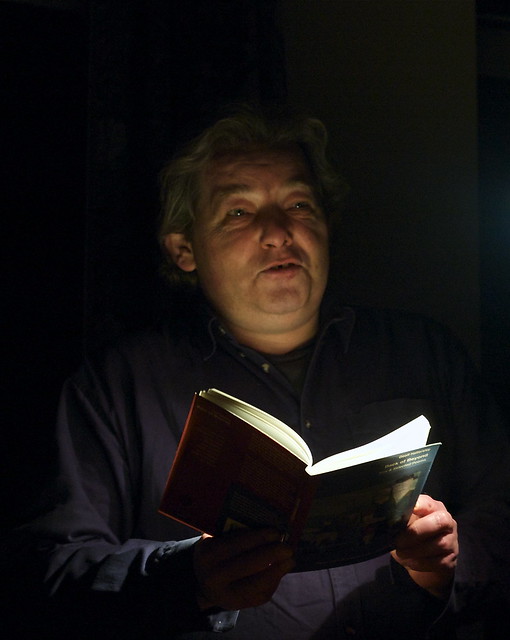
Geoff Hattersley - The Only Son at the Fish 'n' Chip Shop

He lived with his mother till he was forty-five
and no one was allowed to touch his head.
He worked on a novel for twenty years
without writing a word. He didn’t like people
who wrote novels. He often drank. One glass of beer
was too many, two glasses weren’t enough.
Travel brochures were as far as he went.
A football match, one time. He often said
Why would anyone want to think about a potato?
He painted his door with nobody’s help.
GEOFF HATTERSLEY
From Back of Beyond: New and Selected Poems (Smith/Doorstop Books, 2006)
Tuesday, 22 November 2016
David Tindle Retrospective at Huddersfield Art Gallery

David Tindle RA: A Retrospective review – lush yet spectral
Huddersfield Art Gallery
One of the finest figurative painters of his generation, David Tindle remains unknown to many. This retrospective is long overdue
Rachel Cooke
Tindle, who now lives and works in Italy, wasn’t always unknown, of course. In a vitrine at Huddersfield Art Gallery you can see the newspaper reports that greeted his arrival on the scene in the early 50s: an angular, floppy-haired fellow who, by the critics’ account, was coming up hard on the heels of Prunella Clough, Francis Bacon, Lucian Freud and Keith Vaughan. After a six-month stint at junior art college in Coventry and two years’ graft at a commercial art studio, Tindle had his first London exhibition aged just 19, having moved to the city to work with the theatrical scene-painter Edward Delaney (the business of painting backdrops, “working in a big flow of colour”, was to have a profound and lasting influence on his work). The exhibition changed everything. An admirer of John Minton, Tindle found the artist’s number in the telephone book and rang to invite him to see it. Minton did, and the two became friends. Also in the vitrine is Tindle’s 1952 pencil drawing of Minton, tender and reverent.
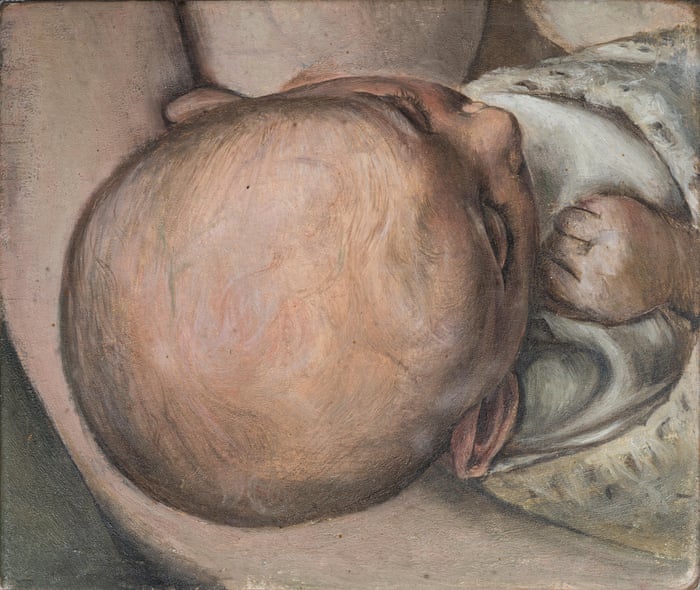
Mother and Child, 1954
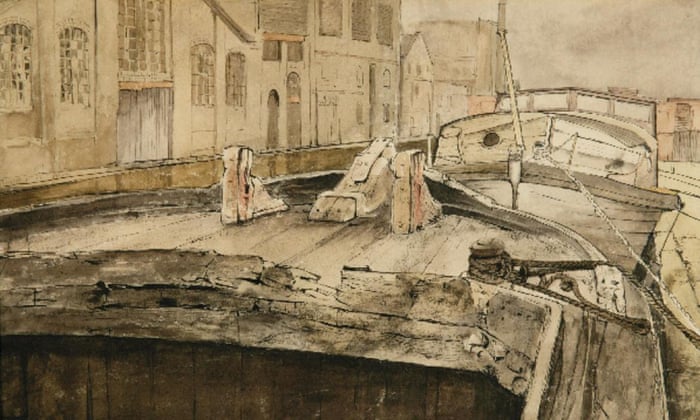
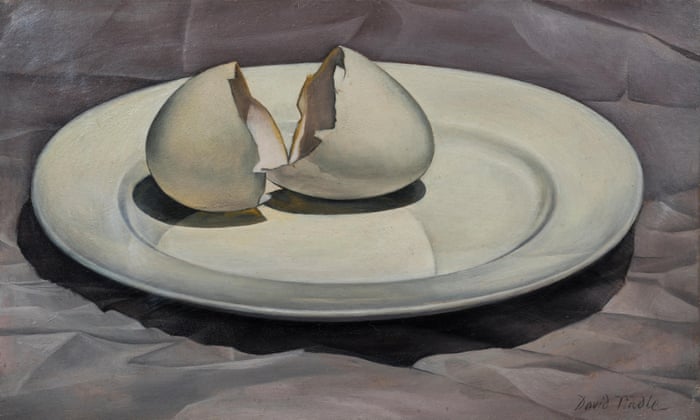
Through Minton, Tindle met Freud, Vaughan and the rest – older men who helped build his sense of himself as an artist. He was then “very susceptible to influence”, and you see this in the early works: Barges on the Regent’s Canal(1954, ink and watercolour on paper) shows what he learned about line from Minton; Freud exerts a clear hold on the wondrously detailed Mother and Child(1954, oil on board), a portrait of Tindle’s baby son, John, on the breast. The more abstract Paddington (1961, oil and sand on canvas) links to Frank Auerbach’s work of the same period. But already Tindle’s paintings have an extraordinary presence: there is something sacramental about the arrangement of the objects in his still lifes. Broken Egg Shell (1954, oil on board) is an extraordinary picture. At first sight it belongs to the school of William Nicholson, a study in beauty, light and shadow. But look closer and the eggshell in question seems to be out of proportion, almost planet-like on its white plate, which is itself balanced on a moonscape rather than a tablecloth. Here is the first whisper of the atmosphere that will pervade Tindle’s mature work, which plays in the most delicate way with the idea of realism.
Broken Egg Shell, 1954
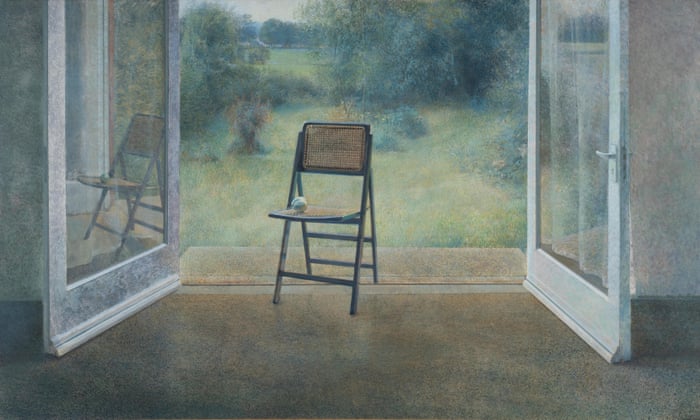
The sea change came in the early 1970s, when he swapped oil and acrylic for egg tempera, an exacting medium that helped him achieve a “crisper articulation of form”, a quality closer to a photograph. The result was, and is, stunning. He used it for still lifes and portraits (Tindle is a gorgeous, empathetic portraitist, and several are included in this show, including a study for a painting of Dirk Bogarde commissioned by the National Portrait Gallery), but its most perfect expression can be seen in the series of gardens – verdant rooms, really – that he painted through the 70s and well into the 80s: Garden, Evening (1979); Garden on the Hill, 7am (1984); Egg on a Table (1985). These have recurring motifs: doors and windows to form pictures within pictures, a theatrical framing device that may be traced back to his scenery painting days; a carefully placed chair, often featuring some kind of basketwork, and on it, perhaps, an apple. However, it’s their atmosphere, lush yet spectral, that hangs in the mind like mist.

Egg on a Table, 1985
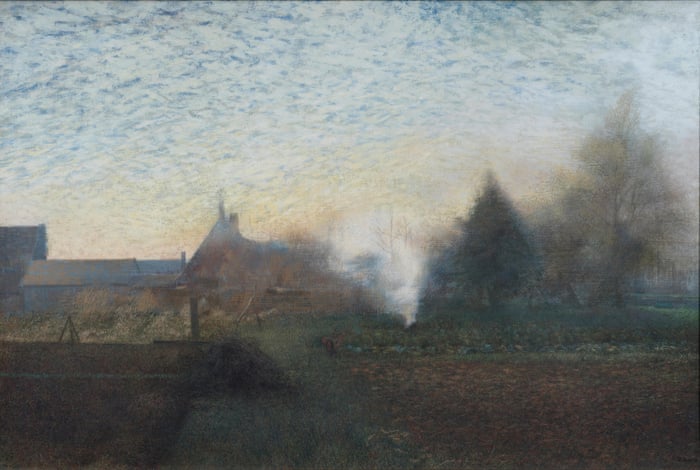
Tindle has said that in these works “memory and presence are very close”. They are, in other words, depictions of real places, recollected in the tranquillity of the studio. I can’t really describe the powerful effect they have on me. Only the work of Michael Andrews, his near contemporary and with whom his work shares a certain tone, moves me more. The finest of them all, Garden on the Edge of the Village (1976), depicts those few moments on a cold but bright winter’s day just before dusk. We are in an allotment or cultivated field close to a farmhouse, where a small bonfire still smokes; the sky is mottled, like an old enamel mug. It is a painting that is at once both calm and urgent, an eternal scene but also a vanishing one. Tindle, you finally realise, is as interested in time as he is in place. How to capture it? Light is the key. It illuminates his work, warms it seemingly from within, humanising his extraordinary skill. But it is also a metaphor. Beyond the trees, the wall, the hedge, darkness is creeping ever closer.
David Tindle RA: A Retrospective is at Huddersfield Art Gallery until 4 February 2017
Huddersfield Art Gallery
One of the finest figurative painters of his generation, David Tindle remains unknown to many. This retrospective is long overdue
Rachel Cooke
The Guardian
Sunday 20 November 2016
Unless you live there, or close by, Huddersfield isn’t particularly easy to reach. The journey by train from Wakefield can take up to 40 minutes, the puttering two-carriage engine that works this route no match at all for the town’s magnificent neoclassical station. But never mind. Who cares about bad connections and too-weak Costa tea when at the end is one of the loveliest small exhibitions you’re likely to see this side of Brexit, and perhaps far beyond it?
Sunday 20 November 2016
Unless you live there, or close by, Huddersfield isn’t particularly easy to reach. The journey by train from Wakefield can take up to 40 minutes, the puttering two-carriage engine that works this route no match at all for the town’s magnificent neoclassical station. But never mind. Who cares about bad connections and too-weak Costa tea when at the end is one of the loveliest small exhibitions you’re likely to see this side of Brexit, and perhaps far beyond it?

Garden on the Edge of the Village, 1976
The painter David Tindle was born in Huddersfield in 1932, and though he grew up largely in Coventry, it’s this connection that has given the town’s art gallery an excuse to stage a long overdue retrospective of a career that began in the late 40s and continues still. Will this ignite new interest in him, an artist whose name is now far too little known? I hope so, and the show may yet (fingers crossed) travel. In the meantime, seek it out and you will discover, over the course of just two oblong rooms, an uncommonly exquisite painter whose sensibility, imbuing as it does the quotidian with the numinous, can be traced back to Samuel Palmer and forward to another Coventry man, George Shaw.

Baltais Dzidrais, 1979
The painter David Tindle was born in Huddersfield in 1932, and though he grew up largely in Coventry, it’s this connection that has given the town’s art gallery an excuse to stage a long overdue retrospective of a career that began in the late 40s and continues still. Will this ignite new interest in him, an artist whose name is now far too little known? I hope so, and the show may yet (fingers crossed) travel. In the meantime, seek it out and you will discover, over the course of just two oblong rooms, an uncommonly exquisite painter whose sensibility, imbuing as it does the quotidian with the numinous, can be traced back to Samuel Palmer and forward to another Coventry man, George Shaw.

Baltais Dzidrais, 1979
Tindle, who now lives and works in Italy, wasn’t always unknown, of course. In a vitrine at Huddersfield Art Gallery you can see the newspaper reports that greeted his arrival on the scene in the early 50s: an angular, floppy-haired fellow who, by the critics’ account, was coming up hard on the heels of Prunella Clough, Francis Bacon, Lucian Freud and Keith Vaughan. After a six-month stint at junior art college in Coventry and two years’ graft at a commercial art studio, Tindle had his first London exhibition aged just 19, having moved to the city to work with the theatrical scene-painter Edward Delaney (the business of painting backdrops, “working in a big flow of colour”, was to have a profound and lasting influence on his work). The exhibition changed everything. An admirer of John Minton, Tindle found the artist’s number in the telephone book and rang to invite him to see it. Minton did, and the two became friends. Also in the vitrine is Tindle’s 1952 pencil drawing of Minton, tender and reverent.

Through Minton, Tindle met Freud, Vaughan and the rest – older men who helped build his sense of himself as an artist. He was then “very susceptible to influence”, and you see this in the early works: Barges on the Regent’s Canal(1954, ink and watercolour on paper) shows what he learned about line from Minton; Freud exerts a clear hold on the wondrously detailed Mother and Child(1954, oil on board), a portrait of Tindle’s baby son, John, on the breast. The more abstract Paddington (1961, oil and sand on canvas) links to Frank Auerbach’s work of the same period. But already Tindle’s paintings have an extraordinary presence: there is something sacramental about the arrangement of the objects in his still lifes. Broken Egg Shell (1954, oil on board) is an extraordinary picture. At first sight it belongs to the school of William Nicholson, a study in beauty, light and shadow. But look closer and the eggshell in question seems to be out of proportion, almost planet-like on its white plate, which is itself balanced on a moonscape rather than a tablecloth. Here is the first whisper of the atmosphere that will pervade Tindle’s mature work, which plays in the most delicate way with the idea of realism.

The sea change came in the early 1970s, when he swapped oil and acrylic for egg tempera, an exacting medium that helped him achieve a “crisper articulation of form”, a quality closer to a photograph. The result was, and is, stunning. He used it for still lifes and portraits (Tindle is a gorgeous, empathetic portraitist, and several are included in this show, including a study for a painting of Dirk Bogarde commissioned by the National Portrait Gallery), but its most perfect expression can be seen in the series of gardens – verdant rooms, really – that he painted through the 70s and well into the 80s: Garden, Evening (1979); Garden on the Hill, 7am (1984); Egg on a Table (1985). These have recurring motifs: doors and windows to form pictures within pictures, a theatrical framing device that may be traced back to his scenery painting days; a carefully placed chair, often featuring some kind of basketwork, and on it, perhaps, an apple. However, it’s their atmosphere, lush yet spectral, that hangs in the mind like mist.
Egg on a Table, 1985
Tindle has said that in these works “memory and presence are very close”. They are, in other words, depictions of real places, recollected in the tranquillity of the studio. I can’t really describe the powerful effect they have on me. Only the work of Michael Andrews, his near contemporary and with whom his work shares a certain tone, moves me more. The finest of them all, Garden on the Edge of the Village (1976), depicts those few moments on a cold but bright winter’s day just before dusk. We are in an allotment or cultivated field close to a farmhouse, where a small bonfire still smokes; the sky is mottled, like an old enamel mug. It is a painting that is at once both calm and urgent, an eternal scene but also a vanishing one. Tindle, you finally realise, is as interested in time as he is in place. How to capture it? Light is the key. It illuminates his work, warms it seemingly from within, humanising his extraordinary skill. But it is also a metaphor. Beyond the trees, the wall, the hedge, darkness is creeping ever closer.
David Tindle RA: A Retrospective is at Huddersfield Art Gallery until 4 February 2017
Monday, 21 November 2016
Tintin exploring the moon - a bargain at €1.55m...

Tintin drawing sells for record €1.55m in Paris auction
Original artwork by Hergé from Explorers on the Moon was expected to sell for between €700,000 and €900,000
Agence France-Presse in Paris
The Guardian
Saturday 19 November 2016
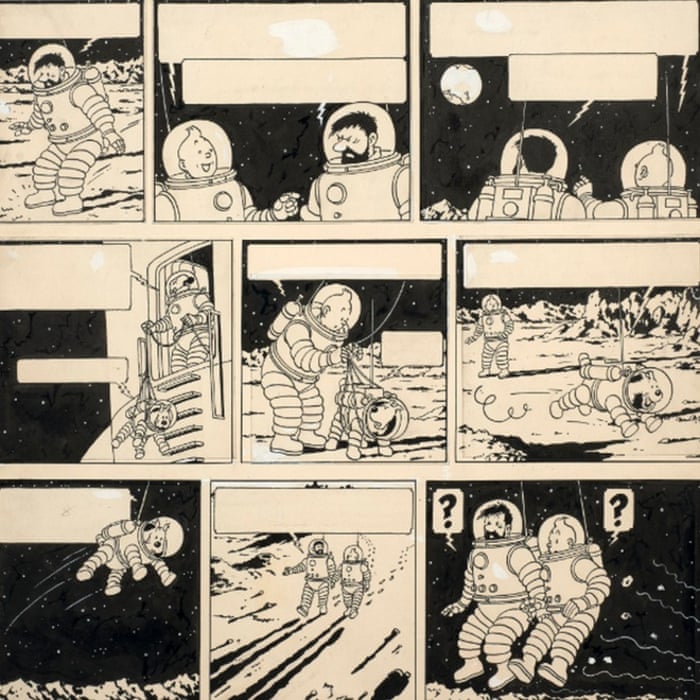
An original drawing from the popular Tintin adventure Explorers on the Moon has sold for a record €1.55m (£1.3m) in Paris, auction house Artcurial has announced.
The 50cm x 35cm drawing in Chinese ink by the Belgian cartoonist known as Hergé shows the boy reporter, his dog, Snowy, and sailor Captain Haddock wearing spacesuits and walking on the moon while looking at Earth. It had been expected to sell for between €700,000 and €900,000.
“It’s simply fantastic. It’s an exceptional price for an exceptional piece,” said Artcurial’s comics expert, Eric Leroy. He described Explorers on the Moon as “a key moment in the history of comic book art ... it has become legendary for many lovers and collectors of comic strips”.
Leroy added: “It is one of the most important from Hergé’s postwar period, on the same level as Tintin in Tibet and The Castafiore Emerald.” The 1954 book is viewed as one of Hergé’s masterpieces.
Saturday’s sale was a record for a single cartoon drawing. In 2012, the 1932 cover illustration of Tintin in America fetched €1.3m.
Hergé already holds the world record for the sale of a comic strip. A double-page ink drawing that served as the inside cover for all the Tintin adventures published between 1937 and 1958, sold for €2.65m to an American fan two years ago.
Original Tintin comic book drawings have been fetching millions at auctions in recent years. In February 2015, the original cover design for The Shooting Star almost matched the record when it was sold for €2.5m.
In May the original artwork for the last two pages of the King Ottokar’s Sceptre book sold for $1.2m (£1m), while in October 2015, a double-page slate from the same Tintin book fetched more than €1.5m. That same month, an Asian investor paid $1.2m for a drawing from The Blue Lotus book, published in 1936, of Tintin and Snowy in Shanghai.
Alongside the moon drawings, Artcurial also sold 20 ink sketches Hergé created for a series of new year greeting cards known as his “snow cards”. The drawings, including Tintin and Snowy skiing, or hapless detectives the Thompson twins ice-skating, brought in €1.2m.
Prices for cartoon art have multiplied tenfold in the last decade, according to gallery owner Daniel Maghen.
The 1954 Explorers on the Moon completes the lunar adventure started in Destination Moon (1953).
The sales come as Tintin-mania again grips Paris, with Hergé the subject of a huge retrospective exhibition at the Grand Palais.
Hergé sold about 230m Tintin books by the time of his death in 1983.
Sunday, 20 November 2016
Saturday, 19 November 2016
Mose Allison RIP
Mose Allison: farewell to a satirical blues and jazz master
From grooving with Stan Getz to piano-thumping in London’s Soho, Allison never lost his caustic charm or the earthiness of his southern rootsJohn Fordham
The Guardian
Wednesday 16 November 2016
When I was 16, I was torn between trying to learn to play guitar like the Shadows’ Hank Marvin or the Indianapolis bebop marvel Wes Montgomery. Me and my mate Dave used to stumble through Montgomery tunes on a couple of battered semi-acoustics, and after half an hour or so of it, in which we even bored ourselves, we’d play jazz LPs instead – Montgomery’s hip-looking albums for the Riverside label, Miles Davis’s Kind of Blue or Porgy and Bess or Sketches of Spain, with a good many of Gil Evans’ beautiful orchestral nuances excised by the shortcomings of the Dansette record player. Everybody we listened to was purely an instrumentalist – except for Mose Allison.
I thought Dave had let the side down at first by buying a record with singing on it, but Mose did things I didn’t know singers did. His lyrics were poetic, intelligent, satirical, and mostly they didn’t seem to be about love. His quirky piano-playing was jazzy but it was oddly inflected, as if he’d learned it like a second language. He seemed to understand bebop (I heard, with fascination, that he’d been a sideman for cool-jazz saxophone star Stan Getz), but he was deeply rooted in the earthiness of the blues. He was a white kid at home and accepted in an African-American musical world, just like we wanted to be. He could write wonderful ironic poetry, as well as the kind of blistering putdown you vainly dreamed of being able come out with in the presence of a smartass.
Wednesday 16 November 2016
When I was 16, I was torn between trying to learn to play guitar like the Shadows’ Hank Marvin or the Indianapolis bebop marvel Wes Montgomery. Me and my mate Dave used to stumble through Montgomery tunes on a couple of battered semi-acoustics, and after half an hour or so of it, in which we even bored ourselves, we’d play jazz LPs instead – Montgomery’s hip-looking albums for the Riverside label, Miles Davis’s Kind of Blue or Porgy and Bess or Sketches of Spain, with a good many of Gil Evans’ beautiful orchestral nuances excised by the shortcomings of the Dansette record player. Everybody we listened to was purely an instrumentalist – except for Mose Allison.
I thought Dave had let the side down at first by buying a record with singing on it, but Mose did things I didn’t know singers did. His lyrics were poetic, intelligent, satirical, and mostly they didn’t seem to be about love. His quirky piano-playing was jazzy but it was oddly inflected, as if he’d learned it like a second language. He seemed to understand bebop (I heard, with fascination, that he’d been a sideman for cool-jazz saxophone star Stan Getz), but he was deeply rooted in the earthiness of the blues. He was a white kid at home and accepted in an African-American musical world, just like we wanted to be. He could write wonderful ironic poetry, as well as the kind of blistering putdown you vainly dreamed of being able come out with in the presence of a smartass.
More than three decades later in the 1990s, when I started regularly hearing him play live on what became his twice-yearly trips to the Pizza Express Jazz Club in Soho, London, it was wonderful to hear how much of the old bite and unsentimental realism remained, that he was still producing new material, and that his resourcefulness as a piano improviser had, if anything, expanded. In his lean, wise, grey-bearded 70s, he would arrive on stage as if passing through to a more urgent appointment somewhere else, throw his jacket on the piano lid and barrel through classic songs at headlong speed, draining them and moving on as if he were leaving empties on a bar. He didn’t talk much or tell anecdotes about what must have been a fascinating life, preferring to thumbnail-sketch the biographies and credit the importance of the southern country and blues artists, famous or unknown, whose work he would often cover. And he would play a great deal of piano, mixing insistent, boogying grooves with unexpectedly ornate flourishes and fills, without ever letting an underlying and hard-hit chordal punctuation stay quiet for long.
Timeless Allison lyrics – “Ever since the world ended, I don’t get out so much”, “Your mind’s on vacation but your mouth’s working overtime” and “Y’know if silence was golden, you couldn’t raise a dime” – never lost their caustic charm, and as the ages of many of his fans advanced along with him, it was also gratifying to witness him turning his scalpel on what life as a senior citizen could feel like. “The young man is the man of the hour, 35 years of purchasing power,” the octogenarian Allison would snap, over a rocking piano vamp and glittering boppish rejoinders that sounded as if he was still 35 himself – winding up Old Man Blues with the indictment: “An old man ain’t nothin’ in the USA.” In this new political era, we’ll miss him even more.
Friday, 18 November 2016
Dead Poets Society #16 Stevie Smith: Alone in the Woods

Alone in the Woods by Stevie Smith
The bitter hostility of the sky and the trees
Nature has taught her creatures to hate
Man that fusses and fumes
Unquiet man
As the sap rises in the trees
As the sap paints the trees a violent green
So rises the wrath of Nature's creatures
At man
So paints the face of Nature a violent green.
Nature is sick at man
Sick at his fuss and fume
Sick at his agonies
Sick at his gaudy mind
That drives his body
Ever more quickly
More and more
In the wrong direction.
Thursday, 17 November 2016
Last night's set lists
At The Habit, York
Ron Elderly: -
You Better Move On
No Expectations
Da Elderly: -
Tell Me Why
Southern Man
Only Love Can Break Your Heart
Birds*
The Elderly Brothers: -
The Sound Of Silence
True Love ways
If I Fell
So Sad
Out Of Time
The Habit was full from the off, with plenty of punters and players. Local maestro Chris Helme brought the house down with a magical rendition of Paul Simon's Peace Like A River and our host finished off the evening with his very own ribald version of Hallelujah.
Ron Elderly: -
You Better Move On
No Expectations
Da Elderly: -
Tell Me Why
Southern Man
Only Love Can Break Your Heart
Birds*
The Elderly Brothers: -
The Sound Of Silence
True Love ways
If I Fell
So Sad
Out Of Time
The Habit was full from the off, with plenty of punters and players. Local maestro Chris Helme brought the house down with a magical rendition of Paul Simon's Peace Like A River and our host finished off the evening with his very own ribald version of Hallelujah.
Not the same night, but you get the picture...
Some punters we were chatting to let it be known that they were Rolling Stones fans, so Ron obliged with a couple of numbers. In honour of the great man's recent birthday (71st), yours truly selected some songs from Neil Young's After The Gold Rush album, prompted by regular acapella singer Chris, who had asked me earlier to accompany him on Birds*. The Elderlys set contained songs that we haven't performed for a while - I totally messed up the intro to If I Fell, but recovered without too much damage being done. Thankfully Out Of Time went down a storm!!
Wednesday, 16 November 2016
Tuesday, 15 November 2016
Bob Dylan: The 1966 Live Recordings

D.A. PENNEBAKER
Video A new short film made to accompany the release of the boxed set “Bob Dylan: The 1966 Live Recordings” features previously unseen footage of the tour, onstage and off, shot by D.A. Pennebaker.
Ben Sisario
The New York Times
10 November 2016
"THAT’S it — that sounds like the original,” Richard Alderson said, with a knowing nod.
Sitting in his living room in the West Village, Mr. Alderson was cranking up Bob Dylan’s “Just Like Tom Thumb’s Blues” as recorded in Liverpool, England, on May 14, 1966, in a version never released before: raw and clear, direct from the tapes that Mr. Alderson made as the live-sound engineer for Mr. Dylan’s 1966 tour.
That tour, on which Mr. Dylan was backed up by musicians who became the Band, has attained almost mythic status as a tableau of confrontation, as Mr. Dylan’s folk fans rejected his embrace of electric rock ’n’ roll. In its most famous incident, an audience member in Manchester, England, blurted out, “Judas!” (In response, Mr. Dylan told his band to “play loud” — adding an expletive that made the instruction spiteful, joyous or both.)
Some of these shows have long circulated in bootleg versions. But on Friday, Columbia/Legacy will release every known recording from the tour as a 36-CD boxed set, “Bob Dylan: The 1966 Live Recordings,” most of which have never been heard in any form. It is a monumental addition to the corpus just as Mr. Dylan has been named the winner of the Nobel Prize in Literature.
The new boxed set is the latest archival release from Mr. Dylan, after “The Basement Tapes Complete” (six CDs) and “The Cutting Edge 1965-1966” (up to 18 CDs), that have been gobbled up by fans. For Mr. Dylan, there may also be a more prosaic motivation for the release: to secure European copyright protection on the recordings. (The works are eligible if released before they’re 50 years old.)
As the sound man, Mr. Alderson had a front-row seat on the historic tour. In an interview with The New York Times, and in a short film made by the record company, he reminisced about the demands of the job and the perplexing crowd reactions. The video includes previously unseen footage of the tour, onstage and off, shot by D. A. Pennebaker, who directed the film “Dont Look Back,” about Mr. Dylan’s 1965 tour.

Boxes of master audiotapes from 1966
A particular challenge of the 1966 tour, Mr. Alderson said, was building a sound system at a time when most theaters were ill equipped for a loud, amplified band.
“There was kind of no precedent for it,” Mr. Alderson, now 79, said as a terrier puppy yipped at his heels, and a pile of Dylan bootlegs sat on the coffee table for comparison.
The recordings trace Mr. Dylan’s tour through the United States, Australia, Britain and Europe, repeating the same two-part set with virtually no changes. In the first, acoustic half, he sang incantatory versions of “Visions of Johanna” and “Desolation Row”; for the second half, the entire band’s full-throttled takes on “Like a Rolling Stone” do not always drown out the jeers.

Even in the exhaustively documented field of Dylan studies, Mr. Alderson has been nearly lost in plain sight. He ran the tape machine for Mr. Dylan’s shows at the Gaslight Cafe in 1962 but was uncredited on the official release of those recordings in 2005. He also appears, unidentified, in “No Direction Home,” a documentary by Martin Scorsese that was also released that year. His name is barely in the Dylan history books (of which there are many).
“Nobody really wants to give me any credit,” Mr. Alderson said. “When I brought up the fact that I’m in the Scorsese film — I’m on screen with Dylan in some of the most important parts — the response was, ‘We thought it was some other Richard.’”
Mr. Alderson’s own career offers some explanation for the lapse. He was hired for the 1966 Dylan tour after recording Nina Simone at Carnegie Hall and building a live sound system for Harry Belafonte. After the tour ended, Mr. Dylan had a motorcycle accident and withdrew; Mr. Alderson ran his own studio — recording avant-garde jazz and rock bands like the Fugs — before burning out in 1969 and leaving for Mexico.

Richard Alderson, the sound engineer who recorded the performances on Mr. Dylan’s 1966 tour
FRED R. CONRAD FOR THE NEW YORK TIMES
“I stayed in Mexico the entire time that Nixon was president,” Mr. Alderson said. “I completely lost touch with the New York recording scene.”
The audiotapes from the Dylan tour were made to accompany film footage being shot of the shows, some of which were used for the famously disjointed film “Eat the Document.”
Once the tour ended, Mr. Alderson turned over the tapes, which sat in refrigerated storage for five decades in Mr. Dylan’s extensive archives. Mr. Alderson reconnected with the Dylan circle over the last year as the boxed set came together, but his involvement was minimal. Until an interview with The Times, he had not heard the recordings in 50 years.

Richard Alderson, left, with Bob Dylan on tour in 1966.
D.A. PENNEBAKER
Speaking now, Mr. Alderson is still a little cranky but is clearly thrilled by the belated attention. He said that working with Mr. Dylan in 1966 was “more like working with a friend,” even though the video captures his old client bossing him around in no uncertain terms. And he doesn’t overthink the magic that went into capturing the tour on tape.
“You put good microphones up in front of good music,” Mr. Alderson says in the video, “and it sounds good.”
He was also careful to note his gratitude to Sony Music, the parent company of Columbia/Legacy, and to the Dylan camp for including his name in the official credits: “Mixing board tapes recorded by Richard Alderson.”
Sitting in his living room in the West Village, Mr. Alderson was cranking up Bob Dylan’s “Just Like Tom Thumb’s Blues” as recorded in Liverpool, England, on May 14, 1966, in a version never released before: raw and clear, direct from the tapes that Mr. Alderson made as the live-sound engineer for Mr. Dylan’s 1966 tour.
That tour, on which Mr. Dylan was backed up by musicians who became the Band, has attained almost mythic status as a tableau of confrontation, as Mr. Dylan’s folk fans rejected his embrace of electric rock ’n’ roll. In its most famous incident, an audience member in Manchester, England, blurted out, “Judas!” (In response, Mr. Dylan told his band to “play loud” — adding an expletive that made the instruction spiteful, joyous or both.)
Some of these shows have long circulated in bootleg versions. But on Friday, Columbia/Legacy will release every known recording from the tour as a 36-CD boxed set, “Bob Dylan: The 1966 Live Recordings,” most of which have never been heard in any form. It is a monumental addition to the corpus just as Mr. Dylan has been named the winner of the Nobel Prize in Literature.
The new boxed set is the latest archival release from Mr. Dylan, after “The Basement Tapes Complete” (six CDs) and “The Cutting Edge 1965-1966” (up to 18 CDs), that have been gobbled up by fans. For Mr. Dylan, there may also be a more prosaic motivation for the release: to secure European copyright protection on the recordings. (The works are eligible if released before they’re 50 years old.)
As the sound man, Mr. Alderson had a front-row seat on the historic tour. In an interview with The New York Times, and in a short film made by the record company, he reminisced about the demands of the job and the perplexing crowd reactions. The video includes previously unseen footage of the tour, onstage and off, shot by D. A. Pennebaker, who directed the film “Dont Look Back,” about Mr. Dylan’s 1965 tour.

Boxes of master audiotapes from 1966
A particular challenge of the 1966 tour, Mr. Alderson said, was building a sound system at a time when most theaters were ill equipped for a loud, amplified band.
“There was kind of no precedent for it,” Mr. Alderson, now 79, said as a terrier puppy yipped at his heels, and a pile of Dylan bootlegs sat on the coffee table for comparison.
The recordings trace Mr. Dylan’s tour through the United States, Australia, Britain and Europe, repeating the same two-part set with virtually no changes. In the first, acoustic half, he sang incantatory versions of “Visions of Johanna” and “Desolation Row”; for the second half, the entire band’s full-throttled takes on “Like a Rolling Stone” do not always drown out the jeers.

Even in the exhaustively documented field of Dylan studies, Mr. Alderson has been nearly lost in plain sight. He ran the tape machine for Mr. Dylan’s shows at the Gaslight Cafe in 1962 but was uncredited on the official release of those recordings in 2005. He also appears, unidentified, in “No Direction Home,” a documentary by Martin Scorsese that was also released that year. His name is barely in the Dylan history books (of which there are many).
“Nobody really wants to give me any credit,” Mr. Alderson said. “When I brought up the fact that I’m in the Scorsese film — I’m on screen with Dylan in some of the most important parts — the response was, ‘We thought it was some other Richard.’”
Mr. Alderson’s own career offers some explanation for the lapse. He was hired for the 1966 Dylan tour after recording Nina Simone at Carnegie Hall and building a live sound system for Harry Belafonte. After the tour ended, Mr. Dylan had a motorcycle accident and withdrew; Mr. Alderson ran his own studio — recording avant-garde jazz and rock bands like the Fugs — before burning out in 1969 and leaving for Mexico.

Richard Alderson, the sound engineer who recorded the performances on Mr. Dylan’s 1966 tour
FRED R. CONRAD FOR THE NEW YORK TIMES
“I stayed in Mexico the entire time that Nixon was president,” Mr. Alderson said. “I completely lost touch with the New York recording scene.”
The audiotapes from the Dylan tour were made to accompany film footage being shot of the shows, some of which were used for the famously disjointed film “Eat the Document.”
Once the tour ended, Mr. Alderson turned over the tapes, which sat in refrigerated storage for five decades in Mr. Dylan’s extensive archives. Mr. Alderson reconnected with the Dylan circle over the last year as the boxed set came together, but his involvement was minimal. Until an interview with The Times, he had not heard the recordings in 50 years.

Richard Alderson, left, with Bob Dylan on tour in 1966.
D.A. PENNEBAKER
Speaking now, Mr. Alderson is still a little cranky but is clearly thrilled by the belated attention. He said that working with Mr. Dylan in 1966 was “more like working with a friend,” even though the video captures his old client bossing him around in no uncertain terms. And he doesn’t overthink the magic that went into capturing the tour on tape.
“You put good microphones up in front of good music,” Mr. Alderson says in the video, “and it sounds good.”
He was also careful to note his gratitude to Sony Music, the parent company of Columbia/Legacy, and to the Dylan camp for including his name in the official credits: “Mixing board tapes recorded by Richard Alderson.”
Monday, 14 November 2016
Leon Russell RIP
Jon Pareles
The New York Times
13 November 2016
Leon Russell, the longhaired, scratchy-voiced pianist, guitarist, songwriter and bandleader who moved from playing countless recording sessions to making hits on his own, died on Sunday in Nashville. He was 74.
His website said he had died in his sleep but gave no specific cause.
Mr. Russell’s health had incurred significant setbacks in recent years. In 2010, he underwent surgery for a brain fluid leak and was treated for heart failure. In July he had a heart attack and was scheduled for further surgery, according to a news release from the historical society of Oklahoma, his home state.
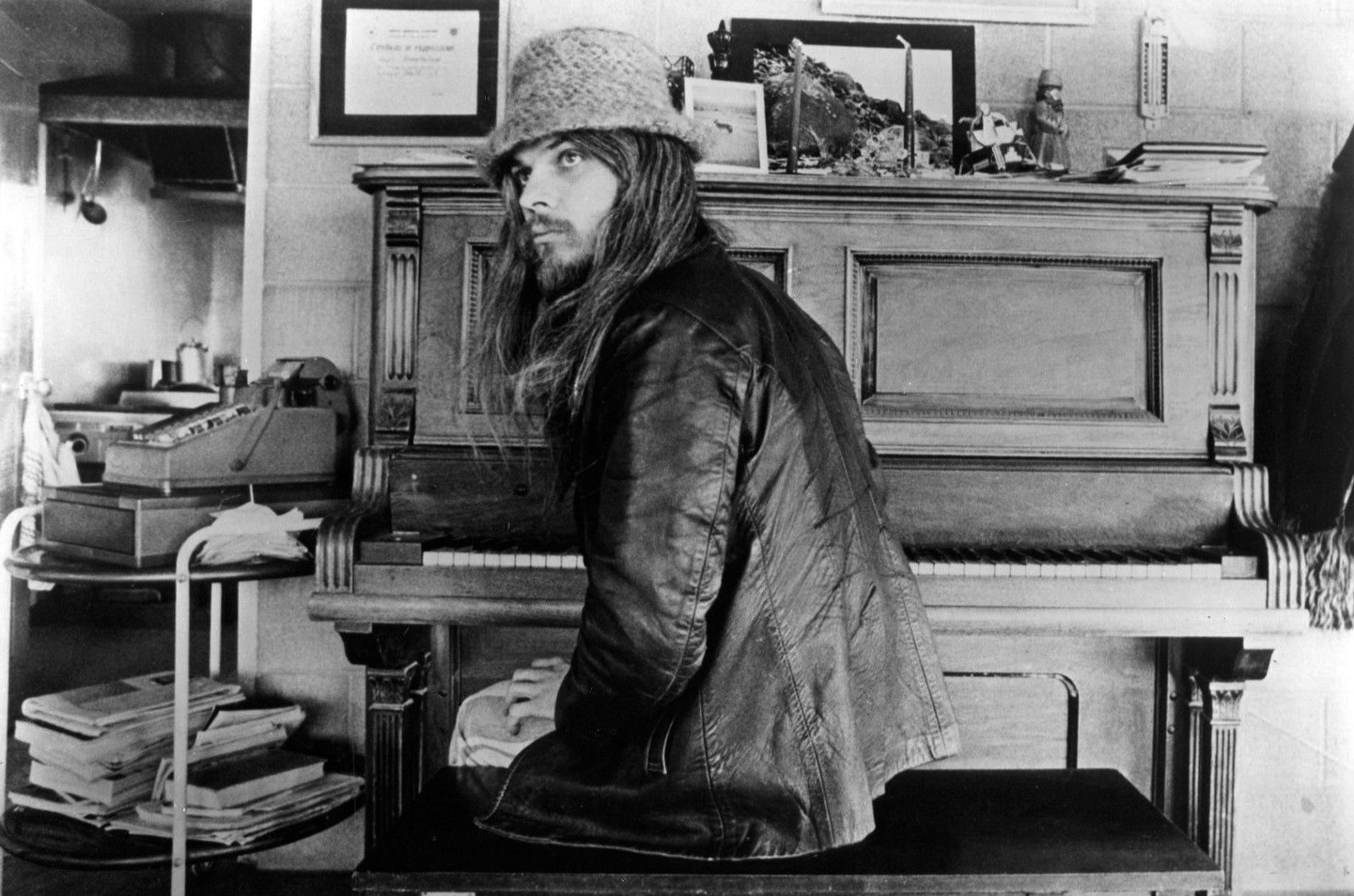
With his trademark top hat, hair well past his shoulders, a long, lush beard, an Oklahoma drawl and his fingers splashing two-fisted barrelhouse piano chords, Mr. Russell cut a flamboyant figure in the early 1970s. He led Joe Cocker’s band Mad Dogs & Englishmen, appeared at George Harrison’s 1971 Concert for Bangladesh in New York City and had numerous hits of his own, including “Tight Rope.”
Many of his songs became hits for others, among them “Superstar” (written with Bonnie Bramlett) for the Carpenters, “Delta Lady” for Mr. Cocker and “This Masquerade” for George Benson. More than 100 acts have recorded“A Song for You,” which Mr. Russell said he wrote in 10 minutes.
By the time he released his first solo album, in 1970, he had already played on hundreds of songs as one of the top studio musicians in Los Angeles. He was in Phil Spector’s Wall of Sound Orchestra, and he played sessions for Frank Sinatra, Sam Cooke, Aretha Franklin, the Ventures and the Monkees, among many others. His piano playing is heard on “Mr. Tambourine Man” by the Byrds, “A Taste of Honey” by Herb Alpert, “Live With Me” by the Rolling Stones and all of the Beach Boys’ early albums, including “Pet Sounds.”
The music Mr. Russell made on his own put a scruffy, casual surface on rich musical hybrids, interweaving soul, country, blues, jazz, gospel, pop and classical music. Like Willie Nelson, who collaborated with him, and Ray Charles, whose 1993 recording of “A Song for You” won a Grammy Award, Mr. Russell made a broad, sophisticated palette of American music sound down-home and natural.Photo
After his popularity had peaked in the 1970s, he shied away from self-promotion and largely set aside rock, though he kept performing. But he was prized as a musicians’ musician, collaborating with Elvis Costello and Elton John, among others. In 2011, after making a duet album with Mr. John, “The Union,” he was inducted into the Rock and Roll Hall of Fame. At the ceremony, Mr. John called him “the master of space and time”and added, “He sang, he wrote and he played just how I wanted to do it.”
Leon Russell was born Claude Russell Bridges in Lawton, Okla., on April 2, 1942. An injury to his upper vertebrae at birth caused a slight paralysis on his right side that would shape his music: A resulting delayed reaction time in his right hand forced him to think ahead about what it would play. “It gave me a very strong sense of duality,” he said last year in a Public Radio International interview.
He started classical piano lessons when he was 4, played baritone horn in his high school marching band and also learned trumpet. At 14 he started gigging in Oklahoma; since it was a dry state at the time, he could play clubs without being old enough to drink. Soon after he graduated from high school, Jerry Lee Lewis hired him and his band to back him on tour for two months.
He moved to Los Angeles in the late 1950s and found club work and then studio work; he learned to play guitar, and he began calling himself Leon Russell, taking the name Leon from a friend who had lent him an ID so he could play California club dates while underage.
His music-making drew on both his classical training and his Southern roots, and he played everything from standards to surf-rock, from million-sellers to pop throwaways. He was glimpsed on television as a member of the Shindogs, the house band for the prime-time rock show “Shindig!” in the mid-1960s, and was in the house band for the 1964 concert film, “The T.A.M.I. Show.”
In 1967, he built a home studio and began working with the guitarist Marc Benno as the Asylum Choir, which released its debut album in 1968. He also started a record label, Shelter, in 1969 with the producer Denny Cordell. Mr. Russell drew more recognition as a co-producer, arranger and musician on Mr. Cocker’s second album, “Joe Cocker!,” which included Mr. Russell’s song “Delta Lady.”
When Mr. Cocker’s Grease Band fell apart days before an American tour, Mr. Russell assembled Mad Dogs & Englishmen, a big, boisterous band that included three drummers and a 10-member choir. Its 1970 double live album and a tour film became a showcase for Mr. Russell as well as for Mr. Cocker; the album reached No. 2 on the Billboard album chart.Photo
Mr. Russell also released his first solo album in 1970; it included “A Song for You” and had studio appearances from Mr. Cocker, Eric Clapton, two members of the Beatles and three from the Rolling Stones. But Mr. Russell’s second album, “Leon Russell and the Shelter People,” fared better commercially: It reached No. 17 on the Billboard chart.
Mr. Russell had his widest visibility as the 1970s began. He played the Concert for Bangladesh at Madison Square Garden with Mr. Harrison, Bob Dylan and Mr. Clapton; he produced and played on Mr. Dylan’s songs “When I Paint My Masterpiece” and “Watching the River Flow.” He toured with the Rolling Stones and with his own band.
His third album, “Carney,” went to No. 2 with the hit “Tight Rope”; it also featured his own version of “This Masquerade.” In 1973, his “Leon Live” album reached the Top 10, and he recorded his first album of country songs under the pseudonym Hank Wilson. The fledgling Gap Band, also from Oklahoma, backed Mr. Russell in 1974 on his album “Stop All That Jazz.” His 1975 album “Will o’ the Wisp” included what would be his last Top 20 pop hit, “Lady Blue.”
But he continued to work. He made duet albums with his wife at the time, Mary Russell (formerly Mary McCreary). And he collaborated with Mr. Nelson in 1979 on “One for the Road,” a double LP of pop and country standards. It sold half a million copies.
That same year he married Janet Lee Constantine, who survives him, as do six children: Blue, Teddy Jack, Tina Rose, Sugaree, Honey and Coco.
Mr. Russell delved into various idioms over the next decades, mostly recording for independent labels. He toured and recorded with the New Grass Revival, adding his piano and voice to their string-band lineup. He made more country albums as Hank Wilson. He recorded blues, Christmas songs, gospel songs and instrumentals.
In 1992, the songwriter and pianist Bruce Hornsby, who had long cited Mr. Russell’s influence, sought to rejuvenate Mr. Russell’s rock career by producing the album “Anything Can Happen,” but it drew little notice. Mr. Russell continued to tour for die-hard fans, who called themselves Leon Lifers.
A call in 2009 from Mr. John, whom Mr. Russell had supported in the early 1970s, led to the making of “The Union” — which also had guest appearances by Neil Young and Brian Wilson — and a 10-date tour together in 2010. Mr. Russell also sat in on Mr. Costello’s 2010 album, “National Ransom.” Then he bought a new bus and returned to the road, on his own.
Leon Russell, the longhaired, scratchy-voiced pianist, guitarist, songwriter and bandleader who moved from playing countless recording sessions to making hits on his own, died on Sunday in Nashville. He was 74.
His website said he had died in his sleep but gave no specific cause.
Mr. Russell’s health had incurred significant setbacks in recent years. In 2010, he underwent surgery for a brain fluid leak and was treated for heart failure. In July he had a heart attack and was scheduled for further surgery, according to a news release from the historical society of Oklahoma, his home state.
With his trademark top hat, hair well past his shoulders, a long, lush beard, an Oklahoma drawl and his fingers splashing two-fisted barrelhouse piano chords, Mr. Russell cut a flamboyant figure in the early 1970s. He led Joe Cocker’s band Mad Dogs & Englishmen, appeared at George Harrison’s 1971 Concert for Bangladesh in New York City and had numerous hits of his own, including “Tight Rope.”
Many of his songs became hits for others, among them “Superstar” (written with Bonnie Bramlett) for the Carpenters, “Delta Lady” for Mr. Cocker and “This Masquerade” for George Benson. More than 100 acts have recorded“A Song for You,” which Mr. Russell said he wrote in 10 minutes.
By the time he released his first solo album, in 1970, he had already played on hundreds of songs as one of the top studio musicians in Los Angeles. He was in Phil Spector’s Wall of Sound Orchestra, and he played sessions for Frank Sinatra, Sam Cooke, Aretha Franklin, the Ventures and the Monkees, among many others. His piano playing is heard on “Mr. Tambourine Man” by the Byrds, “A Taste of Honey” by Herb Alpert, “Live With Me” by the Rolling Stones and all of the Beach Boys’ early albums, including “Pet Sounds.”
The music Mr. Russell made on his own put a scruffy, casual surface on rich musical hybrids, interweaving soul, country, blues, jazz, gospel, pop and classical music. Like Willie Nelson, who collaborated with him, and Ray Charles, whose 1993 recording of “A Song for You” won a Grammy Award, Mr. Russell made a broad, sophisticated palette of American music sound down-home and natural.Photo
After his popularity had peaked in the 1970s, he shied away from self-promotion and largely set aside rock, though he kept performing. But he was prized as a musicians’ musician, collaborating with Elvis Costello and Elton John, among others. In 2011, after making a duet album with Mr. John, “The Union,” he was inducted into the Rock and Roll Hall of Fame. At the ceremony, Mr. John called him “the master of space and time”and added, “He sang, he wrote and he played just how I wanted to do it.”
Leon Russell was born Claude Russell Bridges in Lawton, Okla., on April 2, 1942. An injury to his upper vertebrae at birth caused a slight paralysis on his right side that would shape his music: A resulting delayed reaction time in his right hand forced him to think ahead about what it would play. “It gave me a very strong sense of duality,” he said last year in a Public Radio International interview.
He started classical piano lessons when he was 4, played baritone horn in his high school marching band and also learned trumpet. At 14 he started gigging in Oklahoma; since it was a dry state at the time, he could play clubs without being old enough to drink. Soon after he graduated from high school, Jerry Lee Lewis hired him and his band to back him on tour for two months.
He moved to Los Angeles in the late 1950s and found club work and then studio work; he learned to play guitar, and he began calling himself Leon Russell, taking the name Leon from a friend who had lent him an ID so he could play California club dates while underage.
His music-making drew on both his classical training and his Southern roots, and he played everything from standards to surf-rock, from million-sellers to pop throwaways. He was glimpsed on television as a member of the Shindogs, the house band for the prime-time rock show “Shindig!” in the mid-1960s, and was in the house band for the 1964 concert film, “The T.A.M.I. Show.”
In 1967, he built a home studio and began working with the guitarist Marc Benno as the Asylum Choir, which released its debut album in 1968. He also started a record label, Shelter, in 1969 with the producer Denny Cordell. Mr. Russell drew more recognition as a co-producer, arranger and musician on Mr. Cocker’s second album, “Joe Cocker!,” which included Mr. Russell’s song “Delta Lady.”
When Mr. Cocker’s Grease Band fell apart days before an American tour, Mr. Russell assembled Mad Dogs & Englishmen, a big, boisterous band that included three drummers and a 10-member choir. Its 1970 double live album and a tour film became a showcase for Mr. Russell as well as for Mr. Cocker; the album reached No. 2 on the Billboard album chart.Photo
Mr. Russell also released his first solo album in 1970; it included “A Song for You” and had studio appearances from Mr. Cocker, Eric Clapton, two members of the Beatles and three from the Rolling Stones. But Mr. Russell’s second album, “Leon Russell and the Shelter People,” fared better commercially: It reached No. 17 on the Billboard chart.
Mr. Russell had his widest visibility as the 1970s began. He played the Concert for Bangladesh at Madison Square Garden with Mr. Harrison, Bob Dylan and Mr. Clapton; he produced and played on Mr. Dylan’s songs “When I Paint My Masterpiece” and “Watching the River Flow.” He toured with the Rolling Stones and with his own band.
His third album, “Carney,” went to No. 2 with the hit “Tight Rope”; it also featured his own version of “This Masquerade.” In 1973, his “Leon Live” album reached the Top 10, and he recorded his first album of country songs under the pseudonym Hank Wilson. The fledgling Gap Band, also from Oklahoma, backed Mr. Russell in 1974 on his album “Stop All That Jazz.” His 1975 album “Will o’ the Wisp” included what would be his last Top 20 pop hit, “Lady Blue.”
But he continued to work. He made duet albums with his wife at the time, Mary Russell (formerly Mary McCreary). And he collaborated with Mr. Nelson in 1979 on “One for the Road,” a double LP of pop and country standards. It sold half a million copies.
That same year he married Janet Lee Constantine, who survives him, as do six children: Blue, Teddy Jack, Tina Rose, Sugaree, Honey and Coco.
Mr. Russell delved into various idioms over the next decades, mostly recording for independent labels. He toured and recorded with the New Grass Revival, adding his piano and voice to their string-band lineup. He made more country albums as Hank Wilson. He recorded blues, Christmas songs, gospel songs and instrumentals.
In 1992, the songwriter and pianist Bruce Hornsby, who had long cited Mr. Russell’s influence, sought to rejuvenate Mr. Russell’s rock career by producing the album “Anything Can Happen,” but it drew little notice. Mr. Russell continued to tour for die-hard fans, who called themselves Leon Lifers.
A call in 2009 from Mr. John, whom Mr. Russell had supported in the early 1970s, led to the making of “The Union” — which also had guest appearances by Neil Young and Brian Wilson — and a 10-date tour together in 2010. Mr. Russell also sat in on Mr. Costello’s 2010 album, “National Ransom.” Then he bought a new bus and returned to the road, on his own.
Sunday, 13 November 2016
Subscribe to:
Posts (Atom)