Saturday, 12 November 2016

Robert Vaughn RIP

Image result for napoleon solo
Robert Vaughn obituary
Prolific television and film actor best known for his role as Napoleon Solo in The Man from UNCLE

Brian Baxter
The Guardian
Friday 11 November 2016

Many actors opt for long-term employment in television series, only to find their lucrative association with a “personality” difficult to shake off. Robert Vaughn, who has died aged 83, overcame that problem in not one but seven long-running TV series, beginning with The Lieutenant in 1963.

By far the most substantial of these was The Man from UNCLE, in which he played the suave Napoleon Solo, in more than 100 episodes (1964-68) and eight features cobbled together from the series. Eventually, that too ran out of steam (although it remained a cult, particularly in Britain) and he moved on to create the detective Harry Rule in The Protectors, filmed in London through the early 1970s.

He also starred in episodes of Emerald Point NAS (1983-84), and was General Stockwell in the fifth and final series of The A-Team (1986-87). Late in his career, he was appointed Judge Travis in The Magnificent Seven (1998-2000), a TV spin-off from the western film in which he had played the gunslinger Lee 40 years previously.

An astonishingly prolific actor, he guested in hundreds of television shows, from Gunsmoke to Police Woman and from Wagon Train to Law and Order, as well as scores of TV movies and miniseries, including the prestigious Washington Behind Closed Doors (1977), which won him an Emmy.

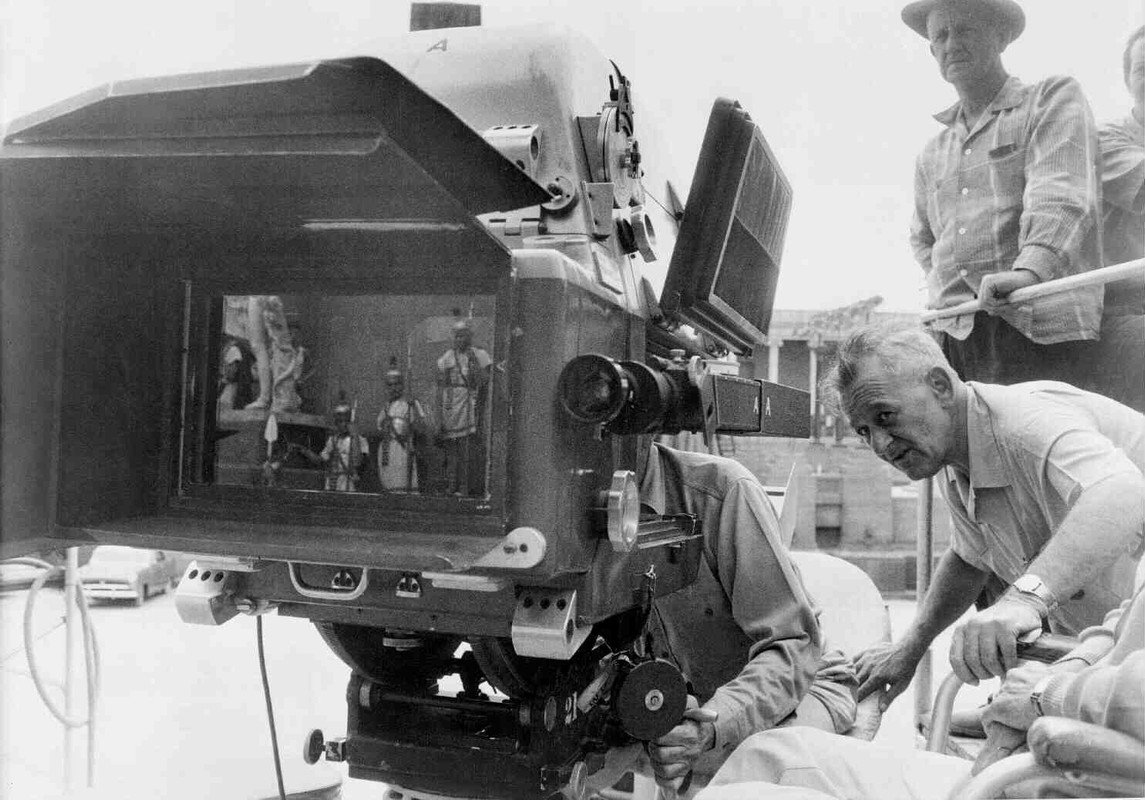
Vaughn also appeared in some 50 movies, following his uncredited debut as a spear-carrier in The Ten Commandments (1956). In tandem with acting he maintained an interest in politics, campaigning against the Vietnam war from the late 1960s until the US withdrawal from the conflict in 1973, and supported liberal causes as a Democrat and friend of the Kennedys, especially Robert.

Vaughn was born in New York, son of actors, Marcella (nee Gaudel) and Walter Vaughn. He studied journalism at the University of Minnesota, transferring to Los Angeles City College to take drama and to LA State College for a master’s. His PhD thesis on the aftermath of the House Un-American Activities Committee investigation sympathetically examined its effect on members of the acting profession. It was published in 1972 as Only Victims: A Study of Show Business Blacklisting.

Although he did not begin full-time acting until he was in his mid-20s, he started with stage work, television appearances and uncredited screen roles, and was soon cast as the lead in No Time to Be Young (1957), where the influence of James Dean, killed two years before, was apparent. When he played the title role in Roger Corman’s preposterous Teenage Caveman (1958), his character was promoted as a “prehistoric rebel without a cause”. The actor later described it as “one of the best worst films of all time”.

It led to an intriguing western, A Good Day for a Hanging (1959), in which he co-starred as a killer who charms the townsfolk into opposing the sheriff who wants him hanged. He got his break in The Young Philadelphians (1959), receiving an Oscar nomination as best supporting actor for his performance as an alcoholic who is framed for murder and defended by a calculating lawyer (Paul Newman).

That drama established Vaughn, but it was The Magnificent Seven (1960) that consolidated his big-screen stardom, four years before he debuted as Napoleon Solo. He played the gunfighter who has lost his nerve and joins the Seven to defend villagers from marauding bandits, simply for the money. In a climactic shoot-out, the jittery coward redeems himself, returning to help his friends in Ixcatlan, and sacrificing his life in the process.

After the tongue-in-cheek The Man from UNCLE series, to which David McCallum as his sidekick Illya Kuryakin contributed a cheery breeziness, the darker-toned Vaughn needed a change and moved back into movies with Bullitt (1968). Cast, in Pauline Kael’s words, as “the slimy Mr Big”, he was memorable as Chalmers, a crooked politician, who is a thorn in the side of the bullish detective (Steve McQueen). He was equally persuasive as the Nazi officer in The Bridge at Remagen (1969) and made a credible Casca in the dull 1970 version of Julius Caesar. He was a bossy senator in The Towering Inferno (1974) and a caring neurosurgeon in The Mind of Mr Soames, bringing his patient (Terence Stamp) out of a 30-year coma with terrifying consequences.

Soon after appearing in René Clément’s last picture, La Baby Sitter (AKA Scar Tissue, 1975), Vaughn was used to devastating effect as the voice of the rebellious computer Proteus in Demon Seed (1977), where his off-screen voice was a coolly intelligent reflection of his often menacing on-screen persona.

In Corman’s Battle Beyond the Stars (1980), he reworked his gunslinger Lee in space, and a year later played a philistine studio executive (allegedly based on Robert Evans) in S.O.B. (1981), Blake Edwards’s blistering attack on Tinseltown. Few such literate scripts or talented directors were available during the later 1980s and 1990s and Vaughn contented himself with guesting as authoritarian figures, including judges, ambassadors and senior army personnel.

Often that was in movie dross, although television was kinder to him in prestige miniseries such as Backstairs at the White House (1979) and The Blue and the Gray (1982) or in lighter material such as Murder, She Wrote.

Throughout four busy decades he had reinvented himself as required by age and changing fashion. His early roles as outsiders, troubled lovers, cowards and alcoholics gave way to a mild debunking of his persona, particularly his well-groomed heroes. His somewhat cerebral acting style proved a perfect antidote to spoofs and he established a cult following, partly as the sole redeeming aspect in such later movies as Joe’s Apartment (1996, as a corrupt senator), Motel Blue (1997, as a police chief) and the sports spoof BASEketball (1998).

Despite a steady stream of work, Vaughn announced, aged 70, that he was “going to take it a little easier” and promised to complete his autobiography, tentatively titled, Christ, Shakespeare, Ho Chi Minh: As I Knew Them. This emerged in 2008 as A Fortunate Life and declared his enjoyment of a long and profitable career, his work as a liberal activist (even playing three Democratic presidents on screen) and a happy marriage.

He continued working steadily on television and occasional features, playing a judge in Cottonmouth (2002), villains in Happy Hour (2003) and Hoodlum and Son (2003), and a doctor in Scene Stealers (2004). However, it was in yet another successful TV series that he returned to form. Vaughn starred in 48 episodes of Hustle, produced by the BBC between 2004 and 2012, as the debonair Albert Stroller, member of a disparate group of con artists. Elegant and assured, he showed that he had retained his sense of humour and lack of pretension, something confirmed by his appearance in The Magnificent Eleven (2012), about a football team who go the aid of an Indian restaurant, harassed by local thugs. He had a recurring role, too, in the soap Coronation Street in 2012 as the businessman Milton Fanshaw, love interest of Sylvia Goodwin (Stephanie Cole), mother of Roy Cropper.

Vaughn is survived by his wife, Linda (nee Staab), whom he married in 1974, and their two children, Caitlin and Cassidy.

• Robert Vaughn, actor, born 22 November 1932; died 11 November 2016

https://www.theguardian.com/tv-and-radio/2016/nov/11/robert-vaughn-obituary

Friday, 11 November 2016

Leonard Cohen RIP

Leonard Cohen, Epic and Enigmatic Songwriter, Is Dead at 82

Larry Rohter
The New York Times
10 November 2016

Leonard Cohen, the Canadian poet and novelist who abandoned a promising literary career to become one of the foremost songwriters of the contemporary era, has died, according to an announcement Thursday night on his Facebook page. He was 82.

Mr. Cohen’s record label, Sony Music, confirmed the death. No details were available on the cause. Adam Cohen, his son and producer, said: “My father passed away peacefully at his home in Los Angeles with the knowledge that he had completed what he felt was one of his greatest records. He was writing up until his last moments with his unique brand of humor.”

Over a musical career that spanned nearly five decades, Mr. Cohen wrote songs that addressed — in spare language that could be both oblique and telling — themes of love and faith, despair and exaltation, solitude and connection, war and politics. More than 2,000 recordings of his songs have been made, initially by the folk-pop singers who were his first champions, like Judy Collins and Tim Hardin, and later by performers from across the spectrum of popular music, among them U2, Aretha Franklin, R.E.M., Jeff Buckley, Trisha Yearwood and Elton John.

Mr. Cohen’s best-known song may well be “Hallelujah,” a majestic, meditative ballad infused with both religiosity and earthiness. It was written for a 1984 album that his record company rejected as insufficiently commercial and popularized a decade later by Jeff Buckley. Since then some 200 artists, from Bob Dylan to Justin Timberlake, have sung or recorded it. A book has been written about it, and it has been featured on the soundtracks of movies and television shows and sung at the Olympics and other public events. At the 2016 Emmy Awards, Tori Kelly sang “Hallelujah” for the annual “In Memoriam” segment recognizing recent deaths.

Mr. Cohen was an unlikely and reluctant pop star, if in fact he ever was one. He was 33 when his first record was released in 1967. He sang in an increasingly gravelly baritone. He played simple chords on acoustic guitar or a cheap keyboard. And he maintained a private, sometime ascetic image at odds with the Dionysian excesses associated with rock ’n’ roll.

At some points, he was anything but prolific. He struggled for years to write some of his most celebrated songs, and he recorded just 14 studio albums in his career. Only the first qualified as a gold record in the United States for sales of 500,000 copies. But Mr. Cohen’s sophisticated, magnificently succinct lyrics, with their meditations on love sacred and profane, were widely admired by other artists and gave him a reputation as, to use the phrase his record company concocted for an advertising campaign in the early 1970s, “the master of erotic despair.”

Early in his career, enigmatic songs like “Suzanne” and “Bird on a Wire,” quickly covered by better-known performers, gave him visibility. “Suzanne” begins and ends as a portrait of a mysterious, fragile woman “wearing rags and feathers from Salvation Army counters,” but pauses in the middle verse to offer a melancholy view of the spiritual:

And Jesus was a sailor when he walked upon the water,
And he spent a long time watching from his lonely wooden tower,
And when he knew for certain only drowning men could see him,
He said “All men will be sailors then until the sea shall free them.”
But he himself was broken, long before the sky would open,
Forsaken, almost human, he sank beneath your wisdom like a stone.


In 2008, Mr. Cohen was inducted into the Rock and Roll Hall of Fame, which described him as “one of the few artists in the realm of popular music who can truly be called poets” and praised him for having “raised the songwriting bar.” In 2010, the National Academy of Recording Arts and Sciences, the Grammys’ group, gave him a lifetime achievement award, praising him for “a timeless legacy that has positively affected multiple generations.”

Wearing a bolo tie and his trademark fedora, Mr. Cohen dryly made light in his acceptance speech of the fact that none of his records had ever been honored at the Grammys. “As we make our way toward the finish line that some of us have already crossed, I never thought I’d get a Grammy Award,” he said. “In fact, I was always touched by the modesty of their interest.”

Leonard Norman Cohen was born in Montreal on Sept. 21, 1934, and grew up in the prosperous suburb of Westmount. His father, Nathan, whose family had emigrated to Canada from Poland, owned a successful clothing store; he died when Leonard was 9, but his will included a provision for a small trust fund, which later allowed his son to pursue his literary and musical ambitions. His mother, the former Masha Klonitzky, a nurse, was of Lithuanian descent and the daughter of a Talmudic scholar and rabbi. “I had a very messianic childhood,” Mr. Cohen would later say.

In 1951, Mr. Cohen was admitted to McGill University, Canada’s premier institution of higher learning, where he studied English. His first book of poetry, “Let Us Compare Mythologies,” was published in May 1956, while he was still an undergraduate. It was followed by “The Spice-Box of Earth” in 1961 and “Flowers for Hitler” in 1964. Other collections would appear sporadically throughout Mr. Cohen’s life, including the omnibus “Poems and Songs” in 2011.

A period of drift followed Mr. Cohen’s graduation from college. He enrolled in law school at McGill, then dropped out and moved to New York City, where he studied literature at Columbia University for a year before returning to Montreal. Eventually, after a sojourn in London, he ended up living in a house on the Greek island of Hydra, where he wrote a pair of novels: “The Favorite Game,” published in 1963, and “Beautiful Losers,” published in 1966.

“Beautiful Losers,” about a love triangle all of whose members are devotees of a 17th-century Mohawk Indian Roman Catholic saint, gained a cult following, which it retains, and eventually sold more than three million copies worldwide. But Mr. Cohen’s initial lack of commercial success was discouraging, and he turned to songwriting in hopes of expanding the audience for his poetry.

“I found it was very difficult to pay my grocery bill,” Mr. Cohen said in 1971, looking back at his situation just a few years earlier. “I’ve got beautiful reviews for all my books, and I’m very well thought of in the tiny circles that know me, but I’m really starving.”

Within months, Mr. Cohen had placed two songs, “Suzanne” and “Dress Rehearsal Rag,” on Judy Collins’s album “In My Life,” which also included the Lennon-McCartney title song and compositions by Bob Dylan, Randy Newman and Donovan. But he was extremely reluctant to take the next step and sing his songs himself.

“Leonard was naturally reserved and afraid to sing in public,” Ms. Collins wrote in her autobiography, “Sweet Judy Blue Eyes: My Life in Music” (2011). She recalled him telling her: “I can’t sing. I wouldn’t know what to do out there. I am not a performer.” He was “terrified,” she wrote, the first time she brought him onstage to sing with her, in the spring of 1967.

Later that year, after being signed to Columbia Records by John Hammond, the celebrated talent scout who also signed Bob Dylan and Bruce Springsteen, Mr. Cohen released his first album. Its simple title, “Songs of Leonard Cohen,” and its cover, a portrait of the artist gazing solemnly into the camera, matched the music, which was spare and unembellished, in stark contrast to the psychedelic style that then prevailed.

The record began with “Suzanne,” which was already being performed by folk singers everywhere thanks to the popularity of Ms. Collins’s version. It also included three other songs of great impact that would become staples of Mr. Cohen’s live shows, and that numerous other artists would record over the years: “Sisters of Mercy,” “So Long Marianne” and “Hey, That’s No Way to Say Goodbye.”

His second album, “Songs From a Room,” released early in 1969, cemented his growing reputation as a songwriter. “The Story of Isaac,” a retelling of the biblical tale of Abraham and Isaac, became an anthem of opposition to the war in Vietnam, and “Bird on a Wire” went on to be recorded by performers including Joe Cocker, Aaron Neville, Johnny Cash and Willie Nelson.

In 1971, Mr. Cohen released “Songs of Love and Hate,” which contained the cryptic and frequently covered “Famous Blue Raincoat,” but after that his production began to tail off and his live performances became less frequent. He released three more albums during the 1970s but, amid bouts of depression, only two in the 1980s and one in the 1990s.

The quality of his songs remained high, however: In addition to “Hallelujah,” future standards like “Dance Me to the End of Love,” “First We Take Manhattan,” “Everybody Knows” and “Tower of Song” date from that era.

Mr. Cohen, raised Jewish and observant throughout his life, became interested in Zen Buddhism in the late 1970s and often visited the Mount Baldy monastery, east of Los Angeles. Around 1994, he abandoned his music career altogether and moved to the monastery, where he was ordained a Buddhist monk and became the personal assistant of Joshu Sasaki, the Rinzai Zen master who led the center, who died in 2014. He took the name Jikan, which means “silence.”

During the remainder of the decade, there was much speculation that Mr. Cohen, rather than merely taking a sabbatical, had stopped writing songs and would never record again. But in 2001, he released “Ten New Songs,” whose title suggests it was written while he was in the monastery. It was followed in 2004 by “Dear Heather,” an unusually upbeat album.

In 2005, Mr. Cohen sued his former manager, Kelley Lynch, accusing her of defrauding him of millions of dollars that he had set aside as a retirement fund, leaving him with only $150,000 and a huge tax bill and forcing him to take out a new mortgage on his home to cover his legal costs. The next year, after Ms. Lynch countersued, a judge awarded Mr. Cohen $9.5 million, but he was unable to collect any of the money.

The legal battles may have soured Mr. Cohen’s mood, but they did not seem to damage his creativity. In 2006, he published a new collection of poems, “Book of Longing,” which the composer Philip Glass set to music and then took on tour, with Mr. Cohen’s recorded voice reciting the words and Mr. Glass’s ensemble performing the music.

In 2008, Mr. Cohen hit the road for the first time in 15 years for a grueling world tour, which would continue, with a few short breaks, through 2010. He was driven, he acknowledged, at least in part by financial necessity.

“It was a long, ongoing problem of a disastrous and relentless indifference to my financial situation,” he told The New York Times in 2009. “I didn’t even know where the bank was.”

Combined with a pair of CDs and accompanying DVDs recorded in concert, “Live in London” and “Songs From the Road,” the constant touring, before audiences often larger than those he had enjoyed in the past, clearly eased Mr. Cohen’s financial problems. Billboard magazine estimated that the 2009 leg of the tour alone earned him nearly $10 million.

Over that three-year period, Mr. Cohen performed nearly 250 shows, many of them lasting more than three hours. He seemed remarkably fit and limber, skipping across the stage, doing deep-knee bends and occasionally dropping to his knees to sing.

The shows were not without incident: During a show in Valencia, Spain, in 2009, he fainted, and early in 2010 one segment of the tour had to be postponed when he suffered a lower back injury. He recovered, however, and in 2012 he released “Old Ideas,” his first CD of new songs in more than seven years, and embarked on another marathon tour.

That pattern of extensive touring and recording continued into the decade. In 2014, for instance, Mr. Cohen released a CD of mostly new material, “Popular Problems,” as well as a three-CD, one-DVD set called “Live in Dublin.” His final studio album, “You Want It Darker,” was released in October 2016.

Mr. Cohen never married, though he had numerous liaisons and several long-term relationships, some of which he wrote about. His survivors include two children, Adam and Lorca, from his relationship with Suzanne Elrod, a photographer and artist who shot the cover of his 1973 album, “Live Songs,” and is pictured on the cover of his critically derided album “Death of a Ladies’ Man” (1977); and three grandchildren.

To the end, Mr. Cohen took a sardonic view of both his craft and the human condition. In “Tower of Song,” a staple of live shows in his later years, he brought the two together, making fun of being “born with the gift of a golden voice” and striking the same biblical tone apparent on his first album.

Now you can say that I’ve grown bitter, but of this you may be sure
The rich have got their channels in the bedrooms of the poor
And there’s a mighty judgment coming, but I may be wrong
You see, you hear these funny voices in the tower of song.


“The changeless is what he’s been about since the beginning,” the writer Pico Iyer argued in the liner notes for the anthology “The Essential Leonard Cohen.” “Some of the other great pilgrims of song pass through philosophies and selves as if through the stations of the cross. With Cohen, one feels he knew who he was and where he was going from the beginning, and only digs deeper, deeper, deeper.”

Thursday, 10 November 2016

Last night's set lists

At The Habit, York: -

Ron Elderly: -
The River
A Good Year For The Roses


Da Elderly: -
Give Me Strength
Into The Light


The Elderly Brothers: -
Love Hurts
The Boxer
Walk Right Back
Medley: Sweet Caroline/Hi Ho Silver Lining
Medley: High Heel Sneakers/ It's All Over Now


Things kicked off early in celebration of our host's 2-year stint in charge of the Wednesday night open mic. There were plenty of players and some very attentive punters. The variety of musical styles never ceases to amaze and we even had a contribution from a young poetess. Yours truly introduced an unreleased Neil Young song (Give Me Strength from 1976 - surely a strong contender for inclusion in Archives 2 whenever that sees the light of day). Before the Elderly's set we presented our host with a card signed by all the regulars and a cake with 2 candles in honour of the occasion. All in all a most enjoyable evening!

Wednesday, 9 November 2016

Tuesday, 8 November 2016

Bob Dylan: The Beaten Path at the Halcyon Gallery, London

n His Own Words: Why Bob Dylan Paints
In the introduction to a new exhibition of his landscapes opening Saturday at London’s Halcyon Gallery, the recent Nobel laureate says, “The idea was to create pictures that would not be misinterpreted or misunderstood by me or anybody else.”

Bob Dylan
Vanity Fair
2 November 2016

In 1974 I played the first of many shows with the Band—maybe in eight years. We were in a hockey arena in Chicago. There were maybe 18,000 people there. The Band and I hadn’t played publicly together since 1966 where our shows caused a lot of disruption and turmoil—a lot of anger. Now we were in Chicago starting up again. There was no way to predict what was going to happen. At the end of the concert we had played over 25 or 30 songs and we were standing on the stage looking out. The audience was in semi-darkness. All of a sudden, somebody lit a match. And then somebody else lit another match. In short time, there were areas of the arena that were engulfed in matches. Within seconds after that, it looked like the whole arena was in flames and that all the people in the arena had struck matches and were going to burn the place down. The Band and I looked for the nearest stage exit as none of us wanted to go down in flames. It seemed like nothing had changed. If we thought the response was extreme on the earlier tours we played, this was positively apocalyptic. Every one of us on the stage thought that we’d really done it this time—that the fans were going to burn the arena down. Obviously we were wrong. We misinterpreted and misunderstood the reaction of the crowd. What we believed to be disapproval was actually a grand appreciative gesture. Appearances can be deceiving.

For this series of paintings, the idea was to create pictures that would not be misinterpreted or misunderstood by me or anybody else. When the Halcyon Gallery brought the idea of me doing American landscapes for an exhibition, all they had to do was say it once. And after a bit of clarification, I took it to heart and ran with it. The common theme of these works having something to do with the American landscape—how you see it while crisscrossing the land and seeing it for what it’s worth. Staying out of the mainstream and traveling the back roads, free-born style. I believe that the key to the future is in the remnants of the past. That you have to master the idioms of your own time before you can have any identity in the present tense. Your past begins the day you were born and to disregard it is cheating yourself of who you really are.
Image result for bob dylan at halcyon gallery
My idea was to keep things simple, only deal with what is externally visible. These paintings are up to the moment realism—archaic, most static, but quivering in appearance. They contradict the modern world. However, that’s my doing. The San Francisco Chinatown street stands merely two blocks away from corporate, windowless buildings. But these cold giant structures have no meaning for me in the world that I see or choose to see or be a part of or gain entrance to. If you look half a block away from the Coney Island hot-dog stand, the sky is littered with high rises. I choose not to see them either. Down the road, across the highway from the Cabin in the Woods is a manicured golf course. But it has little meaning compared to the seemingly worthless shack which speaks to me. The Alabama Side Show is surrounded by woods in all directions. The side show happens to be in a clearing and you go there by dirt road. I chose to paint the side show instead of the endless woods. There are countless other works where this is also true.

All the iconography is used in a semi-conscious way. I chose images because of the meanings they have for me, and patterns can be seen in the repeating images—roads, shacks, piers, automobiles, streets, bayous, railroad tracks, bridges, motels, truck stops, power lines, farmyards, theater marquees, churches, signs and symbols, etc.—all establishing a certain type of compositional value. I would say the purpose is plain, non-experimental or exploratory.

Some of these works have much complexity of detail. Some are less demanding . . . in some cases my hand couldn’t do what my eye was perceiving. So I went to the camera-obscura method. The camera obscura was a primitive camera invented in the 1600s which projected an image upside down so the painter could work from it. This was a real camera, but the image was not printable. It could only be seen and filled in. Caravaggio used this in about all of his paintings and so did Van Eyck and Vermeer. These days you don’t have to go to all that trouble. You can use a real camera. I put a 58-mm 0.43x wide-angle conversion lens onto a used Nikon D3300 Af-p on quite a few paintings, Downtown Bank, Katz’s, Nathans, Russ & Daughters, Roy’s, Blue Line, among others, and was able to get the desired effect. If that didn’t work, I used a convex Plexiglass RCA 24 x 20 television screen that can be found in old junk shops and looked at the world through that. On Curry Road in Arizona, I used an old movie frame, and I did that on a couple of different paintings, too. In just as many others I drew it straight on. Topanga Ranch, Ice Cream Factory, Truck Stops, Flat Top Mt. Diner, and Del Rio Cantina. The method with the particular altered lens was used for fullness of effect. In a lot of the other cases, all I needed was a straight edge, compass, and a T square going on a case-by-case basis without abandoning tradition or adhering to any conventions or aesthetic doctrines.

The watercolors and acrylics done here purposely show little or no emotion, yet I would say they are not necessarily emotionally stringent. The attempt was made to represent reality and images as they are without idealizing them. My idea is to compose works that create stability, working with generalized, universal, and easily identifiable objects. Throughout, there is the attempt to depict scenes of life and inanimate life for their own sake (Ice Cream Shack, Arcade, Threatening Skies). Da Vinci paints a blurred picture—you see no lines but clouds that fade into one another with different color schemes. An opposing view would be Mondrian and Van Gogh with strict lines that define the volumes of space. In the middle somewhere would be Kandinsky and Rouault. And these paintings would probably fall into that category.

An attempt was made to depersonalize the works—strip them of illusion. All the work is exclusively placed in non-exotic settings within a rationally defined space. The focus points are important and sometimes unusually placed. Background and foreground not easily defined. In Amusement Park Alleyway, the focus point is the Ferris wheel in the background. The orange Chevy truck might be centered in the foreground but it’s not the focal point. In Morning in Pittsburgh, the focal point would be the bridge in the background instead of the larger warehouse in the foreground. Just like in the Flat Top Diner, the focal point might actually be the green trees.

I tried to create the two dimensional image using a mathematical system. At times, the background and foreground converge. Natural scenery is always the main feature. These are not crowded compositions. They are using basic structures to express feelings and ideas. Perfect proportion and logic instead of emotion. The nature of beauty, the lines, forms, shape, and texture that emphasize the recognizable create harmony where natural scenery is the main feature.

I restricted myself to traditional subject matter, viewing nothing as shallow or gaudy. A simple hot-dog stand can have classical features, and I view it as such (Donut Shop, High Wire). Whiplash curves, flying buttresses, pointed steeples, arches, and waves. They are all there, reflecting any time period, purposely trying to stay away from dramatic or theatrical lighting effects, bringing naturalism to the forefront.

In some paintings, the brightness of reflected light was brought forth in evident brushstrokes. Sometimes sunlight hitting certain places would contrast deeply with areas of shadow (Sunset on the Prairie, Threatening Skies). I tried to avoid skewed perspectives or man-made light, yet sometimes it couldn’t be avoided. An expert painter is a master in color theory, which means he can turn white into black using a complex value system of colors and hues like a Mark Rothko. “The Beaten Path” however, reflects explorations in color, sometimes using colors that become less pronounced and outlines that become less precise. Other times tipping toward the monochromatic (Oil Rigger’s Shack, Twilight After Dusk).

Flowing or curved lines form another visual vehicle, suggesting a far distance in a landscape painting. Architecture itself is always a vital source of ideas and inspiration, but, always, “The Beaten Path” tries to return to the traditional methods of perceptions—things that are perceived in the visible world—taking the three dimensional into a two dimensional format using contrast, location, isolation, and convergence.


If there is a soundtrack to this compilation of paintings, I would say it could be recordings by Peetie Wheatstraw in some places, Charlie Parker in others, Clifford Brown or Blind Lemon, maybe Guitar Slim—artists that make us a lot bigger when listening to them. It would have to be that way. Absolutely.

There was a conscious attempt to dismiss consumer culture or popular culture, including mass media, commercial art, celebrities, consumer or product packaging, billboard signs, comic strips, magazine advertising. “The Beaten Path” works represent a different subject matter from the everyday imagery of consumer culture. There is nothing to suggest these paintings were inspired by the writings of Sigmund Freud or that they were based on any mental images that occur in dreams, no fantasy worlds, religious mysticism or ambiguous subject matter. In every picture the viewer doesn’t have to wonder whether it’s an actual object or a delusional one. If the viewer visited where the picture actually existed, he or she would see the same thing. It is what unites us all.

This post is adapted from promotional material to support Bob Dylan, The Beaten Path on view at Halcyon Gallery in London from November 5 through December 11.


Tour Bob's paintings in the gallery:

Monday, 7 November 2016

Paul Nash at Tate Britain

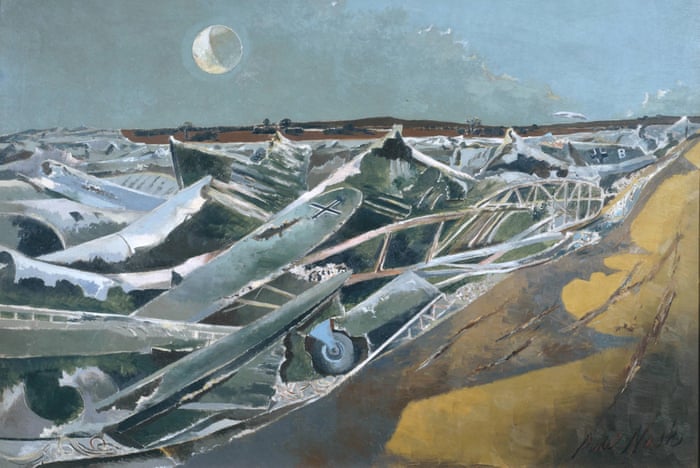
Paul Nash, Landscape of the Moon's Last Phase, 1944, Oil on canvas Walker Art Gallery (Liverpool) Paul Nash © Tate
Landscape of the Moon's Last Phase (1944)

Paul Nash review – between dream and nightmare
Tate Britain, London
Strangeness on the Downs meets the horrors of two world wars in the biggest show of Nash’s work in a generation

Laura Cumming
The Obserber
Sunday 6 November 2016

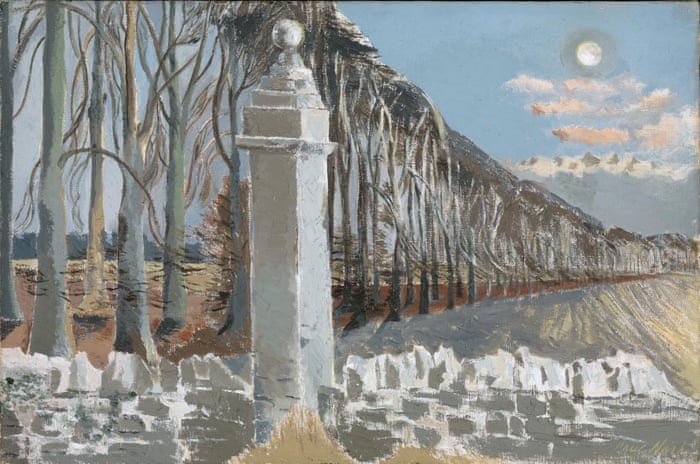
Out walking, you are confronted by a long column of trees approaching across a bare winter landscape. You stop, and it seems as if they stop too. Stationed before them – the field marshal commanding his troops – stands a stone pillar topped with a pale sphere. And this sphere has a peculiarly exact echo in the white moon hanging beside it in the sky: English pastoral geometry.

Pillar and Moon (1932 - 42)

Pillar and Moon is not just one of Paul Nash’s greatest works, it encapsulates the painter’s gift for mood, mystery and strange alignment. Every element of the scene is independently familiar – the parade of vertical trunks, the low-hanging moon, the architectural remnant of some aristocratic parkland – but all are made extraordinary and oneiric. The positioning of the two discs may be significant, or meaningless, but it holds the mind in wonder. The atmosphere feels dazed and convalescent.

Equivalents for the Megaliths (1935)
Nash died of heart failure, brought on by chronic asthma, in a Bournemouth suburb in 1946. He was 57, and had narrowly escaped gassing and death more than once in the first world war. He lost consciousness several times during his curtailed life, and his bleached and dreamy landscapes seem to hold on to the light as if it might fade. And landscape is where everything happens in Nash’s art: outdoors is his internal stage.

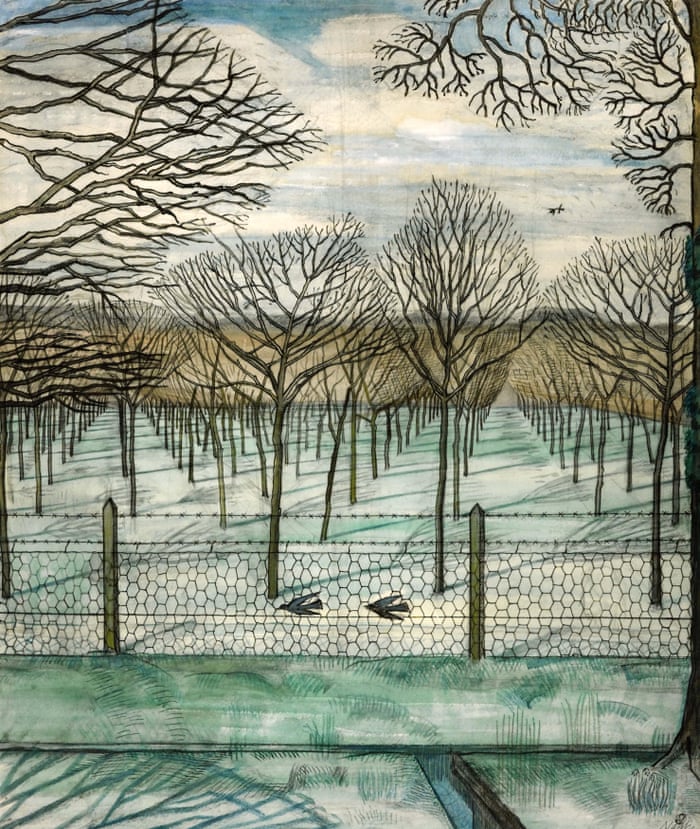
The Cherry Orchard (1917)

The Cherry Orchard, beautifully positioned at the entrance to this enormous show– the first full-stretch survey in a generation – sets the tone from the start. An array of trunks casts diagonal shadows on the landscape, which is divided again by wire fencing as the sky is crisscrossed by stark branches. These are the bare ruin’d choirs of Shakespeare, and yet the watercolour was made in leafy July. Nash was temporarily home from the trenches in 1917. His image is distanced from life, while partaking of it: he sees the ribs, bones and ghosts in the landscape.

Trees march by night, hugger-mugger in the darkness. Huddled together, they watch dawn break over the horizon. Their trunks lie felled, vast as the ancient stones of Wiltshire, or protrude upright, shattered and amputated, from the black mud of Ypres. They are bodies, and sometimes corpses, yet never people.

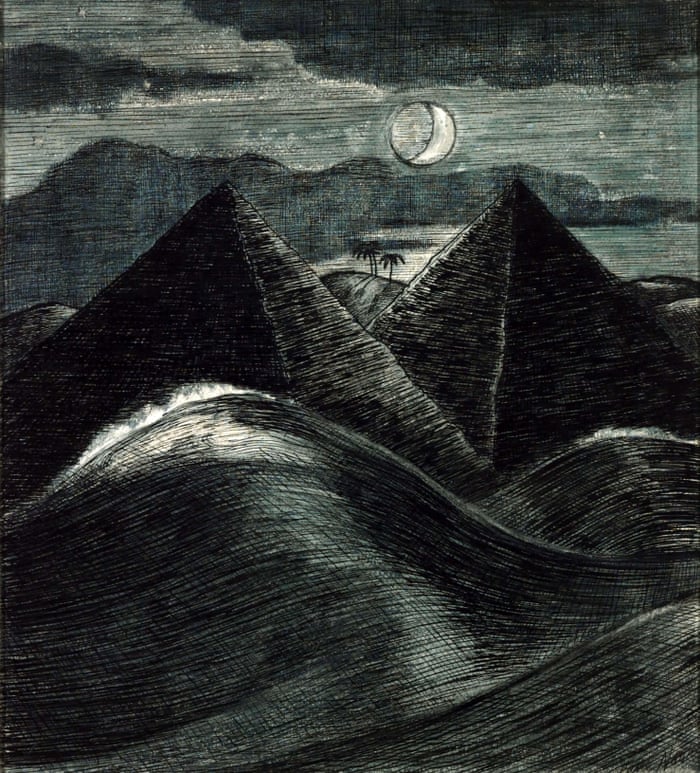
The Pyramids in the Sea (1912)


It was noted at the Slade – where Nash studied in the diverse generation that included Ben Nicholson, Wyndham Lewis and Stanley Spencer – that the human figure would never be his forte. People do appear in his art, surprisingly often, but always as wraiths or surrogates. Far more haunting are nature’s figures, such as the two tiny trees holding still at the centre of The Pyramids in the Sea.

This irreducibly strange vision shows roiling seas by night, two pyramids dropped among them, and sand dunes metamorphosing into waves. It is a vision from the land of counterpane, made when Nash was scarcely 23. Yet it contains the future like a kernel – the intermingling of land and sea, the premonition of surrealism,the Samuel Palmer moon (long before Palmer was discovered in the 1920s) of Nash’s English nocturnes. Above all the bell-shaped waves that rise and fall across the picture, and all through the rest of his work.

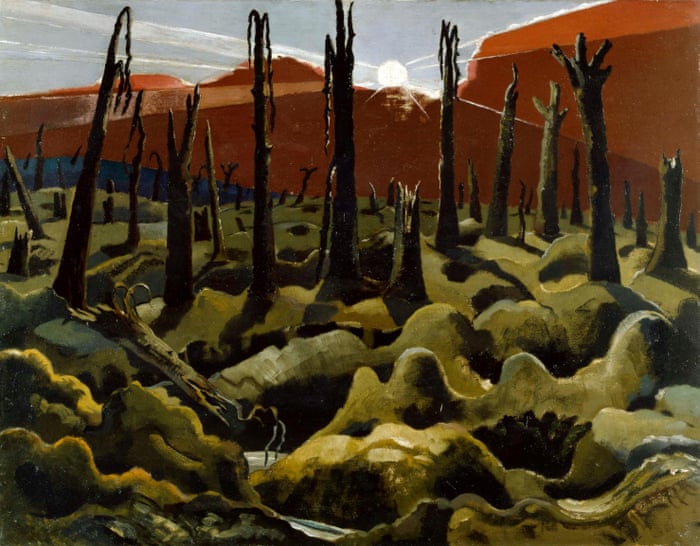
We Are Making a New World (1918)

You see these in his devastating masterpiece We Are Making a New World (1918), where the spiked rays of the sun radiate like searchlights above a sea of tragic humps – the churned and deadly trenches. And it is there in weird vernal hillscapes painted during the second world war. Cumulus mounts over the Channel in swelling curves and descends in matching formations with the dark plumes of crashing aeroplanes.
Paul Nash, Landscape for a Dream, 1936-8, Oil paint on canvas collection & © Tate
Landscape for a Dream (1936-8)

Nash is routinely described as Britain’s foremost surrealist. But his consciously surreal paintings are as mediocre as his effortful still lifes. It is a pity Tate Britain has given quite so much space to both, but the curators are intent on dutiful chronology and dust-dry modernist history. Nash’s life is hardly mentioned in the captions, as if he didn’t have one, and a whole room is devoted to his fellow artists in the Unit One group – Hepworth, Moore, the Edwards Burra and Wadsworth – when their work is available in galleries upstairs.
Paul Nash, Events on the Downs, 1934, Oil on canvas, Governement Art Collection (GAC),  Paul Nash © Tate Photo: © UK Government Art Collection
Events on the Downs (1934)

It is true that Nash’s paintings sometimes have the period look – the chalky surface, the mildly sardonic, gas-fire plangency – of London painting in the 1920s. It is also true that for a brief period he painted receding tunnels and metaphysical objects in the obvious shadow of De Chirico. But soon Nash is off on his own again with strange incidents on the Downs and startling shorelines at Dymchurch in Kent, where he rented a cottage after a nervous breakdown.

The Shore (1923)

Here the cold waves clatter like wrecked fuselage or turn into solid planes of ice, stretching into the darkness beneath a grey moon. In that marvellous painting The Shore, made in 1923, the postwar defences lie face-down, as it seems, like a vast plane crashed upon the beach. Later, in the second world war, Nash draws the bones of aircraft lying exposed in the earth, or dangling from wires, or surfacing out of seas of corn. To come upon them in the landscape must have been as surprising as this – like chancing on the skeleton of a dinosaur.

Totes Meer (Dead Sea) (1940-41)

And everything Nash paints has that curious timelessness. The aeroplanes in his most famous masterpiece, Totes Meer (Dead Sea), could almost be old ships, but for the markings, or frozen waves, but for a solitary wheel. They pack the painting like the icebergs of Scott’s doomed expedition to Antarctica, and yet they seem even older, appearing beneath the flight of an owl and a crescent moon. The picture was painted in 1940-1, but it could be set in a nuclear winter.

Nash was a writer as well as a painter, and he left many piercing statements about his work. “There are places,” he wrote, “whose relationship of parts creates a mystery, an enchantment, which cannot be analysed.” This is what his own paintings imagine. In the quiet of the studio, he turned his journey through the English landscape into new and mysterious visions that are so close to reality – the sun appearing at the same time as the moon, a crown of trees suddenly rising out of winter’s tilled earth – as to carry the enchantment of which he writes. And then, with some inexplicable switch of atmosphere, alignment and elements, he makes this world even stranger.

Friday, 4 November 2016

Dead Poets Society #15 e. e. cummings: somewhere i have never travelled, gladly beyond by


somewhere i have never travelled, gladly beyond by e. e. cummings

somewhere i have never travelled, gladly beyond
any experience,your eyes have their silence: 
in your most frail gesture are things which enclose me, 
or which i cannot touch because they are too near 

your slightest look easily will unclose me 
though i have closed myself as fingers, 
you open always petal by petal myself as Spring opens 
(touching skilfully, mysteriously) her first rose 

or if your wish be to close me, i and 
my life will shut very beautifully, suddenly, 
as when the heart of this flower imagines 
the snow carefully everywhere descending; 

nothing which we are to perceive in this world equals 
the power of your intense fragility:whose texture 
compels me with the colour of its countries, 
rendering death and forever with each breathing 

(i do not know what it is about you that closes 
and opens;only something in me understands 
the voice of your eyes is deeper than all roses) 
nobody,not even the rain,has such small hands


Thursday, 3 November 2016

Last night's set lists

At The Habit, York: -

Ron Elderly: -
Can't Help Falling In Love
Need Your Love So Bad


Da Elderly: -
I'm Just A Loser
I Don't Want To Talk About It

The Elderly Brothers: -
When Will I Be Loved
Bring It On Home To Me
Then I Kissed Her
All I Have To Do Is Dream
I Saw Her Standing There


After a fortnight in the far-flung reaches of the West Coast of the USA, it was good to return to the open mic at The Habit. There had been some work done while I was away - new benching around the window area and the wall where the wood-burner used to be - and no empty barrels to negotiate! There was a good turnout too - although never packed, the bar was busy all night. Several regulars turned out to play along with 3 or 4 newcomers, including a lass on keyboard who made a great impression on the audience with her virtuosity and vocal style. There was a warm welcome for the return of The Elderly Brothers and we gave them 5 'standards' from the book. Local musician Jake finished off the evening with fine renditions of Bowie's Heroes and Space Oddity.

Pat Ffrench and The Orchid House Project on Greg Mitchell's playlist for The Tunnels book party


Music Playlist for The Tunnels


Greg Mitchell
19 October 2016

I’ve always been one of those music nerds who have put together playlists for parties and other events, going back to the 1970s–first on cassettes, then burning CDs, and now, at last, via Spotify. For my book party this week for The Tunnels, I mixed in some songs closely or loosely related to the book, touching on Berlin, or walls, or Cold War, or quests for freedom, etc. Here are some of the tunes that fit that category that I mixed in:

“Chimes of Freedom” Live –Bruce Springsteen Songs That Inspired Fahrenheit 9/11

“Another Brick in The Wall Part I” and “Part III” Pink Floyd The Wall

“One”– U2 Achtung Baby

“First We Take Manhattan” and “Anthem” — Leonard Cohen, The Future

“All Along the Watchtower”–Bob Dylan, John Wesley Harding

“Yes We Can”– Allen Toussaint, Our New Orleans

“Different Sides”– Leonard Cohen, Old Ideas

“Ghosts of the Berlin Wall” — Orchid House Project

“Heroes” single version 1998 remastered– David Bowie, Platinum Collection

“Intervention” — Arcade Fire Neon Bible

“Rusty Cage”–Johnny Cash American II

“You Want It Darker”–Leonard Cohen new single

“Rocking in the Free World” — Crazy Horse, The Purge

Note: Of course, can easily substitute Hendrix version of “Watchtower,” Byrds and Dylan with “Chimes of Freedom,” and on and on.


Tuesday, 1 November 2016

Bob Dylan pays tribute to Tony Bennett

Why did Bob Dylan pay a visit to Birmingham's WorkPlay on Friday?

Mary Colurso
29 October 2016 

Bob Dylan likes WorkPlay.

How do we know? He told owner Tom Williams so on Friday, during a video shoot at the venue's theater.

Dylan, 75, one of the most famous names in the rock world, spent about four hours at the Birmingham entertainment complex, filming a video to commemorate Tony Bennett's 90th birthday.

According to Williams, the video will be part of an NBC TV special, "Tony Bennett Celebrates 90: The Best Is Yet to Come." The two-hour show, which airs Dec. 20, also includes performances by Aretha Franklin, Lady Gaga, Elton John, Billy Joel, Stevie Wonder and other celebrities.

Dylan couldn't attend the actual celebration, which was filmed Sept. 15 at Radio City Music Hall. However, Williams said, Dylan wanted to mark the occasion with a song. That's the tune he performed and filmed with his band at WorkPlay, with a technical crew and gear brought in for the occasion.

Williams said he watched Dylan's sound check on Friday, but declined to name the song chosen for the filming, citing the artist's desire to keep it under wraps until the show airs.

Dylan, a notoriously private singer-songwriter, didn't allow outside cameras at the shoot, including cell phones. (Sorry, folks, no selfies!) Williams said, however, that Dylan was extremely cordial during his visit and complimented the facilities at WorkPlay.

"He was coming around the corner, and the security man said, 'There's the owner,'" Williams said. "He approached me. We talked for about three minutes, about WorkPlay and the studios. I told him we could record a live show here. He said, 'Great place, great place.' ... Afterward, as he was finishing up and coming back through, he said 'Tom, you have a really nice place,' and put his hand out."

Although these encounters were brief, Williams has exchanged more words with Dylan than most people ever will. The star, a recent Nobel laureate, has a reputation for being tight-lipped on the concert trail, with fans, reporters and promoters alike.

"He was super-nice," Williams said. "They had one rule: No cell phones, no cameras in the air while he's in the building. They just said, 'Give him his space and no cameras.'"

Dylan, who's touring to promote his new album, "Fallen Angels," stopped in Birmingham on the way to Huntsville, where he'll perform tonight at the Von Braun Center Concert Hall. The tour brings him back to Birmingham on Nov. 15 for a show at the BJCC Concert Hall. After that, he's set to play on Nov. 16 at the Saenger Theatre in Mobile.

Williams said Dylan's team contacted WorkPlay about two months ago, asking about the possibility of a rental for the video shoot. The connection came through the venue's sound engineer and production manager, Davy Moire.

Williams said his initial reaction was, "Of course we can do this! Whatever it takes."

WorkPlay has seen its share of stars over the years, from Jack White to the Drive-By Truckers, and the venue hosted a video shoot for Billy Bob Thornton and the Boxmasters in 2014. An appearance from Dylan, however, would be an important milestone.

Secrecy was crucial, lest the public invade the venue hoping for glimpse of the iconic musician. Only four or five people at WorkPlay, including general manager Joe Benintende and Williams' wife, Courtney Williams, knew about Dylan's visit in advance. If word leaked before the the shoot, that would be a deal-breaker, Williams said.

"It was tough, but not too tough, (to keep the secret) because we didn't want it to get out," Williams said. "And we didn't want to lose it."

Much of the initial discussion with Dylan's team involved the precise location of the shoot — WorkPlay has a theater, a soundstage, recording studios, office space and more — and the theater finally won the day.

A crew arrived on Thursday to ready the theater, Williams said, and the workers brought a substantial amount of equipment, including set design elements and the analog sound gear Dylan prefers.

"Our preparation was to make sure the room was clean and the sound was right," Williams said. "We really wanted to impress the crew. They used our soundboard, but I'd say they used about 80 percent of their own equipment. It was a huge production."

WorkPlay also contacted a local caterer, Jason Marchant of BYOB restaurant in Lakeview, arranging food for Dylan's team on Thursday and Friday. After the shoot, at Courtney Williams' suggestion, the leftovers were donated to Brother Bryan Mission in Birmingham.

The famed artist arrived around 2 p.m. on Friday, wearing a hoodie and sunglasses, and later changed into a suit for the video. Williams said Dylan wore tuxedo pants and a white shirt, and "had his hair up." A makeup artist was on scene, as well.

Williams said excitement was running high at WorkPlay while Dylan was on scene, but everyone present made sure to keep things cool. Although he knew better than to ask for a photo with Dylan, Williams admits that he was tempted.

"I came so close to asking him," Williams said. "I'm a singer-songwriter fan; Bob Dylan and John Prine and Willie Nelson, they're my thing. It was an honor to have a professional musician and Nobel Prize winner come to WorkPlay and record a song."

Williams wouldn't say much about Dylan's performance, or any birthday message the singer might have filmed for Bennett. But he described the video shoot as professional and smooth, and said everyone involved was friendly. Dylan explored the WorkPlay complex a bit during his stay, and even acknowledged the resident dog, Cheetos.

After the filming ended, Williams opened WorkPlay's bar to the visiting crew. Dylan left the venue around 6 p.m., he said, and social media immediately became fair game.

"When I could see the taillights of the bus, I hit Facebook," Williams said. "It was a great day for WorkPlay and for the city."