Saturday, 13 August 2016
Friday, 12 August 2016
Dead Poets Society #4 Frank O'Hara: The Day Lady Day Died

The Day Lady Day Died by Frank O'Hara
three days after Bastille day, yes
it is 1959 and I go get a shoeshine
because I will get off the 4:19 in Easthampton
at 7:15 and then go straight to dinner
and I don't know the people who will feed me
I walk up the muggy street beginning to sun
and have a hamburger and a malted and buy
an ugly NEW WORLD WRITING to see what the poets
in Ghana are doing these days
I go on to the bank
and Miss Stillwagon (first name Linda I once heard)
doesn't even look up my balance for once in her life
and in the GOLDEN GRIFFIN I get a little Verlaine
for Patsy with drawings by Bonnard although I do
think of Hesiod, trans. Richmond Lattimore or
Brendan Behan's new play or Le Balcon or Les Nègres
of Genet, but I don't, I stick with Verlaine
after practically going to sleep with quandariness
and for Mike I just stroll into the PARK LANE
Liquor Store and ask for a bottle of Strega and
then I go back where I came from to 6th Avenue
and the tobacconist in the Ziegfeld Theatre and
casually ask for a carton of Gauloises and a carton
of Picayunes, and a NEW YORK POST with her face on it
and I am sweating a lot by now and thinking of
leaning on the john door in the 5 SPOT
while she whispered a song along the keyboard
to Mal Waldron and everyone and I stopped breathing
Thursday, 11 August 2016
Last Night's Set Lists
Last night's set lists
At The Habit, York: -
Ron Elderly: -
Streets Of London
Need Your Love So Bad
I'll See You In My Dreams
Da Elderly: -
Shine On You Crazy Diamond
Bouquet Of Roses
You've Got A Friend
The Elderly Brothers: -
Love Hurts
Everybody Knows
You Got It
Yes I Will
When Will I Be Loved
The holiday season kicked-in with an unexpected early dearth of players, so the evening kicked-off with three songs apiece for those who did turn up. Yours truly raised a few eyebrows with my first offering, not the usual Neil song, but a Pink Floyd tune. Some new faces from Grimsby performed first as a duo, then as a trio with some awesome 3-part harmonies. The Elderlys dug out a old Hollies classic which we hadn't played for ages. Tim the harmonica maestro joined singer/guitarist Tim for the finale which included an excellent San Francisco Bay Blues.
At The Habit, York: -
Ron Elderly: -
Streets Of London
Need Your Love So Bad
I'll See You In My Dreams
Da Elderly: -
Shine On You Crazy Diamond
Bouquet Of Roses
You've Got A Friend
The Elderly Brothers: -
Love Hurts
Everybody Knows
You Got It
Yes I Will
When Will I Be Loved
The holiday season kicked-in with an unexpected early dearth of players, so the evening kicked-off with three songs apiece for those who did turn up. Yours truly raised a few eyebrows with my first offering, not the usual Neil song, but a Pink Floyd tune. Some new faces from Grimsby performed first as a duo, then as a trio with some awesome 3-part harmonies. The Elderlys dug out a old Hollies classic which we hadn't played for ages. Tim the harmonica maestro joined singer/guitarist Tim for the finale which included an excellent San Francisco Bay Blues.
Wednesday, 10 August 2016
Misery and Blues at The Blue House Roundabout, Newcastle
Newcastle City Council have put forward controversial plans for the redevelopment of the Blue House Roundabout. If they get the go-ahead - after a remarkably but not unsurprisingly short consultation period (when many people will be on their summer holiday...) - the project seems guaranteed to piss off motorists (already pissed off by the many traffic projects the council are putting into place elsewhere around the city. Did I mention the changes to the twin roundabouts at South Gosforth (see below),
the changes at Cowgate, the mess that is Gosforth High Street, the flow of traffic around the Central Station?), cyclists, nearby residents, conservationists and some local MPs.
Here's how the project will eat up great chunks of the nearby moors:
Viz co-creator Chris Donald has come up with his own solution:
Thanks to: http://www.skyscrapercity.com/showthread.php?s=66581c35466b7441216bea6c621cfcd7&t=1209591&page=111
http://www.chroniclelive.co.uk/news/north-east-news/ribbons-appearing-trees-next-newcastles-11716706
Of course, Newcastle doesn't have a monopoly on this:
Tuesday, 9 August 2016
Georgia O'Keeffe at Tate Modern, 2016 - review
Jimson Weed/White Flower No. 1, 1932
Karen Wright
Wednesday 6 July 2016
The major retrospective of Georgia O’Keeffe’s work that opened this week at Tate Modern in London is a rare opportunity for British viewers to engage with this revered American artist. In the same season as the opening of the Tate extension Switch House, this exhibition illuminates the gallery’s determination to provide new readings of old favourites. Curator Tanya Barson has spun a new tale of O’Keeffe, showing her as a progressive artist who was influenced by photography and not “merely an observational painter”. The inclusion of photography, while interesting, again shows a lack of confidence by the institution to let a singular medium prevail.

Black Mesa Landscape, New Mexico / Out Back of Marie’s II , 1930
Georgia O'Keeffe was born in Wisconsin in 1887 and died in 1986 aged 98. Anyone who is lucky enough to live to be nearly 100 has experiences that span a great swath of history. O'Keeffe lived through two world wars, 17 US presidents, the Great Depression and the subsequent migration of east to west, as well as the great drought of the 1930s. She married the great photographer Alfred Steiglitz in 1924, for whom she was a muse, posing often for him clothed as well as in the nude. He also promoted O’Keeffe in both his own gallery as well as with his extensive circle of friends. Ironically, it was he who put forward the idea that the flowers were indeed eroticised images, a reading that O’Keeffe strenuously denied through her long life.


Black Mesa Landscape, New Mexico / Out Back of Marie’s II , 1930
Georgia O'Keeffe was born in Wisconsin in 1887 and died in 1986 aged 98. Anyone who is lucky enough to live to be nearly 100 has experiences that span a great swath of history. O'Keeffe lived through two world wars, 17 US presidents, the Great Depression and the subsequent migration of east to west, as well as the great drought of the 1930s. She married the great photographer Alfred Steiglitz in 1924, for whom she was a muse, posing often for him clothed as well as in the nude. He also promoted O’Keeffe in both his own gallery as well as with his extensive circle of friends. Ironically, it was he who put forward the idea that the flowers were indeed eroticised images, a reading that O’Keeffe strenuously denied through her long life.

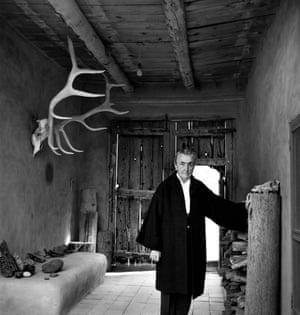
Georgia O’Keeffe, shot for Vogue in 1967
I start with this context to remind viewers of the long history of over-looked women artists, not that O'Keeffe was one of these. The Museum of Modern Art in New York held a retrospective of her work in 1946. Her red poppies appeared on a US postage stamp, and her New Mexico home in Abiquiui, now open to the public, still attracts a pilgrimage of worshiping tourists, both female and male. Her best-known subject matter are the large and eye-catching flowers.

Grey Lines with Black, Blue and Yellow, 1923
O’Keeffe absorbed the landscape and language of her adopted home in New Mexico with a ferocity and a single mindedness, like that of Paul Cézanne when he painted and repainted Montagne Sainte-Victoire. Once when lost near Avignon I found that the soil of that mountain is that reddish brown seen and accepted as poetic licence in his great landscape paintings.
Grey Lines with Black, Blue and Yellow, 1923
O’Keeffe absorbed the landscape and language of her adopted home in New Mexico with a ferocity and a single mindedness, like that of Paul Cézanne when he painted and repainted Montagne Sainte-Victoire. Once when lost near Avignon I found that the soil of that mountain is that reddish brown seen and accepted as poetic licence in his great landscape paintings.
Abstraction White Rose, 1927
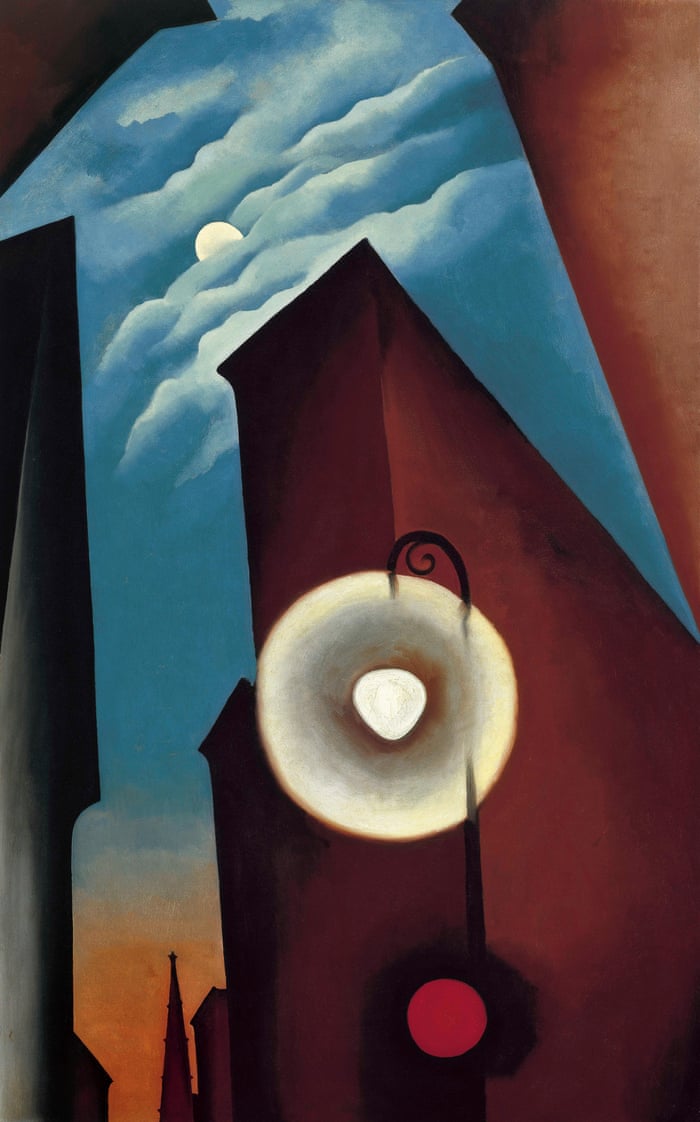
In this exhibition the paintings are arranged roughly chronologically and embrace her time spent in New York City, as well as in Lake George, where she spent summers during the early days of her marriage to Steiglitz. Her New York paintings, often created from a high perspective, encapsulate a city bathed in a dramatic night-time light. While her time spent in Lake George reflects her engagement with a verdant landscape; here, she wrote “I feel smothered with green”.

O’Keeffe was fiercely independent and continued to be so, well into her later years. She was a hiker, going “tramping” in all weathers, visiting and revisiting sites often remote from her home. This pioneering spirit led to her preoccupations with objects and views that she personally experienced.

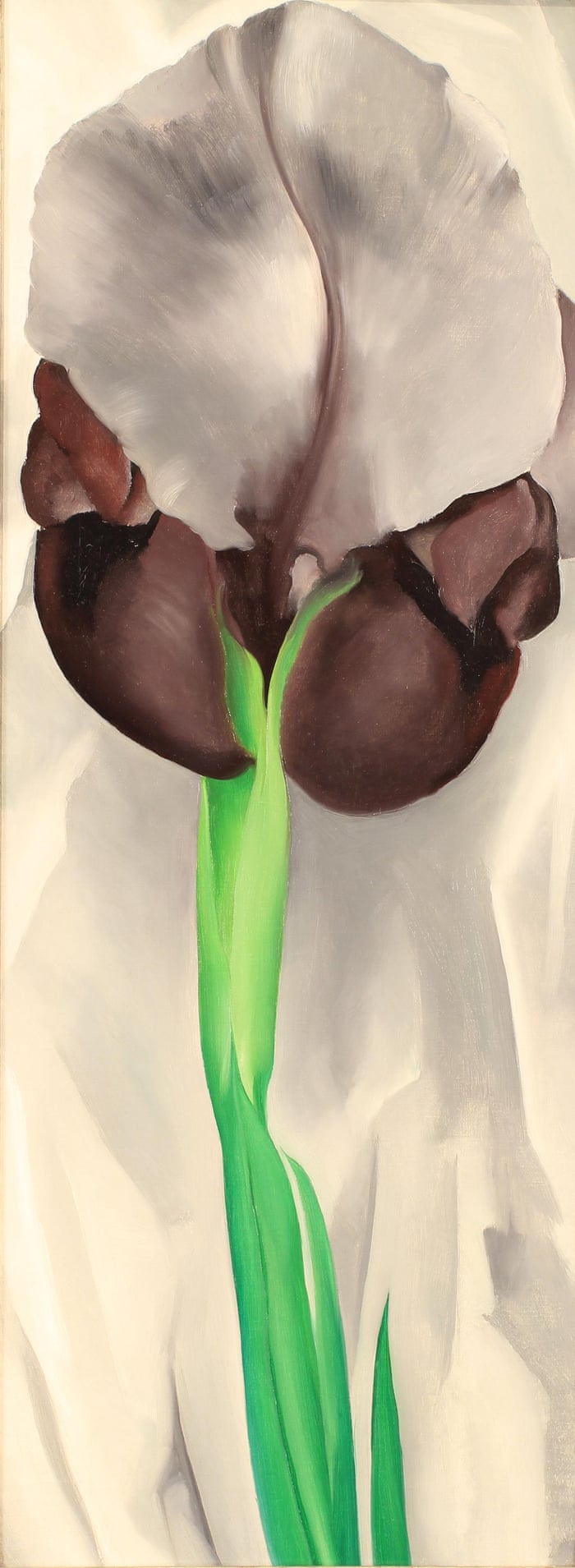
Dark Iris No 1, 1927
While O’Keeffe is best known for her flower paintings; closely observed blossoms. The room of these is sadly not the most powerful room here, perhaps due to loan restrictions. Some of the great blooms, including the luxurious purple iris, are not here, but there is her Jimson Weed of 1932, a painting that in 2014 became the most expensive ever sold at auction by a female artist when it was bought for $44.4m (£34.2m).

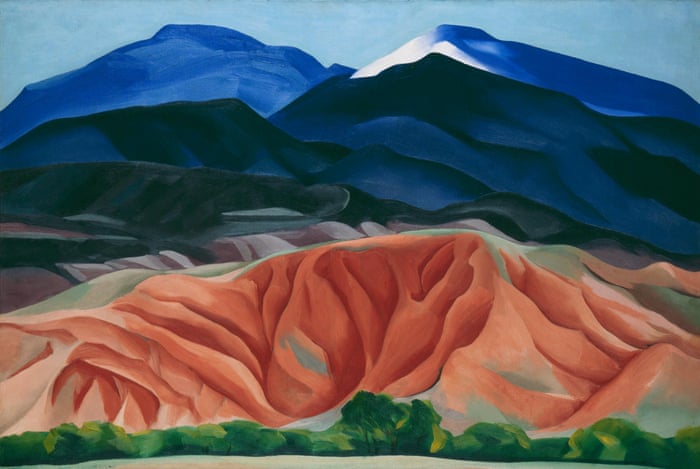
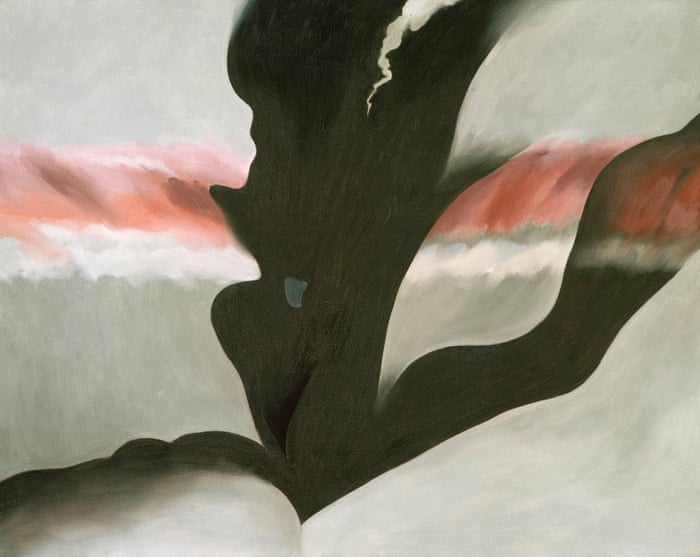
Black Place ll, 1945
Nearby are beautifully observed still lives, an eggplant, figs and an alligator pear in all their majestic simplicity. We are again told that these are a result of O’Keeffe looking at photography. I am not denying that O’Keeffe was friends with Paul Strand and Ansel Adams, as well as her relationship with Steiglitz; they did visit her and were inspired by the landscape that inspired her. But this is an artist who constantly reacted to locations with her own eyes.
From the Faraway, Nearby, 1937
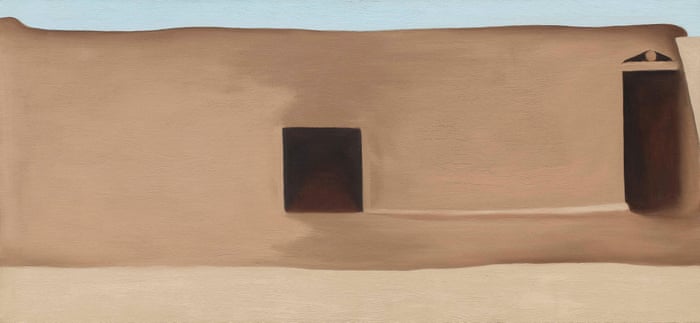
O'Keeffe discovered Ghost Ranch – the property that was to become her home – in 1934, finally purchasing the house in 1940. The view from the ranch, a flat-topped mesa, became her favoured view. She painted and repainted it, saying at one point: “God told me if I painted it enough I could have it.” She also discovered the “Black Place”, another location she revisited throughout her life whilst driving through the Navajo country. These black hills, often abstracted into almost signs, recurred throughout her work became one of the locations of seriality-working through different permutations while also moving towards abstraction, the strong natural forms reduced into powerful symbols. A series of views of paintings of her front door marry the increasing abstraction of an artist such as Piet Mondrian with the observation of Claude Monet, quite a feat for a woman in the early 20th century.

O’Keeffe in Albuquerque, New Mexico, 1960
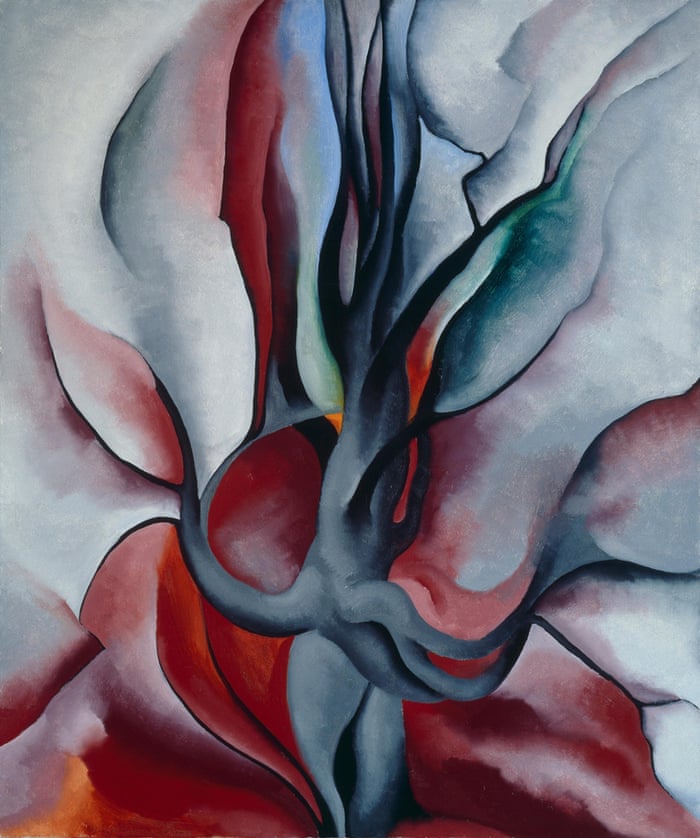
Comparing these to Monet’s serial haystacks is an obvious connection, but I think that Mondrian’s voyage toward abstraction is more apposite. Mondrian’s trees of the early 20th century evolve into a different form of rigorous geometry, while O’Keeffe's sketchy paintings of cottonwood trees are aiming for a different essence of abstraction, one more akin to Canadian artist Emily Carr, who O’Keeffe met, and to the theosophy, serial and spiritual reading of Swedish artist Hilma af Klint.

Autumn Trees-The Maple 1924
I have been lucky enough to have visited the area where O’Keeffe worked and observed the wide skies and flatness of the landscapes. Walking in the arroyos, near her ranch, one discovers lying on the surface the sun-bleached skulls as well as artifacts of abandoned tribes. Not surprisingly, O’Keeffe was drawn to them, exploring and layering them along with other imagery, and some of these paintings look just wrong. Mule’s Skull with Pink Poinsetta (1936), an odd painting, reflects O’Keeffe's continued exploration of themes mashed and layered together. A group of depictions of native American dolls, Kachinas, sit strangely ill at ease with the landscapes ranged nearby. O’Keeffe travelled to Mexico to meet Frida Kahlo, who collected votive paintings, and Diego Rivera, and this group seems to mirror this interest.

New York Street with Moon, 1925
O’Keeffe was perhaps the first artist to paint the view seen from an airplane; her aerial shots of fluffy clouds and the horizontality of the sky produced from memories of her flights from New York City to Santa Fe. Again this is credited to her husband’s photographs of the sky and clouds, but when you stand in front of her Sky Above the Clouds III you can see the painterly licence that O’Keeffe adopted, making this painting much more memorable then the Steiglitz photographs, lovely though they are.

Georgia O’Keeffe photographed by Ansel Adams in 1937
Comparing these to Monet’s serial haystacks is an obvious connection, but I think that Mondrian’s voyage toward abstraction is more apposite. Mondrian’s trees of the early 20th century evolve into a different form of rigorous geometry, while O’Keeffe's sketchy paintings of cottonwood trees are aiming for a different essence of abstraction, one more akin to Canadian artist Emily Carr, who O’Keeffe met, and to the theosophy, serial and spiritual reading of Swedish artist Hilma af Klint.

Autumn Trees-The Maple 1924
I have been lucky enough to have visited the area where O’Keeffe worked and observed the wide skies and flatness of the landscapes. Walking in the arroyos, near her ranch, one discovers lying on the surface the sun-bleached skulls as well as artifacts of abandoned tribes. Not surprisingly, O’Keeffe was drawn to them, exploring and layering them along with other imagery, and some of these paintings look just wrong. Mule’s Skull with Pink Poinsetta (1936), an odd painting, reflects O’Keeffe's continued exploration of themes mashed and layered together. A group of depictions of native American dolls, Kachinas, sit strangely ill at ease with the landscapes ranged nearby. O’Keeffe travelled to Mexico to meet Frida Kahlo, who collected votive paintings, and Diego Rivera, and this group seems to mirror this interest.

New York Street with Moon, 1925
O’Keeffe was perhaps the first artist to paint the view seen from an airplane; her aerial shots of fluffy clouds and the horizontality of the sky produced from memories of her flights from New York City to Santa Fe. Again this is credited to her husband’s photographs of the sky and clouds, but when you stand in front of her Sky Above the Clouds III you can see the painterly licence that O’Keeffe adopted, making this painting much more memorable then the Steiglitz photographs, lovely though they are.
Georgia O’Keeffe photographed by Ansel Adams in 1937
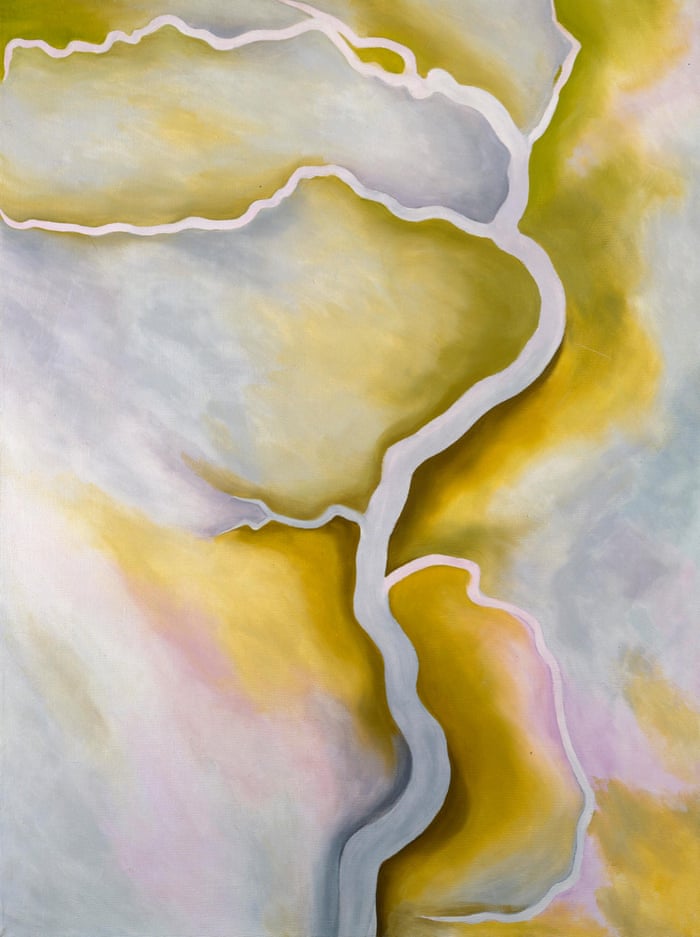
There are many criteria as to what makes an artist great and one is how influential their work is on others. There is no doubt that the American painter Agnes Martin looked closely at O’Keeffe. It is not just their physical proximity (Martin landed in Taos when she moved west from New York City); it is the reaction to the rigorous landscape of place and the strong horizontality of the land and the sky. I was once told an anecdotal story about Martin that she always painted with the lines running down to avoid drips, but then displayed them horizontally.

From the River – Pale, 1959
This is an extraordinary show, a collection of nearly 100 works celebrating a woman artist, long overdue in this country, the last being in 1993 at the Hayward in London. Why do I feel churlish? Perhaps because in trying to make O’Keeffe seem progressive there is the constant intervention of male artists – even great ones – that seem unnecessary.

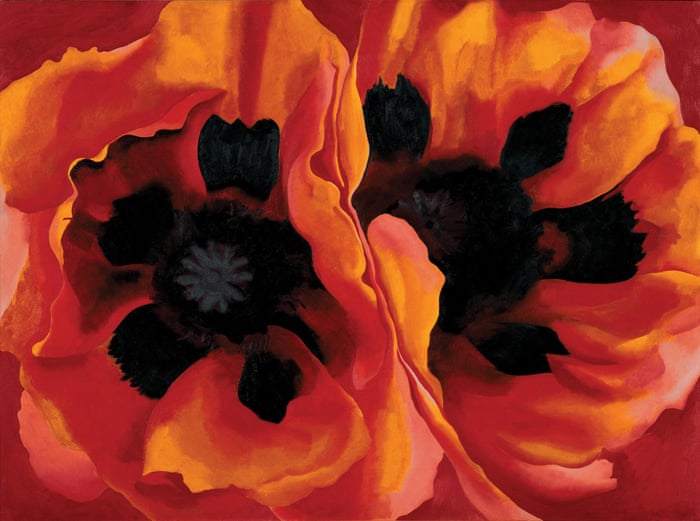
Oriental Poppies, 1927
Georgia O’Keeffe was a role model for many women artists. One could say there was a man behind her early success – Steiglitz did as much as he could for his muse, though she lived apart from him for many years. She was a woman who plowed her own furrow and this is clear in the haunting and revealing portrait of O’Keeffe by Anselm Adams taken in 1937 from the back, the perspective of sky and land and horizon spread out in front of her. I think that a quote from her sums up this rewarding if flawed exhibition: “A woman who has lived many things and who sees lines and colours as an expression of living might say something that a man can’t – I feel there is something unexplored about women that only a woman can explore – the men have done all they can do about it.”
The Georgia O'Keeffe exhibition continues at Tate Modern in London until 5 October.
Monday, 8 August 2016
Sunday, 7 August 2016
Dome of the Hidden Pavilion: New Poems by James Tate - review
Dome of the Hidden Pavilion: New Poems by James Tate
By Michael Andor Brodeur
https://www.bostonglobe.com/arts/books/2015/08/29/review-dome-hidden-pavilion-james-tate/NCJtB0r1uZIsYC3xulJXPK/story.html
By Michael Andor Brodeur
Boston Globe
29 August 2015
When James Tate passed away at age 71 in July, his devoted readers didn’t just lose a remarkable poet, but a masterful storyteller — even if his stories weren’t always quite stories.
The second half of Tate’s nearly 50-year career (which launched auspiciously with “The Lost Pilot” in 1967, earning him the Yale Series of Younger Poets prize), found him increasingly fond of tidy dialogues with untidy conclusions — people colliding with people in the wild of daily life, comparing notes, trading questions, and finding little consensus on anything. Sometimes these poems feel like rambling yarns spun by a folksier cousin of Kafka — or perhaps Beckett if he lived in Becket — but over time they have become signature Tate.
And the 108 poems of “Dome of the Hidden Pavilion,” Tate’s 17th volume, assembled just before his death, continue to twist his seemingly simple narrative arcs into surrealist loop-de-loops. If anything has changed this time around, it’s the long shadows his passing casts upon the poems — their darkness seems a touch darker, their uncertainties a shade deeper, and the people who inhabit them (an endless procession of Cynthias and Darlenes, Bruces and Chets, Brendas and Maureens ), are easier than ever to mistake for ourselves, nondescript but for our existential quirks.
Describing his writing process to poet Charles Simic in a 2006 Paris Review interview, Tate said “I take a step, I see what the new implications are, I take another step, I see what the next implications are — and I just proceed like that.”
If that’s a useful insight into how these poems are written, it’s even more so as a guide toward how to read them. Tate’s tales stymie paraphrase, rolling downhill, gaining wild momentum, skewing off on erratic paths, and eventually slowing to a finish at a point you could never have foreseen from the top. But along the way, as one line unpredictably (yet naturally) rolls into the next, their restless searching feels familiar, their lost denizens downright neighborly, and their gruesome coldness unnervingly close.
A man drops dead and is thrown from a trolley of impatient passengers in “The End of the Line”; an elderly mother grows massive and feral before her daughter and son-in-law release her into the woods in “A Largely Questioning Article Offering Few Answers”; the body of a bludgeoned grandmother stuffed into a laundry bag inexplicably transforms into clumps of feathers in “The Grandmother” — and it’s all delivered with a smile (and not a smirk, mind you).
Even as the first third of “Dome” trudges through the wreckage and carnage of an unspecified war, Tate’s take on absurdity balances the grave with the goofball, without diminishing either, as when a man in his 60s is drafted in “The Cows”: “I watched him walk down the driveway. He was an easy target./ He was slow and he limped. He had worked hard all his life./ It would be so easy for me to take him out now.”
Or when a man in “The Guards” questions an armed guard as to why he’s been stationed on his street: “‘To protect you from the enemy,’ he said./ ‘Who’s the enemy?’ I said. ‘This I have not been informed/ about,’ he said. ‘Well, I hope you get him,’ I said. ‘Yes,/ sir’ he said.”
It’s as though Tate must sneak up on skittish truths, approaching them sideways so as not to startle them. And while his uniquely oddball approach to tale-telling is traceable all the way back to poems like 1970’s “Deaf Girl Playing,” in “Dome” it feels freshly refined, the solemn notes outlasting the silly ones, even in a world where common sense is a dream and “[s]ome things don’t deserve to be contemplated.”
“I love my funny poems, but I’d rather break your heart,” Tate told Simic toward the end of their Paris Review conversation. “And if I can do both in the same poem, that’s the best.” By these standards, “Dome” is Tate at his restless, relentless best — leaving many questions unanswered, and no answer unquestioned.
When James Tate passed away at age 71 in July, his devoted readers didn’t just lose a remarkable poet, but a masterful storyteller — even if his stories weren’t always quite stories.
The second half of Tate’s nearly 50-year career (which launched auspiciously with “The Lost Pilot” in 1967, earning him the Yale Series of Younger Poets prize), found him increasingly fond of tidy dialogues with untidy conclusions — people colliding with people in the wild of daily life, comparing notes, trading questions, and finding little consensus on anything. Sometimes these poems feel like rambling yarns spun by a folksier cousin of Kafka — or perhaps Beckett if he lived in Becket — but over time they have become signature Tate.
And the 108 poems of “Dome of the Hidden Pavilion,” Tate’s 17th volume, assembled just before his death, continue to twist his seemingly simple narrative arcs into surrealist loop-de-loops. If anything has changed this time around, it’s the long shadows his passing casts upon the poems — their darkness seems a touch darker, their uncertainties a shade deeper, and the people who inhabit them (an endless procession of Cynthias and Darlenes, Bruces and Chets, Brendas and Maureens ), are easier than ever to mistake for ourselves, nondescript but for our existential quirks.
Describing his writing process to poet Charles Simic in a 2006 Paris Review interview, Tate said “I take a step, I see what the new implications are, I take another step, I see what the next implications are — and I just proceed like that.”
If that’s a useful insight into how these poems are written, it’s even more so as a guide toward how to read them. Tate’s tales stymie paraphrase, rolling downhill, gaining wild momentum, skewing off on erratic paths, and eventually slowing to a finish at a point you could never have foreseen from the top. But along the way, as one line unpredictably (yet naturally) rolls into the next, their restless searching feels familiar, their lost denizens downright neighborly, and their gruesome coldness unnervingly close.
A man drops dead and is thrown from a trolley of impatient passengers in “The End of the Line”; an elderly mother grows massive and feral before her daughter and son-in-law release her into the woods in “A Largely Questioning Article Offering Few Answers”; the body of a bludgeoned grandmother stuffed into a laundry bag inexplicably transforms into clumps of feathers in “The Grandmother” — and it’s all delivered with a smile (and not a smirk, mind you).
Even as the first third of “Dome” trudges through the wreckage and carnage of an unspecified war, Tate’s take on absurdity balances the grave with the goofball, without diminishing either, as when a man in his 60s is drafted in “The Cows”: “I watched him walk down the driveway. He was an easy target./ He was slow and he limped. He had worked hard all his life./ It would be so easy for me to take him out now.”
Or when a man in “The Guards” questions an armed guard as to why he’s been stationed on his street: “‘To protect you from the enemy,’ he said./ ‘Who’s the enemy?’ I said. ‘This I have not been informed/ about,’ he said. ‘Well, I hope you get him,’ I said. ‘Yes,/ sir’ he said.”
It’s as though Tate must sneak up on skittish truths, approaching them sideways so as not to startle them. And while his uniquely oddball approach to tale-telling is traceable all the way back to poems like 1970’s “Deaf Girl Playing,” in “Dome” it feels freshly refined, the solemn notes outlasting the silly ones, even in a world where common sense is a dream and “[s]ome things don’t deserve to be contemplated.”
“I love my funny poems, but I’d rather break your heart,” Tate told Simic toward the end of their Paris Review conversation. “And if I can do both in the same poem, that’s the best.” By these standards, “Dome” is Tate at his restless, relentless best — leaving many questions unanswered, and no answer unquestioned.
Saturday, 6 August 2016
Friday, 5 August 2016
Wednesday Night's Set Lists
At The Habit, York: -
Ron Elderly: -
Autumn Leaves
Just My Imagination
Da Elderly: -
Long May You Run
Only Love Can Break Your Heart
The Elderly Brothers: -
When Will I Be Loved
Walk Right Back
The Price Of Love
All I Have To Do Is Dream
Then I Kissed Her
Medley: Sweet Caroline/Hi Ho Silver Lining
The player list was virtually full at kick-off! with the usual eclectic mix and a few new faces, including a lass by the name of Katie Spencer (http://www.katiespencer.net/home/4590320546) who, accompanied by electric bass, made some very pleasing sounds. Her first piece, an instrumental, would not have been out of place on David Crosby's first solo album. Another fantastic night of music, beer and conversation - and another late one!
Ron Elderly: -
Autumn Leaves
Just My Imagination
Da Elderly: -
Long May You Run
Only Love Can Break Your Heart
The Elderly Brothers: -
When Will I Be Loved
Walk Right Back
The Price Of Love
All I Have To Do Is Dream
Then I Kissed Her
Medley: Sweet Caroline/Hi Ho Silver Lining
The player list was virtually full at kick-off! with the usual eclectic mix and a few new faces, including a lass by the name of Katie Spencer (http://www.katiespencer.net/home/4590320546) who, accompanied by electric bass, made some very pleasing sounds. Her first piece, an instrumental, would not have been out of place on David Crosby's first solo album. Another fantastic night of music, beer and conversation - and another late one!
Dead Poets Society #3 Charles Bukowski: funhouse
funhouse by Charles Bukowski
I drive to the beach at night
in the winter
and sit and look at the burned-down amusement pier
wonder why they just let it sit there
in the water.
I want it out of there,
blown up,
vanished,
erased;
that pier should no longer sit there
with madmen sleeping inside
the burned-out guts of the funhouse . . .
it's awful, I say, blow the damn thing up,
get it out of my eyes,
that tombstone in the sea.
the madmen can find other holes
to crawl into.
I used to walk that pier when I was 8
years old.
Wednesday, 3 August 2016
The Newcastle Evening Chronicle and the fate of the local newspaper
Anyone familiar with the Trinity Mirror-owned Newcastle Evening Chronicle newspaper and website in recent years will recognise the following: endless speculation about football transfers and team selection passed off as authoritative comment; dependency on the 'Five things we learned about..." type of story; celebration of Grade Z celebrity; occasional use of Google Earth to source images pf streets where incidents have taken place; the use of non-sponsored sponsored features, like those about the efficiency of Teach First, a company with whom Trinity Mirror entered into a partnership, in North-East schools (if they know what's good for journalism, then they know what's good for schools too, right...?); its strange fascination with 'hardmen' (which makes me wonder what the editor thinks the paper's demographic is); its use of clickbait on the website - in common, to be fair, with many local and national newspapers. Although he doesn't refer to the Evening Chronicle and hasn't worked for them, here, an ex-Trinity Mirror journalist fills in some of the gaps and makes it clear that the Trinity Mirror newspapers are not the only ones ding this...
Gareth Davies worked for the Croydon Advertiser for eight years, during which time he frequently made the news himself - as four-time winner of the weekly newspaper reporter of the year title and as the subject of a harassment order as he pursued the story of a conwoman who was subsequently jailed.
Last week he provoked a Twitter storm with his tweets about the state of the paper he left in June. He has now put those thoughts into a detailed article, published below.
SubScribe's view of the latest debate and state of our local journalism can be seen here, here, here and here.
Gareth Davies worked for the Croydon Advertiser for eight years, during which time he frequently made the news himself - as four-time winner of the weekly newspaper reporter of the year title and as the subject of a harassment order as he pursued the story of a conwoman who was subsequently jailed.
Last week he provoked a Twitter storm with his tweets about the state of the paper he left in June. He has now put those thoughts into a detailed article, published below.
SubScribe's view of the latest debate and state of our local journalism can be seen here, here, here and here.
As Davies explains, Trinity Mirror has yet to comment on his thoughts as set out below. Further efforts are being made to encourage a response and SubScribe will happily publish an alternative view if one is forthcoming.

Why the Trinity Mirror model threatens local journalism
Gareth Davies
Tuesday 2 August 2016
On Friday evening I tweeted a photograph of this week’s Croydon Advertiser, the first edition in the weekly newspaper’s 147-year history put together without the input of the reporters who wrote the stories and with minimal involvement of an editor. Instead the paper was made up of articles taken directly from the Advertiser’s website by sub-editors based 50 miles away in Chelmsford, Essex. This is what Trinity Mirror, which bought the paper in October 2015 as part of its purchase of Local World, calls Newsroom 3.1, which is designed to free journalists to concentrate entirely on generating web traffic.
This week’s paper is a mess. Little to no thought has gone into its design. The story count is low and photographs have been used far beyond their usual size in order to compensate. The image I tweeted was of two consecutive pages which, instead of local news stories, consisted of a pair of listicles: “13 things you will know if you are a Southern rail passenger” and “9 things you didn’t know about Blockbuster”. Both were clickbait written for the web and thrown into print to fill space - an indication of what the paper will be as a result of what Trinity Mirror calls a “truly digitally-led” newsroom.
As a strong believer in the value of local journalism, and having worked at the Advertiser for almost eight years, I felt people ought to know.
The tweets (you can find a helpful summary of them here) prompted a large response, receiving 400,000 impressions within 24 hours. People from outside the industry, including readers in Croydon, were surprised and disappointed. Many former reporters said they had left local journalism for similar reasons. I was also contacted privately by journalists at other local and regional papers who recognised an all too familiar tale but, knowing the likely repercussions, have been unable to speak openly about their experiences.
The Advertiser and the other papers in its newsgroup are far from the only newspapers trapped in this race to the bottom. Equally, Trinity Mirror is by no means the only publisher helping it along. It’s probably not even the worst offender.
But what is happening at my former paper is indicative of a wider problem undermining local journalism - and by that I mean what it should be and not what it has become - to such an extent that it is probably beyond saving, at least in its traditional form. This article is about Trinity Mirror, and before that Local World and Northcliffe Media, but many of the problems it describes are playing out in dozens, if not hundreds, of newsrooms across the country...
http://www.pressgazette.co.uk/fresh-redundancies-in-cornwall-and-newcastle-as-trinity-mirror-newsroom-restructure-continues/

Why the Trinity Mirror model threatens local journalism
Gareth Davies
Tuesday 2 August 2016
On Friday evening I tweeted a photograph of this week’s Croydon Advertiser, the first edition in the weekly newspaper’s 147-year history put together without the input of the reporters who wrote the stories and with minimal involvement of an editor. Instead the paper was made up of articles taken directly from the Advertiser’s website by sub-editors based 50 miles away in Chelmsford, Essex. This is what Trinity Mirror, which bought the paper in October 2015 as part of its purchase of Local World, calls Newsroom 3.1, which is designed to free journalists to concentrate entirely on generating web traffic.
This week’s paper is a mess. Little to no thought has gone into its design. The story count is low and photographs have been used far beyond their usual size in order to compensate. The image I tweeted was of two consecutive pages which, instead of local news stories, consisted of a pair of listicles: “13 things you will know if you are a Southern rail passenger” and “9 things you didn’t know about Blockbuster”. Both were clickbait written for the web and thrown into print to fill space - an indication of what the paper will be as a result of what Trinity Mirror calls a “truly digitally-led” newsroom.
As a strong believer in the value of local journalism, and having worked at the Advertiser for almost eight years, I felt people ought to know.
The tweets (you can find a helpful summary of them here) prompted a large response, receiving 400,000 impressions within 24 hours. People from outside the industry, including readers in Croydon, were surprised and disappointed. Many former reporters said they had left local journalism for similar reasons. I was also contacted privately by journalists at other local and regional papers who recognised an all too familiar tale but, knowing the likely repercussions, have been unable to speak openly about their experiences.
The Advertiser and the other papers in its newsgroup are far from the only newspapers trapped in this race to the bottom. Equally, Trinity Mirror is by no means the only publisher helping it along. It’s probably not even the worst offender.
But what is happening at my former paper is indicative of a wider problem undermining local journalism - and by that I mean what it should be and not what it has become - to such an extent that it is probably beyond saving, at least in its traditional form. This article is about Trinity Mirror, and before that Local World and Northcliffe Media, but many of the problems it describes are playing out in dozens, if not hundreds, of newsrooms across the country...
Read the rest of the article here: http://www.sub-scribe.co.uk/2016/08/gareth-davies-why-trinity-mirror-model.html
And to further your dining and dancing pleasure:
Fresh redundancies in Cornwall and Newcastle as Trinity Mirror newsroom restructure continues
Tuesday, 2 August 2016
Saturday, 30 July 2016
Wednesday night's set lists
At The Habit, York: -
Ron Elderly: -
Sweet Virginia
Dead Flowers
Da Elderly: -
Chasing Rainbows (new song debut)
I'm Just A Loser
The Elderly Brothers: -
Crying In The Rain
Medley: High Heel Sneakers/It's All Over Now
Out Of Time
Bring It On Home To Me
Baby What You Want Me To Do
Another amazing night of open mic mayhem! Several regulars were missing (presumably on holiday) but there was no shortage of players. The Elderly Brothers were joined, for their last 4 songs, by harmonica player extraordinaire Stuart, making his last appearance in The Habit before returning to the USA having spent 6 weeks in York. He will be missed!
Ron Elderly: -
Sweet Virginia
Dead Flowers
Da Elderly: -
Chasing Rainbows (new song debut)
I'm Just A Loser
The Elderly Brothers: -
Crying In The Rain
Medley: High Heel Sneakers/It's All Over Now
Out Of Time
Bring It On Home To Me
Baby What You Want Me To Do
Another amazing night of open mic mayhem! Several regulars were missing (presumably on holiday) but there was no shortage of players. The Elderly Brothers were joined, for their last 4 songs, by harmonica player extraordinaire Stuart, making his last appearance in The Habit before returning to the USA having spent 6 weeks in York. He will be missed!
The new song - Chasing Rainbows
Subscribe to:
Posts (Atom)