THE Friday Boys are a disparate group of men spread across Tyneside who meet once a week - 'always on a Friday' - to talk about the arts, raise a glass to recently departed heroes and villains and, at the evening's end, down a whisky or two. The FBs have only one golden rule - talk of the working week is strictly off-limit.
This Morning by Raymond Carver
This morning was something. A little snow
lay on the ground. The sun floated in a clear
blue sky. The sea was blue, and blue-green,
as far as the eye could see.
Scarcely a ripple. Calm. I dressed and went
for a walk — determined not to return
until I took in what Nature had to offer.
I passed close to some old, bent-over trees.
Crossed a field strewn with rocks
where snow had drifted. Kept going
until I reached the bluff.
Where I gazed at the sea, and the sky, and
the gulls wheeling over the white beach
far below. All lovely. All bathed in a pure
cold light. But, as usual, my thoughts
began to wander. I had to will
myself to see what I was seeing
and nothing else. I had to tell myself this is what
mattered, not the other. (And I did see it,
for a minute or two!) For a minute or two
it crowded out the usual musings on
what was right, and what was wrong — duty,
tender memories, thoughts of death, how I should treat
with my former wife. All the things
I hoped would go away this morning.
The stuff I live with every day. What
I’ve trampled on in order to stay alive.
But for a minute or two I did forget
myself and everything else. I know I did.
For when I turned back i didn’t know
where I was. Until some birds rose up
from the gnarled trees. And flew
in the direction I needed to be going.
Six years on: the enduring influence of J. D. Salinger
Emma Michelle and Anne Maxwell
26 January 2016
Today marks six years since celebrated writer J. D. Salinger passed away at his home in Cornish, New Hampshire, at the age of 91. Famously shunning all aspects of public life for decades prior to his death, he published no new work after 1965 and gave no interviews after 1980. Yet he apparently continued to write every day with a religious diligence.
In 1972 a girlfriend observed “he has completed at least two books, the manuscripts of which now sit in the safe".
Unsealed portions of depositions taken in 1986 showed Salinger confirmed under oath that he was writing “Just a work of fiction. That’s all”.
And then after his death, a 2013 book and documentary detailed five new works he approved for publication between 2015 and 2020, however so far none have eventuated.
Today on the anniversary of his death, we reflect on how J. D. Salinger’s writing first influenced the world and how it continues to do so now.
The Catcher in the Rye and young-adult fiction
For many teenage readers The Catcher in the Rye was a revelation. The earliest critics called protagonist Holden Caulfield a “lout,” his angst and suffering “cute,” and his rebellious nature “the differential revolt of the lonesome rich child,” though none could overlook the 1951 novel’s commercial success and popularity with adolescents.
The Catcher in the Rye has sold 65 million copies worldwide and continues to sell 250,000 more each year, frequently as a prescribed text in high school curricula.
Salinger’s pre-eminence as a youth writer is mainly attributed to the way he successfully captures the language of young people and depicts themes that appeal to teenage sensibilities. John Green – perhaps the most popular contemporary author of young-adult fiction – said last year that “anybody who writes about teenagers does so in the shadow of Salinger".
Rarely (if ever) does a list of the best young-adult fiction omit the novel and, as David Levithan wrote in 2010:
The Catcher in the Rye was one of the first books on the shelf of our young adult [sic] literature, and for almost sixty years we’ve written plenty more in an attempt to keep it company.
Controversy: the death of John Lennon
Once a text gains a diehard following it is vulnerable to extremes of interpretation. When Mark David Chapman shot John Lennon in December of 1980 he was found reading The Catcher in the Rye at the scene. Inside the book he’d written “This is my statement” and signed off as Holden Caulfield.
Months later, John Hinckley Jr. tried to assassinate President Ronald Reagan and police found a copy of the novel in his hotel room.
Salinger never gave public comment on the shootings during his lifetime. Yet by all accounts he despised critics misreading his texts, and one could assume that murder is a most extreme misreading of Holden stood for. Critics have rightly asserted that Holden’s rebellion “never quite transcends the adolescent pique at wrong guys and boring teachers,” and that Holden:
… wanders through New York with a genuine desire, to quote an old Beatles tune, to “take a sad song and make it better”, but he doesn’t know how to begin […]. Simply put, it appears Chapman misread The Catcher in the Rye.
Film and the work of Wes Anderson
The Catcher in the Rye has inspired leagues of on-screen stories – notably Rebel Without a Cause (1955) and Six Degrees of Separation (1990 play and 1993 film). A drama about Salinger’s life has been announced and will address “the birth of The Catcher in the Rye,” despite his insistence that a film adaptation of the novel must never arise.
This film is supposedly based on a 2011 biography, perhaps an interesting way of circumventing the writer’s wishes.
Yet nowhere is his influence in film felt more than the work of Wes Anderson. Salinger’s Glass family (who feature heavily in his later work) are reconstructed in Anderson’s The Royal Tenenbaums (2001) as three child prodigies struggle to adjust to adult life. Margot’s bathtub conversation, The Royal Tenenbaums.
Margot’s bathtub conversation with her mother is clear homage to a scene in Salinger’s 1957 novella Zooey, and even her favourite coat finds its twin in a Salinger story.
The precocious young lovers in Anderson’s Moonrise Kingdom (2012) replicate numerous child figures in Salinger’s fiction. Children in Salinger’s work are equal parts characters and symbols of virtue, where the integrity and innocence of childhood is idealised and broken adults can find salvation in their “wonderful directness“.
Anderson’s film is no different, with Suzy and Sam repeatedly shown as“resourceful, optimistic, capable of loyalty and love – all the qualities with which their elders struggle".
Despite the prospect of forthcoming titles, 2015 came and went and the world was left wanting. The J. D. Salinger Literary Trust was busy fighting a small publisher over foreign licensing rights for some old short stories, and any schedule for forthcoming Salinger books is still to be confirmed.
However, despite this absence, there remains abundant evidence of his influence in the contemporary world.
Here's an interesting piece from The New Yorker a couple of years ago exploring the slippery boundaries of film noir. It's particularly timely now when we live in an age where any number of lazy TV critics assign the term to crime shows that have labyrinthine plots and low lighting. See for example, the constant references to 'Scandi-Noir' by writers in The Guardian.
Although Brody refers to the significance of the trauma caused by World War Two, a side product of that is surely the emasculating role of women - often, but not always (see The Reckless Moment (Maz Ophuls, 1949 http://fridaynightboys300.blogspot.co.uk/2015/01/noir-of-week-5-reckless-moment-max.html ), the femme fatale and the fear, or at least recognition, that women had become empowered during the war by taking traditional male roles in industry while the men were away fighting for their country.
I also suspect - or hope - that Brody doesn't mean t o imply that the definition of a Western is quite as rigid as this piece implies, whether defined by visual iconography or thematic concerns.
Paul Kelly in Crossfire (1947): “You’re wondering about this setup, aren’t you?”
Film Noir: The Elusive Genre
Richard Brody
The New Yorker
23 July 2014
There are two terrific film-noir series taking place in New York right now, one at Film Forum, “Femmes Noir,” the other, at the Museum of Modern Art, “Lady in the Dark: Crime Films from Columbia Pictures, 1932-1957.” But only the Film Forum series uses the word “noir,” and moma’s avoidance of the term makes perfect sense.
Film noir is a peculiar genre. A Western is identifiable by people on horseback in the West; a musical involves singing and dancing; a war movie shows war. Even the so-called women’s picture was a movie that featured women prominently. But the directors who worked in film noir didn’t use that term to describe their work. One searches in vain for the term in the interviews with some of the genre’s crucial creators—Otto Preminger, Don Siegel, Fritz Lang, Robert Aldrich, and Edgar G. Ulmer—by Peter Bogdanovich in his great collection “Who the Devil Made It.” The first appearance of the term “film noir” in this magazine is from 1971; the first in the New York Times is from 1973.
For that matter, the term wasn’t even endemic in French cinephilic circles. When François Truffaut discussed his film “Shoot the Piano Player” soon after its release, he spoke of it in terms of “B movies” and “gangster films”; when Jean-Luc Godard talked about “Breathless,” he said that he wanted to make a “gangster film” and also referred to “films policiers.”
The documentation on the subject is ample and fascinating, as provided in a richly detailed historical post by M. E. Holmes at a Web site devoted to the French critic Nino Frank, who coined the term in 1946. Holmes’s meticulous discussion of the use and rise of the term cites Frank’s work liberally, and highlights what he found so remarkable in the films in question:
Thus these “noir” films no longer have anything in common with the usual kind of police reel. They are essentially psychological narratives with the action—however violent or fast-paced—less significant than faces, gestures, words—than the truth of the characters, this “third dimension” I discussed a short while ago.
The movies in question, Frank argued, aren’t procedurals or whodunits, they’re character studies and sociological investigations. Holmes traces the fascination with these Hollywood crime dramas of the forties through the work of other French critics of the postwar years:
It is clear that one of the key elements in the welcome given by the French critics to the American “films noirs” was the feeling that serious European influence lay behind their modern American settings and panache. Later commentators have pointed to stylistic influences from prewar German films, but for the 1946 critics the primary consideration was not one of style. It was rather that they believed in cinema’s twofold function: as an absorbing entertainment and as a potential force for good, not through reinforcing conventional morality but through its ability to expose corruption and injustice. They had seen at first hand the prewar struggles of European filmmakers to speak out against evil in their films, and felt that the new American crime films could represent the opportunity for a surreptitious continuation of that work within unashamedly entertainment films.
In other words, Frank and the critics who joined him in his praise of the newly dubbed genre were interested in exactly the sorts of things that the young enthusiasts of Cahiers du Cinéma—Truffaut, Godard, and company—didn’t care about at all: the politics and sociology of cinema, the cinema of social criticism. The big French book on the subject of film noir was written, in 1955, by Raymond Borde and Étienne Chaumeton—two critics associated with the magazine Positif, Cahiers’s bitter rival. French Wikipedia sums up the opposition well, if tendentiously;
Raymond Borde was a member of the editorial board of Positif from 1954 to 1967. A member of the Communist Party until 1958, he was a partisan of [politically] engaged cinema and took a stand against Cahiers du Cinéma and the filmmakers of the New Wave, whose politique des auteurs and rightist tendencies he denounced.
The term “film noir” has come down to us as a product of a subordinate strain of French criticism, different from the one that came to dominate cinematic discourse with the concept of auteurism, as well as to dominate filmmaking itself through the innovations of the New Wave. It had no currency among Hollywood filmmakers of the forties and fifties, for the simple reason that French criticism over-all had little influence in the U.S. until the rise of the New Wave. (Though it would be interesting to try to trace the term in Cahiers through the years—a concordance is needed.) And, even as film noir has become firmly entrenched in the cultural vocabulary, its strangeness remains. That’s why I’m partial to the choice of moma’s curators to cite the simplest unifying factor in their series—the element of crime—that both predates the rise of film-noir style and, above all, that survives it.
I wrote here a few years ago about the genre, and I cited four factors that contributed to its rise: “the influence of German Expressionism, the liberating innovations of Orson Welles, the new importance of independent producers, and the probing of wartime traumas.” German filmmakers fleeing the Nazi regime, such as Lang, Preminger, Ulmer, Robert Siodmak, Max Ophuls, and Billy Wilder brought their shadowy, fragmented aesthetic to Hollywood. Welles (who was also a director of film-noir classics, including “The Lady from Shanghai”) gave directors, including his venerable elders, a sense that anything was possible, even in Hollywood. The sudden weakening of studio control over production (the result of court battles) gave independent producers, many of whom were very sympathetic to artistically original directors, a much freer hand. And then there’s the war, with its terrors and disruptions.
The four movies that Nino Frank cites in his primordial 1946 essay are “The Maltese Falcon,” “Laura,” “Murder, My Sweet,” and “Double Indemnity.” All of them were made during the Second World War (though “The Maltese Falcon” was made in 1941, before the United States was involved in combat). The film historian Sheri Chinen Biesen makes a convincing case, in her book “Blackout,” that there are two separate strains of film noir—one arose during wartime, the other followed it:
These early noir films created a psychological atmosphere that in many ways marked a response to an increasingly realistic and understandable anxiety—about war, shortages, changing gender roles, and “a world gone mad”—that was distinctive from the later postwar paranoia about the bomb, the cold war, HUAC, and the blacklist, which was more intrinsic to late 1940s and 1950s noir pictures.
I’m not sure that the distinction is as precise or as clear as she suggests. For instance, I don’t think that there’s a difference in kind between Siodmak’s “Phantom Lady,” from 1944, and “Criss Cross,” from 1949, or between Lang’s “The Woman in the Window,” from 1944, and “While the City Sleeps,” from 1956. But I do think that she’s right to call attention to the historical specificities on which the genre (if, indeed, it’s a genre) thrived. Many of the crime dramas of the nineteen-thirties had much to do with the Depression; those of wartime reflected the war (though it’s a critical temptation to read the war into any film contemporaneous with it), and those that came after the war—well, by definition, they reflect postwar life.
That’s why it’s strange to think of film noir as a genre—at least, as an open-ended one. A Western is a Western is a Western, whether it’s filmed by Thomas H. Ince in 1916, by John Ford in 1939, or by Clint Eastwood in 1992. The same is true of war films, comedies, and, yes, crime movies. But the film noir is historically determined by particular circumstances; that’s why latter-day attempts at film noir, or so-called neo-noirs, almost all feel like exercises in nostalgia.
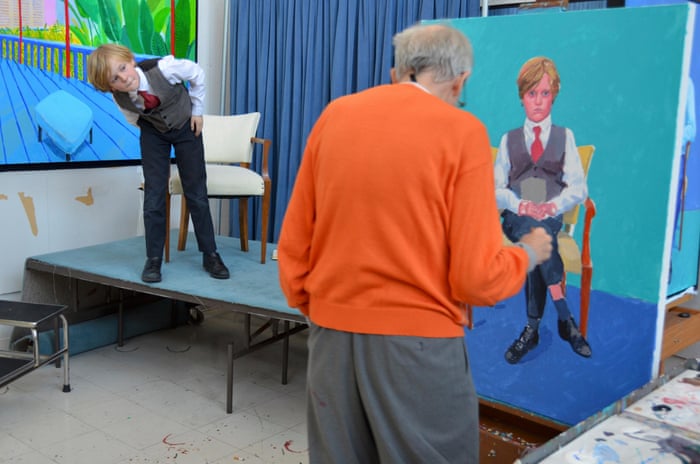
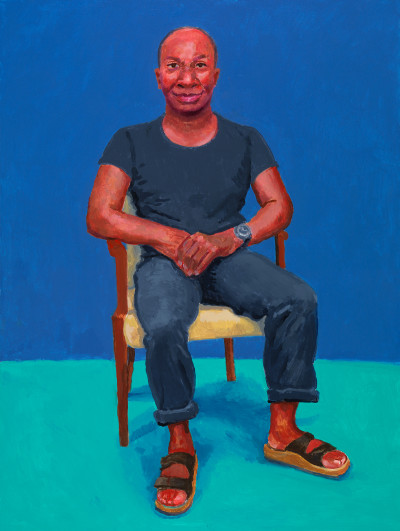
David Hockney paints Rufus Hale in Los Angeles, November 2015
David Hockney among friends: a triumphant return to portraiture
In the wake of a personal tragedy, Hockney embarked on a new project: to capture his wide social circle in defiantly exuberant tones
Tim Barringer
Friday 17 June 2016
David Hockney once said that art comes in three kinds – landscapes, portraits and still-lifes. This mischievous pronouncement was directed with a wry smile at the high priests of the contemporary art world, where the smart money is on conceptual art, installation, performance, video, and digital art. In a career spanning more than six decades, Hockney has experimented with photography and collage; he was a pioneer in the use of digital media and is a virtuoso of the iPad. Yet at the core of his practice lie the most traditional categories of British painting: landscape and portraiture, with an occasional still‑life thrown in for light relief.
In 2005, Hockney moved from California, where he had spent much of his adult life, back to live in Bridlington and the house where his mother, Laura, lived until her death, at 98, in 1999. When the prodigal son returned to his native Yorkshire, the results were electric. He produced a vast, euphoric body of landscapes employing a saturated palette of colours tinged with memories of the sunshine of the Hollywood Hills. A hugely successful exhibition at the Royal Academy in 2012, titled A Bigger Picture, placed the seal of public – if not unanimously of critical – approval on this rich new vein of creativity. The Yorkshire paintings suggested that Hockney, like Titian or Picasso, had developed a late style, arriving at a culminating mastery of his materials. The show cemented his status as a living national treasure, a successor to Turner and Constable, but one who, against all the odds, retained the cheeky irreverence of the bleached-blond celebrity of the swinging 60s.
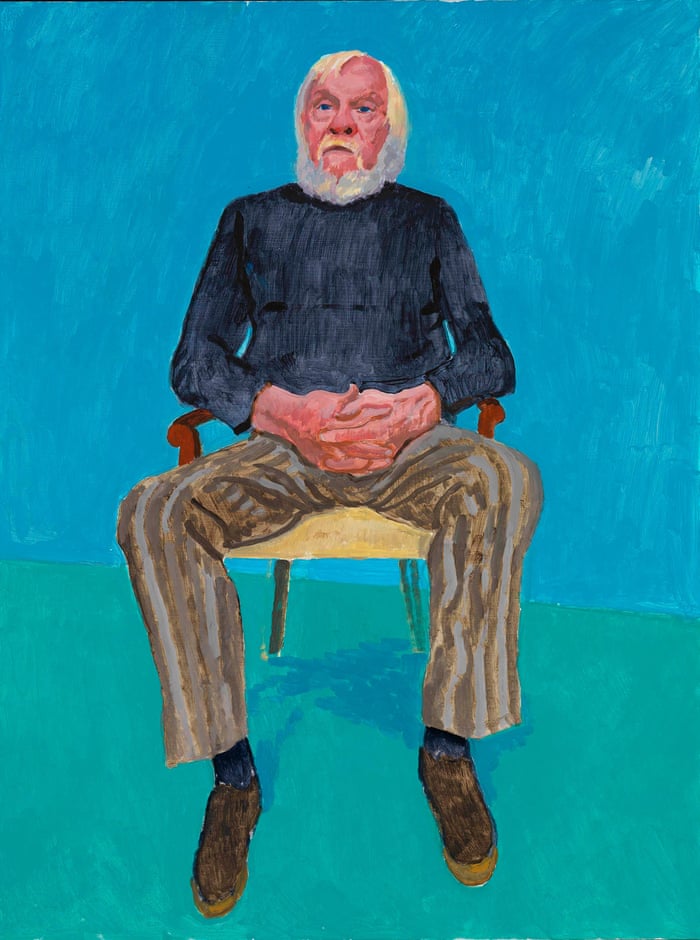
John Baldessari, 13th, 16th December 2013.
In 2013 Hockney suffered a minor stroke, and it seemed possible that his career, subject to so many reinventions over the years, might be entering its twilight; in the spring of that year, moreover, personal tragedy intervened with the accidental death of a studio assistant, Dominic Elliott. This cast a profound shadow over Hockney’s close-knit, quasi-familial studio team. Deeply affected, Hockney found himself unable to paint or draw for several months. He moved back to California, abandoning the Bridlington studio and ending the landscape project it had nurtured.
In the depths of this artistic and personal crisis, Hockney suddenly produced a portrait of Jean-Pierre Gonçalves de Lima, his trusted studio assistant and amanuensis over many years. Head in hands, J-P (as Hockney calls him) appears a broken man, touched as strongly as the artist himself by the death of their young friend and collaborator. For Hockney the painting is “almost a self-portrait”: there is no mistaking the gravity of shared feeling that links old master and trusted lieutenant.
The portrait might have been allowed to stand alone as an elegy, a meditation on the fragility of life. But Hockney’s response was characteristically contrarian. Rather than an ending, it became a beginning. The upright format, its bright Californian colours contrasting painfully with the brooding quality of the figure, sparked new possibilities in the painter’s mind. From this personal, confessional utterance, there emerged a new project, grand in scale, public in scope. Portraits began to appear, each on an upright canvas 48 x 36 inches in size, tumbling out of Hockney’s Los Angeles studio in a headlong rush of productivity. Eventually the comprehensive portrait gallery of his wide circle of friends and acquaintances became the exhibition 82 Portraits and 1 Still‑life, which opens at the Royal Academy in London on 2 July.
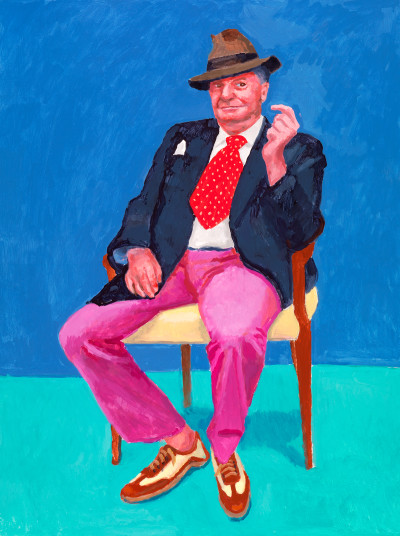
Barry Humphries, 26-28 Mar 2015
These new portraits bring to fruition a project begun in Hockney’s adolescence and pursued ever since. His first portraits were, inevitably, of subjects near at hand. An early self-portrait sees the teenage artist in 1954 with a pudding-bowl haircut, sitting on a chair and staring awkwardly into the mirror. The only hint of incipient dandyism is a pair of flamboyantly striped trousers and a matching tie, whose pattern is wittily echoed in the yellow wallpaper.
Throughout his career, Hockney has repeatedly portrayed the same sitters – his parents (and especially his mother), friends, lovers, studio assistants – producing a family album in which a wide public can share. At moments of personal crisis – the collapse of major relationships, or the Aids epidemic of the late 80s – portraiture has provided him with solace, an opportunity to gather friends together, as well as technical exercise of the utmost difficulty. Hockney turns to portraiture as a great pianist may turn to Bach: it is the centre of his art and of his being.
Hockney made a splash from his student days: indeed, his professional debut has become the stuff of legend. Anxious to overturn convention, at this time he professed to be wary of the portrait as a genre. Nonetheless, in DollBoy (1961) a student work of exceptional originality, he created a coded celebrity portrait, queering and subverting the medium in the process. Flowing from his crush on Cliff Richard, the painting has the improvised and hasty quality of erotic graffiti scribbled on a lavatory wall. At a time when homosexual acts were still illegal, Hockney found in the portrait a place to celebrate male-male desire. Earl Simms, 29th February, 1st, 2nd March, 2016.
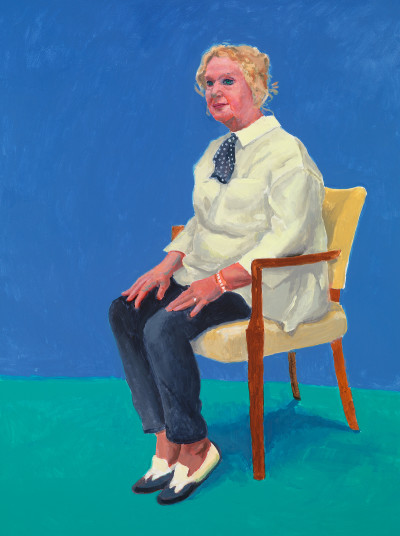
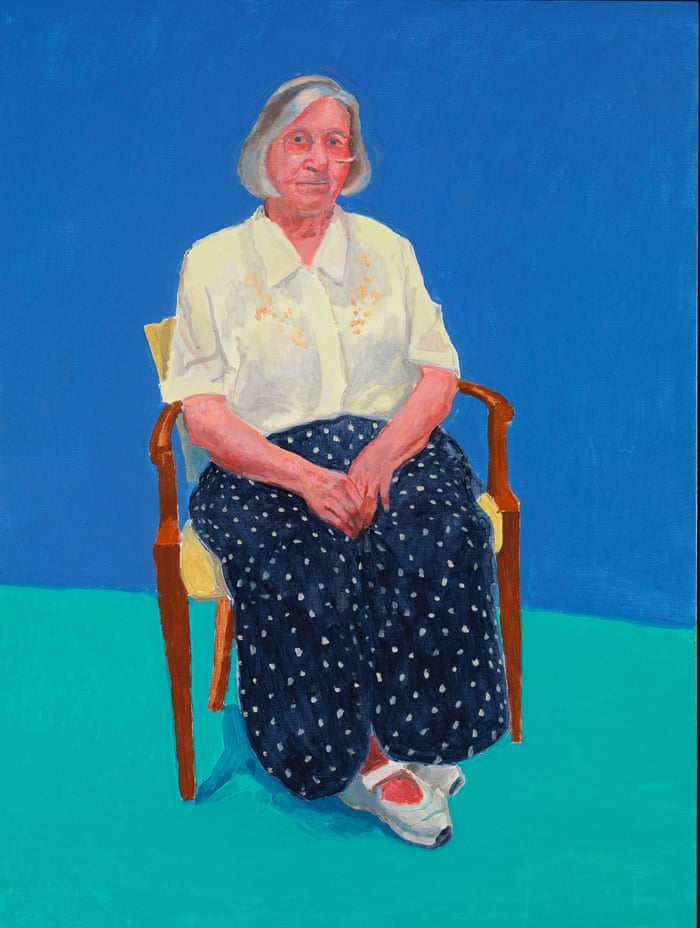
By the 70s, Hockney had swerved back into an opulent vein of representational art closely linked to photography. His most famous portrait, Mr and Mrs Clark and Percy (1971), lies in the tradition of the conversation piece, in which leisured figures inhabit an interior or landscape. This work derives from personal affection: it depicts Hockney’s close friends, the fashion designer Ossie Clark and his wife, the textile designer Celia Birtwell. We stand where the artist stood, the third element in a triangular relationship. All three were from the north of England, and were darlings of fashionable society. Ossie, who died in 1996, despite international success as a designer drifted into a life of substance abuse that destroyed the marriage and left him a marginalised, lonely figure. Celia, by contrast, has remained a confidante of Hockney’s and has sat for him regularly for five decades. Her portrait is among the most vibrant works in the present exhibition: a grandmother and in her mid 70s, she mesmerises the painter now as always. This is one of his very few close relationships with women beyond his family: as he recently remarked, “we just laugh and laugh – even though she doesn’t always like the way I paint her”.
Birtwell has become familiar with Hockney’s rigorous portrait practices. The sitter arrives at the studio and is seated in a simple dining chair, which is raised up on a platform about three feet from the ground. Each sitter wears everyday clothes. Once the pose is agreed, one of the artist’s assistants will draw an outline around the sitter’s shoes so that work can be resumed with the sitter properly placed after breaks. Always working in silence, Hockney spends the first hour or so making a charcoal drawing. This establishes a likeness, focusing mainly on the face and hands. Drawing, he insists, lies at the core of portraiture: “I accept what I’ve drawn, and I get that in the first hour: by then, I’ve caught their individuality as they sit in the chair. Everybody sits in a different way.” Painting then continues over three days, with sessions of up to seven hours per day, with a break for lunch.
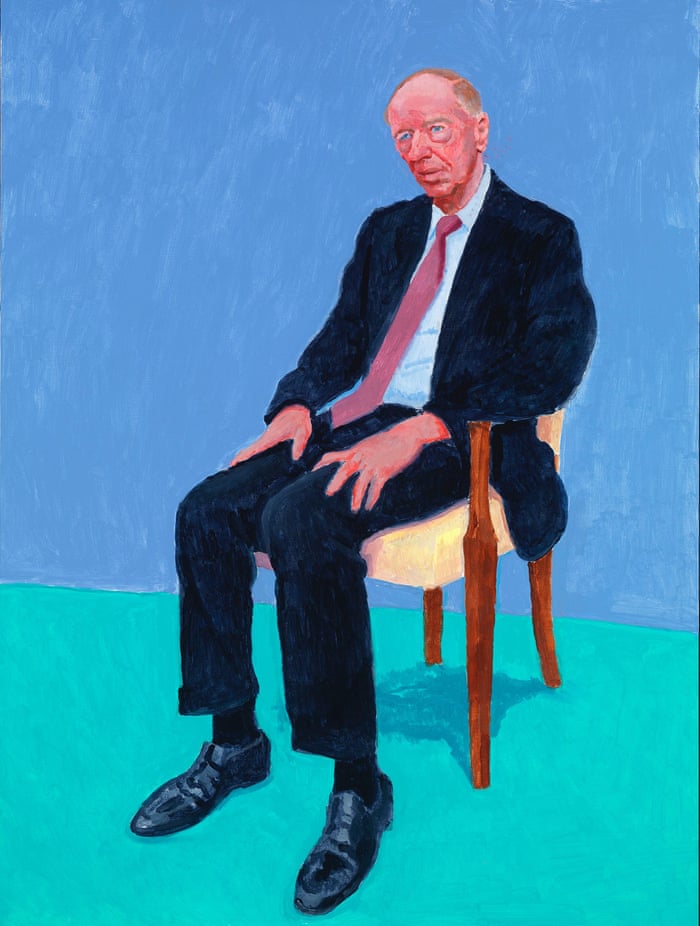
Lord Jacob Rothschild (2015)
A few sitters, such as philanthropist and collector Jacob Rothschild, whose schedules did not allow them to stay for the full period, were portrayed more quickly. Hockney is not averse to having a little fun with his sitters: Rothschild, lanky and quizzical, looks too tall for the chair; Barry Humphries sports a magnificently louche tie and pink trousers, a burlesque facade that masks his other identity as an astute patron and critic of art. More simple and heartfelt are the representations of Hockney’s family – his sister, Margaret, still in Bridlington, and brother John, who emigrated to Australia. A poignant absence is that of his mother and father, scrutinised so closely in earlier years.
Margaret Hockney (2015)
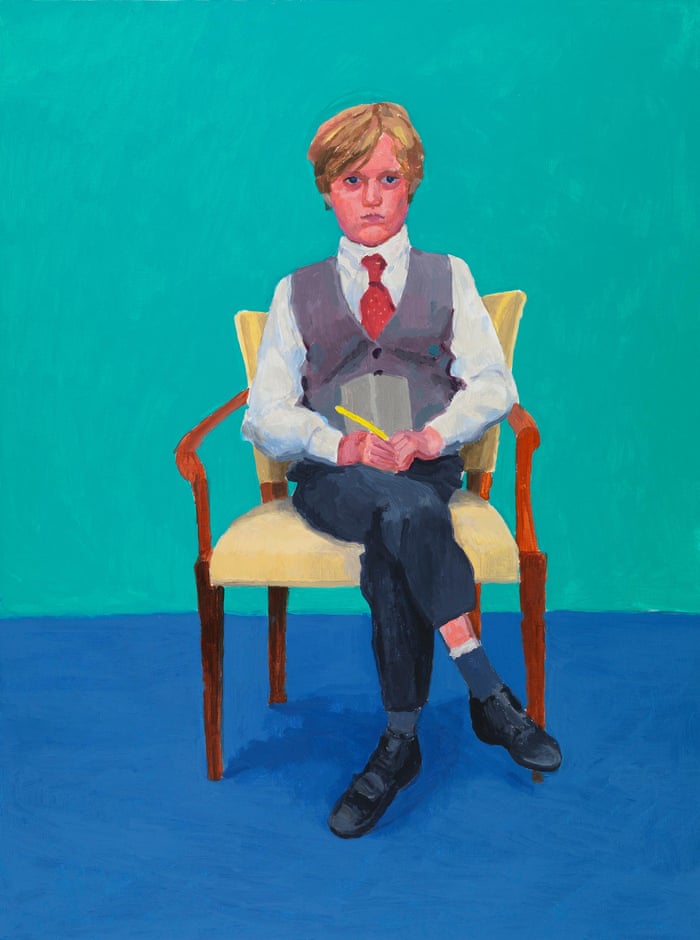
Throughout the exhibition a benign atmosphere prevails, as if the tragedy of Elliott’s death can be assuaged only by a celebration of life. Perhaps the most significant encounter for Hockney came with a visit to LA by the artist Tacita Dean, her husband Mathew Hale and their 11-year old son, Rufus. Self-possessed and articulate, the boy was keenly interested in Hockney’s project and agreed to sit. His precocious seriousness was fascinating to Hockney in a world of diminishing attention spans. Inspired by this chance meeting, Hockney displays a painterly elan to match that of the old masters, capturing ambition and seriousness as well as vulnerability and youth. Staring at Rufus for many hours, Hockney recalls, his mind turned to his own self-portrait, seated in his house in Bradford in 1954. Thus an artist of almost 80 forged a largely silent bond with a boy not yet in his teens. 82 Portraits turns out to be a meditation on age, and the most commanding canvas in the series is that of its youngest sitter.
Rufus Hale, 23-25 Nov 2015.
Creating these works has brought him a rare sense of artistic and personal fulfilment. “After periods of doing other things, I always come back to the portrait, and have a burst of sanity,” he says. The exhibition stands at the apex of his career, and it seems appropriate that it should be shown at the RA, founded nearly 250 years ago by Joshua Reynolds, a master of the portrait. Yet the work is not concluded. After painting, by now, almost 90 portraits in precisely the same format, Hockney’s enthusiasm is undiminished: “It’s endless. I’m seeing them clearer and clearer. I could go on for the rest of my days.”
• David Hockney: 82 Portraits and 1 Still-life will be published by the Royal Academy of Arts on 2 July (£30). The exhibition is at the Royal Academy of Arts, London W1J, 2 July-2 October.
Ron Elderly: - You Better Move On Just My Imagination
Da Elderly: - Helpless I Don't Want To Talk About It
The Elderly Brothers: - Love Hurts All My Loving Baby It's You The First Cut Is The Deepest Somebody Help Me
The venue was packed when The Elderlys finally showed up (about 9:30) having been delayed by a beer and curry session! There were the regulars with their loop machines, some fine purveyors of original songs and the visiting harmonica player from the US of A - he joined our host for two unforgettably good songs: Henry Thomas' Don't Ease Me In and Bull Doze Blues (which became Canned Heat's Going Up The Country). The Elderly Brothers closed the show with the usual mixture of 60s fare, including their debut of a Cat Stevens song, notably covered by P.P. Arnold in 1967. In the after-show jam there was more harmonica-fuelled music with a blues or two and a splendid time was had by all!
Here's a great article on the missing Marx Brothers' movie, Humor Risk, by Matthew Coniam, esteemed author of The Annotated Marx Brothers - a great book you should have by your bedside in case you awaken from a fevered dream in which you weren't able to decode the lyrics for Lydia the Tattooed Lady - as I often do.
So why has the face of the woman at the right been 'removed'?
The Marx Brothers’ Lost Film: Getting to the Bottom of a Mystery
Matthew Coniam
7 September 2015 The hunt’s back on!
Universal has just announced another concerted effort to produce the completest possible restorations of the five Paramount Marx Brothers movies, so it’s all hands to the attics and storerooms once again. The prizes? Same as ever, still glittering at the end of the black and white rainbow. From Horse Feathers (1932): the scenes with Harpo and the dogs, and a version of the Thelma Todd bedroom farce that hasn’t been shredded into virtual incomprehensibility. From Animal Crackers (1930): that snipped line from ‘Hooray for Captain Spaulding’ that folks seem never to doubt was cut for a Code-era re-release… and Zeppo offering to scratch Elsie would be nice, too, if you have it. From The Cocoanuts (1929): oh, nothing in particular, but a print where certain reels don’t look as though they were photographed through wet toilet paper would be good…
Because they appeared in so few films compared to just about all the other great screen comedians, these lost Marx elements seem especially galling, and the need to replace them, perhaps, disproportionately imperative. Small wonder that we so often forget there’s also an entirely lost Marx movie out there – or not, as the case may be. A risk not worth taking?
Humor Risk, the first ever Marx Brothers film, was here and then, seemingly, it was gone – almost immediately. But as reputations go, Hats Off (1927) or London after Midnight (1927) it is not. We’ve called off the search, if indeed it was ever on. Whenever those lists are made of the most keenly desired lost silents, there it always is: somewhere else.
There are two main reasons for this: aesthetic and practical. The former seems to me somewhat misguided. In the first place, we don’t actually know it’s lousy. We are, I think, far too willing to allow Groucho’s own famously self-deprecating judgement of the film to condition our own. Odder still is the tendency to offer the fact that it’s silent, and that the Marxes are by most accounts not playing even an approximation of their established roles, as fatal drawbacks. Each to his own, of course, but to my mind these aspects of the film are high among what makes it so desirable.
Though the idea of a silent Marx Brothers seems an absurd one, it nearly happened on several other occasions. There was the offer from First National that got as far as an announcement in 1926. Then an overture from MGM to make a series of comedies (presumably meaning screen originals) as close to the wire as 1928. And then the screen test by United Artists, for a proposed version of The Cocoanuts itself, a full year before Paramount took them up. Had the latter happened it would almost certainly have been largely if not entirely silent.
As well as these near misses, the New York Evening Post reported in 1928 that the Brothers “have been offered a staggering sum by a moving picture company to appear in a screen burlesque on the life of Napoleon Bonaparte”, with Harpo as Napoleon, Groucho as Wellington, Chico as Blucher and Zeppo as King William of Prussia. (Alas, they “are said to have refused the offer, at least for the time being.”) And that’s not counting both Harpo’s and Zeppo’s encounters with the silent camera, both in 1925, in A Kiss in the Dark and Too Many Kisses, respectively. (Actually, it’s been claimed that Zeppo can be seen as an extra in Too Many Kisses, too, though the word hasn’t travelled far as yet. But it’s Paramount’s Behind the Front [1926] that features the first sighting of an authentic Marx routine in the movies, and it doesn’t involve any of them. As Variety noted: “One of the laugh hits of the picture, where the pick-pocket drops a lot of knives and forks from his sleeves has been taken bodily from I’ll Say She Is.It’s a Marx Brothers bit.”)
Boxed, burned or buried?
Aside from Joe Adamson’s mischievous observation in Groucho, Harpo, Chico and Sometimes Zeppo that the film’s continued loss may be the price we have to pay “to keep silent film fanatics from saying it was the best movie they ever made,” there’s really only one persuasive reason why the possibility of its reclamation excites so little determination: what I earlier termed the practical objection. Humor Risk, according to every published account, differs from all the other titles on those lists of most eagerly sought lost silents in one key respect – it was never released.
The story goes like this. The Marx Brothers, noting the money being made in movies, formed a company called Caravel Comedies to produce their own two-reel shorts and grab a piece of the action. They each pitched in a thousand dollars, as did two co-investors called Al Posen and Max Lippman. So did Jo Swerling, who wrote the script. Kyle Crichton in his biography The Marx Brothers names a further investor: “their friend Nathan (Nucky) Sachs” who, he says, “gathered in $6,000 with laughable ease”. Hector Arce, in his biography Groucho, favours ‘Nuck’ over ‘Nucky’ and, more importantly, posits a friendship with the Brothers stretching right back “to their days on Ninety-Third Street”.
We should pause here to add two other names, who don’t crop up in most accounts. Arce gives us Oscar Mirantz as a kibitzer. (Strangely, he casts Sachs in this role also.) ‘Mike’ Mirantz was the husband of the cousin of Chico’s wife Betty: he and his wife are the ‘Aunt Flo and Uncle Mike’ that Maxine Marx mentions staying with at various points in her memoir Growing Up With Chico. (Bizarrely enough, we find reference in 1929 to his appearing in a play called The Kibitzer, that turns out to have been co-written by Jo Swerling, and also featured an appearance by Al Posen! “It is all as antic as something with the Marx Brothers,” wrote the Chicago Tribune of a later production that year. Sadly, another mystery for another time.) Meanwhile, the 1921 Motion Picture Studio Directory and Trade Annual lists Caravel Comedies as among the professional associations of one ‘Y.C. Alley’. This was Yeatman Cheatham Alley, and yes, that’s just one man, not a firm of three accountants. Born in 1870 and dying in 1947, he was a vaudeville comedian, theatrical director, producer and manager, among other attainments.
Once assembled, the team took residence at 130 West 46th Street, pretended to make themselves an offer, pretended to accept it, and set to work. The film was shot in between live shows (“they were doing four a day,” notes Joe), in a converted warehouse studio somewhere in New York and at Fort Lee, New Jersey. The resulting footage, however, was deemed inadequate for professional distribution, and the project was abandoned. The film itself was either soon lost or deliberately destroyed.
If any of this is true, then clearly we are looking at a loss of a very different kind to, say, a film that MGM managed to release into every territory in the world and still somehow allowed to fall down the gap between the cushion and the back of the armchair. If a few prints, or even just one, are all that were ever struck, and all accounts of the thing dry up after one showing, then the chances of finding it are so very slim that a serious search would be all but pointless, and if I was a betting man, I’d be putting my money on Bigfoot.
But is it true? How much do we really know about Humor Risk – and where are we getting our information from?
Robin Hardy obituary
Director of the eerily unsettling horror film The Wicker Man
Ryan Gilbey
Monday 4 July 2016 1
The director Robin Hardy, who has died aged 86, made only one film of note. But as this was The Wicker Man (1973), which terrified audiences without showing so much as a drop of blood being spilt, his place in British cinema history was always going to be assured. It tells the story of a puritanical Christian policeman (Edward Woodward) who visits an island off the coast of Scotland after reports that a young girl has gone missing. He is shocked to find his investigation impeded by the community, which is steeped in rituals and paganism. The chilling purpose of their secrecy is finally revealed in one of the great twist endings of all time.
Even before that pay-off, Hardy had sustained expertly an atmosphere of unsettling eeriness, in which the root of the unease could never quite be pinpointed. Count Dracula himself, the actor Christopher Lee, played the island’s leader, Lord Summerisle, but the horror on offer was of a more insidious variety than the sort peddled by the Hammer studio.
The Wicker Man arose out of meetings between Lee, the writer Anthony Shafferand the producer Peter Snell, during which they shared ideas, suggestions and research for a film inspired by David Pinner’s novel Ritual. Hardy then joined the project. “Tony and I were great horror film buffs and used to see lots of the original Hammers,” he said. “We wondered why it was that they always centred on pentacles, garlic, stakes in hearts and all those other things to do with black magic. We thought it would be fun to go back to the religion on which all this hokey witchcraft stuff was based – the old religion – and recreate a contemporary society that was pre-Christian.”
The beleaguered studio British Lion made The Wicker Man cheaply as a way for its new owner, the businessman John Bentley, to prove to the unions that the company was still a going concern. But the studio was sold to EMI, which hated the film and pruned it from 99 to 87 minutes before releasing it on the bottom half of a double bill with Nicolas Roeg’s Don’t Look Now. With no press screenings arranged for The Wicker Man, Lee cold-called critics to persuade them to view it. He also accompanied it to the International Festival of Fantasy and Science Fiction Films in Paris, where it won the grand prix in 1974.
The reviews, when they emerged, were largely grudging. “The story turns into a barbarous joke, too horrible for pleasure,” wrote Dilys Powell in the Sunday Times, “but one must admire the playing and the distinction with which Hardy has directed Shaffer’s screenplay.” Margaret Hinxman in the Sunday Telegraph commended the film on its “genuine sense of what is horrific” but decided that it lacked “the satisfactory inter-relation of the ordinary and the extraordinary that marks the best fantasy fiction”.
Rumours that Rod Stewart tried to buy the picture in order to destroy nude scenes featuring his then partner Britt Ekland, or that the original negative of Hardy’s cut was buried in landfill beneath the M4, only contributed to the popular conception of The Wicker Man as a film maudit. It was in every sense a movie that refused to die.
Various versions surfaced over the years, among them a 102-minute edit on video in the 1980s and a 40th anniversary 93-minute version approved by Hardy as the “final cut” in 2013. Shaffer wrote a follow-up, The Loathsome Lambton Worm, which was never filmed, while Hardy directed The Wicker Tree (2011), a “spiritual sequel” adapted from his own novel Cowboys for Christ.
A 2006 US remake of The Wicker Man, directed by Neil LaBute and starring Nicolas Cage, was roundly mocked. In 2012, the National Theatre of Scotland produced a musical version, An Appointment with the Wicker Man, about an amateur dramatics society trying to mount a play of the film. But the influence of Hardy’s original endures. British directors including Edgar Wright (Hot Fuzz) and Ben Wheatley (Kill List) have paid explicit homage to the movie in their work, while the band Radiohead recently produced a video based on it to accompany their single Burn the Witch.
It would be fair to say that The Wicker Man eclipsed everything else its director did. Born in Wimbledon, south London, Robin was the son of Gordon, a member of the Indian civil service, and his wife, Veronica (nee Rimington). After attending Bradfield college, near Reading, Robin studied art in Paris.
He began directing for the National Film Board of Canada and for the Esso World Theater strand on the PBS channel in the US. Then he moved to London and with Shaffer co-founded the advertising agency Hardy Shaffer Ferguson Avery. After making The Wicker Man, he returned to America, where he made commercials and became involved in the historical theme park business.
He wrote novels including The Education of Don Juan (1981), directed the thriller The Fantasist (1986) and co-wrote Forbidden Sun (1989), about sexual repression at a girls’ school in Crete. He also wrote Winnie, a musical about Winston Churchill that was staged in London in 1988. At the time of his death, he wastrying to raise funds for a third Wicker Man instalment, The Wrath of the Gods.
He is survived by his fifth wife, Victoria Webster, and his eight children, Jeremy, St Clair, Zoë, Alexander, Dominic, Justin, Arabella and Tom.
• Robin St Clair Rimington Hardy, film-maker and novelist, born 2 October 1929; died 1 July 2016
For a little extra-curricular reading, you ought to see this:
The various versions of The Wicker Man
Steve Phillips
There can be few, if any, film fans in the world who haven't watched, at least once, a low-budget offering from Britain which popped up as a B-movie in 1973 – The Wicker Man. From these lowly beginnings, the film has steadily grown in reputation in the intervening years to become one of the principal cult movies of the last 40 years. Most aficionados are also aware that the film circulates in a number of different versions, but there is much confusion and misinformation about the exact differences between the various cuts. But first, let's find out why more than one version exists in the first place...
The Wicker Man began life in 1971 when three vague acquaintances: actor Christopher Lee, independent film producer Peter Snell, and writer Anthony "Sleuth" Shaffer, got together and started to discuss the possibility of working on a movie project of mutual interest. Shaffer discovered a 1967 novel called Ritual by David Pinner, and each of the three members of the group stumped up £5000 to acquire the film rights to the book. Shaffer set to work adapting the book but soon came across problems with its structure but, moreover, realised that the book simply wasn't exciting enough to be turned into a worthwhile production. (It might be suggested that somebody should have recognised these problems before the money was spent, but still...)
An old associate of Shaffer, small-time director Robin Hardy, who was convalescing after a heart attack, appeared on the scene and a quiet weekend was spent brainstorming some fresh ideas at Hardy's house near Maidenhead. During that weekend a framework was developed that ended up being very close to the finished movie.
The film would concern a battle of ideals between a devoutly Christian police sergeant from the Scottish mainland, and the older pagan beliefs of the locals on a isolated Hebridean island called Summerisle. The pagan ways of the islanders would be conveyed to the audience as they followed Howie's attempts to investigate the disappearance of a young girl. Howie would become ever more deeply embroiled in the bizarre ways of the locals, and eventually realise that the whole thing is a set-up: a trap to get him to the island. The community's crops have failed and the islanders want Howie as a human sacrifice to appease their gods and ensure bountiful harvests in the future. The ultimate point the film was to make is this – what does Howie's religion (albeit a more mainstream one than the islanders') actually count for if he is alone in a sea of different beliefs? Unless deities actually exist, the winner in a conflict of religions is simply the one that has the muscle to enforce his doctrine.
The pagan details were to be entirely authentic; Shaffer's main research source being Sir James George Frazer's 12-volume The Golden Bough which details how early myths, rites and pagan beliefs have fed into modern twentieth-century life. Hardy: "Everything you see in the film is absolutely authentic. The whole series of ceremonies and details that we show have happened at different times and places in Britain and western Europe. What we did was to bring them all together in one particular time and place. The wicker man itself is quite real. The Druids used the structure to burn their sacrificial victims. What we hoped would fascinate people is not that they would think these things are still going on in Europe, but that they would recognise an awful lot of these things as sort of little echoes from either out of childhood stories and nursery rhymes or things they do at various times of the year. There are so many Christian holidays that are celebrated where there was previously a pagan feast. Easter is one of them, originally it was a hare feast. At Christmas, you set up a Christmas tree because that was what the goddess Hera worshipped. Mistletoe is purely Druidic – it relates to the Golden Bough. My God, when you decorate your home for Christmas you are using nearly every pagan symbol there is!"
Ron Elderly: - Can't Help Falling In Love Make You Feel My Love
The Elderly Brothers: - The Price Of Love I'll Get You All I Have To Do Is Dream True Love Ways Sweet Virginia
Solo Sets from 'Phil' and Don' kicked off the proceedings on another busy night at The Habit. Given that Wales were playing Portugal in the semi-finals of Euro 2016, we had expected a quiet night, but players and punters turned out in good numbers. We were treated to covers of Paul Simon's Call Me Al and Neil Young's My My, Hey Hey (Out Of The Blue). A holiday-maker from the USA brought his collection of harmonicas and joined The Elderly Brothers on Sweet Virginia; during the after-show acoustic jam we indulged him with songs such as Baby What You Want Me To Do, Bring It On Home To Me and Need Your Love So Bad. Another late finish and another night of boozy, musical mayhem!
Matt Walters, Matt Roper, Noah Diamond, and Seth Shelden are Zeppo, Chico, Groucho, and Harpo
How a long lost Marx Brothers musical found its way back onstage By Adam Gopnik
1 June 2016
On a recent Saturday morning at the Pearl Studios, on Eighth Avenue, the most labyrinthine of all Broadway rehearsal halls, one of the most beautiful and endangered of all New York sounds suddenly materialized: the shatter and thunder of massed tap dancers on a wooden studio floor. The chorus line of a new show was working on a new-old number, and the dancers, instead of being all-of-a-kind, post-Fosse giraffes and gazelles, had the pixie faces and powerful thighs you would see on chorus lines from the nineteen-twenties and early thirties. “We wanted that kind of casting-call variety of types,” one of the directors said. “We told the girls not to do any work outs for the duration of the run. They shouldn’t have muscle tone. Just muscles.”
The need to have a group of dancers who resemble their own great-grandmothers comes about because the enterprise at hand is a revival of a twenties musical—and not even so much a revival, in the manner of the current “Shuffle Along,” as a full-scale, quixotic reconstruction, as improbable in ambition as the remaking of a Giganotosaurus skeleton from two shin bones and a tooth worn down by time, of the lost 1924 Marx Brothers musical “I’ll Say She Is.” Having opened in May of that high Jazz Age year at the Moorish Revival-style Casino Theatre, to rapturous reviews—one in particular, from Alexander Woollcott, more or less made the brothers’ reputation—the show closed the following February (a fine run for the time), never to be seen onstage again. One of the legendary late débuts of American theatrical history (the Marxes were well into their thirties when they finally escaped vaudeville for the stage), “I’ll Say She Is!” contained—nice chance to use the tendentious form of “arguably” here—arguably the most influential of all twentieth-century comic sketches, the legendary “Napoleon” scene that, more than any other five minutes in comedy, began the line of absurdist pop humor that continued on directly from the Marxes to Ernie Kovacs and right through to Monty Python.
To call the musical “lost” implies that someone was looking for it. In truth, it was simply gone—gone into the same netherworld of fading programs and yellowing clippings that most other revues of the time have fallen into. Now it’s here again. The Quixotes who fought for its return are the New York writer and performer Noah Diamond and his wife, the director Amanda Sisk, accompanied by a gang of twenty- and thirty-something friends. Their windmill, for much of the past ten years, has been a full-scale stage revival, which they’ve now finally achieved, at the Connelly Theatre, on the Lower East Side, where the will open at last on Thursday evening. (For all the clichés of ascent from the tenements, that neighborhood was not really the Marxes’ haunt; they were strictly Yorkville boys, raised around 93rd and Lexington.)
The hunt to find “I’ll Say She Is” began when Diamond, as an adolescent growing up in the New York suburbs in the nineteen-eighties, fell in love, as awkward young men often do, with the mystique of the Marxes. “I was one of those kids,” he says. “Groucho was my God.” His worship extended to trying to woo girls with borrowed Grouchoisms. “Your eyes shine like the pants of my blue serge suit,” he would say to some winsome Thelma Todd of the eighties, a doubly baffling come-on: the girl had no idea what a blue serge suit was, and neither did he.
Infatuation ripened into impersonation. Diamond’s Groucho, which he has worked on for almost thirty years and showcased on many occasions, is genuinely uncanny, capturing the subtle truth that Groucho’s voice, far from being a machine-gun wise guy’s, is essentially soft and grainy, rising to its trebly heights only in feigned indignation. (Diamond also makes the interesting point that, while the original Groucho had to project his lines unamplified into a large Broadway theatre, we are now so used to hearing Groucho exclusively through his miked performances, in movies and on television, that he only sounds fully “Groucho” when miked onstage.)
“ ‘I’ll Say She Is’ always haunted me,” Diamond says. The Marx Brothers’ two other Broadway hits—the George Kaufman-penned “The Cocoanuts” and “Animal Crackers”—were adapted into movies while they were still running onstage. “I’ll Say She Is,” though, in its day, at least as famous as the other two, had just passed away: as a revue it had no appealing afterlife for other performers, and, so far as anyone knew, no script of any kind had survived; its score, written largely by the cartoonist and humorist Will B. Johnstone, with music by his brother Tom, had never been recorded.
The dinosaur shinbone, in this case, was a typescript of Johnstone’s, a well-thumbed old draft outlining the show’s scenes. It was not really a script but more what a contemporary screenwriter would call a treatment. Diamond also knew that a short film made by the Marxes in the early thirties, as a kind of teaser for their feature “Monkey Business,” reproduced, in only very slightly different form, one of the lost musical’s key scenes. Another key scene, the Napoleon sketch, survived as well, in a script that had remained in Groucho’s archives. There was also a single, soiled molar to build around: a version of the Napoleon scene that had, improbably, been made into a rather mediocre episode in a long-forgotten, cheaply made cartoon special in 1970, with the very elderly Groucho supplying his lines and Hans Conried doing the other brother’s voices. A disappointing delivery, but a delivery all the same. (Diamond also points out that the show’s revival is as much as product of YouTube as of Broadway—only in the digital age did the whole archive of the past become available.)
The rest of the dinosaur had to be recreated, so to speak, from imaginative reconstruction. Quote by quote, line-by-line, and joke-by-joke, Diamond reassembled the script, or a reasonable facsimile thereof. Note by note and syllable by syllable, he reassembled the score, recycling music from other Johnstone scores and melding it with that of his own lyrical mind. The musical’s songs, which were famously mediocre—Groucho himself called the score “the most undistinguished one that ever bruised the eardrums of a Broadway audience”—had nonetheless to be re-created, reconstructed, and quietly improved. The pre-jazz operetta, slightly ragtime music was, Diamond knew, essential to the effect: without that roistering tone, however dated, one can’t register the Marxes’ seismographic surprises.
Becoming the Marx Brothers, meanwhile, is more operatically ambitious than it might seem. The skills picked up during a decade on the vaudeville road have to be re-created, painstakingly, in months. In need of brothers to join him in the pursuit, Diamond enlisted Seth Shelden, a brilliant young intellectual-property lawyer who was just returning from a Fulbright fellowship in Latvia. Improbable though it seems, Shelden’s secret ambition had always been to become Harpo Marx. “There was something about Harpo that turned me on—not so much his mime but his wildness,” he said. Shelden not only mastered the art of chasing blondes, blowing klaxons, and making the Gookie—the legendary puffed-cheek and lolling-tongue face that Harpo copied from a cigar roller in Yorkville—but also had to learn how to play the harp. A young British actor named Matt Roper, enlisted to play Chico, had to learn how to reproduce a fiendishly singular accent—not an Italian accent but a New York Italian-émigré accent as rendered in caricature by an émigré New York Jew—as well as how to play “trick” piano, in the distinctive Chico style, with the left hand lolling and the right hand shooting the keys and kittening. (According to legend, Chico’s instructor in this art was one-handed.) For Zeppo, Diamond and Zisk chose an old friend of Diamond’s named Matt Walters, who is at once extremely handsome and oddly nondescript, in the Zeppo manner.
On that Saturday afternoon at Pearl, the cast was re-creating the Napoleon scene for one of the first times since it last played on Broadway, nearly a century ago. Its central premise is simple: Groucho is Napoleon, marching off to Russia and then returning, on quick trips, to check up on the honor and chastity of Josephine, who is besieged by suitors, in the form of the other Marxes, the moment the mustached Emperor leaves the room. “Forgive me, my Queen. I don’t doubt your love. When I look into your big blue eyes, I know that you are true to the Army. I only hope it remains a standing Army, “Groucho remarks. And, not long after, “Ten seconds I’ve been gone, and she is still vertical.” There are also some classic Chico quasi-meta puns (“I want to marry the Emperor. He’s the guy-a-that’s got the money.” “That would be bigamy!“ “Yeah, and it’s big-a-me, too.”)
The new Brothers execute the scene with uncanny perfection. Diamond has worked for years on his Groucho walk, which is not merely stooped but, as he says, a mix of lithe and awkward—the basic Groucho move being to dive forward into a scene or moment, then come up for air and take a breath, looking around suspiciously. Seth is a no-word-perfect Harpo, while the first Matt captures the strange, unearned belligerence of Chico, and the second Matt, becoming Zeppo, is a reminder that the Marxes were never quite as good again after they lost their one straight man. The object of the Marxes’ comedy is anarchy, but its subject is fraternity: they are in it together to the end. Zeppo’s inclusion in the family made the others less like clowns and more like brothers.
One sees at once why the Napoleon scene became legendary overnight—apart from still being extremely funny, it has the edge of randomness, the pure absurdity, that made the Marx Brothers seem, on that opening night as ever after, so modern. Of the great movie comedians, Chaplin is rooted in Dickens and the nineteenth-century stage; Keaton, more cinematic, in a kind of melancholic Civil War stoicism. Only the Marxes seem contemporary with Dada. There is no logic or pathos or point or even much structure to it—the fourth wall is broken, then restored, and then broken again. Napoleon’s appearances and reappearances from the Russian front are as arbitrary as a Magritte drawing—and the scene’s moral, to the degree that it has one, is the nihilistic one that runs true in comedy from Aristophanes to Sid Caesar: all authority is always ridiculous, and man (and woman) runs by appetite alone. All of Monty Python’s non sequiturs and sudden stoppages—“the sketch is now over”—begin here, as does most of the pure burlesque aggression of a Mel Brooks, whose historical kidding, as in the “2000 Year Old Man” skits, starts here, too. Its modernity was such that the playwright Thornton Wilder once claimed that the Napoleon scene was referenced in “Finnegan’s Wake,” in the lines, occurring early in the book, “This is the three lipoleum Coyne Grouching down in the living detch”—with the brothers turned into the three lipoleum (Joyce having presumably edited out Zeppo), and Groucho transformed into a participle. (On hearing this news, a flattered but bemused Groucho wondered how Joyce could have heard of the play: “Did some New York policeman on his way back to Ireland to see his dear old Mother Machree encounter Joyce in some peat bog and patiently explain to him that at the Casino theater on 39th and Broadway there were three young Jewish fellows running around the stage shouting to an indifferent world that they were all Napoleon?”)
A few days later, the entire company had removed to the Connelly Theatre, one of those surprising proscenium theaters that still linger in the area, and they’ve since been through many rehearsals and previews, approaching this week’s opening. Watching them, Jorge Luis Borges’s famous story “Pierre Menard, Author of the Quixote” comes seeping back to a viewer’s mind. The point of Borges’s fable is that if “Don Quixote” could be written now, fresh, though word for word the same, without a “Don Quixote” in the past, its meanings would all be entirely different—at once less riotous in comedy and much richer in allusion. Comedy gets dampened by distance; reference expands with time. The same is true of “I’ll Say She Is.” The jokes in the first version obviously came from the anarchic breeze of the Marxes blowing past the conventions of the musical revue of 1924. Now, Noah Diamond has had to re-create the wheezy bits in order to allow the re-created Marxes to explode them—but , long freed from the conventions of the wheezy bits, we appreciate their loving re-creation every bit as much as 1924 did their destruction. This leads us to be patient in a way that perhaps softens the madness of the comedy.
The young Marx Brothers
The original Groucho was, above all, an outsider. What he really wanted to be was not a comedian but a writer, poor guy (Richard Avedon said once that his portrait of the older Groucho was the most perfect study of a Jewish intellectual he had ever made), and his complete freedom from love me/need me, the performer’s curse, is what makes his performances still so astonishingly fresh. He breaks through the fourth wall, of proscenium illusion, but, even more importantly, he breaks through the fifth wall, of the performer’s desire to be loved. There is a hair-raising photograph of the four Marxes in their youth (reproduced in a book that Diamond wrote about his quest, “Gimme A Thrill”) that shows them hungry and beautiful and looking exactly like either an anarchist cell or a gathering of Futurist painters, or maybe both. That ravenous energy is irreproducible. Now Groucho onstage seems lovable, not because Diamond softens his edges but because the past is invariably softened and smoothed by the ocean-wash of time. Groucho’s leer was once pure lust—now it is lust plus time, and lust plus time is longing.
Noah Diamond knows this. What occurs in his revival—no matter how diamond-hard the action or exquisitely achieved the comedy, no matter how charmingly retro-right the music and dance—is the intrusion of filial piety. “We love the Marx Brothers, love them sentimentally, emotionally, with all our hearts,” Diamond has said, and that love, which of course the brothers could not feel for themselves, fills the space. What will survive of us is love, Philip Larkin once wrote, and in a weird, unsentimental way, this is necessarily true: only a steady infusion of softness can keep alive even the most hard-edged of forms, and the softness of retrospective love blurs comedy’s boundaries even as it reproduces its shapes. Yet, if the laughter is touched with longing, it is still laughter, and it is still loud. For the moment, Diamond and Sisk can look on, proud and astonished parents, at the most Marxian of sights: an audience in New York, grouching with joy.
Michael Cimino: a great of a great period in American film The director of Thunderbolt and Lightfoot, The Deer Hunter and Heaven’s Gate – said to have ended 70s American New Wave – leaves an indelible mark
Peter Bradshaw Sunday 3 July 2016
The last time I saw Michael Cimino was actually the first time I ever saw him – at the Venice film festival in 2012. He was presenting a new, digitally remastered version of his 1980 epic Heaven’s Gate which famously flopped horribly prior to an agonisingly slow and still disputed process of critical rehabilitation. The Venice event allowed Cimino to luxuriate in the way this film was now admired in Europe.
I was invited to a party on a palazzo terrace overlooking the Lido where Cimino was going to be present. The excitement was palpable. This was the modern Howard Hughes of American cinema, rarely seen in public, rumoured to be addicted to cosmetic surgery, understood to be only interested in his new career as a novelist. When I saw him I could hardly credit it: a tiny, elfin figure who remained seated in the corner, holding court to a group of admirers. He had big, dark glasses that he never removed, an inscrutable smile and an immobile helmet of dark hair. He resembled a miniature, androgynous version of a semi-retired rocker: nothing like the tough, rangy guy photographed in the 70s. I didn’t dare approach him.
Like Kubrick, Cimino had by this stage amassed a huge list of unrealised projects – of which the most important was his doomed plan to film Crime and Punishment. But unlike in Kubrick’s case, creative internal exile had been forced on him by failure: the overreaching calamity of Heaven’s Gate became known as the act of legendary hubris which brought down not merely a studio but – it is alleged – the whole spirit of the 70s American New Wave. After that disaster, everyone was more cautious, less inclined to indulge folies de grandeur. But Cimino can certainly claim to have been one of the greats of this great period. He had already given us an authentic American tragedy and essential anti-war document: The Deer Hunter. Cimino had started as a director of commercials and from there made the bold move into writing screenplays, co-writing the cult sci-fi masterpiece Silent Running. But his great breakthrough was Thunderbolt and Lightfoot, his excellent western thriller with Clint Eastwood and Jeff Bridges. Eastwood had bought the script from him and sportingly allowed him to direct – thus giving him the career springboard for The Deer Hunter.
The “Vietnam movie” was becoming an accepted genre, much criticised for focusing on American angst and being uninterested in the experiences of the Vietnamese. Arguably, The Deer Hunter fell into that template – and the famous “Russian roulette” scene is an invention, with no relation to historical fact. The Viet Cong never did anything like this to American POWs. But as creative licence goes, it is inspired – a blazing, horrifying image of the random death-dealing of war and the grim fact that soldiers try not to think about as they go off to battle: not all of them will die but some definitely will. Only five chambers in the revolver are empty. The Deer Hunter is superb in that it balances home front drama with wartime action and gives each equal weight. Robert De Niro, Christopher Walken and John Savage play Pennsylvania steelworkers who like to hunt deer – an activity which seems clearer, nobler and more rational than the chaos of warfare. Meryl Streep is the woman with whom more than one is in love. The men respond to the call-up to Vietnam and there is a daringly, brilliantly protracted “wedding” scene which precedes their departure for war – and of course it is a kind of funeral for their way of life. They are far from the world of protest, hippyism and flower power.
The emphasis on patriotism and sacrifice is what is so striking about The Deer Hunter. And it was only on watching it again recently that a very simple thought struck me: Vietnam was different from the Iraq wars because for Vietnam, America had the draft. Men of fighting age had to go – just like they had to go in the second world war. Two years later, Heaven’s Gate took up these ideas again: how America was shaped by violence and war. This movie was about the Johnson county war in late 19th-century Wyoming, in which small farmsteaders were driven off their land by the big ranchers – an agribusiness pogrom. Heaven’s Gate did not quite succeed in balancing visual giganticism with human poignancy and loss the way The Deer Hunter did. It was more operatic, more of an old-fashioned western in the John Ford mould. It didn’t capture the public’s attention the way Cimino hoped – and he was entitled to suspect the American critics were exacting a price for their extravagant praise for the previous film – but it was thrilling and bold cinema nonetheless: a flawed masterpiece.
After this, Cimino’s career fizzled out with a handful of under-par movies. It was a painful anti-climax for this tremendous talent.
But in Thunderbolt and Lightfoot, The Deer Hunter and Heaven’s Gate we can see the work of a real American artist: ambitious, passionate, historically engaged – and magnificent.
Buono estente Caroline Aherne obituary Award-winning writer and actor best known for The Mrs Merton Show and The Royle Family
Stuart Jeffries Saturday 2 July 2016
Caroline Aherne, who has died aged 52 of cancer, was responsible for some of the most distinctive and memorable comedy creations of the 1990s. From Mrs Merton to The Royle Family, her characters were waspish but warmly observed, and gave audiences an all-too-rare taste of comedy that reflected their relationship with television and love-hate feelings about celebrity. She was one of the few members of the British comedy pantheon not to be male, metropolitan and privileged, and her work often drew on her background.
Aherne made her name with The Mrs Merton Show, a chatshow featuring the eponymous horn-rimmed, chintzy-sleeved northern housewife who fired faux-naive questions at her hapless celebrity guests: “What first attracted you to the millionaire Paul Daniels?” she once asked his wife, Debbie McGee.
The Royle Family, the sitcom she co-wrote with Craig Cash, was groundbreaking in its portrayal of a working-class Manchester family watching TV in their front room. It was a sitcom that drew on the British tradition of 1950s kitchen sink dramas and the films of Mike Leigh, but it was more compassionate than either. The writer Jimmy McGovern said of it: “There is great love in that family, but it is never stated. That’s so true to life.”
Though the sitcom cannot be said to have ushered in a new era of comedy drawing on working-class experience – British TV comedy remains, with a few exceptions, as dominated by ex-public schoolboys as it ever was – it did pave the way for at least two subsequent TV series. Paul Abbott, creator of Shameless, the Channel 4 comedy drama set in a low-income northern milieu, said he owed his show’s success to The Royle Family. More recently, Gogglebox, Channel 4’s documentary series observing viewers watching television – narrated by Aherne – owed an obvious debt to its sitcom precursor.
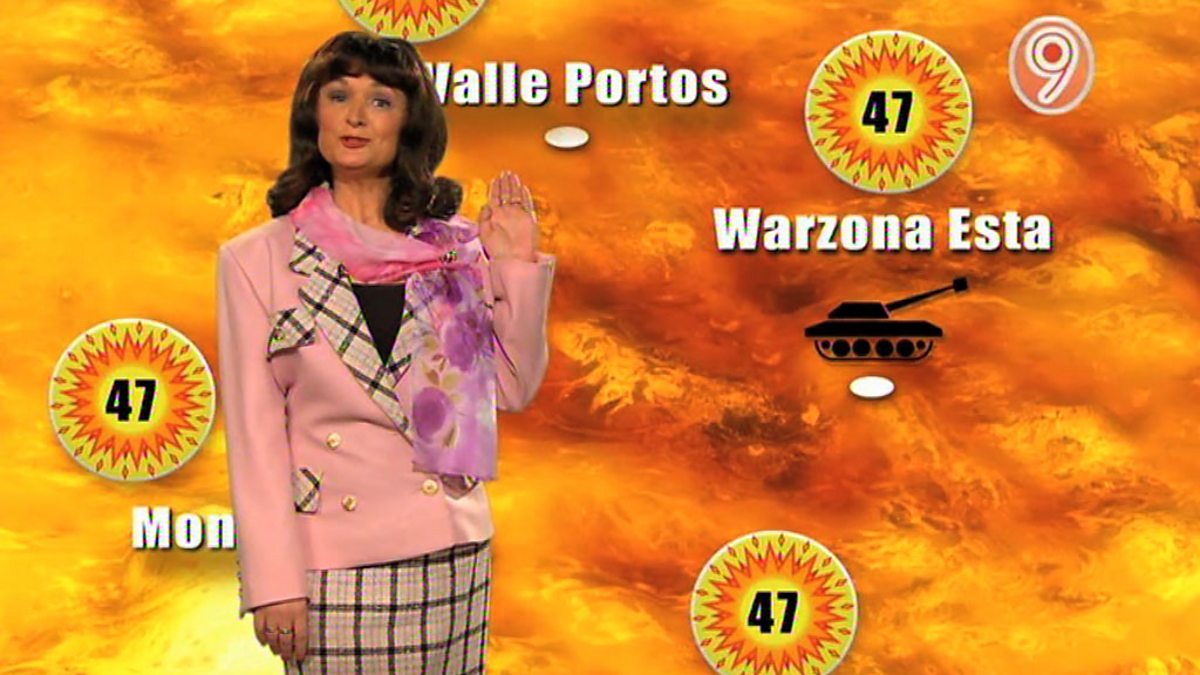
There was more to her comic armoury than Mrs Merton and Denise Royle, though they were her best-known characters. In the 1990s sketch programme The Fast Show, Aherne played the Mediterranean weather girl Paola Fisch (catchphrase “scorchio!”), and a cheeky checkout girl who insulted customers. The comedy series Dossa and Joe, which she wrote and directed in the early 2000s while in self-imposed exile in Australia, focused on a couple who had been happily married for 40 years yet found their marriage floundering after retirement. The show was a critical success but a ratings flop.
Aherne was born in London to Irish immigrants, Bert, a labourer on the railways, and Maureen, a school dinner lady. When she was two, the family moved to Wythenshawe, Manchester. The Royle Family may well have been inspired by the Aherne family, with her father serving as unwitting prototype for sharp-tongued, moaning Jim Royle. She recalled later: “My dad was always going on about the immersion, and about lights being left on. ‘It’s like feckin’ Blackpool illuminations,’ he used to say.”
Both she and her older brother Patrick were born with a rare cancer of the retina, retinoblastoma, that caused Patrick to lose an eye, and left Caroline almost unsighted in one eye. She became the family joker, impersonating TV characters like Margot and Barbara from The Good Life and celebrities such as Marti Caine and Cilla Black. “Nobody else in the family was like that,” Patrick said. “But she was funny from the time she was really little.” As a teenager, Caroline watched Mike Leigh’s television play Abigail’s Party (1977) and resolved she would become a writer like him.
Precociously intelligent, she scored 176 in an IQ test and received nine As in her O-levels at the Hollies Convent grammar school. She studied drama at Liverpool Polytechnic, and in the late 1980s took a job at BBC Manchester as secretary to Janet Street-Porter. During this time she began to develop an act on the Manchester comedy circuit, with characters including Mitzi Goldberg, lead singer of the comedy country and western act the Mitzi Goldberg Experience, and a nun called Sister Mary Immaculate, whose ambition was to kiss the pope’s ring.
Mrs Merton was developed in collaboration with Henry Normal, then a performance poet in Manchester, Craig Cash, with whom she presented a show on the Manchester radio station KFM, and the comedian Dave Gorman. But it was the late Chris Sievey, the man behind the outsize-masked comic character Frank Sidebottom, who ensured that their creation made it to the big time. Sievey asked Aherne, a friend of his brother-in-law, to voice the part of Frank’s neighbour Mrs Merton on his album 5:9:88 (1988), and later on his Piccadilly Radio show in Manchester.
The following year, Sievey invited her to reprise the character in Frank Sidebottom’s Fantastic Shed Show (1992) on ITV. She was supposed to be Sidebottom’s sidekick, but Mrs Merton overshadowed him and was so well received that Granada TV commissioned her to make her own comedy vehicle.
The result was The Mrs Merton Show, which ran from 1995 to 1998 on the BBC. It had an audience composed of real-life pensioners and an in-house band, Hooky and the Boys, led by her first husband, Joy Division and New Order bassist Peter Hook, whom she married in 1994. The couple divorced in 1997. The Royle Family ran for three seasons from 1998 to 2000, followed by specials until 2012. Mrs Merton and Malcolm, with Cash as a 37-year-old son still living at home, had a single series in 1999.
For all that she was feted by critics and garlanded with awards, Aherne struggled with fame and with her health. In 1998, at her mews home in Notting Hill, west London, she tried to take her own life. She was treated for depression and alcoholism at the Priory clinic in 1998, and was also treated there in 2002. In addition, she suffered bladder cancer related to her eye condition. In 2014, as part of a charity drive to raise money to treat other patients suffering from the disease, she announced she was suffering from lung cancer.
In 2001, she announced she was quitting showbusiness, because she no longer wanted to be famous. She moved for a while to Australia, returning in 2002 to collaborate with Cash one last time, on Early Doors, a fondly observed sitcom about the regulars of a Manchester pub, but she quit, leaving Cash to write and star in the hit show that some critics misguidedly called the British Cheers.
In later years, Aherne never equalled her earlier successes, still less the celebrity that came from writing and performing in two hit TV shows. She eschewed the media spotlight and lived quietly at a house in Manchester not far from her mother’s home.
She wrote such dramas as The Fattest Man in Britain (2009) and The Security Men (2013), as well as taking minor roles, such as a barmaid in a comedy called Sunshine (2008) with Steve Coogan. She also narrated programmes including Pound Shop Wars (2014), a BBC1 documentary, and voiced some of the characters in CBBC’s animated series Strange Hill High (2013-14). Perhaps fittingly, one of her last TV roles was to narrate Gogglebox, the weekly Channel 4 documentary series in which TV viewers watch other TV viewers watching TV.
She is survived by her mother and brother.
Caroline Mary Aherne, comedy actor and writer, born 24 December 1963; died 2 July 2016


![[IMG]](https://lh3.googleusercontent.com/blogger_img_proxy/AEn0k_utfNxZErPcWvLpIbYEQqw6bRVFM6zwdMKsH7R34TDECTXO5LANF6GqcHizeOrI9yVfMSCVQYymhteasoiromeGdqqqVfw6bsZfmZmfBOyGddqHFvbnktr6oiJbul64_BK6VL4tYwicGNeFzqVkUhhs=s0-d)