Showing posts with label Classic Chandler.... Show all posts

Sunday, 5 April 2020

Philip Marlowe's America is with us today...

The prophetic Raymond Chandler
Chandler’s California is a cultural desert stretching along the western edge of a continental wasteland

Chilton Williamson, Jr.
Spectator USA
24 February 2020

In an age of extreme individualism complicated by racial sensitivity and class resentment, ancestry is an uncomfortable subject. But it remains a fact that a man’s ancestors are never irrelevant to who and what he is, though of course they determine neither.

Raymond Chandler (1888–1959) said that he was conceived here in Laramie, before being delivered in Chicago following the usual interval of nine months. His American father deserted the family and his Anglo-Irish mother took her son to England, to be educated at Dulwich College.

After graduation, Chandler failed in a literary career in London, fought in France with the Canadian army during the Great War, and ended up back in America, where he worked as an executive for an oil company in Los Angeles. A too-fond relationship with John Barleycorn got him fired in 1932, and he began a new career writing stories for the detective magazine Black Mask. These led to his first novel, The Big Sleep (1939), and from there to his best work, including Farewell, My Lovely (1940) and The Long Goodbye (1953), all written in first-person narrative by Los Angeles P.I. Philip Marlowe.

Ross MacDonald, Chandler’s partner in fictive crime, said he ‘wrote like a slumming angel’, but neglected to add that the angel was determinedly American. ‘I had to learn American,’ Chandler explained, ‘just like a foreign language. To learn it I had to study and analyze it. As a result, when I use slang, solecisms, colloquialisms, snide talk or any kind of off-beat language, I do it deliberately. The literary use of slang is a study in itself.’ So he studied and got the job done. No writer, including Mark Twain, ever captured the American language of his era more accurately and convincingly than Chandler did, having learned all about it.

But language was not all Chandler knew about America. Almost none of it is flattering, and a good deal is unpleasant. That American readers appear not to have been offended suggests that they are more honestly self-aware at a deeper, perhaps unconscious, level than they know or are given credit for by critics both native and foreign. Chandler’s California is a cultural desert stretching along the western edge of a continental wasteland. ‘No doubt,’ he presciently wrote to a friend, ‘in years, or centuries to come, this will be the center of civilization, if there is any left, but the melting-pot stage bores me horribly. I like people with manners, grace, some social intuition, an education slightly above the Reader’s Digest fan, people whose pride of living does not express itself in their kitchen gadgets and their automobiles.’

And beyond the social and intellectual thinness, Chandler perceived something more sinister: ‘The bitter fact is that outside of two or three technical professions which require long years of preparation, there is absolutely no way for a man of this age to acquire a decent affluence in life without to some degree corrupting himself, without accepting the cold, clear fact that success is always and everywhere a racket.’

Chandler’s view of American culture, which in the Thirties, Forties and Fifties was steadily becoming the culture of modernity everywhere, shows through the grain of all his books. It is developed most plainly and relentlessly in The Long Goodbye, a novel unsparing of the idle, self-indulgent and corrupt rich, of local government and the politicians who run it, and of the gangsters who prey upon and exploit everyone and everything within their reach.

‘Crime isn’t a disease, it’s a symptom,’ Marlowe tells the police lieutenant Bernie Ohls. ‘We’re a big, rough, rich, wild people and crime is the price we pay for it, and organized crime is the price we pay for organization. We’ll have it with us a long time. Organized crime is just the dirty side of the sharp dollar.’ When Ohls asks what the clean side is, Marlowe replies, ‘I never saw it.’

More directly still, Chandler commented in another letter about watching a group of ‘the big boys’ stroll across the Paramount lot after lunch in the executive dining room. ‘It brought home to me in a flash the strange psychological and spiritual kinship between the operations of big money business and the rackets. Same faces, same expressions, same manners. Same way of dressing and same exaggerated leisure of movement.’

In a Chandler novel, corrupt local and municipal government is a constant theme. Yet national politics are hardly referenced at all. ‘P. Marlowe doesn’t give a damn who is president; neither do I, because I know he will be a politician,’ Chandler explained. Another, equally plausible reason is that stories about Bay City, California offered little opportunity for their author to comment about or dramatize events centered upon Washington, DC. Indeed, the only mention of the subject that I have come across occurs in a letter to a critic of detective fiction, James Sandoe, in which Chandler is discussing the Hollywood screenwriters’ legal defense strategy during the House Un-American Activities Committee hearings of 1949: ‘You say it is forthright. What’s forthright about it? It strikes me as a singularly incompetent attempt…to use the legalistic weakness of the democratic system in order to undermine or sabotage the functioning of that system.’

Raymond Chandler’s America remains recognizable, even familiar, in 2020, in nearly all ways but one: the extent to which American government has advanced from a political-financial racket to an ideological-financial one. The HUAC hearings were the earliest sign of a shift that lapsed into abeyance between Sen. McCarthy’s hearings in the early Fifties, and the mid-Sixties when it returned — for good, it seems — with the civil-rights movement merging with the Marxist, student one. Chandler did not live to see this historic development that neither he nor P. Marlowe would have failed to recognize as the new American racket that it was then — and still is 60 years on.

The earlier system of organized crime and cheap graft that intrudes into the novels has been superseded by an equally organized political and semi-criminal system, grounded in the revolutionary ideology of ‘the Resistance’ that has been waging war against Donald Trump during the three years since the President’s election. Chandler’s two-bit crooks and shakedown artists, operators like Mendy Menendez of Bay City and Randy Starr of Las Vegas, have been replaced by self-righteous liars and legal and political manipulators, typified by James Comey and Adam Schiff, who dominate the news 24 hours a day.

Raymond Chandler was a bit of a prophet, in his way. One wonders whether he saw this coming.

https://spectator.us/prophetic-raymond-chandler/

Saturday, 28 December 2019

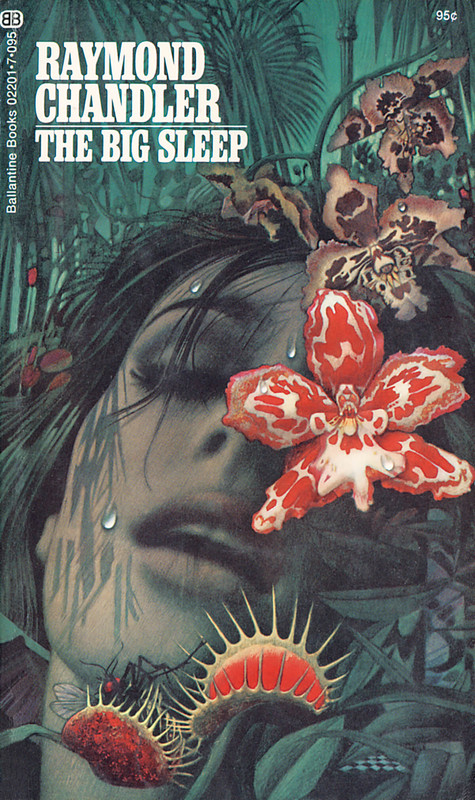
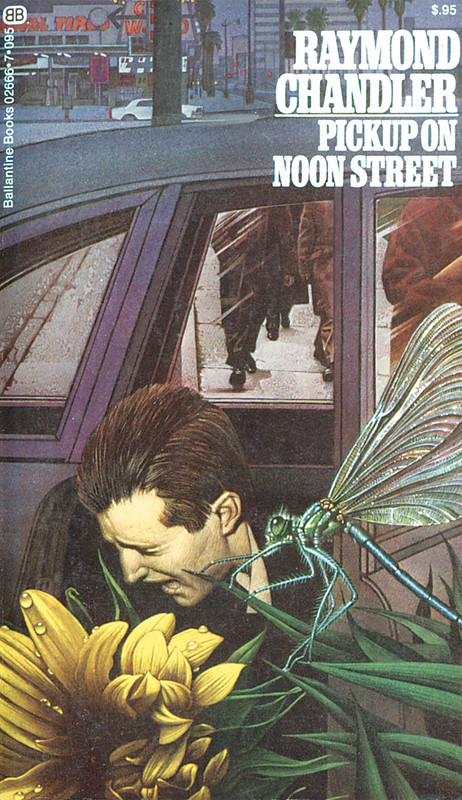
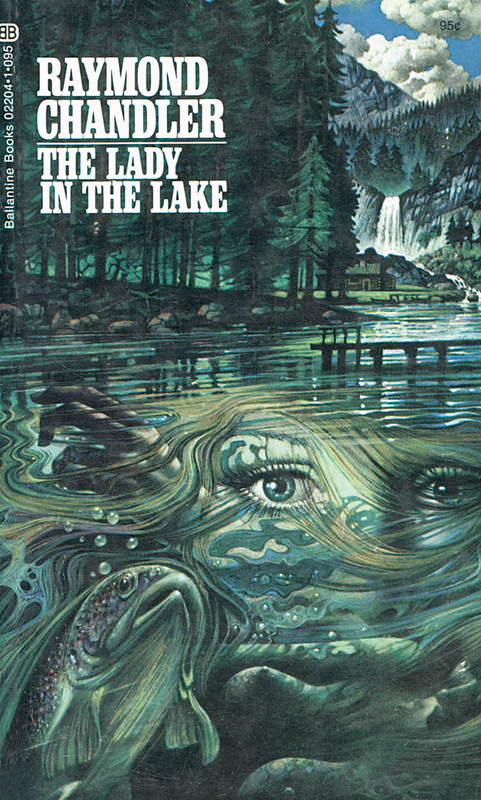
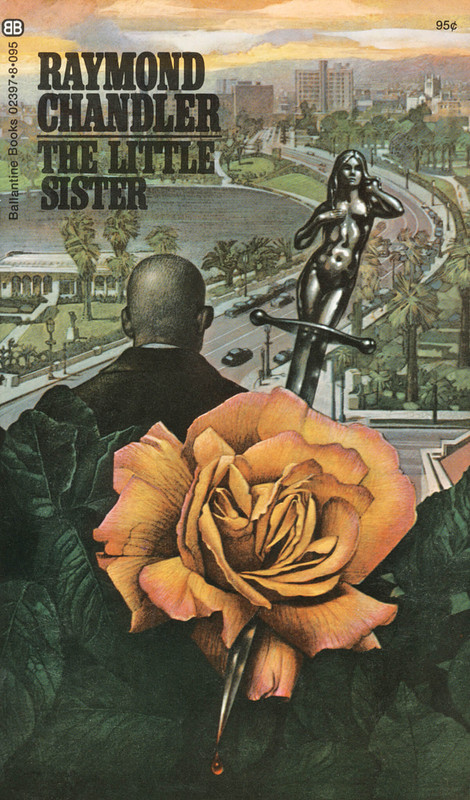
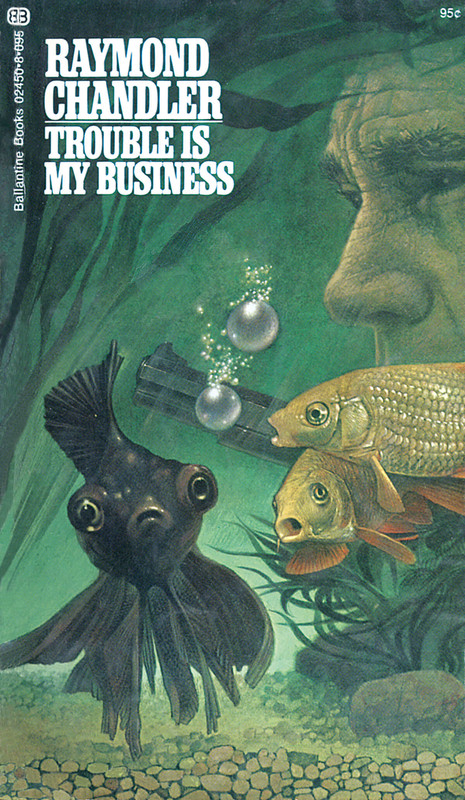
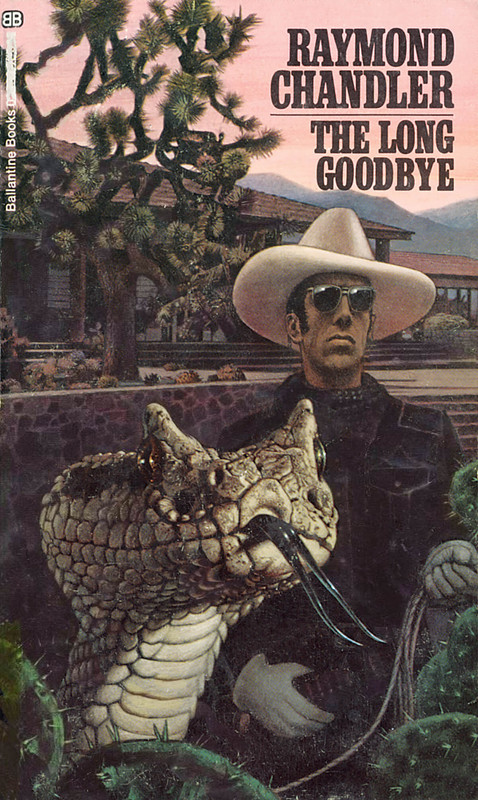
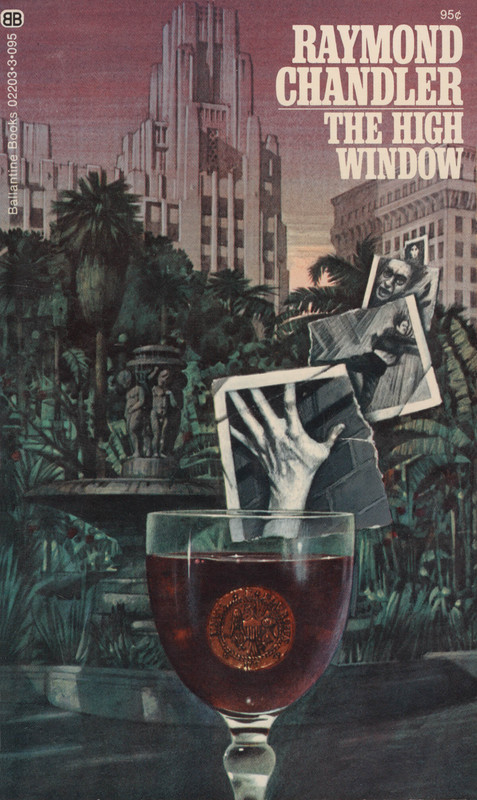
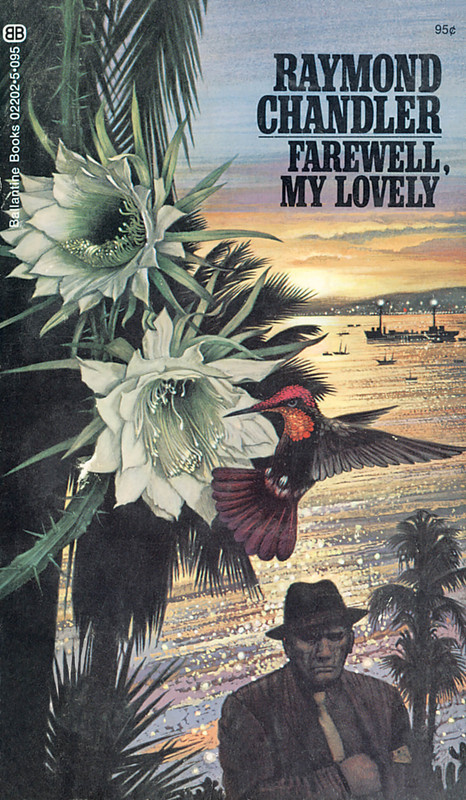
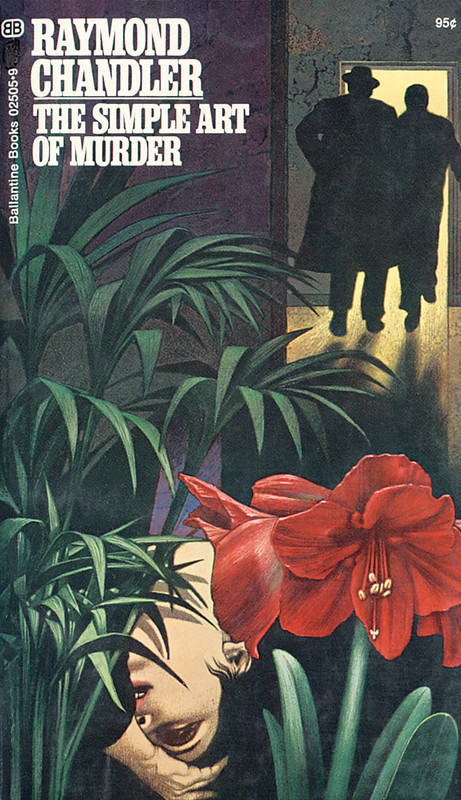
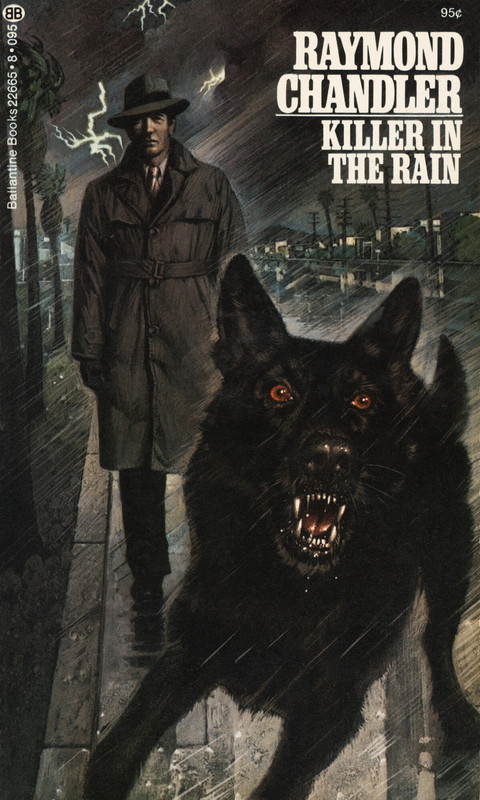
Tom Adams' covers for Raymond Chandler novels


Tom Adams, who died On 17 December, was a prolific illustrator and noted for his covers of books by Agatha Christie, Raymond Chandler and John Fowles. He worked on a wide variety of other projects, including murals, adverts, Kubrick's 2001: A Space Odyssey, various features in the British comics, Eagle, Swift and Girl and the cover of Lou Reed's first post-Velvets album.


Sunday, 24 March 2019

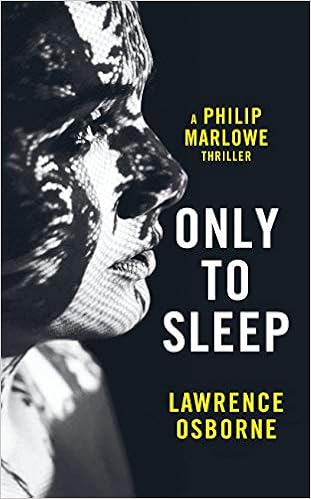
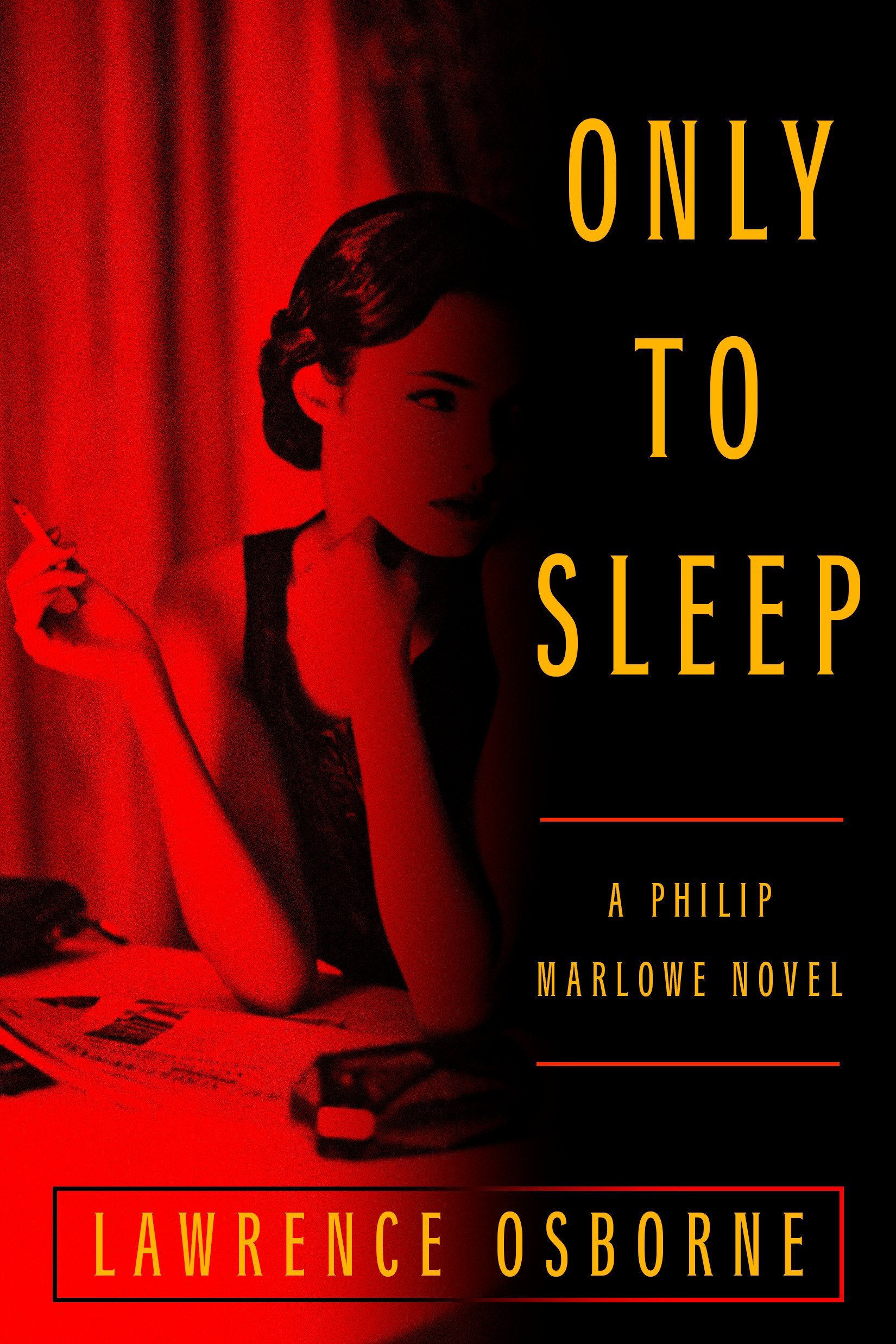
Lawrence Osborne on writing Philip Marlowe

Image result for lawrence osborne
Impersonating Philip Marlowe

By Lawrence Osborne
The New York Times
20 September 2018

In 2016 the great London agent Ed Victor, and the equally formidable Graham C. Greene, a nephew of the novelist, asked me if I would consider writing a sequel to the Philip Marlowe novels that have periodically appeared since Raymond Chandler’s death in 1959. The offer, as you might expect, was gentlemanly. Robert B. Parker and the novelist John Banville would be my only predecessors, having between them published three Marlowe novels between 1988 and the present. The sequels began with Parker’s “Poodle Springs,” a completion of Chandler’s last novel, then continued with the same author’s “Perchance to Dream,” in 1991, and culminated with Banville’s “The Black Eyed Blonde,” published under his pen name Benjamin Black in 2014. I was told that I could do more or less whatever I wanted — within reason. But what was within reason?

My first impulse was to turn the offer down. I revere Banville as a stylist, not to mention Chandler himself, and it seemed hazardous to try to compete with both of them at the same time. I surely couldn’t win that one. Apart from anything else, fans of both would probably be propelled into a tediously predictable state of ire. So what was the upside? There was vanity, of course; and then there was curiosity, the demon that killed the cat. So far, so treacherous. But there were also possibilities. I wrote back to the Chandler estate to ask whether its executors might consider my making Marlowe old, alone and desolately marooned in the year 1988. Would it fly with them, or indeed with Chandler’s fans? Would they mind seeing him in the age of Ronald Reagan and Slash?

I thought to myself that before accepting I would write 40 pages set in Baja in 1988 and see if the resulting Marlowe-in-dotage gave off the delicious sparks that a character must generate if his creator is to stay the course. If the pages worked, I’d accept the commission and stand by the decision. Presented with the whole novel, they could then see if I had wasted my time, and theirs. It was not a small gamble.

But to begin with it was an exercise, a speculative ventriloquy. The cadences of Chandler, the inner world of his knight-errant (a thinly disguised version of the hero knight of Sir Thomas Malory’s “Le Morte d’Arthur”), the quick-stepping wisecracks and beautifully compressed metaphors — all of this could be echoed in some way. But tricks of that kind are bound to weary a reader looking, as all readers do, for authenticity of voice. Little by little, something else has to happen. In the end, you’re condemned to write your own book. A pastiche or historical period piece would never have worked for me anyway. As Salvador Dalí used to say: “Don’t bother about being modern. Unfortunately it is the one thing that, whatever you do, you cannot avoid.”
Marlowe sizes up The Infinite Pad.
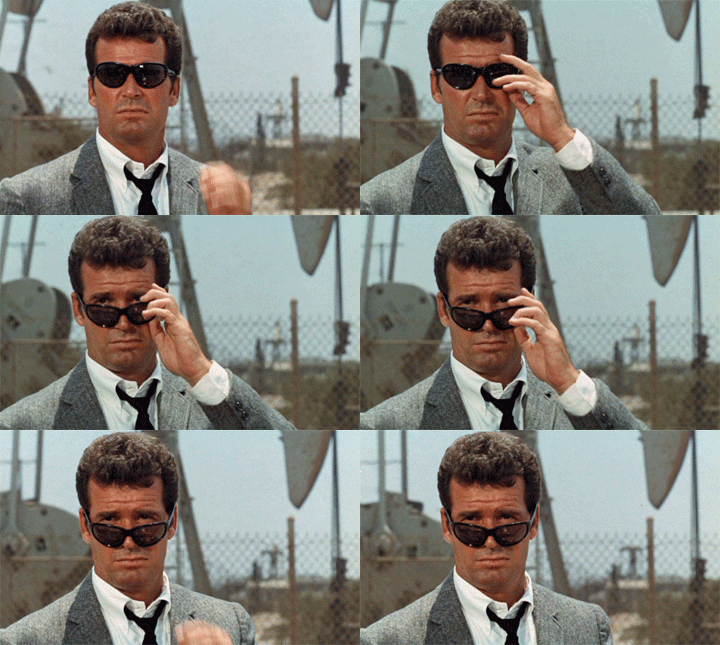
James Garner as the eponymous detective in Marlowe (1969)

I had worked as a small-time reporter on the United States-Mexico border at about that time. Not as a gumshoe, but not dissimilar. The paper was The San Diego Reader. When I arrived there from England, inexperienced, arrogant, penniless, I had no idea where I was. For my first assignment I was sent to the Sycuan Indian casino in El Cajon, where I won $2,000 on the Crazy Bow Tie bingo game televised live from Oklahoma City. It was larger than any check I had ever received from a publisher in London, and I began to wonder if California was really where I was meant to be. Among the books stacked in my 1940s Hillcrest apartment were the seven Chandler novels, which I repeatedly reread because they now seemed so much less fantastical. Above, the shrill blue sky of our little nightmares; below, the San Diego canyons among which Chandler was now buried.

Thereafter I was dispatched to places like Mexicali, Sonoyta and Tijuana to report on illegal immigration, local crime and the occasional lucha libre wrestling tournament. Then further afield to Mexico City to take the coyote buses that leave from the Terminal Central to the northern border. I learned Spanish, and moved to Baja for a while. But inevitably things went south in more metaphorical ways.

On one assignment I was sent to do a nocturnal police ride-along in the gang-infested desert town of El Centro, right on the border, a place straight out of “Touch of Evil.” I misspelled the name of a cinema over whose roof I reported clambering with a rookie cop while holding his shotgun, and the mayor hauled me in for a blistering rebuke, after which I was fired for misrepresenting “the community.” I think it was fair enough. I also now had a setting that I would never use creatively until Ed Victor made his call: the landscapes of the Anza-Borrego, the half-dead settlements of the Salton Sea, where occasionally I reported stories of con men or real-estate shenanigans, and, of course, the long mapless journeys by bus around Mexico that never had a logical beginning or end.

The Hotel Portales in Colima, the Salton Sea and the saloon bars of El Centro and Mazatlán: These were flyblown places that all remained internally fossilized. But with the excuse of a genre outing, an impersonation of another writer, I found these places suddenly liberated from their bedrock. Far from being an impersonal pastiche of a distant time, my Marlowe novel, “Only to Sleep,” became, during the writing, an act of memoir. Those places came back to life.

What I remembered most from those years on the road was the absoluteness of the loneliness. Every day you wash up alone in some bar or restaurant and take your beer among strangers, talking insanely to yourself, looking out on to squares and streets you don’t know, and then the following day you climb into a bus going somewhere you haven’t yet quite figured out and move in to another bar and restaurant with the same beer and the same flies and the same strangers. I used to think it was a particular kind of madness to which I was prone. But you can’t spend so much time doing what I did for no reason. It must answer a yearning that has no prospectus. All this passed into my Marlowe.

The following year, after the book was finished, I was invited to the Italian home of several of the descendants of Graham Greene, who today manage much of the Chandler estate (a complicated family history entwines the Chandler and Greene families). Alexander Greene and his stepsister, Charlotte Horton, make a magnificent wine in the estate surrounding their Castello di Potentino in the wild hills south of Montalcino. I took the proofs of my book with me to work on during the day, and in my lofty room overlooking the vineyards, I lay in bed dressed in a set of Graham Greene’s brightly striped pajamas, given to me by the family. They fit perfectly, which made me wonder how Raymond Chandler’s pajamas would have fit. Did the family have some of those too? Would they have been too small, would they have been striped? I never learned.

I was surprised by how little I remembered writing any of “Only to Sleep.” Had it come out so automatically, without the usual torments, as if channeled not by the ghost of a dead American writer but by the ghost of my own failed and pathless younger self? Apparently so. Places I had forgotten suddenly alive again in a single paragraph, as if written under hypnosis — the aging Marlowe, stumbling and melancholic, wandering through rooms and streets that only I had stumbled through. You could say that the greatest danger of accepting such a commission is the hubris of the later writer pointlessly emulating the great one before him, and it would be true. But there is also the unexpected deviation, the tale that wouldn’t have happened otherwise — and also, if I may dare to say, the voice that would have remained buried.
Image result for philip marlowe
Lawrence Osborne’s latest novel, “Only to Sleep,” came out in July.

https://www.nytimes.com/2018/09/20/books/review/lawrence-osborne-only-to-sleep.html

I really enjoyed this. It's respectful and evokes Chandler without trying to shoehorn in Chandler-lite similes at every opportunity (a sure sign of imitation rather than good writing). There's also a real touch of Graham Greene to it. 

Monday, 17 September 2018

Lawrence Osborne on writing Philip Marlowe in Only to Sleep...

Lawrence Osborne on re-imagining Philip Marlowe, Raymond Chandler's iconic sleuth

CBC Radio
14 September 2018

Novelist and journalist Lawrence Osborne writes as adventurously as he lives. Born in England, he's spent time in Mexico, Greece, Italy, France, Morocco, Cambodia and Thailand, and draws on his experience of diverse locations to create rich, vivid settings in his work.

For his latest book, Only to Sleep, Osborne was invited by the Raymond Chandler estate to write a new novel featuring Philip Marlowe, Chandler's enduring private detective. In a unique twist, Osborne sets his story in Mexico, luring an aging Marlowe out of a comfortable retirement for one more investigation.

Osborne's novels often feature European expatriates facing dramatic events in far-flung places — the Moroccan desert in The Forgiven, China's Macau peninsula in The Ballad of a Small Playerand the Greek island of Hydra in Beautiful Animals. His nonfiction includes Paris Dreambook and The Wet and the Dry, a memoir about bar-hopping through the Islamic world.

Osborne spoke with Eleanor Wachtel from his home in Bangkok.

Your mission, should you choose to accept it...

"My first instinct was to not write a Philip Marlowe story. I didn't really want to. This whole idea of a franchise, to me, is something like James Bond. But I thought to myself that if I could make him old and set it in the Mexico where I had lived in 1990, I could do it. That way, it wasn't just a pastiche based on research or what other people had already done — I could draw from my own experience.

"It was a flattering yet dangerous proposition, one where the diehard Chandler fans will sneer at you for not being up to the standards of the master. I don't want to compete with Raymond Chandler. I don't want to compete with other Marlowe writers, like John Banville or Robert B. Parker. With Only to SIeep, I wanted to write my own book. If I had not been able to find my own voice in this, I would not have accepted it."

Chivalry, dead or alive

"There's a medieval, romantic aspect to Marlowe, which I think is what Chandler intended. It's such an anachronism in the culture that we have now. It's maybe even an aspect of outmoded masculinity, which is maybe not outmoded at all, but it's certainly part of a masculinity that no longer has credibility today.

"Masculinity it may be, but it's also gentle and generous in spirit. It's a point to consider whether such virtues are more durable than we like to think, or whether they survive more than we think and are felt by more people than we realize. I think, actually, that it is a kind of eternal aspect of the male character." 
 
An evocative sense of place

"I think we grow out of the landscapes we grew up in. It was D. H. Lawrence who coined the phrase 'the spirit of place' and I was a great devotee of Lawrence when I was a kid. It was Lawrence who famously arrived in a place and immediately started writing about it, even though he'd never been there before. His idea was that place itself has a kind of mystical electricity, one that you can feel in the animal sense, and you can even describe it.

"Place is a completely enigmatic thing. It's not something necessarily cultural; it's more than that. Landscapes have a kind of energy and a kind of character that is definitely distinct. For example, I go to Mongolia every year because I love archery. There's something about the spirit of place there in the Gobi desert that refreshes me in some way."

Monday, 10 September 2018

Only to Sleep by Lawrence Osborne: the return of Philip Marlowe

Image result for lawrence osborne only to sleep
Only to Sleep 
By Lawrence Osborne
256 pp. Hogarth. $26.

It’s 1988 and Philip Marlowe Is Retired. But Not for Long

By Laura Lippman
The New York Times
17 July 2018

My stepson had read all of J. R. R. Tolkien by age 10, even “The Silmarillion.” Mourning for a world in which there were no more hobbits to follow, he tried to write his own adventure for Tolkien’s characters. I understood the impulse; as a teenager, I wrote short stories based on a relatively obscure novel that had managed to inspire a film and a short-lived television show. (This novel is named in a document in my safe deposit box and will be revealed at my funeral service.) Almost every reader has known this desire for more. The results have ranged from the“Oz” sequels to “Fifty Shades of Grey.”

When these stories emerge from the genre known as fan fiction — noncommissioned, uploaded to the internet for anyone to enjoy — they’re frequently derided. But a fan’s notes are rooted in a passion seldom matched by the authorized versions. The latter, even if better crafted, have a hard time escaping that cash register ka-ching pinging beneath each word. Estates also err on the side of caution. The keepers of the“Gone With the Wind” flame authorized “Scarlett” and fought “The Wind Done Gone”; surely, it should have been the other way around.

The best plan is to find fans-in-waiting, writers with genuine passion and encyclopedic knowledge; Ace Atkins, recruited by Robert B. Parker’s heirs for the continuation of the Spenser series, is a good example. Parker, as it happens, was scouted by the estate of Raymond Chandler to finish a Philip Marlowe book (“Poodle Springs”) and write an additional one(“Perchance to Dream”). Then, as in a fairy tale, the kingdom fell silent for many years. Four years ago, John Banville, albeit under the name of his crime-writing alter ego, Benjamin Black, published “The Black-Eyed Blonde.” Now Lawrence Osborne, an accomplished writer of fiction and nonfiction, has been asked to imagine a new case for Philip Marlowe and — have a smell from the barrel, all you gunsels and able grables — it crackles.

I approached the book as wary as a — forget it, I’m not going to succumb to the urge to match Chandler’s (and now Osborne’s) signature similes. The setup is brisk and disarming. The year is 1988 and Marlowe is a retiree in Mexico — Baja California, which, at the end of the Reagan era, is “what all of California once looked like.” His days are routine, although part of the routine is rather odd. On weekends, he frequents a bar with a machine called El Electrucador — put your fingers on the pad, withstand the shock and get a free shot of mezcal. “I figured the shocks were doing my intestines and hair roots some good. People said I looked much younger when I came back from my weekends. They said I looked ‘returned from the dead.’ At my age, I’ll take any compliment.”

Oh, and he walks with a silver-tipped cane, a cane that hides a blade worthy of the Bride in “Kill Bill.” Do I really need to tell you to keep an eye on that cane?

Weekends in Ensenada’s casinos, weekdays at a hotel called La Fonda, playing cards and eating roast suckling pig — this has been Marlowe’s life for almost a decade. Then two insurance men “dressed like undertakers” walk into La Fonda’s terrace bar. They’ve been told that Marlowe is the “best that money couldn’t buy.” An American named Donald Zinn has died under mysterious circumstances in a remote coastal village, leaving $2 million to his much-younger wife. The insurance men think there might be mitigating circumstances that could affect the payout.

Zinn and his wife, Dolores, had been drowning in debt from bad real estate investments. Surprise, surprise, the widow is gorgeous — and possibly lethal. “She had the level interest in something new that a leopard has. While it decides whether you can be killed or not, its eyes are remarkably gentle and serene.” Still, Marlowe is instantly smitten. He fantasizes about whisking her around a dance floor, preferably to “Begin the Beguine.”

And this is where Osborne comes into his own, only 20 pages in. Dames once literally fell for Marlowe; consider Carmen Sternwood in “The Big Sleep,” collapsing into his arms within minutes of meeting him. She was still doing a variation on this shtick in the 1978 screen version, when Marlowe was played by a careworn Robert Mitchum only a few years out from collecting Social Security. But Osborne’s Marlowe is finished with the romance game, and he knows it. He’s frankly envious that the 71-year-old dead man, so near his age, “had gotten to lie next to this beauty night after night, like Gandhi among his Nereids.”

The best P.I. stories build slowly and keep the stakes relatively small. Osborne, who worked as a reporter along the border in the early 1990s, knows Mexico well and he passes that knowledge along to Marlowe. The former private investigator quickly establishes that the dead man on the beach might not have been Donald Zinn, but some poor patsy with Zinn’s ID. The game is afoot, with just the right amount of reversals and double-crosses. If certain moments seem illogical — well, that too is part of the Chandler oeuvre.

The book’s greatest suspense centers on Osborne’s fealty to Chandler’s Marlowe, especially in the description set out in Chandler’s 1950 essay,“The Simple Art of Murder.” The key passage begins, rather famously: “But down these mean streets a man must go who is not himself mean, who is neither tarnished nor afraid.” It continues at great length, delineating the man’s — always a man’s, forever a man’s — sexual habits (“neither a eunuch nor a satyr”), his way of speaking, his code.

Chandler was doing what writers often do, making a case for his own brand of art — while taking potshots at writers who did it differently, such as Agatha Christie and Dorothy L. Sayers. As someone who has written P.I. fiction, I don’t always subscribe to Chandler’s dictates, particularly his assertion that “in everything that can be called art there is a quality of redemption.” So I’m wide open to Osborne’s version of Marlowe, which forces us to wonder at times whether he’s still a man of honor.

He’s definitely a man still full of similes and metaphors — about women, the weather, the color of the skies in the dusty Mexican towns he visits. When “Perchance to Dream” was released, Martin Amis, writing in these pages, argued that most readers couldn’t spot the difference between Chandler’s and Parker’s rhetorical flourishes — both had written too many duds. I believe Chandler simply fell back on those flourishes too often, resulting in a low winning percentage. Osborne does it slightly better, although I would still prune a few. (Dolores’s eyes are also likened to “the shiftiness of a vagrant, the ever-moving pupil that reminds you of an apple bobbing in dirty water.” Man, that’s one hard-boiled Halloween party.)

But this is a quibble with a novel that exceeded my expectations, a gripe as petty as —

Naw, I’m still not going to risk it.

Wednesday, 21 February 2018

Re-shooting The Big Sleep

Mystery of 'The Big Sleep' Solved

William Grimes
The New York Times
9 January 1997

Some film classics are born. Others are made. ''The Big Sleep,'' Howard Hawks's classic mystery starring Humphrey Bogart and Lauren Bacall, falls into the second category.

The 1946 film that audiences have known and loved is actually a revised version of an unreleased ''Big Sleep'' that was made in late 1944 and early 1945 and left forgotten in the Warner Brothers vaults for nearly half a century.

The original film was discovered several years ago by Bob Gitt, the preservation officer of the Film and Television Archive at the University of California at Los Angeles.

The revised film, which was cut to accommodate 18 minutes of new material, ran 114 minutes, making it 2 minutes shorter than the 1945 version of the Chandler story. It played up the glamour and sex appeal of Ms. Bacall by adding more of the saucy back-and-forth between her and Bogart that audiences had loved in her first film, ''To Have and Have Not'' (1944). It also added a scene between Bogart and Martha Vickers, who plays Ms. Bacall's sex-crazed sister, Carmen.

To make room for the added Bogart-Bacall material, Hawks cut an important scene, more than nine minutes long, in which Bogart and Regis Toomey review the facts of the case for the district attorney and a police detective. As a result, the 1946 version of the film has always confounded viewers trying to figure out the plot. ''The 1946 version is definitely a more enigmatic film, and there's more of Lauren Bacall in it,'' said the critic Leonard Maltin. ''The original is more linear, a bit clearer and somehow a little less intriguing. Stylistically it's less exotic.''

Mr. Maltin saw the original film in July when it was shown for the first time since 1945 at the Festival of Preservation, an annual event organized by the University of California Film and Television Archive.

The road from ''Big Sleep I'' to ''Big Sleep II'' is a twisted one. The original version was ready for release in March 1945, when historical events and the iron will of Ms. Bacall's agent, Charles K. Feldman, intervened.

''With World War II coming to a close, Warner Brothers was concerned that films with wartime themes would be dated, so they rushed them into release,'' said Mr. Gitt. One such film was ''Confidential Agent,'' Ms. Bacall's second film, which was put ahead of ''The Big Sleep'' on the studio's release schedule. Unfortunately, the film was a failure that put her career in jeopardy.

''She was universally panned,'' said Mr. Gitt. ''The critics said the acting was wooden and that she was miscast.''

In November 1945, Feldman, who represented Ms. Bacall and Hawks, wrote to Jack Warner, the head of Warner Brothers, urging him to reshoot several Bacall scenes in ''The Big Sleep,'' especially her entrance, in which her face was hidden by a heavy black veil.

''Give the girl at least three or four additional scenes with Bogart of the insolent and provocative nature that she had in 'To Have and Have Not,' he wrote. Feldman added a warning: ''Bear in mind, Jack, that if the girl receives the same type of reviews and criticisms on 'The Big Sleep,' which she definitely will receive unless changes are made, you might lose one of your most important assets.''

Warner agreed, halted release of the film and ordered a reshoot, although the 1945 film was shown to American servicemen stationed overseas, who customarily saw Hollywood films before the general public. In February 1946, Warner watched a sneak preview of the new version, which ''comes off great,'' he wrote in a wire to the studio's New York executives. ''In my opinion we have a 100 percent better film,'' he added.

The new, sharpened Bacall scenes worked magic. ''It's not that the role expanded or that there's more depth to it,'' said Mr. Maltin. ''She has a couple more good scenes with Bogart. It's as simple as that.''

Sharp-eyed viewers will notice several other changes. In the 1945 version, when Bogart returns to the Sternwood house holding the semiconscious Carmen, he has a conversation with the butler; in the 1946 version, the scene plays between Bogart and Ms. Bacall. In the film's final scene, in the hideout of the gangster Eddie Mars, Mars's wife, played by Peggy Knudsen in the 1946 version, is played by Patricia Clarke in the earlier version.

Mr. Gitt, meanwhile, continues to rummage. ''It's always interesting what you find in studio vaults,'' he said.

http://www.nytimes.com/1997/01/09/movies/mystery-of-the-big-sleep-solved.html

Wednesday, 17 January 2018

Liam Neeson as Philip Marlowe?

Image result for liam neeson in hat fedora trilby
Liam Neeson to play Philip Marlowe. ‘It’s about bloody time’
At 64, is the Ballymena actor too old to play Ramond Chandler’s much acted detective?

Donald Clarke
The Irish Times
Monday 3 April 2017

It seems as if Liam Neeson is about to play Philip Marlowe. William Monahan, writer of The Departed, will be adapting Benjamin Black’sThe Black-Eyed Blonde – a sequel to Raymond Chandler’s Marlowe stories – and the Ballymena man has agreed to walk the mean streets.

“It’s hard to tell who has the more of a lion’s heart and soul, Philip Marlowe or Liam Neeson,” Monahan said. “I hope I’ve done the both of them and a picture I could not anticipate more some service.”

Benjamin Black is, of course, a penname for John Banville, Booker prize-winning novelist and former Irish Times Literary Editor.

The first thing to say is: it’s about bloody time. We think of Chandler’s private detective as one of cinema’s essential protagonists. But it has been nearly 40 years since he appeared in a major motion picture. (Meanwhile, in the last 15 years, we have had no fewer than three Spider-Men.)

The last big-screen Marlowe adaptation was, alas, Michael Winner’s misbegotten take on The Big Sleep from 1978. Trust Mr Winner to kill off a much-loved icon.

Memories of that film bring us to a second uneasy observation. One of the main criticisms of Winner’s The Big Sleep hung around the lead’s superannuation. Robert Mitchum got away with the role in Dick Richards’s fine Farewell My Lovely three years earlier, but, by 1978, then 60, the star was looking a bit scuffed around the edges.

Is it unkind to mention that Neeson is 64? Banville’s novel is set in the early 1950s when, if Chandler is to be trusted, Marlowe was approaching his middle 40s.

Ah, never mind that. Raised on a diet of cigarettes and rubbing alcohol, tough men aged a lot more rapidly in those days. Humphrey Bogart, who died at 57, never looked younger than Neeson looks today. Age need not be a consideration.

Professors in Chandler Studies will, however, remain cautious about seeing an accurate translation of the literary character. After all, it’s never really happened before. There have been some excellent adaptations of Raymond Chandler novels.

A case could be made for The Big Sleep (1946) as the best film of Howard Hawks’s illustrious career. Robert Altman’s The Long Goodbye (1973) is one of the great Los Angeles odysseys. Robert Montgomery’s The Lady in the Lake (1947) made famously audacious use of the subjective camera.

Yet none of those films really featured the character we meet in the books. They were none the weaker for that. But I make the observation anyway.

Phillip Marlowe drinks too heavily, but he is not an alcoholic. He is cynical about the compromises around him, but he never gives in to amorality. Bogart’s performance in The Big Sleep does not grind against those gears. The actor was, however, neither so tall nor so handsome as Chandler suggests.

He is also probably a little less well read. Banville described Marlowe as “a bit of an intellectual” in a recent musing on the creation of The Black-Eyed Blonde. Educated at Dulwich College in South London, Chandler was always proud of his learning and passed that on to his creation.

Ian Fleming admitted that, after reluctantly accepting Sean Connery as James Bond (who was supposed to look like Hoagy Carmichael), his perception of his own character began to change. John Le Carré said much the same about Alec Guinness’s portrayal of George Smiley (who was supposed to look like Arthur Lowe).

But Marlowe’s character remains reasonably consistent throughout the books. He is never so slovenly and disorganised as Elliot Gould in The Long Goodbye. He is never so amiable as James Garner in the too-swinging Marlowe (1969).

The sense of an inner Englishman that Dulwich lent to Chandler’s creation is missing from all those performances. Marlowe is a deceptively nuanced creature.

It offers no great challenge to accurately represent an empty cipher on screen. Every actor who has played Tom Clancy’s Jack Ryan – Ben Affleck, Harrison Ford, Chris Pine, Alec Baldwin – has wrestled effectively with the agent’s inner nothingness.

To paraphrase Gertrude Stein on something else, there’s no there there. Such great actors as Bogart, Gould and Garner have, in contrast, made a workable hybrid from their own psyches and Chandler’s immortal material.

We ask no more than that Neeson do the same.


Probably not a great idea - though there were rumours that Hugh Laurie was going to play Lew Archer in a version of The Galton Case a few years back... Jon Hamm, anyone?

Friday, 24 November 2017

It’s All Right – He Only Died: newly-discovered Raymond Chandler story

Image result for raymond chandler
Raymond Chandler attacks US healthcare in newly-discovered story
It’s All Right - He Only Died was found in The Big Sleep author’s archives with a note underlining his contempt for doctors who turned away poor patients

Alison Flood
The Guardian
Thursday 16 November 2017

A lost story by Raymond Chandler, written almost at the end of his life, sees the author taking on a different sort of villain to the hardboiled criminals of his beloved Philip Marlowe stories: the US healthcare system.

Found in Chandler’s archives at the Bodleian Library in Oxford by Andrew Gulli, managing editor of the Strand magazine, the story, It’s All Right – He Only Died, opens as a “filthy figure on a stretcher” arrives at a hospital. The man, who smells of whisky, has been hit by a truck, and staff at the hospital are loth to treat him because they assume he will be unable to pay for his care. “The hospital rule was adamant: A fifty dollar deposit or no admission,” writes Chandler.

Gulli said the story was one of the last things Chandler ever wrote – it is believed to have been written between July 1956 and spring 1958. Chandler died in 1959. “He’d been in and out of hospital, he’d tried committing suicide once, and he’d had a fall down the stairs,” said Gulli. “The story mirrors some of his experiences of that time. It’s about what he calls a ‘transient’, a homeless man who gets hit by a truck and who finds himself in a hospital that is reluctant to treat someone who can’t pay the bill. And of course there’s a twist at the end.”

The Strand is publishing the story this weekend, complete with an author’s note from Chandler in which he reveals his fury at the US healthcare system. The doctor who turned away the patient, Chandler writes, had “disgrace[d] himself as a person, as a healer, as a saviour of life, as a man required by his profession never to turn aside from anyone his long-acquired skill might help or save”.

According to Chandler scholar Dr Sarah Trott, the story is “a prime example of Chandler as social critic and visionary in American literary history”, and unlike anything else Chandler wrote, with its serious tone, “bordering on sinister”.

“The story’s unsympathetic dialogue, paired with Chandler’s damning assessment, in itself unique, suggests a deep personal dissatisfaction with American healthcare, where the amount of money a person carries can dictate the level of care they receive,” Trott writes in an assessment of the story also published in the Strand. “It is a contemporary life-or-death story; a cautionary tale about the problematic nature of assumption and appearance in a ‘cash-is-king’ society, and a disturbing commentary about the American dream, where the competition to remain employed means not running a hospital ‘for charity’, even if it requires denying medical attention to a seriously ill patient.”

Trott called its publication timely, given the current situation with US healthcare, pointing out that Chandler was a British citizen until 1956, and would have had experience of the contrasting service of the NHS. “It feels relevant today,” agreed Gulli. “Things don’t change.”

Gulli, who has previously unearthed stories languishing in archives by major names including William Faulkner and HG Wells, said that he had given up on finding anything new by Chandler.

“I was very pessimistic,” he said. “You don’t see all the times I’ve found something by a great writer and it’s not that good, it would be a minus on their reputation.”

He speculated that Chandler might have decided not to publish the story because it was so different from his Marlowe tales. “I think perhaps, since this was unlike anything he’d ever written that he might have decided not to publish it,” he said. “To me, this shows the activist side to Chandler, particularly with the author’s note. This was not Marlowe showing up some of the LA phonies, this was Chandler penning a social message.”

https://www.theguardian.com/books/2017/nov/16/unseen-raymond-chandler-story-us-healthcare-it-s-all-right-he-only-died

Friday, 18 March 2016

Raymond Chandler and the craft of writing

Raymond Chandler: literary genius is all about hard work
How do you create a masterpiece? With a lot of graft and heartache, according to the crime fiction master

Robert McCrum
The Guardian
Monday 9 February 2009

Craft versus creativity, painstaking attention to technique versus the wild heat of inspiration; an old theme, but an important one, alluded to (by anytimefrances) in a recent thread here on this blog. I've been reflecting on this question while reading a selection of Raymond Chandler's letters, edited by Dorothy Gardiner and Kathrine Sorley Walker. It's a window on a lost world - the Anglo-American literary life of the 1940s and 50s - but also, in some of Chandler's asides, rather contemporary.

As you might expect, Chandler has plenty of bracing things to say about "the craft of writing". If ever a man devoted himself to his craft – detective fiction is all about "craft" – while somehow managing to sustain an open line to his hard-bitten unconscious, it was Chandler.

His down-to-earth practicality about writing probably started with money. As in "not having any". He wrote for the "slicks" (The Black Mask etc) because he knew he would get paid for it and because, as he puts it, this was "a good way to learn to write fiction".

Chandler was a born writer, and a great one, but he found it hard. "What do I do with myself from day to day?" he wrote, in answer to a fan. "I write when I can and don't write when I can't ... " And again, to his publisher Hamish Hamilton: "The actual writing is what you live for. The rest is something you have to get through in order to arrive at the point."

Somewhere else, speaking of narrative technique, he writes: "A good story cannot be devised; it has to be distilled. I always regard the first draft as raw material. What seems to be alive in it is what belongs in the story."

So, no plot outlines for Chandler. He just goes at it, letting character and situation take him where they will. Famously, he said somewhere that when in doubt you could always bring a man through the door with a gun in his hand. Those are the words of a man writing for The Black Mask, but Chandler's letters have a hardboiled sweetness that also tells us he was an artist at heart.

Reading between the lines, it's clear that he found writing physically draining. "When a book reaches a certain intensity of artistic performance it becomes literature," he writes. "That intensity may be a matter of style, situation, character, emotional tone or half a dozen other things. It may also be a perfection of control over the movement of a story similar to the control a great pitcher has over the ball."

Chandler was a great pitcher. Like any sportsman at the top of his game, he did it his way, and made it seem effortless. Of course, his style was hard-won, and it mattered to him deeply. As he put it to the magazine editor who rashly interfered with his prose: "I write in a sort of broken-down patois which is something like the way a Swiss waiter talks. When I split an infinitive, God damn it, I split it so it will stay split …"

What am I saying ? You should pay attention to craft, but you can't teach it (whatever the writing schools tell us), and you certainly can't give advice when it comes to words on the page. What you can pass on is a love of reading, and the shining example of a really good book (novel, memoir, or collection of poems).

Sometimes, I think that to have written one good poem might be enough for one lifetime. There are too many words on the loose in the world, and if "craft" is another way of saying that we want to bring the chaos of that exuberant marketplace into some kind of temporary harmony then – yes – I'm for craft every time.

http://www.theguardian.com/books/booksblog/2009/feb/09/raymond-chandler

Wednesday, 20 January 2016

The Letters of Raymond Chandler


Raymond Chandler, a master letter-writer too

Edwin McDowell
The New York Times
31 August 1981

DURING the long, insomniac evenings after his wife had gone to bed, Raymond Chandler sat in the study of his home in Southern California and corresponded with people from all over the world. For almost 20 years he expressed a wide range of opinions to editors, publishers, agents, authors and admirers of his detective fiction.

Chandler, author of ''The Big Sleep,'' ''Farewell, My Lovely'' and ''The Long Goodbye'' and creator of the fictional detective Philip Marlowe, had harsh words for Alfred Hitchcock's treatment of screenwriters, lectured E. Howard Hunt on the ethics of plagiarizing from oneself, declared that the only writing school necessary is to ''analyze and imitate'' and fulminated against ''the literary life'': ''all this desperate building of castles on cobwebs, the long-drawn acrimonious struggle to make something important which we all know will be gone forever in a few years.''

Chandler's passions and prejudices are on full display in ''Selected Letters of Raymond Chandler,'' edited by Frank MacShane, which Columbia University Press will publish on Oct. 26. Mr. MacShane, author of ''The Life of Raymond Chandler'' and ''The Life of John O'Hara,'' writes in the introduction that Chandler, who died in 1959, was ''one of the finest letter writers American literature has produced over the last 200 years.'' He adds that Chandler wanted to express his thoughts and feeling to whoever would write him in return.

One who did was Ian Fleming, who sent him a letter after Chandler reviewed ''Moonraker'' for The Sunday Times of London. Chandler replied: ''I thought my review was no more than you deserved and I tried to write it in such a way that the good part could be quoted and the bad parts left out. After all, old boy, there had to be some bad parts. I think you will have to make up your mind what kind of a writer you are going to be.'' Cops and Crooks

To Eric Partridge, the English literary critic and lexicographer, Chandler wrote: ''Incidentally, it doesn't follow that a man who has been in stir writes the best prison lingo any more than it follows that a man who has been a police officer writes the best detective stories. Cops and crooks are readers of crime literature, and I have no doubt that many a Western sheriff has ornamented his language and perhaps even his costume from a study of six-gun literature.''

Seeking an interview, Chandler wrote to Luciano Lucania, who was known as ''Lucky Luciano'' and who was living in Naples after having been deported from the United States for criminal activities. ''Some of my questions to you may be rather brutal,'' he said, ''but if you decline to answer them, there will be no record that they have been asked. There will be nothing published by me which you do not say, but of course, I cannot be responsible for editorial comment.'' Chandler's sympathetic article based on that interview, titled ''My Friend Luco'' and written for The Sunday Times of London, was never published.

In a 1950 letter to W. Somerset Maugham, Chandler said: ''I think it's rather a pity that somewhere along the line, seeing you have had time for so many things, you did not write a detective story. Not only would it have given us something to shoot at, but it would have quieted my long annoyance with those who gabble about the 'classic' detective story. We should have had at least one specimen to which the term might be applied without idiocy.'' 'Vicious Propaganda'

He returned to the subject in a letter to Maugham the following year, remarking on a recent visit from J.B. Priestley, who told Chandler that he wrote well and that he should write a straight novel. ''Of course I have heard this before in other connections,'' Chandler said. ''If you write well, you should not be writing a mystery. Mysteries should only be written by people who can't write. I regard this as vicious propaganda from the Edmund Wilson crowd. Obviously you can't expect detective fiction to be anything but subliterary, to use Edmund Wilson's word, if you insist on weeding out from that field anyone who shows any pretentions to skill or imagination in the use of words.''

But Chandler reserved much of his contempt for Hollywood, where he helped write screenplays, including the one for James M. Cain's ''Double Indemnity.'' When he had earned enough to leave, he and his wife, Cissy, moved to La Jolla, where they lived for most of the rest of their lives.

''Like every writer, or almost every writer, who goes to Hollywood, I was convinced in the beginning that there must be some discoverable method of working in pictures which would not be completely stultifying to whatever creative talent one might happen to possess,'' he lamented to Hamish Hamilton, his English publisher. ''But like others before me I discovered that this was a dream. It's nobody's fault; it's part of the structure of the industry. Too many people have too much to say about a writer's work. It ceases to be his own. And after a while he ceases to care about it. He has brief enthusiasms, but they are destroyed before they can flower. People who can't write tell him how to write.'' A Waste of Time

Chandler wrote but never mailed an embittered letter to Alfred Hitchcock, who disregarded Chandler's suggestions for the script of ''Strangers on a Train'': ''If you wanted something written in skim milk, why on earth did you bother to come to me in the first place?'' he asked. ''What a waste of money! What a waste of time! It's no answer to say that I was well paid. Nobody can be adequately paid for wasting his time.''

One of the most unusual Chandler letters was written in 1952 to Mr. Hunt, who later became an aide to President Richard M. Nixon and served 32 months in prison for his part in the Watergate conspiracy. Mr. Hunt has written more than 50 novels, many of them paperbacks under a pseudonym, but his current hardcover novel, ''The Gaza Intercept'' (Stein & Day), was recently published under his own name. However, at the time Chandler wrote to him, Mr. Hunt was assigned to the American Embassy in Mexico City.

When the editors of Pocket Books sent Chandler a letter that Mr. Hunt had sent to them, accusing Chandler of plagiarizing from his own articles in a detective magazine of the 1930's, the author replied that he had a perfect right to use them. ''I am the copyright owner, I can use my material in any way I see fit,'' he declared. He then added that ''a wide selection of opinions on the subject'' had persuaded him to use them because a whole generation might possibly want to read those stories that had been written for an ephemeral publication.

The last five years of Chandler's life, after his wife's death in 1954, were marked by frantic attempts to find a solution to loneliness, Mr. MacShane writes. One month before his death he wrote to Maurice Guinness, an English detective novelist, who suggested that Philip Marlowe marry. Chandler disagreed. ''I think he will always have a fairly shabby office, a lonely house, a number of affairs, but no permanent connection.'' he replied. ''I think he will always be awakened at some inconvenient hour by some inconvenient person to do some inconvenient job. I see him always in a lonely street, in lonely rooms, puzzled but never quite defeated.''

http://www.nytimes.com/1981/08/31/books/raymond-chandler-a-master-letter-writer-too.html

Monday, 20 April 2015

Raymond Chandler - Writers in Hollywood (1945)

To the writing of his detective stories RAYMOND CHANDLER brings the experience and the skepticism of a newspaper reporter, the narrative gifts of a born storyteller, and a mastery of pungent American dialogue. His leading character, Philip Marlowe, is a professional detective who has held the spotlight thus far in four novels, all of which have been purchased by the movies. One of them, The Big Sleep, in which Lauren Bacall plays the lead, is soon to be released. In his screenplays as in his books, Mr. Chandler has scored a personal success, but he has done so without losing sight of the difficulties encountered by the creative writer in the studios. For this is the anomaly: the producers pay their authors large fees apparently for the purpose of disregarding their advice and their text.

Writers in Hollywood
1 November 1945

1.

HOLLYWOOD is easy to hate, easy to sneer at, easy to lampoon. Some of the best lampooning has been done by people who have never been through a studio gate, some of the best sneering by egocentric geniuses who departed huffily - not forgetting to collect their last pay check – leaving behind them nothing but the exquisite aroma of their personalities and a botched job for the tired hacks to clean up.

Even as far away as New York, where Hollywood assumes all really intelligent people live (since they obviously do not live in Hollywood), the disease of exaggeration can be caught. The motion picture critic of one of the less dazzled intellectual weeklies, commenting recently on a certain screenplay, remarked that it showed "how dull a couple of run-of-the-mill $3000-a-week writers can be." I hope this critic will not be startled to learn that 50 per cent of the screenwriters of Hollywood made less than $10,000 last year, and that he could count on his fingers the number that made a steady income anywhere near the figure he so contemptuously mentioned. I don't know whether they could be called run-of-the-mill writers or not. To me the phrase suggests something a little easier to get hold of.

I hold no brief for Hollywood. I have worked there a little over two years, which is far from enough to make me an authority, but more than enough to make me feel pretty thoroughly bored. That should not be so. An industry with such vast resources and such magic techniques should not become dull so soon. An art which is capable of making all but the very best plays look trivial and contrived, all but the very best novels verbose and imitative, should not so quickly become wearisome to those who attempt to practice it with something else in mind than the cash drawer. The making of a picture ought surely to be a rather fascinating adventure. It is not; it is an endless contention of tawdry egos, some of them powerful, almost all of them vociferous, and almost none of them capable of anything much more creative than credit-stealing and self-promotion.

Hollywood is a showman's paradise. But showmen make nothing; they exploit what someone else has made. The publisher and the play producer are showmen too; but they exploit what is already made. The showmen of Hollywood control the making – and thereby degrade it. For the basic art of motion pictures is the screenplay; it is fundamental, without it there is nothing. Everything derives from the screenplay, and most of that which derives is an applied skill which, however adept, is artistically not in the same class with the creation of a screenplay. But in Hollywood the screenplay in written by a salaried writer under the supervision of a producer - that is to say, by an employee without power or decision over the uses of his own craft, without ownership of it, and, however extravagantly paid, almost without honor for it.

I am aware that there are colorable economic reasons for the Hollywood system of "getting out the script." But I am not much interested in them. Pictures cost a great deal of money—true. The studio spends the money; all the writer spends is his time (and incidentally his life, his hopes, and all the varied experiences, most of them painful, which finally made him into a writer) - this also is true. The producer is charged with the salability and soundness of the project - true. The director can survive few failures; the writer can stink for ten years and still make his thousand a week - true also. But entirely beside the point.

I am not interested in why the Hollywood system exists or persists, nor in learning out of what bitter struggles for prestige it arose, nor in how much money it succeeds in making out of bad pictures. I am interested only in the fact that as a result of it there is no such thing as an art of the screenplay, and there never will be as long as the system lasts, for it is the essence of this system that it seeks to exploit a talent without permitting it the right to be a talent. It cannot be done; you can only destroy the talent, which is exactly what happens - when there is any to destroy.

Granted that there isn't much. Some chatty publisher (probably Bennett Cerf) remarked once that there are writers in Hollywood making two thousand dollars a week who haven't had an idea in ten years. He exaggerated—backwards: there are writers in Hollywood making two thousand a week who never had an idea in their lives, who have never written a photographable scene, who could not make two cents a word in the pulp market if their lives depended on it. Hollywood is full of such writers, although there are few at such high salaries. They are, to put it bluntly, a pretty dreary lot of hacks, and most of them know it, and they take their kicks and their salaries and try to be reasonably grateful to an industry which permits them to live much more opulently than they could live anywhere else.

And I have no doubt that most of them, also, would like to be much better writers than they are, would like to have force and integrity and imagination enough of these to earn a decent living at some art of literature that has the dignity of a free profession. It will not happen to them, and there is not much reason why it should. If it ever could have happened, it will not happen now. For even the best of them (with a few rare exceptions) devote their entire time to work which has no more possibility of distinction than a Pekinese has of becoming a Great Dane: to asinine musicals about technicolor legs and the yowling of night-club singers; to "psychological" dramas with wooden plots, stock characters, and that persistent note of fuzzy earnestness which suggests the conversation of schoolgirls in puberty; to sprightly and sophisticated comedies (we hope) in which the gags are as stale as the attitudes, in which there is always a drink in every hand, a butler in every doorway, and a telephone on the edge of every bathtub; to historical epics in which the male actors look like female impersonators, and the lovely feminine star looks just a little too starry-eyed for a babe who has spent half her life swapping husbands; and last but not least, to those pictures of deep social import in which everybody is thoughtful and grown-up and sincere and the more difficult problems of life are wordily resolved into a unanimous vote of confidence in the inviolability of the Constitution, the sanctity of the home, and the paramount importance of the streamlined kitchen.

And these, dear readers, are the million-dollar babies—the cream of the crop. Most of the boys and girls who write for the screen never get anywhere near this far. They devote their sparkling lines and their structural finesse to horse operas, cheap gun-in-the-kidney melodramas, horror items about mad scientists and cliffhangers concerned with screaming blondes and circular saws. The writers of this tripe are licked before they start. Even in a purely technical sense their work is doomed for lack of the time to do it properly. The challenge of screenwriting is to say much in little and then take half of that little out and still preserve an effect of leisure and natural movement. Such a technique requires experiment and elimination. The cheap pictures simply cannot afford it.

2

LET me not imply that there are no writers of authentic ability in Hollywood. There are not many, but there are not many anywhere. The creative gift is a scarce commodity, and patience and imitation have always done most of its work. There is no reason to expect from the anonymous toilers of the screen a quality which we are very obviously not getting from the publicized litterateurs of the best-seller list, from the compilers of fourth-rate historical novels which sell half a million copies, from the Broadway candy butchers known as playwrights, or from the sulky maestri of the little magazines.

To me the interesting point about Hollywood's writers of talent is not how few or how many they are, but how little of worth their talent is allowed to achieve. Interesting - but hardly unexpected, once you accept the premise that writers are employed to write screenplays on the theory that, being writers, they have a particular gift and training for the job, and are then prevented from doing it with any independence or finality whatsoever, on the theory that, being merely writers, they know nothing about making pictures, and of course if they don't know how to make pictures, they couldn't possibly know how to write them. It takes a producer to tell them that.

I do not wish to become unduly vitriolic on the subject of producers. My own experience does not justify it, and after all, producers too are slaves of the system. Also, the term "producer" is of very vague definition. Some producers are powerful in their own right, and some are little more than legmen for the front office; some - few, I trust - receive less money than some of the writers who work for them. It is even said that in one large Hollywood studio there are producers who are lower than writers; not merely in earning power, but in prestige, importance, and aesthetic ability. It is, of course, a very large studio where all sorts of unexplained things could happen and hardly be noticed.

For my thesis the personal qualities of a producer are rather beside the point. Some are able and humane men and some are low-grade individuals with the morals of a goat, the artistic integrity of a slot machine, and the manners of a floorwalker with delusions of grandeur. In so far as the writing of the screenplay is concerned, however, the producer is the boss; the writer either gets along with him and his ideas (if he has any) or gets out. This means both personal and artistic subordination, and no writer of quality will long accept either without surrendering that which made him a writer of quality, without dulling the fine edge of his mind, without becoming little by little a conniver rather than a creator, a supple and facile journeyman rather than a craftsman of original thought.

It makes very little difference how a writer feels towards his producer as a man; the fact that the producer can change and destroy and disregard his work can only operate to diminish that work in its conception and to make it mechanical and indifferent in execution. The impulse to perfection cannot exist where the definition of perfection is the arbitrary decision of authority. That which is born in loneliness and from the heart cannot be defended against the judgment of a committee of sycophants. The volatile essences which make literature cannot survive the clichés of a long series of story conferences. There is little magic of word or emotion or situation which can remain alive after the incessant bone-scraping revisions imposed on the Hollywood writer by the process of rule by decree. That these magics do somehow, here and there, by another and even rarer magic, survive and reach the screen more or less intact is the infrequent miracle which keeps Hollywood's handful of fine writers from cutting their throats.

Hollywood has no right to expect such miracles, and it does not deserve the men who bring them to pass. Its conception of what makes a good picture is still as juvenile as its treatment of writing talent is insulting and degrading. Its idea of "production value" is spending a million dollars dressing up a story that any good writer would throw away. Its vision of the rewarding movie is a vehicle for some glamorpuss with two expressions and eighteen changes of costume, or for some male idol of the muddled millions with a permanent hangover, six worn-out acting tricks, the build of a lifeguard, and the mentality of a chicken-strangler. Pictures for such purposes as these, Hollywood lovingly and carefully makes. The good ones smack it in the rear when it isn't looking.

3

For all this too there are colorable economic reasons. The motion picture is a great industry as well as a defeated art. Its technicians are now in their third generation, its investments are world-wide, its demand for material is insatiable. Five hundred pictures a year must be made or the theaters will be dark, countless people will be thrown out of work, financial organizations will totter, and bankers will start jumping out of their office windows again. Hollywood does not possess enough real talent to make one tenth of five hundred pictures, even if it could find stories to base them on. But the rest must be made somehow, and they are made—with great effort and bitter struggle, with the hardening of many arteries and the graying of many hairs, and with the slow deadening of such real ability as could have been saved by happier tasks.

And the men who turn out this essentially dreary product are well paid by the standards of other industries. This reward is not, of course, due to any big-heartedness on the part of the financial big shots who control the working capital. The men with the money and the ultimate power can do anything they like with Hollywood - as long as they don't mind losing their investment. They can destroy any studio executive overnight, contract or no contract; any star, any producer, any director—as an individual. What they cannot destroy is the Hollywood system. It may be wasteful, absurd, even dishonest, but it is all there is, and no cold-blooded board of directors can replace it. It has been tried, but the showmen always win. They always win against mere money. What in the long run - the very long run - they can never defeat is talent, even writing talent.

It is, I am afraid, a very long run indeed. There is no present indication whatever that the Hollywood writer is on the point of acquiring any real control over his work, any right to choose what that work shall be (other than refusing jobs, which he can only do within narrow limits), or even any right to decide how the values in the producer-chosen work shall be brought out. There is no present guarantee that his best lines, best ideas, best scenes will not be changed or omitted on the set by the director or dropped on the floor during the later process of cutting - for the simple but essential reason that the best things in any picture, artistically speaking, are invariably the easiest to leave out, mechanically speaking.

There is no attempt in Hollywood to exploit the writer as an artist of meaning to the picture-buying public; there is every attempt to keep the public uninformed about his vital contribution to whatever art the movie contains. On the billboards, in the newspaper advertisements, his name will be smaller than that of the most insignificant bit-player who achieves what is known as billing; it will be the first to disappear as the size of the ad is out down toward the middle of the week; it will be the last and least to be mentioned in any word-of-mouth or radio promotion.

The first picture I worked on was nominated for an Academy award (if that means anything), but I was not even invited to the press review held right in the studio. An extremely successful picture made by another studio from a story I wrote used verbatim lines out of the story in its promotional campaign, but my name was never mentioned once in any radio, magazine, billboard, or newspaper advertising that I saw or heard - and I saw and heard a great deal. This neglect is of no consequence to me personally; to any writer of books a Hollywood by-line is trivial. To those whose whole work is in Hollywood it is not trivial, because it is part of a deliberate and successful plan to reduce the professional screenwriter to the status of an assistant picture-maker, superficially deferred to (while he is in the room), essentially ignored, and even in his most brilliant achievements carefully pushed out of the way of any possible accolade which might otherwise fall to the star, the producer, the director.

4

IF ALL this is true, why then should any writer of genuine ability continue to work in Hollywood at all? The obvious reason is not enough; few screenwriters possess homes in Bel-Air, illuminated swimming pools, wives in full-length mink coats, three servants, and that air of tired genius gone a little sour. Money buys pathetically little in Hollywood beyond the pleasure of living in an unreal world, associating with a narrow group of people who think, talk, and drink nothing but pictures, most of them bad, and the doubtful pleasure of watching famous actors and actresses guzzle in some of the rudest restaurants in the world.

I do not mean that Hollywood society is any duller or more dissipated than moneyed society anywhere: God knows it couldn't be. But it is a pretty thin reward for a lifetime devoted to the essential craft of what might be a great art. I suppose the truth is that the veterans of the Hollywood scene do not realize how little they are getting, how many dull egotists they have to smile at, how many shoddy people they have to treat as friends, how little real accomplishment is possible, how much gaudy trash their life contains. The superficial friendliness of Hollywood is pleasant - until you find out that nearly every sleeve conceals a knife. The companionship during working hours with men and women who take the business of fiction seriously gives a pale heat to the writer's lonely soul. It is so easy to forget that there is a world in which men buy their own groceries and, if they choose, think their own thoughts. In Hollywood you don't even write your own checks - and what you think is what you hope some producer or studio executive will like.

Beyond this I suppose there is hope; there are several hopes. The cold dynasty will not last forever, the dictatorial producer is already a little unsure, the top-heavy director has long since become a joke in his own studio; after a while even technicolor will not save him. There is hope that a decayed and makeshift system will pass, that somehow the flatulent moguls will learn that only writers can write screenplays and only proud and independent writers can write good screenplays, and that present methods of dealing with such men are destructive of the very force by which pictures must live.

And there is the intense and beautiful hope that the Hollywood writers themselves - such of them as are capable of it - will recognize that writing for the screen is no job for amateurs and half-writers whose problems are always solved by somebody else. It is the writers' own weakness as craftsmen that permits the superior egos to bleed them white of initiative, imagination, and integrity. If even a quarter of the highly paid screenwriters in Hollywood could produce a completely integrated and photographable screenplay under their own power, with only the amount of interference and discussion necessary to protect the studio's investment in actors and ensure a reasonable freedom from libel and censorship troubles, then the producer would assume his proper function of coordinating and conciliating the various crafts which combine to make a picture; and the director - heaven help his strutting soul -would be reduced to the ignominious task of making pictures as they are conceived and written - and not as the director would try to write them, if only he knew how to write.

Certainly there are producers and directors - although how pitifully few - who are sincere enough to want such a change, and talented enough to have no fear of its effect on their own position. Yet it is only a little over three years since the major (and only this very year the minor) studios were forced, after prolonged and bitter struggle, to agree to treat the writers according to some reasonable standard of business ethics. In this struggle the writers were not really fighting the motion picture industry at all; they were only fighting certain powerful elements in it - employees like themselves - who had hitherto glommed off all the glory and prestige and most of the money, and could only continue to do so by selling themselves to the world as the true makers of pictures.

This struggle is still going on; in a sense it will always go on, in a sense it alwaysshould go on. But so far the cards are stacked against the writer. If there is no art of the screenplay, the reason is at least partly that there exists no available body of technical theory and practice by which it can be learned. There is no available library of screenplay literature, because the screenplays belong to the studios, and they will only show them within their guarded walls. There is no body of critical opinion, because there are no critics of the screenplay; there are only critics of motion pictures as entertainment, and most of these critics know nothing whatever of the means whereby the motion picture is created and put on celluloid. There is no teaching, because there is no one to teach. If you do not know how pictures are made, you cannot speak with any authority on how they should be constructed; if you do, you are busy enough trying to do it.

There is no correlation of crafts within the studio itself; the average—and far better than average—screenwriter knows hardly anything of the technical problems of the director, and nothing at all of the superlative skill of the trained cutter. He spends his effort in writing shots that cannot be made, or which if made would be thrown away; in writing dialogue that cannot be spoken, sound effects that cannot be heard, and nuances of mood and emotion which the camera cannot reproduce. His idea of an effective scene is something that has to be shot down a stairwell or out of a gopher hole; or a conversation so static that the director, in order to impart a sense of motion to it, is compelled to photograph it from nine different angles.

In fact, no part of the vast body of technical knowledge which Hollywood contains is systematically and as a matter of course made available to the new writer in a studio. They tell him to look at pictures – which is to learn architecture by staring at a house. And then they send him back to his rabbit hutch to write little scenes which his producer, in between telephone calls to his blondes and his booze-companions, will tell him ought to have been written quite differently. The producer is probably correct; the scene ought to have been written differently. It ought to have been written right. But first it had to be written. The producer didn't do that. He wouldn't know how. Anyway he's too busy. And he's making too much money. And the atmosphere of intellectual squalor in which the salaried writer operates would offend his dignity.

I have kept the best hope of all for the last. In spite of all I have said, the writers of Hollywood are winning their battle for prestige. More and more of them are becoming showmen in their own right, producers and directors of their own screenplays. Let us be glad for their additional importance and power, and not examine the artistic result too critically. The boys make good (and some of them might even make good pictures). Let us rejoice together, for the tendency to become showmen is well in the acceptable tradition of the literary art as practiced among the cameras.

For the very nicest thing Hollywood can possibly think of to say to a writer is that he is too good to be only a writer.

http://www.theatlantic.com/magazine/archive/1945/11/writers-in-hollywood/306454/
Monday, 13 April 2015

Clive James on Raymond Chandler


The Country Behind the Hill: Raymond Chandler

Clive James
1977

‘In the long run’, Raymond Chandler writes in Raymond Chandler Speaking, ‘however little you talk or even think about it, the most durable thing in writing is style, and style is the most valuable investment a writer can make with his time.’ At a time when literary values inflate and dissipate almost as fast as the currency, it still looks as if Chandler invested wisely. His style has lasted. A case could be made for saying that nothing else about his books has, but even the most irascible critic or disillusioned fan (they are often the same person) would have to admit that Chandler at his most characteristic is just that – characteristic and not just quirky. Auden was right in wanting him to be regarded as an artist. In fact Auden’s tribute might well have been that of one poet to another. If style is the only thing about Chandler’s novels that can’t be forgotten, it could be because his style was poetic, rather than prosaic. Even at its most explicit, what he wrote was full of implication. He used to say that he wanted to give a feeling of the country behind the hill.

Since Chandler was already well into middle-age when he began publishing, it isn’t surprising that he found his style quickly. Most of the effects that were to mark The Big Sleep in 1939 were already present, if only fleetingly, in an early story like ‘Killer in the Rain’, published in Black Mask magazine in 1935. In fact some of the very same sentences are already there. This from ‘Killer in the Rain’:

The rain splashed knee-high off the sidewalks, filled the gutters, and big cops in slickers that shone like gun barrels had a lot of fun carrying little girls in silk stockings and cute little rubber boots across the bad places, with a lot of squeezing.

Compare this from The Big Sleep:

Rain filled the gutters and splashed knee-high off the pavement. Big cops in slickers that shone like gun barrels had a lot of fun carrying giggling girls across the bad places. The rain drummed hard on the roof of the car and the burbank top began to leak. A pool of water formed on the floorboards for me to keep my feet in.

So there is not much point in talking about how Chandler’s style developed. As soon as he was free of the short-paragraph restrictions imposed by the cheaper pulps, his way of writing quickly found its outer limits: all he needed to do was refine it. The main refining instrument was Marlowe’s personality. The difference between the two cited passages is really the difference between John Dalmas and Philip Marlowe. 
Marlowe’s name was not all that more convincing than Dalmas’s, but he was a more probable, or at any rate less improbable, visionary. In The Big Sleep and all the novels that followed, the secret of plausibility lies in the style, and the secret of the style lies in Marlowe’s personality. Chandler once said that he thought of Marlowe as the American mind. As revealed in Chandler’s Notebooks (edited by Frank McShane and published by the Ecco Press, New York), one of Chandler’s many projected titles was The Man Who Loved the Rain. Marlowe loved the rain.

Flaubert liked tinsel better than silver because tinsel possessed all silver’s attributes plus one in addition – pathos. For whatever reason, Chandler was fascinated by the cheapness of L. A. When he said that it had as much personality as a paper cup, he was saying what he liked about it. When he said that he could leave it without a pang, he was saying why he felt at home there. In a city where the rich were as vulgar as the poor, all the streets were mean. In a democracy of trash, Marlowe was the only aristocrat. Working for 25 dollars a day plus expenses (Jim Rockford in the T.V. series The Rockford Files now works for ten times that and has to live in a trailer), Marlowe was as free from materialistic constraint as any hermit. He saw essences. Chandler’s particular triumph was to find a style for matching Marlowe to the world. Vivid language was the decisive element, which meant that how not to make Marlowe sound like too good a writer was the continuing problem. The solution was a kind of undercutting wit, a style in which Marlowe mocked his own fine phrases. A comic style, always on the edge of self-parody – and, of course, sometimes over the edge – but at its best combining the exultant and the sad in an inseparable mixture.

For a writer who is not trying all that hard to be funny, it is remarkable how often Chandler can make you smile. His conciseness can strike you as a kind of wit in itself. The scene with General Sternwood in the hot-house, the set piece forming Chapter Two ofThe Big Sleep, is done with more economy than you can remember: there are remarkably few words on the page to generate such a lasting impression of warm fog in the reader’s brain. ‘The air was thick, wet, steamy and larded with the cloying smell of tropical orchids in bloom.’ It’s the rogue verb ‘larded’ which transmits most of the force. Elsewhere, a single simile gives you the idea of General Sternwood’s aridity. ‘A few locks of dry white hair clung to his scalp, like wild flowers fighting for life on a bare rock.’ The fact that he stays dry in the wet air is the measure of General Sternwood’s nearness to death. The bare rock is the measure of his dryness. At their best, Chandler’s similes click into place with this perfect appositeness. He can make you laugh, he gets it so right – which perhaps means that he gets it too right. What we recognize as wit is always a self-conscious performance.

But since wit that works at all is rare enough, Chandler should be respected for it. And anyway, he didn't always fall into the trap of making his characters too eloquent. Most of Marlowe's best one-liners are internal. In the film of The Big Sleep, when Marlowe tells General Sternwood that he has already met Carmen in the hall, he says: 'She tried to sit on my lap while I was standing up.' Bogart gets a big laugh with that line, but only half of the line is Chandler's. All that Chandler's Marlowe says is: 'Then she tried to sit in my lap.' The film version of Marlowe got the rest of the gag from somewhere else - either from William Faulkner, who wrote the movie, or from Howard Hawks, who directed it, or perhaps from both. On the page, Marlowe's gags are private and subdued. About Carmen, he concludes that 'thinking was always going to be a bother to her.' He notices - as no camera could notice, unless the casting director flung his net very wide - that her thumb is like a finger, with no curve in its first joint. He compares the shocking whiteness of her teeth to fresh orange pith. He gets you scared stiff of her in a few sentences.

Carmen is the first in a long line of little witches that runs right through the novels, just as her big sister, Vivian, is the first in a long line of rich bitches who find that Marlowe is the only thing money can't buy. The little witches are among the most haunting of Chandler's obsessions and the rich bitches are among the least. Whether little witch or rich bitch, both kinds of woman signal their availability to Marlowe by crossing their legs shortly after sitting down and regaling him with tongue-in-the-lung French kisses a few seconds after making physical contact.

All the standard Chandler character ingredients were there in the first novel, locked in a pattern of action so complicated that not even the author was subsequently able to puzzle it out. The Big Sleep was merely the first serving of the mixture as before. But the language was fresh and remains so. When Chandler wrote casually of 'a service station glaring with wasted light' he was striking a note that Dashiell Hammett had never dreamed of. Even the book's title rang a bell. Chandler thought that there were only two types of slang which were any good: slang that had established itself in the language, and slang that you made up yourself. As a term for death, 'the big sleep' was such a successful creation that Eugene O'Neill must have thought it had been around for years, since he used it in The Iceman Cometh (1946) as an established piece of low-life tough talk. But there is no reason for disbelieving Chandler's claim to have invented it.

Chandler's knack for slang would have been just as commendable even if he had never thought of a thing. As the Notebooks reveal, he made lists of slang terms that he had read or heard. The few he kept and used were distinguished from the many he threw away by their metaphorical exactness. He had an ear for depth - he could detect incipient permanence in what sounded superficially like ephemera. A term like 'under glass', meaning to be in prison, attracted him by its semantic compression. In a letter collected in Raymond Chandler Speaking, he regards it as self-evident that an American term like 'milk run' is superior to the equivalent British term 'piece of cake'. The superiority being in the range of evocation. As it happened, Chandler was inventive, not only in slang but in more ambitiously suggestive figures of speech. He was spontaneous as well as accurate. His second novel, Farewell, My Lovely (1940) - which he was always to regard as his finest - teems with show-stopping metaphors, many of them dedicated to conjuring up the gargantuan figure of Moose Malloy.

In fact some of them stop the show too thoroughly. When Chandler describes Malloy as standing out from his surroundings like 'a tarantula on a slice of angel food' he is getting things backwards, since the surroundings have already been established as very sordid indeed. Malloy ought to be standing out from them like a slice of angel food on a tarantula. Chandler at one time confessed to Alfred A. Knopf that in The Big Sleep he had run his metaphors into the ground, the implication being that he cured himself of the habit later on. But the truth is that he was always prone to overcooking a simile. As Perelman demonstrated in Farewell, My Lovely Appetizer (a spoof which Chandler admired), this is one of the areas in which Chandler is most easily parodied, although it should be remembered that it takes a Perelman to do the parodying.

'It was a blonde', says Marlowe, looking at Helen Grayle's photograph, 'A blonde to make a bishop kick a hole in a stained-glass window.' I still laugh when I read that, but you can imagine Chandler jotting down such brain-waves à propos of nothing and storing them up against a rainy day. They leap off the page so high that they never again settle back into place, thereby adding to the permanent difficulty of remembering what happens to whom where in which novel. The true wit, in Farewell, My Lovely as in all the other books, lies in effects which marry themselves less obtrusively to character, action and setting. Jessie Florian's bathrobe, for example. 'It was just something around her body.' A sentence like that seems hardly to be trying, but it tells you all you need to know. Marlowe's realization that Jessie has been killed - 'The corner post of the bed was smeared darkly with something the flies liked' - is trying harder for understatement, but in those circumstances Marlowe would understate the case, so the sentence fits. Poor Jessie Florian. 'She was as cute as a washtub.'

And some of the lines simply have the humour of information conveyed at a blow, like the one about the butler at the Grayle house. As always when Chandler is dealing with Millionaires’ Row, the place is described with a catalogue eye for ritzy detail, as if F. Scott Fitzgerald had written a contribution to Architectural Digest. (The Murdock house in The High Window bears a particularly close resemblance to Gatsby’s mansion: vide the lawn flowing ‘like a cool green tide around a rock.’) Chandler enjoyed conjuring up the grand houses into which Marlowe came as an interloper and out of which he always went with a sigh of relief, having hauled the family skeletons out of the walk-in cupboards and left the beautiful, wild elder daughter sick with longing for his uncorruptible countenance. But in several telling pages about the Grayle residence, the sentence that really counts is the one about the butler. ‘A man in a striped vest and gilt buttons opened the door, bowed, took my hat and was through for the day.’

In the early books and novels, before he moved to Laurel Canyon, when he still lived at 615 Cahuenga Building on Hollywood Boulevard, near Ivar, telephone Glenview 7537, Marlowe was fond of Los Angeles. All the bad things happened in Bay City. In Bay City there were crooked cops, prostitution, drugs, but after you came to (Marlowe was always coming to in Bay City, usually a long time after he had been sapped, because in Bay City they always hit him very hard) you could drive home. Later on the evil had spread everywhere and Marlowe learned to hate what L.A. had become. The set-piece descriptions of his stamping-ground got more and more sour. But the descriptions were always there – one of the strongest threads running through the novels from first to last. And even at their most acridly poisonous they still kept something of the wide-eyed lyricism of that beautiful line in Farewell, My Lovely about a dark night in the canyons – the night Marlowe drove Lindsay Mariott to meet his death. ‘A yellow window hung here and there by itself, like the last orange.’

There is the usual ration of overcooked metaphors in The High Window (1942). Lois Morny gives forth with ‘a silvery ripple of laughter that held the unspoiled naturalness of a bubble dance.’ (By the time you have worked out that this means her silvery ripple of laughter held no unspoiled naturalness, the notion has gone dead.) We learn that Morny’s club in Idle Valley looks like a high-budget musical. ‘A lot of light and glitter, a lot of scenery, a lot of clothes, a lot of sound, an all-star cast, and a plot with all the originality and drive of a split fingernail.’ Tracing the club through the musical down to the fingernail, your attention loses focus. It’s a better sentence than any of Chandler’s imitators ever managed, but it was the kind of sentence they felt able to imitate – lying loose and begging to be picked up.

As always, the quiet effects worked better. The back yard of the Morny house is an instant Hockney. ‘Beyond was a walled-in garden containing flower-beds crammed with showy annuals, a badminton court, a nice stretch of greensward, and a small tiled pool glittering angrily in the sun.’ The rogue adverb ‘angrily’ is the word that registers the sun’s brightness. It’s a long step, taken in a few words, to night-time in Idle Valley. ‘The wind was quiet out here and the valley moonlight was so sharp that the black shadows looked as if they had been cut with an engraving tool.’ Saying how unreal the real looks makes it realer.

‘Bunker Hill is old town, lost town, shabby town, crook town.’ The High Window has many such examples of Chandler widening his rhythmic scope. Yet the best and the worst sentences are unusually far apart. On several occasions Chandler is extraordinarily clumsy. ‘He was a tall man with glasses and a high-domed bald head that made his ears look as if they had slipped down his head.’ This sentence is literally effortless: the clumsy repetition of ‘head’ is made possible only because he isn’t trying. Here is a useful reminder of the kind of concentration required to achieve a seeming ease. And here is another: ‘From the lay of the land a light in the living room. . . ‘ Even a writer who doesn’t, as Chandler usually did, clean as he goes, would normally liquidate so languorous an alliterative lullaby long before the final draft.

But in between the high points and the low, the general tone of The High Window had an assured touch. The narrator’s interior monologue is full of the sort of poetry Laforge liked – comme ils sont beaux, les trains manqués. Marlowe’s office hasn’t changed, nor will it ever. ‘The same stuff I had had last year, and the year before that. Not beautiful, not gay, but better than a tent on the beach.’ Marlowe accuses the two cops, Breeze and Spangler, of talking dialogue in which every line is a punch-line. Criticism is not disarmed: in Chandler, everybody talks that kind of dialogue most of the time. But the talk that matters most is the talk going on inside Marlowe’s head, and Marlowe was making it more subtle with each book.

Chandler’s descriptive powers are at their highest in The Lady In The Lake (1943). It takes Marlowe a page and a half of thoroughly catalogued natural detail to drive from San Bernardino to Little Fawn Lake, but when he gets there he sees the whole thing in a sentence. ‘Beyond the gate the road wound for a couple of hundred yards through trees and then suddenly below me was a small oval lake deep in trees and rocks and wild grass, like a drop of dew caught in a curled leaf.’ Hemingway could do bigger things, but small moments like those were Chandler’s own. (Nevertheless Hemingway got on Chandler’s nerves: Dolores Gonzales in The Little Sister is to be heard saying ‘I was pretty good in there, no?’ and the nameless girl who vamps Marlowe at Roger Wade’s party in The Long Goodbye spoofs the same line. It should be remembered, however, that Chandler admired Hemingway to the end, forbearing to pour scorn even on Across the River and Into the Trees. The digs at Papa in Chandler’s novels can mainly be put down to self-defence.)

The Little Sister (1949), Chandler’s first post-war novel, opens with Marlowe stalking a bluebottle fly around his office. ‘He didn’t want to sit down. He just wanted to do wing-overs and sing the prologue to Pagliacci.’ Ten years before, in Trouble Is My Business, John Dalmas felt like singing the same thing after being sapped in Harriet Huntress’s apartment. Chandler was always ready to bring an idea back for a second airing. A Ph.D thesis could be written about the interest John Dalmas and Philip Marlowe take in bugs and flies. There is another thesis in the tendency of Chandler’s classier dames to show a startling line of white scalp in the parting of their hair: Dolores Gonzales, who throughout The Little Sister propels herself at Marlowe like Lupe Velez seducing Errol Flynn, is only one of the several high-toned vamps possessing this tonsorial feature. ‘She made a couple of drinks in a couple of glasses you could almost have stood umbrellas in.’ A pity about that ‘almost’ – it ruins a good hyperbole. Moss Spink’s extravagance is better conveyed: ‘He waved a generous hand on which a canary-yellow diamond looked like an amber traffic light.’

But as usual the would-be startling images are more often unsuccessful than successful. The better work is done lower down the scale of excitability. Joseph P. Toad, for example. ‘The neck of his canary-yellow short was open wide, which it had to be if his neck was going to get out.’ Wit like that lasts longer than hyped-up similes. And some of the dialogue, though as stylized as ever, would be a gift to actors: less supercharged than usual, it shows some of the natural balance which marked the lines Chandler has been writing for the movies. Here is Marlowe sparring with Sheridan Ballou.

‘Did she suggest how to go about shutting my mouth?’
‘I got the impression she was in favour of doing it with some kind of heavy blunt instrument.’

Such an exchange is as playable as anything in Double Indemnity or The Blue Dahlia. And imagine what Laird Cregar would have done with Toad’s line ‘You could call me a guy what wants to help out a guy that don’t want to make trouble for a guy.’ Much as he would have hated the imputation, Chandler’s toil in the salt-mines under the Paramount mountain had done things for him. On the other hand, the best material in The Little Sister is inextricably bound up with the style of Marlowe’s perception, which in turn depends on Chandler’s conception of himself. There could be no complete screen rendition of the scene with Jules Oppenheimer in the studio patio. With peeing dogs instead of the hot-house steam, it’s exactly the same lay-out as Marlowe’s encounter with General Sternwood in The Big Sleep, but then there was no filming that either. The mood of neurotic intensity – Marlowe as the soldier-son, Sternwood/Oppenheimer as the father-figure at death’s door – would be otiose in a film script, which requires that all action be relevant. In the novels, such passages are less about Marlowe than about Chandler working out his obsessions through Malowe, and nobody ever wanted to make a film about Chandler.

In The Long Goodbye (1953) Marlowe moves to a house on Yucca Avenue in Laurel Canyon and witnesses the disintegration of Terry Lennox. Lennox can’t control his drinking. Marlowe, master of his own thirst, looks sadly on. As we now know, Chandler in real life was more Lennox than Marlowe. In the long dialogues between these two characters he is really talking to himself. There is no need to be afraid of the biographical fallacy: even if we knew nothing about Chandler’s life, it would still be evident that a fantasy is being worked out. Worked out but not admitted – as so often happens in good-bad books, the author’s obsessions are being catered to, not examined. Chandler, who at least worked for a living, had reason for thinking himself more like Marlowe than like Lennox. (Roger Wade, the other of the book’s big drinkers, is, being a writer, a bit closer to home.) Nevertheless Marlowe is a day-dream – more and more of a day-dream as Chandler gets better and better at making him believable. By this time it’s Marlowe v. the Rest of the World. Of all Chandler’s nasty cops, Captain Gregorius is the nastiest. ‘His big nose was a network of burst capillaries.’ But even in the face of the ultimate nightmare Marlowe keeps his nerve. Nor is he taken in by Eileen Wade, superficially the dreamiest of all Chandler’s dream girls.

It was a near-run thing, however, Chandler mocked romantic writers who always used three adjectives but Marlowe fell into the same habit when contemplating Eileen Wade. ‘She looked exhausted now, and frail, and very beautiful.’ Perhaps he was tipped off when Eileen suddenly caught the same disease and started referring to ‘the wild, mysterious, improbable kind of love that never comes but once’. In the end she turns out to be a killer, a dream-girl gone sour like Helen Grayle in Farewell, My Lovely, whose motherly clutch (‘smooth and soft and warm and comforting’) was that of a strangler. The Long Goodbye is the book of Marlowe’s irretrievable disillusion.

I was as hollow and empty as the spaces between the stars. When I got home I mixed a stiff one and stood by the open window in the living-room and sipped it and listened to the ground swell of the traffic on Laurel Canyon Boulevard and looked at the glare of the big, angry city hanging over the shoulder of the hills through which the boulevard had been cut. Far off the banshee wail of police or fire sirens rose and fell, never for very long completely silent. Twenty-four hours a day somebody is running, somebody else is trying to catch him.

Even Marlowe got caught. Linda Loring nailed him. ‘The tip of her tongue touched mine.’ His vestal virginity was at long last ravished away. But naturally there was no Love, at least not yet.

Having broken the ice, Marlowe was to be laid again, most notably by the chic, leg-crossing Miss Vermilyea in Chandler’s next novel, Playback (1958). It is only towards the end of that novel that we realize how thoroughly Marlowe is being haunted by Linda Loring’s memory. Presumably this is the reason why Marlowe’s affair with Miss Vermilyea is allowed to last only one night. (‘ “I hate you,” she said with her mouth against mine. “Not for this, but because perfection never comes twice and with us it came too soon. And I’ll never see you again and I don’t want to. It would have to be for ever or not at all.” ‘) We presume that Miss Vermilyea wasn’t just being tactful.

Anyway, Linda Loring takes the prize, but not before Marlowe has raced through all his usual situations, albeit in compressed form. Once again, for example, he gets hit on the head. ‘I went zooming out over a dark sea and exploded in a sheet of flame.’ For terseness this compares favourably with an equivalent moment in Bay City Blues, written twenty years before.

Then a naval gun went off in my ear and my head was a large pink firework exploding into the vault of the sky and scattering and falling slow and pale, and then dark, into the waves. Blackness ate me up.

Chandler’s prose had attained respectability, but by now he had less to say with it – perhaps because time had exposed his day-dreams to the extent that even he could see them for what they were. The belief was gone. In The Poodle Springs Story, his last, unfinished novel, Marlowe has only one fight left to fight, the war against the rich. Married now to Linda, he slugs it out with her toe to toe. It is hard to see why he bothers to keep up the struggle. Even heroes get tired and not even the immortal stay young forever. Defeat was bound to come some time and although it is undoubtedly true that the rich are corrupt at least Linda knows how corruption ought to be done: the classiest of all Chandler’s classy dames, the richest bitch of all, she will bring Marlowe to a noble downfall. There is nothing vulgar about Linda. (If that Hammond organ-cum-cocktail bar in their honeymoon house disturbs you, don’t forget that the place is only rented.)

So Marlowe comes to an absurd end, and indeed it could be said that he was always absurd. Chandler was always dreaming. He dreamed of being more attractive than he was, taller than he was, less trammelled than he was, braver than he was. But so do most men. We dream about our ideal selves, and it is at least arguable that we would be even less ideal if we didn’t. Marlowe’s standards of conduct would be our standards if we had his courage. We can rationalize the discrepancy by convincing ourselves that if we haven’t got his courage he hasn’t got our mortgage, but the fact remains that his principles are real.

Marlowe can be hired, but he can’t be bought. As a consequence, he is alone. Hence his lasting appeal. Not that he is without his repellent aspects. His race prejudice would amount to outright fascism if it were not so evident that he would never be able to bring himself to join a movement. His sexual imagination is deeply suspect and he gets hit on the skull far too often for someone who works largely with his head. His taste in socks is oddly vile for one who quotes so easily from Browning (‘the poet, not the automatic’). But finally you recognize his tone of voice.

It is your own, day-dreaming of being tough, of giving the rich bitch the kiss-off, of saying smart things, of defending the innocent, of being the hero. It is a silly day-dream because anyone who could really do such splendid things would probably not share it, but without it the rest of us would be even more lost than we are. Chandler incarnated this necessary fantasy by finding a style for it. His novels are exactly as good as they should be. In worse books, the heroes are too little like us: in better books, too much.
http://www.clivejames.com/books/pillars/chandler