Saturday, 22 October 2016
Friday, 21 October 2016
Dead Poets Society #14 Ted Hughes: Wind

Wind by Ted Hughes
This house has been far out at sea all night,
The woods crashing through darkness, the booming hills,
Winds stampeding the fields under the window
Floundering black astride and blinding wet
Till day rose; then under an orange sky
The hills had new places, and wind wielded
Blade-light, luminous black and emerald,
Flexing like the lens of a mad eye.
At noon I scaled along the house-side as far as
The coal-house door. Once I looked up -
Through the brunt wind that dented the balls of my eyes
The tent of the hills drummed and strained its guyrope,
The fields quivering, the skyline a grimace,
At any second to bang and vanish with a flap;
The wind flung a magpie away and a black-
Back gull bent like an iron bar slowly. The house
Rang like some fine green goblet in the note
That any second would shatter it. Now deep
In chairs, in front of the great fire, we grip
Our hearts and cannot entertain book, thought,
Or each other. We watch the fire blazing,
And feel the roots of the house move, but sit on,
Seeing the window tremble to come in,
Hearing the stones cry out under the horizons.
Thursday, 20 October 2016
Wednesday, 19 October 2016
Picasso Portraits at the National Portrait Gallery, London - review

Pablo’s people: the truth about Picasso's portraits
Picasso has been accused of remaking the world in his own image, but a new exhibition reveals art that captures the idiosyncrasies of each of his subjects
Kathryn Hughes
Friday 30 September 2016
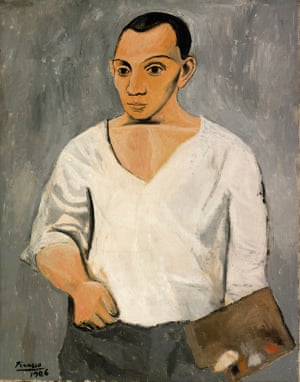
The painting that greets you at the entrance to the National Portrait Gallery’s autumn show is Picasso’s famous Self-portrait with Palette from 1906. It’s pre-cubist but post-blue period, so the young man’s eyes, ears and nose are all pointing in the same direction and his hair isn’t marine-coloured, but a proper Iberian lacquer black. There’s a blank, mask-like quality to the face, yet Picasso is instantly recognisable in the broad fleshy nose and bull neck. At the same time the painting is a clear homage to an earlier self-portrait by Cezanne – there’s the same austerity, the same workmanlike setting – as well as exhibiting a cousinship with Picasso’s own triumphant image of Gertrude Stein, also from 1906 (that basilisk stare and sand-coloured skin). What’s more, by choosing to pose with the paraphernalia of his profession, Picasso puts himself in a tradition of classic portraiture that stretches back centuries to his beloved Goya and Velázquez.

Self-portrait with Palette (1906)
It’s an awful lot for one picture to do, which is why it stands as gatekeeper to an exhibition that sets out to unsettle what we think we know about Picasso, about portraiture, and about Picasso and portraiture. That it is the NPG that is hosting the show adds a further layer of complexity. Set up in 1856 to provide a biography in paint of the men (and very occasional woman) who had made Britain great, the gallery historically had little interest in how portraits were done, or even whether they were done well. All that mattered was whose face was staring back at you from the wall. Picasso Portraits, by contrast, is all about the infinite ways in which the greatest artist of the 20th century tackled his most enduring subject, the human figure. Among the 75 pieces of art on display here, sourced from around the world, you will find dashed-off caricatures, carefully formulated cubes, calm neoclassicism and, during the first four years of the 20th century, an awful lot of blue.
The young Picasso began his career with the long apprenticeship in the human form that every art student, whether in London, Rome, Paris or indeed Barcelona, was obliged to undergo. First came the endless drawing of canonical antique sculpture, then graduation to the life class. Typical too was the insistence of Picasso’s art teacher father that his boy should master the knack of producing “likenesses”, briskly and to order. Portraiture was a steady, well‑paid gig (there were always people vain enough to want to see themselves in paint), and it got you an entrance into the best circles. At the very least, you’d always be able to pay the rent.
But these lapdog aspects of professional face-painting were anathema to Picasso. He never took on a commission and any notable people he painted during his long career – Stein, Stravinsky, Cocteau – were only there by chance, because they were friends or colleagues or had an interesting arrangement of flesh and bone that he itched to get down on paper. And rather than include a famous subject’s name in a painting’s title, Picasso often used the broadest descriptions, such as Woman Ironing or Cubist Head.
Not every sitter was thrilled by these erasures. Dora Maar, Picasso’s lover from the late 1930s, famously said of his pictures of her: “they’re all Picassos, not one is Dora Maar”. But the fact that she made the claim in the bitter years after their relationship ended is often overlooked, allowing the idea to flourish that Picasso was a monomaniac who absorbed other people’s faces into his greedy art with little care for what made them unique. The fact that he often dismissed his sitters after a few hours, preferring to work from their photographs instead, only added to this suspicion that he was not a portraitist but a Picasso-ist, intent on remaking the world, and everyone in it, in his own image.

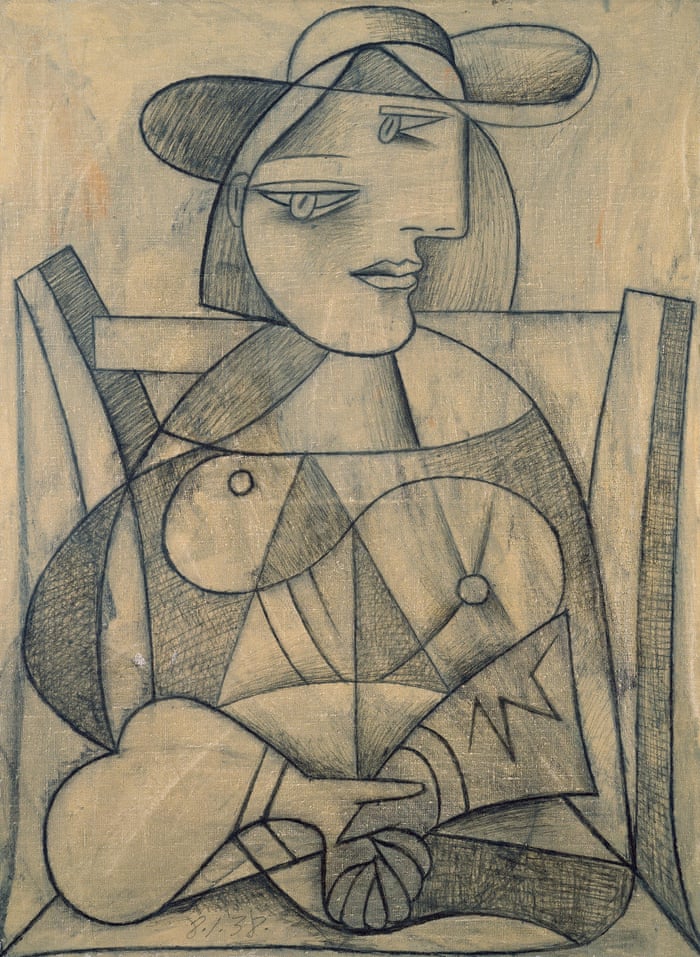
Woman With Joined Hands (1938)
This is unfair, says Elizabeth Cowling, the curator of Picasso Portraits. And to prove it she has grouped together three portraits of three different women painted within a few months of each other in 1938. In Woman With Joined Hands Picasso presents his longtime lover Marie-Thérèse Walter with soft, loving intimacy. Despite being rendered in graphic greys and blacks, Walter resembles nothing so much as a comfortably padded sofa, all folds and creases and cushiony cross-hatching. At the same time her body’s sinuous contours suggest a surging eroticism, one that speaks of pleasurable sexual familiarity rather than piercing desire.

Nush Éluard (1938)
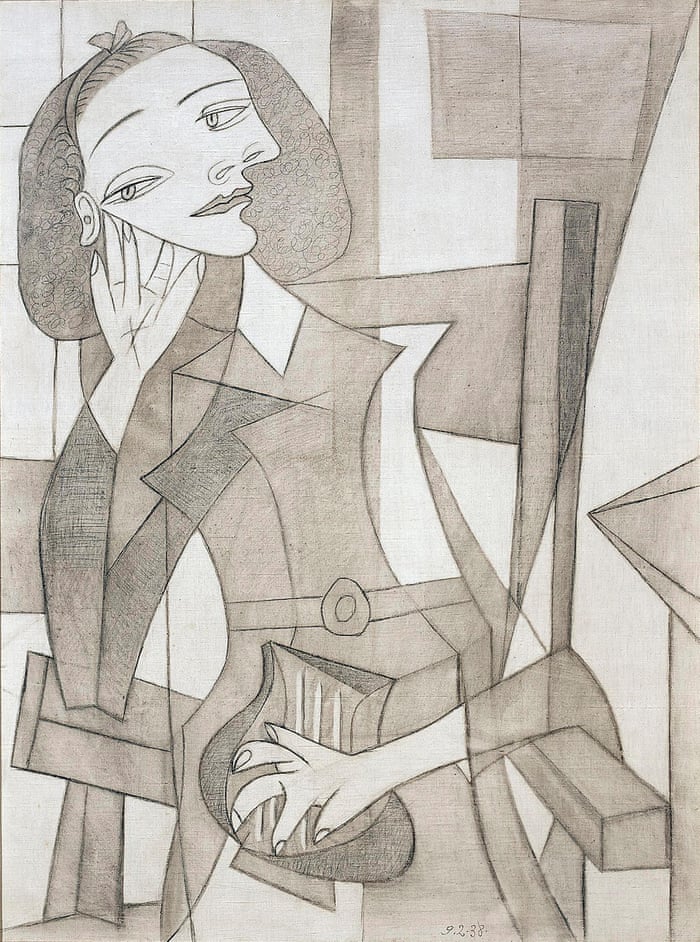
Just a month later Picasso drew Nusch Éluard, the wife of his friend the surrealist poet Paul Éluard. Éluard, a professional acrobat with a light, pliable body, is conveyed in tight angles and wafer-thin planes, her wiry hair rendered in hard squiggles. There is none of the placid softness of Walter in evidence here, and Éluard’s outsized claw-hand is a pointed joke that acrobats, like cats, have nine lives.
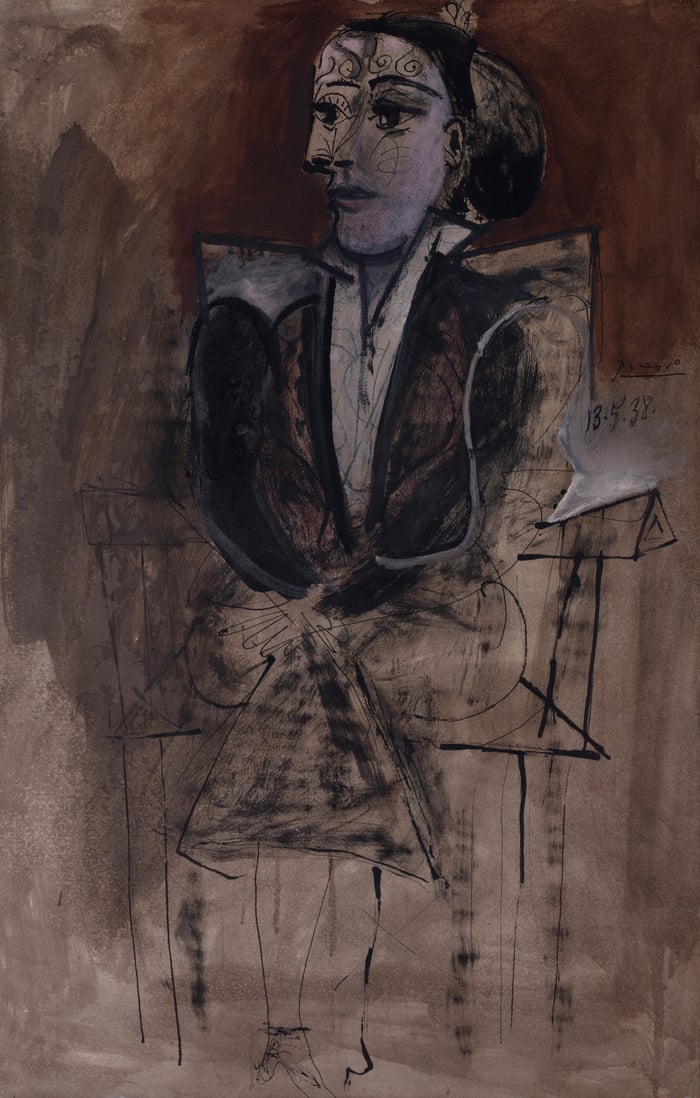
Completing the trio of female portraits from 1938 is Dora Maar Seated. Here Picasso draws his lover, with whom he started a relationship while still with Walter, in a swirl of calligraphic doodles that double crazily back on themselves. This tortured frenzy matched what Picasso called Maar’s “Kafkaesque” personality. Beneath the hectic surface of ink and thinned-out gouache you can make out her tightly clamped-together legs (the couple rowed frequently) as well as references to her studied self-presentation as a Spanish señora straight out of Goya (she was actually French-Croatian). Despite what Maar liked to say, this could only be
Picasso has been accused of remaking the world in his own image, but a new exhibition reveals art that captures the idiosyncrasies of each of his subjects
Kathryn Hughes
Friday 30 September 2016
The painting that greets you at the entrance to the National Portrait Gallery’s autumn show is Picasso’s famous Self-portrait with Palette from 1906. It’s pre-cubist but post-blue period, so the young man’s eyes, ears and nose are all pointing in the same direction and his hair isn’t marine-coloured, but a proper Iberian lacquer black. There’s a blank, mask-like quality to the face, yet Picasso is instantly recognisable in the broad fleshy nose and bull neck. At the same time the painting is a clear homage to an earlier self-portrait by Cezanne – there’s the same austerity, the same workmanlike setting – as well as exhibiting a cousinship with Picasso’s own triumphant image of Gertrude Stein, also from 1906 (that basilisk stare and sand-coloured skin). What’s more, by choosing to pose with the paraphernalia of his profession, Picasso puts himself in a tradition of classic portraiture that stretches back centuries to his beloved Goya and Velázquez.

Self-portrait with Palette (1906)
It’s an awful lot for one picture to do, which is why it stands as gatekeeper to an exhibition that sets out to unsettle what we think we know about Picasso, about portraiture, and about Picasso and portraiture. That it is the NPG that is hosting the show adds a further layer of complexity. Set up in 1856 to provide a biography in paint of the men (and very occasional woman) who had made Britain great, the gallery historically had little interest in how portraits were done, or even whether they were done well. All that mattered was whose face was staring back at you from the wall. Picasso Portraits, by contrast, is all about the infinite ways in which the greatest artist of the 20th century tackled his most enduring subject, the human figure. Among the 75 pieces of art on display here, sourced from around the world, you will find dashed-off caricatures, carefully formulated cubes, calm neoclassicism and, during the first four years of the 20th century, an awful lot of blue.

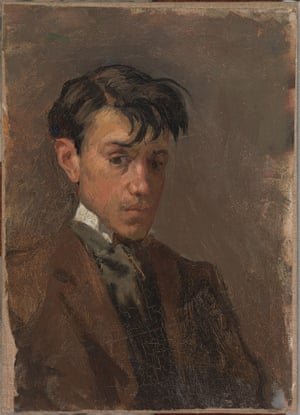
Self-portrait, 1896
The young Picasso began his career with the long apprenticeship in the human form that every art student, whether in London, Rome, Paris or indeed Barcelona, was obliged to undergo. First came the endless drawing of canonical antique sculpture, then graduation to the life class. Typical too was the insistence of Picasso’s art teacher father that his boy should master the knack of producing “likenesses”, briskly and to order. Portraiture was a steady, well‑paid gig (there were always people vain enough to want to see themselves in paint), and it got you an entrance into the best circles. At the very least, you’d always be able to pay the rent.
But these lapdog aspects of professional face-painting were anathema to Picasso. He never took on a commission and any notable people he painted during his long career – Stein, Stravinsky, Cocteau – were only there by chance, because they were friends or colleagues or had an interesting arrangement of flesh and bone that he itched to get down on paper. And rather than include a famous subject’s name in a painting’s title, Picasso often used the broadest descriptions, such as Woman Ironing or Cubist Head.
Not every sitter was thrilled by these erasures. Dora Maar, Picasso’s lover from the late 1930s, famously said of his pictures of her: “they’re all Picassos, not one is Dora Maar”. But the fact that she made the claim in the bitter years after their relationship ended is often overlooked, allowing the idea to flourish that Picasso was a monomaniac who absorbed other people’s faces into his greedy art with little care for what made them unique. The fact that he often dismissed his sitters after a few hours, preferring to work from their photographs instead, only added to this suspicion that he was not a portraitist but a Picasso-ist, intent on remaking the world, and everyone in it, in his own image.

Woman With Joined Hands (1938)
This is unfair, says Elizabeth Cowling, the curator of Picasso Portraits. And to prove it she has grouped together three portraits of three different women painted within a few months of each other in 1938. In Woman With Joined Hands Picasso presents his longtime lover Marie-Thérèse Walter with soft, loving intimacy. Despite being rendered in graphic greys and blacks, Walter resembles nothing so much as a comfortably padded sofa, all folds and creases and cushiony cross-hatching. At the same time her body’s sinuous contours suggest a surging eroticism, one that speaks of pleasurable sexual familiarity rather than piercing desire.

Nush Éluard (1938)
Just a month later Picasso drew Nusch Éluard, the wife of his friend the surrealist poet Paul Éluard. Éluard, a professional acrobat with a light, pliable body, is conveyed in tight angles and wafer-thin planes, her wiry hair rendered in hard squiggles. There is none of the placid softness of Walter in evidence here, and Éluard’s outsized claw-hand is a pointed joke that acrobats, like cats, have nine lives.
Completing the trio of female portraits from 1938 is Dora Maar Seated. Here Picasso draws his lover, with whom he started a relationship while still with Walter, in a swirl of calligraphic doodles that double crazily back on themselves. This tortured frenzy matched what Picasso called Maar’s “Kafkaesque” personality. Beneath the hectic surface of ink and thinned-out gouache you can make out her tightly clamped-together legs (the couple rowed frequently) as well as references to her studied self-presentation as a Spanish señora straight out of Goya (she was actually French-Croatian). Despite what Maar liked to say, this could only be
her.

Dora Maar Seated (1938)
Picasso’s insistence on matching his style to the idiosyncrasies of each sitter has its roots, suggests Cowling, in the artist’s lifelong practice of caricature. Starting as a schoolboy in the 1890s, he delighted in making swift, scabrous sketches of his friends on napkins, torn up bits of paper bag, in the margins of his textbooks. As an adolescent he drew doodles of his art school colleagues, and later it would be dealers, patrons, rivals and friends, whom he dashed down in a few bold strokes – here an elongated neck, there a ridiculous moustache or odd pair of glasses. These were in-jokes, a way of cementing bonds in a homosocial atmosphere that was also deeply competitive: so the artist Josep Rocarol i Faura is drawn, flushed and sloppy from too much absinthe, while the small and prudish Jaume Sabartés is shown leering at nubile pin-ups ripped from magazines.
Humorous Composition: Jaume Sabartés and Esther Williams by Pablo Picasso, (1957)

Gustave Coquiot (1901)
Portrait of Daniel-Henry Kahnweiler (1910)
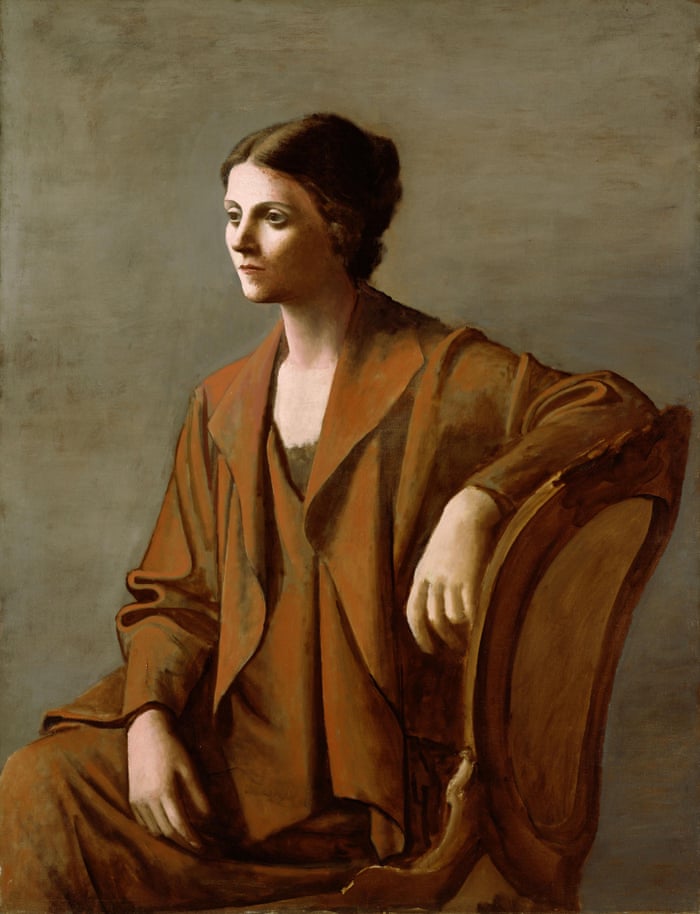
Portrait of Olga Picasso, 1923
Picasso’s insistence on matching his style to the idiosyncrasies of each sitter has its roots, suggests Cowling, in the artist’s lifelong practice of caricature. Starting as a schoolboy in the 1890s, he delighted in making swift, scabrous sketches of his friends on napkins, torn up bits of paper bag, in the margins of his textbooks. As an adolescent he drew doodles of his art school colleagues, and later it would be dealers, patrons, rivals and friends, whom he dashed down in a few bold strokes – here an elongated neck, there a ridiculous moustache or odd pair of glasses. These were in-jokes, a way of cementing bonds in a homosocial atmosphere that was also deeply competitive: so the artist Josep Rocarol i Faura is drawn, flushed and sloppy from too much absinthe, while the small and prudish Jaume Sabartés is shown leering at nubile pin-ups ripped from magazines.
The poet Guillaume Apollinaire is made into a fat businessman (he was actually a bank clerk) with a pear-shaped head. Far from being insulted by his friend’s view of him, Apollinaire treasured Picasso’s scrawls as tokens of affectionate attention.
It has been customary to ignore this aspect of Picasso’s work, to classify his caricatures as byproducts – waste products, even – of the finer kind of art with which he was concerned over six decades. But, suggests the exhibition, it was in these quick-fire sketches that he honed the ability to edit, distil and exaggerate details that allowed him to produce portraits that went far beyond mere surface likeness, and penetrated instead to the essence of each sitter. “There are so many realities that in trying to encompass them all one ends in darkness,” Picasso once explained. “That is why, when one paints a portrait, one must stop somewhere, in a sort of caricature.” Later, this too became pithily contracted to “all portraiture is caricature”.

Gustave Coquiot (1901)
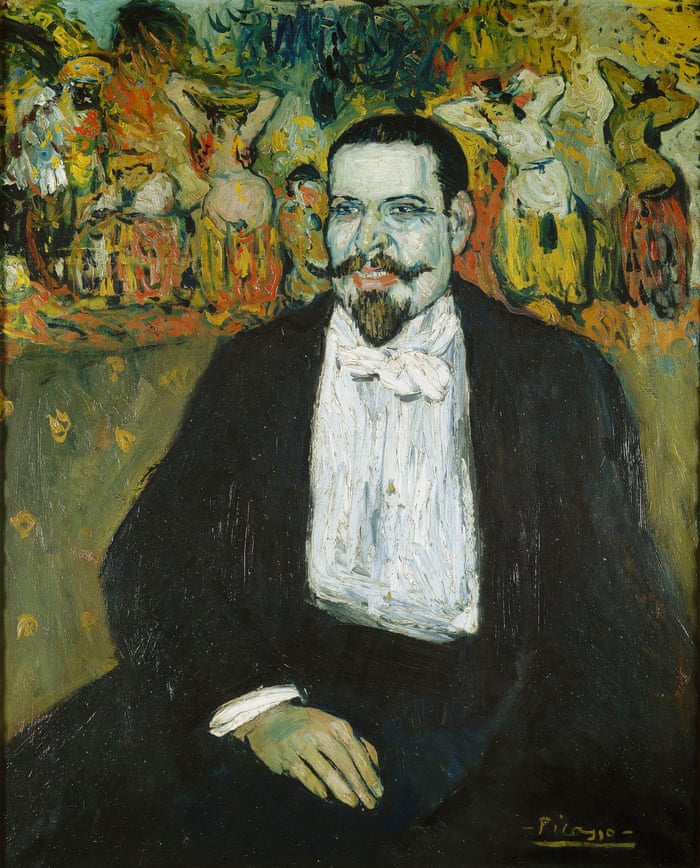
You can see this principle at work in an early portrait of Gustave Coquiot, a louche Parisian critic about town. The portrait is a thank you present for a nice review that Coquiot had recently written of the young man’s work, yet there is nothing remotely ingratiating about it. Coquiot is shown with a wet lascivious grin sheltering under a ludicrously twisty moustache while near-naked showgirls bump and grind in the background. Coquiot’s hand, resting on his lap, looks as though it is positioned to conceal an incipient erection. But if this is smut, it is smut with a point to it: in setting and style Picasso knowingly channels Toulouse-Lautrec, the pre-eminent genre painter of Parisian flânerie, an art historical reference he knew would tickle Coquiot’s vanity.
Even when Picasso moved decisively away from descriptive naturalism, there is never any sense that he is slighting his human subjects. Instead, he sought always to find the details that made individuals instantly recognisable to themselves and to others. One of the jewels in the NPG exhibition is Picasso’s 1910 portrait of art dealer Daniel-Henry Kahnweiler, a cubist masterpiece that rarely leaves the Art Institute of Chicago.
At first glance the picture seems to be merely a metre-high arrangement of grey and sludge-coloured squares. Gradually, though, the eye settles and the pattern resolves so that beneath the facets you begin to see the soft but certain form of a bourgeois man. There is his beaky nose, his wings of oiled wavy hair, his neatly folded hands, his watch chain.
Far from being random, each of these details is part of a caricatural shorthand. Kahnweiler was famously punctual, which explains the watch chain. He was notoriously abstemious, hence the way that the wine glasses that so often figure in cubist paintings have been replaced on this occasion by medicine bottles. These in-jokes add up to an image that is designed to be instantly readable to those who knew Kahnweiler well, yet still speak to those who have never set eyes on the subject of Picasso’s portrait.

Woman in a Hat (Olga) (1935)
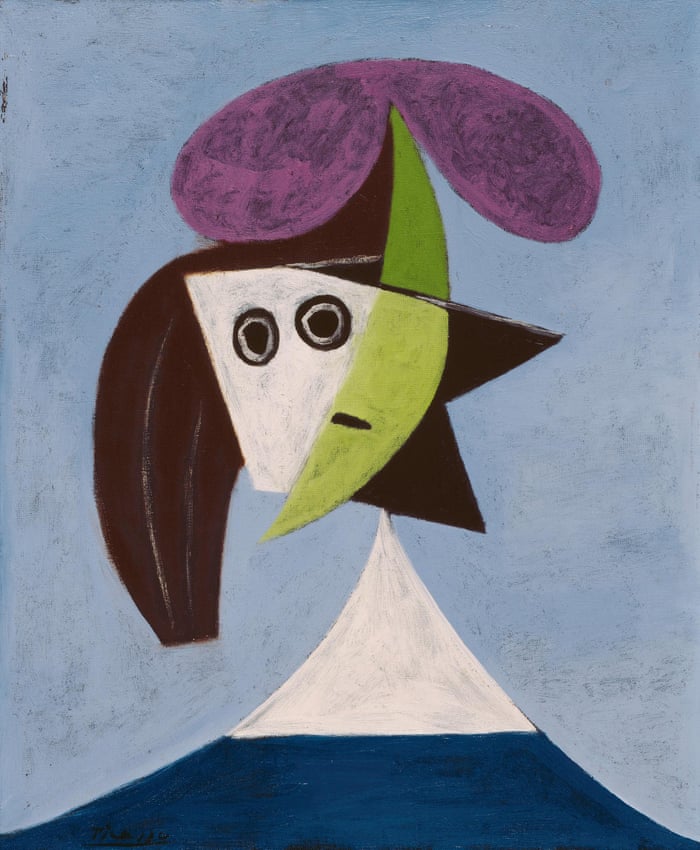
Nor did Picasso paint his people in an eternal present. He used his repertoire of gestures honed from years of doing caricatures not to generalise about a face, to fix it for all time, but to capture its quiddity. Some of the most expressive pieces in the exhibition are those of his many lovers during the dying days of their relationships. Woman in a Hat (Olga) (1935) shows his first wife’s face segmented between sickly chalk white and venomous green. Her eyes are deep black holes, staring with fatigue and disappointment, while her mouth is a downward slit. The stiffly lacquered hair and purple hat, meanwhile, speak of a desperate need to put a good face on things going very wrong indeed. Its fractured desperation stands in extraordinary contrast to the luminous neoclassical portrait Picasso had completed of Olga 12 years earlier in which she is portrayed as entirely in charge of herself, as serene as a Roman matron.

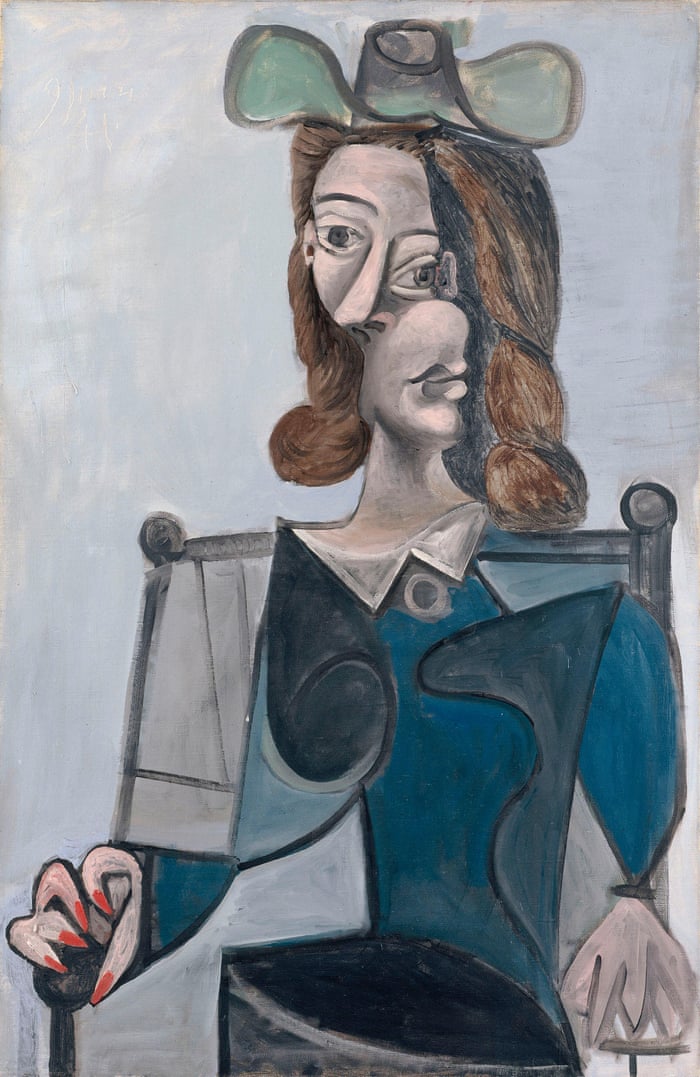
And then there is another woman in another hat, this time from 1941. It is Dora Maar, painted at the moment when she and Picasso returned to Nazi-occupied Paris to discover horrors that they could not quite believe. Like Olga, Dora is trying to hold herself together, smart in a business-like suit. Her jaunty hat, however, is woefully small for a giant head that looks anxiously in two directions at once, alert to the sound of tramping boots or a knock on the door. Her body, rigid with fear, seems to have become fused to the chair on which she perches (even Picasso’s most non-naturalistic portraits used the standard seated pose from classical tradition). And then there are the hands, clawed with tension, the nails painted a ripe red, suggesting that a fight to the death may already be going on in the streets below.

Woman in Hat (1941)
Here, surely, is Picasso’s definitive riposte to anyone who maintained, still maintains in fact, that his portraiture was indifferent to its subjects and careless about their circumstances. What he had actually done was take a moribund tradition, concerned with commemoration of the blandest kind, and wrench it back to thrilling life.
• Picasso Portraits is at the National Portrait Gallery, London WC2, from 6 October. npg.org.uk.
Tuesday, 18 October 2016
Happy 90th birthday, Chuck Berry!
Just don't use his bathroom.
Happy birthday, Chuck, without whom etc etc.
Monday, 17 October 2016
Bob Dylan talks about Leonard Cohen...

From Leonard Cohen makes it darker
At eighty-two, the troubadour has another album coming. Like him, it is obsessed with mortality, God-infused, and funny.
David Remnick
The New Yorker
17 October 2016
Dylan, who is seventy-five, doesn’t often play the role of music critic, but he proved eager to discuss Leonard Cohen. I put a series of questions to him about 'Number 1', and he answered in a detailed, critical way—nothing cryptic or elusive.
“When people talk about Leonard, they fail to mention his melodies, which to me, along with his lyrics, are his greatest genius,” Dylan said. “Even the counterpoint lines—they give a celestial character and melodic lift to every one of his songs. As far as I know, no one else comes close to this in modern music. Even the simplest song, like ‘The Law,’ which is structured on two fundamental chords, has counterpoint lines that are essential, and anybody who even thinks about doing this song and loves the lyrics would have to build around the counterpoint lines.
“His gift or genius is in his connection to the music of the spheres,” Dylan went on. “In the song ‘Sisters of Mercy,’ for instance, the verses are four elemental lines which change and move at predictable intervals . . . but the tune is anything but predictable. The song just comes in and states a fact. And after that anything can happen and it does, and Leonard allows it to happen. His tone is far from condescending or mocking. He is a tough-minded lover who doesn’t recognize the brush-off. Leonard’s always above it all. ‘Sisters of Mercy’ is verse after verse of four distinctive lines, in perfect meter, with no chorus, quivering with drama. The first line begins in a minor key. The second line goes from minor to major and steps up, and changes melody and variation. The third line steps up even higher than that to a different degree, and then the fourth line comes back to the beginning. This is a deceptively unusual musical theme, with or without lyrics. But it’s so subtle a listener doesn’t realize he’s been taken on a musical journey and dropped off somewhere, with or without lyrics.”
In the late eighties, Dylan performed “Hallelujah” on the road as a roughshod blues with a sly, ascending chorus. His version sounds less like the prettified Jeff Buckley version than like a work by John Lee Hooker. “That song ‘Hallelujah’ has resonance for me,” Dylan said. “There again, it’s a beautifully constructed melody that steps up, evolves, and slips back, all in quick time. But this song has a connective chorus, which when it comes in has a power all of its own. The ‘secret chord’ and the point-blank I-know-you-better-than-you-know-yourself aspect of the song has plenty of resonance for me.”
I asked Dylan whether he preferred Cohen’s later work, so colored with intimations of the end. “I like all of Leonard’s songs, early or late,” he said. “ ‘Going Home,’ ‘Show Me the Place,’ ‘The Darkness.’ These are all great songs, deep and truthful as ever and multidimensional, surprisingly melodic, and they make you think and feel. I like some of his later songs even better than his early ones. Yet there’s a simplicity to his early ones that I like, too.”
Dylan defended Cohen against the familiar critical reproach that his is music to slit your wrists by. He compared him to the Russian Jewish immigrant who wrote “Easter Parade.” “I see no disenchantment in Leonard’s lyrics at all,” Dylan said. “There’s always a direct sentiment, as if he’s holding a conversation and telling you something, him doing all the talking, but the listener keeps listening. He’s very much a descendant of Irving Berlin, maybe the only songwriter in modern history that Leonard can be directly related to. Berlin’s songs did the same thing. Berlin was also connected to some kind of celestial sphere. And, like Leonard, he probably had no classical-music training, either. Both of them just hear melodies that most of us can only strive for. Berlin’s lyrics also fell into place and consisted of half lines, full lines at surprising intervals, using simple elongated words. Both Leonard and Berlin are incredibly crafty. Leonard particularly uses chord progressions that seem classical in shape. He is a much more savvy musician than you’d think.”
“When people talk about Leonard, they fail to mention his melodies, which to me, along with his lyrics, are his greatest genius,” Dylan said. “Even the counterpoint lines—they give a celestial character and melodic lift to every one of his songs. As far as I know, no one else comes close to this in modern music. Even the simplest song, like ‘The Law,’ which is structured on two fundamental chords, has counterpoint lines that are essential, and anybody who even thinks about doing this song and loves the lyrics would have to build around the counterpoint lines.
“His gift or genius is in his connection to the music of the spheres,” Dylan went on. “In the song ‘Sisters of Mercy,’ for instance, the verses are four elemental lines which change and move at predictable intervals . . . but the tune is anything but predictable. The song just comes in and states a fact. And after that anything can happen and it does, and Leonard allows it to happen. His tone is far from condescending or mocking. He is a tough-minded lover who doesn’t recognize the brush-off. Leonard’s always above it all. ‘Sisters of Mercy’ is verse after verse of four distinctive lines, in perfect meter, with no chorus, quivering with drama. The first line begins in a minor key. The second line goes from minor to major and steps up, and changes melody and variation. The third line steps up even higher than that to a different degree, and then the fourth line comes back to the beginning. This is a deceptively unusual musical theme, with or without lyrics. But it’s so subtle a listener doesn’t realize he’s been taken on a musical journey and dropped off somewhere, with or without lyrics.”
In the late eighties, Dylan performed “Hallelujah” on the road as a roughshod blues with a sly, ascending chorus. His version sounds less like the prettified Jeff Buckley version than like a work by John Lee Hooker. “That song ‘Hallelujah’ has resonance for me,” Dylan said. “There again, it’s a beautifully constructed melody that steps up, evolves, and slips back, all in quick time. But this song has a connective chorus, which when it comes in has a power all of its own. The ‘secret chord’ and the point-blank I-know-you-better-than-you-know-yourself aspect of the song has plenty of resonance for me.”
I asked Dylan whether he preferred Cohen’s later work, so colored with intimations of the end. “I like all of Leonard’s songs, early or late,” he said. “ ‘Going Home,’ ‘Show Me the Place,’ ‘The Darkness.’ These are all great songs, deep and truthful as ever and multidimensional, surprisingly melodic, and they make you think and feel. I like some of his later songs even better than his early ones. Yet there’s a simplicity to his early ones that I like, too.”
Dylan defended Cohen against the familiar critical reproach that his is music to slit your wrists by. He compared him to the Russian Jewish immigrant who wrote “Easter Parade.” “I see no disenchantment in Leonard’s lyrics at all,” Dylan said. “There’s always a direct sentiment, as if he’s holding a conversation and telling you something, him doing all the talking, but the listener keeps listening. He’s very much a descendant of Irving Berlin, maybe the only songwriter in modern history that Leonard can be directly related to. Berlin’s songs did the same thing. Berlin was also connected to some kind of celestial sphere. And, like Leonard, he probably had no classical-music training, either. Both of them just hear melodies that most of us can only strive for. Berlin’s lyrics also fell into place and consisted of half lines, full lines at surprising intervals, using simple elongated words. Both Leonard and Berlin are incredibly crafty. Leonard particularly uses chord progressions that seem classical in shape. He is a much more savvy musician than you’d think.”
Bob Dylan - Early Roman Kings at Desert Trip 2016
Sunday, 16 October 2016
Saturday, 15 October 2016
Bob Dylan on the Nobel Prize; Leonard Cohen on Bob Dylan, songwriting and life...
Leonard Cohen: giving Nobel to Bob Dylan like 'pinning medal on Everest'
At an event in Los Angeles to launch his album, the 82-year-old singer-songwriter rows back on claims he was ‘ready to die’ by saying he now wants to live for ever
Guardian staff
Friday 14 October 2016
On Thursday, Bob Dylan was awarded the Nobel prize for literature, sparking controversy among musicians, novelists and fans. That evening in Los Angeles, his songwriting peer and friend Leonard Cohen gave his thoughts on Dylan’s award. “To me,” he said, “[the award] is like pinning a medal on Mount Everest for being the highest mountain.”
Cohen was speaking at a playback and Q&A for his forthcoming album, You Want It Darker. In a recent interview with the New Yorker, to the consternation of fans the 82-year-old had announced: “I am ready to die.” However, on Thursday evening seemed to have reconsidered his stance.
“I think I was exaggerating,” Cohen told the audience, according to Billboard. “I’ve always been into self-dramatization. I intend to live forever.” At the end of the event, at which Cohen divulged his plans to release another pair of albums after You Want it Darker, the songwriter told the audience: “I hope we can do this again. I intend to stick around until 120.”
Cohen returned to the subject of Dylan when talking about the way he writes songs. “I think that Bob Dylan knows this more than all of us: you don’t write the songs anyhow,” he said. “So if you’re lucky, you can keep the vehicle healthy and responsive over the years. If you’re lucky, your own intentions have very little to do with this. You can keep the body as well-oiled and receptive as possible, but whether you’re actually going to be able to go for the long haul is really not your own choice.”
His own songs come slowly, he says: “It comes kind of by dribbles and drops. Some people are graced with a flow; some people are graced with something less than a flow. I’m one of those.” He added: “The fact that my songs take a long time to write is no guarantee of their excellence.”
An ordained Zen Buddhist monk who nevertheless still cleaves to Judaism, Cohen has long explored religious themes in his work – as has Dylan. Nevertheless, Cohen told the audience: “I’ve never thought of myself as a religious person. I don’t have any spiritual strategy. I kind of limp along like so many of us do in these realms. Occasionally I’ve felt the grace of another presence in my life. But I can’t develop any kind of spiritual structure on that.”
Cohen added: “This biblical landscape is very familiar to me, and it’s natural that I use those landmarks as references. Once they were universal references, and everybody understood and knew them. That’s no longer the case today, but it is still my landscape. I try to make those references. I try to make sure they’re not too obscure. But outside of that, I can’t – I dare not – claim anything in the spiritual realm for my own.”
Cohen was speaking at a playback and Q&A for his forthcoming album, You Want It Darker. In a recent interview with the New Yorker, to the consternation of fans the 82-year-old had announced: “I am ready to die.” However, on Thursday evening seemed to have reconsidered his stance.
“I think I was exaggerating,” Cohen told the audience, according to Billboard. “I’ve always been into self-dramatization. I intend to live forever.” At the end of the event, at which Cohen divulged his plans to release another pair of albums after You Want it Darker, the songwriter told the audience: “I hope we can do this again. I intend to stick around until 120.”
Cohen returned to the subject of Dylan when talking about the way he writes songs. “I think that Bob Dylan knows this more than all of us: you don’t write the songs anyhow,” he said. “So if you’re lucky, you can keep the vehicle healthy and responsive over the years. If you’re lucky, your own intentions have very little to do with this. You can keep the body as well-oiled and receptive as possible, but whether you’re actually going to be able to go for the long haul is really not your own choice.”
His own songs come slowly, he says: “It comes kind of by dribbles and drops. Some people are graced with a flow; some people are graced with something less than a flow. I’m one of those.” He added: “The fact that my songs take a long time to write is no guarantee of their excellence.”
An ordained Zen Buddhist monk who nevertheless still cleaves to Judaism, Cohen has long explored religious themes in his work – as has Dylan. Nevertheless, Cohen told the audience: “I’ve never thought of myself as a religious person. I don’t have any spiritual strategy. I kind of limp along like so many of us do in these realms. Occasionally I’ve felt the grace of another presence in my life. But I can’t develop any kind of spiritual structure on that.”
Cohen added: “This biblical landscape is very familiar to me, and it’s natural that I use those landmarks as references. Once they were universal references, and everybody understood and knew them. That’s no longer the case today, but it is still my landscape. I try to make those references. I try to make sure they’re not too obscure. But outside of that, I can’t – I dare not – claim anything in the spiritual realm for my own.”
Friday, 14 October 2016
Dead Poets Society #13 Emily Dickinson: There Is No Frigate Like A Book
There Is No Frigate Like A Book by Emily Dickinson
There is no frigate like a book
To take us lands away,
Nor any coursers like a page
Of prancing poetry.
This traverse may the poorest take
Without oppress of toll;
How frugal is the chariot
That bears a human soul!
Thursday, 13 October 2016
Bob Dylan awarded Nobel Prize in Literature

Bob Dylan Awarded Nobel Prize in Literature
The singer and songwriter Bob Dylan, 75, won the prize on Thursday
Sewell Chan and Ben Sisario
The New York Times
The singer and songwriter Bob Dylan, one of the world’s most influential musicians, was awarded the Nobel Prize in Literature on Thursday for “having created new poetic expressions within the great American song tradition,” in the words of the Swedish Academy.
He is the first American to win the prize since the novelist Toni Morrison, in 1993. The announcement, in Stockholm, was a surprise: Although Mr. Dylan, 75, has been mentioned often as having an outside shot at the prize, his work does not fit into the literary canons of novels, poetry and short stories that the prize has traditionally recognized.
“Mr. Dylan’s work remains utterly lacking in conventionality, moral sleight of hand, pop pabulum or sops to his audience,” Bill Wyman, a journalist, wrote in a 2013 Op-Ed essay in The New York Times arguing for Mr. Dylan to get the award. “His lyricism is exquisite; his concerns and subjects are demonstrably timeless; and few poets of any era have seen their work bear more influence.”
Sara Danius, a literary scholar and the permanent secretary of the 18-member Swedish Academy, which awards the prize, called Mr. Dylan “a great poet in the English-speaking tradition” and compared him to Homer and Sappho, whose work was delivered orally. Asked if the decision to award the prize to a musician signaled a broadening in the definition of literature, Ms. Danius jokingly responded, “The times they are a changing, perhaps,” referencing one of Mr. Dylan’s songs.
Mr. Dylan emerged on the New York music scene in 1961 as an artist in the tradition of Woody Guthrie, singing protest songs and strumming an acoustic guitar in clubs and cafes in Greenwich Village. But from the start, Mr. Dylan stood out for dazzling lyrics and an oblique songwriting style that made him a source of fascination for artists and critics. In 1963, the folk group Peter, Paul and Mary reached No. 2 on the Billboard pop chart with a version of his song “Blowin’ in the Wind,” with ambiguous refrains that evoked Ecclesiastes.
Within a few years, Mr. Dylan was confounding the very notion of folk music, with ever more complex songs and moves toward a more rock ’n’ roll sound. In 1965, he played with an electric rock band at the Newport Folk Festival, stewing controversy from folk purists who accused him of selling out.
After reports of a motorcycle accident in 1966 near his home in Woodstock, N.Y., Mr. Dylan withdrew further from public life but remained intensely fertile as a songwriter. His career has continued to surprise fans and critics and has led to one of the most densely analyzed bodies of work in the history of pop music.
His 1975 album “Blood on the Tracks” was interpreted as a supremely powerful account of the breakdown of a relationship, but just four years later the Christian themes of “Slow Train Coming” divided critics. His most recent two albums were chestnuts of traditional pop that had been associated with Frank Sinatra.
Since 1988, Mr. Dylan has toured almost constantly, inspiring an unofficial name for his itinerary, the Never Ending Tour. Last weekend, he played the first of two performances at Desert Trip, a festival in Indio, Calif., that also featured the Rolling Stones, Paul McCartney and other stars of the 1960s.
Mr. Dylan was born on May 24, 1941, in Duluth, Minn., and grew up in Hibbing. He played in bands as a teenager, influenced by the folk musician Woody Guthrie, the authors of the Beat Generation and modernist poets.
Mr. Dylan, whose original name is Robert Allen Zimmerman, identifies as Christian and has released several albums of religiously inspired songs, but he was born into a Jewish family.
The critic Greil Marcus, one of the foremost scholars of Mr. Dylan’s work, has examined the influence on his music of Harry Smith’s “Anthology of American Folk Music,” a 1952 compilation that was pivotal to the folk revival in the United States. Mr. Dylan first heard the anthology in 1959 after he had dropped out of the University of Minnesota.
In 1962, Mr. Dylan signed a contract with the record producer John Hammond for his debut album, “Bob Dylan.” He was only 22 when he performed at the March on Washington for Jobs and Freedom, singing “When the Ship Comes In,” with Joan Baez, and “Only a Pawn in Their Game,” a retelling of the murder of the civil rights activist Medgar Evers, before the Rev. Dr. Martin Luther King Jr. delivered his “I Have a Dream” speech.
“As the ’60s wore on,” Giles Harvey wrote in The New York Review of Books in 2010, “Dylan grew increasingly frustrated with what he came to regard as the pious sloganeering and doctrinaire leftist politics of the folk milieu.” He “began writing a kind of visionary nonsense verse, in which the rough, ribald, lawless America of the country’s traditional folk music collided with a surreal ensemble of characters from history, literature, legend, the Bible, and many other places besides.”
David Hajdu, a music critic for The Nation who has written extensively about Mr. Dylan and his contemporaries, said that the Nobel recognition was long overdue and that it may be intended in part to honor the broader American music movement that Mr. Dylan emerged from.
“It’s partly a recognition of the whole tradition that Bob Dylan represents, so it’s partly a retroactive award for Robert Johnson and Hank Williams and Smokey Robinson and the Beatles,” Mr. Hajdu said in an interview on Thursday. “It should have been taken seriously as an art form a long time ago.”
In giving the literature prize to Mr. Dylan, the Nobel committee may also be recognizing that the gap between high art and more commercial art forms has narrowed.
“It’s literature but it’s music, it’s performance, it’s art, it’s also highly commercial,” Mr. Hajdu said. “The old categories of high and low art, they’ve been collapsing for a long time, but this is it being made official.”
Mr. Dylan’s many albums, which the Swedish Academy described as having “a tremendous impact on popular music,” include “Bringing It All Back Home” and “Highway 61 Revisited” (1965), “Blonde On Blonde” (1966) and “Blood on the Tracks” (1975), “Oh Mercy” (1989), “Time Out Of Mind” (1997), “Love and Theft” (2001) and “Modern Times” (2006).
“Dylan has recorded a large number of albums revolving around topics like the social conditions of man, religion, politics and love,” the Swedish Academy said in a biographical note accompanying the announcement. “The lyrics have continuously been published in new editions, under the title ‘Lyrics.’ As an artist, he is strikingly versatile; he has been active as painter, actor and scriptwriter.”
The academy added: “Since the late 1980s, Bob Dylan has toured persistently, an undertaking called the ‘Never-Ending Tour.’ Dylan has the status of an icon. His influence on contemporary music is profound, and he is the object of a steady stream of secondary literature.”
Along with his albums, Mr. Dylan has produced experimental work like “Tarantula,” a 1971 collection of prose poetry, and “Writings and Drawings,” a 1973 compilation. The first volume of his autobiography, “Chronicles,” published in 2004, recounts his early years in New York, where he moved at age 19.
Mr. Dylan’s many honors include Grammy, Academy and Golden Globe awards; he was inducted into the Rock & Roll Hall of Fame in 1988 and was awarded the Presidential Medal of Freedom in 2012. “By the time he was 23, Bob’s voice, with its weight, its unique, gravelly power, was redefining not just what music sounded like, but the message it carried and how it made people feel,” President Obama said at the White House ceremony. “Today, everybody from Bruce Springsteen to U2 owes Bob a debt of gratitude. There is not a bigger giant in the history of American music. All these years later, he’s still chasing that sound, still searching for a little bit of truth. And I have to say that I am a really big fan.”
The singer and songwriter Bob Dylan, 75, won the prize on Thursday
Sewell Chan and Ben Sisario
The New York Times
13 October 2016
The singer and songwriter Bob Dylan, one of the world’s most influential musicians, was awarded the Nobel Prize in Literature on Thursday for “having created new poetic expressions within the great American song tradition,” in the words of the Swedish Academy.
He is the first American to win the prize since the novelist Toni Morrison, in 1993. The announcement, in Stockholm, was a surprise: Although Mr. Dylan, 75, has been mentioned often as having an outside shot at the prize, his work does not fit into the literary canons of novels, poetry and short stories that the prize has traditionally recognized.
“Mr. Dylan’s work remains utterly lacking in conventionality, moral sleight of hand, pop pabulum or sops to his audience,” Bill Wyman, a journalist, wrote in a 2013 Op-Ed essay in The New York Times arguing for Mr. Dylan to get the award. “His lyricism is exquisite; his concerns and subjects are demonstrably timeless; and few poets of any era have seen their work bear more influence.”
Sara Danius, a literary scholar and the permanent secretary of the 18-member Swedish Academy, which awards the prize, called Mr. Dylan “a great poet in the English-speaking tradition” and compared him to Homer and Sappho, whose work was delivered orally. Asked if the decision to award the prize to a musician signaled a broadening in the definition of literature, Ms. Danius jokingly responded, “The times they are a changing, perhaps,” referencing one of Mr. Dylan’s songs.
Mr. Dylan emerged on the New York music scene in 1961 as an artist in the tradition of Woody Guthrie, singing protest songs and strumming an acoustic guitar in clubs and cafes in Greenwich Village. But from the start, Mr. Dylan stood out for dazzling lyrics and an oblique songwriting style that made him a source of fascination for artists and critics. In 1963, the folk group Peter, Paul and Mary reached No. 2 on the Billboard pop chart with a version of his song “Blowin’ in the Wind,” with ambiguous refrains that evoked Ecclesiastes.
Within a few years, Mr. Dylan was confounding the very notion of folk music, with ever more complex songs and moves toward a more rock ’n’ roll sound. In 1965, he played with an electric rock band at the Newport Folk Festival, stewing controversy from folk purists who accused him of selling out.
After reports of a motorcycle accident in 1966 near his home in Woodstock, N.Y., Mr. Dylan withdrew further from public life but remained intensely fertile as a songwriter. His career has continued to surprise fans and critics and has led to one of the most densely analyzed bodies of work in the history of pop music.
His 1975 album “Blood on the Tracks” was interpreted as a supremely powerful account of the breakdown of a relationship, but just four years later the Christian themes of “Slow Train Coming” divided critics. His most recent two albums were chestnuts of traditional pop that had been associated with Frank Sinatra.
Since 1988, Mr. Dylan has toured almost constantly, inspiring an unofficial name for his itinerary, the Never Ending Tour. Last weekend, he played the first of two performances at Desert Trip, a festival in Indio, Calif., that also featured the Rolling Stones, Paul McCartney and other stars of the 1960s.
Mr. Dylan was born on May 24, 1941, in Duluth, Minn., and grew up in Hibbing. He played in bands as a teenager, influenced by the folk musician Woody Guthrie, the authors of the Beat Generation and modernist poets.
Mr. Dylan, whose original name is Robert Allen Zimmerman, identifies as Christian and has released several albums of religiously inspired songs, but he was born into a Jewish family.
The critic Greil Marcus, one of the foremost scholars of Mr. Dylan’s work, has examined the influence on his music of Harry Smith’s “Anthology of American Folk Music,” a 1952 compilation that was pivotal to the folk revival in the United States. Mr. Dylan first heard the anthology in 1959 after he had dropped out of the University of Minnesota.
In 1962, Mr. Dylan signed a contract with the record producer John Hammond for his debut album, “Bob Dylan.” He was only 22 when he performed at the March on Washington for Jobs and Freedom, singing “When the Ship Comes In,” with Joan Baez, and “Only a Pawn in Their Game,” a retelling of the murder of the civil rights activist Medgar Evers, before the Rev. Dr. Martin Luther King Jr. delivered his “I Have a Dream” speech.
“As the ’60s wore on,” Giles Harvey wrote in The New York Review of Books in 2010, “Dylan grew increasingly frustrated with what he came to regard as the pious sloganeering and doctrinaire leftist politics of the folk milieu.” He “began writing a kind of visionary nonsense verse, in which the rough, ribald, lawless America of the country’s traditional folk music collided with a surreal ensemble of characters from history, literature, legend, the Bible, and many other places besides.”
David Hajdu, a music critic for The Nation who has written extensively about Mr. Dylan and his contemporaries, said that the Nobel recognition was long overdue and that it may be intended in part to honor the broader American music movement that Mr. Dylan emerged from.
“It’s partly a recognition of the whole tradition that Bob Dylan represents, so it’s partly a retroactive award for Robert Johnson and Hank Williams and Smokey Robinson and the Beatles,” Mr. Hajdu said in an interview on Thursday. “It should have been taken seriously as an art form a long time ago.”
In giving the literature prize to Mr. Dylan, the Nobel committee may also be recognizing that the gap between high art and more commercial art forms has narrowed.
“It’s literature but it’s music, it’s performance, it’s art, it’s also highly commercial,” Mr. Hajdu said. “The old categories of high and low art, they’ve been collapsing for a long time, but this is it being made official.”
Mr. Dylan’s many albums, which the Swedish Academy described as having “a tremendous impact on popular music,” include “Bringing It All Back Home” and “Highway 61 Revisited” (1965), “Blonde On Blonde” (1966) and “Blood on the Tracks” (1975), “Oh Mercy” (1989), “Time Out Of Mind” (1997), “Love and Theft” (2001) and “Modern Times” (2006).
“Dylan has recorded a large number of albums revolving around topics like the social conditions of man, religion, politics and love,” the Swedish Academy said in a biographical note accompanying the announcement. “The lyrics have continuously been published in new editions, under the title ‘Lyrics.’ As an artist, he is strikingly versatile; he has been active as painter, actor and scriptwriter.”
The academy added: “Since the late 1980s, Bob Dylan has toured persistently, an undertaking called the ‘Never-Ending Tour.’ Dylan has the status of an icon. His influence on contemporary music is profound, and he is the object of a steady stream of secondary literature.”
Along with his albums, Mr. Dylan has produced experimental work like “Tarantula,” a 1971 collection of prose poetry, and “Writings and Drawings,” a 1973 compilation. The first volume of his autobiography, “Chronicles,” published in 2004, recounts his early years in New York, where he moved at age 19.
Mr. Dylan’s many honors include Grammy, Academy and Golden Globe awards; he was inducted into the Rock & Roll Hall of Fame in 1988 and was awarded the Presidential Medal of Freedom in 2012. “By the time he was 23, Bob’s voice, with its weight, its unique, gravelly power, was redefining not just what music sounded like, but the message it carried and how it made people feel,” President Obama said at the White House ceremony. “Today, everybody from Bruce Springsteen to U2 owes Bob a debt of gratitude. There is not a bigger giant in the history of American music. All these years later, he’s still chasing that sound, still searching for a little bit of truth. And I have to say that I am a really big fan.”
The Nobel comes with a prize of 8 million Swedish kronor, or just over $900,000. The literature prize is given for a lifetime of writing rather than for a single work.
Wednesday, 12 October 2016
Brian Wilson interview 2016
Brian Wilson Talks Mental Illness, Drugs and Life After Beach Boys
Singer-songwriter explains how new memoir 'I Am Brian Wilson' sets the record straightKory Gow
Rolling Stone
10 October 2016
It's a warm June afternoon in New York City, and Brian Wilson is casually leaning back in a chair in a luxurious midtown hotel room. His arms are folded, and he occasionally looks at his watch. It's the body language of someone who's guarded, standoffish. When he speaks, however, it's a different story.
A few days earlier, the singer-songwriter and founding Beach Boy celebrated his 74th birthday and when the subject comes up, his eyes widen. "It was the greatest birthday of my life," he says, uncrossing his arms. "We went to a place called Peter Luger's [Steakhouse]. You gotta go there; you will fucking love it. I had the greatest steak dinner that I ever had in my whole life." He waits a beat and raises his voice. "In my whole life!"
Wilson has spent a lot of time thinking about his whole life lately, as he worked on I Am Brian Wilson: A Memoir, his second autobiography, following up 1991's Wouldn't It Be Nice: My Own Story – a book that landed him legal trouble with his bandmate and cousin Mike Love. "I wanted a book that tells the truth," he says of the need to write a new memoir. "It doesn't bullshit."
In it, he writes about the distance he felt from his domineering father, who managed the group, as well as the admiration he had for him. He talks about the ups and downs he and his brothers, Dennis and Carl, his cousin Mike and the rest of the Beach Boys have weathered over the years. He addresses his mental illness – and his relationship with the domineering Dr. Eugene Landy, as depicted recently in the movie Love & Mercy – writing that he feels safest and most at peace in a navy-blue chair at home. And he broaches the toll LSD took on him.
When Wilson speaks with Rolling Stone, looking back on his life, relationships and music, he alternates between speaking frankly and with wonder. His voice occasionally quivers as he finds the right words, which sometimes take bizarre turns except for when the subject that seems to matter most to him, family, comes up. When he's done talking, he stands up and puts out his hand forcefully. "Squeeze it," he says bluntly, unprompted. "That's what my dad taught me."
What did you want people to learn from your life story?
I want people to realize that drugs can be very detrimental and dangerous. I talk a lot about my bad experiences on drugs in the book for that reason.
What are your regrets with drugs?
I've told a lot of people don't take psychedelic drugs. It's mentally dangerous to take. I regret having taken LSD. It's a bad drug.
You also talked about mental illness. What do you want people to know about your mental-health struggles?
Well, just that the struggle for mental health is the result of bad drugs.
That's sometimes true. How did you allow yourself to open up about that subject?
It was tough for me. It took a lot of inner strength to go through it. I just prepped myself. I said, "Brian, I know you can do it."
When you were working on the book, what did you have to work the hardest on to get right?
My relationship with my dad. It was tough for me because he was the first male figure in my life. So I was scared of him.
You seem to have very conflicted feelings about him; he was abusive but you loved him. How did you get to the point where you could accept the good with the bad?
It was tough. My dad was quite the slave driver. He made us mow the lawn and when we were done, he'd say, "Mow it again." That's just the way it was. "Mow it twice. Do it right." He was just one of those crazy dads.
Right. But you wrote that you love him.
I love his music. He wrote some very beautiful music.
Was it hard to come to a positive place with his memory?
No, not really. It came very naturally.
You're a dad. What did you take from your father that you put into your own life as a dad?
I learned to be a little kinder with my kids. I haven't laid a hand on my kinds. Not one hand.
When you wrote about your first marriage, you said you did it to be like him – it was partially because your dad got married.
I just sat there and said to myself, "God, what a blessing it was to have a father that could teach me little tricks." Like being a perfectionist. He taught me how to be a perfectionist.
When you were going through the book and thinking back on your life, what made you the happiest?
When I met my wife, Melinda. The night we recorded "Good Vibrations" at CBS Studio in Los Angeles was the biggest moment of my life. Recording "California Girls." When I first saw the ocean, when my dad took me and my brothers down to the ocean. I've had a few high points in my life.
You wrote in the book that the ocean terrified you when you first saw it.
Right. It's a very big body of water, which scared me very much.
What did you learn about yourself from writing this book?
I learned that I had a lot of courage. I had the courage to face up to my ... [pauses] There's a "Serenity Prayer" for Alcoholics Anonymous. "God grant me the serenity to accept the things I can't change, the courage to change the things I can't." I've been sober now for three-and-a-half years. My doctor told me to knock off the alcohol. "You've got to stop drinking alcohol." And I did; I stopped. I feel a lot better, too.
What else struck you about your life when you were writing the book?
My relationship with my brothers and my cousin and Al [Jardine], the way we worked together, the way they sang. I'm very proud of Mike Love for singing. He's a great singer, one of the greatest rock & roll singers that ever lived. Very exciting singer. A lot of energy. It just really surprised me very much when he sang.
What about your brothers?
My brother Carl is probably my favorite singer. "God Only Knows." "Darlin'." He was incredible. I miss hearing him talk, the things he has to say.
What about Dennis?
I miss hanging with Dennis. We used to hang, snort cocaine together for a couple years in the early Eighties. We had a good time. And then he drowned, of course, in 1983. And Carl died in 1998. My mother died in 1997. My dad died in 1973. And when I die that will be the end of the Wilsons.
When is the last time you spoke with Mike Love?
About three-and-a-half years ago. I haven't spoken to him since our 50th anniversary tour. I assume he's still touring, as usual. I don't know how to explain it.
Is that a relationship you hope to repair?
I would like to sometime, yeah.
How would you go about mending fences?
Well, by producing a few records for him and making sure that he gets a good song to sing.
You've been playing Pet Sounds live as a solo artist recently. That record turned 50 this year. Has it taken on a new meaning for you?
Yeah. It reminds me of the harmonies that we did. My favorite part of music is harmony. That's the part of music I like the most. I like the full harmony.
What music inspires you now?
I listen to Sixties and Seventies music. Those two generations: the Sixties revolution and the Seventies revolution. I listen to them a lot. I find them to be very good listening enjoyment. The music that speaks to me most is the Beatles, John and Paul's songs. Oh, and "Be My Baby" by the Ronettes. I hear that every now and then.
You recently turned 74. What are your thoughts on retirement?
Retirement? Oh, man. No retiring. If I retired I wouldn't know what to do with my time. What would I do? Sit there and go, "Oh, I don't want to be 74"? I'd rather get on the road and do concerts and take airplane flights.
Are you working on new music?
Yes. I'm just as creative as I was 50 years ago but I don't work as fast. I work a little slower. I'm going to make an album December. I'm going to call it – so far, this is just a working title – Sensitive Music for Sensitive People. I think that's a good title and a good starting point.
It's a warm June afternoon in New York City, and Brian Wilson is casually leaning back in a chair in a luxurious midtown hotel room. His arms are folded, and he occasionally looks at his watch. It's the body language of someone who's guarded, standoffish. When he speaks, however, it's a different story.
A few days earlier, the singer-songwriter and founding Beach Boy celebrated his 74th birthday and when the subject comes up, his eyes widen. "It was the greatest birthday of my life," he says, uncrossing his arms. "We went to a place called Peter Luger's [Steakhouse]. You gotta go there; you will fucking love it. I had the greatest steak dinner that I ever had in my whole life." He waits a beat and raises his voice. "In my whole life!"
Wilson has spent a lot of time thinking about his whole life lately, as he worked on I Am Brian Wilson: A Memoir, his second autobiography, following up 1991's Wouldn't It Be Nice: My Own Story – a book that landed him legal trouble with his bandmate and cousin Mike Love. "I wanted a book that tells the truth," he says of the need to write a new memoir. "It doesn't bullshit."
In it, he writes about the distance he felt from his domineering father, who managed the group, as well as the admiration he had for him. He talks about the ups and downs he and his brothers, Dennis and Carl, his cousin Mike and the rest of the Beach Boys have weathered over the years. He addresses his mental illness – and his relationship with the domineering Dr. Eugene Landy, as depicted recently in the movie Love & Mercy – writing that he feels safest and most at peace in a navy-blue chair at home. And he broaches the toll LSD took on him.
When Wilson speaks with Rolling Stone, looking back on his life, relationships and music, he alternates between speaking frankly and with wonder. His voice occasionally quivers as he finds the right words, which sometimes take bizarre turns except for when the subject that seems to matter most to him, family, comes up. When he's done talking, he stands up and puts out his hand forcefully. "Squeeze it," he says bluntly, unprompted. "That's what my dad taught me."
What did you want people to learn from your life story?
I want people to realize that drugs can be very detrimental and dangerous. I talk a lot about my bad experiences on drugs in the book for that reason.
What are your regrets with drugs?
I've told a lot of people don't take psychedelic drugs. It's mentally dangerous to take. I regret having taken LSD. It's a bad drug.
You also talked about mental illness. What do you want people to know about your mental-health struggles?
Well, just that the struggle for mental health is the result of bad drugs.
That's sometimes true. How did you allow yourself to open up about that subject?
It was tough for me. It took a lot of inner strength to go through it. I just prepped myself. I said, "Brian, I know you can do it."
When you were working on the book, what did you have to work the hardest on to get right?
My relationship with my dad. It was tough for me because he was the first male figure in my life. So I was scared of him.
You seem to have very conflicted feelings about him; he was abusive but you loved him. How did you get to the point where you could accept the good with the bad?
It was tough. My dad was quite the slave driver. He made us mow the lawn and when we were done, he'd say, "Mow it again." That's just the way it was. "Mow it twice. Do it right." He was just one of those crazy dads.
Right. But you wrote that you love him.
I love his music. He wrote some very beautiful music.
Was it hard to come to a positive place with his memory?
No, not really. It came very naturally.
You're a dad. What did you take from your father that you put into your own life as a dad?
I learned to be a little kinder with my kids. I haven't laid a hand on my kinds. Not one hand.
When you wrote about your first marriage, you said you did it to be like him – it was partially because your dad got married.
I just sat there and said to myself, "God, what a blessing it was to have a father that could teach me little tricks." Like being a perfectionist. He taught me how to be a perfectionist.
When you were going through the book and thinking back on your life, what made you the happiest?
When I met my wife, Melinda. The night we recorded "Good Vibrations" at CBS Studio in Los Angeles was the biggest moment of my life. Recording "California Girls." When I first saw the ocean, when my dad took me and my brothers down to the ocean. I've had a few high points in my life.
You wrote in the book that the ocean terrified you when you first saw it.
Right. It's a very big body of water, which scared me very much.
What did you learn about yourself from writing this book?
I learned that I had a lot of courage. I had the courage to face up to my ... [pauses] There's a "Serenity Prayer" for Alcoholics Anonymous. "God grant me the serenity to accept the things I can't change, the courage to change the things I can't." I've been sober now for three-and-a-half years. My doctor told me to knock off the alcohol. "You've got to stop drinking alcohol." And I did; I stopped. I feel a lot better, too.
What else struck you about your life when you were writing the book?
My relationship with my brothers and my cousin and Al [Jardine], the way we worked together, the way they sang. I'm very proud of Mike Love for singing. He's a great singer, one of the greatest rock & roll singers that ever lived. Very exciting singer. A lot of energy. It just really surprised me very much when he sang.
What about your brothers?
My brother Carl is probably my favorite singer. "God Only Knows." "Darlin'." He was incredible. I miss hearing him talk, the things he has to say.
What about Dennis?
I miss hanging with Dennis. We used to hang, snort cocaine together for a couple years in the early Eighties. We had a good time. And then he drowned, of course, in 1983. And Carl died in 1998. My mother died in 1997. My dad died in 1973. And when I die that will be the end of the Wilsons.
When is the last time you spoke with Mike Love?
About three-and-a-half years ago. I haven't spoken to him since our 50th anniversary tour. I assume he's still touring, as usual. I don't know how to explain it.
Is that a relationship you hope to repair?
I would like to sometime, yeah.
How would you go about mending fences?
Well, by producing a few records for him and making sure that he gets a good song to sing.
You've been playing Pet Sounds live as a solo artist recently. That record turned 50 this year. Has it taken on a new meaning for you?
Yeah. It reminds me of the harmonies that we did. My favorite part of music is harmony. That's the part of music I like the most. I like the full harmony.
What music inspires you now?
I listen to Sixties and Seventies music. Those two generations: the Sixties revolution and the Seventies revolution. I listen to them a lot. I find them to be very good listening enjoyment. The music that speaks to me most is the Beatles, John and Paul's songs. Oh, and "Be My Baby" by the Ronettes. I hear that every now and then.
You recently turned 74. What are your thoughts on retirement?
Retirement? Oh, man. No retiring. If I retired I wouldn't know what to do with my time. What would I do? Sit there and go, "Oh, I don't want to be 74"? I'd rather get on the road and do concerts and take airplane flights.
Are you working on new music?
Yes. I'm just as creative as I was 50 years ago but I don't work as fast. I work a little slower. I'm going to make an album December. I'm going to call it – so far, this is just a working title – Sensitive Music for Sensitive People. I think that's a good title and a good starting point.
Tuesday, 11 October 2016
Abstract Expressionism at The Royal Academy, London 2016

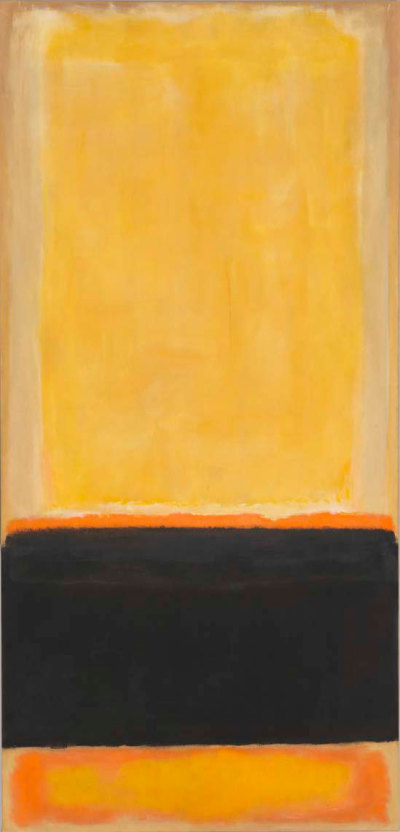
Mark Rothko,No. 4 (Yellow, Black, Orange on Yellow/ Untitled), 1953
There hasn’t been a major group show of Abstract Expressionism in Europe since 1959
Works by Mark Rothko, Jackson Pollock, Willem de Kooning, Franz Kline and other artists are being exhibited together for the first time in 57 years. What do we gain from seeing these works as a group?
Holly Williams
The Independent
Thursday 22 September 2016
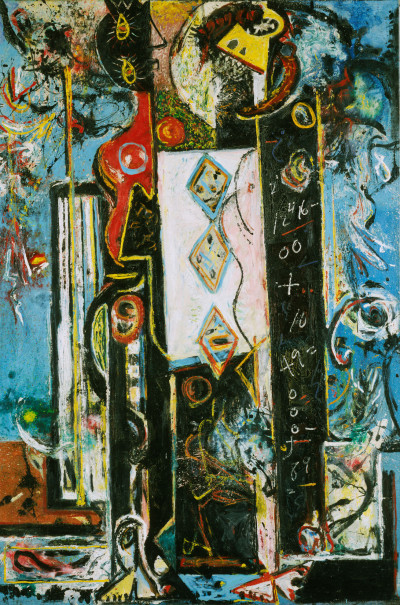
In 1959, New York’s Museum of Modern Art sent an exhibition to eight European cities – concluding at London’s Tate gallery – with the calmly self-assured title of The New American Painting. It featured 17 artists, most of whom were associated with Abstract Expressionism, including Mark Rothko, Jackson Pollock, Willem de Kooning, Franz Kline, Arshile Gorky, Barnett Newman and Clyfford Still.

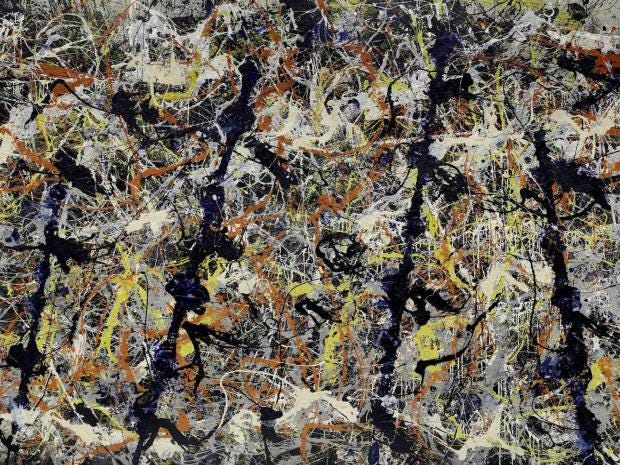
Jackson Pollock, Blue Poles, 1952
While critical reactions on the continent veered between stunned admiration and outrage at this show of large, bold, abstract works (one French critic asked: “Why do they think they are artists?”), the mood back in New York was one of jubilant triumph. Abstract Expressionism had proved itself.
They were right to feel confident: Abstract Expressionism went on to be one of the most widely known movements of 21st century art. Pollock and his paint splatters are practically proverbial today. Yet – astonishingly – there hasn’t been a major group show of these artists in Europe since that touring blockbuster.
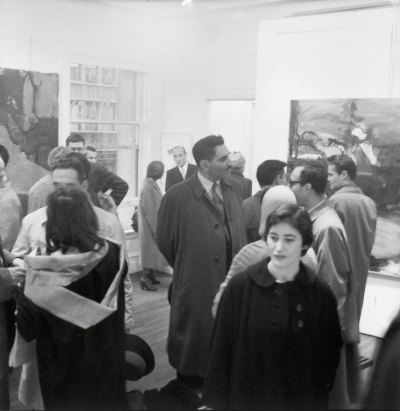
That changes this week, when the Royal Academy in London brings together works by both core and more peripheral artists for a new group show called simply Abstract Expressionism. While many of the individual artists have had substantial solo shows in the UK over the years, this offers a rare chance to consider their work together, to allow their paintings to really speak to each other.
“This is a group exhibition because Abstract Expressionism was a group phenomenon, involving painters, sculptors and photographers and stretching from New York City to the West Coast,” says Dr David Anfam, art historian and co-curator of the show, who adds that, given it is 57 years since the last group show, “the time is ripe to do this at the RA”.

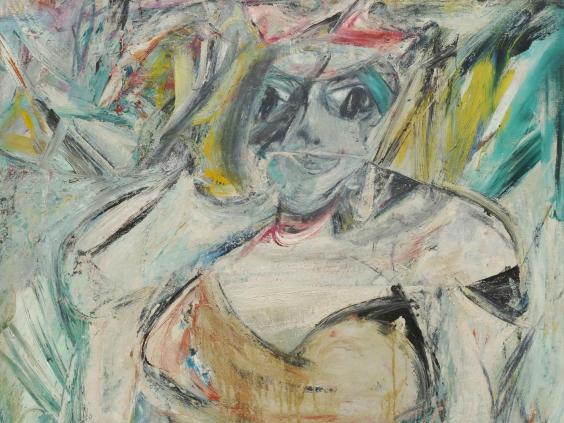
Willem De Kooning, Woman II, 1952
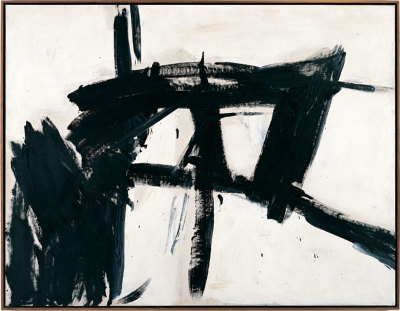
Abstract Expressionism was never a self-defined movement; while many of the artists knew each other well, they had no manifesto like, say, the Futurists. The work is varied: De Kooning’s frantic, grotesque Woman paintings don’t appear to have much in common with, for instance, Newman’s more minimal, soothing “zip” canvasses.
Still, you can say that, starting in 1940s New York, a coherent group of artists began to produce work of a certain vitality, scale and urgency. Whether through intense fields of colour or dynamic drips, slashes and splashes, these abstractions sought to express a human truth, and to elicit a powerful emotional response in the viewer.
As Rothko asserted: “I’m interested only in expressing basic human emotions – tragedy, ecstasy, doom and so on – and the fact that lots of people break down and cry when confronted with my pictures shows that I communicate those basic human emotions.”
Showing these artists together will demonstrate the breadth of work that falls under the Abstract Expressionism banner, and the show has a revisionist side, paying attention to overlooked artists – women especially – and including photography, works on paper and sculpture as well as monumental paintings.

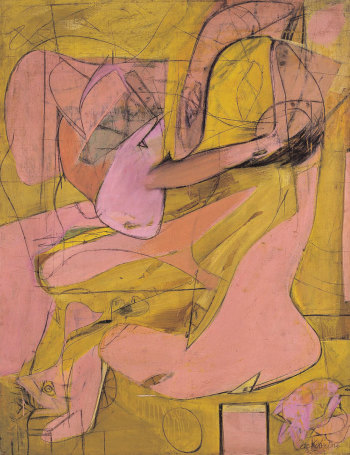
Willem de Kooning,Pink Angels, 1945
Thursday 22 September 2016
In 1959, New York’s Museum of Modern Art sent an exhibition to eight European cities – concluding at London’s Tate gallery – with the calmly self-assured title of The New American Painting. It featured 17 artists, most of whom were associated with Abstract Expressionism, including Mark Rothko, Jackson Pollock, Willem de Kooning, Franz Kline, Arshile Gorky, Barnett Newman and Clyfford Still.
Jackson Pollock, Blue Poles, 1952
While critical reactions on the continent veered between stunned admiration and outrage at this show of large, bold, abstract works (one French critic asked: “Why do they think they are artists?”), the mood back in New York was one of jubilant triumph. Abstract Expressionism had proved itself.
They were right to feel confident: Abstract Expressionism went on to be one of the most widely known movements of 21st century art. Pollock and his paint splatters are practically proverbial today. Yet – astonishingly – there hasn’t been a major group show of these artists in Europe since that touring blockbuster.
That changes this week, when the Royal Academy in London brings together works by both core and more peripheral artists for a new group show called simply Abstract Expressionism. While many of the individual artists have had substantial solo shows in the UK over the years, this offers a rare chance to consider their work together, to allow their paintings to really speak to each other.
“This is a group exhibition because Abstract Expressionism was a group phenomenon, involving painters, sculptors and photographers and stretching from New York City to the West Coast,” says Dr David Anfam, art historian and co-curator of the show, who adds that, given it is 57 years since the last group show, “the time is ripe to do this at the RA”.
Willem De Kooning, Woman II, 1952
Abstract Expressionism was never a self-defined movement; while many of the artists knew each other well, they had no manifesto like, say, the Futurists. The work is varied: De Kooning’s frantic, grotesque Woman paintings don’t appear to have much in common with, for instance, Newman’s more minimal, soothing “zip” canvasses.
Still, you can say that, starting in 1940s New York, a coherent group of artists began to produce work of a certain vitality, scale and urgency. Whether through intense fields of colour or dynamic drips, slashes and splashes, these abstractions sought to express a human truth, and to elicit a powerful emotional response in the viewer.
As Rothko asserted: “I’m interested only in expressing basic human emotions – tragedy, ecstasy, doom and so on – and the fact that lots of people break down and cry when confronted with my pictures shows that I communicate those basic human emotions.”
Showing these artists together will demonstrate the breadth of work that falls under the Abstract Expressionism banner, and the show has a revisionist side, paying attention to overlooked artists – women especially – and including photography, works on paper and sculpture as well as monumental paintings.

Willem de Kooning,Pink Angels, 1945
But, crucially, it should also allow the artworks to connect, to hum and resonate with each other. The exhibition is deliberately organised to reveal lines of influence and aesthetic assonance in a group of artists who, as Anfam explains, “were often very much aware of each other, socially and artistically”.
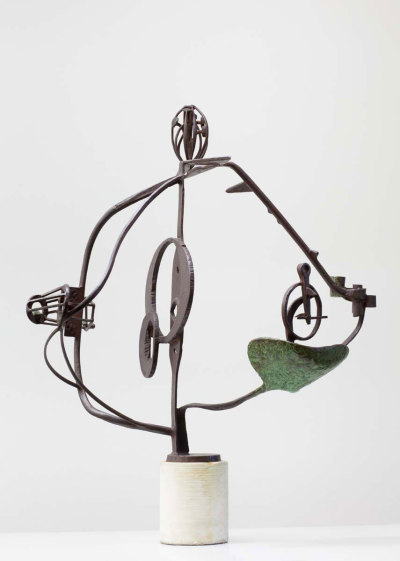
“By showing the artists together it is possible to establish new sight lines and experiences – for instance, connecting Barnett Newman and Ad Reinhardt, who were both involved, in their different ways, with developing extremes of colour and similar visual absolutes,” he continues. “Throughout, the curatorial premise is to put the various works in dialogue with each other: Arshile Gorky leading on to his disciple de Kooning, [David] Smith with Pollock, and Pollock himself with his wife Lee Krasner.”
There are rooms devoted solely to Still and to Rothko – but they adjoin each other, with the curators hoping it will be “possible to make visual connections between the two artists for those who want to do so”. Other rooms are thematic: one, entitled Darkness Visible, will bring together works by several of the Abstract Expressionists who, at different points in their careers, “explored the hypnotic power of blackness and shadowy depths of colour”.

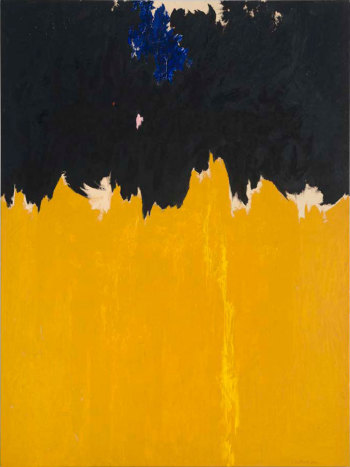
Clyfford Still, PH-950, 1950
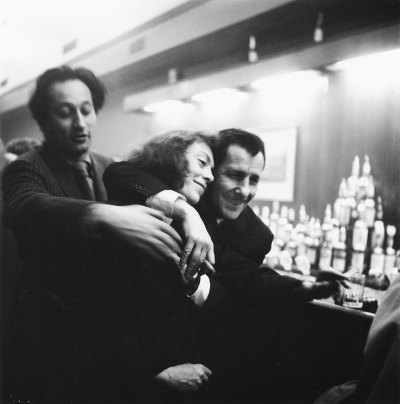
That there should be artistic overlap is no surprise; although not confined to New York, many Abstract Expressionists lived and worked there in the Forties and Fifties, and would gather in cheap bars and cafés to drink hard, and talk harder.
Gorky, De Kooning, Smith and others would eat at Romany Marie’s, a gloomy little café in Greenwich Village, and afterwards many tables would be commandeered at the seedy Waldorf Cafeteria for heated discussions about art, amid a clientele of cabbies, bums and pickpockets.
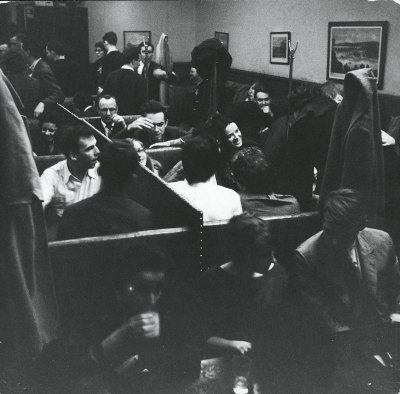
At the end of 1949, De Kooning, Kline, Reinhardt and others established The Club in a loft in the East Village; it hosted Wednesday evening discussion groups on lofty topics such as the function of art, and its moral value. Weekends there, however, were for dancing, the alcohol chipped in for by whoever was least broke, and served in paper cups. More booze-fuelled fervent discussion would continue in the cramped Cedar Street Tavern, where Rothko, Newman, Kline, de Kooning and Pollock all would gather.
It’s no wonder artistic influence – not to mention petty jealousies and deeper feuds – spread among them. “It was Clyfford Still who influenced Mark Rothko’s breakthrough into abstraction during the second half of the 1940s,” suggests Anfam. “Some of David Smith’s sculptures also clearly echoed Pollock’s paintings. And Pollock and De Kooning famously became rivals who each vied to be the numero uno, as it were, of the whole group.”
By the mid-Fifties, Abstract Expressionism might have been rising in artistic importance, and in financial value, but the relationships within the loose group were falling apart. Still wrote letters denouncing Rothko’s desire for “bourgeois success”, while Newman also claimed Rothko had stolen from his paintings. Newman tried to sue Reinhardt for publishing a sneering account of him in a satirical piece about the New York art scene, and he and Still also fell out over accusations of copying.
Mark Rothko No. 15, 1957
Hey, no one ever said being part of a major artistic phenomenon would be easy. But given there were such intense relationships, it’s surely surprising that there haven’t been more group shows. Aside from the physical considerations – securing loans of such vast canvasses isn’t easy – why might this be the case?
“Abstract Expressionism was so huge that it soon got taken for granted throughout the art world,” suggests Anfam. With many other, also highly significant, movements rapidly following it – from Pop to Minimalism to Conceptualism – he thinks Abstract Expressionism got somewhat elbowed out of the way.
“Now is the moment to see its breadth and depth afresh. It’s an art of enormous ambition and originality, with which we need to reckon once more.”
Abstract Expressionism is at the Royal Academy in London, 24 September to 2 January

Inside the Cedar Tavern, 1956
New York’s legendary Cedar Tavern and the surrounding galleries became the hub of the New York art scene in the 1940s and ‘50s. Morgan Falconer walks the streets where reputations were on the line
Morgan Falconer
Royal Academy Magazine Autumn, 2016
1 September 2016
One of the frequent complaints of native New Yorkers today is how the city is all the same, and the same as everywhere else. You only have to glance into the lives of the Abstract Expressionists to see that their New York was a different place altogether.
Back then, Barnett Newman could have a loft on Wall Street and remember Manhattan as a “compact heterogeneous cosmopolis”, a place where you could have the “feeling of living in two centuries”. Uptown was 20th century: when the writer Alfred Kazin had lunch on the roof of the Museum of Modern Art, he felt he was “swimming in the reflected surfaces of some great goldfish bowl. New York was gold skin, kaleidoscopic glass.” Downtown was where you found old New York – and the working artists. It was here, in 1934, that Jackson Pollock and his brother Sande moved into an abandoned commercial building sitting among piles of rubble and the shanties of the homeless. It had no heat or running water and visitors had to throw stones at the windows to get their attention.

Norman Bluhm, Joan Mitchell and Franz Kline at the Cedar Tavern, 1957
1 September 2016
One of the frequent complaints of native New Yorkers today is how the city is all the same, and the same as everywhere else. You only have to glance into the lives of the Abstract Expressionists to see that their New York was a different place altogether.
Back then, Barnett Newman could have a loft on Wall Street and remember Manhattan as a “compact heterogeneous cosmopolis”, a place where you could have the “feeling of living in two centuries”. Uptown was 20th century: when the writer Alfred Kazin had lunch on the roof of the Museum of Modern Art, he felt he was “swimming in the reflected surfaces of some great goldfish bowl. New York was gold skin, kaleidoscopic glass.” Downtown was where you found old New York – and the working artists. It was here, in 1934, that Jackson Pollock and his brother Sande moved into an abandoned commercial building sitting among piles of rubble and the shanties of the homeless. It had no heat or running water and visitors had to throw stones at the windows to get their attention.

Norman Bluhm, Joan Mitchell and Franz Kline at the Cedar Tavern, 1957
The young and restless move to cities all the time to slum it while dreaming of moving “uptown” – figuratively or literally. But among the Abstract Expressionists, those who made their breakthroughs in the late 1940s, there were few with such ambitions. The Depression years – when many of that circle came to know each other – taught them to expect little. And the world of contemporary art in New York was tiny, with only a handful of galleries – names like Betty Parsons, Peggy Guggenheim, Samuel Kootz and Sidney Janis. “The public,” as critic John Gruen wrote, “stayed away in droves.” By day the artists would work, by night they would frequent “The Club”, their private talking-shop, or dance in someone’s studio – the tango, the jitterbug, even the kazatsky, the Russian folk dance beloved by Communists and Russophiles in the 1930s.

Jackson Pollock,Male and Female, 1942-43
And they would drink and drink and drink at the Cedar Tavern. In the garrulous man’s world that was New York Abstract Expressionism, reputations were established as much in the Cedar as in the galleries. Situated on West 8th Street during its heyday, it was nothing more than a long, narrow room with brass-studded leatherette booths (pictured above). There was little decor and the clock over the bar sometimes ran backwards; its walls were described as ‘interrogation green’. But for the painter Norman Bluhm (above, with Joan Mitchell and Franz Kline), and many others, it was “the cathedral of American culture in the Fifties.”

Pollock, de Kooning, critics like Harold Rosenberg (below, seen centre talking with Irving Sandler) and Thomas Hess – they all passed through its doors. Kline was a regular. Tormented by his unhappy childhood and his wife’s mental illness, he was remembered as someone who would be there when you arrived and still there when you left. Pollock would bound in on Tuesdays after visiting his psychotherapist and would hunt down Kline, joking with him as much as baiting him. On one occasion, after Kline had admonished Pollock for criticising Philip Guston, Pollock pulled a swinging door off its hinges and hurled it at him.
In the early 1950s, when the market for Abstract Expressionism began to grow, artist-run galleries began to pop up a few blocks away around East 10th Street. Galleries like Hansa, Tanager (shown at top), James and Brata were established as co-operatives, and artists lived and worked around them. The backdrop was dull – pool rooms, an employment agency, a metal-stamping factory – but the mood lively and do-it-yourself. One visitor to a group show in 1951 remembered sheltering from the summer heat under a sign painted by Kline.

Harold Rosenberg (centre) chats to fellow critic Irving Sandler at an exhibition of works by Grace Hartigan, 1959
For the most successful among them, there was also uptown. The better commercial galleries were mostly situated in lavish quarters near Tiffany & Co and Bergdorf Goodman on 57th Street. The dealers often came from rarefied worlds: before opening her gallery, Betty Parsons had been to finishing school and appeared as a debutante in the society circles of Newport and Palm Beach. Bridging this chasm wasn’t always easy for the artists. On one occasion, when Pollock had to head uptown – and dress accordingly – for an uncomfortable meeting, a friend remembered their car coming to rest at a traffic light next to a limousine. Pollock exploded, shouting, “Goddamn sons of bitches, dirty sons of bitches! Goddammit, I can wear a pinstripe suit, too!”

Ad Reinhardt at work on an untitled ‘black’ painting in his studio, New York, 1966
Of course, as Barnett Newman noted, the New York of the 1940s wasn’t just a binary world of uptown and downtown, it was multifarious. Many disliked the Abstract Expressionists’ haunts. The critic Clement Greenberg described the Cedar Tavern as “awful and sordid”; Lee Krasner said the “women were treated like cattle,” and Frank O’Hara, the poet and curator, hated the homophobia. Tellingly, the next generation of New York artists would spring from different circles, and a different part of town. Ellsworth Kelly, Agnes Martin, James Rosenquist and Robert Indiana lived around Coenties Slip, at the foot of Manhattan, with Jasper Johns and Robert Rauschenberg nearby.

But by the late 1950s, when that new generation was emerging, the Abstract Expressionists were already starting to leave the city. Pollock and his wife Lee Krasner moved out to Springs, a pocket of the Hamptons on Long Island in 1945, as newlyweds; de Kooning followed years later; Mark Rothko and Robert Motherwell would also take houses nearby. Today, Springs is just one part of the area’s playground for Manhattan’s business elite; then, it was a remote town of farmers and fisherman where life, de Kooning said, was “kind of biblical.” Pollock’s Long Island studio is preserved to this day, and the paint on the floor has sat there since he worked on canvases like Blue Poles (1952). But much else in the world of those artists has changed. When I took a trip downtown recently, I decided to find out what had become of the Cedar Tavern of Pollock’s day. I walked up and down, struggling with the street numbers until finally I realised that the site of the bar, and much else besides, has been engulfed by a vast, chain-store pharmacy. They do, at least, sell hangover cures.
Abstract Expressionism is in the Main Galleries at the RA from 24 September 2016 – 2 January 2017.
Subscribe to:
Posts (Atom)