THE Friday Boys are a disparate group of men spread across Tyneside who meet once a week - 'always on a Friday' - to talk about the arts, raise a glass to recently departed heroes and villains and, at the evening's end, down a whisky or two. The FBs have only one golden rule - talk of the working week is strictly off-limit.
Out of our seats
we watch the starlit company.
All those animal garments
of the hungry soul.
They fall on the stars
and the stars absorb them.
To win, suck seed.
The Elderly Brothers: - You Really Got A Hold On Me I'll Get You The Sound Of Silence Never Be Anyone Else But You Chains
It wasn't as packed as last week, but a fair crowd were well entertained with the usual wide variety of music on show. Last week's Spanish guitar duo's jazz-tinged Latin instrumental jams had the audience spellbound once more. A young lass who has also been before also wowed the crowd with some great guitar work and one of the warmest vocal deliveries heard in a long time.
With yours truly still recovering from last week's sandpaper throat, things could have gone rather badly for the Elderly Brothers. A quick run-through "The Book" allowed us to choose songs unlikely to challenge the vocal chords and with the aid of various potions from the doc we made it through.
Why Prefab Sprout's return with America is a whim and a wonder
Paddy McAloon surfaced on Friday with a new track that is heartbreaking in an entirely unexpected way Pete Paphides
The Guardian
Monday 6 March 2017
Instinctively, your thoughts turn to One of the Broken, with its opening line: “Hi, this is God here.” In 1990, when Paddy McAloon recorded that song, he didn’t look remotely like God. But now, in 2017, if you were to imagine Him suddenly breaking His extended silence, chances are it wouldn’t be dissimilar to the manner in which Prefab Sprout’s 59-year-old frontman has resurfaced. The look favoured by McAloon these days is textbook biblical deity: a silver-haired man of seemingly advancing years with a beard to match. The manner of the recording also seems somehow appropriate. McAloon’s impromptu return, with a new song, America, looks like it was filmed on a phone in a place that could just about be anywhere or indeed nowhere. And, of course, few would disagree that, if there is an all-knowing, all-seeing creator out there, there has never been a better time for Them to send us a sign.
But although the first responses from fans might have you believe otherwise, the creator of America is visibly vulnerable to the vicissitudes which loom over all humans. McAloon’s eyesight is severely impaired these days – hence the enormous shades and the magnifying glasses that lie scattered in every room in his Durham home – and he suffers from tinnitus. For all the prescience of Prefab Sprout’s 2013 song The Devil Came a Calling – which depicts Satan as an unscrupulous huckster happy to feed his lust for power by issuing promises he has no hope or intention of keeping – the McAloon of America looks heartbroken at what has since come to pass. “America, America,” he sings, straining to reach the high notes, “Liberty welcomes everyone / Now she’s blushing in the sun … An orphan child exiled by war / She may become a doctor / And work among the poor /A scientist who finds a cure.”
Such global neighbourliness isn’t exactly surprising coming from McAloon. Since the release of 1997’s Andromeda Heights album, his faith in human empathy as the only thing that mitigates the unbearable brevity of our time here seems to be the engine of much of his songwriting. It reveals itself most transparently on Life’s a Miracle from that album, but you don’t have to scratch too deep beneath the surface to find it on List of Impossible Things, Grief Built the Taj Mahal and his astounding 2003 solo album-cum-fever-dream I Trawl the Megahertz. Perhaps what’s more surprising is the spontaneity of this release. When I interviewed him two years ago, he explained that he lives in a perpetual state of “the here and now”. That meant that while writing songs wasn’t a problem, recording them properly and releasing them into the world was harder to commit to.
Like perhaps his closest early contemporary, Green from Scritti Politti, McAloon’s love songs often acknowledged their own impudence in seeking to follow in the footsteps of songwriters such as Jimmy Webb and Stevie Wonder. McAloon sometimes casts himself as a true believer in idealised love who nonetheless remains aware of evidence to the contrary. On Blue Roses, from The Gunman and Other Stories, and Cruel, from Swoon, we’re listening to a protagonist perpetually on the verge of holding his hands up and admitting his chances of saying something about love that has never been said before are fanciful. And yet, the thing about McAloon is that he frequently does, often with disarming simplicity. “What you see in me / I will never know / That’s the mystery of love / But each time we kiss / Ignorance is bliss / That’s the mystery of love.” (The Mystery of Love from Andromeda Heights.) Both Jimmy and Stevie would have claimed that in an instant.
Like Green, he allowed himself – more out of curiosity than megalomania – to be co-opted into the world of pop stardom, abetting the process with an album (From Langley Park to Memphis) that made the job easy for radio pluggers at the time. Both artists emerged from the experience with a reluctance to fully re-enter the music industry, with its necessary promotional cycles and the commitments it demands from the artists on whom it depends. As a result, both have amassed demos of far more songs than they can ever hope to formally record in their own lifetime. Over time, the unfinished projects – among them, entire albums about Michael Jackson and Princess Diana – have become such millstones that he refrains from naming any others.
His ambivalence about the tension between the sometimes conflicting demands of the muse and the market has led him to strange places. The chorus of Prefab Sprout’s biggest hit, The King of Rock ’n’ Roll, saw its protagonist musing on the chorus that made him famous: “Hot dog, jumping frog, Albuquerque.” In doing so, the song about an albatross became an albatross – something he had already realised by the time he attended an industry function and Paul McCartney told him that The King of Rock ’n’ Roll was to his back catalogue what My Ding-a-Ling was to Chuck Berry’s. An astute businessman like McCartney wouldn’t have meant that as a putdown – and neither was it taken as such. On Meet the New Mozart (from Let’s Change the World with Music), McAloon sang: “Meet the new Mozart / He’s in the bed where commerce / Sleeps with art / Who can blame him? / No pauper’s grave this time round / Will claim him.”
For all of that, it’s pretty clear that, as long as the annual royalties from earlier successes pay his mortgage, McAloon’s continuing reclusiveness shows no sign of abating. I would be amazed if America is a portent of a new album. It’s entirely consistent with what we know about McAloon that, without even stopping to set up a microphone, he filmed it on a whim and gave it to his manager (who uploaded it to YouTube) before he had a chance to change his mind. I suspect that, like many of us, McAloon had tuned into the radio every day, and with every new executive order from the White House, every new transmission of anti-immigrant rhetoric, imagined that someone somewhere must have written a song about it, and perhaps gathered together a bunch of well-known musicians to sing it. But we’re still waiting.
Perhaps no one found a combination of words and music that could hold a big enough mirror to what we’re seeing happening in America (and, of course, in Britain) right now. Perhaps there is simply no combination of words and music that can do that at this moment. And yet to watch one of our greatest songwriters setting aside the trappings of the studio and forlornly exhorting an entire country not to “reject the stranger knocking at your door” is heartbreaking in an entirely unexpected way. In 2017, McAloon seems unable to believe that it’s come to this. And neither, of course, can we. Therein lies the power of his newest creation.
A New Documentary Explores The Troubled, Brilliant Life Of Pianist Bill Evans
NPR Staff
25 February 2017
Jazz pianist Bill Evans (seen here as he appears on the cover of the 2016 legacy release Some Other Time) is the subject of a new documentary called Bill Evans: Time Remembered.Courtesy of the artist
Bill Evans was a genius: The jazz world, which can be roiled by factions and jealousies, usually agrees on that. He was a composer and pianist with a light, lyrical touch that was once described as what you might hear at the gates of heaven. But like many geniuses, Evans died too young — in 1980, at the age of just 51, after years of cocaine and heroin addiction.
A new documentary by filmmaker Bruce Spiegel helps capture that genius with interviews of musicians, family members, and archival footage of Bill Evans himself.
"When you listen to some of the songs that he plays, some of the intros that he plays, some of the long compositions, they're emotionally wrought. They just take you to a different place than most normal piano players would go," Spiegel says. "I got a couple kids; they aren't really into jazz. But in the course of making the movie I played [Evans] for them, and they say, 'Jesus, that's pretty good.' So I think it's interesting that people are rediscovering Bill, and part of the reason I'm doing this is because I want people to rediscover Bill. I think he's a great American artist, and I think more people should listen to him and respect the beauty that he was able to create."
Bruce Spiegel has produced a complete documentary giving you insights into Bill Evans; not just the musician, but also the person. The film moves chronologically starting with Bill's childhood in New Jersey and culminating with details about his death.
"The film Bill Evans, Time Remembered took me 8 years to make. Eight years of tracking down anybody who knew Bill and who played with him, to try and find out as much as I could about the illusive and not easy to understand Bill Evans. I feel very honored to have had the chance to interview and get to know good guys that spent a lot of time with Bill: Billy Taylor, Gene Lees, Tony Bennett, Jack DeJohnette, Jon Hendricks, Jim Hall, Bobby Brookmeyer, Chuck Israels, Paul Motian, Gary Peacock, Joe LaBarbera. It was a once in a life time experience talking to these gifted talented guys about their time in jazz music, about their “Time Remembered“ with Bill Evans. - Bruce Spiegel"
"The film was a bull's eye at capturing as much as one can capture of someone's music, pain, and life story. My family is forever grateful to your outstanding work." - Debby Evans (Waltz for Debby)"
"The film is musically intriguing and sensitively crafted. Not soppy with just the right amount of honesty regarding his personal life." - Nenette Evans
Al Jardine, who turned 74 on September 3, was an original member of The Beach Boys when the group formed in 1961, but for a time he wasn’t sure if playing music was in his future. Shortly after recording the group’s first single, “Surfin’,” he left for a while intending to pursue a less risky career, only to return in 1963. He remained a Beach Boy throughout the band’s entire run as a major recording act and is currently a member of Brian Wilson’s touring band.
We spoke with Al Jardine in the spring on the 50th anniversary of the Beach Boys’ Pet Sounds, often named the greatest album of all time.
Do you consider Pet Sounds the Beach Boys’ best album?
Al Jardine: Probably artistically, yeah. It was a little ahead of its time. We didn’t have a lot of time to appreciate it because the label was looking for a lot of sales and when it didn’t meet their expectations they took it off the market and quickly put out a best-of album. We really didn’t have a chance to exploit it or perform it. We were basically a hitmaking machine and that was something [Pet Sounds] was difficult to market. They didn’t know what to do with it. Fortunately the public climbed on board and made it happen. I shouldn’t say the public—future generations appreciated it for what it is. The ’70s material that we did post-Pet Sounds is becoming quite popular with new generations of fans. There’s a revivalist thing going on with the Beach Boys right now, which is pretty interesting.
What is it about that music that is so universal?
AJ: It has to be the human voice. Brian’s voicings and his own personal voice as well are so special. The way we came together as a vocal blend was pretty special. And we had great engineering and great producers—Brian, I should say. We met the challenge when we did Pet Sounds. That was a big one. “California Girls” and “She Knows Me Too Well” and “Please Let Me Wonder” are epic moments in recording history to me.
Those last two were B-sides of singles. A lot of the Beach Boys’ B-sides were as good as the hit A-sides.
AJ: We had so many great B-sides. We often put out competitive pieces on the other side. We didn’t have as many number one singles as the Beatles but we might have if we’d put a clunker on the other side. Where would you rank Pet Sounds among the Beach Boys’ albums? Are there others you like more?
AJ: That’s a style thing. There are different kinds of favorite albums. Pet Sounds was a different direction. I like All Summer Long. It had “Help Me, Rhonda” on it, which was one of my songs. I liked Stack-O-Tracks. Not many people have heard it. It was amazing to hear the tracks without the vocals.
Capitol Records recently released the Pet Sounds (50th Anniversary Collectors Edition) boxed set. Is it aimed at people who grew up with the album?
AJ: I’m not sure. It’s really for the audiophiles. I don’t know. There’s a lot of information on there. You have to enjoy sitting down to four hours of backing tracks—if you’re a real fan you’ll dig it, man. There’s a Blu-ray disc of the audio. There’s one great DVD of us actually singing “Good Vibrations.”
Is it true that “Good Vibrations” was initially intended to be included on Pet Sounds?
AJ: We had a major impasse with Brian with respect to “Good Vibrations.” We all wanted it to be on Pet Sounds and I don’t know if it was a timing thing but Brian told me at the time that he wanted to save it for Smile, the next project, and we disagreed. Not for the first time and not for the last!
AJ: Generally, if somebody has a pretty strong point of view, we respect that, and we all respected his point of view. It was finished, in our opinion, but in Brian’s mind it wasn’t finished. In any event it was going to be put aside, do it later. Then the label said, “You gotta have a hit single on [Pet Sounds], something with some commercial appeal.” They’re always looking for a hit. “Sloop John B” [which Jardine arranged] had proved itself. So I was responsible for that, I admit it. It may not fit the creative tone of the album but it certainly gave some relief at the end of side one. I took a pretty primitive folk song, which I’d learned in high school, and added a chord or two—I heard the Beach Boy harmonies in there and felt very strongly that we could make a great record. And it worked.
It’s such an odd tale for a top 40 song.
AJ: And antithetical to what we were doing. But when you listen to the production value, it’s astoundingly powerful. What do you remember about the vocal sessions for that album? Was it more arduous than before?
AJ: Are you kidding? [Before] we would just walk in and do our parts and leave but this one we spent three to maybe six months. We were recording Smile and Pet Sounds simultaneously so you can only imagine the stuff we were doing. Within that three- to six-month framework we would alternate between songs and go back and forth and reshape each song until we got them just right. It took awhile. The king of all the re-do’s was “Wouldn’t It be Nice” and “Good Vibrations.” Brian was never quite satisfied with those two and he wanted to get them perfect.
All of those stories that have been going around for 50 years, that the rest of the band was against Pet Sounds, fought Pet Sounds—how much of that is true?
AJ: That’s not accurate. Mike being more of a lyricist, he obviously wanted to question some of the lyrics that he didn’t understand. If you don’t understand something, hey, explain it to me. And actually, he got his way with one of the songs on Pet Sounds, “I Know There’s An Answer.” I liked it both ways [The alternate version was called “Hang On to Your Ego.”] If Brian wants to work with his cousin to make him happy, it is what it is. But as far as not wanting to do it, it was a big leap from where we were. Holy crap—we got home from [touring] Japan, and we’d been gone for a long time. And there was a lot of adjustment. It wasn’t that we didn’t want to do it.
Brian has said that the Beatles and Beach Boys were always in competition. Was that true?
AJ: That’s the story. I don’t even ask Brian that question; I read the same things you guys do. But when I see him I’ll ask him. I’ll say, “Hey, did Rubber Soul really give you that inspiration?” I’m sure it did. I seem to recall the same thing. But we were on the road 150 days a year so we didn’t see Brian that much. How does it feel to sing these songs now?
AJ: It’s fun. I enjoy sitting back and watching Brian go through the set. He does a real good job.
Do you hear an influence on young bands today from Pet Sounds?
AJ: Absolutely. I think Brian raised the bar. It allows people to play off that ingeniousness that he has. He hears things and phrases things in a way that you wouldn’t expect. It’s the unexpected that makes Brian so amazing. He has a real gift for the left hand on the piano, the bass line. You’d give your right arm for that and he has it on so many different levels: melodies, harmonies, arranging. We didn’t hear that before Brian. Post-Brian you get people emulating him and it’s really cool. Fleet Foxes are a good example. A little different phraseology, but similar.
I Do Not Love You Except Because I Love You by Pablo Neruda
I do not love you except because I love you;
I go from loving to not loving you,
From waiting to not waiting for you
My heart moves from cold to fire.
I love you only because it's you the one I love;
I hate you deeply, and hating you
Bend to you, and the measure of my changing love for you
Is that I do not see you but love you blindly.
Maybe January light will consume
My heart with its cruel
Ray, stealing my key to true calm.
In this part of the story I am the one who
Dies, the only one, and I will die of love because I love you,
Because I love you, Love, in fire and blood.
Ron is on holiday, so there was no Elderly Brothers' set. There were already 9 players waiting to play when I walked in at 8:30 and more kept coming as the night progressed. There was a sizeable non-playing audience too, who were appreciative of the wide variety of music on show. We had a new instrumental acoustic duo who played Spanish guitars: their first number was a jam in a Latin-jazz style, the second an improvisation on Stairway To Heaven - great musicianship and a hit with the punters. One of last week's duos returned and again wowed the audience with cool guitar work and spot-on harmonies. My own set was hampered by a voice resembling crushed gravel and I was provided with a shot of Auchentoshan after the first song to get me through the second - very generous! The punters didn't seem to mind, but maybe I should just have done some Tom Waits?
America After the Fall review – upheaval in the home of the brave
Royal Academy, London
Dance marathons, dustbowl farms, brawling sailors, impoverished cotton-pickers … Adrian Searle takes a journey through 1930s America in a gripping show
Adrian Searle
The Guardian
Tuesday 21 February 2017
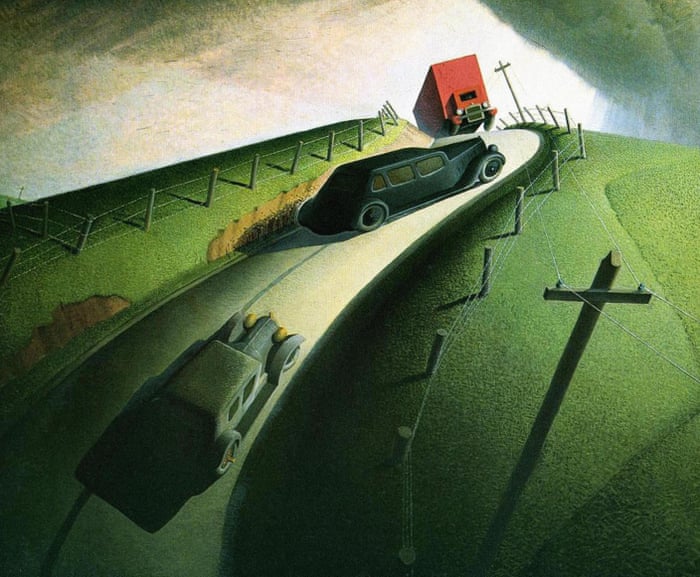
The sedan careers up the hill on a country road, slewing as a truck comes over the rise. We have a death’s-eye view, watching it happen. Everything slows down – a car pootling toward the sedan from behind, the oncoming truck going so fast its wheels have left the road. A storm is moving in, the fence-posts and telegraph poles, like ominous crosses on the hill, rearing.
Grant Wood - Death on Ridge Road
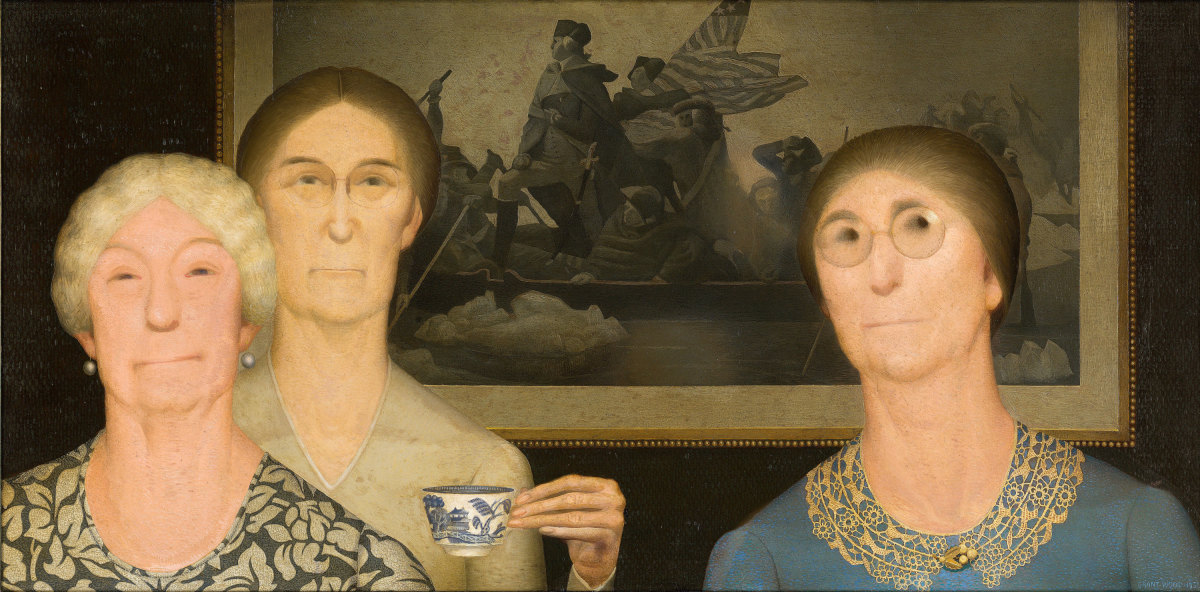
You don’t expect such graphic, cartoon action from Grant Wood, painter of ruralist, idealised farmsteads and small-minded Daughters of the American Revolution. The last time anything exciting happened was when Wood painted Paul Revere galloping through town and hollering, waking everyone up. Grant Wood - Daughters of the Revolution
Curated by Judith A Barter of the Art Institute of Chicago, and drawn from many US collections, America After the Fall looks at American painting from the Wall Street crash and the great depression to the second world war. In no more than 50 paintings this fascinating show charts the turbulence of American society, its inequalities and divisions, its fears, fantasies and insecurities, during a period of both national and international upheaval. Sound familiar?
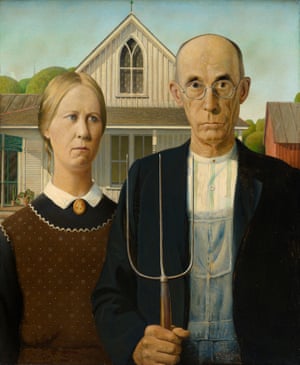
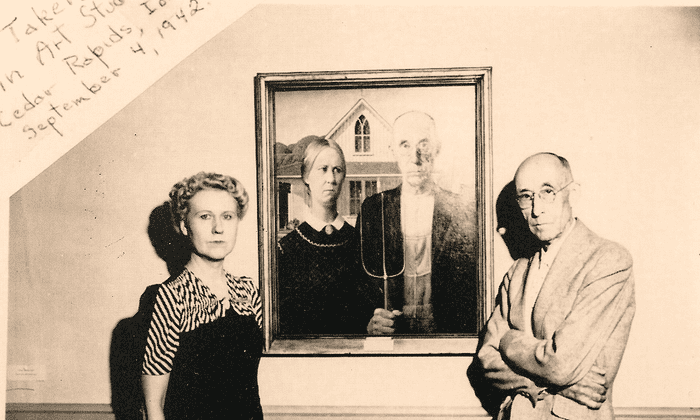
Grant Wood - American Gothic
Nothing happens in Wood’s best known painting, American Gothic, now in London for the first time, with that creepy couple standing in front of their farmhouse. The most you get here is a mean look and the shine on the sharpened tips of the old man’s pitchfork. Never mind that the woman in this enigmatic portrait of a suspicious, unfriendly farm couple were actually Wood’s sister and the artist’s dentist, a man doubtless well-acquainted with sharp tools. The artist’s models, Nan Wood Graham – his sister – and Byron McKeeby – his dentist – pose next to the painting
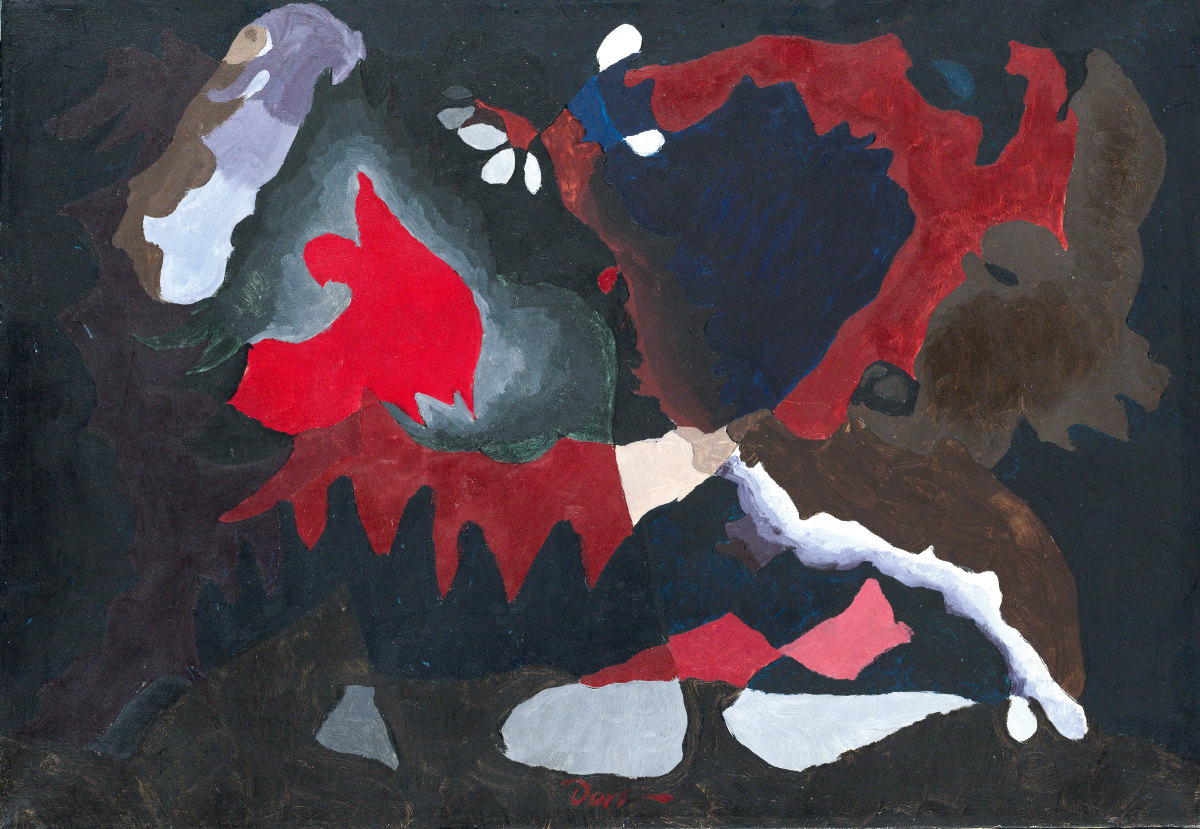
America in the 1930s was a society in turmoil and transition. The New Deal and public arts projects helped keep things going. New York went to the movies to watch films called Joys of the Flesh and Dangerous Curves, and the streets teemed with gawkers, barkers and floosies, street-walkers and drunks; Reginald Marsh’s paintings are filled with cheap fashions and cheaper thrills, cheap glamour and lots of clamour. Arthur Dove - Swing Music (Louis Armstrong)
Exhausted dancers drag each other round the floor in Philip Evergood’s 1934 Dance Marathon, staying sentient for the chance of the $1,000 prize. The painting is as beat-up as the dancers.
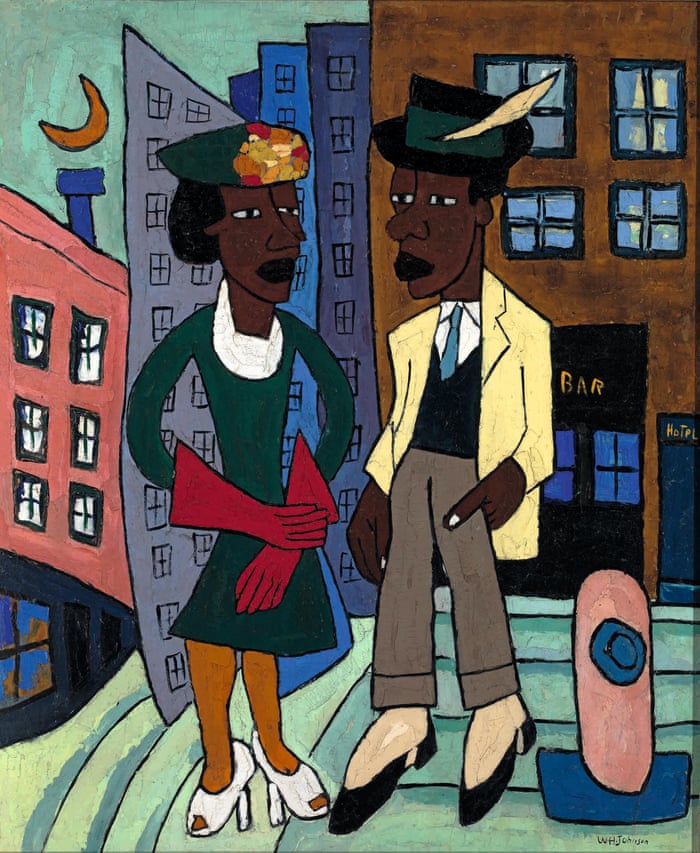
William H. Johnson - Street Life
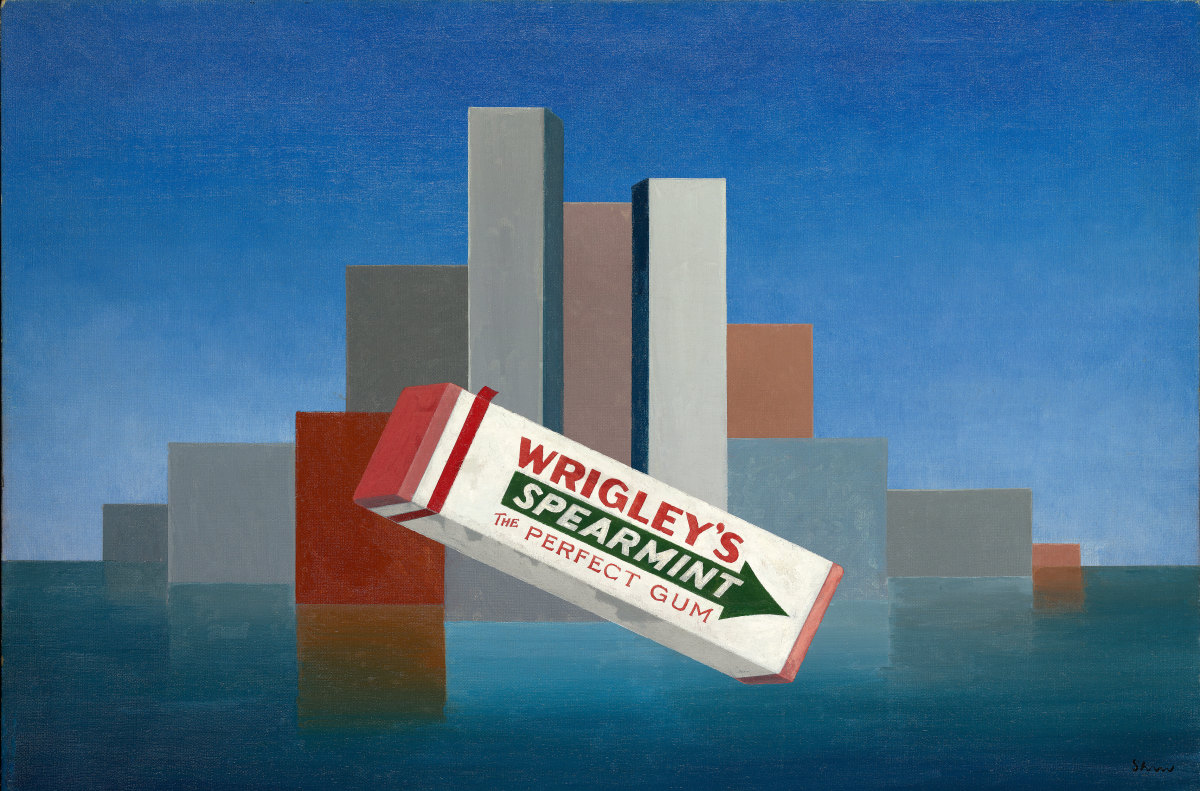
In William H Johnson’s Street Life, a black Harlem couple are out for the evening under a clunky moon. The painting is all angles and buildings and the woman’s big red gloves and the electric evening. Charles Green Shaw - Wrigley's
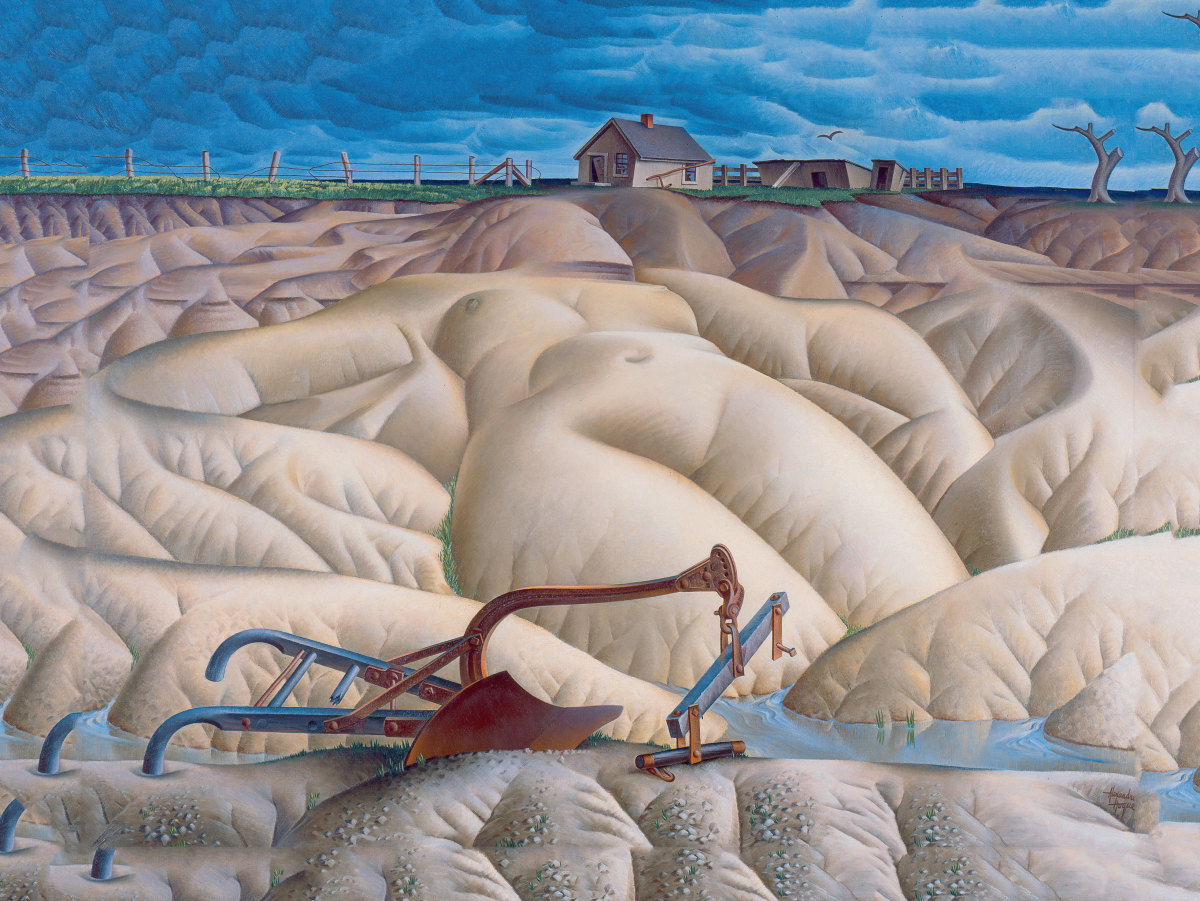
It is the opposite of Charles Green Shaw’s suave geometric towers of the city overlain with a hovering, realistic pack of Wrigley’s gum. This is a city to chew on, an intimation of pop art and the future. Stuart Davis melded New York and Paris in a swanky modernism where new and old jostle amiably. Alexandre Hogue - Erosion No. 2 - Mother Earth Laid Bare
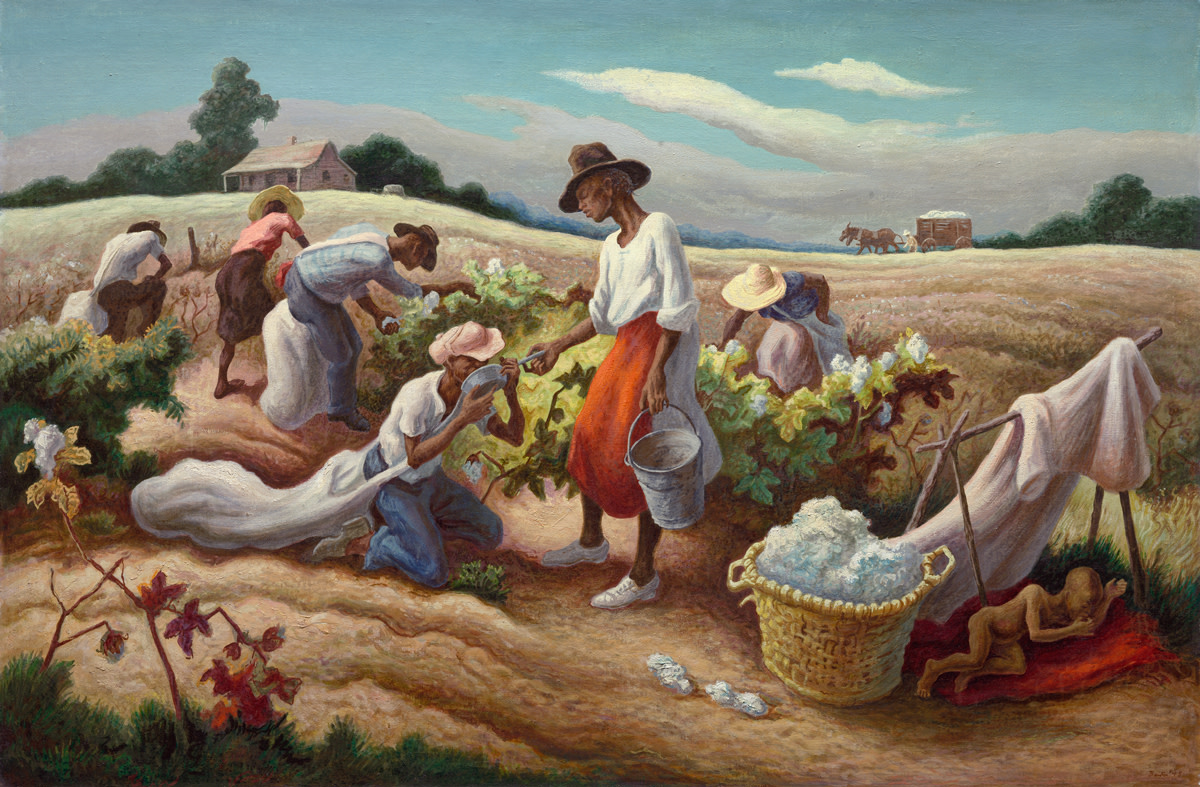
Paul Cadmus started a scandal with The Fleet’s In!, a 1934 painting of sailors on the razz, drunk, bawling, sprawling and cruising with groups of good-time girls and an elegant gay man who offers a sailor a smoke. Thanks, pal. There are bulging crotches and asses, leers and slaps. The US Navy called the painting sordid and depraved. Now, it owns it. What fun this is. Thomas Hart Benton - Cotton Pickers
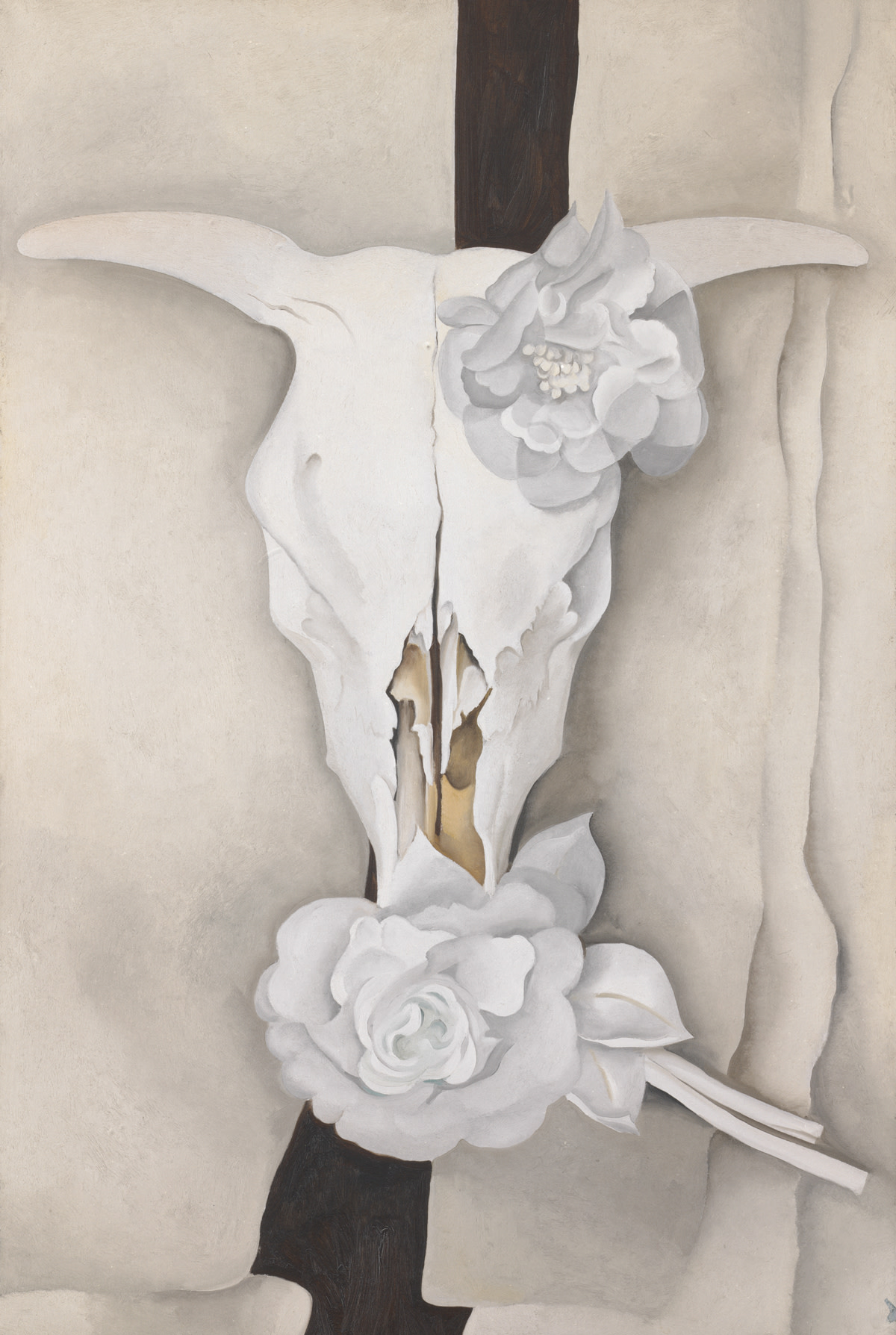
But this show takes sudden swerves. Cadus is a far cry from Joe Jones’s somnolent 1933 image of black roustabouts on a dock, heaving bails under the watchful gaze of a white, beer-gut boss, and Thomas Hart Benton’s impoverished Cotton Pickers, a sickly infant on the ground beside them, under the makeshift shade of a towel. Georgia O' Keefe - Cow's Skull with Calico Roses
Homely, outdoor church suppers, Thanksgiving dinners prepared in steamy kitchens and nostalgic visions of a land of plenty compete with images of the earth farmed down to the bones, a world eroded. A hawk hovers over broken fences and collapsing barns in the dust bowl, the midwest prairie farms that overproduction and modern farming techniques inadvertently destroyed. In Alexandre Hogue’s rather obvious 1936 painting Mother Earth Laid Bare is a dead vista, the topsoil blown away, revealing a prone woman in humps of dust, a shifting dune.
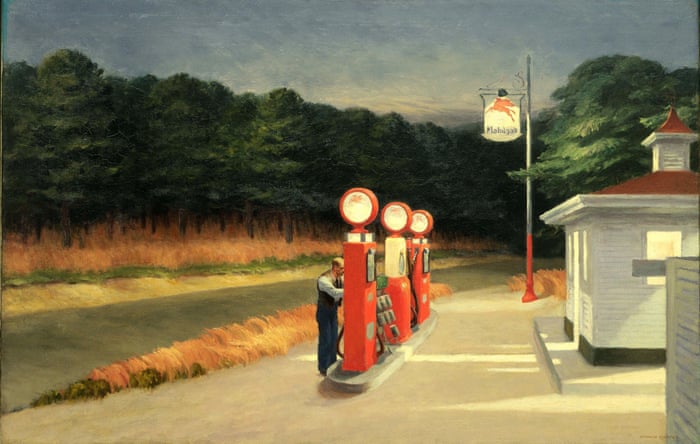
Edward Hopper - Gas
America After the Fall is all the better for its rackety variety. Edward Hopper is here, and a lone Georgia O’Keefe skull painting, but there is much I have never seen before, telling the story of troubled times in a multitude of voices. Towards the end, a lone Jackson Pollock, an inverted self-portrait, looms among seething blooded limbs and fists and eyes. Here’s a house on fire, lit by the Ku Klux Klan, while a black girl lies dead in the foreground. A noose hangs from a branch and a dog howls. American Justice, by Joe Jones, needs no sublety. Joe Jones - American Justice
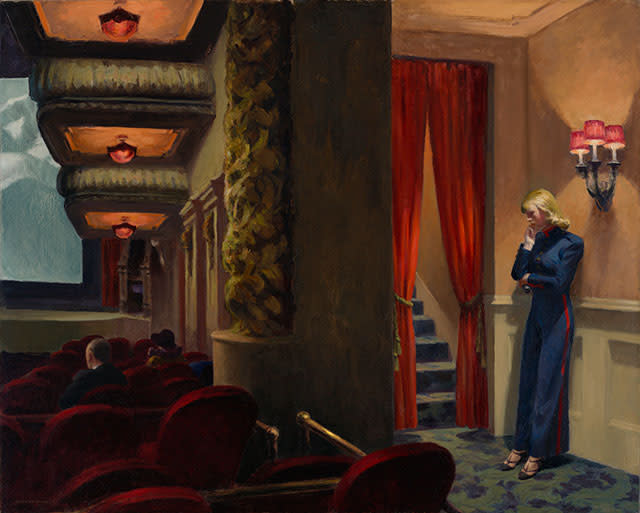
Fascinating stories are attached to many of the works and artists here, for which you will need to buy the excellent catalogue to learn that the first owner of Wood’s car crash painting was songwriter Cole Porter, whose wife’s ex-husband was the first American to kill someone in an auto crash. That the black and white movie playing in Edward Hopper’s wonderful painting of a pensive, bored cinema usherette in the wings of the movie theatre is probably Frank Capra’s 1937 Lost Horizon, in which a plane crash in the Himalayas leads to the discovery of Shangri-La. The stories multiply. Edward Hopper - New York Movie
America in the 1930s was no lost utopia. While farming collapsed, industry was on the rise. Charles Demuth’s street corner – with its elegant stop lights, the facade of a tobacco factory rising into a sheer blue sky, the bulk of a water tower looming on the roof – manages to be both majestic, impersonal and empty. The title, And the Home of the Brave, taken from the new American anthem, gives us no idyll but a factory wall. It feels a lonely, silent place.
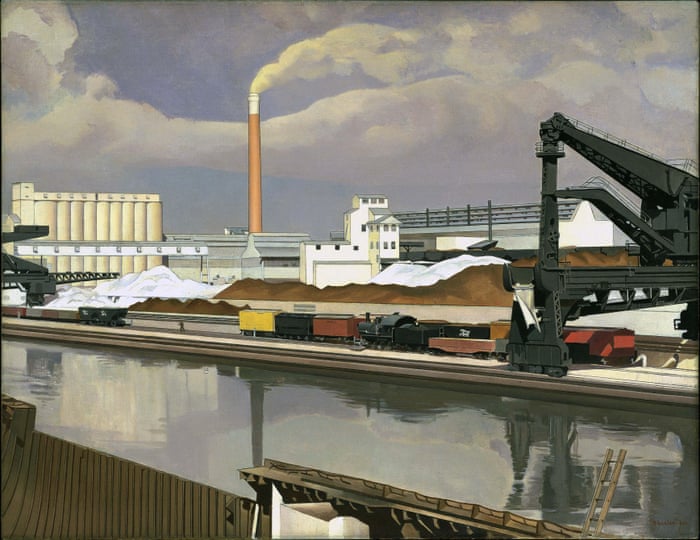
Emptier still were Charles Sheeler’s almost metaphysical industrial zones of river and railroad tracks, the cranes and vast factory complex of Ford’s River Rouge car plant. One lone, tiny figure walks the tracks. There’s no one else to be seen and the air is clear and still. The man is only there to give a measure of the place. Whatever is impending waits and the chimney belches. Alice Neel - Pat Whalen
There is terrific range in style and subject matter, outlook and temperament, artistic registers, ambitions and focus here. These are glimpses of the past, but one whose repercussions are felt in the divisions of America today. A terrific foil to the RA’s recently opened Revolution: Russian Art 1917-32 exhibition (whose time frame this show overlaps); and a rejoinder to the sprawling and unfocused Abstract Expressionism show that filled the main galleries last year, America After the Fall has other echoes of the present. Philip Guston - Bombardment
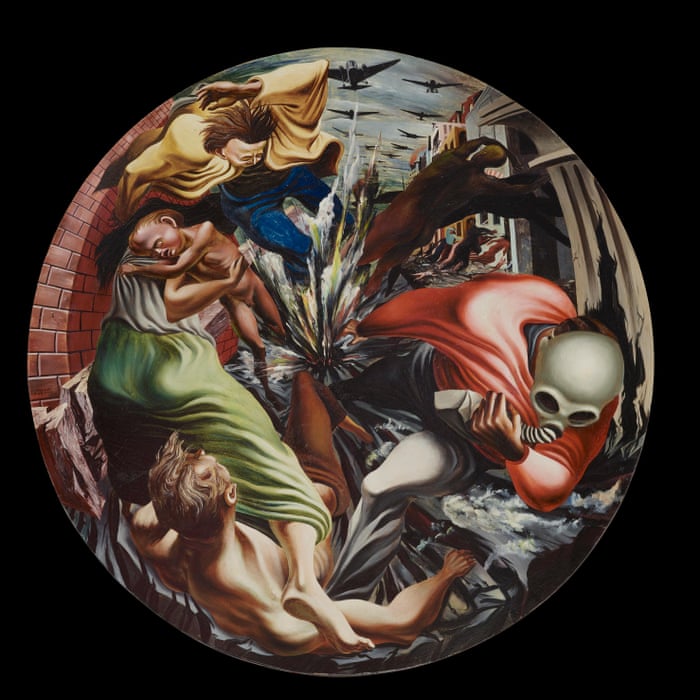
Hankerings for a past that never was, a culture and certainty that was white, rural and stoic compete with images of black poverty, the aftermath of slavery, black aspiration and the threat of the KKK. Urban and rural America alike suffered the economic deprivations of the 1930s, in a land of crumbling certainties. A vexed relationship to Europe was exacerbated by the rumblings of war abroad. In 1938, O Louis Guglielmi painted Brooklyn Bridge as a blasted wreck, with a woman sitting on a twisted girder, an unexploded bomb protruding from her back. The year before Philip Guston painted the bombing of Guernica, in a tondo of mangled bodies, the German planes flying in.
Peter Blume - Eternal City
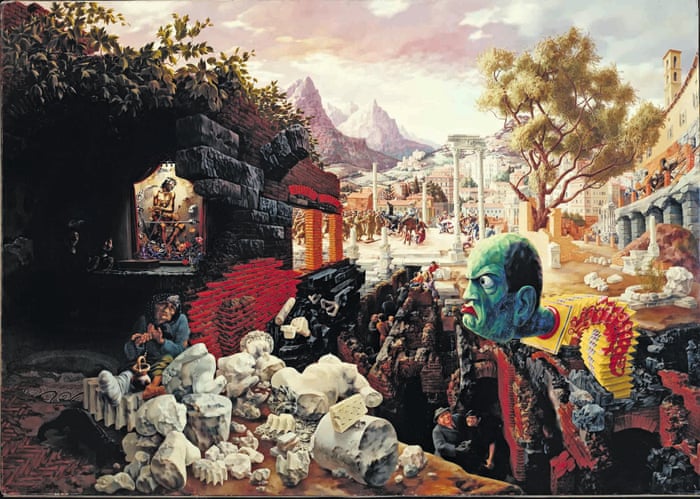
Peter Blume, an artist who had spent time in Italy in the early 1930s, depicted the Roman Forum as a war zone, with blackshirts fighting the populace, conniving capitalists grinning from a trench, fleeing monks, a green-faced, red-lipped Mussolini as a glowering jack-in-the-box. He reminds me of someone else with a painted face. In a wayside shrine, Christ is surrounded by useless votives and baubles.
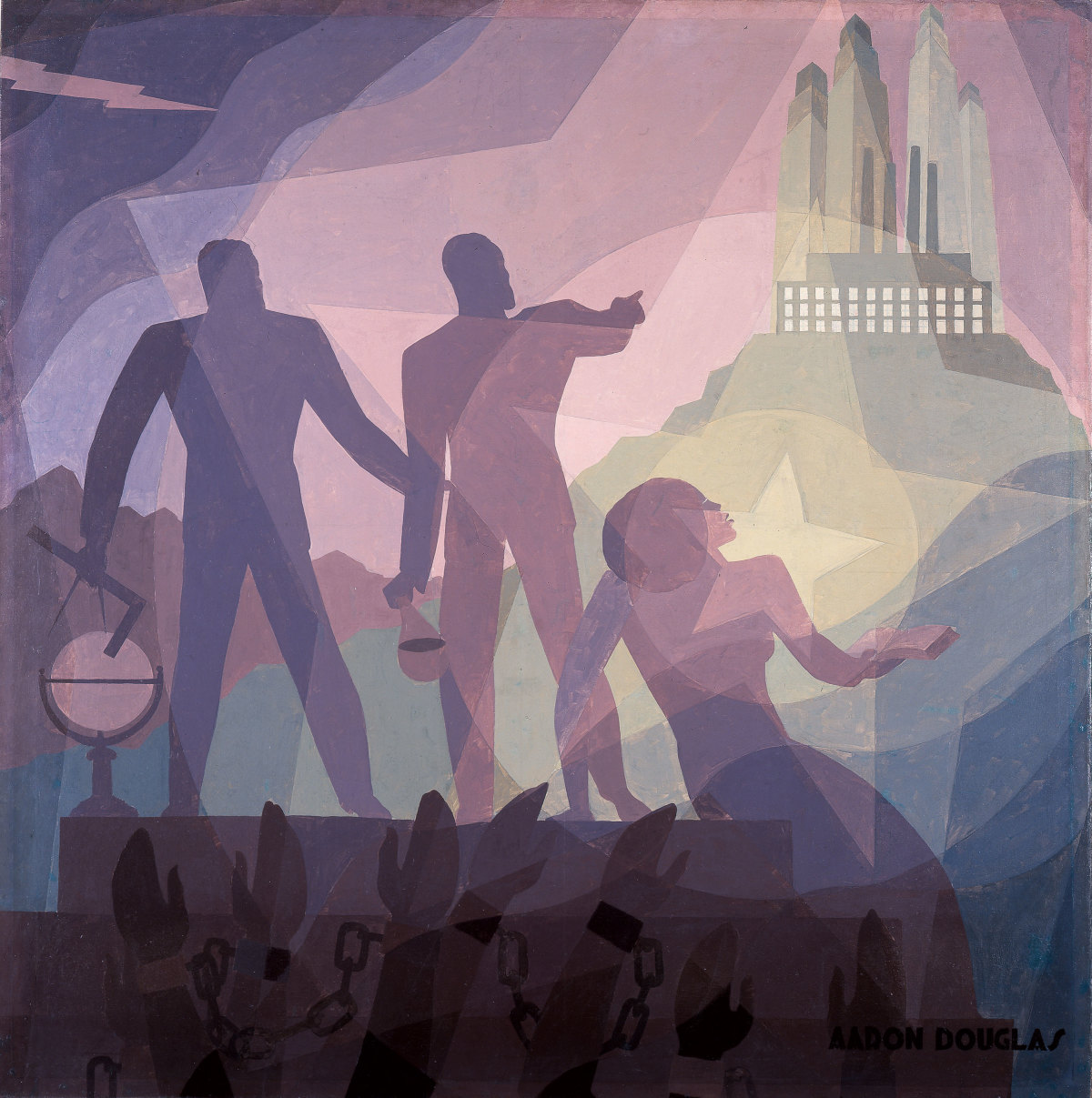
Aaron Douglas - Aspiration
While Blume was painting this, Sinclair Lewis published It Can’t Happen Here, about a presidential contender, Buzz Windrip, who beats Franklin Roosevelt and establishes a repressive dictatorship. Today’s echoes are obvious, the complexities still as enormous. What times.
America After the Fall: Painting in the 1930s is at the Royal Academy, London, from 25 February to 4 June