Monday, 4 July 2016

Geoffrey Hill RIP

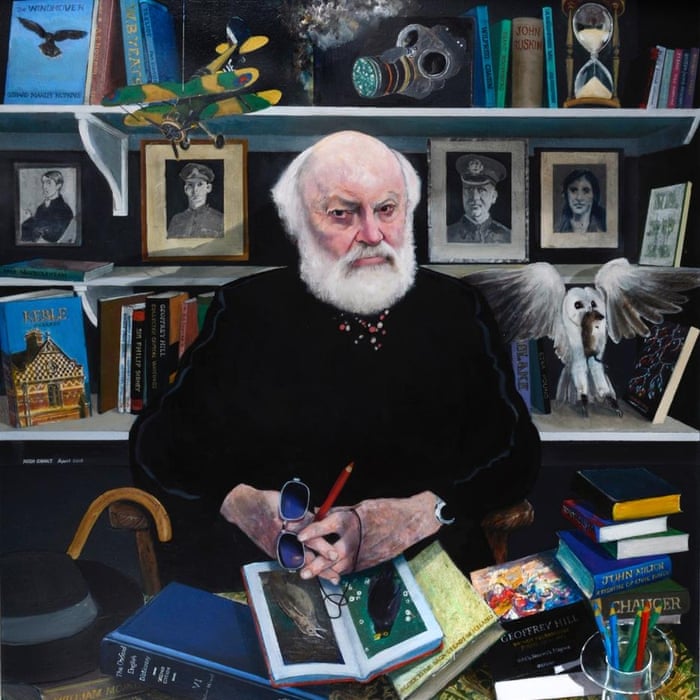
Sir Geoffrey Hill by Keith Grant, 2015

Sir Geoffrey Hill obituary

Poet and academic with a passion for the history and landscapes of England
 Sir Geoffrey Hill captured in a portrait by Keith Grant, 2015. Photograph: Chris Beetles Gallery

Robert Potts
Friday 1 July 2016

Sir Geoffrey Hill, who has died aged 84, was one of Britain’s finest poets in the second half of the 20th century. His was among the handful of names discussed in relation to the poet laureateship in Britain in 1998, after the death of Ted Hughes; and while it is hard to imagine Hill accepting such a dubious honour, or the post being awarded to so demanding a poet, he would not have been an inappropriate choice.

Hill had an unusually powerful sense of, and care for, the history of England; a sense above all of its bloody battles, religious schisms and civic institutions, and of its landscapes, especially those of his childhood. In his prose poem, Mercian Hymns, he conflated his Midlands childhood with King Offa’s Mercia, identifying his own birthplace as that of modern England.

Born in Bromsgrove, Worcestershire, Geoffrey was the son of William, a village policeman, and his wife, Hilda. “If you stood at the top of the field opposite our house,” he once recalled, “you looked right across the Severn Valley to the Clee hills and the Welsh hills very faint and far off behind them.”

Hill identified himself as working-class – indeed was “glad and proud to have been born into the English working-class” – and commemorated his maternal grandmother, who had spent her life making nails, in poem XXV of Mercian Hymns: “I speak this in memory of my grandmother, whose childhood and prime womanhood were spent in the nailer’s darg ... It is one thing to celebrate the ‘quick forge’, another to cradle a face hare-lipped by the searing wire.” Critics who accused Hill of nostalgia, conservativism, and reactionary and monarchist politics tended to ignore or misunderstand his passionate care for the nameless and forgotten victims of power, across all countries and all centuries.

Educated at Bromsgrove county high school, Hill was an excellent student, and – although “somewhat apart”, in the words of Norman Rea, a contemporary – played football, acted in school plays, and became a prefect. One of his roles was to introduce a piece of classical music in each morning assembly. As Rea recalled years later, it was a task he performed “with enjoyment and aplomb ... He demurred only once, in a stage-managed gesture, when he felt that to introduce Danny Kaye’s Tubby the Tuba, even for educational ends, was rather beneath him. With a sudden, winning smile, he delegated that task to the headmaster.”

Hill went on to Keble College, Oxford, where he read English, gaining a first (1953). Subsequently he taught at Leeds, being elected to a professorship in 1976, and then at Cambridge, where he was a fellow of Emmanuel College (1981-88).

At Oxford, he met the American poet Donald Hall, who told Hill that he was taking over the editorship of the Fantasy Poets and asked him to submit a manuscript. Later, Hall recalled receiving the poems: “I could not believe it. You can imagine reading these poems suddenly in 1952. I read them and I was amazed. I remember waking up in the night, putting on the light and reading them again. Of course I published them.”

The volume was For the Unfallen. It remains a powerful book, astonishing as a young man’s debut; ornate, rhetorical, grandiose in its subjects and themes. Genesis, the very first poem, takes the creation myth as its own creative occasion, beginning: “Against the burly air I strode, / crying the miracles of God” and ending:

By blood we live, the hot, the cold,
To ravage and redeem the world,
There is no bloodless myth will hold.
And by Christ’s blood are men made
free
Though in close shrouds their bodies
lie
Under the rough pelt of the sea;
Though Earth has rolled beneath her
weight
The bones that cannot bear the light.

For the Unfallen, eventually published in 1959, and all Hill’s subsequent books, dwell on blood and religion; his treatments of violence range from Funeral Music (from King Log, 1968), a remarkable sequence on the astonishingly violent battles of the Wars of the Roses, to his careful and sensitive elegies for Holocaust victims. From his earliest poetry he was intensely interested in martyrs, whether of the religious controversies of the 16th and 17th centuries, or totalitarian regimes of the 20th; and he aimed at a scrupulous weighing of the appropriate words by which their witness could be mediated. By making historical atrocities more immediate, and refusing to abandon the memory of the dead, Hill was also tacitly calling attention to more contemporary political predicaments.

His poetry was deliberately unfashionable – Hill emerged at the same time as the Movement poets, writers such as Philip Larkin and Kingsley Amis, and the contrast between them could not have been greater. Hill’s work was steeped in history (and occasionally myth), unashamed of intellectual and scholarly breadth; Movement poetry was cautious, rooted in a defiantly ordinary contemporary English postwar vision, scornful of “pretension”.

Nonetheless, Hill’s beautifully cadenced verse, with a recondite vocabulary enjoyable for its very strangeness, was unignorable, and he found a place in anthologies throughout the years.

He also published three volumes of essays, The Lords of Limit, The Enemy’s Country, and Style and Faith (all included in the Collected Critical Writings of Geoffrey Hill, 2008), which are object lessons in the importance of scrupulous reading, and equally scrupulous writing. His essay on Ezra Pound’s fascist broadcasts, My Word Is My Bond, is a highly significant rendering of Hill’s own ethic, and manages to be both rigorous and sympathetic in its judgments.

By the time his Collected Poems were published in 1985, the blurb in the Penguin edition confidently presented the polarised judgments on Hill alongside each other, commenting that Hill had generally “encountered either baffled goodwill or baffled resentment”. There were sympathetic commentators – Christopher Ricks, for many years, and Peter Robinson – who gathered together intelligent, informed appreciations of work that required a certain amount of research and exegesis for its proper appreciation. Hill could be a distant, exacting, curmudgeonly and sometimes ungrateful figure in those days, even to those who wished him well; though he also had unswervingly loyal relationships with friends such as RS Thomas and David Wright.

Illness, and a period of poetic inactivity, preceded Hill’s move to Boston in the US in 1988 to teach theology and English literature. He did not publish another book until Canaan in 1996, after which the books poured from him. He returned to England in 2006.

In his last years, when volumes came so much faster, Hill professed himself amazed at his youthful patience. From the 1950s to the 1980s, Hill might work at a phrase for weeks; but having had a heart attack in the late 1980s (and again in 2001), he had begun to feel, in his own words, “If I don’t do it now, I never will: there is that sort of urgency.”

After he went to the US, he was diagnosed as having suffered, since childhood, from chronic depression, and “various exhausting obsessive-compulsive disorders”; and the prescription of Prozac transformed his life. Hill had, in his critical work, written with sympathy and tact of the religious writers who suffered from neurasthenic difficulties, and later was quite open about his own case, speaking about it in interview, and in the poems.

Prozac he described as “a signal / mystery, mercy, of these latter days”. Another factor in his eventual happiness was surely his marriage in 1987 to Alice Goodman. With her, he had a daughter, Alberta; he also had four children, Julian, Andrew, Jeremy and Bethany, from his first marriage, to Nancy Whittaker, which had ended in divorce.

Goodman was the librettist of John Adams’s operas Nixon in China and The Death of Klinghoffer. In 1990, she was received into the Church of England, and in 2001 was ordained as an Anglican priest. Hill described his wife as one of the few people whose comments on his work he would always listen to – “99% of the time she’s right” – and introduced Hill to some diverse and surprising influences, such as the poet Frank O’Hara and the choreographer and dancer Mark Morris, whom Hill startlingly compared to Dryden. In Speech! Speech! there are a handful of subtle, tender lines that are surely addressed to his wife, and about his happiness: “Ageing, I am happy ... Togetherness after 16 years? You’re on.”

Hill’s last work had a mixed reception. The quartet of books from Canaan to The Orchards of Syon (2002) constitute a modern Pilgrim’s Progress, Hill’s epic conflation of autobiography, theology and history, rendered in defiantly modernist style and startling in its juxtapositions of the contemporary and the eternal. It is work that will undoubtedly take a great deal of time and a collaboration of commentators and critics to fully appreciate; but in its extent and ambition, and its ethical commitment, it already stands out amid the typical English poetry of its time. It seems certain that his work will survive long after the work of more fashionable poets has faded from view.

As professor of poetry at Oxford (2010-15), Hill delivered 15 lectures on writers from Shakespeare to Larkin, occasionally making sharp remarks about the state of contemporary poetry and the current poet laureate, Carol Ann Duffy. He was knighted in 2012.

He continued to write – he had a lead essay in the Times Literary Supplement in March this year, on Charles Williams. For the first time in 40 years, he had also begun to play the piano.

He is survived by Alice and his children.

• Geoffrey William Hill, poet and academic, born 18 June 1932; died 30 June 2016

https://www.theguardian.com/books/2016/jul/01/geoffrey-hill-obituary

Here's a review of Hill's Broken Hierarchies (2014) by Terry Kelly:

Saturday, 2 July 2016

Scotty Moore RIP

Scotty Moore obituary
Rock guitarist who in the mid-50s helped create Elvis Presley’s revolutionary sound

Adam Sweeting
Thursday 30 June 2016

If the mythology of the rock’n’roll star began with Elvis Presley, then Scotty Moore, who has died in Nashville aged 84, could claim to have invented the role of the rock guitarist. Moore was one of the creators of the revolutionary sound that launched Presley’s career in the mid-1950s, and the discs that they cut together in the early years of Presley’s career stand today almost as the Ten Commandments of rock’n’roll. As Keith Richards of the Rolling Stones put it: “All I wanted to do in the world was to be able to play and sound like that. Everyone else wanted to be Elvis, I wanted to be Scotty.”

Moore’s great adventure with Elvis began on 5 July 1954, when Sam Phillips, boss of Sun Records, assembled Moore and the bassist Bill Black to join the 19-year-old Elvis for what was supposed to be an audition. However, their spontaneous performance of Arthur Crudup’s That’s All Right, with Presley’s voice riding confidently over Black’s thumping bass and Moore’s lithe guitar licks (enhanced by an echoing “tape slap” effect), was so fresh and powerful that Phillips released it as a single.

It was a local hit in Memphis, and the start of a rocket-powered ride. By the end of 1955, Moore, Black and Presley had been joined by the drummer DJ Fontana (their band becoming known as the Blue Moon Boys), had become a sensational live attraction, and had released a batch of singles including Good Rockin’ Tonight, Baby Let’s Play House and Mystery Train. Moore cited Mystery Train as one of his favourites, and its crisp, propulsive guitar work is some of his best. He preferred to play Gibson hollow-body guitars, and described his playing as “just a combination of several different styles rolled into one. I was a big fan of Merle Travis, of Chet Atkins with his thumb and finger styles, and a lot of the blues players.”

After Elvis signed to the RCA label in late 1955, the pace of touring and recording accelerated frantically, as they created a stream of classic hits including Heartbreak Hotel (featuring an eerie solo from Moore), Hound Dog, Don’t Be Cruel, Too Much and Jailhouse Rock. The group also appeared with Elvis on TV shows and in the movies Loving You (1957), Jailhouse Rock (1957), King Creole (1958) and GI Blues (1960), made after Elvis returned from the army.

Moore was born on a farm near Gadsden, Tennessee, son of Mattie (nee Hefley) and Winfield Scott Moore. With three older guitar-playing brothers and a father who played the banjo and fiddle, he started playing the guitar when he was eight. In 1948 he joined the US navy, and served in China and Korea before he was discharged in January 1952. His oldest brother ran a dry-cleaning business in Memphis, and he gave Scotty a job in the hat department. Aiming to make a living in music, Moore formed a country music group, Doug Poindexter and the Starlite Wranglers, which made a recording of Moore’s song My Kind of Carrying On for Phillips’s Sun Records.

After Phillips put Moore together with Presley, Moore also became Elvis’s manager in 1954, but he was edged out by Colonel Tom Parker. When Presley signed to RCA, both he and Parker enjoyed huge financial benefits, while the band were paid a wage. Moore said that in 1956 he earned $8,000, while Elvis became a millionaire. During the making of the film Loving You, the musicians threatened to quit when they discovered they were being paid less than the minimum scale for actors. Afterwards, they were paid per performance rather than receiving a salary.

When Presley was drafted into the US army in 1958, Moore worked at the Memphis label Fernwood Records, and played on and produced Thomas Wayne’s single Tragedy, which reached No 5 on the Billboard Hot 100. With the Scotty Moore Trio, he cut the instrumental Have Guitar, Will Travel. He resumed work with Presley after his return from the military, playing on the album Elvis Is Back! (1960) and appearing regularly on his albums until How Great Thou Art (1967).

However, the now middle-of-the-road Presley was increasingly preoccupied with making movies, and Moore boosted his income by working as a production manager for Phillips in Memphis. In 1964 he made the solo album The Guitar That Changed the World, comprising instrumental versions of Elvis’s hits, but it sold poorly. He parted company with Phillips and moved to Nashville, where he founded the studio Music City Recorders and started Belle Meade Records. His final work with Presley was on a 1968 comeback NBC television special.

Thenceforth he concentrated on engineering and production. He engineered Ringo Starr’s album Beaucoups of Blues (1970), as well as singles by Joe Simon. In 1979 he played the guitar on Ral Donner’s album I’ve Been Away for Awhile Now, a musical tribute to Presley after his death. He played on the Carl Perkins album 706 ReUnion: A Sentimental Journey (1992); and on the Elvis tribute album All The King’s Men (1997) alongside Fontana, Richards, Jeff Beck, Ronnie Wood and Levon Helm. His memoir That’s Alright, Elvis, co-written with James Dickerson, was published in 1998.

In 2000 he was inducted into the Rock and Roll Hall of Fame and, last October, into the Memphis Music Hall of Fame, with Richards accepting the award on his behalf.

Moore’s longtime parter, Gail Pollock, died in 2015. He is survived by five children, Donald, Linda, Andrea, Vikki and Tasha.

• Scotty Moore (Winfield Scott Moore III), guitarist, producer and songwriter, born 27 December 1931; died 28 June 2016

https://www.theguardian.com/music/2016/jun/30/scotty-moore-obituary

Thursday, 30 June 2016

Last night's set lists

At The Habit, York: -

Ron Elderly: -
Streets Of London
My Home Town

Da Elderly: -
Out On The Weekend
Heart Of Gold

The Elderly Brothers: -
Crying In The Rain
The Sound Of Silence
When Will I Be Loved
Then I Kissed Her
Out Of Time
Medley: High Heel Sneakers/It's All Over Now

After holidays and following Neil Young's tour of Europe, The Elderly Brothers made a welcome return to The Habit on what turned out to be a busy night. With plenty of players and, eventually a bar full of punters, there was the usual eclectic mix of musical styles on show. Our host was interrupted during his closing song with a rousing chorus of "Happy Birthday To You" as the clock struck 12 and celebrations continued until chucking-out time.

Wednesday, 29 June 2016

Happy 90th birthday to Mel Brooks...


A day late we know, but we hope he doesn't mind...

Celebrating Mel Brooks On His 90th Birthday: A Classic Routine

Michael Dale
28 June 2016
Everyone thought he was crazy when Mel Brooks told them he was going to make a movie about a Broadway musical called "Springtime For Hitler." But "The Producers" now considered a satirical masterpiece, won the fledgling filmmaker a 1968 Academy Award for Best Original Screenplay and turned his career around.

While he's best known today for hilarious films like "Young Frankenstein," "High Anxiety" and "Blazing Saddles," and for his later in life Broadway success with THE PRODUCERS and YOUNG FRANKENSTEIN, during the 1950s Brooks was primarily known as a sketch comedy writer. His Broadway debut came penning scenes for the revue Leonard Sillman'S NEW FACES OF 1952, which featured his bit where a small-time crook, played by Paul Lynde, was upset because his son (Ronny Graham) wanted to be a musician instead of following in his footsteps.

He then turned to television, joining Carl Reiner, Neil Simon and Larry Gelbart on the writing staff of Sid Caesar's "Caesar's Hour," before heading back to Broadway as co-bookwriter of SHINBONE ALLEY, a musical based on Don Marquis' stories of "archie and mehitabel," about a poetry-writing cockroach and his alley cat friend.

His book for the 1962 musical ALL-AMERICAN (score by Charles Strouse and Lee Adams) had Ray Bolger playing a European college professor who takes a position at a football crazy American university and uses mathematical equations to turn their sorry football team into winners.

During this time, Brooks' outrageous personality and energy made him a popular television guest, especially when he and Reiner teamed up for routines where Brooks was interviewed as a 2,000 year old man.


In this 1967 clip from the Colgate Comedy Hour, Brooks and Reiner are introduced by Dick Shawn for a set that includes an explanation of how applause was invented.


Happy 90th birthday to funnyman Mel Brooks

28 June 2016

A tip of the hat to funnyman Mel Brooks, who turns 90 today! The director of  "Blazing Saddles," "Young Frankenstein" and "The Producers" is one of the few people alive who've earned an EGOT: an Emmy, Grammy, Oscar and Tony.

He was born Melvin Kaminsky on June 28, 1926 in Brooklyn. He began his career as a comic and a writer for the early TV variety show "Your Show of Shows." Along with Buck Henry, he created the hilarious '60s spy spoof series "Get Smart."

He went on to direct some of the best-known comedy films of all time, including "The Producers," "Blazing Saddles," "Young Frankenstein," "Silent Movie," "High Anxiety," and "Spaceballs." He won an Oscar for Best Original Screenplay for "The Producers" and received nominations for the screenplay for "Young Frankenstein" (which he co-wrote with Gene Wilder) and for the song "Blazing Saddles" from the film of the same name.

The Broadway adaptation of "The Producers" starring Nathan Lane and Matthew Broderick ran from 2001 to 2007 and won a record-breaking 12 Tony Awards.

Brooks was married to Oscar-winning actress Anne Bancroft from 1964 until her death in 2005. Their son Max Brooks wrote "The Zombie Survival Guide" and "World War Z: An Oral History of the Zombie War," which became the hit Brad Pitt film.

Here's some of the ways you can celebrate Mel Brooks's birthday today:
Join the Mel Brooks Blogathon
Follow Mel on Twitter. (He describes himself as "Writer, Director, Actor, Producer and failed Dairy Farmer.")
Read "The 10 Funniest Lines From His AFI Tribute"
Watch the career-spanning documentary "Mel Brooks: Make a Noise" on Netflix or PBS
Listen to Mel Brooks recreate his classic 2000-Year-Old Man character as he talks about what Times Square was like back then
Buy "The Mel Brooks Collection" on Amazonhttp://www.examiner.com/article/happy-90th-birthday-to-funnyman-mel-brooks

Tuesday, 28 June 2016

Quentin Tarantino talks music and films


Quentin Tarantino's Jukebox

For the first time since Hitchcock, moviegoers have embraced a film director whose name denotes a genre in itself.

Transcending his reputation as a maker of violent movies, Quentin Tarantino is also recognised by his fans and admirers as an exceptional soundtrack producer. True Romance, Natural Born Killers, Reservoir Dogs, Pulp Fiction, Jackie Brown, Kill Bill... Tarantino selected all the tracks himself. In the first of two programmes, the enfant terrible of American Cinema reveals his musical obsessions and his influences, and talks us through the contents of his virtual jukebox.

Music is a critical element in many movies, but never more so than in Tarantino's - he plunders his own backstory, remembering the tracks of his youth, as well as often making references to - and featuring music from - cult movies and television.

This intriguing documentary (coming to you from the red leatherette banquettes of Quentin's favourite virtual diner in LA) not only forage in the annals of great popular music, they provide a unique insight into the way music can infuse a film, and the way a film can bring music back from the dusty vaults.

Also featuring Mary Wilson of the Supremes, Vicki Wickham (manager of Dusty Springfield), film producer Laurence Bender, music & movie critic Paul Gambaccini, film editor Sally Menke and music supervisors Mary Ramos and Karyn Rachtman.

Presented by conductor/composer & film-music historian Robert Ziegler.

Sunday, 26 June 2016

Matthew and Michael Dickman interview 2016


‘The only way I could really talk about his suicide was in a poem’
When their half-brother took a fatal overdose, twins Matthew and Michael Dickman wrote a series of poems in his honour. Now, the collection is breaking taboos about suicide and inviting comparisons with America’s great poets

Alex Clark
Sunday 19 June 2016

If you go to interview twin poets about the death of their elder brother, and the work they have made jointly in response to it, your natural expectation is that the atmosphere will be serious, even sombre. And, indeed, my conversation with American writers Matthew and Michael Dickman, whose book revolves around the suicide, a decade ago, of their half-brother Darin Hull, frequently enters inevitably painful emotional territory, and the extent to which art is ever able to chart a course through it. But the morning that we spend together is punctuated with gusts of hilarity, irreverence, playfulness and informality, the alternating rainstorms and sunshine that flood the Bloomsbury streets outside an almost too neat pathetic fallacy.

The laughs begin straight away, as we’re settling down, and Michael – the older of the 40-year-old twins by two minutes, and a shade more reserved than Matthew – is pouring us coffee. One brother – I forget which now, because they both do it – calls the other “Chancho”. What’s behind that nickname, I ask. Ah, they reply; yes, they’d better explain. “Since high school we’ve called each other pig,” says Michael, “and then versions of it in different languages, like cochon or chancho, or the diminutive in Spanish, chanchito.” “Also, piggy, or Mr Pig,” adds Matthew. “Or Piggums,” rounds off Michael. They also have pig tattoos on their arms.

It emerges that “one of the only books we seem to have gotten through in high school” was William Golding’s Lord of the Flies, and Piggy was the character with whom they identified. “Piggy is heavier set, with glasses, and he gets picked on,” explains Matthew, “and my brother and I went through a period of getting really picked on a lot in school.” But even more touchingly, Michael recalls the moment at the end of the book when the schoolboy Ralph “refers to the now deceased Piggy as his one true good friend. And that was always true of Matthew.”

I’ve already apologised for talking about twin stuff the minute I arrived – how to tell them apart, etc. They’re used to it, they say, graciously. But now I point out that their affinity with Lord of the Flies is interesting: after all, before it descends into savagery, the novel delivers a version of the fantasy that all children have, of a sudden and decisive release from adult control, and the emergence of a world in which they can make their own rules. It is a mirror of the way people often view twins – bound together in a space of their own, and at some level immune to the demands of others. Is that a cliche?

“It certainly happened with us,” replies Michael, remembering the private language they had as toddlers (a paediatrician told their mother to put a stop to it). “There was never a question that we would have someone to play with, or who we would sit with in the cafeteria. Not that we didn’t have those terrible lonely moments for children growing up – but we at least had each other.”

Did they feel like that within their own family, too?

“Still!” laughs Matthew. “If all the family members get together for Christmas dinner or Thanksgiving, Michael and I – every time – will sequester ourselves in the kitchen, saying ‘Oh, we’ll cook for everybody because we love cooking’. We do love cooking, but just to get away from everything and have protection. And as the evening goes on, and people are in the living room drinking wine and suffering, once in a while they’ll come in to the kitchen and say, ‘Do you guys need any help?’ in this desperate way, you know, ‘Will you please save me?"

Michael: “Very little, actually.”

Matthew: “It’s way more self-indulgent – it’s more like we just want to hang out.”

Michael: “And you know, we have this sense of humour that we’ve been working on since childhood, which isn’t always shared with everyone at a family get-together.”

Hiding in the kitchen notwithstanding, their family ties are evident in Brother, a selection of poems from their previous books, collected here for the first time. The book – a “tête-bêche”, or “head-to-tail” edition, in which each poet’s work occupies a part of the book, which is printed upside down in relation to the other’s – is dedicated to their elder sister, Dana. Eleven years older than Michael and Matthew, she and Darin, who was born in 1968, were the children of Allen Hull, who some years later conceived the twins during a brief relationship with their mother, Wendy Dickman. He lived nearby, in Portland, Oregon, but never as part of their family; Wendy went on to have another daughter, Elizabeth, with a new partner.

As their half-brother, the twins tell me, Darin exerted an immense influence on them. Describing the first time he wrote about Darin’s death from an overdose, in the poem “Trouble”, Matthew explains: “The only way I could really talk about his suicide was by including him in this poem that is basically a long list of famous people who killed themselves. Because Darin was such a famous person in my mind and my heart.”

Trouble, which appeared in Matthew’s debut collection, All-American Poem(2008), also appears in Brother, and in the middle of a chronicle of the deaths of Marilyn Monroe, Ernest Hemingway, Sarah Kane and John Berryman come these lines:

“My brother opened / thirteen fentanyl patches and stuck them on his body / until it wasn’t his body any more.”

Elsewhere, in the poem Coffee, part of a sequence entitled Notes Passed to My Brother on the Occasion of His Funeral, Matthew writes:

“Once, I had a brother / who used to sit and drink his coffee black, smoke / his cigarettes and be quiet for a moment / before his brain turned its armadas against him”.

I ask them why Darin felt so “famous” to them. “We were raised without a father, and so I think there’s part of us that, through our older brother, got some of that energy,” says Matthew. “He would make you feel very special in his company. He was someone who had this really big, empathic heart – for years, he worked with troubled youth in different programmes. So he was, in our minds, always beloved, and complicated.”

“And he and Dana were just so cool,” chips in Michael. “Listening to the Cure, and smoking clove cigarettes.” Darin, who shared the twins’ love of skateboarding, took them from the “nice, family” supply stores to somewhere called Rebel Skates – edgy, sketchy, downtown. He and Dana added British bands such as Cocteau Twins and Joy Division to their playlists of punk and west coast rap.

Darin’s death came after problems with drugs and alcohol, but Brother is not coy about the manner of his death. “You know that our older brother killed himself: it’s not hidden,” Matthew says. “And it’s not really even hidden in our poems. And that’s something that I’m excited about with this book, because I think that the subject of suicide, at least in the States, is still one that there’s a lot of shame around, a lot of complicated feelings around; people keep it quiet.”

The poems themselves didn’t come for a long time. Neither of them, as Matthew puts it, “are poets who believe you experience something and you immediately need to write about it, or it needs to be a poem at all”.

While Matthew’s poetry has an expansive, free-associative, narrative style, Michael’s tends towards the spartan and oblique, appearing to portray an interior world under immense pressure, and it came as a result of a series of dreams he had in the immediate aftermath of Darin’s death. “About a week after he died, and for about a month or so, every night I had an intense dream about flies. This is very unusual for me. The dreams that I remember tend to be very boring: I’ll have a dream that I’m at a coffee shop, and I’ve ordered a coffee. End of dream.” Now, though, his nights were studded with human-sized “Hollywood flies”, or rooms packed with flies he had somehow to get through. Sometimes Darin appeared in them – “it was very exciting to have a sense of him, his physical body next to mine” – and then, abruptly, they stopped altogether. But their “residue” persisted, and eventually Michael began to write about them, conceding now that the dreams “might have just been a way to trick myself into addressing the subject matter in a poem”. The result is stunning, unnerving, disturbing. “At the end of one of the billion light years of loneliness”, the poem False Start begins, “My mother sits on the floor of her new kitchen carefully feeding the flies from her fingertips”.

It was Matthew Hollis, poet, award-winning biographer and poetry editor at Faber and Faber, who thought the Dickmans’ poems about their brother would work as a single volume, and, he told me, “connect far more widely than poetry sometimes does”. A long-term fan of their work, he sees in Matthew’s “long, rolling lines” the influences of Walt Whitman, Allen Ginsberg and Frank O’Hara, and in Michael’s shorter, more European-inflected work echoes of Wallace Stevens. But what united them, he was sure, was this deep, personal investment in describing their family’s loss.

The Dickmans discuss their work, and their lives, so openly and warmly that you can momentarily forget how painful it must be. How does it feel to them, to be sitting here, talking about it? “I’m very proud of this work,” says Michael, “and of this book in particular. And I also wish it never existed. So that is a strange position to be in.” Matthew agrees: “I would guess anyone who’s written about the death of a beloved would give up that book and any other book that they would ever write again just to hang out with them again.”

They’ve told me about the plays they wrote jointly, one for each of the 50 states of America (plus Puerto Rico and Guam), which began life as a scramble to help Michael finish a grad school class project that he’d left until the last minute. “I love that you call it a project!” laughs Matthew. What would he call it? “A scam!” They’ve also told me how once, when Matthew was in a college play, Michael went to watch. At the interval, Michael went to the toilet, as did the play’s director, who began to berate him for his poor performance.

Now, though, I want to ask them about the starriest experience of their careers. How did they come by their roles – as the ghostly “pre-cogs” – in Steven Spielberg’s futuristic Minority Report? They immediately pull my leg. Michael: “No one has ever asked us that.” Matthew: “It’s so weird.” I express astonishment. Michael: “I’m kidding.” OK, but how? They’re not quite sure how it came together, but after being involved in high-school and college theatre, they were briefly signed to an agency. In the first audition, they sat in fold-out chairs and shook. For the callback, they were told that Spielberg really liked their look, and “that a lot of the twins they had auditioned were really beautiful models, really handsome, like surf gods”, says Matthew.

Michael adds: “‘Spielberg loved how vacant your faces looked.’”

They roar.

Matthew: “‘Like nothing was happening inside your heads.’”

Michael: “‘Slightly weird-looking idiots!’”

They got the parts, and loved working with Spielberg, who treated them with great kindness, they say. As a thank you, they bought him a first edition of the poetry of Jewish-German Nobel prize winner Nelly Sachs, whose work the director had put on the cast and crew’s reading list during the making of Schindler’s List. Now, Spielberg asked Minority Report’s star, Samantha Morton, to hold the book, and read a poem at random to herself during the film’s closing scene, a fact that pleases them inordinately. The Dickman brothers: getting poetry into the most unexpected of places, with double piggy power.

Brother by Matthew and Michael Dickman is published by Faber, £10.99

https://www.theguardian.com/books/2016/jun/19/brother-matthew-dickman-michael-dickman-interview

There's a terrific Terry Kelly interview with Michael here:

And a review of Green Migraine here: 

Tuesday, 21 June 2016

Re-discovering Ross Macdonald


On the 100th anniversary of Ross Macdonald’s birth, Linwood Barclay reflects on the mystery writer’s work

Linwood Barclay
The Globe and Mail
1 May 2015


Ross Macdonald: Four Novels of the 1950s
Author Edited by Tom Nolan
Publisher The Library of America
Pages 926 pages
Price $43
Year 2015

Back in 1970, when I was 15 years old, my bookstore was the twirling metal stand at the Shea’s IGA in Bobcaygeon, Ont., where my parents ran a cottage resort and trailer park. This was where I’d grab an Agatha Christie novel, or the latest Nero Wolfe mystery by Rex Stout. But on this particular day, what caught my eye was the Bantam paperback edition of The Goodbye Look, a Lew Archer novel by Ross Macdonald.

Six years later, when I found myself spending an evening with the man, having dinner with him, giving him a tour of Trent University, it would dawn on me what a pivotal moment that visit to the grocery store had been.

But more about that later.

On the paperback cover was a quote from a William Goldman article in the New York Times Book Review: “The finest series of detective novels ever written by an American.” That was good enough for me. I put down 95 cents and the book was mine.

The key word in that cover blurb was “ever.” Goldman, the famous screenwriter and novelist, was clearly implying Ross Macdonald’s work had surpassed that of Raymond Chandler and Dashiell Hammett. He wasn’t alone in thinking that way. In the sixties and seventies, Macdonald (whose real name was Kenneth Millar) was seen to be their successor, a novelist who’d taken the conventions of the detective novel and enriched them with psychological insight and greater moral complexity.

Since Macdonald’s death in 1983, his star has faded somewhat, while Chandler and Hammett remain literary household names. But on the 100th anniversary of Macdonald’s birth, The Library of America is taking a welcome step to ensure that his work is given proper consideration.

It has just published Ross Macdonald: Four Novels of the 1950s – The Way Some People Die, The Barbarous Coast, The Doomsters and The Galton Case. The book also includes a detailed chronology of the author’s life and a selection of articles and letters by Macdonald that offer insights into his approach to his work.

The first two novels are of the hard-boiled variety, and owe much to Chandler and Hammett. But Macdonald believed he could do better than that, particularly better than Chandler, whose loose plots were designed to create good scenes, whereas Macdonald viewed plot as a vehicle for meaning.

His approach has evolved by the time he writes The Doomsters, about an escapee from a psychiatric facility who comes to Archer for help, and The Galton Case, in which a woman engages Archer to find her long-lost son. Archer himself is rarely the story. He’s not hired by old girlfriends with long legs and ample bosoms who now find themselves in a jam. As Macdonald himself had said, Archer was so two-dimensional that if he turned sideways, he would disappear. I wouldn’t go that far. Archer feels fully realized, has a strong moral code, a sense of decency. But he is also a device, a kind of gardener who unearths dirt to allow sunshine in and expose diseased roots. Unlike the earlier novels, where Archer often tangled with common thugs, inThe Doomsters and The Galton Case the detective’s clients are more upscale, but their sins run just as deep.

The latter is seen by many as Macdonald’s masterpiece, and it may well have been at the time, but his career highs would come in later decades with The Chill, Black Money and The Underground Man. The Galton Case, however, marked a period where Macdonald mined, in a more direct way, his own life for material. It explores his feeling of displacement that came from being born in the United States but raised in Canada. Plus, there’s the theme of the absent father: Macdonald’s abandoned the family when he was a boy; in Galton, Archer is on the trail of a young man named John who’s in search of his own. (Macdonald’s father’s name was John.) Many of the 18 Archer novels, and short stories (one called, interestingly, Gone Girl), are about disappearances, and it doesn’t seem to be reading too much into things to surmise that much of Macdonald’s writing was about finding what he himself had lost.

This Library of America collection is edited by Tom Nolan, who wrote the definitive biography of the author in the late 1990s, and is co-editor of the upcoming Meanwhile There Are Letters: The Correspondence of Eudora Welty and Ross Macdonald.

Macdonald was a prodigious writer of letters. I know. I have a stack of them.

I was in my late teens when I wrote to my favourite writer, who lived in Santa Barbara, Calif., ostensibly to ask if he could point me to pieces written about him – such as a Newsweek cover story – for a thesis I was intending to write for a Trent English course. When, to my joy, he replied, I wrote back and made a request I now realize was a huge imposition. Could I send him the manuscript of the detective novel I’d written? He said sure.

I’ve often wondered why. Maybe it had something to do with my letter’s postmark. Ontario had made its mark on Macdonald. He’d attended Kitchener-Waterloo Collegiate (and later taught there; writer-broadcaster June Callwood was one of his students), studied at Western, married the daughter of Kitchener’s mayor (Margaret Millar would achieve fame as a crime writer before her husband hit it big), saw his first professional work published in Toronto Saturday Night.

We had many letters back and forth covering a range of topics, including that book I’d sent him, and a second one. (Neither of those novels was ever published, and we can all be grateful for that.)

In 1976, in the lead-up to the publication of The Blue Hammer, Macdonald wrote to tell me he was coming to Canada. Maybe there would be a chance to meet in Peterborough when he was visiting with Margaret’s family. The call came on a May afternoon. I’d just finished burying the fish guts from our cottage resort’s guests’ catch. Did I want to join them for dinner?

For most other kids in this country – I never played hockey – this would be like getting a call from Bobby Orr asking if you wanted to hang out.

I raced over and found him standing outside, as though expecting me. He was dressed in a sport jacket and nice slacks, looking just like his author photo on the hardcover of Sleeping Beauty I’d brought with me. He was reserved and soft-spoken.

He asked about my family. I told him about losing my father when I was 16. It seemed to hit home. “I’m sorry,” he said.

At his request, I’d brought along a copy of the skin magazine Gallery that included an interview with him he’d not seen. He peeked into the bag, blushed, asked that I wait a minute while he went inside and tucked it away into his suitcase.

I drove him along the road that hugs the Otonabee River, gave him a walking tour of Trent. We talked about writing and other things, but I can recall almost nothing specific of what we said. I think, maybe, I was in shock. I do remember telling him, over dinner at the home of his wife’s relatives, how much I loved the low-key, opening chapter of The Underground Man, where Archer befriends a troubled young boy feeding some blue jays.

“I’ll write another one like that for you,” he said, and smiled.

Not that he actually would have, but unbeknownst to him, he’d already written his final novel. Encroaching Alzheimer’s disease would end his writing career, and seven years later, he would be dead.

In my copy of his novel Sleeping Beauty, he wrote: “For Linwood, who will, I hope, someday outwrite me. Sincerely, Kenneth Millar (Ross Macdonald).”

Perhaps as much as I treasure that inscription are these words he wrote to me in a letter dated Feb. 28, 1976:

“This is a fairly complex discipline that you and I have undertaken, and it takes time to master or be mastered by it. Something like a lifetime, in my rather slow case, but worth the time, and we make friends on the way.”

Linwood Barclay’s new novel, Broken Promise, was released in July 2015


You might also like this:

Friday, 17 June 2016

Van Morrison - the ten best...


Van Morrison – 10 of the best
From radio-friendly R&B via religious fervor to spiritual reawakening, these tracks map the Northern Irish songwriter’s soul-searching career

Graeme Thomson
Wednesday 1 June 2016


1. TB Sheets

During Van Morrison’s spell in Them, the brutally, brilliantly reductive Belfast band he fronted between 1964 and 1966, there had been glimmers of an artistic sensibility at odds with the turbo-boosted dockside R&B of songs like Gloria and Baby Please Don’t Go. On My Lonely Sad Eyes, Hey Girl and an aching cover of John Lee Hooker’s Don’t Look Back, Morrison was reaching for something deeper and more revelatory. It wasn’t until he made his first solo recordings in New York with Bert Berns in 1967, however, that he began forging a distinct creative identity. The antithesis of the jaunty Brown Eyed Girl, TB Sheets is the first great Morrison immersion: 10 minutes of crawling, bloodied blues, sticky with the sweet stench of decay. Taking cues from gnarled old death songs like TB Blues, Morrison conjures something entirely idiosyncratic. The “Julie baby” dying of tuberculosis was, according to various sources, either an old high school friend, his London landlady or a work of fiction. Whoever she may be, Morrison delivers us, with unremitting focus, into her fetid room, creating a suitably claustrophobic, choking musical backdrop of stabbing organ, stinging blues licks and searing harmonica. His agitated death-watch veers between compassion (“I cried for you”), impatience (“I gotta go, I’ll send somebody around later”), awkward empathy, guilt and mortal dread. When words fail, he snuffles at the window like a hunted boar. When the recording was over – apparently; perhaps apocryphally – Morrison burst into tears. Not an easy listen, but grimly unforgettable.


2. Madame George

It’s almost impossible to pick one track from the close-stitched tapestry that is Astral Weeks, where every song – excepting, perhaps, the smooth swing of The Way Young Lovers Do – makes persuasive claim to being a masterpiece. Morrison’s dreamtime evocation of postwar Belfast was recorded in a handful of hours with some of America’s finest jazz musicians, relying on intuition and alchemy to bring the songs of memory and rebirth to vivid life. Madame George exemplifies the album’s mood of heightened nostalgia, its pitch of ecstatic longing. Earlier attempts at the song recorded with Berns came out sounding boorish and flat-footed. Now working with New York producer Lewis Merenstein, Morrison and his hired hands instinctively divine the heart of it, capturing an entire street world in 10 minutes with three simple acoustic guitar chords, fluttering flute, backstreet violin and Richard Davis’s double bass, the elastic anchor which holds the whole thing together. The charismatic drag queen of the title – an amalgam of six or seven different people, according to Morrison – is a wonderfully elusive construct around whom a rich cast of characters spin. Although his lyricism has never been more colourful or evocative, the key line is a simple one: “Say goodbye.” Madame George is one long letting go: to time, place, people; above all to innocence. It ranks among the most beautiful and heartbreaking farewells in popular music.


3. Into the Mystic

Morrison followed the loose abstractions of Astral Weeks with the precise opposite – a collection of tight, honed, radio-friendly blue-eyed soul made with the crack band of local musicians he had assembled near his home in Woodstock. The 10 tracks on Moondance offer up an embarrassment of riches, but the killer cut is this mysterious tale of being “born before the wind, oh so younger than the sun”, and sailing the “bonny boat” into some sublime metaphysical harbour. Pinned down by Morrison’s rattling acoustic rhythm guitar, John Klingberg’s propulsive bass, and the totemic foghorn, Into the Mystic provides the spiritual heft on an album more concerned with transmission than transcendence. I saw him perform it a couple of years ago in Edinburgh and it still possesses a mighty pair of wings.


4. Jackie Wilson Said (I’m in Heaven When You Smile)

Morrison’s superlative run of driving R&B singles in the early 1970s – Come Running, Domino, Blue Money, Wild Night – turned him into a US pop star, a development he professed to loathe, naturally. That particular populist strain of writing peaked with this frantic, appealingly odd slice of finger-snapping soul-pop from 1972’s Saint Dominic’s Preview. Paying homage to the great American R&B star, one of the few vocal stylists who could hold a candle to the Belfast Cowboy, Morrison is at his most unaffected and exuberant. There’s no poetry here, just a string of “do-do-do-dos”, “bop-shoop-bops” and “dang-a-lang-a-langs” to express the sheer joy of being head over heels in love. Dexys Midnight Runners had the big UK hit with the song in 1982 (resulting in their infamous “Jocky Wilson” Top of the Pops performance), but Van’s remains the definitive reading. You can imagine the wee fellow high-kicking his way through it, letting it “all hang out”, and very possibly tearing the seat of his trousers in the process.


5. Listen to the Lion (live)

Morrison’s peerless double live album, It’s Too Late to Stop Now, is revisited this month in an expanded box set. Recorded during his 1973 tour, it captures him at a career peak, performing with the 11-piece Caledonia Soul Orchestra, a superlative band augmented with two horn players and a string quartet. The new material – 45 tracks – only serves to emphasise the jaw-dropping power and versatility of Morrison in full flood. It includes two previously unheard versions of Listen To the Lion, his epic incantation from Saint Dominic’s Preview; the one recorded at the Rainbow in London just about shades it for sheer vocal abandon, not to mention Bill Atwood’s soaring trumpet part. The song itself is the ultimate expression of Morrison’s compulsion to heed the internal voices that drive his music, the seemingly painful search for his inner lion. Over a slow, stop-start shuffle, the words are pared to a bare minimum. “I will search my very soul,” is the digested read; this is all about sound and feel. Many years later Morrison described it as “a song about me. Probably the only one”.


6. Streets of Arklow

After moving to America in 1967, Morrison spent the next six years in exile from Ireland. On his return in 1973 for a holiday, he immediately found the muse rapping at his window. He flew back to his home near San Francisco with a hatful of strange and beautiful songs, infused with Celtic twilight and preoccupied with a grail-like object that gave his next album its title but the significance of which even Morrison has since been unable to adequately explain. Reminiscent of Astral Weeks in its instrumentation, flow and questing spirit, Veedon Fleece is one of his greatest works. Any selection from the album is bound to be representative rather than definitive, but this brooding, contemplative march is a highlight, inspired by Morrison’s visit to the Wicklow town of Arklow, his head “full of poetry”. James Rothermel’s high, lyrical recorder soars over “God’s green land”, and when the strings swoop in at the start of the third verse, the force of the music perfectly conveys the gravitas of Morrison’s “soul-cleansing” excursion.


7. Full Force Gale

Following a directionless mid-to-late 1970s, Morrison wrapped up the decade with one of his most enjoyable albums, Into the Music, a breezy declaration of spiritual and musical regeneration. With a sensational new band, spearheaded by former James Brown horn player Pee Wee Ellis and freewheeling violinist Toni Marcus, he hit upon a powerful folk-soul hybrid which on the album culminated in a monumental 11-minute version of the 1950s standard It’s All in the Game. Van’s more accessible musical instincts were also back on track. The one-two punch of Bright Side of the Road (a minor hit in the UK) and this rousing declaration of being “returned to the Lord” is one of Morrison’s most uplifting opening sequences, and the most effortlessly immediate music he had made since the days of Brown Eyed Girl. Whether or not you care for the God-talk, Full Force Gale is an irresistible expression of rebirth, a punchy pop gospel testament which sweeps away any doubters.


8. Summertime in England

This 15-minute excursion from 1980s meditative Common One became the fulcrum of Morrison’s live shows for the next decade, an open-ended opportunity for the band to vamp and for he and Ellis to engage in extended call-and-response routines about topics as obscure as brass bands and Seamus Heaney’s publisher. Summertime in England is the deepest of Deep Van, an improvised jumble of some of Morrison’s most pressing musical, spiritual and literary preoccupations. Partly inspired by the open spaces of Miles Davis’s In a Silent Way, it’s a deeply ambitious, highly eccentric, improvised blend of snappy rhythm, hymn-like half-time passages, funky organ, vaulting strings and free-flowing horns. The action moves from the Lakes to the Vale of Avalon as Morrison pictures Wordsworth and Coleridge “smokin’ up in Kendal”, evokes Mahalia Jackson coming “through the ether”, pays homage to Yeats, Joyce, Eliot and, of course, William Blake, and eulogises about a woman in a red robe – “high in the art of sufferin’” – with whom he plans an assignation in the long grass. The conclusion of all this magnificent madness? “It ain’t why, why, why – it just is.” Amen.


9. In the Garden

Van’s last full-length masterpiece was No Guru, No Method, No Teacher, released 30 years ago. From its pointed title onward it found him shucking off many of the formal teachings that had infiltrated his music over the past several years – Christianity, Scientology, Rosicrucianism – to reconnect with his enduring muses: nature, pantheistic spirituality and a deep absorption with the past. In the Garden brings all three themes together in six minutes of pure rapture. Morrison transports himself back to “the garden wet with rain” of Astral Weeks, taking the listener, trancelike, through what he later described as “a meditative process”. The music is unspeakably gorgeous, a wonderfully tensile ensemble performance lead by Jef Labes’ rippling piano motif, every quiver held in check through to the ecstatic climax, where Morrison turns the album title into a mantra. Though he tends to favour more workmanlike material in concert these days, this remains the transcendent high point of Morrison’s recent live appearances.


10. Coney Island

Before Morrison’s long slide into genre exercises – a skiffle album here, a country record there, jazzin’ at Ronnie Scott’s – and the undistinguished collections of too-solid blues and R&B that have defined his music over the past two decades, he enjoyed a late-80s commercial renaissance with Avalon Sunset. The album marks the lush, string-drenched apogee of his preoccupation with a peculiarly British strain of ancient mysticism. Forget the singularly unlikely Cliff Richard duet (Whenever God Shines His Light) which finally got The Man on Top of the Pops, and head instead to this magnificent miniature Coney Island is an orchestrated gem over which Morrison recites – in thick east Belfast vernacular; check out the way he says “face” – an autumn bird-watching trip through the County Down where the “craic was good” and so, apparently, was the grub: “Stop off at Ardglass for a couple of jars of mussels and some potted herrings, in case we get famished before dinner”. Somebody once tracked the route taken in the song and concluded that Morrison must have deployed William Burroughs’ cut-up technique on his road map, but such literalism misses the point. This is a journey into the heart of life’s simple joys, a note-to-self to seize contentment when it appears, even in such seemingly mundane pleasures as “stopping off for Sunday papers at the Lecale District”. A mere 123 seconds it may be, but Morrison’s eternally restless soul has rarely sounded at such peace. “Wouldn’t it be great if it was like this all the time?”


Coney Island? Seriously? 

Hard to pick just ten, I know, and I could quite easily go for all of Into the Music, but mine would include Angeliou, The Street Only Knew Your Name (but the version on Philosopher's Stone not the version on Inarticulate Speech of the Heart that seems smothered in the production and not sung with as much gusto), St Dominic's Preview, Caravan (but it has to be the version from The Last Waltz, silly outfit and all), Ancient Highway, Celtic Ray (the version of Beautiful Vision), Sweet Thing, Warm Love, Wild Night, Cold Wind in August (from the deeply - and wrongly - unfashionable Period of Transition)

There, that's ten, isn't it?