Friday, 15 April 2016

Jonas Gutierrez wins Newcastle United discrimination tribunal case

Jonas Gutierrez wins Newcastle United discrimination tribunal case

14 April 2016
BBC

Midfielder Jonas Gutierrez was dropped by Newcastle United because of his cancer diagnosis, an employment tribunal has found.

The 32-year-old was suing the Magpies for about £2m on the grounds of disability discrimination.

The tribunal also ruled the club made it impossible for Gutierrez to trigger an appearance-based contract extension.

Newcastle say they are "dismayed" by the judgement and are considering further options with their legal team.

Gutierrez's barrister Martin Budworth said: "The tribunal has made it clear that a Premier League football club owes the same duties to a disabled person as any other employer."

Claims of unfavourable treatment and another of harassment related to disability were dismissed.

A further remedy hearing will be held in due course, in which compensation will be addressed.

Although Gutierrez has not released a statement, he did post on social media,saying: "Always in my heart Geordie nation. I love you."

Gutierrez's claims

Gutierrez, who joined Newcastle from Real Mallorca in 2008, was diagnosed with testicular cancer in October 2013.

He had been a regular at St James' Park before that time, scoring 10 goals in 177 appearances at the time of the return of the illness and subsequent treatment.

The Argentina international sued Newcastle over the way he was treated following his diagnosis and claimed the Premier League club saw him as a liability after he returned from treatment.

Gutierrez, now playing for Deportivo La Coruna in Spain, also alleged that he was not selected for some of the second half of the 2014-15 season, when the Magpies avoided relegation on the final day of the campaign, so the club would not trigger an automatic one-year contract extension.

The findings

Jonas Gutierrez was told he would not be part of first-team plans two weeks after his return from cancer

The tribunal found that Gutierrez was discriminated against following his diagnosis and subsequent return to fitness as it deemed he was considered part of the club's plans right up to the point of his absence.

The ruling stated:

Gutierrez "had maintained his place in the starting line-up without difficulty for five years."
"Just over two weeks after the claimant returned to the club in November 2013 following his diagnosis and treatment, and at a point when he was match fit and returning to action he was told that he no longer featured in the club's future plans. We conclude that the decision to drop the claimant was because of the claimant's cancer."

The tribunal also concluded that Gutierrez was not considered for selection following his return to fitness until he could not achieve the 80 Premier League starts required over the length of his four-year contract to trigger the extension.

As a result of his absence because of cancer, Gutierrez had only 121 games instead of 152 to earn his extended deal and the club had discriminated against him by failing to make reasonable adjustments.

The ruling stated:

"It was in essence more difficult for the claimant to achieve the required number of games because in the periods of time that he was not absent for treatment or rehabilitation he had to be more frequently selected as a proportion of the total number of games available than his non disabled counterparts. We conclude that this was a substantial (more than minor or trivial) disadvantage."
"Had the possibility of a triggering of the clause not been an issue then Mr Charnley [Newcastle managing director Lee] would not have needed to discuss it at all with Mr Carver [former manager John] and would not have needed to double check how close the claimant was to triggering the clause."

Claims of unfavourable treatment were rejected, as his move to Norwich City on loan in January 2014 was consensual.

A claim of harassment which related to Gutierrez training and playing with the under-21s was also dismissed as the tribunal ruled that many players, such as "Davide Santon, Siem de Jong and Gabriel Obertan" were required to do so to gain match fitness after injury.

The witnesses
  • Gutierrez was found to be a "credible and convincing witness".
  • Former Newcastle boss Alan Pardew "was able to deliver his evidence in a confident, convincing and articulate way".
  • However, "the detail of what was said was not necessarily as credible as the manner in which the evidence was delivered". Some of Pardew's evidence was deemed to be contradictory and "inconsistent".
  • Managing director Charnley's evidence was described as "evasive and lacking in credibility".
  • Parts of former Newcastle boss John Carver's evidence were "vague" and were "rejected
Newcastle's unconvincing evidence
  • In August 2013, Newcastle's doctor club advised that Gutierrez, who was recovering from a hamstring injury, should be picked as a substitute "at the very most".
  • Pardew had picked Gutierrez to play and told the hearing that he "did not understand" the doctor's advice, a claim the tribunal considered "improbable".
  • Pardew was dismissive of the doctor's notes in Gutierrez's medical record, which read: "Somehow managed to start game against Manchester City. Manager's decision, against medical advice."
  • Charnley would not accept that Gutierrez was an established international player, despite winning 22 caps and playing at the 2010 World Cup for Argentina.
  • Charnley "could not say" how many international players Newcastle had in their squad in September 2011.
  • Charnley said that Gutierrez's 71 starts in 76 games in 2011-12 and 2012-13 only "demonstrated someone who plays for the first team" and not consistent performance.
  • Carver told the tribunal that Gutierrez "had a certain clause in his contract if he reached a certain criteria".
  • He later said there was no discussion about the clause and denied knowing what the "certain criteria" might be.
http://www.bbc.co.uk/sport/football/36044285

Thursday, 14 April 2016

Last night's set lists

At The Habit, York: -

Ron Elderly: -
He'll Have To Go
Just My Imagination

Da Elderly: -
You've Got A Friend
Like A Hurricane

The Elderly Brothers: -
If Not For You
Love Hurts
Proud Mary
When Will I Be Loved
Bring It On Home To Me
Bye Bye love
I Saw Her Standing There
Then I Kissed Her

A tremendous night of open mic mayhem! Plenty of players, an attentive audience and an eclectic mix of music to raise the spirits of even the most jaded muso. There were some powerful original songs on offer as well as covers. Our host kept changeovers to the absolute minimum and we were treated to some fine music; not least being the duo The Black Jacks with their 21st-century take on rockabilly and skiffle - minus the washboard!
The Black Jacks performing Putting On The Style

Wednesday, 13 April 2016

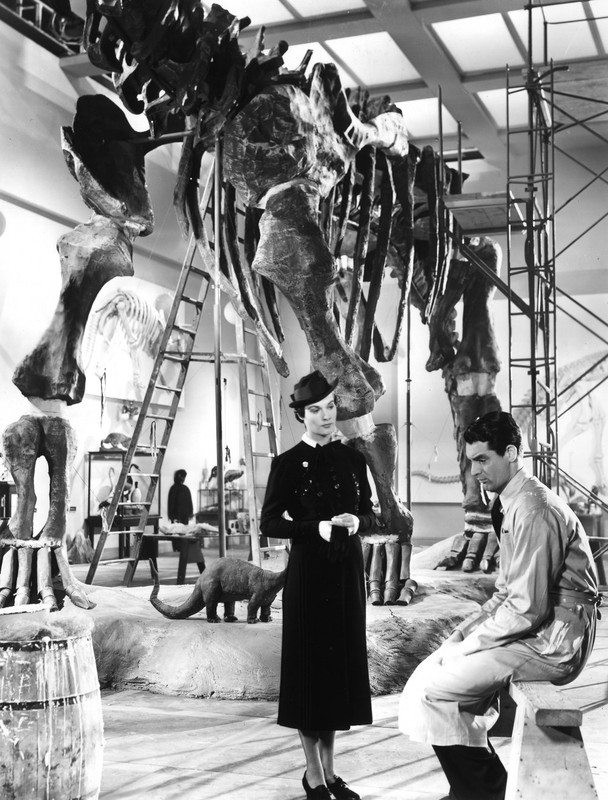
Billy Wilder's Sherlock Holmes sub found in Loch Ness

Loch Ness monster: remains of film model discovered by robot
Large model of monster used in 1970 film The Private Life of Sherlock Holmes is discovered at depth of 180 metres

Haroon Siddique
Wednesday 13 April 2016

The remains of a monster have been found in Loch Ness – but it is a model of the elusive beast, not the real thing.

The 10-metre (30ft) model, from the 1970 film The Private Life of Sherlock Holmes, was discovered 180 metres down on the lochbed by an underwater robot, VisitScotland revealed on Wednesday.

“We have found a monster, but not the one many people might have expected,” Loch Ness expert Adrian Shine told the BBC News Scotland website.

“The model was built with a neck and two humps and taken alongside a pier for filming of portions of the film in 1969.
The underwater sonar-imaging investigation at Loch Ness

“The director did not want the humps and asked that they be removed, despite warnings I suspect from the rest of the production that this would affect its buoyancy. And the inevitable happened. The model sank.”

The Private Life of Sherlock Holmes was directed by Billy Wilder, who was also behind Some Like it Hot, and starred Christopher Lee as the sleuth’s brother, Mycroft, and Robert Stephens as the detective. In the film, a woman persuades Holmes to look for her missing husband and the search takes him to Loch Ness and an encounter with the monster. However, it turns out in the film that the “monster” is actually a submarine.

A couple on a trip to Scotland at the time the film was being made reportedly saw the model and mistook it for the real thing. They began snapping photographs before spotting the boat tugging the “monster” and realising their mistake.

The model, created by special effects man Wally Veevers, sank during a test run on the loch, at which point the actor Genevieve Page recalled that Wilder went over and comforted Veevers.


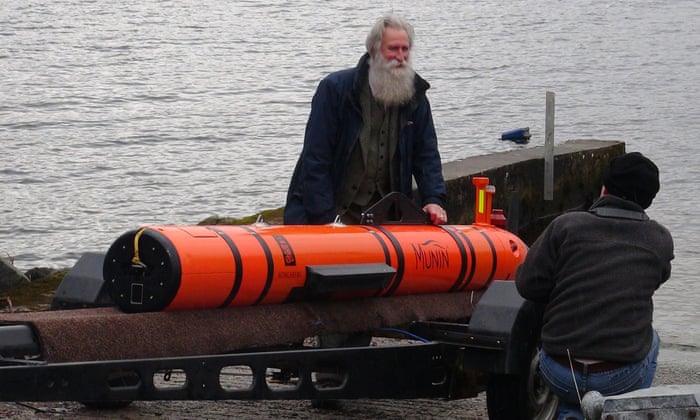
The model was discovered by Munin, a robot that has previously been used to search for downed planes. It has been deployed by Norwegian company Kongsberg, which hopes to explore hidden depths of the loch during a two-week survey. In the past, Loch Ness has proved difficult to survey due to its depth and steeply sloping side walls consisting of hard clay and rocky outcrops.

The robot has made other interesting findings, including disproving claims about the existence of a “Nessie trench”, which would allow the monster to hide, made by a retired fisherman using sonar equipment in January. VisitScotland, which is supporting the mission, along with Shine’s Loch Ness project, said the claims were “incorrect, as the new, more precise underwater evidence shows that there is in fact no anomaly or abyss in the location specified”.


Additionally Munin found a 8-metre long shipwreck at the bottom of the loch. The team is looking for more information on the origins of the boat. The model and shipwreck join a crashed second world war Wellington bomber, a 100-year-old Zulu-class sailing fishing vessel and parts of John Cobb’s speed record attempt craft Crusader – which crashed at over 200mph in 1952 – among objects found in the loch, but no monster.
Adrian Shine and the Munin underwater robot, which has previously been used to search for downed planes

The first photograph claiming to be of the monster was taken in 1933 and and was published on the front cover of the Scottish Daily Record. There have been a number of claimed sightings many of which have been scientifically debunked.

Malcolm Roughead, chief executive of VisitScotland, said: “We are excited about the findings from this in-depth survey by Kongsberg, but no matter how state-of-the-art the equipment is, and no matter what it reveals, there will always be a sense of mystery and the unknown around what really lies beneath Loch Ness.”

http://www.theguardian.com/uk-news/2016/apr/13/loch-ness-monster-remains-discovered-by-robot

Tuesday, 12 April 2016

Harpo Marx, practically speaking...

Finding Harpo's Voice

The internationally acclaimed cellist Steven Isserlis first encountered the Marx brothers as a teenager when he saw their film "The Cocoanuts". And it was the character of Harpo Marx, the silent clown of the brothers, who spoke to him the most directly. The young Steven became a huge fan, to the extent that, instead of practising, he would go to the library to read everything he could find about him and, as Harpo so famously did, instead of shaking people's hands, he would offer his leg instead.

But Harpo wasn't always silent. There were the noises of the horns which became his voice substitute. And at most times during the films he would play the harp- the instrument that got him his stage name. As a musician, this made Steven all the more interested in him.

Steven explores how Harpo came to be the silent Marx brother- he could talk perfectly well but stopped on stage after a bad review. However, without using his voice, Harpo managed to create a unique language with the use of props, sounds and of course his harp. What were the elements of this creation that spoke so eloquently to Steven and what legacy has the silence left?

He travels to the home of Bill Marx, Harpo's eldest son who he first met decades earlier and who first showed him Harpo's raincoat and wig. Steven gets another chance to put them on and to hear the sound of the famous horns.

Steven also talks to actor Simon Callow about Harpo's use of props and the film critic Jonathan Romney about Harpo's technique.

He discusses his harp playing with the harpists Charlotte Seale and Imogen Barford.

And he discusses Harpo with the poet and critic Charlene Fix, author of the book, "Harpo Marx as Trickster".

Producer; Emma Kingsley.

You still have 15 days to listen to the show here: http://www.bbc.co.uk/programmes/b074zdcx

Monday, 11 April 2016

Paul Simon - Thelma

One of Paul Simon’s strongest songs is also one of his most easily ignored

David Brusie
7 Oct , 2013

Just as Hearts And Bones is unfairly dismissed as Paul Simon’s misstep beforeGraceland, The Rhythm Of The Saints is too often described as the lackluster follow-up to the 1986 masterpiece. Though it’s understandable that the records are considered companion pieces—both Graceland and Saints find Simon taking cues from other cultures, and the records share some personnel—they’re very different albums.

Graceland’s strength is its wild diversity: Simon shifts from South African pop to Zydeco, full band to a cappella, and all at a moment’s notice. The Rhythm Of The Saints, which draws primarily from percussion styles of Brazil and West Africa and has consistently airy, crisp production, is more unified in style and tone.

That consistency may explain why “Thelma,” a groove-oriented, borderline jaunty song, was left off the record (it later resurfaced on Simon’s 1964-1993 box set, as well as on the Saints reissues as a bonus track). The Rhythm Of The Saints is many things, but “jaunty” isn’t one of them. The song’s only possible Saintscomplement is the peppy, conversational “Proof”; “Thelma” would otherwise stick out like a sore thumb.


But what a sore thumb it is. The nimble work of Cameroonian guitarist Vincent Nguini lends “Thelma” some levity, but the song’s groove is deep and heavy. And while it contains some of Simon’s late-period imagistic lyrics (“Last night I slept on a rented pillow / A silver moon above my head”), many of its verses are also strikingly, wittily specific: “People aware of my history / Trying to steer you away from me / I left a message at your hotel / Don’t let management poison the well.” This is an old-fashioned love song, the kind Simon didn’t do much in 1990 (or, arguably, ever).

Perhaps it’s for the best that “Thelma” was left on the cutting-room floor. It’s now a perpetual underdog, but a pleasant surprise when it pops up on shuffle. Just like its narrator, “Thelma” is a romantic idealist in search of a home.

http://www.avclub.com/article/one-of-paul-simons-strongest-songs-is-also-one-of--103823

Friday, 8 April 2016

Gordon Lightfoot interview 2016

Image result for gordon lightfoot
Gordon Lightfoot interviewed by Paul Kelly
7 April 2016

THE ties that bind Bob Dylan and Canadian singer-songwriter Gordon Lightfoot are manifold. Both emerged from the early sixties folk boom and both were managed by Albert Grossman. They have long expressed admiration for the each other's work and Lightfoot joined Bob on his 1975 Rolling Thunder Revue tour during its Canadian stopover. Dylan was also on hand to induct Lightfoot into the Canadian Music Hall of Fame at the Juno Awards in 1986. Lightfoot, now 77, spoke to PAUL KELLY via telephone from his home in Toronto ahead of his UK tour in May - his first in more than 30 years.

P: How is the weather in Toronto, Gordon?

G: It's cold. Very cold.

P: Why has it been more than three decades since your last tour of the UK? I hope we didn't do anything to offend you?

G: (laughs) No, I had always hoped I would get back at one point in my life but the years just went by. I wasn't getting any younger and we were receiving all kinds of requests from people to go over.
People were coming over here to Canada, flying over from Britain to see us, so we decided to make the trip. It's a much larger tour than we've ever done there before. I actually lived in Britain for five months, at the time when The Beatles and the Rolling Stones were hitting the headlines, right through that summer of 1963. I lived at 56 Gloucester Road in London and I took the tube over to Shepherds Bush to do rehearsals for these 'Country & Western' shows I was doing on the BBC.

P: I'm calling from Newcastle, where you are to perform at the City Hall on Saturday, May 21. The last and only previous time you played that venue was in 1972. Any particular memories of that concert or that UK tour?

G: I can recall a lot of the shows we did that tour. I remember we played Dublin and Belfast and we would always get to the venue when there was some kind of a political problem going on. It was like we'd arrive there and there would be some demonstration. You had to go through a guard post to get from Northern Ireland to southern Ireland. I remember doing that late at night and our promoter, Jimmy Aiken, talking to the guards and explaining what we were doing there at that hour of the night, you know? But on that same tour I got word that my record had gone to number one on the Billboard chart, back here in the States, my song 'Sundown' had moved McCartney back to number two and I was at number one.

P: I know there are always about a dozen of the same songs you play at every concert but can we expect some more obscure choices on this tour. Perhaps 'Whispers of the North', 'Knotty Pine' or 'Biscuit City', all from 1983's 'Salute'. That's a great, under-rated album. And how do you condense a 50-year-long songbook into twenty-odd songs each night?

G: I'm trying to think about that album, 'Salute', that's one of my favourite albums, although why I ever called it 'Salute' I don't know. I should have called it 'Whispers of the North'. It was produced by Dean Parks, a really talented producer.

We have got about 45 songs we choose from, the kind of tunes that have momentum, you know, and I have to boil that down to 26 or 27 tunes for each show and I do two hours and five or ten minutes, with a 20 minute intermission. I try not to go on too long really and we even condense songs by dropping a verse here and there. A lot of songs we edit, making a medley out of them almost in order to do all the songs the audience wants to hear. There are certain standards that are really well known, such as 'If I Could Read Your Mind', 'Sundown', 'The Wreck of the Edmund Fitzgerald', 'Carefree Highway', 'Early Morning Rain'. They all have to get done and the other 30 tunes are in rotation around them.

There are many permutations and combinations. I can travel between the cities doing nothing but figuring out what to do. I can spend several hours doing that. I'm always thinking about the show I'm going to do that night.

P: You have a relentless touring schedule for a performer in his seventies. What keeps you on the road?

G: I, like many of my compatriots, just love the work and I have really terrific back-up. They are all professionals. I have four guys backing me. We play I guess what you call folk-rock, that's probably the closest term to describe what we do, but all the songs I do have a beat, all the songs we do on stage.

P: It's been some years since we have heard any new Lightfoot songs. Has the muse deserted you or can we expect a welcome musical surprise from you soon?

G: There are always four or five songs hanging around but I tend to leave songwriting for the young now. We try to make the old songs sound new, songs like 'Now and Then', off my 'Cold on the Shoulder' album. It's the only tune in my whole stage repertoire that is in C-shape for a 12-string guitar.

P: You are one of the most covered songwriters in the history of popular music and Bob Dylan has often cited you as his favourite singer-songwriter. How do you respond to that?

G: Dylan has always been very kind to me and he is the king of that realm, that goes without saying.

P: A couple of years ago Dylan did a version of your song 'Shadows' in concert and another of your compositions, 'I'm Not Supposed to Care', a few years earlier. Did you get to hear those versions?

G: Yes, I did. As I say he's been very kind to me through the years and I don't know why. We had the same office for a time and I've been listening to him since his very first album. I got to hear that hot off the press. I thought 'boy, we've got something different here' and it made me think 'can I do this as well?'. I got the work ethic and I got as close as I could to him - in my own style.

P: You have both done each others' songs over the years. You have covered Dylan's 'Ballad in Plain D' that appeared in the movie 'Renaldo and Clara' and, more recently, 'Ring Them Bells'.

G: Ring Them Bells is such a beautiful song, we do that all the time. We don't do it every night but very often, about every second or third show. It's a great tune. The one song I wish I'd written is Bob's 'A Hard Rain's a-Gonna Fall'.

P: You have never done an album of cover songs but what did you think of Dylan's Sinatra-inspired 'Shadows in the Night' album. Have you heard it?

G: No, I haven't heard that one yet and I know it's there. I know I should listen to that and I probably will. In fact, thank you for reminding me to do so. But covering those songs is not something I would do.

P: Are you still in contact with Bob?

G: Yes, once in a while. The last time I saw Bob was when he was playing at the Sony theater here in Toronto, that was a couple of years back. At one point I had five of my family crammed into his dressing room. I see him through the years.

P: Fellow Canadian Neil Young also recorded two of your songs, 'If I Could Read Your Mind' and 'Early Morning Rain', on his 'A Letter Home' album a couple of years ago. What did you think of them?

G: Oh, yes, I heard those, very good. I have never heard a cover version that I didn't like. When someone does one of your tunes it is really encouraging and it makes you want to work a little harder. I love the versions of 'Early Morning Rain' by Peter Paul and Mary and by Ian and Sylvia, and then Elvis did it. He did a really good job with Charlie McCoy on harmonica, that's my favourite cover version of them all.

P: I know you can't vote in the election, but have you been following the US Presidential race?

G: I really think it's about the best entertainment on television. The Republicans had 12 or 13 candidates to start out and Donald Trump just happened to be one of them and he just jumped out. Maybe he met the standards of TV.

P: Thanks so much for your time Gordon. I'm really looking forward to seeing you in Newcastle.

G: My pleasure. I'll put you down for a 'meet and greet' - see you in Newcastle!"

Thursday, 7 April 2016

Last night's set lists

At The Habit, York: -

Ron Elderly: -
Need Your Love So Bad
Sweet Virginia

Da Elderly: -
Is It Only The Moonlight?
Into The Light

The Elderly Brothers: -
Walk Right Back
You Really Got A Hold On Me
Everybody Knows
Hello Mary Lou
Then I Kissed Her
Crying In The Rain
Medley: Sweet Caroline/Hi Ho Silver Lining
I Saw Her Standing There

The success of recent open mic nights prompted our host to restrict players to 2 instead of 3 songs and yet again The Habit didn't let us down. There were half a dozen-or-so new players, some visiting during the Easter Holidays. One or two were exceptional, but no makeweights anywhere to be seen. A young lass sang two original songs with a voice so pure and sweet, but a guy with a voice just made for ballads rather let himself down with a jaunty number. There were excellent renditions of It's All Over Now Baby Blue and a completely unexpected Crosstown Traffic! Finally our host followed a well received Elderly Brothers set to close out the open mic. Unplugged acoustic mayhem followed after a short pause for refreshment.

Merle Haggard RIP

Merle Haggard obituary: ‘all he really wanted to do was fish and write songs’
Inventive singer-songwriter who gave common people a forthright voice

Tony Russell
Wednesday 6 April 2016

Merle Haggard, who has died aged 79, was one of the most resonant figures in country music for almost half a century. Popular, successful, highly influential upon the genre and critically admired both within and beyond it, he also acquired the status of a spokesman for his core audience, his songs Okie from Muskogee and The Fightin’ Side of Me appearing to rally blue-collar Americans round Old Glory and old-fashioned values. But Haggard was an altogether more complicated and interesting man than that status might suggest.

His family background was an archetypal Dust Bowl story. In 1934, James Haggard and his wife Flossie Mae (nee Harp), like the Joads in John Steinbeck’s The Grapes of Wrath, quit the worn-out soil of Oklahoma to find work in California. They lived in migrant workers’ camps and, when Merle was born after three years, their home in Oildale, near Bakersfield, was a converted railway boxcar. James died when Merle was nine, and five years later the restless youth left home to become an itinerant worker and petty criminal. These early years of poverty and frustration, punctuated by spells in reform school, would inspire some of his most enduring songs, such as Hungry Eyes, Branded Man and Mama Tried.

Following a conviction for burglary, Haggard spent his 21st birthday in the state prison at San Quentin, north of San Francisco. Paroled in 1960, he was determined to become a country singer like his models Lefty Frizzell and Jimmie Rodgers, and learned his craft in the bars of Bakersfield. From Frizzell in particular, he absorbed the vocal slides and the wry, resigned blues delivery of the honkytonk singer, a label that came from those bars. For a while he played bass in a band led by Wynn Stewart, a talented, almost forgotten singer who also had some part in moulding the younger man’s style.

He made a few recordings for a small label and began singing with Bonnie Owens, the ex-wife of California’s leading country artist, Buck Owens. In 1965 they married, Haggard’s first marriage, to Leona Hobbs, having ended in divorce. He formed a band, the Strangers, and signed with Capitol Records.

That year he won an Academy of Country Music award as most promising newcomer and, for three years running, he and Bonnie were voted best vocal duet. By the late 60s, his folio packed with songs like Sing Me Back Home and Today I Started Loving You Again, Haggard was a nationally known artist, winning awards, guesting on TV shows and spearheading the “Nashville West” movement, centred in Bakersfield, which offered a less ingratiating kind of country music than the smooth productions emanating from Nashville itself. He was admired even by artists of a very different stripe, such as the Grateful Dead and Joan Baez, who both recorded Mama Tried and Sing Me Back Home.

Then, in 1969, came Okie from Muskogee, a litany of anti-hippie putdowns celebrating the Oklahoma town “where even squares can have a ball”. It was written in the band bus on the spur of the moment, and when it was recorded, one of the session musicians remembered, everyone was laughing so much that they despaired of getting the job done. But many conservative small-town Americans heard it as a fanfare for the common man, and the album of the same name was his first to sell a million.

When Haggard followed it in 1970 with The Fightin’ Side of Me, an aggressive paean to patriotism, he accrued the kind of admiration that would now be accorded to a rightwing talkshow host. He was invited to play at the White House for President Nixon, who told him he approved of his song Workin’ Man Blues,

Unfortunately, Haggard’s broad-brush political gestures obscured other, more finely crafted recordings that reveal much more about the man who made them and the place he wished to occupy in the grand narrative of country music. In 1969, he had also released Same Train, a Different Time, an album of songs associated with Rodgers. A year later, he made a similar tribute to another venerated artist, the western swing bandleader Bob Wills, for which he taught himself to play fiddle. Four years after that he produced Wills’s final album, For the Last Time.

The respect for country music’s history evinced by these projects was both genuine and informed. For the Wills tribute, Haggard recruited former members of Wills’s Texas Playboys, including fiddler Johnny Gimble and guitarist Eldon Shamblin, who continued to play in the Strangers. Another significant sideman was the guitarist Roy Nichols, a veteran of the west coast country music scene, who served in the Strangers for more than 20 years, a period in which they were voted touring band of the year by the Academy of Country Music an unprecedented eight times.

Other projects, such as a gospel album shared with members of the Carter Family and a venture into Dixieland jazz, attested to Haggard’s inventiveness. Meanwhile, he continued to provide his hardcore followers with memorable country songs like It’s Not Love (But It’s Not Bad) and If We Make It Through December. In 1977 he was elected to the Nashville Songwriters’ Hall of Fame, in the company of another Okie composer, Woody Guthrie. The following year he and Owens were divorced and he married one of his backing singers, Leona Williams. In 1981 he published an autobiography, Sing Me Back Home.

Though periods of his life were marked by heavy drinking, and by songs about it such as The Bottle Let Me Down and I Think I’ll Just Stay Here and Drink, Haggard relaxed only with friends and his band. He had no interest in the social circles of country music, or in spending time with politicians, journalists and other hangers-on; all he really wanted to do, he said, was fish and write songs. In the 80s, now wealthy enough to do that, he worked only on projects that interested him, such as duet albums with George Jones and Willie Nelson; Pancho and Lefty (1983), with Nelson, was another million-seller. During the farming crisis of the mid-80s he produced the sombre Amber Waves of Grain, and in 1987 he regrouped with Bonnie Owens and old friends for the album Chill Factor. By then he had scored 38 No 1 records in the country singles charts.

He was less productive in the 90s and seemed to be settling into the role of living legend, a stature recognised by election to the Country Music Hall of Fame in 1994. But in 2000 he started making albums again and, in Roots, Vol 1, returned to honouring predecessors like Frizzell and Hank Williams. He too was receiving respectful nods from younger artists, being mentioned by name in songs by George Strait, the Dixie Chicks and Brooks & Dunn (“Turn off that rap and play me some Haggard”). His 2005 album Chicago Wind was notable for the song America First, reflecting national disillusion with the Iraq war.

If he attracted less attention in his later years than certain contemporaries, it was largely because he did not court it. In some ways he could not: as a personality, on stage or TV, he was less immediately striking, less magnetic than, say, Johnny Cash, even though he was a far more gifted singer. His place in country music as a singer and stylemaker is assured, but he himself wished to be remembered, as he once told the journalist Paul Hemphill, “as a writer, somebody who did some living and wrote songs about what he knew. That’s all.”

In November 2008, he was diagnosed with a form of lung cancer and underwent surgery, but by January 2009 he had recovered enough to give concerts again. In 2014–15 he kept up a touring schedule that would have taxed a much younger man. During 2015 he released his last albums, collaborations with fellow veteran country singers Mac Wiseman and Willie Nelson.

Haggard’s marriages to Leona Williams and then Debbie Parret ended in divorce. He is survived by his fifth wife, Theresa Lane; their two children, Ben and Jenessa; four children, Dana, Marty, Kelli and Noel, from his first marriage; a son, Scott, from another relationship; and a sister, Lillian.

• Merle Ronald Haggard, singer and songwriter, born 6 April 1937; died 6 April 2016

http://www.theguardian.com/music/2016/apr/06/merle-haggard-obituary

A brief interview with Kinky Friedman about Merle: http://www.bbc.co.uk/programmes/p03q88hz

Wednesday, 6 April 2016

Becoming The Beach Boys - review and interview with James B. Murphy


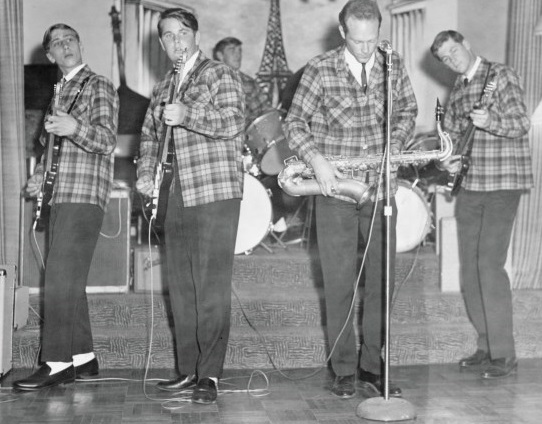
Torrance High School, March 1962

Becoming the Beach Boys (1961-1963)
New book looks at the early Beach Boys

August 23, 20154:26 PM MST

There are many groups who have achieved classic status in the history of rock and roll, but only a few are truly iconic. The Beach Boys are one of those few. In James B. Murphy’s new book, the group’s early trajectory is traced and examined, pointing out how their ideas, essentially the ideas of Brian Wilson, evolved into what eventually defined them as a unit.

There are several books that try to understand the creative process of The Beach Boys once they achieved hit status with their first record. But Murphy’s book offers the most in-depth look at what transpired beforehand. Three brothers, a cousin, and a friend, with passion and spirit, but no musical training, managed to learn to play rented instruments, learn to sing, cut a record for an indie label, watch it climb the charts, and then sign with a major company. Their initial songs helped create the fun loving sunshine, surfing, and fast car mythology of California life in the post-Elvis, pre-Beatles 1960s.

Murphy offers fascinating details about the creation of each song. Early ones like “409” were written by Brian Wilson and a songwriting friend named Gary Usher (Mike Love later sued to get credit for the line “she’s real fine my 409”). There are also new revelations about Brian’s tumultuous relationship with his father, his creative process during this early period, and how he felt about certain songs.

Of course The Beach Boys would score after 1963 with such classics as “I Get Around,” “Don’t Worry Baby,” the amazing “Good Vibrations,” and the quintessential album “Pet Sounds.” But the period that Murphy examines offers the most detailed look at their history and creative development than can be found elsewhere.

For libraries, research centers, musicians, songwriters, and casual fans of the group, “Becoming the Beach Boys” is an absolute must.

http://www.examiner.com/review/book-review-becoming-the-beach-boys-1961-1963


background cover 7
Catch A Wave: A Chat with Beach Boys Author James B. Murphy

From performing in school cafeterias to tearing it up on the stage of the Hollywood Bowl, James B. Murphy’s new book, Becoming the Beach Boys 1961-1963 chronicles the back story behind how it all happened in exhaustive detail.

Ken Sharp

Culling original and archival interviews, newly discovered documents and illustrated with scores of previously unseen photographs and ephemera, the book is a marvel of research teeming with revelatory information about the group’s formative years, puncturing myths and setting the record straight about this seminal period in the group’s history. Essential reading for Beach Boys fans or rock music aficionados, Becoming the Beach Boys 1961-1963 is the definitive portrait of their launch demonstrating in detail how a bunch of kids from Hawthorne, California caught a musical wave and were soon sitting on top of the world. Highly recommended.

Rock Cellar Magazine
: What prompted you to write Becoming the Beach Boys, 1961-1963?

Jim Murphy: I was introduced to the music of the Beach Boys when my older brother, Rich, first heard Good Vibrations on the radio in October 1966. We had never heard anything like it. That record, with its angelic lead vocal, staccato cello, otherworldly theremin, soaring harmonies, and stellar production, transported you to another world.

It was a life-changing experience for kids growing up on the East coast in the Bronx. We went out and bought every album the Beach Boys had already released and each subsequent new album beginning with Smiley Smile and Wild Honey. Over the years I read everything I could get my hands on about the band. But their early history, their origin story, never made sense to me. It never added up. I could never find a clear, cohesive explanation of what actually happened and the order in which it happened. I was always left with more questions than answers. So, I started looking into it and began writing the book I wanted to read.

Rock Cellar Magazine:
What were the greatest challenges you faced working on the project?

Jim Murphy: Worthwhile challenges often bring about an introspective moment when you wonder: if you knew at the onset what you know now, would you do it again? Going to veterinary medical school in my late 30s was one of those moments for me. Writing this book was another. Not knowing what you’re getting into makes things infinitely more possible. When I started working on the book, I didn’t know it would take eight years—writing at night and on weekends, searching for people to interview, reading everything I could find, comparing conflicting stories in everything published, trying to make sense of what happened, retrieving and reviewing stacks of legal documents, and tackling the actual writing.
At this time the quartette of Barrow, Wilson, Lent, and Griffin made its first and last appearance" - Morningside High School Auditorium (from http://cougartown.com/feedback647.php)

As a first-time author, I made typical beginner mistakes with structure, veering from the story’s spine, and keeping the manuscript a manageable length. There are many stories that didn’t make it into the book that I hope to provide on a companion website under construction. I also had to develop thick skin to rejections from publishers. McFarland loved the proposal from the onset and they’ve been terrific partners. I tried repeatedly to interview the surviving band members but, without a high profile platform, was unsuccessful. I hope they enjoy the book and, perhaps, there will be an opportunity for them to weigh in on the story.

Rock Cellar Magazine: Hite and Dorinda Morgan are key movers and shakers in the band’s early career, tell us about them and their importance to the group’s career arc.

Jim Murphy: Hite and Dorinda Morgan, a husband and wife songwriting team in their late 40s, were friends of Audree and Murry Wilson for a decade before the Wilson brothers decided they wanted to make a record. The Morgans recorded aspiring artists in a make-shift recording studio in their living room and produced the first nine recordings by the Beach Boys, including Surfin’ and early versions of Surfin’ Safari and Surfer Girl. And yet, after fifty years, hundreds of magazine articles, more than a dozen books, and several documentaries about the band, I knew very little about the Morgans and had never seen a photograph of them.

When I first spoke with Bruce Morgan, their son, I told him I believed his parents were overlooked in the Beach Boys story and that one of my goals was to shed more light on their integral role in the band’s early history. Brian and the Boys went on to more sophisticated writing and production, but Hite and Dorinda Morgan were the first people in the LA music industry who believed in them. It seemed to me we should know more about them.

Rock Cellar Magazine: Little is known about the background of Candix Records and its founders, fill us in.

Jim Murphy: CANDIX Enterprises, Incorporated, released the Beach Boys’ first record. It was an independent record company founded August 26, 1960, in Fresno, California, by twin brothers Richard and Robert Dix, who enlisted the help of their younger brothers Albert and Sherman (a fifth brother, Theodore, and a sister, Sarita, were not involved). The Dix brothers were professional musicians and, for the previous two decades, had toured the country as the Dix Brothers Orchestra. They hired William Silva Canaday for his knowledge of the LA music industry and the name of the record company was an amalgam of their last names (CAN from Canaday + DIX).

The plan was for Sherman to funnel the profits from the brother’s real estate and home construction business in Fresno into the record company, but Sherman had other ideas. This resulted in a chronic shortage of capital, frustrating Joe Saraceno, their Artist and Repertoire director, and two record promoters who were always battling a shortage of records. In fall 1961, Hite Morgan, on the strength of a recommendation from Bill Angel, the record librarian at KFWB, brought the Beach Boys’ first record,Surfin’, to Candix. It was a great opportunity for Candix, whose biggest hit to date was the Frogmen’s Underwater that reached #44 in spring 1961, but it could not have come at a worse time.

Bob Dix had discovered Saraceno diverted Surfer’s Stomp, a #31 hit by the Mar-kets, to his own recently formed Union Records. Saraceno resigned from Candix. Bob had also recently fired Silva and was pursuing legal action accusing him of embezzling $15,000 from Candix. Bob did everything he could (which I detail in the book) to keep Surfin’ stocked in record stores nationwide. Surfin’ reached #3 in LA, but stalled at #75 in Billboard. It likely would have gone further had it been handled and promoted differently. In September 1963, Bob Dix chose not renew the company’s corporate status. He had released forty-one singles on the Candix label, one (Surfin’) on his X Records subsidiary, and two on the Candix-distributed Storm label.

Rock Cellar Magazine: In the book, you follow the band playing house parties to the Hollywood Bowl in a short timespan. Take us through what shaped them as a live act.

Jim Murphy:
The key thing about the early Beach Boys in the studio and on stage is that only nine months after forming they were thrust into the national spotlight. Unlike the Beatles, who enjoyed a lengthy musical apprenticeship, honing their live skills and stockpiling songs, the Beach Boys scored a #3 regional hit with their first record, recorded a demo reel, and landed a seven-year contract with Capitol Records. Their Capitol debut, Surfin’ Safari backed with 409, was a double-sided hit and the pressure was on. Demand for their personal appearances skyrocketed. By most contemporary accounts, they were not a very good live band when they started.

But they persevered and kept at it, propelled by Murry Wilson’s persistence and assertive personality. They played grand openings, record stores, hardware stores, appliance stores, birthday parties, gymnasiums, recreation centers, high schools, roof tops, back yards, and parking lots. The hits just kept coming and, fueled by their songwriting and unparalleled vocals, they became one of the best and enduring live bands. For most concertgoers, seeing and hearing the Beach Boys live was an unforgettable experience.

Rock Cellar Magazine:
There are quotes in the book culled from members of bands that played on the same bill with the Beach Boys in the early days remarking they were not impressed with their performing abilities. When did they come into their own as a live act?

Jim Murphy: The Beach Boys learned to play as a band in front of live audiences. Their first (April 24-May 5, 1963) and second (July 19-August 30, 1963) tours outside of California were hampered by the intermittent absence of Brian Wilson (Al Jardine was recruited to fill in for Brian on the road). Some early reviews are mixed most likely because of Brian’s absence in the harmony stack. Brian grew tired of touring very early on and decided, quite wisely in retrospect, it would better serve the band if he stayed home to write, arrange, and demo new material for the group. But when David Marks quit, Jardine was enlisted as a permanent replacement for Marks and Brian lost his road replacement and had to rejoin the touring band.

Their October 19, 1963, performance at the 31st Annual Y-Day at the Hollywood Bowl is available online and that gives us a pretty good idea of how the Beach Boys, with Brian, sounded as a live band toward the end of 1963. They played Little Deuce Coupe, In My Room, Be True to Your School, Surfer Girl, and an a cappella tribute to KFWB, the radio station that co-sponsored the show. These are solid, somewhat raw, but wildly exciting performances. Given the technological limits of recording a live show in an outdoor cavernous venue like the Hollywood Bowl, that they sound so powerful and exhilarating is quite remarkable.

Rock Cellar Magazine: Murry Wilson, father of Brian, Dennis and Carl and the band’s manager is a misunderstood figure in the band’s history, were there new insights gleaned about his role and working methods?

Jim Murphy: Let me first say I do not pretend to know what actually went on inside 3701 West 119th Street, Hawthorne, California, as Brian, Dennis, and Carl Wilson were growing up with their parents, Audree and Murry. Only the Wilson boys fully experienced Murry’s strengths and shortcomings as a father. In fall 1961, Murry was forty-four years old, owned his own leased machinery business, had three teenage sons, each two years apart, and the family lived in a two-bedroom, one-level home.

On his modest salary, Murry provided Brian with accordion lessons, a record collection, a meeting with his musical idols, the Four Freshmen, a Wollensak tape recorder, and a used 1957 Ford Fairlane for his senior year at Hawthorne High. Al Jardine recalled Brian was a natty dresser in high school, especially noting his stylish Florsheim loafers. Dennis had a motorized go-kart, a BB gun, a memorable tenth birthday party, and a nine-foot surfboard. Carl had an acoustic-electric guitar, an amplifier, and guitar lessons. Now, material possessions do not make a childhood happy, but Murry did his best to provide his boys with things they enjoyed.

And no one fought harder for the fledgling Beach Boys than Murry. Key players in the early Beach Boys’ story like Chuck Britz, Stan Ross (co-owner of Gold Star studio), Russ Regan, and Fred Vail are all on record with positive comments about Murry, crediting him with much of the group’s early success. Interestingly, most of the negative things the brothers said about their father came after he died from cardiac arrest June 4, 1973. Nick Venet, the band’s first staff producer at Capitol, provided much of the anti-Murry fodder. But, keep in mind, in summer 1963, after Murry told Capitol the Beach Boys refused to work with Venet, Nick was gone from Capitol within a few months. Now, before I am accused of being a Murry apologist, by many accounts, he was a flawed man, haunted by his own rough childhood. Perhaps Murry’s greatest shortcoming was not recognizing the need to provide a more protective environment for Brian, a sensitive soul who, at the time, was doing everything, and not knowing when to step back and allow his sons the freedom to pursue their own creative vision. But without Murry there would have been no Beach Boys.

Rock Cellar Magazine: One of the many coups of your book was tracking down Judy Bowles, Brian Wilson’s girlfriend who inspired some of his music. Tell us about her, how you located her and characterize her place in Brian’s universe and her role as his muse.

Jim Murphy: Judy Bowles was Brian Wilson’s first serious romantic relationship. Brian began dating Judy in summer 1961 just before the group formed. They dated during the formation of the band, the writing and recording of Surfin’, signing with Capitol Records, all of 1962, and most of 1963. Audree Wilson helped Brian select a diamond engagement ring that he presented to Judy for Christmas 1962. They planned to marry within the year. Judy was the inspiration for Surfer Girl, Judy, and, after a painful break-up in fall 1963, The Warmth of the Sun.

It took me a long time to find Judy and I would not have been able to gain her trust and confidence without the help of a good friend of hers who, quite modestly, declined acknowledgement in the book. It was a real joy speaking with Judy, one of the highlights of researching the book. She told me I was the first writer who took the time to look for her and speak with her, and that nearly everything written previously about her was untrue. I found that astonishing. Judy was open, honest, funny, down-to-earth, grounded, and had a wonderfully healthy perspective on that part of her life and how things worked out. She really loved Brian and he will always have a special place in her heart. After the success of Love & Mercy, I would like to see a film adaptation of their love story as Brian came into his musical gift, helped form the Beach Boys, and the group experienced the ups and downs of world-wide fame.
Beach Boys concert early 60s
Rock Cellar Magazine:
Brian Wilson’s songwriting collaborator Gary Usher is yet another key figure in the book, how does he play into the story?

Jim Murphy:
In January 1962, Gary Usher was a twenty-three-year-old bank employee and aspiring singer songwriter. He was visiting his uncle who lived near the Wilsons and his uncle insisted Usher go over and meet the Wilsons because they had a record on the radio. Within a half hour, Brian and Usher wrote Lonely Sea. And 409 soon followed. When Surfin’ dropped off the charts in late March 1962, it was Usher who urged Brian to record some new demos that April at Western Recorders where Usher introduced Brian to engineer Chuck Britz who later helped Brian record some of his most influential music. Usher taught Brian about the business aspect of the music industry, and helped him become more assertive and to approach songwriting more competitively. Usher was critical to the Beach Boys signing with Capitol Records in May 1962 and he co-wrote six of the songs on Surfin’ Safari, the group’s debut album.

Rock Cellar Magazine: Cite the major revelations you were able to uncover that surprised you.

Jim Murphy: The dates of September 15, 1961, for the Surfin’ demo session, and October 3, 1961, for the Surfin’ recording session, which have been accepted for the past twenty-five years, cannot be verified. That alters the entire chronology of certain key events, including the group’s rehearsal sessions, the demo session, when Al joined the group, the renting of musical gear, the recording session, and when Hite Morgan shopped an acetate of Surfin’ to record labels.

I believe Surfin’ was written, a Standard Songwriter’s Contract with the Morgans signed, and a demo recorded before Al joined the band. Then, after he runs into Brian on the campus of El Camino Community College, Al begins singing with the Wilson brothers and Mike. When Audree and Murry went to Mexico for a weekend, the guys rented musical gear, financed by Al’s mother, Virginia, in an effort to up their game. They continued rehearsing for about a month and then recorded the version of Surfin’ released on Candix 331.

Although Surfin’ is credited to Brian and Mike, Carl contributed the guitar part and Dennis made some lyrical contributions that went uncredited.

As Murry suspected, the Beach Boys were indeed short-changed in royalties on the sales of Surfin’. They received $990, but should have received about $2,500.

Rock Cellar Magazine:
What are the major myths you’ve been able to solve while doing the book?

Jim Murphy:
Here are a few that come to mind:

The rental of musical gear did not occur over the Labor Day weekend, September 2-4, 1961. And when Audree and Murry traveled to Mexico, they most certainly did not leave their sons $800, as one source noted, for food or an emergency.

The earliest footage of the Beach Boys singing live is their performance of Surfin’ Safari at the Azusa Teen Club on July 27, 1962, filmed for Dale Smallin’s documentary One Man’s Challenge. But the film crew did not just happen to show up on a night the band was performing. This was a scheduled taping and the group rehearsed for hours in the sweltering heat of the Azusa Recreation Center that doubled as the teen club.

Surfin’ on Candix 331 was their first release. For reasons that I detail in the book, it was next released on X Records 301, Candix 301, the Era Records-distributed Candix 301. Also, an “Audition Only” copy was released on the Era Records-distributed Candix 301.

This is a minor myth, but when their first royalty check arrived in mid-April 1962, it was long believed Murry added one hundred dollars of his own money to bring it up to one thousand dollars so the five boys could each receive two hundred dollars. But the royalty check was for $990, so Murry actually contributed ten dollars.

Rock Cellar Magazine:
Are there still mysteries about that period of time that elude you that you’d like to uncover?

Jim Murphy: Here’s four in chronological order:

A photograph of the Beach Boys with Al Jardine before David Marks replaced him has been reported to exist, but has never surfaced. Does anyone, especially the surviving members of the band, have such a photo?

I would like this one further clarified. When did Al reconnect with Brian by the chance encounter of running into him on the campus of El Camino Community College where they were both enrolled in fall 1961? The school year began September 11, 1961, and the Standard Songwriter’s Contract for Surfin’ was signed September 15, 1961. Brian’s handwritten list of the Pendletones as a quartet (the three Wilson brothers and Mike Love) is dated October 12, 1961. Hence, it may have been well into October before Al ran into Brian and began singing with the Wilson brothers and Mike. If that is true, as I believe it to be, then Al may have joined the band after the Surfin’ demo was recorded, but before the recording session that yielded the version of Surfin’ released on Candix 331.

Second, I wonder whether Surfin’, Luau, and Lavender may have been recorded at Hite Morgan’s Stereo Masters, 5534-5538 Melrose Avenue, Los Angeles. That would mean there was only one session at World Pacific Studio, 8715 West Third Street, Los Angeles—the one on February 8, 1962, at which they recorded Surfin’ Safari, Surfer Girl, Judy, and Karate (aka, Beach Boy Stomp). Both Bruce Morgan and Dino Lappas, the recording engineer at World Pacific, independently recalled only one session at World Pacific. Intriguing.

And third, I would like to discover additional personal appearances the band made in 1962, especially between January and June, and the mysterious mini-tour Murry booked in California around Christmas 1962.

Rock Cellar Magazine:
Do you think this period of the band’s career is overlooked on a musical level compared with later acclaimed productions like Pet Sounds?

Jim Murphy: Not so much on a musical level, but more on a historical level. The band has such a rich musical catalog that most career-spanning books could only devote a few pages to the early days because there was such a wealth of information to explore in the next forty or fifty years. But I love origin stories. I love how Bruce Wayne becomes Batman. And how did Churchill become the man who helps save the world. So, I was naturally drawn to the band’s early history, especially given the contradictory information out there. And keep in mind, a musical education is cumulative, so what Brian and the Beach Boys learned in their early years laid the foundation of what came next.

You don’t reach the pinnacle without climbing the first floor. You can’t have Good Vibrations without Surfin’ U.S.A. And there are some songs from this period, certainly Surfer Girl, Lonely Sea, Farmer’s Daughter, and The Warmth of the Sun, that are just gorgeous early Brian Wilson compositions that portend what is to come.

Rock Cellar Magazine: Who are the unsung heroes and villains of that period in the group’s history?

Jim Murphy: One of the things that appealed to me about 1961 to 1963 was the innocence of that period. They were a bunch of young guys that wanted to form a band, write a song, have a hit record, meet girls, and make a few bucks. So, the players in the early days are all heroes. Hite and Dorinda Morgan, Bill Angel, Dino Lappas, Bob Dix, Joe Saraceno, Russ Regan, Gary Usher, Chuck Britz, Voyle Gilmore, Roger Christian, Nick Venet, and Bob Norberg each played a role in Brian’s and the band’s musical growth.

Rock Cellar Magazine:
Tell us about the Holy Grail most collectible Beach Boy records from that period and their value in 2015.

Jim Murphy: The most collectible Beach Boys records from 1961-1962 are the red and yellow splash wax of Barbie (b/w What Is a Young Girl Made Of?, Randy 422), the Complete Selections from Surfin’ Safari by the Beach Boys promotional EP with cardboard sleeve (Capitol PRO 2186), the I Was There KFWB Day! mailer sleeve that housed the promotional 45 Spirit of America (b/w Boogie Woodie, Capitol Custom), and The Surfer Moon (b/w Humpty Dumpty, Safari 101) by Bob and Sheri. As with most rare records, they’re worth whatever two people say they’re worth! I would like to pose a question to readers—has anyone ever seen and can anyone verify a white label promotional copy of Surfin’ on Candix 331? [Not the black label “Audition Only” Surfin’ on the Era Records-distributed Candix 301]. Candix produced white label promo records from Candix 303 through 330, but I have never seen a white label promo of Surfin’ on Candix 331. I don’t think it exists, but I would like to be proven wrong.

Rock Cellar Magazine: From a personal perspective, is there a defining song or two that best encapsulates the 1961-1963 period of the band’s career?

Jim Murphy: That’s a great question. Two come to mind. Surfin’ U.S.A. for its sheer energy and exuberance. In March 1963, it exploded out of AM radios with a searing guitar intro, slicing rhythm guitars, a wave of crisp double-tracked vocals, and Brian’s soaring falsetto. It revitalized rock ‘n’ roll with an electrifying burst of freedom and rebellion. It is their first great record and it propelled their career world-wide. The Warmth of the Sun is a beautiful ballad with a mournful melody. It remains one of their most personal and deeply moving songs. It is sad, but comforting. Desolate, yet hopeful. A reflection on love, once so beautiful, now lost forever. In light of the dissolution of Brian’s and Judy’s two and one-half year relationship, the haunting melancholy is laden with emotional poignancy. Together, these two songs are a great example of why the Beach Boys will always be beloved.

Rock Cellar Magazine: You were unable to land an interview with any of the surviving Beach Boys and instead mined archival sources for your book. If you could speak to Brian, Mike, Al, or David and ask them only one question, what would you ask and why?

Jim Murphy:
I wrote this book because the Beach Boys’ musical catalog has brought me years of joy. I wanted to have a better understanding of their early history and I hoped to make a contribution to our collective understanding of the band. I avoided the word “definitive” in the title because I truly hope the book generates robust debate. If I got something wrong, I want to be corrected. Perhaps there will be an opportunity for a second edition and the story can be further refined. Of course, I would love the opportunity to speak with Brian, Mike, Al, and David. In the meantime, here’s a question for each of them:

Brian: Tell me about your memories of Hite and Dorinda Morgan.

Mike: Was the demo of Surfin’ recorded before Al Jardine joined the band and was the demo recorded at Hite and Dorinda Morgan’s home on Mayberry Street in Los Angeles?

Al: Was Surfin’ (the version released on Candix) recorded at World Pacific on Third Street or Stereo Masters on Melrose Avenue?

David: What do you believe was your most significant contribution to the early Beach Boys and tell me about a time when you realized quitting the band may have been a mistake?

Becoming the Beach Boys, 1961-1963, is available at Amazon, Barnes & Noble’s website, and McFarland Books.

http://www.rockcellarmagazine.com/2015/11/06/becoming-the-beach-boys-author-james-b-murphy-interview/?utm_source=Rock+Cellar+Magazine+Subscribers&utm_campaign=046f104901-October+Issue+Email+10.8.15&utm_medium=email&utm_term=0_951cfef8de-046f104901-159115861#sthash.4DqyGB6v.KgW5GH17.dpbs

And... Murphy has created a terrific website to complement his book, complete with interviews, reviews, podcasts and additional detail about people and events:

http://becomingthebeachboys.com/

Monday, 4 April 2016

Al Jardine, Brian Wilson and David Marks of The Beach Boys wear Ravenscroft


Am I the only one sad enough to recognise the spine of There Goes Rhymin' Simon from the giant album sleeves in the background without having to enlarge the photo...?

Sunday, 3 April 2016

Loudon Wainwright III interview 2016

Loudon Wainwright III: 'I wrote a song about Donald Trump. He’s an easy target'
The veteran troubadour is still on the road and using his songwriting to discuss the issues of the day, including the Republican frontrunner and Spotify

Martin Longley
Friday 1 April 2016

Loudon Wainwright III is just beginning a huge US tour, which runs until April 2017. At his apartment in Manhattan’s Upper West Side, which overlooks the Hudson river, he’s preparing for the rigours of the road. Most of the coming dates will find him alone, as usual. “It’s an economic thing, to a degree,” he admits. “A long time ago, in the 70s, I had a rock band. Primarily I’ve been solo. I don’t go out with a tour manager, I travel alone. It’s getting harder to haul my ass around everywhere, but there are less overheads.”

Customarily, he’ll fly and then hire a car if he’s hitting several cities within driving distance. “It’s hard for me to write on the road, just because it takes every ounce of energy I have to get there, rest a little bit, then go up and do the show. Occasionally I can write songs on the road, but it doesn’t happen usually.”

So a song such as 1971’s Motel Blues was probably penned when Loudon returned home, able to filter his touring experiences. “I’m always trying to write songs, I’m always thinking about putting out another album,” he says, unsurprisingly. “I caved and wrote a song about Donald Trump. It’s a dirty job … He’s a pretty easy target, I wouldn’t even say he’s a moving target. I’m still learning it, just finishing it. I think that there’s some laughs in it.”

Wainwright’s last two albums have markedly different characters. In 2012, Older Than My Old Man Now was steeped in morbid reflection, considering mortality, with any humour, if it was present, being dark indeed. Haven’t Got The Blues (Yet) featured an upbeat band presentation, jumping around to address a wide range of varied subjects, from the weighty to the almost trivial. It sounded like the album of a younger man, as if to recover from the downbeat pall of its predecessor.

“It takes me a couple of years to write an album’s worth of songs that I think are good enough to be on a record,” Loudon muses. “I do it song by song, and then kind of shape it, and the record might have a tone or mood. That’s just the way it turned out, and it wasn’t as if I’d planned ahead of time. I don’t do that. I just focus on trying to get the songs together, and then make a decision over how I’m going to produce the record, and who I’m going to use. It’ll find my, or its, audience, one way or another. Or not!”

In a drive against complacency, Loudon plans on reviving different song selections as the tour proceeds. “I have more than I need. I have a lot of songs. I’ve been going back and relearning some of them,” he says. “It was great to go back to that very old material, some of which I had to relearn, and completely treat them in a different way. I’m struck by how good they are.”

Wainwright grew up in Westchester County, upstate New York. “This is my hometown. I feel comfortable here. I started to play in the clubs here in New York, down in Greenwich Village, the Gaslight [Café], that was the primary club.”

This was a significant hive on MacDougal Street, where the likes of Bob Dylan, Dave Van Ronk and Tom Paxton honed their craft and which the Coen Brothers loosely based 2013’s Inside Llewyn Davis on. Loudon just got in there at the Gaslight a few years before it closed in 1971.

The place he really got his start though was in Cambridge and Boston. “I used to go up and play, little coffee houses. You start off by doing a few numbers on a hoot, or an open mic: they used to call them hoots.

“You don’t have an audience at that point, so you’re really just trying to get noticed, and you’re not getting paid, well virtually nothing.” His luck changed when someone from the Village Voice saw him and wrote up a positive review.

“In a matter of months, I had a record deal, so I was extremely lucky. There was not even a year of bumming around, and trying to play shows.

“John Peel was very instrumental in getting my career going. He played my first couple of albums a lot. You hear about people struggling for five, or even 10 years: I was good, don’t get me wrong, but I was also extremely lucky.”

In June, Wainwright plays a pair of New York City gigs, just below his original Greenwich Village stomping ground, at SoHo’s City Winery, which has been a regular haunt in recent years. The first gig is called Under The Wall And Off The Radar (22 June): “The idea being that I would pick people that I like, that I’ve seen, and that other people may not have seen, but should, that I think are really good.” So far, he’s invited along Dave Hill, Rachelle Garniez, Brian Dewan and Marc Eskenazi, a very diverse crew whose talents veer between writing, singing, guitaring and stand-up, in varying ratios. The second Winery date, on 29 June, is a Family & Friends show, where a possible combination of Rufus, Martha, Lucy or sister Sloan Wainwright may well be involved.

A glance at Loudon’s Spotify page reveals a live album, Late Night Calls, as the most recent release, lifted from a 1972 radio broadcast. “That’s a bootleg,” Wainwright fumes. “I have nothing to do with that complete rip-off. That infuriates me. I wouldn’t listen to it, it’d be too depressing. I hate the idea that someone is just getting something for nothing, but also that there’s no quality control. It pisses me off – I consider it thievery. Being the person who did the performing and writing, I feel violated.”

For him the important things are easily calculated: it still comes down to playing and writing music.

“The exciting part is writing the songs and the fun part is doing the shows. As long as those two elements are in play, and I’m getting paid, I’m perfectly happy.”

Loudon Wainwright III is currently touring the US

Friday, 1 April 2016

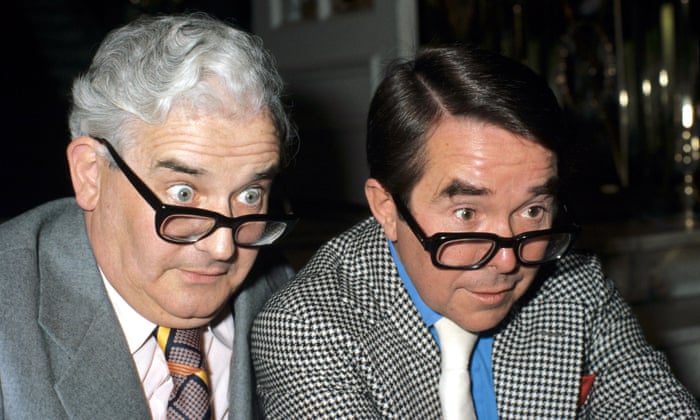
Ronnie Corbett RIP


Ronnie Corbett obituary
Actor and comedian who became a national treasure as partner to Ronnie Barker in The Two Ronnies

Stuart Jeffries
The Guardian
Thursday 31 March 2016

“I was lying in bed with my wife last Sunday morning when she called me by a special pet name,” said the actor and comedian Ronnie Corbett, during a monologue on the TV show The Two Ronnies. “‘Hey, Shorty,’ she said, ‘would you like to hear the patter of little feet?’ Somewhat taken aback, I replied: ‘Yes, I would.’ She said: ‘Good. Run down to the kitchen and get me a glass of water.’”

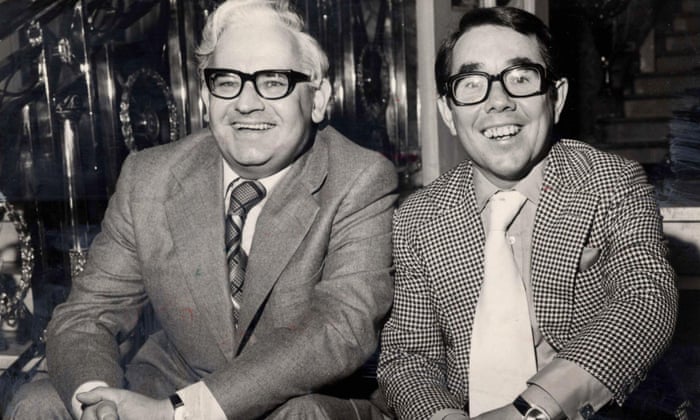
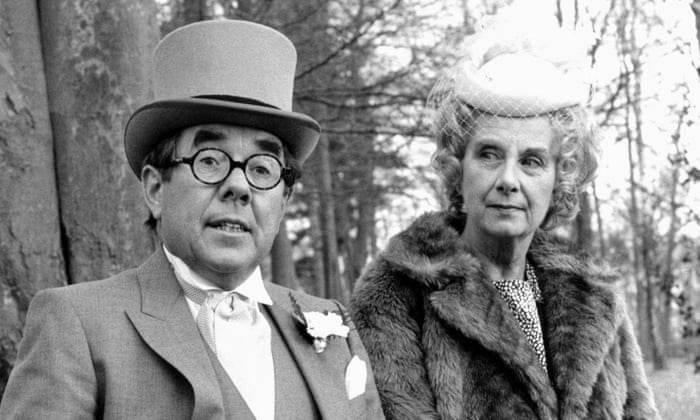
It would be wrong to suggest, though, that Corbett’s huge role in British TV comedy from the 1960s onwards was due only to him playing on his diminutive stature. Over the years, Corbett, who has died aged 85, and his long-term professional partner, Ronnie Barker, created some of the most memorable and frequently repeated moments in British comedy.

In another, more celebrated Two Ronnies sketch, for instance, Corbett played an ironmonger confounded by Barker’s homophonically challenged customer. “Four candles,” demanded the latter. Corbett presented the customer with four candles. “No, fork ’andles. Handles for forks.” The sketch continued with more hilarious misunderstandings. In a version that was not broadcast, Corbett was to be replaced by a buxom woman who would ask the customer: “Right then, young man, what kind of knockers do you want?”

Sketches like these – which can be quoted verbatim by viewers of a certain age – wove themselves into the fabric of British vernacular in the 1970s and 80s, as did Corbett and Barker’s catchphrases. Corbett’s rambling weekly monologues, delivered from a tubular steel chair by the comedian while sporting a Lyle and Scott sweater, were frequently punctuated with Corbett’s “But I digress.” And when the show ended, with the Ronnies as faux newsreaders behind a desk, Corbett would say: “It’s goodnight from me!” “And it’s goodnight from him!” added Barker.

In an era of TV double acts – Morecambe and Wise, Mike and Bernie Winters, Little and Large, Cannon and Ball – the Two Ronnies were different*, not least because Corbett was more than Barker’s straight man and both received equal billing. “In fact,” argued Barry Cryer, who wrote for both The Two Ronnies and Morecambe and Wise, “because they [alone] never regarded themselves as a double act, Corbett and Barker never saw themselves in competition with Eric and Ernie.”

For 16 years, and more than 93 episodes, from 1971 to 1987, up to 22 million British viewers regularly watched The Two Ronnies on Saturday nights, making the comedy duo household names and even national treasures. Corbett, unlike his diffident partner, enjoyed the fame. “I do find the ‘national treasure’ thing very touching,” he told one interviewer. “Actually, it brings a tear to my eye when people call me that.”

Corbett was under no illusion about why he was a national treasure. “It’s all down to The Two Ronnies,” he said. “Those years with Ronnie Barker were the spine of my career.” But he had other successes. In the BBC sitcom Sorry!, which ran for seven seasons from 1981, Corbett played Timothy Lumsden, a middle-aged librarian who lives at home with his mother. “He was a sort of Walter Mitty – he pretended to be bold and worldly but really he was just a timid mother’s boy,” wrote Corbett in his autobiography, High Hopes (2000). “I received a lot of letters from librarians saying: ‘We are trying to improve the image of librarians and we’re not sure Timothy Lumsden is a step in the right direction.’”

And then there were the late-career comedy turns in which Corbett gamely subverted his national treasure status. On Ricky Gervais’s sitcom Extras in 2006, Corbett played himself snorting cocaine with fellow actors in the loos at the Baftas. They were caught and hauled before the head of security, who said: “Corbett! It’s always bloody Corbett.” “Just a bit of whizz to blow away the cobwebs,” replied the comedian. Corbett explained why he took the role: “It did cause a stir, but I had the reasonable safety valve that Moira Stewart was my ‘supplier’. If I was in trouble, she was in more trouble.”

In Little Britain Abroad, broadcast on Christmas Day in the same year, Corbett appeared as unwitting suitor to Matt Lucas’s grotesque exhibitionist Bubbles DeVere, who stripped off and attempted to seduce the 76-year-old in his Monte Carlo villa. Corbett turned down another sketch on the show, though. “I was supposed to be having a massage at a health spa and the script said I came out afterwards in my towelling dressing gown ‘visibly erect’,” he recalled. “I wrote a letter saying: ‘You have to understand that after years of me being a cherished little soul in a Lyle and Scott sweater, I am not prepared to trade it all for one sweaty moment in a sauna.”

Corbett was born in Edinburgh, the eldest of three children of William, a baker at McVitie’s who worked night shifts for 29 years, and his wife, Annie, who worked in a telephone exchange. Ronnie was educated at the Royal high school, and after leaving took an office job at the animal feeding stuffs department at the Ministry of Agriculture and Fisheries. By then, though, he had a sense of his true vocation.

“There was no history of theatre in the family,” he said once. “It wasn’t until I got a part playing the dame in my local church youth club pantomime at 17 that it all burst out of me. I thought: ‘Hang on, I’ve got something here.’”

He was entering a world very different from that of his childhood. “Our parents taught us the value of hard work and discipline. They never borrowed money, never drank except for a sherry at Christmas and took us to church on Sunday.”

He joined an amateur dramatics company during his national service in 1950 and subsequently moved to London to start an acting career. He worked for a time behind the bar at the drag artist Danny La Rue’s nightclub, Winston’s, in Mayfair, and for many years did cabaret there. It was at Winston’s that he met and fell for Anne Hart, an actor and dancer who, at 5ft 8in, was seven inches taller than him. “But of course she was married, and in those days you didn’t fall in love with married people,” he recalled. “Sadly, her husband then died an untimely death.” The pair eventually married in 1965, and had two daughters, Sophie and Emma, as well as a son, Andrew, who died of a heart defect at six weeks.

Corbett’s first big break was doing standup on the BBC children’s TV show Crackerjack in the mid-50s. But he was also becoming a stage star. In 1963 he starred opposite Bob Monkhouse in Rodgers and Hart’s musical The Boys from Syracuse at the Theatre Royal, Drury Lane. In 1965 he was due to appear as Will Scarlet in Lionel Bart’s Twang!, a musical about Robin Hood, but the production collapsed. That was fortuitous as it left Corbett free to accept an offer by David Frost to appear in The Frost Report (1966–67). It was there that he met Barker, and the two men formed a bond: they were two grammar school boys who had not been to university, surrounded by writers and actors who were mostly Oxbridge graduates.


One sketch from the satirical show became a classic. In it, Corbett played a cloth-capped working-class man literally looking up to Ronnie Barker’s middle-class man (5ft 8in) who, in turn, looked up to upper-class John Cleese (6ft 5in). “I know my place,” said Corbett. “But I don’t look up to him” – looking at the other Ronnie – “as much as I look up to him,” nodding at Cleese.

Apart from being a satire on the sclerotic British class system, the sketch traded on Corbett’s size. He had been self-conscious about his height ever since his doctor recommended stretching exercises when he was 15. He recalled asking a girl to dance with him when he was in his teens. She looked down at him and said: “If you weren’t so short, you’d be quite good-looking.” The remark devastated him. “I felt like I’d been cut in half,” he said.


In the late 1960s he gave a revealing interview in which he said: “Being small is a bit like being Jewish – you always feel you’re being discriminated against. I mean, could you see anyone employing me as a bank clerk or consulting me about an insurance policy? Whatever I did to seem dignified, they’d think I was the teaboy.” But at least he could play that sense of discrimination for laughs. Between 1967 and 1970, he starred in No, That’s Me Over Here!, a sitcom written by Cryer, Eric Idle and Graham Chapman, as a small insurance clerk with big ideas, always confounded by more adept office politicians (notably his lanky colleague Henry McGee).

During the late 60s, Corbett started to get film work. He appeared in the Bond spoof Casino Royale (1966) alongside David Niven, Woody Allen, Peter Sellers and Ursula Andress. It was a critical and box-office disaster. He also appeared in Some Will, Some Won’t (1970), as one of four people who go to great lengths to obtain the fortune left in a will, and in the film version of No Sex Please: We’re British (1973). In this, he was a small-town bank clerk horrified when he receives pornographic postcards in the post, rather than the calculator he ordered. His character spends much of the rest of the film trying to dispose of the package without courting scandal. “A pleasing performance from Corbett,” said the American TV Guide critic, “saves this otherwise average British farce from the usual doldrums.”

Corbett was destined to become more famous on the small screen. After No, That’s Me Over Here!, he appeared in two follow-up BBC sitcoms by the same writers, Now Look Here (1971-73) and The Prince of Denmark (1974).

After The Two Ronnies and Sorry! finished, he was never to repeat their successes. He appeared on game shows such as the short-lived Full Swing (1996), hosted by his golfing chum Jimmy Tarbuck, which involved general knowledge and golf. It was cancelled after one series. The following year he was reunited with Cleese to appear in another big-screen comedy flop, Fierce Creatures.

In 2000 he revived his armchair monologue routine on Ben Elton’s TV show, his still-innocent humour standing up well among younger, swearier and more political comedians.

He was reunited in 2005 for one last time with Barker, who in 1987 had retired from showbiz, for The Two Ronnies Sketchbook, a series of six programmes of sketches from The Two Ronnies, with new introductions by the two stars. The last episode was broadcast on Christmas Day that year, Barker having died in October.

The one Ronnie carried on. In 2010 he took a role in the John Landis film Burke and Hare, starring Simon Pegg and Andy Serkis as two 19th-century grave robbers in Edinburgh. In his 80s he starred in the cult hit When the Dog Dies (2010-14), a BBC Radio 4 sitcom written by Ian Davidson and Peter Vincent (who wrote Sorry!), as a retired man whose family want him to leave the house he shares with a lodger, Dolores (played by Liza Tarbuck), so they can move in. He resolves to do so only when his beloved companion, Henry the dog, dies.

Corbett celebrated his golden wedding with Anne in 2015. For many years he lived in Surrey in a house adjoining a golf course, where he could indulge his passion for the game. He was appointed CBE in 2012. “I’ve had a very happy life and although I have had tragedy,” he said once, “I’ve never suffered from any darkness.”

He is survived by Anne and their daughters.

• Ronald Balfour Corbett, actor and comedian, born 4 December 1930; died 31 March 2016

http://www.theguardian.com/culture/2016/mar/31/ronnie-corbett-obituary

* Yes, and with the exception of Morecambe and Wise, the others weren't funny.


Ronnie Corbett: 'It was such a wonderful feeling making people laugh'
TV great Ronnie Corbett died on March 31, 2016, aged 85. This interview with Celia Walden was conducted during an emotional time for Corbett, when he was returning to TV after 17 years and mourning the sudden loss one of his oldest friends, David Frost. It was first published in The Telegraph in September 2013

Celia Walden
The Telegraph
31 March 2016

"Is this tea or coffee?” asks Ronnie Corbett, peering through his horn-rimmed Specsavers glasses at the murky liquid in his cup. “I can’t tell.” Without waiting for a response, the 82-year-old comedian empties one sachet of sugar and one sachet of sweetener into this unidentifiable brew, takes a sip and frowns. “I think it’s a mixture of tea and coffee. But it’s warm, isn’t it?”

It’s the kind of relentlessly upbeat reaction one would expect from a man whose joyous brand of humour as one half of The Two Ronnies has been part of our national comic identity for over 50 years. Age and a much-mourned absence from our TV screens has done nothing to diminish Corbett’s effect on the public. As he trots into Addington Palace – a country club near his Surrey home – in a canary-yellow windbreaker, every face colours with pleasure. “I do find the 'national treasure’ thing very touching,” Corbett admits, once safely ensconced in a Queen Ann style armchair, the windbreaker swapped for one of his trademark tartan jackets (“Hunting Stewart of Appin, this one’s called – or 'Little Ron of Midlothian’ as I like to call it”). “Actually, it brings a tear to my eye when people call me that.” 


These days, that happens all too easily, he apologises, dabbing beneath his specs with a hankie. Filming his new prime time BBC One show, Ronnie’s Animal Crackers – a quirky series about the British love of animals – provided more than a few touching moments, as did the compilation of The Two Ronnies’ best moments for a forthcoming UK Gold series. “Ronnie B, bless his heart, had kept such an impressive collection of material.

Watching it all back reminded me what an excellent fit we were. And it was such a wonderful feeling making people laugh,” he explains, his eyes filling with tears again. “Sorry. I don’t know why I’m crying so much. My eyes just keep on running.” It has been an emotional time for Corbett, who buried one of his dearest friends, Sir David Frost, last week. “To die the way he did, suddenly taken ill on a cruise ship… I mean David wasn’t just a great friend, he was the founder of my career.” The Edinburgh-born son of a master baker was in his early thirties when the late broadcaster spotted him at Winston’s nightclub in Mayfair and put him together with Ronnie Barker, with the comedy duo soon becoming a regular feature on his satirical BBC show, The Frost Report.

The Two Ronnies’ physical incongruities belied a comic connection that was based on a mutual love of the absurd. “We were a real couple with matching tastes and styles,” smiles Corbett. “Of course we were quite different but somehow we fitted so well together. I think it’s a more pleasant and palatable thing to see people being funny together because you’re touching areas of truth. Dinner parties or falling out with people – it’s the naturalness of it.”

The 1970s, 1980s, and 1990s was a great period for comedy duos, with the likes of Morecambe and Wise, Smith and Jones, Fry and Laurie, French and Saunders and Reeves and Mortimer dominating prime time television. Is the dearth of double acts now down to celebrity culture? A reluctance to share the glory with someone else? “Well, my first instinct was not to be up there on my own,” Corbett shrugs. “People who want to do stand-up from the start – I mean that’s an extremely self-centred thing to want, isn’t it? Michael McIntyre is an exception, along with one or two others, but it is more difficult when you’re standing on your own two feet to avoid vicious jokes. It’s very easy to be fierce.”


The meanness of contemporary British humour is, as one might expect, anathema to Corbett. He thinks talent shows are partly responsible (“it’s all about having a quick effect. Mock the Week is a little bit like that: they’re all rushing to get up and say their funny joke first”) and although negativity is not in his nature, Corbett appears mystified by the tiresomely provocative Russell Brand. “He seems to be so bold in everything,” he says. “I mean he’s had a terrific touch in America managing to follow Dudley Moore in that great role [in Arthur]. But the trouble with monologue people is that all they seem to be doing is showing off.”

Does he think women can ever be as funny as men? “Well, I loved Beatrice Lillie,” he chuckles. “And Joan Rivers is very funny and raw. But you have to be very clever as a lady to be funny and not lose some of your sexuality. I mean Jennifer Saunders and Dawn French were very funny together and Miranda Hart is divine – although not, of course, really feminine. A man can add to his sexuality by being funny whereas a woman can diminish hers. I don’t know why that’s the case: it’s completely unfair.”


Corbett was nevertheless grateful for this when he met his wife, Anne Hart – a beautiful actress and dancer, seven inches taller than him at 5ft 8in – at Winston’s one night. “But of course she was married, and in those days you didn’t fall in love with married people. Sadly, her husband then died an untimely death.” The pair finally married in 1965, and have two daughters, Sophie, 45, and Emma, 46.

“We’ve been very fortunate,” he sighs contentedly. “I’ve had a very happy life and although I have had tragedy,” he adds – referring, I imagine, to the loss of his baby son Andrew, who died of a heart defect at six weeks old – “I’ve never suffered from any darkness.” Unlike some of his contemporaries, who had depressive temperaments off screen, Corbett was never afflicted by ''sad clown’’ syndrome.

Indeed, throughout our hour together, Corbett’s face has creased up with mirth every few minutes, propelling those wonderful eyebrows right up to his hairline. He chuckles raucously all the way through an account of the moment he was awarded his CBE at Buckingham Palace last year. “I was caught in the lavatory when they called me up. I was having a quick pee. This keeps happening to me. I was caught in the lavatory at Windsor Castle, too – I was late for a dinner because I couldn’t get out of there. And at Victor Spinetti’s memorial service I was really locked in. They had to throw a screwdriver over the door.”


Did the Queen mind when he – as described at the time – committed the faux pas of touching her arm? He thinks about this for a moment. “No. I think she was quite pleased to be reassured.” What did she feel like? “Silky smooth and sweet,” he smiles. “She said to me 'You’ve been doing this a long time haven’t you?’ And I said 'Over 50 years, but not as long as you.”

Memories of the medical he was forced to undergo before doing National Service provokes still more hilarity. “I panicked because I had – and still have – a deviated septum. When the doctors pointed this out I thought: 'Please don’t send me home because of a deviated septum. I can’t go home and tell people that.’”

Corbett remembers there being a lot of laughter around the kitchen table as a child. “Mum was really funny. She was well read and enjoyed words, but it wasn’t until I got a part playing the dame in my local church youth club pantomime at 17 that it all burst out of me. I thought: 'hang on, I’ve got something here’.”


He joined the amateur dramatics company during his National Service stint (he was the shortest commissioned officer in the British Forces) and subsequently moved to London to start an acting career that initially involved playing schoolboy roles in films.

Although he’s pleased to be coming back to our screens after 17 years, Corbett’s also relieved that he doesn’t have to fill an hour of prime time Saturday night TV. “I don’t do as much stuff on my own now because one does have a worry about memory.”

Ask which moment of his professional life he would relive if he could, and a slow grin spreads across his face. “When Ronnie B and I did those two big sell-out seasons at the Palladium. Having sat in that same theatre at 18 and seen Bob Hope, Jack Benny and Danny Kaye perform there… To think that we were in the same place, together and being such dear friends. That’s a pretty hard one to beat.”

http://www.telegraph.co.uk/tv/2016/03/31/ronnie-corbett-interview-from-2013/