Showing posts with label Michael Chabon.... Show all posts

Saturday, 23 March 2019

Michael Chabon - Bookends: Collected Intros and Outros - review

Related image

Are intros and outros the bland bread of a book sandwich? Michael Chabon's 'Bookends' makes them the main course
Michael Chabon's new book "Bookends: Collected Intros and Outros" assembles his pieces that accompany other texts

Stephen Phillips
The Los Angeles Times
11 February 2019

Forewords, prefaces and afterwords rank squarely among literature’s stepchildren — above marginalia and non-David Foster Wallace footnotes perhaps but below prologues and postscripts. For many readers they’re makeweight puffery, eminently skippable, a lot of throat-clearing and flapdoodle. A collection of such squibs might be a tough sell even if its author is acclaimed litterateur Michael Chabon.

Chabon concedes as much in his “meta-introduction” to “Bookends: Collected Intros and Outros.” The proportion of readers prepared to waylay themselves with an introduction approximates the proportion of consumers willing to futz “with user manuals before … powering up the widget,” he suspects. And spare a thought for the humble afterword — literature’s caboose. Who sticks around for that? For a hint of what those of us outside the golden circle of overachievement are missing, Chabon obligingly taxonomizes the merits of felicitous forewords. They may be “transitive: acts of seduction that are at the same time documents of earlier seductions,” or, in a good way, “parasitical,” upstaging “their hosts.” The finest prefaces and afterwords, meanwhile, are “restorative. They unstopper the vial that contains, like some volatile oil, the fragrance of the time in which the prefaced work was engendered, conceived, or written, summoning for writer and reader alike a sensuous jolt of things past.” But does uncoupling such hurrahs, homages, raves and rhapsodies from the works they accessorize and cobbling them together yield a volume that satisfies on its own? Most readers will likely never have heard of much of the arcana eulogized in “Bookends.” Chabon has long channeled his inner fanboy, flaunting obscure passions and inspirations in his novels. And aficionados will find familiar preoccupations — comic books, superheroes, sci-fi, fantasy. But non-heads may blank on Swedish author Frans G. Bengtsson. Stated otherwise: Is “Bookends” strictly for the Chabon completist?

I’d recommend it for the Chabon greenhorn on up. Chabon has never been precious or stingy with his talent; he’s unspooled it from a single skein, whether in essays, columns, even — for DJ-producer Mark Ronson — liner notes (a species of foreword and reproduced in “Bookends”) or novels. “The primary motivation for writing introductions,” he explains, is of a piece with “everything I write: a hope of bringing pleasure to the reader.” The strongest entries in this compilation emphatically afford this — ignorance of their subjects no object.

“Bookends” reveals in full measure the avid fandom flickering around the edges of much of Chabon’s fiction. Eschewing hermetic analysis, he recounts the sensation of encountering a work of art.

Here, he recollects the feeling of reading Greek myths after millennia “of moralizers, preceptors, dramatists, hypocrites and scolds” have had their way in mediating them for our consumption:

“The original darkness was still there, and it was still very dark indeed. But it had been engineered, like a fetid swamp by the Army Corps, rationalized, bricked up, rechanneled, given a dazzling white coat of cement. It had been turned to the advantage of people trying to make a point to recalcitrant listeners.”

And he makes short work of evoking for the uninitiated the aesthetic of the Ben Katchor comic strip, “Julius Knipl, Real Estate Photographer” — “a dyspeptic, masculine world the color of the stained lining of a hat.”

Elsewhere, he compares ghost-story master M.R. James in his unwitting use of recondite post-modern devices in service of the workaday task of frightening the wits out of his readers to a “casual, gentleman tinkerer yoking a homemade anti-gravity drive to the derailleurs of his bicycle because he is tired of being late to church every Sunday.”
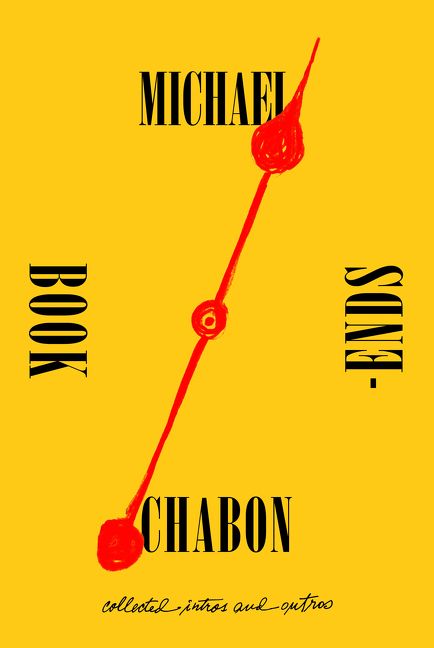
Image result for michael chabon bookends
And prefacing shards from an abandoned early novel, Chabon describes exhuming it from his computer and beholding “a strangely intact record of my life during the time I was writing the book, a bubble of ancient air trapped in the caulked hull of the sunken novel,” before giving up the ghost: “the great brined and barnacled hulk sank back to the silence and dark.”

Then there’s the preface to his novel “Summerland” that detours into a meditation on his “sense,” as a nostalgia fiend (“… who cannot make it from one end of a street to another without being momentarily upended by some fragment of outmoded typography, curve of chrome fender, or whiff of lavender hair oil from the pate of a semi-retired neighbor …,” he writes elsewhere), “of belatedness” — “perhaps … an artifact or hangover of the evolution of consciousness itself, of the descent of homo sapiens from the smooth, continuous flow of animal time into human time, discontinuous and pulsing like a watch-works with the awareness of mortality. Perhaps a child or grandchild of the first hominid to abandon the forest canopy for the forest floor looked up, one ancient African evening, at the sunlight that was fading in the treetops overhead, and felt just the way I felt …”

Besides such numinous musing is dead-eyed observation — for instance, a beloved literary mentor shod in “the kind of tan hybrid of sneaker and Oxford shoe favored by elder-hostlers.”

Corralled between covers for the first time a thread runs through these pieces: In their paeans to formative influences, “A Portrait of the Artist as a Young [Nerd]” meets Jonathan Lethem’s “Ecstasy of Influence” refracted through Henry Miller’s “The Books in My Life.”

“Bookends” wobbles and sags in places. Chabon can frustrate as well as beguile. A disquisition on superhero outfits is logorrheic — “Thus, while claiming, on the one hand, a dubiously ahistorical, archetypal source for the superhero idea in the Jungian vastness of legend, we dissolve its true universality in a foaming bath of periodized explanations, and render the superhero and his costume a time-fixed idea that is always already going out of fashion.”

Still, in an age of algorithmic “based on your viewing history” recommendation engines, it offers — with all the serendipity, and redundancy, this entails — the gleanings of an idiosyncratic, omnivorous human mind: a destination unto itself but also a gateway to the work of others.

https://www.latimes.com/books/la-et-jc-collected-intros-michael-chabon-20190211-story.html

Saturday, 12 January 2019

The World of Wes Anderson...

Image result for wes anderson and isle of dogs models
Wes Anderson with models from Isle of Dogs

Wes Anderson’s Worlds

Michael Chabon
The New York Review of Books
31 January 2013

The world is so big, so complicated, so replete with marvels and surprises that it takes years for most people to begin to notice that it is, also, irretrievably broken. We call this period of research “childhood.”

There follows a program of renewed inquiry, often involuntary, into the nature and effects of mortality, entropy, heartbreak, violence, failure, cowardice, duplicity, cruelty, and grief; the researcher learns their histories, and their bitter lessons, by heart. Along the way, he or she discovers that the world has been broken for as long as anyone can remember, and struggles to reconcile this fact with the ache of cosmic nostalgia that arises, from time to time, in the researcher’s heart: an intimation of vanished glory, of lost wholeness, a memory of the world unbroken. We call the moment at which this ache first arises “adolescence.” The feeling haunts people all their lives.
Image result for wes anderson
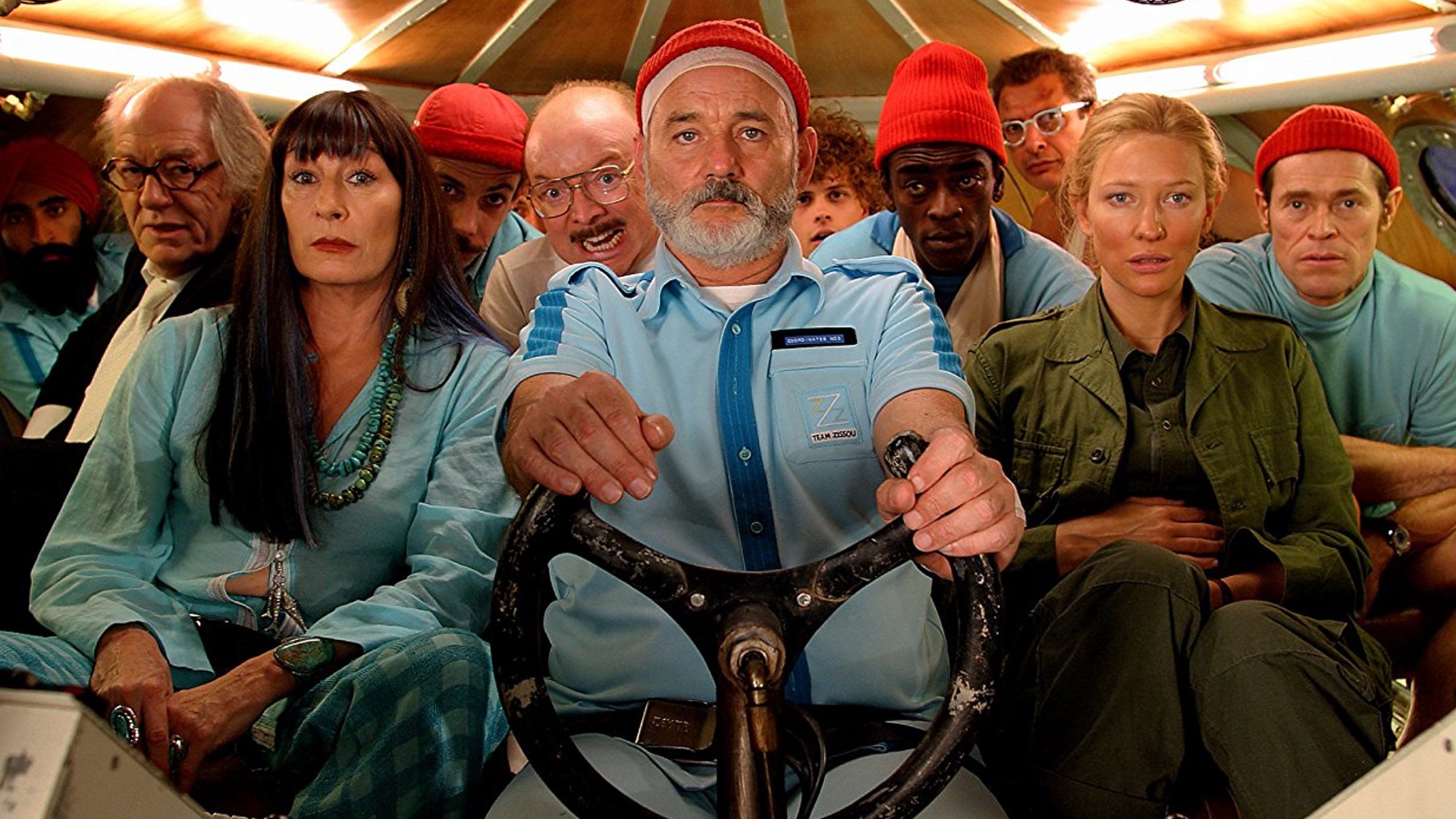
The Life Aquatic with Steve Zissou

Everyone, sooner or later, gets a thorough schooling in brokenness. The question becomes: What to do with the pieces? Some people hunker down atop the local pile of ruins and make do, Bedouin tending their goats in the shade of shattered giants. Others set about breaking what remains of the world into bits ever smaller and more jagged, kicking through the rubble like kids running through piles of leaves. And some people, passing among the scattered pieces of that great overturned jigsaw puzzle, start to pick up a piece here, a piece there, with a vague yet irresistible notion that perhaps something might be done about putting the thing back together again.
Image result for wes anderson fox
Fantastic Mr Fox

Two difficulties with this latter scheme at once present themselves. First of all, we have only ever glimpsed, as if through half-closed lids, the picture on the lid of the jigsaw puzzle box. Second, no matter how diligent we have been about picking up pieces along the way, we will never have anywhere near enough of them to finish the job. The most we can hope to accomplish with our handful of salvaged bits—the bittersweet harvest of observation and experience—is to build a little world of our own. A scale model of that mysterious original, unbroken, half—remembered. Of course the worlds we build out of our store of fragments can be only approximations, partial and inaccurate. As representations of the vanished whole that haunts us, they must be accounted failures. And yet in that very failure, in their gaps and inaccuracies, they may yet be faithful maps, accurate scale models, of this beautiful and broken world. We call these scale models “works of art.”Touchstone Pictures
Image result for wes anderson
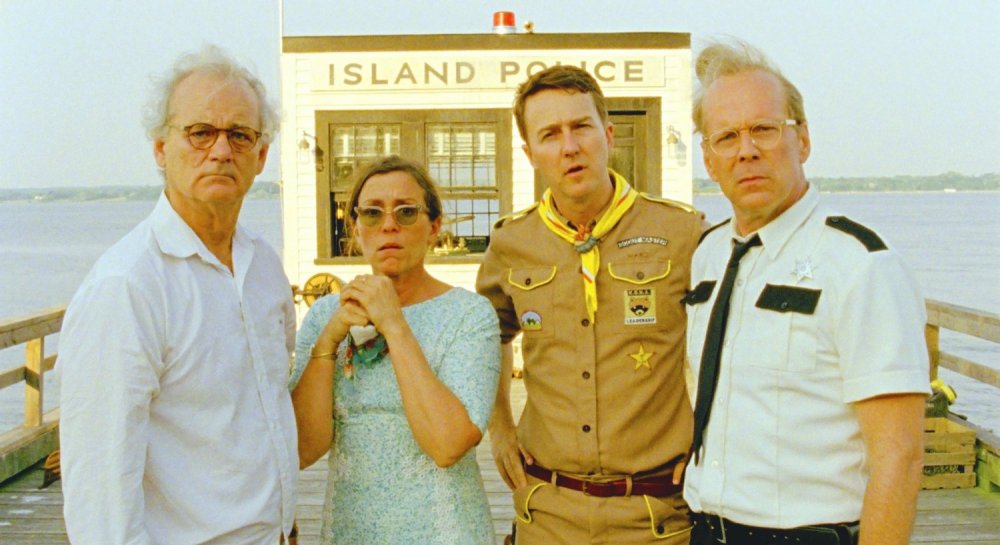
Moonrise Kingdom

From Rushmore to Moonrise Kingdom (shamefully neglected by this year’s Academy voters), Wes Anderson’s films readily, even eagerly, concede the “miniature” quality of the worlds he builds, in their set design and camera-work, in their use of stop-motion, maps, and models. And yet these miniatures span continents and decades. They comprise crime, adultery, brutality, suicide, the death of a parent, the drowning of a child, moments of profound joy and transcendence.

Vladimir Nabokov, his life cleaved by exile, created a miniature version of the homeland he would never see again and tucked it, with a jeweler’s precision, into the housing of John Shade’s miniature epic of family sorrow. Anderson—who has suggested that the breakup of his parents’ marriage was a defining experience of his life—adopts a Nabokovian procedure with the families or quasi families at the heart of all his films, from Rushmore forward, creating a series of scale-model households that, like the Zemblas and Estotilands and other lost “kingdoms by the sea” in Nabokov, intensify our experience of brokenness and loss by compressing them. That is the paradoxical power of the scale model; a child holding a globe has a more direct, more intuitive grasp of the earth’s scope and variety, of its local vastness and its cosmic tininess, than a man who spends a year in circumnavigation.
The Darjeeling Limited

Grief, at full scale, is too big for us to take it in; it literally cannot be comprehended. Anderson, like Nabokov, understands that distance can increase our understanding of grief, allowing us to see it whole. But distance does not—ought not—necessarily imply a withdrawal. In order to gain sufficient perspective on the pain of exile and the murder of his father, Nabokov did not, in writing Pale Fire, step back from them. He reduced their scale, and let his patience, his precision, his mastery of detail—detail, the god of the model-maker—do the rest. With each of his films, Anderson’s total command of detail—both the physical detail of his sets and costumes, and the emotional detail of the uniformly beautiful performances he elicits from his actors—has enabled him to increase the persuasiveness of his own family Zemblas, without sacrificing any of the paradoxical emotional power that distance affords.
Image result for wes anderson cutaway
Anderson on the soundstage with a cutaway model of The Belafonte from The Life Aquatic

Anderson’s films have frequently been compared to the boxed assemblages of Joseph Cornell, and it’s a useful comparison, as long as one bears in mind that the crucial element, in a Cornell box, is neither the imagery and objects it deploys, nor the Romantic narratives it incorporates and undermines, nor the playfulness and precision with which its objects and narratives have been arranged. The important thing, in a Cornell box, is the box.

Cornell always took pains to construct his boxes himself; indeed the box is the only part of a Cornell work literally “made” by the artist. The box, to Cornell, is a gesture—it draws a boundary around the things it contains, and forces them into a defined relationship, not merely with one another, but with everything outside the box. The box sets out the scale of a ratio; it mediates the halves of a metaphor. It makes explicit, in plain, handcrafted wood and glass, the yearning of a model-maker to analogize the world, and at the same time it frankly emphasizes the limitations, the confines, of his or her ability to do so.
Image result for wes anderson grand budapest hotel
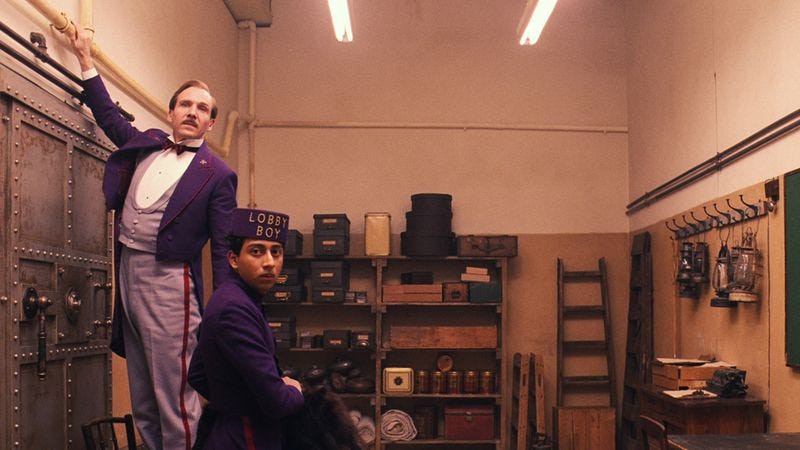
The Grand Budapest Hotel

The things in Anderson’s films that recall Cornell’s boxes—the strict, steady, four-square construction of individual shots, by which the cinematic frame becomes a Cornellian gesture, a box drawn around the world of the film, as in Moonrise Kingdom’s dressing room scene, with the little bird-girls framed by strips of light bulbs; the teeming, gridded, curio cabinet sets at the heart of The Life Aquatic, The Darjeeling Limited, and Fantastic Mr. Fox—are often cited as evidence of his work’s “artificiality,” at times with the implication, simple-minded and profoundly mistaken, that a high degree of artifice is somehow inimical to seriousness, to honest emotion, to so-called authenticity. All movies, of course, are equally artificial; it’s just that some are more honest about it than others. In this important sense, the hand-built, model-kit artifice on display behind the pane of an Anderson box is a guarantor of authenticity; indeed I would argue that artifice, openly expressed, is the only true “authenticity” an artist can lay claim to.
Image result for wes anderson
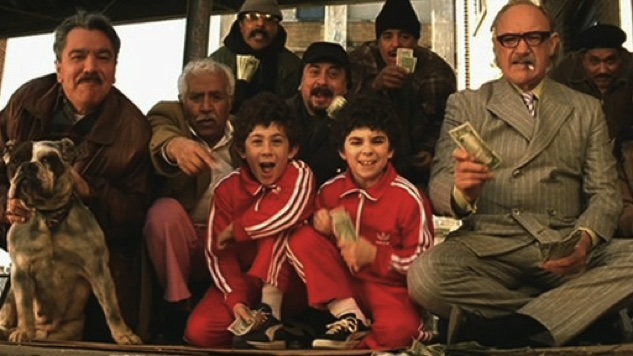
The Royal Tenenbaums

Anderson’s films, like the boxes of Cornell or the novels of Nabokov, understand and demonstrate that the magic of art, which renders beauty out of brokenness, disappointment, failure, decay, even ugliness and violence—is authentic only to the degree that it attempts to conceal neither the bleak facts nor the tricks employed in pulling off the presto change-o. It is honest only to the degree that it builds its precise and inescapable box around its maker’s x:y scale version of the world.

“For my next trick,” says Joseph Cornell, or Vladimir Nabokov, or Wes Anderson, “I have put the world into a box.” And when he opens the box, you see something dark and glittering, an orderly mess of shards, refuse, bits of junk and feather and butterfly wing, tokens and totems of memory, maps of exile, documentation of loss. And you say, leaning in, “The world!”

Adapted from the introduction to The Wes Anderson Collection by Matt Zoller Seitz, to be published in October by Abrams Publishers.

Monday, 28 May 2018

Michael Chabon - Pops: Fatherhood in Pieces review

Image result for michael chabon
Pops by Michael Chabon review – what parenthood asks of a man
Pops: Fatherhood in Pieces by Michael Chabon (Fourth Estate, £10)
The prolific and prizewinning novelist reflects on the pram in the hall, what children can teach fathers and a trip to Paris men’s fashion week

Fiona Sturges
The Guardian
Thu 17 May 2018

Ayear before he published his first novel, Michael Chabon met a famous author at a literary party. This man, who was twice Chabon’s age, offered him some unsolicited advice. “Don’t have children,” he said. “That’s it. Do not. That is the whole of the law.” He went on to explain how, after one book, there would be a second that would inevitably be more difficult and unwieldy than the first, and would probably bomb. A third would nonetheless be expected, followed by a fourth, fifth and sixth, and so on for as long as his “stubbornness and luck held out”. All this would happen, he said, unless Chabon made the same fatal mistake as so many fledgling writers before him. “You can write great books,” he said. “Or you can have kids. It’s up to you.”

Twenty years later, Chabon – novelist, short story writer and proud father of four – has turned their exchange into an essay called The Opposite of Writing, the first in this warm, whimsical and elegantly observed collection. Chabon, who won a Pulitzer prize for fiction in 2001 for The Amazing Adventures of Kavalier & Clay, is too generous a writer to take a yah-boo-sucks approach to this author, whose intentions, despite the tone of condescension, were seemingly decent. Instead he uses it as a springboard to pondering the perceived problem that is the pram in the hall.

At the time of their conversation, Chabon was a month away from marrying his “future ex-wife”. Four years later, and without children, they divorced and he married the writer Ayelet Waldman. As their family has multiplied, he has written 14 books, though there are times when he has wondered: “Should there be eighteen?” After a rough day at the keyboard, when the words won’t come in the way that he wishes, he finds himself in “a kind of mourning for the loss of those other, phantom-limb novels, the ones that my children stole”. But Chabon is nothing if not a realist, and, despite his many literary successes, is not one to romanticise his job.

Once they are written, my books, unlike my children, hold no wonder for me; no mystery resides in them. Unlike my children, my books are cruelly unforgiving of my weaknesses, failings, and flaws of character. Most of all, my books, unlike my children, do not love me back.

Pops, then, is for him another in a long line of books that, once published, will refuse to reciprocate the time and nurturing poured into them. It is not, it should be noted, a misty-eyed treatise on the miracle of life, or a parenting manual dispensing solemn advice about how best to steer one’s offspring towards a rich, rewarding adulthood. Yet it stands as a heartfelt and thoughtful meditation on what parenthood asks of a man. Rather than focusing on the next generation, the book is about the experience of being in the previous one, and observing one’s slow-burning irrelevance. In Chabon’s view, irrelevance is a worthwhile price to pay in exchange for those sweet moments of intimacy and bonding where, in so many instances, children show us something about ourselves.

The book began life in 2016 as an article in GQ magazine for which Chabon was dispatched to write about Paris men’s fashion week. He took his youngest son, Abe, with him on the assignment as a bar mitzvah present. Abe was 13 at the time and, thanks to his older brother, was already deeply into clothes, though he had long superseded his sibling in terms of style, knowledge and enthusiasm. In the essay, Chabon takes the role of Abe’s “ponderous old minder”, gawping in bemusement at models prowling the catwalk in shaggy yellow Muppet pants, enormous sneakers and with bored expressions. By the end of the week, he was none the wiser about fashion, but the scales had fallen from his eyes regarding his son and his greatest obsession:

Abe had not been dressing up, styling himself, for all these years because he was trying to prove how different he was from everyone else. He did it in the hope of attracting the attention of somebody else – somewhere, someday – who was the same. He was not flying his freak flag; he was sending up a flare, hoping for rescue, for company in the solitude of his passion.

Elsewhere, in the chapter Adventures in Euphemism, Chabon recalls reading The Adventures of Tom Sawyer at bedtime with his children, and prevaricating over the use of the N-word; in Against Dickitude, in which he observes his son’s abruptness via text towards a girl, he wryly expounds on his own rock-strewn path to kindness and empathy towards the women in his life. While no great parenting secrets are uncovered in this slim volume, Chabon has a knack of locating the fundamentals of the parent-child relationship in the innocuous and the everyday. Pops is not about what we should be teaching our children but the ways in which our children teach us. That, contrary to the edict of his would-be mentor in the opening chapter, they can also provide the writer with a book’s worth of material is, one imagines, merely a bonus.

Tuesday, 22 May 2018

Michael Chabon talks about Pops: Fatherhood in Pieces

Image result for michael chabon
Michael Chabon: ‘Parent properly and you’re doing yourself out of a job’
The Pulitzer prize-winner on combining writing with raising kids, his freakozoid tendencies and the authors he returns to

Alex Preston
The Guardian
Sat 12 May 2018

Michael Chabon is one of America’s best-loved writers, the author of nine novels, including The Amazing Adventures of Kavalier & Clay (which won the Pulitzer prize), Wonder Boys, The Yiddish Policemen’s Union and Moonglow. In 2009, he published Manhood for Amateurs, a series of reflections on his early years as a father. Now, with Pops: Fatherhood in Pieces, 54-year-old Chabon has collected his essays about parenting four teenagers.

A few years ago, Chabon’s wife, the novelist Ayelet Waldman, wrote a controversial essay for the New York Times in which she claimed to love her husband more than her children (and to be the only one of her married friends still having regular sex). Chabon’s meditations on fatherhood are less likely to offend – they’re generous, very Californian (Chabon lives in Berkeley) and full of warm, often humorous anecdotes.

If Manhood for Amateurs was about taking on responsibility, Pops feels like it’s about letting go as your kids grow up.
Eventually, one of the things you come up against as a parent is the limitation of your importance in your kids’ life. They go off and forge relationships and make families by choice, in one way or another. You recede and dwindle in importance. If you are parenting properly, you’re parenting yourself out of a job.

In the introduction to Pops, you recall a long-ago conversation with an older author who told you that you had to choose between being a great novelist or a father.
I realised I wasn’t interested in the question of balancing one’s art and one’s life as a parent. I’m not saying it isn’t a problem, but I was trying to consider a different question – what difference does it make in the end, either way? Either your books will be forgotten or even if you are remembered in 100 years, you won’t be around to enjoy it.

You write about a discussion with your daughter in which you talk about how important it is to be a “freakozoid”. How do we encourage our children to embrace their own weirdnesses?
My daughter went to fifth grade one day wearing a dress on top of jeans, a green rubber apron with blue frogs all over it and a Martha Washington bonnet that we’d bought on a family trip to Washington’s home at Mount Vernon. When your kid has an impulse like that you either say: “Go change your clothes, people are going to make fun of you, you look ridiculous” or you say: “See you this afternoon.” If you choose the latter option then you take a step in the direction of encouraging your kid’s freakozoid tendencies.

In Against Dickitude, you gently upbraid your elder son for his textual mistreatment of a female friend. She’s interested in him and he either doesn’t reply or sends emotionless one-word responses. How have you found bringing up teenagers during the boom years of social media?
When I observe the lives not just of my teenage children but also of their friends, it’s just so much harder now and that’s almost exclusively because of social media. When I was a teenager, I might arrive at school on a Monday and gradually come to realise that a party had occurred over the weekend to which I had not been invited. But I was blissfully unaware of that over the weekend when the party was going on. That Fomo [fear of missing out] is just a routine part of adolescence now and you’re always vividly and constantly aware of all of the apparently fun things that are going on within your supposed friend group to which you have not been invited.

You write about your children by name. Do you ask their permission? Do you worry about their right to private lives?
Everything you write is drawn from the people you know. You can do all this sweating and agonising about whether it’s going to embarrass them or make them angry and often it just sails right over them and they don’t even recognise that you’re talking about them.

Saying that, writing Little Man [an essay in Pops about taking his 13-year-old son to Paris fashion week] was the single hardest short piece of writing I’ve ever had to do.

What’s the last really great book you read?
I just reread for probably the fifth time The Queen’s Gambit by Walter Tevis. I had to teach it at the State University of New York. Every time I read it I’m overcome afresh with admiration for it and with awe for the control of its performance.

How do you organise your books?
Alphabetically, in the most part. We have a house where we live here in Berkeley and we have a summer house in Maine, which is full of all the books we couldn’t fit in here. There are some glassed-in shelves in our house in Maine in which, one summer’s day a few years back when I didn’t have a whole lot else to do, I organised them by colour. That looks pretty spectacular.

Which classic novel did you read recently for the first time?
I’m not sure if it quite counts as a classic, but I just read Sebald’s Austerlitz for the first time. I loved it – it’s beautiful. It was the one of his that I hadn’t read.

Which book would you give to a young person?

Books that I loved as a child and which I then reread to my children who also loved them were The Dark Is Rising series of novels. They are so fantastic. Also Lloyd Alexander’s Chronicles of Prydain, based on Welsh mythology and The Phantom Tollbooth by Norton Juster.

Finally, there’s Harriet the Spy by Louise Fitzhugh, which I mostly loved because she wanted to be a writer when she grew up.

What books do you read for sheer pleasure?
I go back to Edgar Allan Poe, Raymond Chandler. There’s a little-known American thriller novelist called Ross Thomas. I’ll pick one of his books up and I’ll only sometimes have to read a chapter or two to re-establish contact with whatever it was that was comforting and familiar about it.

Tuesday, 17 January 2017

Moonglow by Michael Chabon - review


Michael Chabon Returns With a Searching Family Saga
Moonglow
By Michael Chabon
430 pp. Harper/HarperCollins Publishers.

A. O. Scott
The New York Times
18 November 2016

Michael Chabon’s new book is described on the title page as “a novel,” in an author’s note as a “memoir” and in the acknowledgments as a “pack of lies.” This is neither as confusing nor as devious as it might sound, since “Moonglow” is less a self-conscious postmodern high-wire act than an easygoing hybrid of forms. Chabon has what sounds like a mostly true story to tell — about characters whose only names are “my grandmother” and “my grandfather,” and also about mental illness, snake hunting, the Holocaust and rocket science — and he may not have wanted to be bound too tightly by the constraints of literal accuracy in telling it.

At the same time, he has shaken loose the formal conventions of fiction, liberating himself in particular from the tyranny of plot. In his previous books, Chabon has always shown great skill at operating the novelistic machinery of cause and effect, foreshadowing and surprise, especially in semi-fabulist confections like “The Amazing Adventures of Kavalier & Clay” and “The Yiddish Policemen’s Union.” But in more realistic books the humming of those narrative engines can sometimes drown out the interesting cacophony of life. For me, that was the case in “Telegraph Avenue,” a well-observed slice of gentrifying urban life clogged with a bit too much Dickensian contrivance to work as well as it should have.

“Moonglow,” in happy contrast, wanders where it will, framing a series of chronologically disordered episodes from the past with conversations involving the narrator (who never tries to persuade us that he is anyone other than Michael Chabon) and various kinfolk, principally his mother and grandfather. This isn’t to say that the book lacks structure, but rather that its structure is determined by the logic of memory, and that the author has resisted the urge to do too much tidying and streamlining. The action zigzags across time and geography — from Germany in the last days of World War II through a grab bag of American locations in the decades after — with blithe indifference to the usual rules of linearity or narrative economy. A sensational and tragic revelation that might have been at the volcanic center of a more familiar kind of book is disclosed almost in passing. There are moments at which you can feel the irresistible temptation to embellish and invent, to infuse reality with Chabonesque touches of wistful Jewish magic realism, being resisted.

But not entirely. “After I’m gone, write it down,” Chabon’s grandfather instructs him. “Explain everything. Make it mean something. Use a lot of those fancy metaphors of yours. Put the whole thing in proper chronological order, not like this mishmash I’m making you.” “Moonglow” both obeys these instructions and rebels against them, preserving the mishmash and mixing in generous dollops of meaning, a sprinkling of fancy metaphors and an abundance of beautiful sentences so that it becomes a rich and exotic confection. Too strict a recipe would have spoiled the charm of this layer cake of nested memories and family legends, which have been arranged with painstaking haphazardness.

Mementos, curios and old photographs figure prominently, as evidence of past actions and symbols of their hidden significance. Through these objects, recollected dialogue and his own powers of speculation, Chabon constructs a loving, partial portrait of an unlikely, volatile and durable marriage. At a synagogue gala in Baltimore in 1947, an irascible veteran from Philadelphia meets a melancholy refugee from France with a fetching accent, a young daughter and a concentration camp tattoo. The daughter will be Chabon’s mother. His scapegrace father, whom readers of “The Mysteries of Pittsburgh” will recognize, makes a few brief appearances later on, but this book dwells mainly on the mysteries of the maternal line.

The union of Chabon’s grandparents is disrupted by hospitalizations and imprisonment. His grandmother, who grew up near a tannery in Lille, is haunted by visions of a “skinless horse,” a monstrous creature that seems to embody the unspeakable, intimate horrors of Nazism. Her delusions test her husband’s patience, but they also illuminate his loyalty and ardor. A tough man whose temper is hot enough to bring him close to murdering an employer (which earns him 20 months in a New York State prison), he is guided by ethical instincts that seem to him as inarguable as the laws of physics. Promises must be kept, bullies must be brought down, hypocrites must be exposed, and the weak must be protected. He is stubborn and chivalrous, blunt and generous, physically brave and intellectually nimble.

In literary terms, Chabon’s grandfather might be the humbler cousin of Swede Levov, Philip Roth’s tragic paragon of American Jewish manhood from “American Pastoral.” He occupies a similar mid-Atlantic, rapidly assimilating geographical and cultural space and embodies similar secular Jewish virtues. But the book, rather than witnessing his fall, elevates him. It’s not a chronicle of filial revenge; it’s a grandchild’s testament of wonder and devotion. Grandpa chases the Nazi rocket-builder Wernher von Braun in Germany at the end of the war and stalks a pet-killing reptile in a Florida retirement community many years later. Fascinated by space travel, he designs rockets, builds a model moon base and drives for hours to watch the shuttle launch.

Grandma, meanwhile, fascinates young Michael with her old-world mannerisms and her witchy association with tarot cards, scary puppets and haunting tales. “Almost 50 years later I still remember some of her stories,” Chabon writes. “Bits of them have consciously and unconsciously found their way into my work.” And this book, a love letter to two temperamentally opposite grandparents — one a rational, practical American, the other a dreamy, romantic European — is also an account of their formative influences on the writer their grandson would become.

These are not so much explained as felt, woven into the very fabric of Chabon’s supple and resourceful prose. He brings the world of his grandparents to life in language that seems to partake of their essences. When he describes an asylum pageant staged by his grandmother, the feverish poetry of the images seems like the product of her tormented, enchanted consciousness: “Darkness falls over the field of clover, dawn breaks on the moon. Jagged moon mountains glow cool and silvery blue in the background as the bee herder, hatchet restored, strolls along unfazed by his new surroundings. He passes silver moon trees like the skeletons of cacti.”

This fantastical landscape coexists with an all-too-real one — a blasted German town described in the precise, engineer’s language of the grandfather: “The stray 88 had knocked the square tower off the shoulders of St. Dominic’s Church. The beams holding up the roof, which was clad in metal, had collapsed and caught fire. In their collapse, the roof beams had formed a kind of bowl or funnel into which the metal roof, now a molten pool, had poured. The glowing drizzle had burned a hole in the sandstone floor, then flowed through to fill the crypt. What missed the hole spread in ripples across the floor, setting fire to everything it touched that was not made of stone.”

Whatever else it is — a novel, a memoir, a pack of lies, a mishmash — this book is beautiful.

Monday, 11 February 2013

Michael Chabon on The Long Ships

The Long Ships
Unearthing a Viking treasure

June 28, 2010
by Michael Chabon
theparisreview.org.

In my career as a reader I have encountered only three people who knew The Long Ships, and all of them, like me, loved it immediately. Four for four: from this tiny but irrefutable sample I dare to extrapolate that this novel, first published in Sweden during the Second World War, stands ready, given the chance, to bring lasting pleasure to every single human being on the face of the earth.

The record of a series of three imaginary but plausible voyages (interrupted by a singularly eventful interlude of hanging around the house) undertaken by a crafty, resourceful, unsentimental and mildly hypochondriacal Norseman named “Red Orm” Tosteson, The Long Ships is itself a kind of novelistic Argos aboard which, like the heroes of a great age, all the strategies deployed by European novelists over the course of the preceding century are united—if not for the first, then perhaps for the very last time. The Dioscuri of 19th-century Realism, factual precision and mundane detail, set sail on The Long Ships with nationalism, medievalism and exoticism for shipmates, brandishing a banner of 19th-century Romance; but among the heroic crew mustered by Frans Bengtsson in his only work of fiction are an irony as harsh and forgiving as anything in Dickens, a wit and skepticism worthy of Stendhal, an epic Tolstoyan sense of the anti-epic, and the Herculean narrative drive, mighty and nimble, of Alexander Dumas. Like half the great European novels it is big, bloody and far-ranging, concerned with war and treasure and the grand deeds of men and kings; like the other half it is intimate and domestic, centered firmly around the seasons and pursuits of village and farm, around weddings and births, around the hearths of woman who see only too keenly through the grand pretensions of men and bloody kings.

It offers, therefore—as you might expect from a novel with the potential to please every literate human being in the entire world—something for everyone, and if until now The Long Ships has languished in the second-hand bins of the English-speaking world, this is certainly through no fault of its author, Frans Bengtsson, whom the reader comes to regard—as we come to regard any reliable, capable and congenial companion in the course of any great novel, adventure, or novel of adventure—as a friend for life. Bengtsson recreates the world of 1000 AD, as seen through the eyes of some of its northernmost residents, with telling detail and persuasive historiography, with a keen grasp of the eternal bits that pebble the record of human vanity, and with the unflagging verve of a born storyteller—but above all, and this is the most remarkable of the book’s many virtues, with an intimate detachment, a neighborly distance, a sincere irony, that feels at once ancient and postmodern. It is this astringent tone, undeceived, versed in human folly, at once charitable and cruel, that is the source of the novel’s unique flavor, the poker-faced humor that is most beloved by those who love this book. Though at times the story, published in two parts each consisting of two parts over a span of several years, has an episodic feel, each of its individual components narratives is well-constructed of the soundest timbers of epic, folk tale and ripping yarn, and as its hero grows old and sees his age passing away, that episodic quality comes to feel, in the end, not like some congeries of saga and tall tale but like the accurate representation of one long and crowded human life.

Nor can blame for the neglect of The Long Ships be laid at the feet of Bengtsson’s English translator, Michael Meyer, who produced a version of the original the faithfulness of which I leave for the judgment of others but whose utter deliciousness, as English, I readily proclaim. The antique chiming that stirs the air of the novel’s sentences (without ever overpowering or choking that air with antique dust) recalls the epics and chronicles and history our mother tongue (a history after all shared, up to a point, with the original Swedish), and the setting of parts of the action in Dark-Ages Britain further strengthens the reader’s deceptive sense that he or she is, thanks to the translator’s magic and art, reading a work of English literature. Toss in the novel’s unceasing playfulness around the subject of Christianity and its relative virtues and shortcomings when compared to Islam and, especially, to the Old Religion of the northern forests (a playfulness that cannot disguise the author’s profound but lightly worn concern with questions of ethics and the right use and purpose of a life), and the startling presence, in a Swedish Viking story, of a sympathetic Jewish character, and you have a work whose virtues and surprises ought long since have given it a prominent place, at least, in the pantheon of the world’s adventure literature if not world literature full stop.

The fault, therefore, must lie with the world, which as any reader of The Long Ships could tell you, buries its treasures, despises its glories, and seeks contentment most readily in the places where it is least likely to be found. Fortunately for us, it is in just those unlikely places, as Red Orm quickly learns, that the opportunities and treasures of the world may often be found. My encounter with The Long Ships came when I was fourteen or fifteen, through the agency of a true adventurer, my mother’s sister, Gail Cohen. Toward the end of the sixties she had set off, with the rest of her restless generation of psychic Vikings, on a journey that led from suburban Maryland, to California where she met and fell in love with a roving young Dane, to Denmark itself, where she settled and lived for twenty years. It was on one of her periodic visits home that she handed me a UK paperback edition of the book, published by Fontana, which she had randomly purchased at the airport in Copenhagen, partly because it was set in her adopted homeland, and partly because there was nothing on the rack that looked any better. “It’s really good,” she assured me, and I would soon discover for myself the truth of this assessment, which in turn I would repeat to other lucky people over the years to come. Gail’s own adventure came to an end at home, in America, in the toils of cancer. When she looked back at the map of it, like most true adventurers, she saw moments of joy, glints of gold, and happy chances like the one that brought this book into her hands. But I fear that like most true adventurers—but unlike Bengtsson’s congenitally fortunate hero—she also saw, looking back, that grief overtopped joy, that trash obscured the treasure, that, in the end, the bad luck outweighed the good. That is the great adventure, of course, that reading holds over what we call “real life.” Adventure is a dish that is best eaten takeout, in the comforts of one’s own home.

Wednesday, 19 September 2012

Michael Chabon Interview


Michael Chabon: 'Two years into writing this I felt like it was an utter flop'
The Pulitzer prize winner on the struggle to write his latest novel and how his wife persuaded him to persevere

Killian Fox
The Observer
Sunday 9 September 2012

Michael Chabon, 49, is the author of the Pulitzer prize-winning novel The Adventures of Kavalier & Clay and Wonder Boys, which was made into a film starring Michael Douglas. His eighth novel, Telegraph Avenue, centres on a used-record shop in Berkeley, California, where Chabon lives with his wife, the writer Ayelet Waldman, and their four children.

How long did you spend working on this book?
Actually writing the novel took almost five years, but the original idea came much earlier. It began as a proposed pilot for a television series for the PNT network, around 1999. Nothing ever came of it so I put it aside. But because the story was set in my neighbourhood, I kept coming into contact with all kinds of things I wanted to put into it.

So what happened?
I got two years into the novel and got completely stymied and felt like it was an utter flop. I wanted to put it aside but my wife talked me out of it. She said she cared too much about these characters and wanted to find out what became of them. I had to start all over again, keeping the characters but reinventing the story completely and leaving behind almost every element with the exception of the birth that goes wrong – that was the only significant element that I preserved.

You've had this experience before…
It happens with every book now, I hate to say. I abandoned my second novel completely. Writing Kavalier & Clay, I had several moments of utter collapse. Same with The Yiddish Policemen's Union. I'm obviously just not very good at this.

But you persevere.
Usually thanks to my wife: her role is often to lash me to the tiller and keep me there long enough to get through the bad patches. The lesson I've learned is that you do come out the other side with a clear understanding of what you're doing.

Did you do much research for this book, given that it was set in your neighbourhood?
In some ways, this was the most easily researched book I've ever done. Just walking out my front door, I was doing research. My other books, with the exception of Wonder Boys, have been set in the past or in some alternate version of the present. Even something like how do you communicate with another person had to be researched. That whole element of it was taken off the table here. The research that I did need to do was primarily centred around music… I say "research": what I was really doing was buying records and listening to them.

What's your average writing day?
I work at night, starting at around 10 o'clock and working until 2 or 3 in the morning. I do that usually five days a week. In Berkeley I have an office behind our house that I share with my wife, who works more in the daytime. It's always been my tendency: working at night just seems quieter and I can focus more easily and the words tends to come more readily.

What's the last really great book you've read?
I recently discovered the Edward St Aubyn novels, the series of five books beginning with Never Mind. I sat down and read them as one book and I loved them so much. It's always thrilling to encounter the sweep of time in a work of fiction in a way that feels authentic and real.

Do you have to be careful with what you read in case you fall under another author's influence?
No, I don't worry about that too much. If, say, I spend the whole day reading Moby-Dick and then sit down and start writing, I might notice little echoes of Ishmael creeping in here or there. It's not like: "Oh my God, there are weeds growing in my garden. I must eradicate them." If a little blossom of Melvillean prose pops out in the middle of one of my paragraphs, I like to stand back and admire it.

Do ideas come easily to you?
Ideas are the easy part. I spend a lot of time batting them away, trying to keep them from distracting me from what I actually have to focus on and finish. A lot of times they are a siren temptress beckoning me with the promise of a much shorter, simpler, more slender novel over the horizon, but of course that's very dangerous.

You've done some work for Hollywood over the years, most recently as a writer on the movie John Carter. Does that kind of work suit you?
I'm taking a break from screenwriting right now, although I'm developing a TV project with my wife for HBO, a second world war spy series called Hobgoblins, about a bunch of magicians and con-artists who are hired by British intelligence to perpetrate cons and scams against the Germans. We completed the pilot script for that and it was liked enough for them to request a second script, so that's what we're working on now. That's been a very positive experience. I was disappointed by what happened with John Carter. I thought we'd made a good movie and it didn't get treated at all fairly – it had already been condemned to death before it had been seen by anyone. I think the audiences who did see it generally really enjoyed it.

Any more novels brewing?
I definitely have some possible novel ideas and one that I've already started tinkering with. They always seem like they're going to be very slim, elegant novels when the idea first sells itself to me, but that almost never turns out to be the case.

http://www.guardian.co.uk/books/2012/sep/09/michael-chabon-telegraph-avenue-interview?INTCMP=SRCH

Thursday, 13 September 2012

Michael Chabon - Telegraph Avenue


Telegraph Avenue by Michael Chabon – review
Michael Chabon's new novel skilfully challenges America's attitudes to race. 

Attica Locke
guardian.co.uk
Wednesday 5 September 2012

A little over 100 pages into Michael Chabon's magnificent new novel, a young, road-weary state senator by the name of Barack Obama makes an unexpected appearance. Just weeks after his historic speech at the 2004 Democratic National Convention, which announced his vision of an America unified against the divisions of race and class and thrust him on to the national stage, the future president is campaigning in California, making his first run at higher office. At a $1,000-a-plate fundraiser, Obama ducks through the back door of a posh house in northern California to steal a quiet moment to himself, passing time by listening to the hired jazz band as they warm up. It's a relatively short scene, but Obama's presence – and his most famous catchphrase, "change" – seems to linger at the outer corners of this novel's soul.

In many ways, Telegraph Avenue feels like Chabon's first book of the new millennium, his first to speak so adroitly to the anxieties and emotional challenges of our time. There is something deeply current about this wise and soulful novel, even as its main characters are so deeply mired in the past.

The story begins inside the walls of Brokeland Records. This is Archy Stallings and Nat Jaffe's secondhand record shop on Telegraph Avenue, the main drag of the eponymous neighbourhood and a live wire that serves as a connector between Berkeley – land of artisanal cheese, tantric yoga and conflict-free coffee, a place brimming with new and former hippies who have turned righteousness into competition – and Oakland, a working-class, predominantly black city that even before the economic collapse of 2008 was already struggling with the threat of economic flatline. Archy and Nat have been friends for over a decade when the novel opens. Together, they are professional collectors and curators, acolytes at the altar of jazz, blues and funk – black music that is the main artery running through American pop culture. (Part of the charm of this book is the breadth of the author's knowledge of black music from, say, 1940 until the late 1970s. If this novel wins Chabon another Pulitzer, I feel certain it will be the first in history to make a reference to Peabo Bryson.)

Though Nat and Archy are passionate lovers of vinyl, they are less than gifted businessmen, deep in debt, and each keeping an eye scanning the horizon for trouble. It arrives in the form of a whale-sized zeppelin creeping across the sky, boldly advertising Gibson "G-Bad" Goode's entrepreneurial designs on the neighbourhood: plans to build a super-entertainment centre with movie theatres, restaurants and, yes, a music shop, just a few blocks from Brokeland Records. Goode, a former NFL player turned businessman, has revitalised struggling working-class neighbourhoods in Los Angeles, but his plans to do the same in Oakland will surely put Nat and Archy out of business. This kind of "Wal-Mart effect" is a familiar theme in America – large-scale businesses obliterating the character of neighbourhoods. Chabon's twist is that the "big capital" villain here is a black man, a local hero offering hundreds of jobs and uplift for the community, and thereby complicating notions of what "progress" is.

Archy, who is black, and Nat, who is white, find their friendship strained by the gulf between their differing reactions to the outside threat. Further adding to the tension is the relationship between Archy's wife, Gwen, and Nat's wife, Aviva, who are likewise in business together (and also under attack when their midwife practice faces legal threat after a home birth goes horribly wrong). Throw into the mix Archy's long-lost, previously unacknowledged teenage son, Titus, who embarks on a friendship, fraught with romantic complications, with Nat's son, Julius; Archy's estranged father, a former drug addict and Blaxploitation film star, who is on the lam; a crooked undertaker; a jazz legend with a talking parrot on his shoulder; and the ghosts of the Black Panther Party – and what you get is a big, serious, probing American novel, a page-turner that, like Chabon himself, seems to walk the line between high and low culture, between the erudition and intellectual precociousness of jazz and the dark humour and truth-telling of the blues.

Almost nothing Chabon has written previously could have prepared me for this book, though there are elements of his other work here: themes of fatherhood, abandonment, diaspora and complex questions of identity, not to mention gorgeous prose and a dose of humour. What's striking is the number of times I forgot I was reading a Michael Chabon novel. With the front cover flipped back, I could, for a moment, imagine I was holding Colson Whitehead in my hands, Percival Everett or Victor LaValle. But this kind of racial shortcut and lazy thinking about art and its ability to bridge our differences are the very things that the novel's existence argues against. By writing so convincingly from behind the veil of black culture, Chabon has allowed the form of his novel to follow its function, making a powerful statement about the pulse of humanity that runs deeper than our skin colour. Telegraph Avenue finds its heart in the friendships of Archy and Nat, Gwen and Aviva, Titus and Julius – relationships that Chabon allows to be frustrated by race, but never defined by it. The book quietly makes the point that in this millennium of sweeping "change", we have arrived at a place that, if it's not exactly "post-racial", certainly demands that we lay down some of our old ideas about race and the level of communion that's possible between so-called disparate groups. This is the Chabon I most recognise: writer as humanitarian.

Late in the novel, Nat, a man who typically finds expression easier in music than in words, makes a beautiful statement about the dream he and Archy cherished for Brokeland Records at its inception: a "creole" mix of music genres and peoples from all over the world. Chabon's book seems to reaffirm America's promise of its own "Brokeland Creole" dream. Like the characters in the novel, America is still growing up, a nation that often has to be dragged kicking and screaming into its own future. The book is ultimately about the inevitability of change, but it suggests, in the surrender to it, the possibility of grace on the other side.

http://www.guardian.co.uk/books/2012/sep/05/telegraph-avenue-michael-chabon-review?INTCMP=SRCH

Monday, 31 May 2010

Michael Chabon - Maps and Legends

Maps and Legends
by Michael Chabon
250pp, Fourth Estate Ltd, £8.99

Olivia Laing
The Observer
Sunday 11 April 2010

The novelist Michael Chabon loves comics. He loves Sherlock Holmes, young adult fiction and those classic ghost stories of the kind produced by MR James. He is also painfully aware that genre fictions such as these are not generally considered current reading material for upstanding intellectual adults. His sense of defensive outrage on the part of such books, so influential on his own work, has fuelled this cri de coeur, an eloquent if decidedly partisan plea for the definition of what constitutes decent literature to be expanded and made more elastic.

Chabon's theory is that the prime function of writing should be to entertain the reader. He is also sure that writers used to be considerably less snooty about providing this essential service, and that it is only recently that the notion of entertaining has become so devalued. His defence is witty, original and only slightly marred by the fact that most of the 16 essays contained in this collection were originally written for quite different purposes. Many were initially reviews and some – such as the detailed and faintly carping account of Philip Pullman's Dark Materials trilogy* – do not add much to his central thesis, which is that edgy and compelling books frequently arise from the borderlands of fiction.

His take on Sherlock Holmes is particularly convincing, revealing far more complexity and skill in the workings than one is accustomed to seeing. But for all his gleaming acuity as a critic, Chabon is at his strongest here as a memoirist, and the two standout pieces both concern his own development as a writer. The first, "Maps and Legends", records his boyhood in the partially built utopian city of Columbia, which was constructed according to ideals that it couldn't possibly live up to. The second, "Golems I Have Known", is a strange, circling essay that charts Chabon's own shifting sense of himself as a writer and a Jew by telling a linked set of stories about golems, those clay men of Jewish mythology.

Both pieces are charged with an infectious excitement about the possibilities of writing, but only one is true. The other is a false memoir, a self-conscious lie, and it serves to underline Chabon's brilliant, heartening sense of the writer as swashbuckler, advancing into unmapped territory in search of, if not the truth, at the very least a whopping story.

http://www.guardian.co.uk/books/2010/apr/11/maps-and-legends-michael-chabon

* Chabon was lucky to get away with this because the slightest criticism of Pullman is a no-no in the pages of the Guardian and the Observer, where, ironically, he has taken on a somewhat saintly status alongside the likes of Jay-Z and Sam Taylor-Wood...

Sunday, 28 March 2010

Michael Chabon interview

Michael Chabon: 'I hadn't read a lot by men of my generation and background about being a father – it felt like I was on relatively untrodden ground'
The author of Manhood for Amateurs talks to Christopher Tayler

The Guardian
Saturday 27 March 2010

'You have no tristezza," Michael Chabon was once informed by a friend who liked to get drunk and stoned and tell people their destinies. "And you never will." Only the second part really rankled with Chabon, who was 19 or 20 and willing to admit he'd had few chances to store up deep-seated sadness. As he tells it in one of the essays in Manhood for Amateurs, his newest book, however, his later efforts to get hold of some were not a success. Driving through endless rain during the breakup of his first marriage, a sad song playing, his face wet with tears, he thought of his friend's prediction ("If he could see me now . . ."). Then he stopped for an ice-cream sandwich, listened to a ball game, and realised, to his horror, that he was quite content. Asked if he still worries about his non-melancholic temperament, he says: "I'm tormented by it! That's my only source of tristezza: my lack of tristezza"

Chabon, a screenwriter, occasional essayist and Pulitzer-prize-winning novelist, is one of the least neurotic figures in American letters. "Michael remembers to simply enjoy himself better than any long-term professional writer I know," Jonathan Lethem, a fellow novelist and a friend of Chabon's, says. "And the pleasure is shared by his readers." A comic book fan who discovered his vocation by pastiching Sherlock Holmes stories and science fiction paperbacks, he functions as effectively in Hollywood – his screen credits include work on Spider-Man 2 – as in the pages of such novels as Wonder Boys (1995), The Yiddish Policemen's Union (2007) and The Amazing Adventures of Kavalier & Clay (2000). It rarely occurs to anyone to mark him down for championing and dabbling in once-despised genres, chiefly because of his unquestioned stylistic powers. "He never neglects the musical and metaphorical potential of expression as a means of intensifying meaning," the American critic Wyatt Mason says. "His choices at that basic expressive level always feel vital, surprising, alive."

When we meet, Chabon is in London to look in on the filming of John Carter of Mars, a live-action Disney adaptation of Edgar Rice Burroughs's Martian stories, for which he was hired to do script-polishing work. Wearing a brightly coloured shirt, Chelsea boots and a salt-and-pepper goatee, and with the general air of a long-term resident of northern California, Chabon manages to come across as both an unpretentious professional and a person one could imagine doing bong hits with while discussing HP Lovecraft's prose style. He was once, in fact, a reasonably dedicated pothead, but stopped smoking completely in 2005, thanks partly to the responsibilities of parenthood. He has four children with his second wife, Ayelet Waldman, and as the essays in the new book indicate, he takes his duties as a father seriously.

Manhood for Amateurs was largely assembled from the columns he used to write for Details, a glossy American men's fashion magazine that "made me an offer I couldn't refuse. There was no brief for the column, and the fact that so many of the pieces ended up dealing with aspects of being a father just came from that being something I confront on a daily basis. And I hadn't read a lot by men of my generation and background about being the father now – maybe the floodgates are opening a little, but it felt like I was on relatively untrodden ground." Waldman took on the job of sifting through his journalism after the idea of a book came up, "and when she came back to me, she had two piles". The second eventually became Maps and Legends, a selection of his pieces on reading and writing from such outlets as the New York Review of Books. Because this book was "kind of a gift", he gave the proceeds to 826 National, a nonprofit organisation founded by Dave Eggers.

Chabon doesn't think that parenthood lends itself to forward planning. "It's like war in that regard," he says. Even so, he gives it a lot of thought. He's alarmed by the fenced-in, safety-helmeted culture around American childhood: "If children are not permitted – not taught – to be adventurers and explorers," he wrote last year, "what will become of the world of adventure, of stories, of literature itself?" And it's a situation, he says, that has "only gotten worse. Getting people to be afraid not just of what will befall your children if you let them out to play, but of all kinds of things, including foreigners and terrorists, is immensely profitable."

In a more equivocal way (one of his chapters on this is called "Hypocritical Theory"), he finds himself worrying about the exploitation of fart-and-snot humour by profit-minded grown-ups. "Tropes and jokes that adults never would have gone near, and would have disdained to traffic in not that long ago," he says, "are now actively employed to snare children's attention, and ultimately their income." What bothers him isn't the jokes and tropes themselves but "the co-opting of kids' consciousness": naughty playground rhymes should be an adult-free zone. Acknowledging various contradictions ("I'm not a media critic, but . . ."), he's also uneasy about the slickness of the entertainment industry's products aimed at children. "A lot more money, talent, craft and intelligence get lavished on things that are ultimately just designed to make a quick killing. In an earlier time, lousy TV shows were made by big movie studios for the networks, but there was a kind of disregard for the whole business that could be inviting in a way. Everything seems much more calculated now."

Doctor Who, to which his family is devoted, is exempted from these strictures; one of his subsidiary missions in London involves stocking up on Who-related merchandise. The show's capacity for inspiring "conversational riffing and Talmudic debate" is part of the appeal: born in 1963, Chabon has warm memories of the more rickety, and therefore more imaginatively inhabitable, entertainments on offer in the early 70s. Growing up in Columbia, Maryland, he had the run of the neighbourhood, as fewer kids do these days. His father, Robert, a doctor and lawyer, introduced him to comics, the Marx Brothers and Star Trek, and Columbia itself – a planned community opened in 1967 – offered the future novelist further lessons. "It began with a blank expanse and a map that said, 'This is what's going to happen.' And it happened. All these streets that had been named came into being, and I was there to witness it. It showed me that the things you could map in your imagination could take on a kind of reality."

Columbia "was one of the first places in that part of the United States to welcome black homebuyers, and you had white families moving there because they believed in that. There were interfaith centres, where Protestants and Catholics shared the facility with Jewish congregations; there were bike paths everywhere – it was distinctive and different and the people who built it really believed in it." In consequence, he was, he says, "ill-prepared" for the gloomier realities of American life, which began to get through to him after his parents' divorce, when his father moved to Pittsburgh, Pennsylvania. During his sophomore year at college there, Chabon got a job in a bookshop. "At Christmas, they hired off-duty policemen as security. This one cop would stand by the cash register, and every time a black person came in, he unleashed, sotto voce, this torrent of the most vile abuse. Outside movies or books, I'd never heard anything like that."

Pittsburgh – which Chabon, a fan of British rock bands as well as Monty Python, MR James and Michael Moorcock, describes for English audiences as "sort of like Sheffield" – was his city of experience and early manhood. He first wrote about it in a sustained way, however, while doing a master's in creative writing in California, where his mother, Sharon, a lawyer, moved in his undergraduate years. Having exhausted such literary models as Arthur Conan Doyle and Ray Bradbury, he was absorbing the influence of "probably too many writers to name" – among them Donald Barthelme, Jorge Luis Borges, Gabriel García Márquez, Raymond Chandler, John Updike, Philip Roth and F Scott Fitzgerald. Harold Bloom's notion of "the anxiety of influence" makes little sense to Chabon; as he sees things, "influence is bliss". He remembers being blown away by the opening of Rabbit, Run "and writing something in shameless imitation of Updike after reading it. I just copied the writers whose voices I was responding to, and I think that's probably the best way to learn."

The Mysteries of Pittsburgh (1988), his first novel, which was written as his master's thesis, made him famous in his mid-20s and became a bestseller. (It also briefly got him labelled a gay writer: same-sex desire is no big deal in his work.) For five years afterwards he struggled with a follow-up, a massive novel called Fountain City, which he eventually abandoned. Doubts about the contemporary novel's vitality weren't part of the problem. "I'm not speaking of any particular person's public fretting on the subject, but I think that frequently there's – at least in part – an attempt to globalise an anxiety that all writers feel almost every day: what the hell am I doing? And why? There's a tendency to say, 'Not only do I suck but this whole damn world sucks.' The death of the novel's been proclaimed my whole life. Philip Roth wrote that piece around the year I was born, lamenting the fact that fiction can't compete with American reality . . . I guess I feel that, if it's true, then what's the point of worrying about it? And if it isn't true, then go back to work."


His first book's success did, however, put a strain on his relationship with Lollie Groth, a co-student at the University of California, Irvine, whom he married in 1987. They divorced in 1991, and in the stories he wrote as the marriage broke up, "there's a lot of hopeless hovering around the question of the possibility of marital happiness. But I came out of that period. I'm a perpetually disappointed optimist. I don't have any illusions about people's behaviour, and I'm perfectly capable of seeing the worm in the bud and ascribing base motives to my fellow human beings, and to myself. It's not that I think everything happens for the best in the best of all possible worlds. But optimism is just an animal reaction. It's not something I necessarily subscribe to, even; I just can't help it. You could call it denial but – to be hopeful requires a kind of singleminded disregard of everything that would give you reason for despair, and that is a kind of denial, but in a good way."

Another effect of the end of his first marriage was an increase in his interest in Judaism, which eventually led to the Pulitzer-winning Kavalier & Clay, a novel much concerned with Jewish lore and experience. When he was growing up, being Jewish "was part of who we were as a family, but it didn't seem to have any particular use when I was in my teens and 20s." It didn't seem important when he married Groth, who isn't Jewish, but whenever they talked about children, he discovered that he had visceral feelings about their upbringing. "I started trying to reconnect even before I met my present wife. I also got back in touch with some of the more literary heritage of Judaism, and it was very exciting. There were these cables that had just been lying there, and as soon as I plugged them in, this whole new unit that I hadn't been using powered up."

Waldman, an Israeli-born writer and lawyer whose novels include the splendidly titled "Mommy-Track Mystery" Playdate With Death, played a big part in his reconnection too. They married in 1993 and live in Berkeley, California, writing at back-to-back desks when not parenting. A high-profile figure in her own right, Waldman was castigated on The Oprah Winfrey Show after arguing in a 2005 New York Times piece that parents should love each other "even more than they love the children". Combined with their enviable lifestyle, her somewhat uncensored utterances – she is bipolar – concerning their marriage and sex life attract a fair amount of backbiting from New York media blogs. Asked if Berkeley's distance from the East Coast publishing world is one of its attractions, Chabon says emphatically: "Yes. I'm very grateful that I don't try to get work done in that environment, where everyone knows everything about everyone and how much someone got paid for this or that . . . California doesn't have that overheated atmosphere at all."

In the 10 years since Kavalier & Clay, he has been determinedly unsnooty in his work, writing, among other things, a young adult novel, Summerland (2002), and promoting "the great work being done by people who are categorised, or ghettoised, as genre writers". For a while there was talk of his doing a collection of stories along the lines of "In the Black Mill", a horror tale he wrote as "August Van Zorn", his Lovecraft-like alter ego. "It didn't work out because I kept writing things that were too long. One of them was meant to have been a Sherlock Holmes story, but that came out as a novella, The Final Solution. It was the same with Gentlemen of the Road: I couldn't contain my prose sufficiently to generate a collection of short stories." The novel he's currently working on, which he describes as "somewhere between short and massive", is more naturalistic. "So far there's no overtly genre content: it's set in the present day and has no alternate reality or anything like that."

All the same, he's perhaps the only heavyweight novelist going who's as happy to talk about the prose of Larry Niven, a hard science fiction writer he admired in his early teens, as he is to enthuse about Our Mutual Friend. "Maybe if I was going to start a new series of opinions to follow up on this," he says, gesturing at a copy of Maps and Legends, "instead of worrying so much about genre and entertainment, I'd look more at style, and sentence, and voice, because that's what it all boils down to. I'm an avid reader of biography and history, but I would still rather read a great novel about a time or a place – I'd feel like I hadn't really understood it otherwise. So novels are incredibly useful, I think, but whatever other uses they have, primarily their use is to bring pleasure, and they still bring pleasure to a lot of people."

http://www.guardian.co.uk/books/2010/mar/27/michael-chabon-interview-christopher-tayler

Monday, 15 March 2010

Manhood for Amateurs

Manhood for Amateurs by Michael Chabon
Michael Chabon's a great family man, but it's his mistakes that make these essays worth reading, says Michael Sayeau

Despite his claims to the contrary, Michael Chabon clearly is a great dad. Early on in Manhood for Amateurs he writes that "A father is a man who fails every day". If this collection of autobiographical essays shows one thing, it's that he fails better than most men when it comes to the task of parenting.

The author of six novels, including the Hollywood-adapted Wonder Boys (1995) and the Pulitzer-winning The Amazing Adventures of Kavalier & Clay (2000), Chabon nonetheless cooks and cleans and loves his wife, seems to spend countless hours drawing superheroes and watching Doctor Who with his children, and above all else is warmly thoughtful and reflective about the beauty and meaning of these acts. When the time comes to confess his paternal sins, the list is filled with things like answering emails when his children want him to play, and spending a few nights away from home on a book tour.

One feels assured, then, about the welfare of Chabon's children. The problem for his readers is that the stuff of good, stable parenting isn't necessarily the stuff of persuasive, illuminating writing. Many of the essays resolve themselves into enactments of principles shared by all parents – at least the sort who write novels and live in Berkeley, California. Honesty is the best policy when it comes to answering your children's questions about your youthful consumption of drugs. While it's hard to watch your daughter's male classmates begin to ogle her, you have to face facts (and the box of junior-sized tampons in the bathroom) and deal with her emergent sexuality. Sometimes it's good to share your enthusiasms with your kids, but it's also important to give them room to develop their own passions, even if they're disagreeable. All of this is true, but none of it is news.

And while Chabon's fascination with the cultural landscape of his youth during the 1960s and 1970s leads to some valuable insights about popular culture, angling these meditations through the lens of fatherhood far too often leads them toward the same conclusion: a nostalgic, if considerate, regret for the lost freedoms and openness of the America of his childhood. The evolution of Lego from six-colour austerity into Star Wars sets deprives his kids of open-ended imaginative play, just as anxiety about child abduction has foreclosed the freedom he experienced wandering by himself around the streets and woods of suburban Maryland as a boy.

The fact that the most interesting moments in Manhood for Amateurs are those most removed from his present household in a sense proves the point. "Fever" is an abbreviated but intriguingly elusive tale of Rebecca, "the first great love" of Chabon's life, and his temporary rescue of her from "the burning-down house of her brain". "The Heartbreak Kid" details the origin of his tumultuous first marriage, to the poet Lollie Groth, in a moment of half-deliberate perversity: "I looked at her, this woman who was not the one I wanted to talk to, and I wasn't even sure if I really liked her much. I remember thinking, as I stood there weighing her offer, This is going to be a mistake." But mistakes make for interesting narratives. Chabon's descriptions of the spurned lover of his mother's boyfriend, who would sit smouldering in her car outside his boyhood home, or his brief affair, aged 15, with one of his mother's friends, aren't just interesting because they are sensational. Rather, their sensationalness allows them to open on to issues less easily resolved than the question of what to make of his son's fondness for Captain Underpants or the changing musical selection of his favourite radio station.

In 2005, Chabon's wife, novelist Ayelet Waldman, caused a stir (and ended up on Oprah Winfrey's show) when she wrote a piece confessing she loved her husband more than her children – and that, in the end, this was a good thing for all involved. The controversy centred on a thought-experiment she called "the parental pastime known as God forbid", in which she speculated about the effects that the death of her children and the death of her husband would have on her. While "there is always a future beyond the child's death", she admitted that she could "imagine no joy without my husband".

Reading Chabon's Manhood for Amateurs in the light of his wife's essay brings to light a somewhat unsettling truth about the relationship between responsible adulthood and eye-catching writing. Her piece was a luridly packaged argument against the grain of conventional wisdom and perhaps even the best practices of parenting. While Chabon's book, on the other hand, contains flashes of insight, its overarching sanity makes it difficult for it to transcend the level of right-thinking banality. The world would no doubt be a better place, and families would no doubt be happier, if there were more fathers and husbands who acted and thought like he does. But we also remember what Tolstoy wrote about happy families, unhappy families, and the difference between the two.

http://www.guardian.co.uk/books/2010/mar/14/manhood-for-amateurs-michael-chabon

Monday, 1 March 2010

Michael Chabon - Manhood for Amateurs


Autobiographical ssays from Manhood for Amateurs in the weekend glossies:

What do you tell your kids when they ask about your past?
Drugs, sex, what the Beatles really meant… the only response to those awkward questions your kids will ask is honesty, says Michael Chabon

"THE FIRST PERSON I ever saw smoking pot was my mother, some time around 1977 or so, sitting in the front seat of her friend Kathy's car, passing a little metal pipe back and forth before we went in to see a movie at the Westview in Catonsville, Maryland. I have a dim sense that at 14 I neither disapproved of nor felt any surprise at this behaviour, leading me to conclude that my mother already must have told me, prepared me with the information, that she was "experimenting" with pot (because that was all it ever amounted to for her – a brief reagent test conducted within the beaker of her new status as a single woman in the great wild laboratory of the 1970s)... "

More at http://www.guardian.co.uk/theobserver/2010/feb/28/talking-to-kids-drugs-sex-michael-chabon

An ideal father
It was love at first sight for Michael Chabon and his father-in-law. So what would become of their relationship once his marriage started to crumble?

"I did like her, as it turned out. She had an eye for furniture and flowers, a rich history of weird sex, weird jobs and weird scenes. Most important for me, she had expectations of how a man ought to act and speak and shoulder his obligations, and in the three years of our marriage I learned how to be a husband. But she was often miserable – sometimes justi­fiably, usually for no reason at all – and in a short period of time I found that I was miserable, too. There were operatic arguments, all-night ransackings of the contents of our souls, grim grey bitter mornings. We travelled, and moved, and bought a house and acquired animals, and engaged in all the standard ploys and dodges, short of having children (thank God), employed by couples trying to outrun the shadow of that first enduring mistake..."

More at http://www.guardian.co.uk/lifeandstyle/2010/feb/27/michael-chabon-father-manhood-amateurs

Sunday, 15 November 2009

Michael Chabon - Manhood For Amateurs - review

Photo from http://www.flickr.com/photos/merkley/462605449/

Manhood for Amateurs by Michael ChabonThe novelist pities -- and commiserates with -- the sappier, more confused sex in a collection of essays.
By Steve Almond October 4, 2009

Over the course of 20 years and six acclaimed novels, Michael Chabon has proved one of the most imaginative fiction writers of his generation. His readers have come to expect, along with silky prose and high-concept plots, a thrilling immersion in far-flung, intricately conceived worlds.

His new book, "Manhood for Amateurs," is a decidedly more traditional offering: a raft of shortish essays that traces his progression from a lonely, bookish boy to a thoughtful if addled husband and father. Thankfully, even in this, Chabon remains an invitingly restless writer. His focus swivels from unrepentant geekitude (comic books, Carl Sagan, "Planet of the Apes") to the sorrows of divorce, with welcome excursions into the wonders of Bisquick, telescopes, basement lairs and Roberto Clemente.

Chabon is more or less incapable of writing a boring sentence. Like Updike, he is an inveterate noticer, and the central appeal of his style lies in its lyric precision, whether he's describing a pack of stickers "scented with the sweet dust of bubble gum" or a fudge upside-down cake "floating like the earth's mantle on a glutinous brown magma." If the book has a unifying theme, it is the need to preserve our sense of wonder against an incessant tide of marketing. Chabon takes direct aim at the forces eroding our cultural imagination. He is especially good at diagnosing the neuroses of what used to be called the bourgeoisie. Here's his take on the paranoia that plagues modern parenthood:

"The endangerment of children . . . resonates so strongly because, as parents, as members of preceding generations, we look at the poisoned legacy of modern industrial society and . . . feel guilty. . . . [O]ur children have become cult objects to us, too precious to be risked. At the same time, they have become fetishes, the objects of unhealthy and diseased fixation. And once something is fetishized, capitalism steps in and finds a way to sell it."

For elaboration, visit your local Babies R Us outlet.

Of course, one of the occupational hazards of writing about children, particularly one's own children, is the slippery descent into sentiment. Chabon -- who has four kids, God bless him -- is not immune to spells of earnest contemplation. But more often he's sensationally funny, as when his 10-year-old son, having established that Chabon smoked pot, asks how many times: "So far, even blindsided as I had been by the abrupt onset of this conversation, I hadn't violated the guiding principle my wife and I had decided on for its eventual proper conduct: I had been honest. But now I had a moment's pause before replying, unwilling to pronounce those two simple words: one million."

I hear you, brother.

A few of the pieces are slight enough -- like a rather mystifying defense of the baseball player Jose Canseco -- to remind us that they were originally written for men's magazines, presumably on deadline. And there are particular moments when I wish Chabon had ditched his eloquent digressions in favor of a more sustained account of his own history. The apparently operatic dissolution of his first marriage, for instance, transpires in a single page. He spends more time lamenting the current state of Legos.

For the most part, though, Chabon proves excellent company, an insightful chatterbox, curious, erudite, occasionally profane and ultimately wise to the delusions of masculinity. "This is an essential element of the business of being a man," he explains, "to flood everyone around you in a great radiant arc . . . whose source and object of greatest intensity is yourself." There aren't many male writers around who would cop to such a statement and with such obvious good cheer.
Whatever its excesses and evasions, "Manhood for Amateurs" offers a fascinating glimpse inside the mind of a preeminent literary artist, one whose towering ambitions have been fueled by immense doubts, whose outsized hunger for connection derives from an aching loneliness. It would be natural to suppose -- given the general bustle and acclaim of his present life -- that Chabon has left such woes behind. But he returns to his childhood again and again as a sort of repository of galvanizing regret.

At one point, he recalls an episode in which a classmate appeared at his door, with a backgammon set under his arm. Chabon doesn't much like backgammon. "If only there were a game," he muses, "whose winning required a gift for the identification of missed opportunities and of things lost and irrecoverable, a knack for the belated recognition of truths, for the exploitation of chances in imagination after it is too late!"

If that's not a perfect description of writing, I don't know what is.

Almond is the author of the forthcoming "Rock and Roll Will Save Your Life."

Manhood for Amateurs: The Pleasures and Regrets of a Husband, Father, and Son by Michael Chabon
Harper: 306 pp., $25.99

Copyright © 2009, The Los Angeles Times
http://www.latimes.com/entertainment/news/la-ca-michael-chabon4-2009oct04,0,4055347.story

Saturday, 18 July 2009