Saturday, 7 February 2015
Thursday, 5 February 2015
Last night's set lists
At The Habit, York: -
The Elderly Brothers: -
The Price Of Love
Walk Right Back
I've Got Dreams To Remember
Crying In The Rain
So Sad (To Watch Good Love Go Bad)
Da Elderly: -
Things We Said Today
Birds
You've Got A Friend
Ron Elderly: -
Autumn Leaves
Love is The Drug
Tell Me
We decided to change things around this week and do solo sets after The Elderly Brothers instead of before and debuted an Otis Redding song I've Got Dreams To Remember. A fairly busy night all told with a wide variety of players, style-wise. Plenty of Dylan and Neil Young including renditions of She Belongs To Me, Comes A Time and Old Man. Another enjoyable night.
The Elderly Brothers: -
The Price Of Love
Walk Right Back
I've Got Dreams To Remember
Crying In The Rain
So Sad (To Watch Good Love Go Bad)
Da Elderly: -
Things We Said Today
Birds
You've Got A Friend
Ron Elderly: -
Autumn Leaves
Love is The Drug
Tell Me
We decided to change things around this week and do solo sets after The Elderly Brothers instead of before and debuted an Otis Redding song I've Got Dreams To Remember. A fairly busy night all told with a wide variety of players, style-wise. Plenty of Dylan and Neil Young including renditions of She Belongs To Me, Comes A Time and Old Man. Another enjoyable night.
Wednesday, 4 February 2015
John Singer Sargent at The National Portrait Gallery 2015
Le Verre de Porto (1884)
How John Singer Sargent made a scene
Often derided as staidly traditional, John Singer Sargent in fact provided a glimpse of the modern world. Ahead of a major new exhibition, Sarah Chuchwell surveys the sensational portraits that caught the imagination of painters and authors alike
Sarah Churchwell
Friday 30 January 2015
In 1893, Henry James wrote an essay praising his friend, the painter John Singer Sargent, in which he declared: “There is no greater work of art than a great portrait,” because of the empathetic vision it required. Sargent was remarkable, said James, for the “extraordinarily immediate” translation of his perception into a picture, “as if painting were pure tact of vision, a simple manner of feeling”. In particular, he admired Sargent’s “faculty of taking a fresh, direct, independent, unborrowed impression”. This admiration was widely shared: after seeing The Misses Hunter in 1902, Rodin called Sargent “the Van Dyck of our times”. But after Sargent’s death, his realism was viewed increasingly as anachronistic and facile, the work of a society painter, a careerist happy to pander to aristocratic privilege. One of the most successful and esteemed painters of his day was rapidly dismissed as virtuosic but lightweight, a slick craftsman rather than an innovative creator, superseded by Matisse and Picasso. He was a Gilded Age flatterer, “not an enthusiast,” sniffed Pissarro, “but rather an adroit performer”.
Often derided as staidly traditional, John Singer Sargent in fact provided a glimpse of the modern world. Ahead of a major new exhibition, Sarah Chuchwell surveys the sensational portraits that caught the imagination of painters and authors alike
Sarah Churchwell
Friday 30 January 2015
In 1893, Henry James wrote an essay praising his friend, the painter John Singer Sargent, in which he declared: “There is no greater work of art than a great portrait,” because of the empathetic vision it required. Sargent was remarkable, said James, for the “extraordinarily immediate” translation of his perception into a picture, “as if painting were pure tact of vision, a simple manner of feeling”. In particular, he admired Sargent’s “faculty of taking a fresh, direct, independent, unborrowed impression”. This admiration was widely shared: after seeing The Misses Hunter in 1902, Rodin called Sargent “the Van Dyck of our times”. But after Sargent’s death, his realism was viewed increasingly as anachronistic and facile, the work of a society painter, a careerist happy to pander to aristocratic privilege. One of the most successful and esteemed painters of his day was rapidly dismissed as virtuosic but lightweight, a slick craftsman rather than an innovative creator, superseded by Matisse and Picasso. He was a Gilded Age flatterer, “not an enthusiast,” sniffed Pissarro, “but rather an adroit performer”.
The Misses Hunter (1902)
The forthcoming exhibition at the National Portrait Gallery aims to end that assessment for good by crediting the texture and inventiveness of Sargent’s realism. It is not a full retrospective, focusing instead on Sargent’s interactions in artistic and intellectual circles, but it certainly makes the case for a show that would reveal all of Sargent’s range – not only the many magnificent portraits on display in this exhibition, but also his landscapes, watercolours, sketches and murals, as well as the extraordinary Gassed, the colossal late painting of soldiers blinded on the western front that anticipates “proletarian realism”.
Modernism – in the evolving forms of impressionism, fauvism, cubism –increasingly directed the energies of the art world during Sargent’s life, but while defiantly sticking to realism, Sargent redefined it by putting Van Dyck, Velázquez, Reynolds and Gainsborough into dialogue with moderns including Manet and Monet, using visual echoes and quotations to create a new fusion of classic and modern technique (portraits painted, following Monet, en plein air and sur le motif) with contemporary subjects and perspectives. James understood this, praising Sargent’s portraiture for “the quality in light of which the artist sees deep into his subject, undergoes it, absorbs it, becomes patient with it, and almost reverent, and, in short, enlarges and humanises the technical problem” of creating a realistic portrait.
Lily, Lily Rose (1885-6)
This notion of art as perfect empathy is also the novelist’s art; it is no coincidence that James and Sargent have so often been paired. They had much in common, not least as Americans raised across the European continent by affluent parents on a kind of permanent grand tour. Sargent was born in Florence in 1856, and spent his formative years travelling around France, Germany, Italy, Switzerland and Spain. This “Baedeker education” made Sargent multilingual, “civilised to his fingertips”, in James’s words. But their affinities ran much deeper than being well-travelled cosmopolitans who focused largely on high-society subjects. Both brought to an apparently conventional realism an experimental sensibility, exploring psychology, narrative and identity. Sargent is the novelist’s painter, his portraits intimating entire worlds, dramas or what James always called “scenes”. Like James, Sargent had an instinctive appreciation for what it meant to “make a scene”. Sargent’s first biographer, his friend Evan Charteris, wrote in 1927 that Sargent’s best portraits reveal “Jamesian perplexities, the play of social type against personality, of the sitter’s inner nature against fashion’s constantly shifting ideals”.
A celebrity in his day, Sargent was notoriously publicity-shy, avoiding interviews and ferociously guarding his privacy. The artist William Rothenstein recalled: “I think of his huge frame, of his superb appetite, his constant consumption of cigars; of his odd shyness too, and his self-consciousness, of his decided opinions expressed with a Jamesian defensiveness.” Just over 6ft tall, he was affable, urbane and social, and devoted to the creation of beauty. Sargent told his cousin that his earliest memory was of a deep red cobblestone in a gutter in Florence that obsessed him. Drawing from a young age, he studied painting in Paris with Carolus-Duran, who became the subject of his first major portrait in 1879. His paintings elicited praise from the start and began to win prizes, his virtuosity of technique recognised almost immediately. At just 26, he painted both El Jaleoand The Daughters of Edward Darley Boit, as well as the beautiful Lady with the Rose. James called El Jaleo “astonishing” for “the sense it gives of assimilated secrets and instinct and knowledge”. The famous Daughters of Edward Darley Boit offers a salute to Velázquez’s Las Meninas, but daringly composes its apparently conventional Edwardian subject around empty space, giving the painting a dark, enigmatic edge.

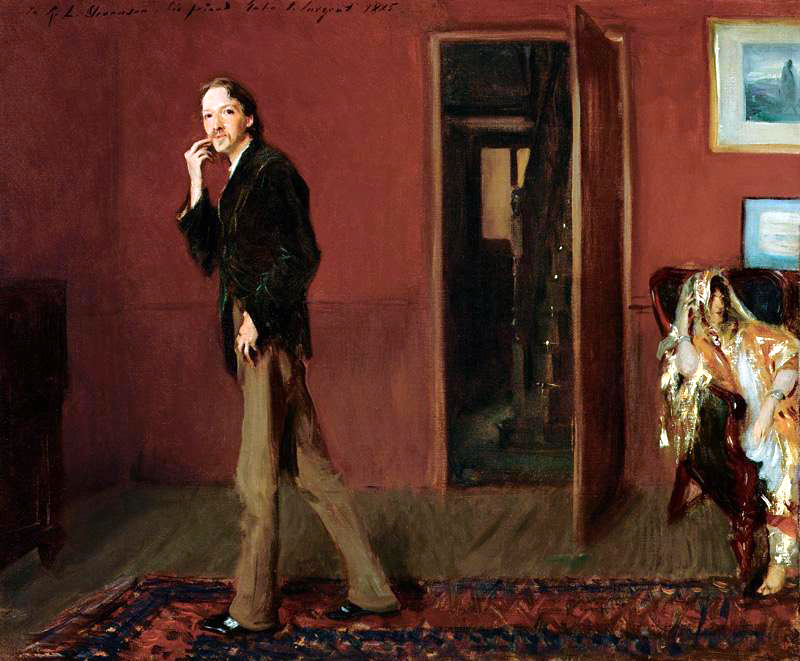
Robert Louis Stevenson and his Wife (1885)
RAM Stevenson, a cousin of Robert Louis Stevenson who studied with Sargent in Paris, wrote of his classmate’s remarkable talent: “Sargent’s painting is strict painting, as Bach’s fugues are strict music.” An accomplished musician himself, Sargent was known for talking constantly while he painted, and would walk around the room (he once estimated that he walked four miles every day going back and forth around his model and the easel) and interrupt his work to play the piano. Carnation, Lily, Lily, Rose, painted in the late summer of 1885 and 1886, was named for a popular song; its style “is poised”, the exhibition catalogue notes, “between several aesthetics: French impressionism, English pre-Raphaelitism and aestheticism”. Sargent’s chief aim in this portrait, all who watched him create it agreed, was to capture en plein air the transient quality of “fugitive evening light”. It took him two years to achieve, for he could only paint for 25 minutes each night in late summer: every evening at 6:45 Sargent “would drop his tennis racquet”, remembered a friend, and “lug out the big canvas” from his 70ft-long studio into the garden, where he would paint for as long as “the effect lasted”. He had almost certainly been to Giverny by then, and had watched Monet paint out of doors. He came to share Monet’s preoccupation with the play of natural light, but he never fully embraced impressionism’s subordination of subject to technique, its willingness to dissolve representation into paint, colour and light.
Dr Samuel Jean Pozzi at Home (1881)
Although Sargent’s subjects were often posed, his oeuvre suggests the painter as flaneur, strolling through metropolitan cities and capturing the personalities he encountered, the scenes he saw. His own coterie was stylish, knowing, chic: he portrayed other painters, sculptors, musicians, actors, dancers, including WB Yeats, Eleonora Duse, Edwin Booth, Edmund Gosse, George Meredith, Antonio Mancini (whom Sargent once described as “the best living painter”), the collector and hostess Isabella Stewart Gardner. There is the famous portrait of Ellen Terry as Lady Macbeth, raising the crown on to her head, and the 1885 picture of Robert Louis Stevenson and his wife, Fanny, who said their portrait was “like an open box of jewels”. He painted a Chilean mining heiress, formidable and stylishly dressed, who became a lay nun and had her habit designed by Coco Chanel. There is An Interior of Venice, depicting the Palazzo Barbaro on the Grand Canal, where James wrote The Wings of the Dove, and which some have speculated may have helped inspire The Aspern Papers. Sargent presented the painting as a gift to his hostess, but, offended by her appearance and her son’s informal pose, she rejected it, to the dismay of James, who wrote to her that he “absolutely and unreservedly adored” the painting. She did not change her mind. There is Sargent’s first double portrait, from 1881, of the Pailleron children. They are in a claustrophobic, dark but richly furnished space, and seem to have a knowing gaze; viewers have since been reminded of the doubtful children in James’s Turn of the Screw, written more than 15 years after the picture was first shown. There is the scarlet Dr Pozzi, painted as a handsome, louche aesthete, whose dressing gown slyly evokes cardinals: contemporary British reviewers found it objectionably Parisian, too insolent, too en vogue. Sargent’s paintings may look staidly traditional now, but they were seen as modern when he painted them.
Madame X (1883-4)
Celebrity and theatricality were central to Sargent’s style, and his success. It is the portrait of Amélie Gautreau, titled Madame X, for which he remains best known. Working on the painting, he told his friend the writer Vernon Lee that he was “struggling with the unpaintable beauty and hopeless laziness” of his sitter, but eventually, fusing techniques from Velázquez, Titian and Manet, as well as Sargent’s then fashionable interest in Japanese art, he produced a painting now seen as a masterpiece, but which first inspired outrage, creating a succes de scandale when it was exhibited at the 1884 Paris Salon. Reviews either objected to Madame Gautreau’s appearance (some complaining at the powder-blue pallor of her skin, others at the depth of her decolletage or the shockingly wanton shoulder strap allowed to fall suggestively loose) or hailed the modernity of Sargent’s technique.
When he sold Madame X to the New York Metropolitan Museum years later, Sargent admitted to feeling it might have been the best work he had ever done, but at the time he was unnerved by the malice it elicited. He beat a retreat to London, where James had promised him a more sympathetic reception. British critics did not, in fact, instantly embrace Sargent: The Misses Vickers was voted the worst painting of 1886 by the Royal Academy, for example, while the Spectator demanded: “Could we fancy anyone a hundred years hence caring to possess such a picture as this?” Carnation, Lily, Lily, Rose might strike some viewers as prettily pre-Raphaelite (although they would have to ignore its spectacular luminescence), but it provoked controversy when it was purchased through the Chantrey Bequest, one journal reporting that “artists [had] almost come to blows over this picture”. Modern, too, are the expressionist portrait of Lee, who appears to be chattering away, and a lovely impressionist evocation of one of Sargent’s touchstones, Monet, characteristically painting outside, sur le motif. There is the famous 1913 portrait of James for his 70th birthday, which, as the catalogue notes, delighted the Master: “Sargent at his very best and poor old HJ not at his worst; in short a living breathing likeness and a masterpiece of painting.”
Of Sargent’s private life, little is known. He never married; although twice he was suspected of being on the verge of an engagement, nothing came of it. Many have come to believe that his extreme privacy was a sign on the closet door, signalling a life kept carefully secret to hide desires deemed unacceptable (and illegal). Certainly Sargent executed many – very beautiful – drawings of male nudes, which he did not exhibit during his life. It is also true that a number of men with similarly suppressed or hidden desires, including James, were among his close circle of friends. But so were married couples, and heterosexual philanderers. The painter Jacques-Émile Blanche, who once sat for Sargent, claimed after his death that Sargent was “notorious in Paris, and in Venice, positively scandalous. He was a frenzied bugger.” But no other affirmation of this claim has come to light, and Sargent’s private papers were destroyed. Many scholars believe he had an affair with Louise Burckhardt, who sat for Lady with the Rose, while some of his female nudes have struck viewers as being as erotic as his males.
But in the end this is all conjecture. For better or worse – again like James – Sargent had married his art. Lee wrote after his death that the only useful biographical summation would be two words: “he painted”. Late in life, Sargent declined the honour of a knighthood, because he was American. He died at 69, in his sleep, a volume of Voltaire beside him. It was 14 April 1925, four days afterThe Great Gatsby was published; the modern era was at hand, and it was Sargent, whether we know it or not, who helped show us what it would look like.
• Sargent: Portrait of Artists and Friends opens at the National Portrait Gallery, London WC2H, on 12 February.
http://www.npg.org.uk/whatson/sargent/home.php
The Scandal of Madame X
In an exclusive excerpt from David McCullough’s new book, the story of how John Singer Sargent’s obsession with a woman led to the famous painting Madame X—and the scandal it caused in Paris.
David McCullough
22 May 2011
Sargent was by nature, as Vernon Lee wrote, always “especially attracted by the bizarre and outlandish,” the very essence of Virginie Amélie Avegno Gautreau, who, contrary to the impression most people had, was an American.
Born in New Orleans, she had been brought to Paris as a child of eight by her widowed, socially ambitious mother. Her father, a major in the Confederate army, had been killed at the battle of Shiloh. She was, by 1883, twenty-four years old, two years younger than Sargent.
To her mother’s great approval, she had married a wealthy French banker, Pierre Gautreau, and became what was called a “professional beauty,” the perfect “parisienne,” someone known for her remarkable looks and social stage presence, and who, in her appearances in society, was expected to fill that role with all due attention to wardrobe and the artful use of cosmetics, no less than a great actress. In her particular case a heavy use of a chalky lavender powder on face and body gave her a pallor distinctive enough in itself to draw attention. To her critics she was all too plainly an arriviste.
Her beauty was distinctly different, almost eccentric, her nose too long by accepted standards, her forehead too high. Yet the total effect, and particularly given her hourglass figure and her way of moving, was striking in the extreme, her appeal unmistakably seductive, as she well knew.
An American art student named Edward Simmons wrote of being “thrilled by every movement of her body.”
She walked as Virgil speaks of a goddess—sliding—and seemed to take no steps. Her head and neck undulated like that of a young doe, and something about her gave you the impression of infinite proportion, infinite grace, and infinite balance. Every artist wanted to make her in marble or paint.
After meeting her socially, Sargent, some said, had become obsessed by her. He let it be known that he wanted to do “homage to her beauty” in a portrait to be shown at the Salon, the implication being it could bring each of them notoriety in the way Manet’s sensational Olympia had, albeit she need not pose in the nude.
Do you object to people who are fardées [made up] to the extent of being uniform lavender or blotting paper color all over [he wrote to Vernon Lee]. If so you would not care for my sitter. But she has the most beautiful lines and if the lavender or chlorate-of-potash lozenge color be pretty in itself I shall be more than pleased.
He did one line drawing after another of her head in profile, made studies in pencil and watercolor of her relaxing on a settee in a low-cut evening dress, painted her in oil drinking a toast, and here again in profile. In the summer of 1883, from the Gautreaus’ country estate in Brittany, he wrote to tell Vernon Lee he was “still struggling with the unpaintable beauty and hopeless laziness” of his subject.
That he and Amélie Gautreau were both Americans was by no means immaterial to their ambitions. The same year they met, a society journal noted that “Yankees” in Paris were gaining ever-greater prominence. “They have painters who carry off our medals, like Mr. Sargent, beautiful women who eclipse ours, Mme. Gautreau. . . .” If they were to be known always as Americans, then all the more reason to be at the forefront.
Finished with his preliminary studies, Sargent left Brittany for Nice to pay his annual visit to his parents, before moving on for an autumn stay in Florence.
“His life is a pleasant life,” FitzWilliam Sargent wrote to a brother in Philadelphia.
Her sole purpose in life is to demonstrate by her skills in contriving incredible outfits which shape her and exhibit her and which she can carry off with bravado. . . .
He seems to be respected, even admired and beloved (according to all accounts) for his talent and success as an artist, for his conduct and character as a man. His work is a pleasurable occupation to him and brings him a very handsome income. He travels about in countries which provide him with materials for his pictures as well as with bread and butter and elements of health and enjoyment. He is well received everywhere for his manners are good and agreeable. He is good looking, plays the piano well and dances well, converses well, etc., etc. In short, he has given us, his parents great satisfaction so far. . . .
In the winter of 1883–84, Sargent moved from the Left Bank to a new studio across the Seine at 41 boulevard Berthier, in the then fashionable neighborhood near the Parc Monceau. It was there in a workplace elegantly furnished with comfortably upholstered chairs, Persian rugs, and drapery befitting his new professional standing, and an upright piano against one wall, that he painted his full-length portrait of Madame Gautreau, the whole time suffering what he called “a horrid state of anxiety.”
She was dressed in a long black satin skirt and low-cut black velvet bodice, her shoulders bare except for two slim jeweled straps. She held both shoulders back and her head cocked sharply to the left, giving full cameo emphasis to the remarkable profile.
Her left arm on her hip, she held her skirt with the left hand, while the right arm was oddly turned back on itself, her right hand gripping the top of the side table. She wore her hair up, with a tiny diamond tiara on top.
It was a flagrantly stagy pose, which could only have been difficult to hold for any length of time, even for one who was a poser by nature.
Against the deep black of the dress, the deathly blue-white of her powdered skin was even more strange and striking. When, during one sitting her right shoulder strap dropped suggestively over her arm, Sargent requested she leave it that way.
In contrast to his usual approach, he worked and reworked the canvas, simplifying and redefining edges.
One day I was dissatisfied with it and dashed a tone of light rose over the former gloomy background [he reported to a friend]. I turned the picture upside down, retired to another end of the studio and looked at it under my arm. Vast improvement. The élancée figure of the model shows to much greater advantage.
No doubt Madame Gautreau saw how the portrait was emerging under his brush from one sitting to another. Possibly her mother, too, may have been present occasionally. If they found anything about it disturbing at the time, there is no evidence that a word was said. When Carolus-Duran came by for a look, he told Sargent he could submit the painting to the Salon with perfect confidence. Sargent was not so sure.
Another who dropped in was Henry James. In Paris briefly, James had met and quite liked the young artist, calling him “the only Franco-American product of importance” in France. But, as James confided to a friend, he only “half-liked” the portrait of Madame Gautreau.
The 1884 Paris Salon, an exhibition filling thirty-one of the grandes salles in the Palais de l’Industrie, opened on a beautiful May morning with much excitement among the customary well-dressed crowds in attendance. So great had the number of American painters in Paris become, and so important to their careers was representation at the Salon, that they were now second only to the number of French artists included. For Sargent it marked the sixth consecutive year he had exhibited at the Salon, always with increasing acclaim.
Paintings filled every wall. The portrait of Amélie Gautreau, ideally placed at eye level, was hung in Salle 31, and the doors had been open scarcely an hour when it became the talk of the exhibition.
For all that would be written and said, no eyewitness account of the event and of its effect on Sargent compared to what his friend Ralph Curtis wrote to his parents the next day. Whether the opening marked Sargent’s birthday as an artist or his funeral, Curtis could not say.
Walked up the Champs-Élysées, chestnuts in full flower and a dense mob of “tout Paris” in pretty clothes, gesticulating and laughing, slowly going into the Ark of Art. In 15 minutes I saw no end of acquaintances and strangers and heard everybody say, “Où est le portrait Gautreau?” “Oh, allez voir ça.”
Curtis had seen Sargent the night before. “He was very nervous about what he feared,” he wrote, “but his fears were far exceeded by the facts of yesterday. There was a grande tapage [great fuss] before it [the portrait] all day.”
In a few minutes I found him dodging behind doors to avoid friends who looked grave. By the corridors he took me to see it. I was disappointed by the color. She looks decomposed. All the men jeer. “Ah voilà ‘la belle!’ ” “Oh, que le horreur!” Etc. Then a painter exclaims, “superbe de style, magnifique d’audace!” [Magnificent audacity!] “Quel dessin!” [What drawing!].
In an exhibition wherein paintings of nudes were commonplace, that of Madame Gautreau in her black evening dress was considered scandalously erotic.
But what was unacceptable to “tout Paris” was the blatant, self-centered impropriety of it all—the heavy powder, the odd, arrogant pose, the décolletage. Such vulgar flaunting was simply not done by women of social standing.
“All the A.M. it was one series of bons mots, mauvaises plaisanteries and fierce discussions,” Curtis continued in his letter. “John, poor boy, was navré [full of sorrow]. The tumult of talk lasted through the day, but by evening the tone of opinion about the picture had changed. It was discovered to be the knowing thing to say ‘étrangement épatant.’ [shocking, amazing!]”
“I went home with him,” Curtis continued, “and remained there while he went to see the Boits.” Madame Gautreau and her mother came to the studio “bathed in tears.” Curtis “stayed them off,” but Madame Avegno came back again, after Sargent had returned, and made “a fearful scene.”
“All Paris mocks my daughter,” she said. If the painting were to stay on exhibit, she would “die of chagrin.”
Sargent, obviously put out, told her there was nothing he could do, that it was against the rules of the Salon to retire a picture and that he had painted Amélie exactly as she was dressed.
“Defending his cause made Sargent feel much better,” wrote Curtis. “Still we talked it over until 1 o’clock here last night and I fear he has never had such a blow.”
The reviews were essentially of three kinds, those that objected to Madame Gautreau’s décolletage, those repulsed by the color of her skin, and those that, seeing “modernity” in the approach, applauded Sargent’s courage.
The New York Times dismissed the painting out of hand as a “caricature,” far below Sargent’s usual standard. “The pose of the figure is absurd, and the bluish coloring atrocious.” The Times of London conceded only that the portrait was “most interesting.” But the French critic Louis de Fourcaud, writing in the Gazette des Beaux-Arts, called it a masterpiece of characterization. It should be kept in mind, he wrote, that “in a person of this type everything relates to the cult of self and the increasing concern to captivate those around her.
Her sole purpose in life is to demonstrate by her skills in contriving incredible outfits which shape her and exhibit her and which she can carry off with bravado. . . .
Sargent had been living and working in Paris for a full decade and in that time had received only expressions of admiration and praise. He had never known an adverse review or even mild criticism, let alone public mockery. His portrait of Madame Gautreau was in fact a masterpiece and in time would be so recognized. He hung on to it, renaming it Madame X. He also repainted the fallen shoulder strap, restoring it to its proper place. Years later, when he sold the painting to the Metropolitan Museum in New York for $1,000, he would remark that it was perhaps the best thing he had done.
He and Amélie Gautreau seem to have had no further contact, though she, too, eventually changed her opinion about the painting and expressed pride in it.
Yet hard hit as he was and angry over what had happened, Sargent appears to have had no doubts about his ability or his ambition to keep painting. Feeling an immediate need for a change of scene, he followed up on an earlier plan to go to London. He left Paris in late May 1884, not to return until December.
Sargent was by nature, as Vernon Lee wrote, always “especially attracted by the bizarre and outlandish,” the very essence of Virginie Amélie Avegno Gautreau, who, contrary to the impression most people had, was an American.
Born in New Orleans, she had been brought to Paris as a child of eight by her widowed, socially ambitious mother. Her father, a major in the Confederate army, had been killed at the battle of Shiloh. She was, by 1883, twenty-four years old, two years younger than Sargent.
To her mother’s great approval, she had married a wealthy French banker, Pierre Gautreau, and became what was called a “professional beauty,” the perfect “parisienne,” someone known for her remarkable looks and social stage presence, and who, in her appearances in society, was expected to fill that role with all due attention to wardrobe and the artful use of cosmetics, no less than a great actress. In her particular case a heavy use of a chalky lavender powder on face and body gave her a pallor distinctive enough in itself to draw attention. To her critics she was all too plainly an arriviste.
Her beauty was distinctly different, almost eccentric, her nose too long by accepted standards, her forehead too high. Yet the total effect, and particularly given her hourglass figure and her way of moving, was striking in the extreme, her appeal unmistakably seductive, as she well knew.
An American art student named Edward Simmons wrote of being “thrilled by every movement of her body.”
She walked as Virgil speaks of a goddess—sliding—and seemed to take no steps. Her head and neck undulated like that of a young doe, and something about her gave you the impression of infinite proportion, infinite grace, and infinite balance. Every artist wanted to make her in marble or paint.
After meeting her socially, Sargent, some said, had become obsessed by her. He let it be known that he wanted to do “homage to her beauty” in a portrait to be shown at the Salon, the implication being it could bring each of them notoriety in the way Manet’s sensational Olympia had, albeit she need not pose in the nude.
Do you object to people who are fardées [made up] to the extent of being uniform lavender or blotting paper color all over [he wrote to Vernon Lee]. If so you would not care for my sitter. But she has the most beautiful lines and if the lavender or chlorate-of-potash lozenge color be pretty in itself I shall be more than pleased.
He did one line drawing after another of her head in profile, made studies in pencil and watercolor of her relaxing on a settee in a low-cut evening dress, painted her in oil drinking a toast, and here again in profile. In the summer of 1883, from the Gautreaus’ country estate in Brittany, he wrote to tell Vernon Lee he was “still struggling with the unpaintable beauty and hopeless laziness” of his subject.
That he and Amélie Gautreau were both Americans was by no means immaterial to their ambitions. The same year they met, a society journal noted that “Yankees” in Paris were gaining ever-greater prominence. “They have painters who carry off our medals, like Mr. Sargent, beautiful women who eclipse ours, Mme. Gautreau. . . .” If they were to be known always as Americans, then all the more reason to be at the forefront.
Finished with his preliminary studies, Sargent left Brittany for Nice to pay his annual visit to his parents, before moving on for an autumn stay in Florence.
“His life is a pleasant life,” FitzWilliam Sargent wrote to a brother in Philadelphia.
Her sole purpose in life is to demonstrate by her skills in contriving incredible outfits which shape her and exhibit her and which she can carry off with bravado. . . .
He seems to be respected, even admired and beloved (according to all accounts) for his talent and success as an artist, for his conduct and character as a man. His work is a pleasurable occupation to him and brings him a very handsome income. He travels about in countries which provide him with materials for his pictures as well as with bread and butter and elements of health and enjoyment. He is well received everywhere for his manners are good and agreeable. He is good looking, plays the piano well and dances well, converses well, etc., etc. In short, he has given us, his parents great satisfaction so far. . . .
In the winter of 1883–84, Sargent moved from the Left Bank to a new studio across the Seine at 41 boulevard Berthier, in the then fashionable neighborhood near the Parc Monceau. It was there in a workplace elegantly furnished with comfortably upholstered chairs, Persian rugs, and drapery befitting his new professional standing, and an upright piano against one wall, that he painted his full-length portrait of Madame Gautreau, the whole time suffering what he called “a horrid state of anxiety.”
She was dressed in a long black satin skirt and low-cut black velvet bodice, her shoulders bare except for two slim jeweled straps. She held both shoulders back and her head cocked sharply to the left, giving full cameo emphasis to the remarkable profile.
Her left arm on her hip, she held her skirt with the left hand, while the right arm was oddly turned back on itself, her right hand gripping the top of the side table. She wore her hair up, with a tiny diamond tiara on top.
It was a flagrantly stagy pose, which could only have been difficult to hold for any length of time, even for one who was a poser by nature.
Against the deep black of the dress, the deathly blue-white of her powdered skin was even more strange and striking. When, during one sitting her right shoulder strap dropped suggestively over her arm, Sargent requested she leave it that way.
In contrast to his usual approach, he worked and reworked the canvas, simplifying and redefining edges.
One day I was dissatisfied with it and dashed a tone of light rose over the former gloomy background [he reported to a friend]. I turned the picture upside down, retired to another end of the studio and looked at it under my arm. Vast improvement. The élancée figure of the model shows to much greater advantage.
No doubt Madame Gautreau saw how the portrait was emerging under his brush from one sitting to another. Possibly her mother, too, may have been present occasionally. If they found anything about it disturbing at the time, there is no evidence that a word was said. When Carolus-Duran came by for a look, he told Sargent he could submit the painting to the Salon with perfect confidence. Sargent was not so sure.
Another who dropped in was Henry James. In Paris briefly, James had met and quite liked the young artist, calling him “the only Franco-American product of importance” in France. But, as James confided to a friend, he only “half-liked” the portrait of Madame Gautreau.
The 1884 Paris Salon, an exhibition filling thirty-one of the grandes salles in the Palais de l’Industrie, opened on a beautiful May morning with much excitement among the customary well-dressed crowds in attendance. So great had the number of American painters in Paris become, and so important to their careers was representation at the Salon, that they were now second only to the number of French artists included. For Sargent it marked the sixth consecutive year he had exhibited at the Salon, always with increasing acclaim.
Paintings filled every wall. The portrait of Amélie Gautreau, ideally placed at eye level, was hung in Salle 31, and the doors had been open scarcely an hour when it became the talk of the exhibition.
For all that would be written and said, no eyewitness account of the event and of its effect on Sargent compared to what his friend Ralph Curtis wrote to his parents the next day. Whether the opening marked Sargent’s birthday as an artist or his funeral, Curtis could not say.
Walked up the Champs-Élysées, chestnuts in full flower and a dense mob of “tout Paris” in pretty clothes, gesticulating and laughing, slowly going into the Ark of Art. In 15 minutes I saw no end of acquaintances and strangers and heard everybody say, “Où est le portrait Gautreau?” “Oh, allez voir ça.”
Curtis had seen Sargent the night before. “He was very nervous about what he feared,” he wrote, “but his fears were far exceeded by the facts of yesterday. There was a grande tapage [great fuss] before it [the portrait] all day.”
In a few minutes I found him dodging behind doors to avoid friends who looked grave. By the corridors he took me to see it. I was disappointed by the color. She looks decomposed. All the men jeer. “Ah voilà ‘la belle!’ ” “Oh, que le horreur!” Etc. Then a painter exclaims, “superbe de style, magnifique d’audace!” [Magnificent audacity!] “Quel dessin!” [What drawing!].
In an exhibition wherein paintings of nudes were commonplace, that of Madame Gautreau in her black evening dress was considered scandalously erotic.
But what was unacceptable to “tout Paris” was the blatant, self-centered impropriety of it all—the heavy powder, the odd, arrogant pose, the décolletage. Such vulgar flaunting was simply not done by women of social standing.
“All the A.M. it was one series of bons mots, mauvaises plaisanteries and fierce discussions,” Curtis continued in his letter. “John, poor boy, was navré [full of sorrow]. The tumult of talk lasted through the day, but by evening the tone of opinion about the picture had changed. It was discovered to be the knowing thing to say ‘étrangement épatant.’ [shocking, amazing!]”
“I went home with him,” Curtis continued, “and remained there while he went to see the Boits.” Madame Gautreau and her mother came to the studio “bathed in tears.” Curtis “stayed them off,” but Madame Avegno came back again, after Sargent had returned, and made “a fearful scene.”
“All Paris mocks my daughter,” she said. If the painting were to stay on exhibit, she would “die of chagrin.”
Sargent, obviously put out, told her there was nothing he could do, that it was against the rules of the Salon to retire a picture and that he had painted Amélie exactly as she was dressed.
“Defending his cause made Sargent feel much better,” wrote Curtis. “Still we talked it over until 1 o’clock here last night and I fear he has never had such a blow.”
The reviews were essentially of three kinds, those that objected to Madame Gautreau’s décolletage, those repulsed by the color of her skin, and those that, seeing “modernity” in the approach, applauded Sargent’s courage.
The New York Times dismissed the painting out of hand as a “caricature,” far below Sargent’s usual standard. “The pose of the figure is absurd, and the bluish coloring atrocious.” The Times of London conceded only that the portrait was “most interesting.” But the French critic Louis de Fourcaud, writing in the Gazette des Beaux-Arts, called it a masterpiece of characterization. It should be kept in mind, he wrote, that “in a person of this type everything relates to the cult of self and the increasing concern to captivate those around her.
Her sole purpose in life is to demonstrate by her skills in contriving incredible outfits which shape her and exhibit her and which she can carry off with bravado. . . .
Sargent had been living and working in Paris for a full decade and in that time had received only expressions of admiration and praise. He had never known an adverse review or even mild criticism, let alone public mockery. His portrait of Madame Gautreau was in fact a masterpiece and in time would be so recognized. He hung on to it, renaming it Madame X. He also repainted the fallen shoulder strap, restoring it to its proper place. Years later, when he sold the painting to the Metropolitan Museum in New York for $1,000, he would remark that it was perhaps the best thing he had done.
He and Amélie Gautreau seem to have had no further contact, though she, too, eventually changed her opinion about the painting and expressed pride in it.
Yet hard hit as he was and angry over what had happened, Sargent appears to have had no doubts about his ability or his ambition to keep painting. Feeling an immediate need for a change of scene, he followed up on an earlier plan to go to London. He left Paris in late May 1884, not to return until December.
Monday, 2 February 2015
Sunday, 1 February 2015
Friday, 30 January 2015
Thursday, 29 January 2015
Last night's set lists
At The Habit, York: -
Ron Elderly: -
Dead Flowers
Wagon Wheel
Need Your Love So Bad
You Better Move On
Da Elderly: -
There Stands The Glass
Mother's Lament
Helpless
I Don't Want To Talk About It
The Elderly Brothers: -
The Price Of Love
Walk Right Back
So Sad (To Watch Good Love Go Bad)
He'll Have To Go
Well....it was just like the old times at The Habit open mic, on a miserable night outside; the place was packed almost from the start, with loads of players and punters. By the time The Elderly Brothers hit the mic it was close to midnight and we managed to play our set without the book (and a safety net)!! Beer and Fireballs flowed and the after-show unplugged session even had some folks dancing. I repeat....it was just like the old times.
Ron Elderly: -
Dead Flowers
Wagon Wheel
Need Your Love So Bad
You Better Move On
Da Elderly: -
There Stands The Glass
Mother's Lament
Helpless
I Don't Want To Talk About It
The Elderly Brothers: -
The Price Of Love
Walk Right Back
So Sad (To Watch Good Love Go Bad)
He'll Have To Go
Well....it was just like the old times at The Habit open mic, on a miserable night outside; the place was packed almost from the start, with loads of players and punters. By the time The Elderly Brothers hit the mic it was close to midnight and we managed to play our set without the book (and a safety net)!! Beer and Fireballs flowed and the after-show unplugged session even had some folks dancing. I repeat....it was just like the old times.
Monday, 26 January 2015
Bob Dylan - Shadows in the Night review
Dylan's 'Shadows in the Night' illuminates American standards
Bob Dylan upends expectations once again with his 'Shadows in the Night' collection of American standards
Randall Roberts
http://www.latimes.com/entertainment/music/la-et-ms-dylan-shadows-review-20150126-column.html

Bob Dylan upends expectations once again with his 'Shadows in the Night' collection of American standards
Randall Roberts
Los Angeles Times
26 January 2015
Call them standards if you must — imagine dusty old classics of the so-called Great American Songbook. But as interpreted by Bob Dylan, more accurate is to consider the entirety of "Shadows in the Night" as a gathering of meditations, or a booklet of hymns, or a selection of reveries.
Ten songs, 34 minutes, a soaring lifetime's worth of emotion conveyed with the fearlessness of a cliff diver spinning flips and risking belly flops in the open air — that's Dylan and his band on the graceful, often breathtaking "Shadows." The record comes out Feb. 3.
Strikingly unadorned and as emotionally raw as anything in the artist's canon, Dylan's new studio album is rich with moaning pedal steel lines and tonal whispers that drift in and out of measures. Guided by bassist Tony Garnier's liquid lines, "Shadows" is an exercise in precision, each syllable essential, each measure evenly weighted. Absent are piano, overdubs, all but the most minimal percussion or any lyric written by Dylan himself. And it's as slow as molasses.
Rather, for "Shadows," the 73-year-old artist gathered his longtime band into Studio A at Capitol Studios in Hollywood to celebrate the artfully penned lyric and melody. Resurrecting works, many obscure, written or cowritten in the decades between the 1920s and '60s by composers including Rodgers & Hammerstein, Irving Berlin, Matt Dennis & Tom Adair, Frank Sinatra and Buddy Kaye, the album is a celebration of the craft and enduring power of a seamless ballad.
A random selection of lines tells the story: Where is my happy ending? Where are you? Since you went away the days grow long. Full moon and empty arms. I'm a fool to love you. Take me back, I need you. What'll I do when you are far away and I am blue? I'm sentimental, so I walk in the rain. I've got some habits even I can't explain.
Songs of lovers gone, of vanishing emotions, of fading years and stubborn habits, of isolation, unanswered prayers and never-ending hope — you can feel the emptiness. The studio comfortably fits 50 musicians, but this session was tight: Dylan circled by the five who tour with him: Garnier, Stu Kimball (rhythm guitar), Donnie Herron (pedal steel, lap steel), Charlie Sexton (lead guitar) and George Receli (drums, percussion). The occasional muted brass section washes through.
Recording the songs in the order in which they appear on the album, the artist didn't even use headphones to monitor the mix. Rather, he listened to the experts around him, spiriting intimate takes on songs about autumn leaves, enchanted evenings and an ambivalent sun spinning around. So intimate is the recording that vague hints of Dylan's breath can be heard at key moments. The occasional shuffle of a lyric sheet. A little inhale at the end of a lap steel line during "What'll I Do."
The result is akin to Willie Nelson's "Stardust," Chet Baker's late-period "Let's Get Lost" recordings or Jimmy Scott's miraculous post-retirement comeback, "All the Way." If there's a connector, it's that all the songs on "Shadows" were interpreted at one time or another by Frank Sinatra. But this certainly isn't a tribute per se to that swinging stylist.
That's a relief, as Dylan is obviously no Sinatra. His voice raw, pitchy and quivering, Dylan croons his way through elegantly crafted songs with seeming disinterest in flawless takes or perfect pitch. Yet it's profound, thematically devastating and so well curated as to feel essential.
"Shadows in the Night" is an album that's best appreciated when heard with intention, while sitting still, with volume and focus. It's Dylan upending expectations once again, another left turn in a career filled with them, sharing his wisdom and defining himself through the lines of others. He's done that both as a historian and a thief of American music, playing with context and blurring intentions in innumerable songs.
In that sense, the album's closest companions in his repertoire are two equally intimate albums of cover songs from the early '90s that helped further define him, "Good as I Been to You" and "World Gone Wrong." Those too were minimalist Dylan — just him and guitar. They featured the artist's takes on a different brand of American song: haggard old blues songs and murder ballads. Both explored love and death through songs of violent betrayal. Then in his early 50s, Dylan still burned with feral passion, singing of "blood in my eyes" for a lover, of a life cut too short in "Delia." For "Shadows," that passion is supplanted with equanimity and hard-earned wisdom.
In fact, if there's an underlying philosophy to "Shadows," Dylan hints at it in his only interview in regards to the record. Strategically given to AARP magazine, he offered thoughts on aging and creative expression: "Passion is a young man's game," he said. "Young people can be passionate. Older people gotta be more wise. I mean, you're around awhile, you leave certain things to the young. Don't try to act like you're young. You could really hurt yourself."
Call them standards if you must — imagine dusty old classics of the so-called Great American Songbook. But as interpreted by Bob Dylan, more accurate is to consider the entirety of "Shadows in the Night" as a gathering of meditations, or a booklet of hymns, or a selection of reveries.
Ten songs, 34 minutes, a soaring lifetime's worth of emotion conveyed with the fearlessness of a cliff diver spinning flips and risking belly flops in the open air — that's Dylan and his band on the graceful, often breathtaking "Shadows." The record comes out Feb. 3.
Strikingly unadorned and as emotionally raw as anything in the artist's canon, Dylan's new studio album is rich with moaning pedal steel lines and tonal whispers that drift in and out of measures. Guided by bassist Tony Garnier's liquid lines, "Shadows" is an exercise in precision, each syllable essential, each measure evenly weighted. Absent are piano, overdubs, all but the most minimal percussion or any lyric written by Dylan himself. And it's as slow as molasses.
Rather, for "Shadows," the 73-year-old artist gathered his longtime band into Studio A at Capitol Studios in Hollywood to celebrate the artfully penned lyric and melody. Resurrecting works, many obscure, written or cowritten in the decades between the 1920s and '60s by composers including Rodgers & Hammerstein, Irving Berlin, Matt Dennis & Tom Adair, Frank Sinatra and Buddy Kaye, the album is a celebration of the craft and enduring power of a seamless ballad.
A random selection of lines tells the story: Where is my happy ending? Where are you? Since you went away the days grow long. Full moon and empty arms. I'm a fool to love you. Take me back, I need you. What'll I do when you are far away and I am blue? I'm sentimental, so I walk in the rain. I've got some habits even I can't explain.
Songs of lovers gone, of vanishing emotions, of fading years and stubborn habits, of isolation, unanswered prayers and never-ending hope — you can feel the emptiness. The studio comfortably fits 50 musicians, but this session was tight: Dylan circled by the five who tour with him: Garnier, Stu Kimball (rhythm guitar), Donnie Herron (pedal steel, lap steel), Charlie Sexton (lead guitar) and George Receli (drums, percussion). The occasional muted brass section washes through.
Recording the songs in the order in which they appear on the album, the artist didn't even use headphones to monitor the mix. Rather, he listened to the experts around him, spiriting intimate takes on songs about autumn leaves, enchanted evenings and an ambivalent sun spinning around. So intimate is the recording that vague hints of Dylan's breath can be heard at key moments. The occasional shuffle of a lyric sheet. A little inhale at the end of a lap steel line during "What'll I Do."
The result is akin to Willie Nelson's "Stardust," Chet Baker's late-period "Let's Get Lost" recordings or Jimmy Scott's miraculous post-retirement comeback, "All the Way." If there's a connector, it's that all the songs on "Shadows" were interpreted at one time or another by Frank Sinatra. But this certainly isn't a tribute per se to that swinging stylist.
That's a relief, as Dylan is obviously no Sinatra. His voice raw, pitchy and quivering, Dylan croons his way through elegantly crafted songs with seeming disinterest in flawless takes or perfect pitch. Yet it's profound, thematically devastating and so well curated as to feel essential.
"Shadows in the Night" is an album that's best appreciated when heard with intention, while sitting still, with volume and focus. It's Dylan upending expectations once again, another left turn in a career filled with them, sharing his wisdom and defining himself through the lines of others. He's done that both as a historian and a thief of American music, playing with context and blurring intentions in innumerable songs.
In that sense, the album's closest companions in his repertoire are two equally intimate albums of cover songs from the early '90s that helped further define him, "Good as I Been to You" and "World Gone Wrong." Those too were minimalist Dylan — just him and guitar. They featured the artist's takes on a different brand of American song: haggard old blues songs and murder ballads. Both explored love and death through songs of violent betrayal. Then in his early 50s, Dylan still burned with feral passion, singing of "blood in my eyes" for a lover, of a life cut too short in "Delia." For "Shadows," that passion is supplanted with equanimity and hard-earned wisdom.
In fact, if there's an underlying philosophy to "Shadows," Dylan hints at it in his only interview in regards to the record. Strategically given to AARP magazine, he offered thoughts on aging and creative expression: "Passion is a young man's game," he said. "Young people can be passionate. Older people gotta be more wise. I mean, you're around awhile, you leave certain things to the young. Don't try to act like you're young. You could really hurt yourself."
The secret Sinatra past of Bob Dylan's new album
Gustavo Turner
Los Angeles Times
24 January 2015
Bob Dylan has a new album coming out Feb. 3, "Shadows in the Night," a collection of pop songs about romance, heartbreak and other existential themes written by other songwriters.
But whatever you call this labor-of-love project, there's one thing Bob Dylan does not want you to call it: his "Sinatra covers album."
These are old songs, written between the early 1920s and the early 1960s, some of which have become bona fide jazz standards ("Autumn Leaves"), others of which were minor hits when they were first recorded ("Full Moon and Empty Arms"), and there's even the odd gem ("Stay With Me") that has been overlooked by audiences since its first appearance on an obscure single.
All these songs have one thing in common: They were recorded by Frank Sinatra at some point (in some cases, several points) in his career.
"I don't see myself as covering these songs in any way," Dylan said in a statement last December. "They've been covered enough. Buried, as a matter a fact. What me and my band are basically doing is uncovering them. Lifting them out of the grave and bringing them into the light of day."
In a way, Dylan is treating the massive Sinatra catalog as an open bazaar from where he has decided to rearrange and reinterpret specific areas to create a new, wholly Dylanesque work. It's the same process he applied to the folk standard canon in his first album in 1961 and the kind of artistic practice he has continued in his forays into fine art, where he works in the same appropriation and resignification field as artists like Richard Prince.
"In folk and jazz, quotation is a rich and enriching tradition," he told Rolling Stone magazine in 2012, speaking about his use of lines from Civil War poet Henry Timrod and others in some of his recent songs. "As far as [...] Timrod is concerned, have you even heard of him? Who's been reading him lately? And who's pushed him to the forefront? Who's been making you read him?"
The same could be said of the following Sinatra-related songs, which will surely be given new life into the 21st century by Dylan's selection process:
"I'm a Fool to Want You" (Sinatra, Wolf, Herron): First recorded by Sinatra in 1951, with an arrangement by Axel Stordahl, in New York for Columbia Records. It was B-side to novelty single "Mama Will Bark" (with Dagmar, a busty chorus girl and early TV starlet). It's a rare songwriting credit for Sinatra, who's much better known as an interpreter of others' material. "Frank changed part of the lyric, and made it say what he felt when he was doing it," explained cowriter Joel Herron in the book "Frank Sinatra: An American Legend." "We said, 'He's gotta be on this song!' and we invited him as cowriter." At the time the singer had left his first wife Nancy to be together with Ava Gardner, whom he was hoping to marry after his divorce had been finalized. He recorded a second version in 1957 in Hollywood at the legendary Capitol Tower, this time arranged by Gordon Jenkins. It was released on "Where Are You?," his 1957 album of "suicide songs" (Sinatra's term for his concept albums about masculine loneliness) released by Capitol. In fact, four out of 10 songs on Dylan's "Shadows in the Night," also recorded in Hollywood's Capitol Tower, were songs Sinatra recorded for "Where Are You?" After Sinatra's recording, "I'm a Fool to Want You" became a popular song with other interpreters, and it was also recorded by Billie Holiday (for 1958's "Lady in Satin," a Sinatra favorite), Dinah Washington, Billy Eckstine, Chet Baker, Peggy Lee, Tom Jones, Elvis Costello and many others.
"The Night We Called It a Day" (Dennis, Adair): Originally published in 1941, Sinatra also recorded this in 1957 at the Capitol Tower for "Where Are You?," arranged by Gordon Jenkins. There are other notable pop versions by Chet Baker, June Christy and Doris Day, and a great jazz arrangement by Milt Jackson and John Coltrane. Trivia fact: The song gives its original title to a bizarre 2003 Australian movie (also know as "All the Way") with Dennis Hopper playing Frank Sinatra and Melanie Griffith playing the singer's fourth (and final) wife, Barbara.
"Stay With Me" (Moross, Jerome): Originally known as "Stay With Me (Main Theme from 'The Cardinal')" and featured in the soundtrack of a 1963 social melodrama directed by Otto Preminger, this is the real obscure piece in the set. It came out on Sinatra's own label, Reprise, in 1964 as a single, but only stayed three weeks on the Billboard charts, peaking at an unimpressive No. 81. (It also turned up a year later on an odds-and-ends Reprise album, "Sinatra '65"). It was recorded in December 1963 at United Western Recorders in Hollywood, with Don Costa arranging and conducting. The week "Stay With Me" peaked at 81 (Feb. 1, 1964) was right in the heart of Beatlemania and "I Want to Hold Your Hand" ruled the airwaves. At the time, Dylan was between "The Times They Are-a-Changing" (which had just been released) and "Another Side of Bob Dylan." The passionate, epic "Stay With Me" wouldn't have made a strong impression on him at the time: Dylan had just embarked on a legendary, pot-fueled cross-country trip with his buddies, where he would write youth-culture classics like "Chimes of Freedom."
"Autumn Leaves" (Mercer, Kosma, Prevert): Yet another song recorded by Sinatra for "Where Are You?" in 1957 at Capitol with arrangements by Gordon Jenkins, in the same session as "The Night We Called It a Day." "Autumn Leaves," a jazz standard, was originally written in 1945 in France by Hungarian composer Joseph Kosma and poet Jacques Prevert as "Les Feuilles Mortes" ("Dead Leaves"). Sublime lyricist Johnny Mercer wrote English words for it in 1947. There are many, many versions of this song, so we'll just note a few: Jo Stafford's big pop hit, an unusual version in Japanese by Nat King Cole, bilingual versions in French and English by Edith Piaf (1950), and Iggy Pop's 2009 cover for his strange Francophile project "Préliminaires." Jerry Lee Lewis, strangely enough given his manic persona, has had a moving version of "Autumn Leaves" as part of his extensive repertoire for decades (there's a YouTube video of Lewis performing the song in 1971).
"Why Try to Change Me Now" (Coleman, McCarthy): Sinatra recorded this twice. The first version, from 1952 (arranged by Percy Faith), was his last recording for Columbia Records and many interpreted the lyrics as a kiss-off to the company. The second recording is from 1959's "No One Cares," another Jenkins-arranged album of "suicide songs" and a thematic sequel of sorts to Dylan favorite "Where Are You?" The song was cowritten by Broadway legend Cy Coleman, of "Sweet Charity" fame. An outstanding modern version was recorded by Fiona Apple for "The Best Is Yet to Come" a 2009 multi-artist tribute to Coleman. Check out the live version at L.A.'s Largo.
"Some Enchanted Evening" (Rodgers and Hammerstein): One of the showstoppers from 1949's hit musical "South Pacific," of course, Sinatra recorded it three times, first when the song was fresh, for a 1949 Columbia single arranged by Axel Stordahl, which didn't sell as well as contemporary versions by Perry Como and Bing Crosby. Sinatra rerecorded it in 1963 with Nelson Riddle as part of the "Reprised Musical Repertory Theater" series of albums based on Broadway musicals that he recorded with showbiz friends. He revived it in the autumn of his years for the H.B. Barnum-led 1967 sessions for "The World We Knew." Other versions? Take your pick, as it's been done by everyone from Art Garfunkel to Harry Connick Jr. to any number of sentimental karaoke drunks around the world.
"Full Moon and Empty Arms" (Rachmaninoff, Kaye and Mossman): Yes, Rachmaninoff as in the famous Russian composer, from whose Piano Concerto No. 2 Kaye and Mossman adapted the melody in 1945. Sinatra had a minor hit on Columbia with it, and it was later done by Eddie Fisher and Sarah Vaughan. It was the track chosen by Dylan to give a sneak peek into the project back in May 2014.
"Where Are You?" (Adamson, McHugh): The title song from 1957 heartbreak concept album "Where Are You?" (and by this point, it should be clear, one of the inspirations of Dylan's "Shadows in the Night"). By the time Sinatra got around to recording it the song was 20 years old, originating in the 1937 film "Top of the Town." The early hit version was by Mildred Bailey in the 1930s, but Sinatra made it his. There are many other good versions, including those by Shirley Bassey, Dinah Washington and this writer's favorite songstress, Julie London. Aretha Franklin recorded a moving rendition in 1963 during her unfairly maligned stint at Columbia Records as a jazz and pop singer.
"What'll I Do" (Berlin): The oldest song on the set, written by Irving Berlin in the early 1920s for a Broadway revue. Jazzman Paul Whiteman had a hit with it in 1924. Sinatra recorded it twice: in 1947 for Columbia with Axel Stordahl and in 1962 for Reprise with Gordon Jenkins. The 1962 version was released on "All Alone," Sinatra's update for his own label, Reprise, of his famous "suicide songs" concept albums for Capitol in the 1950s. The song remained a popular standard for decades and there are good versions by Chet Baker (Dylan and Baker seem to share an affinity for the same torch songs), Lena Horne, Julie London, Sarah Vaughan, Cher and Harry Nilsson. "What'll I Do" was also used by Nelson Riddle as the theme for his score for the 1974 version of "The Great Gatsby" (the one with Robert Redford and Mia Farrow).
"That Lucky Old Sun" (Smith, Gillespie): "Shadows in the Night" closes with the most soulful of the songs Dylan selected. Composed in 1949 as a kind of late-era spiritual/work song, it was recorded by Louis Armstrong, but Frankie Laine had the hit. Sinatra did his version when the song was new, but Laine's became the definitive rendition of 1949 (and a palpable influence on singers who were coming of age at the time like Elvis Presley and Johnny Cash). Jerry Lee Lewis revved it up as a Sun recording, and it was later adopted as a proto-soul standard by Sam Cooke, Ray Charles and Aretha Franklin (also during the Columbia years). More recently, Willie Nelson recorded a crystalline version for 1976's "The Sound in Your Mind" (included now as a bonus track to Willie's "Stardust," which Dylan told AARP was a direct influence on "Shadows in the Night") and in 2007 became the centerpiece of a song cycle about California by none other than Brian Wilson.
http://www.latimes.com/entertainment/music/posts/la-et-ms-dylan-sinatra-covers-20150123-story.html#page=1
Bob Dylan has a new album coming out Feb. 3, "Shadows in the Night," a collection of pop songs about romance, heartbreak and other existential themes written by other songwriters.
But whatever you call this labor-of-love project, there's one thing Bob Dylan does not want you to call it: his "Sinatra covers album."
These are old songs, written between the early 1920s and the early 1960s, some of which have become bona fide jazz standards ("Autumn Leaves"), others of which were minor hits when they were first recorded ("Full Moon and Empty Arms"), and there's even the odd gem ("Stay With Me") that has been overlooked by audiences since its first appearance on an obscure single.
All these songs have one thing in common: They were recorded by Frank Sinatra at some point (in some cases, several points) in his career.
"I don't see myself as covering these songs in any way," Dylan said in a statement last December. "They've been covered enough. Buried, as a matter a fact. What me and my band are basically doing is uncovering them. Lifting them out of the grave and bringing them into the light of day."
In a way, Dylan is treating the massive Sinatra catalog as an open bazaar from where he has decided to rearrange and reinterpret specific areas to create a new, wholly Dylanesque work. It's the same process he applied to the folk standard canon in his first album in 1961 and the kind of artistic practice he has continued in his forays into fine art, where he works in the same appropriation and resignification field as artists like Richard Prince.
"In folk and jazz, quotation is a rich and enriching tradition," he told Rolling Stone magazine in 2012, speaking about his use of lines from Civil War poet Henry Timrod and others in some of his recent songs. "As far as [...] Timrod is concerned, have you even heard of him? Who's been reading him lately? And who's pushed him to the forefront? Who's been making you read him?"
The same could be said of the following Sinatra-related songs, which will surely be given new life into the 21st century by Dylan's selection process:
"I'm a Fool to Want You" (Sinatra, Wolf, Herron): First recorded by Sinatra in 1951, with an arrangement by Axel Stordahl, in New York for Columbia Records. It was B-side to novelty single "Mama Will Bark" (with Dagmar, a busty chorus girl and early TV starlet). It's a rare songwriting credit for Sinatra, who's much better known as an interpreter of others' material. "Frank changed part of the lyric, and made it say what he felt when he was doing it," explained cowriter Joel Herron in the book "Frank Sinatra: An American Legend." "We said, 'He's gotta be on this song!' and we invited him as cowriter." At the time the singer had left his first wife Nancy to be together with Ava Gardner, whom he was hoping to marry after his divorce had been finalized. He recorded a second version in 1957 in Hollywood at the legendary Capitol Tower, this time arranged by Gordon Jenkins. It was released on "Where Are You?," his 1957 album of "suicide songs" (Sinatra's term for his concept albums about masculine loneliness) released by Capitol. In fact, four out of 10 songs on Dylan's "Shadows in the Night," also recorded in Hollywood's Capitol Tower, were songs Sinatra recorded for "Where Are You?" After Sinatra's recording, "I'm a Fool to Want You" became a popular song with other interpreters, and it was also recorded by Billie Holiday (for 1958's "Lady in Satin," a Sinatra favorite), Dinah Washington, Billy Eckstine, Chet Baker, Peggy Lee, Tom Jones, Elvis Costello and many others.
"The Night We Called It a Day" (Dennis, Adair): Originally published in 1941, Sinatra also recorded this in 1957 at the Capitol Tower for "Where Are You?," arranged by Gordon Jenkins. There are other notable pop versions by Chet Baker, June Christy and Doris Day, and a great jazz arrangement by Milt Jackson and John Coltrane. Trivia fact: The song gives its original title to a bizarre 2003 Australian movie (also know as "All the Way") with Dennis Hopper playing Frank Sinatra and Melanie Griffith playing the singer's fourth (and final) wife, Barbara.
"Stay With Me" (Moross, Jerome): Originally known as "Stay With Me (Main Theme from 'The Cardinal')" and featured in the soundtrack of a 1963 social melodrama directed by Otto Preminger, this is the real obscure piece in the set. It came out on Sinatra's own label, Reprise, in 1964 as a single, but only stayed three weeks on the Billboard charts, peaking at an unimpressive No. 81. (It also turned up a year later on an odds-and-ends Reprise album, "Sinatra '65"). It was recorded in December 1963 at United Western Recorders in Hollywood, with Don Costa arranging and conducting. The week "Stay With Me" peaked at 81 (Feb. 1, 1964) was right in the heart of Beatlemania and "I Want to Hold Your Hand" ruled the airwaves. At the time, Dylan was between "The Times They Are-a-Changing" (which had just been released) and "Another Side of Bob Dylan." The passionate, epic "Stay With Me" wouldn't have made a strong impression on him at the time: Dylan had just embarked on a legendary, pot-fueled cross-country trip with his buddies, where he would write youth-culture classics like "Chimes of Freedom."
"Autumn Leaves" (Mercer, Kosma, Prevert): Yet another song recorded by Sinatra for "Where Are You?" in 1957 at Capitol with arrangements by Gordon Jenkins, in the same session as "The Night We Called It a Day." "Autumn Leaves," a jazz standard, was originally written in 1945 in France by Hungarian composer Joseph Kosma and poet Jacques Prevert as "Les Feuilles Mortes" ("Dead Leaves"). Sublime lyricist Johnny Mercer wrote English words for it in 1947. There are many, many versions of this song, so we'll just note a few: Jo Stafford's big pop hit, an unusual version in Japanese by Nat King Cole, bilingual versions in French and English by Edith Piaf (1950), and Iggy Pop's 2009 cover for his strange Francophile project "Préliminaires." Jerry Lee Lewis, strangely enough given his manic persona, has had a moving version of "Autumn Leaves" as part of his extensive repertoire for decades (there's a YouTube video of Lewis performing the song in 1971).
"Why Try to Change Me Now" (Coleman, McCarthy): Sinatra recorded this twice. The first version, from 1952 (arranged by Percy Faith), was his last recording for Columbia Records and many interpreted the lyrics as a kiss-off to the company. The second recording is from 1959's "No One Cares," another Jenkins-arranged album of "suicide songs" and a thematic sequel of sorts to Dylan favorite "Where Are You?" The song was cowritten by Broadway legend Cy Coleman, of "Sweet Charity" fame. An outstanding modern version was recorded by Fiona Apple for "The Best Is Yet to Come" a 2009 multi-artist tribute to Coleman. Check out the live version at L.A.'s Largo.
"Some Enchanted Evening" (Rodgers and Hammerstein): One of the showstoppers from 1949's hit musical "South Pacific," of course, Sinatra recorded it three times, first when the song was fresh, for a 1949 Columbia single arranged by Axel Stordahl, which didn't sell as well as contemporary versions by Perry Como and Bing Crosby. Sinatra rerecorded it in 1963 with Nelson Riddle as part of the "Reprised Musical Repertory Theater" series of albums based on Broadway musicals that he recorded with showbiz friends. He revived it in the autumn of his years for the H.B. Barnum-led 1967 sessions for "The World We Knew." Other versions? Take your pick, as it's been done by everyone from Art Garfunkel to Harry Connick Jr. to any number of sentimental karaoke drunks around the world.
"Full Moon and Empty Arms" (Rachmaninoff, Kaye and Mossman): Yes, Rachmaninoff as in the famous Russian composer, from whose Piano Concerto No. 2 Kaye and Mossman adapted the melody in 1945. Sinatra had a minor hit on Columbia with it, and it was later done by Eddie Fisher and Sarah Vaughan. It was the track chosen by Dylan to give a sneak peek into the project back in May 2014.
"Where Are You?" (Adamson, McHugh): The title song from 1957 heartbreak concept album "Where Are You?" (and by this point, it should be clear, one of the inspirations of Dylan's "Shadows in the Night"). By the time Sinatra got around to recording it the song was 20 years old, originating in the 1937 film "Top of the Town." The early hit version was by Mildred Bailey in the 1930s, but Sinatra made it his. There are many other good versions, including those by Shirley Bassey, Dinah Washington and this writer's favorite songstress, Julie London. Aretha Franklin recorded a moving rendition in 1963 during her unfairly maligned stint at Columbia Records as a jazz and pop singer.
"What'll I Do" (Berlin): The oldest song on the set, written by Irving Berlin in the early 1920s for a Broadway revue. Jazzman Paul Whiteman had a hit with it in 1924. Sinatra recorded it twice: in 1947 for Columbia with Axel Stordahl and in 1962 for Reprise with Gordon Jenkins. The 1962 version was released on "All Alone," Sinatra's update for his own label, Reprise, of his famous "suicide songs" concept albums for Capitol in the 1950s. The song remained a popular standard for decades and there are good versions by Chet Baker (Dylan and Baker seem to share an affinity for the same torch songs), Lena Horne, Julie London, Sarah Vaughan, Cher and Harry Nilsson. "What'll I Do" was also used by Nelson Riddle as the theme for his score for the 1974 version of "The Great Gatsby" (the one with Robert Redford and Mia Farrow).
"That Lucky Old Sun" (Smith, Gillespie): "Shadows in the Night" closes with the most soulful of the songs Dylan selected. Composed in 1949 as a kind of late-era spiritual/work song, it was recorded by Louis Armstrong, but Frankie Laine had the hit. Sinatra did his version when the song was new, but Laine's became the definitive rendition of 1949 (and a palpable influence on singers who were coming of age at the time like Elvis Presley and Johnny Cash). Jerry Lee Lewis revved it up as a Sun recording, and it was later adopted as a proto-soul standard by Sam Cooke, Ray Charles and Aretha Franklin (also during the Columbia years). More recently, Willie Nelson recorded a crystalline version for 1976's "The Sound in Your Mind" (included now as a bonus track to Willie's "Stardust," which Dylan told AARP was a direct influence on "Shadows in the Night") and in 2007 became the centerpiece of a song cycle about California by none other than Brian Wilson.
Sunday, 25 January 2015
Poem and whisky for Burn's Night: Tam O'Shanter

Tam O' Shanter
When chapman billies leave the street,
And drouthy neibors neibors meet;
As market days are wearing late,
And folk begin to tak the gate,
While we sit bousing at the nappy,
An' getting fou and unco happy,
We think na on the lang Scots miles,
The mosses, waters, slaps and stiles,
That lie between us and our hame,
Where sits our sulky, sullen dame,
Gathering her brows like gathering storm,
Nursing her wrath to keep it warm.
This truth fand honest Tam o' Shanter,
As he frae Ayr ae night did canter:
(Auld Ayr, wham ne'er a town surpasses,
For honest men and bonie lasses).
O Tam! had'st thou but been sae wise,
As taen thy ain wife Kate's advice!
She tauld thee weel thou was a skellum,
A blethering, blustering, drunken blellum;
That frae November till October,
Ae market-day thou was na sober;
That ilka melder wi' the Miller,
Thou sat as lang as thou had siller;
That ev'ry naig was ca'd a shoe on
The Smith and thee gat roarin fou on;
That at the Lord's house, ev'n on Sunday,
Thou drank wi' Kirkton Jean till Monday;
She prophesied that late or soon,
Thou wad be found, deep drown'd in Doon,
Or catch'd wi' warlocks in the mirk,
By Alloway's auld, haunted kirk.
Ah, gentle dames! it gars me greet,
To think how mony counsels sweet,
How mony lengthen'd, sage advices,
The husband frae the wife despises!
But to our tale: - Ae market night,
Tam had got planted unco right,
Fast by the ingle, bleezing finely,
Wi' reaming swats that drank divinely;
And at his elbow, Souter Johnie,
His ancient, trusty, drouthy crony:
Tam lo'ed him like a very brither;
They had been fou for weeks thegither.
The night drave on wi' sangs an' clatter;
And aye the ale was growing better:
The Landlady and Tam grew gracious,
Wi' favours secret, sweet and precious:
The Souter tauld his queerest stories;
The Landlord's laugh was ready chorus:
The storm without might rair and rustle,
Tam did na mind the storm a whistle.
Care, mad to see a man sae happy,
E'en drown'd himsel amang the nappy.
As bees flee hame wi' lades o' treasure,
The minutes wing'd their way wi' pleasure:
Kings may be blest, but Tam was glorious,
O'er a' the ills o' life victorious!
But pleasures are like poppies spread,
You seize the flow'r, its bloom is shed;
Or like the snow falls in the river,
A moment white - then melts for ever;
Or like the Borealis race,
That flit ere you can point their place;
Or like the Rainbow's lovely form
Evanishing amid the storm. -
Nae man can tecther Time nor Tide,
The hour approaches Tam maun ride;
That hour, o' night's black arch the key-stane,
That dreary hour he mounts his beast in;
And sic a night he taks the road in,
As ne'er poor sinner was abroad in.
The wind blew as 'twad blawn its last;
The rattling showers rose on the blast;
The speedy gleams the darkness swallow'd;
Loud, deep, and lang the thunder bellow'd:
That night, a child might understand,
The deil had business on his hand.
Weel-mounted on his grey mare Meg,
A better never leg,
Tam skelpit on thro' dub and mire,
Despising wind, and rain, and fire;
Whiles holding fast his gude blue bonnett,
Whiles crooning o'er some auld Scots sonnet,
Whiles glow'rin round wi' prudent cares,
Lest bogles catch him unawares;
Kirk-Alloway was drawing nigh,
Where ghaists and houlets nightly cry.
By this time he was cross the ford,
Where in the snaw the chapman smoor'd;
And past the birks and meikle stane,
Where drunken Charlie brak's neck-bane;
And thro' the whins, and by the cairn,
Where hunters fand the murder'd bairn;
And near the thorn, aboon the well,
Where Mungo's mither hang'd hersel'.
Before him Doon pours all his floods,
The doubling storm roars thro' the woods,
The lightnings flash from pole to pole,
Near and more near the thunders roll,
When, glimmering thro' the groaning trees,
Kirk-Alloway seem'd in a bleeze,
Thro' ilka bore the beams were glancing,
And loud resounded mirth and dancing.
Inspiring bold John Barleycorn!
What dangers thou canst make us scorn!
Wi' tippeny, we fear nae evil;
Wi' usquabae, we'll face the devil!
The swats sae ream'd in Tammie's noddle,
Fair play, he car'd na deils a boddle,
But Maggie stood, right sair astonish'd,
Till, by the heel and hand admonish'd,
She ventur'd forward on the light;
And wow! Tam saw an unco sight!
Warlocks and witches in a dance:
Nae cotillon, brent new frae France,
But hornpipes, jigs, strathspeys, and reels,
Put life and mettle in their heels.
A winnock-bunker in the east,
There sat auld Nick, in shape o' beast;
A tousie tyke, black, grim, and large,
To gie them music was his charge.
He screw'd the pipes and gart them skirl,
Till roof and rafters a' did dirl. -
Coffins stood round, like open presses,
That shaw'd the Dead in their last dresses;
And (by some devilish cantraip sleight)
Each in its cauld hand held a light.
By which heroic Tam was able
To note upon the haly table,
A murderer's banes, in gibbet-airns;
Twa span-lang, wee, unchristened bairns;
A thief, new-cutted frae a rape,
Wi' his last gasp his gab did gape;
Five tomahawks, wi' blude red-rusted:
Five scimitars, wi' murder crusted;
A garter which a babe had strangled:
A knife, a father's throat had mangled,
Whom his ain son of life bereft,
The grey hairs yet stack to the heft;
Wi' mair of horrible and awfu',
Which even to name was be unlawfu'.
As Tammie glowr'd, amaz'd, and curious,
The mirth and fun grew fast and furious;
The Piper loud and louder blew,
The dancers quick and quicker flew,
They reel'd, they set, they cross'd, they cleekit,
Till ilka carlin swat and reekit,
And coost her duddies to the wark,
And linkit at it in her sark!
Now Tam, O Tam! had they been queans,
A' plump and strapping in their teens!
Their sarks, instead o' creeshie flainen,
Been snaw-white seventeen-hunder linen! -
Thir breeks o' mine, my only pair,
That aince were plush, o' guid blue hair,
I wud hae gien them off my hurdies,
For ae blink o' the bonie burdies!
But wither'd beldams, auld and droll,
Rigwoodie hags wad spean a foal,
Louping an' flinging on a crummock,
I wonder did na turn thy stomach.
But Tam kent what was what fu' brawlie:
There was ae winsome wench and waulie
That night enlisted in the core,
Lang after ken'd on Carrick shore
(For mony a beast to dead she shot,
And perish'd mony a bonie boat,
And shook baith meikle corn and bear,
And kept the country-side in fear);
Her cutty sark, o' Paisley harn,
That while a lassie she had worn,
In longitude tho' sorely scanty,
It was her best, and she was vauntie.
Ah! little ken'd thy reverend grannie,
That sark she coft for her wee Nannie,
Wi' twa pund Scots ('twas a' her riches),
Wad ever grac'd a dance of witches!
But here my Muse her wing maun cour,
Sic flights are far beyond her power;
To sing how Nannie lap and flang
(A souple jade she was and strang),
And how Tam stood, like ane bewitch'd,
And thought his very een enrich'd:
Even Satan glowr'd, and fidg'd fu' fain,
And hotch'd and blew wi' might and main:
Till first ae caper, syne anither,
Tam tint his reason a' thegither,
And roars out, "Weel done, Cutty-sark!"
And in an instant all was dark:
And scarcely had he Maggie rallied,
When out the hellish legion sallied.
As bees bizz out wi' angry fyke,
When plundering herds assail their byke;
As open pussie's mortal foes,
When, pop! she starts before their nose;
As eager runs the market-crowd,
When "Catch the thief!" resounds aloud;
So Maggie runs, the witches follow,
Wi' mony an eldritch skreich and hollo.
Ah, Tam! Ah, Tam! thou'll get thy fairin!
In hell they'll roast thee like a herrin!
In vain thy Kate awaits thy comin!
Kate soon will be a woefu' woman!
Now, do thy speedy utmost, Meg,
And win the key-stane o' the brig;
There, at them thou thy tail may toss,
A running stream they dare ne cross.
But ere the key-stane she could make,
The fient a tail she had to shake!
For Nannie, far before the rest,
Hard upon noble Maggie prest,
And flew at Tam wi' furious ettle;
But little wist she Maggie's mettle!
Ae spring brought off her master hale,
But left behind her ain grey tale:
The carlin claught her by the rump,
And left poor Maggie scarce a stump.
Now, wha this tale o' truth shall read,
Ilk man, and mother's son, take heed:
Whene'er to Drink you are inclin'd,
Or Cutty-sarks rin in your mind,
Think ye may buy the joys o'er dear;
Remember Tam o' Shanter's mare.
And drouthy neibors neibors meet;
As market days are wearing late,
And folk begin to tak the gate,
While we sit bousing at the nappy,
An' getting fou and unco happy,
We think na on the lang Scots miles,
The mosses, waters, slaps and stiles,
That lie between us and our hame,
Where sits our sulky, sullen dame,
Gathering her brows like gathering storm,
Nursing her wrath to keep it warm.
This truth fand honest Tam o' Shanter,
As he frae Ayr ae night did canter:
(Auld Ayr, wham ne'er a town surpasses,
For honest men and bonie lasses).
O Tam! had'st thou but been sae wise,
As taen thy ain wife Kate's advice!
She tauld thee weel thou was a skellum,
A blethering, blustering, drunken blellum;
That frae November till October,
Ae market-day thou was na sober;
That ilka melder wi' the Miller,
Thou sat as lang as thou had siller;
That ev'ry naig was ca'd a shoe on
The Smith and thee gat roarin fou on;
That at the Lord's house, ev'n on Sunday,
Thou drank wi' Kirkton Jean till Monday;
She prophesied that late or soon,
Thou wad be found, deep drown'd in Doon,
Or catch'd wi' warlocks in the mirk,
By Alloway's auld, haunted kirk.
Ah, gentle dames! it gars me greet,
To think how mony counsels sweet,
How mony lengthen'd, sage advices,
The husband frae the wife despises!
But to our tale: - Ae market night,
Tam had got planted unco right,
Fast by the ingle, bleezing finely,
Wi' reaming swats that drank divinely;
And at his elbow, Souter Johnie,
His ancient, trusty, drouthy crony:
Tam lo'ed him like a very brither;
They had been fou for weeks thegither.
The night drave on wi' sangs an' clatter;
And aye the ale was growing better:
The Landlady and Tam grew gracious,
Wi' favours secret, sweet and precious:
The Souter tauld his queerest stories;
The Landlord's laugh was ready chorus:
The storm without might rair and rustle,
Tam did na mind the storm a whistle.
Care, mad to see a man sae happy,
E'en drown'd himsel amang the nappy.
As bees flee hame wi' lades o' treasure,
The minutes wing'd their way wi' pleasure:
Kings may be blest, but Tam was glorious,
O'er a' the ills o' life victorious!
But pleasures are like poppies spread,
You seize the flow'r, its bloom is shed;
Or like the snow falls in the river,
A moment white - then melts for ever;
Or like the Borealis race,
That flit ere you can point their place;
Or like the Rainbow's lovely form
Evanishing amid the storm. -
Nae man can tecther Time nor Tide,
The hour approaches Tam maun ride;
That hour, o' night's black arch the key-stane,
That dreary hour he mounts his beast in;
And sic a night he taks the road in,
As ne'er poor sinner was abroad in.
The wind blew as 'twad blawn its last;
The rattling showers rose on the blast;
The speedy gleams the darkness swallow'd;
Loud, deep, and lang the thunder bellow'd:
That night, a child might understand,
The deil had business on his hand.
Weel-mounted on his grey mare Meg,
A better never leg,
Tam skelpit on thro' dub and mire,
Despising wind, and rain, and fire;
Whiles holding fast his gude blue bonnett,
Whiles crooning o'er some auld Scots sonnet,
Whiles glow'rin round wi' prudent cares,
Lest bogles catch him unawares;
Kirk-Alloway was drawing nigh,
Where ghaists and houlets nightly cry.
By this time he was cross the ford,
Where in the snaw the chapman smoor'd;
And past the birks and meikle stane,
Where drunken Charlie brak's neck-bane;
And thro' the whins, and by the cairn,
Where hunters fand the murder'd bairn;
And near the thorn, aboon the well,
Where Mungo's mither hang'd hersel'.
Before him Doon pours all his floods,
The doubling storm roars thro' the woods,
The lightnings flash from pole to pole,
Near and more near the thunders roll,
When, glimmering thro' the groaning trees,
Kirk-Alloway seem'd in a bleeze,
Thro' ilka bore the beams were glancing,
And loud resounded mirth and dancing.
Inspiring bold John Barleycorn!
What dangers thou canst make us scorn!
Wi' tippeny, we fear nae evil;
Wi' usquabae, we'll face the devil!
The swats sae ream'd in Tammie's noddle,
Fair play, he car'd na deils a boddle,
But Maggie stood, right sair astonish'd,
Till, by the heel and hand admonish'd,
She ventur'd forward on the light;
And wow! Tam saw an unco sight!
Warlocks and witches in a dance:
Nae cotillon, brent new frae France,
But hornpipes, jigs, strathspeys, and reels,
Put life and mettle in their heels.
A winnock-bunker in the east,
There sat auld Nick, in shape o' beast;
A tousie tyke, black, grim, and large,
To gie them music was his charge.
He screw'd the pipes and gart them skirl,
Till roof and rafters a' did dirl. -
Coffins stood round, like open presses,
That shaw'd the Dead in their last dresses;
And (by some devilish cantraip sleight)
Each in its cauld hand held a light.
By which heroic Tam was able
To note upon the haly table,
A murderer's banes, in gibbet-airns;
Twa span-lang, wee, unchristened bairns;
A thief, new-cutted frae a rape,
Wi' his last gasp his gab did gape;
Five tomahawks, wi' blude red-rusted:
Five scimitars, wi' murder crusted;
A garter which a babe had strangled:
A knife, a father's throat had mangled,
Whom his ain son of life bereft,
The grey hairs yet stack to the heft;
Wi' mair of horrible and awfu',
Which even to name was be unlawfu'.
As Tammie glowr'd, amaz'd, and curious,
The mirth and fun grew fast and furious;
The Piper loud and louder blew,
The dancers quick and quicker flew,
They reel'd, they set, they cross'd, they cleekit,
Till ilka carlin swat and reekit,
And coost her duddies to the wark,
And linkit at it in her sark!
Now Tam, O Tam! had they been queans,
A' plump and strapping in their teens!
Their sarks, instead o' creeshie flainen,
Been snaw-white seventeen-hunder linen! -
Thir breeks o' mine, my only pair,
That aince were plush, o' guid blue hair,
I wud hae gien them off my hurdies,
For ae blink o' the bonie burdies!
But wither'd beldams, auld and droll,
Rigwoodie hags wad spean a foal,
Louping an' flinging on a crummock,
I wonder did na turn thy stomach.
But Tam kent what was what fu' brawlie:
There was ae winsome wench and waulie
That night enlisted in the core,
Lang after ken'd on Carrick shore
(For mony a beast to dead she shot,
And perish'd mony a bonie boat,
And shook baith meikle corn and bear,
And kept the country-side in fear);
Her cutty sark, o' Paisley harn,
That while a lassie she had worn,
In longitude tho' sorely scanty,
It was her best, and she was vauntie.
Ah! little ken'd thy reverend grannie,
That sark she coft for her wee Nannie,
Wi' twa pund Scots ('twas a' her riches),
Wad ever grac'd a dance of witches!
But here my Muse her wing maun cour,
Sic flights are far beyond her power;
To sing how Nannie lap and flang
(A souple jade she was and strang),
And how Tam stood, like ane bewitch'd,
And thought his very een enrich'd:
Even Satan glowr'd, and fidg'd fu' fain,
And hotch'd and blew wi' might and main:
Till first ae caper, syne anither,
Tam tint his reason a' thegither,
And roars out, "Weel done, Cutty-sark!"
And in an instant all was dark:
And scarcely had he Maggie rallied,
When out the hellish legion sallied.
As bees bizz out wi' angry fyke,
When plundering herds assail their byke;
As open pussie's mortal foes,
When, pop! she starts before their nose;
As eager runs the market-crowd,
When "Catch the thief!" resounds aloud;
So Maggie runs, the witches follow,
Wi' mony an eldritch skreich and hollo.
Ah, Tam! Ah, Tam! thou'll get thy fairin!
In hell they'll roast thee like a herrin!
In vain thy Kate awaits thy comin!
Kate soon will be a woefu' woman!
Now, do thy speedy utmost, Meg,
And win the key-stane o' the brig;
There, at them thou thy tail may toss,
A running stream they dare ne cross.
But ere the key-stane she could make,
The fient a tail she had to shake!
For Nannie, far before the rest,
Hard upon noble Maggie prest,
And flew at Tam wi' furious ettle;
But little wist she Maggie's mettle!
Ae spring brought off her master hale,
But left behind her ain grey tale:
The carlin claught her by the rump,
And left poor Maggie scarce a stump.
Now, wha this tale o' truth shall read,
Ilk man, and mother's son, take heed:
Whene'er to Drink you are inclin'd,
Or Cutty-sarks rin in your mind,
Think ye may buy the joys o'er dear;
Remember Tam o' Shanter's mare.
ROBERT BURNS
Burns Night 2015: 11 best whiskies
Our pick of the whiskies to toast the life and work of Scotland's national poet on January 25
Will Dean and Samuel Muston
Thursday 22 January 2015
Mark Burns Night in suitable style: with a dram of one of these whiskies, all hailing from the British Isles - with one exception for renegade celebrators.
1. Lagavulin 16-year-old single malt
The pride of Islay, Lagavulin’s standard single malt is a consistent winner of high scores in the whisky ratings world, winning double gold medals for four consecutive years in the mid aughts in the San Francisco World Spirits awards. It’s also the sip of choice of one of the best whisky drinkers on television, Parks and Recreation’s Ron Swanson. No better endorsement than that.
2. Glenlivet 12-year-old

2. Glenlivet 12-year-old
A fine go-to single malt for the casual supper - always worth having in the cabinet. It’s not for no good reason that the famous Scottish distillery’s 12-year-old remains one of the world’s top sellers. A smooth, golden, oaky Scottish drop that’s great post-dinner or as a toast for Rabbie himself.
3. Bushmills 16-year-old

3. Bushmills 16-year-old
Tricky to get hold of - and with good reason - the giant of Irish whisky making’s 16-year-old treasure is matured in a combination of barrels. This three-wood approach sees one whisky matured in a bourbon barrel, another in a Spanish Oloroso sherry butt before the two are combined in a port cask. The result of this concoction. A sweet, nutty taste of malt heaven.
4. Talisker Port Ruighe

4. Talisker Port Ruighe
Like the Bushmills 16, this peaty, smoky whisky from Talisker is matured in separate oak casks - one normal oak, the other charred - before being finished in port casks, giving it that lovely, slightly amber glow. Perfect for a cold night by the fire.
5. Caol Ila 12-year single malt

5. Caol Ila 12-year single malt
Also on Islay is the Caol Ila distillery (its name means “Sound of Islay”). The 12-year single malt is one of the island’s lighter whiskies and rather smooth on the the tastebuds, though it retains a signature smokiness.
6. Balblair 2003
6. Balblair 2003
So good is Balblair’s offering that we have included two of their whiskies. Bottled in 2013, this 10-year-old malt number is long on honey and citrus flavours co-mingled with a touch of the floral. It is an absolute cracker. Worth a tipple for its long, sweet finish alone.
7. Bowmore Black Rock

7. Bowmore Black Rock
Burnt orange, peat smoke and treacle - this sherry-cask matured single malt has all things you want on a cold winter evening. It’s real draw, though, is the fact that it deftly balance smokiness with richness, and even has a touch of sea salt-flavour to it. A reliable every-day drinker.
8. Old Pulteney 17-Year-Old

8. Old Pulteney 17-Year-Old
This teenager scooped a gold medal for top-notch quality at the 2014 International Wine and Spirit Competition. The fact that it was matured in Pedro Ximenez and Oloroso sherry casks shines through in the tasting: it has a complex sweetness to it that runs from peach to raisin.
9. Glen Grant 10 Year Old

9. Glen Grant 10 Year Old
This is best described as a ‘subtle’ single malt. It won’t dance a can-can on your tongue, by any means, but there is a reason it is a stalwart of Jim Murray’s whisky bible and won gold at the San Francisco World Spirit competition. It’s easy-going with a touch of peat to it, along with lots of vanilla sweetness.
10. Balblair 1990

10. Balblair 1990
Balblair has been slaking the nations thirst for Scotch since 1790 – and you can see all their sure-footed brilliance in this 25-year-old. It is matured in both American oak bourbon and Spanish sherry casks, giving it a warm amber hue and a rich chocolate and raisin palate and cocoa-ish finish.
11. Suntory Whisky The Hakushi Single Malt

11. Suntory Whisky The Hakushi Single Malt
Ok, so this isn’t from Scotland – the distillery is in the foothills of Mount Kaikomagatake, Japan -- but it most definitely wouldn’t have the Bard of Ayrshire rolling in his grave. Both heavy and lightly peated malts have been used in this to give a complex character with not a little of the herbaceous about it. Very good in a Highball.
Verdict
For your Burns Night toast, our pick of the nips is Balblair'sspectacular 2003 offering. If you're after a spirit-cupboard staple, keep a bottle of Glenlivet 12-year-old on the shelf.
Friday, 23 January 2015
Subscribe to:
Posts (Atom)