Sunday, 15 March 2015

Memories and Imaginings: Blade Runner - Ridley Scott's Timeless Classic...


Tears in rain? Why Blade Runner is timeless
One of the greatest science fiction films ever made is about to be screened across the country in its definitive version. With its towering cityscapes, dreamy Vangelis soundtrack and nods to film noir, the movie offers a vision of a dystopian future devoid of human emotion

Michael Newton
Saturday 14 March 2015

It’s entirely apt that a film dedicated to replication should exist in multiple versions; there is not one Blade Runner, but seven. Though opinions on which is best vary and every edition has its partisans, the definitive rendering of Ridley Scott’s 1982 dystopian film is most likely The Final Cut (2002), about to play out once more in cinemas across the UK. Aptly, too, repetition is written into the movie’s plot (there are spoilers coming), that sees Deckard (played by Harrison Ford) as an official bounty hunter (or “Blade Runner”) consigned to hunt down, one after the other, four Nexus-6 replicants (genetically-designed artificial human beings, intended as slaves for Earth’s off-world colonies). One by one, our equivocal hero seeks out the runaways: worldly-wise Zhora (Joanna Cassidy); stolid Leon (Brion James); the “pleasure-model” Pris (Daryl Hannah); and the group’s apparent leader, the ultimate Nietzschean blond beast, Roy Batty (the wonderful Rutger Hauer). Along the way, Deckard meets and falls in love with another replicant, Rachael (Sean Young), as beautiful and cold as a porcelain doll.

In Blade Runner, as in all science-fiction, the “future” is a style. Here that style is part film noir and part Gary Numan. The 40s influence is everywhere: in Rachael’s Joan-Crawford shoulder pads, the striped shadows cast by Venetian blinds, the atmosphere of defeat. It’s not just noir,Ridley Scott also taps into 70s cop shows and movies that themselves tapped into nostalgic style, with their yearning jazz and their sad apartments; Deckard even visits a strip joint as all TV detectives must. The movie remains one of the most visually stunning in cinema history. It plots a planet of perpetual night, a landscape of shadows, rain and reflected neon (shone on windows or the eye) in a world not built to a human scale; there, the skyscrapers dwarf us like the pyramids. High above the Philip Marlowe world, hover cars swoop and dirigible billboards float by. More dated now than its hard-boiled lustre is the movie’s equal and opposite involvement in modish early 80s dreams; the soundtrack by Vangelis was up-to-the-minute, while the replicants dress like extras in a Billy Idol video, a post-punk, synth-pop costume party. However, it is noir romanticism that wins out, gifting the film with its forlorn Californian loneliness.

It is a starkly empty film, preoccupied as it is with the thought that people themselves might be hollow. The plot depends on the notion that the replicants must be allowed to live no longer than four years, because as time passes they begin to develop raw emotions. Why emotion should be a capital offence is never sufficiently explained; but it is of a piece with the film’s investigation of a flight from feeling – what psychologist Ian D Suttie once named the “taboo on tenderness”. Intimacy here is frightful (everyone appears to live alone), especially that closeness that suggests that the replicants might be indistinguishable from us.

This anxiety may originally have had tacit political resonances. In the novel that the film is based on, Philip K Dick’s thoughtful Do Androids Dream of Electric Sheep? (1968), the dilemma of the foot soldier plays out, commanded to kill an adversary considered less human than ourselves, yet troubled by the possibility that the enemy are in fact no different. Shades of Vietnam darken the story, as well as memories of America’s slave-owning past. We are told that the replicants can do everything a human being can do, except feel empathy. Yet how much empathy do we feel for faraway victims or inconvenient others?

Ford’s Deckard may or may not be as gripped by uncertainty about his job as Dick’s original blade runner. In any case, his brusque “lack of affect” provides one of the long-standing puzzles of the film: is he, too, a replicant? Certainly Ford’s perpetual grumpiness (it sometimes seems his default acting position), his curdled cynicism, put up barriers to feeling that suggest it is as disturbing for him as it is for the hunted Leon or Roy. Though some still doubt, it seems clear that Deckard is indeed a replicant, his imaginings and memories downloaded from some database, his life as transitory as that of his victims. However, as we watchBlade Runner, Deckard doesn’t feel like a replicant; he is dour and unengaged, but lacks his victims’ detached innocence, their staccato puzzlement at their own untrained feelings. The antithesis of the scowling Ford, Hauer’s Roy is a sinister smiler, or someone whose face falls at the brush of an unassimilable emotion.

After all, none of the replicants that are Deckard’s quarry are older than four; it should hardly be surprising that they act like kids, too. (“Gosh,” murmurs Roy, as he gazes at a menagerie of living puppets and dolls, “you’ve really got nice toys here.”) It’s as children that we perhaps learn to warm to them, for all their chilling potentiality for violence. They are children, too, in relation to the man who created them: Tyrell, the Frankenstein-father to Roy’s outcast creature. In this regard the film’s psychologically dark and patricidal energies are inescapable: when pressed about his mother, Leon replies “let me tell you about my mother”, and blasts the inquiring blade runner in the groin; when Roy demands of Tyrell, “I want more life, fucker”, it’s the first and only swear word in the film, all the stronger for it, and for being addressed to a “father” who has unfeelingly engineered him, and not out of love fathered him at all.

Tyrell is the Murdochian head of the Tyrell Corporation; one of the good guessesBlade Runner made about the future is that it would not be governments, but corporations who would really run things. Indebtedness to commercial power depersonalises the people in this film: more even than dispensable workers, the replicants are not makers of the product, they are the product; otherwise Deckard is a man scoured out by being a functionary on behalf of what he himself names “the business”. Against this dehumanisation, first the replicants and then Deckard strive to create ways that will restore the personal to their lives. Leon attempts to do so by clinging to photographs; one of the key things that Ridley Scott brings to Philip K Dick’s story is an attention to film itself, and to how it makes meaning for us. Leon’s sentimental snapshots are lit like the paintings of Edward Hopper, though in them the human figures are almost absent, obscured by gloom, hidden in mirrors. Film would hold on to such fugitive moments, screening remembrance for us. Otherwise memories are lost, as Roy tell us, “like tears in rain”; but are his memories real or artificially implanted ones? Are the photographs that decorate Deckard’s piano authentic or fake?

Yet Blade Runner does not gloss over the fact that film can also participate in the dehumanising procedure, turning others into objects for our voyeurism. Our own resistance to this process can be measured in our responses to the replicants’ deaths. Wearing a stripper’s bikini and a see-through plastic mac, Zhora is murdered in a soft-porn, slow-motion spectacle, played out to sad music; but is sadness for her what we feel? When Pris dies, she does so like a beetle thrashing and screeching on her back; the strangeness of it repulses sympathy. Yet minutes later, we shall see Roy mourning her, her death not a matter of disgust but of lament.

Deckard’s own path away from cruelty and disconnection occurs, equivocally enough, in his rejecting the values of the “business” and allowing himself to fall in love with Rachael. There are three love scenes between them in Deckard’s apartment, each played with gathering closeness: the first is hardly a love scene at all, the two stalk in different rooms, doors close between them; the second, just after Rachael has saved Deckard’s life, shows him disturbingly violent towards her, bullying her into saying that she loves him, forcing the words into her mouth. The last scene achieves at last both tenderness and reciprocity; he awakens her from what really might be death, as in a fairytale, with a kiss. “Do you love me?” he asks. “I love you,” she replies. “Do you trust me?” “I trust you.” After these words, Deckard denies his role as blade runner; the two of them end the film on the run, as Pris and Roy have been, their unrelenting mortality running with them.

Feeling connection to the beautiful Rachael is one thing; coming into connection with brutal, terrifying Roy is quite another. Since Edgar Allan Poe’s Dupin (arguably the first detective), sleuths have solved crimes by putting themselves in the position of the criminal, by becoming what Poe called a “double Dupin”. For much of the film, Deckard refuses to identify himself with his prey; after all, that might make him no better than an organic machine. Yet throughout, the replicants are busy trying to make him feel as they feel, to share the unnerving experience of “living in fear”. In one of the film’s most brilliant sequences, Roy and Deckard pursue each other through a murky apartment, playing a vicious child’s game of hide and seek. As they do so, the similarities between them grow stronger – both are hunter and hunted, both are in pain, both struggle with a hurt, claw-like hand. If the film suggests a connection here that Deckard himself might still at this point deny, at the very end doubt falls away. Roy’s life closes with an act of pity, one that raises him morally over the commercial institutions that would kill him. If Deckard cannot see himself in the other, Roy can. The white dove that implausibly flies up from Roy at the moment of his death perhaps stretches belief with its symbolism; but for me at least the movie has earned that moment, suggesting that in the replicant, as in the replicated technology of film itself, there remains a place for something human.

• Blade Runner is on general release from 3 April.

http://www.theguardian.com/film/2015/mar/14/why-blade-runner-is-timeless

Thursday, 12 March 2015

Last night's set lists

At The Habit, York: -

Da Elderly: -
Helpless
Teach Your Children
You've Got A Friend
Heart Of Gold

Ron Elderly: -
Sweet Virginia
Cry To Me
The Way You Look Tonight
You Better Move On

Da Elderly: -
Old Man

The Elderly Brothers: -
Somebody Help Me
You Can't Always Get What You Want
Lucille
So Sad (To Watch Good Love Go Bad)
Crying In The Rain

A very quiet start to a most enjoyable evening of song and drink! Being 45 years to the day since the release of CSNY's Deja Vu, it seemed appropriate to start with a couple of songs from that album. Also on that day in 1972 Heart Of Gold was No.1 in the US charts, so it too got played, harmonica and all. At the end of the set someone called out for Old Man (not an observation, but a request!), so it got an airing while we were setting up for the Elderly's late show.

Monday, 9 March 2015

Joshua Reynolds - Experiments in Paint at The Wallace Collection


Miss Nelly O’Brien, circa 1762-1764

Joshua Reynolds: the overlooked master who revolutionised British art
An exhibition coming to London’s Wallace Collection paints the artist in a new light: as a daring Enlightenment portraitist who became the victim of his own boldness


Jonathan Jones
Monday 9 March 2015

In 1773 the successful portrait artist Joshua Reynolds painted the aristocratically maternal Lady Cockburn and her three young sons using the methods he preached in his lectures as first president of the Royal Academy.

Study the old masters, Reynolds instructed his students, for “the works of those who have stood the test of ages, have a claim to … respect and veneration to which no modern can pretend”.

In his portrait of Cockburn and her boys Reynolds practised what he preached. He structured his composition with quotations from masterpieces by Van Dyck and Velázquez. Yet Reynolds thought the picture still needed something – so he added a portrait of his huge pet parrot to its classical setting.
Lady Cockburn and her Three Eldest Sons, 1773

Nowadays Reynolds’ parrot is by far the most engaging part of this picture, which hangs in the National Gallery. The flamboyant red, blue and yellow bird lives in a way Cockburn does not.

If only Reynolds had followed his eccentric whims more often. If only he had painted parrots instead of posh people, and done so spontaneously instead of eruditely, he might be an artist the modern world could love.

Sir Joshua Reynolds, who was born in 1723 and died in 1792, was the most famous and honoured artist of his time, a figure so central to British art history that his statue still greets visitors to the Royal Academy. But modern eyes find his contemporaries infinitely more interesting. The scientific dramas of Joseph Wright of Derby, the intense, almost surreal animal portraits of George Stubbs, and the sensuality of Thomas Gainsborough make Reynolds look dull by comparison. The National Gallery has shoved Lady Cockburn over to the edge of its British gallery to make way for these artists.

But has Reynolds been misunderstood? Is he the victim of his own avant garde boldness? An exhibition opening on Thursday at the Wallace Collection in London shows he took risks – as he did by adding his parrot to a formal portrait – all the time. After examining his works in the National Gallery’s laboratories and comparing his technique with what people said about him in his lifetime, experts have concluded he has been done down.
Coming soon: Joshua Reynolds: Experiments in Paint
Mrs Mary Robinson, 1783 - 1784

“Contemporaries talk about him as this experimental painter,” said the exhibition’s co-curator, Mark Hallett. “He talks about his experiments in paint; he talks about his failures. He says his approach means there will be failures as well as successes.”

My ears pricked up at this, because if there’s one certain thing about Reynolds’ paintings it is their total inconsistency. Some of his portraits have faded, blueish-white faces or bubbly crusts, as if they have been boiled. Others look like they were phoned in. And some are majestic. The Wallace Collection owns a full range, from the weird and hideous The Strawberry Girl to his luminous portrait of Nelly O’Brien in sunlight that anticipates the impressionists by more than a century.

Mrs Abington as Miss Prue, 1771

The Wallace Collection’s Reynolds research project, whose findings the new exhibition will make public, has established, through a battery of hi-tech analyses, exactly how experimental Reynolds was. He was constantly trying out new pigments and media, sometimes with bizarre results.

“He does use oil paint, in general, but he adds things to it,” said the project’s paintings conservator, Alex Gent. “Generally what he adds is mastic and resin, so the varnish is mixed into the paint. It’s partly to recreate the translucency of old master paintings.” Sometimes he even added wax to imitate the encaustic painters of ancient Rome. All these impurities led to his paint “cracking”, said Gent.

Even more eccentrically, Reynolds decided that British portraits looked too ruddy-faced, and to get a more subtle flesh tone he used red lake pigment. “But it fades,” Gent said.

So it was routine for Reynolds to have to restore faded portraits. No one seemed too bothered by it. Today the ghostly faces of his failed experiments haunt our galleries, like gothic monsters.
The Strawberry Girl, 1772-3

The image of Reynolds that emerges from the Wallace Collection’s exhibition is a kind of mad scientist, a would-be alchemist of art. It makes for a much more attractive personality than the man who handed down the rules of art in his lectures to the academy. Hallett observed that Reynolds could often speak in an official oratorical tone while, in his letters, he used a much more human one: “witty, playful, idiosyncratic.”

Yet does all this rescue Reynolds as an artist? For me, it does. Reynolds changed British art because he had such vast ambitions for it. When he became founding president of the Royal Academy in 1768 he really believed it could raise British art to the heights of the Renaissance. He was vindicated soon after his death when two of its students, John Constable and JMW Turner, took British painting into the stratosphere. As it happens, one of the research project’s discoveries is that Reynolds used Indian yellow decades before Turner.

Self Portrait Shading the Eyes, 1747-9

Britain in the 1700s was bubbling with commerce, industry and science. The Enlightenment encouraged experiments, from Horace Walpole’s reinvention of the gothic style to Laurence Sterne’s self-deconstructing novel Tristram Shandy. Reynolds stood at the centre of this bold culture, and portrayed its leading lights with brilliant familiarity.

With this new idea of Reynolds in mind, his paintings in the National Portrait Gallery suddenly come alive. He captured the scientist Joseph Banks as a brilliant, passionate, perceptive character. His portrait of Samuel Johnson makes you feel the force of the great man of letters. He portrayed Walpole as a strange genius, and gave Sterne an almost demonic mask of a face.

These are great paintings. Reynolds is not remote or staid at all. He’s the portraitist of the Enlightenment, a daring artist who captured a daring age.

Joshua Reynolds: Experiments in Paint, Wallace Collection, 12 March to 7 June, admission free

http://www.theguardian.com/artanddesign/2015/mar/09/joshua-reynolds-wallace-collection-exhibition

Joshua Reynolds: Experiments in Paint
Thursday 12th March, 2015 - Sunday 7th June, 2015

Price: Admission Free

"To John Constable's generation, Reynolds was the greatest modern artist" - The Guardian. Join us for an exhibition that provides a fresh perspective on a towering figure of British painting.

Joshua Reynolds is widely regarded as one of the greatest portraitists of the 18th century. Celebrated for capturing the leading figures and glitterati of his day, he also helped establish a distinctive British school of painting. However, Reynolds’s reputation as an ‘establishment’ artist masks his unquenchable thirst for innovation and his experimental approach to the practice and materials of painting.
Mrs Mary Nesbitt
Mrs Mary Nesbitt, 1781

This exhibition offers a snapshot of Joshua Reynolds’s creative process, and reveals discoveries made during a four-year research project into the outstanding collection of his works at the Wallace Collection. We have selected not only significant portraits but lesser known ‘fancy pictures’ and a rare history painting, all of which will be shown side by side. Among the works on display will be famous pictures such as Nelly O’Brien, Mrs Abington as Miss Prue and Reynolds’s own Self Portrait Shading the Eyes.

By focusing on the themes of experimentation and innovation, we trace Reynolds’s working practice in two ways: on the material level, through his use of pigments and media; and on a conceptual level, through his development of composition and narrative. What emerges is a vision of Reynolds as a pioneering painter, highly original in his approaches to pictorial composition. This drive to innovation is exemplified in his ambitious allusions to the great masters of the past, such as Titian and Rembrandt and his obsessive tendency to rework and revise his images as he painted.
File:Kitty Fisher and parrot, by Joshua Reynolds.jpg
Kitty Fisher and Parrot, 1783=4

Reynolds’s portraits not only depicted the colourful society in which he lived, ranging from the actress Mrs Abington, the scandalous Kitty Fisher and the ‘social climber’ Mrs Nesbitt, but were often the product of a collaborative relationship between artist and sitter. Reynolds explored the possibilities of performance and role play with the sitters, while at the same time drawing on their colourful biographies to ‘personalise’ their portraiture.

Spanning most of Reynolds’s career, this exhibition demonstrates the sheer diversity of his artistic production and provides an eloquent and surprising insight into the creative processes of this remarkable and immensely prolific British artist.

http://www.wallacecollection.org/collections/exhibition/114

Saturday, 7 March 2015

Albert Maysles RIP


Albert Maysles: a film-maker who had an artist's sense of what was important
The late director was – despite his modesty – much more than just a simple technician; in Grey Gardens, he and his brother David created one of the great American works of art

Peter Bradshaw
Friday 6 March 2015

Before reality TV became a cornerstone of popular culture, and perhaps even before direct cinema and cinéma vérité were widely understood, Albert and David Maysles had created their masterpieces of documentary movie-making. Albert (who yesterday died at the age of 88; David died of a stroke in 1987 at 55) pioneered the art of the cameraman being the unobtrusive fly-on-the-wall in documentary. Which is to say: his camera was unobtrusive only as far as the documentary subject was concerned. The audience watching the finished product would be highly conscious of the film-maker with his camera, observing, selecting, intervening.

The Maysles’ movie Salesman (1969) was a study of salesmen going door-to-door in the US, selling Bibles, and this hard-hitting study forms a kind of link – though perhaps not exactly a missing link – between Arthur Miller’s 1949 play Death of a Salesman and David Mamet’s 1984 play Glengarry Glen Ross. The brutally plain capitalist imperative in selling is in contradistinction to the rejection of money and materialism inherent in Christianity. Selling and the service economy is the purest example of the American ideal of making something of yourself, lifting yourself up by your bootstraps, without any primary source material other than yourself and your self-belief. The Maysles’ movie Salesman was to be a locus classicus in this field, freighted with implied irony and tragedy.

Their equally famed movie Gimme Shelter (1970) was another study of compromised idealism and contemporary anxiety. It is a record of the Rolling Stones 1969 US tour and the notorious concert at the Altamont Speedway Park in northern California in which chaotic “security” was allegedly provided by Hells Angels motorbike gangs, whose aggressive machismo and self-importance were exacerbated by drugs and headspinning proximity to the biggest rock’n’roll band in the world. Violence spiralled out of control: an 18-year-old was stabbed – a horrific event captured on film. The era of peace and love is widely thought to have finished rather neatly at the 1960s’ end with the disbanding of the Beatles and the death of Jimi Hendrix. But it was the Maysles’ 1970 film which captured on celluloid the very moment when this epoch of idealism finally, definitively, curdled.

But the Maysles’ finest hour came in 1975, with their remarkable film Grey Gardens. I will never forget seeing it for the first time in 1999 at the Edinburgh film festival – and seeing Albert Maysles on stage, a shy, self-effacing man who behaved as if he was merely a technician who just pointed the camera. He was more than that: Maysles had an artist’s sense of what was humanly important. He also, I suspect, had what Graham Greene called the “splinter of ice” in his heart which would allow him to go ahead and film what was happening: an old woman living through her final days, hours and minutes.

Yet always there is compassion. The heroines of Grey Gardens (it is not wrong to call them that) are not ridiculed. The film is a study of two grandly patrician Wasp ladies, a mother and daughter both called Edith Beale, distinguished by their nicknames Big Edie and Little Edie – related to Jacqueline Bouvier Onassis who before filming commenced had evidently paid some money for futile repairs to their still spectacularly dilapidated home, Grey Gardens, in Long Island, New York. The house, like its occupants, is a tragicomic ruin and part of the film’s fascination is how entirely naive the Beale women are about how they will be perceived; how childlike in their innocence about the modern age.
They could have come from the 19th century. They were stranger than fiction. Tennessee Williams could have scripted Big Edie and Little Edie – but it would have been too operatic. Gore Vidal might have done so – but he would have been too caustic. Albert Maysles, with his brother David, was perfect: reticent, cool, gentle, and yet shrewd. In Grey Gardens, Maysles created a great American work of art.

http://www.theguardian.com/film/filmblog/2015/mar/06/albert-maysles-a-film-maker-artist-grey-gardens


Grey Gardens documentary-maker Albert Maysles dies aged 88
Film-maker behind celebrated film about reclusive socialites, as well as Rolling Stones documentary Gimme Shelter, dies at home in New York

Andrew Pulver
Friday 6 March 2015

Albert Maysles, the celebrated film-maker who pioneered the fly-on-the-wall style of documentary making, has died at the age of 88.
/
Together with his brother David (who died in 1987, aged 55), Maysles made a string of documentaries from the early 60s onwards – initially specialising in entertainment, such as with their 1964 film about the Beatles’ first trip to the US – that would radically influence the entire documentary movement. They were regarded as leaders in the field of “direct cinema”, which prized intimate, unselfconscious observation that was made possible by lightweight cameras and sound recorders. French new wave director Jean-Luc Godard called Maysles “the best American camera-man”.

Their most famous film was perhaps Grey Gardens, the 1975 film about two reclusive socialites who lived in a crumbling mansion in East Hampton, New York. Their most widely seen film, however, is probably Gimme Shelter, the 1970 documentary of the Rolling Stones’ Altamont concert, which captured the murder of audience member Meredith Hunter on film. Mayles himself said his own favourite of his films was Salesman, the 1969 study of bible salesmen on the road.

Mayles continued making films after the death of his brother, including The Gates, about the Christo and Jeanne Claude art project to “wrap” Central Park in New York, and The Love We Make, a film about Paul McCartney’s 9/11 benefit concert. His final two films, Iris, a portrait of fashion icon Iris Apfel, and In Transit, a study of passengers on the Empire Builder train, will be screened in 2015.

In a statement, his family said: “For more than five decades, Albert created groundbreaking films, inspired film-makers and touched all those with his humanity, presence and his belief in the power of love. He was also a teacher, mentor and a source of inspiration for countless film-makers, artists and everyday people.”

In the same statement it was announced that Maysles died at home in New York on Thursday 5 March “after a brief battle with cancer”.

http://www.theguardian.com/film/2015/mar/06/grey-gardens-documentary-maker-albert-maysles-dies-aged-88


Albert Maysles: Stones, socialites and monsters
Albert Maysles, the godfather of documentaries, tells Danny Leigh the secret of his success

Danny Leigh
Wednesday 15 June 2011

Albert Maysles seems to have just woken up. His breakfast sits untouched, his crumpled black shirt is undone, and he's wearing odd socks, one grey, one green. Outside his hotel room, the attendees of the Sheffield documentary festival are in the process of paying tribute to this legendary documentary-maker, with screenings, masterclasses – and, last night, a party that reportedly found him drinking shots until 4am. Not bad for an 84-year-old.

Asked what he thinks of such reverence, he suddenly snaps into focus. "It can take surprising forms," he smiles, eyes fixed on mine through black-framed glasses. "When I got there last night, there were two dozen people with their arms raised, saluting, like a guard of honour. That was nice. But surprising."

Ever since he set out to make a film about Soviet mental hospitals in the 1950s, Maysles's "direct cinema", as he calls his graceful, observational style, has been the bedrock of the whole genre. It's tempting to regard every hungry young film-maker here in Sheffield as one of his children. "Well, people do come up and say they started making films because of me – but children? Hmm."

A little after we speak, he will lead a parade of fans to an outdoor screening of Grey Gardens, his 1975 portrait of two reclusive New York socialites, a mother and her daughter. There, as everywhere else at the festival, his every word is hung on, like a Dalai Lama in odd socks. In fact, the Dalai Lama is just one of many notables to have passed in front of his camera over the last half-century, along with JF Kennedy, Brando, Ali, Dalí, Castro, Capote, the Beatles. But the interesting thing about a Maysles film is that, however illustrious the subject, his camera has a knack of catching the tiny gesture, the sideways glance, that illuminates a whole character.

His favourite work, however, isn't a document of 20th-century celebrity, but Salesman, a 1968 portrait of four door-to-door Bible salesmen of which one, the eternally luckless Paul Brennan, emerged as one of cinema's most absorbing characters. "It's the most personal of the films. Much of it takes place in Boston, where I'm from, and it's about these four Irish guys. Growing up Jewish in Boston in the 30s, hardly a day went by when some Irish kid didn't come up to me and say, 'I'll see you outside.' So I never had the chance to get along with the Irish. The film gave me that. And, because he had the intelligence to be something better than a salesman, Paul reminded me of my father, who became a postal clerk when he should have been a musician."

Maysles made his documentaries with his late brother, David. Salesman showcases their incredible rapport with their subjects, persuading a man like Brennan to open up. "I never knew what to call it – until I read an essay that my wife, who's a psychotherapist, had on connecting with patients. It said you had to use the gaze. First meeting: your eyes, their eyes, the gaze. And you develop that with empathy. Constant empathy. And I thought, yeah, the gaze and empathy. That's my technique."

It's a technique that could have been used to lull unsuspecting victims into humiliating themselves. But the thing about Maysles films is that they are endlessly compassionate. To Maysles, that's the point: he believes he has a "duty" to "find the good" in his subjects. So could he make a film about someone badly flawed, even monstrous? "You have to find the humanity. Take Mr Bush, whose misdeeds are obvious. You can still find the human reasons. The most extreme example is Hitler. I've thought about this a lot, and maybe if you just have this figure sitting alone in a Viennese restaurant, in a kind of a shameful trance, that might do it. Because any psychologist will tell you: violence comes from shame. Always. So maybe that's how you find the humanity there. As humans, what else can we do?"

In December 1969, the brothers were in Altamont, California, filming what was to become an infamous concert by the Rolling Stones. The documentary that resulted, Gimme Shelter, featured the killing of black teenager Meredith Hunter by Hells Angels as a panicked Mick Jagger stumbled through Under My Thumb. Maysles says there was no question the footage had to be included once they knew they had it. "But then the New York Times ran their review with the headline, 'Making murder pay.' Nice, huh? But had we not had that footage, we would have been criticised for being sloppy, or for censoring ourselves." His expression grows darker when he mentions the late critic Pauline Kael. She isn't the only enemy this man with the gentlest handshake in history has made: he has a long-running beef with Michael Moore over his bruising approach to his subjects. Even 40 years on, Kael's hostility to Gimme Shelter and Maysles himself, complete with comparisons to Nazi propagandist Leni Riefenstahl and accusations of staging scenes, still rankles. "She made awful claims. False claims. And some people believed them. It was devastating." Ironically, other films now seen as classics were also given distinctly chilly receptions. Critics said the brothers should be "disgusted" with themselves after Grey Gardens, while Salesman could hardly find a cinema to play in. Such is the lot of the pioneer.

All around Maysles in Sheffield are new documentaries tagged with very 2011 buzzwords: crowdfunded, promoted on Twitter, made on video. "The democratisation of documentaries delights me," he beams. "I'm too busy making my own to see as many as I should – but that they're being made is wonderful."

He's still a working film-maker, he is at pains to point out, his brownstone HQ in Harlem being a hive of activity. The project closest to his heart at the moment is In Transit, in which he will strike up conversations with passengers on trains all over the world. Not thinking about retirement, then? "Oh, there are too many films to be made for that," he says. "Where there are people, there are stories – and I want to tell them."

http://www.theguardian.com/film/2011/jun/15/albert-maysles

Friday, 6 March 2015

Ron Sexsmith: 10 things I can't live without...


Ten things Ron Sexsmith can’t live without
The melancholy singer-songwriter releases his new album, Carousel One, next month. Here, the 10 things he can’t live without

Bronwen Jervis
Photographs by Norman Wong
5 February 2015

1 My ushanka
I have a hard time finding hats because I have a really big head. I bought this furry one at Eddie Bauer at the Eaton Centre. I live near Trinity ­Bellwoods, and I love walking around looking like Dr. Zhivago.

2 My frilly shirts
I’ve been collecting them since 1997, when I shot the ­“Strawberry Blonde” video in L.A. They make me feel like a rock star.

3 My record collection
I don’t have an iPod or smartphone—the only way I listen to music is on vinyl. Captain Fantastic was the first album I ever bought. I was a ­member of Elton John’s fan club as a kid. Years later, he started sending me holiday cards.

4 My glasses
I’ve worn them since kindergarten. I hate them. They make me feel dorky. But the other day I went to meet my son without my glasses, and he was waving at me forever before he came into focus and I realized it was him.

5 My Bing portrait
Bing Crosby is one of my favourite singers. My friend Kurt ­Swinghammer, an artist and songwriter, painted this portrait of him for my 50th birthday last year.

6 My custom jackets
Susan Harris designs these jackets for me. She uses recycled materials and transfers original prints onto them, like a deer or a clock. It’s my thing.

7 My Kinks
When I was 15, I read an interview with Pete Townshend, who said Ray Davies was his favourite musician. Right after that I heard my first Kinks song, and that’s when I knew I wanted to be a songwriter.

8 My Viewmaster
I got it when I was six. It doesn’t work quite as well as it did back then, but I still have all the original reels I received as birthday and Christmas gifts.

9 My wedding calacas
My wife and I got married in Santa Fe in 2009. We bought Day of the Dead skeletons as souvenirs.

10 My ’56 Martin
A few years ago, I was hired to play a surprise private show for a woman’s 80th birthday party. They told me not to bring my guitar because they had some. I played this one, and a couple of months later they gave it to me as a gift. It’s my baby now.

http://www.torontolife.com/informer/people/2015/02/05/ron-sexsmith-the-list/

[​IMG]

1. Sure as the Sky
2. Saint Bernard
3. Loving You
4. Before the Night Is Gone
5. Lucky Penny
6. Getaway Car
7. Nothing Feels the Same Anymore
8. Sun's Coming Out
9. Lord Knows
10. All Our Tomorrows
11. No One
12. Can't Get My Act Together
13. Tumbling Sky
14. Many Times
15. The Other Side (bonus track)
16. Is Anyone Going to San Antone (bonus track)


Ron Sexsmith Announces 'Carousel One' LP

By Alex Hudson
2 February 2015

In the last couple of years, Ron Sexsmith has worked as a collaborator on albums from the likes of Jenn Grant, Andy Kim and Kevin Hearn, but the journeyman songwriter hasn't actually released anything of his own since 2013's Forever Endeavour. That will change on March 31 when he issues Carousel One on Warner Music Canada.

The album was produced by Jim Scott (Wilco, Red Hot Chili Peppers, Foo Fighters) and features veteran backing players Bob Glaub (bass), Jon Graboff (guitar), Don Heffington (drums) and John McGinty (keyboards).

"I didn't realize until we were putting the songs together for Carousel One that this would be more outgoing, there's a lot more humour," Sexsmith said in a statement. "I mean, there's even a smiling picture on the cover, which I've never had before. I just hope it doesn't scare the children."

The album contains 14 new tunes, plus two bonus tracks on the CD and digital versions that aren't on the vinyl. Carousel One is named after the location in the Los Angeles airport where travellers pick up luggage from flights arriving from Toronto.

Pre-orders begin on February 17. 


Tuesday, 3 March 2015

Inventing Impressionism: Paul Durand-Ruel and the Impressionists - The National Gallery, London, 2015


The Artist's Garden (detail), Monet, 1873

Inventing Impressionism review –seeing the familiar through new eyes
National Gallery, London
Monet, Degas, Renoir et al used nature and upper-class whimsy as a muse but this show reveals their eye for fleeting moments of drama among the everyday

Jonathan Jones
Sunday 1 March 2015

Impressionism was a revolution that changed art forever. When Claude Monet,Pierre-Auguste Renoir and their fellow experimenters painted the ephemeral light on dappled woods and rainy Paris streets, they destroyed the traditional idea that art must reveal nature’s deeper truth.

Only the light in the painter’s eye – a fleeting glimpse of a passing moment – mattered for the impressionists. When Monet painted a serpentine curving line of poplar trees in 1891 he caught their greenness against a violet sky. Just to emphasise the momentary and even delusory nature of this strange effect he painted them from another viewpoint as stately sentinels reflected in water. And again, looking like totem poles.

Monet’s 1891 series Poplars, brought together again from collections all over the world for this thought-provoking exhibition, is a tour de force of modern art that shows it was Monet, not Picasso, who first revealed the true complexity of perception and memory in paintings with multiple viewpoints.
Music in the Tuileries Gardens by Edouard Manet, 1862

But then, the impressionists are not who you think they were. You thought Edgar Degas just painted ballet dancers? At the second impressionist group show in 1876 he exhibited a painting of naked peasant girls cavorting in the sea, wild and uninhibited, letting it all hang out more than 30 years before Matisse painted The Dance.

Peasant Girls Bathing in the Sea by Edgar Degas, 1876

Inventing Impressionism sees the familiar through new eyes. They are the eyes of Paul Durand-Ruel, the first art dealer who believed in the impressionists. It was at his gallery in 1876 that Degas displayed that shocking primitivist seaside scene. It is often said impressionism is an art that portrays the French bourgeoisie at play. But by going back and painstakingly finding the paintings Durand-Ruel sold and tried to sell, this serious, intelligent show casts doubt on that cosy stereotype.

Untold riches: Dealer Paul Durand-Ruel's grand salon at Rue de Rome, with Renoir's 'Dance in the City' on the left

Edouard Manet’s great painting The Battle of the Kearsage and Alabama, for instance, is a violent image of history happening right here, right now. The Alabama was a Confederate ship that attacked the north’s Atlantic supply lines during the Amercian Civil War. In 1864 the Kearsage tracked it down off the Normandy coast and sank it. Manet painted this smoky scene of modern warfare after apparently watching the fight from a boat.

He finished his contemporary history painting in a month – this is painting as reportage, what the critic and poet Baudelaire advocated when he wrote about “the painting of modern life”.
Horses before the Stands by Edgar Degas, 1866 - 1868. 

Berthe Morisot has eyes for another side of modern life – women’s work. Her 1875 painting Hanging the Laundry Out to Dry shows servants going about their daily routine in a middle class garden. Manet too shows a woman bored by her job in his oil sketch for his Courtauld Gallery masterpiece, A Bar at the Folies-Bergere.

Hanging the Laundry Out to Dry by Berthe Morisot, 1875

The exhibition has its longeurs. There are so many paintings by Renoir that don’t work; it is hard to get excited about another river scene by Sisley. And yet, impressionism emerges here not as some soppy sensual reboot of landscape painting but a clear-eyed report on the modern world.

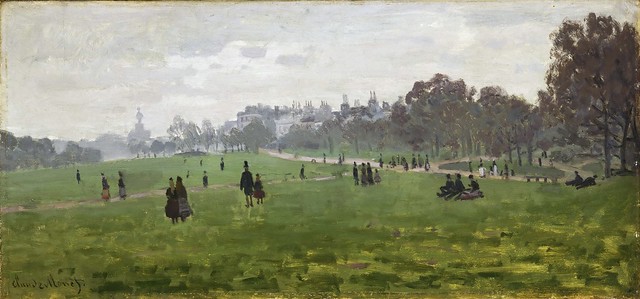
Green Park, London by Monet, 1870 - 71

Who are those Victorians out for a stroll around 1870–71 in Monet’s painting Green Park, London? Reduced to daubed stick figures, holding hands or sitting on the grass, fuzzy in the city light, they might be you or me. We moderns will never really outgrow the first artists who showed us our reflection.

Inventing Impressionism is on at the National Gallery, London, from 4 March-31st May


Renoir's 1910 portrait of art dealer Paul Durand-Ruel

Paul Durand-Ruel: the 'madman' who saved Impressionism
A new exhibition at the National Gallery tells the extraordinary story of the Parisian art dealer who saved Monet, Renoir and others from oblivion

Lucy Davies
28 Feb 2015

In 1868, two years before he met Paul Durand-Ruel, Claude Monet was so broke that he tried to commit suicide by throwing himself into the Seine. He and his painter friends – Renoir, Sisley, Pissarro and Manet – had been slogging away, poverty stricken and disillusioned, for many years by then; the abstractions of colour and light they produced had so far met with nothing but ridicule from the Parisian cognoscenti.

Durand-Ruel was different, though. He had been introduced to art when his father chose to supplement the income from their art supplies shop on the rue Saint-Jacques in Paris by exchanging, selling and loaning paintings. The less popular, more experimental works were hung on the young Paul’s bedroom wall – and had a profound effect on him. By the time he met Monet in London, where both men had taken refuge from the Franco-Prussian War, Durand-Ruel was ready to ignore everything he had heard about this degenerate upstart, and bought several of his works on the spot.

It was a transaction that changed both Monet’s life and his own. Within days, Monet’s friend Pissarro (also in London at that time) had turned up at Durand-Ruel’s temporary premises on New Bond Street and left one of his canvases for inspection. Durand-Ruel wrote to Pissarro immediately: “The painting you have brought me is charming and I am sorry I was not at the gallery to compliment you myself. Please tell me how much you would like for it, and please be so kind as to send me others as soon as you are able to. I must try to sell many of them for you here.”

Such was the excitement this new dealer generated that as soon as all three men were back in Paris in 1871, Monet and Pissaro took their friends to see Durand-Ruel. They were not yet identified as a group or a movement, simply a rabble of artists united in their rejection of (and by) the official salon. Nevertheless, Durand-Ruel noted a common new vitality in their work and over the next year began purchasing works by Degas, Manet (including an incredible 23 works on a single day), Sisley, Cassatt and Renoir. Each time he paid the artist’s asking price. They were flabbergasted.

'Fruit Tarts' by Monet (1882)

The relationship that developed between the Impressionists, as they would later become known, and the dealer who championed their cause is the subject of a show at the National Gallery opening next week.

The collection of works on display – all of which passed through Durand-Ruel’s hands – includes some of the best-loved pieces of the movement. It amounts to a spectacular tribute to the man who dedicated his entire life to supporting and defending the Impressionists long before their talent was recognised. “We would have died of hunger without him, all we Impressionists,” said Monet. “We owe him everything.”

Durand-Ruel didn’t intend to become an art dealer. As a young boy, he dreamt of being a missionary or a soldier, but when his father’s health failed he took over the family business. A visitor to his gallery would later describe his demeanour as “much irony; few words, no long sentences. On the other hand, there is every mark of uncommon obstinacy, of an unyielding yet nonviolent will that is imposed with a smile.”

His wife died in 1871 when she was pregnant with their sixth child. He never remarried, devoting himself to his fold of artists, to whom he increasingly acted as a father figure. As well as coordinating their careers and inflating the prices of their works by paying way beyond market value, he also paid their doctor’s fees, their tailor’s bills and even their rent, thus ensuring that they could continue to paint.

When they were downhearted, he encouraged them. In 1882, Monet wrote to him from Pourville on the Normandy coast, where he had spent the summer painting wind-whipped clifftops and beaches: “You will find I am lacking in courage… I am going mad and have taken against my canvases: a large painting of flowers I had just finished; I destroyed it, along with three or four other canvases that I punctured and scratched. It is absurd, I realise that.”

Durand-Ruel replied that same afternoon: “I am sending the 1,500 francs you asked for. I would also like to be able to send you some courage to overcome the many difficulties you are facing… The challenges you are undergoing will be useful to you. It is adversity that gives rise to the best lessons; do not believe you have learnt nothing in your struggle.”

The Bridge at Villeneuve-la-Garenne by Alfred Sisley (1872)

Of course, Durand-Ruel was speaking from experience. The battle to keep his business afloat and weather the criticism levelled at his judgment was severe. As soon as he began exhibiting the Impressionists, his name was irretrievably linked with theirs, and the whole of Paris mounted a campaign against him.

“Attacked and reviled by upholders of the academy and old doctrines, by the most established art critics, by the entire press and by most of my colleagues, [my artists] were beginning to become the laughing stock of the salons and the public,” he later recalled. “Myself, guilty of having exhibited and daring to champion such works, I was treated as a madman… Little by little, the trust I had succeeded in inspiring disappeared and my best clients began to question me. ‘How can you?’ they would say.”

He was forced to sell every painting from his stock of earlier works to stay above water, those beautiful (and by then highly fashionable) works by Delacroix, Corot, Courbet and Millet, with which he and his father had made their reputation. Things were so bad that he had to use a broker, as even having his name attached to a sale scared away buyers. When he tried to borrow money against the works he had left, those by Monet and co, the bank would only advance against the value of the frames.

But even as he was warding off bankruptcy, he was forging new and inventive ways of creating a market for his artists. His eye was good, his understanding of value unrivalled and his daring never wavered. He was the first to give his artists solo shows, the first to exhibit work in his own home and the first to request he represent his artists exclusively, although he never asked them to sign a contract.

Claude Monet (right) and others at his famous water lily pond in Giverny (1900)

Such goodwill was reciprocated. In 1884, when Durand-Ruel was in difficulties with his creditors again, Renoir wrote: “If you need me, please consider me entirely at your disposal, whatever may occur. I will always be loyal to you… If you are obliged to make a sacrifice when it comes to the paintings, regret nothing. I will paint other, better ones for you.”

Salvation finally came from thousands of miles away. In 1885 Durand-Ruel was invited to exhibit in New York by James Sutton, the director of the American Art Association. Encouraged by the growing American footfall in his Paris gallery, Durand-Ruel agreed, and packed up around 300 works to take with him across the Atlantic.

He was already something of a folk hero on American soil for his championing of the Barbizon school of realist painters a generation earlier. “People came without the least prejudice to study the works of my new friends,” he wrote in his memoir. Press coverage was so encouraging, and word of mouth so strident, that the exhibition had its run extended and was moved to larger premises. Within weeks he had sold almost every painting.

Unsurprisingly, Paris took note, and by 1894 Durand-Ruel was able to pay off all his creditors. Paintings sold 25 years earlier for a mere 50 francs, he noted, now fetched nearer 50,000, and his artists were able to live in comfort at last. “To think that, had I passed away at 60, I would have died debt-ridden and bankrupt, surrounded by a wealth of underrated treasures,” Durand-Ruel reflected, late in his life. “At last the Impressionist masters triumphed. My madness had been wisdom.”

Inventing Impressionism is at the National Gallery from March 4 until May 31.

http://www.telegraph.co.uk/culture/art/11440434/Paul-Durand-Ruel-the-madman-who-saved-Impressionism.html

http://www.nationalgallery.org.uk/whats-on/exhibitions/inventing-