Wednesday, 18 February 2015

Picasso's Weeping Woman at The Laing Art Gallery, Newcastle

Picasso masterpiece Weeping Woman heads for Newcastle's Laing Art Gallery
Pride of place at a new Laing Art Gallery exhibition will go to a celebrated and valuable Picasso painting on loan from the Tate

David Whetstone
14 February 2015

A priceless Picasso painting will have pride of place in the next big exhibition a tNewcastle’s Laing Art Gallery.

The striking painting, Weeping Woman, is one of several done by the great Spanish artist in protest at the bombing of the Basque town of Guernica in 1937 during the Spanish Civil War.

Picasso first expressed his outrage in a huge anti-war mural, called simply Guernica, which shows the devastating effect of the attack on civilians by German and Italian bombers in support of the Spanish nationalists led by General Franco.

Sarah Richardson, keeper of art at the Laing, said: “The big Guernica picture is in Madrid and is not allowed to travel because it got pretty knocked about in the years after the Spanish Civil War.

“But this is one of the Guernica paintings that Picasso did after completing the mural.

“I think it’s a great work. Weeping Woman shows Picasso’s mistress, Dora Maar, in this very fragmented way to show the agony of the people of Guernica.

“In her weeping eyes you can see the outline of the bombers.”

The 1937 painting by Pablo Picasso, a Spaniard, will be the highlight of the exhibition Conscience and Conflict: British Artists and the Spanish Civil War, depicting the response of artists in this country to the conflict and looking at their connection with their European counterparts.

The exhibition will feature work by British artists including Wyndham Lewis, Edward Burra and Julian Trevelyan but the angry Picasso portrait is expected to be the big draw to the latest of the Laing exhibitions for which an admission fee will be charged.

“We don’t have a Picasso in the (Laing) collection and I can’t remember us showing a painting by Picasso while I’ve been here,” said Sarah Richardson.

“It’s not something you get the opportunity to do very often. You really have to go to London or Edinburgh to have easy access to his work.”

As well as Weeping Woman, the exhibition will feature two Picasso etchings, The Dream and Lie of Franco I and II, which scream the artist’s outrage at the Guernica atrocity while lampooning Franco for his delusions of grandeur.

The etchings, usually on display in Edinburgh, belong in the collection of the late Roland Penrose, a British artist who in 1938 brought the fragile Guernica mural to Britain to raise money to support the republican cause in Spain.

Weeping Woman has been in the collection of the Tate in London since 1987 when it was given to the Government in lieu of tax, with an additional part of the purchase price raised from organisations including the National Heritage Memorial Fund, The Art Fund and the Friends of the Tate.

It has to be called priceless because it is not up for sale but two years ago a Picasso painting, Le RĂªve, changed hands in a private deal for £102m.

The Laing Art Gallery, which enjoys the status of a designated collection, is covered by a Government indemnity scheme when exhibiting valuable works of art.

Conscience and Conflict: British Artists and the Spanish Civil War will run at the Laing from March 7 to June 7 2015.

http://www.chroniclelive.co.uk/whats-on/arts-culture-news/picasso-masterpiece-weeping-woman-heads-8646119

Tuesday, 17 February 2015

Clive James - Poetry Notebook 2006 - 2014 review


Poetry Notebook 2006-2014 review – Clive James’s absorbing thoughts on verse
The great critic champions the poems that have given him most pleasure in this provocative collection of essays

Kate Kellaway
Sunday 15 February 2015

Clive James is never po-faced about poetry. He writes with the buoyant, aphoristic panache that made his career and with a judgment refined by a lifetime of reading and thinking about poetry – and writing it (he has a new collection coming out this April). This sympathetic, absorbing and provocative book is a miscellany – most of its articles written for Chicago’s Poetry magazine. But there are unifying thoughts. One is that “poetry” is not what excites him – too baggy a word and covering a multitude of sins – it is the particular poem that matters, the hardest thing to write. He argues that we are living in a time when “almost everyone writes poetry but scarcely anyone can write a poem”. He is on the side of clarity (he hopes it is “forgivable to favour those poets who show signs of knowing what they are saying”) while noting how complicated simplicity can be.

His spreading of the word is a delight. You need a second poetry notebook, as you read, in which to write down the names of unfamiliar poets and poems. This is, in its way, his literary will and testament – he makes no secret of the leukaemia that afflicts him. And he has such a discerning ear and eye that what I long for now is an inventory of every poem that has mattered to him – the one thing missing here. Or, better, a Jamesian anthology (he is pro-anthologies). He makes a splendid case for Australian poet Stephen Edgar and his poem Man on the Moon. And I was grateful to be led towards Robert Frost’s miraculous The Silken Tent, which I had somehow missed. And thanks to him, I now intend to read John Updike’s last collection, Endpoint. I found myself noting down some of James’s phrases, too, complete with Wildean flourishes: “Unless you can get beyond yourself, you were never there.” “Real talent can survive anything, even encouragement.” “Verve travels.”
He writes with verve about Keats, Hopkins, Louis MacNeice, Michael Donaghy, Les Murray. He also explains why Milton and Pound leave him cold. He rummages through Pound’sThe Cantos like a customs official, deciding ultimately, and mainly persuasively, that he is guilty of having nothing to declare. One notices, with regret, that he says almost nothing about Robert Lowell, save for a couple of underwhelmed asides. I was sorry, too, that his fond praise of Michael Longley bordered on condescension. I’d also have liked more about Browning, master of rhyme.


But the notebook is full of surprises, including a marvellously entertaining tribute to the late Australian poet Peter Porter (for many years the poetry reviewer on this paper). He insists Porter did not know how attractive he was to women: “I knew plenty of women who complained that they would have very much liked to kiss him but he wouldn’t stop telling them about Scarlatti,” he reports.

I also enjoyed his brilliant essay “Product placement in modern poetry”, about the way poets, starting in the early 20th century with EE Cummings, used brand names. He observes that Seamus Heaney will tell you “everything about a plough, except the name of its manufacture”, that TS Eliot was pleased to mention ABC restaurants by name, while Betjeman “unblushingly said who made everything”.

This book works like a zoom lens. James does not stop at individual poems. He homes in on the lines that have given him keenest pleasure: “…we could all give examples, from our memories, of how a poetic moment can put the poem it comes from in the shade”. More than once, he quotes the final lines from Larkin’s The Whitsun Weddings: “We slowed again,/And as the tightened brakes took hold, there swelled/A sense of falling, like an arrow-shower/Sent out of sight, somewhere becoming rain.” And the last three words transport us elsewhere – the reader translated with the rain. It perfectly exemplifies what the best poems do.

Monday, 16 February 2015

Bob Dylan interviewed by Paul Robbins 1965

The Paul J. Robbins interview with with Bob Dylan - Santa Monica California, March, 1965
Originally appeared as a two=part interview in the Los Angeles Free Press, Sepember 17 and 24, 1965

Robbins: I don't know whether to do an serious interview or carry on in that absurdist way we talked last night.

Dylan: It'll be the same thing anyway, man.

Robbins: Yeah, Okay ... If you are a poet and write words arranged in some sort of rhythm, why do you switch at some point and write lyrics in a song so that you're singing the words as part of a Gestalt presence?

Dylan: Well, I can't define that word poetry, I wouldn't even attempt it. At one time I thought that Robert Frost was poetry, other times I thought that Allen Ginsberg was poetry, sometimes I thought Francois Villon was poetry -- but poetry isn't really confined to the printed page. Hey, then again, I don't believe in saying "Look at that girl walking! Isn't that poetry?" I'm not going to get insane about it. The lyrics to the songs ... just so happens that it might be a little stranger than in most songs. I find it easy to write songs. I been writing songs for a long time and the words to the songs aren't written out just for the paper; they're written as you can read it, you dig. If you take whatever there is to the song away -- the beat, the melody -- I could still recite it. I see nothing wrong with songs you can't do that with either -- songs that, if you took the beat and the melody away, they wouldn't stand up Because they're not supposed to do that, you know. Songs are songs ... I don't believe in expecting too much out of any one thing.

Robbins: Whatever happened to Blind Boy Grunt?

Dylan: I was doing that four years ago. Now there's a lot of people writing songs on protest subjects. But it's taken some kind of a weird step. Hey, I'd rather listen to Jimmy Reed or Howlin' Wolf, man, or the Beatles, or Francois Hardy, than I would listen to any protest song singers -- although I haven't heard all the protest song singers there are. But the ones I've heard -- there's this very emptiness which is like a song written "Let's hold hands and everything will be grand". I see no more to it than that. Just because someone mentions the word "bomb", I'm not going to go "Aalee!" and start clapping.

Robbins: Is it that they just don't work any more?

Dylan: It's not that it don't work, it's that there are a lot of people afraid of the bomb, right. But there are a lot of other people who're afraid to be seen carrying a MODERN SCREEN magazine down the street, you know. Lot of people afraid to admit that they like Marlon Brando movies... Hey, it's not that they don't work anymore but have you ever thought of a place where they DO work? What exactly DOES work?

Robbins: They give a groovy feeling to the people who sing them, I guess that's about it. But what does work is the attitude, not the song. And there's just another attitude called for.

Dylan: Yeah, but you have to be very hip to the fact about that attitude -- you have to be hip to communication. Sure, you can make all sorts of protest songs and put them on a Folkways record. But who hears them? The people that do hear them are going to be agreeing with you anyway. You aren't going to get somebody to hear it who doesn't dig it. People don't listen to things they don't dig. If you can find a cat that can actually say "Okay, I'm a changed man because I heard this one thing -- or I just saw this one thing ...". Hey it don't necessarily happen that way all the time. It happens with a collage of experience which somebody can actually know by instinct what's right and wrong for him to do. Where he doesn't actually have to feel guilty about anything. A lot of people can act out of guilt. They act because they think somebody's looking at *them*. No matter what it is. There's people who do anything because of guilt ...

Robbins: And you don't want to be guilty?

Dylan: It's not that I'm NOT guilty. I'm not any more guilty than you are. Like, I don't consider any elder generation guilty. I mean, they're having these trials at Nuremberg, right? Look at that and you can place it out. Cats say "I had to kill all those people or else they'd kill me" Now, who's to try them for that? Who are these judges that have got the right to try a cat? How do you know they wouldn't do the same thing?

Robbins: This may be a side trip, but this thing about the Statute of Limitations running out and everybody wants to extend it? You remember, in AMIMAL FARM, what they wrote on the wall? "All animals are equal." But later they added "... but some are more equal than others." It's the same thing in reverse. That some are less equal than others. Like nazis are *really* criminals, so let's *really* get them; change any law just to nail them all.

Dylan: Yeah, all that shit runs in the same category. Nobody digs revenge, right? But you have these cats from Israel who, after TWENTY years, are still trying to catch these cats, who're OLD cats, man, who have escaped. God knows they aren't going to go anywhere, they're not going to do anything. And you have these cats from Israel running around catching them. Spending twenty years out of their lives. You take that job away from them and they're no more or less than a baker. He's got his whole life tied up in one thing. It's a one-thought thing, without anything between: "That's what it is, and I'm going to get it". Anything between gets wiped all away. I can't make that, but I can't really put it down. Hey: I can't put ANYTHING down, because I don't have to be around any of it. I don't have to put people down which I don't like, because I don't have to be around any of those people. Of course there is the giant great contradiction of What Do You Do. Hey, I don't know what you do, but all I can do is cast aside all the things NOT to do. I don't know where it's at once in a while, all I know is where it's NOT at. And as long as I know that, I don't really have to know, myself, where's it at. Everybody knows where it's at once in a while, but nobody can walk around all the time in a complete Utopia. Dig poetry. You were asking about poetry? Man, poetry is just bullshit, you know? I don't know about other countries, but in this one it's a total massacre. It's not poetry at all. People don't read poetry in this country -- if they do, it offends them; they don't dig it. You go to school, man, and what kind of poetry do you read? You read Robert Frost's "The Two Roads", you read T.S. Eliot -- you read all that bullshit and that's just bad, man, It's not good. It's not anything hard, it's just soft-boiled egg shit. And then, on top of it, they throw Shakespeare at some kid who can't read Shakespeare in high school, right? Who digs reading, HAMLET, man? All they give you is IVANHOE, SILAS MARINER, TALE OF TWO CITIES -- and they keep you away from things which you should do. You shouldn't even be there in school. You should find out from people. Dig! That's where it all starts. In the beginning -- like from 13 to 19 -- that's where all the corruption is. These people all just overlook it, right? There's more V.D. in people 13 to 19 than there is in any other group, but they ain't ever going to say so. They're never going to go into the schools and give shots. But that's where it's at. It's all a hype, man.

Robbins: Relating all this: if you put it in lyrics instead of poetry, you have a higher chance of hitting the people who have to be hit?

Dylan: I do, but I don't expect anything from it, you dig? All I can do is be me -- whoever that is -- for those people that I do play to, and not come on with them, tell them I'm something I'm not. I'm not going to tell them I'm the Great Cause Fighter or the Great Lover or the Great Boy Genius or whatever. Because I'm not, man. Why mislead them? That's all just Madison Avenue selling me, but it's not really selling ME, 'cause I was hip to it before I got there.

Robbins: Which brings up another thing. All the folk magazines and many folk people are down on you. Do they put you down because you changed or...

Dylan: It's that I'm successful and they want to be successful, man. It's jealousy. Hey, anybody, with any kind of knowledge at all would know by instinct what's happening here. Somebody who doesn't know that, is still hung up with success and failure and good and bad ... maybe he doesn't have a chick all the time ... stuff like that. But I can't use comments, man. I don't take nothing like that seriously. If somebody praises me and say "How groovy you are!", it doesn't mean nothing to me, because I can usually sense where that person's at. And it's no compliment if someone who's a total freak comes up and says "How groovy you are!" And it's the same if they don't dig me. Other kinds of people don't HAVE to say anything because, when you come down to it, it's all what's happening in the moment which counts. Who *cares* about tomorrow and yesterday? People don't live there, they live now.

Robbins: I have a theory, which I've been picking up and shaking out every so often. When I spoke with the Byrds, they were saying the same thing as I am saying -- a lot of people are saying -- you're talking it. It's why we have new so-called rock & roll sound emerging, it's a synthesis of all things a ...

Dylan: It's further than that, man. people know nowadays more than before. They've had so much to look at by now and know the bullshit of everything. People now don't even care about going to jail. So what? You're still with yourself as much as if you're out on the streets. There's still those who don't care about anything, but I got to think that anybody who doesn't hurt anybody, you can't put that person down, you dig, if that person's happy doing that.

Robbins: But what if they freeze themselves into apathy? What if they don't care about anything at all anymore?

Dylan: Whose problem is that? Your problem or theirs? No, it's not that, it's that nobody can learn by somebody else showing them or teaching them. People got to learn by themselves, going through something which relates. Sure, you say how do you make somebody know something ... people know it by themselves; they can go through some kind of scene with other people and themselves which somehow will come out somewhere and it's grind into them and be them. And all that just comes out of them somehow when they're faced up to the next thing.

Robbins: It's like taking in until the times comes to put out, right. But people who don't care don't put anything out. It's a whole frozen thing where nothing's happening anywhere; it's just like the maintenance of status quo, of existing circumstances, whatever they are ...

Dylan: People who don't care? Are you talking about gas station attendants or a Zen doctor, man? Hey, there's a lot of people who don't care; a lot don't care for different reasons. A lot care about some things and not about others, and some who don't care about anything -- it's just up to me not to let them bring me down and not to bring them down. It's like the whole world has a little thing: it's being taught that when you get up in the morning, you have to go out and bring somebody down. You walk down the street and, unless you've brought somebody down, don't come home today, right? It's a circus world.

Robbins: So who is it that you write and sing for?

Dylan: Not writing and singing for anybody, to tell you the truth. Hey, really, I don't care what people say. I don't care what they make me seem to be or what they tell other people I am. If I did care about that, I'd tell you; I really have no concern with it. I don't even come in contact with these people. Hey, I dig people, though. But if somebody's going to come up to me and ask me some questions which have been on his mind for such a long time, all I can think of is "Wow, man, what else can be in that person's head besides me? Am I that important, man, to be in a person's head for such a long time he's got to know this answer?" I mean, can that really straighten him out -- if I tell him something? Hey, come on ...

Robbins: A local disc jockey, Les Claypool, went through a whole thing on you one night, just couldn't get out of it. For maybe 45 minutes, he'd play a side of yours and then an ethnic side in which it was demonstrated that both melodies were the same. After each pair he'd say, "Well, you see what's happening ... This kid is taking other people's melodies; he's not all that original. Not only that", he'd say, "but his songs are totally depressing and have no hope".

Dylan: Who's Les Claypool?

Robbins: A folk jockey out here who has a long talk show on Saturday nights and an hour one each night, during which he plays highly ethnic sides?

Dylan: He played THOSE songs? He didn't play something hopeful?

Robbins: No, he was loading it to make his point. Anyway, it brings up an expected question: why do you use melodies that are already written?

Dylan: I used to do that when I was more or less in folk. I knew the melodies; they were already there. I did it because I liked the melodies. I did it when I really wasn't that popular and the songs weren't reaching that many people, and everybody around dug it. Man. I never introduced a song, "Here's the song I've stole the melody from, someplace". For me it wasn't that important; still isn't that important. I don't care about the melodies, man, the melodies are all traditional anyway. And if anybody wants to pick that out and say "That's Bob Dylan", that's their thing, not mine. I mean if they want to think that. Anybody with any sense at all, man, he says that I haven't any hope ... Hey, I got FAITH. I know that there are people who're going to know that's total bullshit. I know the cat is just up tight. He hasn't really gotten into a good day and he has to pick on something. Groovy. He has to pick on me? Hey, if he can't pick on me, he picks on someone else, it don't matter. He doesn't step on me, 'cause I don't care. He's not coming up to me on the street and stepping on my head, man. Hey, I've only done that with very few of my songs, anyway. And then when I don't do it, everybody says they're rock & roll melodies. You can't satisfy the people -- you just can't. You got to know, man; they just don't care about it.

Robbins: Why is rock & roll coming in and folk music going out?

Dylan: Folk music destroyed itself. Nobody destroyed it. Folk music is still here, if you want to dig it. It's not that it's going in or out. It's all the soft mellow shit, man, that's just being replaced by something that people know there is now. Hey, you must've heard rock & roll long before the Beatles, you must've discarded rock & roll around 1960. I did that in 1957. I couldn't make it as a rock & roll singer then. There were too many groups. I used to play piano. I made some records, too.

Robbins: Okay, you got a lot of bread now. And your way of life isn't like it was four or five years ago. It's much grander. Does that kind of thing tend to throw you off?

Dylan: Well, the transition never came from working at it. I left where I'm from because there's nothing there. I come from Minnesota, there was nothing there. I'm not going to fake it and say I went out to see the world. Hey, when I left there, man, I knew one thing: I had to get out of there and not come back. Just from my senses I knew there was something more than Walt Disney movies. I was never turned on or off by money. I never considered the fact of money as really that important. I could always play the guitar, you dig, and make friends -- or fake friends. A lot of other people do other things and get to eat and sleep that way. Lot of people do a lot of things just to get around. You can find cats who get very scarred, right? Who get married and settle down. But, after somebody's got something and sees it all around him, so he doesn't have to sleep out in the cold at night, that's all. The only thing is he don't die. But is he happy? There's nowhere to go. Okay, so I get the money, right? First of all, I had to move out of New York. Because everybody was coming down to see me -- people which I didn't really dig. People coming in from weird-ass places. And I would think, for some reason, that I had to give them someplace to stay and all that. I found myself not really being by myself but just staying out of things I wanted to go to because people I knew would go there.

Robbins: Do you find friends -- real friends -- are they recognizable anymore?

Dylan: Oh, sure, man, I can tell somebody I dig right away. I don't have to go through anything with anybody. I'm just lucky that way.

Robbins: Back to protest songs. The IWW's work is over now and the unions are pretty well established. What about the civil rights movement?

Dylan: Well, it's okay. It's proper. It's not "Commie" anymore. Harper's Bazaar can feature it, you can find it on the cover of Life. But when you get beneath it, like anything, you find there's bullshit tied up in it. The Negro Civil Rights Movement is proper now, but there's more to it than what's in Harper's Bazaar. There's more to it than picketing in Selma, right? There's people living in utter poverty in New York. And then again, you have this big Right to Vote. Which is groovy. You want all these Negroes to vote? Okay, I can't go over the boat and shout "Hallelujah" only because the want to vote. Who're they going to vote for? Just politicians; same as the white people put in their politicians. Anybody that gets into politics is a little greaky anyway. Hey, they're just going to vote, that's all they're going to do. I hate to say it like that, make it sound hard, but it's going to boil down to that.

Robbins: What about the drive for education?

Dylan: Education? They're going to school and learn about all the things the white private schools teach. The catechism, the whole thing. What're they going to learn? What's this education? Hey, the cat's much better off never going to school. The only thing against him is he can't be a doctor or a judge. Or he can't get a good job with the salesman's company. But that's the only thing wrong. If you want to say it's good that he gets an education and goes out and gets a job like that, groovy. I'm not going to do it.

Robbins: In other words, the formal intake of factual knowledge ...

Dylan: Hey, I have no respect for factual knowledge, man. I don't care what anybody knows, I don't care if somebody's a walking encyclopedia. Does that make him nice to talk to? Who cares if Washington was even the first president of the United States? You think anybody has actually ever been helped with this kind of knowledge?

Robbins: Maybe through a test. Well, what's the answer?

Dylan: There aren't any answers, man. Or any questions. You must read my book ... there's a little part in there about that. it evolves into a thing where it mentions words like "Answer". I couldn't possibly rattle off the words for these, because you'd have to read the whole book to see these specific words or Question and Answer. We'll have another interview after you read the book.

Robbins: Yeah, you have a book coming out. What about it? The title?

Dylan: Tentatively, "Bob Dylan Off the Record". But they tell me there's already books out with that "off the record" title. The book can't really be titled, that's the kind of book it is. I'm also going to write the reviews for it.

Robbins: Why write a book instead of lyrics?

Dylan: I've written some songs which are kind of far out, a long continuation of verses, stuff like that -- but I haven't really gotten into writing a completely free song. Hey, you dig something like cut-ups? I mean, like William Burroughs?

Robbins: Yeah, there's a cat in Paris who published a book with no pagination. The book comes in a box and you throw it in the air and, however it lands, you read it like that.

Dylan: Yeah, that's where it's at. Because that's what it means, anyway. Okay, I wrote the book because there's a lot of stuff in there I can't possibly sing ... all the collages. I can't sing it because it gets too long or it goes too far out. I can only do it around a few people who would know. Because the majority of the audience -- I don't care where they're from, how hip they are -- I think it would just get totally lost. Something that had no rhyme, all cut up, no nothing, except something happening, which is words.

Robbins: You wrote the book to say something?

Dylan: Yeah, but certainly not any kind of profound statement. The book don't begin or end.

Robbins: But you had something to say. And you wanted to say it to somebody.

Dylan: Yeah, I said it to myself. Only, I'm lucky, because I could put it into a book. Now somebody else is going to be allowed to see what I said to myself.

Robbins: You have four albums out now, with a fifth any day. Are these albums sequential in the way that you composed and sung them?

Dylan: Yeah, I've got about two or three albums that I've never recorded, which are lost songs. They're old songs; I'll never record them. Some very groovy songs. Some old songs which I've written and sung maybe once in a concert and nobody else ever heard them. There are a lot of songs which would fill in between the records. It was growing from the first record to the second, then a head change on the third. And the fourth. The fifth I can't even tell you about.

Robbins: So if I started with Album One, Side One, Band One, I could truthfully watch Bob Dylan grow?

Dylan: No, you could watch Bob Dylan laughing to himself. Or you could see Bob Dylan going through changes. That's really the most.

Robbins: What do you think of the Byrds? Do you think they're doing something different?

Dylan: Yeah, they could. They're doing something really new now. It's like a danceable Bach sound. Like "Bells of Rhymney". They're cutting across all kinds of barriers which most people who sing aren't even hip to. They know it all. If they don't close their minds, they'll come up with something pretty fantastic.

Thursday, 12 February 2015

Last night's set lists

At The Habit, York: -

Ron Elderly: -
The Way You Look Tonight
Autumn Leaves
Sweet Virginia
Make You Feel My Love

Da Elderly: -
I Am A Pilgrim
In The Morning Light
Human Highway
Harvest Moon

The Elderly Brothers: -
The Price Of Love
Crying In The Rain
So Sad (To Watch Good Love Go Bad)
I Saw Here Standing There
Walk Right Back

Another enjoyable night at The Habit open mic with plenty of punters and players; so many players in the end that some had to play unplugged afterwards. There were more Bob and Neil covers on show as well as some welcome Bowie (Space Oddity and The Jean Genie). The Elderlys closed the show and included I Saw Here Standing There as a tribute to the recording of The Beatles' first LP on this day in 1963. Three guys who came too late to make the show treated us to some Hot Club of Paris-style tunes, wielding authentic gypsy-guitars and an upright bass - magic!! 

LATE NEWS: due to a cancellation, The Elderly Brothers will be performing at The Habit on Saturday night (14 Feb).

Monday, 9 February 2015

Bob Dylan MusiCares Speech 2015

Transcript of Bob Dylan's MusiCares Person of Year speech
Randall Roberts
7 February 2015

Bob Dylan was honored by MusiCares, the charity organization that aids musicians in need, at the Los Angeles Convention Center on Friday night. After performances by artists including Tom Jones, Sheryl Crow, Neil Young, Beck, Jackson Browne and others, Dylan himself took a rare opportunity in the spotlight to deliver a 30-plus-minute acceptance speech.

Expansive, funny and insightful, Dylan didn't pull any punches, calling out songwriters who had criticized his work while indicting Nashville and commercial country music.

He was introduced by former President Jimmy Carter, and walked out to a standing ovation. After thanking the organizers, Dylan referred to his notes and began by saying, "I'm going to read some of this."

Because of moments of applause, and some echoey acoustics, a few of Dylan's words were inaudible on the recording I've consulted, and I've noted as such. Though it upsets him to hear it (see below), Dylan does sometimes mumble and slur his words.

Bob Dylan's MusiCares person of the year acceptance speech:

I'm glad for my songs to be honored like this. But you know, they didn't get here by themselves. It's been a long road and it's taken a lot of doing. These songs of mine, they're like mystery stories, the kind that Shakespeare saw when he was growing up. I think you could trace what I do back that far. They were on the fringes then, and I think they're on the fringes now. And they sound like they've been on the hard ground.

I should mention a few people along the way who brought this about. I know I should mention John Hammond, great talent scout for Columbia Records. He signed me to that label when I was nobody. It took a lot of faith to do that, and he took a lot of ridicule, but he was his own man and he was courageous. And for that, I'm eternally grateful. The last person he discovered before me was Aretha Franklin, and before that Count Basie, Billie Holiday and a whole lot of other artists. All noncommercial artists.

Trends did not interest John, and I was very noncommercial but he stayed with me. He believed in my talent and that's all that mattered. I can't thank him enough for that.

Lou Levy runs Leeds Music, and they published my earliest songs, but I didn't stay there too long. Levy himself, he went back a long ways. He signed me to that company and recorded my songs and I sang them into a tape recorder. He told me outright, there was no precedent for what I was doing, that I was either before my time or behind it. And if I brought him a song like "Stardust," he'd turn it down because it would be too late.

He told me that if I was before my time -- and he didn't really know that for sure -- but if it was happening and if it was true, the public would usually take three to five years to catch up -- so be prepared. And that did happen. The trouble was, when the public did catch up I was already three to five years beyond that, so it kind of complicated it. But he was encouraging, and he didn't judge me, and I'll always remember him for that.

Artie Mogull at Witmark Music signed me next to his company, and he told me to just keep writing songs no matter what, that I might be on to something. Well, he too stood behind me, and he could never wait to see what I'd give him next. I didn't even think of myself as a songwriter before then. I'll always be grateful for him also for that attitude.

I also have to mention some of the early artists who recorded my songs very, very early, without having to be asked. Just something they felt about them that was right for them. I've got to say thank you to Peter, Paul and Mary, who I knew all separately before they ever became a group. I didn't even think of myself as writing songs for others to sing but it was starting to happen and it couldn't have happened to, or with, a better group.

They took a song of mine that had been recorded before that was buried on one of my records and turned it into a hit song. Not the way I would have done it -- they straightened it out. But since then hundreds of people have recorded it and I don't think that would have happened if it wasn't for them. They definitely started something for me.

The Byrds, the Turtles, Sonny & Cher -- they made some of my songs Top 10 hits but I wasn't a pop songwriter and I really didn't want to be that, but it was good that it happened. Their versions of songs were like commercials, but I didn't really mind that because 50 years later my songs were being used in the commercials. So that was good too. I was glad it happened, and I was glad they'd done it.

Pervis Staples and the Staple Singers -- long before they were on Stax they were on Epic and they were one of my favorite groups of all time. I met them all in '62 or '63. They heard my songs live and Pervis wanted to record three or four of them and he did with the Staples Singers. They were the type of artists that I wanted recording my songs.

Nina Simone. I used to cross paths with her in New York City in the Village Gate nightclub. These were the artists I looked up to. She recorded some of my songs that she [inaudible] to me. She was an overwhelming artist, piano player and singer. Very strong woman, very outspoken. That she was recording my songs validated everything that I was about.

Oh, and can't forget Jimi Hendrix. I actually saw Jimi Hendrix perform when he was in a band called Jimmy James and the Blue Flames -- something like that. And Jimi didn't even sing. He was just the guitar player. He took some small songs of mine that nobody paid any attention to and pumped them up into the outer limits of the stratosphere and turned them all into classics. I have to thank Jimi, too. I wish he was here.

Johnny Cash recorded some of my songs early on, too, up in about '63, when he was all skin and bones. He traveled long, he traveled hard, but he was a hero of mine. I heard many of his songs growing up. I knew them better than I knew my own. "Big River," "I Walk the Line."

"How high's the water, Mama?" I wrote "It's Alright Ma (I'm Only Bleeding)" with that song reverberating inside my head. I still ask, "How high is the water, mama?" Johnny was an intense character. And he saw that people were putting me down playing electric music, and he posted letters to magazines scolding people, telling them to shut up and let him sing.

In Johnny Cash's world -- hardcore Southern drama -- that kind of thing didn't exist. Nobody told anybody what to sing or what not to sing. They just didn't do that kind of thing. I'm always going to thank him for that. Johnny Cash was a giant of a man, the man in black. And I'll always cherish the friendship we had until the day there is no more days.

Oh, and I'd be remiss if I didn't mention Joan Baez. She was the queen of folk music then and now. She took a liking to my songs and brought me with her to play concerts, where she had crowds of thousands of people enthralled with her beauty and voice.

People would say, "What are you doing with that ragtag scrubby little waif?" And she'd tell everybody in no uncertain terms, "Now you better be quiet and listen to the songs." We even played a few of them together. Joan Baez is as tough-minded as they come. Love. And she's a free, independent spirit. Nobody can tell her what to do if she doesn't want to do it. I learned a lot of things from her. A woman with devastating honesty. And for her kind of love and devotion, I could never pay that back.

These songs didn't come out of thin air. I didn't just make them up out of whole cloth. Contrary to what Lou Levy said, there was a precedent. It all came out of traditional music: traditional folk music, traditional rock 'n' roll and traditional big-band swing orchestra music.

I learned lyrics and how to write them from listening to folk songs. And I played them, and I met other people that played them back when nobody was doing it. Sang nothing but these folk songs, and they gave me the code for everything that's fair game, that everything belongs to everyone.

For three or four years all I listened to were folk standards. I went to sleep singing folk songs. I sang them everywhere, clubs, parties, bars, coffeehouses, fields, festivals. And I met other singers along the way who did the same thing and we just learned songs from each other. I could learn one song and sing it next in an hour if I'd heard it just once.

If you sang "John Henry" as many times as me -- "John Henry was a steel-driving man / Died with a hammer in his hand / John Henry said a man ain't nothin' but a man / Before I let that steam drill drive me down / I'll die with that hammer in my hand."

If you had sung that song as many times as I did, you'd have written "How many roads must a man walk down?" too.

Big Bill Broonzy had a song called "Key to the Highway." "I've got a key to the highway / I'm booked and I'm bound to go / Gonna leave here runnin' because walking is most too slow." I sang that a lot. If you sing that a lot, you just might write,

Georgia Sam he had a bloody nose

Welfare Department they wouldn’t give him no clothes

He asked poor Howard where can I go

Howard said there’s only one place I know

Sam said tell me quick man I got to run

Howard just pointed with his gun

And said that way down on Highway 61

You'd have written that too if you'd sang "Key to the Highway" as much as me.

"Ain't no use sit 'n cry / You'll be an angel by and by / Sail away, ladies, sail away." "I'm sailing away my own true love." "Boots of Spanish Leather" -- Sheryl Crow just sung that.

"Roll the cotton down, aw, yeah, roll the cotton down / Ten dollars a day is a white man's pay / A dollar a day is the black man's pay / Roll the cotton down." If you sang that song as many times as me, you'd be writing "I ain't gonna work on Maggie's farm no more," too.

I sang a lot of "come all you" songs. There's plenty of them. There's way too many to be counted. "Come along boys and listen to my tale / Tell you of my trouble on the old Chisholm Trail." Or, "Come all ye good people, listen while I tell / the fate of Floyd Collins a lad we all know well / The fate of Floyd Collins, a lad we all know well."

"Come all ye fair and tender ladies / Take warning how you court your men / They're like a star on a summer morning / They first appear and then they're gone again." "If you'll gather 'round, people / A story I will tell / 'Bout Pretty Boy Floyd, an outlaw / Oklahoma knew him well."

If you sung all these "come all ye" songs all the time, you'd be writing, "Come gather 'round people where ever you roam, admit that the waters around you have grown / Accept that soon you'll be drenched to the bone / If your time to you is worth saving / And you better start swimming or you'll sink like a stone / The times they are a-changing."

You'd have written them too. There's nothing secret about it. You just do it subliminally and unconsciously, because that's all enough, and that's all I sang. That was all that was dear to me. They were the only kinds of songs that made sense.

"When you go down to Deep Ellum keep your money in your socks / Women in Deep Ellum put you on the rocks." Sing that song for a while and you just might come up with, "When you're lost in the rain in Juarez and it's Easter time too / And your gravity fails and negativity don't pull you through / Don’t put on any airs / When you’re down on Rue Morgue Avenue / They got some hungry women there / And they really make a mess outta you."

All these songs are connected. Don't be fooled. I just opened up a different door in a different kind of way. It's just different, saying the same thing. I didn't think it was anything out of the ordinary.

Well you know, I just thought I was doing something natural, but right from the start, my songs were divisive for some reason. They divided people. I never knew why. Some got angered, others loved them. Didn't know why my songs had detractors and supporters. A strange environment to have to throw your songs into, but I did it anyway.

Last thing I thought of was who cared about what song I was writing. I was just writing them. I didn't think I was doing anything different. I thought I was just extending the line. Maybe a little bit unruly, but I was just elaborating on situations. Maybe hard to pin down, but so what? A lot of people are hard to pin down. You've just got to bear it. I didn't really care what Lieber and Stoller thought of my songs.

They didn't like 'em, but Doc Pomus did. That was all right that they didn't like 'em, because I never liked their songs either. "Yakety yak, don't talk back." "Charlie Brown is a clown," "Baby I'm a hog for you." Novelty songs. They weren't saying anything serious. Doc's songs, they were better. "This Magic Moment." "Lonely Avenue." Save the Last Dance for Me.

Those songs broke my heart. I figured I'd rather have his blessings any day than theirs.

Ahmet Ertegun didn't think much of my songs, but Sam Phillips did. Ahmet founded Atlantic Records. He produced some great records: Ray Charles, Ray Brown, just to name a few.

There were some great records in there, no question about it. But Sam Phillips, he recorded Elvis and Jerry Lee, Carl Perkins and Johnny Cash. Radical eyes that shook the very essence of humanity. Revolution in style and scope. Heavy shape and color. Radical to the bone. Songs that cut you to the bone. Renegades in all degrees, doing songs that would never decay, and still resound to this day. Oh, yeah, I'd rather have Sam Phillips' blessing any day.

Merle Haggard didn't even think much of my songs. I know he didn't. He didn't say that to me, but I know [inaudible]. Buck Owens did, and he recorded some of my early songs. Merle Haggard -- "Mama Tried," "The Bottle Let Me Down," "I'm a Lonesome Fugitive." I can't imagine Waylon Jennings singing "The Bottle Let Me Down."

"Together Again"? That's Buck Owens, and that trumps anything coming out of Bakersfield. Buck Owens and Merle Haggard? If you have to have somebody's blessing -- you figure it out.

Oh, yeah. Critics have been giving me a hard time since Day One. Critics say I can't sing. I croak. Sound like a frog. Why don't critics say that same thing about Tom Waits? Critics say my voice is shot. That I have no voice. What don't they say those things about Leonard Cohen? Why do I get special treatment? Critics say I can't carry a tune and I talk my way through a song. Really? I've never heard that said about Lou Reed. Why does he get to go scot-free?

What have I done to deserve this special attention? No vocal range? When's the last time you heard Dr. John? Why don't you say that about him? Slur my words, got no diction. Have you people ever listened to Charley Patton or Robert Johnson, Muddy Waters. Talk about slurred words and no diction. [Inaudible] doesn't even matter.

"Why me, Lord?" I would say that to myself.

Critics say I mangle my melodies, render my songs unrecognizable. Oh, really? Let me tell you something. I was at a boxing match a few years ago seeing Floyd Mayweather fight a Puerto Rican guy. And the Puerto Rican national anthem, somebody sang it and it was beautiful. It was heartfelt and it was moving.

After that it was time for our national anthem. And a very popular soul-singing sister was chosen to sing. She sang every note -- that exists, and some that don't exist. Talk about mangling a melody. You take a one-syllable word and make it last for 15 minutes? She was doing vocal gymnastics like she was on a trapeze act. But to me it was not funny.

Where were the critics? Mangling lyrics? Mangling a melody? Mangling a treasured song? No, I get the blame. But I don't really think I do that. I just think critics say I do.

Sam Cooke said this when told he had a beautiful voice: He said, "Well that's very kind of you, but voices ought not to be measured by how pretty they are. Instead they matter only if they convince you that they are telling the truth." Think about that the next time you [inaudible].

Times always change. They really do. And you have to always be ready for something that's coming along and you never expected it. Way back when, I was in Nashville making some records and I read this article, a Tom T. Hall interview. Tom T. Hall, he was bitching about some kind of new song, and he couldn't understand what these new kinds of songs that were coming in were about.

Now Tom, he was one of the most preeminent songwriters of the time in Nashville. A lot of people were recording his songs and he himself even did it. But he was all in a fuss about James Taylor, a song James had called "Country Road." Tom was going off in this interview -- "But James don't say nothing about a country road. He's just says how you can feel it on the country road. I don't understand that."

Now some might say Tom is a great songwriter. I'm not going to doubt that. At the time he was doing this interview I was actually listening to a song of his on the radio.

It was called "I Love." I was listening to it in a recording studio, and he was talking about all the things he loves, an everyman kind of song, trying to connect with people. Trying to make you think that he's just like you and you're just like him. We all love the same things, and we're all in this together. Tom loves little baby ducks, slow-moving trains and rain. He loves old pickup trucks and little country streams. Sleeping without dreams. Bourbon in a glass. Coffee in a cup. Tomatoes on the vine, and onions.

Now listen, I'm not ever going to disparage another songwriter. I'm not going to do that. I'm not saying it's a bad song. I'm just saying it might be a little overcooked. But, you know, it was in the top 10 anyway. Tom and a few other writers had the whole Nashville scene sewed up in a box. If you wanted to record a song and get it in the top 10 you had to go to them, and Tom was one of the top guys. They were all very comfortable, doing their thing.

This was about the time that Willie Nelson picked up and moved to Texas. About the same time. He's still in Texas. Everything was very copacetic. Everything was all right until -- until -- Kristofferson came to town. Oh, they ain't seen anybody like him. He came into town like a wildcat, flew his helicopter into Johnny Cash's backyard like a typical songwriter. And he went for the throat. "Sunday Morning Coming Down."

Well, I woke up Sunday morning

With no way to hold my head that didn't hurt.

And the beer I had for breakfast wasn't bad

So I had one more for dessert

Then I fumbled through my closet

Found my cleanest dirty shirt

Then I washed my face and combed my hair

And stumbled down the stairs to meet the day.

You can look at Nashville pre-Kris and post-Kris, because he changed everything. That one song ruined Tom T. Hall's poker parties. It might have sent him to the crazy house. God forbid he ever heard any of my songs.

You walk into the room

With your pencil in your hand

You see somebody naked

You say, “Who is that man?”

You try so hard

But you don’t understand

Just what you're gonna say

When you get home

You know something is happening here

But you don’t know what it is

Do you, Mister Jones?

If "Sunday Morning Coming Down" rattled Tom's cage, sent him into the looney bin, my song surely would have made him blow his brains out, right there in the minivan. Hopefully he didn't hear it.

I just released an album of standards, all the songs usually done by Michael Buble, Harry Connick Jr., maybe Brian Wilson's done a couple, Linda Ronstadt done 'em. But the reviews of their records are different than the reviews of my record.

In their reviews no one says anything. In my reviews, [inaudible] they've got to look under every stone when it comes to me. They've got to mention all the songwriters' names. Well that's OK with me. After all, they're great songwriters and these are standards. I've seen the reviews come in, and they'll mention all the songwriters in half the review, as if everybody knows them. Nobody's heard of them, not in this time, anyway. Buddy Kaye, Cy Coleman, Carolyn Leigh, to name a few.

But, you know, I'm glad they mention their names, and you know what? I'm glad they got their names in the press. It might have taken some time to do it, but they're finally there. I can only wonder why it took so long. My only regret is that they're not here to see it.

Traditional rock 'n' roll, we're talking about that. It's all about rhythm. Johnny Cash said it best: "Get rhythm. Get rhythm when you get the blues." Very few rock 'n' roll bands today play with rhythm. They don't know what it is. Rock 'n' roll is a combination of blues, and it's a strange thing made up of two parts. A lot of people don't know this, but the blues, which is an American music, is not what you think it is. It's a combination of Arabic violins and Strauss waltzes working it out. But it's true.

The other half of rock 'n' roll has got to be hillbilly. And that's a derogatory term, but it ought not to be. That's a term that includes the Delmore Bros., Stanley Bros., Roscoe Holcomb, Clarence Ashley ... groups like that. Moonshiners gone berserk. Fast cars on dirt roads. That's the kind of combination that makes up rock 'n' roll, and it can't be cooked up in a science laboratory or a studio.

You have to have the right kind of rhythm to play this kind of music. If you can't hardly play the blues, how do you [inaudible] those other two kinds of music in there? You can fake it, but you can't really do it.

Critics have made a career out of accusing me of having a career of confounding expectations. Really? Because that's all I do. That's how I think about it. Confounding expectations.

"What do you do for a living, man?"

"Oh, I confound expectations."

You're going to get a job, the man says, "What do you do?" "Oh, confound expectations.: And the man says, "Well, we already have that spot filled. Call us back. Or don't call us, we'll call you." Confounding expectations. What does that mean? 'Why me, Lord? I'd confound them, but I don't know how to do it.'

The Blackwood Bros. have been talking to me about making a record together. That might confound expectations, but it shouldn't. Of course it would be a gospel album. I don't think it would be anything out of the ordinary for me. Not a bit. One of the songs I'm thinking about singing is "Stand By Me" by the Blackwood Brothers. Not "Stand By Me" the pop song. No. The real "Stand By Me."

The real one goes like this:

When the storm of life is raging / Stand by me / When the storm of life is raging / Stand by me / When the world is tossing me / Like a ship upon the sea / Thou who rulest wind and water / Stand by me

In the midst of tribulation / Stand by me / In the midst of tribulation / Stand by me / When the hosts of hell assail / And my strength begins to fail / Thou who never lost a battle / Stand by me

In the midst of faults and failures / Stand by me / In the midst of faults and failures / Stand by me / When I do the best I can / And my friends don't understand / Thou who knowest all about me / Stand by me

That's the song. I like it better than the pop song. If I record one by that name, that's going to be the one. I'm also thinking of recording a song, not on that album, though: "Oh Lord, Please Don't Let Me Be Misunderstood."

Anyway, why me, Lord. What did I do?

Anyway, I'm proud to be here tonight for MusiCares. I'm honored to have all these artists singing my songs. There's nothing like that. Great artists. [applause, inaudible]. They're all singing the truth, and you can hear it in their voices.

I'm proud to be here tonight for MusiCares. I think a lot of this organization. They've helped many people. Many musicians who have contributed a lot to our culture. I'd like to personally thank them for what they did for a friend of mine, Billy Lee Riley. A friend of mine who they helped for six years when he was down and couldn't work. Billy was a son of rock 'n' roll, obviously.

He was a true original. He did it all: He played, he sang, he wrote. He would have been a bigger star but Jerry Lee came along. And you know what happens when someone like that comes along. You just don't stand a chance.

So Billy became what is known in the industry -- a condescending term, by the way -- as a one-hit wonder. But sometimes, just sometimes, once in a while, a one-hit wonder can make a more powerful impact than a recording star who's got 20 or 30 hits behind him. And Billy's hit song was called "Red Hot," and it was red hot. It could blast you out of your skull and make you feel happy about it. Change your life.

He did it with style and grace. You won't find him in the Rock and Roll Hall of Fame. He's not there. Metallica is. Abba is. Mamas and the Papas -- I know they're in there. Jefferson Airplane, Alice Cooper, Steely Dan -- I've got nothing against them. Soft rock, hard rock, psychedelic pop. I got nothing against any of that stuff, but after all, it is called the Rock and Roll Hall of Fame. Billy Lee Riley is not there. Yet.

I'd see him a couple times a year and we'd always spent time together and he was on a rockabilly festival nostalgia circuit, and we'd cross paths now and again. We'd always spend time together. He was a hero of mine. I'd heard "Red Hot." I must have been only 15 or 16 when I did and it's impressed me to this day.

I never grow tired of listening to it. Never got tired of watching Billy Lee perform, either. We spent time together just talking and playing into the night. He was a deep, truthful man. He wasn't bitter or nostalgic. He just accepted it. He knew where he had come from and he was content with who he was.

And then one day he got sick. And like my friend John Mellencamp would sing -- because John sang some truth today -- one day you get sick and you don't get better. That's from a song of his called "Life is Short Even on Its Longest Days." It's one of the better songs of the last few years, actually. I ain't lying.
/
And I ain't lying when I tell you that MusiCares paid for my friend's doctor bills, and helped him to get spending money. They were able to at least make his life comfortable, tolerable to the end. That is something that can't be repaid. Any organization that would do that would have to have my blessing.

I'm going to get out of here now. I'm going to put an egg in my shoe and beat it. I probably left out a lot of people and said too much about some. But that's OK. Like the spiritual song, 'I'm still just crossing over Jordan too.' Let's hope we meet again. Sometime. And we will, if, like Hank Williams said, "the good Lord willing and the creek don't rise."

http://www.latimes.com/entertainment/music/posts/la-et-ms-grammys-2015-transcript-of-bob-dylans-musicares-person-of-year-speech-20150207-story.html#page=1

Thursday, 5 February 2015

Last night's set lists

At The Habit, York: -

The Elderly Brothers: -
The Price Of Love
Walk Right Back
I've Got Dreams To Remember
Crying In The Rain
So Sad (To Watch Good Love Go Bad)

Da Elderly: -
Things We Said Today
Birds
You've Got A Friend

Ron Elderly: -
Autumn Leaves
Love is The Drug
Tell Me

We decided to change things around this week and do solo sets after The Elderly Brothers instead of before and debuted an Otis Redding song I've Got Dreams To Remember. A fairly busy night all told with a wide variety of players, style-wise. Plenty of Dylan and Neil Young including renditions of She Belongs To Me, Comes A Time and Old Man. Another enjoyable night.

Wednesday, 4 February 2015

John Singer Sargent at The National Portrait Gallery 2015


Le Verre de Porto (1884)

How John Singer Sargent made a scene

Often derided as staidly traditional, John Singer Sargent in fact provided a glimpse of the modern world. Ahead of a major new exhibition, Sarah Chuchwell surveys the sensational portraits that caught the imagination of painters and authors alike

Sarah Churchwell
Friday 30 January 2015

In 1893, Henry James wrote an essay praising his friend, the painter John Singer Sargent, in which he declared: “There is no greater work of art than a great portrait,” because of the empathetic vision it required. Sargent was remarkable, said James, for the “extraordinarily immediate” translation of his perception into a picture, “as if painting were pure tact of vision, a simple manner of feeling”. In particular, he admired Sargent’s “faculty of taking a fresh, direct, independent, unborrowed impression”. This admiration was widely shared: after seeing The Misses Hunter in 1902, Rodin called Sargent “the Van Dyck of our times”. But after Sargent’s death, his realism was viewed increasingly as anachronistic and facile, the work of a society painter, a careerist happy to pander to aristocratic privilege. One of the most successful and esteemed painters of his day was rapidly dismissed as virtuosic but lightweight, a slick craftsman rather than an innovative creator, superseded by Matisse and Picasso. He was a Gilded Age flatterer, “not an enthusiast,” sniffed Pissarro, “but rather an adroit performer”.

The Misses Hunter (1902)

The forthcoming exhibition at the National Portrait Gallery aims to end that assessment for good by crediting the texture and inventiveness of Sargent’s realism. It is not a full retrospective, focusing instead on Sargent’s interactions in artistic and intellectual circles, but it certainly makes the case for a show that would reveal all of Sargent’s range – not only the many magnificent portraits on display in this exhibition, but also his landscapes, watercolours, sketches and murals, as well as the extraordinary Gassed, the colossal late painting of soldiers blinded on the western front that anticipates “proletarian realism”.

Modernism – in the evolving forms of impressionism, fauvism, cubism –increasingly directed the energies of the art world during Sargent’s life, but while defiantly sticking to realism, Sargent redefined it by putting Van Dyck, VelĂ¡zquez, Reynolds and Gainsborough into dialogue with moderns including Manet and Monet, using visual echoes and quotations to create a new fusion of classic and modern technique (portraits painted, following Monet, en plein air and sur le motif) with contemporary subjects and perspectives. James understood this, praising Sargent’s portraiture for “the quality in light of which the artist sees deep into his subject, undergoes it, absorbs it, becomes patient with it, and almost reverent, and, in short, enlarges and humanises the technical problem” of creating a realistic portrait.
Lily, Lily, Rose by John Singer Sarhent, 1885-6. Photograph courtesy of Tate, London, 2015
Lily, Lily Rose (1885-6)

This notion of art as perfect empathy is also the novelist’s art; it is no coincidence that James and Sargent have so often been paired. They had much in common, not least as Americans raised across the European continent by affluent parents on a kind of permanent grand tour. Sargent was born in Florence in 1856, and spent his formative years travelling around France, Germany, Italy, Switzerland and Spain. This “Baedeker education” made Sargent multilingual, “civilised to his fingertips”, in James’s words. But their affinities ran much deeper than being well-travelled cosmopolitans who focused largely on high-society subjects. Both brought to an apparently conventional realism an experimental sensibility, exploring psychology, narrative and identity. Sargent is the novelist’s painter, his portraits intimating entire worlds, dramas or what James always called “scenes”. Like James, Sargent had an instinctive appreciation for what it meant to “make a scene”. Sargent’s first biographer, his friend Evan Charteris, wrote in 1927 that Sargent’s best portraits reveal “Jamesian perplexities, the play of social type against personality, of the sitter’s inner nature against fashion’s constantly shifting ideals”.

A celebrity in his day, Sargent was notoriously publicity-shy, avoiding interviews and ferociously guarding his privacy. The artist William Rothenstein recalled: “I think of his huge frame, of his superb appetite, his constant consumption of cigars; of his odd shyness too, and his self-consciousness, of his decided opinions expressed with a Jamesian defensiveness.” Just over 6ft tall, he was affable, urbane and social, and devoted to the creation of beauty. Sargent told his cousin that his earliest memory was of a deep red cobblestone in a gutter in Florence that obsessed him. Drawing from a young age, he studied painting in Paris with Carolus-Duran, who became the subject of his first major portrait in 1879. His paintings elicited praise from the start and began to win prizes, his virtuosity of technique recognised almost immediately. At just 26, he painted both El Jaleoand The Daughters of Edward Darley Boit, as well as the beautiful Lady with the Rose. James called El Jaleo “astonishing” for “the sense it gives of assimilated secrets and instinct and knowledge”. The famous Daughters of Edward Darley Boit offers a salute to VelĂ¡zquez’s Las Meninas, but daringly composes its apparently conventional Edwardian subject around empty space, giving the painting a dark, enigmatic edge.
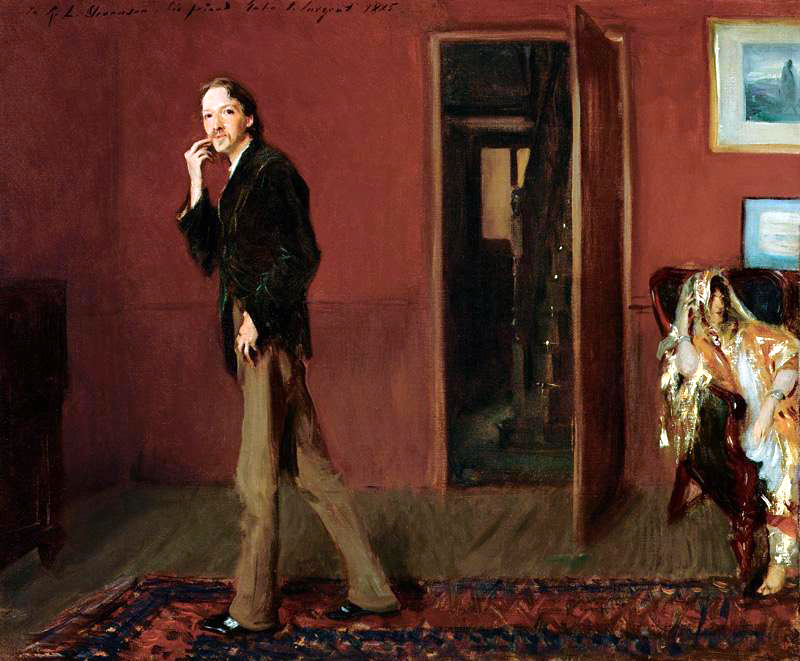
Robert Louis Stevenson and his Wife (1885)

RAM Stevenson, a cousin of Robert Louis Stevenson who studied with Sargent in Paris, wrote of his classmate’s remarkable talent: “Sargent’s painting is strict painting, as Bach’s fugues are strict music.” An accomplished musician himself, Sargent was known for talking constantly while he painted, and would walk around the room (he once estimated that he walked four miles every day going back and forth around his model and the easel) and interrupt his work to play the piano. Carnation, Lily, Lily, Rose, painted in the late summer of 1885 and 1886, was named for a popular song; its style “is poised”, the exhibition catalogue notes, “between several aesthetics: French impressionism, English pre-Raphaelitism and aestheticism”. Sargent’s chief aim in this portrait, all who watched him create it agreed, was to capture en plein air the transient quality of “fugitive evening light”. It took him two years to achieve, for he could only paint for 25 minutes each night in late summer: every evening at 6:45 Sargent “would drop his tennis racquet”, remembered a friend, and “lug out the big canvas” from his 70ft-long studio into the garden, where he would paint for as long as “the effect lasted”. He had almost certainly been to Giverny by then, and had watched Monet paint out of doors. He came to share Monet’s preoccupation with the play of natural light, but he never fully embraced impressionism’s subordination of subject to technique, its willingness to dissolve representation into paint, colour and light.
Dr Samuel Jean Pozzi at Home (1881)

Although Sargent’s subjects were often posed, his oeuvre suggests the painter as flaneur, strolling through metropolitan cities and capturing the personalities he encountered, the scenes he saw. His own coterie was stylish, knowing, chic: he portrayed other painters, sculptors, musicians, actors, dancers, including WB Yeats, Eleonora Duse, Edwin Booth, Edmund Gosse, George Meredith, Antonio Mancini (whom Sargent once described as “the best living painter”), the collector and hostess Isabella Stewart Gardner. There is the famous portrait of Ellen Terry as Lady Macbeth, raising the crown on to her head, and the 1885 picture of Robert Louis Stevenson and his wife, Fanny, who said their portrait was “like an open box of jewels”. He painted a Chilean mining heiress, formidable and stylishly dressed, who became a lay nun and had her habit designed by Coco Chanel. There is An Interior of Venice, depicting the Palazzo Barbaro on the Grand Canal, where James wrote The Wings of the Dove, and which some have speculated may have helped inspire The Aspern Papers. Sargent presented the painting as a gift to his hostess, but, offended by her appearance and her son’s informal pose, she rejected it, to the dismay of James, who wrote to her that he “absolutely and unreservedly adored” the painting. She did not change her mind. There is Sargent’s first double portrait, from 1881, of the Pailleron children. They are in a claustrophobic, dark but richly furnished space, and seem to have a knowing gaze; viewers have since been reminded of the doubtful children in James’s Turn of the Screw, written more than 15 years after the picture was first shown. There is the scarlet Dr Pozzi, painted as a handsome, louche aesthete, whose dressing gown slyly evokes cardinals: contemporary British reviewers found it objectionably Parisian, too insolent, too en vogue. Sargent’s paintings may look staidly traditional now, but they were seen as modern when he painted them.
Madame X (1883-4)

Celebrity and theatricality were central to Sargent’s style, and his success. It is the portrait of AmĂ©lie Gautreau, titled Madame X, for which he remains best known. Working on the painting, he told his friend the writer Vernon Lee that he was “struggling with the unpaintable beauty and hopeless laziness” of his sitter, but eventually, fusing techniques from VelĂ¡zquez, Titian and Manet, as well as Sargent’s then fashionable interest in Japanese art, he produced a painting now seen as a masterpiece, but which first inspired outrage, creating a succes de scandale when it was exhibited at the 1884 Paris Salon. Reviews either objected to Madame Gautreau’s appearance (some complaining at the powder-blue pallor of her skin, others at the depth of her decolletage or the shockingly wanton shoulder strap allowed to fall suggestively loose) or hailed the modernity of Sargent’s technique.

When he sold Madame X to the New York Metropolitan Museum years later, Sargent admitted to feeling it might have been the best work he had ever done, but at the time he was unnerved by the malice it elicited. He beat a retreat to London, where James had promised him a more sympathetic reception. British critics did not, in fact, instantly embrace Sargent: The Misses Vickers was voted the worst painting of 1886 by the Royal Academy, for example, while the Spectator demanded: “Could we fancy anyone a hundred years hence caring to possess such a picture as this?” Carnation, Lily, Lily, Rose might strike some viewers as prettily pre-Raphaelite (although they would have to ignore its spectacular luminescence), but it provoked controversy when it was purchased through the Chantrey Bequest, one journal reporting that “artists [had] almost come to blows over this picture”. Modern, too, are the expressionist portrait of Lee, who appears to be chattering away, and a lovely impressionist evocation of one of Sargent’s touchstones, Monet, characteristically painting outside, sur le motif. There is the famous 1913 portrait of James for his 70th birthday, which, as the catalogue notes, delighted the Master: “Sargent at his very best and poor old HJ not at his worst; in short a living breathing likeness and a masterpiece of painting.”

Of Sargent’s private life, little is known. He never married; although twice he was suspected of being on the verge of an engagement, nothing came of it. Many have come to believe that his extreme privacy was a sign on the closet door, signalling a life kept carefully secret to hide desires deemed unacceptable (and illegal). Certainly Sargent executed many – very beautiful – drawings of male nudes, which he did not exhibit during his life. It is also true that a number of men with similarly suppressed or hidden desires, including James, were among his close circle of friends. But so were married couples, and heterosexual philanderers. The painter Jacques-Émile Blanche, who once sat for Sargent, claimed after his death that Sargent was “notorious in Paris, and in Venice, positively scandalous. He was a frenzied bugger.” But no other affirmation of this claim has come to light, and Sargent’s private papers were destroyed. Many scholars believe he had an affair with Louise Burckhardt, who sat for Lady with the Rose, while some of his female nudes have struck viewers as being as erotic as his males.

But in the end this is all conjecture. For better or worse – again like James – Sargent had married his art. Lee wrote after his death that the only useful biographical summation would be two words: “he painted”. Late in life, Sargent declined the honour of a knighthood, because he was American. He died at 69, in his sleep, a volume of Voltaire beside him. It was 14 April 1925, four days afterThe Great Gatsby was published; the modern era was at hand, and it was Sargent, whether we know it or not, who helped show us what it would look like.

• Sargent: Portrait of Artists and Friends opens at the National Portrait Gallery, London WC2H, on 12 February.
http://www.npg.org.uk/whatson/sargent/home.php

http://www.theguardian.com/artanddesign/2015/jan/30/how-john-singer-sargent-made-a-scene


The Scandal of Madame X
In an exclusive excerpt from David McCullough’s new book, the story of how John Singer Sargent’s obsession with a woman led to the famous painting Madame X—and the scandal it caused in Paris.

David McCullough
22 May 2011

Sargent was by nature, as Vernon Lee wrote, always “especially attracted by the bizarre and outlandish,” the very essence of Virginie AmĂ©lie Avegno Gautreau, who, contrary to the impression most people had, was an American.

Born in New Orleans, she had been brought to Paris as a child of eight by her widowed, socially ambitious mother. Her father, a major in the Confederate army, had been killed at the battle of Shiloh. She was, by 1883, twenty-four years old, two years younger than Sargent.

To her mother’s great approval, she had married a wealthy French banker, Pierre Gautreau, and became what was called a “professional beauty,” the perfect “parisienne,” someone known for her remarkable looks and social stage presence, and who, in her appearances in society, was expected to fill that role with all due attention to wardrobe and the artful use of cosmetics, no less than a great actress. In her particular case a heavy use of a chalky lavender powder on face and body gave her a pallor distinctive enough in itself to draw attention. To her critics she was all too plainly an arriviste.

Her beauty was distinctly different, almost eccentric, her nose too long by accepted standards, her forehead too high. Yet the total effect, and particularly given her hourglass figure and her way of moving, was striking in the extreme, her appeal unmistakably seductive, as she well knew.

An American art student named Edward Simmons wrote of being “thrilled by every movement of her body.”

She walked as Virgil speaks of a goddess—sliding—and seemed to take no steps. Her head and neck undulated like that of a young doe, and something about her gave you the impression of infinite proportion, infinite grace, and infinite balance. Every artist wanted to make her in marble or paint.

After meeting her socially, Sargent, some said, had become obsessed by her. He let it be known that he wanted to do “homage to her beauty” in a portrait to be shown at the Salon, the implication being it could bring each of them notoriety in the way Manet’s sensational Olympia had, albeit she need not pose in the nude.

Do you object to people who are fardées [made up] to the extent of being uniform lavender or blotting paper color all over [he wrote to Vernon Lee]. If so you would not care for my sitter. But she has the most beautiful lines and if the lavender or chlorate-of-potash lozenge color be pretty in itself I shall be more than pleased.

He did one line drawing after another of her head in profile, made studies in pencil and watercolor of her relaxing on a settee in a low-cut evening dress, painted her in oil drinking a toast, and here again in profile. In the summer of 1883, from the Gautreaus’ country estate in Brittany, he wrote to tell Vernon Lee he was “still struggling with the unpaintable beauty and hopeless laziness” of his subject.

That he and AmĂ©lie Gautreau were both Americans was by no means immaterial to their ambitions. The same year they met, a society journal noted that “Yankees” in Paris were gaining ever-greater prominence. “They have painters who carry off our medals, like Mr. Sargent, beautiful women who eclipse ours, Mme. Gautreau. . . .” If they were to be known always as Americans, then all the more reason to be at the forefront.

Finished with his preliminary studies, Sargent left Brittany for Nice to pay his annual visit to his parents, before moving on for an autumn stay in Florence.

“His life is a pleasant life,” FitzWilliam Sargent wrote to a brother in Philadelphia.

Her sole purpose in life is to demonstrate by her skills in contriving incredible outfits which shape her and exhibit her and which she can carry off with bravado. . . .

He seems to be respected, even admired and beloved (according to all accounts) for his talent and success as an artist, for his conduct and character as a man. His work is a pleasurable occupation to him and brings him a very handsome income. He travels about in countries which provide him with materials for his pictures as well as with bread and butter and elements of health and enjoyment. He is well received everywhere for his manners are good and agreeable. He is good looking, plays the piano well and dances well, converses well, etc., etc. In short, he has given us, his parents great satisfaction so far. . . .

In the winter of 1883–84, Sargent moved from the Left Bank to a new studio across the Seine at 41 boulevard Berthier, in the then fashionable neighborhood near the Parc Monceau. It was there in a workplace elegantly furnished with comfortably upholstered chairs, Persian rugs, and drapery befitting his new professional standing, and an upright piano against one wall, that he painted his full-length portrait of Madame Gautreau, the whole time suffering what he called “a horrid state of anxiety.”

She was dressed in a long black satin skirt and low-cut black velvet bodice, her shoulders bare except for two slim jeweled straps. She held both shoulders back and her head cocked sharply to the left, giving full cameo emphasis to the remarkable profile.

Her left arm on her hip, she held her skirt with the left hand, while the right arm was oddly turned back on itself, her right hand gripping the top of the side table. She wore her hair up, with a tiny diamond tiara on top.

It was a flagrantly stagy pose, which could only have been difficult to hold for any length of time, even for one who was a poser by nature.

Against the deep black of the dress, the deathly blue-white of her powdered skin was even more strange and striking. When, during one sitting her right shoulder strap dropped suggestively over her arm, Sargent requested she leave it that way.

In contrast to his usual approach, he worked and reworked the canvas, simplifying and redefining edges.

One day I was dissatisfied with it and dashed a tone of light rose over the former gloomy background [he reported to a friend]. I turned the picture upside down, retired to another end of the studio and looked at it under my arm. Vast improvement. The élancée figure of the model shows to much greater advantage.

No doubt Madame Gautreau saw how the portrait was emerging under his brush from one sitting to another. Possibly her mother, too, may have been present occasionally. If they found anything about it disturbing at the time, there is no evidence that a word was said. When Carolus-Duran came by for a look, he told Sargent he could submit the painting to the Salon with perfect confidence. Sargent was not so sure.

Another who dropped in was Henry James. In Paris briefly, James had met and quite liked the young artist, calling him “the only Franco-American product of importance” in France. But, as James confided to a friend, he only “half-liked” the portrait of Madame Gautreau.

The 1884 Paris Salon, an exhibition filling thirty-one of the grandes salles in the Palais de l’Industrie, opened on a beautiful May morning with much excitement among the customary well-dressed crowds in attendance. So great had the number of American painters in Paris become, and so important to their careers was representation at the Salon, that they were now second only to the number of French artists included. For Sargent it marked the sixth consecutive year he had exhibited at the Salon, always with increasing acclaim.

Paintings filled every wall. The portrait of Amélie Gautreau, ideally placed at eye level, was hung in Salle 31, and the doors had been open scarcely an hour when it became the talk of the exhibition.

For all that would be written and said, no eyewitness account of the event and of its effect on Sargent compared to what his friend Ralph Curtis wrote to his parents the next day. Whether the opening marked Sargent’s birthday as an artist or his funeral, Curtis could not say.

Walked up the Champs-ÉlysĂ©es, chestnuts in full flower and a dense mob of “tout Paris” in pretty clothes, gesticulating and laughing, slowly going into the Ark of Art. In 15 minutes I saw no end of acquaintances and strangers and heard everybody say, “OĂ¹ est le portrait Gautreau?” “Oh, allez voir ça.”

Curtis had seen Sargent the night before. “He was very nervous about what he feared,” he wrote, “but his fears were far exceeded by the facts of yesterday. There was a grande tapage [great fuss] before it [the portrait] all day.”

In a few minutes I found him dodging behind doors to avoid friends who looked grave. By the corridors he took me to see it. I was disappointed by the color. She looks decomposed. All the men jeer. “Ah voilĂ  ‘la belle!’ ” “Oh, que le horreur!” Etc. Then a painter exclaims, “superbe de style, magnifique d’audace!” [Magnificent audacity!] “Quel dessin!” [What drawing!].

In an exhibition wherein paintings of nudes were commonplace, that of Madame Gautreau in her black evening dress was considered scandalously erotic.

But what was unacceptable to “tout Paris” was the blatant, self-centered impropriety of it all—the heavy powder, the odd, arrogant pose, the dĂ©colletage. Such vulgar flaunting was simply not done by women of social standing.

“All the A.M. it was one series of bons mots, mauvaises plaisanteries and fierce discussions,” Curtis continued in his letter. “John, poor boy, was navré [full of sorrow]. The tumult of talk lasted through the day, but by evening the tone of opinion about the picture had changed. It was discovered to be the knowing thing to say ‘Ă©trangement Ă©patant.’ [shocking, amazing!]”

“I went home with him,” Curtis continued, “and remained there while he went to see the Boits.” Madame Gautreau and her mother came to the studio “bathed in tears.” Curtis “stayed them off,” but Madame Avegno came back again, after Sargent had returned, and made “a fearful scene.”

“All Paris mocks my daughter,” she said. If the painting were to stay on exhibit, she would “die of chagrin.”

Sargent, obviously put out, told her there was nothing he could do, that it was against the rules of the Salon to retire a picture and that he had painted Amélie exactly as she was dressed.

“Defending his cause made Sargent feel much better,” wrote Curtis. “Still we talked it over until 1 o’clock here last night and I fear he has never had such a blow.”

The reviews were essentially of three kinds, those that objected to Madame Gautreau’s dĂ©colletage, those repulsed by the color of her skin, and those that, seeing “modernity” in the approach, applauded Sargent’s courage.

The New York Times dismissed the painting out of hand as a “caricature,” far below Sargent’s usual standard. “The pose of the figure is absurd, and the bluish coloring atrocious.” The Times of London conceded only that the portrait was “most interesting.” But the French critic Louis de Fourcaud, writing in the Gazette des Beaux-Arts, called it a masterpiece of characterization. It should be kept in mind, he wrote, that “in a person of this type everything relates to the cult of self and the increasing concern to captivate those around her.

Her sole purpose in life is to demonstrate by her skills in contriving incredible outfits which shape her and exhibit her and which she can carry off with bravado. . . .

Sargent had been living and working in Paris for a full decade and in that time had received only expressions of admiration and praise. He had never known an adverse review or even mild criticism, let alone public mockery. His portrait of Madame Gautreau was in fact a masterpiece and in time would be so recognized. He hung on to it, renaming it Madame X. He also repainted the fallen shoulder strap, restoring it to its proper place. Years later, when he sold the painting to the Metropolitan Museum in New York for $1,000, he would remark that it was perhaps the best thing he had done.

He and Amélie Gautreau seem to have had no further contact, though she, too, eventually changed her opinion about the painting and expressed pride in it.

Yet hard hit as he was and angry over what had happened, Sargent appears to have had no doubts about his ability or his ambition to keep painting. Feeling an immediate need for a change of scene, he followed up on an earlier plan to go to London. He left Paris in late May 1884, not to return until December.

http://www.thedailybeast.com/articles/2011/05/22/the-scandal-of-madame-x-excerpt-from-david-mcculloughs-the-greater-journey.html