Sunday, 12 November 2017
Saturday, 11 November 2017
Friday, 10 November 2017
Dead Poets Society #56 Herbert Read: The Happy Warrior

His wild heart beats with painful sobs,
His strain'd hands clench an ice-cold rifle,
His aching jaws grip a hot parch'd tongue,
His wide eyes search unconsciously.
He cannot shriek.
Bloody saliva
Dribbles down his shapeless jacket.
I saw him stab
And stab again
A well-killed Boche.
This is the happy warrior,
This is he…
Thursday, 9 November 2017
Last night's set lists
At The Habit, York: -
Ron Elderly: -
Wild Horses
You Better Move On
Da Elderly: -
Wrecking Ball
Motion Pictures (for Carrie)
The Elderly Brothers: -
Love Hurts
The Night Has A Thousand Eyes
You Really Got A Hold On Me
Then I Kissed Her
When Will I Be Loved
It was a strange night at The Habit, starting very quietly and just getting better as time rolled on. It looked like there wouldn't be enough players initially, but they just kept on coming through the door and the night was soon filled. Ron played his favourites, The Rolling Stones, and I pulled out two Neil Young obscurities for the punters. Late on a young chap wowed the audience with a loop pedal-backed version of Eleanor Rigby - great guitar playing throughout. Our host (pictured) opened and closed the proceedings - his 3rd year in charge!
Wednesday, 8 November 2017
Tuesday, 7 November 2017
Monday, 6 November 2017
This is J.D. Salinger and no, he won't be returning your call...
Salinger’s Nightmare
An unemployed actor tracked down Salinger to get his permission to adapt The Catcher in the Rye.
Bill Barich
The trip to New Hampshire proved exhausting. Traveling on the cheap, Mahan boarded a small, piston-driven plane in Burbank that stopped twelve times en route to New York, where he made his way to the Saint Regis Hotel. His sister Colleen, a secretary to David O. Selznick, was staying there with her boss and some other staffers. Selznick was out for the evening, so Mahan took a shower, ordered a chicken sandwich, and helped himself to a drink from the well-stocked bar, careful to choose an off-brand vodka rather than the premium Smirnoff. But he wasn’t cautious enough. Selznick returned early—“a big man,” as Mahan describes him, “expensively dressed, with a heavy shock of pure white hair”—and gently chastised him for drinking the imported Russian vodka instead of the much cheaper domestic stuff.
When Colleen told her boss that Bill was headed to see J. D. Salinger, Selznick was incredulous. “Salinger!” he exclaimed. “I can’t even get near him.”
“I got a telegram from him just the other day,” Mahan said, dipping into his pocket to show it off.
“Let me know how you make out,” said Selznick before heading off to bed.
From Idlewild Airport, Mahan flew to Manchester, New Hampshire, then rented a car and drove the hundred or so miles to Cornish. He wasn’t impressed: the place lacked any amenities and didn’t strike him as a “real town,” just a hamlet. Most residents, Salinger included, conducted their business affairs on the other side of the Connecticut River in Windsor, Vermont. In his early days in Cornish, before he became more withdrawn, Salinger was known to be reasonably sociable. He liked to hang out with a group of Windsor High students, inviting them to his place to watch movies and listen to records, but when he agreed to be interviewed for the school paper, the subsequent uproar and attention convinced him to cut off all contact.
Mahan checked into a Windsor hotel and pumped the locals at a corner bar for directions to Salinger’s house. He had no trouble finding it: a roomy, wood-frame place he recognized from the photos that had accompanied a recent spread in Life magazine. The house had a gambrel roof, a Jeep in the yard, and a superb view of Mount Ascutney. The gate was wired shut, but Mahan opened it and knocked on the front door. No one answered. He suspected Salinger might be working in a smaller cinder-block house nearby, also pictured in Life, and started for it only to change his mind. Interrupting a writer who was concentrating might be unwise. He returned to his hotel to clean up and rest.
On his second run to the house, he spotted the Jeep crossing the bridge to Windsor and followed it. Sure enough, Salinger was at the wheel. He parked by the Windsor News general store and walked in. Mahan jotted in his journal, “About six feet one, maybe even two. Very slender. Gaunt bony face … He was wearing regular businessman’s hat and a light colored raincoat. Light brown I think. He is very heavy bearded.” He took up a position outside the store, ready to intercept Salinger when he left.
Mahan recorded the ensuing conversation in minute detail. It bears a fair resemblance to a one-act play bound for the theater of the absurd. Both men were so “deadly serious” that they were unable to find the humor in a situation whereby Salinger steadfastly refused to see the man he was in fact seeing at that very moment. Mahan’s strategy, such as it was, appeared to be based on the same boyish charm that had won him favor as little Bobby Jones. He greeted Salinger by saying, “Hi! I came anyway.”
“Who are you?” Salinger asked, no doubt startled. “What do you want? Who are you?”
“I’m Bill Mahan.”
One can only imagine Salinger’s despair on hearing those words. “Oh, you didn’t,” he said. “Why did you come?”
“Well, I thought if I came to see you personally,” Mahan explained, “you might at least listen to what I have to say.”
“Well, I won’t,” Salinger insisted. “I just don’t see why you came here. What are you going to do?” He was so uncomfortable he looked to Mahan “like someone on the brink of a seizure. He speaks with a heavy New England accent and when he gets excited (which is most of the time) the voice goes up and is as squealy as hell.” Salinger continued, “I don’t understand you people. You wrote to me and I even went to the trouble of sending you a telegram saying no.”
“I know. I remember it. In fact I can quote it verbatim,” said Mahan, probably hoping to score a point.
“I remember it, too. Why didn’t you contact my agent? … You’re all so selfish.” Salinger paused to correct himself. “I can’t say that though. I certainly understand selfishness.”
After a few more volleys, Mahan grasped the error of his ways and admitted he shouldn’t have come. “I’m terribly embarrassed about the whole thing now,” he apologized.
“There’s no point in being embarrassed. We’re both grown men. It’s just that I don’t want to see anyone. What are you going to do?” Salinger repeated, obviously concerned about the welfare of his uninvited guest and what to do about it.
“I don’t really know.”
“Where’s your wife?”
“She’s home.”
“My God, she must think you’re a nut or something.”
“No,” Mahan assured him. “I gambled that I might have a chance at the book. It’s really pretty great, you know.”
Salinger refused to discuss it. “I’m just terribly irritated by the fact that you came after I said no.”
“I’m terribly sorry, too. I didn’t realize that it would upset you like this.”
With rising frustration, Salinger delivered a long lament: “People won’t seem to let me alone. They hang around the house and peek in the windows and upset my wife. They throw beer cans on the lawn. They even bother my children. Reporters follow me on the road … I just feel terribly about this whole thing—that long trip and everything.” He asked again: “What are you going to do now?”
“You don’t have to feel responsible for me,” Mahan suggested.
“But I do feel responsible.” This was a telling moment. In writing a novel that had touched and even altered the lives of so many people, Salinger was forced to consider to what extent he might be responsible for its effect on them. What drew so many pilgrims to his doorstep? (Almost twenty years later, Mark David Chapman would invoke Catcher as his “statement” after assassinating John Lennon.) His rigorous discipline clashed with a desire to be decent, to treat Mahan kindly. There was a monstrous element to his selfishness and isolation, and he appears to have known it. “You made this long trip,” he reiterated, in the grip of an obsession, “and I can’t see you.”
“Right here,” Mahan noted perceptively, “he looked like a really sad little boy with a terrible problem that he could neither solve nor run away from.”
The conversation ground to a halt. As a parting shot, Mahan put yet another request to Salinger. Would he read a story his mother had published in Good Housekeeping ten years ago? To his great credit, Salinger didn’t lose his temper or laugh out loud. Instead he voiced a weary resignation.
“I can’t. I really can’t,” he all but sighed. “It would just lay around and probably get lost. I’m sure it’s valuable to you.” Walking toward the store, he turned back and said, “Please don’t leave it in my car.”
Mahan checked out of his hotel, but he couldn’t tear himself away from Cornish. Despite Salinger’s firm denial, he seemed not at all displeased with the results of his trip; he lingered in its aftermath. Musing over a cup of coffee at Windsor News, he felt he should write a farewell letter to Salinger and deliver it himself. So he did: trudging through the snow with his flashlight to the wired gate.
Through a kitchen window, he could see Salinger fixing dinner, whistling and looking happy. As Mahan looked on, a big white Samoyed bounded out of nowhere, pinning him to the ground and exploring his ear with its tongue. The dog was friendly but disinclined to budge, so Mahan was forced to cry for help.
“Mr. Salinger!” he shouted. “Oh-ooh, Mr. Salinger!”
Salinger came to the rescue. He can’t have been delighted. “My God, it’s you again! What do you want?” He accepted the letter and pulled Mahan to his feet. They proceeded to the porch.
“Since you delivered it in person, I may as well read it,” Salinger said, leaving Mahan to wait outside, still unable to give him the boot, and retreating into the house. On his return, he made no mention of the letter. Instead he spoke with Zen-like economy, saying only four words, “Seven inches expected tonight,” as a light snow began to fall.
They shook hands, and Salinger waved goodbye. Six hours later, Mahan was at the Saint Regis again, regaling David O. Selznick with the tale of his adventure in Cornish. Selznick, impressed with his chutzpah, offered him a job in South America selling a block of twenty-one movies he owned.
But Mahan wasn’t done with Salinger just yet. In May of 1963, Mike Connolly of The Hollywood Reporter ran an item in his column:
J. D. Salinger descended from his ivory tower and slipped his Catcher in the Rye screen rights to producer Bill Mahan, having previously spurned such top moviemakers as Elia Kazan and David O. Selznick. Salinger will be technical advisor. On camera, as narrator, he’ll be portrayed by Kier Dullea.
Whether Mahan was involved in placing the item, an old Hollywood ploy, isn’t known, but he was quick to write Salinger and deny it. “I had nothing to do with it,” he swore, “and I am terribly sorry that misinformation got into print.” The trip to Cornish had turned out to be good luck, he confided, leading to his success with Selznick and his new position as the director Henry Koster’s assistant on the feature film, Take Her, She’s Mine. He closed with a paragraph that must’ve had Salinger pulling out his hair by the roots.
The more I think about it, at the end of this job I believe I’ll come and see you again, and maybe this time you will at least give me the chance to tell you what I would like to do with your book.
Salinger wrote back two days later. Why did he bother to keep the connection alive? It would’ve been easy enough to say nothing. But maybe Mahan’s charm had worked, and Salinger now saw the humor and absurdity of the situation. Certainly the tone of his letter is bemused, even if its message is firm. There would be no movies based on his work, and no further visits from Mahan.
Afterward, Bill Mahan had a checkered career in and around Los Angeles. In 1963, he served as a producer on Strange Lovers, a B-movie about gay men that carried the tagline “a deep penetration into the world of unnatural love.” He also became a successful syndicated newspaper columnist, covering movies, TV, and entertainment. For convincing the actor Jeff Hunter to play the lead in No Man Is an Island, he earned ten thousand dollars and twenty weeks of work on the film. He wrote an autobiography about being a child star, The Boy Who Looked Like Shirley Temple, and, with his sister Colleen, a novel, The Moviola Man.
Fiction was on Mahan’s mind on April 3, 1984, when he composed one last letter to Salinger. His mood was melancholy. He’d gone through a divorce and he was still out there hustling. He addressed Salinger as “Jerry,” spoke of trying to imitate him as a writer, and enclosed a copy of a novel, presumably The Moviola Man. “You’ll enjoy it and you’ll relate,” he asserted. “You are responsible for it.” Responsible—that word again. “It should kind of make you proud because it is a good novel—my new one is even better.” Mahan was ever the optimist: “Not yet sold but it will be.” And he added, “Just wanted you to know that you are (as you were, many years ago worried about) responsible for me—only in a different way.”
This time Salinger chose not to reply.
Digital reproductions of select material from the Bill Mahan Papers (Collection Number 10045) are unrestricted, open to the public, and available online at the American Heritage Center, University of Wyoming. The quotes, letters, and observations attributed to Mahan in this essay, along with the verbatim record of his conversation with Salinger, can be found in Box 3, Folder 4 (J. D.Salinger 1961–70), except for Mahan’s last letter to Salinger from Box 3, Folder 1 (Personal Correspondence 1962–1984).
Bill Barich’s books include Big Dreams, A Pint of Plain, and the racetrack classic Laughing in the Hills.
Bill Barich
The Paris Review
13 April 2017
In 1953, J. D. Salinger fled Manhattan for rural Cornish, New Hampshire, hoping to protect his privacy and find the solitude he needed for his work. The Catcher in the Rye, which spent thirty weeks on the New York Times’ best-seller list, had generated immeasurable publicity and adulation for Salinger, who wanted none of it. Among his new suitors were such Hollywood bigwigs as Samuel Goldwyn and David O. Selznick, both vying for the screen rights to Catcher. They failed to secure Salinger’s approval, as did many others, in turn—but that didn’t stop Bill Mahan, an unemployed former child star and devoted fan from Los Angeles, from giving it a shot. In the early sixties, he resolved to claim the film rights himself, even if it meant disturbing Salinger at home.
Mahan’s account of his unlikely adventure can be found in his papers at the University of Wyoming’s American Heritage Center. On December 1, 1961, he wrote to Salinger by registered mail to share his vision for turning Catcher into an independent feature, with the author retaining “artistic control.” At the age of thirty-one, Mahan had no credits as a producer or a director, and very little money, so he proposed to shoot the film “art-house” style, without changing a word of dialogue. Given the shoestring budget, Salinger would, of course, have to grant him the rights for free. In hopes of sealing the deal, Mahan wrote that he would arrive in Cornish on December 13, whether he’d heard from Salinger or not.
Salinger had fielded more than his fair share of oddball requests over the years, and he knew how to ignore them—but Mahan’s pluck must’ve convinced the author that he really would show up. On December 7, he fired off a telegram that spelled out, in no uncertain terms, his utter disinterest in the proposal. He urged Mahan to stay home.
The message fell on deaf ears. Overjoyed to receive any response at all, Mahan seized on the telegram as a positive sign and decided to go ahead with the plan, believing he could “sell anything to anybody.” He’d learned to rely on his charm—and he had vast stores of confidence, having risen to fame as a child star. From 1936 to 1940, he’d featured in eighteen pictures as Bobby Jones, the youngest member of the Jones family. It was a lucrative comedy franchise, and the public loved little Bobby; a studio press book described the one-hour comedies as “energetic hokum … tolerably amusing in an entirely inconsequential way.” Now, decades later, Mahan had resolved to take that “energetic hokum” of his on the road: he was heading east.

Young Bill Mahan in The Jones Family at The County Fair
The trip to New Hampshire proved exhausting. Traveling on the cheap, Mahan boarded a small, piston-driven plane in Burbank that stopped twelve times en route to New York, where he made his way to the Saint Regis Hotel. His sister Colleen, a secretary to David O. Selznick, was staying there with her boss and some other staffers. Selznick was out for the evening, so Mahan took a shower, ordered a chicken sandwich, and helped himself to a drink from the well-stocked bar, careful to choose an off-brand vodka rather than the premium Smirnoff. But he wasn’t cautious enough. Selznick returned early—“a big man,” as Mahan describes him, “expensively dressed, with a heavy shock of pure white hair”—and gently chastised him for drinking the imported Russian vodka instead of the much cheaper domestic stuff.
When Colleen told her boss that Bill was headed to see J. D. Salinger, Selznick was incredulous. “Salinger!” he exclaimed. “I can’t even get near him.”
“I got a telegram from him just the other day,” Mahan said, dipping into his pocket to show it off.
“Let me know how you make out,” said Selznick before heading off to bed.
From Idlewild Airport, Mahan flew to Manchester, New Hampshire, then rented a car and drove the hundred or so miles to Cornish. He wasn’t impressed: the place lacked any amenities and didn’t strike him as a “real town,” just a hamlet. Most residents, Salinger included, conducted their business affairs on the other side of the Connecticut River in Windsor, Vermont. In his early days in Cornish, before he became more withdrawn, Salinger was known to be reasonably sociable. He liked to hang out with a group of Windsor High students, inviting them to his place to watch movies and listen to records, but when he agreed to be interviewed for the school paper, the subsequent uproar and attention convinced him to cut off all contact.
Mahan checked into a Windsor hotel and pumped the locals at a corner bar for directions to Salinger’s house. He had no trouble finding it: a roomy, wood-frame place he recognized from the photos that had accompanied a recent spread in Life magazine. The house had a gambrel roof, a Jeep in the yard, and a superb view of Mount Ascutney. The gate was wired shut, but Mahan opened it and knocked on the front door. No one answered. He suspected Salinger might be working in a smaller cinder-block house nearby, also pictured in Life, and started for it only to change his mind. Interrupting a writer who was concentrating might be unwise. He returned to his hotel to clean up and rest.
On his second run to the house, he spotted the Jeep crossing the bridge to Windsor and followed it. Sure enough, Salinger was at the wheel. He parked by the Windsor News general store and walked in. Mahan jotted in his journal, “About six feet one, maybe even two. Very slender. Gaunt bony face … He was wearing regular businessman’s hat and a light colored raincoat. Light brown I think. He is very heavy bearded.” He took up a position outside the store, ready to intercept Salinger when he left.
Mahan recorded the ensuing conversation in minute detail. It bears a fair resemblance to a one-act play bound for the theater of the absurd. Both men were so “deadly serious” that they were unable to find the humor in a situation whereby Salinger steadfastly refused to see the man he was in fact seeing at that very moment. Mahan’s strategy, such as it was, appeared to be based on the same boyish charm that had won him favor as little Bobby Jones. He greeted Salinger by saying, “Hi! I came anyway.”
“Who are you?” Salinger asked, no doubt startled. “What do you want? Who are you?”
“I’m Bill Mahan.”
One can only imagine Salinger’s despair on hearing those words. “Oh, you didn’t,” he said. “Why did you come?”
“Well, I thought if I came to see you personally,” Mahan explained, “you might at least listen to what I have to say.”
“Well, I won’t,” Salinger insisted. “I just don’t see why you came here. What are you going to do?” He was so uncomfortable he looked to Mahan “like someone on the brink of a seizure. He speaks with a heavy New England accent and when he gets excited (which is most of the time) the voice goes up and is as squealy as hell.” Salinger continued, “I don’t understand you people. You wrote to me and I even went to the trouble of sending you a telegram saying no.”
“I know. I remember it. In fact I can quote it verbatim,” said Mahan, probably hoping to score a point.
“I remember it, too. Why didn’t you contact my agent? … You’re all so selfish.” Salinger paused to correct himself. “I can’t say that though. I certainly understand selfishness.”
After a few more volleys, Mahan grasped the error of his ways and admitted he shouldn’t have come. “I’m terribly embarrassed about the whole thing now,” he apologized.
“There’s no point in being embarrassed. We’re both grown men. It’s just that I don’t want to see anyone. What are you going to do?” Salinger repeated, obviously concerned about the welfare of his uninvited guest and what to do about it.
“I don’t really know.”
“Where’s your wife?”
“She’s home.”
“My God, she must think you’re a nut or something.”
“No,” Mahan assured him. “I gambled that I might have a chance at the book. It’s really pretty great, you know.”
Salinger refused to discuss it. “I’m just terribly irritated by the fact that you came after I said no.”
“I’m terribly sorry, too. I didn’t realize that it would upset you like this.”
With rising frustration, Salinger delivered a long lament: “People won’t seem to let me alone. They hang around the house and peek in the windows and upset my wife. They throw beer cans on the lawn. They even bother my children. Reporters follow me on the road … I just feel terribly about this whole thing—that long trip and everything.” He asked again: “What are you going to do now?”
“You don’t have to feel responsible for me,” Mahan suggested.
“But I do feel responsible.” This was a telling moment. In writing a novel that had touched and even altered the lives of so many people, Salinger was forced to consider to what extent he might be responsible for its effect on them. What drew so many pilgrims to his doorstep? (Almost twenty years later, Mark David Chapman would invoke Catcher as his “statement” after assassinating John Lennon.) His rigorous discipline clashed with a desire to be decent, to treat Mahan kindly. There was a monstrous element to his selfishness and isolation, and he appears to have known it. “You made this long trip,” he reiterated, in the grip of an obsession, “and I can’t see you.”
“Right here,” Mahan noted perceptively, “he looked like a really sad little boy with a terrible problem that he could neither solve nor run away from.”
The conversation ground to a halt. As a parting shot, Mahan put yet another request to Salinger. Would he read a story his mother had published in Good Housekeeping ten years ago? To his great credit, Salinger didn’t lose his temper or laugh out loud. Instead he voiced a weary resignation.
“I can’t. I really can’t,” he all but sighed. “It would just lay around and probably get lost. I’m sure it’s valuable to you.” Walking toward the store, he turned back and said, “Please don’t leave it in my car.”
Mahan checked out of his hotel, but he couldn’t tear himself away from Cornish. Despite Salinger’s firm denial, he seemed not at all displeased with the results of his trip; he lingered in its aftermath. Musing over a cup of coffee at Windsor News, he felt he should write a farewell letter to Salinger and deliver it himself. So he did: trudging through the snow with his flashlight to the wired gate.
Through a kitchen window, he could see Salinger fixing dinner, whistling and looking happy. As Mahan looked on, a big white Samoyed bounded out of nowhere, pinning him to the ground and exploring his ear with its tongue. The dog was friendly but disinclined to budge, so Mahan was forced to cry for help.
“Mr. Salinger!” he shouted. “Oh-ooh, Mr. Salinger!”
Salinger came to the rescue. He can’t have been delighted. “My God, it’s you again! What do you want?” He accepted the letter and pulled Mahan to his feet. They proceeded to the porch.
“Since you delivered it in person, I may as well read it,” Salinger said, leaving Mahan to wait outside, still unable to give him the boot, and retreating into the house. On his return, he made no mention of the letter. Instead he spoke with Zen-like economy, saying only four words, “Seven inches expected tonight,” as a light snow began to fall.
They shook hands, and Salinger waved goodbye. Six hours later, Mahan was at the Saint Regis again, regaling David O. Selznick with the tale of his adventure in Cornish. Selznick, impressed with his chutzpah, offered him a job in South America selling a block of twenty-one movies he owned.
But Mahan wasn’t done with Salinger just yet. In May of 1963, Mike Connolly of The Hollywood Reporter ran an item in his column:
J. D. Salinger descended from his ivory tower and slipped his Catcher in the Rye screen rights to producer Bill Mahan, having previously spurned such top moviemakers as Elia Kazan and David O. Selznick. Salinger will be technical advisor. On camera, as narrator, he’ll be portrayed by Kier Dullea.
Whether Mahan was involved in placing the item, an old Hollywood ploy, isn’t known, but he was quick to write Salinger and deny it. “I had nothing to do with it,” he swore, “and I am terribly sorry that misinformation got into print.” The trip to Cornish had turned out to be good luck, he confided, leading to his success with Selznick and his new position as the director Henry Koster’s assistant on the feature film, Take Her, She’s Mine. He closed with a paragraph that must’ve had Salinger pulling out his hair by the roots.
The more I think about it, at the end of this job I believe I’ll come and see you again, and maybe this time you will at least give me the chance to tell you what I would like to do with your book.
Salinger wrote back two days later. Why did he bother to keep the connection alive? It would’ve been easy enough to say nothing. But maybe Mahan’s charm had worked, and Salinger now saw the humor and absurdity of the situation. Certainly the tone of his letter is bemused, even if its message is firm. There would be no movies based on his work, and no further visits from Mahan.
Afterward, Bill Mahan had a checkered career in and around Los Angeles. In 1963, he served as a producer on Strange Lovers, a B-movie about gay men that carried the tagline “a deep penetration into the world of unnatural love.” He also became a successful syndicated newspaper columnist, covering movies, TV, and entertainment. For convincing the actor Jeff Hunter to play the lead in No Man Is an Island, he earned ten thousand dollars and twenty weeks of work on the film. He wrote an autobiography about being a child star, The Boy Who Looked Like Shirley Temple, and, with his sister Colleen, a novel, The Moviola Man.
Fiction was on Mahan’s mind on April 3, 1984, when he composed one last letter to Salinger. His mood was melancholy. He’d gone through a divorce and he was still out there hustling. He addressed Salinger as “Jerry,” spoke of trying to imitate him as a writer, and enclosed a copy of a novel, presumably The Moviola Man. “You’ll enjoy it and you’ll relate,” he asserted. “You are responsible for it.” Responsible—that word again. “It should kind of make you proud because it is a good novel—my new one is even better.” Mahan was ever the optimist: “Not yet sold but it will be.” And he added, “Just wanted you to know that you are (as you were, many years ago worried about) responsible for me—only in a different way.”
This time Salinger chose not to reply.
Digital reproductions of select material from the Bill Mahan Papers (Collection Number 10045) are unrestricted, open to the public, and available online at the American Heritage Center, University of Wyoming. The quotes, letters, and observations attributed to Mahan in this essay, along with the verbatim record of his conversation with Salinger, can be found in Box 3, Folder 4 (J. D.Salinger 1961–70), except for Mahan’s last letter to Salinger from Box 3, Folder 1 (Personal Correspondence 1962–1984).
Bill Barich’s books include Big Dreams, A Pint of Plain, and the racetrack classic Laughing in the Hills.
Sunday, 5 November 2017
Saturday, 4 November 2017
Neil Young sells part of his classic car and model train collection...
Included is his first-in-production 1953 Buick
Reuters/Jill Sergeant
Autoblog
2 November 2017
Rock singer Neil Young is selling some of his most prized possessions — part of his model train and classic car collections
The Canadian folk-rock star is putting more than 230 of his vast collection of Lionel trains and some of his cars up for auction in Los Angeles in December. Some of the trains have estimated selling prices of up to $9,000, Julien's Auctions said on Thursday.
Young, 71, known for his Woodstock-era songs as well as "Ohio," "Heart of Gold" and many, many others, has been a passionate model train enthusiast for more than 20 years.
His collection and vast layouts at his California ranch took off in the early 1990s as a means of connecting with his son Ben, who has cerebral palsy, Young said.
Young is also selling some of his classic car collection.
They include:
(For a closer look at Young's lifetime interest in cars, here's a New York Times interview from 2012, which includes an anecdote about the time he ate road tar. Or his memoir "Special Deluxe: A Memoir of Life & Cars," in which he recounts every car he ever owned, and describes how he wrote the lyrics for "Like a Hurricane" in the back of a friend's 1950 DeSoto. He promoted the book in this NPR interview. He also tipped us off to the return of the Lincoln Continental, and is known for his LincVolt plug-in biodiesel 1960 Lincoln.)
As for Young's train collection, he designed a remote control that allows multiple trains to run at once, and a device that delivers realistic railroad audio to help his son get the most of out the hobby.
"It is just relaxing," Young told David Letterman of his hobby in a 2012 appearance on Letterman's television talk show.
Highlights of the Dec. 9 auction include the Lionel Hudson factory prototype locomotive with a pre-auction estimate of $4,000 to $9,000, and the H.O.A.R.D tour psychedelic Vanderbilt Hudson locomotive which is expected to sell for $3,000 to $6,000, Julien's said.

Young, who divorced his wife Pegi in 2014 after a 36-year marriage, said it was time for others to enjoy the items. A portion of the auction proceeds will benefit the Bridge School in California, which Pegi Young co-founded in 1986 for children with severe speech and physical impairments.
"Collecting all of these items has been my great joy. They have provided a source of inspiration, fun and creativity throughout my life," Young said in a statement.
"Now it is time to share them with others in the world whom I hope will enjoy and love them as much as I have."
https://www.autoblog.com/2017/11/02/neil-young-to-auction-model-train-collection-classic-cars/
Young, 71, known for his Woodstock-era songs as well as "Ohio," "Heart of Gold" and many, many others, has been a passionate model train enthusiast for more than 20 years.
His collection and vast layouts at his California ranch took off in the early 1990s as a means of connecting with his son Ben, who has cerebral palsy, Young said.
Young is also selling some of his classic car collection.
They include:
- A first-in-production 1953 Buick Roadmaster Skylark convertible 50th anniversary special edition, with a steering wheel hub saying "customized for Neil Young," that has a pre-auction estimate of $200,000 to $300,000.
- A 1954 Cadillac Fleetwood Imperial eight-passenger limousine (estimate $30,000-$40,000) with the Cadillac crest styled "Broken Arrow" emblem on the rear passenger door, referring to both the Buffalo Springfield song and his ranch of the same name in Portalo Valley, Calif.
- A 1948 Buick Roadmaster Hearse built by Flxible (estimate: $8,000-$10,000) used by Young and his band, The Squires, to haul equipment to gigs in the early 1960's. Dubbed "Mortimer," it's decorated with backstage passes and bumper stickers, and it inspired Young's song "Long May You Run."
- A 1941 Chrysler Series 28 Windsor Highlander two-door, three-person coupe (estimate: $15,000-$20,000), considered Chrysler's most prestigious model in its day.
As for Young's train collection, he designed a remote control that allows multiple trains to run at once, and a device that delivers realistic railroad audio to help his son get the most of out the hobby.
"It is just relaxing," Young told David Letterman of his hobby in a 2012 appearance on Letterman's television talk show.
Highlights of the Dec. 9 auction include the Lionel Hudson factory prototype locomotive with a pre-auction estimate of $4,000 to $9,000, and the H.O.A.R.D tour psychedelic Vanderbilt Hudson locomotive which is expected to sell for $3,000 to $6,000, Julien's said.
Young, who divorced his wife Pegi in 2014 after a 36-year marriage, said it was time for others to enjoy the items. A portion of the auction proceeds will benefit the Bridge School in California, which Pegi Young co-founded in 1986 for children with severe speech and physical impairments.
"Collecting all of these items has been my great joy. They have provided a source of inspiration, fun and creativity throughout my life," Young said in a statement.
"Now it is time to share them with others in the world whom I hope will enjoy and love them as much as I have."
https://www.autoblog.com/2017/11/02/neil-young-to-auction-model-train-collection-classic-cars/
Friday, 3 November 2017
Dead Poets Society #55 W.H. Auden: A Summer Night
A Summer Night by W. H. Auden
Vega conspicuous overhead
In the windless nights of June,
As congregated leaves complete
Their day's activity; my feet
Point to the rising moon.
Lucky, this point in time and space
Is chosen as my working-place,
Where the sexy airs of summer,
The bathing hours and the bare arms,
The leisured drives through a land of farms
Are good to a newcomer.
Equal with colleagues in a ring
I sit on each calm evening
Enchanted as the flowers
The opening light draws out of hiding
With all its gradual dove-like pleading,
Its logic and its powers:
That later we, though parted then,
May still recall these evenings when
Fear gave his watch no look;
The lion griefs loped from the shade
And on our knees their muzzles laid,
And Death put down his book.
Now north and south and east and west
Those I love lie down to rest;
The moon looks on them all,
The healers and the brilliant talkers,
The eccentrics and the silent walkers,
The dumpy and the tall.
She climbs the European sky,
Churches and power stations lie
Alike among earth's fixtures:
Into the galleries she peers
And blankly as a butcher stares
Upon the marvellous pictures.
To gravity attentive, she
Can notice nothing here, though we
Whom hunger does not move,
From gardens where we feel secure
Look up and with a sigh endure
The tyrannies of love:
And, gentle, do not care to know,
Where Poland draws her eastern bow,
What violence is done,
Nor ask what doubtful act allows
Our freedom in this English house,
Our picnics in the sun.
Soon, soon, through dykes of our content
The crumpling flood will force a rent
And, taller than a tree,
Hold sudden death before our eyes
Whose river dreams long hid the size
And vigours of the sea.
But when the waters make retreat
And through the black mud first the wheat
In shy green stalks appears,
When stranded monsters gasping lie,
And sounds of riveting terrify
Their whorled unsubtle ears,
May these delights we dread to lose,
This privacy, need no excuse
But to that strength belong,
As through a child's rash happy cries
The drowned parental voices rise
In unlamenting song.
After discharges of alarm
All unpredicted let them calm
The pulse of nervous nations,
Forgive the murderer in his glass,
Tough in their patience to surpass
The tigress her swift motions.
Thursday, 2 November 2017
Last night's set lists
At The Habit, York: -
The Elderly Brothers: -
All I Have To Do Is Dream
When Will I Be Loved
Mailman, Bring Me No More Blues
No Reply
Ron Elderly: -
Need Your Love So Bad
One More Cup Of Coffee
Da Elderly: -
Mellow My Mind
Unknown Legend
It was good to be back for the open mic night at The Habit after travels to the US West Coast. It may have been Halloween the night before, but the spooks were definitely out last night. Our host was late arriving, so we were asked to go on unplugged and kick off proceedings; half way through Dream he arrived and started setting up the PA around us. In doing so he knocked Ron's pint off the window sill and down his back, soaking the artists' seating in beer. We finished the song and then stopped to clear up. The show continued with extra cushions protecting us from soggy bottoms! So instead of closing the show we opened it for once. A few performers later, regular Deb got the same treatment as Ron with another dislodged pint! The gremlins were definitely out!!!
Despite the interruption Deb performed a great version of Christine McVie's Songbird. Dave from Leeds hadn't been for a while and he played The Beatles' Across The Universe and CSN's Marrakesh Express to great applause. During Across The Universe there was a chorus of Jia Guru Dave..ah, ha. The 2 lasses in the photograph wowed the audience with superb musicianship - excellent guitar/mandolin ensemble playing in a folkie style. Another enjoyable night of musical madness with a dusting of chaos.
Wednesday, 1 November 2017
Tuesday, 31 October 2017
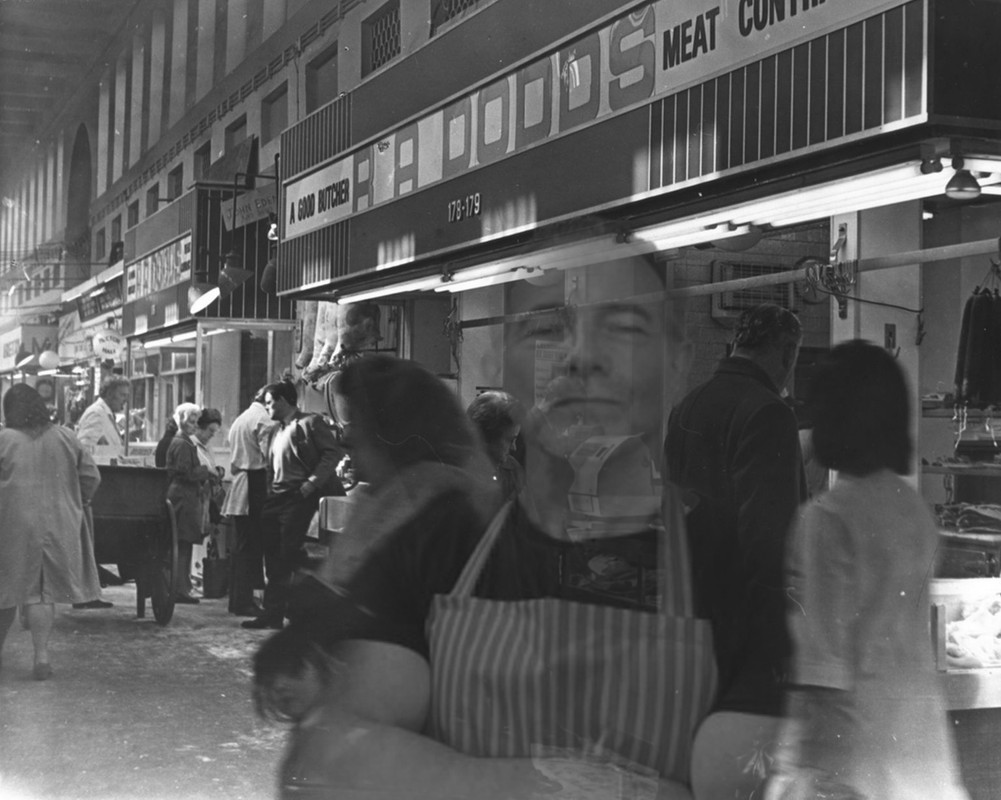
Happy Halloween - 'new' photo of notorious Newcastle upon Tyne butcher 'Jimmy Giblets'
Frank Black
31 October 2017
I almost feel that this should begin in audience-grabbing, click-bait Trinity-Mirror style with the inevitable Five Things You Need To Know about Jimmy Giblets, but we’re better than that, so I’ll tell it straight, definitely no chaser.
Regular readers will be familiar with the story of Jarrow-born Newcastle butcher Andrew ‘Jimmy’ Gibbons – or ‘Jimmy Giblets’ as he came to be known: a popular, mild-mannered, some even say affable, butcher operating in Newcastle’s Grainger Market in the late Victorian period; a nominee for the prestigious Tartes du Monde in Paris in 1882; a recipient of the Royal Stamp of Approval for his services to butchery in 1884; a brutal serial killer who disposed of his victims in the very pies on which he built his reputation.
Andrea Finley, a researcher at Tyne and Wear Archives, made a chilling discovery when compiling a book of photographs of Newcastle in the 1960s. Staring out at her from a black and white photograph of innocently oblivious shoppers looking for a suitable joint for their Sunday roast in the Grainger Market, there was the haunting apparition of ‘Jimmy Giblets’ with arms crossed and smug look etched across his weathered features.
“There’s no doubt about it: it’s him. That’s how people described him in Victorian times. Bloodied, striped apron, slicked back hair and arrogantly posing in front of his store, flexing his muscles to impress the middle class ladies who were waiting to have their pies filled personally. He looks just he does in the existing photos and etchings we have,” said Senior Archivist Trevor Halliwell.
“I was supposed to work late the night Andrea showed me what she found, but the room turned icy cold and I quickly made other plans. This is one photo that won’t make it into the book.”
No-one knows for sure what happened to Gibbons after he made his daring escape en route to Durham Jail following his arrest for murder, though rumours abound that he resurfaced in Whitechapel in 1887 and later stowed away on a steam packet to Morocco where, in a move that inspired Joseph Conrad to write Heart of Darkness, he was adopted by a local warlord, joined the Barbary Coast pirates and was known as Jimmy the Jarra Corsair. The horror, indeed.
In recent years, surviving members of the Gibbons family, who still live in Jarrow, have made claims that he was framed and that the murders were the work of a butcher’s boy from a rival store, a callow youth known only as Kelly.
See also:
http://fridaynightboys300.blogspot.co.uk/2014/09/jimmy-giblets-butcher-of-old-newcastle.html
Monday, 30 October 2017
Sunday, 29 October 2017
Saturday, 28 October 2017
Subscribe to:
Posts (Atom)