THE Friday Boys are a disparate group of men spread across Tyneside who meet once a week - 'always on a Friday' - to talk about the arts, raise a glass to recently departed heroes and villains and, at the evening's end, down a whisky or two. The FBs have only one golden rule - talk of the working week is strictly off-limit.
Thomas Bewick printing blocks to go under the hammer at Cherryburn Twelve engravings are to come out of storage to produce limited edition images to help maintain naturalist Bewick's birthplace
Tony Henderson
20 October 2015
Printing blocks carved by master engraver Thomas Bewick are to be pressed into service to raise the profile of his Northumberland birthplace.
The National Trust cares for Bewick’s boyhood home at Cherryburn in Mickley along with original blocks that he hand-engraved to produce his now famous prints of birds and other illustrations.
Twelve of these blocks will be used to produce 20 prints each, using the original methods that Bewick employed.
The 240 prints in total will go on sale during a special weekend at Cherryburn on Saturday and Sunday, November 7 and 8, from 11am to 3pm. The prints include images used to illustrate Bewick’s A General History of Quadrupeds, A History of British Birds and Aesop’s Fables, plus tail pieces which ended the chapters of publications.
They include Jupiter and the Ass, Man and Weasel, The Drunken Husband, Platypus, Walrus, The Tarcic, The Wimbrel, The Purre, The Anthus Ricardi, Two dogs, The Moon and the Stile, Dog with Worms and Dog and Moon.
Bewick is thought to have hand-engraved the blocks during the late 18th century from box wood and went on to produce many more wooden blocks.
Inspiration for many of his works came from fables and moral tales, and his book The Fables of Aesop and Others was eventually published in 1818. Christopher Bacon, master printer and a member of the Bewick Society, which promotes the life and work of Thomas Bewick, will be carrying out the printing of the impressions.
Mr Bacon, who lives in Allendale in Northumberland, said, “Printing is a passion of mine and I’m thrilled to be involved in using these wonderful blocks again for printing. “Highlighting the work of Thomas Bewick is wonderful as he was an extremely clever man with a very rare talent for capturing real-life scenes.
“To ensure these prints are recognisable as recent works, I’m printing the blocks on to a modern French paper called Lana 1590 which helps to identify the prints as a modern production and ensures a quality, long-lasting product.
“This is dampened the evening before and stored overnight ready for use the next day.”
Mr Bacon said that suitable original blocks were only used for printing every 10 years or more to help conserve them. The prints are hand printed on a press dating from 1857. “We print from them incredibly carefully, using hand-ground ink,” he said.
“The prints encapsulate the history, skill, artistic ability and vision of Thomas Bewick and will bring his work to the attention of a wider public.”
Kay Owen, National Trust visitor and site operations manager for Cherryburn, said: “We are thrilled to be able to use these wood blocks to bring history to life by showing how Thomas Bewick created his remarkable prints and to give people the chance to own one.
“If this sale is successful, we hope to do it again with different blocks from the unique Bewick collection.”
The limited edition prints will be on sale for £50 each with proceeds helping in the upkeep of Cherryburn.
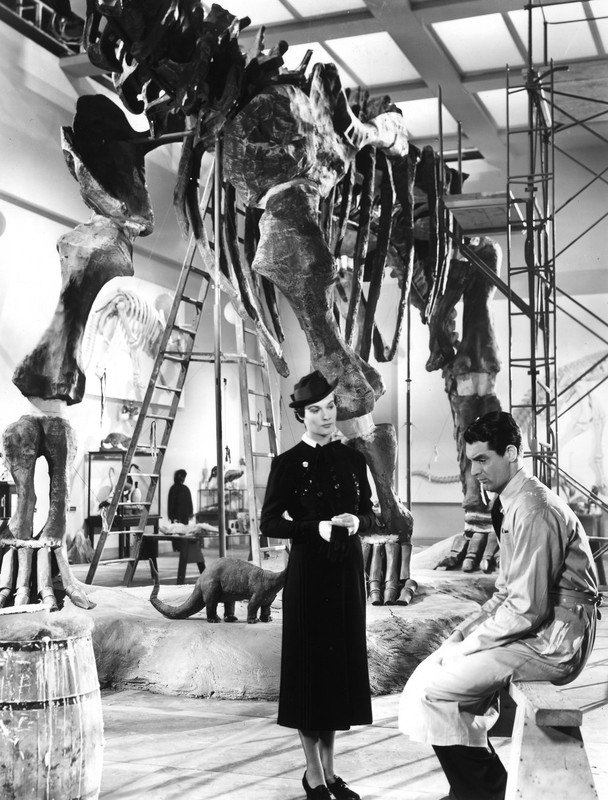
From the Thirties to the Nineties, we saw so much of John Mills that we took him for granted. There seemed to be a law in the Fifties that no British war film could be made without him. Unlike his contemporaries Olivier, Gielgud and Richardson, he was not known best for his theatrical work, which perhaps also counted against his being esteemed properly.
But his range was enormous. He could play the officer class (Above Us the Waves) or could be below decks (In Which We Serve). He could do comedy (The Black Sheep of Whitehall) or tragedy (Scott of the Antarctic). When you look down his list of works, you realise he was in a significant proportion of the greatest films ever made in this country.
What finally convinced me of Mills's greatness was his 1953 film The Long Memory, directed by Robert Hamer, whose most famous work was Kind Hearts and Coronets. The critic Jonathan Meades first alerted me to it and opened my eyes to its many facets. It is the story of Philip Davidson, played by Mills, imprisoned for a murder he did not commit. I shan't spoil the story for you, because you should watch this brilliant film: but suffice it to say it is an essay on the morality (or otherwise) of revenge, and the effect of revenge on the revenger as well as on his target. As one would expect of Hamer, who as well as directing the film also wrote the screenplay, there is nothing predictable or clichéd about his approach to the question, and there is a twist concerning Davidson's principal betrayer that adds to the film's depth.
The Long Memory shows that Mills could give a performance entirely at odds with the generally lovable or admirable types that the British cinema-going public of the Forties and Fifties was used to seeing. Habitually charismatic in his films - whether playing Captain Scott or a cheerful squaddie - here Mills is introverted, sullen, angry, and unrelievedly bitter. There is not even a touch of gallows humour.
He had hinted at this side to his acting talent in The Rocking Horse Winner, a 1949 dramatisation of a D H Lawrence short story, in which he has a crucial supporting role: and in a film of 1952, Mr Denning Drives North, where he plays a professional man who takes a dislike to his daughter's boyfriend and, by accident, kills him. It would surface yet again in 1957 in The Vicious Circle, in which Mills plays an eminent doctor who becomes the victim of a blackmailer. I recall seeing those last two films on television around 20 years ago and thinking them rather ordinary. Having watched them again recently, I can see how wrong I was, and how Mills brilliantly articulates the personal crises of the characters he plays.
As well as Mills's performance, the other outstanding quality of The Long Memory is its cinematography. The film was shot on location in Gravesend, whose post-war grimness is finely depicted, and on the desolate marshes of North Kent in the Thames Estuary, where Davidson finds an abandoned hut to live in while he attempts to settle his scores. By setting the drama against this timeless landscape Hamer not only invests the film with moments of surprising beauty and poetry, but also suggests that the question of the ethics of revenge is something that, like the landscape, is eternal.
Undistracted by the everyday world, the viewer can also concentrate on the relentlessness with which Mills pursues what he thinks are his goals: not so much to clear his name as to express his outrage against those who perverted justice in order to damage him and to escape punishment themselves. This is a fundamentally bleak view of the world, and of justice itself, and it is the darkness and cynicism of this film - the cynicism is not Mills's, but his traducers' - that set it apart from so much of the rest of his work. In the end his character attains a certain nobility; but in the film, as so often in life, there is no conventionally happy ending.
Hamer's genius - also displayed in Kind Hearts - is always to force his actors to go beyond themselves in what they say and do. John Mills certainly responded to him. If you haven't yet seen The Long Memory, you have the greatest treat in store.
The Kid From Kogarah Grows Up
Latest Readings, Clive James, Yale University Press, 2015, 192pp, £12.99 (hardback)
Terry Kelly
When Aussie polymath Clive James was diagnosed with terminal leukaemia in 2010, he could have been forgiven for bringing down the curtain on a long and glittering literary career. Instead, his unwanted contract with the Grim Reaper sparked a highly prolific second creative life. New volumes of verse, literary criticism, a translation of Dante's Divine Comedy and a poetry handbook have appeared with almost indecent haste since his diagnosis, forcing James to make a running joke of his undelivered demise. The shadow of mortality has spurred James on to continue lighting up the page, including this year's acclaimed death-haunted collection, Sentenced To Life. The newest instalment in this unexpected autumnal harvest is Latest Readings, a hymn to the pleasures, passions and obsessions of reading and collecting books. But just as importantly, James the bibliophile connects a love of reading with the larger issues of life itself, noting how 'Being book crazy is an aspect of love, and therefore scarcely rational at all.'
Latest Readings - a title surely punning on medical as well as literary concerns, especially as the book is dedicated 'To my doctors and nurses at Addenbrooke's Hospital, Cambridge, UK' - rarely reads like a valedictory book. Rather, it is a typically Jamesian collection, light on its feet, various and erudite, and packed with his trademark epigrammatic literary skills. A late love letter to favourite books and authors, old and recently discovered, it is also partly a homage to Hugh's bookstall in Cambridge, where the ailing James still trundles to replenish his already overstuffed shelves. But devotion to literature has been the guiding principle of a writer born in 1939 in Kogarah, suburban Sydney, later immortalising his early life in the bestselling Unreliable Memoirs (1980.) Arriving in England in the early 1960s, James initially endured the life of the penniless poet, before his intellectual life blossomed at Cambridge University, where he took a second degree and also developed a taste for performance as part of the Cambridge Footlights. The patronage of such inspired literary editors as Karl Miller and Ian Hamilton furthered the career of the ambitious Australian, James becoming part of the talented coterie of writers associated with Hamilton's The Review and the later and more lavish The New Review. Embracing high and low culture, James' early critical prose style was rambunctious, possessing an almost rock 'n' roll swagger. (Recalling an early 1960s reading by the urbane American poet Richard Wilbur, James wrote in The Review in 1971: 'Into the pocket of high pressure created by this performance strode Wilbur, the epitome of cool. It was all there: the Ivy League hair-cut, the candy-stripe jacket, the full burnished image of the Amherst phi beta. Riding his audience like the Silver Surfer, he took European Culture out of his pocket and laid it right on us. We were stoned.') Collecting his energetic early criticism in his first book, The Metropolitan Critic (1974), James was an unstuffy intellectual who seemed to know as much about Wittgenstein as Diana Ross and the Supremes, delighting in working in all available cultural registers, often irritating conventional academics into the bargain with his blatant disregard for aesthetic boundaries.
Clive James first made a big splash with the wider public when he was appointed TV critic for The Observer in 1972. During his decade-long tenure, James reinvented the art of TV criticism, attracting a huge weekly readership with his funny, sparkling descriptions of everyone from tennis star Bjorn Borg ('Borg runs a taut ship. He likes his headband tight too, to bring his eyes closer together') to Henry Kissinger ('All Kissinger could do was fall back on his old trick, or drick, of substituting, or subsdiduding, 'd' for 't.' His line on Vietnam was familiar. 'We inherided a dragedy.') Collected in two volumes, as Visions Before Midnight and The Crystal Bucket, James followed up his writing about TV to making it, becoming one of the most familiar talking heads on British television in the 1980s and 90s. Whether sending his idiosyncratic televisual 'Postcards' from exotic, far-flung locations of the world, cherry picking the weirdest Japanese game shows or interviewing everyone from the Spice Girls to Frank Sinatra, James' TV shows were distinguished by his trademark razor-sharp wit. But there were some who eventually questioned whether James was squandering his considerable literary talents on telly trivia and he eventually withdrew from the charms of the gogglebox. Returning to writing in earnest - which, in truth, he had never abandoned - James entered his mature second creative phase. This included launching his own dedicated website (clivejames.com) and resuming his songwriting relationship with Pete Atkin, for whom he had supplied lyrics since the late 1960s. Although never troubling the charts, the string of albums the duo produced in the 1970s represented one of the Australian's most serious creative endeavours. Spurred on by a website called Midnight Voices, supported by long-term fans, James and Atkin picked up the pieces of their words and music partnership in several late career albums, including 2015's The Colours of the Night, which, given the parlous state of James' health, represents what Atkin calls the 'natural end' of their long songwriting marriage.
Latest Readings is the result of Yale University Press asking James to 'compose a little book' about his recent reading. It is indeed a little book, but one packing a considerable critical punch, betraying few signs of its author's poor health. Illuminated by his epigrammatic gift, the brief chapters read like witty philosophical meditations on the books and writers which have meant the most to James, both old and new, ranging from Osbert Lancaster to Evelyn Waugh and from Patrick O'Brian to Olivia Manning. The favoured books are reconsidered through the prism of time and experience.
A central presence is Joseph Conrad, a touchstone for the ailing Australian for more than half a century: 'Time felt precious and I would have preferred to spend less of it with him, but he wouldn't let me go.' Revisiting Lord Jim for the first time since he was an English student at Sydney University, the older writer recognises the historical resonances he had missed in Conrad as an undergraduate, as he lies on his sweat-soaked hospital bed: 'An international historical picture is exactly what it exemplifies.' He reconsiders Hemingway, another lifelong favourite, the mature critic highlighting the imperfections in The Sun Also Rises. While recalling with fondness Hemingway's sharp narrative details - 'the chestnut trees of Paris, the running of the bulls in Pamplona' - such youthful admiration is tempered with an awareness of the American's stylistic shortcomings, including repetitious dialogue and characters merging into one. Overstatement was, James feels, a cardinal sin in Hemingway, as 'he habitually trod on the accelerator instead of the brake.'
Diverting off the literary path, James' study of movie books is evidence of his critical amplitude. He reveals he is 'always reading' My Indecision Is Final by Jake Eberts and Terry Ilott. A chastening analysis of Britain's failure to develop a Hollywood-style film industry, James feels the book underlines the necessity of balancing art and commercial nous, concluding that Britain has plenty of the former and not enough of the latter. For James, other kinds of lessons are contained in Steven Bach's Final Cut, about the making of director Michael Cimino's 'pretentious fiasco' Heaven's Gate. A hideously expensive western that ruined United Artists, James draws parallels between its delusional director and the self-inventions of Hemingway. Heaven's Gate was 'all lessons,' the most significant being the ability of critics to hail a formless movie a masterpiece. Similarly, books about World War 11 offer James more scope to brood on the lessons of history, much as he did in his ambitious, almost 900-page book of biographical portraits Cultural Amnesia (2007.) Never afraid to name-drop or shy about revealing his multi-lingual erudition, James is also given to pithy pen portraits of the great and good of history, speculating that although wartime Britain would not have survived without Churchill, 'the war would have been lost if he had been left to himself.' He even accuses Hitler of intellectual oneupmanship, questioning the Fuhrer's claim of carrying all five volumes of Schopenhauer's collected works in his knapsack during his time in the trenches. (Naturally, James has those same five weighty volumes on the bookshelves of his Cambridge home.)
In a touching coda, James momentarily dispenses with high literary concerns for the nitty gritty of serious illness. Recalling the night his catheter bag broke, flooding the hospital floor with 'amber piss,' James sings the praises of the nurse who came to his aid: 'I can only hope that the sum total of my writings has been as useful to the world as her kindness, but I doubt that this is so.' Left with one good eye after several cataract operations, James now reads his beloved books under the twin pressures of terminal illness and limited time. Composing the inscription for an imaginary plaque in his memory, James writes: 'He loved the written word, and told the young.' Latest Readings is a late-career gem from a writer continuing to rage against the dying of the light.
Ron Elderly: - Autumn Leaves Cry To Me You Better Move On
Da Elderly: - I Don't Want To Talk About It You've Got A Friend Country Girl
The Elderly Brothers: - The Price Of Love You Really Got A Hold On Me Breaking Up Is Hard To Do True Love Ways When Will I Be Loved
Packed from the off with punters and players this was a most enjoyable night of open mic mayhem. A clarinet/guitar duo entertained us with some jazzy tunes; a mandolin/flute duo did likewise in a prog-rock style. Marvellous stuff! The Elderlys pulled out two 'new' tunes from the American Songbook and held court with Everly Brothers' classics during the after-show jam.
Seeing Catch-22 Twice The awful truth people miss about Heller's great novel.
By Ron Rosenbaum
2 August 2015
Now, my father wasn't a big reader and rarely wrote letters, much less to authors. But when I went through a phase in high school of constantly carrying Catch-22 around and quoting from it and writing things like, "There was only one catch and that was catch-22" in magic marker on phone booths in the supermarket parking lot where I worked as a shopping cart retriever (superdistinguished summer job!), my father asked to borrow my copy and, to my surprise, became an instant fan.
I guess it shouldn't have been so surprising. He had served as a wartime second lieutenant and was fond of quoting to me and my sister such profound military maxims as, "There's a right way, a wrong way and the army way." (Which meant:Do things my way, right or wrong.)
And I think he was impressed when I stumped him with what I would later come to think of as Joseph Heller's hilarious refutation of Kant's Categorical Imperative.
There's a scene in the World War II novel when some officer or other reproves the novel's anti-hero, Capt. Yossarian, for trying to escape another of the ever-escalating number of dangerous bombing missions he's ordered to fly.
"Suppose everybody on our side felt that way," the officer demands, echoing Kant's imperative—that one should decide how to act by envisioning the consequences if everyone else acted that way. It's a maxim much beloved by parents. Mine, anyway.
So, if everybody else acted that way? "Then I'd certainly be a damned fool to feel any other way," Yossarian says.
Beautiful! It was one of the reasons I fell madly in love with the novel. Almost the way Yossarian says he fell for the chaplain in the first lines of the book. (Heller said he found a way to start writing Catch-22 when he heard in his head a version of the first lines: "It was love at first sight. The first time Yossarian saw the chaplain he fell madly in love with him.") It's one of the novel's amazing achievements that it may be the darkest, most profoundly negative vision of existence in modern fiction, yet it leaves you with a feeling of mad love for its crazy beauty.
Anyway my father was moved enough by his love of the novel to write a letter to Heller telling him how perfectly he had captured the absurdity of military life ("the army way") and how much it had moved him that someone understood. And it moved me that we could share this literary affection. So I was even more affected that Heller would take the time—a year after publication, just when Catch-22 was taking off and becoming the multimillion-copy best-seller it would be—to write a letter to my father thanking him for sharing his experience with the war and the military mind.
Every time I recall that, I think about the way reading Catch-22 changed my life. Maybe not for the better. Sometimes I think the book predisposed me to tangle with authority, and made me think that all authority was a joke founded upon pretense. (It's not?) But even though the book shaped me from a young age, the way I think about it changed, somewhat abruptly, about a dozen years ago.
If you remember the novel, you'll remember the chapter in the middle of the book about the soldier who "sees everything twice." (If you haven't read it, you really should get yourself a copy, and now is an optimal moment: The book is 50 years old; a biography of Heller and a memoir by his daughter are both just hitting bookstore shelves; and there's a 50th anniversary edition already in stores with an affectionate and perceptive introduction by Christopher Buckley, who became a close friend of Heller's later in his life.)
Curiously enough it was something Christopher's father, William F. Buckley Jr., published in his magazine the National Review some years ago that caused me to rethink why I like Catch-22— led me, in effect, to see Catch-22 twice. And even more curious than that was the fact that what Buckley pere had published was anattack on the novel by Norman Podhoretz, who had something of a negative obsession with the book.
Before I seek to explain my second sight (my new vision) I should probably mention that Simon & Schuster, which is publishing the 50th-anniversary edition, also published my most recent book—about what you might call the catch-22 of nuclear deterrence.
Most people see Catch-22 as an "anti-war novel." But I'm not sure that's exactly right, or that it goes far enough.
There's a brief passage in Chris Buckley's introduction to the new edition in which he quotes from a letter written to Heller by Stephen Ambrose the historian: "For sixteen years," Ambrose wrote, I have been waiting for the great anti-war book which I knew WWII must produce. I rather doubted, however, that it would come out of America; I would have guessed Germany. I am happy to have been wrong. Thank you."
This is a bit puzzling: Wasn't World War II supposed to have been "the good war," one of the few in history in which there was relative moral clarity? And didn't Ambrose write Band of Brothers for Spielberg, a script that was realistic about war but not anti-war. We were seeking to defeat Adolf Hitler after all.
This was the point that Podhoretz was making in his attack on the novel:
In due course even World War II fell victim to the onslaught of the antiheroic ethos that was resurrected in the Sixties and given even greater currency by Vietnam. Joseph Heller's novel Catch-22 is the key document here. Though published in the early days of American involvement in Vietnam, Catch-22 was a product of the new climate, and so powerful was this climate already becoming that Heller not only got away with but was even applauded for what a few years earlier would have been thought virtually blasphemous—showing up World War II as in effect no different from or better than World War I. As Heller portrayed it, there were no heroes in that war; there were only victims of a racket run by idiots, hustlers and thieves.
I think I can speak for my father in saying that Podhoretz, who has written repeated attacks on the book, has missed the point, or lets a lack of a sense of humor obscure it. But sometimes an attack can have a clarifying effect on why one really values a book and this was the case here. I remember being indignant when I when I first read it. For Podhoretz, Yossarian was not the lovable, shambolic, subversive anti-war anti-hero I (and almost everyone else, particularly of the Vietnam generation) thought him to be. He was a shameless, shameful shirker.
In refusing to go on bombing missions after the requisite number kept being raised by self-serving commanders every time Yossarian came near fulfilling the quota, and by causing the scrubbing of planned missions, Yossarian was either condemning others to die or risk death in his place. He was undermining, Podhoretz argues, in an immoral, cowardly way, what was generally agreed to be a virtuous cause, however bungled its execution.
The people who defended Heller, Yossarian, and Catch-22 from critiques like Podhoretz's tended to say, Well, the war was just about all over! Already won! The missions were hardly even necessary; the commanders were foolishly and unnecessarily condemning the fliers to death by ordering extra missions.
I was satisfied with that for a while, and I kept on rereading Catch-22 with even more defiant pleasure. But after a while, probably after the time I spent writing Explaining Hitler, I began to rethink that defense, and to find it deficient. And re-examining the book opened the door to a new way of looking at Catch-22, one that saw it as even more profound.
First the factual background: If you examine the state of the war at the time when the novel is set more closely, you have to concede the war wasn't "over," in the sense of having been definitively won. (I've just done a new introduction to the 50th-anniversary edition of William Shirer's The Rise and Fall of the Third Reich, which sensitized me to the chronology of the war.) There is no mention of Normandy in the novel, the Herman Goering Division is still a force to be reckoned with, even the Italian campaign was not a done deal. Mussolini is still in power in the novel, so its time frame must be 1943. Which means there was a lot of significant, potentially disastrous fighting yet to be done and that those bombing runs that Yossarian is shirking—even if they were ordered by preening idiots with no concern for the air crews or the war beyond the opportunity for self-promotion—had significance.
Which means that on strictly moral grounds, Podhoretz may have had a point. If you want to admire Catch-22 as an anti-war novel, you can only reasonably do so from a strictly pacifist position. What if everyone acted like Yossarian? Well, maybe he'd be a fool not to have done so, but Hitler might well have remained in control of Europe.
So where does that leave us? It left me thinking that to regard Catch-22 merely as an anti-war novel is a mistake. Even to regard it, as many critics do, as about "mortality" diminishes its scope. After all, Yossarian's much ballyhooed "discovery" of mortality at the end of the novel is not much of a discovery, however "hands on" it may be. (Spoiler alert: His fellow crewman Snowden suffers a horrendous flak wound and literally spills his guts into Yossarian's hands; the incident, recounted at the end of the book, takes place early on in the chronology and may well be what triggered the overt symptoms of rebellion we see in Yossarian throughout.) Even so, there's no shortage of novels that dwell on the tragedy of mortality.
I think Heller's argument was not with war or with death but with God. That the novel is less about the death of Snowden than "the death of God," as that theological tendency was known back then. That what the novel is really about is theodicy. Theodicy being of course the subcategory of theology which attempts (and studies the attempts) to reconcile human suffering, cruelty, and evil with the existence of an all-powerful, all-knowing, loving God. Heller doesn't think it can be done.
He makes this extremely daring, radically blasphemous argument—essentially that God is, if not evil, then hopelessly incompetent—most explicitly in the chapter about the soldier who "sees everything twice."
It's in Chapter 18. (Purely coincidence I'm sure, but by now everyone knows the story of how Heller had originally titled his novel Catch-18 but—because he learned at the last minute that popular novelist Leon Uris was coming out with a book entitled Mila 18—he and his editor and publisher decided to change the title to Catch-22. There has been much speculation about why they chose 22, as opposed to another number, and I have a theory I shall relate in a moment.)
But to set the stage: Chapter 18 takes place in the airbase hospital to which Yossarian has once again repaired, hoping to convince the doctors he's sick enough to avoid flying any more missions even though he's perfectly healthy.
This dodge has been wearing thin, which is all the more reason Yossarian is impressed by the scam invented by a fellow airman in his ward. The guy suddenly sits up and shouts, "I see everything twice!"
Chaos follows. "A nurse screamed and an orderly fainted," Heller writes, "Doctors came running up from every direction with needles, lights, tubes, rubber mallets and oscillating metal tines. They rolled up complicated instruments. ..."
It's in keeping with the novel's trademark absurdist genius that everyone seems to take terribly seriously the condition of "seeing everything twice" even though, if you stop and try to think what that means, it makes no logical sense at all. (It's not double vision.) And yet it seems incredibly suggestive, whatever it is. Perhaps a distant reference to Marx's version of Hegel in The Eighteenth Brumaire of Louis Napoleon :Everything in history happens twice: First time as tragedy, second time as farce. Not a bad definition of Catch-22's literary genre: tragedy/farce.
The doctors struggle to decide which specialist should get to treat this unique but inexplicable syndrome and the airman gets to stay in the hospital. Before long Yossarian tries this gambit himself:
"The leader of this team of doctors was a dignified, solicitous gentleman who held up one finger directly in front of Yossarian and demanded, 'How many fingers do you see?' "
"Two," said Yossarian.
"How many fingers do you see now?" asked the doctor, holding up two.
"Two" said Yossarian.
"And how many now?" asked the doctor, holding up none.
"Two"" said Yossarian.
"The doctor's face wreathed with a smile. 'By Jove he's right,' he declared jubilantly. 'He does see everything twice.' "
"They rolled Yossarian away on a stretcher ... and quarantined everyone else in the ward for another fourteen days."
I always loved this scene for its Marx Bros. refusal of logic and the fact that everyone accepts it as logically possible. And I think the scene is a key analog to another instance of the genre of black humor/aburdism that was so influential in American culture of the latter half of the 20th century. I have a strong feeling the awareness of the "seeing everything twice" line crept into Bob Dylan's absurdist "Stuck Inside of Mobile (With the Memphis Blues Again)". In those lines Dylan sings: "An' here I sit so patiently/Waiting to find out what price/You have to pay to get out of/going though all these things twice." It's no fun going from tragedy to farce.
But for me, the high point of the "I see everything twice" chapter, perhaps the thematic high point of the book, is Yossarian's astonishingly scathing denunciation of God.
It comes between the first time he sees the soldier who sees everything twice and his decision to pretend that he does, too.
This is the key theodicy (or anti-theodicy) passage that makes Catch-22 in its own way a religious (or anti-religious) novel. It grows out of an argument Yossarian recounts having the following year (time schemes are not rigidly adhered to in Catch-22), an argument with the wife of his commanding officer Lt. Scheisskopf. (Occasionally, subtlety isn't either.)
It's Thanksgiving Day and she's reproving Yossarian for not being thankful, and he says, "I bet I can name two things to be miserable about for every one you can name to be thankful for."
Among her responses: "Be thankful you're healthy."
"Be bitter you're not going to stay that way," he says.
"Be glad you're even alive," she says.
"Be furious you're going to die," he counters.
They continue until Yossarian launches into a page-long denunciation of God that I think is the blasphemous heart of the book:
"And don't tell me God works in mysterious ways," Yossarian continued, hurtling over her objections. "There's nothing so mysterious about it. He's not working at all. He's playing or else He's forgotten all about us. That's the kind of God you people talk about—a country bumpkin, a clumsy, bungling, brainless, conceited, uncouth hayseed. Good God, how much reverence can you have for a Supreme Being who finds it necessary to include such phenomena as phlegm and tooth decay in His divine system of creation? What in the world was running through that warped, evil, scatological mind of His when He robbed old people of the power to control their bowel movements? Why in the world did he ever create pain? ... Oh, He was really being charitable to us when He gave us pain! [to warn us of danger] Why couldn't He have used a doorbell instead to notify us, or one of His celestial choirs? Or a system of blue-and-red neon tubes right in the middle of each person's forehead. Any jukebox manufacturer worth his salt could have done that. Why couldn't He? ... What a colossal, immortal blunderer! When you consider the opportunity and power He had to really do a job, and then look at the stupid, ugly little mess He made of it instead, His sheer incompetence is almost staggering. ..."
Wow! It's a tour de force of anti-Deism. People speak too narrowly when they talk of Catch-22 as a satire of humanity. It's that, yes, and there are few better. But it's really a vicious satiric attack on God, as much as his poorly made creatures. This denunciation of God comes from the heart—Yossarian's, anyway—and transcends any denunciation of the evil of war. It's about the evil of existence itself and the creator of that existence and that evil.
I actually think that the importance of this passage dwarfs the obviousness of the passage about Snowden's death, which critics tirelessly tell us is the supreme moment of the novel. Yossarian's supposedly shocking discovery of mortality just does not live up to the metaphysical venom of this novel. OK, it's horrible to have someone's guts spill into your hands, but give me a break, he's been through war, he's seen death.
But the passage in the "I see everything twice" chapter is far more caustic, scathing, and deeply shocking and disturbing. Because it's not saying "death is bad." It's saying life is bad, existence is horrible. Why, in fact, get all upset about leaving the shambles of existence this deranged "country bumpkin" Creator has bequeathed us?
Once you get this you see Catch-22 twice or maybe for the first time.
I still love the book the way I used to, I still find it funnier than almost any other piece of literature. But there is a hidden "what's so funny here, anyway" aspect to the book as well, once you get beyond the war-is-hell and the officers-are-idiots. Life is hell. What kind of God created a world in which we'd have a Hitler to fight in the first place? Oh, it's a test, you say? Give me a spinal tap (in fact, give me Spinal Tap) instead.
Indeed, thinking about it in this way I wonder if both my father and I were touched by the same intuition that the novel is both tragedy and farce with a bleak vision of existence that encompasses far more than mere military madness.
And rereading the "everything twice" chapter for maybe the 10th time I had another intuition, perhaps a bit far-fetched: I think this passage is so fundamental I'd speculate that the choice of Catch-22 to replace Catch-18 can perhaps be linked to the "I see everything twice" chapter. Maybe it was unconscious, but think of the number 22: It's seeing two, twice. I rest my case.
From princes to paupers: how Goya’s portraits tell the story of Spain Whether depicting ugly royalty or the poor of Madrid, Goya painted the person first and their position second. The first major UK exhibition of his portraits celebrates the artist who captured a nation’s history, traumas and traditions through the faces of its people
Michael Prodger Saturday 26 September 2015
There are, according to current scholarship, 160 existing portraits by Francisco de Goya – about a third of his painted output. The real number, though, is much greater since there are no pure landscapes in Goya’s work, in that everything he ever painted deals with people. In the work of no other great portraitist are a nation’s people, history, traumas, folk traditions and superstitions so comprehensively and relentlessly captured. Titian, Holbein,Van Dyck and Rembrandt were superlative painters of the human face and figure but they made a distinction between their portraiture and their other work. Goya didn’t. Put his work together – the public and private paintings, the personal drawings and sketches and the unsettling and sinister etching series – and what you have is a portrait in the round of Spain itself.
His subject was a good one since Goya lived in interesting times: his lifetime (1746-1828) was a period that saw Spain pass through the ancien regime and the effects of the French Revolution, the Napoleonic wars and the restoration of the monarchy; it was ruled by a succession of authoritarian and liberal governments; and was simultaneously marked by the Enlightenment, fervent Catholicism and a widespread belief in the supernatural. Goya went from provincial obscurity to the Madrid court and later self-imposed exile in Bordeaux. And aged 46 he went deaf: as Spain entered its most cacophonic period he couldn’t hear what was going on around him, only see.
People were the constant during these unstable times and he recorded both the faces of those who mattered to Spain and to him – often they were one and the same. The new exhibition at the National Gallery, Goya: the Portraits, is the first major UK show to look at his portraits alone. As with Rembrandt, the demotion of previously bona fide works (including, in preparation for this exhibition, perhaps the National’s own Doña Isabel Porcel) has meant whittling down numbers but, because some 70 works will be gathered together, this show gives a chance not just to trace Goya’s development but examine in depth the types of people he painted and how he painted them.
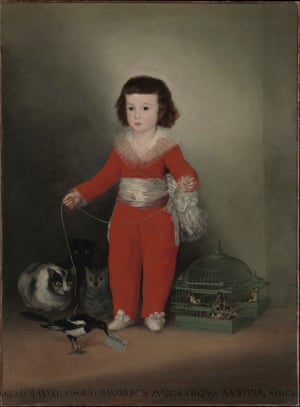
Manuel Osorio Manrique de Zuñiga, 1788, aka The Boy in Red
The organisers are pitching Goya as the “father of the psychological portrait”, a difficult claim to prove, especially in the light of his statement: “I have had three masters, Nature, Velázquez, and Rembrandt.” Add in Titian, whose works he saw in the royal collection in Madrid, and Goya joins a very select group rather than standing on his own. Psychology in portraiture is in the eye of the beholder but in his etchings, forLos Caprichos, for example – showing folly, witchcraft and superstitions – it is at the very heart of the matter.
Goya was 37 by the time he painted anyone’s face other than his own. Prior to that he had been a painter of religious scenes around his home city of Zaragoza (at the Charterhouse of Aula Dei outside the city and in the imposing Basilica of Our Lady of the Pillar) and then scenes of everyday life for the Royal Tapestry Factory in Madrid. Although he studied under José Luzán and later Francisco Bayeu, who became his brother-in-law in 1773 when he married Josefa “Pepa” Bayeu, Goya remained largely self-taught. In the 1760s he tried twice to be accepted into the Royal Academy of Fine Art but was rejected (the first time receiving no votes at all from the academicians), and so to further his artistic education he self-funded a two-year visit to Italy.
His work as a portraitist has its origins in the 45 tapestry cartoons he painted after he moved to Madrid in 1775. Although his designs don’t show portraits, they do show types – the majos and majas who gave Madrid its street swagger, peasants and rich men, courting couples, singers, hunters, children, and young men and women playing blind man’s buff or tossing a mannequin into the air. The pictures have a light, rococo palette and the faces are individualised without being those of individuals. But in them Goya practised poses and groupings and a way of handling light on and around figures that was to be invaluable.
The tapestry designs also show social roles rather than the people inhabiting them, but when it came to painting portraits proper, Goya would turn this on its head. His greatest strength as a portraitist is that regardless of the status of the sitter, be they a king and queen, the Duke of Wellington or a doctor or writer, it was the person he showed first and their position second. It was this trait, most apparent in his royal portraiture, that has led him to be seen as satirising the Bourbon monarchy rather than as a painter who depicted what he saw without showing obeisance to the usual flattering conventions. In Robert Hughes’s phrase, he did not “pay reflexive homage to authority” but instead walked a fine line between respect and truth.
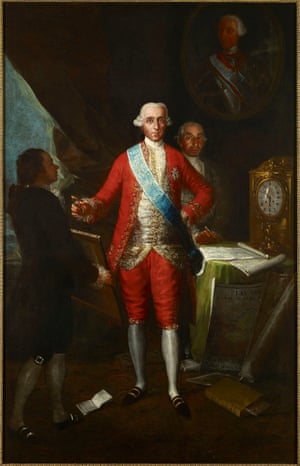
The Count of Floridablanca, 1783
In 1780 Goya was finally elected a member of the Academy and when his first portrait commissions arrived they came from the nobility. In 1783 he painted the Count of Floridablanca, the reforming first minister of Charles III and, in 1784, his breakthrough work, The Family of the Infante Don Luis de Borbón, which was a paean to Velázquez’s Las Meninas. Don Luis (a man, according to Casanova, “laid à faire peur” – “so ugly it was scary”) was the king’s younger brother, sent into internal exile for taking time off during a royal hunting expedition to refresh himself with prostitutes placed strategically in the woods by his entourage.
Goya painted the roué as a reformed character – an uxorious husband, gathered with key members of his 550-strong household to watch his wife María Teresa have her hair done (Don Luis’s first prospective bride, the king’s daughter Maria Josefa, refused him on the not unreasonable grounds that he was still recovering from venereal disease). It is a candle-lit scene that pulses with intrigue: as well as the Infante (engrossed in a game of cards), his wife and their children, Goya showed himself, à la Velázquez, at his easel; a figure that might be the composer Boccherini; another – in a nice jibe – seems to be rival painter of Goya’s and a third who has been identified as María Teresa’s lover. For a first full essay in group portraiture it is remarkably daring, both in its technical accomplishment and in the strange and charged mise-en-scéne it depicts.
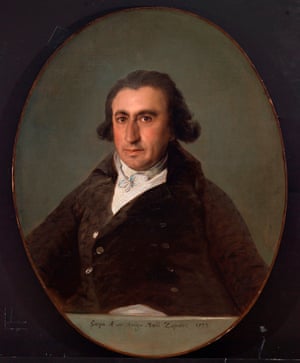
Martín Zapate, 1797
Goya’s success was rapid; in 1785 he was made deputy director of painting at the Royal Academy (his main message to his students was subversive – “there are no rules in painting”) and in 1786 became pintor de cámara, required to paint “works required for royal service”. He immediately spent some of his 15,000-reales salary on a two-wheeled gig (one of only three in Madrid) which he promptly crashed on his first outing. His amour propre untouched, he wrote to his childhood friend Martín Zapater: “I have now established an enviable way of living: I do not wait on anyone in antechambers, and if anyone wants anything from me they must come to me; I have made myself more in demand and unless it is a person of rank or at the request of a friend I would do nothing for anyone …” Five years later he blew his own trumpet even more forcibly: “From the king downwards everyone knows me.”
Part of the reason for his success was that, unlike Gainsborough, for example, he did not resent portraiture as an economically necessary chore that ate away at the time he could devote to higher art. Portraiture fascinated him; it was, after all, part of that “sacred science which requires so much study” and his portraits reveal a fully engaged artist. There is hardly any repetition in his poses (to help, he drew on prints of English portraits as well as classical statuary), he worked hard to give his sitters in repose a sense of latent movement and he defined them by the careful depiction of the space around them. When it came to clothing he allowed himself extraordinary freedom, the frogging on uniforms or lace on a dress sketched in thick impasto rather than being laboriously defined. From close up such three-dimensional scumblings look out of focus but from a distance they coalesce into silks, braiding and gauze. Such varieties of technique within a painting keep the eye entertained and moving.
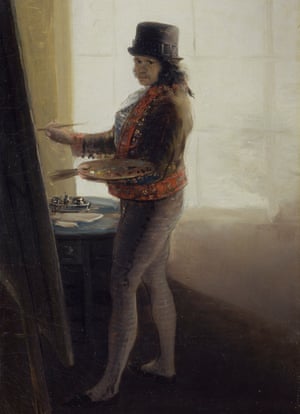
Shortly after the painter’s death his son Javier, the sole child of seven to survive, wrote of his father’s portraits: “Those that he did in one session are much acclaimed. He painted only in one session, sometimes lasting 10 hours, but never as the light was fading and the final touches he would apply at night, with artificial light.” A self-portrait of the early 1790s, shows exactly that, the painter silhouetted in front of his easel and wearing a metal band round his hat to hold candles to light those “final touches”.
Public success was, however, tempered by private sadness. In 1792 and 1793 he suffered a serious illness followed by a cerebral attack – described by a friend as “apoplexy” – which left him deaf. Electrotherapy treatment did not work. When in 1798 he painted the liberal statesman Gaspar Melchor de Jovellanos in an attitude borrowed from Dürer’s Melancholia, the painter’s sensitivity towards the man with the weight of Spain on his shoulders was in part reciprocal. Goya had commented on the solicitude shown to him by Jovellanos who made sure he stopped chewing when communicating with the deaf painter and used his hands clearly to gesticulate his thoughts.
Portrait of the Duchess of Alba, 1797
Deafness was no impediment, though, when in 1794 the Duchess of Alba, the highest aristocrat in the land, “barged into my studio yesterday to have her face painted”. Makeup duly applied, Goya went on to paint several portraits of her. He had already painted her husband and mother-in-law – one of the connected series of extended family commissions that mark his work. Despite rumours, there is no evidence they were lovers (nor is she the model for the Naked Maja) but rather that he was an honorary member of her household. As such he had privileged access and made many intimate sketches of her – tearing at her hair in a fit of rage, teasing her former nanny, tenderly holding her adopted black child – as well as a pair of bravura full-lengths.
One of these shows her in white and the other, which will be at the National Gallery, in black lace with a red sash, pointing to the words “Solo Goya” (“Only Goya”) written in the sand at her feet. It is a picture that gives the lie to the words of one French visitor to Madrid, who reported pantingly: “The Duchess of Alba has not a single hair on her head that does not awaken desire. Nothing on earth is as beautiful as she is …” Goya shows her not as a full-on beauty but as a somewhat imperious and physically insistent character. In her will she left numerous bequests to her servants, with one to Goya’s son.
“My work is very simple. My art reveals idealism and truth,” Goya claimed. The truth though is always more apparent than the idealism. In the most important commission of his career, for example, the portrait of Charles IV and the royal family of 1800, he eschewed entirely the grandeur of majesty to portray the assembled Bourbons as they appeared – a motley grouping (a French visitor had likened Charles and his queen Maria Luisa to a butcher and his wife) in fancy clothes. Goya may have been a political liberal but he wouldn’t have jeopardised his hard-won new position as first court painter – the first Spaniard since Velázquez to hold the role – in order to score political points at the expense of his patrons.
That his sitters didn’t regard the portrait as unflattering was evidenced by succeeding royal commissions, not least his 1815 portrait of Ferdinand VII. Ferdinand himself was physically unprepossessing, tyrannical, vicious and small-minded and that is exactly how Goya shows him. The king, however, looking in Goya’s particular mirror, saw no such characteristics staring back at him.
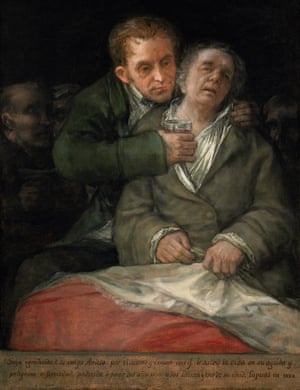
Self-portrait With Doctor Arrieta, 1820
The private side of Goya’s portraiture was a world away the public. The contrast between the Ferdinand portrait and the remarkable 1820 double portrait showing Goya with Dr Arrieta represents a moral version of the three ages of man – the 73-year-old painter in the throes of a debilitating illness being tended with the utmost tenderness by his doctor. If Ferdinand represents human malignity and Goya its frailty then Arrieta stands for man’s innate goodness.
While not all his portraits are successful (some have a doll-like stiffness), this is what Goya at his best could do: in the guise of representing individuals he showed, without judging, man as a universal being.
There is a macabre but appropriate coda to Goya’s story. He died in Bordeaux in 1828. In 1901, when his body was exhumed for transferral back to Spain, the skull was missing. Among the explanations suggested were that it was stolen by a phrenologist or taken by a medical student who, as an experiment, filled it with dried chickpeas which he soaked with water until they expanded and the bones broke. There is also an 1849 painting by Dionisio Fierros in the Museo de Zaragoza that purports to show the skull. What happened to it, however, remains a mystery. The painter who got inside the heads of so many others eventually lost his own.
• Goya: The Portraits is at the National Gallery, London WC2, from 7 October.
X-Files revival inspired by surveillance revelations, says show's creator
Chris Carter says time is perfect for Mulder and Scully to return to TV, amid climate of paranoia, state spying and hacking collectives
Stuart Dredge
Tuesday 6 October 2015
The new series of The X-Files has been partly prompted by recent exposés about government snooping, according to the show’s creator, Chris Carter.
“It’s a perfect time to come back with the X-Files considering global politics,” said Carter, who was speaking in Cannes shortly after the first episode of the new series had premiered.
“We’re trying to be honest with the changes dealing with digital technology: the capability of spying. Clearly we’re being spied on in the US – or at least spying on you – and there seems to be no shame in it.”
The new six-episode series reunites agents Mulder and Scully – reprised by David Duchovny and Gillian Anderson – with its first episode setting up a series arc promising “the most evil conspiracy the world has ever known”.
Fans can expect some tearing up of history – “Roswell? That was a smokescreen” – and some sharp observations on developments in national security since the 9/11 attacks. There is also fresh insight into Mulder and Scully’s relationship.
Following the screening at the Mipcom conference, Carter said he had never lost his appetite for the show. “Every day I look at the newspaper and I see a possible X-Files episode,” he said. “I did it for a long time and you never quite lose the eye for what would be good X-Files storytelling.”
He described the show as “a story about the modern pursuit of science by scientists”, and while admitting that he was part Mulder and part Scully in his views on all things extra-terrestrial, he said: “Believe it or not, I’m a sceptic. I’ve never been visited by aliens.”
Carter praised Duchovny and Anderson, saying their chemistry was the reason that The X-Files was so successful first time round and has been so fondly remembered by fans since. “If not for them, the anchor wouldn’t be there. We’ve told good stories along the way but without those two characters and their involvement, I think you’d have had less of a show,” he said.
Carter said he was optimistic of making more new series after the new six-episode run, but warned that they would not be as long as the original seasons. “For the future of X Files, if we are to come back, I think you’ll see us come back with these mini-series, if you will. Special events. We used to tell a story over a long saga, 22 to 25 episodes. Now the arc is much sharper, from one to six. So I think we pack a lot more in to these six episodes.”
Carter was careful to keep spoilers to a minimum during his interview, although he hinted at surprises for fans hoping for more characters from the original series to reappear. But possibly also some shocks. “Modern television asks that you kill off a main character very quickly,” he said. “I can tell you that … well, I’m not going to tell you!”
One new character, Tad O’Malley, a conspiracy theorist who makes online videos, is based on Carter’s own web surfing in the years since The X-Files was last broadcast. “Right now in the internet there are 500 conspiracy sites, and there are people like Tad O’Malley out here who have got the public’s attention. And I’m interested in these people,” he said.
Carter said the new series would include at least one “monster-of-the-week” episode – a standalone story featuring a single alien – but that they would also explore the mythology of the X-Files characters. He is already planning for the future. “I love telling X-Files stories. The truth is out there! If we satisfy audience expectations, certainly there’s an opportunity,” he said. “Mulder and Scully will be in wheelchairs before they are wheeled off stage!”
Decoding the 'X-Files' set: What does it all mean?
Jeff Jensem
Entertainment Weejly
26 June 2015
Chris Carter breaks down some of the items that can be seen on the set of Mulder’s home in The X-Files 2.0.
1. Vacuum Cleaner
“The idea here is that Mulder has kind of moved into his living room. It should suggest something else about Mulder that I won’t spoil, but Mulder has moved into the central room of his house, and everything that might come into play in such a messy house is in that room.”
2. Newspaper Clippings and Graphs on the Wall
“There’s a theme here on this wall, a UFO/extraterrestrial theme. This is the accumulation of a man’s obsession,” Carter says.
3. VCR
Those VHS tapes? They’re meant to suggest one of Mulder’s edgier character traits: his appreciation for porn. Carter states, “Mulder’s porn addiction is currently firmly in check. These are remnants of a former obsession.”
4. “I Want to Believe” Poster
Composed of hundreds of tiny photos, this Easter egg is the creation of a fan group called X-Philanthropy that asked fellow “X-Philes” to buy a spot in the mosaic, with proceeds going to Gillian Anderson’s SA-YES charity.
5. Trunk
“The tattered furniture here -represents Mulder’s tattered life,” says Carter. “Mulder has always been a fringe dweller, in every sense of the term. You can imagine him on the outskirts of society, and maybe sanity.”
6. Map on the Wall
A chart of UFO sightings, of course. (That’s a lot of probing.)
Ron Elderly: - Sweet Virginia Here, There And Everywhere Wild Horses My Hometown
Da Elderly: - Too Far Gone After The Gold Rush When You Awake Across The Great Divide
The Elderly Brothers: - When Will I Be Loved Love Hurts Lola Dream Baby Bring It On Home To Me Crying In The Rain Need Your Love So Bad
The evening started well with a full and attentive crowd in the bar; plenty of players too. As time passed the audience thinned somewhat, but those who stayed were treated to the usual kaleidoscope of musical styles. Yours truly debuted two songs from the wonderful The Band album (aka the brown album).
With his first solo album re-released (no extra tracks, unfortunately), the publication of a new biography and the 'official' release of one of his 1981 concerts (but not in Japan or the USA), it's time for an interview with Carl Wilson...
The Beach Boys
High Times and Ebb Tides
Carl Wilson Recalls 20 Years With and Without Brian
Geoffrey Himes
September 1983
The following article originally appeared in Musician, Sept. 1983. Most of the text has been omitted, and just Carl's quotes have been excerpted.
... A bushy, brown beard wraps around Carl's chubby, cherubic face as he stands by the window of his house at Colorado's Caribou Ranch. The snow-capped Continental Divide looms through the window...
Carl as Brian's apprentice:
I've always been the one who worked real closely with Brian. I was his sounding board; I was his underling. I always tagged along. In addition to being one of the players in the studio, I worked with him in the control room, because he wanted my ear.
"Surfer Girl":
"Surfer Girl" has a real spiritual quality to it. I don't know whom he wrote it for, but there's a real heart attached to that. The chords are just so filling. For its time, the record was so advanced. It was really beautiful to be alive when that record was playing. The way our voices sounded on that, the melody Brian wrote, the way he put the arrangement together, that might be the perfect melding of all the elements. It's very enchanting; it's very Brian.
If you think back to 1961, the records then were pretty nerdy. Our stuff way very appealing: all over the country, people wanted a neat car and a girlfriend or boyfriend, people wanted to hang out at the beach. It was really an early hippie thing.
Brian created this whole world at home at his piano, and people were mad to get to California. There was an awe connected to California and the beach and the way we lived. Those were the people who were really cool. But it wasn't the real California so much as the California in Brian's songs.
Growing up and the early days:
I remember music was always present. My dad was a part-time songwriter, and we always had a couple of pianos in the hose and a jukebox. We had a garage thatmy dad fixed up into a den. We'd all get around the piano; my mom would play, and later Brian started to play. By age ten, he already played great boogie-woogie piano.
Brian was in love with the Four Freshmen's approach. He would play the piano for hours, really studying. As he got better at it, he'd start to do his own arrangements of their arrangements.
When I was ten, I'd have to sing a background part. The thing about that kind of modern jazz is that the parts are very strange; it's not like singing Christmas carols. I had to listen really hard; they weren't your regular three-chord tunes. If I'd make a mistake, he'd say, "No, it goes like this," and I'd have to do it again until I got it right. Just so it would be more fun, I started to learn my parts more quickly. It was great training. By the time I was fifteen, I could hear a part once and have it.
[Dennis] was the only real surfer in the group. I tried it, but I was never good, so I gave it up. Dennis was really living it; this was his life. I remember everyone was bleaching their hair; Brian tried it and it turned out a very unnatural orange - very funny. But Brian drew on Dennis' experiences. I remember Brian would drill Dennis on what was going on, really pump him for the terminology and the newest thing. Dennis was the embodiment of the group; he lived what we were singing about. If it hadn't been for Dennis, the group wouldn't have happened in the same way. I mean, we could have gotten it from magazines like everyone else did, but Dennis was out there doing it. He made it true.
Mike went to Dorsey High, and most of his classmates were black. He was the only white guy on his track team. He was really immersed in doo-wop and that music, and I think he influenced Brian to listen to it. The black artists were so much better in terms of rock records in those days that the white records sounded like put-ons.
"Surfin'":
It was my guitar, Alan had the upright bass, and Brian played a single snare drum with a pencil, and that was it. Brian took his shirt off and put it over the drum because it was too loud. We did it all at once, with Michael on one microphone and the rest of us on another.
Dennis was so thrilled, because he was living it. He went to school and his friends said, "We were on our way home from the beach, totally exhausted from riding the waves all day. We heard your record come on, and it turned us on so much that we went back to the beach."
"Surfin' USA":
When we heard "Surfin' USA," we just knew it was going to be an undeniably big hit. It was the first time we were aware we could make a powerful record. Brian had this idea to change "Sweet Little 16" into "Surfin' USA." We were total Chuck Berry freaks, and the original Chuck Berry record is a fabulous record, but we made it our own.
My first guitar was a Kay. I would mute the strings a bit to get that clipped surf sound. I'd just hit the strings lightly with the palm of my picking hand to give it more of a percussive sound. It was a style that became popular in southern California with a lot of surf bands. Most of them were guitar bands, though, and we surfaced because we had the vocals.
I combined that surf style with a white approach to the Chuck Berry style. Our sound was very clean; we had big amps that made a clean sound, while he was just turning his amps up and cranking. I used a Stratocaster on the early records. We were young and foolish; we wanted the biggest, best, newest, most powerful thing: Fender amps, Showmans, Dual Showmans... Brian played Fender Precision bass on the early records; it was a great recording bass. Dennis was into Camco drums for a long time. the snare was good and bright and it had a full range. He used Zecos for a few years; he still has a set to record on.
Harmony:
Everyone sensed their part. When Brian would present a song to us, we would almost know what our part would be. Michael always sang the bottom; I would sing the one above that, then would come Dennis or Alan, and then Brian on top. We had a feeling for it. It's not widely know, but Michael had a hand in a lot of the arrangements. he would bring out the funkier approaches, whether to go shoo-boo-bop or bom-bom-did-di-did-did. It makes a big difference, because it can change the whole rhythm, the whole color and tone of it. We're big oooh-ers; we love to oooh. It's a big, full sound, that's very pleasing to us; it opens up the heart.
Alan's voice has a bright timbre to it; it really cuts. Brian's voice is very complete. He's not using it now; it's really sad. But when he does, he has a very thick voice. Our voices are voiced like horn parts, the way those R&B records made background vocals sound like a sax section. They're all within the same octave; that's really the secret to it. We didn't just duplicate parts; we used a lot of counterpoint, a lot of layered sound. Obviously, Brian's influence is now massive.
Early production:
Brian was really the one making the records. Nick [Venet] would call out the take numbers, but he wasn't part of making the music. When Brian said he wouldn't work with Nick anymore, Capitol sent over this other guy. Then it became clear to Brian, and he said, "Look, I'm not cutting with these guys, and what's more, I'm not going to use your studio. We'll send you the next record." Now this was a big thing in those days, because record companies were used to having absolute control over their artists. It was especially nervy, because Brian was a 21 year old kid with just two albums. It was unheard of. But what could they say? Brian made good records. He wouldn't work at Capitol, because it was a crappy-sounding studio. It had a fabulous string sound, and that was great for those records that Nat King Cole made, but not for rock n' roll guitar. So we recorded at Western Recorders, which was really our home.
"In My Room" is a tune we've learned to appreciate more as the years go by. You can tell it's getting pretty close to home for Brian, and all those tender, vulnerable things are coming out. "California Girls" is a very artistic record for its time. The guitar part by Ray Pohlman and myself in the introduction was very different, very bizarre. You didn't expect a rock n' roll record to sound like that, classical and majestic. Then it came on like gangbusters out of nowhere.
Brian was evolving very fast. We learned as we went. He was writing stuff that really needed to be performed; that's why he needed session players.
Brian just adored Phil [Spector]; he couldn't get enough of him. Brian started going to Phil's sessions, and it just blew him away. Phil would play things back so loud it was scary. I think the psychological and emotional impact of going in and hearing songs before they came out made him totally fascinated with Phil, under a spell almost. That was Brian's kind of rock; he liked it more than the early Beatles stuff.
When Brian first heard a record, he would get the whole thing at once. The rest of us would have to listen ten times or so to really get everything that was going on. So when Brian taught us our parts, he had the total picture in his head.
I remember a date at Gold Star one night. There were a lot of players in the room. They were making a big, big sound, and Brian said, "Whoa!" because one little thing didn't happen; someone didn't ring an orchestra bell at the right time. He used to drive Michael crazy. Michael would be doing his lead, and Brian would say, "Okay, scratch." We'd say, "No, Brian, wait a minute, we love that part." And he'd say, "Nope, 86," and it'd be gone; we'd have to do it again. But he was always right.
Brian's 1964 breakdown:
This guy had turned Brian on to LSD, and Brian just wasn't set up for it; he couldn't handle it. The pressure of writing, producing and performing all had a cumulative effect on him. Earlier that year, the group had decided they didn't want to work with my dad anymore. There was some fatherhood he wasn't willing to let go of. It's hard to have someone bossing you around and working for you too. All these pressures and the chemicals took Brian apart. He flew home, and it was decided he couldn't go on the road.
We had the choice of continuing or not continuing. We just felt, "This is too much fun to stop." It got the group to discipline itself and to really do good work on the road. I just assumed leadership; it seemed natural. It got down to the point where I knew it would get done if I did it. It was kind of a private directive from Brian, too. I'd always been Brian's apprentice. That's really when I became the older brother.
Summer Days And Summer Nights was a turning point; that album sticks out. Brian was really getting into a very expansive stream of energy. We could see that he was opening up and making very serious music, and it was serious rock n' roll music which made it complete.
Pet Sounds:
The disappointment and the loss of innocence that everyone has to go through when they grow up and find everything's not Hollywood are the recurrent themes of that album. Pet Sounds was really Brian's baby; he did an awful lot of the singing on it. Singles weren't enough for him anymore. He wasn't getting enough out of the experience. Most of the albums at that time had a hit and eleven other tunes. He was really the first to make albums as a whole. Pet Sounds was far more adult and human than what he had done. The whole album was integrated with this really high quality music recorded beautifully with all this big production. Pet Soundshad rhythm and power in it, and yet the chords and constructions were starting to get classical.
The idea for Pet Sounds was Brian's; it would be his favorite sounds; his pet sounds. He was fascinated by sounds and collected them. He would experiment with tapes: we'd laugh in key and try different things just to see what we could do. It's that old thing of going maybe too far to find out what you can do, and then pulling back a little bit to fit what else you're actually doing.
Capitol didn't support Pet Sounds; I think they tried to talk Brian out of having it. Can you imagine that album not coming into being? It was a glorious album in our ears, but then, but the record company gave it a real lukewarm reception. That really worried Brian; it really bothered him. He'd put his heart and soul on the line.
"Good Vibrations":
"Good Vibrations" has a lot of texture on it, because we did so many overdubs. We'd double or triple or quadruple the exact same part, so it would sound like 20 voices. When I first heard it, it was a much rougher sound; it had more whomp to it. Instead of making it bigger, bulgier and more raucous as Phil Spector might have, Brian refined it, and got it more even-sounding. He had the idea of "I'm picking up good vibrations," but Michael didn't write the lyrics until the very last minute.
We recorded different sections at three different studios. Each one had a good sound for a different thing. Recording in sections was an innovation. It was pretty daring back then to record a section and see if it would fit in later.
Smile:
Brian just couldn't thread it together, he couldn't make that full cycle and tie it all together. How finished was it? Half, I suppose. At that time, it just seemed inconceivable to spend two years on an album. Just think: two years before, they wanted three albums a year. If people heard the Smile tapes today, they'd hear a lot of themes that keep cycling back on each other. A lot of tunes were interchangeable; you could take a section out of one and put it in another.
To get that album out, someone would have needed willingness and perseverance to corral all of us. Everybody was so loaded on pot and hash all of the time that it's no wonder the project didn't get done. Brian was getting fragmented, starting to have difficulty completing things. And it was also a thing of, "What if it didn't turn out to be great, what if it had totally flopped?" That would have completely destroyed him. We would have lost him forever in terms of having any communication with him.
In the middle of all this, Brian just said, "I can't do this. We're going to make a homespun version of it instead. We're just going to take it easy. I'll get in the pool and sing. Or let's go in the gym and do our parts." That was Smiley Smile. I've always said that Smiley Smile was the bunt, and Smile was the home run. A lot of Smile songs were on Smiley Smile but they didn't sound the same at all. The melodies were similar, but the versions were more laid back. Maybe we'd do the melody, but nothing would be there of the original production. Brian had given up and didn't want to know about it. So we just had fun.
Wild Honey:
Wild Honey was underrated. It didn't have the polish and pizzazz, but it brought out all our R&B influences that had always been there but people had overlooked.
The late '60s:
We were used as a reference point as to what was lame about the time. It was nonsense, but people still associated us with cars and surfboards. When the hits stopped coming, we all felt a lot of pressure. It was back to the real world after the fairy tale. Carl leans back in his chair and sighs. That was a scary time for us. We were trying to get free from Capitol, because we didn't think they supported the group anymore. We were really stuck. Mo Ostin had always dug the group, so we finally signed with Warner Brothers. It was called "Mo's folly,' because people at the label thought we were ridiculous. But Mo was incredible, he really supported us when we needed it.
Sunflower:
We did Sunflower, which we thought was one of our really good records, but that didn't hit either. It was a great time for Dennis, he was at the very height of his creativity, and it got stifled later. He wrote "Got To Know The Woman" and "Slip On Through"; damn, I wish he would do that again.
Carl & The Passions - So Tough:
Even without the Pet Sounds reissue, I thought that Carl & The Passions should have been three separate albums. I wish that Brian had been strong enough to produce the record, because it could have been an ass-kicking, great record, but...
Brian was starting to get into the drug stuff then, some really bizarre behavior. We didn't know what was going on. It didn't even occur to us that he was strung out on coke. We were really sheltered. We were dumb.
Endless Summer, etc.:
We just surrendered to it. We'd gone through so many changes over the idea of oldies over the years, and now it was obvious what the people wanted us to play. Really obvious.
Brian Is Back - 15 Big Ones:
That slogan was simply premature. Brian was almost there, but not quite. Once we had finished a certain batch of songs, Brian said, "That's it; put it out." That's why the album sounds unfinished. Brian just wanted to do one cut and capture the moment rather than working on something.
The Beach Boys Love You:
Brian was just getting back on his feet. He had been with Gene [Landy] for more than a year. He was becoming a lot more productive. It was part of his therapy to make music. But Gene and Stan Love [Mike's brother and the group's business manager] disagreed a lot about what Brian should do. Gene was doing it form a theraputic angle, and Steve had business considerations. So Steve terminated Gene. It was really a shame, because Brian regressed pretty much after that.
The group was really fractured at that time. We really went through an explosion. A lot of stuff that hadn't been acknowledged and hadn't been dealt with surfaced.
1977's near-breakup:
That was a very rough time for all of us. Relations were very strained and icy. Everyone was frightened and it came out as anger. Everything was falling apart in front of us, and we didn't know how to get ahold of it. What we had to do was just let everything fall apart and then realize, "Now, wait a minute. Do I want to fight with my family and friends?" We got a chance to see if we really wanted to be a group or not. We got to choose again. It became clear that we should put it back together.
Keepin' The Summer Alive:
Brian got hot for about three days in the studio. He was singing like a bird. All the protection that he usually runs just dropped; he came out of himself. He was right there in the room. Michael got so exited that he was singing several notes above his normal range.
Carl going solo:
I was never inclined to do a solo album until three years ago. I got to the point where I wanted to sing and make new music; the guys in the band decided not to record and we were playing the same old songs every night. I got itchy. I remember the last two weeks of the summer tour of '79, I was so bored I couldn't believe it. It was horrible to go on sometimes, because there was nothing in it. It was the first time that had ever happened to me with the group.
I asked Jerry Schilling [Carl's personal manager] if his wife Myrna might like to write some tunes with me. [Myrna had been one of the Sweet Temptations]. So I took a cassette player, a guitar and a tiny amp over to their house, and we just started making up tunes. It was very easy and natural. She has a very pure sense - very gentle and yet funky.
I didn't want to compromise, and make my stuff sound like the Beach Boys, just as I wouldn't want to compromise the Beach Boys' stuff either. The R&B approach just came naturally. It's the side of me that's always wanted to come out. I have this massive collection of R&B records. When we were doing Pet Sounds, I'd go home and put on my Stax and Aretha stuff. It's always been a big part of my life.
As for playing with the Beach Boys, Carl agreed to do some dates with the band in April of 1982, but again the lack of formal rehearsal time irked him:
Everything was rushed; it was very mechanical. There was resistance to rehearsing out of habit. But it all finally came together at the last minute. In 1983 they'll be a lot more rehearsals, new faces, new songs... I may open some shows with my new band.
I'd like to see the group take another shot at making one more good record. That's the thing we keep trying to do but can never quite pull together all the elements. But I don't think we'll make another Beach Boys album until Brian's healthy enough to produce again. I know we could make a real strong commercial record with an outside producer. So that's possible, but, if you're talking about making a great record, "Good Vibrations" class, you're talking about Brian with us. Anything else it bullshit.
And yet, I don't mind if he doesn't make any more music. That's fine with me. I don't care if he makes hits or not. My interest in Brian is that I love him as a human being and as a brother, as I love all my family. I want him to have some joy and satisfaction in life, and he's not getting that. I'm not discouraging him by any means, but the main thing is that he have a nurturing, loving life. That's all that matters anyway.
Henning Mankell obituary Swedish crime writer best known for his Kurt Wallander books who was a dedicated political activist
Andrew Brown Monday 5 October 2015
Henning Mankell, who has died aged 67, after being diagnosed with cancer last year, established almost single-handedly the global picture of Sweden as a crime writer’s ideal dystopia. He took the existing Swedish tradition of crime writing as a form of leftwing social criticism and gave it international recognition, capturing in his melancholy, drunken, bullish detective Kurt Wallander a sense of struggle in bewildered defeat that echoed round the world.
His tone is perfectly captured in the first Wallander novel, Faceless Killers (1991), when the detective comes across a murder scene: “Wallander thought of his own wife, who had left him, and wondered where to begin. A bestial murder, he thought. And if we’re really unlucky, it’ll be a double murder.”
There were other, contemporary figures of middle-aged male detectives being dragged through their future backwards as if it were a briar hedge – most obviously Ian Rankin’s Inspector Rebus – but Wallander was the purest example and probably the most successful one. He first appeared when Sweden was in the middle of a precipitate retreat from the optimistic utopianism of the 1960s and 70s, so that the corruption and decay of the hero found an echo in the corruption and decay of the society around him. Rebus’s Edinburgh had never been a shining city, but Wallander picked his melancholy way like Eeyore through the thistly ruins of the New Jerusalem. It proved a remarkably popular journey. After a slow start, the 10 Wallander novels (plus a volume of short stories and a novel centred on Wallander’s daughter, Linda, in which he also featured) sold millions of copies in various languages. Two separate Swedish television series were made featuring the character, who took on a life of his own within them: both were sold around the world, as was a BBC adaptation, featuring Kenneth Branagh.
As the series progressed, Wallander seemed to become more miserable: “Every time he came home in the evening after a stressful and depressing work day, he was reminded that once upon a time he had lived there with a family. Now the furniture stared at him as if accusing him of desertion,” he reflected in the last novel (The Troubled Man, 2009), where he is also losing his memory to dementia.
The extraordinary global success of Swedish and later Norwegian crime fiction as a form of escapist literature for men had several causes. One is that police work is one of the last wholly unionised jobs in the world, so that our hero will never be sacked for anything other than gross misconduct – of which he, being the hero, is never really guilty. In the optimistic 60s, James Bond was distinguished from other middle-aged men by his licence to kill but by the 90s the policeman as a fantasy hero had a licence to keep his job. In the economic whirlwind of globalisation, this was something that a lot of frustrated middle-aged men could only dream of. Mankell himself had never been a frustrated middle-aged man. His life was distinguished by a restless energy from the moment he went to sea as a teenager. He was born in Stockholm, the son of a lawyer, Ivar, whose wife, Ingrid, left him the next year. “It is only what many men do,” Mankell said later, about his mother’s decision to walk out. Ivar moved with his children to Sveg, a small town in the backwoods, where they lived above the courthouse until Mankell was 13, when they moved to Borås, a possibly less dull town outside Gothenburg, a few hundred miles to the south.
In those years he read voraciously. He also constructed an imaginary mother to replace the one who had left him. “I work best when imagination is as valuable as reality,” he said later. He remembered his childhood as extremely happy, and Sweden in the late 50s and early 60s as one of the best places in the world to be a child.
After three years in Borås he dropped out of school and left home, going first to Paris, and then to sea, where he worked on a freighter and loved it. In 1966 he returned to Paris and lived a bohemian life, determined to become a writer. He took part in the agitations there that led to the student uprising of 1968 but returned to work as a stagehand in Stockholm. There he wrote his first play, about Swedish colonialism. In 1973, he published a novel about the Swedish labour movement and flew to Africa on the proceeds. The continent became a second home to him, and he spent a great deal of his life there after his success made it possible, founding and then running a theatre in Mozambique from 1986 onwards.
Africa deepened and sharpened his outrage at the inequalities of the world. He campaigned against Aids and landmines; where drugs against Aids could not be afforded, he encouraged an oral history project, so that the lives and struggles of those who died might be remembered – he dreamed this would be read in a new library of Alexandria in centuries to come. “Africa has taught me that there is so much needless suffering in the world. We could stop it tomorrow: to teach every child in the world to read and write would cost no more than we in the west spend on dog food,” he said.
Most of his working life was split between novel writing and theatre work. He was extraordinarily prolific, publishing as many as three novels a year, and his sales figures eventually topped 40m. The quality might have been uneven but there was no mistaking the passion and generosity behind them. He wrote, always, about subjects he thought really mattered. Wallander was born after Mankell’s return from a long stay in Mozambique, when he saw that Sweden had become a much more racist country than it had seemed in the 60s, when there were hardly any immigrants from outside Scandinavia there. The third in the series, The White Lioness (1993), led to his breakout success from Scandinavia.
Mankell had earlier thrown himself wholeheartedly into the leftwing politics of optimism. After returning from Paris he had taken part in the 1968 demonstrations in Stockholm against the Vietnam war and the university system, and spent much of the 70s in Norway on the fringe of a Maoist group to which his then partner belonged.
So he was perfectly placed to experience and to articulate the shock and disappointment that arrived with the end of the postwar bubble of hope and prosperity. That came earlier and more violently to Sweden than to most of western Europe, just as the bubble had inflated earlier and further there in the good years.
For the most part his books stayed closely aligned to the conventions of the 20th-century Swedish progressive aesthetic: chiefly that the rich are always morally repulsive; that Christianity is wicked, but the common decency of ordinary people is to be trusted; and that conventional respectability must always conceal and corrupt the real nature beneath, like a plaster beneath which an ulcer is silently growing. There is often some more open and honest society abroad – in the novels of Maj Sjöwall and Per Wahlöö this was eastern Europe under Soviet rule – and the books are also marked by a profound sexual pessimism: a sense that you will find greater happiness and truer friendship among the people with whom you share an office than among those with whom you share your bed.
Yet cheerfulness keeps breaking through. There is little nihilism in Swedish noir: good and bad are always clearly distinguished all the way through to the cartoonish culmination of the genre in Stieg Larsson’s trilogy about Lisbeth Salander: the problem for the heroes is that good no longer corresponds neatly with the Swedish state. There is still no doubt that good is somewhere to be found. Evil is firmly located in reassuringly wicked villains. This is what allows the genre to perform its traditional function of reassurance despite the horror of the crimes.
The extraordinary global success of Wallander did not slow Mankell down much, nor diminish his engagement in global causes. He wrote a trilogy about an African girl who lost both legs after stepping on a landmine, and her struggles as she grows up. He wrote one novel in which a Chinese man massacres an entire family in a remote Swedish village as revenge for the treatment meted out by their ancestors to his in the US in the 19th century.
He took a strongly pro-Palestinian position, repeatedly comparing Israel to South Africa and asserting that it was building a new apartheid society, and he sailed on one of the ships that attempted to break the blockade of Gaza in 2010 and was seized by Israeli commandos. In later years he worried about the surveillance state, and warned that digital technologies were being used to make the individual transparent while governments and corporations could operate in secrecy.
He used some of his fortune for charities, endowing a children’s village in Mozambique, a prize for political theatre in Sweden, and another for writing about the north of the country, where he had spent much of his childhood. In Sveg, a museum was built in his honour in his lifetime. He bought a house outside the town and donated it for the use of writers and playwrights who needed a quiet and peaceful place to work.
His personal life showed something of the restlessness of his professional activities: he was married four times and had four sons, Thomas, Marius, Morten and Jon, by various relationships.
In 1998 he married Eva Bergman, a daughter of the film director Ingmar. She survives him.
• Henning Mankell, writer, born 3 February 1948; died 5 October 2015