Monday, 25 May 2020

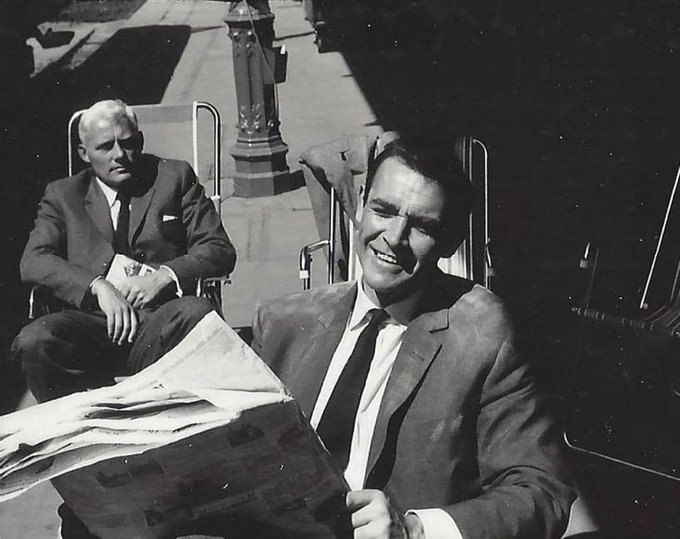
Happy birthday, Bob!

A day late, but we hear he won't hold it against us.

Wednesday, 20 May 2020

Nebula 75 is Go!

Here’s how a Gerry and Sylvia Anderson-inspired puppet show was created and filmed in lockdown
Filmmakers decided they wouldn't be thwarted by self-isolation and made a mini episode of a Thunderbirds-style sci-fi show. And it's proved so popular on social media that they are making more!

By Mark Braxton
Radio Times
27 April 2020

The UK lockdown has stymied the producers of many new and existing TV shows. But even in adverse conditions, it seems creativity will find a way. Calling Century 21 Films..!

While more conventional dramas with human casts and huge crews have become a logistical impossibility for all involved, the puppet heroes of Supermarionation hold no risk of catching the coronavirus from each other.

The result is what they cleverly term a “Superisolation” production, called Nebula-75, a short-form puppet drama that follows in the miniature footsteps of 1960s favourites including Fireball XL5, Stingray and Thunderbirds, while at the same time fashioning something entirely new.

Although members of Century 21 Films live around the world, and were able to contribute remotely to pre- and post-production, all the filming for Nebula-75 was done by three people who already live together in a small London flat: director Stephen La Rivière, puppeteer and post-production supervisor Elliot Pavelin and art department head Géraldine Donaldson.

In the best British tradition of make-do-and-mend ingenuity, their living room was turned into a movie studio, with bookshelves, cardboard boxes and other household objects becoming the inside of the show’s eponymous spacecraft!

The flat was already home to many of the puppets, props and costumes that they had accumulated from previous projects, and, as a short behind-the-scenes film after the episode reveals, the model for the spaceship was built in Preston, then sent to London.

Director Stephen La Rivière explains, “We’ve been making Supermarionation productions of different kinds for several years now – including three brand-new episodes of Thunderbirds in 2015 and a guest spot on Endeavour last year. We’ve wanted to make a new, original Supermarionation series for some time and there’s been much work behind the scenes towards that goal – which the current lockdown situation has partly derailed.”

But, he adds, “Rather than sit around moping, we decided we’d have a go at making something brand-new – but from our tiny living room. We decided to see if we could construct a series based around the limited space, settings and money available to us. The result is Nebula-75.”

The theme of Nebula-75 taps into the current Government restrictions. The hero, Commander Neptune, finds himself in his own “lockdown” – inside a spaceship travelling the distant reaches of the cosmos…

Puppeteer and post-production supervisor Elliot Pavelin with the puppet of Commander Neptune

On previous productions they’ve had a full studio to work in, where they operate the puppets from a bridge six feet above the set. Elliot Pavelin says, “The ceiling in our flat doesn’t quite allow for this! Instead, we operated from the ground by leaning over the set walls. Getting the puppets into the right part of the set, performing with them and avoiding tripping over furniture and equipment when crammed into the living room was quite difficult!”

The episode (which you can watch below) made its debut on Facebook and YouTube on Saturday, with instant feedback indicating the company had a lockdown hit on their hands. “Bravo!” said one fan; “A glorious continuation of #Supermarionation,” said another. One enthusiast even mocked up a page from a Nebula-75 annual, done in the style of a 1960s children’s book.

It’s fair to say that the outpouring of praise was a shock to Stephen. “We’re very aware of the limitations we’re faced with and I very seriously considered not releasing it at all. But as each bit fell into place I thought, ‘Oh. This isn’t so bad – we’ll put it out anyway.’ So the reaction has caught me completely by surprise! Not that there’s not an audience that wants to see more Supermarionation. I’ve always known that!”

The plaudits gave them heart to continue with the series. In fact, they’re hoping to start shooting episode two this week. “It took us four days to film episode one… episode two is a bit more complicated. But we’d like to try and get something together within a couple of weeks. We’ll shoot episode three at the same time.”

Adds Géraldine Donaldson, “We’ve got lots of ideas for future episodes. Our imaginations are unlimited, even if the same can’t be said for the space in the living room!”

Stephen La Rivière demonstrates the flat-based puppetry that was necessary for Nebula-75. He wrote the episode with producer Andrew T Smith

While made on the tightest of budgets, Nebula-75 fits neatly into the style and themes of puppet shows popularised in the 1960s by husband-and-wife team Gerry and Sylvia Anderson, in a universe of old-fashioned heroism against a backdrop of race-against-time action and humour.

With the announcement that from 7th May, BritBox will be adding episodes of some of those series including Thunderbirds, Captain Scarlet and Stingray, and Century 21 Films rolling out new product for both the older and next generation of puppet fans, an exciting new era is dawning.


Sunday, 17 May 2020

Sound of Redemption: The Frank Morgan Story


Review: ‘Sound of Redemption’ Traces Frank Morgan’s Route From Jazz Musician to Prisoner and Back
Sound of Redemption: The Frank Morgan StoryDirected by N.C. HeikinDocumentary, Biography, Drama, Music1h 24m

By Ken Jaworowski
The New York Times
1 December 2015

In the 1950s, some jazz musicians believed they couldn’t get that Charlie Parker “happy-sad feeling without using drugs.” So says a friend of the saxophonist Frank Morgan in “Sound of Redemption,” a documentary that revels in the happy despite some seriously sad events.

Mr. Morgan was born into music. His father was a professional musician who used to play his guitar while pressing it against the belly of his pregnant wife, and later played by his son’s crib. Mr. Morgan was an accomplished saxophonist by the time he was a teenager; it’s said that when he performed with Billie Holiday, his music made her cry.


His renown grew, as did an addiction to heroin. His drug habit was soon financed by crime, and for some 30 years he was in and out of prison. After his last stint, he was released and went on to record some of his finest work.

The film, directed by N.C. Heikin, traces Mr. Morgan’s career with beautiful black-and-white photographs and newsreels. Those scenes are intertwined with segments from a 2012 tribute concert at San Quentin prison in California, five years after his death.

“Sound of Redemption,” subtitled “The Frank Morgan Story,” isn’t a hard-hitting exploration. Though Mr. Morgan’s grittier side is outlined, it’s not deeply investigated. (When a former wife says that the only way to love Frank Morgan was to “live in a state of exasperation,” you long to hear more about their marriage, and his demons.) Instead, it’s a fond and forgiving tribute to the man, filled with music that moves beyond happy and sad, and toward something like brilliance.


Tuesday, 12 May 2020

Little Richard RIP

Little Richard, Flamboyant Wild Man of Rock ’n’ Roll, Dies at 87
Delving deeply into the wellsprings of gospel music and the blues, and screaming as if for his very life, he created something new, thrilling and dangerous.

Tim Weiner
The New York Times
9 May 2020

Richard Penniman, better known as Little Richard, who combined the sacred shouts of the black church and the profane sounds of the blues to create some of the world’s first and most influential rock ’n’ roll records, died on Saturday in Tullahoma, Tenn. He was 87.

His lawyer, Bill Sobel, said the cause was bone cancer.

Little Richard did not invent rock ’n’ roll. Other musicians had already been mining a similar vein by the time he recorded his first hit, “Tutti Frutti” — a raucous song about sex, its lyrics cleaned up but its meaning hard to miss — in a New Orleans recording studio in September 1955. Chuck Berry and Fats Domino had reached the pop Top 10, Bo Diddley had topped the rhythm-and-blues charts, and Elvis Presley had been making records for a year.

But Little Richard, delving deeply into the wellsprings of gospel music and the blues, pounding the piano furiously and screaming as if for his very life, raised the energy level several notches and created something not quite like any music that had been heard before — something new, thrilling and more than a little dangerous. As the rock historian Richie Unterberger put it, “He was crucial in upping the voltage from high-powered R&B into the similar, yet different, guise of rock ’n’ roll.”

Art Rupe of Specialty Records, the label for which he recorded his biggest hits, called Little Richard “dynamic, completely uninhibited, unpredictable, wild.”

“Tutti Frutti” rocketed up the charts and was quickly followed by “Long Tall Sally” and other records now acknowledged as classics. His live performances were electrifying.

“He’d just burst onto the stage from anywhere, and you wouldn’t be able to hear anything but the roar of the audience,” the record producer and arranger H.B. Barnum, who played saxophone with Little Richard early in his career, recalled in “The Life and Times of Little Richard” (1984), an authorized biography by Charles White. “He’d be on the stage, he’d be off the stage, he’d be jumping and yelling, screaming, whipping the audience on.”

Rock ’n’ roll was an unabashedly macho music in its early days, but Little Richard, who had performed in drag as a teenager, presented a very different picture onstage: gaudily dressed, his hair piled six inches high, his face aglow with cinematic makeup. He was fond of saying in later years that if Elvis was the king of rock ’n’ roll, he was the queen. Offstage, he characterized himself variously as gay, bisexual and “omnisexual.”

A Showman With Influence

His influence as a performer was immeasurable. It could be seen and heard in the flamboyant showmanship of James Brown, who idolized him (and used some of his musicians when Little Richard began a long hiatus from performing in 1957), and of Prince, whose ambisexual image owed a major debt to his.

Presley recorded his songs. The Beatles adopted his trademark sound, an octave-leaping exultation: “Woooo!” (Paul McCartney said that the first song he ever sang in public was “Long Tall Sally,” which he later recorded with the Beatles.) Bob Dylan wrote in his high school yearbook that his ambition was “to join Little Richard.”

Little Richard’s impact was social as well.

“I’ve always thought that rock ’n’ roll brought the races together,” Mr. White quoted him as saying. “Especially being from the South, where you see the barriers, having all these people who we thought hated us showing all this love.”

Mr. Barnum told Mr. White that “they still had the audiences segregated” at concerts in the South in those days, but that when Little Richard performed, “most times, before the end of the night, they would all be mixed together.”

Look at those white kids getting it on...

If uniting black and white audiences was a point of pride for Little Richard, it was a cause of concern for others, especially in the South. The White Citizens Council of North Alabama issued a denunciation of rock ’n’ roll largely because it brought “people of both races together.” And with many radio stations under pressure to keep black music off the air, Pat Boone’s cleaned-up, toned-down version of “Tutti Frutti” was a bigger hit than Little Richard’s original. (He also had a hit with “Long Tall Sally.”)

Still, it seemed that nothing could stop Little Richard’s drive to the top — until he stopped it himself.

He was at the height of his fame when he left the United States in late September 1957 to begin a tour in Australia. As he told the story, he was exhausted, under intense pressure from the Internal Revenue Service and furious at the low royalty rate he was receiving from Specialty. Without anyone to advise him, he had signed a contract that gave him half a cent for every record he sold. “Tutti Frutti” had sold half a million copies but had netted him only $25,000.


One night in early October, before 40,000 fans at an outdoor arena in Sydney, he had an epiphany.

“That night Russia sent off that very first Sputnik,” he told Mr. White, referring to the first satellite sent into space. “It looked as though the big ball of fire came directly over the stadium about two or three hundred feet above our heads. It shook my mind. It really shook my mind. I got up from the piano and said, ‘This is it. I am through. I am leaving show business to go back to God.’”

He had one last Top 10 hit: “Good Golly Miss Molly,” recorded in 1956 but not released until early 1958. By then, he had left rock ’n’ roll behind.

He became a traveling evangelist. He entered Oakwood College (now Oakwood University) in Huntsville, Ala., a Seventh-day Adventist school, to study for the ministry. He cut his hair, got married and began recording gospel music.

For the rest of his life, he would be torn between the gravity of the pulpit and the pull of the stage.

“Although I sing rock ’n’ roll, God still loves me,” he said in 2009. “I’m a rock ’n’ roll singer, but I’m still a Christian.”

He was lured back to the stage in 1962, and over the next two years he played to wild acclaim in England, Germany and France. Among his opening acts were the Beatles and the Rolling Stones, then at the start of their careers.

He went on to tour relentlessly in the United States, with a band that at one time included Jimi Hendrix on guitar. By the end of the 1960s, sold-out performances in Las Vegas and triumphant appearances at rock festivals in Atlantic City and Toronto were sending a clear message: Little Richard was back to stay.

But he wasn’t.

‘I Lost My Reasoning’

By his own account, alcohol and cocaine began to sap his soul (“I lost my reasoning,” he would later say), and in 1977, he once again turned from rock ’n’ roll to God. He became a Bible salesman, began recording religious songs again and, for the second time, disappeared from the spotlight.

He did not stay away forever. The publication of his biography in 1984 signaled his return to the public eye, and he began performing again.

By now, he was as much a personality as a musician. In 1986 he played a prominent role as a record producer in Paul Mazursky’s hit movie “Down and Out in Beverly Hills.” On television, he appeared on talk, variety, comedy and awards shows. He officiated at celebrity weddings and preached at celebrity funerals.


He could still raise the roof in concert. In December 1992, he stole the show at a rock ’n’ roll revival concert at Wembley Arena in London. “I’m 60 years old today,” he told the audience, “and I still look remarkable.”

He continued to look remarkable — with the help of wigs and thick pancake makeup — as he toured intermittently into the 21st century. But age eventually took its toll.

By 2007, he was walking onstage with the aid of two canes. In 2012, he abruptly ended a performance at the Howard Theater in Washington, telling the crowd, “I can’t hardly breathe.” A year later, he told Rolling Stone magazine that he was retiring.

“I am done, in a sense,” he said. “I don’t feel like doing anything right now.”

Survivors include a son, Danny Jones Penniman. Complete information on survivors was not immediately available.

Richard Wayne Penniman was born in Macon, Ga., on Dec. 5, 1932, the third of 12 children of Charles and Leva Mae (Stewart) Penniman. His father was a brick mason who sold moonshine on the side. An uncle, a cousin and a grandfather were preachers, and as a boy Richard attended Seventh-day Adventist, Baptist and Holiness churches and aspired to be a singing evangelist. An early influence was the gospel singer and guitarist Sister Rosetta Tharpe, one of the first performers to combine a religious message with the urgency of R&B.

By the time he was in his teens, Richard’s ambition had taken a detour. He left home and began performing with traveling medicine and minstrel shows, part of a fading 19th-century tradition. By 1948, billed as Little Richard — the name was a reference to his youth and not his physical stature — he was a cross-dressing performer with a minstrel troupe called Sugarfoot Sam From Alabam, which had been touring for decades.

In 1951, while singing alongside strippers, comics and drag queens on the Decatur Street strip in Atlanta, he recorded his first songs. The records were generic R&B, with no distinct style, and attracted almost no attention.

Little Richard in the mid-1950s, around the time his first hit record, “Tutti Frutti,” was released.

Around this time, he met two performers whose look and sound would have a profound impact on his own: S.Q. Reeder, who performed and recorded as Esquerita, and Billy Wright. They were both accomplished pianists, flashy dressers, flamboyant entertainers and as openly gay as it was possible to be in the South in the 1950s.

Little Richard acknowledged his debt to Esquerita, who he said gave him some piano-playing tips, and Mr. Wright, whom he once called “the most fantastic entertainer I had ever seen.” But however much he borrowed from either man, the music and persona that emerged were his own.

His break came in 1955, when Mr. Rupe signed him to Specialty and arranged for him to record with local musicians in New Orleans. During a break at that session, he began singing a raucous but obscene song that Mr. Rupe thought had the potential to capture the nascent teenage record-buying audience. Mr. Rupe enlisted a New Orleans songwriter, Dorothy LaBostrie, to clean up the lyrics; the song became “Tutti Frutti”; and a rock ’n’ roll star was born.

By the time he stopped performing, Little Richard was in both the Rock & Roll Hall of Fame (he was inducted in the Hall’s first year) and the Songwriters Hall of Fame and the recipient of lifetime achievement awards from the National Academy of Recording Arts and Sciences and the Rhythm and Blues Foundation. “Tutti Frutti” was added to the Library of Congress’s National Recording Registry in 2010.

If Little Richard ever doubted that he deserved all the honors he received, he never admitted it. “A lot of people call me the architect of rock ’n’ roll,” he once said. “I don’t call myself that, but I believe it’s true.”


Little Richard onstage at Wembley Stadium in London in 1972, on a bill that also included his fellow rock ’n’ roll pioneers Jerry Lee Lewis and Chuck Berry.
Bob Dylan Remembers Little Richard: ‘My Shining Star and Guiding Light’“Of course he’ll live forever. But it’s like a part of your life is gone,” Dylan says of rock pioneer

Daniel Kreps
Rolling Stone
9 May 2020 

Bob Dylan, who dreamed of joining Little Richard’s band as a young musician in Minnesota, penned a short tribute to the rock pioneer following his death Saturday at the age of 87.

“I just heard the news about Little Richard and I’m so grieved,” Dylan wrote. “He was my shining star and guiding light back when I was only a little boy. His was the original spirit that moved me to do everything I would do.”

Dylan continued, “I played some shows with him in Europe in the early nineties and got to hang out in his dressing room a lot. He was always generous, kind and humble. And still dynamite as a performer and a musician and you could still learn plenty from him. In his presence he was always the same Little Richard that I first heard and was awed by growing up and I always was the same little boy. Of course he’ll live forever. But it’s like a part of your life is gone.”

In Dylan’s high school yearbook in 1959, then-senior Robert Zimmerman famously wrote that his life ambition was “to join Little Richard.” As the Star Tribune reported, Dylan even attempted to emulate Little Richard’s imitable performing style during his first-ever public performance at a Hibbing High School talent show in 1957.


Sunday, 10 May 2020

Peter Sellers: A State of Comic Ecstasy

The Undiscovered Peter Sellers | Sky.com
Peter Sellers: A State of Comic Ecstasy

Frank Black
10 May 2020

This new BBC life of Peter Sellers, directed by John O' Rourke, is, to be honest, fairly similar to others you may have seen, though lacking the depth of the three-part Arena documentary and with some different talking heads, including an either misplaced or badly used Steve Coogan. There isn't enough on the early years with Milligan and Secombe and, because it spends a lot of time on his romantic relationships, it's pretty selective when talking about his films, which is a shame because he was a tremendously funny, inventive guy and these days seems a largely underrated actor, who squandered his talent in too many poor films, culminating in the Prisoner of Zenda and The Fiendish Plot of Dr. Fu Manchu.

O'Rourke hints at mother issues; explores his often appalling treatment of his wives - and his family; portrays him as one given to bouts of egomania; a romantic desperate to fall in love, yet whose marriages had disastrous consequences for the women involved, except in the case of Lynne Frederick, in whom he had, the documentary alleges, a wife who was controlling and cruel to Sellers' children.

The most interesting parts are lengthy and revealing interviews with ex-wife Britt Ekland and Sellers' secretaries and chauffeur and the way O'Rourke attempts - in places - to show things from the perspective of a grandson who never met him, though the views of his son, Michael, loom large, as do those of Seller's biographer, Richard Lewis, whose magnificent and magnificently depressing book, I read years ago and is not to be confused with the fairly shallow film that it inspired. 

The whole thing is terribly sad. I recall a time as a kid when it was not uncommon to catch Sellers bursting into genius on television talk shows (some of which the documentary uses). Hard to believe he was only 54 when he died.

You can watch the documentary here, for the next 29 days: https://www.bbc.co.uk/programmes/m000j4c1

Many - though not all - Sellers' better performances were often in the smaller, less-well-known British movies, so, in no particular order, here's my favourite 15:

1. Two Way Stretch
2. The Lady-Killers
3. The Pink Panther (I can't be bothered with the sequels where the schtick is the same but turned up to 11)
4. The Mouse That Roared
5. I'm All Right, Jack
6. The Running Jumping and Standing Still Film
7. Being There
8. Heavens Above
9. Dr Strangelove
10. What's New Pussycat (though I wish I could forget about the last third)
11. The Millionairess
12. The Party
13. The World of Henry Orient
14. The Dock Brief
15. Lolita

How baby Richard became Peter Sellers the world famous actor ...

From the BBC:

Peter Sellers was one of the twentieth century's most astonishing actors. His meteoric rise to fame - from his beginnings with Spike Milligan on BBC Radio's The Goon Show in the 1950s to his multiple Oscar nominations and status as Stanley Kubrick's favourite actor - is equalled only by the endless complexities of his personal life - the multiple marriages, the chronic health problems, the petulant fits of rage, the deep insecurity, the unwise career choices and the long decline in his later years.

This film explores the life of this peerless actor and comedian, featuring interviews with family, friends, colleagues and critics, many of whom have never spoken out before. The film charts Sellers's formative years backstage as part of his parents' itinerant music hall revue group, his wartime service in India and Burma and his journey to global superstardom, where tales of his life backstage with the likes of Sophia Loren, Orson Welles and Alec Guinness were often more unbelievable than the roles they were playing out before the cameras. This is the story of the man who could play any role, apart from one - himself.

With contributions from family members, including second wife Britt Ekland and his daughters Sarah and Victoria, as well as former friends and girlfriends such as Sinead Cusack, Nanette Newman and Janette Scott, the film explores the life of Sellers with candour and affection. Colleagues like director Joe McGrath and actor Simon Williams recall tales of Sellers's extravagant behaviour onset, and famous fans like Michael Palin, Steve Coogan and Hanif Kureishi reveal why they hold Sellers in such high esteem.

This is a film about family and how Sellers's mercurial temperament has affected the generation that followed. His two surviving children Sarah and Victoria recall the challenges of growing up alongside his tempestuous mood swings, while his grandson Will explores the troubled legacy his grandfather left behind.

It'll go down a whole lot better if you also watch this:


Wednesday, 29 April 2020

Bob Dylan: Song of Himself...


Bob Dylan adopts various guises in surprise track I Contain Multitudes
Warmly burnished and gently cryptic, this is easy listening at its most enjoyable  

Ludovic Hunter-Tilney 
The Financial Times
24 April 2020

 Following the surprise release of “Murder Most Foul” last month, Bob Dylan has another new song up his sleeve. Like its Macbeth-inspired predecessor, “I Contain Multitudes” borrows its title from the literary canon, a phrase from Walt Whitman’s poem “Song of Myself, 51”. 

Musically, it doesn’t contain multitudes. A thoughtfully strummed acoustic guitar and swaying bent notes from a steel guitar predominate, with a cello adding an elegiac tone in the background. It has an easy lilt, the slow sway of Hawaiian palms in a warm westerly breeze. There’s an odd moment when the volume seems to fade out momentarily before fading in again: possibly the result of overhasty editing. 

Dylan sings with a soft rise and fall, never straining himself, but full of verbal vim. The sing-speak style and lack of song structure resemble “Murder Most Foul”. But “I Contain Multitudes” is lighter and shorter than its 17-minute predecessor. It is a very Dylanish form of easy listening: warmly burnished, gently cryptic, infused with a mercurial sense of feeling. 

“I’m a man of contradictions,” he announces, paraphrasing Whitman’s poem. The primary contradiction of life — death — occurs at the top of the song (“The flowers are dying like all things do”). Then Dylan adopts a contradictory series of personae: a Blakean visionary poet, Little Red Riding Hood, a Rolling Stones-style bad boy of rock ’n’ roll, Anne Frank (murdered by the Nazis) and Indiana Jones (defeater of the Nazis). 

Wit is the life force holding death at bay here. It’s most evident in the various rhymes that Dylan has evidently enjoyed devising for “multitudes” — “blood feuds”, “all the young dudes”, “Chopin’s preludes”: bravo.


Wednesday, 15 April 2020

Friday, 10 April 2020

John Banville on Georges Simenon

Literature's enduring hero: The Inspector Maigret novels will soon ...

The Escape Artist: George Simenon

John Banville
The Los Angeles Times
28 May 2008

The novel is resilient, and so are novelists. Sometimes, a successful writer is rejuvenated by the works of another. A few years ago, the Irish novelist John Banville was introduced by a friend to the works of the late French auteur Georges Simenon, whose absurdly prolific output included the Inspector Maigret novels, for which he is best known. Banville, himself the author of 16 novels, including the 2005 Man Booker Prize–winning The Sea, is a writer of serious literary intent, but not long after reading Simenon, he began to write mystery novels (Christine Falls, The Silver Swan) under the name Benjamin Black. As he told the Weekly last year, “I was really blown away by this extraordinary writer. I had never known this kind of thing was possible, to create such work in that kind of simple — well, apparently simple — direct style. … Looking back, I think it was very much a transition. It was a way of breaking free from the books I had been writing for the last 20 years, these first-person narratives of obsessed, half-demented men going on and on and on and on. “I had to break out of that. And I see now in retrospect that Christine Falls was part of that process. Because it’s a completely different process than writing as John Banville. It’s completely action-driven, and it’s dialogue-driven, and it’s character-driven. Which none of my Banville books are.” 
Banville, then, on his rejuvenator:

As one contemplates the life and work of Georges Simenon, the question inevitably arises: Was he human? In his energies, creative and erotic, he was certainly extraordinary. He wrote some 400 novels, under a variety of pseudonyms, as well as countless short stories and film scripts, and toward the end of his life, having supposedly given up writing, he dictated thousands of pages of memoirs. He could knock off a novel in a week or 10 days of manic typing — he never revised, as the work sometimes shows — and in Paris in the 1920s he is said to have broken off an affair with Josephine Baker, the expatriate American chanteuse and star of La Revue Nègre, because in the year he was with her, he was so distracted by his passion for her that he had managed to write only three or four books.

He put himself in the way of many such distractions. In 1976, when he was in his 70s, he told his friend Federico Fellini in an interview in L’Express that over the course of his life he had slept with 10,000 women. True, he was an early starter. He lost his virginity at the age of 12 to a girl three years his senior, who got him to change schools so that they could continue to see each other and then promptly threw him over for another sweetheart. Young Georges had received his first lesson in the school of hard knocks.

He was born in Liège, Belgium, in 1903, the son of a kindly but ineffectual accountant and a fearsome mother with whom, throughout her long life, he had an intense love-hate relationship. When he was 16, he left school and went to work as a reporter on the Gazette de Liège, and joined La Caque, a group of young dandies and bohemians under the spiritual leadership of the painter Luc Lafnet. Later, Simenon described the Sunday in June 1919 when he first met Lafnet as “probably one of the most important days of my adolescence.”

La Caque were a wild bunch, indulging in drink, drugs and free love. “We were an elite,” Simenon later wrote. “A little group of geniuses thrown together by chance.” They were also dangerous and, in at least one case, self-destructive. Early one winter morning, after a night of heavy drinking, a member of the group, Joseph Kleine, “le petit Kleine,” a would-be artist and cocaine addict who lived up, or down, to his name, being slight of build and delicate of constitution, was found hanging by his neck from the door of the church of Saint-Pholien in Liège.

Suicide was suspected, or murder made to look like suicide. Next morning, however, the Liège Gazette confidently reported that the young man had killed himself. Many years were to pass before Simenon admitted that he was the author of that convenient report, which appeared before police inquiries had properly begun. “I plead not guilty on our behalf,” Simenon wrote in his memoirs. “Or rather, I plead lack of premeditation. … We did not know the true state of ‘le petit Kleine.’ But in the last resort, wasn’t it us who killed him?”

The image of the hanged man remained a powerful one for Simenon — his second Maigret tale was called Le Pendu de Saint-Pholien — and in one of his finest novels, The Strangers in the House, published in 1940, there is a wild and self-destructive gang of young people, obviously modeled on La Caque, whose escapades culminate in murder. Simenon the novelist knew whereof he wrote.

In 1920, at the age of 17, he published his first novel, Au Pont des Arches, with illustrations by various artists, including his mentor, the slightly satanic Lafnet. A humorous work, Au Pont des Arches enjoyed local success. It had been written under the name Georges Sim, a nom de plume Simenon was to retain for some years, and which he kept even after he had moved to Paris at the age of 20 and seriously got down to the business of making himself into a real writer.

He began to submit stories to Colette, then literary editor of the newspaper Le Matin. She urged him to pare his style to the bone, surely the best advice he ever received, and which he wisely took. He set to writing pulp fiction, in which he was highly successful, churning out books under a couple of dozen pen names. By his middle 20s he was rich, and embarked on a series of travels that would take him throughout Europe and to Africa and, in 1934, all the way ’round the world. It was a pattern of unremitting work and obsessive restlessness that was to endure for most of his life.

In 1923, he married a young painter named Régine Renchon, but the marriage did not last. In New York, just after the war, he met Denyse Ouimet, a French Canadian 17 years his junior, whom he had interviewed for a secretarial job. The couple were married in 1950, in Reno — it was courting disaster, surely, to marry in America’s divorce capital — and moved to Connecticut, where they lived for the next five years. Returning to Europe in 1955, the Simenons settled in Lausanne, Switzerland, in a huge house, Epalinges, which they had designed themselves and which was as ugly and clinically functional as a hospital. As this second marriage disintegrated — Simenon had been carrying on a long affair with a servant in the house — Ouimet floundered into depression. In 1964 she left the antiseptic Epalinges for a real hospital.
Margery Darrell: The Simenon Phenomenon
Shortly afterward, their troubled daughter Marie-Jo also entered on a course of psychiatric treatment, but to no avail, and in 1978 she killed herself. Marie-Jo had been frankly and hopelessly in love with her father from an early age. However, in a volume of memoirs published in 1981, Simenon blamed Ouimet for the girl’s death. Ouimet had already made her case against her husband in an angry memoir of her own, Un Oiseau pour le chat, published the year their daughter died. It could all have been a plot for one of Simenon’s novels, although he probably would have rejected it as too melodramatic.

Pietr le Letton (1930), the first novel that Simenon published under his own name, introduced his best-known character, the pipe-smoking detective Inspector Maigret. Between 1930 and 1973, when he retired from fiction writing and devoted himself to dictating his memoirs, Simenon produced some 80 Maigret novels. It is on these books that his fame chiefly rests. It is calculated that half a billion “Simenons,” in 50 languages, have been sold; but his finest work is in the romans durs, or “hard” novels, ten of the finest of which have been republished, in new or heavily revised translations, by the New York Review of Books.

Most crime fiction, no matter how “hard-boiled” or bloodily forensic, is essentially sentimental, for most crime writers are disappointed romantics. William T. Vollmann, in an afterword to the NYRB edition of Simenon’s greatest masterpiece, Dirty Snow, contrasts him with Raymond Chandler, whose Philip Marlowe novels, despite their elegance, wit and polished metaphors, seem now distinctly soft-boiled. “Chandler’s novels,” Vollmann writes, “are noir shot through with wistful luminescence; Simenon has concentrated noir into a darkness as solid and heavy as the interior of a dwarf star.” Only Patricia Highsmith approaches Simenon’s ability — indeed, his compulsion — to show the world as it really is, in all its squalor, excitement and contingent cruelty, yet Highsmith’s characters are paper-thin compared to the French master’s vividly multidimensional men and women.

Newcomers to this existentialist Simenon — the Maigret books, while entertaining, are often formulaic and even slapdash — might do well to begin with The Strangers in the House, for it is the quintessential roman dur: direct, spare, sensuously atmospheric, hypnotic in its realism, and honest in a way that few novelists would dare to be. What is written of the events of the narrative might be said of the book itself: “It was because it had all begun with such violence — in mud, blood and vomit — that everything had rushed to a climax.”

The book’s central character is Loursat, a semi-aristocratic small-town lawyer whose wife left him 20 years ago and who has since that time lived the life of a drink-sodden and misanthropic recluse. One winter night, he wakes to the sound of a gunshot from one of the rooms in the rambling old house, and after a search finds lying on a bed a man who has been shot through the neck and who dies at the exact moment of Loursat’s arrival. It turns out that Loursat’s daughter, who lives with him but with whom he has hardly exchanged a word since her mother’s disappearance, has without his knowing it been entertaining nightly a gang of her friends in the attic, one of whom is the murderer.

It is typical of Simenon’s work that the discovery of this secret life that has been going on under his averted nose should bring Loursat out of his 20-year lethargy and fill him with energy and excitement. Henri Cartier-Bresson used to speak of the “decisive moment” when reality is caught in its unguarded essence, and it is on such moments that Simenon builds his fictions. In a passage that not only sums up this particular story but is emblematic of all the romans durs — and which P.D. James singles out in her introduction to the NYRB edition of Strangers — the author describes the passionate longing that suddenly floods Loursat’s hitherto frozen heart:

To discover a new world, new people, new sounds and smells, new thoughts, new feelings, a swarming, writhing world, which had no relation to the epics and tragedies of literature, one that was full of all those mysterious and generally trivial details you don’t find in books — the breath of cold air in a dirty back alley, the loiterer on a street corner, a shop remaining open long after all others had closed, an impatient, highly strung boy waiting all keyed up outside a watchmaker’s for the friend who was going to lead him into a new and unknown future.

Dirty Snow, published eight years after Strangers, is an astonishing work. Signed off at “Tucson (Arizona) 20 March 1948,” it was published that year in France as La Neige était sale. Nasty, brutish and not very long, the book presents a thoroughly Hobbesian view of life on this dwindling planet; here indeed is the war of all against all. It is set in an unnamed European city, most likely Liège, during the German occupation. Over the course of a seemingly interminable winter, Frank Friedmaier, the central character, turns 19. When we first encounter him, he is standing at night in a snow-filled alley with a borrowed knife in his pocket, waiting with grim anticipation to commit his first murder, a Gidean acte gratuit — the gratuitousness of which would surely have shocked Gide.

Frank’s victim is to be a “noncommissioned officer” known as the Eunuch, a member of the occupation forces. Frank has no reason to kill him; it is simply a rite of passage to be performed, a losing of virginity. For Frank, we are told, “it was a question of killing his first man and breaking in Kromer’s Swedish knife.” Frank is driven partly by a determination not to be outdone by his friend Kromer, who has already carried out a particularly grisly killing, described on the second page of the book. The passage is a richly representative example of Simenon’s brisk, sleek and seemingly effortless style, or nonstyle, glassy-eyed in its impassivity and yet thoroughly, horribly compelling.

Coming out of Timo’s bar, Kromer the smalltime hood is confronted by a “skinny little man, pale and feverish,” to whom apparently he sold something unsatisfactory and who now is seeking reparation. The little man grabs Kromer by the collar of his coat and begins yelling at him.

Kromer, in the middle of the dark alley between the two banks of snow, took the cigar from his mouth with his left hand. He punched with his right, just once. Then two arms and two legs were in the air, just like a marionette, and then the black form sank down into the pile of snow along the sidewalk. The strangest thing was that there was an orange peel beside the head — something you probably wouldn’t see anywhere in town except in front of Timo’s.

Timo came out without his overcoat or cap, dressed just as he had been at the bar. He poked the marionette and stuck out his lower lip.

“He’s had it,” he growled. “In an hour he’ll be stiff.”

The focus of the entire scene is, of course, that piece of orange peel.


Frank lives with his mother, Lotte, who runs a brothel in their apartment. He does not know the identity of his father but suspects that it is the police inspector, Hamling, a frequent visitor who acts, it is implied, as Lotte’s protector in these dangerous times. But Frank has fixed on another and far more preferred father figure, Holst, his neighbor in the apartment building, an intellectual out of favor with the authorities, who has been forced to take a job as a streetcar conductor.

Holst makes only the most fleeting of appearances in the book, yet for Frank he is a presiding deity, at once remote and fascinating, an object almost of veneration. Holst passes by as Frank waits in the alley to commit his murder, and Frank wishes the older man might pause for a moment and “see the thing done,” for it seems to him that there is already a secret bond between the two of them, that “it was really as though he had just chosen Holst, as though he had always known that things would turn out this way, because he wouldn’t have done it for anyone but the streetcar conductor.”
If only Georges Simenon had been a bit more like Maigret ...
Holst has a daughter, the innocent and pure-hearted Sissy, who falls in love with Frank, and whose love Frank repays by tricking her into sacrificing her virginity not to him, as she believes, but to Kromer, with whom he switches places in a darkened bedroom. Discovering how she has been betrayed, Sissy flees the house and almost perishes in the snow. Meanwhile, Frank has killed again, in the course of robbing a cache of antique watches, which will be sold to a German officer.

Frank is at last picked up by the authorities, not for the killings he has committed, about which nobody seems to care in the least, but because of his tenuous connection with the German officer, who, it turns out, has paid for the watches with money stolen from official sources; Frank is suspect also due to the fact that one of the girls working for his mother is found to be a member of the resistance on the run.

These details are of scant interest to Frank. In imprisonment, interrogation and torture, he has found a sort of holy task, a ritualized process of atonement and even — although neither he nor Simenon would dream of using the word — redemption. As the days and weeks of his incarceration go on, he descends deep into himself. It is an existential journey, and along the way he comes to understand himself and the impossible predicament in which he is caught — not the predicament of being a prisoner but, on the contrary, of being free, the most burdensome state of all.

At the end, Holst and Sissy are allowed to visit him, perhaps in a devilish strategy to get him to confess. Sissy tells him, to his astonishment and joy, that she still loves him, but almost more important than her declaration of forgiveness is the moment when Holst “laid his hand on Frank’s shoulder exactly as Frank had always known a father would.” After that, death for Frank is a mere incidental, a supererogatory closure to a life already completed.

What Frank wants, as Vollmann points out, is to be known: “He scarcely knows himself, or anything else worth knowing. But if he can somehow stand revealed to the gaze of the Other, then maybe he will achieve some sort of realization.” What makes the book so harrowing, however, is that at the culmination of this search for authenticity, despite Holst’s paternal gesture and Sissy’s vow of love — Vollmann suggests, and surely he is right, that the prison visit by Holst and Sissy is the one false note in the book — what Frank discovers is that even authenticity itself is no great thing.

Unlike Joyce, who boasted of being nowhere to be found in his work yet is everywhere plain to see in it, Simenon really does manage to seem a disinterested observer, standing apart from the world he created, paring his fingernails. Still, in the atmosphere of Dirty Snow, sweaty and soiled and rife with insinuation, we might be permitted to detect a hint of the mauvaise conscience of a writer who lived in France contentedly enough through the occupation and at the war’s end found himself accused of collaboration, so that, although the collaboration charges were eventually dropped, he had to flee to Canada, later moving to the United States.

In Three Bedrooms in Manhattan, first published in 1946, the protagonist, François Combe, a famous Parisian actor in his late 40s, who has fled to America after a scandalous and shaming breakup with his actress wife, is a scarcely disguised self-portrait. In a Manhattan bar, Combe encounters Kay Miller, a Viennese expatriate living in America pretty much by her wits, and falls for her, altogether despite himself. Miller for her part is undoubtedly a portrait of Denyse Ouimet.

Through the bars and the night streets of the city, and the three bedrooms of the title — the first is in a cheap hotel, the second is Combe’s rented bolthole, the third is Miller’s room in her shared apartment — the two stumble, through serious emotional obstacles, including Combe’s violent jealousy and Miller’s emotional fecklessness, into a love that seems to leave Combe as much dismayed as happy. In her NYRB introduction, Joyce Carol Oates accepts the book as a fictionalized memoir and sees Simenon, “master of irony … overcome by wonder at what is happening to him, succumbing to romantic infatuation in jaded middle age.”

The urge to flee life’s embroilments and disappear into anonymity, common to many men and at least to some women, is an obsessively recurring theme in Simenon’s work. Nowhere is it worked out more neatly or more persuasively than in Monsieur Monde Vanishes. Norbert Monde — Simenon has a wonderful way with names — is a cautiously successful Parisian businessman running the brokerage and export firm founded by his grandfather. On the morning of his 48th birthday — the same age, not incidentally, as François Combe in Three Bedrooms, and as the writer himself just after his marriage to Denyse Ouimet —Monsieur Monde has his barber shave off his moustache, withdraws 300,000 francs from his bank account, exchanges his tailor-made suit for an anonymous secondhand outfit and walks out of his life without a word to anyone.

Monde’s flight is not provoked by any grand crisis, though it is true that his work has ceased to engage him, and his relations with his family are troubled. When he leaves it all behind, he does not run so much as drift, “following a preordained plan, for which he was not responsible.” He takes a train for Marseilles and checks into a featureless hotel, and in the morning half-wakes to find himself in tears, an “endless flow from some deep spring,” and speaking to himself without moving his lips: “He was telling of his infinite aching weariness, which was due not to his journey in a train but to his long journey as a man.”

The state into which Monde has fallen, or to which he has risen, is at once numbed and ecstatic. “He was lucid, not with an everyday lucidity, the sort one finds acceptable, but on the contrary the sort of which one subsequently feels ashamed, perhaps because it confers on supposedly commonplace things the grandeur ascribed to them by poetry and religion.” The insinuation of shame here, utterly unexpected, utterly right, is pure Simenon.

In Marseilles, Monde takes up with Julie, a nightclub performer — “her lips stained the pallid tip of a cigarette with a vivid pink that was more sensuously feminine than a woman’s blood” — and they travel together to Nice. No sooner have they arrived in that city than all of Monde’s money is stolen. The ever-resourceful Julie at once finds jobs for them both at the Monico, a nightclub and run-down casino.

It is at the Monico that Monde re-encounters his first wife, Thérèse, whom he has not seen for 18 years. She is, or was, a nymphomaniac who kept obscene photographs in a secret drawer in her desk and “who had sought out their chauffeur in his attic bedroom and who, when he drove her into town, had him stop in front of dubious apartment houses.” Now fallen on hard times, and a drug addict, she is acting as companion to a rich old lady known as the Empress, an habitué of the Monico.

When the Empress unexpectedly dies, Monde is compelled to take responsibility for Thérèse. He returns with her to Paris, installs her in an apartment in the suburbs, instructs a doctor friend of his to supply her with whatever amounts of morphine she requires, and washes his hands of her. Then he calmly walks back into his old life, to the consternation of his wife, who, during his absence, had been happily settling into the position of rich widow.

She felt impelled to remark: “You haven’t changed.”

He replied, with that composure which he had brought back with him, and under which could be glimpsed a terrifying abyss: “Yes, I have.”

That was all. He was relaxed. He was part of life, as flexible and fluid as life itself.


These romans durs — other NYRB reissues include the insouciantly gruesome The Man Who Watched Trains Go By, another tale of a husband on the run; Tropic Moon, a frightening study of lust and violence in the Belgian Congo; and Red Lights, a subversively straightforward story of American life involving alcoholism, marital disharmony and violent rape — are superb and polished works of art masquerading as pulp fiction. Gide, who admired Simenon, felt that he had not achieved his full potential as an artist, which may be true: If he had tackled his obsessiveness and found a way of slowing himself down, he might have written the leisurely and long-fermented work that Gide apparently expected of him. But that book would not have been a “Simenon,” and it is in the “Simenons,” surely, that Simenon displayed his prodigious and protean genius.


Wednesday, 8 April 2020

John Prine RIP

John Prine: Secrets Behind His Classic Songs - Rolling Stone
John Prine, Who Chronicled the Human Condition in Song, Dies at 73
A singer and songwriter with a raspy voice and a gift for offbeat humor, he was revered by his peers, including Bob Dylan. He died of the coronavirus.

William Grimes
The New York Times
7 April 7 2020

John Prine, the raspy-voiced country-folk singer whose ingenious lyrics to songs by turns poignant, angry and comic made him a favorite of Bob Dylan, Kris Kristofferson and others, died on Tuesday in Nashville. He was 73.

The cause was complications of the coronavirus, his family said.

Mr. Prine underwent cancer surgery in 1998 to remove a tumor in his neck identified as squamous cell cancer, which had damaged his vocal cords. In 2013, he had part of one lung removed to treat lung cancer. He had been hospitalized since late last month.

Mr. Prine was a relative unknown in 1970 when Mr. Kristofferson heard him play one night at a Chicago club called the Earl of Old Town, dragged there by the singer-songwriter Steve Goodman. Mr. Kristofferson was performing in Chicago at the time at the Quiet Knight. Mr. Prine treated him to a brief after-hours performance of material that, Mr. Kristofferson later wrote, “was unlike anything I’d heard before.”


A few weeks later, when Mr. Prine was in New York, Mr. Kristofferson invited him onstage at the Bitter End in Greenwich Village, where he was appearing with Carly Simon, and introduced him to the audience.

“No way somebody this young can be writing so heavy,” he said. “John Prine is so good, we may have to break his thumbs.”

The record executive Jerry Wexler, who was in the audience, signed Mr. Prine to a contract with Atlantic Records the next day.

Music writers at the time were eager to crown a successor to Mr. Dylan, and Mr. Prine, with his nasal, sandpapery voice and literate way with a song, came ready to order. His debut album, called simply “John Prine” and released in 1971, included songs that became his signatures. Some gained wider fame after being recorded by other artists.


They included “Sam Stone,” about a drug-addicted war veteran (with the unforgettable refrain “There’s a hole in Daddy’s arm where all the money goes”); “Hello in There,” a heart-rending evocation of old age and loneliness; and “Angel From Montgomery,” the hard-luck lament of a middle-aged woman dreaming about a better life, later made famous by Bonnie Raitt.

“He’s a true folk singer in the best folk tradition, cutting right to the heart of things, as pure and simple as rain,” Ms. Raitt told Rolling Stone in 1992.

Mr. Dylan, listing his favorite songwriters in a 2009 interview, put Mr. Prine front and center. “Prine’s stuff is pure Proustian existentialism,” he said. “Midwestern mind trips to the nth degree. And he writes beautiful songs.”

John Prine was born on Oct. 10, 1946, in Maywood, Ill., a working-class suburb of Chicago, to William and Verna (Hamm) Prine. His father, a tool-and-die maker at the American Can Company, and his mother had moved from the coal town of Paradise, Ky., in the 1930s.

Mr. Prine later wrote a ruefully bitter song titled “Paradise,” in which he sang:

The coal company came with the world’s largest shovel
And they tortured the timber and stripped all the land
Well, they dug for their coal till the land was forsaken
Then they wrote it all down as the progress of man


John grew up in a country music-loving family. He learned guitar as a young teenager from his grandfather and brother and began writing songs.

After graduating from high school, he worked for the Post Office for two years before being drafted into the Army, which sent him to West Germany in charge of the motor pool at his base. After being discharged, he resumed his mail route, in and around his hometown, composing songs in his head.

“I always likened the mail route to a library with no books,” he wrote on his website. “I passed the time each day making up these little ditties.”

Reluctantly, he took the stage for the first time at an open-mic night at the Fifth Peg, where his performance met with profound silence from the audience. “They just sat there,” Mr. Prine wrote. “They didn’t even applaud, they just looked at me.”

Then the clapping began. “It was like I found out all of a sudden that I could communicate deep feelings and emotions,” he wrote. “And to find that out all at once was amazing.”


Not long after, Roger Ebert, the film critic for The Chicago Sun-Times, wandered into the club while Mr. Prine was performing. He liked what he heard and wrote Mr. Prine’s first review, under the headline “Singing Mailman Who Delivers a Powerful Message in a Few Words.”

“He appears onstage with such modesty he almost seems to be backing into the spotlight,” Mr. Ebert wrote. “He sings rather quietly, and his guitar work is good, but he doesn’t show off. He starts slow. But after a song or two, even the drunks in the room begin to listen to his lyrics. And then he has you.”

Mr. Prine had a particular gift for offbeat humor, reflected in songs like “Jesus, the Missing Years,” “Some Humans Ain’t Human,” “Sabu Visits the Twin Cities Alone” and the antiwar screed “Your Flag Decal Won’t Get You Into Heaven Anymore.”

“I guess what I always found funny was the human condition,” he told the British newspaper The Daily Telegraph in 2013. “There is a certain comedy and pathos to trouble and accidents.”


After recording several albums for Atlantic and Asylum, he started his own label, Oh Boy Records, in 1984. He never had a hit record, but he commanded a loyal audience that ensured steady if modest sales for his albums and a durable concert career.

In 1992, his album “The Missing Years,” with guest appearances by Bruce Springsteen, Tom Petty and other artists, won a Grammy Award for best contemporary folk recording. He received a second Grammy in the same category in 2006 for the album “Fair and Square.”

Mr. Prine, who lived in Nashville, was divorced twice. He is survived by his wife, Fiona Whelan Prine, a native of Ireland whom he married in 1996; three sons, Jody, Jack and Tommy; two brothers, Dave and Billy; and three grandchildren. In 2017, Mr. Prine published “John Prine Beyond Words,” a collection of lyrics, guitar chords, commentary and photographs from his own archive.


In 2019, he was inducted into the Songwriters Hall of Fame, and his album “Tree of Forgiveness” was nominated for a Grammy, for best Americana album. It was his 19th album and his first of original material in more than a decade. (The award went to Brandi Carlile, for “By the Way, I Forgive You.”)

Mr. Prine went on tour in 2018 to promote “Tree of Forgiveness,” and after a two-night stand at the Ryman Auditorium in Nashville — known there as the mother church of country music — Margaret Renkl, a contributing opinion writer for The New York Times, wrote, under the headline “American Oracle”:


“The mother church of country music, where the seats are scratched-up pews and the windows are stained glass, is the place where the new John Prine — older now, scarred by cancer surgeries, his voice deeper and full of gravel — is most clearly still the old John Prine: mischievous, delighting in tomfoolery, but also worried about the world.”

In December, he was chosen to receive a 2020 Grammy for lifetime achievement.

As a songwriter, Mr. Prine was prolific and quick. In the early days, he would sometimes dash off a song while driving to a club.

“Sometimes, the best ones come together at the exact same time, and it takes about as long to write it as it does to sing it,” he told the poet Ted Kooser in an interview at the Library of Congress in 2005. “They come along like a dream or something, and you just got to hurry up and respond to it, because if you mess around, the song is liable to pass you by.”