THE Friday Boys are a disparate group of men spread across Tyneside who meet once a week - 'always on a Friday' - to talk about the arts, raise a glass to recently departed heroes and villains and, at the evening's end, down a whisky or two. The FBs have only one golden rule - talk of the working week is strictly off-limit.
Ron Elderly: - Autumn Leaves House Of The Rising Sun The Air That I Breathe Ruby Tuesday Wild Horses You Better Move On
Da Elderly: - I Don't Want To Talk About It Never Let Her Slip Away Heart Of Gold Till There Was You Laurel Canyon Home Need Your Love So Bad
The Elderly Brothers: - Mailman, Bring Me No More Blues Let It Be Me When Will I Be Loved The Price Of love I Saw Her Standing There
Given the news on Look North that York was a virtual ghost-town, you would have expected a complete no-show at The Habit, but of course the alarmist hyperbole was just that and there was a reasonable turnout for the open mic night. The audience were attentive and enthusiastic and it made for an enjoyable evening of escape from the wall-to-wall grimness on the telly. We went around with two three-song solo sets and finished off with an Elderlys set.
Dave Brubeck by Philip Clark review – a life in jazz time On tour with the man behind ‘Take Five’ ... the definitive biography of one of jazz’s most successful pianists
Richard Williams
The Guardian Thu 13 Feb 2020
In 1954 the pianist Dave Brubeck became the first jazz musician of the postwar generation to be featured on the cover of Time magazine, infuriating those who felt that this white middle-class Californian had no business taking the limelight from Charlie Parker, Dizzy Gillespie or Thelonious Monk, the true pioneers of an essentially African American music.
In the decades that followed, Brubeck remained the focus of controversy, even as his quartet’s albums – with their abstract-expressionist cover art by Joan Miró, Franz Kline and Sam Francis – became almost as ubiquitous a fixture in the homes of the upwardly mobile as a hostess trolley or coffee percolator. By the dawn of the 1960s, when “Take Five”, a catchy little number in 5/4 time, was high in the pop charts, regularly requested on the BBC’s Sunday lunchtime radio show Two-Way Family Favourites, he was effectively the public face of modern jazz, even though his genial temperament and settled family life – he was married to the same woman for 70 years – ran contrary to what was generally seen as the idiom’s beatnik tendency.
For all the resentment he provoked, and the scorn poured on his sometimes heavy-handed playing, Brubeck was an interesting musician whose experiments with unorthodox time signatures helped open the way for others to venture beyond the standard 4/4 and waltz time. Combining his commitment to jazz with the lessons learned during his early studies with the expatriate French classical composer Darius Milhaud, he was happy to explore a hybrid work such as his brother Howard’s four-movement “Dialogues for Jazz Combo and Orchestra”, which he and his quartet recorded with the New York Philharmonic in 1960, under the baton of Leonard Bernstein. That earned him no points from the jazz purists, but their scepticism did not deter him from writing his own orchestral and choral pieces, some of them on sacred themes, later in life.
The British writer Philip Clark is not the first to attempt a Brubeck biography, but he is exceptional in leaving the details of his subject’s early life – a childhood that might have led to a career as a cattle rancher, for instance – until the final quarter of the book. That is because the author is after a looser, more discursive structure, examining the impulses behind Brubeck’s creativity through an approach freed from strict chronology, roaming backwards and forwards in his search for strands of development.
The first of his own encounters with Brubeck came in 1992, after a concert in Manchester, when he asked the artist to cast an eye over one of his own student compositions and received an encouraging response. A rapport was established and led Clark to accompany the quartet throughout a UK tour in 2003, continuing a dialogue maintained almost up to the pianist’s death, aged 91, in 2012. He supplements those conversations with material from Brubeck’s extensive personal archive, to which he was given access.
The bandleader’s early years and his rise from obscurity are closely examined, but the main focus of the story is inevitably the 10-year lifespan of Brubeck’s classic quartet, in which he and the alto saxophonist Paul Desmond, his long-term musical partner (and the composer of “Take Five”), were joined by the bassist Eugene Wright and the drummer Joe Morello. This was a perfectly balanced mechanism with an immediately identifiable sound, thanks largely to the ethereal purity of Desmond’s tone in the group’s foreground. Clark reveals that the musicians were subject to an unusual set of printed “principles and aims” in which Brubeck detailed their individual roles and responsibilities with a bracing and slightly alarming clarity.
In his laudable desire to enlighten and convince, Clark describes many of Brubeck’s piano solos in detail. The late Whitney Balliett of the New Yorker mastered the difficult skill of bringing an improvisation to life in the mind’s ear, largely by avoiding the use of technical terms. Clark shows no such reluctance, which means that readers unfamiliar with “polytonal chords” – a favourite Brubeckian device – may find themselves struggling, although the author’s sheer enthusiasm generally preserves the momentum. At a different level, Clark is sensitive to the musicians’ human characteristics, such as Desmond’s destructive ego and alcohol problems. He also deals fully with Brubeck’s insistence, at a time when segregation was still a de facto reality in some states of the US, on facing down the racism that resulted from the inclusion of Wright, an African American, in an otherwise all-white band (in 1959 he rejected his agent’s request to replace the bassist for a highly paid 25-date tour of southern colleges, cancelling the whole thing and forfeiting nearly $40,000).
For all his success, Brubeck was an essentially modest and unpretentious man whose immediate reaction to the Time magazine cover was that it should have gone to Duke Ellington. He once related, with some amusement, an enigmatic compliment paid to him by the great avant-garde pianist Cecil Taylor: “He told me I was the missing link. He didn’t say between what and what.” Clark comes as close as anyone ever will to filling in the blanks.
Too filthy to print – Aubrey Beardsley and his explosions of obscenity
His erotic ink drawings, full of nudity and sex, influenced everyone from Klimt to Picasso. But, ahead of a Tate Britain show, we look at the pictures that were deemed just too outrageous.
Jonathan Jones
The Guardian
Fri 28 Feb 2020
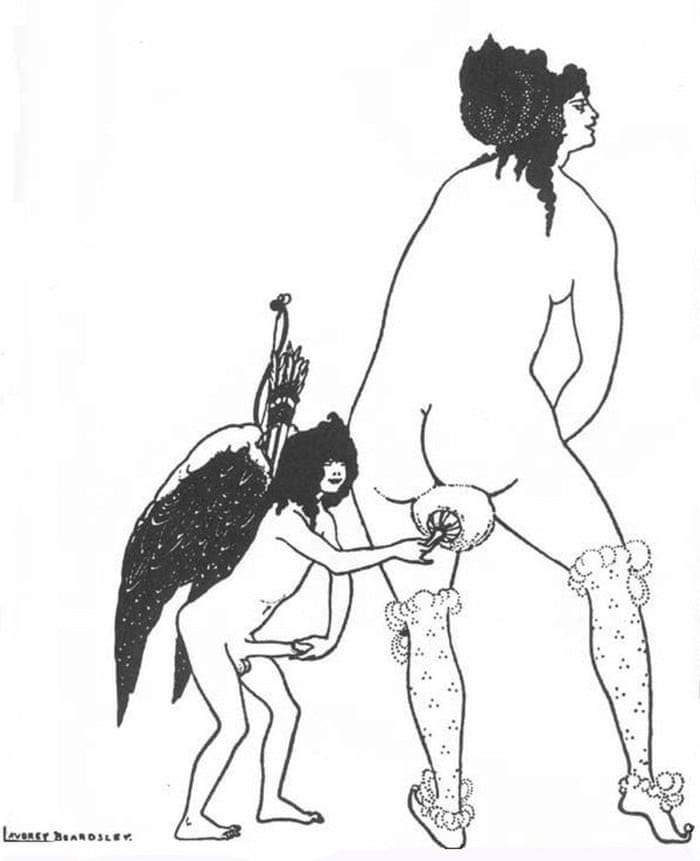
A woman who is naked except for fancy stockings touches what the artist calls her “coynte” while a winged cupid teases her bottom with a powder puff. A wizened man admires a young man’s elephantine erection, the glans as big as his bald head – all delineated in sharp black outlines and shadowed with inky pools against expanses of white. These are a few of the many explosions of obscenity that a slender, pale young man created in the room he checked into at the Spread Eagle hotel in Epsom, Surrey, in June 1896.
The Toilet of Lampito, 1896
The drawings Aubrey Beardsley completed in this suburban hideaway were to illustrate the ancient Greek comedy Lysistrata by Aristophanes. The works, that can be perused at your leisure in Tate Britain’s forthcoming exhibition, had an incalculable effect on the birth of modern art. Beardsley’s eroticism would soon be emulated all over Europe by revolutionaries such as Klimt, Schiele and Picasso, while James Joyce summed up his impact on modernism in a double entendre: “Kunstfull”.
That isn’t generally how this unique artist is remembered, though. Beardsley is pigeonholed as a preciously eccentric purveyor of late-Victorian erotica. Rediscovered in the 1960s, when both Victoriana and sex were fashionable, he hovers in the subconscious of British art. His name sounds posh, which adds to the air of whimsy, but he was born into an economically unstable lower-middle-class family in Brighton in 1872 and left school aged 16.
Beardsley was an insurance clerk before being discovered by Oscar Wilde’s first male lover, Robert Ross. This led to an artistic collaboration with Wilde, but his importance goes far beyond the aesthetic movement. He put sexuality at the centre of modern art for the first time, spreading his influence across Europe – to Vienna, Paris and Barcelona – 25 years before surrealism.
Then in 1895, a year before he settled in at the Spread Eagle, Beardsley’s world fell apart. Wilde was arrested and charged with gross indecency. The author’s love for Lord Alfred Douglas became a scandal and anyone associated with him was suspected of sodomy. Beardsley, at the age of 22, had been chosen by Wilde to illustrate the printed edition of his disturbing drama Salome. Following that success, he became art editor, designer and illustrator of the Yellow Book, a bestselling magazine that brought avant garde ideas into respectable homes. But when Wilde fell, its publisher John Lane sacked him. Beardsley had only recently been able to give up his day job. Now he was vilified and poverty-stricken.
The Peacock Skirt, Salomé, 1893
The poet WB Yeats, a friend of Beardsley, remembered him looking into a mirror shortly after being sacked and saying: “Yes, yes, I look like a sodomite ... but no, I am not that.” The man in the mirror was an exquisite dandy: when Beardsley became a star in 1890s London, he started wearing suits in subtly contrasting shades of grey with yellow gloves over his ethereally thin figure. Yet there is no evidence that he ever went to bed with anyone of any gender – except maybe, biographers speculate, his sister, Mabel.
And here Mabel is, naked in a back room at Tate Britain. To get a sneak peak at Beardsley’s drawings, I’ve visited the museum’s Prints and Drawings Rooms. The frontispiece he designed for the collected plays of a now-forgotten writer rests on a wooden stand. Mabel Beardsley is the nude at the far left, with layers of radiating hair that look like they belong in a psychedelic poster. She is looking ecstatically at Wilde, who stands beside her dressed as the ancient wine god Bacchus. In front of them is a goat-legged faun.
Sex is Beardsley’s theme and, unprovable allegations aside, it seems to have existed for him only on paper. That makes him an artist for our time. Long before the virtual and fluid sexualities of the 21st century, Beardsley created an erotic fantasy world of shifting identities and infinite variety. His art is one long act of self-pleasuring that reached its consummation on Epsom High Street.
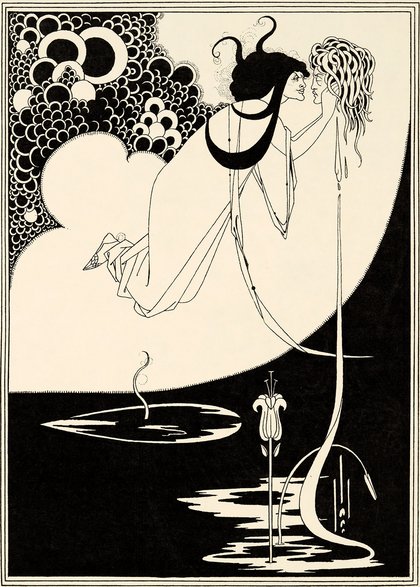
The Climax, 1893
His most famous illustration for Wilde’s Salome is actually called The Climax. In this intense symbolist design, Salome has persuaded her stepfather, Herod, to have John the Baptist’s head cut off in return for gratifying his lust with an erotic dance. She can now satiate her own lust for the Baptist – or at least his lips. She floats in the air, seemingly with orgasmic joy, as black blood pours from the fetishised dead head she embraces.
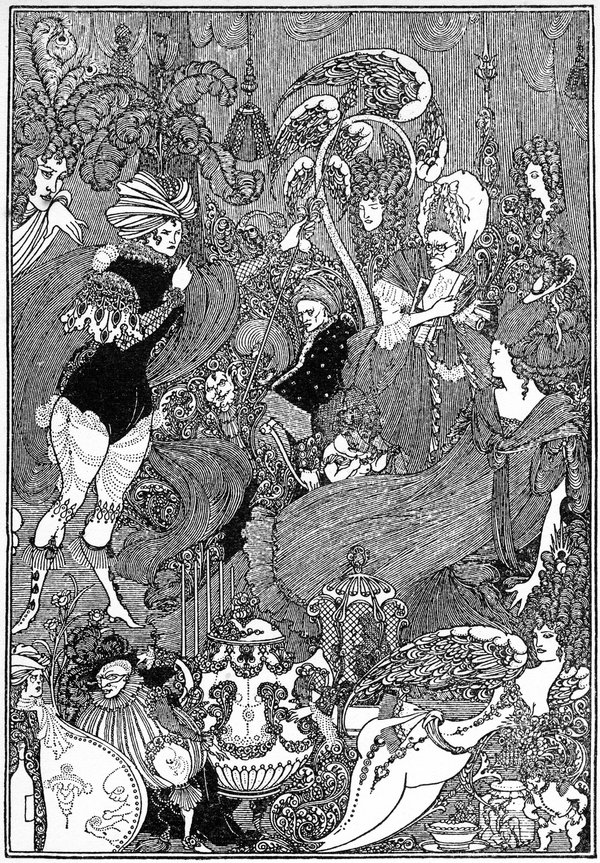
The Toilet of Salome (first version), 1894
Does that seem an over-explicit interpretation of this great fin de siècle image? Well, you should see his rejected designs for Salome. Several scenes were deemed too dirty by the publisher and he was asked to replace them with milder versions. In his original drawing of The Toilet of Salome, a pageboy stands naked holding a tray of tea things. Another near-nude youth sits with his hand between his legs, masturbating as he gazes at the tray-carrier. Meanwhile, Salome also masturbates.
The Lady with the Rose, 1897
Sex is all in the head. That is Beardsley’s message, and the basis of the strange game he played with Victorian censorship. The reason Salome first appeared in English as a book, rather than on stage, was because it was refused a licence by the Lord Chamberlain. Beardsley’s drawings mock the censor by dancing a fine line between innocence and depravity. The publisher accepted his vision of Salome’s love of a severed head, but rejected his drawing of her sitting with her back to us in a dressing gown that’s open. What was the problem? She holds a conductor’s baton.
The Yellow Book Vol I, 1894
Before he got sacked from the Yellow Book, Beardsley filled the widely read magazine with similar suggestiveness. His illustration A Night Piece shows a woman in a long black dress and gloves and a thin black ribbon round her white throat walking down a dark city street – she is, in Victorian parlance, a woman of the night. In another picture, called L'education, a young woman is listening attentively to her older friend. Both have tough, pinched faces. It’s not a sentimental but a sexual education set in a brothel.
L’Éducation Sentimentale, 1894
Beardsley pictured his audience as young women. On the cover he designed for the Yellow Book’s publicity leaflet, his imagined female reader studies the latest volumes outside a bookshop. She looks rapt, for Beardsley depicts reading itself as the most subversive of pleasures. In his revised version of The Toilet of Salome, she has Émile Zola’s novel Nana on her bookshelves – a “dirty French novel”, as Lou Reed would later put it. The Yellow Book was yellow to evoke the typical covers of sexy French fiction. Wilde wrote Salome in French, intoxicated by the writings of Flaubert, Huysmans and Baudelaire. Beardsley was equally au fait, regularly taking the boat train to Paris. French artists loved him back: Toulouse-Lautrec ordered three copies of his illustrated Salome.
The Black Cape, 1893
When Beardsley checked in to the Spread Eagle hotel, he’d just come back from Brussels, another capital of fin de siècle culture. There he probably encountered the explicit art of Félicien Rops, including his 1878 gouache Pornocrates, in which a pig is held on a leash by a naked woman wearing a blindfold and black stockings. On the way back from the Belgian capital, Beardsley fell seriously ill. It was to get out of London’s smog that he fled to Epsom. He had known since he was diagnosed with tuberculosis when he was seven years old that his lifespan would be limited. In the two years following his stay in Epsom, he would travel to France in search of better health, dying at Menton on the Riviera in 1898, aged 25.
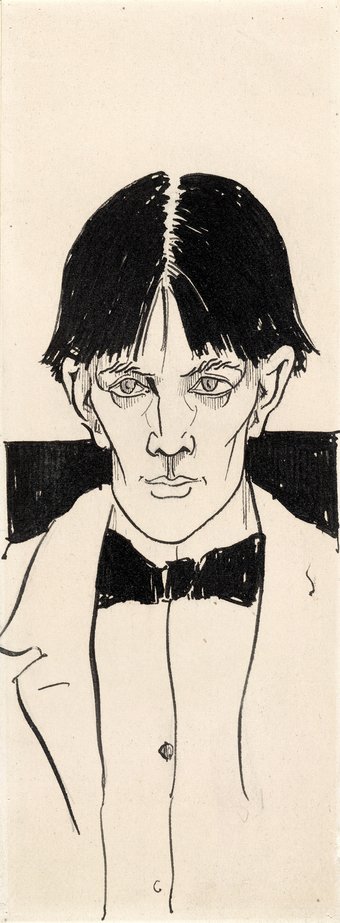
Self-Portrait, 1892
As his young life entered its premature twilight, he found sensual solace in Aristophanes’ Lysistrata, a play about love defeating death – or, in Greek, Eros defeating Thanatos. Aristophanes wrote it during a murderous war between Athens and Sparta that seemed to have no end. He imagines the women of both cities refusing to have sex with their husbands to stop the war. Beardsley turns this sex strike into an orgiastic triumph of lust over despair. Even as they listen to a speech, his Greek women can’t stop fondling each other. A Spartan woman gleefully taunts her lust-crippled husband with her body. Men gather in a mass display of monumental members.
We tend to analyse erotic art in terms of power, but for Beardsley it was quite simply a matter of life and death.
• Aubrey Beardsley is at Tate Britain, London, 4 March to 25 May.
Ron Elderly: - Streets Of London My Home Town Make You Feel My Love A Good Year For The Roses Tell Me You Better Move On
Da Elderly: - Out On The Weekend I Am A Pilgrim Everybody's Talkin' Helpless I'm Just A Loser Harvest Moon
The Elderly Brothers: - He'll Have To Go The Sound Of Silence True Love Ways Let It Be Me Mailman, Bring Me No More Blues
On a cold night in York there were few punters and even less players at the open mic in The Habit. As it was last week we went around with 3-song sets and just managed to fill out the time until midnight. Host Simon, cab-driver Chris and local multi-instrumentalist Cat completed the line-up. Cat gave us some of her original songs with various alt-tunings like dropped A and D. She also accompanied Chris on a few numbers (see photo - covering Seal's Kiss From A Rose). By the time the late-night quizzers had arrived, The Elderlys were in full swing, digging out some rarities from the songbook. Another fun, if quiet, night.
Loudon Wainwright III Opens Up About The 'Exes & Excess' That Inform His Music Wainwright's music centers on family, and how we hurt and heal each other. He spoke to Fresh Air in 1992 and '17 about his life as a husband, father and son. His new Netflix special is Surviving Twin