THE Friday Boys are a disparate group of men spread across Tyneside who meet once a week - 'always on a Friday' - to talk about the arts, raise a glass to recently departed heroes and villains and, at the evening's end, down a whisky or two. The FBs have only one golden rule - talk of the working week is strictly off-limit.
Pete Atkin and Clive James have shared a partnership in songwriting for half a century since their University days in Cambridge, creating an archive of 300 or more songs known for their intellectual ranking.
"Writing song lyrics is my favourite form of writing anything. But I've never managed to become famous for it" declares Clive.
Pete and Clive's songs are reminiscent of The Great American Songbook. Although Pete is well known for performing the songs, they were also writing songs for other people to sing in a similar tradition to Tin Pan Alley.
In the 1970s, their musical partnership was described as "one of the best song-writing partnerships alive", alongside Elton John, Joni Mitchell and The Beatles. At this time, Pete Atkin was the most booked artist on The John Peel Show for two years running. The songs gained most recognition in the 1970s thanks to DJ Kenny Everett and recordings by singers Julie Covington and Val Doonican.
In this programme, we hear revealing and personal reminiscences from Pete and Clive today as they discuss how it all began, the differences between writing poetry and song, and their thoughts on the future of their songs. Friends and colleagues contribute a personal insight into this unique pairing, considered to be masters of their craft by Stephen Fry, Bruce Beresford, Daniel Finklestein, Simon Wallace and Russell Davies.
Why is this the missing part in Clive James' career despite it being the one thing he wants to be most remembered for?
Producer: Hayley Redmond A Sue Clark production for BBC Radio 4
Alasdair Gray obituary Artist in words and pictures whose novel Lanark sparked a creative flowering in his native Scotland
James Campbell
The Guardian Sun 29 Dec 2019
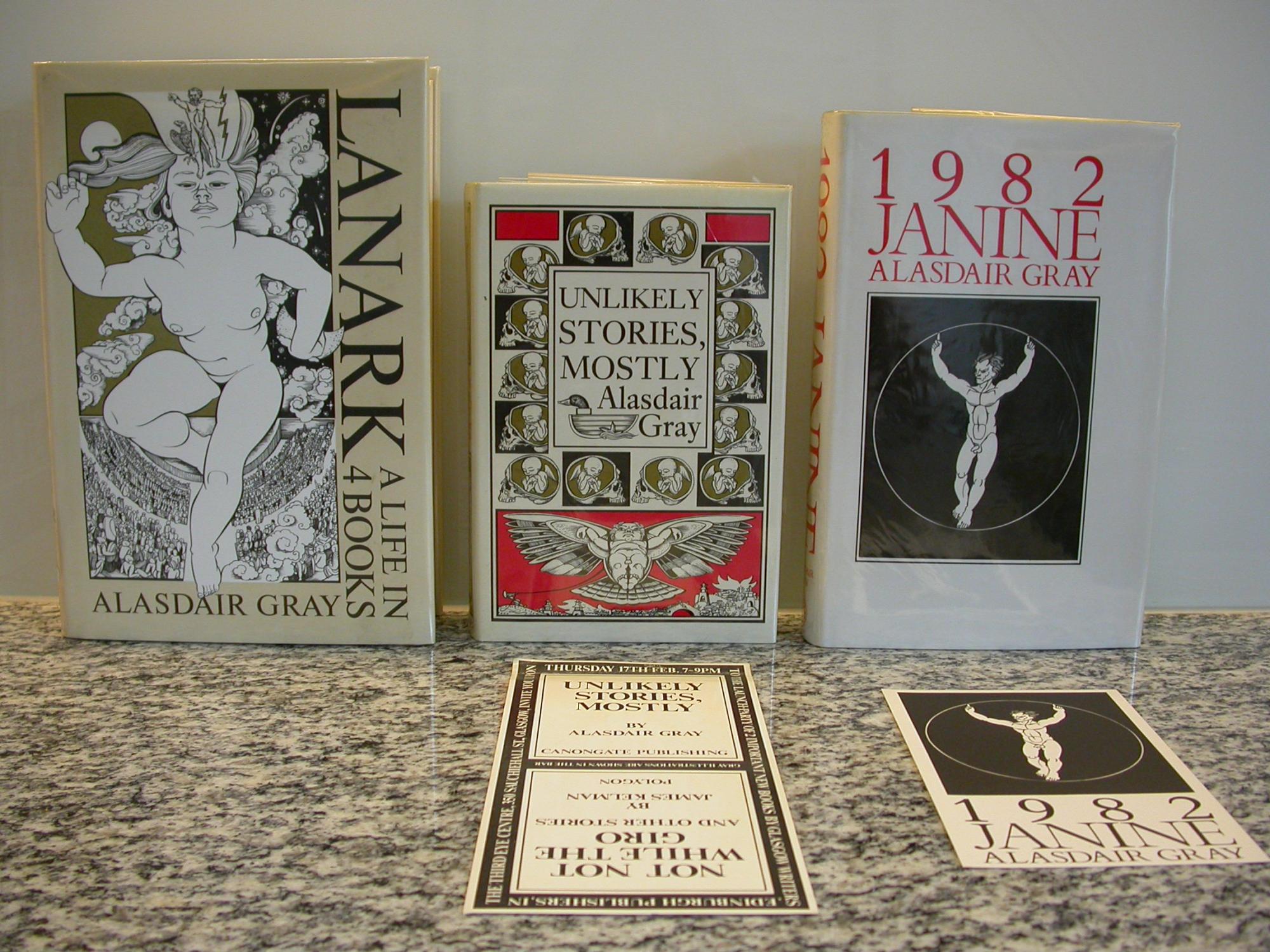
Alasdair Gray, who has died aged 85, was the father figure of the renaissance in Scottish literature and art which began in the penultimate decade of the 20th century. Gray’s great novel Lanark (1981) was an almost preposterously ambitious concoction of thinly disguised autobiography, science fiction, formal playfulness (the four-part story opened at Book Three) and graphic design by the author on a monumental scale. Scottish fiction, which had lain in a depressed state for years, suddenly took off in unexpected directions. Irvine Welsh, Alan Warner, AL Kennedy and Janice Galloway, among others, were all Gray’s bairns. Authors invited Gray to illustrate their books. Little magazines sported his self-portraits and cursive designs on their covers. A graphic artist known locally for his eccentric appearance and behaviour became, at the age of nearly 50, a central figure of the literary world.
Born in Riddrie, in the east of Glasgow, Alasdair was the son of working-class parents with an inclination towards “Fabian, non-revolutionary socialism”. His mother Amy (nee Fleming) worked in a clothing warehouse, but nurtured a love of music, particularly opera. His father, Alexander, who ended his working life as a builder’s labourer, sought consolation in the countryside, and was a founder member of the Scottish Youth Hostels Association.
Self Portrait, Night Street, 1953
Their efforts to hold to a life of imagination or adventure, while bound to the necessities of raising a family in an imposing industrial city, infused Gray’s own artistic vision and political instinct. He was a lifelong socialist and Scottish nationalist, who lived in the city of his birth all his life, save for a four-year spell during the second world war, when the family moved to Yorkshire.
The publication in 2010 of A Life in Pictures, a combined visual and verbal autobiography and an essential companion to Lanark, revealed not only how much of Gray’s novel was straightforwardly personal, but that the formative events of his life took place in a relatively brief period of his late teens. His mother died in 1952, before he turned 18. In the same year, he was admitted to Glasgow College of Art, despite lacking the necessary paper qualifications. There, he immediately impressed both his teachers and fellow students with fantastic, even visionary, projects; but his artistic stature was cruelly undermined by social failures, particularly involving the opposite sex.
Lanark: design for the title page, Book 4, 1982
Gray suffered from chronic eczema and an accompanying shyness which gave rise to unpredictable outbursts and an excitable delivery that remained characteristic all through his life. Lanark, like later novels including 1982, Janine (1984) and Something Leather (1990), is blistering with sexual frustration. Romantic proposals are rejected with misplaced kindliness; healthy erotic wishes are twisted into ugly shapes. The realistic portion of Lanark ends with a prostitute recoiling at the sight of the hero’s reptilian skin, which precipitates his descent to perdition.
Some of the pictures he painted at art school were still being exhibited many years later. One was Night Street Self Portrait (1953), which depicts a brooding figure in half-darkness against a background of kissing lovers and happy families. A black cat depicted nine times suggests that life is draining away. During the same period, Gray drew a remarkable Marriage Feast at Cana, in which the faces of the disciples are modelled on travellers on the Glasgow underground railway. The picture exists only in reproduction, the original having been lost after having been “left too long with a photocopying shop. When I went to collect it the firm no longer existed.”
Immediately after leaving art school, in 1958, Gray received a commission (unpaid, apart from expenses) to paint a set of murals on the subject of the Creation, in Greenhead Church of Scotland church in Glasgow. “I showed God as the third sentence of Genesis says,” Gray wrote in A Life in Pictures, “moving over the waters, not like a dove as sometimes depicted, but more like Superman.” The building was neglected over the following decade, and was demolished in 1970, leading to the loss of what Gray called “my best and biggest mural painting”. He did several other murals: in Belleisle Street synagogue, in Greenbank church, on the walls of private houses, among other places. Among the last he carried out (2012) was the 40ft mural for the entrance hall of Hillhead subway station in the West End of Glasgow. In addition to local landmarks, including the university, it has a section devoted to “All kinds of folk” – “hard workers”, “head cases”, “queer fishes” and so on, all represented in Gray’s typical witty and accessible style.
Cowcaddens Streetscape in the Fifties, 1964
The impulse to write as well as draw emerged in childhood. While at art school, he began a novel called Portrait of the Artist as a Young Scot, which contained the seed that grew into Lanark, almost 30 years later. In the 1960s and 70s, he wrote plays for radio, television and the stage, including some which would later be converted into novels. The Fall of Kelvin Walker (1985), his third novel, began life as a TV play in 1968. McGrotty and Ludmilla (1990) and Mavis Belfrage (1996) had similar origins. Some 20 of these plays were later collected in A Gray Play Book (2009). It included The Cave of Polyphemus, written in 1944, when he was nine.
Many writers have had subsidiary careers at the easel, just as artists have written books. What set Gray apart was a determination to integrate the different skills in the process of bookmaking. A words-only version of Lanark, without the elaborate plates, would be tantamount to an abridged edition. His collection of tales, Unlikely Stories, Mostly (1983), was likewise lavishly decorated. In these and other instances, Gray employed motifs and images which became recognisable staples of his design: amazonian women; biblically bearded men; a foetus inside a skull; self-portraits (often showing the subject drawing the artist); doves and dogs; and always an impish figure at the end holding a sign saying “Goodbye”.
Another recurring habit was to introduce portraits of friends into his work, including the church murals. The Scottish writers James Kelman, Tom Leonard, Liz Lochhead, among many others, have found themselves immortalised in this way. When I asked Gray to sign a copy of his book Old Men in Love (2007), he took it and drew my portrait on the endpaper (handing it back with “Hmmm. Not very flattering”). Faust in his Study, 1958
In 1961, Gray married Inge Sørensen, a Danish nurse then in her teens. They bought the wedding ring from a jeweller’s shop on the way to the registry office. “I believe she married me because she found me more interesting than men with steady jobs and money,” Gray stated – not out of boastfulness but as an explanation for an otherwise puzzling acceptance. He and Inge had a son, Andrew, the subject of many affectionate portraits. The couple separated after eight years and later divorced. He had a long relationship with another Danish woman, Bethsy Gray, and in the late 1980s met Morag McAlpine. They married in 1991. She died in 2014.
Even at the height of his literary and artistic success (in the autumn of 2010 there were two Gray exhibitions showing in Edinburgh at the same time), Gray feared poverty. “I am a well-known writer who cannot make a living from his writing,” he would say. Despite the status of Lanark, its sales never equalled its reputation.
Eden and After, 1956
Moreover, any book by him threatened high production costs, and even the most indulgent of his publishers – Canongate in Edinburgh, and Cape and Bloomsbury in London, all catered to his demand for full artistic control – felt the need to pass at least some of the burden back to the author. The unearthly metropolis in which Duncan Thaw arrives after death in Lanark is called Unthank, and is not all that far removed from Glasgow in certain respects.
Gray’s pictorial autobiography contains many tales of an ungrateful city press – his church murals, like his early exhibitions, were practically ignored, if not mocked. At the beginning of the 21st century, Gray was reduced to applying to the Scottish Artists’ Benevolent Fund for money. Residual resentments were apt to surface in remarks such as: “Lanark won the publishers – not me – a design award.”
A peculiarity of Gray’s graphic work is that it sometimes appears at its best in reproduction. He himself observed that his art lacked “tactile values”. Different portraits – often gorgeous to look at, with particular attention paid to background details such as flowers in a vase or a sofa covering – tend to have similar atmospheres. A Conservative politician breathes the same air as an experimental poet. “My portraits show me as an illustrative decorator,” Gray said, in one of many perceptive comments about his own work in A Life in Pictures.
He related his definite-outline method to “fear or distrust” of “anything liable to shift or depart”. Much of his best work was executed in the spirit of friendship. As he promoted fellow writers, he enjoyed painting friends and their children. He had a likable tendency to idealise his sitters, making them appear more innocent than they were in life.
Portrait of the Artist as an Old Man (Seven Days, 2004)
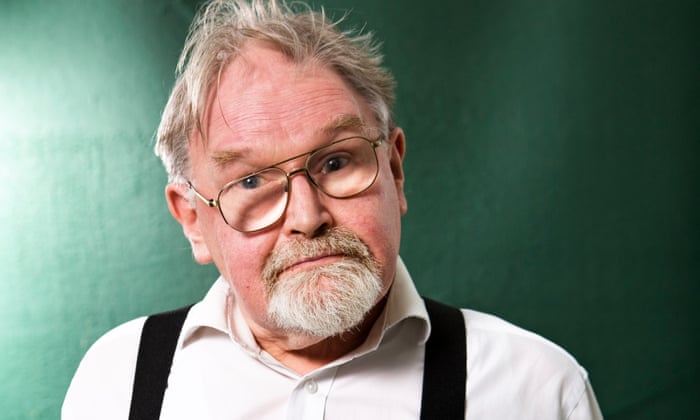
In person, Gray himself presented an arresting spectacle. He had what was once described as a “benignly nutty professor” persona, with “thick spectacles and haywire hair”.
There was a high-pitched laugh which always threatened to leave mirth behind and enter the realm of mania. He would turn up for an appointment, half an hour late, in paint-stained trench-coat, with turned-up flannels flapping well above sandalled feet. Much of the time he was humorous and kind, but could snap impatiently at a remark he considered ill-thought-out, especially with reference to Scottish politics. His ideas about independence are contained in the pamphlet Why Scots Should Rule Scotland (1992).
In 1977, he was Glasgow’s official artist recorder, painting portraits and streetscapes for the People’s Palace Local History Museum. The major project of his later years – perhaps the greatest of his non-literary career – was the mural decoration of Oran Mor, an arts and leisure centre in the converted Kelvinside parish church, at the northern corner of Glasgow’s Byres Road.
Òran Mór
Sponsored by the owner, Colin Beattie, Gray began the work in 2002, lying on his back on a scaffold like a Clydeside Michelangelo, painting constellations of the zodiac in each of 12 ceiling sections. A stream of stars streaks across the central roof beam. The apse is dedicated to his favourite subject, the Creation. In is an astonishing achievement, which required the work of several assistants in addition to the artist himself.
Following a serious fall into a basement outside his home in the summer of 2015, Gray was hospitalised with a broken back, though he later returned to work. A dramatisation of Lanark by the playwright David Grieg was presented at the Edinburgh international festival that year.
His Collected Verse (2010) was followed by Every Short Story 1951-2012. Hell and Purgatory, the first two parts of his version of Dante’s Divine Comedy, “decorated and Englished in prosaic verse”, appeared in 2018 and 2019. In November Gray received the inaugural Saltire Society Scottish Lifetime Achievement award.
He is survived by Andrew and a granddaughter.
• Alasdair Gray, writer and artist, born 28 December 1934; died 29 December 2019
Neil Innes, a Master of Musical Humor, Is Dead at 75
He worked with the Monty Python troupe and was known for his own projects, including the Beatles parody band the Rutles
By Neil Genzlinger
The New York Times
30 December 2019
Neil Innes, the British humorist and musician who was an honorary member of the Monty Python comedy troupe and made a name for himself with a nutty assortment of musical and television projects, including the Beatles parody band the Rutles, died on Sunday near Toulouse, France, where he had lived in recent years. He was 75.
His wife, Yvonne Innes, said the cause was a heart attack.
Mr. Innes, a multi-instrumentalist, was a particular type of songwriter: one who excelled at satirical songs and parodies of other people’s music, but who could also write a pretty good straight song. Sometimes it was hard to tell the difference.
In the early 1960s he was one of the first members of the Bonzo Dog Doo Dah Band, also known as simply the Bonzo Dog Band. He wrote the group’s biggest hit, “I’m the Urban Spaceman,” which climbed into the Top 10 on the British charts in 1968.
In the 1970s he wrote material for Monty Python, the groundbreaking six-member comedy troupe. Midway through that decade he and Eric Idle, a Python, came up with the Rutles, a deadpan parody of the Beatles; the group not only recorded albums but also made films, most notably the mock documentary “The Rutles: All You Need Is Cash” in 1978.
Mr. Innes also performed live shows throughout his career and was still doing so recently.
“His humor is gentle and whimsical, long on non sequiturs and only occasionally risqué,” Jon Pareles wrote in The New York Times, reviewing a show in 1985 at the Bottom Line in Manhattan. “He skewered pomposity in all its guises, from preciousness to enforced singalongs. With a mobile face that could metamorphose in seconds from Buster Keaton to Bob Dylan, and the slightly italicized gestures of a crack vaudevillian, Mr. Innes could get laughs whenever he wanted to.”
Neil James Innes was born on Dec. 9, 1944, in Danbury, England, northeast of London, to Edward and Rita (Hudson) Innes. His father was in the military, and he spent part of his childhood in postwar Germany.
He took piano lessons as a child, taught himself to play guitar and dabbled in drawing and painting. He pursued his art interest first at the Norwich School of Art, then at Goldsmiths College School of Art, graduating in 1966. That same year he married Yvonne Catherine Hilton.
While in school he had begun playing in what was originally named the Bonzo Dog Dada Band.
“The Bonzos tumbled out of the heady early-’60s art-school scene, an ever-changing troupe of eccentrics who delighted the college crowd with a riot of exploding wardrobes, archaic instruments, prewar novelty songs and jazz-age pop,” according to an entry about the group’s first album, “Gorilla” (1967), in “The Mojo Collection: The Ultimate Music Companion.”
“We found the sort of songs we wanted to learn from old 78 Gramophone records,” Mr. Innes told NPR in 2004, “the breakable ones, which we used to buy in street markets.”
The group is seen in the Beatles movie “Magical Mystery Tour” playing its song “Death Cab for Cutie.” The Bonzos also appeared in about 20 episodes of “Do Not Adjust Your Set,” a children’s television show that had a lot of adult fans thanks to a cheeky cast that included Mr. Idle and two other future Pythons, Terry Jones and Michael Palin. Mr. Innes was never a Python, but he did contribute material to “Monty Python’s Flying Circus,” which premiered in England in 1969.
He also appeared in the movies “Monty Python and the Holy Grail” (1975) and “Monty Python’s Life of Brian” (1979), as well as films by individual Pythons.
The Rutles started as a quick gag on “Rutland Weekend Television,” a BBC sketch comedy series about a laughably small-town TV station. Mr. Idle wrote and starred in the show, which ran for two seasons in the mid-1970s; Mr. Innes’s job was to contribute one or two songs per episode.
“Not many people saw it,” Mr. Idle wrote of the series in his memoir, “Always Look on the Bright Side of Life” (2018). “Because it had no live audience, I was never very sure whether it was funny or not, and some people kindly went out of their way to point out that it wasn’t.”
But, of course, it was, particularly when, in the second season, it aired a sketch that featured a segment on a local band that looked and sounded an awful lot like the Beatles and performed a tune written by Mr. Innes called “I Must Be in Love.”
The band, the fake newscaster said, “created a musical legend that will last a lunchtime.”
In October 1976 Mr. Idle hosted “Saturday Night Live,” then in its second season, and played the Rutles clip. Lorne Michaels, creator of “S.N.L.,” became a fan and saw possibilities for a full-length mockumentary, an idea he sprang during a brainstorming meeting at which Mr. Innes was a casual participant.
“I was sitting to one side, on a window sill in an executive office, high up in the Rockefeller Center in New York, listening to all this when suddenly everyone started looking at me,” Mr. Innes recalled in a 2014 interview with The Birmingham Mail. “Lorne asked if I could write 20 more Rutles songs by next Thursday lunchtime. I said I would try!”
“All You Need Is Cash,” a TV movie shown in both England and the United States, was the result. In the mock band, Mr. Innes was Ron Nasty, the John Lennon-like Rutle. (Mr. Idle, as the Paul McCartney character, Dirk McQuickly, lip-synced.) And he was responsible for the songwriting.
John J. O’Connor reviewed “All You Need Is Cash” in The Times. “The music and lyrics,” he wrote, “all written by Mr. Innes, smartly capture the essence of the Beatles and then, ever so cleverly, turn it to mush."
Mr. Innes was also known for two British TV series, “The Innes Book of Records” (1979-81) and the children’s series “Puddle Lane” (1985-89).
In addition to his wife, he is survived by three sons, Miles, Luke and Barney; and three grandchildren.
As news of Mr. Innes’s death spread, each social media post by admirers seemed to single out a different sketch or song or television show that he created or to which he contributed. Danny Kelly, a British music journalist, put it simply.
“A genius at the very eye of the hurricane of British comedy and music,” he wrote on Twitter, “What a CV.”