Saturday, 16 November 2019

Friday, 15 November 2019
Alan Alda riffing on life, death and other stuff...

The former M*A*S*H star has Parkinson’s disease – but remains optimistic. He talks about his new film, Marriage Story, how actors can help heal political division and working with Woody Allen
David Smith
The Guardian
Thu 14 Nov 2019
‘Would you like a beer?” asks Alan Alda, tall and elegant in black raincoat, grey jacket and blue jeans as he walks through his offices near the Lincoln Center in New York. The actor, director and science communicator warmly greets Einstein, a female half bernese mountain dog, half border collie. “Smartest dog I ever met,” Alda’s assistant later observes.
The urbane 83-year-old star of M*A*S*H, The West Wing and The Aviator settles in a glass-walled meeting room, acknowledges that we are here to talk about his new film, Marriage Story, but says he is happy to talk about anything. Over the next hour, he will discuss God, mortality, his mother, podcasting, science, Woody Allen and how he is, so far, unbowed by Parkinson’s disease.
Alda does not appear in the first hour of Marriage Story, probably the most wrenching film about divorcing parents since Kramer vs Kramer. But his role, as a world-weary lawyer with past divorces of his own, is exquisitely rounded. He says he is “more and more impressed” by how the director, Noah Baumbach, has “done the unimaginable and that’s to make a love story out of a divorce story”.

Partly set in New York, the film’s improvisational quality and wry study of marital angst bring to mind Woody Allen at a moment when the Annie Hall director is persona non grata. Allegations that he sexually abused his adopted daughter Dylan Farrow in 1993, when she was a child, have gained renewed attention following the birth of the #MeToo movement. Allen has always denied them and Farrow’s claims were dismissed by two investigations at the time.
In September, Scarlett Johansson, who has appeared in three of Allen’s films and also stars in Marriage Story, said she believed the director and would work with him again. Last week, Jeff Goldblum agreed and said he would consider doing so. Alda, who was born two months after Allen and has appeared in such films of Allen’s as Crimes and Misdemeanors and Manhattan Murder Mystery, appears to be in the same camp.

“I think he was on trial at least once and maybe twice, and at what point do you say innocent until proven guilty and, if you were acquitted, when do you accept it? I don’t have any personal indication that he’s guilty. I don’t like mob actions and it feels a little like a mob to me. I respect somebody’s decision not to work with somebody because they believe the person has not done good things. But I don’t like badmouthing people if they haven’t joined your opinion.”
Alda is clear, however, in his support for #MeToo in the film industry and beyond. “I think it’s really important that women are giving voice to what’s been a plague for centuries,” he says. “When the #MeToo movement spreads to farms and offices, manufacturing floors, then we’ll see big numbers.
“It has the slight – in some cases not slight – disadvantage that it’s a movement. It’s not a set of laws where there’s an effort made for the punishment to fit the crime. Movements have that built into them. I hope it leads to more serious rules and systems of coping with it.”
Alda has seen both sides of marriage. His parents’ relationship was full of strife and ended in divorce. His father, Robert, was an actor and singer who created the role of Sky Masterson in the Broadway musical Guys and Dolls. His mother, Joan, had paranoid schizophrenia and tried to stab her husband when Alan was six.
“She was ill from the time I was born,” he says. “I was angry for a long time because I didn’t know why she behaved that way and I felt I didn’t have a real mother. When I look back, I realise that even with her illness, she loved me very, very much and expressed it in the only ways she could – in spite of the fact that she would tell me often that I was trying to kill her. So I got a lot of mixed messages but, before she died, I understood a lot better. And I went to a lot of trouble to try to make her last days as comfortable as I could.”
Alda and his wife, Arlene, a photographer and children’s author, have been married for 62 years and have three daughters and eight grandchildren. He says that, according to Arlene: “The secret to a long marriage is a short memory. I have a more pedestrian way of looking at it which is, when you’re in the middle of yelling at each other, which you will at some point, remember that you’re talking to the person you love more than anybody in the world and it might change the tone of the conversation.”

When Alda fell ill with an intestinal obstruction in Chile in 2003, he dictated a letter to Arlene before emergency surgery in case he never saw her again. “I had about two hours to live,” he says, matter of factly. “We just came across it recently and it was just as pedestrian as I imagined. But it was basically telling my wife I loved her. That’s the best kind of pedestrian.”
A few years ago, while asleep, Alda threw a pillow at Arlene; he had been dreaming that he was under attack and was throwing a sack of potatoes at the assailant. When he woke, he remembered a New York Times article that said acting out dreams can be an early sign of Parkinson’s disease. A few months later, he got the first visible symptom, by which time he was already on an exercise programme that now includes boxing, juggling, tennis and marching to music by John Philip Sousa.
Alda went public about his condition last year but, like Michael J Fox, whom he has interviewed on his Clear+Vivid podcast, has no intention of letting it end his career. His hand can be seen mildly shaking in Marriage Story. In the TV drama Ray Donovan he plays a psychiatrist who also has Parkinson’s – a little worse than his own. “So sometimes I have to fake it.”
Alda also has prosopagnosia, or face blindness, but is untroubled by self-pity, instead focusing on the precious present. “I love reality,” he says. “I’m more comfortable with the uncertainty of reality than I am with wishes and hope.
“I am sort of optimistic, so that represents hope for me but reality is even more connected to hope than that because what is, is” – he slaps the table – “so why waste time wishing it away? I have a natural tendency to deny it so I can get on with things but that’s not the same thing as saying: ‘Oh, why me?’ If not me, somebody else. Why anybody? Nature is uncertain and, to a great extent, destructive. For Christ’s sake, we all die.”
Alda relinquished the religion in which he was raised long ago. “I’m not any kind of Catholic,” he says. “I haven’t come across any evidence for God.” Instead, he says he finds the beauty and wonder of the universe sublime enough. Asked whether he thinks death is the end, he riffs on the ubiquity of microbes and how they made the world inhabitable for all living things, before adding that it is extraordinary “that we’re gonna die and it’s so amazing that most of us live as if that’s not gonna happen”.

Ten years ago, he helped set up the Alda Center for Communicating Science at Stony Brook University in New York. Scientists feature heavily on his popular podcast, of which there have been about 75 editions so far – and which he tries to keep as politics-free as possible, in part because of the impact he feels it has had on lucidity. “I don’t talk about politics in public, but I am in favour of facts. I think science has been under attack for a while by a number of groups, some of which support the administration.”
In an age of fragmented media, Trump in the White House and a nation either appalled or thrilled by his views, unifiers seem in short supply. But a generation ago, in 1983, there was M*A*S*H, which drew more than 106m viewers for its finale. Alda, who played Hawkeye in that series – and a likable Republican candidate for president in The West Wing – hopes that his efforts on and off screen can encourage people to listen to each other and mend the frayed social fabric.
Accepting a Screen Actors Guild lifetime achievement award this year, he said: “It may never have been more urgent to see the world through another person’s eyes than when a culture is divided so sharply. Actors can help, just a little, by just doing what we do.”
The speech moved people to tears. “I wanted to say something about how what we do might be regarded by other people as an exercise in narcissism,” says Alda. “Because we [actors] really perform an important function, which is to help people live other people’s lives vicariously and we do that through empathy, and we make a real contribution when we do it well.
“Marriage Story is really about what I spend a lot of my life trying to do, which is help improve communication. To be able to recognise another point of view with respect and not contempt? Boy, do we need that now.”
Marriage Story is in UK cinemas on 15 November and on Netflix from 6 December.
Thu 14 Nov 2019
‘Would you like a beer?” asks Alan Alda, tall and elegant in black raincoat, grey jacket and blue jeans as he walks through his offices near the Lincoln Center in New York. The actor, director and science communicator warmly greets Einstein, a female half bernese mountain dog, half border collie. “Smartest dog I ever met,” Alda’s assistant later observes.
The urbane 83-year-old star of M*A*S*H, The West Wing and The Aviator settles in a glass-walled meeting room, acknowledges that we are here to talk about his new film, Marriage Story, but says he is happy to talk about anything. Over the next hour, he will discuss God, mortality, his mother, podcasting, science, Woody Allen and how he is, so far, unbowed by Parkinson’s disease.
Alda does not appear in the first hour of Marriage Story, probably the most wrenching film about divorcing parents since Kramer vs Kramer. But his role, as a world-weary lawyer with past divorces of his own, is exquisitely rounded. He says he is “more and more impressed” by how the director, Noah Baumbach, has “done the unimaginable and that’s to make a love story out of a divorce story”.
Partly set in New York, the film’s improvisational quality and wry study of marital angst bring to mind Woody Allen at a moment when the Annie Hall director is persona non grata. Allegations that he sexually abused his adopted daughter Dylan Farrow in 1993, when she was a child, have gained renewed attention following the birth of the #MeToo movement. Allen has always denied them and Farrow’s claims were dismissed by two investigations at the time.
In September, Scarlett Johansson, who has appeared in three of Allen’s films and also stars in Marriage Story, said she believed the director and would work with him again. Last week, Jeff Goldblum agreed and said he would consider doing so. Alda, who was born two months after Allen and has appeared in such films of Allen’s as Crimes and Misdemeanors and Manhattan Murder Mystery, appears to be in the same camp.
“I think he was on trial at least once and maybe twice, and at what point do you say innocent until proven guilty and, if you were acquitted, when do you accept it? I don’t have any personal indication that he’s guilty. I don’t like mob actions and it feels a little like a mob to me. I respect somebody’s decision not to work with somebody because they believe the person has not done good things. But I don’t like badmouthing people if they haven’t joined your opinion.”
Alda is clear, however, in his support for #MeToo in the film industry and beyond. “I think it’s really important that women are giving voice to what’s been a plague for centuries,” he says. “When the #MeToo movement spreads to farms and offices, manufacturing floors, then we’ll see big numbers.
“It has the slight – in some cases not slight – disadvantage that it’s a movement. It’s not a set of laws where there’s an effort made for the punishment to fit the crime. Movements have that built into them. I hope it leads to more serious rules and systems of coping with it.”
Alda has seen both sides of marriage. His parents’ relationship was full of strife and ended in divorce. His father, Robert, was an actor and singer who created the role of Sky Masterson in the Broadway musical Guys and Dolls. His mother, Joan, had paranoid schizophrenia and tried to stab her husband when Alan was six.
“She was ill from the time I was born,” he says. “I was angry for a long time because I didn’t know why she behaved that way and I felt I didn’t have a real mother. When I look back, I realise that even with her illness, she loved me very, very much and expressed it in the only ways she could – in spite of the fact that she would tell me often that I was trying to kill her. So I got a lot of mixed messages but, before she died, I understood a lot better. And I went to a lot of trouble to try to make her last days as comfortable as I could.”
Alda and his wife, Arlene, a photographer and children’s author, have been married for 62 years and have three daughters and eight grandchildren. He says that, according to Arlene: “The secret to a long marriage is a short memory. I have a more pedestrian way of looking at it which is, when you’re in the middle of yelling at each other, which you will at some point, remember that you’re talking to the person you love more than anybody in the world and it might change the tone of the conversation.”
When Alda fell ill with an intestinal obstruction in Chile in 2003, he dictated a letter to Arlene before emergency surgery in case he never saw her again. “I had about two hours to live,” he says, matter of factly. “We just came across it recently and it was just as pedestrian as I imagined. But it was basically telling my wife I loved her. That’s the best kind of pedestrian.”
A few years ago, while asleep, Alda threw a pillow at Arlene; he had been dreaming that he was under attack and was throwing a sack of potatoes at the assailant. When he woke, he remembered a New York Times article that said acting out dreams can be an early sign of Parkinson’s disease. A few months later, he got the first visible symptom, by which time he was already on an exercise programme that now includes boxing, juggling, tennis and marching to music by John Philip Sousa.
Alda went public about his condition last year but, like Michael J Fox, whom he has interviewed on his Clear+Vivid podcast, has no intention of letting it end his career. His hand can be seen mildly shaking in Marriage Story. In the TV drama Ray Donovan he plays a psychiatrist who also has Parkinson’s – a little worse than his own. “So sometimes I have to fake it.”
Alda also has prosopagnosia, or face blindness, but is untroubled by self-pity, instead focusing on the precious present. “I love reality,” he says. “I’m more comfortable with the uncertainty of reality than I am with wishes and hope.
“I am sort of optimistic, so that represents hope for me but reality is even more connected to hope than that because what is, is” – he slaps the table – “so why waste time wishing it away? I have a natural tendency to deny it so I can get on with things but that’s not the same thing as saying: ‘Oh, why me?’ If not me, somebody else. Why anybody? Nature is uncertain and, to a great extent, destructive. For Christ’s sake, we all die.”
Alda relinquished the religion in which he was raised long ago. “I’m not any kind of Catholic,” he says. “I haven’t come across any evidence for God.” Instead, he says he finds the beauty and wonder of the universe sublime enough. Asked whether he thinks death is the end, he riffs on the ubiquity of microbes and how they made the world inhabitable for all living things, before adding that it is extraordinary “that we’re gonna die and it’s so amazing that most of us live as if that’s not gonna happen”.
Ten years ago, he helped set up the Alda Center for Communicating Science at Stony Brook University in New York. Scientists feature heavily on his popular podcast, of which there have been about 75 editions so far – and which he tries to keep as politics-free as possible, in part because of the impact he feels it has had on lucidity. “I don’t talk about politics in public, but I am in favour of facts. I think science has been under attack for a while by a number of groups, some of which support the administration.”
In an age of fragmented media, Trump in the White House and a nation either appalled or thrilled by his views, unifiers seem in short supply. But a generation ago, in 1983, there was M*A*S*H, which drew more than 106m viewers for its finale. Alda, who played Hawkeye in that series – and a likable Republican candidate for president in The West Wing – hopes that his efforts on and off screen can encourage people to listen to each other and mend the frayed social fabric.
Accepting a Screen Actors Guild lifetime achievement award this year, he said: “It may never have been more urgent to see the world through another person’s eyes than when a culture is divided so sharply. Actors can help, just a little, by just doing what we do.”
The speech moved people to tears. “I wanted to say something about how what we do might be regarded by other people as an exercise in narcissism,” says Alda. “Because we [actors] really perform an important function, which is to help people live other people’s lives vicariously and we do that through empathy, and we make a real contribution when we do it well.
“Marriage Story is really about what I spend a lot of my life trying to do, which is help improve communication. To be able to recognise another point of view with respect and not contempt? Boy, do we need that now.”
Marriage Story is in UK cinemas on 15 November and on Netflix from 6 December.
Wednesday, 13 November 2019
Monday, 11 November 2019


Saturday, 9 November 2019
Wednesday night's set lists at The Habit, York

He'll Have To Go
Here, There And Everywhere
Need Your Love So Bad
You Better Move On
Promises
Lola
Da Elderly: -
You've Got A Friend
Everybody's Talkin'
Till There Was You
In The Morning Light
One Of These Days
Harvest Moon
The Elderly Brothers: -
Things We Said Today
You Really Got A Hold On Me
No Reply
Chains
Walk Right Back
I Saw Her Standing There
Up until about 11pm the bar was quiet, with only a few players. Afterwards the place was rammed, with a great atmosphere. To start with we did 2 rounds of sets, each with 3 songs. A young chap surprised us with some fine songs and guitar work, featuring a resonator (see photo), the highlight being a cover of Fleetwood Mac's Rambling Pony. The Elderly Brothers closed the show with some Beatles' songs and one by the Everlys.
Friday, 8 November 2019
Earl Slick on his career and working with David Bowie and John Lennon

Earl Slick performing at Celebrating David Bowie at the Wiltern Theatre in 2017 in Los Angeles (Photo by Kevin Winter)
Guitarist to the stars Earl Slick recalled a possibly imaginary 1970s encounter with ex-Beatle John Lennon minutes after flying into London from New York earlier this week.
By Paul Kelly
The Southern Reporter
Thursday, 7th November 2019
Slick, speaking on a mobile telephone en route from Heathrow Airport to Shepherd’s Bush in London, was hired to play on the ex-Beatle’s 1980 album Double Fantasy, in part because Lennon fondly recalled the way he wielded his musical axe five years earlier at the David Bowie session that produced the hit single Fame, a No 17 in 1975.
But one problem was that Slick, now 67, had no recollection of the encounter. “How could I forget meeting John Lennon? I didn’t have any memory of it,” he said, adding: “I was there. I know I played on Fame. Well, I kind of remember playing on Fame.”
His somewhat hazy recollection may be due to his self-confessed heavy drug use during the period.
Whatever the truth, the legendary guitarist was similarly frazzled – a result of jetlag, not drug use – when he disembarked from his plane to prepare for a UK talk tour kicking off at Selkirk’s Victoria Halls on Sunday. “My body has landed, now I’m waiting for the rest of me to arrive,” he quipped wearily.
What is not in any doubt is Slick’s prestigious record for musical collaborations.
The Brooklyn-born musician has played alongside such rock legends as Carl Perkins, Ringo Starr, George Harrison, Eric Clapton, Keith Richards, Robert Smith and Stevie Ray Vaughan.
And although it’s as a sideman to Bowie and Lennon that he is best remembered, he does have a Scottish musical pedigree. In the early 1970s, he toured and recorded with Glasgow-born singer-songwriter Jim Diamond, who went on to enjoy a UK number one single with I Should Have Known Better in 1985.
Slick explained: “Me and Jim were friends for years and we had a band in the States for a while. A record producer by the name of John Alcock – he produced Thin Lizzy records and my Razor Sharp record with the Earl Slick Band – got me and Jim hooked up. He flew Jim over to the States, and we were actually getting some headway when his visa ran out, and that took care of that.”
Slick’s UK tour takes the form of a conversation and question-and-answer session, with some guitar-playing thrown into the mix.
The idea emerged in 2012 when he linked up again with Lennon’s widow, Yoko Ono. “It was the South Bank in London, and Yoko was curator of the Meltdown Festival and we did the whole Double Fantasy record. They gave me a venue and I didn’t know what to do with it, and my manager said ‘why don’t you speak and do a Q&A?’.”
His links with Bowie and Lennon will no doubt dominate the questions and answers at the Victoria Halls this weekend.
Slick played on three Bowie albums during the 1970s – David Live, Young Americans and Station to Station – returning for three more, Heathen in 2002, Reality a year later and Bowie’s unexpected and much-heralded return, The Next Day, in 2013. Between times, he’d joined with Bowie for the Serious Moonlight Tour in 1984, in support of 1983’s Let’s Dance album, as a last-minute replacement for Texan blues guitarist Stevie Ray Vaughan.
That had echoes of a decade earlier when Slick had the daunting challenge of replacing Mick Ronson in the Thin White Duke’s band.
“Mick Ronson was a tough act to follow. As young as I was at the time, I was aware enough to ask myself ‘how am I going to do this?’. I was concerned enough to ask Bowie if he wanted me to be Mick Ronson, to sit there and learn his parts and everything, and he said ‘no, I hired you because I like the way you play’. He said to ‘play ’em the way you see ’em’, which saved my cookies because when we started that Diamond Dogs tour the reviews on me were good. Had I tried to be Mick, they would have killed me. Everything you read and heard about that period was what it was. All of us were out there. I don’t know how we got anything done, but we did.”
Bowie’s 21st-century albums proved a different challenge.
“The way we did those records was a lot different to how we did them in the seventies. Things were way more focused. Bowie was a different person. We all were more stable across the board. When you take the drugs away, you kind of become a human again.”
When Slick was asked to play on Lennon and Ono’s Double Fantasy album in October 1980, the ex-Beatle hadn’t released a record for five years, but he proved a relaxed presence in the studio.
“He didn’t miss a beat when he took those five years off. He was on his game. He really was so easy to work with because he considered himself a band member as opposed to an artist with a backing band.
“He felt more comfortable being part of that than being separated from us and that got better performances out of us.
“His voice was spot on, but he still made jokes about it, but he made jokes about the way he looked too, he made jokes about everything, just like he did in the old Beatles footage.
“It was pretty much the same. Maybe he might have been a little concerned that the time off was an issue with his voice but by no means was he insecure about it.
“He was very well together at the time, and any socialising with him would involve me dropping off at the apartment to have a cup of coffee and talk about the material. At the end of the sessions, he would just sit there and tell stories and jokes or go out to dinner once in a while.
“I was in Los Angeles when I heard he had been shot. I was gearing up to go back to New York for the Christmas holidays and was going to stay on because we were supposed to go back in the studio with John in January to finish up the tracks that eventually became the Milk and Honey album and then go into rehearsals for a tour which obviously didn’t happen.”
Tickets for Slicky Speaks – Earl Slick in Conversation with Jesse Smith at the Victoria Halls on Sunday from 8pm are £14.30. For details, go to liveborders.org.uk, wegottickets.com or call 01750 21382. Details of the rest of the tour can be found at facebook.com/EarlSlickOfficial
A little closer to home, Slick entertains at The Cluny on Wednesday 13 November:
Wednesday, 6 November 2019
Bridging the Gap: The Tyne Bridge

A sound portrait of the Tyne Bridge, linking Newcastle and Gateshead
With recordings by wildlife sound recordist, Chris Watson, the sounds of the waves, the wind and the wildlife are combined with the voices of the river in this powerful and vivid portrait of a magnificent bridge.
The earliest bridge across the Tyne, Pons Aelius, was built by the Romans near the location of the present Tyne bridge. After it fell into disrepair, a stone bridge was built in 1270 but this was destroyed by the great flood of 1717. The idea for the present Tyne Bridge dates back to 1883, but it wasn't until 1825 that work began. The design is based on the Sydney bridge. And whilst work on the Sydney bridge began first, the Tyne bridge was finished and opened first by King George V on 10th October 1928.
The Tyne is a major artery through the city, the Tyne Bridge a vital span; a thoroughfare of business and trade, a link between Gateshead and Newcastle, between north and south. As a giant arch, the bridge is an engineering triumph and hugely symbolic; it spans place and time, and as a port-way it's symbolic of the changes which have taken place in the north east.

Today, the wildlife has moved into the gaps vacated by the industrial past; the river is home to otters and salmon and the bridge is a nesting site for kittiwakes, a species of ocean-travelling gull. The birds which nest here and on the Baltic on the Gateshead river bank make it the furthest inland breeding site of kittiwakes in the world.
Sound recordist Chris Watson
Producer: Sarah Blunt
Listen here for another 29 days:
https://www.bbc.co.uk/programmes/b00q3kvw
https://www.bbc.co.uk/programmes/b00q3kvw
Monday, 4 November 2019


Sunday, 3 November 2019
Saturday, 2 November 2019
Wednesday night's set lists at The Habit, York

Never Let Her Slip Away
Mellow My Mind
Heart Of Gold
Set 2: -
I'm Just A Loser
I'm So Tired
Mother's Lament
Unknown Legend
Old Man
Ron was poorly with the flu-like bug going around, so there was no Elderly Brothers' set. The place was quite full at 9pm unlike last week. The first three 'turns' exemplified why The Habit open mic night is such a joy......unexpected just doesn't do them justice. First up was a quartet made up of 3 female vocalists backed by a chap on guitar......the sound was Andrews Sisters tight 3-part harmony with acoustic guitar backing; their outstanding song was Girls Just Wanna Have Fun! Next up was a Spanish guy who gave us two numbers in his native tongue and an excellent medley of La Bamba with Twist and Shout, everyone singing the responses. Later he did a superb Superstition with host Simon backing on guitar. Following him was an all girl duo who had "just thrown these songs together this afternoon". The vocalist had a beautifully mellow voice covering Love Will Tear Us Apart, Slip Sliding Away and The Boxer. Regular George gave us spirited performances of Ruby, Don't Take Your Love To Town and I Will Survive. I was asked to close the show, so pulled out a couple of rarities in the form of a White Album favourite and the closing track on Cream's Disraeli Gears.
Thursday, 31 October 2019


Wednesday, 30 October 2019
Lucian Freud: The Self Portraits at The Royal Academy, London - review
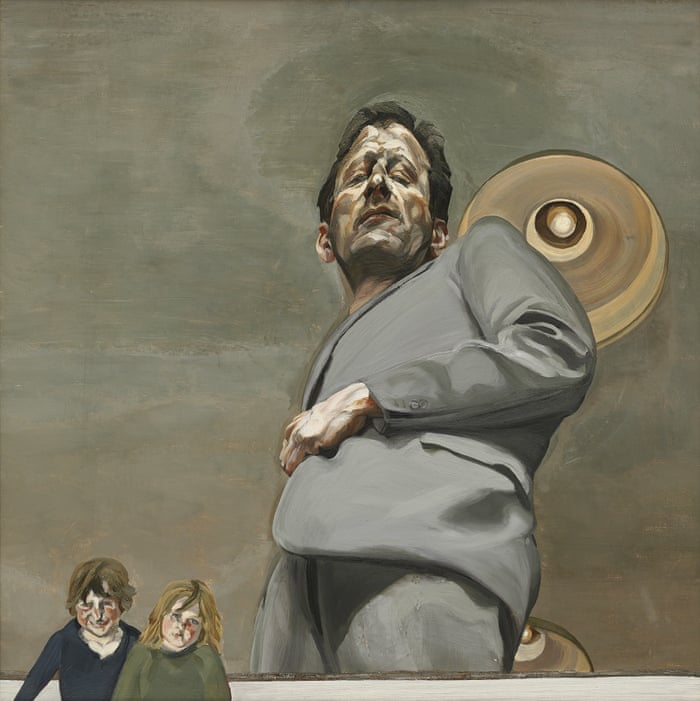
Lucian Freud: The Self-Portraits review – menacing, elusive ... orgasmic?
Royal Academy, London
Whether he’s just a shadow or staring at us, open-mouthed and wide-eyed, the great self-dramatist remains curiously unknowable
Adrian Searle
Open-mouthed and surprised, he draws himself with soft black crayon and pencil in a deceptively plain 1948 image. The caption talks about some Rembrandt etchings from 1630 and Courbet’s 1843 self-portrait The Desperate Man. Instead, I see a young man wide-eyed in orgasm, his head tilted slightly back, the chin closer to us than his forehead. Who’s on top? Is anybody there? There is shading around the edge of his ears and his neck, as if he were pressed against a pillow. Maybe he is imagining what he would look like in that instant to a lover. Behind Freud’s teeth his mouth is a black cavern that could swallow the world. I imagine it going all the way down, but maybe that’s just me.
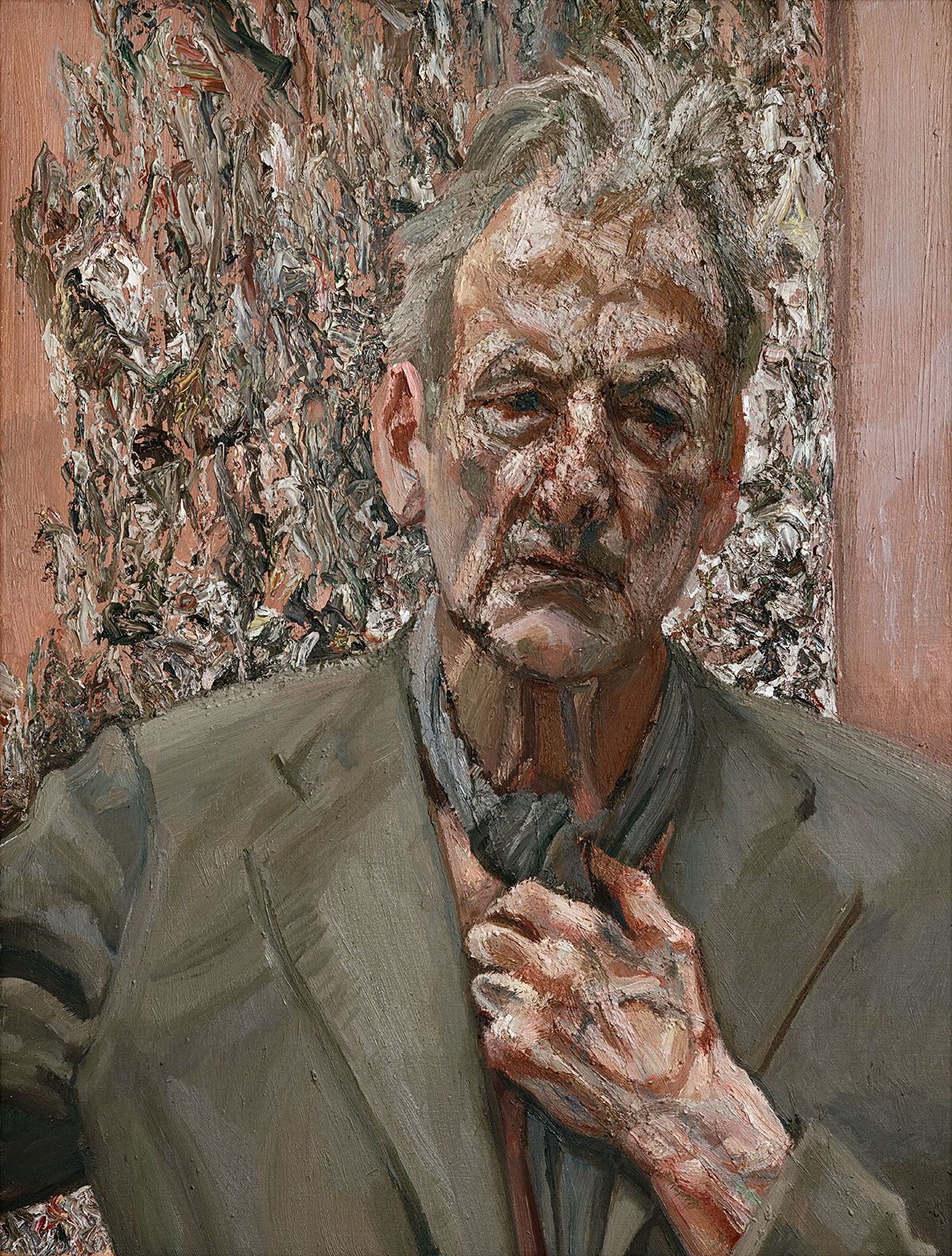 Self-portrait, Reflection, 2002
Once, he’s only a shadow, cast on the bed where his model lies naked. Like a stain or trace evidence, this looming, enlarged patch of grey on the sheet almost isn’t there, while everything else in the painting is solid; the woman on the bed is raw and fleshy. This shadow puts us in the painter’s place, hovering invisible over a naked woman. It looks like a movie murder scene; I think of Sickert and of Alfred Hitchcock’s Frenzy. A section of this exhibition is devoted to works in which Freud’s own presence is secondary: a pair of small self-portraits sit at the bottom of a wall in the background to his portrait of two Irishmen in their suits. My eye wanders past and out of the window in the background to the open-skied views of west London’s stuccoed streets and tower blocks beyond. Is he misdirecting us?
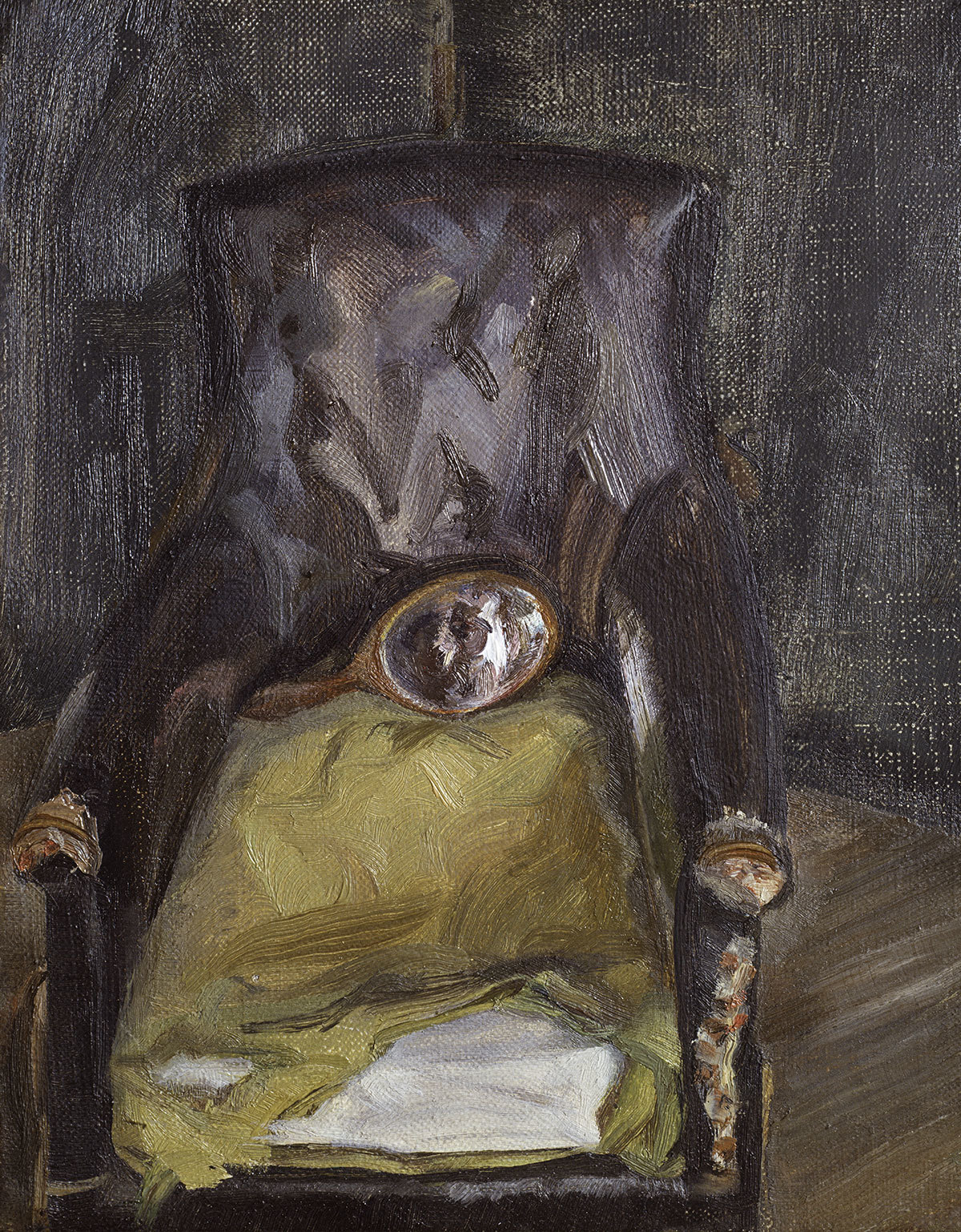 Hand Mirror on Chair, 1966
These glimpses are always more than incidental, even when all we see are Freud’s pacing shoes beyond his sitter, caught in the studio mirror as he turns between the canvas and his model. You think you hear the sound of his feet. And then you see a bit of his leg, reflected dim in the night-time window between the blind and the sill, as his son Freddy, naked and stark, stands in the corner of the room.
Sometimes he is cropped and sometimes he is unfinished, his face petering out into smears and lost brushstrokes. In their way, these false starts are as complete as any portrait gets. He is always beginning again. “When I see photographs of painters staring into the distance I always think, ‘What complete cunts. I don’t want to be one of those,’” Freud once remarked. I don’t think he wanted to be one of those painters who portray themselves all constipated and brow-furrowing, smug and supercilious, either. Even when he is at the centre of things, he’s unknowable.
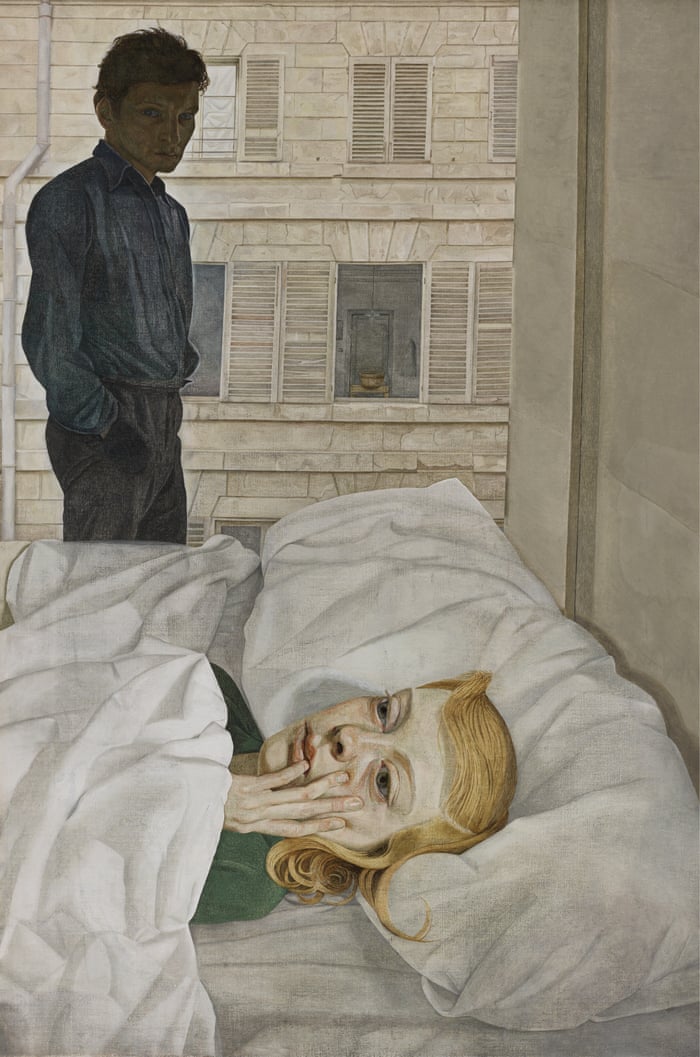 Hotel Bedroom, 1954
Freud is a great self-dramatist, and seems to take pleasure catching snatches of himself in mirrors, peering between the foliage of a potted plant, looming and menacing like a 1960s London gangster, then suave and louche, or a sly old git, fixing us from the corner of his eye with a horrible knowing glance as he passes by.
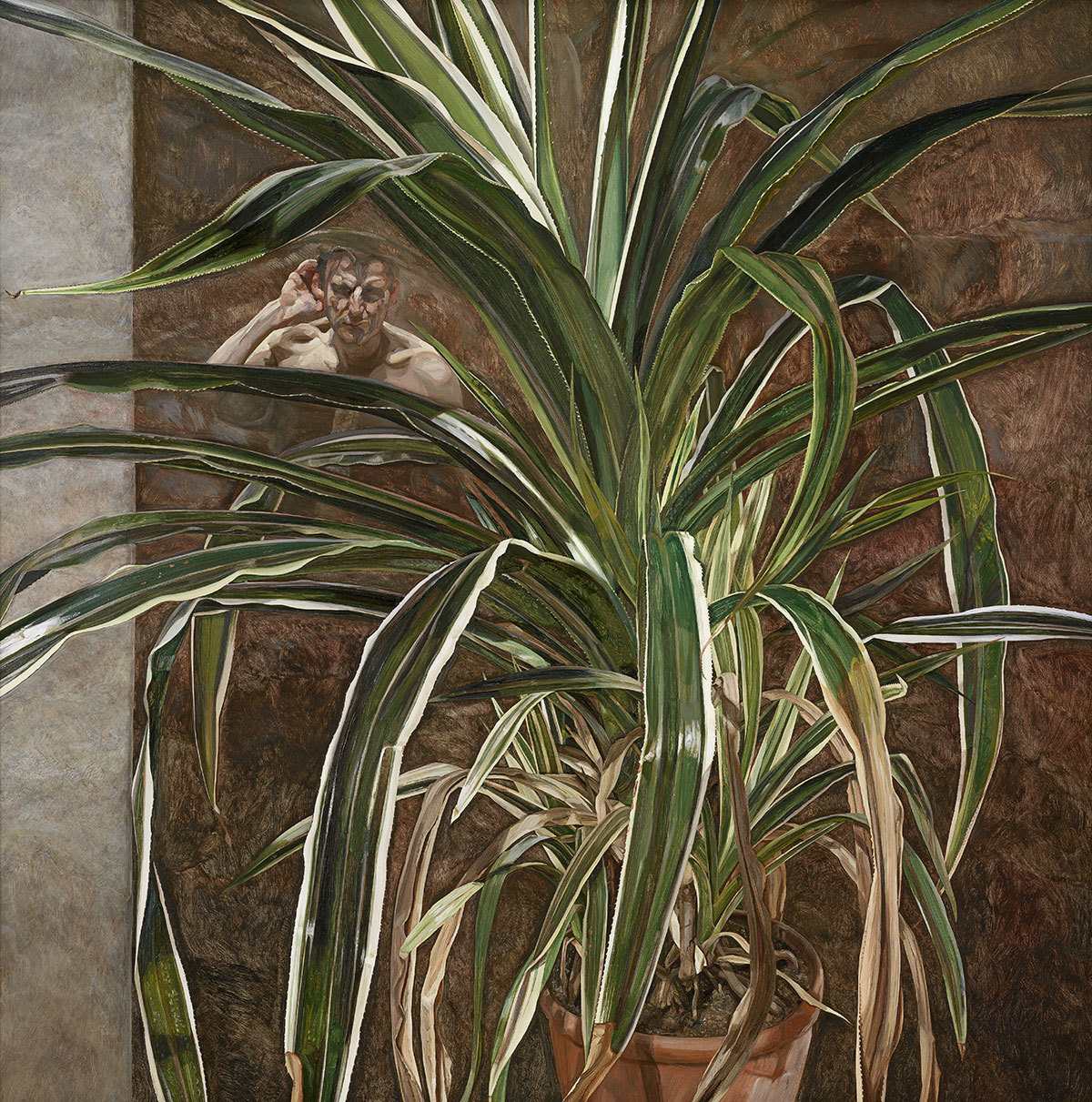 Interior with Plant, Reflection Listening, (Self-portrait), 1967-68
Freud may have resisted his grandfather Sigmund’s influence on his own paintings, but both worked in self-consciously contrived stage-set rooms where other people come and go, leave and return and have secrets to tell. In Freud’s paintings the secrets are the one’s the body tells, rather than the things they say. How complicated, how fascinating it all is.
Lucian Freud: The Self-Portraits is at the Royal Academy, London, from 27 October to 26 January.
https://www.theguardian.com/artanddesign/2019/oct/22/lucian-freud-the-self-portraits-review-royal-academy-london
Royal Academy, London
Whether he’s just a shadow or staring at us, open-mouthed and wide-eyed, the great self-dramatist remains curiously unknowable
Adrian Searle
The Guardian
22 Oct 2019
Lucian Freud at 18, his head ballooning out of the frame, flat-faced, a glint in his liquid eye where the light catches the varnish. His eyebrows are millipedes. Then Lucian in 1943, big-eared, gawky, oddly calm, a white feather in his hand.
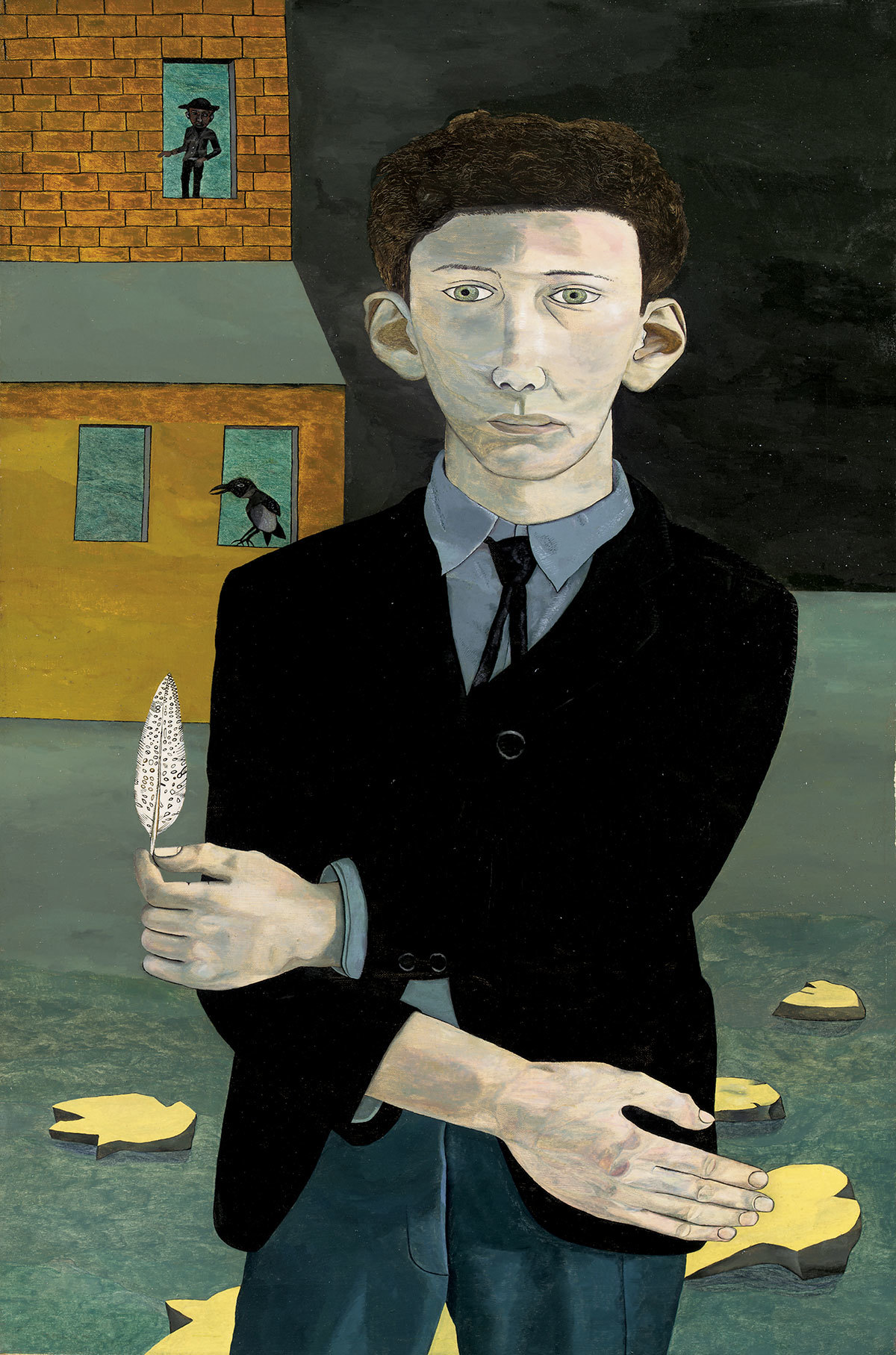
Man with a Feather, 194322 Oct 2019
Lucian Freud at 18, his head ballooning out of the frame, flat-faced, a glint in his liquid eye where the light catches the varnish. His eyebrows are millipedes. Then Lucian in 1943, big-eared, gawky, oddly calm, a white feather in his hand.
With each work in this exhibition of Freud’s self-portraits we witness an increasing occupation with his own portrayal, the person moving in and taking up residence in his own unstable image – the one he’s been given and the one he’s making for himself. Sometimes we see Freud in glimpses, or peering round a corner, uneasy but knowing. Then he’s hanging about by a streetlamp, beside a wall surrounding a big house. I hear a lonesome harmonica, and imagine him reaching into his pocket for a packet of Strand cigarettes. (“You’re never alone with a Strand,” the advert went.)
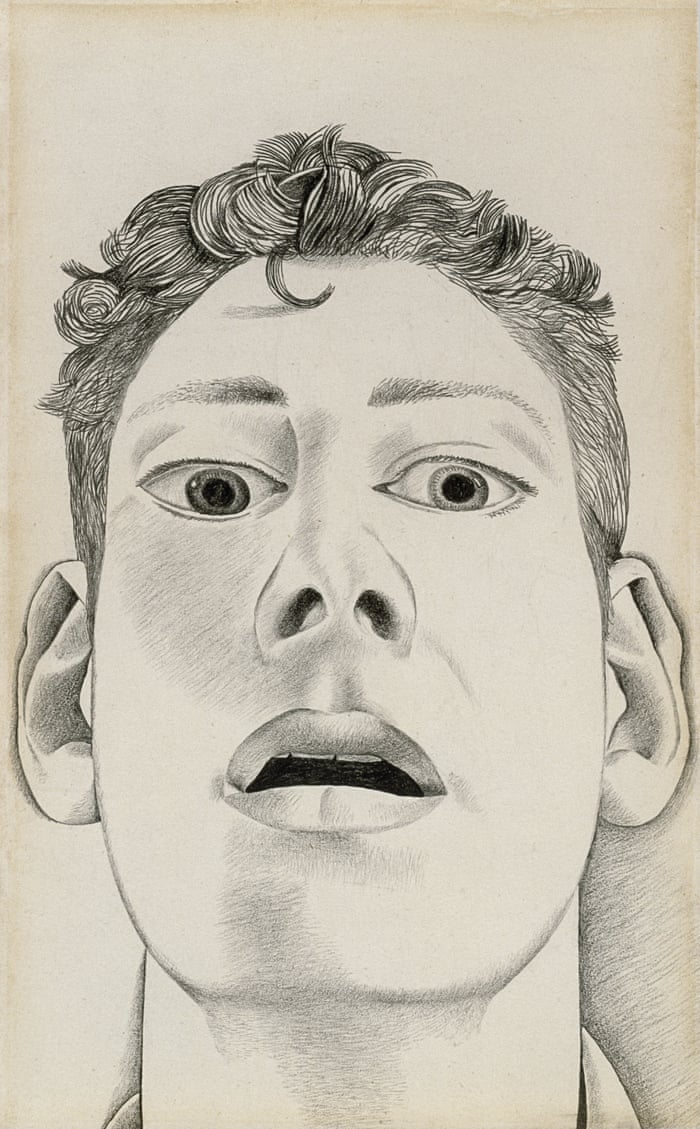
Startled Man: Self Portrait, 1948Open-mouthed and surprised, he draws himself with soft black crayon and pencil in a deceptively plain 1948 image. The caption talks about some Rembrandt etchings from 1630 and Courbet’s 1843 self-portrait The Desperate Man. Instead, I see a young man wide-eyed in orgasm, his head tilted slightly back, the chin closer to us than his forehead. Who’s on top? Is anybody there? There is shading around the edge of his ears and his neck, as if he were pressed against a pillow. Maybe he is imagining what he would look like in that instant to a lover. Behind Freud’s teeth his mouth is a black cavern that could swallow the world. I imagine it going all the way down, but maybe that’s just me.
Once, he’s only a shadow, cast on the bed where his model lies naked. Like a stain or trace evidence, this looming, enlarged patch of grey on the sheet almost isn’t there, while everything else in the painting is solid; the woman on the bed is raw and fleshy. This shadow puts us in the painter’s place, hovering invisible over a naked woman. It looks like a movie murder scene; I think of Sickert and of Alfred Hitchcock’s Frenzy. A section of this exhibition is devoted to works in which Freud’s own presence is secondary: a pair of small self-portraits sit at the bottom of a wall in the background to his portrait of two Irishmen in their suits. My eye wanders past and out of the window in the background to the open-skied views of west London’s stuccoed streets and tower blocks beyond. Is he misdirecting us?
These glimpses are always more than incidental, even when all we see are Freud’s pacing shoes beyond his sitter, caught in the studio mirror as he turns between the canvas and his model. You think you hear the sound of his feet. And then you see a bit of his leg, reflected dim in the night-time window between the blind and the sill, as his son Freddy, naked and stark, stands in the corner of the room.
Sometimes he is cropped and sometimes he is unfinished, his face petering out into smears and lost brushstrokes. In their way, these false starts are as complete as any portrait gets. He is always beginning again. “When I see photographs of painters staring into the distance I always think, ‘What complete cunts. I don’t want to be one of those,’” Freud once remarked. I don’t think he wanted to be one of those painters who portray themselves all constipated and brow-furrowing, smug and supercilious, either. Even when he is at the centre of things, he’s unknowable.
Freud is a great self-dramatist, and seems to take pleasure catching snatches of himself in mirrors, peering between the foliage of a potted plant, looming and menacing like a 1960s London gangster, then suave and louche, or a sly old git, fixing us from the corner of his eye with a horrible knowing glance as he passes by.
Life, like painting, is a kind of self-invention, but along the way things intervene. Shit happens to us and around us, in paintings as well as life. Accidents and mistakes pile up – just like that thick, granular and poisonous lead-white Freud used in his later work. The mistakes and accidents include other people, their presence and affect as they pass through the studio. Their bodies, clothed or naked, are always in the way.
Hell isn’t only other people. One must include oneself and one’s body in this comedy of errors and terrors and that’s what Freud does. Then, later, naked in the studio, he raises his palette knife aloft with a kind of comic defiance. Along with the sallow, sagging skin, he is a mess of revisions and repaintings, the pigment piling up and moiling over his cock and balls, the face redone and done again, the room emptying out behind him. It is only him there now.
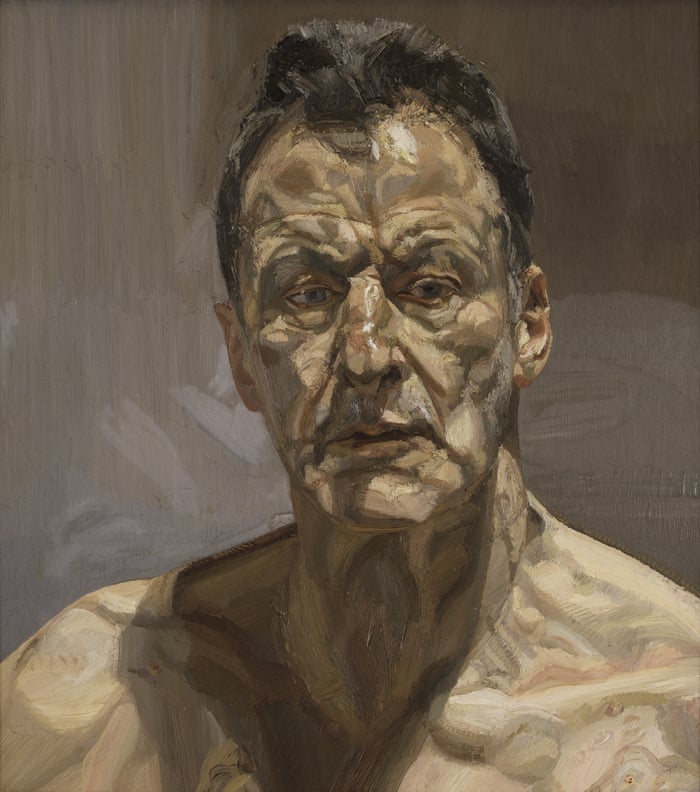
Hell isn’t only other people. One must include oneself and one’s body in this comedy of errors and terrors and that’s what Freud does. Then, later, naked in the studio, he raises his palette knife aloft with a kind of comic defiance. Along with the sallow, sagging skin, he is a mess of revisions and repaintings, the pigment piling up and moiling over his cock and balls, the face redone and done again, the room emptying out behind him. It is only him there now.
Reflection (Self Portrait), 1985
Freud may have resisted his grandfather Sigmund’s influence on his own paintings, but both worked in self-consciously contrived stage-set rooms where other people come and go, leave and return and have secrets to tell. In Freud’s paintings the secrets are the one’s the body tells, rather than the things they say. How complicated, how fascinating it all is.
Lucian Freud: The Self-Portraits is at the Royal Academy, London, from 27 October to 26 January.
https://www.theguardian.com/artanddesign/2019/oct/22/lucian-freud-the-self-portraits-review-royal-academy-london
Monday, 28 October 2019


Subscribe to:
Posts (Atom)