THE Friday Boys are a disparate group of men spread across Tyneside who meet once a week - 'always on a Friday' - to talk about the arts, raise a glass to recently departed heroes and villains and, at the evening's end, down a whisky or two. The FBs have only one golden rule - talk of the working week is strictly off-limit.
Tate Britain, London This magnificent exhibition of 300 images reveals Blake’s inspiring vision at its most vivid and strange
Laura Cummings
The Observer 15 September 2019
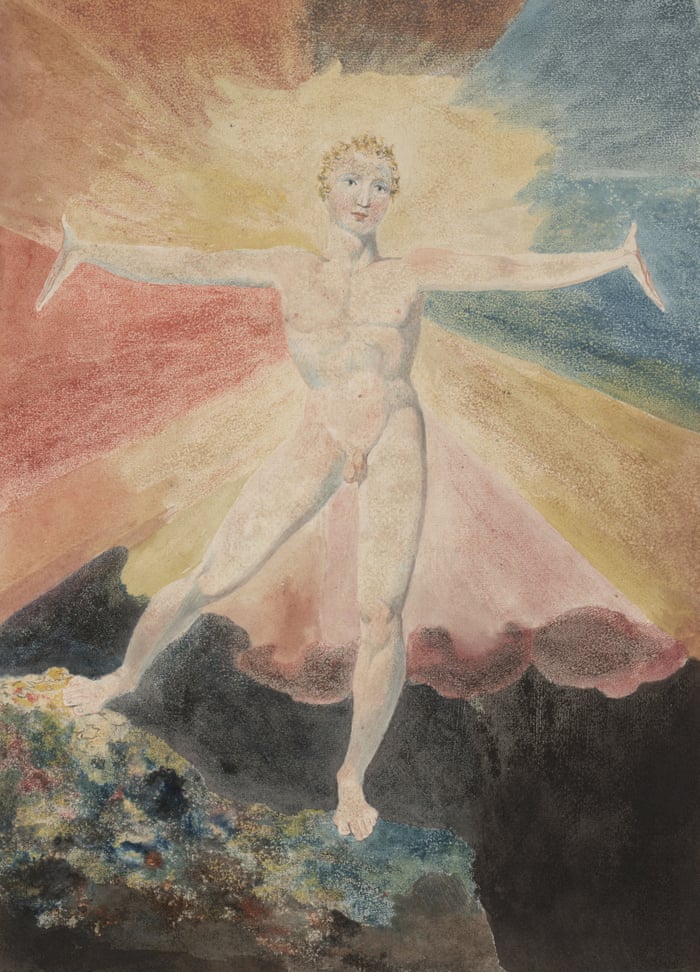
This stupendous show opens with a starburst: the naked figure of Albion rising in glory, rainbows exploding around his outstretched arms. It is a curtain-raiser, a full frontal performance: the beautiful dancer in mid-sashay on the edge of a cliff, bringing light to dispel the darkness. And Albion’s arms are holding out for more – welcoming this new dawn, inviting us all to rise up with him. It is the great wake-up call of British art.
Albion Rose, c1793
But what does it mean, this spectacular engraving? Albion represents England (and primeval man) in the made-up mythologies of William Blake (1757-1827). But many people believe this is not Albion so much as the personification of freedom, imagination, independence. Shake off those mind-forg’d manacles, rebel against conservatism, slavery, organised religion, even tight clothes: interpretations of the image are ceaselessly at odds.
Everyone knows that Blake is art’s original free spirit. He is against science, the establishment, the Age of Reason. Yet this radiant figure might be the very emblem of Enlightenment thinking, just as it could be the angel Gabriel, a prelapsarian Lucifer, or the spirit of political awakening. The curators of this colossal survey, the first on such a scale in nearly 20 years, are wise to point out the almost impenetrable complexities of Blake’s thinking from the start. Their aim is to throw the focus on his works as images, as opposed to emblems – tiny, teeming visions of gods, monsters and wild scenarios taking place at the bottom of the ocean or outer space, but above all in the free world of Blake’s imagination.
Beatrice Addressing Dante from the Car 1824–7
He is rightly presented here as the most radical of leftfield artists. The son of a Soho shopkeeper who stumped up the money for drawing lessons and his son’s apprenticeship to an engraver at 14, Blake studied for about a year at the Royal Academy. He learned to loathe the conformism of both the institution and its president, Joshua Reynolds. There was only one show – an unqualified disaster held above the Soho shop, with not a work sold. All his life, Blake kept having to make engravings of other people’s art.
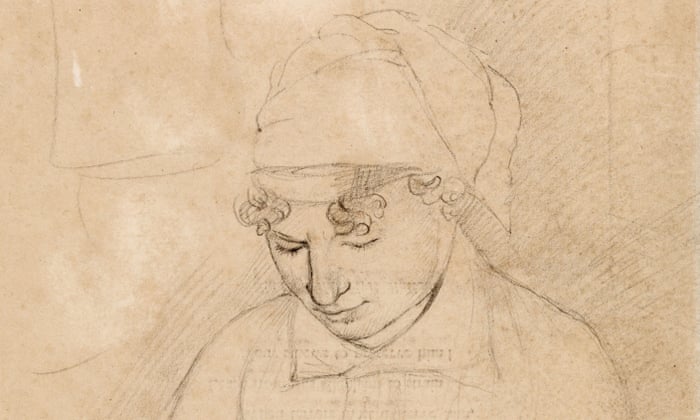
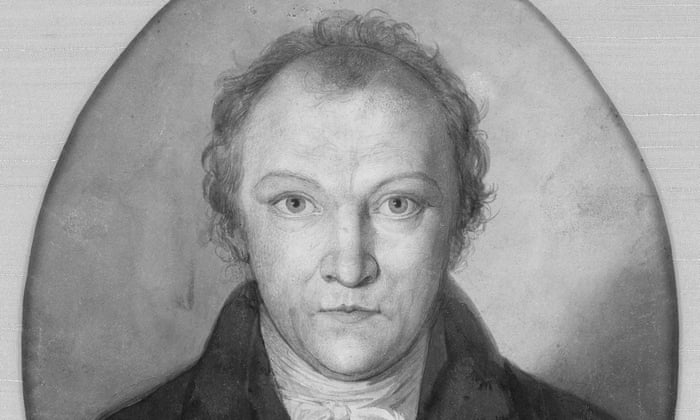
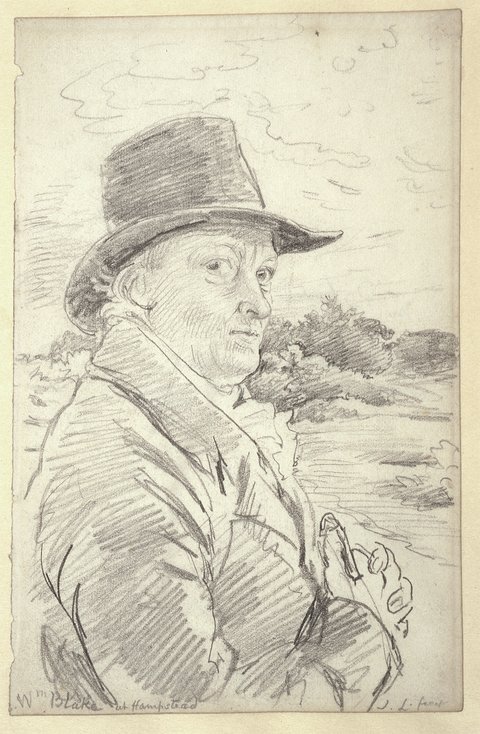
Except for the occasional hint of a Regency sideburn, however, his art reflects nothing of Georgian London. An unconfirmed self-portrait in the first gallery shows the artist with an intense but entirely in-turned gaze, plus that same startling symmetry that characterises so much of his work; images stream out of his mind, not in through his eyes. The critic of Blake’s one and only show – an unqualified disaster, held above the shop – thought he was eccentric, not to say mad.
Possible self-portrait it from 1802
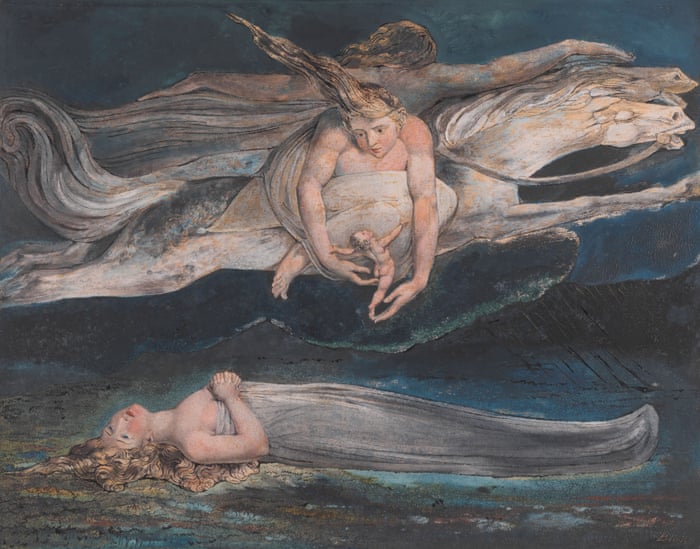
And Blake’s art remains irreducibly strange. Familiarity cannot diminish the utter singularity of his home-grown aesthetic: heads floating on columns of transparent Lycra-like material, rippling up towards multicoloured skies or gathering in tumultuous spirals. Saints diving through the firmament, devils flickering like fire, angels back-crawling through transparent seas. Lone bodies are shown in convulsion, drowning, paralysed or hunched tight as padlocks. Unbound, they appear spreadeagled, levitating, or hurtling upwards like the bellowed flames up a chimney.
Pity, c 1795
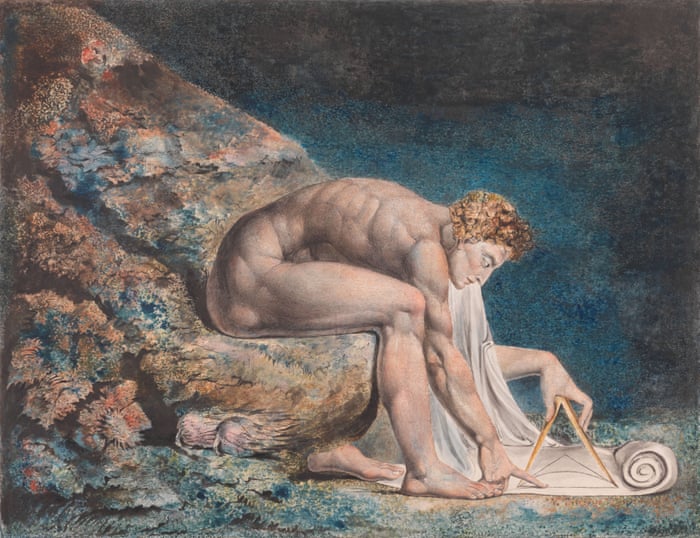
Moses holds up the tablets: a rocket man just about to lift off. Adam and Eve, with their high waists and Blake’s weirdly pronounced muscle groups, perform a nude pas de deux. Men and women look alike, and both at times resemble a stylised version of his self-portrait, with its fixated eyes. Tulips make love, lovers couple inside flowers, fleas are reincarnated as titans. Newton does his pointless calculations – as if the world could possibly be measured – at the bottom of an inky blue sea.
Newton, 1795-c1805
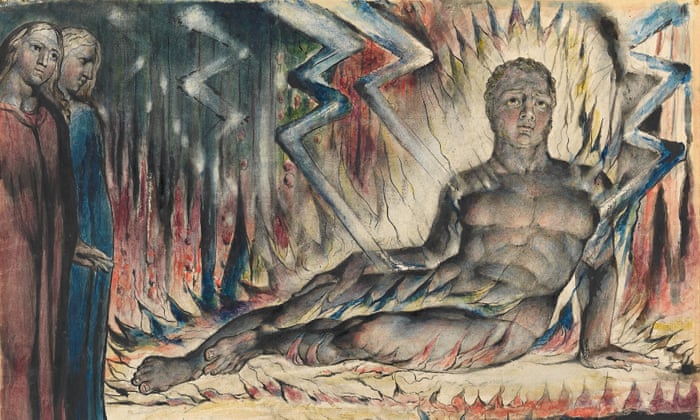
Could anyone, without benefit of scholarship, honestly interpret that marvellous icon as a diatribe against Newton and all his works? Can anyone really tell the difference between Blake’s The Ancient of Days, with his wind-blown beard and lightning-bolt dividers, and his doppelganger in the imaginary The Book of Urizen, representative of science and unfreedom? These visual archetypes appear interchangeable, evenly distributed across the moral spectrum. And walking through this immense show – 300 works and more – it becomes obvious that good and evil may well have the same face or physique in Blake’s conceit. After all, Lucifer eventually becomes Satan. Satan Smiting Job with Sore Boils, c.1826
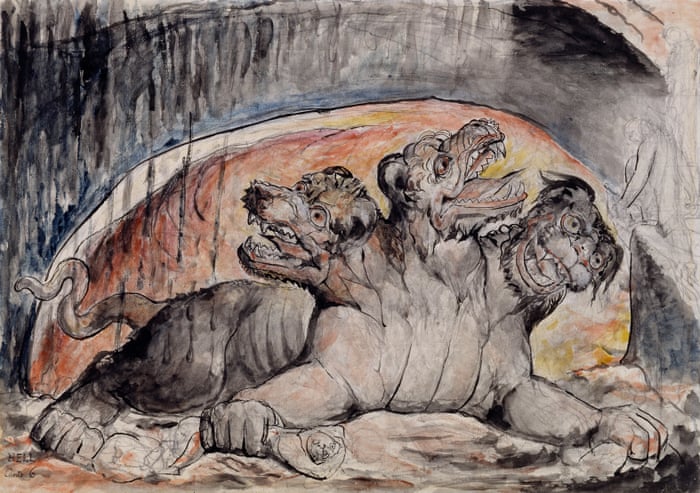
In his visions, the devil may be tragic, tortured by interminable regret; and God may be violent, uprooting Adam like a weed from the earth. Horror is not always frightening. One illustration of hell shows a smoking serpent front of stage in a kind of glamorous limelight. Cerberus has at least one head resembling a London dog.
Cerberus, 1824-7
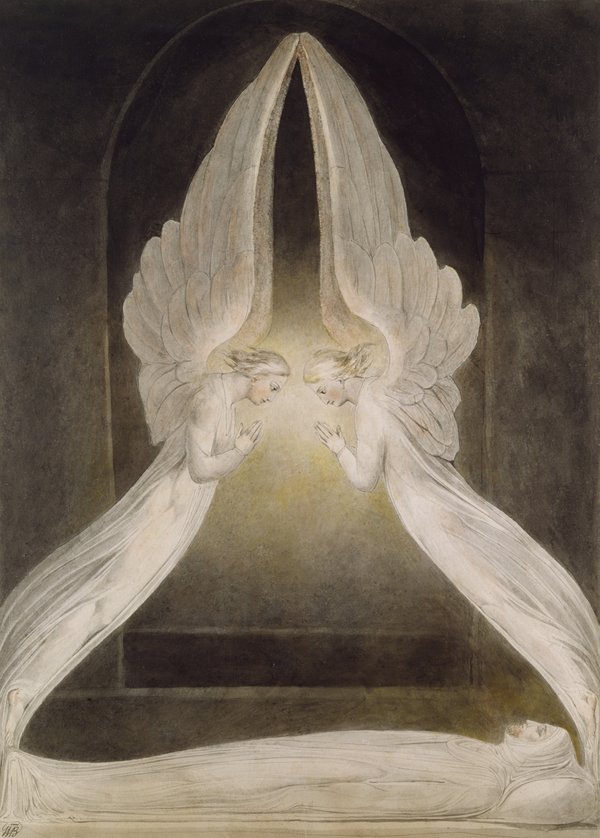
This late ink and watercolour painting is unusually large for Blake, about the size of a hardback book. In the early years, his paintings looked like outsize black and white prints, scenes from the Bible done in greyscale, all hieratic poses, super-long bodies and neo-Gothic drapes, based on his fascination with Queen Eleanor’s medieval tomb in Westminster Abbey. But quite soon they shrink in size, even as they expand pictorially; to paraphrase Blake: infinity in the palm of your hand.
Christ in the Sepulchre, guarded by Angels, c. 1805
Ideas proliferate as images. A wild scrimmage of monkeys: evolution condensed. Infants so joyful they hover in the air like butterflies. Urizen falls to earth like a comet, a diver, or an Olympic gymnast balanced head down on a beam. God, in one supreme vision, is shown creating the entire world in the act of opening the pages of an illustrated book.
Nobody made books like William Blake. He pioneered the technique of relief etching, in which everything but his images and words – which had to be written backwards – was corroded from the plate. The words appear in his own handwriting; the images are hand-touched by Blake, and also by Catherine, so that they look like individual watercolours. Working this way, Blake freed himself and his art from traditional printing and existing typefaces.
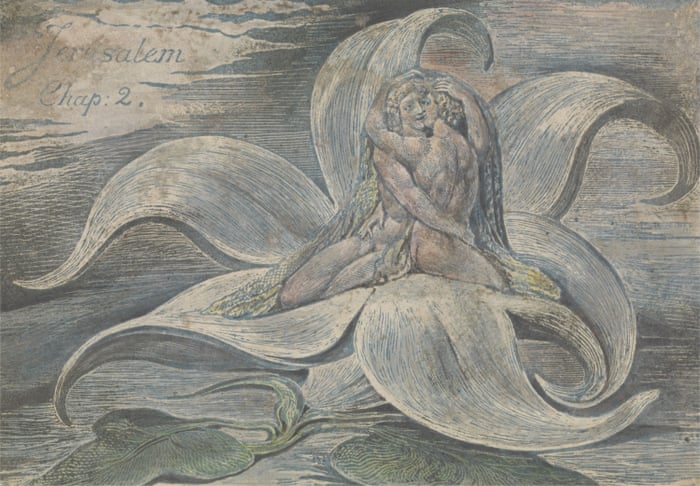
Jerusalem, plate 28, 1820
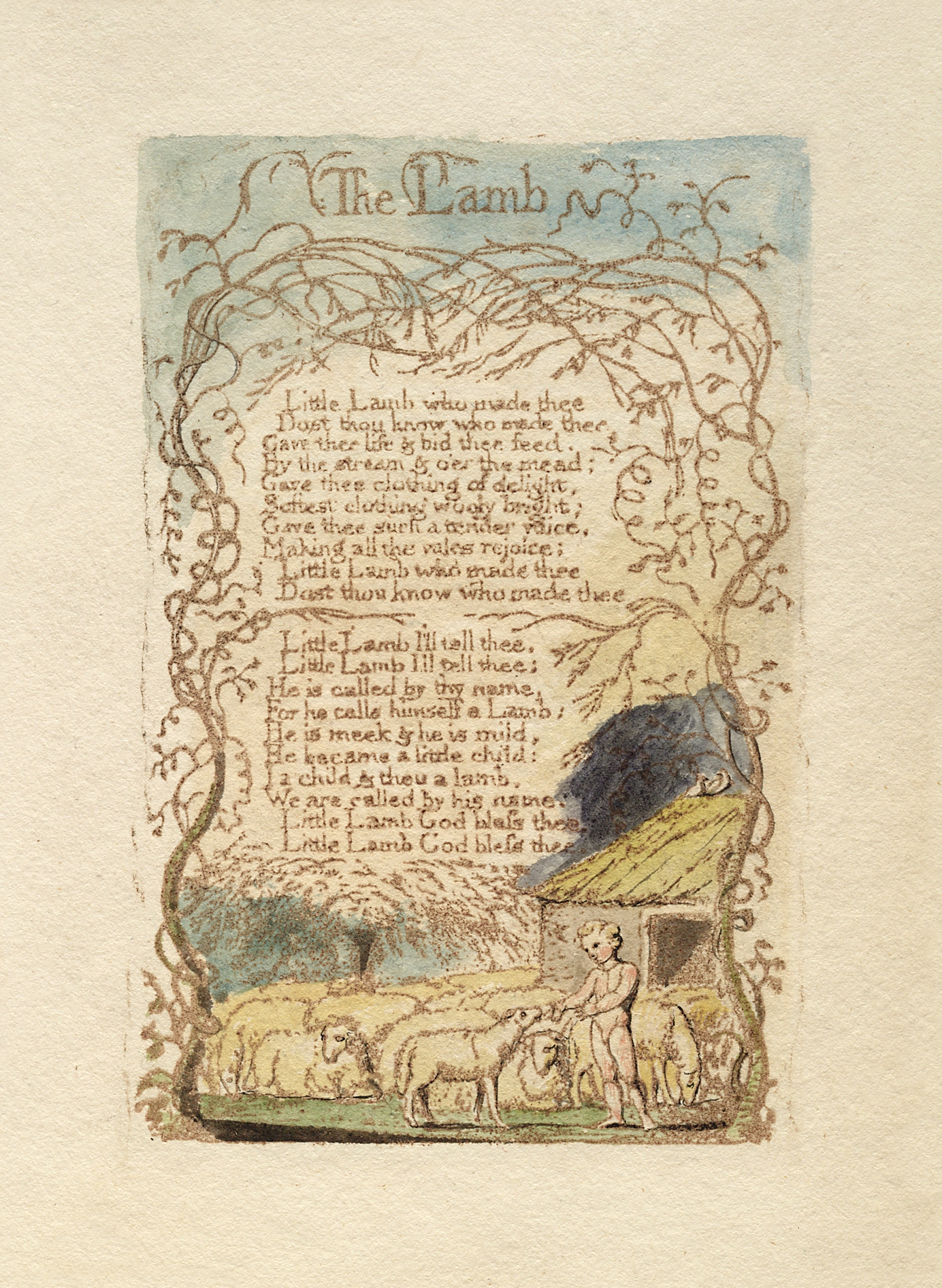
In displaying them bound up as printed books, as well as separately, in the individual sheets prized by museums all over the world, the curators emphasise Blake’s unique enterprise on paper. Everything he imagined – radiant planets, swooping angels, infernal pile-ups – was choreographed in terms of the illuminated page. Scenes float like vignettes – a star-spangled heaven top right, the lamb of God lying down bottom left – or merge with the words themselves, passing through them like the very things depicted: rivers, fireballs, gusting winds. "The Lamb" published in Songs of Innocence in 1789
Sometimes the script is so tiny it is almost illegible, particularly when there is so much going on between the lines. It is astonishing to spot proper names like Washington and Tom Paine on a page, in the poem America, beneath a dazzling image of Urizen lying back on an armchair composed of storm clouds. And while the words are an indelible exhortation to freedom in themselves – freedom from slavery, or British rule, freedom from conventional marriage or dark Satanic mills – the images carry that idea of liberty as a graphic principle.
The Symbolic Figure of the Course of Human History Described by Virgil, 1824-1827
Blake may depict Apollo dancing like a prima ballerina, or Death taking a bow. The Symbolic Figure of the Course of Human History Described by Virgil is – amazingly – a dead ringer for the Statue of Liberty, complete with spiky diadem and torch. It is impossible to believe that Frédéric-Auguste Bartholdi hadn’t seen Blake’s watercolour when he designed his monument.
Every figure must fit the page – sometimes deliberately fighting its limitations, in the case of the eternal prophet Los, howling in despair against the imprisoning walls of his box. But the page is also the source of true freedom. Everything can go wild within the fierce symmetry of Blake’s art – man becomes Superman, angels are skydivers, gods and prophets are shape-shifting wraiths and every sinew is visible beneath those see-through garments because everything is vision transcribed; figments of line and wash on the airy page.
The Spiritual Form of Pitt Guiding Behemoth, 1805
Peering into these tiny pictures, you keep seeing premonitions of our present times: factionalism, violence, stupidity, oppression. But it would be hard to think of a more encouraging artist; and that is a matter of images, beyond words. Blake’s figures are designed to inspire: urging you to stand up, rise up, embrace your fellow man and woman with their surging uplift, distilled in Albion rising. His whole being was devoted to freedom, his art a perpetual call to arms.
•William Blake is at Tate Britain, London SW1 until 2 February
Three stars of the Blake show
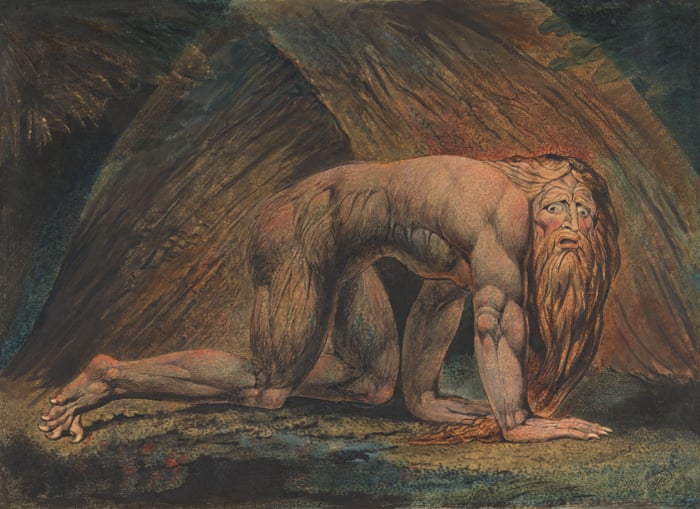
Nebuchadnezzar 1795-1805
The king of Babylon is a terrible warning to us all: “those that walk in pride, the Lord can abase”. Blake’s Nebuchadnezzar has been so abased it is by now a hybrid of man and beast, crawling the Earth on his hands and knees, skin like hide, toes turning into griffin’s talons. 'Europe' Plate i: Frontispiece, 'The Ancient of Days' 1827
The divine white-beard, reaching down from his burning disc to measure the Earth below with his shining dividers. For all the force and similarity, this is not in fact God but Blake’s Urizen, the despised personification of Reason and Science.
The River of Life 1805
A family streams up the transparent waters of this winding river, hand in hand, past classical buildings and towards a shining golden sun. Everything flows onwards towards the light, in one of Blake’s most radiant visions of happiness.
John Linnell - William Blake at Hampstead wearing a hat, c.1825
Heavenly visions of hell: Alan Moore on the sublime art of William Blake Blake’s Lambeth home was also the scene of the spiritual apparitions captured in a major new Tate exhibition, writes the graphic novelist
Alan Moore
The Guardian Friday 30 Aug 2019
When we speak of the poetry or painting of place, we generally refer to words and images that celebrate or else investigate some fixed location. And yet, given that all creative works have arisen from whatever influences surrounded their geographic point of composition, surely all art could be said to be the art of place, something that could only have emerged from that specific spot at that specific time? A city, a field, a house, a street: all of these have their own aura, their own atmosphere, a lyric condensation born of memory and history. Might it be, however, that some places have not only an embedded past, but an embedded future also? Could some works of art be already contained within their site of origin, immanent and waiting for discovery, for realisation?
If we imagine the material world about us having a concealed component of the fictional and the fantastic, visions buried in its stones and mortar waiting for their revelation, then we may suppose that 18th-century Lambeth was a teeming hub of such imaginal biodiversity. Bedlam alone could account for this ethereal population boom, but then nearby was the Hercules Buildings residence of William Blake, which can have only added to the sublime infestation.
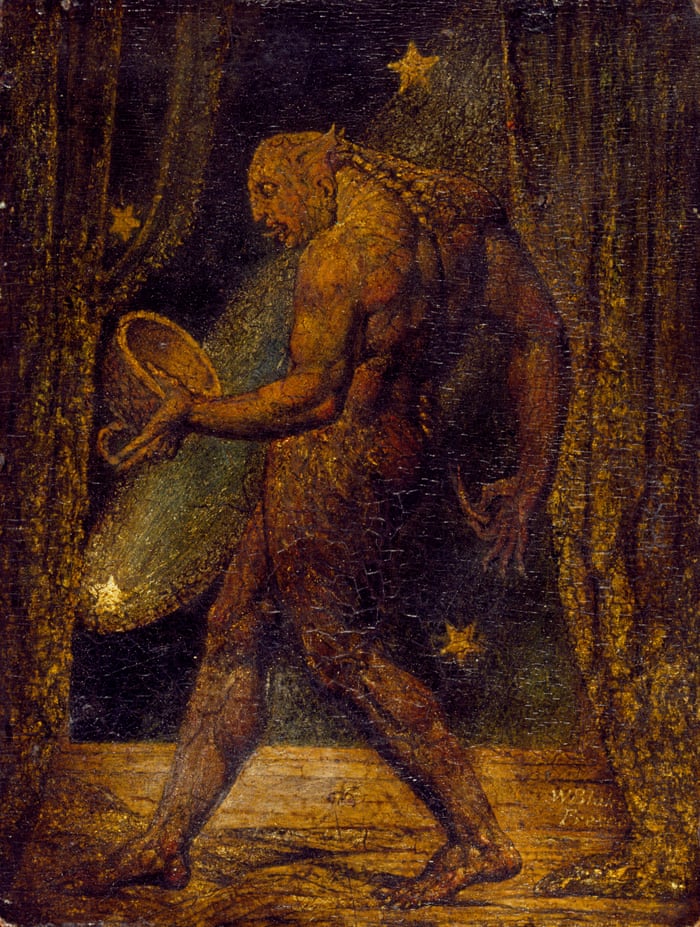
Blake’s house is long gone, with nothing but the Herculean mural decorating a replacement block of flats nodding to its memory. Other than some contemporary depictions, all we know about the place is of the incidents that he, his wife and their associates reported as occurring there. There is a drawing of William and Catherine in their bedroom that radiates a scuffed contentment. There are the naturist anecdotes suggesting that the couple had repurposed their back garden as an urban Eden. But the place that would seem to have harboured the most startling idea-forms is the liminal, transitional space represented by the stairway, hall and landing. It was here that Blake was introduced to two of his most memorable phantasms – the glowering Ancient of Days and the macabre Ghost of a Flea.
The last of these, painted 25 years after the former, was the first to be encountered. Blake and Catherine moved into 13 Hercules Buildings in 1790, and according to Blake’s biographer Alexander Gilchrist, in that same year Blake described his only sighting of what he believed to be a ghost. Speckled and scaly, the appalling apparition had rushed down the stairs at him, driving him out into his Edenic garden, more afraid than he had ever been before; would ever be again. Then, Blake was witness to a second visitation, of a very different nature and yet once more manifested near the stairhead, hovering above the landing. 'Europe' Plate i: Frontispiece, 'The Ancient of Days' 1827
This forbidding figure, Blake’s Ancient of Days, was worked immediately into his evolving personal mythology, and would become the frontispiece for his 1794 publication Europe a Prophecy. This stern primordial entity makes his exact and calculated judgment from a throne amid the clouds, above the mundane darkness of the world. His seat is possibly the sun itself, but is here shown as a concavity; one of Blake’s “chariots of fire”, or else the ostentatious 1960s swivel chair of a Bond villain.
The dividers with which this windswept creator makes his moral measurements, along with something of the posture, crouching and absorbed, would recur a year later in Blake’s Newton. The father of thermodynamics’ deified and Apollonian appearance is most probably satirical, a marker of vainglorious ambition, and this same authoritarian conceit is evident in Blake’s judgmental Ancient as, like Newton, he divides the cosmos into motion, heat and gravity. This, perhaps born of Blake’s Moravian parentage or the dissenting Christian faiths that he grew up with, seems a Gnostic view of the Almighty as self-glorifying tyrant, manufacturing a penitentiary material universe that it might worship him. Blake was a proto-anarchist. In his reaction to this second hallway visitation we can see him turn his huge, radical eyes on conventional religion, where he finds that pasture wanting.
Twenty years would pass before the earlier and more aggressive of Blake’s Lambeth spectres would be conjured into visible, malign existence as a fresco, worked in tempera and gold on a hardwood panel, tiny even in comparison with his other unusually small compositions. The peculiar circumstances of this late revisiting invite examination: in 1818, by now living with Catherine at their South Molton Street address, Blake had been visited by his friend and patron, the astrologically infatuated watercolourist John Varley. As the conversation turned to Blake’s sole sighting of a ghost, two decades earlier in Lambeth, Varley asked for a description of the phantom and, in what must have been a spine-tingling moment, Blake claimed that he saw the creature there before them as they spoke and asked Varley to pass him his drawing materials.
There is an eerily persuasive incident halfway through this part seance/part sitting as described by Varley, when Blake paused in his delineation and explained that his uncanny model had just let its mouth fall open, forcing him to work on a detail of the jaw until his subject had resumed its pose. By the next year, Varley, a frustrated spiritualist who had never seen a spirit, had commissioned Blake to work the sketch into a finished portrait as part of a proposed series titled Visionary Heads. And so, in 1819, Blake’s horrific visitor of 1790 finally stepped out on to a stained and creaking stage, making its debut in the muddy world of matter and sensation.
The Ghost of a Flea, c 1819
As imagined by the Lambeth angel whisperer, the threatening and somehow smug abomination is theatrical in its demeanour, consciously performing for the viewer. Glossed by Blake, the flea is the transposed soul of a murderer trapped in a form that, while both bloodthirsty and powerful, is too small to become a mighty engine of destruction. Thus condemned, it struts its miniature domain and makes a swaggering display of cruelties that it can no longer accomplish. With nothing save an acorn cap to represent its drinking bowl of blood, with nothing but a thorn to serve as improvised prison yard shiv, this former demon is demoted and no longer dangerous. In its fallen state, more mischievous than malefic now, the has-been homicidal maniac is almost poignant.
Framed by threadbare curtains with a plunging star upon its painted backdrop, something in the monster’s owl-like stare and heavy posture led me to recruit it as a premonition of Sir William Withey Gull, the posited Jack the Ripper in From Hell, my work with Eddie Campbell. Once again, there is the sense of something that once had its own imagined grandeur, its own self-exonerating black magnificence, reduced now to a sordid tabloid narrative of pointless butchery; a banal flea-bite on the wrist of history. The gothic nightmare licks its chops and postures on its narrow platform, in a sour astral miasma. Weathered and distressed, the craquelure and mottling only enhance the glimmering murk in which the violent wraith enacts its purgatory, treading the discoloured boards, the sky forever falling.
In the hallway of No 13 Hercules Buildings, Blake beheld both austere deities and trampled devils. It is to the credit of his generous and blazing soul that heaven was not spared his fierce, critical gaze, nor hell his sympathy.
At the break: - I Don't Want To Talk About It Love Harvest Moon
At the close: - Love Is The Sweetest Thing You're Still On My Mind You Must Not Be Drinking Enough She's The One
It was quite a surprise to be running the show myself. Our usual host Simon contacted me about 4:30 to ask if Ron and I could run the show....... I told him that Ron was away, so I said that if no one else could be found to get back to me.......which he did an hour or so later.
Despite a warmish evening and plenty of thirsty punters, there weren't many players around, so I started things off offering 3 songs solo or 4 songs for duos. A new (to me) duo of guitar/vocal and cello were third on the list and made a great impression with their original songs.......folks passing by stopped to listen and some came in. Sure enough we eventually exhausted the play-list, so I did a short set and asked those who were left if they would like to do another. Unfortunately the classy duo had departed. Finally having gone around twice, there was still nearly 20 minutes left, so I dug out some song sheets and closed the open mic with a few rarities: an Al Bowlly song from 1932, a George Jones classic, my current favourite drinking song by Danny Kortchmar and World Party's 1997 sing-along. Regular Deb and I carried on playing unplugged for another hour at the request of several punters, who joined in with the fun.
'This tape rewrites everything we knew about the Beatles'
Mark Lewisohn knows the Fab Four better than they knew themselves. The expert’s tapes of their tense final meetings shed new light on Abbey Road – and inspired a new stage show
Richard Williams
The Guardian
Wed 11 Sep 2019
The Beatles weren’t a group much given to squabbling, says Mark Lewisohn, who probably knows more about them than they knew about themselves. But then he plays me the tape of a meeting held 50 years ago this month – on 8 September 1969 – containing a disagreement that sheds new light on their breakup.
They’ve wrapped up the recording of Abbey Road, which would turn out to be their last studio album, and are awaiting its release in two weeks’ time. Ringo Starr is in hospital, undergoing tests for an intestinal complaint. In his absence, John Lennon, Paul McCartney and George Harrison convene at Apple’s HQ in Savile Row. John has brought a portable tape recorder. He puts it on the table, switches it on and says: “Ringo – you can’t be here, but this is so you can hear what we’re discussing.”
What they talk about is the plan to make another album – and perhaps a single for release in time for Christmas, a commercial strategy going back to the earliest days of Beatlemania. “It’s a revelation,” Lewisohn says. “The books have always told us that they knew Abbey Road was their last album and they wanted to go out on an artistic high. But no – they’re discussing the next album. And you think that John is the one who wanted to break them up but, when you hear this, he isn’t. Doesn’t that rewrite pretty much everything we thought we knew?”
Lewisohn turns the tape back on, and we hear John suggesting that each of them should bring in songs as candidates for the single. He also proposes a new formula for assembling their next album: four songs apiece from Paul, George and himself, and two from Ringo – “If he wants them.” John refers to “the Lennon-and-McCartney myth”, clearly indicating that the authorship of their songs, hitherto presented to the public as a sacrosanct partnership, should at last be individually credited.
Then Paul – sounding, shall we say, relaxed – responds to the news that George now has equal standing as a composer with John and himself by muttering something mildly provocative. “I thought until this album that George’s songs weren’t that good,” he says, which is a pretty double-edged compliment since the earlier compositions he’s implicitly disparaging include Taxman and While My Guitar Gently Weeps. There’s a nettled rejoinder from George: “That’s a matter of taste. All down the line, people have liked my songs.”
John reacts by telling Paul that nobody else in the group “dug” his Maxwell’s Silver Hammer, a song they’ve just recorded for Abbey Road, and that it might be a good idea if he gave songs of that kind – which, John suggests, he probably didn’t even dig himself – to outside artists in whom he had an interest, such as Mary Hopkin, the Welsh folk singer. “I recorded it,” a drowsy Paul says, “because I liked it.”
A mapping of the tensions that would lead to the dissolution of the most famous and influential pop group in history is part of Hornsey Road, a teasingly titled stage show in which Lewisohn uses tape, film, photographs, new audio mixes of the music and his own matchless fund of anecdotes and memorabilia to tell the story of Abbey Road, that final burst of collective invention.
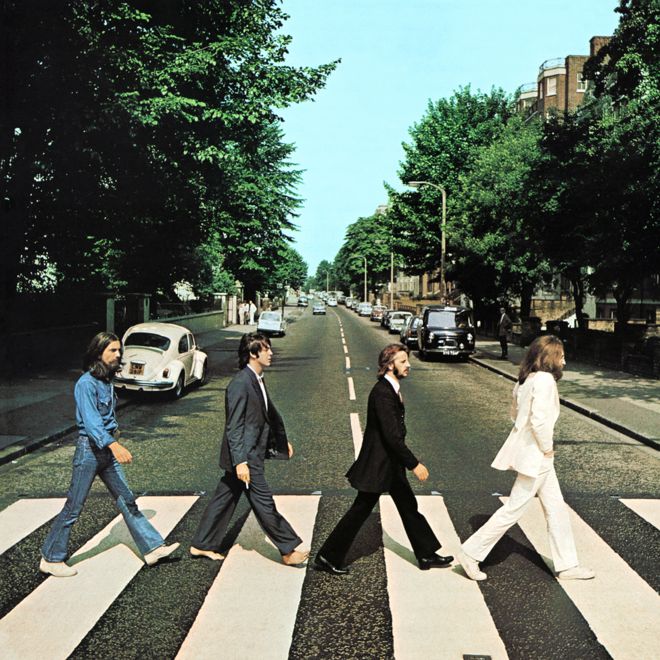
The album is now so mythologised that the humdrum zebra crossing featured on its celebrated cover picture is now officially listed as site of special historic interest; a webcam is trained on it 24 hours a day, observing the comings and goings of fans from every corner of the world, infuriating passing motorists as these visitors pause to take selfies, often in groups of four, some going barefoot in imitation of Paul’s enigmatic gesture that August morning in 1969.
“It’s a story of the people, the art, the people around them, the lives they were leading, and the break-up,” Lewisohn says. The show comes midway through his writing of The Beatles: All These Years, a magnum opus aiming to tell the whole story in its definitive version. The first volume, Tune In, was published six years ago, its mammoth 390,000-word narrative ending just before their first hit. (“All the heft of the Old Testament,” the Observer’s Kitty Empire wrote, “with greater forensic rigour.”)
Constant demands to know when Turn On (covering 1963-66) and Drop Out (1967-69) might appear are met with a sigh: “I’m 61, and I’ve got 14 or 15 years left on these books. I’ll be in my mid-70s when I finish.” Time is of the essence, he adds, perhaps thinking of the late John Richardson’s uncompleted multi-volume Picasso biography. This two-hour show is a way of buying the time for him to dive back into the project.
For 30 years, Lewisohn has been the man to call when you needed to know what any of the Fab Four was doing on almost any day of their lives, and with whom they were doing it. His books include a history of their sessions at what were then known as the EMI Recording Studios in Abbey Road, and he worked on the vast Anthology project in the 90s.
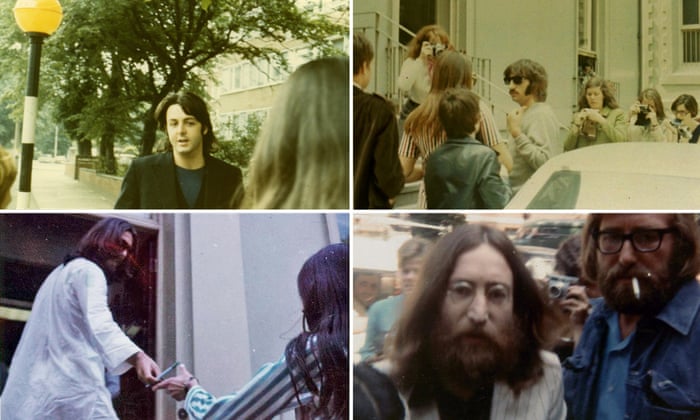
Fan photos of (clockwise from top left) Paul McCartney, Ringo Starr, John Lennon and George Harrison used in Lewisohn’s show Hornsey Road. Photograph: Courtesy Mark Lewisohn
The idea for a stage show was inspired by an invitation from a university in New Jersey to be the keynote speaker at a three-day symposium on the Beatles’ White Album, then celebrating its golden jubilee. His presentation, called Double Lives, juxtaposed the making of the album and the lives they were leading as individuals outside the studio. “It took several weeks to put together, and I thought, ‘This is mad – I should be doing this more than once to get more people to see it.’”
The next anniversary to present itself was that of Abbey Road, which took place during a crowded year in which Paul married Linda Eastman, John and Yoko went off on their bed-ins for peace, George’s marriage to Pattie Boyd was breaking up, and they were all involved in side projects. John had released Give Peace a Chance as the Plastic Ono Band and George had been spending time in Woodstock with Bob Dylan.
John also took Yoko and their two children, Kyoko and Julian, on a sentimental road trip to childhood haunts in Liverpool, Wales and the north of Scotland, ending when he drove their Austin Maxi into a ditch while trying to avoid another car. Brian Epstein, their manager, had died the previous year and the idealism that had fuelled the founding of their Apple company – “It’s like a top,” John said. “We set it going and hope for the best” – was starting to fray badly. Other business concerns – such as their song-publishing copyrights, which had been sold without their knowledge – led to a war between Allen Klein, the hard-boiled New York record industry veteran invited by John to sort it out, and John Eastman, Linda’s father, a top lawyer brought in by Paul to safeguard his interests.
Lewisohn has the minutes of another business meeting, this time at Olympic Studios, where the decision to ratify Klein’s appointment was approved by three votes to one (Paul), the first time the Beatles had not spoken with unanimity. “It was the crack in the Liberty Bell,” Paul said. “It never came back together after that one. Ringo and George just said, whatever John does, we’re going with. I was actually trying, in my mind, to save our future.”
And yet Lewisohn challenges the conventional wisdom that 1969 was the year in which they were at each other’s throats, storming out of the recording sessions filmed by Michael Lindsay-Hogg for the verité-style movie Let It Be, and barely on speaking terms. During the making of Abbey Road, says Lewisohn, “they were in an almost entirely positive frame of mind. They had this uncanny ability to leave their problems at the studio door – not entirely, but almost.”
In fact, Abbey Road was not the only recording location for the album: earlier sessions were held at Olympic in Barnes and Trident in Soho. And Lewisohn’s creation is called Hornsey Road because that, in other circumstances, is what the album might have been titled, had EMI not abandoned its plans to turn a converted cinema in that rather grittier part of north London into its venue for pop recording.
The show, Lewisohn believes, is the first time an album has been treated to this format. “People will be able to listen with more layers and levels of understanding,” he says. “When you go to an art gallery, you hope that someone, an expert, will tell you what was happening when the artist painted a particular picture. With these songs, I’m going to show the stories behind them and the people who made them, and what they were going through at the time. Certainly, no one who sees this show will ever hear Abbey Road in the same way again.”
• Hornsey Road is at the Royal and Derngate, Northampton, on 18 September and touring until 4 December.
Tinypic.com, on which many images from our early days were stored, has closed - hence the forced change of header image and the ugly tinypic logo appearing where images once were. Screw 'em.
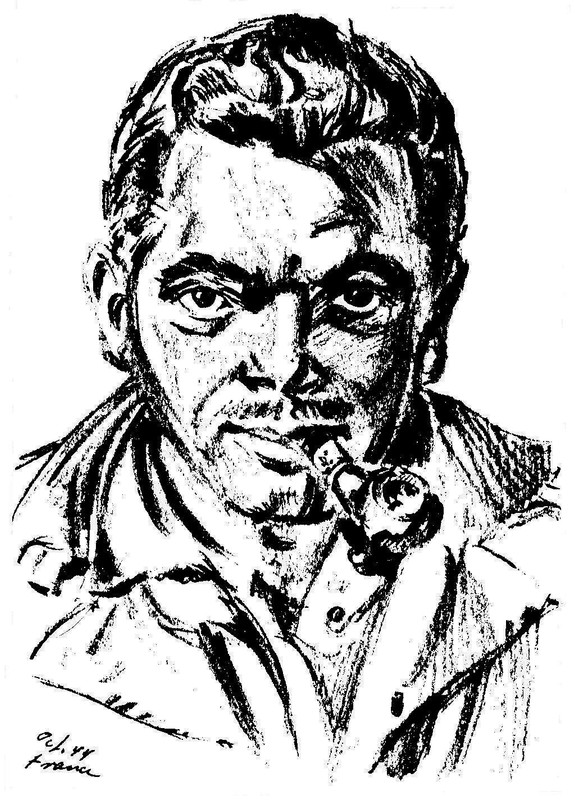
Self-portrait during World War II (kirbymuseum.org)
The persistent influence of Jack Kirby at 100 Peter Hoskin reflects on the work of a comic book artist who was ‘constantly in search of freedom’
Peter Hoskin
The Times Literary Supplement
31 August 2017
No one spans the history of comic books quite like Jack Kirby. He was there at the dawn of the superhero, now called the Golden Age, to co-create Captain America. He toiled with Stan Lee during the Silver Age of the 1950s and 60s to turn a failing publisher into Marvel Comics, home of the Fantastic Four, the Incredible Hulk, Thor and the X-Men. His departure from Marvel, and work he did subsequently, is regarded as one of the instigating events of the industry’s grittier Bronze Age. His influence persists, even past his death in 1994, through the Modern Age and beyond. Kirby would have been 100 years old this week. He was born in New York, on August 28, 1917, as Jacob Kurtzberg, the eldest son of two Jewish-Austrian émigrés. His childhood, therefore, was affected by the Great Depression, and his early adulthood by the war. Kirby’s famous drawing of Captain America punching Adolf Hitler is only one part of his Second World War story. Kirby killed Nazis and saw friends die, as an infantryman in Europe. Like so many of his fellow survivors, he then witnessed the atomic bomb, the Cold War and the rise of counter-cultures and computers.
Kirby’s experience of the twentieth century informs his most singular achievement, his Fourth World saga. This is the grand story, spanning several comic-book titles, that he both drew and wrote for DC Comics after leaving Marvel in 1970. Kirby begins with two familiar DC characters, Superman and Jimmy Olsen, but soon pulls them into an unfamiliar mythology born of his own experiences and imagination. Here, a cosmic war is being fought between the gods of New Genesis and the demonic Darkseid of Apokolips. Humanity is a potential casualty. The word “holocaust” appears in the Fourth World saga with chilling regularity. So too do death camps, torture devices and atomic blasts. Forever People #3, one of Kirby’s finest single issues, even begins with a quote attributed to Hitler: “That is the great thing about our movement – that these members are uniform not only in ideas, but, even, the facial expression is almost the same!” Underneath stands a crowd of people, all of whom wear the same blank expression, all victims of Darkseid’s Anti-Life propaganda.
But there is light as well as dark in Kirby’s story – particularly when it comes to young people. The heroes of the Fourth World books are typically bohemians from across space-time, with names such as “Beautiful Dreamer” or “Big Bear”. They ride motorcycles down psychedelic highways, talking of love, and are dismissed as hippies by many of the people they encounter. Yet Kirby doesn’t dismiss them. He identifies not just with those who, like him, have fought against the Nazis, but also with those who have grown up, free, afterwards.
Kirby was constantly in search of freedom. By most accounts, he rarely found it. He began to feel imprisoned during his time at Marvel in the 1960s, and his home studio, in which he would work for fourteen hours a day, completing pages at a rate that few other artists could match, was nicknamed “The Dungeon”. The story of Kirby’s relationship with Stan Lee, and how it soured, is recounted in Sean Howe’s Marvel Comics: The untold story, but it comes down to a simple imbalance. Together, they created superheroes such as the Fantastic Four and Thor, each adding to the collaboration in different and essential ways – yet Lee ended up with the better contracts and more of the fame.
Yet Jonathan Lethem, a vocal fan of Kirby’s, argues in his essay collection The Disappointment Artist that Kirby benefited from working with Lee. As he puts it, “Kirby always wanted to drag the [Fantastic] Four into the Negative Zone – deeper into psychedelic science fiction and existential alienation – while Lee, in his scripting, resolutely pulled them back into the morass of human lives, hormonal alienation, teenage dating problems and pregnancy and unfulfilled longings to be human and normal and loved”. In other words, Lee brought Kirby back down to Earth.
It’s certainly true that undiluted Kirby, the brand that readers got after his move to DC, is almost overwhelming. Back in the 1940s, he had pioneered the most spacious layout in comics, the double-page spread. But now he struggled to stay within its confines. His drawings in the Fourth World books are a riot of thickly-proportioned characters, multi-limbed monsters and impossible machinery. His writing is loud and insistent. It is a style made for deities such as Darkseid – “I am the revelation! The tiger-force at the core of all things!” – not for everyday people. Various novelists, including Lethem, Michael Chabon and Michel Faber, have spoken of their admiration for Kirby. Few, if any, have ever written anything that might be described as “Kirby-esque”. In his most recent science fiction novel, The Book of Strange New Things, Faber seems to acknowledge this almost directly. He names a character after Kirby, but that character is off on his own – a space missionary whose story is left purposefully mysterious, and who may have lost himself in an alien society. In this missionary’s absence, the author describes a planetary scene that Kirby would never have drawn: “Nothing fancy or monumental. Square blocks, like British tower blocks, cheap utilitarian housing. Not exactly the diamantine spires of a fantastical city”.
No one can match Kirby, and, in a sense, no one should try. According to his biographer and friend, Mark Evanier, Kirby didn’t have much sympathy for artists who hoped to continue comic-book titles in his tradition. “The Kirby tradition”, he would say, “is to create a new comic.” That is how he ought to be remembered, 100 hundred years after his birth: as an artist who always wanted to go beyond.