Friday, 12 July 2019

Thursday, 11 July 2019
Lines Off by Hugo Williams - review

Lines Off by Hugo Williams review – fascinating reflections on body and mind
Inspired by a spell in hospital, Hugo Williams confronts the body in crisis with irresistible styleKate Kellaway
The Guardian
Tuesday 9 July 2019
Hugo Williams’s “lines off” – a stage direction – were written during a period in which he had dialysis, followed by a kidney transplant. Hospitals are dramas in themselves – operating theatres appropriately named. In Transplant 2014, the surgeon is poised to give “the performance of a lifetime” (and let us not forget, Williams once worked as a theatre critic). But sickness and the surgeon’s knife do not necessarily make great poetry. What matters is Williams’s own writerly performance, his ability to rally while undergoing the trials of Job. It is the gallantry of his writing that moves. The raffish intelligence that makes all his poetry a pleasure to read does not desert him in extremis. There is – thank the NHS – never any sense of his being diminished on the page.
His old style cooperates with his new predicament even if hospital is not his preferred habitat. His gloom as he casts himself a has-been is offset by the doctor’s disbelief (in The Check-Up) that he has survived:
“Oh yes, we thought he was a goner,”
the doctor tells his student nurse.
She looks at me admiringly,
imagining me dead. I take a little bow.
Readers – particularly older ones – will be tickled by his sense of the body as a docile soldier, continuing to oblige
There are not many openings for dandies on hospital wards, but there is reason to swank a little about a faithful servant in Dear Arm. Readers – particularly older ones – will be tickled by and recognise Williams’s sense of the body as a docile soldier, continuing to oblige. But the body is not always compliant. And if performance is the thing, what happens when you “dry”?
What is fascinating about this collection is Williams’s curiosity about the body in crisis. The most impressive poems are about what happens when the mind temporarily unfastens itself. In My Absence describes this state as another country (from whose bourne this particular traveller has returned). It is vertiginous, alpine and avalanche-rich:
I’m buried alive
in an abstract expression
of blizzards and ghosts,
blubbing, terrified, lost,
as I try but fail to exist.
The schoolboy’s word “blubbing” tempers our pity and underscores a resolve never to take himself too seriously, not to let what Patrick White once called “luxurious self-pity” rule. But if sickness is a landscape to be navigated – and Williams has a generous sense of its metaphorical scope – its precise geography repeatedly eludes him. And in Fall Zone (Royal Free Hospital), bad weather spreads to his notebooks, which have by now become a territory in themselves, assailed by “a blizzard of crossings-out”.
In Carphology, there is irresistible comedy in the account of how the human need for purpose translates to the hospital bed:
Since we are here, we reason,
we might as well get on
with collecting bits of fluff
from our hospital blankets
and placing them in piles
against a rainy day.
And several autobiographical pieces would serve well for that rainy day. These are beguiling poems that look back at childhood, sepia set pieces from the mind’s family album (My War, Tea-time). But they lack the urgent strangeness of the hospital poems. Williams has a gift for making poetry read as effortlessly as conversation – a huge accomplishment. And the final poem, The Half-Open Door, is so simple it barely exists, beautifully balanced between the pedestrian and profound. If it has a metaphorical implication, it is light as a coat slung over an arm:
Hat or umbrella?
Raincoat or windbreaker?
It’s hard to be sure
when the sun is shining
and rain is falling
from a clear blue sky.
Dear Arm
How many times, dear arm,
have you put yourself in danger
for my sake? How many times
have you found your way home
through the dark, or saved me from falling?
I didn’t have to ask you twice.
Poor arm! I broke you once.
I burnt you once. More than once
I cursed your weakness
at arm-wrestling and swimming,
but I was proud of your tan
when I rolled up my sleeve at school.
You aren’t so handsome now,
but you soldier on, one of the faithful
in my band of volunteers,
my noble standard bearer
in the war within a war,
the daily clash of purposes.
Dear arm, hold still for me now,
while I make you suffer once more.
Be brave, while the surgeon
creates an “access fistula”
that will wash my blood for me.
It seems you must save my life as usual.
Tuesday, 9 July 2019

Monday, 8 July 2019

Sunday, 7 July 2019
João Gilberto RIP

João Gilberto obituary
One of the most important figures in Brazilian music who was known as the father of bossa nova
Robin Denselow
Soon, US jazz musicians would be visiting Brazil to hear the new music for themselves. In 1961, the guitarist Charlie Byrd arrived, and inevitably he found his way to “Bottle Alley” in Rio de Janeiro, where bossa musicians gather and collaborated with jazz players such as Sérgio Mendes.
Byrd returned home excited by what he had heard, and on his return to the US he recorded the album Jazz Samba with Getz. It became a best-seller, staying in the American charts for 70 weeks – an astonishing achievement for a jazz album.
It was now inevitable that Gilberto would be invited to perform in the US, and in November 1962 he played in New York at an historic concert that also featured Jobim, Mendes and other Brazilian artists including Carlos Lyra, alongside Byrd and Getz.
According to some of the Brazilian musicians, the concert was something of a mess – Lyra claimed “they just wanted to do a recording session on stage” – but this was a high-profile event that helped to boost Gilberto’s reputation in the US. And there was further American success to come.
In 1964 he and Getz released Getz/Gilberto, which included the massively successful Girl from Ipanema, written by Jobim and Moraes as they sat in a bar off Copocabana beach in Rio, watching the girls go by, and still one of the most celebrated songs of the bossa nova era.
Bossa nova had become a new global pop fashion, thanks very largely to Gilberto, but in 1964 the Brazilian music scene suddenly changed. A military coup ended the years of optimism, and Brazil’s easy-going, romantic image was shattered.
New styles would now emerge, from protest songs to the experiments of the Tropicália movement, and leading musicians Caetano Veloso and Gilberto Gil would later be jailed and then exiled by the authorities. Many of the bossa nova stars – including Gilberto – simply decided to stay in the US, where their music was so popular.
Gilberto remained in self-imposed exile until 1980. He made further recordings with Getz, and with Herbie Mann, spent two years living in Mexico, where he also recorded, but spent much of his time practising, playing privately, and reviving songs by earlier Brazilian composers.
On returning to Brazil, he also began to work with a younger generation of Brazilian musicians, and in 1981 he recorded the album Brasil with Veloso, Gil and Maria Bethânia, who regarded Gilberto as a hero of Brazilian music.
In an interview in 2007, Caetano told me that he first heard Gilberto when he was 17, and it was “like enlightenment for me. It was like an incredible revelation of everything, of aesthetic criteria and deep emotions, and most of all, hope in Brazil … hope in our future, and the idea that we had a kind of mission. I still think João Gilberto is our greatest artist.”
Gilberto continued to tour and record, though he always insisted that the acoustics in a concert hall should be excellent, and that audiences should remain quiet. He performed in the US and Europe, and became a cult hero in Japan, where there was an enthusiastic following for bossa nova. One of his finest live recordings, João Gilberto in Tokyo, was released in 2004.
He was a recluse, and an eccentric perfectionist, and Brazilian musicians delighted in telling stories about him. Lyra described him as “a fantastic artist and a very special man, very neurotic like all of us, but probably a little more so”.
Gilberto was very fond of cats, and Lyra re-told with some glee the story of how one of his cats was allegedly driven to jump from an eighth-floor window, driven crazy by his master’s constant repetition of a guitar phrase.
His daughter, the singer Bebel Gilberto, described him like this: “My father changed Brazilian music. I would sometimes see him seeking for different chords for classics he’s been playing for 14 years. I can’t believe his obsession – always seeking for perfection, something that could be better, a version that no-one had thought of before.”
He is survived by João Marcelo, his son from his marriage to Astrud, which ended in divorce; Bebel, his daughter from his marriage to the singer Miúcha, who died in 2018; and Luisa Carolina, his daughter from a relationship with the journalist Claudia Faissol.
• João Gilberto Prado Pereira de Oliveira, musician, born 10 June 1931; died 6 July 2019
https://www.theguardian.com/theguardian/2019/jul/06/joao-gilberto-obituary
Robin Denselow
The Guardian
Sat 6 Jul 2019
João Gilberto, who has died aged 88, was one of the most important and best loved figures in Brazilian music, who played a key role in the development of bossa nova in the late 1950s and early 60s.
Along with the composer Antônio Carlos “Tom” Jobim, he created a romantic, reflective new style in which samba rhythms were mixed with influences from the American “cool jazz” scene. As a guitarist, he pioneered a new technique that mixed the syncopated plucking of acoustic guitar chords with jazz-influenced harmonies and chord progressions, while as a singer his style was laid-back and understated.
Bossa nova was a new, cool and sophisticated style that reflected the optimism of Brazil in the early 60s and initially became popular among middle and upper-class Brazilian music fans. Then its popularity began to spread.
Along with other leading Brazilian musicians, Gilberto appeared at a now legendary concert at Carnegie Hall, New York, in 1962, and the following year he released the album Getz/Gilberto with the American saxophonist Stan Getz, who had become fascinated by bossa nova. The album included the single Girl from Ipanema, sung by Astrud Gilberto, to whom Gilberto was then married. It sold more than a million copies, and brought him international acclaim.
It was an extraordinary achievement for a musician who had initially struggled to succeed and find acceptance for his music. Born in Juazeiro in Bahia state, he began playing the guitar as a teenager, forming a band while still at school. He tried working as a singer on a radio station in Salvador, the capital of Bahia, and at the age of 19 moved to Rio de Janeiro as singer with the Garotos da Lua, but was fired because he could never be trusted to turn up for rehearsals.
He now found himself out of work and depressed, and after a period working with a vocal group in the southern city of Porto Alegre, he moved to Minas Gerais state to live with his elder sister. Here he spent months practising, and perfecting his new musical style.
In 1956 he eventually returned to Rio, and his fortunes changed. Jobim was impressed by the new approach, and set about finding a suitable song for the new bossa nova style. Chega de Saudade was written by Jobim with lyrics by a third hero of the early bossa movement, Vinicius de Moraes, and became the first bossa nova hit.
It was followed by a full album with the same title. In 1959, the new music enjoyed international success when Gilberto and Jobim helped to contribute the music for the cult film Orfeu Negro (Black Orpheus), in which the Greek myth was re-told in the setting of a Brazilian carnival.
It won an Academy Award for best foreign language film in 1960, and the Palme D’Or at the 1959 Cannes film festival, and was helped by a soundtrack that included Gilberto’s recording of A Felicidade. America began to discover a brand new, cool and sophisticated Brazilian music, and the bossa nova boom began.
Soon, US jazz musicians would be visiting Brazil to hear the new music for themselves. In 1961, the guitarist Charlie Byrd arrived, and inevitably he found his way to “Bottle Alley” in Rio de Janeiro, where bossa musicians gather and collaborated with jazz players such as Sérgio Mendes.
Byrd returned home excited by what he had heard, and on his return to the US he recorded the album Jazz Samba with Getz. It became a best-seller, staying in the American charts for 70 weeks – an astonishing achievement for a jazz album.
It was now inevitable that Gilberto would be invited to perform in the US, and in November 1962 he played in New York at an historic concert that also featured Jobim, Mendes and other Brazilian artists including Carlos Lyra, alongside Byrd and Getz.
According to some of the Brazilian musicians, the concert was something of a mess – Lyra claimed “they just wanted to do a recording session on stage” – but this was a high-profile event that helped to boost Gilberto’s reputation in the US. And there was further American success to come.
In 1964 he and Getz released Getz/Gilberto, which included the massively successful Girl from Ipanema, written by Jobim and Moraes as they sat in a bar off Copocabana beach in Rio, watching the girls go by, and still one of the most celebrated songs of the bossa nova era.
Bossa nova had become a new global pop fashion, thanks very largely to Gilberto, but in 1964 the Brazilian music scene suddenly changed. A military coup ended the years of optimism, and Brazil’s easy-going, romantic image was shattered.
New styles would now emerge, from protest songs to the experiments of the Tropicália movement, and leading musicians Caetano Veloso and Gilberto Gil would later be jailed and then exiled by the authorities. Many of the bossa nova stars – including Gilberto – simply decided to stay in the US, where their music was so popular.
Gilberto remained in self-imposed exile until 1980. He made further recordings with Getz, and with Herbie Mann, spent two years living in Mexico, where he also recorded, but spent much of his time practising, playing privately, and reviving songs by earlier Brazilian composers.
On returning to Brazil, he also began to work with a younger generation of Brazilian musicians, and in 1981 he recorded the album Brasil with Veloso, Gil and Maria Bethânia, who regarded Gilberto as a hero of Brazilian music.
In an interview in 2007, Caetano told me that he first heard Gilberto when he was 17, and it was “like enlightenment for me. It was like an incredible revelation of everything, of aesthetic criteria and deep emotions, and most of all, hope in Brazil … hope in our future, and the idea that we had a kind of mission. I still think João Gilberto is our greatest artist.”
Gilberto continued to tour and record, though he always insisted that the acoustics in a concert hall should be excellent, and that audiences should remain quiet. He performed in the US and Europe, and became a cult hero in Japan, where there was an enthusiastic following for bossa nova. One of his finest live recordings, João Gilberto in Tokyo, was released in 2004.
He was a recluse, and an eccentric perfectionist, and Brazilian musicians delighted in telling stories about him. Lyra described him as “a fantastic artist and a very special man, very neurotic like all of us, but probably a little more so”.
Gilberto was very fond of cats, and Lyra re-told with some glee the story of how one of his cats was allegedly driven to jump from an eighth-floor window, driven crazy by his master’s constant repetition of a guitar phrase.
His daughter, the singer Bebel Gilberto, described him like this: “My father changed Brazilian music. I would sometimes see him seeking for different chords for classics he’s been playing for 14 years. I can’t believe his obsession – always seeking for perfection, something that could be better, a version that no-one had thought of before.”
He is survived by João Marcelo, his son from his marriage to Astrud, which ended in divorce; Bebel, his daughter from his marriage to the singer Miúcha, who died in 2018; and Luisa Carolina, his daughter from a relationship with the journalist Claudia Faissol.
• João Gilberto Prado Pereira de Oliveira, musician, born 10 June 1931; died 6 July 2019
Saturday, 6 July 2019
Restoring Rembrandt's The Night Watch

'Like a military operation': restoration of Rembrandt's Night Watch begins
Elaborate process will be livestreamed from Amsterdam’s RijksmuseumDaniel Boffey
The Guardian
5 Jul 2019
The restorers, data experts and art historians at the Rijksmuseum call it Operation Night Watch. “Because it is like a military operation in the planning,” said Taco Dibbits, the museum’s general director.
At 9am on Monday, as the doors of the Amsterdam museum open to the public, the largest and most elaborate public art restoration in history will begin.
In a specially constructed seven sq metre glass chamber, a team of 12 experts will work to bring back to its former glory one of the world’s most spectacular paintings: The Night Watch by Rembrandt.
The process will not only be performed in front of the public, in the building built in 1885 as a “cathedral of the arts”, where The Night Watch occupies the “high altar” in the museum’s gallery of honour, but will be livestreamed to millions around the world.
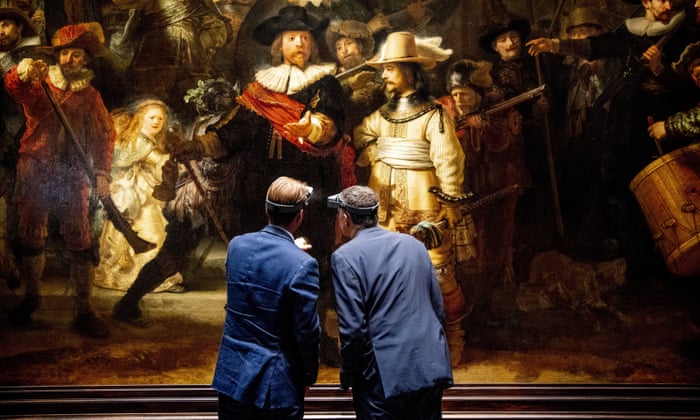
Beyond conserving the painting for generations to come – it was last restored in 1975 following a knife attack by a Dutch teacher – it is hoped that an initial 10-month research stage using the most sophisticated technology will bring new insights into how Rembrandt van Rijn made his masterpiece in 1642, whether he did, as is believed, make a preparatory sketch across the vast canvas and what changes he made along the way.
Over the last two weeks, an iron frame into which plates of clear glass can fit to form the restoration case has been constructed in a warehouse just outside Ghent in Belgium. The team did one practice run putting it all together, but there were some precarious moments. “You have to gain the experience of moving such long glass plates and that was not easy,” said Dibbits. “None broke, but it was very good to do that before.”
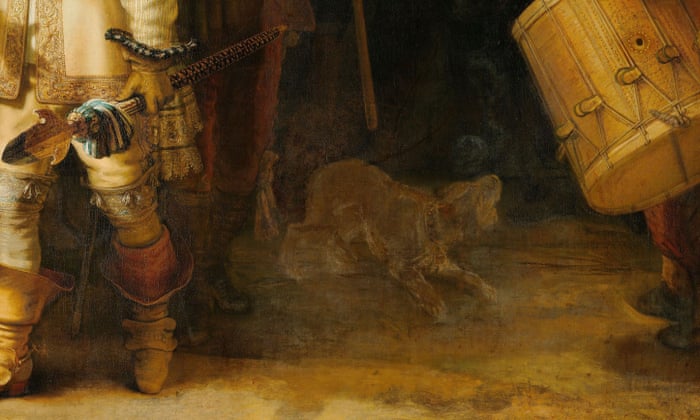
On Saturday the construction of the chamber will be completed – on the spot where The Night Watch is viewed by 2 million people every year. The painting was moved a week ago to a different part of the gallery of honour to allow for preparations. “It was always wisest to move the painting well out of the way and not build the glass case around it,” Dibbits said.

After the last visitors have left the Rijksmuseum on Sunday afternoon, about 25 people will start the arduous task of transporting the 337kg painting into the waiting chamber and on to a tripod-like imaging frame, a job that is expected to take until midnight.
The Night Watch has been moved only a handful of times in the last 150 years, including its transportation into a bunker in the coastal dunes at the start of the second world war, and later in the conflict into mines in the south of the Netherlands.
“Any move of any painting, especially The Night Watch, which is such a large painting, you always have to be very careful and it is very precisely done,” said Dibbits. “It is moved from the wall by hand and then hydraulic lifts on to a kind of cart especially constructed for it on wheels, and then it is pushed into the glass case which has one very high door which enables it to move it there without barely any vibrations.”
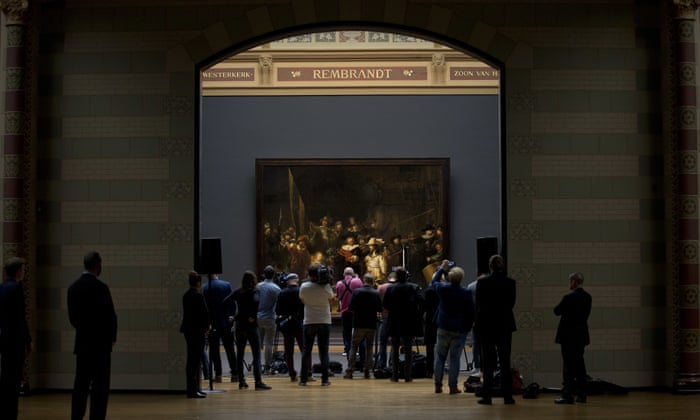
On Monday morning, Dibbits will offer the gathering crowds and online viewers an introduction to the team working on the masterpiece. “And then we will let them get to work,” he said.
“What we will do over the coming 10 months [is] map it layer by layer and pigment by pigment, and then on the basis of that we will make a plan for the conservation and then after that the conservation will start,” Dibbits said.
Dibbits said that because the painting has always been on view even those who knew it best had much to learn. “I have been working there for 17 years and I have never seen the top of the painting – you can’t just put a ladder in front of it. We know so little on how he worked on making The Night Watch.”
5 Jul 2019
The restorers, data experts and art historians at the Rijksmuseum call it Operation Night Watch. “Because it is like a military operation in the planning,” said Taco Dibbits, the museum’s general director.
At 9am on Monday, as the doors of the Amsterdam museum open to the public, the largest and most elaborate public art restoration in history will begin.
In a specially constructed seven sq metre glass chamber, a team of 12 experts will work to bring back to its former glory one of the world’s most spectacular paintings: The Night Watch by Rembrandt.
The process will not only be performed in front of the public, in the building built in 1885 as a “cathedral of the arts”, where The Night Watch occupies the “high altar” in the museum’s gallery of honour, but will be livestreamed to millions around the world.
Beyond conserving the painting for generations to come – it was last restored in 1975 following a knife attack by a Dutch teacher – it is hoped that an initial 10-month research stage using the most sophisticated technology will bring new insights into how Rembrandt van Rijn made his masterpiece in 1642, whether he did, as is believed, make a preparatory sketch across the vast canvas and what changes he made along the way.
Over the last two weeks, an iron frame into which plates of clear glass can fit to form the restoration case has been constructed in a warehouse just outside Ghent in Belgium. The team did one practice run putting it all together, but there were some precarious moments. “You have to gain the experience of moving such long glass plates and that was not easy,” said Dibbits. “None broke, but it was very good to do that before.”
On Saturday the construction of the chamber will be completed – on the spot where The Night Watch is viewed by 2 million people every year. The painting was moved a week ago to a different part of the gallery of honour to allow for preparations. “It was always wisest to move the painting well out of the way and not build the glass case around it,” Dibbits said.
After the last visitors have left the Rijksmuseum on Sunday afternoon, about 25 people will start the arduous task of transporting the 337kg painting into the waiting chamber and on to a tripod-like imaging frame, a job that is expected to take until midnight.
The Night Watch has been moved only a handful of times in the last 150 years, including its transportation into a bunker in the coastal dunes at the start of the second world war, and later in the conflict into mines in the south of the Netherlands.
“Any move of any painting, especially The Night Watch, which is such a large painting, you always have to be very careful and it is very precisely done,” said Dibbits. “It is moved from the wall by hand and then hydraulic lifts on to a kind of cart especially constructed for it on wheels, and then it is pushed into the glass case which has one very high door which enables it to move it there without barely any vibrations.”
On Monday morning, Dibbits will offer the gathering crowds and online viewers an introduction to the team working on the masterpiece. “And then we will let them get to work,” he said.
“What we will do over the coming 10 months [is] map it layer by layer and pigment by pigment, and then on the basis of that we will make a plan for the conservation and then after that the conservation will start,” Dibbits said.
Dibbits said that because the painting has always been on view even those who knew it best had much to learn. “I have been working there for 17 years and I have never seen the top of the painting – you can’t just put a ladder in front of it. We know so little on how he worked on making The Night Watch.”
The livestream: https://www.rijksmuseum.nl/en/nightwatch
Friday, 5 July 2019
Wednesday night's set lists at The Habit, York

I'll See You In My Dreams
Just My Imagination
Da Elderly: -
Midnight On The Bay
You've Got A Friend
The Elderly Brothers: -
Love Hurts
The Sound Of Silence
You Really Got A Hold On Me
Out Of Time
It was a full house for most of the evening, no slow start like last week, with plenty of players old and new. First in line were Boroughbridge duo Phil and Ann (pictured), who haven't been for a while - they chose The Eagles' Tequila Sunrise and The Lovin' Spoonful's Summer In The City. A guy claiming folky roots sang two songs acapella: the first about fishing for cod off Iceland, the second about sheep rustling....never say The Habit lacks variety! The surprise of the evening was a guy from Middlesbrough whose guitar style would have fitted nicely into a Leon Redbone song. He sang two numbers by Hoagy Carmichael: Rockin' Chair and a sublime Georgia On My Mind. The Elderly's closed out the night and, after a short refuelling stop continued until closing with some acoustic tuneage........with a smattering of drinking songs - very apt given the circumstances.
Thursday, 4 July 2019
Tuesday, 2 July 2019

Monday, 1 July 2019

Sunday, 30 June 2019
Saturday, 29 June 2019
Wednesday night's set lists at The Habit, York
Ron Elderly: -
The Air That I Breathe
Lola
I'll See You In My Dreams
Autumn Leaves*
Always On My Mind*
You Better Move On*
Da Elderly: -
A Whiter Shade Of Pale
You Don't Have To Say You Love Me
You Must Not Be Drinking Enough
Human Highway*
Teach Your Children*
Unknown Legend*
The Elderly Brothers: -
Sea Of Heartbreak
Medley: High Heel Sneakers/It's All Over Now
Hello Mary Lou
People Get Ready
Bye Bye Love
*second set
What a change from last week's packed house! For the first hour there was the host, 4 players and the barmaid..... hence 3-song sets. The place filled up nicely after 10 with some additional players arriving. We still went around for a second time though. One latecomer who came on just before The Elderlys' closing set played some excellent finger-picking guitar. His first song was Dylan's Girl From The North Country.........the guitar could have been straight from Nashville Skyline, but the vocal was definitely Dylan live circa 2019......tuneless, almost spoken, but absolutely spot on!! There was no after-show jam, as we got talking politics and the state of NUFC.....could have gone on all night. Ron came up to the Toon yesterday and we played at the Cumberland Arms jam night.....always fun and packed for the final hour or so, after the Morris sides had finished entertaining folks on the terrace outside. Oh what fun we had!
Friday, 28 June 2019
Prefab Sprout - Femmes Mythologiques

Prefab Sprout’s New LP Femmes Mythologiques Set For September* Release
Alex Green
Stereo Embers
While many have suggested over the years that Prefab Sprout’s Paddy McAloon is the J.D. Salinger of pop music, the musician’s retreat from public life was not Plan A.
The Durham-born singer/songwriter has been suffering from several health ailments over the past decade that have kept him out of action. Although the perception was that McAloon’s lack of visibility and virtual disappearance from the music world was a conscious choice, it was one that was more necessary than purposeful.
In a rare interview this weekend, he told the Irish Times: “I have Ménière’s disease, and I’ve had problems for over 12 years, but in October 2017 it all descended on me again. In January last year, I got up one day and I couldn’t keep my balance. I fell over, I felt incredibly sick, had to lie still on the floor, and to make it worse it was in the middle of a record shop in Newcastle. I couldn’t move.”
An inner ear disorder, Ménière’s disease–which was named after the French doctor Prosper Ménière’ who discovered it–is, at this point, a cureless disease. It causes vertiginous episodes along with hearing loss and tinnitus. It’s believed to be attributed to blood vessel constriction and fluid build-up in the ear. The disease usually hits those over 40 and after a period of 5-15 years, the symptoms tend to stop, leaving the patient with varying degrees of hearing loss.
The 61-year old McAloon, who also has detached retinas, has found that his health has curtailed not only the possibility of playing live ever again, it’s also prevented him from songwriting composition.
“…the sound of an acoustic guitar is offensive to my ears,” he told the Irish outlet. “I can pick out chords and melodies on a small keyboard, so I can technically write, but it’s not what it was.”
As for what it used to be, it used to be pretty grand, indeed. McAloon is perhaps one of the greatest songwriters of the last fifty years and Prefab Sprout’s catalog is a murderer’s row of straight up classic albums. From Steve McQueen to From Langley Park To Memphis, the band’s discography is a master class of pop majesty.
And now McAloon is set to add to that winning list.
McAloon’s lone solo album I Trawl the Megahertz (2003), will be reissued under the Prefab Sprout moniker by Sony Legacy in the first week of February and McAloon has also revealed that Prefab Sprout’s new album Femmes Mythologiques will be out in September.
McAloon said in the same interview that the new album is, “a collection of reasonably short pop songs about women: Eve, Helen of Troy, Cleopatra, Queen of Sheba…it’s very tuneful, and the choruses are big. The whole idea of it is the distance between what we hear about people and how far removed they were from what we say about them. It’s a home recording, not a big, polished million-pound studio production, but it’s got heart.”
McAloon has also indicated his vaults are rather vast.
How vast?
“You can work it out by doing the maths,” he went on to say. “…if you write three albums a year, approximately, and you’ve been doing that for 30 years, then that’s where we are. Most of it is in metal or plastic boxes with labels on them, and they are usually titled by the year or the project. If a songwriter or musician doesn’t play gigs, then they have an awful lot of time to fill in.”
McAloon also revealed that he’s got a crop of new material that he plans to send to producer Trevor Horn.
http://stereoembersmagazine.com/prefab-sprouts-new-lp-femmes-mythologiques-set-for-september-release/
* of which year though, Paddy...?
* of which year though, Paddy...?
Thursday, 27 June 2019
Tuesday, 25 June 2019

Monday, 24 June 2019




Sunday, 23 June 2019
Elliot Roberts RIP


Elliot Roberts, Longtime Neil Young Manager, Dead at 76
Pivotal industry figure managed Joni Mitchell and Crosby, Stills, Nash & Young alongside launching the careers of Tracy Chapman and the Cars
David Browne
Rolling Stone
21 June 2019
Elliot Roberts, who managed the careers of Neil Young, Joni Mitchell, Tom Petty and many classic-rock legends, died Friday at the age of 76. A cause of death has not been revealed.
“It is with a heavy heart that we can confirm the passing of Elliot Roberts. No further details are available at this time,” a rep for Young wrote in a statement on behalf of Roberts’ Lookout Management. “Roberts, among the most respected and beloved music industry figures of all time, leaves an indelible footprint as a pioneer and leader in the business of artist representation. His uncanny intellect, unmatched, sharp wit, larger-than-life charisma along with his keen understanding of the music industry will remain unparalleled. Truly one of a kind, he will be missed always and by many.”
With his former colleague David Geffen, Roberts was one of the pivotal figures in the rise of the Southern California and Laurel Canyon music scenes of the Sixties and Seventies. Known equally for his business savvy and sense of humor, Roberts landed record deals for Young and Mitchell, co-managed Crosby, Stills, Nash & Young, conceived the idea of Petty and the Heartbreakers backing Bob Dylan in the 1980s and helped launch the careers of Tracy Chapman and the Cars.
Young called Roberts “the greatest manager of all time” in a tribute he penned Saturday. “Never one to think of himself, he puts everyone else first. That’s what he did for me for over fifty years of friendship, love and laughter, managing my life, protecting our art in the business of music. That’s what he did,” Young wrote. “When it came to our business, Elliot guided me through every move. We talked every day. Often I would call him multiple times in a day, arguing, discussing, planning and sharing. He was there for me and protected my music with a fierceness.”
“Elliot was a funny, brilliant friend and devoted manager,” Graham Nash said in a statement. “His life touched many people, and he brought forth the best in people. He was the glue that kept CSNY together in our early years and I will certainly miss him with sadness in my heart.”
In a statement to Rolling Stone, Stephen Stills said Roberts was “probably the kindest, gentlest, and far and away the funniest man I ever worked with in Show Business.” “He was also tough as a barbed wire fence, fiercely loyal and keenly observant; guarding the best interests of his clients with uncommon tenacity and skill. But his greatest gift was his soulful, open heart,” Stills wrote.
Roberts was long known as one of the fiercest protectors of his clients. “I think I’m tough,” he told Young biographer Jimmy McDonough in 2002’s Shakey. “Have you ever met a guy in my position who thought he was a pussy? I’m tough, but I’m fair… No, I think I’m way tough, and I don’t think I’m fair at all. Fairness comes into the equation sometimes, but when I deal with Neil for Neil, I don’t care what’s fair — I only care what Neil wants. Not what’s fair.”
The tenacious manager also negotiated Crosby, Stills, Nash & Young’s massive 1974 stadium tour and, later that decade, reorganized the deal between Petty and the Heartbreakers, giving Petty 50 percent and the other four musicians the remaining amount. “As I told them, this will keep us together; otherwise, this band will not stay together,’” he told Petty biographer Warren Zanes last year. “It was something that, as Tom’s manager, I had to do.”
Born Elliot Rabinowitz on February 25th, 1943, Roberts was raised in the Bronx, ran with gangs and, after flirting with the idea of becoming an athlete given his basketball chops, opted for show business. He wound up in the mail room at the William Morris Agency, where he would meet fellow would-be mover and shaker David Geffen.
After he and Geffen rose up the ladder, Roberts heard a tape of Mitchell and soon became her manager, forming Lookout Management. At Mitchell’s urging, Roberts, then only 23, also began managing Young (following the breakup of Buffalo Springfield) and, soon after, Crosby, Stills & Nash. While trying to land the trio a record deal, Roberts realized he needed someone with more record company contacts. Alongside Geffen, he formed the powerful Geffen-Roberts Company. The management firm soon came to represent not just Mitchell (until 1985) but Crosby, Stills, Nash & Young, America and many others. When Geffen started Asylum Records, its acts, including the Eagles and Jackson Browne, were also managed by Geffen-Roberts.
Roberts’ working relationship with Young, which began in 1969 and continued through Roberts’ death, was one of the most enduring artist-manager relationships in rock history. The two often butted heads but remained close and forged a bond that got them through the peaks and valleys of Young’s career. “Because I tend to avoid the confrontations and delivering bad news, I am not good at doing any of that,” Young wrote in his first memoir, Waging Heavy Peace. “Elliot is. He knows how to communicate where I don’t … Just as I wake up every day with a new idea, he wakes up every day with a new approach to solving the problems that arise with the projects I am already immersed in. There are a lot of them. This is our pattern.”
As Roberts told McDonough in Shakey, “I couldn’t write all those great fuckin’ albums for Neil, or have the pain that he has so he could get those emotions out. I can protect him, I can showcase him, I can make sure when it’s special, everyone knows.”
Subscribe to:
Posts (Atom)