THE Friday Boys are a disparate group of men spread across Tyneside who meet once a week - 'always on a Friday' - to talk about the arts, raise a glass to recently departed heroes and villains and, at the evening's end, down a whisky or two. The FBs have only one golden rule - talk of the working week is strictly off-limit.
Half of the supremely talented writing duo who produced popular comedy hits such as Steptoe and Son and Hancock’s Half Hour
Dennis Barker
The Guardian Sun 7 Oct 2018
For three long and bleak years in the late 1940s a teenager with tuberculosis had to endure boredom, depression and a sense of alienation because all the other occupants of his sanatorium were much older. Then another teenager was brought into the ward and one of Britain’s most successful and enduring comedy writing teams was born.
The lonely young man was Ray Galton, who has died aged 88. The other was Alan Simpson. The two boys found they were on the same wavelength and teamed up to become writing partners. Until Simpson’s death last year, they were still making each other laugh. Together they created Hancock’s Half Hour – on radio and later on television – for Tony Hancock, a programme that, in 1954 was one of the first “situation comedies”, based on characters and experiences rather than on gags.
They went on to create Steptoe and Son (1962-74) for Wilfrid Brambell and Harry H Corbett, a TV programme that drew audiences as high as 28 million. They also wrote for the comedians Frankie Howerd and Les Dawson, and lived a Rolls-Royce lifestyle far removed from their working-class roots. Neither took their new wealth entirely seriously. In one room of Galton’s huge house in the grounds of Hampton Court was a grand piano with Liberace-style candelabra on it. Asked by a journalist who played it, Galton replied: “The piano tuner.”
Born to Christine and Herbert Galton, a bus conductor, Ray grew up on a Surrey council estate. He attended Garth school, Morden, leaving at 14 for a job as a clerk with the Transport and General Workers’ Union. In 1947, aged 16, he knew there was something badly wrong. He was 6ft 4in but weighed only nine stone and was suffering from permanent sweats, a bad cough and no energy. His doctor told him to take malt. But his elder brother, Bert, who had just returned home on leave from the merchant navy, insisted that he should have an X-ray and took him to St Helier hospital in Sutton, where tuberculosis was diagnosed. He soon found himself at the Surrey county sanatorium in Milford, near Godalming.
Some of the treatment was nearly as bad as the disease. Liquid had to be removed from the top of his lungs at about a litre a time, which took half an hour. For the first year, Galton was not allowed to get out of bed, even to turn on the radio.
He dreaded undergoing the operations other patients were enduring, and watched with horror when they were wheeled back into the ward. He refused to believe it was the end for him; but the dreariness of the ward, with its yellow walls and elderly patients, became increasingly depressing. It was only at the start of his third incarcerated year that Simpson appeared. Together they would listen to the American Forces Network programmes on the ward radio, enjoying Jack Benny, Bob Hope, Phil Harris and Don Ameche as well as British comedy programmes from the BBC. Soon they began to write their own sketches for the sanatorium’s radio station – housed in a broom cupboard. Their first show was called Have You Ever Wondered? Its review – their first – in the 89th issue of the sanatorium’s Milford Bulletin said: “Slick, up to the minute with a dash of satire, a worthy effort indeed.”
The introduction of new medicines got them both out of the sanatorium after Galton’s fourth year. But in a sense, they wrote themselves out of it, emerging with expanded mental horizons.
Simpson returned home to Mitcham, south-west London, and became involved with a concert run by his local church, St Olave’s. He asked Galton if he would co-write some sketches. After this the pair began writing gags for the comedian Derek Roy’s Happy Go Lucky BBC radio programme at 5s (25p) a time. They were soon put on the programme’s payroll at eight guineas a week each. They ended up writing all the shows, an hour every fortnight, for 20 guineas each.
The pair wrote to the most famous writing team of the time, Frank Muir and Denis Norden, offering their services. They then sent a script direct to the BBC and were put in touch with the comedian Tony Hancock, who offered them 25 guineas a week. Between 1954 and 1961, they wrote 160 radio or TV scripts, which appeared under the title of Hancock’s Half Hour or simply Hancock.
For seven years, Galton and Simpson wrote every word uttered by Hancock, a difficult and touchy man who embraced the illusion that he could do better than his writers, and parted company with them. His career never fully recovered.
Galton and his writing partner, now part of Associated London Scripts, a co-operative writers’ agency, along with Spike Milligan, Eric Sykes and Howerd, were rescued by the BBC TV series Comedy Playhouse, a vehicle for individual plays. They contributed number four, The Offer, featuring an old rag-and-bone man and his deluded and snobbish son. Both writers thought these characters too good to waste and saw the comic possibilities of a series. It became Steptoe and Son.
Soon they were working side by side at antique desks in Mayfair. In 1977 they worked for ITV on a Galton and Simpson Playhouse series while the Steptoe programmes were flourishing, with local actors, in Scandinavia, Portugal and Germany. But in that year their partnership ran out of steam. Simpson took to exploring French vineyards in his Rolls while Galton collaborated with Johnny Speight, in Spooner’s Patch – set in a police station and starring Donald Churchill and Patricia Hayes, from 1977 to 1981 – and with John Antrobus in Room at the Bottom, from 1986 to 1987. “I really have no other interests,” Galton explained.
Like Simpson, he stuck to working-class failures as his stock in trade. And the sanatorium had not been forgotten. In 1997, he wrote a television series called Get Well Soon, two years after his wife, Tonia (nee Phillips), whom he had married in 1956, had died from cancer. The cast included a young Eddie Marsan.
Galton and Simpson came together again professionally in 1998 to adapt some of their work for the BBC radio series Radio Playhouse. The plays were Cliquot et Fils, Nought for Thy Comfort, A Clerical Error and The Offer. They never ceased to be friends, living within a couple of miles of one another, and seeing each other every week. In 1996, Paul Merton revived some of the duo’s best scripts for a TV series.
Among the awards Galton received, jointly with Simpson, were the Guild of TV Producers and Directors’ scriptwriters of the year in 1959, the Screenwriters’ Guild best comedy series for Steptoe and Son four years running from 1962 to 1965, the Screenwriters Guild best comedy screenplay in 1972, and the Writers’ Guild of Great Britain lifetime achievement award in 1997.
To celebrate the pair’s 60-year anniversary as a team, in 2009 BBC Radio broadcast a series of updated plays, called Galton and Simpson’s Half Hour. The casts included Frank Skinner, Mitchell and Webb, Rik Mayall, June Whitfield and Paul Merton. And in 2016, the 60th anniversary of the first TV episode of Hancock’s Half Hour, the BBC remade an episode that had been lost, The New Neighbour, with Jon Culshaw and Kevin McNally.
That same year, Galton and Simpson were awarded a Bafta fellowship. Galton said: “We are happy and honoured to accept this award on behalf of all the blood donors, test pilots, radio hams and rag-and-bone men of the 20th century without whom we would probably be out of a job.” Galton was appointed OBE in 2000. His son, Andrew, daughters, Sara and Lisa, and five grandchildren survive him.
• Raymond Percy Galton, comedy writer, born 17 July 1930; died 5 October 2018
''Our almost-instinct almost there: What will survive of us is love."
Philip Larkin, 1974.
"Love is all there is, It makes the world go 'round."
Bob Dylan, 1969.
Passivity pervades 'Frank and Dolores', the new seven-track CD from Ian Ravenscroft.
It is, undeniably, a love album, an ode to romance, all roses, no thorns in sight. Filled with yearning the songs are heartfelt, melodic and unashamedly romantic. Ravenscroft chooses to celebrate an all-too-brief love affair rather than carry out a musical autopsy over what or who went wrong. And amidst the love-fest there are some cracking tunes.
Proceedings kick off on a 'Mariposa Morning', a country-folk number with a James Taylor-vibe and a rather lovely, lilting melody.
The stately 'A Place To Fall in Love' is followed by 'Loving You is Beautiful', reminiscent of the gentle country waltzes John Prine and Roger Cook specialised in during their productive mid-eighties Nashville songwriting partnership. It's a strolling on the beach, whistling in the wind, swaying from side-to-side delight.
The piano-led 'An Open Door' is a contender for the album's highlight, a killer hook nestled nicely in a lovely pared-down arrangement, while the hymn-like 'Someone Else Who Loves You' is punctuated by a fine harmonica solo.
An air of contented resignation hangs over the penultimate track, 'A Peaceful Place', with 'Frank' praying it's 'not too late' for a late-life reunion with his missing muse.
'Frank and Dolores' closes the album.
Almost 16 minutes in length, it is, in truth, a long ride, tracing in forensic-detail two lovers music-laden road trip.
Happily, it's worth hitching a ride on, if only for the stellar rhyme:
"Frank was undecided, in Gruhn Guitars, that sinker mahogany quad O, had him seeing stars."
'Frank and Dolores' is easy listening, but in the best sense.
Review: The Tom Petty Archival Set ‘American Treasure’ Offers a New Way to Hear the Rock Legend Its track list captures his ascendency and sheds light on his artistry.
Kory Grow
Rolling Stone
28 September 2018
It’s difficult to offer a different perspective on an artist whose songs you know by heart. It’s even harder with Tom Petty and the Heartbreakers. The group’s 1993 Greatest Hits album is 12-times platinum, and more than half of his albums were Top 10 sellers. By the time of his death last year, his songs were already deeply woven into the fabric of American pop and rock. So creating a new anthology of Petty’s music is already a Sisyphean task. With more than 40 years of recordings, there is so much you would have to include for an accurate picture, but also so much you could leave out, since Petty already made his own excellent self-portrait with B sides and outtakes in 1995’s excellent Playback box set.
The new box set, An American Treasure, tries to fill in Playback’s gaps: deeper cuts, alternate takes, unreleased songs he left off the first box. His widow and elder daughter assembled it with Heartbreakers guitarist Mike Campbell and keyboardist Benmont Tench with the idea of showcasing Petty, the workhorse and perfectionist. So many of his greatest hits are absent in lieu of lesser-known works and his friends’ and family’s personal favorites. Some of the numbers are gems – especially post-Playback entries like the autobiographical, contemplative “Gainesville” and the catchy “I Don’t Belong,” both outtakes from 1999’s Echo – and some are track-list stopgaps.
The producers faltered in two places when piecing together An American Treasure. Since a lavish, four-disc box set is for diehard fans only by nature, it’s safe to say purchasers already have Petty’s discography and therefore have opinions about the album cuts included here. They’re unnecessary inclusions in the age of the digital playlist (a notion, which, admittedly, would have likely made Petty shudder). Second, for all the outtakes included, it’s curious there aren’t more demos or work-in-progress takes on some of his more well-known hits – the songs that earned him his fans. Where, for instance, is the guitar riff that Rick Rubin singled out and turned into “Mary Jane’s Last Dance”? It would be nice for a deeper look into Petty’s sketchbook. (And that said, who but a diehard needs the extended “Here Comes My Girl” included here to hear the Heartbrearkers jam past the original’s fadeout?) Those quibbles aside, An American Treasure makes good on its promise of lighting Petty from a different angle.
Since it moves chronologically, the track list captures Petty’s ascendency from humble, rock everyman to refined and dignified rock everyman. There are unreleased Mudcrutch songs and an outtake from his first album, “Surrender,” but his journey is most striking on an early live recording of “Breakdown,” for a radio broadcast, which finds the band grooving before an audience so small you can hear individual hoots and hollers; they stretch the song out to nearly twice its recorded length, too, as they dig into it. Later, on a live recording of “I Won’t Back Down” from 1997, the crowd is nearly as loud as Petty. Meanwhile a live, acoustic version of “Even the Losers” shows how Petty took the general song template of his fellow Wilbury, Bob Dylan, and made it his own.
It also shows his decision making: The previously unreleased “Keep a Little Soul,” from 1982, might have been withheld because of its inherent Springsteeniness. And then there’s the early take on “Sins of My Youth,” from around 2014’s Hypnotic Eye, which is more like a Muscle Shoals rocker with its organ and wide guitar chords than the shimmery, tango-like version they released.
Some of the outtakes make you wonder why he dismissed them. “Rebels,” which opened 1985’s Southern Accents, was a song that frustrated Petty so that he punched a hole in the wall during its torturous recoding session, and it rocks anew here with an honest-to-goodness real drumbeat and a looser vibe unlike the more familiar version. “Walkin’ From the Fire,” also from the Southern Accentssessions, is a master class in Petty’s songwriting with its call-and-response, vocal-guitar interplay and drama that builds as the rhythms start to stutter. And then there is the outtake from Wildflowers: the honky-tonkin’ “Lonesome Dave,” which sounds like a marriage between Dylan and the Stones. Petty’s only excuse for abandoning it is he had so much other great material at the time – which is apparent when you compare the waltzing early versions of that album’s “Wake Up Time” with its revelations on love (“Who could have seen you’d be so hard to please?” he sings) and “Don’t Fade on Me,” an acoustic, dusky cowboy song with a strong, meditative hook with the ones that made the cut.
Tom Petty inarguably was an American treasure, and this set offers a different valuation of what that means. Beyond the chart crushers, he was an even more thoughtful poet, precise in capturing life’s pleasures and acrimonies, and a perfectionist. When you cut away the stuff that’s already out there from the set, it makes you want to know more.
Ron was poorly with a heavy cold and he has taken to his bed. Get well soon Ron.
Da Elderly (set 1): - Nobody's Fault But Mine Out On The Weekend
Da Elderly (set 2): - I Don't Want To Talk About It Mother's Lament
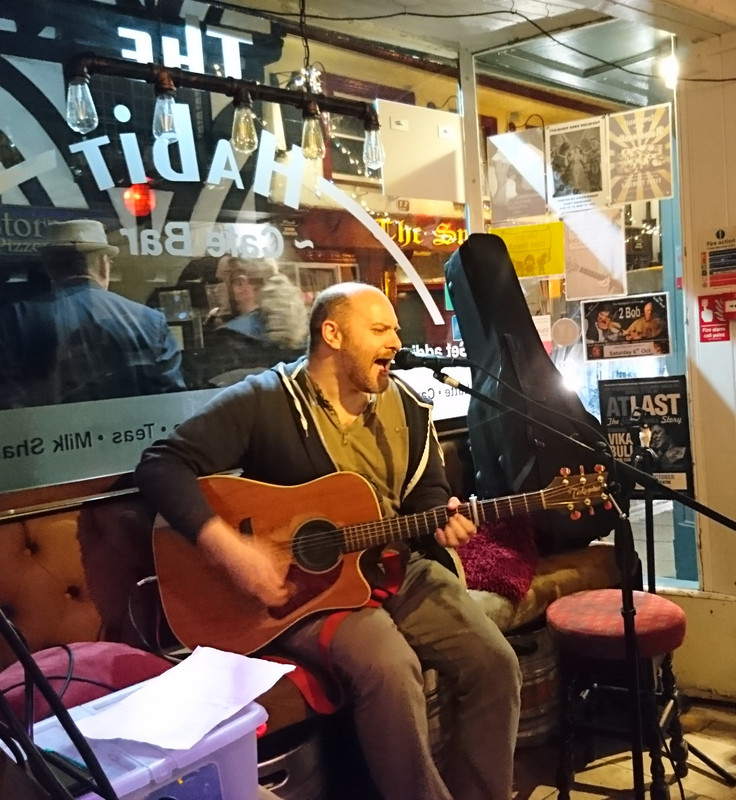
Although the bar was full for most of the night, we were rather short on players and so went around twice, hence two sets. The guy who wowed us last week with Bill Withers songs did another excellent job with Stevie Wonder's Signed Sealed Delivered I'm Yours. A lass delighted us with Corinne Bailey Rae's Put Your Records On and our host (pictured) gave us a great rendition of Peter Gabriel's Sledgehammer. My opening song I first heard on a Grateful Dead bootleg, totally different from Blind Willie Johnson's original.......it's a Cumberland Arms favourite too! My closing song went down well with the late-nighters.....A mother was washing her baby one night...etc et
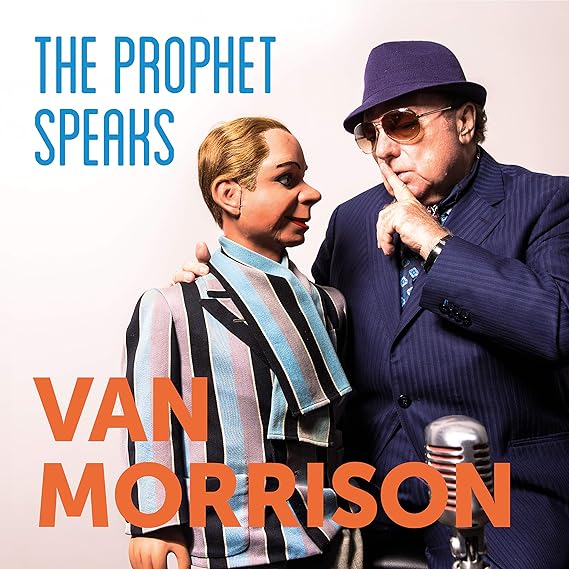
Archie's vocal seems buried in the mix but as duets go, this has to be better than Van with Linda Gail Lewis, Lonnie Donegan or John Lee Hooker, surely?
Charles Aznavour, Enduring French Singer of Global Fame, Dies at 94
By Frank J. Prial
The New York Times
1 October 2018
Charles Aznavour, one of France’s most celebrated singers of popular songs as well as a composer, film star and lifelong champion of the Armenian people, has died at his home in Mouriès, in southeastern France. He was 94.
His death was announced on Monday by the French Culture Ministry. Local authorities said he died overnight.
At an age when most performers have long retired from the footlights and the brutal, peripatetic life of an international star, Mr. Aznavour continued to range the world, singing his songs of love found and love lost to capacity audiences who knew most of his repertoire by heart. In his 60s, even then a veteran of a half century in music, he laughed off talk of retirement.
“We live long, we Armenians,” he said. “I’m going to reach 100, and I’ll be working until I’m 90.”
His accomplishments were prodigious. He wrote, by his own estimate, more than 1,000 songs, for himself and others, and sang them in French, Armenian, English, German, Italian, Spanish and Yiddish. By some estimates, he sold close to 200 million records. He appeared in more than 60 films, beginning with bit parts as a child. His best-known film role was probably as a pianist with a mysterious past in François Truffaut’s eccentric 1960 crime drama, “Shoot the Piano Player” — a part that Truffaut said he had written specifically for Mr. Aznavour.
Charles Aznavour was born in Paris on May 22, 1924. (Most sources say his name at birth was Chahnour Varenagh Azavourian, but some give his original given name as Charles and his original surname as Aznaourian.) His parents, Mischa and Knar, had come to France fleeing Turkish oppression. When they were denied visas to America, they opened a restaurant near the Sorbonne and made the city their home.
Charles’s parents instilled a love of music and theater in him and in 1933, when he was 9, enrolled him in acting school. He was soon part of a troupe of touring child actors. At 11, in Paris, he played the youthful Henry IV in a play starring the celebrated French actress and singer Yvonne Printemps.
But his earliest inspirations were singers, notably the French stars Charles Trenet, Édith Piaf and Maurice Chevalier. “Trenet for his writing, Piaf for her pathos and Chevalier for his professionalism,” he told The New York Times in 1992, “and all three for their tremendous presence on stage.”
Also high in his pantheon were Carlos Gardel, the Argentine tango singer, and Al Jolson. “Gardel and Jolson were far apart,” he said, “but they had the same pathos.” He learned his idiomatic English from Frank Sinatra’s records, but he considered Mel Tormé and Fred Astaire his favorite American singers.
Mr. Aznavour’s career spanned the history of the chanson realiste, the unvarnished tales of unrequited love, loneliness and anomie that found their apotheosis in the anguished voice of Piaf. He wrote songs for her and for Gilbert Bécaud, Léo Ferré, Yves Montand and others. When Piaf rejected one of his songs, “I Hate Sundays,” he gave it to Juliette Gréco, then the darling of the Left Bank philosophers and their acolytes. When Piaf changed her mind, she was enraged to find that she’d lost the song and, according to François Lévy, one of her biographers, confronted Mr. Aznavour, shouting, “What, you gave it to that existentialist?”
He spent nearly eight years in Piaf’s entourage, as a songwriter and secretary but, he insisted, not a lover. (“I never had a love affair with her,” he said in 2015. “That’s what saved us.”) He accompanied her to New York in 1948 and stayed for a year. “I lived on West 44th Street, ate in Hector’s Cafeteria and plugged my songs,” he recalled, “with no success.”
Back in Europe, he spent years singing in working-class cafes in France and Belgium, without much success. One critic wrote dismissively of his “odd looks and unappealing voice.”
Then, in 1956, he was an unexpected hit on a tour that took him to Lisbon and North Africa. The director of the Moulin Rouge in Paris heard him at a casino in Marrakesh and immediately signed him. When he was back in Paris, offers poured in.
In “Yesterday When I Was Young,” an autobiography published in 1979 — it shares its title with the English-language version of one of his best-known compositions — Mr. Aznavour recalled a Brussels promoter who had ignored him for years and was now offering him a contract. He offered 4,000 francs. Mr. Aznavour asked for 8,000. The promoter refused.
The next year, he offered 16,000.
“Not enough,” replied Mr. Aznavour, now a major star. “I want more than you pay Piaf.” Piaf was then making 30,000 francs. Again the promoter refused. The next year, he gave in. “How much more than Piaf do you want?” he asked.
“One franc,” Mr. Aznavour said. “After that I was able to tell my friends I was better paid than Piaf.”
In 1958, the French government lifted a longstanding ban on allowing some of Mr. Aznavour’s more explicit songs — like “Après l’Amour,” which recounts the aftermath of an episode of lovemaking — on the radio. “I was the first to write about social issues like homosexuality,” Mr. Aznavour told The Times in 2006, referring to his 1972 song “What Makes a Man?” “I find real subjects and translate them into song.”
He returned to New York in 1963 and rented Carnegie Hall, where he performed to a packed house. (Among those in the audience was Bob Dylan, who later said it was one of the greatest live performances he had ever witnessed.) A triumphant world tour followed.
Thereafter, the United States became a second home. Mr. Aznavour performed all over the country, often with Liza Minnelli. He became a fixture in Las Vegas for a time and there married Ulla Thorsell, a former model, in 1967. She was his third wife.
Mr. Aznavour had six children. Complete information on survivors was not immediately available.
As a child, Mr. Aznavour watched his father go broke feeding penniless Armenian refugees in his restaurant. As his fame grew, he became a spokesman and fund-raiser for the Armenian cause. He organized help worldwide after an earthquake killed 45,000 people in Armenia in 1988. And when the country broke away from the crumbling Soviet Union in 1991, it made him an unofficial ambassador. He displayed the Corps Diplomatique plaque on his car as proudly as he wore the French Legion of Honor ribbon in his lapel.
President Emmanuel Macron of France said in a statement on Monday: “Profoundly French, viscerally attached to his Armenian roots, famous in the entire world, Charles Aznavour accompanied the joys and sorrows of three generations. His masterpieces, his timbre, his unique influence will long survive him.”
In 2006, at the age of 82, le Petit Charles, as the French called him (he was 5 feet 3 inches tall), began what some — although not Mr. Aznavour himself — called his farewell tour. After several months in Cuba that year, recording an album of his songs with the pianist Chucho Valdés, he moved on to a 10-city swing through the United States and Canada, beginning at Radio City Music Hall. It was just the English-language part of the tour, he said, with England, Australia, New Zealand and South Africa to follow.
He continued performing almost to the end. He had broken his arm in May, but at his death he had concert dates booked in France and Switzerland for November and December.
Reviewing a 2009 concert at New York City Center, Stephen Holden of The Times wrote that Mr. Aznavour “displayed the stamina and agility of a man 30 years younger.” A 2014 performance at the Theater at Madison Square Garden was billed as his final New York appearance, but he suggested in an email interview with The Times that he might change his mind.
He continued writing songs as well. “My Paris,” a musical based on the life of Toulouse-Lautrec for which he wrote the score, was staged at the Long Wharf Theater in New Haven in 2016.
In recent years, health problems inevitably slowed him down, but he showed no sign of stopping. “We are in no hurry,” he said in 2006. “We are still young. There are some people who grow old and others who just add years. I have added years, but I am not yet old.”