Once it was about art, architecture and poetry; broadening the mind; a cultural education; swimming in the Med; romantically wasting away with consumption surrounded by exotic women who looked like Claudia Cardinale.
Now, it's come to this.
Italian lager.
Wednesday, 20 June 2018
Tuesday, 19 June 2018
Paul Simon: Alternate Tunings and In the Blue Light

Joe Marchese
The Second Disc
18 June 2018
Paul Simon may be retiring from the road, but the conclusion of his acclaimed Homeward Bound – The Farewell Tour on September 22 won’t be the last we’ve heard of the legendary musician. On tour, he’s currently previewing two upcoming projects: Alternate Tunings, a long-awaited collection of previously unreleased material, and an album entitled In the Blue Light, due in September.
In lieu of a traditional tour program, Simon is offering a lavish “Limited Edition Folio” for purchase at each evening’s concert (price: a reasonable $30.00). This clothbound, hardcover, roughly LP-sized book is a fitting souvenir, but moreover, it includes a six-song MP3 download “from the forthcoming rarities collection Alternate Tunings.” The download card promises, “Drawn from Paul Simon’s vast archive of recordings, this collection spans his entire career.” This anthology has been mooted for years now; a quick online search reveals discussion of the project as far back as 2003. It’s finally becoming a reality, with the following previously unreleased songs available now for download to purchasers of the folio:
Song for the Asking (Solo Demo) (released version from Simon & Garfunkel, Bridge Over Troubled Water, 1970)
Papa Hobo (Solo Demo) (released version from Paul Simon, 1972)
Learn How to Fall (Solo Demo) (released version from There Goes Rhymin’ Simon, 1973)
Silent Eyes (Film Score Outtake) (released version from Still Crazy After All These Years, 1975)
Hearts and Bones (Solo Demo) (released version from Hearts and Bones, 1983)
Citizen of the Planet (Solo Demo) (released version from Simon & Garfunkel, Old Friends: Live on Stage, 2004)
These six beautiful acoustic tracks, bookended (pun intended) by solo versions of compositions associated with Simon & Garfunkel, augur well for the high quality of the complete release. (“Citizen of the Planet” was originally intended for Hearts and Bones – the album that itself began life as Think Too Much, the S&G reunion album that never was.) “Silent Eyes,” noted as “Film Score Outtake,” is a particularly fascinating offering, with Simon’s ethereal, wordless vocals and guitar joined by subtle, baroque orchestration.
Alternate Tunings isn’t the only project on the way from Rhymin’ Simon, however. The folio promises that In the Blue Light will arrive this September from Legacy Recordings. Though no further information about the album is printed in the folio or otherwise available, we do know that the album title derives from a lyric in “How the Heart Approaches What It Yearns” from 1980’s One Trick Pony. Additionally, Simon mentioned from the stage of Philadelphia’s Wells Fargo Center on Saturday night that his longtime guitarist Vincent N’guini (who died last December at the age of 65) played on In the Blue Light – his final collaboration with the artist. N’guini was first heard on a Simon album in 1990 The Rhythm of the Saints and has been featured on each of Simon’s LPs since. With Alternate Tunings also on the way and the farewell tour occurring now, it’s evident that Simon has been in a reflective mood. Perhaps In the Blue Lightwill find him looking back to the milieu or style of the past as well? In a 2016 interview with American Songwriter, Simon divulged that he and veteran producer-engineer Roy Halee had been re-recording new versions of old songs. The fruits of those sessions, including the possibility of a reworked “How the Heart…,” could finally see the Light of day this September. Whatever the case, Simon assured the enthusiastic Philly crowd that he wouldn’t be turning away from music despite his onstage retirement.
Watch this space for more news on both In the Blue Light and Alternate Tunings as it becomes available. Paul Simon’s Homeward Bound – The Farewell Tour resumes Tuesday night in North Carolina and continues through September 22, when it will wrap up at a still-unannounced venue in (where else?) New York City.
Monday, 18 June 2018
Happy birthday, Stan Laurel!
"Chaplin wasn't the funniest. I wasn't the funniest. Stan Laurel was the funniest." Buster Keaton
Happy Birthday, Stan Laurel
England's greatest cultural export. Okay, we're a couple of days late. Fingers crossed he's busy and doesn't notice...

Dick Cavett
The New York Times
5 October 2012
You overwhelmed me, dear reader, with your reaction(s) to the piece I did last time about Stan Laurel. I’m particularly moved by the number of you who were touched, using phrases like “I misted up,” “I shed a tear” and even “I wept.” I didn’t mean to upset anyone.
I feel a little funny about admitting that, rereading the piece days later, I did at least one of the above.
At the risk of anticlimax, I can add here a few things that swam back to mind in the interval. Things I had forgotten about my golden few visits with the great man. And an event that just recurred recently.
I was in Hollywood last week working on a TV project, a pilot idea concocted by the remarkably talented John Hodgman. I mentioned last time that on my first visit, Stan had told me that The Steps still existed — the daunting 131 concrete steps up which he and “Babe” Hardy back-breakingly struggled and heaved the crated piano, losing it a few times — in the Oscar-winning short “The Music Box.” A classic of team comedy that bears watching at least once a year. (Get “Laurel and Hardy: The Essential Collection.”)
Several commenters on the column had a favorite moment from that film: the one where the generally sweet Stan, moved to a rare display of rage when the fuming Billy Gilbert — the intended recipient of the piano — insists they get themselves and the giant crate out of his way as he descends the stairs from his house at the top of the hill.
Stan swats his top hat off. Gilbert steams and bellows as it bounces and tumbles its way to the very bottom of the steps and rolls into the street. A truck runs over it.
An iconic moment in film comedy.
So last week, in a break from the stuff I was shooting, as a treat for me, my dear wife arranged for a friend of ours to drive us on a pilgrimage. We found The Steps.
(The location is hardly a secret, but just for fun let’s pretend I’m giving you a bit of inside information. You can find the steps yourself at the corner of Vendome and Del Monte in the Silver Lake district, just south of Sunset. There’s a little grassy triangle nearby that’s been named Laurel and Hardy Park. The magic numbers: 923-937 North Vendome Street.)
At first the steps look wrong, somehow, and you wonder if you’ve been misled. In the 1930s, they stood virtually alone; now, houses and low apartment buildings and high shrubbery surround them. Much has changed, but worshippers are rewarded by the fact that the house across the street, where the hapless boys parked their horse-drawn wagon, survives. A plaque on the bottom step reading “Stan Laurel and Oliver Hardy ‘The Music Box’” reassures you you’re in the right place. I assumed it had been put there by the Laurel & Hardy-adoring organization Sons of the Desert, but in fact seems to have been placed by an impressive list of sponsors, including Hollywood Heritage Inc., The Society of Operating Cameramen, The Silent Society, The Hollywood Studio Museum and perhaps others.
It was like visiting a holy place.
For trivialists: there are exactly 131 steps. We climbed them as an act of homage.
Don’t be disappointed to learn that there is, in fact, no house of Billy Gilbert’s at the top. There never was. It was a studio set.
Another bit of arcana. The same steps were used by the boys for a 1927 film called “Hats Off!” Alas, the search for this lost gem goes on.
Stan recalled a favorite moment in “The Music Box”: “Remember the baby nurse lady who’s pushing the baby carriage who laughs at us? And how when she turns her back, I kick her in the butt? And she tells a cop and he says, ‘He kicked you?’ I asked for another take and added a line for her that might have been thought vaguely naughty, but I knew the kids wouldn’t get it but the sharper adults would. I had her say: ‘Yes, officer. He kicked me. Right in the middle of my daily duties.’”
We laughed.
How I could have temporarily forgotten a certain revelation by Stan I can’t imagine. He talked about the time when he and Hardy were suddenly surprised by the oleaginous Ralph Edwards and lured, live, on the spot, onto his “This Is Your Life” TV show. Rudely surprised by Edwards’s crew and suddenly flooded with light while peacefully chatting with their wives and a friend in a hotel lounge, they were to be spirited quickly to Edwards’s studio a few blocks away for the live show, but Hardy rebelled.
Stan: “Babe was livid. He was halfway into his car to go straight home, leaving poor Ralph sweating in the studio with half a guest list. Babe reluctantly relented.”
It’s their only live television appearance and should have been wonderful. It’s around, but it is infuriating to watch. The endlessly yakking Edwards — phony as his hairpiece — does all the talking. He raises a subject and, instead of saying to the pair, “Tell us about that” — he tells us.
You wish Stan would treat him like Billy Gilbert and swat his rug off.
You long to hear them talk. Edwards allows them each a few words while repeatedly attempting witless jokes about the llfe-threateningly obese Hardy’s girth. Babe plays along with faux pleasantry as surprise guests like Hal Roach, their former employer, and a few relatives are awkwardly trotted out. Eventually and mercifully the travesty ends.
It should be avoided as ardently as — and I apologize for this dirty word — the “colorized” version of “The Music Box,” which is still floating around. Miraculously, the cheesy colorizing practice — now junked — manages to extract all humor from the great film. A subject for an essay on the inferiority of color to black and white. (Sorry, young folks who boast of watching no movies not multihued. There really are a few good black-and-white ones.)
This is interesting: One reader pointed out the coincidence that when my first column ran, the BBC radio was airing a show about L&H. I listened to it online. Somehow I joined it in the middle and a man was talking. The voice was not familiar. He was talking about how Babe Hardy took no responsibility for the films, had no interest in the editing and wanted out as early as possible so he could escape to the golf course. And how he, the speaker, worked far into the night. It had to be a stranger reading a quote from Stan Laurel. But it was Stan Laurel.
Here again is something I’d forgotten. Stan’s real voice, in conversation, was not the voice of “Stan” in the movies. It was about 10 notes lower. While not falsetto, his character voice used in the films was at least an octave higher than his own. His real voice was nearer baritone. I’ve never seen this mentioned.
You can prove this for yourself by finding the BBC show and also in the only place I know of in the movies: the remarkable step out of character that Stan takes when a conk on the head reverts him, temporarily, to his former, forgotten life as an upper class English lord in “A Chump at Oxford.” He uses, in his faultless, Noël Coward-y accent, a voice nearly as low as his real voice. When re-conked and “Stan” speaks to the now re-recognized Ollie — who squeals with delight at having his friend back — he cranks his voice back upward to the voice we know and love.
I’ll close with a little gem from my all-too-skimpy, semi-legible and fading notes of my first meeting with Stan. We talked about what he liked and didn’t like on television. “There’s one television show, lad” — I was 24! — “that I just can’t abide. It’s the one with that panel of ultra-shi-shi folks. The one called ‘What’s My Line?’ It sends me straight up the wall. I call it ‘The Snob Family.’”
A man for the ages.
https://opinionator.blogs.nytimes.com/2012/10/05/can-you-stand-some-more-stan/
Sunday, 17 June 2018
Saturday, 16 June 2018
The Scariest 25 Horror Films Eva!!!!
Occult chiller Hereditary is the latest in a proud line of big-screen blood-curdlers. Our critic picks his 25 most terrifying
Peter Bradshaw
The Guardian
Thu 7 Jun 2018
25 Don’t Torture a Duckling (Lucio Fulci, 1972)
Now that Lars von Trier has offered what may be a backhanded homage to it in his serial-killer nightmare The House That Jack Built, attention may well refocus on this cult giallo classic from Italy. A journalist investigates a series of murders in a remote village and uncovers black-magic practices.
24 American Psycho (Mary Harron, 2000)
Once upon a time, Bret Easton Ellis’s novel American Psycho was the most shocking thing in American publishing. Mary Harron’s movie version did not excite the same disgust, but it made Christian Bale into a star as the gym-built Wall Street master of the universe and status snob who is also a serial killer.
23 The Funhouse (Tobe Hooper, 1981)
A classic crude slasher from Tobe Hooper, in my view better than The Texas Chain Saw Massacre. Four teenagers become trapped inside a haunted ride at a carnival and find themselves being picked off by the disfigured killer inside. Hooper weaponises his own fiendish bad taste with some truly grisly killing scenes.
22 The Blair Witch Project (Daniel Myrick and Eduardo Sánchez, 1999)
The explosion of digital movie-making 20 years ago – and the sudden availability of digital cameras at high-street prices – liberated film-makers and gave birth to the “found footage” genre. This is a movie whose cheeky viral marketing allowed people to think it was a genuine documentary. Three students hike into a forest, intending to make a supercilious video-diary history project about the local tradition of the “Blair Witch”. They are never seen again and this footage is all that is recovered.
21 Night of the Living Dead (George A Romero, 1968)
George A Romero invented the zombie genre with this smart, low-budget shocker about a virus, accidentally brought back to Earth from outer space, that causes people to eat each other, afflicted by an eternal hunger. It satirised racism, conformism, careerism and the country’s secret fear of the future.
20 Hereditary (Ari Aster, 2018)
Ari Aster has barnstormed his way into the scary hall of fame with this deeply strange movie featuring Toni Collette as an artist and miniaturist who is haunted in every sense by her late mother, an abusive and manipulative woman who now wishes to gain control of her grandchildren from beyond the grave.
19 It Follows (David Robert Mitchell, 2014)
A brilliant horror inspired by MR James’s story Casting the Runes. After sleeping with someone, a young woman discovers she has been inducted into a supernatural death cult; she is being followed by a demonic figure that only she can see and which pursues her on foot at a zombie pace, but will eventually kill her – unless she has sex with someone else, at which point this demon’s target will change. And so it goes on: a viral chain-letter of sex and shame.
18 Audition (Takeshi Miike, 1999)
An almost unclassifiable masterpiece of J-horror and one of the very few movies in the genre in which the demonically violent protagonist is allowed to be a woman, satirising women’s position in Japanese society and cinema. A film producer hits upon the idea for getting a wife: he will audition actresses for a (nonexistent) minor role and then, having found a suitably submissive woman, let her down and ask her for a date. The auditionee (Eihi Shiina) turns the tables on his arrogance with extreme violence.
17 Get Out (Jordan Peele, 2017)
One of the great horror thrillers of contemporary US cinema and a brilliant allegory for the plot twist of the US post-Obama. An African American photographer (Daniel Kaluuya) is invited by his white girlfriend (Allison Williams) to spend the weekend with her super-liberal parents.
16 The Addiction (Abel Ferrara, 1995)
One of the great movies about vampires, which Abel Ferrara reimagines as a parasitical cult of addiction, a pyramid scheme for spreading evil. Lili Taylor plays a lonely student in New York who is bitten and must then bite. Her agony in confronting her unwished-for destiny of eternal undeadness is brilliant.
15 Halloween (John Carpenter, 1978)
A masked attacker has escaped from a secure facility. It is the loathsome Michael, who has one of the most disturbing walks in film history: lumbering and laborious, and yet inexorable in his pursuit of Jamie Lee Curtis. The pioneering use of electronic music is part of what makes Halloween memorable: the plinking piano theme over a buzzing synth score.
14 Peeping Tom (Michael Powell, 1959)
Frequently and misleadingly described as “the British Psycho”, this is the film that undid Michael Powell’s career – a serial-killer nightmare with strange echoes of his earlier film with Emeric Pressburger, A Canterbury Tale. Carl Boehm plays the deranged porn photographer and amateur cine-movie obsessive who films prostitutes at the moment he kills them. The sheer tattiness and seediness of postwar Britain is superbly conjured.
13 The Wicker Man (Robin Hardy, 1973)
A classic of English folk-horror: Edward Woodward plays the stolidly moralistic police officer who comes to a remote Scottish island community to investigate the case of a missing girl and is unsettled by the strange pagan practices. It is a society that has evolved separately from Britain’s mainland and its Anglican beliefs, but it looks like an alternative reality of fiercely insular, irrational England. Is there anything more Brexity than this?
12 Eyes Without a Face (Georges Franju, 1960)
An eminent surgeon attempts a cosmetic reconstruction of his daughter’s face after she is disfigured in a road accident – using parts of faces of other young women that his assistant lures to his laboratory and kills. It is a horror movie in the tradition of Mary Shelley and yet also something of Beauty and the Beast, with the beastly father-figure turning his innocent daughter into something repulsive. Her mask is inexpressibly disturbing.
11 Carrie (Brian de Palma, 1976)
Sissy Spacek is the bullied teen with telekinetic powers in this parable of bullying and misogyny, which is also a brilliant satire of high school, particularly the prom as a theatre of cruelty and anxiety. The violence and rage scream out of the screen.
10 The Silence of the Lambs (Jonathan Demme, 1991)
Jonathan Demme’s masterpiece of forensic psycho-macabre horror stars Anthony Hopkins, who brings a career’s worth of Shakespearean savvy to his greatest role: the imprisoned serial killer Dr Hannibal Lecter. Jodie Foster plays the FBI rookie Clarice Starling, who must convince Hannibal to offer invaluable help from behind his toughened glass in tracking down another murderer. But what will he want from her in return? A guignol gem.
9 The Babadook (Jennifer Kent, 2014)
I have rewatched this a number of times and it just gets better, verging on classic status. A lonely and stressed young mother finds herself reading to her young son from a strange pop-up book he has found, called The Babadook, about a weird top-hatted figure that lives in the wardrobe. Too late, she realises that it is a satanically charged object and by reading it aloud she has made it come true.
8 The Shining (Stanley Kubrick, 1980)
Stanley Kubrick’s gift for eerie grandeur is given free rein in this adaptation of the Stephen King novel (disliked by the author) about Jack Nicholson’s brooding writer, given the job as caretaker of an out-of-season hotel. There are sensational set pieces of horror and mystery: the lift shaft full of blood, the twin sisters appearing in the corridor.
7 The Innocents (Jack Clayton, 1961)
An elegant, sinister and scalp-prickling ghost story, based on Henry James’s story The Turn of the Screw. A governess, played by Deborah Kerr, takes charge of two children at a remote country estate and suspects that the house is haunted by the drunken valet and the former governess he seduced. She suspects the children can see these ghosts, too, and that these evil spirits have befriended them.
6 Suspiria (Dario Argento, 1977)
There’s a remake on the way from Luca Guadagnino, and we have had many homages (from Darren Aronofsky’s Black Swan to Nicolas Winding Refn’s The Neon Demon), but here is the original and best. The extraordinary, operatic fantasy horror about a young American dancer discovering awful secrets at a German ballet school freaks out its audience with crazed intensity and eyeball-frazzling blocks of fierce colour.
5 Dead of Night (Alberto Cavalcanti et al, 1945)
Low-key it may be compared with the jump-scare slashers, but this Ealing classic from 1945 is genuinely frightening: a portmanteau collection of five ghost stories, of which the most disturbing is probably the one directed by Alberto Cavalcanti, about a mad ventriloquist haunted by his dummy – a superb premonition of Psycho.
4 Psycho (Alfred Hitchcock, 1960)
One of the great event movies of the postwar era and an inspired exploitation nightmare that sensationally took Hitchcock – then in late middle-age – to the next level of cinematic greatness. Based on the novel by Robert Bloch – itself based on the grisly true story of the serial killer Ed Gein – it stars Janet Leigh as a realtor’s secretary who takes off with $40,000 in stolen cash and has to stay at a creepy old motel run by awkward Anthony Perkins, heading for a horrendous fate in the shower.
3 The Exorcist (William Friedkin, 1973)
William Friedkin’s horror masterpiece, the most famous of the devil-child wave made possible by Rosemary’s offspring, delivers a sledgehammer punch of fear – and a lumbar-puncture stab of horror. Max von Sydow plays a priest who is called in to cast out a devil occupying the body of a 12-year-old girl in Washington DC. The effects and prosthetics are still staggeringly good and the cataclysmic confrontation of good and evil is genuinely horrifying.
2 Rosemary’s Baby (Roman Polanski, 1968)
For its sense of insidious and encircling evil, and the sensationally good performance from Mia Farrow, Rosemary’s Baby is unforgettable. Adapted by Polanski from the Ira Levin bestseller, it shows the demure, shy young title character (Farrow) moving in to a strange New York apartment building with her actor husband (John Cassavetes), becoming pregnant under strange circumstances and suspecting that a sinister satanic cult has designs on her baby.
1 Don’t Look Now (Nicolas Roeg, 1973)
Nicolas Roeg’s magnificently disturbing ghost story, adapted by Alan Scott and Chris Bryant from the Daphne du Maurier short story, is an inspired combination of the erotic and the uncanny. Donald Sutherland and Julie Christie give superb performances as the parents of a dead child who encounter, in Venice’s dankly crumbling splendour, terrifying signs of her existence beyond the grave. It is a meditation on time, memory, the poignancy of married love and the inexplicable mystery of death — and very scary.
A click-bait summer filler piece for The Guardian with some good choices, some poor choices and some Brand Guardian choices. The absence of The Haunting and Night of the Demon (and maybe The Changeling) is just plain wrong, as is the presence of films that might be better termed "thrillers," albeit brutal ones about serial killers - and if you're moving away from the supernatural, how about Les Diaboliques? Have to admit, of those I've seen, Funhouse, American Psycho, Carrie, Blair Witch, Suspiria, The Silence of the Lambs, The Addiction and maybe Peeping Tom and Carrie wouldn't be in my 25. Then again, the list was intended to generate argument and comment...
Friday, 15 June 2018
Thursday, 14 June 2018
The Terry Kelly Poetry Competition

Back from left, judges and organisers Alistair Robinson and Tom Kelly with front from left, winners Lauren Aspery, 20, Finn Edmonds, nine, and Bo Buglass, 13
Young poets honoured in annual contest in memory of Gazette reporter
Talented youngsters were honoured as a competition in memory of much-loved former Gazette reporter Terry Kelly was a poetic success once again.
Daniel Prince
The Shields Gazette
Thursday 31 May 2018
The Customs House, in Mill Dam, South Shields, played host to the annual staging of the Terry Kelly Poetry Prize last night.
The contest was set up in memory of the popular former poet and journalist, who died in January 2016. It is open for young poets aged up to 25 and aims to inspire youngsters in the North East to embrace poetry, just as Terry did throughout his life.
Hundreds of entries were made in this year’s competition, with judges Tom Kelly, Alistair Robinson and Sheila Wakefield finding it difficult to whittle it down to a shortlist.
They were full of praise for all those who entered.
This competition keeps Terry’s memory alive and makes people aware about Terry and his work Tom Kelly Tom, who is Terry’s brother, was head judge, and said: “This year’s competition has been terrific, and the most successful one so far."
There were hundreds of entries and the standard was so high, so it was very difficult to choose a shortlist and then the winners.
“This competition keeps Terry’s memory alive and makes people aware about Terry and his work.”
Winners were selected in three categories, with prizes for the best pieces of work from those aged under 11, 11 to 16 and 16 to 25.
Finn Edmonds, nine, was selected as the winner in the first category for his poem ‘Why?’
Bo Buglass, 13, with ‘This Too Will Pass’ and Lauren Aspery, 20, with ‘My First Pair’, were the other winners.
Mr Robinson, who is a poet, journalist and lecturer at the University of Sunderland, said: “This competition gets better every year, and shows the standard and range of writing that is out there.
“It would have been there anyway, but the competition draws it out.
“This competition really does commemorate Terry and his full range of skills, and we are delighted that it continues to provide a showcase for poetry.”
Terry’s wife Val was among those in the audience.
She said: “The poets were absolutely amazing and so mature.
"The poetry was so concise, and you could see such a lot of hard work had gone into it.
“I think Terry would be over the moon, and surprised.
“He would feel very responsive to it because he loved poetry.”
https://www.shieldsgazette.com/news/young-poets-honoured-in-annual-contest-in-memory-of-gazette-reporter-1-9187496
Wednesday, 13 June 2018
Tuesday, 12 June 2018
Monday, 11 June 2018
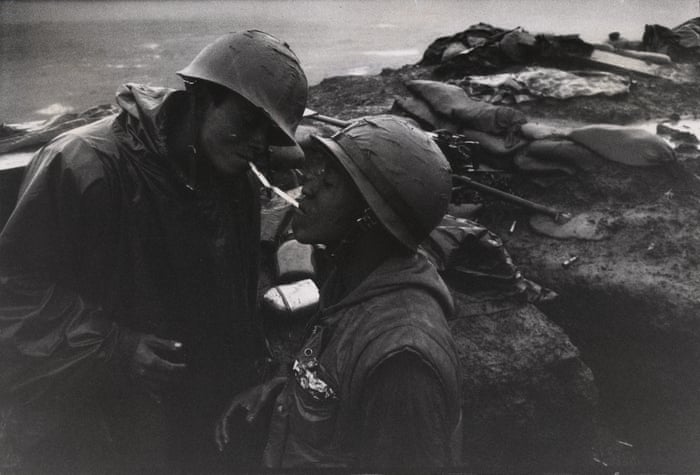
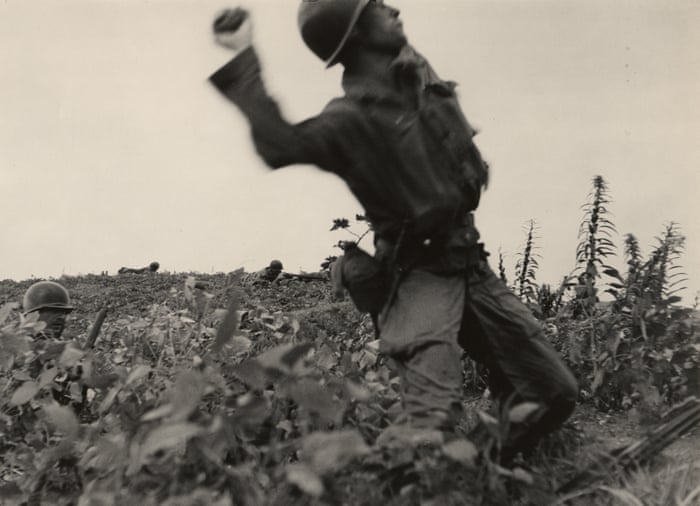
David Douglas Duncan RIP

Pfc John L Lewis, Khe Sanh, February 1968


Sunday, 10 June 2018
Saturday, 9 June 2018
Anthony Bourdain RIP

A New York chef spills some trade secrets
Anthony Bourdain
The New Yorker
19 April 1999
Good food, good eating, is all about blood and organs, cruelty and decay. It’s about sodium-loaded pork fat, stinky triple-cream cheeses, the tender thymus glands and distended livers of young animals. It’s about danger—risking the dark, bacterial forces of beef, chicken, cheese, and shellfish. Your first two hundred and seven Wellfleet oysters may transport you to a state of rapture, but your two hundred and eighth may send you to bed with the sweats, chills, and vomits.
Gastronomy is the science of pain. Professional cooks belong to a secret society whose ancient rituals derive from the principles of stoicism in the face of humiliation, injury, fatigue, and the threat of illness. The members of a tight, well-greased kitchen staff are a lot like a submarine crew. Confined for most of their waking hours in hot, airless spaces, and ruled by despotic leaders, they often acquire the characteristics of the poor saps who were press-ganged into the royal navies of Napoleonic times—superstition, a contempt for outsiders, and a loyalty to no flag but their own.
A good deal has changed since Orwell’s memoir of the months he spent as a dishwasher in “Down and Out in Paris and London.” Gas ranges and exhaust fans have gone a long way toward increasing the life span of the working culinarian. Nowadays, most aspiring cooks come into the business because they want to: they have chosen this life, studied for it. Today’s top chefs are like star athletes. They bounce from kitchen to kitchen—free agents in search of more money, more acclaim.
I’ve been a chef in New York for more than ten years, and, for the decade before that, a dishwasher, a prep drone, a line cook, and a sous-chef. I came into the business when cooks still smoked on the line and wore headbands. A few years ago, I wasn’t surprised to hear rumors of a study of the nation’s prison population which reportedly found that the leading civilian occupation among inmates before they were put behind bars was “cook.” As most of us in the restaurant business know, there is a powerful strain of criminality in the industry, ranging from the dope-dealing busboy with beeper and cell phone to the restaurant owner who has two sets of accounting books. In fact, it was the unsavory side of professional cooking that attracted me to it in the first place. In the early seventies, I dropped out of college and transferred to the Culinary Institute of America. I wanted it all: the cuts and burns on hands and wrists, the ghoulish kitchen humor, the free food, the pilfered booze, the camaraderie that flourished within rigid order and nerve-shattering chaos. I would climb the chain of command from mal carne (meaning “bad meat,” or “new guy”) to chefdom—doing whatever it took until I ran my own kitchen and had my own crew of cutthroats, the culinary equivalent of “The Wild Bunch.”
A year ago, my latest, doomed mission—a high-profile restaurant in the Times Square area—went out of business. The meat, fish, and produce purveyors got the news that they were going to take it in the neck for yet another ill-conceived enterprise. When customers called for reservations, they were informed by a prerecorded announcement that our doors had closed. Fresh from that experience, I began thinking about becoming a traitor to my profession.
Say it’s a quiet Monday night, and you’ve just checked your coat in that swanky Art Deco update in the Flatiron district, and you’re looking to tuck into a thick slab of pepper-crusted yellowfin tuna or a twenty-ounce cut of certified Black Angus beef, well-done—what are you in for?
The fish specialty is reasonably priced, and the place got two stars in the Times.Why not go for it? If you like four-day-old fish, be my guest. Here’s how things usually work. The chef orders his seafood for the weekend on Thursday night. It arrives on Friday morning. He’s hoping to sell the bulk of it on Friday and Saturday nights, when he knows that the restaurant will be busy, and he’d like to run out of the last few orders by Sunday evening. Many fish purveyors don’t deliver on Saturday, so the chances are that the Monday-night tuna you want has been kicking around in the kitchen since Friday morning, under God knows what conditions. When a kitchen is in full swing, proper refrigeration is almost nonexistent, what with the many openings of the refrigerator door as the cooks rummage frantically during the rush, mingling your tuna with the chicken, the lamb, or the beef. Even if the chef has ordered just the right amount of tuna for the weekend, and has had to reorder it for a Monday delivery, the only safeguard against the seafood supplier’s off-loading junk is the presence of a vigilant chef who can make sure that the delivery is fresh from Sunday night’s market.
Generally speaking, the good stuff comes in on Tuesday: the seafood is fresh, the supply of prepared food is new, and the chef, presumably, is relaxed after his day off. (Most chefs don’t work on Monday.) Chefs prefer to cook for weekday customers rather than for weekenders, and they like to start the new week with their most creative dishes. In New York, locals dine during the week. Weekends are considered amateur nights—for tourists, rubes, and the well-done-ordering pretheatre hordes. The fish may be just as fresh on Friday, but it’s on Tuesday that you’ve got the good will of the kitchen on your side.
People who order their meat well-done perform a valuable service for those of us in the business who are cost-conscious: they pay for the privilege of eating our garbage. In many kitchens, there’s a time-honored practice called “save for well-done.” When one of the cooks finds a particularly unlovely piece of steak—tough, riddled with nerve and connective tissue, off the hip end of the loin, and maybe a little stinky from age—he’ll dangle it in the air and say, “Hey, Chef, whaddya want me to do with this?” Now, the chef has three options. He can tell the cook to throw the offending item into the trash, but that means a total loss, and in the restaurant business every item of cut, fabricated, or prepared food should earn at least three times the amount it originally cost if the chef is to make his correct food-cost percentage. Or he can decide to serve that steak to “the family”—that is, the floor staff—though that, economically, is the same as throwing it out. But no. What he’s going to do is repeat the mantra of cost-conscious chefs everywhere: “Save for well-done.” The way he figures it, the philistine who orders his food well-done is not likely to notice the difference between food and flotsam.
Then there are the People Who Brunch. The “B” word is dreaded by all dedicated cooks. We hate the smell and spatter of omelettes. We despise hollandaise, home fries, those pathetic fruit garnishes, and all the other cliché accompaniments designed to induce a credulous public into paying $12.95 for two eggs. Nothing demoralizes an aspiring Escoffier faster than requiring him to cook egg-white omelettes or eggs over easy with bacon. You can dress brunch up with all the focaccia, smoked salmon, and caviar in the world, but it’s still breakfast.
Even more despised than the Brunch People are the vegetarians. Serious cooks regard these members of the dining public—and their Hezbollah-like splinter faction, the vegans—as enemies of everything that’s good and decent in the human spirit. To live life without veal or chicken stock, fish cheeks, sausages, cheese, or organ meats is treasonous.
Like most other chefs I know, I’m amused when I hear people object to pork on nonreligious grounds. “Swine are filthy animals,” they say. These people have obviously never visited a poultry farm. Chicken—America’s favorite food—goes bad quickly; handled carelessly, it infects other foods with salmonella; and it bores the hell out of chefs. It occupies its ubiquitous place on menus as an option for customers who can’t decide what they want to eat. Most chefs believe that supermarket chickens in this country are slimy and tasteless compared with European varieties. Pork, on the other hand, is cool. Farmers stopped feeding garbage to pigs decades ago, and even if you eat pork rare you’re more likely to win the Lotto than to contract trichinosis. Pork tastes different, depending on what you do with it, but chicken always tastes like chicken.
Another much maligned food these days is butter. In the world of chefs, however, butter is in everything. Even non-French restaurants—the Northern Italian; the new American, the ones where the chef brags about how he’s “getting away from butter and cream”—throw butter around like crazy. In almost every restaurant worth patronizing, sauces are enriched with mellowing, emulsifying butter. Pastas are tightened with it. Meat and fish are seared with a mixture of butter and oil. Shallots and chicken are caramelized with butter. It’s the first and last thing in almost every pan: the final hit is called “monter au beurre.” In a good restaurant, what this all adds up to is that you could be putting away almost a stick of butter with every meal.
If you are one of those people who cringe at the thought of strangers fondling your food, you shouldn’t go out to eat. As the author and former chef Nicolas Freeling notes in his definitive book “The Kitchen,” the better the restaurant, the more your food has been prodded, poked, handled, and tasted. By the time a three-star crew has finished carving and arranging your saddle of monkfish with dried cherries and wild-herb-infused nage into a Parthenon or a Space Needle, it’s had dozens of sweaty fingers all over it. Gloves? You’ll find a box of surgical gloves—in my kitchen we call them “anal-research gloves”—over every station on the line, for the benefit of the health inspectors, but does anyone actually use them? Yes, a cook will slip a pair on every now and then, especially when he’s handling something with a lingering odor, like salmon. But during the hours of service gloves are clumsy and dangerous. When you’re using your hands constantly, latex will make you drop things, which is the last thing you want to do.
Finding a hair in your food will make anyone gag. But just about the only place you’ll see anyone in the kitchen wearing a hat or a hairnet is Blimpie. For most chefs, wearing anything on their head, especially one of those picturesque paper toques—they’re often referred to as “coffee filters”—is a nuisance: they dissolve when you sweat, bump into range hoods, burst into flame.
The fact is that most good kitchens are far less septic than your kitchen at home. I run a scrupulously clean, orderly restaurant kitchen, where food is rotated and handled and stored very conscientiously. But if the city’s Department of Health or the E.P.A. decided to enforce every aspect of its codes, most of us would be out on the street. Recently, there was a news report about the practice of recycling bread. By means of a hidden camera in a restaurant, the reporter was horrified to see returned bread being sent right back out to the floor. This, to me, wasn’t news: the reuse of bread has been an open secret—and a fairly standard practice—in the industry for years. It makes more sense to worry about what happens to the leftover table butter—many restaurants recycle it for hollandaise.
What do I like to eat after hours? Strange things. Oysters are my favorite, especially at three in the morning, in the company of my crew. Focaccia pizza with robiola cheese and white truffle oil is good, especially at Le Madri on a summer afternoon in the outdoor patio. Frozen vodka at Siberia Bar is also good, particularly if a cook from one of the big hotels shows up with beluga. At Indigo, on Tenth Street, I love the mushroom strudel and the daube of beef. At my own place, I love a spicy boudin noir that squirts blood in your mouth; the braised fennel the way my sous-chef makes it; scraps from duck confit; and fresh cockles steamed with greasy Portuguese sausage.
I love the sheer weirdness of the kitchen life: the dreamers, the crackpots, the refugees, and the sociopaths with whom I continue to work; the ever-present smells of roasting bones, searing fish, and simmering liquids; the noise and clatter, the hiss and spray, the flames, the smoke, and the steam. Admittedly, it’s a life that grinds you down. Most of us who live and operate in the culinary underworld are in some fundamental way dysfunctional. We’ve all chosen to turn our backs on the nine-to-five, on ever having a Friday or Saturday night off, on ever having a normal relationship with a non-cook.
Being a chef is a lot like being an air-traffic controller: you are constantly dealing with the threat of disaster. You’ve got to be Mom and Dad, drill sergeant, detective, psychiatrist, and priest to a crew of opportunistic, mercenary hooligans, whom you must protect from the nefarious and often foolish strategies of owners. Year after year, cooks contend with bouncing paychecks, irate purveyors, desperate owners looking for the masterstroke that will cure their restaurant’s ills: Live Cabaret! Free Shrimp! New Orleans Brunch!
In America, the professional kitchen is the last refuge of the misfit. It’s a place for people with bad pasts to find a new family. It’s a haven for foreigners—Ecuadorians, Mexicans, Chinese, Senegalese, Egyptians, Poles. In New York, the main linguistic spice is Spanish. “Hey, maricón! chupa mis huevos” means, roughly, “How are you, valued comrade? I hope all is well.” And you hear “Hey, baboso! Put some more brown jiz on the fire and check your meez before the sous comes back there and fucks you in the culo!,” which means “Please reduce some additional demi-glace, brother, and reëxamine your mise en place, because the sous-chef is concerned about your state of readiness.”
Since we work in close quarters, and so many blunt and sharp objects are at hand, you’d think that cooks would kill one another with regularity. I’ve seen guys duking it out in the waiter station over who gets a table for six. I’ve seen a chef clamp his teeth on a waiter’s nose. And I’ve seen plates thrown—I’ve even thrown a few myself—but I’ve never heard of one cook jamming a boning knife into another cook’s rib cage or braining him with a meat mallet. Line cooking, done well, is a dance—a highspeed, Balanchine collaboration.
I used to be a terror toward my floor staff, particularly in the final months of my last restaurant. But not anymore. Recently, my career has taken an eerily appropriate turn: these days, I’m the chef de cuisine of a much loved, old-school French brasserie/bistro where the customers eat their meat rare, vegetarians are scarce, and every part of the animal—hooves, snout, cheeks, skin, and organs—is avidly and appreciatively prepared and consumed. Cassoulet, pigs’ feet, tripe, and charcuterie sell like crazy. We thicken many sauces with foie gras and pork blood, and proudly hurl around spoonfuls of duck fat and butter, and thick hunks of country bacon. I made a traditional French pot-au-feu a few weeks ago, and some of my French colleagues—hardened veterans of the business all—came into my kitchen to watch the first order go out. As they gazed upon the intimidating heap of short ribs, oxtail, beef shoulder, cabbage, turnips, carrots, and potatoes, the expressions on their faces were those of religious supplicants. I have come home.
Friday, 8 June 2018
Dead Poets Society #80 Dylan Thomas: Fern Hill

Fern Hill by Dylan Thomas
Now as I was young and easy under the apple boughs
About the lilting house and happy as the grass was green,
The night above the dingle starry,
Time let me hail and climb
Golden in the heydays of his eyes,
And honoured among wagons I was prince of the apple towns
And once below a time I lordly had the trees and leaves
Trail with daisies and barley
Down the rivers of the windfall light.
And as I was green and carefree, famous among the barns
About the happy yard and singing as the farm was home,
In the sun that is young once only,
Time let me play and be
Golden in the mercy of his means,
And green and golden I was huntsman and herdsman, the calves
Sang to my horn, the foxes on the hills barked clear and
cold,
And the sabbath rang slowly
In the pebbles of the holy streams.
All the sun long it was running, it was lovely, the hay
Fields high as the house, the tunes from the chimneys, it was
air
And playing, lovely and watery
And fire green as grass.
And nightly under the simple stars
As I rode to sleep the owls were bearing the farm away,
All the moon long I heard, blessed among stables, the
nightjars
Flying with the ricks, and the horses
Flashing into the dark.
And then to awake, and the farm, like a wanderer white
With the dew, come back, the cock on his shoulder: it was all
Shining, it was Adam and maiden,
The sky gathered again
And the sun grew round that very day.
So it must have been after the birth of the simple light
In the first, spinning place, the spellbound horses walking
warm
Out of the whinnying green stable
On to the fields of praise.
And honoured among foxes and pheasants by the gay house
Under the new made clouds and happy as the heart was long,
In the sun born over and over,
I ran my heedless ways,
My wishes raced through the house high hay
And nothing I cared, at my sky blue trades, that time allows
In all his tuneful turning so few and such morning songs
Before the children green and golden
Follow him out of grace.
Nothing I cared, in the lamb white days, that time would
take me
Up to the swallow thronged loft by the shadow of my hand,
In the moon that is always rising,
Nor that riding to sleep
I should hear him fly with the high fields
And wake to the farm forever fled from the childless land.
Oh as I was young and easy in the mercy of his means,
Time held me green and dying
Though I sang in my chains like the sea.
Thursday, 7 June 2018
Wednesday night's set list at Helsinki, Hudson, NY

I'm Just A Loser
Things We Said Today
An open mic like no other I have ever been to. The hostess walked around with a goat's head on her back. She also did a trapeze act at half time!!! Other acts included a 7 year old lass covering Big Yellow Taxi, a blue non-comedian and an 84-year old crooner singing Sinatra songs. What a night!!

Busking on the streets of Hudson with friend and host Marilyn
Wednesday, 6 June 2018
RFK
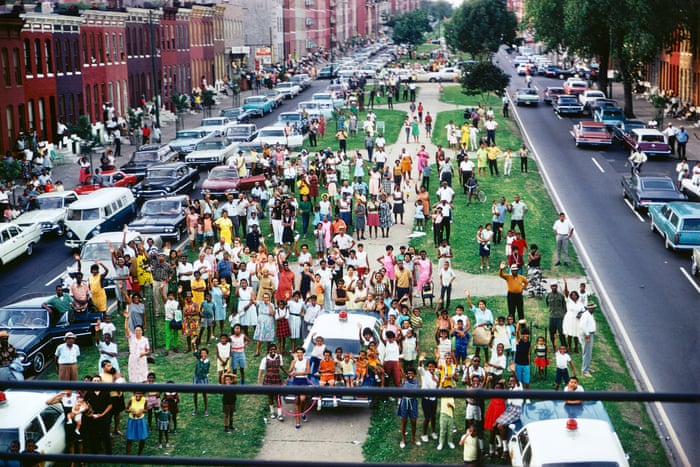
http://www.bbc.co.uk/programmes/articles/60tL2JWGhNncP5mqD8VR5Yr/bobby-kennedys-assassination-9-june-1968

Untitled, from the series RFK Funeral Train, 1968 by Paul Fusco. Photograph: Courtesy Danziger Gallery, New York
Tuesday, 5 June 2018
Subscribe to:
Posts (Atom)