THE Friday Boys are a disparate group of men spread across Tyneside who meet once a week - 'always on a Friday' - to talk about the arts, raise a glass to recently departed heroes and villains and, at the evening's end, down a whisky or two. The FBs have only one golden rule - talk of the working week is strictly off-limit.
Dennis Edwards obituary Lead singer of the Temptations whose gritty vocals brought urgency and drama to hits such as Papa Was a Rollin’ Stone and Cloud Nine
Adam Sweeting
The Guardian Sunday 4 Feb 2018
Though not an original member of the Temptations, Dennis Edwards, who has died aged 74 of complications from meningitis, was a member of the group from 1968 until 1977, a period during which they scored some of their most memorable hits. His gritty, urgent lead vocal was in dramatic contrast to the sweeter tones of the singer he replaced, David Ruffin, and was perfect for tough and funky songs such as Cloud Nine (1968), the apocalyptic Ball of Confusion (1970) and the 1972 US chart-topper Papa Was a Rollin’ Stone.
After trying to launch a solo career, Edwards made several reappearances with the Temptations during the 1980s, and during the 90s he formed the Temptations Review Featuring Dennis Edwards, with which he continued performing until last year.
Edwards had been a member of the Motown group the Contours before the opportunity to join the Temptations arose. The Contours had often been the opening act for the Temptations, and when Eddie Kendricks and Otis Williams decided they had had enough of Ruffin’s erratic time-keeping, cocaine use and galloping megalomania (he wanted the group to be renamed David Ruffin and the Temptations), they turned to Edwards. “I had been hearing rumours about David and drugs and alcohol,” Edwards said in 2013. “One morning at 4am he knocked on my door. I said ‘David, it’s 4 o’clock’. He said ‘I’m leaving the Temptations, and they’re gonna ask you to replace me’.”
So it was that Edwards was officially introduced as the new Temptations singer on stage in Pennsylvania in July 1968. The first single featuring his raunchy lead vocal was Cloud Nine (it reached 6 on the US singles chart and 15 in the UK), which – under the auspices of the producer Norman Whitfield and influenced by Sly Stone – marked a departure for the Temptations.
Its tense, edgy beat and wah-wah guitar introduced a style known as “psychedelic soul”, and its lyrics about poverty and street violence served notice that the group, in tune with the turbulent times, was breaking away from singing solely about love and romance. The song won the band, and Motown, their first Grammy award.
The following year the group topped the US chart with I Can’t Get Next to You, and in 1970 were back in the Top 10 with Psychedelic Shack (US No 7) and the politically outspoken Ball of Confusion (US No 3). Edwards featured again on their 1972 classic Papa Was a Rollin’ Stone, which won the band a second Grammy. In 1977, Edwards quit the Temptations after asking for a million-dollar contract and being refused. “I was young and mad,” he confessed later. Shortly afterwards, the Temptations left Motown to join Atlantic.
Edwards was born in Fairfield, Alabama; his father, Dennis Edwards Sr, was a preacher. When Dennis was 10, the family moved to Detroit, where he sang in the choir in his father’s church and became choir director. He joined the gospel singing group the Mighty Clouds of Joy as a teenager, and when he was 18 formed Dennis Edwards and the Fireballs, playing jazz and soul music.
In 1966, after he had completed a stint of military service, he auditioned for Motown Records and was placed on a retainer. Soon afterwards he was drafted into the Contours, whose lead singer had fallen ill. He left the group in 1967 and soon afterwards joined the Temptations.
He was back with them in 1980 when they returned to Motown, and in 1982 participated in a reunion tour which featured a comeback by Ruffin. The album Reunion reached 37 in the US, and a single, Standing on the Top (Part 1) made the Top 10 of the US R&B chart. Edwards was out of the Temptations again in 1983, and the following year reached No 2 on the R&B singles chart with Don’t Look Any Further, a duet with Siedah Garrett. An album of the same name also reached No 2 on the R&B chart. The single was subsequently sampled by several hip-hop artists including Eric B & Rakim, 2Pac and Junior MAFIA.
In the late 80s, he toured with Ruffin and Kendricks in a Tribute to the Temptations package tour. Then he hit the road as Dennis Edwards and the Temptations, which triggered a lawsuit from two of the original Temptations, Williams and Melvin Franklin. He was legally prevented from billing himself as a member of the Temptations, and thus the Temptations Review Featuring Dennis Edwards came into being. “Otis must have spent a million dollars trying to shut me down and I spent $800,000 trying to stay working,” Edwards said.
In 1989 he was inducted into the Rock and Roll Hall of Fame with the Temptations and in 2013 received a lifetime achievement Grammy, also as a member of the Temptations.
His marriage to Ruth Pointer, of the Pointer Sisters, ended in divorce. He is survived by his wife Brenda, and by five daughters, Issa, Erika, Maya, Denise and Alison, and a son, Bernard.
• Dennis Edwards, singer and musician, born 3 February 1943; died 1 February 2018
Mark E Smith obituary: the Fall's driving force was poet, satirist and misanthrope
Frontman of the Manchester post-punk band was notorious for his deadpan black humour and confrontational attitude
Adam Sweeting
The Guardian Thursday 25 Jan 2018
Of all the fascinating musical offshoots that sprang from mid-70s punk rock, the Fall proved the strangest and most durable. The group was a vehicle for the singer and lyricist Mark E Smith, who has died aged 60 after an extended period of ill health, including respiratory problems.
He formed the Fall after seeing the Sex Pistols perform their famous concert at the Lesser Free Trade Hall, Manchester, in June 1976. This became dubbed “the gig that changed the world”, because, as well as Smith, it was witnessed by future members of Joy Division, the Smiths and Buzzcocks, who all left with a burning urge to create their own band.
Smith assembled the Fall in his home town of Prestwich later that year. Aside from the inspirational spark of the Sex Pistols, the band cited the German group Can and the Velvet Underground as chief influences, both of whom fully exploited the hypnotic power of repetition as a stylistic device. One of the Fall’s early songs was even called Repetition – “the three Rs are repetition, repetition, repetition,” lectured Smith. A fondness for rockabilly was also discernible in their early work, earning them the label Country & Northern from fans.
However, while Smith would remain the band’s constant central factor for more than 40 years, his musicians fell by the wayside, often not voluntarily. During the group’s career, Smith performed with a total of 66 band members. One of them was Marc Riley, now a DJ on BBC Radio 6, who was sacked by Smith on his wedding day in the early 80s.
Though Smith was notoriously difficult to work with, his acidic tone, deadpan black humour and unswervingly confrontational attitude (fuelled by his copious intake of alcohol) lay at the heart of his perverse appeal. In 1998, his violent mood-swings briefly landed him in jail in New York after he was charged with assaulting the keyboard player Julia Nagle. He was sent back to the UK for rehab.
Smith never viewed commercial success as his prime objective, but the Fall’s tally of 31 studio albums and 32 live albums represented a kind of triumph in itself. They topped the UK independent album chart with Grotesque (After the Gramme) in 1980 and again with Perverted By Language (1983), Reformation Post TLC (2007) and Your Future Our Clutter (2010), and occasionally flirted with wider chart success. The Frenz Experiment (1988) reached 19 on the mainstream album chart, Shift-Work (1991) went to 17, and in 1993 The Infotainment Scan climbed to No 9. / Though Smith’s tuneless, declamatory delivery and the group’s clattering, grinding rhythms generally made them the antidote to singles bands, the Fall nonetheless scored high on the indie chart with such singles as Totally Wired, How I Wrote “Elastic Man” and Kicker Conspiracy, and even had a genuine Top 30 hit in 1987 with a cover of R Dean Taylor’s 60s classic,There’s a Ghost in My House.
Smith’s work defied categorisation, combining as it did elements of satire, social commentary, grumbling misanthropy and an abiding enthusiasm for cunning wordplay. The range of his references seemed to know no bounds, and took in literature, philosophy, the occult and football. How I Wrote “Elastic Man” (1980) put listeners inside the mind of a struggling writer burdened by the albatross of his past success. In It’s a Curse (1993), Smith took an oblique but caustic swipe at music critics. Gross Chapel – British Grenadiers (1986) was an extraordinarily menacing piece partly constructed from the old British Grenadiers marching song. In Rowche Rumble (1979), he delivered a furious rant about tranquillisers made by the Swiss drug company Roche. Theme From Sparta FC (2003) was a punchy battle hymn for the obscure Greek football team of the title – Smith’s third wife, Elena Poulou, is Greek – complete with fake-bouzouki sounds. The slow, bluesy Hip Priest (1982) might have been autobiographical, while also sounding like a parody of Jim Morrison and the Doors.
Born in Broughton, Salford, to Irene (nee Brownhill) and Jack Smith, Mark moved to Prestwich with his family while he was young. His father was a plumber who had served in the Black Watch infantry regiment at the end of the second world war, and had an ancestor who fought at the battle of Rorke’s Drift during the Anglo-Zulu war.
He passed his 11-plus and went to Stand grammar school, but quit at 16 and took a job as a shipping clerk on Salford docks. At night, he took an A-level class in literature and numbered Kurt Vonnegut, Aldous Huxley, George Orwell and HP Lovecraft among his favourite authors (the Fall was named after the Albert Camus novel La Chute). He took an interest in politics and, after a spell as a Labour supporter, veered further left and joined the Socialist Workers party. This never stopped him from expressing illiberal or conservative views.
The Fall’s first live show, with the original fellow band members Una Baines (Smith’s then partner), Tony Friel and Martin Bramah, and Steve Ormrod as the very short-lived first drummer, was in the basement of the North West Arts office on King Street, Manchester, on 23 May 1977, and their first recordings appeared on a Virgin Records compilation called Short Circuit: Live at the Electric Circus. Their first single, It’s the New Thing, was released by Step Forward Records in November 1978, and their debut album Live at the Witch Trials followed in April 1979.
Their career would be for ever associated with the DJ John Peel, a staunch supporter for whom the Fall recorded 24 radio sessions between 1978 and 2004, though Peel and Smith never became close. “Me and John had an agreement,” Smith said. “We never were friends or anything like that.”
In 1983, Smith married the American guitarist Brix Smith (born Laura Salenger, now Brix Smith Start), whose tenure with the Fall helped move them in a more polished and commercial direction. Before she left both her husband and the band in 1989, they had enjoyed both critical and commercial success with albums such as The Wonderful and Frightening World of the Fall, This Nation’s Saving Grace, Bend Sinister, and especially, The Frenz Experiment, all on the Beggars Banquet label.
In 1986 Smith also found the time to write a play, Hey, Luciani, on Pope John Paul I, which ran for two weeks at the Riverside Studios in Hammersmith, starring Smith and the performance artist Leigh Bowery. He then went on to write the music for the Michael Clark ballet I Am Curious, Orange, recorded as the Fall album I Am Kurious Oranj (1988).
During the 90s, as the Fall enjoyed more success with albums including Shift-Work, Code: Selfish and Middle Class Revolt, Smith undertook a variety of guest roles. He featured on the D.O.S.E. single Plug Myself In (1996) and collaborated on projects with Elastica, the Clint Boon Experience, Edwyn Collins and Long Fin Killie. He made his first appearance on Top of the Pops when he performed with Inspiral Carpets on their 1994 hit I Want You.
His first solo album, The Post Nearly Man, was released in 1998, and his second, Pander! Panda! Panzer!, in 2002. He formed Von Sudenfed with the electronic duo Mouse on Mars, and they released the album Tromatic Reflexxions (2007). With Mark Blaney, he made the albums Smith and Blaney (2008) and The Train Part Three (2009), and he appeared on Gorillaz’ album Plastic Beach (2010).
In 2005, BBC4 aired the documentary The Fall: The Wonderful and Frightening World of Mark E Smith. Three years later, Smith published an autobiography,Renegade: The Lives and Tales of Mark E Smith, written in collaboration with Austin Collins.
Smith’s second marriage, to Saffron Prior, ended in 1995. He married Elena in 2001. She became the Fall’s keyboard player the following year, but left in 2016.The Fall had continued to make albums at a remarkable rate, The Unutterable (2000) being the first of 11 over the next 17 years, concluding with New Facts Emerge (2017).
• Mark Edward Smith, writer, singer and musician, born 5 March 1957; died 24 January 2018
At first she thought she could kill him in three days.
She nearly did. His heart proved unequal to her compliments.
The she thought it would take three weeks. But he survived.
She revised her tables and calculated three months.
After three years, he was still alive. So they got married.
Now they've married for thirty years. People speak warmly of them.
They are known as the best marriage in town.
It's just that their children keep dying.
If contemplating the politics of despair has left you a little ill in mind and heart, if you crave a measure of vicarious escape, I do not direct you to the series of fourteen novels Ross MacDonald has written about Los Angeles private detective Lew Archer. That would be a bit too much like presenting a presurgical patient with Gray's Anatomy by way of light reading.
Since the publication of Dashiell Hammett's Red Harvest on February 1, 1929, the best crime novels have not offered much in the way of escape or solid, mindless entertainment. Nowadays, even the casual student of the American pathologies, public and private, may find the fiction of mayhem crucially disturbing and very much worth the reading. The worst examples of the genre present the symptoms of our virulent malady in pure form, and a new Mickey Spillaine is not pleasant going, precisely because it has roughly the same significance as a fresh mass murder. The best books of the type offer symptomology, diagnosis, and like most good physicians (and all great works of art), a tentative prescription for treatment. Among living crime novelists, Ross MacDonald is simply the best of the best.
In 1946 MacDonald, newly discharged from the Navy and beginning a career as a novelist, was casting about for a form. That year, long before he created Lew Archer, he produced two books which, their considerable merits aside, are valuable as indicators of his early concern with themes and fictional modes which dominate his later writing. Blue City is an ultra-tough, gut-wrenching narrative of personal vengeance, distinguished by a flexible and convincing use of vernacular speech, a sound knowledge of the impact produced on a human body by objects of diverse shape and size, and a vision of American life in which obsessive violence is not a chance phenomenon but an invariable condition. The Three Roads, a thriller about an amnesiac's torturous investigation of a murder he may well have committed himself, establishes MacDonald's interest in detailed and accurate psychological observation, and his regard for the complex reverberations of a guilty past in an uncertain present.
A statement of the limitations of MacDonald's earliest books only makes it easier to take the measure of his later achievement. Novels like Find a Victim (1954), The Barbarous Coast (1956), The Galton Case (1959), The Zebra Striped Hearse (1962), The Chill (1964), and The Far Side of the Dollar (1965) are unabashedly ambitious, richly peopled, and often far longer than a typical mystery. They are also scrupulously and economically plotted, perfectly paced, simple in style, and developed with attention to details of character and locality, ranging from the involutions of a twisted family group to forest, sea, and asphalt geography of his native California. They are books which go far beyond justifying the presence of their thematic content, to giving that content the weight of artistic truth.
In any writing, quality and quality alone is the first critical consideration. In his essay The Simple Art of Murder Raymond Chandler writes: "The detective story, even in its most conventional form, is difficult to write well. Good specimens of the art are much rarer than good serious novels." MacDonald's best work demands our consideration, not because the author is an intelligent man sincerely interested in serious issues, but because he has found in crime fiction a form perfectly appropriate to those interests, and in himself a talent capable of developing that form to a new level of complexity and interest.
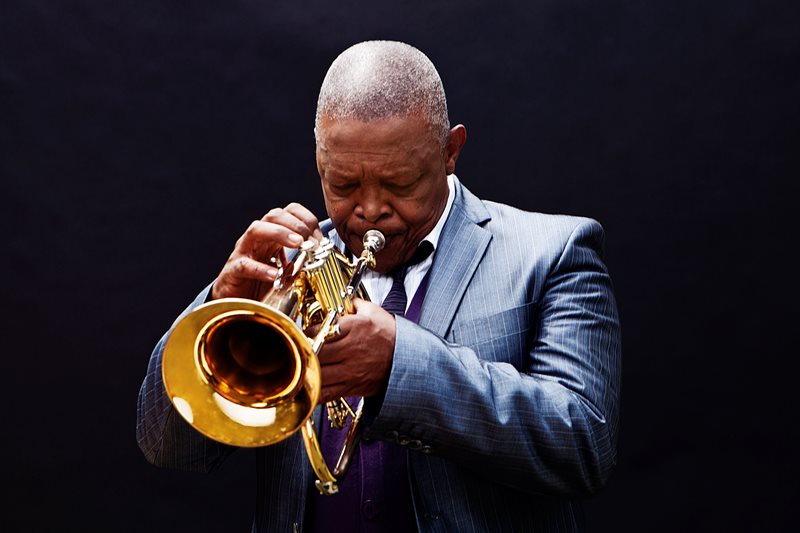
Hugh Masekela, South African trumpeter and a leading voice in the anti-apartheid movement, dies at 78
Harrison Smith
The Washington Post
23 January 2018
Hugh Masekela, a South African trumpeter and singer who formed a musical bridge between two continents, mixing American jazz with African folk in records that made him an early avatar of world music and a joyful standard-bearer of his country’s anti-apartheid movement, died Jan. 23 in Johannesburg. He was 78.
Mr. Masekela (moss-ay-KAY-lah) had been diagnosed with prostate cancer in 2008. His son, Sal Masekela, announced the death in a statement.
Bra Hugh, as he was affectionately known in South Africa, played the fluegelhorn and cornet, as well as the trumpet, and he drew from genres as disparate as disco and mbaqanga, a style of South African dance music. He explored the percussion-heavy sound of Afrobeat, collaborated with trumpeter Herb Alpert on a pair of jazz-funk records, performed with the London Symphony Orchestra, and scored a No. 1 hit with a pop instrumental — the sunny 1968 track “Grazing in the Grass.”
With encouragement from the globally renowned South African-born protest singer Miriam Makeba, his wife in the mid-1960s, he also lent his baritone voice to songs in Zulu, Xhosa and English. A political self-exile for three decades, he wrote the anti-apartheid protest anthem “Bring Him Back Home (Nelson Mandela)” (1987), inspired by a birthday letter Mr. Masekela received from the imprisoned activist and future South African president.
Mr. Masekela had been a virtuosic jazz musician in South Africa before landing in New York in 1960, aspiring to be a bebop star. Trumpeter Miles Davis suggested that he instead “make a name” for himself by fusing his knowledge of jazz and African song. Otherwise, Davis warned, “You’ll be just like a thousand other jazz players; you’ll just be a statistic.”
Mr. Masekela took the advice, defying record executives who said his sound was “too African.” He wryly mocked American listeners’ understanding of Africa, titling his third solo album “The Americanization of Ooga Booga” (1966). The record’s cover featured a barefoot Mr. Masekela standing in the jungle, holding a briefcase and clad in a Brooks Brothers suit.
Not all listeners appreciated Mr. Masekela’s new sound — the record “pissed off a lot of jazz purists,” he later told the Contra Costa Times — but Mr. Masekela remained a pop music fixture, in part through his work in rock-and-roll.
A friend of Jimi Hendrix’s, he played trumpet on singles for the Byrds and performed at the 1967 Monterey Pop Festival, where his howling rendition of “Bajabula Bonke (The Healing Song)” was captured in an acclaimed documentary by D.A. Pennebaker.
“The Healing Song,” a Swazi folk tune he learned from Makeba, initially served as a B-side for “Grazing.” The song featured a jangling cowbell, a soaring trumpet solo and a melody written by actor-composer Philemon Hou. It climbed the charts a second time after the soul group Friends of Distinction added lyrics and recorded a cover version.
Mr. Masekela demonstrated a knack for writing jazz-infused pop songs, scoring hits with “The Boy’s Doin’ It” (1975), a funky dance number, and the disco single “Don’t Go Lose It Baby”(1984).
But his music never strayed far from politics. In concerts, Mr. Masekela discussed the meaning of songs such as “Stimela (Coal Train),” about displaced workers in Johannesburg, and “Soweto Blues,” about a 1976 massacre of black schoolchildren, which he often performed with Makeba.
“I’m a parasite on the world’s conscience, to make them scratch sometimes,” he told Britain’s Guardian newspaper in 1990.
In the early 1980s, he moved to Botswana to start a mobile recording studio and school for African musicians. The school, near the border of South Africa, shuttered in 1985 after defense forces from the apartheid regime conducted a raid in the area, killing 15 people.
With South African playwright Mbongeni Ngema, he composed and arranged the music for “Sarafina!,” which opened in New York in 1987 — transforming “the oppression of black townships,” New York Times theater critic Frank Rich said in a review, “into liberating singing and dancing that nearly raises the theater’s roof.” The show received five Tony Award nominations, including for best musical and best original score, and was adapted into a 1992 movie starring Whoopi Goldberg and Makeba.
Mr. Masekela was by then in the midst of a late-career resurgence, buoyed by a collaboration with Paul Simon. Simon had recorded parts of the 1986 album “Graceland” in South Africa with local musicians, breaking a United Nations boycott and infuriating anti-apartheid groups who argued that he was implicitly condoning the white-only government.
Mr. Masekela, however, saw the album as an opportunity to broaden the appeal of South African music. He organized a group of South African musicians who performed in stadiums worldwide during Simon’s “Graceland” tour. With Makeba, guitarist Ray Phiri and the choral group Ladysmith Black Mambazo, he played hits such as “You Can Call Me Al” alongside protest anthems and the Pan-African liberation song “God Bless Africa.”
“South Africa has become a spectator sport,” Mr. Masekela told the Los Angeles Daily News in 1987, dismissing “Graceland” critics who argued that South African musicians shouldn’t show support for Simon by playing with him on tour.
“If these people are prevented from playing with us overseas,” he continued, “and they are prevented from playing over there in South Africa because of the color of their skin, then I don’t know what the people who want to help us are aiming at. It is as if they are saying, ‘We must deprive you in order to help you.’ ”
Ramopolo Hugh Masekela was born in the coal-mining town of Witbank on April 4, 1939. The son of a health-inspector father and social-worker mother, Hugh (as he became known) was raised mainly by his grandmother, who ran an illegal drinking house known as a shebeen.
Alcohol sales were prohibited for black South Africans, and “drunkenness to a great extent was a form of defiance,” Mr. Masekela told NPR in 2013. He acknowledged addictions to “drinkin’, cokin’, smokin’ — you name it, all the ’kins,” before seeking treatment in the 1990s. Drug use, he said, led him to squander $50 million over the course of his career.
He had shown promise on piano in childhood but became entranced with the trumpet after seeing “Young Man With a Horn” (1950), a Kirk Douglas film about a troubled jazz musician. At the time, he was attending St. Peter’s, an Anglican prep school in the suburbs of Johannesburg, where his musical precociousness was matched only by his reputation for unruliness.
“If I can get a trumpet,” he promised his chaplain, “I won’t bother anybody.”
His chaplain, the anti-apartheid activist Trevor Huddleston, granted his wish, and Huddleston soon found enough interest among other students to start a band.
Within a few years, Mr. Masekela became a founding member of the Jazz Epistles, a pathbreaking black jazz group in South Africa. The 1960 Sharpeville massacre, in which scores of anti-apartheid demonstrators were mowed down by police gunfire, squashed Mr. Masekela’s dream of touring with the group. With the support of entertainers including Harry Belafonte, Mr. Masekela moved to New York, studied at the Manhattan School of Music and released his first record, “Trumpet Africaine,” in 1963.
He married Makeba the following year. “It was difficult, because I was a little bit more popular; men always like to know they’re in control,” she later told the Guardian, recalling the lead-up to their divorce in 1966. “We just decided, like he likes to say, ‘Let’s call it a draw.’ ” The couple continued performing together until her death in 2008.
Mr. Masekela’s marriages to singer Chris Calloway, daughter of American bandleader Cab Calloway, and to Jabu Mbatha also ended in divorce. In 1999, he married Ghanaian-born Elinam Cofie.
Survivors include two children from other relationships, Pula Twala and Selema “Sal” Masekela, who works as a musician and journalist; and two sisters, Elaine Masekela and Barbara Masekela, who served as Mandela’s chief of staff after he was released from prison and was later South Africa’s ambassador to the United States.
Mr. Masekela received a Grammy nomination for best world music album with his 2012 record “Jabulani” and appeared at a White House jazz gala in 2016.
“Heritage restoration is my biggest obsession,” he told the San Francisco Classical Voice in 2011. “Our heritage has been condemned over the years by religion and colonization, and by Western media and culture, and unless African music is owned, produced, distributed, packaged and sold by Africans to Africans in Africa, you can’t say African music is growing. It’s very important to revive heritage and make it visible, so that when our grandchildren grow up, they won’t have to say, ‘We used to be Africans . . . long ago.’ ”
All piffle & twaddle – influence of Bottom Dog man.
For real “decadents” read Huysmans & other French authors.
Diarrhea of words – stew of classic allusions.
Fuck Artemis et alia!
Don’t put intellect in your prick!
Write honestly even if poorly.
Humor is weak – immature.
Try drugs and compare two kinds of writing.
Try using only Anglo-Saxon words.
Throw your dictionary away!
Don’t mix realism with poetics!
If you can’t make words fuck, don’t masturbate them!
When you speak of Cunt put hair on it!
Try to forget everything you learned in college.
Try talking like an ignoramus – or an Igaroti.
Read, for emetic, “Palm Wine Drinkard.”
You will learn to write only when you stop trying to write.
A line without effort is worth a chapter of push and pull.
First ask yourself if you have anything to say.
Don’t draw the pen unless you are ready for the kill.
If you don’t get rid of the Classics you’ll die of constipation.
Never show any one what you’ve written until a year or two later.
Use the axe to your 1st draft and not the fine comb.
The latter is for lice!!!
Ron Elderly:- Try A Little Tenderness Dock Of The Bay
Da Elderly: - I'm Just A Loser You've Got A Friend
The Elderly Brothers: - All I Have To Do Is Dream Walk Right Back He'll Have To Go I Saw Her Standing There
A packed house was quite a surprise for late January, but with the colleges starting up again there was an influx of folk who hadn't been around since before Christmas. That included the band Small Screen (pictured) who made a great sound and delighted the audience with 2 original songs and an excellent cover of John Prine's Angel From Montgomery. Blues aficionado Leo played his resonator guitar finger-style to great effect. The Elderlys returned after a couple of weeks absence to finish off the night - and for once we played without the lyrics book! The music continued unplugged for the next hour and most of the late night revellers joined in and sang along - great fun!!
I'll take the first, the last, the German and French over the rest. The German poster looks like it's advertising an early 20th century expressionist crime movie whereas the Italian one seems to be for an action movie!