THE Friday Boys are a disparate group of men spread across Tyneside who meet once a week - 'always on a Friday' - to talk about the arts, raise a glass to recently departed heroes and villains and, at the evening's end, down a whisky or two. The FBs have only one golden rule - talk of the working week is strictly off-limit.
Don Williams, country music's 'Gentle Giant', dies at 78 The country star best known for his song I Believe In You and his laid-back demeanor died on Friday following a short illness at his home in Alabama
Guardian music and agencies
The Guardian Saturday 9 September 2017
Don Williams, the country singer and Nashville songwriter best known for his 1981 hit ballad I Believe in You, has died at home in Alabama aged 78.
On Friday his publicist confirmed Williams, who was known as “the Gentle Giant” because of his easygoing temperament, died after a short illness.
Williams had 17 No 1 hits in the US and was inducted into the Country Music Hall of Fame in 2010, before he retired in 2016. Williams was known for his rich voice, gentle delivery and storytelling style. He toured sparingly, did few media interviews and spent much of his time on his farm west of Nashville.
His career started as a musician in Portland, a city he moved to from his native Texas, where he was born in 1939. He moved to Nashville in the late 60s and wrote songs for some of country’s biggest names, including “Cowboy” Jack Clement.
“It’s one of those blessings and curses kind of things,” Williams said in an interview with the Associated Press in 1994. “There’s very few things in my life that I’ve done that come anywhere close to making you feel exhilarated and humbled and fulfilled and challenged and all that, all at the same time.”
His hits included I Believe in You, Lord, I Hope This Day Is Good, You’re My Best Friend, Some Broken Hearts Never Mend, and Till the Rivers All Run Dry. Eric Clapton recorded his We’re More Than Friends and Pete Townshend redid his Til the Rivers All Run Dry.
“Don Williams offered calm, beauty, and a sense of wistful peace that is in short supply these days,” said Kyle Young, CEO of the Country Music Hall of Fame in a statement on Friday. “His music will forever be a balm in troublesome times.”
He missed his induction into the hall of fame in 2010 because of bronchitis. His last studio album came out in 2014 and he was the subject of a tribute album this year that included performances of his hits by Lady Antebellum, Garth Brooks and Chris Stapleton.
Mike Neville - the legendary North East news anchorman - has died aged 80
Star TV news presenter left his mark on the North East with a smile and sense of humour
Ian Robson
The Evening Chronicle
6 September 2017
Mike Neville - one of the giants of broadcasting in the North East - has died.
The much-loved presenter, who always had a kind word for everyone, was a huge presence on and off the screen.
His witty banter was as much part of his personality as a professional anchorman with a theatrical touch.
Mike, who was 80, had been retired from television for 11 years but his name was still remembered with affection after stints at both ITV and the BBC .
His death will leave a huge hole in the North East.
Mike’s twin loves were journalism and repertory theatre - and he excelled at both.
He had a variety of jobs before settling on the career path that was to lead him to be a star.
After growing up in Willington Quay, North Tyneside , he recalled how his house with an outside loo, or netty, and said he was the last boy in his school to get long trousers.
His first job was at the Chamber of Trade where he was an office boy followed by a stint as a dogsbody at the Daily Mail in Newcastle.
He spent his two year’s National Service in Cyprus before returning to the North East in a full-time role at the Newcastle Playhouse.
Then came the event that was to change his life and propel him into a lifetime in front of the cameras.
Tyne Tees Television was launched in 1959 and Mike was there almost from the beginning as a continuity announcer and then a newsreader.
His tenure at Tyne Tees - at least the first one - was short and his talent led him to the BBC within a couple of years.
And that’s when things really took off.
He was to front Look North for 32 years when his smile and quick repartee was to earn him the love of the North East.
And he loved us back, refusing to move to London when he had the chance despite some success during occasional duties on the channel’s Nationwide programme, preferring to stay where he was born and raised.
But, despite all the adulation, it was not always a VIP lifestyle for Mike and his wife Pam who had met at a Blyth theatre.
“Pam and I were living in a flat at Cullercoats and I was taking home £25 a week and smoking Senior Service,” he told us once.
“If the public thought I was living it up they were mistaken.”
Mike Neville meets US President Jimmy Carter
During that interview Mike said he has often been asked to go back to Tyne Tees, where the pay was better, but he resisted at the time.
“I like the folk at the BBC and I’m happy here, “ he said. “There’s no bitchiness.
“Tyne Tees have asked me to go back a couple of times but money isn’t everything.
“The Beeb create a sort of two-way feeling of loyalty.”
Mike was known for his humour and, when a BBC official described him as “the most efficient piece of equipment at the BBC” he was quick to make a joke of it.
“I’m the only piece of equipment that isn’t allowed to go on well-oiled,” he quipped.
It was his sense of fun and his lifelong love of theatre that helped him with his collaboration with George House in the classic double-act.
Everyone of a certain age will remember the Larn Yersel’ Geordie broadcasts where, often with a glint in the eye, the pair mocked standard English and had fun speaking how real people in the region spoke.
It started as a one-off sketch on Look North inspired by humorist Scott Dobson but grew to include regular items, record and CD releases, and books.
Mike and George bigged up the North East and our dialect, telling tall tales about the region’s contribution to the world.
Amazingly, Mike was once accused of putting on a posh accent on the BBC.
As the fan letters rolled in - and Mike always tried to reply to them on a battered old typewriter - there was one which accused him of saying “Newcarstle” instead of Newcastle.
He took it in good spirits but did not let it affect his approach to his job.
Mike also told us what he would want his epitaph to be.
“He was a good laugh, wasn’t he,” he told us.
But he also said his greatest ambition was not to have an epitaph at all.
He also said he wished he hadn’t packed in acting for a television career but there is only so much someone can do in a busy life.
You guess, though, that he would have been just as successful if his career had taken a different route.
In 1990 Mike was given a MBE for services to broadcasting.
At about the same time the musician Jez Lowe wrote and recorded the song “Mike Neville Said It (So It Must Be True).
But life at the BBC was about to come to an end as Mike finally went back to Tyne Tees in 1996.
He had his own show with his name in it - North East Tonight With Mike Neville - and anyone who saw the programme would realise he still had what it takes.
This time his stint would last for ten years during which the programme won awards - including the World Service Medal in New York for “Best News Magazine Programme” - and Mike himself was given a “Unique Achievement” award from the Royal Television Society recognition of 40 years as a daily television presenter.
He decided to retire in 2006, a year after an operation to remove a blood clot from his leg, and spent his last years at his home in Whickham.
The Guardian covered his retirement questioning if it was the end of an era for regional television.
As much a part of my television youth as Gerry Anderson!
It's probably difficult to appreciate just how many light years ahead Look North was compared with its creaking Tyne Tees counterpart at the time, but Neville and friends were more engaging and more professional (though sometimes in a rambunctious way).
When I went to university in or visited friends on the west coast and in Scotland, I couldn't believe how flat and stale their local BBC news/magazine programmes were compared to Look North - although I seem to remember Eric Idle succinctly nailing that kind of amateur night presentation on Rutland Weekend Television.
Bird's Eye View of the Tool and Die Co. by John Ashbery
For a long time I used to get up early.
20-30 vision, hemorrhoids intact, he checks into the
Enclosure of time familiarizing dreams
For better or worse. The edges rub off,
The slant gets lost. Whatever the villagers
Are celebrating with less conviction is
The less you. Index of own organ-music playing,
Machinations over the architecture (too
Light to make much of a dent) against meditated
Gang-wars, ice cream, loss, palm terrain.
Under and around the quick background
Surface is improvisation. The force of
Living hopelessly backward into a past of striped
Conversations. As long as none of them ends this side
Of the mirrored desert in terrorist chorales.
The finest car is as the simplest home off the coast
Of all small cliffs too short to be haze. You turn
To speak to someone beside the dock and the lighthouse
Shines like garnets. It has become a stricture.
The Elderly Brothers: - You Really Got A Hold On Me Baby It's You
Mailman Bring Me No More Blues You're Going To Lose That Girl Every Little Thing Walk Right Back I Saw Her Standing There
The evening started quietly with players making up most of the audience, but things improved as the night wore on; we had an almost full bar for the final hour. A female duo wowed us with Nina Simone's Ain't Got No, I Got Life and KT Tunstall's Black Horse and The Cherry Tree. Nonagenarian Don sang Anthony Newley's What Kind Of Fool Am I? Yours truly introduced Neil Young's 1976 Give Me Strength which will finally be released this week. The Elderly's ended off the open mic with a bit of a Beatles-fest, both originals and covers. The one Everly Brothers hit resulted from a request to respect the band name! The after-show acoustic set followed on as usual with several players joining in for a fine jam session.
There will be no set lists posting next week as I shall be staying in the Toon, making last-minute preparations for the Men of the Tyne shows at The Customs House, South Shields on the Thursday (14 Sept). Tickets are still available athttps://www.customshouse.co.uk/theatre/men-of-the-tyne-/ - there is a matinee performance at 2:30pm and the evening show is at 7:30pm.
One of the most influential American poets of his generation admired for his unorthodox use of language
Mark Ford
The Guardian
Monday 4 September 2017
John Ashbery, who has died aged 90, was widely considered the most innovative and influential American poet of his generation. The critic Harold Bloom, who played an important role in establishing Ashbery’s reputation in the mid-1970s, declared: “No one now writing poems in the English language is likelier than Ashbery to survive the severe judgments of time.” Yet Ashbery’s work also frequently aroused controversy; his early volume The Tennis Court Oath (1962) was dismissed by one critic as “garbage”; and even after his 1975 collection Self-Portrait in a Convex Mirror won the Pulitzer prize for poetry, the National Book Critics Circle award and the National Book award, catapulting him to stardom, he was not without doubters and detractors.
Ashbery’s highly distinctive style has been widely imitated, and his elusive but compelling poems explored in numerous critical books, academic articles and PhD theses (of which I wrote one myself). From his very earliest experiments, such as Some Trees and The Painter, both written when he was only 21, to his prolific later years, Ashbery’s work presents a restless, supremely sophisticated imagination meditating self-reflexively on experience, creating in the process a “flow chart”, to borrow the title of his longest work, of the vagaries of memory and the fluctuations of consciousness.
One of his most radical innovations was the fluidity with which he allowed pronouns to operate, a rhetorical habit best illustrated by his friend Kenneth Koch’s parody of a typical Ashbery line: “It wants to go to bed with us.” When asked to comment on this aspect of his work, Ashbery compared his pronouns to “variables in an equation”: “‘You’ can be myself or it can be another person, someone whom I’m addressing, and so can ‘he’ and ‘she’ and for that matter ‘we’.”
The indeterminacy that resulted allowed Ashbery’s poetry to capture the interactions of the many dictions that surround us with a new fullness and complexity; a poem such as Daffy Duck in Hollywood mixes up references to Disney cartoons, Paradise Lost, newspaper comic strips, the symbolist drama of Maeterlinck, new brutalism and Handel’s Amadigi di Gaula, in a dizzying, exhilarating melange.
Ashbery was born in Rochester, New York, son of Chester, a farmer, and his wife, Helen, a biology teacher. A younger brother, Richard, died in childhood of leukaemia. He described his father as prone to outbursts of violent temper, which made life on the fruit farm in upstate New York where he grew up feel like “living on the edge of a live volcano”. The happiest periods of his childhood were those he spent with his maternal grandparents in Rochester, and at their summer cottage in the lakeside town of Pultneyville.
He attended schools in Rochester and Sodus, but at the age of 16 was sent as a boarder to Deerfield academy, a private school in Massachusetts. There he began writing poetry in earnest, inspired principally by WH Auden and Octavio Paz. As an undergraduate at Harvard University, he majored in English, and was on the editorial board of its literary magazine the Advocate. During his time at Harvard he was introduced to Auden, who would select Ashbery’s first collection, Some Trees, for publication in the prestigious Yale Younger Poets series in 1956. He also met the poets Koch and Frank O’Hara; both would become lifelong friends and would be grouped with Ashbery, along with James Schuyler, as original members of what came to be known as the New York School.
Ashbery moved to New York in 1949, studying for an MA at Columbia University (awarded in 1951), and then working in publishing for four years. In 1955 he was awarded a Fulbright fellowship to France; this took him initially to Montpellier, but he soon found himself spending much of his time in Paris, particularly after he met the Paris Match staff writer, and novelist and poet, Pierre Martory, with whom he began living, and to whom The Tennis Court Oath was dedicated.
It was while he was resident in Paris that Ashbery’s poetry took its most radical turn: he began experimenting with cut-up techniques to create disjunctive linguistic collages that defy paraphrase or explication: “The arctic honey blabbed over the report causing darkness,” enigmatically opens Leaving the Atocha Station. Ashbery later questioned the effectiveness of some of these poems, but they would in time prove extremely influential on various poets associated with the movement known as Language Writing.
Ashbery earned his living in Paris by writing art reviews, mainly for the international edition of the New York Herald Tribune. In 1964 his father died, and he returned to the US to look after his mother. He took up the post of executive editor of ArtNews, and settled in New York. His third collection, Rivers and Mountains (1966), was nominated for the National Book award. Over half of this volume’s pages are occupied by The Skaters, the first of his many attempts at an extended Song of Myself-style poem; with its trailing, Whitmanesque lines, its goofy humour and its surrealist turns of phrase (“The day was gloves”), its expansive, self-conscious passages of meditation on its own coming-into-being, The Skaters established the essential template for the Ashberian long poem. It is, to my mind, one of his finest and most moving achievements.
Ashbery’s next five volumes propelled him from well-kept secret to, if not exactly household name, occupant of a pretty elevated pedestal in the pantheon of American poets. The age of Lowell gave way to the age of Ashbery. A reviewer of his fourth collection, The Double Dream of Spring (1970, the title is borrowed from a painting by Giorgio de Chirico), made even greater claims for him, suggesting that “the chances are very good that John Ashbery will come to dominate the last third of the century as Yeats dominated the first”.
Though in 1970 this must have struck many as far-fetched, by the end of the decade that saw the publication of Self-Portrait in a Convex Mirror and Houseboat Days (1977), the “tribe of John”, as his followers were dubbed, seemed everywhere. “Since the death of Robert Lowell,” observed Helen McNeil in a Times Literary Supplement review of As We Know (1979), “the title of most important American poet has been on offer to John Ashbery.”
In 1982, Ashbery suffered an almost fatal spinal infection that necessitated an 11-hour operation. His partner, and later husband, David Kermani, was informed that if Ashbery survived it, he would probably be quadriplegic. In fact, he made an almost complete recovery, and was soon busy again at his typewriter. In all, he published 28 collections of verse, and was the first living poet to have his work collected in the Library of America’s editions of classic American writers.
He was the recipient of numerous honours, awards and prizes, including two Guggenheim fellowships, a MacArthur fellowship, the chancellorship of the Academy of American Poets, the Robert Frost medal, the Feltrinelli prize, the International Griffin poetry prize, and a National Humanities medal, awarded by President Barack Obama in 2012. His work has been translated into dozens of languages. As well as poetry, he published a volume of art criticism (Reported Sightings, 1989), two volumes of literary criticism (Other Traditions, 2000, and Selected Prose, 2004), and numerous translations of French writers, collected in two volumes published in 2014.
From 1979 onwards, Ashbery divided his time between an apartment in Manhattan and an imposing 19th-century mansion in Hudson, New York state, that he purchased partly because it reminded him of the happy times he spent as a child in his grandparents’ house in Rochester. This housed paintings by such as Fairfield Porter and Joe Brainard, and collections of all sorts of Americana snapped up by the magpie-like poet. Gracious, witty, surprising, his conversation ranged from avant-garde composers to advertising jingles. He had an extraordinary memory for dates and events – and quotations, particularly from Ronald Firbank.
In 2014 I gave a reading with him in New York, at the 92nd St Y, and was touched almost to tears by the lines of people queuing to pay their respects to him afterwards. “John, your work has meant so much to me,” was the gist of what they had to say, though one or two went still further: “John, your poetry has changed my life.”
He is survived by David.
• John Lawrence Ashbery, poet, born 28 July 1927; died 3 September 2017
Walter Becker, Co-Founder of Steely Dan, Dies at 67
Jon Pareles
The New York Times
3 September 2017
Walter Becker, left, and Donald Fagen of Steely Dan in 2008 at a cancer benefit concert in New York.CreditEvan Agostini/Associated Press
Walter Becker, the guitarist and songwriter who made suavely subversive pop hits out of slippery jazz harmonies and verbal enigmas in Steely Dan, his partnership with Donald Fagen, died on Sunday. He was 67.
His death was announced on his official website, which gave no other details. He lived in Maui, Hawaii.
Mr. Becker was unable to perform with Steely Dan this summer at Classic West and Classic East in Los Angeles and New York City, two stadium-size festivals of 1970s bands. Last month, Mr. Fagen told Billboard, “Walter’s recovering from a procedure and hopefully he’ll be fine very soon.”
As Steely Dan, Mr. Becker and Mr. Fagen changed the vocabulary of pop in the 1970s with songs like “Do It Again,” “Reelin’ in the Years,” “Rikki Don’t Lose That Number” and “Peg.” Mr. Becker and Mr. Fagen were close collaborators on every element of a song: words, music, arrangement. “We think very much the same musically. I can start songs and Walter can finish them,” Mr. Fagen said in a 1977 interview.
Steely Dan’s musical surfaces were sleek and understated, smooth enough to almost be mistaken for easy-listening pop, and polished through countless takes that earned Mr. Becker and Mr. Fagen a daunting reputation as studio perfectionists.
Their songs were catchy and insinuating enough to infiltrate pop radio in the 1970s. “That’s sort of what we wanted to do, conquer from the margins,” Mr. Becker told Time Out New York in 2011. “Find our place in the middle based on the fact that we were creatures of the margin and of alienation.”
Steely Dan’s lyrics were far from straightforward, depicting cryptic situations and sketching characters like addicts, suicidal fugitives and dirty old men. “You can infer certain things about the lives of people who would write these songs. This we cannot and do not deny,” Mr. Becker deadpanned in an online interview with the BBC in 2000.
Meanwhile, the music used richly ambiguous harmonies rooted in Debussy, Duke Ellington, Charlie Parker and Sonny Rollins, giving the songs a sophisticated core that would be widely influential across jazz and pop.
Although Steely Dan arrived as a full band on its 1972 debut album, “Can’t Buy a Thrill,” it soon recast itself as the Becker-Fagen songwriting team, backed by select session musicians. In its 1970s hitmaking heyday, Steely Dan rarely toured, preferring to work in the studio.
Steely Dan — named after a dildo in the William Burroughs novel “Naked Lunch” — dissolved after its 1980 album, “Gaucho,” though Mr. Becker and Mr. Fagen stayed in contact.
In 1993, Mr. Becker and Mr. Fagen re-emerged as Steely Dan, leading a band that would tour frequently well into 2017. Steely Dan’s songwriting and recording process remained painstaking; it released only two more studio albums, “Two Against Nature” in 2000 (which won the Grammy as Album of the Year) and “Everything Must Go” in 2003. But unlike its 1970s incarnation, Steely Dan thrived onstage.
In a statement released Sunday, Mr. Fagen wrote that Mr. Becker “was cynical about human nature, including his own, and hysterically funny. Like a lot of kids from fractured families, he had the knack of creative mimicry, reading people’s hidden psychology and transforming what he saw into bubbly, incisive art.”
Walter Becker was born in Forest Hills, Queens, on Feb. 20, 1950, and studied saxophone and guitar in his teens. Information on survivors was not immediately available.
He met Mr. Fagen in 1967 when they were students at Bard College, a place they would sardonically recall in Steely Dan’s “My Old School.”
“We started writing nutty little tunes on an upright piano in a small sitting room in the lobby of Ward Manor, a moldering old mansion on the Hudson River that the college used as a dorm,” Mr. Fagen wrote. With Mr. Fagen on keyboards and Mr. Becker on guitar or bass, they formed bands there and began to write songs together.
Once Mr. Fagen graduated in 1969, Mr. Becker dropped out and both moved to New York City, where they were noticed by Kenny Vance of the Top 40 band Jay and the Americans. They played in the touring band for Jay and the Americans and wrote the soundtrack for a 1971 Richard Pryor movie, “You Gotta Walk It Like You Talk It.” The producer Gary Katz got them jobs as staff songwriters for ABC Records, and Mr. Becker and Mr. Fagen moved to Los Angeles in 1971. Barbra Streisand recorded one of their songs, “I Mean to Shine.”
They assembled Steely Dan in Los Angeles with Mr. Fagen on keyboards and lead vocals, Mr. Becker on bass, Denny Dias and Jeff Baxter on guitars, Jim Hodder on drums and a second vocalist, David Palmer. “Do It Again” from Steely Dan’s 1972 debut album, “Can’t Buy a Thrill,” reached the Top 10.
Listen to Walter Becker
The group quickly recorded two more albums, “Countdown to Ecstasy” in 1973 and “Pretzel Logic” in 1974, which included its biggest Top 10 hit, “Rikki, Don’t Lose That Number.” In mid-1974, Mr. Becker and Mr. Fagen decided that they no longer wanted to tour. “It seemed like the more complex the music we were playing, the less able we were to guarantee its consistency,” Mr. Becker recalled in a 1996 interview with The Toronto Star.
Steely Dan reached its pinnacle as a studio duo. Its lyrics took on ambitious themes: a stock-market crash in “Black Friday,” Puerto Rican immigration in “The Royal Scam,” the jazz life in “Deacon Blues.” And its music grew both more subtle and more magisterial, with intricate horn arrangements and pristine sound.
On its 1977 album, “Aja,” Steely Dan brought in celebrated jazz musicians including Wayne Shorter, who plays on the title track, along with studio musicians like the guitarist Larry Carlton, the drummer Steve Gadd and the keyboardist Victor Feldman. “Aja” became Steely Dan’s first certified million-seller in the United States and its best-selling album.
But the recording of its successor, “Gaucho,” was plagued by problems. Mr. Becker had become a heroin user. The master tape of an entire nearly finished song, “The Second Arrangement,” was accidentally erased. Early in 1980, Mr. Becker’s girlfriend died of a drug overdose in his apartment. Weeks later, Mr. Becker was hit by a taxi, fracturing his leg. “We were quantum criminals,” Mr. Becker told The Independent in 1994. “The car and I were attempting to occupy the same place at the same time.”
In 1981, Steely Dan quietly disbanded. According to Mr. Fagen’s statement, Mr. Becker’s “habits got the better of him by the end of the ’70s, and we lost touch for a while.” Mr. Becker moved to Maui, where he detoxed and became an avocado farmer.
In the second half of the 1980s he returned to music. He was a producer, and was credited as a band member, on “Flaunt the Imperfection” by the Scottish band China Crisis in 1985, and he went on to produce Rickie Lee Jones’s 1989 album, “Flying Cowboys.”
In 1991, Mr. Becker began sitting in with Mr. Fagen’s New York Rock and Soul Revue. The duo also produced solo albums for each other: Mr. Fagen’s 1993 album, “Kamakiriad,” and Mr. Becker’s 1994 album, “11 Tracks of Whack” (which had 12 tracks). And in 1993, Steely Dan decisively re-emerged as a touring band.
Songwriting and recording remained a painstaking process for Steely Dan; it didn’t release another studio album, “Two Against Nature,” until 2000, 20 years after “Gaucho.” But “Two Against Nature” sold a million copies in the United States and won the Grammy Award as Album of the Year; Steely Dan was also inducted into the Rock & Roll Hall of Fame. Its final album, “Everything Must Go,” was released in 2003; for the first time on a Steely Dan studio album, Mr. Becker sang lead vocals, on “Slang of Ages.” Mr. Becker released a second solo album, “Circus Money,” in 2008.
Steely Dan toured regularly until well into 2017, settling in for long residencies at places like the Beacon Theater in New York City and performing entire albums from its catalog.
The band that once shunned touring had grown to enjoy it. “We’ve been lucky,” Mr. Becker said in 2011. “We’ve stretched our audience’s indulgence and fondness for us to the point that it can still be fun for us.”
Walter Becker was my friend, my writing partner and my bandmate since we met as students at Bard College in 1967. We started writing nutty little tunes on an upright piano in a small sitting room in the lobby of Ward Manor, a mouldering old mansion on the Hudson River that the college used as a dorm.
We liked a lot of the same things: jazz (from the twenties through the mid-sixties), W.C. Fields, the Marx Brothers, science fiction, Nabokov, Kurt Vonnegut, Thomas Berger, and Robert Altman films come to mind. Also soul music and Chicago blues.
Walter had a very rough childhood - I’ll spare you the details. Luckily, he was smart as a whip, an excellent guitarist and a great songwriter. He was cynical about human nature, including his own, and hysterically funny. Like a lot of kids from fractured families, he had the knack of creative mimicry, reading people’s hidden psychology and transforming what he saw into bubbly, incisive art. He used to write letters (never meant to be sent) in my wife Libby’s singular voice that made the three of us collapse with laughter.
His habits got the best of him by the end of the seventies, and we lost touch for a while. In the eighties, when I was putting together the NY Rock and Soul Review with Libby, we hooked up again, revived the Steely Dan concept and developed another terrific band.
I intend to keep the music we created together alive as long as I can with the Steely Dan band.
DEAD OF WINTER
a song by mark oliver everett
(1998)
standing in the dark outside the house
breathing in the cold and sterile air
well i was thinking how it must feel
to see that little light
and watch it as it disappears
and fades into
and fades into the night
so i know you're going pretty soon
radiation sore throat got your tongue
magic markers tattoo you
and show it where to aim
and strangers break their promises
you won't feel any
you won't feel any pain
and the streets are jammed with cars
rockin' their horns
to race to the wire
of the unfinished line
thought that i'd forget all about the past
but it doesn't let me run too fast
and i just wanna stand outside
and know that this is right
and this is true
and i will not
fade into
fade into the night
standing here in the dark
He caught a wave, but it crashed; years later, 'Smile' artist recognized
Joel Selvin
Chronicle Senior Pop Music Critic
13 September 2005
When Frank Holmes was a young art student in Los Angeles, he landed the plum job to do the new Beach Boys album, "Smile," which was widely presumed to be the forthcoming masterpiece of the musical genius behind the group, Brian Wilson. Although he didn't know it at the time, Holmes would be drawing the cover of the most famous unreleased album in rock history.
Almost 40 years later, Wilson got back together last year with his "Smile" musical collaborator Van Dyke Parks and finished the landmark album. The Beach Boys mastermind performed "Smile" 10 days ago at UC Berkeley's Greek Theatre.
That same weekend a throng of Beach Boys fans turned up for the Sunday afternoon opening of the first public exhibition of Holmes' drawings for the cover and the booklet that was supposed to accompany the 1967 album at the North Beach cultural institution, Enrico's, where his drawings will remain for the next two months.
Holmes and his old pal Parks, who worked with him at the Hermosa Beach nightclub the Insomniac in 1959 and who got him the "Smile" job in the first place, stood by the piano at Enrico's and signed dozens of prints of the famous unreleased album cover.
"While I was doing my thesis, I got the job," Holmes said. "I thought that was a good way to leave art school. It was a boost. Then it went away. I just forgot about it."
Holmes, now 67, went to work at art museums and moved to San Francisco in 1971. He has pursued a long and active career in the arts -- fine arts lithography, painting, teaching. A framed copy of the abortive album's cover hung in his Precita Park living room. "But I didn't talk about it," he said.
"Smile" may not have been officially released, but the album's legend only grew over the years. There have been magazines devoted to the subject. Both nonfiction and fiction books have been written about the album. Bootlegs have flourished, and the Beach Boys' record company has released various tantalizing bits and pieces of the project over the years, long before Wilson himself decided to finally finish the record. Prints of Holmes' album cover circulated. So did reproductions of the booklet. Holmes first came across the cover again as a two-page centerfold in a deluxe book on the Beach Boys. About 10 years ago, a friend called to say he saw someone with a tattoo of Holmes' drawing.
"That stunned me," he said.
Having lost touch with Parks for more than 25 years, Holmes drafted a letter to his old associate and gave it to a mutual friend, singer-songwriter Steve Young, to deliver. "I got a phone call from Van Dyke," said Holmes. " 'Surf's up' he said."
Parks put him in touch with the producers of the Beach Boys boxed set, who introduced him to the Capitol Records art director, who suggested he finish the drawings. For the original booklet, Holmes produced illustrations for seven of the songs. Like Wilson, he went back to the project many years later after it refused to go away. He did the other 12 songs almost 30 years later. He sells prints around the world.
He first met Wilson at the Hollywood apartment Van Dyke and his brother Carson Parks shared. "They were in the thick of Hollywood," said Holmes. "I used to meet all sorts of rock people there -- Frank Zappa, Danny Hutton, Stephen Stills. People were always coming and going. It was a pretty exciting place to visit. One day, there was Brian Wilson."
Holmes joined Wilson on a walk a couple of blocks to Wilson's in-laws' house. They chatted and, when they returned to the Parks' apartment, he pitched Wilson on drawing the cover. When Holmes brought him a preliminary sketch, Wilson gave him the job. "Brian took it to Capitol Records and told them this is what he wanted," Holmes said.
"They printed 500,000 album covers and booklets. They sat in a warehouse. When the project collapsed, they were destroyed. They tell me something like six covers and six booklets still exist."
Holmes finished the cover and booklet art far in advance. He took a job at the Long Beach Museum of Art and went about his professional life.
"I waited and waited," he said. "I couldn't even get my copy from the art director."
He found out that the album had been shelved only after the rest of the Beach Boys stepped in and finished an inferior version of brother Brian's masterwork, called "Smiley Smile" and featuring entirely different cover art. When he heard the album was finally out, he went to the record store, only to discover a new album with a new cover.
"Another big disappointment," he said. "I was a little upset. Well, more than a little upset."
The whimsical drawing based on a dilapidated downtown Pasadena jewelry store was influenced by the Chicago school of artists called the Hairy Who, who brought some of the techniques of cartooning to fine art in the '60s. Holmes said although his art training steeped him in classicism, he was trying to find more childlike simplicity in his work at the time.
"I was trying to find another way to approach art," he said, "like the drawings I did as a child. I was trying to do my work in that fashion -- spontaneous, no retakes, no seconds. I was looking for a fresh, alive quality I wanted in my work."
Holmes, almost coincidentally, captured the innocence Wilson was reaching for in his music on the album. Although he attended one of the recording sessions that produced "Good Vibrations," Holmes never heard much of the work in progress. Wilson and Parks supplied him with some lyrics and told him they wanted something comic for the cover. Parks' lyrics for these songs are notoriously oblique.
"So here comes the allegorical artwork via Van Dyke's metaphorical lyrics," said Holmes.
The cover art for the 2004 version was done by another artist, Mark London, but Holmes doesn't mind. "It just seems best to leave it in the past," he said. "It seems to fit in the past. 'Smile' -- now and then -- that's how I look at it."
The exhibition in the restaurant is the first major showing of Holmes' "Smile" drawings. The 12 recent additional drawings have never really been seen before and the other drawings from the original "Smile" album cover and booklet have only been reproduced from copies. The original drawings disappeared from Capitol Records long ago.
"I made up a new original," said Holmes. "I am an artist."
When to the sessions of sweet silent thought
I summon up remembrance of things past,
I sigh the lack of many a thing I sought,
And with old woes new wail my dear time's waste:
Then can I drown an eye, unus'd to flow,
For precious friends hid in death's dateless night,
And weep afresh love's long since cancell'd woe,
And moan th' expense of many a vanish'd sight;
Then can I grieve at grievances foregone,
And heavily from woe to woe tell o'er
The sad account of fore-bemoaned moan,
Which I new pay as if not paid before.
But if the while I think on thee, dear friend,
All losses are restor'd, and sorrows end.
Ron Elderly: - Just My Imagination Need Your Love So Bad
Da Elderly: - Once An Angel You've Got A Friend
The Elderly Brothers: - When Will I Be Loved Yes I Will Let It Be Me
Back "by popular request" (haha!) The Elderly Brothers finished off a night packed with players, including a new female duo who played some funky tunes and nonagenarian Don who wowed the crowd with a rendition of Around The World. It was so busy that we ran out of time and had to save our to-be-final song I Saw Her Standing There for the after-show acoustic jam. The place was just about full all night with a very supportive audience. The acoustic jam ran right through until closing time with everyone joining in. After time was called a couple from Liverpool who had clearly enjoyed themselves stood up and thanked everyone for a great night - and so it was!
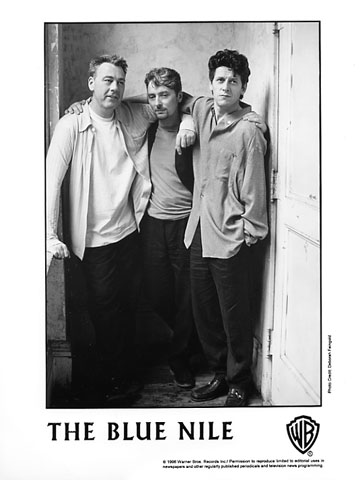
When Irish journalist Ken Sweeney visited Glasgow for the first time, it was a pilgrimage to a place that had existed in his imagination ever since he first heard the music of The Blue Nile. It was also the start of a labour of love as he set out to tell the story of the band in their own words. The result was a delicately crafted radio documentary that was broadcast on RTE in Ireland and found an audience around the world.
Peter Gabriel, Ryan Adams and The 1975 were among those who voiced praise for the programme. John Douglas, husband of Eddie Reader and member of The Trashcan Sinatras describes In Search of The Blue Nile as “beautiful, respectful, probing and informative”.
The attention has led to BBC Scotland scheduling an updated version of In Search of The Blue Nile for Easter Monday at 4pm. Glasgowist spoke to Ken after the first broadcast and caught up with him recently to find out more.
You were back in Glasgow in March, was there more work to do on the documentary before it was ready for a Scottish audience?
I was back over in Glasgow to re-voice some of the doc. It was the most amazing sunny weekend, Glasgow seemed a different city, everybody seemed to be out in the park.
I spent a whole day with [The Blue Nile keyboard player] PJ Moore and at one point we were back up at the spot at Kelvingrove where we created the picture taken by John G Moore – where I had interviewed him in the rain last November. It was so sunny, there were people sun bathing beside us on the steps.
When I was doing the doc originally I used to love getting a 6:30am plane over from Dublin and getting onto the streets of Glasgow before 8am in the morning.
I would go from one end of the city to the other and eventually I would eat in an Italian restaurant called Amalfi – at 148 West Nile Street. They do great ravioli.
That weekend you were here, the BBC 6 Music festival was on and Paul Buchanan from The Blue Nile was speaking at one of the events, what was that like?
Paul took me along to that. I met him at the hotel where his manager was staying and we took a cab over. He’s incredibly cool Paul, wearing this leather jacket, and looking so slim.
We were in the backstage area of The Tramway venue. All those BBC 6 presenters were knocking around.
Mark Radcliffe seemed to be a big fan and was talking to Paul for a while and asking about his solo album. So was Gideon Coe who chaired the talk.
I bumped into Edwyn Collins, who I knew from my days recording on Setanta Records and it turned out Paul was a great pal of Edwyn’s wife Grace, I think they might been in college together.
There was a lot of excitement about Paul’s new album because Paul said it was two thirds complete.
Are you pleased there will now be a Scottish broadcast of the documentary?
I’ve been getting calls this week from friends in Scotland who have been hearing trailers for this on the radio.
I’m delighted BBC Scotland are airing it in such a good slot, 4pm on a Bank Holiday.
You can have the doc shared on social media but there is a huge, older audience out there you can’t get too. I suspect there’s a lot of Blue Nile fans who don’t know anything about the documentary and will be hearing it for the first time.
Something I really want to do with my doc was put Stuart Adamson of Big Country back into the Blue Nile story, Stuart Adamson is revered in Ireland.
Edge of U2 based his guitar sound on what Stuart was doing in The Skids but even big Blue Nile fans, didn’t seem to know the part Stuart played in bringing The Blue Nile to the attention of Virgin Records, through his pal Ronnie Gurr, who was an A&R man with Virgin. It’s certainly makes for a very dramatic part of the story.
Was it easy to get the backing to put the documentary together? How sure were you that it would find an audience?
The previous radio doc I produced was about a cabbie who drove Michael Jackson around Ireland when he lived here. It was my first documentary, and, to my shock, won an Irish radio award. But I wasn’t really a fan of Michael Jackson. I waited a few years before doing another.
This time I wanted to do something on a musician or band I loved. There were a few people who advised me I was wasting my time making a documentary on The Blue Nile in 2017.
They said I was right about Michael Jackson but The Blue Nile? They just laughed and said this band didn’t have any hits when they were together. So why would anyone be interested now… One industry guy went further and said that he doubted there was any kind of audience for The Blue Nile in 2017.
How wrong they were… from the moment someone on the Blue Nile Facebook saw a radio listing in the RTE Guide, it just took off. I was a bit surprised when RTE suggested putting it online before broadcast. There were some difficulties accessing it from the RTE Player, then a Blue Nile fan off the facebook, Kieran McCarthy, suggested a Soundcloud. That went up and it clocked up thousands of plays.
First in Ireland then Nicola Meighan tweeted a link which sent it across Scotland and the UK. Then it started getting picked up in America.
People who liked the doc, would tweet it, and then tweet it again.
My Twitter handle would sometimes get used and I’d get up in the morning and see all these messages from people playing the documentary. I got up one morning and this guy was DMing me about The Blue Nile, we’d started to chat before I realised it was Ryan Adams, the American singer. I was following him already on twitter, he followed me and we were having this conversation.
The people tweeting it were so diverse, along with Peter Gabriel who posted it on his social media accounts, there was the artistic director of the Abbey Theatre in Dublin, fans in the Middle East, Japanese tweets I can’t read.
This programme has reached a much bigger audience than my Michael Jackson documentary. It’s just woken up a sleeping army of Blue Nile fans worldwide. There definitely is a market for this band in 2017.
With Paul having a new record ready to go, the doc might seem as if it was planned. It wasn’t …. I just had a mad idea to jump on a plane and start this last November.
The Blue Nile had a great connection to the late journalist George Byrne. They were really shocked to hear of his death two years ago and we all liked the idea that RTE would make this doc about The Blue Nile dedicated to George. So, from that discussion last month for the 6 Music Festival, there was a bit of confusion. Paul said he had an album that was almost finished, which I presumed to be his solo material, but it was picked up on Twitter as indications that there was a new Blue Nile album in the works. We’ve asked you this before, but we’ll ask again to clarify – will The Blue Nile work together again?
Paul Buchanan and PJ Moore haven’t spoken in several years. In a weird way they were speaking to each other through my documentary.
It’s really nice to hear Paul praising PJ in the programme saying “no one will ever play a Roland the way PJ did in the studio etc. PJ also seemed to have better idea of what was achievable; Paul quotes him saying that the second record couldn’t be done in the short time frame in which the record company wanted it delivered.
On the subject of a reunion. Paul quotes PJ in the documentary, saying that “they made each other too nervous in the studio.” He agrees.
Paul Buchanan’s last album got rave reviews, I think it was as good as any Blue Nile record, maybe better than the last two (Peace At Last and High).*
This new record from Paul is very different in that I believe it has a band sound. There was some confusion when BBC 6 Music said a Blue Nile record was planned after Paul spoke at that panel in Glasgow.
I have no information about whether it’s a going to be released as a Paul Buchanan album or under the Blue Nile title. There’s a whole discussion you could have about it, if PJ and Robert don’t want to perform as The Blue Nile anymore, and Paul wants to, could The Blue Nile name be used?
It doesn’t for a moment diminish PJ or Robert’s contribution in the past. I can remember seeing Prefab Sprout playing in Dublin without key members, and Jeff Lynne tours as ELO. I suppose we will find out in time. I don’t know either way.
What impact did The Blue Nile have in Ireland?
People in Scotland seemed surprised that Irish radio commissioned my documentary. I’m delighted really because The Blue Nile always had a special relationship with Ireland.
PJ Moore summed up The Blue Nile in Ireland to me recently. He said that unlike the London music business where The Blue Nile hadn’t worked… Ireland was different, PJ said “The cogs turned for The Blue Nile in Ireland”.
Radio guys, like Mark Cagney played their music on late night radio, mainstream DJ’s like Gerry Ryan, heard it and liked it and started playing it on daytime radio.
If you look on YouTube you can find clips of Paul bring interviewed on Breakfast TV in Ireland by Mark Cagney who as a late night DJ was one of the first people to play The Blue Nile.
PJ says The Blue Nile were embraced by everybody in Dublin who understood what the Blue Nile were trying to do. The band moved there for a while.
Paul talks about the band deciding to leave Dublin but the night before they left, they had a drive around Stephen’s Green, and changed their mind and stayed in Dublin for another six months.
One of the sweetest messages I got talking about The Blue Nile on Irish radio was from a guy who rang in to say he had been a young barman in a pub on Baggot Street. .
He remembered these three unassuming Scottish guys chatting to him one night at the bar, asking him about himself, his life and his family, and when he asked them about themselves, they told him they were in a band he would never have heard of…
But years later, he now knew all about The Blue Nile and their records and remembered that night in the bar.
Was there anything you left out of the documentary?
There were other people, I interviewed like RTE’s Cathal Murray, Dave Fanning, Dan Hegarty and the TV producer Dave Heffernan I interviewed but there just wasn’t the room to include, and I wasn’t going lose Paul or PJ talking about the recording of Hats to include them.
The Irish actor Liam Cunningham from Game Of Thrones, I interviewed and I couldn’t squeeze in either. He’s so evangelical about The Blue Nile but had never met them. I sent the audio of Liam’s interview to Paul, and Paul rang him up in Dublin to thank him. Which must have been an incredible call for Liam to get.
If I’d had more time, I’d love to have got Billy Sloan, the Scottish journalist and presenter into the doc.
But I ran out of time, on my last day, he was the opposite end of Glasgow. I wouldn’t have made my plane but he provided me with some valuable insight on the band, and was a huge supporter of The Blue Nile.
The documentary was recorded in Dublin and Glasgow, I’d like to say thanks to Frank Kearns at Salt Studios for his help putting it together. Can we expect more documentaries from you Ken? Are there other band stories you would like to tell?
I’ve had some Irish bands contact me since, asking me would I make a similar radio documentary about them. But my heart wouldn’t be in it… and the story of The Blue Nile can’t be matched.
They were in operating at this crazy time when record companies were selling double – as people bought their entire vinyl collection again on CD.
You can see why there was pressure on The Blue Nile to come up with a second album and a third album.
In Search of The Blue Nile will be broadcast on BBC Scotland at 4pm on 17th April.
Jerry Lewis, Mercurial Comedian and Filmmaker, Dies at 91
Dave Kehr
The New York Times
20 August 2017
Jerry Lewis, the comedian and filmmaker who was adored by many, disdained by others, but unquestionably a defining figure of American entertainment in the 20th century, died on Sunday morning at his home in Las Vegas. He was 91.
His death was confirmed by his publicist, Candi Cazau.
Mr. Lewis knew success in movies, on television, in nightclubs, on the Broadway stage and in the university lecture hall. His career had its ups and downs, but when it was at its zenith there were few stars any bigger. And he got there remarkably quickly.
Barely out of his teens, he shot to fame shortly after World War II with a nightclub act in which the rakish, imperturbable Dean Martin crooned and the skinny, hyperactive Mr. Lewis capered around the stage, a dangerously volatile id to Mr. Martin’s supremely relaxed ego.
After his break with Mr. Martin in 1956, Mr. Lewis went on to a successful solo career, eventually writing, producing and directing many of his own films.
As a spokesman for the Muscular Dystrophy Association, Mr. Lewis raised vast sums for charity; as a filmmaker of great personal force and technical skill, he made many contributions to the industry, including the invention in 1960 of a device — the video assist, which allowed directors to review their work immediately on the set — still in common use.
A mercurial personality who could flip from naked neediness to towering rage, Mr. Lewis seemed to contain multitudes, and he explored all of them. His ultimate object of contemplation was his own contradictory self, and he turned his obsession with fragmentation, discontinuity and the limits of language into a spectacle that enchanted children, disturbed adults and fascinated postmodernist critics.
Jerry Lewis was born on March 16, 1926, in Newark. Most sources, including his 1982 autobiography, “Jerry Lewis: In Person,” give his birth name as Joseph Levitch. But Shawn Levy, author of the exhaustive 1996 biography “King of Comedy: The Life and Art of Jerry Lewis,” unearthed a birth record that gave his first name as Jerome.
His parents, Danny and Rae Levitch, were entertainers — his father a song-and-dance man, his mother a pianist — who used the name Lewis when they appeared in small-time vaudeville and at Catskills resort hotels. The Levitches were frequently on the road and often left Joey, as he was called, in the care of Rae’s mother and her sisters. The experience of being passed from home to home left Mr. Lewis with an enduring sense of insecurity and, as he observed, a desperate need for attention and affection.
An often bored student at Union Avenue School in Irvington, N.J., he began organizing amateur shows with and for his classmates, while yearning to join his parents on tour. During the winter of 1938-39, his father landed an extended engagement at the Hotel Arthur in Lakewood, N.J., and Joey was allowed to go along. Working with the daughter of the hotel’s owners, he created a comedy act in which they lip-synced to popular recordings.
By his 16th birthday, Joey had dropped out of Irvington High and was aggressively looking for work, having adopted the professional name Jerry Lewis to avoid confusion with the nightclub comic Joe E. Lewis. He performed his “record act” solo between features at movie theaters in northern New Jersey, and soon moved on to burlesque and vaudeville.
In 1944 — a 4F classification kept him out of the war — he was performing at the Downtown Theater in Detroit when he met Patti Palmer, a 23-year-old singer. Three months later they were married, and on July 31, 1945, while Patti was living with Jerry’s parents in Newark and he was performing at a Baltimore nightclub, she gave birth to the first of the couple’s six sons, Gary, who in the 1960s had a series of hit records with his band Gary Lewis and the Playboys. The couple divorced in 1980.
Between his first date with Ms. Palmer and the birth of his first son, Mr. Lewis had met Dean Martin, a promising young crooner from Steubenville, Ohio. Appearing on the same bill at the Glass Hat nightclub in Manhattan, the skinny kid from New Jersey was dazzled by the sleepy-eyed singer, who seemed to be everything he was not: handsome, self-assured and deeply, unshakably cool.
When they found themselves on the same bill again at another Manhattan nightclub, the Havana-Madrid, in March 1946, they started fooling around in impromptu sessions after the evening’s last show. Their antics earned the notice of Billboard magazine, whose reviewer wrote, “Martin and Lewis do an afterpiece that has all the makings of a sock act,” using showbiz slang for a successful show.
Mr. Lewis must have remembered those words when he was booked that summer at the 500 Club in Atlantic City. When the singer on the program dropped out, he pushed the club’s owner to hire Mr. Martin to fill the spot. Mr. Lewis and Mr. Martin cobbled together a routine based on their after-hours high jinks at the Havana-Madrid, with Mr. Lewis as a bumbling busboy who kept breaking in on Mr. Martin — dropping trays, hurling food, cavorting like a monkey — without ever ruffling the singer’s sang-froid.
The act was a success. Before the week’s end, they were drawing crowds and winning mentions from Broadway columnists. That September, they returned to the Havana-Madrid in triumph.
Bookings at bigger and better clubs in New York and Chicago followed, and by the summer of 1948 they had reached the pinnacle, headlining at the Copacabana on the Upper East Side of Manhattan while playing one show a night at the 6,000-seat Roxy Theater in Times Square.
The phenomenal rise of Martin and Lewis was like nothing show business had seen before. Partly this was because of the rise of mass media after the war, when newspapers, radio and the emerging medium of television came together to create a new kind of instant celebrity. And partly it was because four years of war and its difficult aftermath were finally lifting, allowing America to indulge a long-suppressed taste for silliness. But primarily it was the unusual chemical reaction that occurred when Martin and Lewis were side by side.
Mr. Lewis’s shorthand definition for their relationship was “sex and slapstick.” But much more was going on: a dialectic between adult and infant, assurance and anxiety, bitter experience and wide-eyed innocence that generated a powerful image of postwar America, a gangly young country suddenly dominant on the world stage.
Among the audience members at the Copacabana was the producer Hal Wallis, who had a distribution deal through Paramount Pictures. Other studios were interested — more so after Martin and Lewis began appearing on live television — but it was Mr. Wallis who signed them to a five-year contract.
He started them off slowly, slipping them into a low-budget project already in the pipeline. Based on a popular radio show, “My Friend Irma” (1949) starred Marie Wilson as a ditsy blonde and Diana Lynn as her levelheaded roommate, with Martin and Lewis providing comic support. The film did well enough to generate a sequel, “My Friend Irma Goes West” (1950), but it was not until “At War With the Army” (1951), an independent production filmed outside Mr. Wallis’s control, that the team took center stage.
“At War With the Army” codified the relationship that ran through all 13 subsequent Martin and Lewis films, positing the pair as unlikely pals whose friendship might be tested by trouble with money or women (usually generated by Mr. Martin’s character), but who were there for each other in the end.
The films were phenomenally successful, and their budgets quickly grew. Some were remakes of Paramount properties — Bob Hope’s 1940 hit “The Ghost Breakers,” for example, became “Scared Stiff” (1953) — while other projects were more adventurous.
“That’s My Boy” (1951), “The Stooge” (1953) and “The Caddy” (1953) approached psychological drama with their forbidding father figures and suggestions of sibling rivalry; Mr. Lewis had a hand in the writing of each. “Artists and Models” (1955) and “Hollywood or Bust” (1956) were broadly satirical looks at American popular culture under the authorial hand of the director Frank Tashlin, who brought a bold graphic style and a flair for wild sight gags to his work. For Mr. Tashlin, Mr. Lewis became a live-action extension of the anarchic characters, like Bugs Bunny and Daffy Duck, he had worked with as a director of Warner Bros. cartoons.
Mr. Tashlin also functioned as a mentor to Mr. Lewis, who was fascinated with the technical side of filmmaking. Mr. Lewis made 16-millimeter sound home movies and by 1949 was enlisting celebrity friends for short comedies with titles like “How to Smuggle a Hernia Across the Border.” These were amateur efforts, but Mr. Lewis was soon confident enough to advise veteran directors like George Marshall (“Money From Home”) and Norman Taurog (“Living It Up”) on questions of staging. With Mr. Tashlin, he found a director both sympathetic to his style of comedy and technically adept.
But as his artistic aspirations grew and his control over the films in which he appeared increased, Mr. Lewis’s relationship with Mr. Martin became strained. As wildly popular as the team remained, Mr. Martin had come to resent Mr. Lewis’s dominant role in shaping their work and spoke of reviving his solo career as a singer. Mr. Lewis felt betrayed by the man he still worshiped as a role model, and by the time filming began on “Hollywood or Bust” they were barely speaking.
After a farewell performance at the Copacabana on July 25, 1956, 10 years to the day after they had first appeared together in Atlantic City, Mr. Martin and Mr. Lewis went their separate ways.
For Mr. Lewis, an unexpected success mitigated the trauma of the breakup. His recording of “Rock-a-Bye Your Baby With a Dixie Melody,” belted in a style that suggested Al Jolson, became a Top 10 hit, and the album on which it appeared, “Jerry Lewis Just Sings,” climbed to No. 3 on the Billboard chart, outselling anything his former partner had released.
Reassured that his public still loved him, Mr. Lewis returned to film-making with the low-budget, semidramatic “The Delicate Delinquent” and then shifted into overdrive for a series of personal appearances, beginning at the Sands in Las Vegas and culminating with a four-week engagement at the Palace in New York. He signed a contract with NBC for a series of specials and renewed his relationship with the Muscular Dystrophy Association — a charity that he and Mr. Martin had long supported — by hosting a 19-hour telethon.
Mr. Lewis made three uninspired films to complete his obligation to Hal Wallis. He saved his creative energies for the films he produced himself. The first three of those films — “Rock-a-Bye Baby” (1958), “The Geisha Boy” (1958) and “Cinderfella” (1960) — were directed by Mr. Tashlin. After that, finally ready to assume complete control, Mr. Lewis persuaded Paramount to take a chance on “The Bellboy” (1960), a virtually plotless hommage to silent-film comedy that he wrote, directed and starred in, playing a hapless employee of the Fontainebleau Hotel in Miami Beach.
It was the beginning of Mr. Lewis’s most creative period. During the next five years, he directed five more films of remarkable stylistic assurance, including “The Ladies Man” (1961), with its huge multistory set of a women’s boardinghouse, and, most notably, “The Nutty Professor” (1963), a variation on “Dr. Jekyll and Mr. Hyde,” in which Mr. Lewis appeared as a painfully shy chemistry professor and his dark alter ego, a swaggering nightclub singer.
With their themes of fragmented identity and their experimental approach to sound, color and narrative structure, Mr. Lewis’s films began to attract the serious consideration of iconoclastic young critics in France. At a time when American film was still largely dismissed by American critics as purely commercial and devoid of artistic interest, Mr. Lewis’s work was held up as a prime example of a personal filmmaker functioning happily within the studio system.
“The Nutty Professor,” a study in split personality that is as disturbing as it is hilarious, is probably the most honored and analyzed of Mr. Lewis’s films. (It was also his personal favorite.) For some critics, the opposition between the helpless, infantile Professor Julius Kelp and the coldly manipulative lounge singer Buddy Love represented a spiteful revision of the old Martin-and-Lewis dynamic. But Buddy seems more pertinently a projection of Mr. Lewis’s darkest fears about himself: a version of the distant, unloving father whom Mr. Lewis had never managed to please as a child, and whom he both despised and desperately wanted to be.
“The Nutty Professor” transcends mere pathology by placing that division within the cultural context of the Kennedy-Hefner-Sinatra era. Buddy Love was what the mid-century American male dreamed of becoming; Julius Kelp was what, deep inside, he suspected he actually was.
“The Nutty Professor” was a hit. But the studio era was coming to an end, Mr. Lewis’s audience was growing old, and by the time he and Paramount parted ways in 1965 his career was in crisis. He tried casting himself in more mature, sophisticated roles — for example, as a prosperous commercial artist in “Three on a Couch,” which he directed for Columbia in 1966. But the public was unconvinced.
He seemed more himself in the multi-role chase comedy “The Big Mouth” (1967) and the World War II farce “Which Way to the Front?” (1970). But his blend of physical comedy and pathos was quickly going out of style in a Hollywood defined by the countercultural irony of “The Graduate” and “MASH.” After “The Day the Clown Cried,” his audacious attempt to direct a comedy-drama set in a Nazi concentration camp, collapsed in litigation in 1972, Mr. Lewis was absent from films for eight years. In that dark period, he struggled with an addiction to the pain killer Percodan.
“Hardly Working,” an independent production that Mr. Lewis directed in Florida, was released in Europe in 1980 and in the United States in 1981. It referred to Mr. Lewis’s marginalized position by casting him as an unemployed circus clown who finds fulfillment in a mundane job with the post office. For Roger Ebert, writing in The Chicago Sun-Times, “Hardly Working” was “one of the worst movies ever to achieve commercial release in this country,” but the film found moderate success in the United States and Europe and has since earned passionate defenders.
A follow-up in 1983, “Smorgasbord” (also known as “Cracking Up”), proved a misfire, and Mr. Lewis never directed another feature film. He did, however, enjoy a revival as an actor, thanks largely to his powerful performance in a dramatic role in Martin Scorsese’s “The King of Comedy” (1982) as a talk-show host kidnapped by an aspiring comedian (Robert De Niro) desperate to become a celebrity. He appeared in the television series “Wiseguy” in 1988 and 1989 as a garment manufacturer threatened by the mob, and was memorable in character roles in Emir Kusturica’s “Arizona Dream” (1993) and Peter Chelsom’s “Funny Bones” (1995). Mr. Lewis played Mr. Applegate (a.k.a. the Devil) in a Broadway revival of the musical “Damn Yankees” in 1995 and later took the show on an international tour.
Although he retained a preternaturally youthful appearance for many years, Mr. Lewis had a series of serious illnesses in his later life, including prostate cancer, pulmonary fibrosis and two heart attacks. Drug treatments caused his weight to balloon alarmingly, though he recovered enough to continue performing well into the new millennium. He was appearing in one-man shows as recently as 2016.
Through it all, Mr. Lewis continued his charity work, serving as national chairman of the Muscular Dystrophy Association and, beginning in 1966, hosting the association’s annual Labor Day weekend telethon. Although some advocates for the rights of the disabled criticized the association’s “Jerry’s Kids” campaign as condescending, the telethon raised about $2 billion during the more than 40 years he was host.
For reasons that remain largely unexplained but were apparently related to a disagreement with the association’s president, Gerald C. Weinberg, the 2010 telethon was Mr. Lewis’s last — he had been scheduled to make an appearance on the 2011 telethon but did not — and he had no further involvement with the charity until 2016, when he lent his support via a promotional video. (The telethon was shortened and eventually discontinued.)
During the 1976 telethon, Frank Sinatra staged an on-air reunion between Mr. Lewis and Mr. Martin, to the visible discomfort of both men. A more lasting reconciliation came in 1987, when Mr. Lewis attended the funeral of Mr. Martin’s oldest son, Dean Paul Martin Jr., a pilot in the California Air National Guard who had been killed in a crash. They continued to speak occasionally until Mr. Martin died in 1995.
In 2005, Mr. Lewis collaborated with James Kaplan on “Dean and Me (A Love Story),” a fond memoir of his years with Mr. Martin in which he placed most of the blame for their breakup on himself. Among Mr. Lewis’s other books was “The Total Film-Maker,” a compendium of his lectures at the film school of the University of Southern California, where he taught, beginning in 1967.
In 1983, Mr. Lewis married SanDee Pitnick, and in 1992 their daughter, Danielle Sara, was born. Besides his wife and daughter, survivors include his sons Christopher, Scott, Gary and Anthony, and several grandchildren.
Although the Academy of Motion Picture Arts and Sciences never honored Mr. Lewis for his film work, he received the Jean Hersholt Humanitarian Award for his charitable activity in 2009. His many other honors included two stars on the Hollywood Walk of Fame — one for his movie work, the other for television — and an induction into the Légion d’Honneur, awarded by the French government in 2006.
In 2015, the Library of Congress announced that it had acquired Mr. Lewis’s personal archives. In a statement, he said, “Knowing that the Library of Congress was interested in acquiring my life’s work was one of the biggest thrills of my life.”
Mr. Lewis was officially recognized as a “towering figure in cinema” at the 2013 Cannes Film Festival. The festival’s tribute to him included the screening of a preliminary cut of “Max Rose,” Mr. Lewis’s first movie in almost 20 years, in which he starred as a recently widowed jazz pianist in search of answers about his past. The film did not have its United States premiere until 2016, when it was shown as part of a Lewis tribute at the Museum of Modern Art. Also in 2016, he appeared briefly as the father of Nicolas Cage’s character in the crime drama “The Trust.”
In 2012, Mr. Lewis directed a stage musical in Nashville based on “The Nutty Professor.” The show, with a score by Marvin Hamlisch and book and lyrics by Rupert Holmes, never made it to Broadway, but Mr. Lewis relished the challenge of directing for the stage, a first for him.
“There’s something about the risk, the courage that it takes to face the risk,” he told The New York Times. “I’m not going to get greatness unless I have to go at it with fear and uncertainty.’’