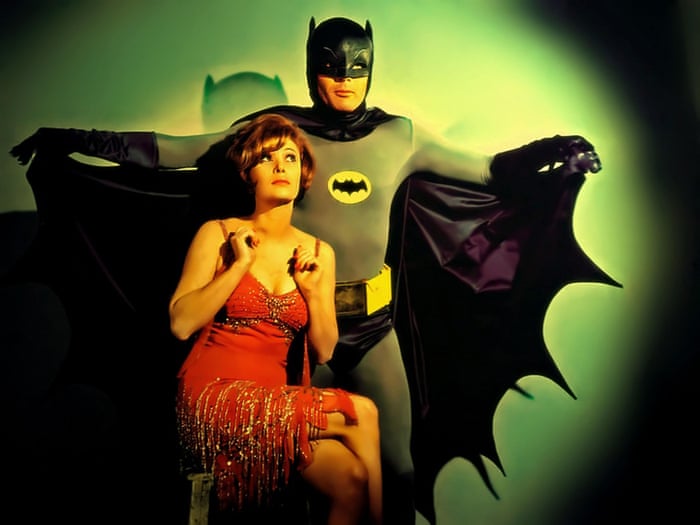
Saturday, 10 June 2017

Batman RIP

Adam West: TV Batman actor dies at 88

Adam West, the US actor best known as the star of the 1960s hit TV series Batman, has died aged 88.

West died peacefully in Los Angeles after a "short but brave battle" with leukaemia, a family spokesperson said.

His tongue-in-cheek portrayal of Batman and the superhero's alter ego Bruce Wayne won a cult following.

He later struggled to find big acting roles, but won a new generation of fans in more recent times after joining the cast of Family Guy.

First appearing in season two in 2002, he voiced Quahog's eccentric Mayor Adam West, described by series creator Seth MacFarlane as an "alternate universe", satirised version of the actor.

MacFarlane paid tribute to the star on Twitter, saying he had "lost a friend" and described West as "irreplaceable".


West's family said in a statement: "Our dad always saw himself as The Bright Knight, and aspired to make a positive impact on his fans' lives. He was and always will be our hero."

The Batman TV series, with its onscreen fight-scene graphics of Wham! and Pow! became an unexpected hit. West and his co-star Burt Ward, who played Batman's sidekick Robin, won widespread acclaim for their kitsch portrayal of the Dynamic Duo.

Actor Julie Newmar, who played Catwoman in the series, paid tribute to West on Saturday, saying he was was "bright, witty and fun to work with".

"I will miss him in the physical world and savour him always in the world of imagination and creativity," she said.

In a 2010 interview with the website Slice of SciFi, West said the TV series had benefitted from very good writers.

"They saw the craziness, the comedy. You know, just as he's about to put her in (jail), Batman says to Catwoman, 'You give me curious stirrings in my utility belt.' That's funny stuff."

When the series ended, West struggled to break free from the character, but over a long career appeared in nearly 50 films including Drop Dead Gorgeous, An American Vampire Story and Nevada Smith.
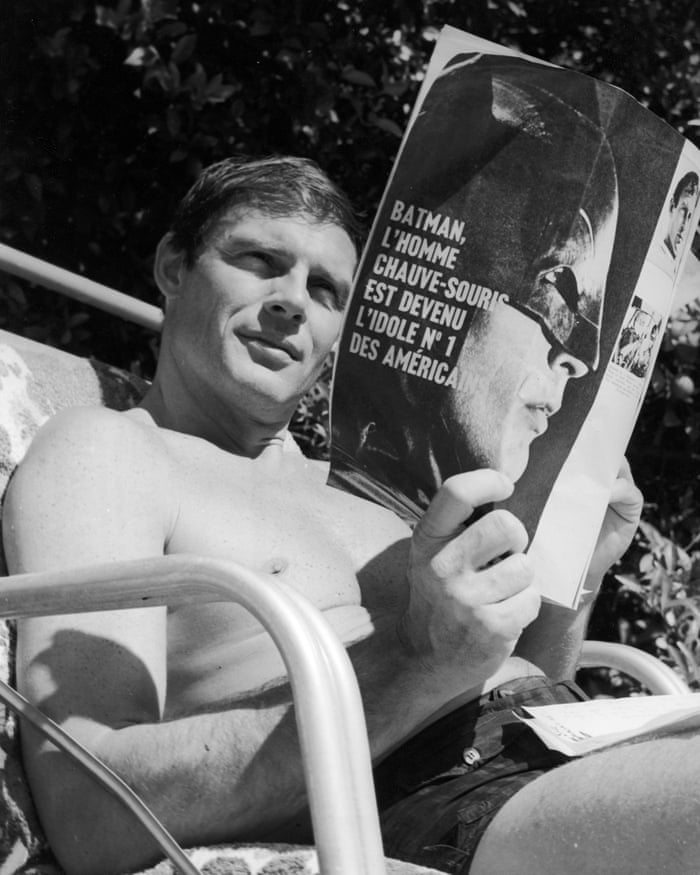


Batman actor Adam West dies aged 88
Actor who played Batman in 1960s US TV series and voiced Mayor West on Family Guy dies

Chris Johnston and agencies
The Guardian
Saturday 10 June 2017

Adam West, the actor best known for playing Batman in the 1960s television series, has died aged 88 of leukaemia. He is remembered by fans for his kooky, exaggerated portrayal of the superhero in the ABC show, which ran for three seasons from 1966 to 1968.

West once said that he played Batman “for laughs, but in order to do [that], one had to never think it was funny. You just had to pull on that cowl and believe that no one would recognise you.”

In a statement, his family said: “Our dad always saw himself as the Bright Knight and aspired to make a positive impact on his fans’ lives. He was and always will be our hero.”

Tributes have poured in from the media world. David Walliams tweeted: “Thank you AdamWest for being the funniest superhero of all time as Batman.”

Many of those expressing their sadness shared the fact that West’s portrayal of the Caped Crusader had been their childhood hero. Author Neil Gaiman tweeted: “Rest in peace Adam West. We met once in 1987 and I was too embarrassed and too foolishly ‘cool’ to tell you what you meant to my childhood.”

Shaun of the Dead director Edgar Wright tweeted: “Farewell Adam West. You were MY Batman. Such a super funny, cool, charismatic actor. Loved the show as a kid, still love the show now. POW!”

John Barrowman wrote on Facebook: “Adam West my after-school hours were filled with excitement watching you battle fantastic villains. You were a delight to meet on the convention circuit.”

Mark Hamill, who played the Joker in an animated series of Batman and worked with West on a short called Batman: New Times, also shared his condolences. He tweeted: “AdamWest was such a wonderful actor & so kind, I’m so lucky to have worked w/ him & tell him how much he meant to me & millions of fans.”

The actor Matthew Modine tweeted:
I shared a flight #adamwest when I began my career. So kind. Sharing insights about the business of show. So generous & loving was he RIP

Batman initially proved a hit with US viewers, but its popularity waned and it was axed after the third season. Reruns of the show continue to this day, although it took until 2014 to make it on to DVD.

The Guardian’s Graeme Virtue wrote: “The licensing tangle between 20th Century Fox, which made and owns the actual episodes, and DC Entertainment, the renamed comics company that owns the characters, was hampered by contracts drawn up before home entertainment options were even being considered.”

West struggled to find steady work after the demise of Batman, complaining later that “the people who were hiring … were dinosaurs” who “thought Batman was a big accident”. it was not until he was cast as the voice of Mayor West on the animated series Family Guy that he found another regular gig.

Friday, 9 June 2017

Dead Poets Society #41 John Donne: Song

Image result for john donne


Song by John Donne

Go and catch a falling star,
Get with child a mandrake root,
Tell me where all past years are,
Or who cleft the devils foot;
Teach me to hear mermaids singing,
Or to keep off envy's stinging,
And find
What wind
Serves to advance an honest mind.

If thou be'st born to strange sights,
Things invisible to see,
Ride ten thousand days and nights
Till Age snow white hairs on thee;
Thou, when thou return'st wilt tell me
All strange wonders that befell thee,
And swear
No where
Lives a woman true and fair.

If thou find'st one let me know;
Such a pilgrimage were sweet.
Yet do not; I would not go,
Though at next door we might meet.
Though she were true when you met her,
And last, till you write your letter,
Yet she
Will be
False, ere I come, to two or three.

Remember: "A man ain't island; John Donne wasn't lying..."

Thursday, 8 June 2017

Last night's set lists

Gamma Ray American Pale Ale

At The Habit, York: -

Military Madness
Teach Your Children
You're Sixty (
aka You're Sixteen)

It was quieter than last week but there was a fine array of players to entertain the punters. Regular Deb surprised us with an excellent You Belong To Me. Rising star Sam Griffiths delighted the audience with Me And Julio Down By The Schoolyard and a blistering Tangled Up In Blue. At the end of the evening he joined our host for One Too Many Mornings and It's All Over Now Baby Blue; surely enough Dylan there to please any Friday Night Boy (even if it was Wednesday!). I chipped in with a couple of Graham Nash tunes and my own take on Johnny Burnette's 1961 hit. In introducing the song I made it clear that the re-write was necessary for one in excess of 60 summers!


Wednesday, 7 June 2017

Tuesday, 6 June 2017

Peter Sallis RIP

Image result for peter sallis last of the summer wine
Peter Sallis obituary
Veteran actor best known for playing Norman ‘Cleggy’ Clegg in Last of the Summer Wine and voicing Wallace in Wallace and Gromit

Stephen Dixon
The Guardian
Monday 5 June 2017

Often self-effacing and meek, but with a sly smirk and a beady eye that hinted at mischief, the actor Peter Sallis, who has died aged 96, played the cloth-capped widower Norman Clegg for 37 years in the BBC TV comedy series Last of the Summer Wine, and was also the voice of Wallace in Nick Park’s acclaimed stop-motion animated films based around the adventures of a cheese-loving inventor and his pet dog, Gromit.

Running from 1973 to 2010, Roy Clarke’s meandering series about three childish old men getting into all kinds of scrapes in a small Yorkshire town was gentle and often poignant, and the character of “Cleggy” absolutely fitted Sallis’s nasal, hesitant and semi-apologetic speech patterns. In Clegg’s wry utterances there were many stereotypical British qualities: understatement, calmness in the face of adversity, self-deprecation and, above all, a willingness to see the funny side of life.

And it was that wonderfully evocative voice that made Sallis first choice for theWallace and Gromit films. He recorded the lines for Aardman Animation’s short A Grand Day Out in 1983 for a smallish fee, forgot about it, and it was six years later that Park rang him to say the film had been completed. From such modest beginnings came an industry that, for Sallis, climaxed with his attending the Academy Awards ceremony in Hollywood, when the Aardman/Dreamworks full-length film The Curse of the Were-Rabbit (2005) won an Oscar for best animated feature.

Born in Twickenham, south-west London, he was the only child of Harry Sallis, a bank manager, and his wife, Dorothy (nee Bernard), and grew up in Palmers Green, in the north of the city. In his autobiography, Fading Into the Limelight (2007), he wrote that his parents did not get on at all well: “I had a little prayer that I used to say: ‘Please God, make Mummy and Daddy live happily together.’”

After his education at Minchenden grammar school in Southgate, he followed his father into banking, as a clerk, and during the second world war joined the RAF. Turned down in 1943 for aircrew because of a disorder that might cause him to black out at high altitudes, he became a wireless mechanic and taught radio procedures at RAF Cranwell.

One of his students was putting on a production of Noël Coward’s Hay Fever at a local YMCA, and Sallis agreed to play the leading male part, though he had never acted before. As he put it: “When I went on the stage and spoke the lines, people laughed … that night, in my bunk, I couldn’t sleep. I just lay there going through the play over and over again. I knew everybody’s lines and after a while I thought to myself, yes, I know what it is: I’ve got what they call the acting bug.”

He appeared in various other amateur productions and still had the bug when the war ended. He was accepted by the Royal Academy of Dramatic Art, London, on an Alexander Korda scholarship, and when he left was offered work in the theatre almost immediately – he had been taken on by the Myron Selznick agency while still at Rada.

The 15 years that followed contained what Sallis considered to be his best creative achievements: in spite of his later fame as a TV and film performer he always saw himself primarily as a serious stage actor. His professional debut came in Sheridan’s The Scheming Lieutenant at the Arts theatre in 1946, and notable subsequent appearances included Orson Welles’s Moby Dick (1955) at the Duke of York’s theatre, Coward’s Look After Lulu (1959) with Vivien Leigh at the Royal Court, and Welles’s production of Ionesco’s Rhinoceros (1959) with Laurence Olivier, also at the Royal Court. He spent two seasons at the Lyric, Hammersmith – with John Gielgud in 1953 and the Fifty Nine Theatre Company in 1959.

He married the actor Elaine Usher in 1957, but it was not a happy relationship and she divorced him in 1965. They were briefly reconciled but she left him for good in 1983, describing him in tabloid newspapers as a devious, serial adulterer. Reflecting on his marriage in 2004, Sallis told the Daily Express that he was “not ideal as a husband”. The couple had a son, Crispian, who went on to become an Oscar-nominated film set designer.

Sallis was also frank about his inadequacies as a parent, saying he was “not good father material”. “I don’t know what it was but I never saw myself as a father figure,” he went on. “I didn’t understand children. I don’t actually like children. There was a distance between me and my father and now there is a distance between me and my son.”

Sallis began his television career at the top, with the title role in the 14-part BBC serial Samuel Pepys in 1958, and he also appeared in smaller parts in shows such as Doctor Who, Catweazle and The Persuaders! He became a busy film actor, too, with smallish parts in The Scapegoat (1959), Saturday Night and Sunday Morning (1960), Doctor in Love (1960), The VIPs (1963) and many others. Able to look terrified very convincingly, he also carved something of a niche in horror films – Curse of the Werewolf (1961), Scream and Scream Again (1970), Taste the Blood of Dracula (1970) and Frankenstein: The True Story (1973).

His was already a familiar face, and Last of the Summer Wine made Sallis a household name; he was the only actor to appear in all 295 episodes of what became the world’s longest-running comedy series. Clarke had already collaborated with him on various projects, and wrote Clegg with him in mind. Of the original trio of anarchic old men re-living their childhoods, Blamire (Michael Bates) was the figure of authority, the Nora Batty-besotted Compo (Bill Owen) was the funniest and most outrageous, and Clegg occupied a middle ground: a witty but timid little man who preferred to be observer and commentator on his friends’ follies but was invariably roped in to the stunts as a reluctant participant.

Bates died before the third series and was replaced first by Brian Wilde, as the ex-soldier “Foggy” Dewhurst, then Michael Aldridge as the former headteacher Seymour Utterthwaite and, finally, by Frank Thornton as the retired policeman Herbert “Truly” Truelove. Owen died in 2000, and was never really replaced, though Brian Murphy as Alvin Smedley became Nora’s new neighbour. In the final two series the physical action was undertaken by younger members of the cast and Thornton and Sallis appeared mainly in indoor or background sequences.

The first Wallace and Gromit short film, A Grand Day Out, was released in 1990 to tremendous acclaim. It was nominated for an Academy Award, and from the start the voice of Sallis was a vital ingredient in its success. The Wrong Trousers (1993), A Close Shave (1995) and the full-length The Curse of the Were-Rabbit followed. All three earned Academy Awards, and Sallis was awarded an Annie award for voice acting for Were-Rabbit.

Sallis was 84 when the film came out, and his sight was failing through macular degeneration. He had no immediate plans for retirement and adjusted his life to meet the challenges involved, moving from his cottage close to the Thames in Richmond to a central London apartment and using a talking portable typewriter with a specially illuminated scanner. With the aid of these devices he was able to voice Wallace in A Matter of Loaf and Death (2008) and the TV science showWallace and Gromit’s World of Invention (2010), and then had to step back from the role. Since 2011 Wallace has been voiced by Ben Whitehead.

Sallis was also able to complete work on the final series of Last of the Summer Wine in 2010 and shortly afterwards he formally retired. Just before doing so, he became happily reconciled to the fact that his enduring global fame lay with Wallace. “I realise now, though it’s taken me nearly a hundred years, that my voice is distinctive,” he said. “I’m very lucky indeed.” In 2007 he was appointed OBE.

Sallis is survived by Crispian and two grandchildren.

• Peter Sallis, actor, born 1 February 1921; died 2 June 2017

Monday, 5 June 2017

Hokusai at The British Museum

Great Wave

Hokusai: the Great Wave that swept the world
He called himself Old Man Crazy To Paint and made his best work in his 70s. As his dragons, deities, poets and wrestlers go on show, we look at the obsessions of the poster-boy for Japanese art

John-Paul Stonard
The Guardian
Friday 19 May 2017

Had Katsushika Hokusai died when he was struck by lightning at the age of 50 in 1810, he would be remembered as a popular artist of the ukiyo-e, or “floating world” school of Japanese art, but hardly the great figure we know today. His late blooming (the subject of an exhibition, Hokusai: Beyond the Great Wave, opening at the British Museum next week) was spectacular – it was only in his 70s that he made his most celebrated print series, Thirty-Six Views of Mount Fuji, including the famous Great Wave, an image that subsequently swept over the world. “Until the age of 70,” he once wrote (self-consciously parodying Confucius) “nothing that I drew was worthy of notice.”

It was a good boast but not quite true – he had begun his manga, woodblock print books of sketches that were wildly popular, in his 50s. They stretched to 15 volumes (the last three published posthumously), and covered every subject imaginable: real and imaginary figures and animals, plants and natural scenes, landscapes and seascapes, dragons, poets and deities combined together in a way that defies all attempts to weave a story around them. Leafing through the manga in the original or a facsimile is a mind-expanding experience, one that should be prescribed for all aspiring artists. In their observation and invention they have been compared to Rembrandt and Van Gogh, and rightly so for the thrilling panorama they provide both of the world and of Hokusai’s imagination.

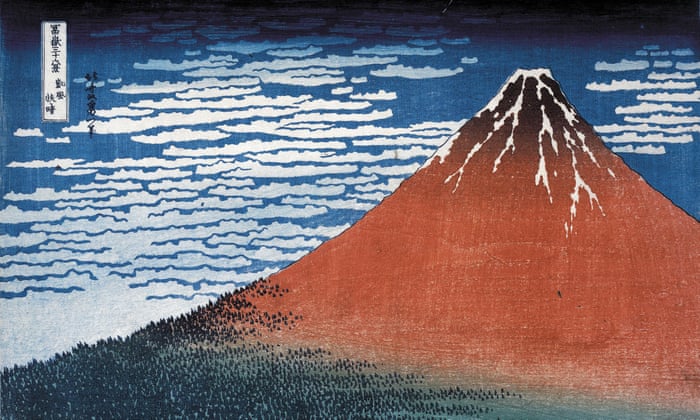
Clear Day with a Southern Breeze, colour woodblock, 1831

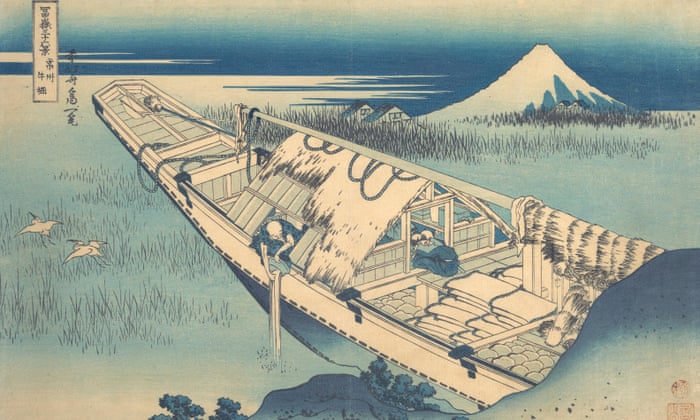
If the manga made Hokusai’s name, the Thirty-Six Views of Mount Fuji (there are in fact 46 prints in the series) ensured his fame. Hokusai’s obsession with Mount Fuji was part of his hankering after artistic immortality – in Buddhist and Daoist tradition, Fuji was thought to hold the secret of immortality, as one popular interpretation of its names suggests: “Fu-shi” (“not death”). I saw the mountain for the first time last year, from the window of the Shinkansen bullet train. You quickly understand how it dominates the landscape, as the train curves around, revealing it over woodlands and cities, behind buildings, over the plains – and why Hokusai returned to it so often, like a pivot for his restless imagination.

Fuji appears in Thirty-Six Views in many different guises, sometimes centre-stage, elsewhere as background detail. The first five in the series were printed entirely in shades of blue (a combination of traditional indigo and Prussian blue, a recently invented chemical pigment), suggesting views of the mountain at dawn, seen now from a beach, now from a neighbouring island, now as passenger boats and cargo vessels head out over Edo bay.

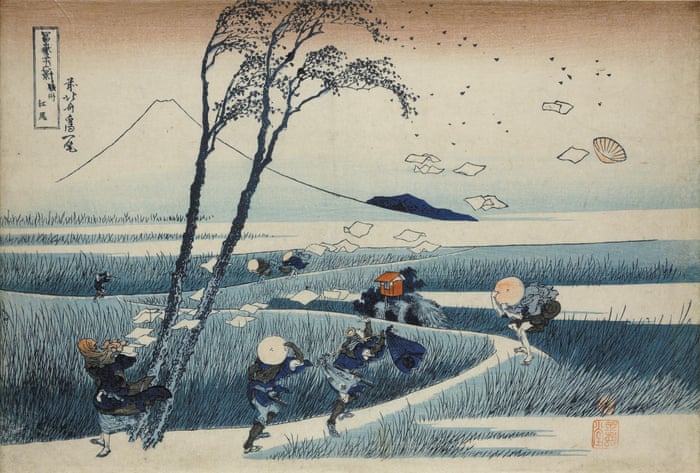
Ejiri, Suruga Province, colour woodblock, early 1831

Hokusai gradually introduced colour into the series, delicate pinks and darker shadows, to show the illumination of the world as the sun creeps up over the horizon. The print Ejiri, Suruga Province shows early morning on a desolate patch of the Tōkaidō highway, Mount Fuji drawn with a single line, while in the foreground a group of travellers are struck by a gust of wind that sends hats and papers flying in the air. It is one of my favourite of the Thirty-Six Views. In Japan the best-loved print is Clear Day with a Southern Breeze. Included in the British Museum exhibition, an early impression of this print shows the delicate atmospheric effects of sunrise, lost in later printings probably made without Hokusai’s direct supervision.

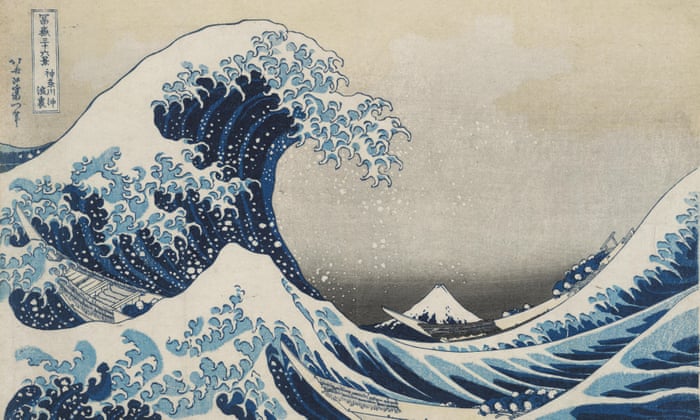
Early impressions of the Great Wave, or Under the Wave off Kanagawa, are just as subtle in their colouring: atmospheric pink and grey in the sky, deep Prussian blue in the folds of the sea. Fishing skiffs are lost in the waves, while the great wall of water, with its finger-like tendrils, threatens to engulf both them and the tiny Mount Fuji in the distance. That the Great Wave became the best known print in the west was in large part due to Hokusai’s formative experience of European art.
Work by Hokusai from the Edo period

Prints from early in his career show him attempting, rather awkwardly, to apply the lesson of mathematical perspective, learnt from European prints brought into Japan by Dutch traders. By the time of Under the Wave, the sense of deep space was far more subtle. The rigid converging lines of European perspective drawing become the gently sloping sides of the sacred mountain. In all other ways it could not have been further from anything being made in Europe at the time.

I would love to see an impression of Hokusai’s delicately coloured print hung next to Géricault’s Raft of the Medusa, painted just over a decade previously, in which a similar large wave is about to crash down on frail humanity. The contrast, and extreme modernity of Hokusai’s print, was certainly on the mind of those post-impressionist painters who so admired his work. You can still see prints by Hokusai, alongside Utamaro and Hiroshige, lining Monet’s dining room at Giverny; Rodin and Van Gogh were also enthusiastic collectors.

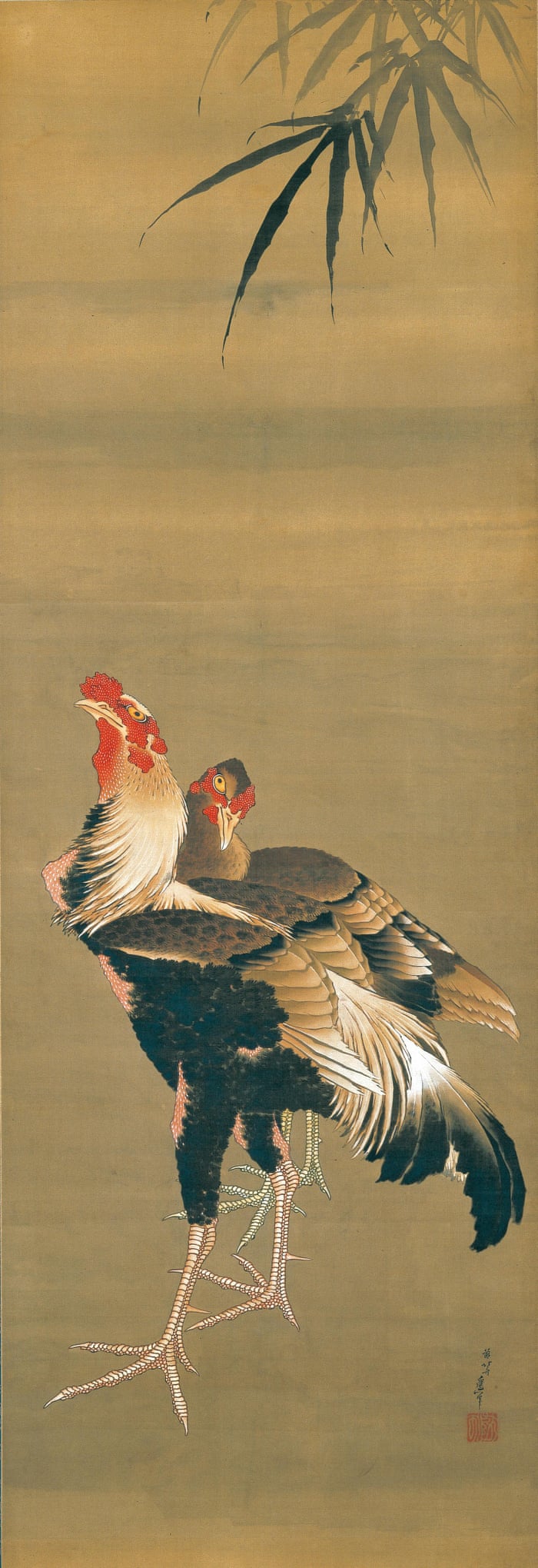
Gamecock and Hen, 1826–34
Hokusai signed his Thirty-Six Views with the name Iitsu, adding for clarification that he was “the former Hokusai”. It was common in Japan, as in China, for artists to adopt different names throughout their careers, marking different stages of life, and perhaps also as a way of refreshing the brand. He adopted the name Hokusai (“North Studio”) in his late 40s, when he became an independent artist, leaving his teaching job and striking out on his own.

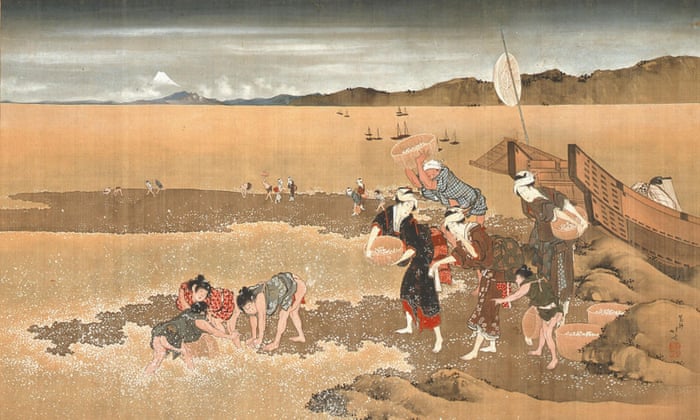
Gathering Shellfish at Ebb-tide
By the time he created his second great tribute to Mount Fuji, three volumes comprising One Hundred Views of Mount Fuji (in fact there were 102 views) he was using the artist names Gakyō rōjin (“Old Man Crazy to Paint”), and Manji (“Ten Thousand Things”, or “Everything”). There is indeed a spirit of crazy comprehensiveness to One Hundred Views, all the mad invention and curiosity of the manga combined with the exquisite technique of the Thirty-Six Views. Timothy Clark, the curator of the British Museum exhibition, describes One Hundred Views as “one of the greatest illustrated books” ever printed, and it is difficult to disagree. The drawings are brilliantly conceived, and the prints beautifully made, the woodblock carvers reproducing Hokusai’s line so accurately that we think we are looking at the drawings themselves, rather than carved and printed copies.
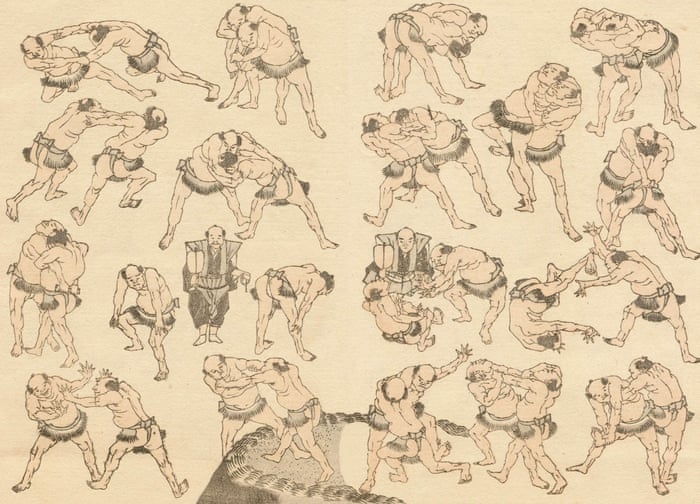
Sumo wrestlers by Hokusai, from a collection of woodblock print sketches begun in 1814

It’s important to remember that Hokusai was a thoroughly commercial artist, relying on a large turnover of sales of his low-cost prints and the many illustrated books he produced throughout his life. Despite his artistic success, he seems to have been permanently on the brink of bankruptcy, largely a result of financial ineptness. After the death of his second wife, in 1828, Hokusai’s daughter, Katsushika Ōi, returned to live with her father and provided him with support. Ōi was herself a talented painter and worked alongside her father in their cramped and messy studio.

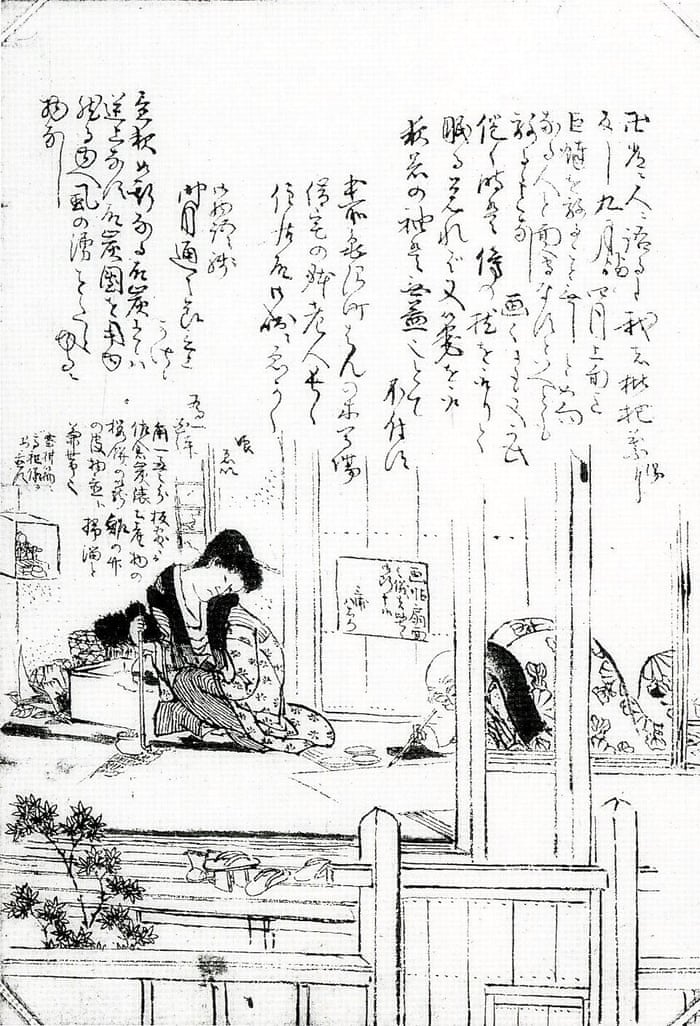
The sketch of Hokusai with his daughter Ōi

An image of their situation is preserved in a memory-sketch by Tsuyuki Kōshō, one of Hokusai’s pupils, showing the master in rented lodgings, covered by a quilt, hunched over an ink painting on the tatami mat. Ōi watches him intently, smoking a long tobacco pipe. An inscription on the drawing says that rubbish was piled in the corner of the studio, food wrappings and other detritus. On the wall hung a sign: “We strictly refuse to paint albums or fans” – although you can imagine them taking on the work anyway.

The small handful of Ōi’s paintings that survive show her prodigious talent as an artist. Recent research has shown how she might have contributed to her father’s late paintings, which contain elements of her style such as elongated fingers, and depictions of beautiful courtesans (drawn from life in the pleasure district of Yoshiwara, if the 2015 anime film Miss Hokusai is anything to go by).

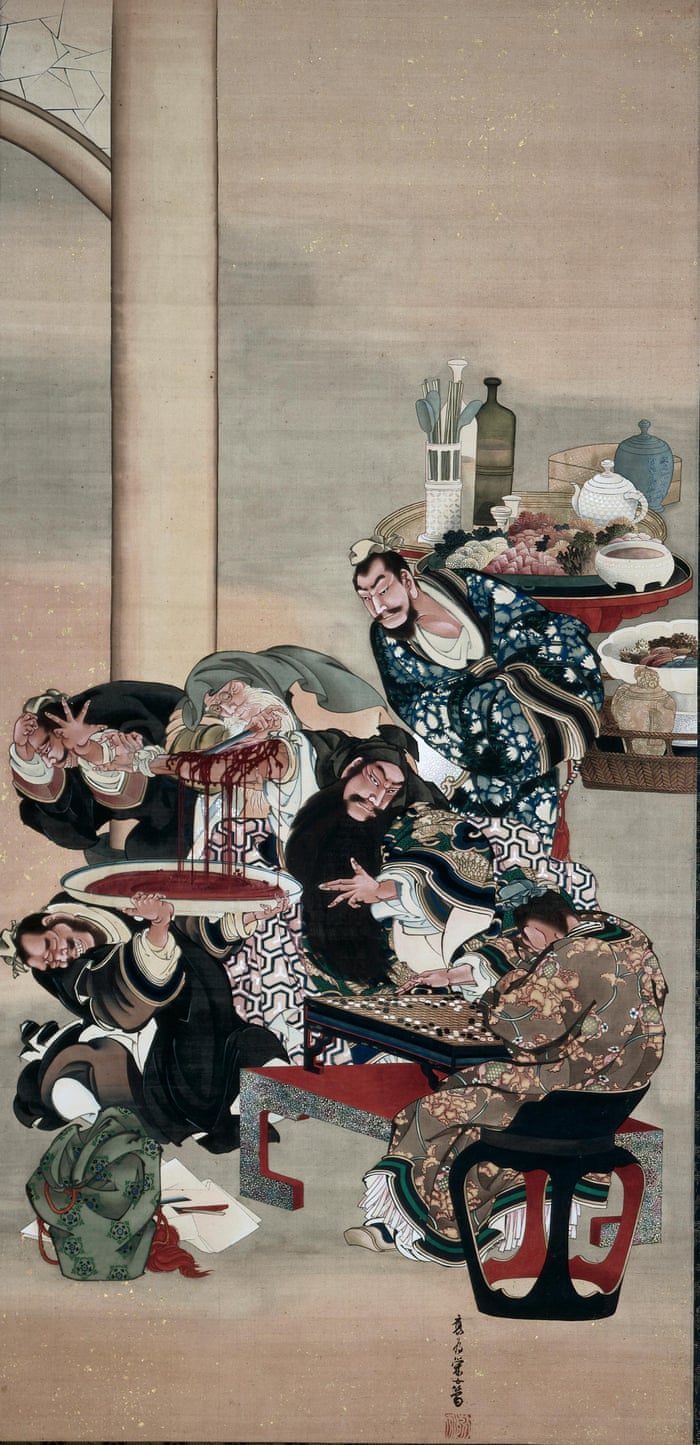
Hua Tuo Operating on the Arm of Guan Yu, by Katsushika Ōi
One of her most impressive paintings, Hua Tuo Operating on the Arm of Guan Yu, a scene from the Chinese historical novel Romance of the Three Kingdoms, has a violent intensity and macabre quality quite unlike her father’s painting. Blood spurts from the arm of the general Guan Yu, who has taken nothing but a bowl of rice wine as anaesthetic, and continues with a game of go. It is one of the few authenticated paintings by Ōi, who disappears from the records following her father’s death in 1849.

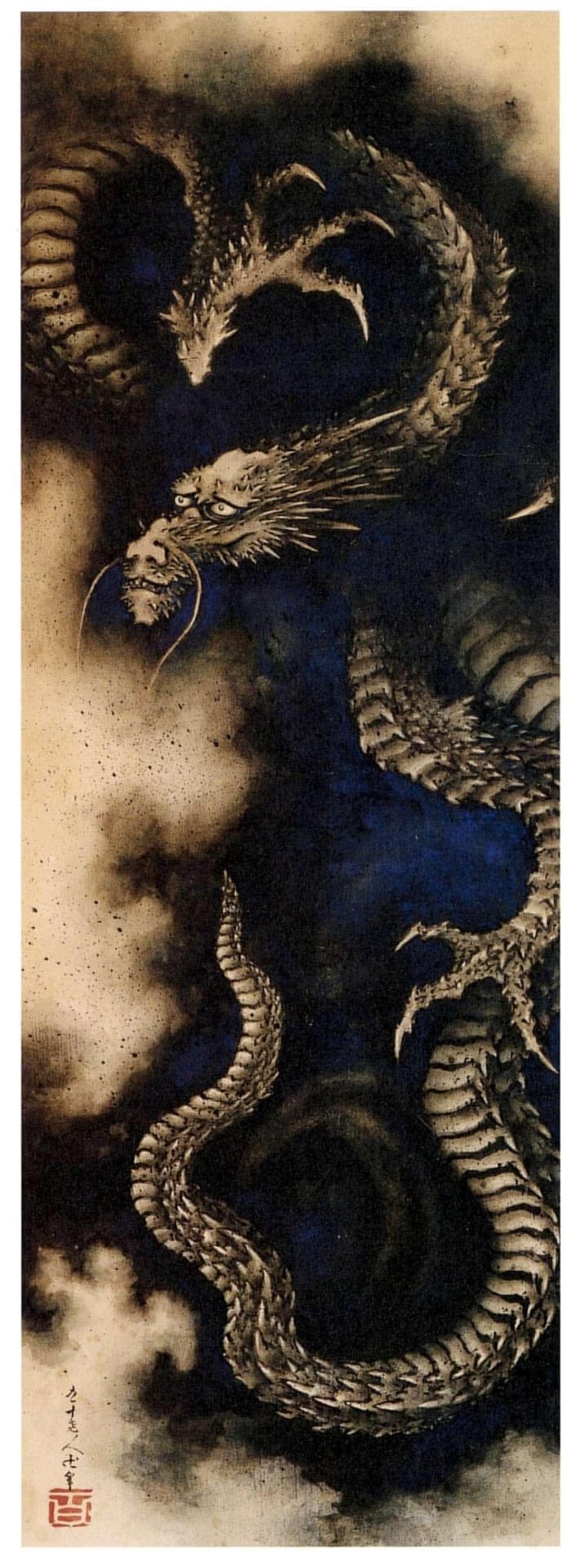
Set alongside his prints, Hokusai’s rarely exhibited late paintings – large hanging scrolls on silk and paper – strike a different note. The subjects are often fantastical: a great dragon writhes in a rain cloud rising above Mount Fuji; a seven-headed dragon deity flies in the sky above the monk Nichiren (Hokusai was a devout follower), sitting on a mountain top reading from a sutra scroll.
Dragon in Rain Clouds, hanging scroll, ink and colour on paper, 1849

In small reproduction (the only form I have seen them in), they can appear a little like commercial illustrations, lacking the sense of emotional and atmospheric depth of his prints. A grinning tiger bounding through the snow, painted just a few months before Hokusai’s death, looks almost too quaint and jolly. All the more reason to make the journey to the British Museum and see them in the flesh. As with Hokusai’s prints, the real qualities of colour and surface, of detailed brushwork and painstaking construction, reveal themselves only on close and lingering inspection.

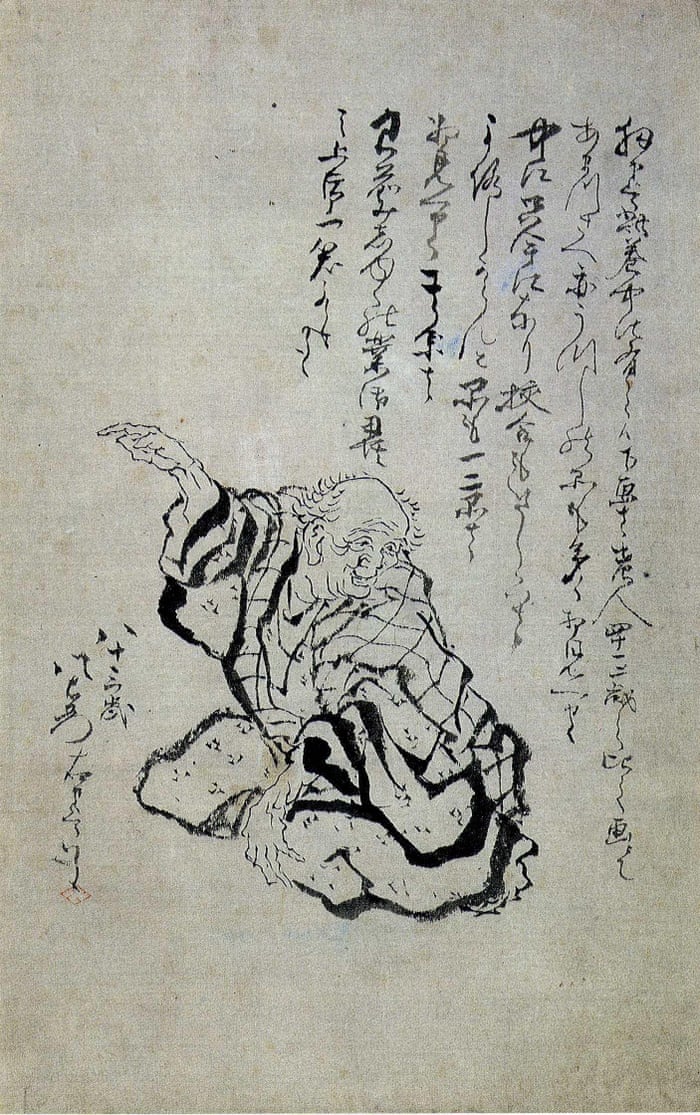
Self-portrait by Hokusai, aged 83, 1842
In his 80s, Hokusai was said to draw a Chinese lion or lion dancer every morning, throwing it out of the window to ward off ill luck. A number of these “daily exorcism” drawings still exist (probably thanks to Ōi running out to collect them up), and they are among his most lively and charming works. Hokusai’s only bad luck was to die 10 years short of his century, and never in his own mind to reach the state of artistic immortality, which he estimated would occur at the age of 110 when, as he once wrote, “Each dot, each line, will possess a life of its own.”

• Hokusai: Beyond the Great Wave is at the British Museum, London WC1B, from 25 May to 13 August, and at the Abeno Harukas Art Museum, Osaka, from 6 October to 19 November.


Saturday, 3 June 2017

Dead Poets Society #40

Image result for john updike

Back From Vacation by John Updike


'Back from vacation', the barber announces,
or the postman, or the girl at the drugstore, now tan.
They are amazed to find the workaday world
still in place, their absence having slipped no cogs,
their customers having hardly missed them, and
there being so sparse an audience to tell of the wonders,
the pyramids they have seen, the silken warm seas,
the nighttimes of marimbas, the purchases achieved
in foreign languages, the beggars, the flies,
the hotel luxury, the grandeur of marble cities.
But at Customs the humdrum pressed its claims.
Gray days clicked shut around them; the yoke still fit,
warm as if never shucked. The world is still so small,
the evidence says, though their hearts cry, 'Not so!'


Thursday, 1 June 2017

Last night's set lists

At The Habit, York: -

Set 1: -
Romancing Tonight
Too Far Gone


Set 2: -
Laurel Canyon Home
Baby What You Want Me To Do


The Habit was packed with punters and players, but notably minus Ron Elderly who is on holiday - so no Elderly Brothers set this week (or next). There was a lot of noise from the busy half-term crowd and several requests from our host to STFU made little difference. Everyone who turned up got to perform. I was asked to close the show and enlisted the help of local blues harp-player Tim Williams on a couple of numbers which seemed to go down well.

Tuesday, 30 May 2017

John Noakes RIP

Blue Peter’s daredevil: John Noakes obituary
Children’s TV presenter whose can-do attitude marked him out from his more sensible Blue Peter co-hosts

Stuart Jeffries
The Guardian
Monday 29 May 2017

In 1977, the television presenter John Noakes, who has died aged 83, climbed Nelson’s Column without safety harness or insurance, for an episode of the BBC’s enduring children’s show Blue Peter. After shinning up one ladder, Noakes swung himself dauntlessly on to another, tilted 45 degrees from the vertical. “At this level,” said Noakes in a voiceover, “the plinth on which Nelson stands overhangs the column. I found myself literally hanging on from the ladder with nothing at all beneath me.” Nothing, that is, but a 52-metre drop to the slabs of Trafalgar Square. Truly, they don’t make television presenters like Noakes any more. “It’s a long way up, really,” he said as he stood on the plinth with Britain’s naval hero, a remark so refreshingly banal as to prove that Blue Peter was not always scripted.

During his 12 years as a Blue Peter presenter, Noakes often climbed things and, for a while, held the British civilian freefall parachuting record – 25,000 feet. Soon after Noakes joined Blue Peter in December 1965, his then co-presenter Christopher Trace, who had no head for heights, had baulked at taking part in an outside broadcast that included climbing to the top of a tower crane. The show’s producer Edward Barnes asked Noakes if he would do it instead: “Aye, all right, I’ll have a go.”

That daredevil can-do attitude stood him in good stead and marked him out from his more sensible co-presenters, such as Valerie Singleton, Peter Purves and Lesley Judd. There are some fans of the show who will always remember the moment that Noakes bared his bruised bottom after coming off his bobsleigh as he shot down the Cresta Run.

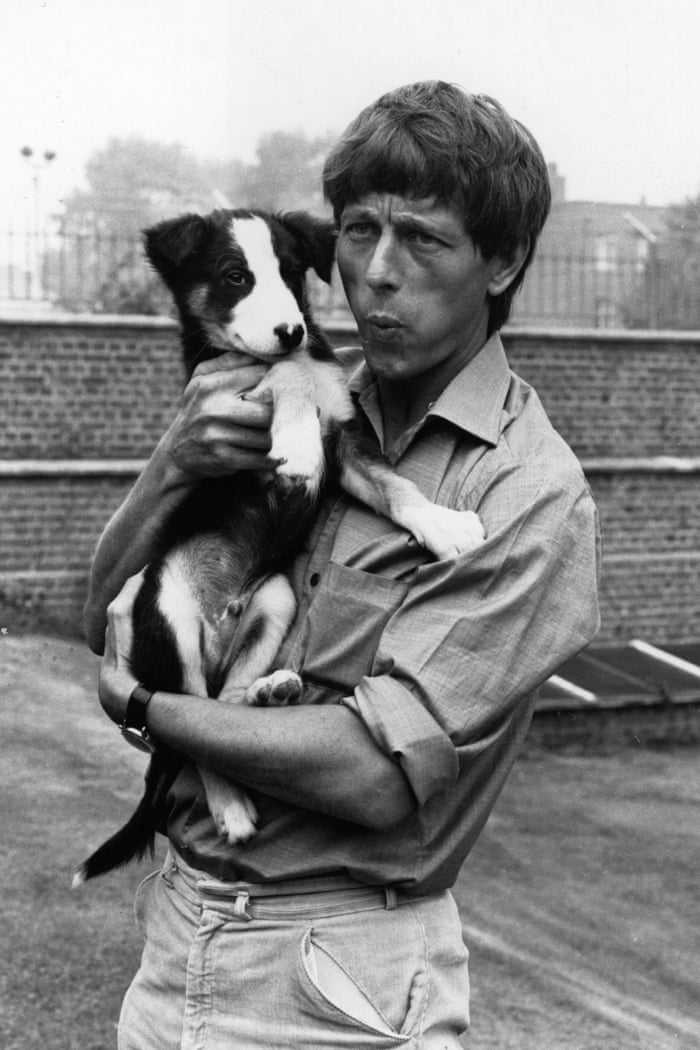
And then there were the animals. Initially, Noakes was charged with looking after Patch, puppy of the first Blue Peter dog Petra, before being given stewardship of Shep, a border collie, after Patch’s death in 1971. Shep remained proverbially beyond his control. As the pop parodists the Barron Knights put it in their 1978 novelty song Get Down, Shep, about Noakes’s relationship with the dog he called his “straight man”, “John could never be alone no matter where he went / Because Shep would always sniff around and soon pick up his scent.” Decades after he left the show, and long after the dog’s death in 1987, people would stop Noakes in the street and ask: “Where’s Shep?”

There was also that incident with Lulu the baby elephant visiting the Blue Peter set in 1969. When Lulu urinated and defecated on the studio floor, and her handler slipped over in the mess, but Noakes went with the madness of the moment, embracing the chaos that ensued. “Ow, he’s trod on my foot,” yelled Noakes, adding, as Singleton and Purves tried vainly to restore order, “Oh dear – I’ve trod right in it!”

It is hard to explain the significance of Blue Peter during the golden age in which Noakes was its lord of misrule. There were only three TV stations and no dedicated children’s network, so Blue Peter was culturally central to its viewers in a way no kids’ TV show could be now. At the peak of its popularity, eight million watched the show, savouring its time-honoured format: a live demonstration of an activity (usually involving making a model from plastic bottles held together with sticky-back plastic), and a music or dance performance, followed by an edifying filmed report with one of the presenters and some risky live turn with an animal. A thousand letters a day arrived from children keen to earn one of the coveted Blue Peter badges, which made them the envy of their classmates. “It was a bit like an overgrown schoolboy’s job,” Noakes told an interviewer many years later. “I was Peter Pan really. I sometimes think I still am.”

Noakes was born in the village of Shelf, between Bradford and Halifax, in West Yorkshire. He was an only child and loved playing by himself in the woods or in the rain. His mother, he once said, thought he was mad. His parents divorced when John was nine and he was sent as a boarder to Rishworth school, Sowerby Bridge, where he was the rebel of Remove B, the class for under-achievers.

Although he excelled in cross-country running and gymnastics, he left school without qualifications, as a result of which he was turned down as a pilot by the RAF. Instead he trained as an engine fitter for the RAF and the airline BOAC, before deciding he wanted to become an actor. He attended the Guildhall School of Music and Drama, London, financing the lessons by working as a liftboy in a hotel and doing early morning cleaning work. After graduation, he joined a touring repertory company and was spotted by Blue Peter’s editor, Biddy Baxter, in a production of Hobson’s Choice at the Phoenix theatre in Leicester, where he was playing Willie Mossop, the gormless hero of Harold Brighouse’s play.

Baxter, who was on the lookout for a third Blue Peter presenter to join Singleton and Trace as the programme went twice weekly, recalled that Noakes was “incredibly fresh faced – he looked about 14”. He was actually 29 at the time. His winning Yorkshire accent (refreshing at a time when received pronunciation was still de rigueur for TV presenters), smiling eyes and quizzical expression “all combined to make the most compelling personality and one we were sure would be right for Blue Peter even before we had seen him on camera,” said Baxter.

Noakes was later dismissive of those Peter Pan years, saying that playing Mossop on stage had given him more satisfaction than the entire Blue Peter experience. “Given my time again,” he told Radio Times in 1999, “I wouldn’t have done Blue Peter. I’d done theatre for six years and was tired. But the pressure was terrible. One year I did nine weeks with only one and a half days off. I collapsed and couldn’t go on. That’s the nearest I came to a breakdown.” Noakes even turned on the woman who had plucked him from obscurity. “Biddy Baxter was an awful woman. I don’t want to talk about her. It would upset my lunch.”

His falling out with Baxter revolved in part around Shep. On leaving Blue Peter in 1978, Noakes wanted to make money from adverts featuring him and the famous collie. “I think it would have been immoral,” Baxter told the Guardian. “How can you have a Blue Peter presenter on commercial television advertising dog food so children think ‘I must buy this’?”

But after Blue Peter, Noakes was not short of work. Since 1976, he had presented Go With Noakes, a BBC children’s show featuring him in various outdoor adventures, such as motor racing, rowing, aerobatics and painting, accompanied by Shep. It lasted for five series until 1980. In 1979 he published a book of stories for children, The Flight of the Magic Clog.

In 1982, with his wife, Vicky, Noakes set off for the Caribbean in his own boat, intending to live there. Sailing had become a passion ever since he bought a boat to use at weekends while he was working on Blue Peter. Somewhere along the voyage, however, the boat was hit by a 60ft wave; the couple were rescued by the crew of a passing tanker. Noakes broke two ribs and suffered a deep cut above one eye that left a permanent scar. The Caribbean plan was shelved and ultimately he and Vicky decided to settle in Majorca.

In 1983 he presented The Dinosaur Trail, a seven-part documentary for ITV. There followed a long period of estrangement from television. He was not invited to the 25th anniversary party of Blue Peter, it was said, because he had threatened to “knock the block off” one of the producers.

In 1998 he returned to Blue Peter for a programme celebrating 40 years of the show, and was back again in January 2000 when Singleton, Purves and Noakes dug up the Blue Peter time capsule they had buried in 1971. In 1999, he presented a LWT series, Mad About Pets, with a new sidekick, a Dalmatian called Sigh. He also made appearances on Pet Rescue (2003), Britain’s Worst Celebrity Drivers (2005) and, with Peter Purves, on the quiz show Pointless Celebrities (2013).

In later years, Noakes enjoyed tap dancing and gardening. He took up painting watercolours of the almond and carob trees near his Majorcan home. “I had one exhibition and made £150, so I was chuffed.”

“I still regret not carrying on as an actor,” Noakes told one interviewer. “It was a wonderful life – you get paid to become somebody else and live in a fantasy world.” But the truth is that he did get paid to become someone else in his TV career, an alter ego he once called Idiot Noakes. “Idiot Noakes has an extrovert personality, is light-hearted and jokey. A bit of a buffoon who would do anything for a laugh or a few pence.” In reality, Noakes claimed, he was nothing like the persona millions of Britons of a certain age admired. “I switch the personality on when I turn up to do the job, and off when I leave.”

He is survived by Vicky.

• John Noakes, television presenter, actor and writer, born 6 March 1934; died 28 May 2017

Friday, 26 May 2017

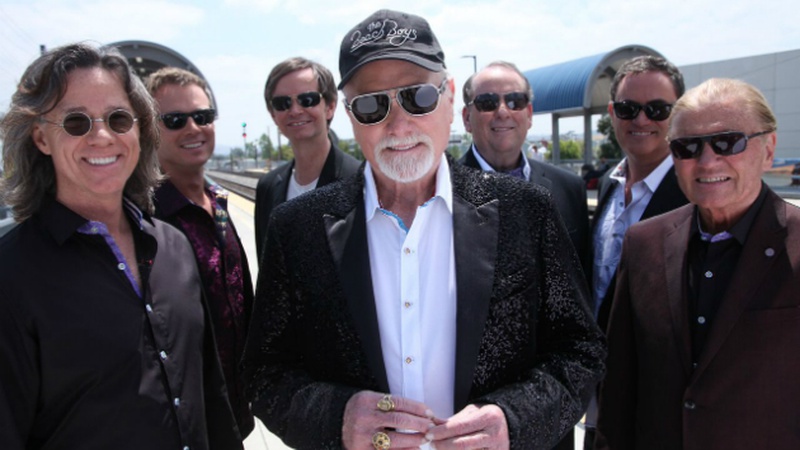
The Beach Boys at The Sage, Gateshead, 2017 - review

Image result for the beach boys wild honey tour 2017
The Beach Boys: The Wild Honey Tour
The Sage, Gateshead
25 May 2017

Often depicted as the black sheep of the band, Mike Love brought the touring Beach Boys to The Sage last night and put on a superlative show. The naysayers will attempt to diminish his role in the band’s evolution. “He only did this…” or “He only did that…”, but the informed fan, regardless of what they may feel about some of his past pronouncements or decisions, knows this is the man who co-wrote many of the band’s early hits and that his voice is all over them, and is often, in fact, the, lead voice that Brian Wilson had in mind.

There is considerable difference amongst fans and scholars as to whether Love should be using the Beach Boys’ name (event though cousin Brian long-since signed off on this), but no-one can doubt the quality of this performance.

At 76, Love is one of THE key surviving figures from this era of music and while his speaking voice seemed rough last night, his lead and bass vocals were superb; in fact, there are those who would say he’s been in better form over recent years than he was in the 1980s. While he was the only original band member present, he was accompanied – as he has been for many years – by Bruce Johnston, a Beach Boy from 1965 -71 and from 1979 to the present; indeed, 1978's MIU is the only studio album from Summer Days (and Summer Nights!!) on which he doesn’t feature - and for that he must be eternally grateful.

They were backed by an incredibly tight band, under the direction of the inestimable Scott Totten and featuring, among others, Jeff Foskett, formerly of the Beach Boys’ touring band and latterly of Brian Wilson’s band, and a long-time Love-associate, the energetic John Cowsill, on drums, whose singing and playing on Wild Honey were beyond belief.
In just over two hours, the band tore through over 40 songs, many from pre-1966 albums, an era often dismissed as ‘formative’ – and yet how many of these are ingrained in our minds and how many were hits? The surf and car songs were performed with a punk rock-intensity; the ballads with sensitivity.

The highlights were many, including the beautiful a cappella Their Hearts Were Full of Spring, originally a Four Freshman song, sung by Love, Johnston, Totten and Brian Eichenberger, who had been a member of the latter day incarnation of the Freshmen; Kiss Me Baby and The Warmth of the Sun, two of Brian Wilson greatest pre-Pet Sounds songs; an outstanding cover of Why Do Fools in Love and, as ever, the wonderful Disney Girls, sung by its composer, Bruce Johnston.

My only real quibble was that although this was termed The Wild Honey Tour, they performed just three songs from that overlooked album. I have to admit, I was kind of hoping for more – particularly because of the imminent and eagerly anticipated release of a stereo version with numerous outtakes and live tracks from the period. See
http://fridaynightboys300.blogspot.co.uk/2017/05/the-beach-boys-sunshine-tomorrow.html

The audience, from people in their late teens to people older than Love himself, were on their feet for most of the concert's second half and there was a real buzz around the place when the hall emptied out. If you dislike Love so much you’d refuse to see this tour and hear music performed by a great band and sung by two of the original vocalists, you really need to get over it…

Frank Black


Thursday, 25 May 2017

Last night's set lists

At The Habit, York: -

Ron Elderly: -
Make You Feel My Love
Just My Imagination


Da Elderly: -
You've Got A Friend
Only Love Can Break Your Heart


The Elderly Brothers (1): -
Then I Kissed Her
Medley: Sweet Caroline/Hi Ho Silver Lining
I Saw Her Standing There


The Elderly Brothers (2): -
When Will I Be Loved
The Boxer


The bar was packed from the off on a lovely warm night in York. There were plenty of players too, including a young chap on banjo playing songs by Johnny Cash and The Rolling Stones. Just before my set, regular Chris the cabby asked if I would stay on and accompany him on his first song, which I did - Birds by Neil Young. There was time at the end for folks to get a second turn at the mic and The Elderly Brothers finished off the evening with a 2-song finale. After-show nonsense continued until about 1:30am - another enjoyable night at The Habit.

Wednesday, 24 May 2017

Roger Moore RIP

Image result for roger moore the saint
Irreverent and knowing as James Bond: Sir Roger Moore obituary
Actor who brought humour, panache and suavity to his starring roles in The Saint, The Persuaders! and seven James Bond films

by Ryan Gilbey
The Guardian
23 May 2017

Sir Roger Moore, who has died aged 89, considered himself to be only the fourth best actor to have played Ian Fleming’s secret-service agent James Bond on screen: in his estimation, he came in behind Daniel Craig (whom he called “the Bond”), Sean Connery and George Lazenby. Though Moore was rarely regarded as the best or most definitive Bond, his inimitable humour and panache made him many viewers’ favourite. His tally of seven films – beginning with Live and Let Die (1973) and ending with A View to a Kill (1985) – equalled that of Connery, though Moore occupied the role for a longer consecutive period. He was eloquent on the distinction between their portrayals. “Sean played Bond as a killer and I played Bond as a lover,” he said. Only on Fridays did he resemble a cold-blooded mercenary: “That’s the day I received my paychecks.”

His casting was sometimes erroneously considered to be the catalyst for a new-found levity in the series; in fact, the two films prior to his arrival (On Her Majesty’s Secret Service, 1969, and Diamonds Are Forever, 1971) had already tipped the tone towards silliness. What Moore did very cannily was to underline the absurdity of Bond himself. “My whole reaction was always – he is not a real spy,” he said. “You can’t be a real spy and have everybody in the world know who you are and what your drink is. That’s just hysterically funny.”
Irreverence and knowingness were integral to his interpretation. But he also seemed far more plausibly endangered as Bond than Connery had ever been. Part of the viewer’s affection and even concern for him could be attributed to his advanced age: Moore was already 45 when he was cast as Bond, whereas Connery made his debut at 32 and Craig was 37. This contributed to the sense that Moore’s wellbeing was actively at risk on screen. Subjected to punishing levels of G-force on a flight simulator in Moonraker (1979) or dismantling a bomb while dressed as a clown in Octopussy (1983), he looked uniquely vulnerable. Clambering up the Eiffel Tower and the Golden Gate Bridge in A View to a Kill seemed inadvisable behaviour for a man of 56.

His range was modest, as he was the first to admit. He credited his success to “99% luck”, and singled out the 1970 supernatural thriller The Man Who Haunted Himself, in which he played a businessman who appears to be living two lives, as “the only film I was allowed to act in”. Such self-deprecation only encouraged critics to contribute their own jibes: Anthony Lane of the New Yorkernsaid that Moore “needed a stunt double for his acting scenes” in the Bond films.

Moore became an object of mild mockery after the 1980s satirical TV show Spitting Image featured a puppet of him that expressed its emotions solely through its eyebrows. The joke proved robust, but not everyone realised that Moore had cracked it first. “The eyebrows thing was my own fault,” he said. “I was talking about how talentless I was and said I have three expressions: eyebrow up, eyebrow down and both of them at the same time. And they used it – very well, I must say.”

He was born in London, to Lily (nee Pope), a housewife, and George Moore, a police constable whose responsibilities included drawing accident scenes to be used in evidence in court. Roger himself had artistic ambitions early in life. He left school at 15 to accept a job as a trainee animator at Publicity Picture Productions, but was sacked a few months later when he neglected to collect a can of film.

Tagging along with friends in 1945 to auditions for film extras, Moore was picked to appear in a non-speaking role as a legionnaire in Caesar and Cleopatra, starring Vivien Leigh and Claude Rains. The film’s first assistant director, Brian Desmond Hurst, took Moore under his wing and encouraged him to audition for Rada. When Moore was accepted, Hurst paid his fees. He left at 18 to become a supporting player in the repertory company of the Arts theatre, Cambridge, before he was called up for military service. Posted to Germany, he succeeded in getting a transfer to the Combined Services Entertainment unit. In 1946, he had married Doorn Van Steyn, a fellow Rada student.

After three years in the army, Moore returned to acting, landing small roles in theatre and film, as well as appearing as a model for knitting patterns and in photo stories. He moved to New York City in 1953 with his second wife, the singer Dorothy Squires (Moore and Van Steyn had divorced earlier that year), and began getting acting work on US television. He signed a contract with MGM and was cast in a series of unmemorable films, including The Last Time I Saw Paris (1954) and Interrupted Melody (1955). Returning to Britain, he took the lead in a 1958 television adventure series adapted from Walter Scott’s novel Ivanhoe.

Other regular TV roles of increasing size followed, including two western series, The Alaskans and Maverick, before Moore finally became a bona fide star, playing the crime-fighter and playboy Simon Templar in the popular television crime series The Saint. Produced by Lew Grade, it ran from 1962 until 1969. Moore, who also directed nine episodes, brought a suavity to the part which makes it a clear precursor of his work as James Bond; even his habit in early episodes of looking directly at the camera prefigures the later Bonds, where he all but winks at the audience.

Two years after The Saint ended, Moore was cast once more as a playboy adventurer in another Grade TV series, The Persuaders!, in which he was teamed with Tony Curtis. The odd-couple pairing (Moore, as Lord Brett Sinclair, was dapper; Curtis, playing Danny Wilde, was a ruffian) and the action staged in glamorous locations made the series a hit. Moore also directed two episodes. During this period, he was appointed the head of Brut Films, an offshoot of the cologne manufacturer. He tried unsuccessfully to entice Cary Grant to make his acting comeback in a Brut production, but succeeded in recruiting him as one of the company’s advisers. Moore was also instrumental in the making of A Touch of Class, the 1973 romantic comedy for which Glenda Jackson won her second Oscar.

His brief tenure as a mogul was abbreviated when he signed a three-film contract to play James Bond, a part which demanded no adjustment to the persona he had already established. Live and Let Die, an attempt to modernise the series with gritty blaxploitation trappings, still had its share of daftness; in one scene, Bond escapes across water using a row of alligators as stepping stones. Moore’s performance here and in his second outing, The Man with the Golden Gun (1974), was cool and confident.

But it is his third Bond film, The Spy Who Loved Me (1977), which is rightly considered his pinnacle. The writing, direction and production design were impressive, the action more than usually taut, and the balance of comedy and suspense acutely judged – as in the iconic opening sequence in which Bond escapes falling to his death by opening a parachute emblazoned with the Union Jack. (The film was released in the Queen’s silver jubilee year.) Moore appeared relaxed but never complacent. He even came up with some of the movie’s nicest touches, such as the moment when Bond, emerging from an underwater drive, deposits a small fish out of his car window.

In between the Bond films, Moore moonlighted in other roles, including Gold (1974), a mining adventure shot in Johannesburg, the romantic comedy That Lucky Touch (1975) and the war movie Shout at the Devil (1975), co-starring Lee Marvin. But nothing came close to eclipsing his day job.

Outside the Bond series, he rarely deviated from action, appearing in quick succession in Escape to Athena (1979), North Sea Hijack and The Sea Wolves (both 1980). The Wild Geese (1978), a clunky, crypto-racist thriller about ageing mercenaries, was unusual in showcasing a more brutal side to Moore. Though he was seen pushing villains to their deaths in The Spy Who Loved Me and For Your Eyes Only (1981), nothing compared to the opening scene of The Wild Geese, in which he kills a drug dealer by forcing him to ingest large quantities of cocaine at gunpoint.

Moonraker (1979), among the silliest of the Bond series, was rushed into production to capitalise on the Star Wars-inspired craze for all things space-related. Moore had a gas playing a mummy’s boy who believes himself to be Roger Moore in the US ensemble comedy The Cannonball Run (1981), before returning to Bond in the comparatively sober For Your Eyes Only and the positively quaint Octopussy. Moore bowed out, not before time, with A View to a Kill, where he looked understandably wary to be sharing the screen, not to mention a bed, with the ferocious Grace Jones.

Though the producer Albert R “Cubby” Broccoli suggested in his autobiography that Moore had refused to accept that his time in the role was over, the actor later denied this. Once free of Bondage, Moore lost his appetite for acting and took on only a handful of roles, few of them distinguished. He had been due to return to the stage in Andrew Lloyd Webber’s Aspects of Love in 1989, but dropped out shortly before opening night, blaming inadequacies in his singing voice.

He joined his friend Michael Caine in Bullseye! (1990), a pitiful Michael Winner comedy in which they played two characters apiece. He also appeared in The Quest (1996), directed by its star, the action hero Jean-Claude Van Damme, and in the Spice Girls’ vehicle Spice World (1997). He had a supporting part in the two-hour pilot for a new series of The Saint (2013), but the show was not commissioned. In 2012, he undertook a highly successful UK stage tour of An Evening With Roger Moore, in which he reflected on his life and career.

Moore devoted much of his time to being a goodwill ambassador for Unicef; it was for this humanitarian work that he was knighted in 2003. He had left Britain in the late 1970s to avoid what he considered the prohibitive tax rate for high earners, and took homes in countries including Switzerland and Monaco. Money continued to be much on his mind: his 2008 autobiography, My Word Is My Bond, is peppered with variations on the line “a rather nice deal was agreed with my agent”.

Moore admitted to being a lifelong hypochondriac; among those to whom he expressed thanks in the acknowledgments of his autobiography are five GPs, four cardiologists, two dermatologists and a proctologist. He visibly enjoyed his time as Bond and expressed only occasional regrets about his career. “I spent my life playing heroes because I looked like one,” he said. “Practically everything I’ve been offered didn’t require much beyond looking like me. I would have loved to play a real baddie.”

He is survived by his fourth wife, Kristina Tholstrup, whom he married in 2002, and by three children – Deborah, Geoffrey and Christian – from his third marriage, to the actor Luisa Mattioli, which ended in divorce.

• Roger George Moore, actor, born 14 October 1927; died 23 May 2017

https://www.theguardian.com/film/2017/may/23/sir-roger-moore-obituary-james-bond

Tuesday, 23 May 2017

The Beach Boys - Sunshine Tomorrow


The Beach Boys Open The Vaults For '1967 - Sunshine Tomorrow,' To Be Released Worldwide On June 30
New 2CD & Digital Collection Features New, First-Ever Stereo Mix of 'Wild Honey,' Plus 54 Previously Unreleased 1967 Studio Session Tracks & Live Recordings
New 'Wild Honey' Stereo Mix Also Debuts in 50th Anniversary 180-Gram Vinyl Edition

PR Newswire
23 May 2017

The Beach Boys have personally overseen the creative process for a new 2CD and digital collection, 1967 – Sunshine Tomorrow, to be released worldwide on June 30 by Capitol//UMe. 1967 – Sunshine Tomorrow features producers Mark Linett and Alan Boyd's new, first-ever stereo mix of The Beach Boys' 1967 Wild Honey album and throws open the legendary band's vault to debut 54 sought-after 1967 rarities, 50 years after they were put to tape. Previously unreleased highlights on the new collection include The Beach Boys' shelved "live" album, Lei'd in Hawaii, studio recordings from the Wild Honey and Smiley Smile album sessions, and several standout concert recordings spanning 1967 to 1970. Wild Honey's new stereo mix will also debut in a 180-gram vinyl 50th Anniversary Edition on June 30.

1967 – Sunshine Tomorrow dives into a fascinating and frenetic chapter in The Beach Boys' long, groundbreaking creative arc, exploring the band's dynamic year in the studio and on tour. The Beach Boys' final studio session for the shelved SMiLE album took place on May 18th, 1967, with Smiley Smile album sessions booked at Brian Wilson's new home studio from June 3rd through the end of July. The band's 12th and 13th studio albums were released exactly three months apart to cap the year's studio efforts: Smiley Smile on September 18th followed by Wild Honey on December 18th.

"I wanted to have a home environment trip where we could record at my house," recalls Brian Wilson in the liner notes for 1967 – Sunshine Tomorrow. "I wanted to try something different, something new. I produced Smiley Smile, but Mike inspired me. He said 'Brian, let's make a really good, easygoing album'. We had an engineer convert my den into a studio. We had my piano detuned to make it ring more."

"Just prior to that, Brian had built up this production peak and then just completely reversed field, and (for Smiley Smile) did something so light and airy, and y' know, easy," explains Mike Love. "That was an underground album, I figure, for us. It was completely out of the mainstream of what was going on at that time, which was all hard rock, psychedelic music, and here we come with a song called 'Wind Chimes.' It just didn't have anything to do with what was going on – and that was the idea."

"Times were changing," adds Al Jardine. "We were happy to put our musical skills to work. We didn't have to look at the clock; there was virtually 24-hour availability to experiment."

Related image
"Take away their sorrow / Give them sunshine tomorrow"

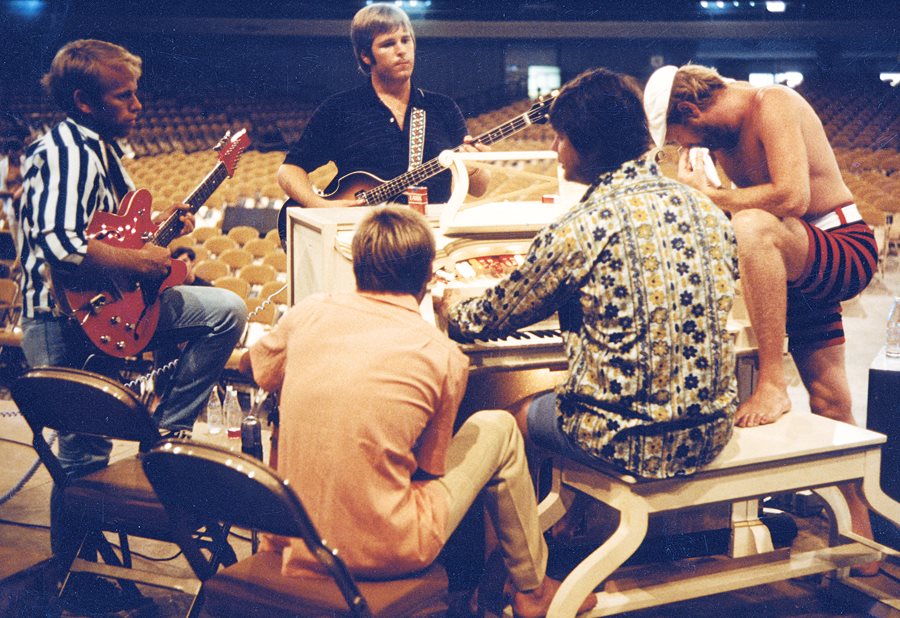
On August 25th and 26th, 1967, The Beach Boys (absent Bruce Johnston, but with Brian Wilson on organ in his first concert appearances with the band in more than two years) recorded two concerts and rehearsals in Honolulu for a prospective live album to be titled Lei'd In Hawaii, applying a new Smiley Smile-inspired aesthetic to the performances. Just over two weeks later, the band (with both Brian and Bruce participating) began re-recording the live set in-studio at Brian's house and at Wally Heider Recording in Hollywood, after theHonolulu concert tapes were deemed unusable. Although completed and mixed, the final planned audio element of a canned concert audience was not added and the Lei'd In Hawaii project was canceled. Those live, in-studio performances morphed into sessions for the Wild Honey album, primarily comprised of original Brian Wilson/Mike Love compositions.

In a 1976 look back at 1967's most heralded albums, Village Voice critic Robert Christgau praised Wild Honey with an "A+" review, writing, "It's perfect and full of pleasure; it does what it sets out to do almost without a bad second."

Bruce Johnston says that Wild Honey showcases a band devoid of pressure: "Here's the thing – the most important thing – you need to know about Wild Honey. It was just an album for us to exhale and do something real simple; but as it's Brian and Mike's music, it's still fabulous and not so simple. I love the album."

Two days after wrapping the Wild Honey sessions on November 15th, 1967, Mike Love, Carl and Dennis Wilson, Al Jardine, and Bruce Johnston returned to the road for The Beach Boys' Thanksgiving Tour, premiering several songs from the forthcoming album at their concerts.


Excerpted from the 1967 – Sunshine Tomorrow Producers Notes by Mark Linett and Alan Boyd:
After the decision was made to shelve the unfinished SMiLE album in early 1967, The Beach Boys opted to return to recording as a self-contained band, working mostly at Brian Wilson's home and using rented recording equipment. The two albums they released that year,Smiley Smile and Wild Honey, were both originally presented in mono only (with Capitol also issuing re-channeled "pseudo stereo" editions). Smiley Smile was remixed and released in stereo in 2012. Now, at last, The Beach Boys and Capitol present the first true stereo mix of Wild Honey, along with outtakes, session highlights, and selected backing tracks from both the Smiley Smile and Wild Honey sessions.

Note that the 8-track master for "Mama Says" could not be located, so that song is presented here in its original mono mix. In addition, the organ solo on "How She Boogalooed It" was actually overdubbed as the song was being mixed to mono (as was the organ on the rest of the song), so that section is also presented in mono.

The Beach Boys: 1967 – Sunshine Tomorrow [2CD, digital]


Disc 1
Image result for the beach boys wild honey  1967

Wild Honey Album (Stereo)
(New stereo mix, except as noted *. Recorded September 15 to November 15, 1967 at Brian Wilson's house and at Wally Heider Recording in Hollywood, California)
1. Wild Honey (2:45)
2. Aren't You Glad (2:16)
3. I Was Made To Love Her (2:07)
4. Country Air (2:21)
5. A Thing Or Two (2:42)
6. Darlin' (2:14)
7. I'd Love Just Once To See You (1:49)
8. Here Comes The Night (2:44)
9. Let The Wind Blow (2:23)
10. How She Boogalooed It (1:59)
11. Mama Says * (Original Mono Mix) (1:08)

Wild Honey Sessions: September - November 1967 (Previously Unreleased)

12. Lonely Days (Alternate Version) (1:45)
13. Cool Cool Water (Alternate Early Version) (2:08)
14. Time To Get Alone (Alternate Early Version) (3:08)
15. Can't Wait Too Long (Alternate Early Version) (2:49)
16. I'd Love Just Once To See You (Alternate Version) (2:22)
17. I Was Made To Love Her (Vocal Insert Session) (1:35)
18. I Was Made To Love Her (Long Version) (2:35)
19. Hide Go Seek (0:51)
20. Honey Get Home (1:22)
21. Wild Honey (Session Highlights) (5:39)
22. Aren't You Glad (Session Highlights) (4:21)
23. A Thing Or Two (Track And Backing Vocals) (1:01)
24. Darlin' (Session Highlights) (4:36)
25. Let The Wind Blow (Session Highlights) (4:14)

Wild Honey Live: 1967 - 1970 (Previously Unreleased)
26. Wild Honey (Live) (2:53) - recorded in Detroit, November 17, 1967
27. Country Air (Live) (2:20) - recorded in Detroit, November 17, 1967
28. Darlin' (Live) (2:25) - recorded in Pittsburgh, November 22, 1967
29. How She Boogalooed It (Live) (2:43) - recorded in Detroit, November 17, 1967
30. Aren't You Glad (Live) (3:12) - recorded in 1970, location unknown

31. Mama Says (Session Highlights) (3:08)
(Previously unreleased vocal session highlights. Recorded at Wally Heider Recording, November 1967)

Disc 2
Image result for the beach boys in hawaii 1967

Smiley Smile Sessions: June - July 1967 (Previously Unreleased)
(Recorded June and July 1967 at Brian Wilson's house, Western Recorders, SRS, and/or Columbia Studios, except as noted *)
1. Heroes And Villains (Single Version Backing Track) (3:38)
2. Vegetables (Long Version) (2:55)
3. Fall Breaks And Back To Winter (Alternate Mix) (2:28)
4. Wind Chimes (Alternate Tag Section) (0:48)
5. Wonderful (Backing Track) (2:23)
6. With Me Tonight (Alternate Version With Session Intro) (0:51)
7. Little Pad (Backing Track) (2:40)
8. All Day All Night (Whistle In) (Alternate Version 1) (1:04)
9. All Day All Night (Whistle In) (Alternate Version 2) (0:50)
10. Untitled (Redwood) * (0:35)
(Previously unreleased instrumental fragment. Studio and exact recording date unknown. Discovered in tape box labeled "Redwood")

Lei'd In Hawaii "Live" Album: September 1967 (Previously Unreleased)
(Recorded September 11, 1967 at Wally Heider Recording in Hollywood, CA, with additional recording September 29, 1967 (except as noted *). Original mono mixes from assembled master ½" reel, dated September 29, 1967, discovered in the Brother Records Archives.)
11. Fred Vail Intro (0:24)
12. The Letter (1:54)
13. You're So Good To Me (2:31)
14. Help Me, Rhonda (2:24)
15. California Girls (2:30)
16. Surfer Girl (2:17)
17. Sloop John B (2:50)
18. With A Little Help From My Friends * (2:21)
(Recorded at Brian Wilson's house, September 23, 1967)
19. Their Hearts Were Full Of Spring * (2:33)
(Recorded during rehearsal, August 26, 1967, Honolulu, Hawaii)
20. God Only Knows (2:45)
21. Good Vibrations (4:13)
22. Game Of Love (2:11)
23. The Letter (Alternate Take) (1:56)
24. With A Little Help From My Friends (Stereo Mix) (2:21)

Live In Hawaii: August 1967 (Previously Unreleased)
(The Beach Boys recorded two complete concerts and rehearsals in Honolulu on August 25 and 26, 1967. Brian Wilson rejoined the group onstage for these shows; Bruce Johnston was not present. The following tracks derive from the original 1" 8-track master reels discovered in the Brother Records Archives.)
25. Hawthorne Boulevard (1:05)
26. Surfin' (1:40)
27. Gettin' Hungry (3:19)
28. Hawaii (Rehearsal Take) (1:11)
29. Heroes And Villains (Rehearsal) (4:45)

Thanksgiving Tour 1967: Live In Washington, D.C. & Boston (Previously Unreleased)
(The touring Beach Boys - Mike, Carl, Dennis, Al, and Bruce – embarked on a Thanksgiving Tour immediately after delivering the finished Wild Honey album to Capitol Records. For this tour, the band was augmented by Ron Brown on bass and Daryl Dragon on keyboards.)
30. California Girls (Live) (2:32) - recorded in Washington, DC, November 19, 1967
31. Graduation Day (Live) (2:56) - recorded in Washington, DC, November 19, 1967
32. I Get Around (Live) (2:53) - recorded in Boston, November 23, 1967

Additional 1967 Studio Recordings (Previously Unreleased)
33. Surf's Up (1967 Version) (5:25)
(Recorded during the Wild Honey sessions in November 1967)
34. Surfer Girl (1967 A Capella Mix) (2:17)
(Previously unreleased mix of Lei'd In Hawaii take from the Wally Heider Recording sessions in September 1967)