THE Friday Boys are a disparate group of men spread across Tyneside who meet once a week - 'always on a Friday' - to talk about the arts, raise a glass to recently departed heroes and villains and, at the evening's end, down a whisky or two. The FBs have only one golden rule - talk of the working week is strictly off-limit.
Quentin Blake profiles of one of the most influential cartoon strips of the 20th century and its creator George Herriman, the first black cartoonist in print. From August 2007.
Many Negroes from the Bayou country could and did pass for white. They, too, had hank-straight black hair, dark eyes and shell-cream skin. —Maya Angelou, “Singin’ and Swingin’ and Gettin’ Merry like Christmas”
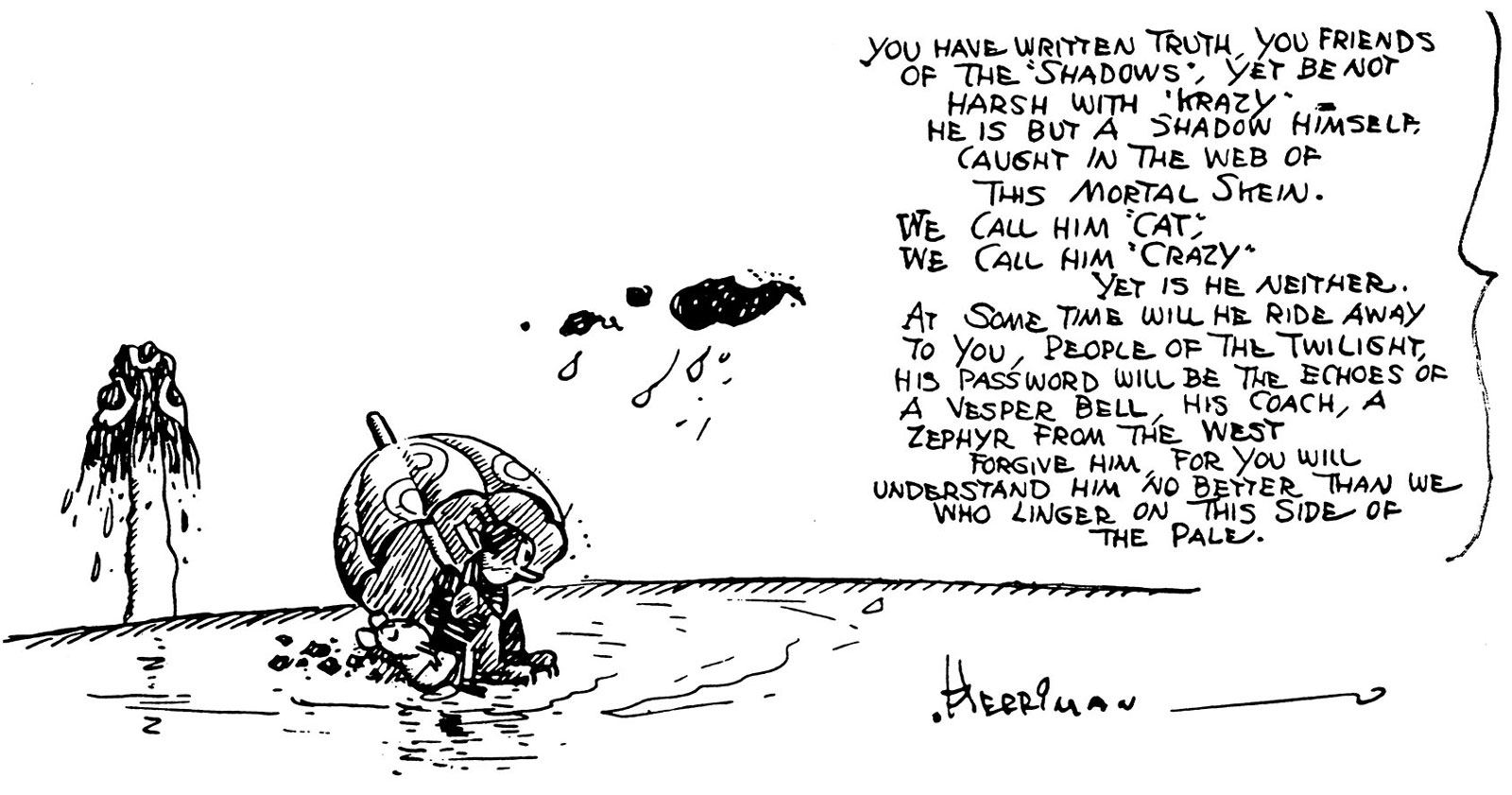
For one of the most prolific and highly-praised cartoonists who ever lived, George Herriman, the creator of Krazy Kat (1913-1944), didn’t like talking about himself. Recoiling from photographers and brushing off personal questions with elliptical answers and even occasional fabrications, George or “Garge” or “The Greek” always preferred the focus to be on the multivalent, multifarious, and multicultural characters who populated the inner world he made every day with the scratchings of his pen. A direct throughline of thought-to-gesture in black ink on white paper, George Herriman’s drawings come alive before the reader’s eye with a vital, persuasive complexity previously unknown in the history of art. Krazy Kat lived on the page—but he—or she—had a secret. And so did George Herriman. Krazy Kat has been described as a parable of love, a metaphor for democracy, a “surrealistic” poem, unfolding over years and years. It is all of these, but so much more: it is a portrait of America, a self-portrait of Herriman, and, I believe, the first attempt to paint the full range of human consciousness in the language of the comic strip. Like the America it portrays, Herriman’s identity has been poised for a revision for many decades now. Michael Tisserand’s new biography Krazy does just that, clearing the shifting sands and shadows of Herriman’s ancestry, the discovery in the early 1970s of a birth certificate which described Herriman as “colored” sending up a flag among comics researchers and aficionados. Tisserand confirms what for years was hiding in plain sight in the tangled brush of Coconino County, Arizona, where Krazy Kat is supposedly set: Herriman, of mixed African-American ancestry, spent his entire adult life passing as white. He had been born in the African-American neighborhood of racially mixed, culturally polyglot 1880s New Orleans, but within a decade Herriman’s parents moved George and his three siblings to the small but growing town of Los Angeles to escape the increasing bigotry and racial animosity of postbellum Louisiana. The Herrimans melted into California life, and it was there that George, with brief professional spates in New York, would remain for the rest of his life. But imagine knowing something about yourself that’s considered so damning, so dire, so disgusting, that you must, at all cost, never tell anyone. Imagine leaving behind a life to which you cannot claim allegiance or affection. Imagine suddenly gaining advantages and opportunity while you see others like you, who have not followed in the footsteps of your deception, suffering. Herriman, once he was considered white, didn’t even have a way of voicing this identity. Until he started drawing Krazy Kat. I may be in the minority here, but I really think that most if not all readers of Krazy Katduring Herriman’s lifetime would have had a hard time thinking of Krazy as anything but African-American. Krazy’s patois, social status, stereotypical “happy-go-lucky despite it all” disposition all funnel into a rather pointed African-American identity. And Herriman, confoundingly, was not above using racial and even racist imagery himself, his early work especially filled with eye-popping stereotypes and blackface caricatures. At the turn of the century, when Herriman was just starting his career, the nineteenth-century cultural phenomenon of blackface minstrelsy, while admittedly in the early process of passing into nostalgia, was still prevalent. Large orchestral shows of dozens of performers like Haverly’s and Christy’s Minstrels, grotesquely metastasized from the already ghastly four-person troupes, filled vaudeville halls and theaters; blackface performances, in a cruel twist of cultural fairness, were the first places for African-American performers to find a foothold. (W. C. Fields called Bert Williams, probably still the best known African-American entertainer from this era, “the saddest man I ever knew.”) At the same time, a reader alive in the early part of the twentieth century probably didn’t really have to think about these associations any more specifically than we think the “Minions” sound vaguely Latino, or why Felix the Cat or Mickey and his minstrel mouse gloves were so funny. Of course Krazy Kat was black. A funny black cat. Just the right amount of slippage and shift in Krazy’s animus, helped along by a tradition of children’s animal stories, was all that was necessary for him/her to be two things—and nothing—all at once. Nevertheless, one detail in Herriman’s strip that would have absolutely cemented this identity in the minds of contemporary readers has since passed into obscurity: Krazy Kat’s banjo. Through received clichés and shifts of poverty and culture in America, the banjo has come to be thought of as an instrument of poor whites, but at the turn of the century, it was as emblematic as a watermelon as part of the African-American stereotype. In fact, the banjo has a solemn origin: descended from the West African akonting, xalam, and ngoni instruments, played as an accompaniment to storytelling by Wolof griots in Senegal or the Jola in Gambia, early instruments like what became the American banjo were recreated by American slaves from whatever plantation materials were at hand—gourds, turtle shells, coconuts, animal skins—to try to hold on to a memory of life and culture torn from their grasp. A Krazy Kat strip left unfinished at Herriman’s death, April 1944
To the modern reader, the banjo in Krazy Kat might seem a lighthearted accessory, but when Krazy picks it up to sing “There is a Heppy Land Fur, Fur Away,” the meaning, to thoughtful readers of the 1920s to the 1940s, would have been clear. Even more astonishingly, Krazy never plays a “proper” banjo, but plays the gourd or coconut banjo, the origins of which by the time of the strip’s appearance would indeed have been obscure. Herriman knew what he was doing, and it’s not insignificant that the very last strip he left unfinished on his drawing table showed Krazy playing a gourd banjo. The earliest representation known of such an instrument appears in the watercolor The Old Plantation, painted by South Carolina slaveholder John Rose in the late eighteenth century.
The Old Plantation, attributed to John Rose, Beaufort County, South Carolina, circa 1785-1790
What do these racial and cultural connections mean for how we see Herriman’s work? From their dimming over the years compared with Krazy Kat’s increasing artistic incandescence, they are clearly not necessary to an appreciation of the strip. But put yourself in Herriman’s shoes, and then reread Krazy Kat with this knowledge rewoven into the tapestry of his work. Think of pink Ignatz, the mouse who is Krazy’s constant tormentor. Think of the brick. Think of what W.E.B. DuBois called the “dual consciousness” of African-Americans, think of the brick hitting Krazy, over and over and over again. (Tisserand shrewdly notes that a July 30, 1866, New Orleans race riot, which Herriman’s father may have witnessed, started when a white boy threatened to throw a brick at African-American soldiers parading through the town.) Think of what recasting that gesture of hate as one of love actually means to its recipient. Think of the lynchings of the 1910s, the race riots of the 1960s, the American police shootings of 2016, the iPhone videos that continually show the treatment of African-Americans as property. Think of Barack Obama, half Scotch-Irish, half African.
George Herriman, circa 1940
George Herriman saw the history of America and its future and wrote it in ink as a dream on paper, and it is a dream that is still coming true. In December, disparate Native-American tribes and activists who had gathered in North Dakota for months staved off an oil pipeline that would have cut through ancestral Sioux burial lands; Herriman began visiting the Diné or Navajo nation and befriending its citizens before some western states were even twenty-five years old. Navajo rug patterns and the folklore of Monument Valley came to define the very cosmos of Krazy Kat. (A wonderful detail in Tisserand’s book recalls Herriman, who had Hollywood friends, setting up a private screening of older western movies with actual Navajo supporting actors for a Navajo audience, solely because the actors had said insulting things in their native language that only the Native audience could understand.) And our most recent election involved debates about the equality of transgender teens, of those trapped inside a body by which they feel betrayed. Krazy Kat’s self-defining gender-switching—“I don’t know if I should take a husband or a wife,” Krazy once remarks—couldn’t be more timely, more oracular. Nor, sadly, could Ignatz’s seemingly implacable hatred. Even sadder, in that same American election, Ignatz won. Everyone “passes” in some way or another; everyone has something they’d rather not discuss, something of their history they’re trying to downplay or hide, some story that doesn’t jibe with the vision and identity they’d prefer to have. This is the essence of fiction. Every one of us nightly, daily, hourly—every minute—reviews, sorts, discards, rewrites details that allow us to somehow get on with our lives, unrecorded acts of revision tantamount to what a writer commits professionally on a page. Do it well, and you’re mentally healthy. Do it badly, and you’re crazy. Fundamentally, we understand others only as refractions through the optic of ourselves, and fiction not only offers an alternative construct, but in its finest form allows the reader to inhabit, and most importantly, to empathize with another consciousness. (Or in Herriman’s case, with a cartoon cat.) So is kaleidoscopic Krazy really the crazy one, whom Ignatz can only understand through the reducing lens of his narrow, white mind? Lately, I’ve been wondering if Herriman knew that one day his secret-in-plain-sight would be uncovered, that America would change, adapt and grow up enough as a people to understand Krazy Kat in all of its psychological and poetic depth. I’m not sure if we’ve yet reached that point, but what myself and other cartoonists already knew—that the strip was already the greatest ever drawn—is now magnified, multiplied and maximized. Krazy Kat is not just one of the greatest comic strips, it’s one of the strangest, most inventive, emotional, and personal works of art of the twentieth century. In their admiration for Herriman, Philip Guston, Willem de Kooning, and Jack Kerouac sensed something in his line and voice that was endemically American, deeply felt. Herriman should now take his rightful place as one of the most original African-American voices of the early twentieth century, contemporary with, if not predating, Richard Wright and Zora Neale Hurston as one of the first writers to understand the racial animus of America and to try to fix the essence of black consciousness on paper. That Herriman made it come alive, sing, dance and suffer in an art form barely fifty years old is all the more astonishing. For decades, we’ve all been reading and laughing and, most of all, feeling for Krazy Kat, who passed right under our eyes as a living drawing on a page. But what we were really feeling came straight from the heart. It was the very soul of George Herriman himself. Adapted from an essay to appear in the catalog of an exhibition on George Herriman at the Museo Nacional Centro de Arte Reina Sofía, Madrid, Spain, opening in October 2017.
Michael Tisserand’s Krazy: George Herriman, A Life in Black and White has just been published by HarperCollins. The collected Krazy Kat strips are published by Fantagraphics.
James Rosenquist, who helped define Pop Art in its 1960s heyday with his boldly scaled painted montages of commercial imagery, died on Friday in New York City. He was 83 years old.
His wife, Mimi Thompson, said Mr. Rosenquist died at his home after a long illness.
Like his contemporaries Andy Warhol and Roy Lichtenstein, Mr. Rosenquist developed a powerful graphic style in the early 1960s that traditionalists reviled and a broad public enthusiastically embraced.
The Pop artists took for their subject matter images and objects from the mass media and popular culture, including advertising, comic books and consumer products. They also employed techniques that until then had been associated primarily with commercial and industrial methods of production, like silk screening or, in Mr. Rosenquist’s case, billboard painting.
Mr. Rosenquist himself drew on his experience painting immense movie billboards above Times Square and a Hebrew National sign in Brooklyn.
It was while working in New York as a sign painter by day and an abstract painter by night that he had the idea to import the giant-scale, broadly painted representational pictures from outdoor advertising into the realm of fine art.
“Was importing the method into art a bit of a cheap trick?” the critic Peter Schjeldahl wrote in The New Yorker in 2003 on the occasion of a ballyhooed retrospective of Mr. Rosenquist’s work at the Guggenheim Museum in New York. “So were Warhol’s photo silk-screening and Lichtenstein’s limning of panels from comic strips.
President Elect (1960/1 - 1964)
“The goal in all cases,” Mr. Schjeldahl added, “was to fuse painting aesthetics with the semiotics of media-drenched contemporary reality. The naked efficiency of anti-personal artmaking defines classic Pop. It’s as if someone were inviting you to inspect the fist with which he simultaneously punches you.”
Mr. Rosenquist drew inspiration, too, from the tradition of Surrealistic collage, as well as from the montage designs of contemporary advertising, to create disjunctive compositions of cropped and fragmented images of cars, movie stars, food products and domestic appliances.
Though painted by hand in a lucidly simplified realistic style, the juxtapositions of images remain mysterious. The paintings could be viewed both as critiques of modern consumerism and as glimpses into the collective American consciousness.
“The art’s formal ingenuity can jump out at you as forcefully as the grill of a Ford or a fragment of Marilyn Monroe’s lips or the cap from a Pepsi bottle or a stack of Fiesta dishes in a dish rack,” Michael Kimmelman wrote in The New York Times, also in 2003.
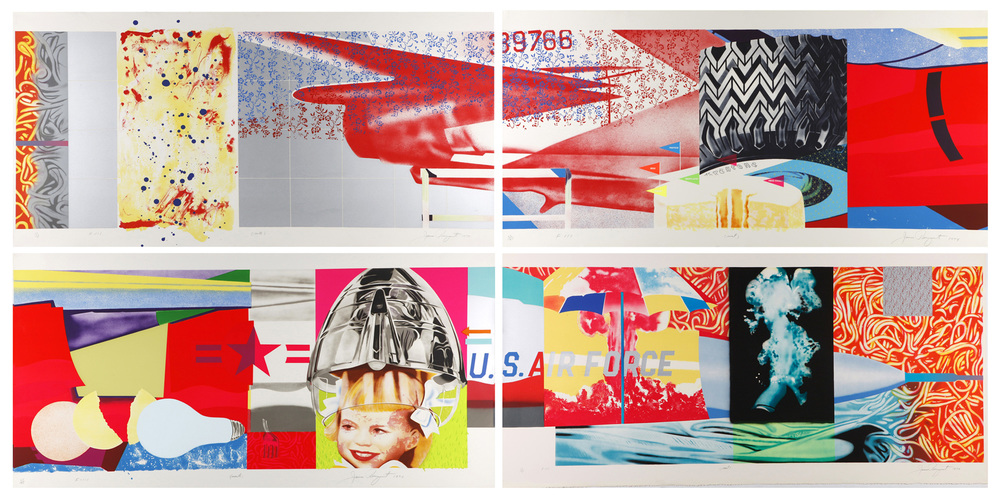
Mr. Rosenquist’s paintings rarely contained overt political messages, but his best-known work, the enormous "F-111," was made in 1964 and 1965 in part as a protest against American militarism. In it, the image of a modern fighter plane stretching 86 feet across a grid of 51 canvas and aluminum panels is interrupted by images of a colossal tire, a beach umbrella, a mushroom cloud, spaghetti and tomato sauce, and a little girl under a chrome hair dryer that resembles a warhead.
James Rosenquist in 1969
Mr. Rosenquist meant to sell the painting as separate panels, but the collector Robert Scull bought it whole and kept it that way. It is now in the collection of the Museum of Modern Art in New York.
James Albert Rosenquist was born in Grand Forks, N.D., on Nov. 29, 1933, and grew up in various towns in Minnesota and Ohio before his parents settled in Minneapolis in 1944. His father, Louis, was an airplane mechanic, among other things. His mother, Ruth, an amateur painter who could also fly a plane, encouraged his interests in art, and he won a scholarship to study at the Minneapolis Institute of Arts when he was in junior high school.
Mr. Rosenquist studied art at the University of Minnesota from 1952 to 1954, and during his summer vacation in 1953 he worked for a contractor painting gas station signs, storage tanks and grain silos.
After receiving an associate degree in studio art, he went to work for a billboard company painting advertisements for movies, liquor and soft drinks. One assignment, during the Davy Crockett craze that swept the United States on the heels of a Walt Disney mini-series, was to paint eight-foot-wide coonskin caps.
In 1955, Mr. Rosenquist received a one-year scholarship to the Art Students League in New York, arriving with $350 in his pocket, he said. He studied there with Will Barnet, Edwin Dickinson and George Grosz, among others.
Marilyn (1974)
He also began frequenting the Cedar Tavern in Greenwich Village, a gathering place for painters and poets. “There was Bill de Kooning, Franz Kline,” Mr. Rosenquist told The Times in 2003.
After leaving school the next year, he held a series of odd jobs before returning to sign painting, joining the sign painters union and working mostly for the Artkraft Strauss Sign Corporation, which painted some of the largest billboards in the world.
“Much of the aesthetic of my work comes from doing commercial art,” Mr. Rosenquist said. “I painted pieces of bread, Arrow shirts, movie stars. It was very interesting. Before I came to New York I wanted to paint the Sistine Chapel. I thought this is where the school of mural painting exists. You were painting things up close, like big chocolate cakes. In Brooklyn, I painted Schenley whiskey bottles two stories high, 147 of them over every candy store.”
He continued the work until 1960, when he quit for good after two co-workers fell from a scaffold and died. I Love You with My Ford (1961)
That year he rented the former studio of Agnes Martin at 3-5 Coenties Slip, a building on the East River in Lower Manhattan where Robert Indiana, Ellsworth Kelly, Jasper Johns and Jack Youngerman also had studios.
Until then, Mr. Rosenquist had been making paintings consisting of allover fields of brushmarks in the spirit of Abstract Expressionism. Now, influenced in part by the works of Robert Rauschenberg and Mr. Johns, whom he had gotten to know, he began to use his sign painting skills.
During the course of his career, Mr. Rosenquist experimented with sculptural assemblage and environmental installations, and he sometimes attached three-dimensional objects to his pictures. But he remained mainly a representational painter. In later years, some of his paintings approached a kind of futuristic, kaleidoscopic abstraction, but the play with different sorts of images and illusions persisted.
Mr. Rosenquist’s first marriage, to Mary Lou Adams, ended in divorce. He is survived by Ms. Thompson, his second wife; his son John, from his first marriage, his daughter Lily, from his second marriage, and a grandson, Oscar.
Mr. Rosenquist’s first solo exhibition, at the Green Gallery in 1962, sold out. That same year his work was included in a survey of new art at Sidney Janis Gallery called “International Exhibition of the New Realists” that put what would soon come to be known as Pop Art on the map of contemporary consciousness.
F-111 (detail)
In 1965, he showed “F-111” in his first exhibition at the Leo Castelli Gallery, which by then represented most of major Pop artists.
The painting was subsequently exhibited at the Jewish Museum and then taken on a tour or Europe. Besides the show at the Guggenheim in 2003, Mr. Rosenquist had museum retrospectives at the National Gallery of Canada in Ottawa in 1968; the Whitney Museum of American Art in New York in 1972; and the Denver Art Museum in 1985. He had an exhibition at the Haunch of Venison Gallery in London, now defunct, in 2006, and a solo show at the Acquavella Galleries in New York in 2012. His most recent exhibition opened last fall at the Galerie Thaddaeus Ropac in Paris. And the Museum Ludwig in Cologne, Germany, will host an exhibition of his work later this year.
For many years he worked out of a loft building on Chambers Street that he bought in 1977 for $120,000. In 1978, he was appointed by President Jimmy Carter to a six-year term on the National Council on the Arts, a group that advises the National Endowment for the Arts.
In later years he spent much of his time in Aripeka, Fla., where he kept a home, an office and studio space. A catastrophic fire destroyed the properties in 2009.
William Acquavella, the New York art dealer, said that Mr. Rosenquist lost a significant amount of work in the fire. Rosenquist in 2009
“He just rebounded from it,” he said. “Another guy would have had a tougher time bouncing back. But he enjoyed working, he enjoyed creating things, and he enjoyed painting.”
Mr. Rosenquist also had homes in Bedford, N.Y., and Miami. Recently, he had been spending most of his time in New York City, Ms. Thompson said.
In 2009, Mr. Rosenquist published an autobiography, “Painting Below Zero: Notes on a Life in Art,” written with David Dalton. Reviewing it in The New York Times, Dwight Garner called it “a ruddy and humble book, lighted from within by the author’s plainspoken, blue-collar charm.”
In the book, Mr. Rosenquist talked about the movement he helped launch.
“Pop Art. I’ve never cared for the term, but after half a century of being described as a Pop artist I’m resigned to it,” he said. “Still, I don’t know what Pop Art means, to tell you the truth.”
Chuck Barris, Producer and Personality of ‘Gong Show’ Fame, Dies at 87
Neil Genzlinger
The New York Times
22 March 2017
Chuck Barris, the “Gong Show” creator, songwriter and novelist who sought to add to his already eclectic résumé with a made-up — or was it? — story about being an assassin for the C.I.A., died on Tuesday at his home in Palisades, N.Y. He was 87.
His death was announced by a spokesman, Paul Shefrin.
“The Gong Show” was just one of Mr. Barris’s hit game show creations. In the 1960s he came up with “The Dating Game” and “The Newlywed Game,” making a spectacle of his contestants’ romantic yearnings in the first case and their honeymoon-period bliss, adjustments and foibles in the second.
Mr. Barris might have earned a brief mention in the obituary pages with one of his earliest accomplishments: He wrote the pop song “Palisades Park,” which became a hit for Freddy Cannon in 1962 and an emblem of that period of good-time rock ’n’ roll just before the genre’s harder, louder side emerged.
Decades later, in 2007, Mr. Cannon, a Massachusetts native, wanted to rework the song into a rally ditty for his favorite baseball team, the Boston Red Sox. But, he told The Boston Globe, he received a complaint from Mr. Barris, a Yankee fan, and so “Down at Fenway Park” ended up being a Cannon original rather than a repurposed Barris.
Mr. Barris wrote “Palisades Park” along an odd path to an eventual career in television. He was born in Philadelphia on June 3, 1929. to Dr. Nathaniel Barris, a dentist, and the former Edith Cohen; his father died when he was young.
After graduating from Drexel University in his home city in 1953, he was accepted into a management training program at NBC in 1955. But, he told The Philadelphia Inquirer in 2003, the department he was placed in — daytime sales — was eliminated, and he found himself trying, unsuccessfully, to sell the devices then known as TelePrompTers.
During the payola scandals of the 1950s, he was hired to keep a young ABC star, Dick Clark, of “American Bandstand,” out of trouble. (“He sat around doing nothing all day but drawing on a pad of paper,” Mr. Clark told The Inquirer.) By 1959 he was ABC’s director of West Coast daytime programming.
But he wanted to make his own shows, and in 1965 he came up with “The Dating Game,” in which a bachelorette or bachelor would choose a date from among three unseen members of the opposite sex after asking them questions.
He followed that the next year with “The Newlywed Game,” another question-and-answer show that put just-married couples’ compatibility to the test. Both shows stayed on the air into the mid-1970s and spawned assorted sequels (“The All-New Dating Game” and “The New Newlywed Game”).
Mr. Barris’s next game shows were less successful, but just as it seemed he was losing his touch, he came up with the concept that would catapult him to a new level of fame: “The Gong Show,” which had its premiere on NBC in June 1976. The show featured a series of performers, most of them amateurs, and a panel of three celebrity judges. Mr. Barris himself was the brash, irritating host.
The performers, who were often terrible, would be allowed to go on until one of the judges couldn’t stand it anymore and sounded a gong, putting an end to the spectacle. Those who weren’t gonged were rated by the judges on a 1-to-10 scale. In keeping with the ridiculousness of the proceedings, the prize amount they vied for was ridiculous: $516.32 on the daytime version of the show, $712.05 on the prime-time edition.
The show, which ran on NBC until 1978 and then in syndication (with revivals in later years), became a cultural sensation. Critics complained about its crassness and cruelty, but Mr. Barris, like purveyors of burlesque and circus sideshows in earlier generations, knew there was a large audience for lowbrow. At one point the daytime version was attracting 78 percent of viewers 18 to 49.
“In my opinion, a good game show review is the kiss of death,” Mr. Barris said in a Salon interview in 2001. “If for some strange reason the critic liked it, the public won’t. A really bad review means the show will be on for years.”
The ghost of “The Gong Show” is evident in numerous reality-television shows of more recent vintage — the early rounds of any given season of “American Idol,” for instance.
Mr. Barris always bristled at the “King of Schlock” label that was hung on him as far back as “The Dating Game.” In a 2003 interview with Newsweek, he noted that shows much like the ones he created were by the 21st century being received differently.
“Today these shows are accepted,” he said. “These shows aren’t seen as lowering any bars.”
By the end of the 1970s, thanks to “The Gong Show,” Mr. Barris’s television production company was busy and profitable, but he was itchy to try something else. What he tried, disastrously, was “The Gong Show Movie,”which he directed and, with Robert Downey Sr., wrote. It was released in May 1980 and flopped.
Mr. Barris gradually withdrew from television, selling his holdings, spending most of his time in France and turning to writing. He had already written one book, “You and Me, Babe” (1974), a novel about a television producer whose marriage failed; it drew heavily on his own rocky marriage to Lyn Levy, a niece of the powerful CBS chief William S. Paley, in the 1950s. They were divorced in 1976.
That first book sold well, but it was the next one that would give Mr. Barris yet another burst of notoriety: “Confessions of a Dangerous Mind” (1984), a supposed autobiography in which he claimed that while traveling in his role as a television producer in the 1960s he was also an assassin for the C.I.A.
The book got only a smattering of attention, but it caught some eyes in Hollywood, and in 2003, after many delays, a film version came out, directed by George Clooney and starring Sam Rockwell as Mr. Barris. (Charlie Kaufman wrote the screenplay, embellishing Mr. Barris’s tale.)*
The film brought Mr. Barris, by now in his 70s, a fresh round of publicity and endless variations on the obvious question: Was it true? Mr. Barris generally played coy, delivering elliptical answers that neither confirmed nor denied. The C.I.A. was more direct: Various spokesmen said Mr. Barris had had nothing to do with the agency.
In later years Mr. Barris continued to write books, among them the comic novels “The Big Question” (2007), about an outlandish game show where the stakes are literally life or death, and “Who Killed Art Deco?” (2009), about the murder of a wealthy young man.
In 2010 he turned to a much more serious subject with “Della: A Memoir of My Daughter,” telling the story of his only child — from his marriage to Ms. Levy — who as a girl sometimes turned up on “The Gong Show.” She died of a drug overdose in 1998, at 36.
Mr. Barris’s second marriage, to Robin Altman, ended in divorce in 1999. He is survived by his wife, the former Mary Clagett.
Which of his several careers was his favorite? In 2007, during an appearance at the Book Passage bookstore in Corte Madera, Calif., he dealt with the question.
“When you go to that great game show in the sky,” he asked himself, “would you rather be known as an author or as a TV game show producer?”
“That’s the easiest question of all,” he responded. “I would love to be known as an author, but I don’t think it’s written that that’s the way it’s going to be. I think on my tombstone it’s just going to say, ‘Gonged at last,’ and I’m stuck with that.”
As I went down to Dymchurch Wall,
I heard the South sing o'er the land
I saw the yellow sunlight fall
On knolls where Norman churches stand.
And ringing shrilly, taut and lithe,
Within the wind a core of sound,
The wire from Romney town to Hythe
Along its airy journey wound.
A veil of purple vapour flowed
And trailed its fringe along the Straits;
The upper air like sapphire glowed:
And roses filled Heaven's central gates.
Masts in the offing wagged their tops;
The swinging waves pealed on the shore;
The saffron beach, all diamond drops
And beads of surge, prolonged the roar.
As I came up from Dymchurch Wall,
I saw above the Downs' low crest
The crimson brands of sunset fall,
Flicker and fade from out the West.
Night sank: like flakes of silver fire
The stars in one great shower came down;
Shrill blew the wind; and shrill the wire
Rang out from Hythe to Romney town.
The darkly shining salt sea drops
Streamed as the waves clashed on the shore;
The beach, with all its organ stops
Pealing again, prolonged the roar.