Friday, 9 September 2016

Dead Poets Society #8 Langston Hughes: Park Bench

Image result for langston hughes

Park Bench  by Langston Hughes

I live on a park bench.
You, Park Avenue.
Hell of a distance
Between us two.

I beg a dime for dinner-
You got a butler and maid.
But I'm wakin' up!
Say, ain't you afraid

That I might, just maybe,
In a year or two,
Move on over
To Park Avenue?

Thursday, 8 September 2016

Last night's set lists

At The Habit, York: -

Da Elderly: -
Teach Your Children
Flying On The Ground Is Wrong
I Don't Want To Talk About It


Ron Elderly: -
Wild Horses
The River
Wagon Wheel


The Elderly Brothers: -
Love Hurts
Yes I Will
Then I Kissed Her
Let It Be Me
I Saw Her Standing There
He'll Have To Go


Our regular host returned to an initially quiet evening in The Habit, but as the night progressed both punters and players helped fill the venue for the last hour or so. There was the usual mix of original songs and covers. One chap insisted on playing unplugged and sang a couple of lively, if somewhat offensive tunes. After some good-natured banter during The Elderly Brothers' set, it was time for revenge as our host sang Billy Joel's She's Always A Woman: some Les Dawson-style non-harmonies during the 'oooh's being particularly pleasing!!

Tuesday, 6 September 2016

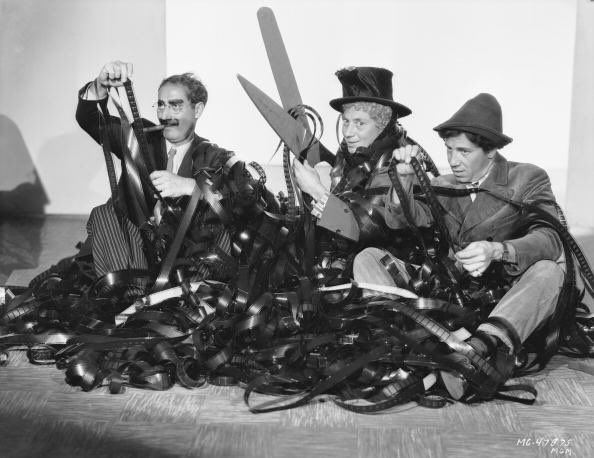
The Annotated Marx Brothers by Matthew Coniam - review

Image result for the annotated marx brothers
Marxist Archaeology
Matthew Coniam – The Annotated Marx Brothers: A Filmgoer’s Guide to In-Jokes, Obscure References and Sly Details (McFarland and Company, Inc., Publishers, Jefferson, North Carolina, 2015)

I love this book. I hate this book.

I love it because you can dip into it to look up some detail that you thought was really central to your understanding of the film but I hate it because it’s so easy to get distracted and wind up looking for some other reference and forgetting what you were after in the first place. It’s that good! In fact, it’s better than that, because ultimately it sends the reader back to the films and that can’t be bad, can it?

Something of an extension to Greg Mitchell’s The Marx Brothers Companion (and get the original version of this if you can, not the later one on the cheaper paper), Matthew Coniam’s book is concordance covering all the films in which they appeared as the Marx Brothers and their TV comedy special, The Incredible Jewel Robbery (1959), explaining allusions in jokes and plotlines that may have been current at the time but might now confuse even the most dedicated Marxian scholar. Who were “those five kids up in Canada”? Who or what was “Minnie the Moocher?” And just when did Don Ameche invent the telephone?

For example, in Horse Feathers (1932), what does being “on the pan” mean? No, not what you think. It means you’re being told off. Fortunately, Coniam, author of the weblog, The Marx Brothers Council of Britain (http://marxcouncil.blogspot.co.uk/) , never loses sight of the joke and doesn’t rake over the humour to the extent where it stops being funny. If anything, it’s more an exercise in enlightenment of the finest kind.

Other references are more complicated. In Monkey Business (1931), when Groucho says, “Come Kapellmeister, let the violas throb. My regiment leaves at dawn,” the audiences of the time would understand that he is mocking the conventions of operettas like The Merry Widow, but this is used as a starting point to riff on the sparky relationship between Groucho and writer S J Pereleman, who contributed the line, although the precise level of his involvement in the rest of the film is still debated, as is his true relationship with Groucho.

One of the few things that defeats the author and his colleague David Cory, who provides a separate concordance for the Harold Arlen-Yip Harburg number Lydia the Tattooed Lady (At the Circus (1939)), is the name, Mendel Picasso. You think: ah, Picasso, but where does Mendel come from? Cory mentions various attempts to explain away this curious name, but is clearly not convinced.

All the other allusions in the song are dealt with, including the one of her sitting on Hitler - and why it was excised from the film, though not from Groucho’s later performances of it; another, Treasure Island, is found not to be the obvious, but an artificial island in San Francisco Bay built for the contemporary Golden Gate Exposition of 1939 - 1940.

Of course, the book is more than just a guide: the author explores the evolution of the films and is eager to offer his opinion of each. You may feel the urge to disagree here and there. For example, he’s less keen on Duck Soup (1935) than I am, feeling that Leo McCarey had his own ideas about comedy and the Marxes had to fit in with them, whereas it should, of course, have been the other way around. God only knows what would have happened had the mooted Billy Wilder film, A Day at the United Nations, with them gone ahead in 1960…

Contrary to Marxian orthodoxy, he provides a spirited defence of Room Service (1938), a film, like so many of their later efforts, starting out with grand ambitions that were almost all eroded by the time it went into production. It is often ignored or dismissed because it was an existing play and not written for the brothers. And yet… I have to admit on viewing it again, there is much to like about it, though it might have been considerably better had not some of Morrie Ryskind’s script (lines not in the original play) been dropped. If nothing else, we are presented with a vintage Harpo, one who behaves impulsively, not like the Harpo in A Night at the Opera (1936), where producer Irving Thalberg felt there was a need to make audiences sympathise with him by having the villain beat him up, a trope which became increasingly more irritating in the post-Paramount films.

I’d agree that the weakest of the MGM films is Go West (1940) but I’d be less hard on At the Circus, which has some great moments but a few admittedly awful ones too, not least the songs, Step Up and Take a Bow and Two Blind Loves. One would be bad enough.

A brave man, Coniam also stands up for Love Happy (1949), a film with a most troubled genesis that was intended initially as a Harpo solo work and turned out to be such a bad experience for him that he left out any recollection of it from his autobiography, Harpo Speaks. Defending this film is almost suicidal in Marxist circles and yet, inspired by his comments, I watched it again and found a lot to like – which will be pleasing to my old student, Andrew Smith, who Coniam credits as an influence on own his thoughts about the film.

Now, let me state straight away, my appreciation for the film is relative. It is a weak film and it is their worst; it frequently comes across as a grade Z crime drama, particularly when we see Raymond Burr dressed in some silly, silky, kinky torturer’s outfit trying, at length, to get information out of Harpo (victimised once again); some terrible musical numbers, especially the first dance scene and the truly jaw-dropping Marion Hutton song, Who Stole That Jam?; the unfortunately glib betrayal of Harpo’s romantic concerns; the bizarre, brief waste of that great comic actor Eric Blore as Groucho’s otherwise absent assistant; the fact that the three brothers never appear together and that Groucho, who all the other films rely on heavily, is barely in it and almost completely wasted – and doesn’t even wear his greasepaint moustache! The brief appearance of the young Marilyn Monroe does not make up for all that.

There are, however, some good comedic bits with Harpo, particularly near the beginning when he’s pilfering food, and during the rooftop pursuit, where he escapes past neon adverts that were famously placed in the film as a way of raising money! It also has to be said that whatever you may think of Chico’s musical numbers, this one is worked nicely into the story and is based on a routine he used in his nightclub act.

Now, when I wake up in a cold sweat in the middle of the night wondering who Gregory Ratoff was, whether or not a male stand in was used for Margaret Dumont during Mrs Upjohn’s examination in A Day At The Races (1937), or why it’s clearly not the brothers playing their roles when the lights go out during the storm in Animal Crackers (1930), I only have to move aside the ipecac (q.v. Room Service) on my bedside table and reach for Coniam’s wonderful book.

FRANK BLACK

Monday, 5 September 2016

Out and about with Prefab Sprout #15 - Paddy McAloon in HMV


Probably not buying Andy Stewart Sings the Sex Pistols, although I have been wrong before.

Picture source: DavidHall_Newcastle_streetjazz on Instagram_ “The Music Man... This man is a genius and I saw him today. A few might recognise him most probably won't . Which is a shame. A Newcastle minute...”.html

Sunday, 4 September 2016

Donald Fagen interview 2016

Image result for donald fagen
Donald Fagen on Right-Wing Paranoia, Steely Dan's Future
Singer-keyboardist also talks sci-fi, mental health and growing up as "a real jazz snob"

David Browne
Rolling Stone
13 June 2016

Whether it's with Steely Dan or on his own, Donald Fagen has long been renowned for alluring melodies; crisp, sophisticated arrangements; and, of course, a dark, deadpan sense of humor. In other words, he's a natural for one of Rolling Stone's wide-ranging "Last Word" interviews. On June 6th, Fagen and longtime cohort Walter Becker launched their summer "The Dan Who Knew Too Much" tour, with opening act Steve Winwood, which runs through July 17th. Before hitting the road, Fagen took the time to chat about everything from his inspirations to the future of Steely Dan.

You're from Passaic, New Jersey. What is the most Jersey thing about you?
None of your fuggin' business, buddy. No, seriously, Jersey's great. Our family used to go to Rutt's Hut in Clifton on Sunday. They had these hot dogs called "rippers." They still do.

Your mother sang until she was 15 and took you to Broadway musicals. What lessons about music or performing did she impart on you?
It was more about the birds and bees. As a 10-year-old, it was a revelation to see Julie Newmar as "Stupefyin' Jones" in L'il Abner.

Where did you inherit your sense of humor?
My Uncle Dave was a real card. He used to do TV commercials for his restaurant in an oversized Stetson and pink woolly chaps.

You switched from rock to jazz when you were about 11. So who were your musical heroes growing up?
I was a real jazz snob. I shunned Blue Note records because Alfred Lion encouraged the players to load their tunes with funky blues clichés. My guys were Miles, Coltrane, Rollins, Mingus and Monk. I had great taste. Now I have shit taste like everybody else.
What music still moves you the most?
Bird, Rollins, Ellington, Stravinsky.
What's the last album you bought or downloaded, and why?
The Vintage Recordings of Cliff Edwards, because he's so awesome. Cliff Edwards, a.k.a. Ukulele Ike, was a terrific jazz singer. Though he was a big star in the Twenties and Thirties, he's probably more familiar as the voice of Jiminy Cricket in Disney's Pinocchio from 1940. That's him singing "When You Wish Upon a Star." He also had this cool way of scatting that he called "eefing." He got rich early on, but spent all his money on cars, dope and chorus girls.

How did reading sci-fi books as a kid inform you and your world view? Was there one particular favorite book in that genre?
A lot of old-school sci-fi satirized the present by imagining the future. I loved Alfred Bester, Fredric Brown, Cyril Kornbluth, William Tenn, all funny guys. I address this subject in detail in my book Eminent Hipsters.

What books are you reading now?
Alien Souls by De Maupassant. It's pretty sexy. And The Violet Hour by Katie Roiphe. That's not so sexy.

Will you be playing classic albums straight through? If not, is that trend winding down in the concert world?
Search me. The main trends I've noticed are general downward trends in civility.
What is your favorite book of all time?
Nabokov's Lolita, or maybe Ada.

Can you elaborate on Lolita?
Not here. It's too complicated. About all I can say now is that I love the way Nabokov mixes lyricism with humor, offsets one with the other. He's the ultimate tragicomedian.

What was the most indulgent purchase you've ever made?
In the Nineties, I was prescribed a medication that had the side effect of producing mild mania with a touch of grandiosity. I bought a ton of useless equipment.
What's the best part of success?
Mild mania with a touch of grandiosity.

You've said "Mary Shut the Garden Door" from Morph the Cat was about what happens when "a thuggish cult gains control of the government." Did you predict Donald Trump?
Not specifically, but, as proved by a British study, all those right-wingers suffer from an enlargement of the amygdala in the lower brain. It makes them paranoid and aggressive. Hopefully, there will be a corrective surgery for this in the near-future (if we make it to a near-future).

What is your favorite thing to do in New York?
One place I like is the Fragonard Room at the Frick Museum, with those big paintings of rococo sweeties frolicking in gardens.

What do you wish someone had told you about the business you're in?
As a kid, I figured that maybe 20 percent of the population were lying, predatory snakes. It turns out it's upwards of 90 percent.
What was the first song you and Walter wrote together that made you think you'd be a good writing team?
I think it was a tune in that downtown decadent style (the first Velvet Underground album had just come out) called "Take It Out on Me."

How have you and Walter managed to be a team for so long (despite the break in the Eighties and very early Nineties)?
This question reminds me of an old Burns and Allen episode where Gracie threatens to leave George. He considers going back to what he was doing before he met Gracie and then realizes that "nobody buys hand-painted socks anymore."

How often do people still ask you what "Steely Dan" means?
Pretty often. That's what happens when the record company asked you to come up with a name by the end of the workday.

What are the most important rules you live by?
Never buy a hat through the mail.
It's been 13 years since the last Steely Dan studio album. Can we expect to hear another?
It's hard to say. Now that reality is indistinguishable from, say, a wacky Kurt Vonnegut novel, it'd be a challenge to overcome the paradigm shift. Maybe some sad chorales?
What's your biggest regret?
Je ne regrette rien.

Friday, 2 September 2016

Dead Poets Society #7 Glyn Hughes: Cold

Image result for glyn hughes poet

Cold by Glyn Hughes

Tonight the brittle trees
rattled and snapped in wind and the stars broke
trembling, like shattered ice.
Logs and frozen heather creaked
and starlight shook under our feet.

My son and I went onto the moor,
walking under drapes of a low room.
A skull cracked underfoot;
a tarred roof winked; a snowball fell;
then quiet, that seemed to glow.
We came indoors when we had stared at snow.

Now we change our places at the hearth,
like penguins on an ice-floe. Draughts
enter through wall and roof: the swords
of cold sneak through our warmth
like poison threading liquid in a glass.

Thursday, 1 September 2016

Last Night's Set Lists

At The Habit, York: -

Ron Elderly: -
Need Your Love So Bad
Autumn Leaves


Da Elderly: -
The Road That You're Travellin'
In The Morning Light


The Elderly Brothers: -
Dreamin'
Walk Right Back
Out Of Time


Ron Elderly: -
Can't Help Falling In Love

Da Elderly: -
Long Time Gone

It was the same routine as last week with short sets and start at the beginning when everyone has played. Bizarre act of the night was a lass accompanying herself on tambourine!! It worked very well actually - hey, Ms Tambourine lass, play a song for us. The Elderlys debuted another sixties classic Dreamin' by Johnny Burnette and yours truly revived a David Crosby song from the first CSN album - no Neil this week. The after show acoustic jam was most enjoyable with challenges to play various songs being shouted out by the punters. We mostly were able to oblige.

Wednesday, 31 August 2016

Frank Sinatra is Dirty Harry


An advance advertising poster for the famous 1971 film, placed in the trade press during 1970.

Sinatra was set to play the role but had to pull out allegedly because he had difficulty holding the most powerful handgun in the world, having broken his wrist in 1962 during the filming of a fight scene with Henry Silva in The Manchurian Candidate in 1962.

Warner Brothers wanted Sidney Pollack or Irvin Kershner to direct, but eventually went for Kershner, who left the project when Sinatra was no longer attached to the role.

Before Eastwood got the role, Burt Lancaster, John Wayne, Robert Mitchum, George C. Scott and Steve McQueen were considered.

Rumours that Richard Wattis auditioned for it have never been proven.

Tuesday, 30 August 2016

Gene Wilder RIP

Gene Wilder: a wild, inspired and sensitive actor who ran on rocket fuel
The singular comic star, who has died at the age of 83, cooked up a quartet of indelible neurotics which belied great intelligence and whose genius may not yet have been fully appreciated

Peter Bradshaw
The Guardian
Monday 29 August 2016

Gene Wilder was a smart, industrious and often very funny actor and writer who earned a slow-burn cult status as the weirdo chocolate mogul Willy Wonka in the Roald Dahl adaptation Willy Wonka and the Chocolate Factory (1971).

His sharp, handsome face with intense blue eyes became more cartoon-like as he got older and he had a regular paycheck by teaming up with Richard Pryor in broad comedies like Silver Streak and Stir Crazy — a double-act which perhaps showed neither to his full potential. He also directed and adapted the 80s romantic comedy The Woman in Red, which got an Oscar for its hit Stevie Wonder tune, I Just Called To Say I Love You.

But his claim to fame lay in his partnership with his great comedy collaborator,Mel Brooks, effortlessly in tune with each other’s classic vein of American Jewish comedy. With Brooks he created three giant comic hits: The Producers (1967), Blazing Saddles (1974) and Young Frankenstein (1974).


Gene Wilder plays Leo Bloom, the nerdy little accountant who comes to work for Max Bialystock, played by Zero Mostel, a failed Broadway producer. Out of pure academic interest, Bloom notes that if Bialystock can persuade enough of his little-old-lady backers to put in far more money than he needs, and the show is a spectacular flop, then he can keep all the excess cash and never be investigated by his notional investors or the tax authorities.


Bialystock of course declares the idea to be pure genius, and they hit on the idea of a Hitler musical which naturally becomes a hit. Gene Wilder’s face is perfect: seething and wincing and gibbering with nerves and excitement, especially when he was reduced to a cringing mess of anxiety by being deprived of his childhood “blue blanket”. Wilder was far better than Matthew Broderick in the stage show, who didn’t have half the neurotic rocket-fuel that Wilder brought to the role. (I think Simon Helberg’s nervy pianist in Florence Foster Jenkins took a little from Wilder’s Leo Bloom.)


In the raucous spoof western, Blazing Saddles, Wilder plays legendary gunfighter Jim, who teams up with a black sheriff called Bart, played by the distinguished Shakespearian actor Cleavon Little, although the part was originally penciled in for Richard Pryor: the Wilder/Pryor partnership would only come into being later. As ever, good deadpan stuff from Wilder who was however rather upstaged by the uproarious setpieces — like the deafening “fart” medley — and also the other cast members, including veteran players Slim Pickens and Harvey Korman as the horribly corrupt politician Hedley Lamarr.


Wilder probably came into his own more with Young Frankenstein which he fully co-wrote with Brooks and which he put his stamp on. He is Dr Frankenstein, a modern-day neurophysiologist, tormented by the memory of his notorious grandfather and by his sense of destiny. Again, he was in danger of being a straight-man to huge comedy turns like Marty Feldman as Igor and Peter Boyle as the monster, but Wilder’s strange beady-eyed, frizzy-haired intensity always allowed him to dominate each scene in exactly the right way. He really did look mad.

The late 60s and early 70s were Gene Wilder’s moment, and perhaps he never quite equalled it later. But with Leo Bloom, Willy Wonka, Jim and Dr Frankenstein is a glorious quartet of comic performances.

https://www.theguardian.com/film/filmblog/2016/aug/29/gene-wilder-acting-career-willy-wonka-mel-brooks

Image result
Gene Wilder, star of Willy Wonka and Mel Brooks comedies, dies aged 83
The actor, who starred in Willy Wonka and the Chocolate Factory and Young Frankenstein, dies aged 83 from complications from Alzheimer’s, family says

Mazin Sidahmed and agencies
The Guardian
Tuesday 30 August 2016

Gene Wilder, the star of such comedy classics as The Producers and Blazing Saddles, has died. He was 83.

Wilder’s nephew said on Monday that the actor and writer died late on Sunday in Stamford, Connecticut, from complications from Alzheimer’s disease.

“It is with indescribable sadness and blues, but with spiritual gratitude for the life lived, that I announce the passing of husband, parent, and universal artist Gene Wilder,” Jordan Walker-Pearlman, Wilder’s nephew, said in a statement.

He added that Wilder was diagnosed with the disease three years ago but kept the condition private so as not to disappoint fans. “He simply couldn’t bear the idea of one less smile in the world,” Walker-Pearlman said.

The frizzy-haired actor was a master at playing panicked characters caught up in schemes that only director Mel Brooks could devise, whether reviving a monster in Young Frankenstein or bilking Broadway in The Producers.

But he also knew how to keep it cool as the boozy gunfighter in Blazing Saddles and as the charming candy man in the children’s favorite Willy Wonka & the Chocolate Factory.


It was for that role that he was most widely known, and Wilder’s face became synonymous with the character from the Roald Dahl novel.

Willy Wonka also earned him a Golden Globe for best actor in a comedy. He was nominated for an Academy Award for the 1968 classic The Producers and also for his work on the script of Young Frankenstein in 1974.

Though they collaborated on film, Wilder and Brooks met through the theater. Wilder was in a play with Brooks’s then future wife, Anne Bancroft, who introduced the pair backstage in 1963.


He was close friends with Richard Pryor and their contrasting personas – Wilder uptight, Pryor loose – were ideal for comedy. They co-starred in four films: Silver Streak; Stir Crazy; See No Evil, Hear No Evil; and Another You, and created several memorable scenes, particularly when Pryor provided Wilder with directions on how to “act black” as they tried to avoid police in Silver Streak.

Wilder was born Jerome Silberman in Milwaukee on 11 June 1933. His father was a Russian emigre, his mother was of Polish descent. When he was six, Wilder’s mother had a heart attack that left her partially disabled. He soon began improvising comedy skits to entertain her.

He studied communication and theatre arts at the University of Iowa before moving to England, where he was trained with the Bristol Old Vic theatre school.

He changed his name after returning from serving in the military, where he worked at the psychiatric ward delivering electroshock therapy, according to the BBC.


Wilder got his start in film with a brief role in the 1967 film Bonnie and Clyde before his breakout part in The Producers the next year. Brooks’s first film, it revolved around the efforts of Wilder and Zero Mostel to create a Broadway flop as a financial scam. But their tasteless musical about the Nazis unfortunately proves a huge success.


He would go on to to play Doctor Ross, who has an affair with a sheep, in Woody Allen’s cult classic Everything You Wanted to Know About Sex.

Wilder was married four times. He met his third wife, Saturday Night Live star Gilda Radner, when they co-starred in the 1982 film Hanky Panky. Radner died of ovarian cancer in 1989. Following her death, Wilder founded the Gilda Radner Ovarian Cancer Detection Center in Los Angeles along with Gilda’s Club to raise awareness of the disease. Wilder went on to survive cancer himself, after he was diagnosed with non-Hodgkins lymphoma in 1999.

Wilder adopted the biological child of his second wife Mary Joan Schultz, Katherine, when the two were married in 1967. However, he became estranged from his daughter later in life. He told Larry King in 2002 that he had a daughter and “lost her a long while ago”.

He continued to act throughout the 1990s and 2000s, starring in an adaptation of Alice in Wonderland and theatre shows. He was also the lead in a short-lived sitcom Something Wilder, from 1994 to 1996. He announced his retirement from acting after winning an Emmy for his guest role in Will & Grace in 2003.

He did not appreciate Warner Brothers’ remake of Willy Wonka in 2005, calling the Tim Burton-directed remake starring Johnny Depp “all about money”. “It’s just some people sitting around thinking: how can we make some more money? Why else would you remake Willy Wonka?” he told the Daily Telegraph in 2005.

Walker-Pearlman said Wilder died surrounded by his family at his home. He is survived by his wife of 25 years, Karen Wilder.

The Associated Press contributed to this report.


Mel Brooks ‏@MelBrooks 12h12 hours ago

Gene Wilder-One of the truly great talents of our time. He blessed every film we did with his magic & he blessed me with his friendship.

A forgotten gem: Wilder in Bud Yorkin's Start The Revolution Without Me (1970), in which he and Donald Sutherland play dual roles: a couple of peasants and the swordsmen they are mistaken for, the Corsican Brothers...


Monday, 29 August 2016

Becoming The Beach Boys: The Complete Hite and Dorinda Morgan Sessions - review


Becoming The Beach Boys: The Complete Hite and Dorinda Morgan Sessions
The Beach Boys (Omnivore)

A few years back, an album of early Beach Boys’ numbers labelled Beach Hits or Greatest Hits or even Surfer Girl was a common sight. Of course, on closer inspection it wasn’t THE Surfer Girl album, but a collection of songs recorded in their pre-Capitol days (occasionally rounded out by numbers by other artists) produced by Hite and Dorinda Morgan between 1961 and 1962 when the Boys changed from The Pendletones to The Beach Boys and then, briefly, to Kenny and the Cadets. It was 1990 before Steve Hoffman located the original recordings, which he re-mastered and in 1991 (on DCC Compact Classics) released as Lost and Found, containing the master takes and a selection of other takes from the sessions. Following that, there was an aborted attempt to have a subscription release of the full sessions (as remastered by Hoffman) under the title, First Wave, in 2000 by Beach Boys historian and collector Brad Elliott, but the band claimed that Bruce Morgan, Hite and Dorinda’s son, didn’t have permission to issue the set and put a stop to it.

So… here we are in 2016 and we have the official release of the most complete set of recordings yet by the nascent Beach Boys, this time mastered by engineer, producer, mixer and long-time Brian Wilson associate Mark Linett, recently seen playing Brian’s engineer Chuck Britz in the film Love and Mercy (2014).

Although only three of finished numbers (Surfin’ Surfin’Safari and Surfer Girl) have come to be regarded as iconic early Beach Boys’ songs, in the manner of other recent collections, like the Smile Sessions box set, this is a fine example of rock archaeology and it pays to listen to the evolution of a song and the ways the Boys change their contributions and the tone of their vocals. Surfer Girl is a particularly good example of this, with the first take painted in much darker hues than the version we're familiar with and missing the lyrics to the bridge.

Lavender, a sentimental tale of lost love written by Dorinda Morgan, shows already how mature and skilful a vocal arranger Brian Wilson already was and the finished version is fleshed out with some stylish jazz-inflected stand-up bass by Al Jardine and guitar licks by the 15 year-old Carl Wilson.

The astute among you may have noticed that there would appear to be the odd take missing (take four of Luaua, for example), but what is presented here is what's left. Either there were no other takes or the tapes are missing.

Jim Murphy’s excellent liner notes complement the set, filling in the gaps and explaining the genesis of songs like, Surfin’, which came about as a result of a Mike Love and Dennis Wilson fishing trip during which they discussed surf instrumentals and wondered why nobody had sung about the topic.

The band’s early influences are clear: from the jazzy Four Freshmen-style vocal arrangements of Lavender, to the doo-wop (via Jan and Dean’s Baby Talk) of Surfin’, to the Chuck Berry influenced Surfin’ Safari, to the surf guitar in Carl’s Beach Boy Stomp (aka Karate).

The set closes with two songs by Kenny and the Cadets from March 1962 – Brian and Carl and their mother Audree, with Al and Val Poliuto of the Jaguars singing over two pre-recorded tracks written by the Morgans (though credited to their son, Bruce to help him on the way as a songwriter).

A month later and The Beach Boys are making the demos at Western Recorders that would secure them a contract with Capitol and their first album, Surfin’ Safari.

For the dedicated fan, this is a fascinating and revealing picture of the birth of a band who would become one of a handful of major players in the development of rock music.

FRANK BLACK

This seems like as good as time as any to remind you that Jim Murphy is the author of the excellent book, Becoming the Beach Boys 1961 - 1963 (McFarland), to which this release is a companion. This was featured here with review and interview: http://fridaynightboys300.blogspot.co.uk/2016/04/becoming-beach-boys-review-and.html

Here’s Jim’s excellent website that serves as a companion to his book – and so much more: https://becomingthebeachboys.com/


If you want more on Al’s early history, check out Andrew G. Doe’s In The Beginning: http://www.esquarterly.com/bellagio/Beginning.html

Another excellent tome cvering the early history of the band is Jon Stebbins’ The Lost Beach Boy: The True Story of David Marks, One of the Founding Members of the Beach Boys (Virgin Books)

Now if only Omnivore could release their Dennis Wilson compilation …


Sunday, 28 August 2016

Cuckoo: A Celebration of Mr Laurel and Mr Hardy


"A film in the BBC TV Omnibus series, first screened in December 1974 with a repeat the following year. This major project remains a key work among Laurel & Hardy documentaries, offering constructive examination (not analysis) of well-chosen clips, intelligent narration (delivered by Britain's top double-act, Morecambe and Wise), appropriate stills and, perhaps of the greatest value, interviews with surviving friends, relatives and colleagues. Many of these are no longer with us: producer Hal Roach; Babe's widow Lucille; composer T. Marvin Hatley; Jean 'Babe' London; early Laurel producer Joe Rock; journalist Kenneth Tyson, whose 1950s review of their stage act remains among the better tributes; and documentary-maker Basil Wright, always one of the team's champions in the UK. Others include actress Dorothy Granger, biographer John McCabe, mime artist Marcel Marceau, critic Dilys Powell and comedians Dick Van Dyke, Jerry Lewis, Bob Monkhouse and Spike Milligan. At least 40 of the Laurel & Hardy films are incorporated, if only through momentary fragments. Some are presented more than cleverly: Angora Love and Be Big are intercut during a routine common to both films, while Ollie's request to see 'the future Mrs Hardy' (in Oliver the Eighth) precedes an interview with his widow. Footage of Our Wife is mixed with home movie film of Babe London with Stan Laurel, seemingly watching themselves on TV. Other peripheral footage includes colour home movies of an older Laurel playing with Laurel & Hardy marionettes, amateur film of their 1932 UK trip, 1947 coverage of the team's visit to the Romney, Hythe and Dymchurch Railway plus a glimpse of Laurel solo in The Noon Whistle (1923). Flaws are that Laurel's birthdate is given as 1895 instead of 1890 (common in earlier publicity) and footage from Come Clean, showing the pair acting like children, is used with the explanation for their behaviour deleted. The post-Roach output is treated very sweepingly, although there are many aficionados who would encourage this trend. The programme, written and produced by Robert Vas, attracted much favourable attention in its day and one can only lament its subsequent disappearance."

Glenn Mitchell, The Laurel and Hardy Encyclopaedia

On the other hand, maybe there is some good news:


Friday, 26 August 2016

Dead Poets Society #6 Philip Larkin: Going

Image result for philip larkin

Going by Philip Larkin

There is an evening coming in
Across the fields, one never seen before,
That lights no lamps.

Silken it seems at a distance, yet
When it is drawn up over the knees and breast
It brings no comfort.

Where has the tree gone, that locked
Earth to the sky? What is under my hands,
That I cannot feel?

What loads my hands down?

Thursday, 25 August 2016

Tuesday and Wednesday's set lists in York


Tuesday:
The Three Tuns, Coppergate: -
Love Song
Into The Light
You've Got A Friend
Heart Of Gold
You're Sixty*
Tell Me Why
I Don't Want To Talk About It


* I've taken to singing Johnny Burnette's classic with a twist - "you're sixty, you're beautiful and you're mine". More tasteful I think, and amusing - the audience certainly agreed. A quiet pub with 4 or 5 players, but a very attentive and appreciative audience. After downing my free pint for playing, I made my way to the second venue of the night.

Sotano, Little Stonegate: -
Out On The Weekend
Only Love Can Break Your Heart


Sotano is a basement bar with an excellent open mic night. The place was rammed when I arrived (10:15-ish). Already the list of players was into the early hours and that with only 2 songs each. It must have been 1:25am when I finally took to the stage, after drinking with my foot on the break pedal - £4.50 a schooner!! nevertheless there were plenty of punters giving it some. While at the bar I was approached by a Canadian lass who had noticed my Neil Young t-shirt. Her favourite song was Out On The Weekend, or as she described it "the one that goes see the lonely boy", so I obliged. Luckily there was just time for another free drink before I headed off.

Wednesday:
The Habit: -
Ron Elderly: -
Just My Imagination
You Better Move On


Da Elderly: -
Things We Said Today
One Of These Days


The Elderly Brothers: -
All I Have To Do Is Dream
When Will I Be Loved

Medley: Sweet Caroline/Hi Ho Silver Lining

Ron Elderly: -
Make You Feel My Love

Da Elderly: -
Baby What You Want Me To Do
Laurel Canyon Home

Our usual host was taking a night off and the organisation was rather more....err....organised. 2 songs each or 3 for a duo. When everyone had had a turn, the rota started again. The place was pretty full all night and there was the usual variety of players including an excellent harmonica player, a lad on ukulele and a raucous duo (double bass & guitar). I invited the harmonica chap to join me on my last two bluesy numbers. The lad on ukulele finished off the night with a wonderfully dextrous instrumental arrangement of the Queen/Bowie classic Under Pressure.

Wednesday, 24 August 2016

Antony Jay RIP

Sir Antony Jay obituary
Co-writer of Yes Minister, BBC TV’s satire on the mechanics of government

Stephen Bates
The Guardian
Tuesday 23 August 2016

Sir Antony Jay, who has died aged 86, was one of the two authors behind the influential 1980s BBC government satire Yes Minister and its successor Yes, Prime Minister. It was a broadcasting triumph that not only intrigued and attracted the civil service caste and politicians from Margaret Thatcher downwards, but has echoed around the world – with sales to 84 countries – and reverberated in spin-off books and a successful West End adaptation of Yes, Prime Minister.

The idea of a hapless politician, constantly thwarted, outwitted and occasionally saved by wilier, more devious, civil servants struck a resonant chord among viewers in democracies from Europe to Australia and the US, and taught viewers valuable, if cynical, lessons about the shortcomings of governments. While it did not make Jay’s fortune – he and his co-author Jonathan Lynn were paid £1,200 an episode between them – it did establish him as an occasional media commentator of trenchant rightwing views on Westminster and Whitehall politics forever afterwards.

The series had its genesis in Jay’s much earlier experience as a young TV producer on the groundbreaking BBC nightly news programme Tonight in the late 50s and early 60s. The live broadcasts were among the first to interview politicians robustly and to report the news occasionally irreverently. What it taught Jay was the conceit and vulnerability of ministers when viewed at close quarters. “You saw a lot of politicians were just puppets,” he told the Irish Times in 2013. “I realised these compromises, driven by conflicts between ministers and permanent secretaries, had huge comic potential.”

Nevertheless it took nearly 20 years for the programme to get off the ground, the 38 episodes of the two series between 1979 and 1988 coinciding with the Thatcher government. Its success was not only down to the crunchingly authentic-seeming verbal jousts between the main characters but to the casting of Paul Eddington as Jim Hacker, the harassed and permanently alarmed minister at the fictional Ministry for Administrative Affairs, and Nigel Hawthorne as his feline permanent secretary Sir Humphrey Appleby, refereed by Derek Fowlds as the private secretary Bernard Woolley. Eddington, seeing where the laughs were, had originally wanted to play Sir Humphrey, but was persuaded of the comic potential of the minister. Nonetheless, he then watched Hawthorne win four Baftas without winning any himself as the series progressed.

The writers themselves were not even invited to the Bafta ceremonies at which the programmes eventually won a total of seven awards. Their partnership was successful despite their different political allegiances: Jay, the rightwing free marketer, researched and supplied the plot lines and Lynn, the left-leaning actor, provided the jokes and dialogue.

The scripts were closely based on detailed research and conversations with former political advisers and ministers, including Marcia Williams and Bernard Donoughue, who had been members of Harold Wilson’s staff at 10 Downing Street, and the scenarios were sometimes derived from real incidents. The distinction between a ministry’s policy and its minister’s policy came from a Civil Service College lecture by Barbara Castle that Jay attended in 1972.

The undatedness of the plot lines arose because the original scripts were written well in advance of transmission – some actually during the era of the Callaghan government in the late 70s – so they could not take their topicality from current events later. “We often had to write months ahead of transmission … it means you can’t put in little topical jokes that will be funny tomorrow but meaningless months later,” Jay said. “Our jokes were about permanent things rather than temporary things and they stayed relevant.”

Thatcher became a fan, identifying so closely with the series that she even insisted on writing a sketch for the characters in 1984 before a National Viewers’ and Listeners’ Association award ceremony. Lynn, Hawthorne and Eddington were reluctant participants, not least because the prime minister’s sense of humour was notoriously non-existent, but also because they did not wish to be associated with a partisan event, since the whole point was that Hacker’s politics were never identified. Jay, however, was happy to indulge the prime minister: “I was a great supporter of Margaret Thatcher: she was very nice about it. It gave us lots of publicity,” he said.

Jay and Lynn had met at a company called Video Arts that Jay had formed with John Cleese in 1972, after he had left the BBC. It was set up to make training documentaries about business management. The humorous approach, tackling issues such as how not to interview candidates and how not to sell things – described by Lynn as the comedy of cock-up – was wildly successful, and Lynn, who had been in the Cambridge Footlights with Cleese, was recommended to Jay when Cleese left to write Fawlty Towers. The company, which started with £4,000, was eventually sold for £44m in 1989.

By then Yes, Prime Minister – the sequel series in which Hacker fortuitously reaches Downing Street – had come to an end in the UK, and Lynn was leaving for Hollywood to become a film director. The two teamed up again more than 20 years later to write a stage play based on the same characters, though with new actors, since Eddington and Hawthorne had both died, and Fowlds was too old to return as Bernard. The stage Yes, Prime Minister came to the West End in 2010 and also toured the US. The afterlife continued in a spin-off television series featuring the same characters, broadcast by the Gold satellite channel.

Born in London, Antony was the son of Ernest Jay, a character actor who appeared in a number of British films in the 30s and 40s, and his wife, Catherine Hay, also an actor. He was educated on a scholarship at St Paul’s school, west London, and studied classics and comparative philology at Magdalene College, Cambridge. He claimed to have spent his time at university playing bridge and cricket and writing for university magazines before knuckling down to study and being awarded a first-class degree.

After national service as a second lieutenant in the Royal Signals, in 1955 he joined the BBC and was in at the start of the Tonight programme as a producer. Broadcast live, with limited technical resources, the show centred on its unflappable presenter Cliff Michelmore, who could be relied upon to cope with films breaking down and guests held up in traffic. But it was also a training ground not only for onscreen journalists but also for producers and directors such as Jay, Alasdair Milne and Michael Peacock. Jay became the programme’s editor (1962-63), and left BBC TV as head of talks features (1963-64) to become a freelance writer and producer.

Following the sale of Video Arts and the success of the Yes Minister series, Jay retired to Somerset, from where he produced a stream of works on management techniques, spin-off books including Jim Hacker’s diaries and How to Beat Sir Humphrey: Every Citizen’s Guide to Fighting Officialdom (1997) and even a handbook, Not in Our Back Yard: How to Run a Protest Campaign and Save the Neighbourhood (2005), about organising community resistance to planning proposals for the likes of wind farms and road schemes.

There was also a regular stream of articles, many attacking his old employers at the BBC, for receptive papers such as the Daily Mail and Telegraph. He insisted that the corporation was institutionally leftwing, and in 2011 he called for it to be reduced to Radio 4 and BBC1: “What more do we need? The case for a drastic slimming-down gets stronger every day.”

Jay was knighted in 1988, at about the time Yes, Prime Minister ended, though apparently for his much earlier work as a producer of the Queen’s Christmas broadcasts. His final collaboration with Lynn came in the Guardian earlier this month, with Sir Humphrey welcoming a new Brexit minister.

In 1957 he married Jill Watkins. She survives him, along with their children, Mike, Roni, Kate and David.

• Antony Rupert Jay, writer and producer, born 20 April 1930; died 21 August 2016

https://www.theguardian.com/tv-and-radio/2016/aug/23/sir-antony-jay-obituary

Tuesday, 23 August 2016

Toots Thielemans RIP

Toots Thielemans, Jazz Harmonica Player, Is Dead at 94

Peter Keepnews
New York Times
22 August 2016

Toots Thielemans, one of the only musicians to have a successful career as a jazz harmonica player, died on Monday in Brussels. He was 94.

The death was confirmed by Mr. Thielemans’s agency, which did not specify a cause. Mr. Thielemans, who retired in 2014 for health reasons, had been hospitalized recently with a broken arm.


That Mr. Thielemans played jazz on the harmonica was unusual enough. Even more unusual was how he first gained international attention: by playing guitar and whistling in unison.

He introduced this approach in 1961 on his recording of the wistful but jaunty jazz waltz “Bluesette,” which he wrote.


The record became an international hit, and the song was his signature. It also became a jazz standard, recorded by numerous instrumentalists, among them Chet Atkins, Tito Puente and Mr. Thielemans himself, who went on to record it several more times. It was also recorded, with lyrics by Norman Gimbel, by Sarah Vaughan and other singers.

But his distinctive sound on the chromatic harmonica was Mr. Thielemans’s primary claim to fame and, especially, to fortune.


Although his name was well known in the jazz world — he performed with greats like Ella Fitzgerald, Benny Goodman and Charlie Parker — it was relatively unknown to the general public; his playing, on the other hand, was virtually ubiquitous.

It can be heard on the soundtracks of movies including “Midnight Cowboy” and “The Getaway.” It was featured in television commercials and on records by, among many others, Ms. Fitzgerald, Paul Simon, Billy Joel, Dizzy Gillespie and Quincy Jones, who once called Mr. Thielemans “one of the greatest musicians of our time.” For more than four decades, it has been heard in the opening theme music of “Sesame Street.”


Jean-Baptiste Frédéric Isidore Thielemans was born on April 29, 1922, in Brussels, where his parents owned a cafe. He offered various explanations over the years for how he came to be known as Toots, sometimes saying he chose the name himself and at others saying it was given to him; whatever the truth, the name was apparently borrowed from two American jazz musicians, Nuncio Mondello and Salvador Camarata, who both went by Toots.Photo

Musically inclined from an early age, he began playing the accordion at 3 and took up the harmonica in his teens. A few years later, inspired by Django Reinhardt, a fellow Belgian, he began playing guitar, as well. By the end of World War II he had become a full-time musician.


In 1949, he shared the stage with Charlie Parker at the Paris Jazz Festival, and a year later he toured Europe as the guitarist in a sextet led by Benny Goodman. He moved to the United States in 1951 and eventually became a citizen.

From 1953 to 1959, he was a member of the British jazz pianist George Shearing’s popular quintet. He mostly played guitar with Mr. Shearing, but his harmonica work was featured on at least one number at every performance. It was also showcased on the handful of albums he recorded as a leader in those years.


After leaving the Shearing group, Mr. Thielemans became a busy studio musician, even spending a few years on staff at ABC. But he remained active in jazz, with the harmonica now his main instrument. He toured frequently, and occasionally recorded as the leader of a small group, for the rest of his life.

Most of his albums presented him in a straightforward jazz context, but late in his career they took on a more international color. On “The Brasil Project,” released in 1992, and a follow-up, released the next year, he collaborated with Milton Nascimento, Gilberto Gil and other prominent Brazilian artists. And on the 1998 album “Chez Toots” he returned to his roots, leading a group of French and Belgian musicians in a program of French songs.


Playing a set in New York a few months after turning 80, Mr. Thielemans “seemed dazzled by his glorious sunset, and found shelter under the umbrella of sophisticated schmaltz,” Ben Ratliff wrote in The New York Times, adding: “He’s in good shape, only losing wind at the end of a long string of notes; but he finds off-centered rhythms, attaining a little bit of freedom, knocking his instrument from side to side for tremolos.”

Albert II, then the king of Belgium, bestowed on Mr. Thielemans the honorary title of baron in 2001. The country’s prime minister, Charles Michel, said on Monday, “We have lost a great musician, a warm personality.”


The National Endowment for the Arts named Mr. Thielemans a jazz master for 2009, the highest honor that can be accorded a jazz musician in the United States. “I accept this distinction with pride and emotion,” he said at the time, adding that he had only “played at music” until a Louis Armstrong record in 1940 provided “instant contamination” and changed the direction of his life.

Mr. Thielemans lived in La Hulpe, a suburb of Brussels. Information on survivors was not immediately available.


In March 2006, Mr. Thielemans was the guest of honor at an all-star Carnegie Hall tribute concert, with the pianist Herbie Hancock and the clarinetist Paquito D’Rivera among the performers. Reviewing the concert for The Times, Nate Chinen praised both Mr. Thielemans’s “exuberantly expressive” playing and his infectious spirit.

“No one stole the spotlight from Mr. Thielemans,” he wrote. “He was having giddy fun, and the feeling was contagious.”

Monday, 22 August 2016