Sunday, 15 May 2016

Saturday, 14 May 2016


Friday, 13 May 2016
Wednesday night's set lists
At The Habit, York: -
Ron Elderly: -
Love Is The Drug
Just My Imagination
Da Elderly: -
In The Morning Light
Long May You Run
The Elderly Brothers: -
Walk Right Back
When Will I Be Loved
Out Of Time
Only The Lonely
Medley: High-Heel Sneakers/It's All Over Now
It being race week in York, the city was awash with visitors on the lookout for entertainment. Some found their way to The Habit and were mostly in need of refreshment, unlike those who hadn't managed to stagger quite so far from the racecourse. There were plenty of players including a new well-rehearsed 4-piece band and the guitar wizard with the loop machine who had the house rocking with jams based on Black Betty and Superstition. The Elderlys debuted 3 'new' songs: a Chris Farlowe hit, a Big O classic and a medley based on the same riff. All were well recieved I'm glad to say.
Wednesday, 11 May 2016
Paul Simon Stranger to Stranger Interview 2016 - and some music too!

"I didn’t think that Bridge Over Troubled Water was a hit”: DiS meets Paul Simon
Jude Clarke
4 May 2016
In London for an almost literal ‘flying visit’, a two-day press junket to promote the upcoming release of new album Stranger to Stranger (his first since 2011’s So Beautiful or So What), it takes a little while, at first, to synch in to the rhythm of Paul Simon’s speech. Courteous and solicitous in that way that Americans of a certain era frequently appear, our pre-interview preliminaries, once I’ve been ushered into the suite in Claridge’s where Simon is based for the day and introductions are completed (“Jude? Hey Jude?” he asks with a wry grin), consist of the Actual Living Legend guiding me from room to room until we’ve found the best place to sit for my recording set-up and then making sure I’m offered a beverage of my choice, while ordering his own lemon and ginger tea. A brief discussion of the delights of English tea and the perils of caffeine ensues, while all the while my brain is screaming to me, in uncouth txt speak, underneath the surface, something along the lines of “OMFG, ACTUAL Paul Simon, there, in front of you points dies.”
Preliminaries completed, the inner voice’s exclamation marks start to subside slightly as we settle in for the interview proper, Paul answering my questions slowly, in a considered and thoughtful manner, peppered with pauses while he contemplates the best way to express a point, often starting a sentence then back-tracking to revise his words and rearrange them into a better approximation of what he is trying to convey. Every bit the man in his mid-70s he now is, despite the boyish baseball cap and the wrist embellished with beads and bands, he speaks with alternate humour and authority, and almost fierce levels of eye contact.
We start by talking about how his experience of London today compares to the mid-60s era when, famously, he moved over here after the initial failure of first Simon and Garfunkel album Wednesday Morning, 3AM. When I ask if it would still be fair to describe him as an anglophile, he responds with a firm “yes. I lived here a long time ago, but it was such a great time in my life.”
But things must have changed a fair bit since those days, both London itself and, well, his own personal circumstances?
“Well of course. Both. Everything is completely changed. When I was in London in the Sixties I was taking the tube and living in Belsize Park for a while, and in the East End for a while. When I first came I lived in Essex, so it was a completely different world. Travelling around now – I step outside and somebody opens a door to a Mercedes to me, and I step in. So… not the same world.”
Does he miss the earlier free-wheeling days, then? He replies, candidly: “No, not really. You can’t be young when you’re not young, you know? I don’t particularly want to ride the tube and miss the last bus and hitch-hike out in the rain. I’m fine to be spoiled a little bit now.”
Because of course you would be. And the anglophile gene seems to have been passed down to his daughter too, now living and studying here in the UK: “She just loves London and England and travelling. Maybe she got that from me, cos I’m the traveller of the family.”
I’ve had a preview copy of Stranger to Stranger for a couple of weeks leading up to the interview, and I’m really looking forward to Paul talking about it. An album of curious echoes and beats, peopled by mysterious and sometimes disturbing characters, it has a mood and a feel rather unlike anything he’s done before. Turns out Paul, though, wants to know what my views on it are (“I’d actually be very interested to hear what you thought it was about”). Gulp. So I waffle something about how it seems to be more themed around sounds and rhythms than the lyrics and (sigh of relief) he concurs. Was that a deliberate choice?
“Yes, I guess. But not in the sense that I set out and said: Well, the next album that I’m going to do will be about sound and rhythm. But that’s what it became, pretty quickly. Not that I don’t spend a lot of time on the lyrics – I do – but thematically, the music and the sound are more of a unit than the lyrics are.”
A continuation of a process that he started on his previous album, So Beautiful…, he recruited “my old friend and engineer Roy Halee, who did all the Simon and Garfunkel records – in fact, he did the audition tape of Simon and Garfunkel, and did Graceland, and did Rhythm of the Saints, so he’s always been my favourite collaborator”, enticing him out of retirement (“he was bored, he was happy to have a chance to come back”) to work with “bells and overtones to colour sounds, and to create echoes that were different to the echoes that were available through the technology.” With Halee bringing “an analogue sense of how records are made”, along with his other engineer Andy Smith and Paul himself they were able to “translate that analogue aesthetic to the digital world”. As this process went along they focussed on “how a note ends and the next note begins, how textures should change”, making the music feel, he believes, “almost more three dimensional” and also making the lyrics, which he always writes after the music has been laid down, “a little bit more interesting, and – on the tracks that were particularly moving – a little bit more personal as well.”
But when I try to share a little more of my own interpretation, this time of the words, I get gently smacked down. Is there, I ask, a bit of a running theme about mortality in the album?
“I don’t think so, no. I think people look for that as an artist gets older. You think that, well, that’s going to come up. But actually, the only time that it’s there is in the last song – 'The Insomniac’s Lullaby'.”
I had read 'The Werewolf' (one of the album’s standout tracks, I think) as a metaphor for death – not so, then?
“No, 'The Werewolf' is a metaphor for...” he pauses. “I’m trying to find another word for ‘shitstorm’, but there’s a shitstorm, a tsunami coming. You can argue, or keep shopping and do anything you want, but the fact is that we’re in for a very very serious crisis, ecologically. The whole species is at a point where it really must decide whether it’s going to turn this planet into paradise in the next century, or whether things are going to be ruined. And that’s what the werewolf is. ‘The werewolf is coming’, you know?”
As such a master of the album as a format and artefact, having, in my opinion, made one of the all-time best albums in 1986’s Graceland, we move on to talk about how technologies in the last decade or so have affected how people consume music, and how artists themselves can respond to those changes.
“Well, I really like the album form, and I think it’s a natural form, and I don’t think it will disappear. I think there will be a revival of it, because artists like to think in that form. But what iPods and streaming does is it changes sound and attention span and it speeds it up.”
The antidote to that, he believes is for artists making albums to “take that into consideration – and I certainly did with this album. I spent a lot of thought on attention span: how long a song is, at what point do I want to stop saying lyrics and put in a guitar piece for a minute, and just let the brain, you know, absorb the information of the previous songs. “
He also took into account things like song length, varying it on the new album from two minutes ('The Clock') to nearly six ('Proof of Love'). “It’s really impossible to make an assured judgement about people’s attention spans, but I’m thinking about at what point the listener would get bored and the measurement that I have is: when do I get bored. And when I do, I change something – either the subject or the sound, or I stop the song. Because if you don’t stay entertaining, people stop listening, it’s really simple.”
So rather than predicting the death of the album, like many other commentators, he believes that we will see younger artists using it in a different way, taking their sound from “a piece of music that’s purely rhythmic to a neo-classical piece that has no drums at all, or lyrics” for example, with “a new mixture of what we think of as contemporary and pleasing.”
Missing the point a bit, I launch into a convoluted journo-splaining spiel about how this was, surely, what he had long been doing anyway with his music: mixing afrobeat with zydeco, folk with beatpop, jazz with lush orchestral sounds for as long as I can remember listening to him. Once again – and oh-so politely – he puts me right.
“Well, yes I have but… what I’m talking about now is even more than different styles, it’s changes of sound and thinking that keep you alert, keep you involved.
“I don’t need to give you a lot of examples, you know what I mean” he (kindly) adds, “but if your mind is such that you like it when it’s on shuffle and you go from hearing Beyonce to Hank Williams to Django Rheinhardt to some Debussy piece to the Beatles – if you like it when things jump like that, then that way of creating interest will find its way into the album form. Because really when things are on shuffle it’s just like a big album. The individual artist can’t possibly change from one person to another, but they can change enough to keep you interested and entertained. And that’s certainly what I’m trying for with this album.”
In terms of his favourite parts of the new album, Paul wouldn’t really be drawn. “What happens is, once I finish, I really don’t go back and listen to my older albums. By the time I’m finished with it, I’m finished. I know that when I go out to play live I’m going to play Wristband, Werewolf and Stranger to Stranger, but part of the reason I’m doing that is that I can do those songs with an acoustic band.”
Talking of playing live, I wonder if he’ll be coming over to the UK again to do some shows. And it’s good news for fans. “In the autumn. They haven’t announced it yet, but I know that it’s in the works.”
Read the rest at: http://drownedinsound.com/in_depth/4150010-i-didn-t-think-that-bridge-over-troubled-water-was-a-hit---dis-meets-paul-simon
Tuesday, 10 May 2016
Webb Wilder - Last of the Full Grown Men - live in Newcastle review

By Tex Ritter Jnr
Another momentous musical occasion took place Tuesday night, with the first ever solo UK concert by Webb Wilder, Last of the Full Grown Men.
It would be an overstatement to say that the Cluny 2 was packed to the rafters. An audience of maybe 50, of which about 10 were die hard Wilderians, with the remainder more like interested onlookers.
Nevertheless, this was an eagerly awaited event and another coup for local musical impresario Graham Shipcote.
Those of you familiar with the Webb Wilder credo will know why...
Work hard
Rock hard
Eat hard
Sleep hard
Grow big
Wear Glasses If You Need Them
If there is a more inspirational rallying call in popular music, then I have yet to hear it. But I digress…
Turning to the gig, WW as he is known, was travelling pretty light. He was using a borrowed Gibson guitar, which resisted all attempts at tuning. In addition, his merchandise, which was scheduled to be delivered direct to the venue, had gone astray. He was however, replete with his trademark pork pie hat. Looking around the room, he quickly realised that this would not be a bumper payday.
In the end, none of this mattered. Mixing songs from his classic back-catalogue and critically acclaimed new release “Mississippi Moderne”, Webb entertained his audience with a one man rock’n’roll show, replete with anecdotes from his Mississippi childhood and time in the music business.
Acknowledging that his audience consisted of a “certain demographic”, he recalled the time when signed to Island Records, he was sent out as support to Melissa Etheridge. The theatres may have been packed, but they did not know what to make of the Last of the Full Grown Men…
The music swung from rock to country and back to rockabilly, and WW without his band, turned in a superb display of guitar playing. The audience loved it. There were surely many converts gained this night, some of whom may even make it to Webb Fest 2016. Yes, folks, there is a Webb Fest…
He encored with two favourites “Poolside”, and “Carrying the news to Mary”, taken from the classic albums “It came From Nashville” and “Acres of Suede” respectively. Then, as suddenly as he had appeared, he was gone.
Fortunately, he had discovered a cache of copies of “Mississippi Moderne” in his hand luggage, and was able make a few bucks selling merchandise to the true Wilderians. And even though I already had a copy, your reviewer queued again to purchase a signed one and help keep live music on the road.
In a typically Webb like post script, it turns out that he picked up a £60 parking fine at his hotel the following day, thereby eliminating any small profit from the gig…
Ah well, Work hard, Rock hard…
Monday, 9 May 2016
Sunday, 8 May 2016
Hope-less.

What a difference a week makes. All of the optimism dissipated in 90 (well, 96) minutes thanks to a dreadful performance more in-keeping with the managerial stints of John Carver and Steve McLaren than the recent upturn in our fortunes under Rafa Benitez. Yet again, Moussa Sissoko's twin brother turned up while our man clearly spent the day at home. This has happened all too often for the last few seasons but the blight seems to have spread to others, whether it's Colback and Gini ambling around or Cisse and Perez (remember when he had potential?) flicking on to nobody in particular. Last week's hero, Andros Townsend, reverted to type with another performance that made Obertan look like Ronaldo. To be fair, most of the team did very little and it could be argued that Rafa ought to have gone for the jugular right from the kick-off.
Because we're fans, we'll not give up hope that Sunderland will lose their next two games and we'll manage to beat Spurs, but Sunderland did what we refused to do: buy a proven striker - and one who was linked with us more than once but considered too old/expensive. Great decision there, Mike.
So, as we rush headlong into the Championship, what does the future hold? Think about it: last time we went down, even after - perhaps especially after - Owen and Duff left, we had a strong squad with Nolan, Barton, Jonas, Colo, Carroll and Enrique at the core. This time, after the vultures have swooped and the mercenaries have all pissed off to Stoke or wherever, we'll have what, precisely? We haven't even got Ameobi. Taken a look at the so-called development programme and the reserves lately?
Look how long it's taken Middlesbrough to return from the Championship. That could be us in, say, ten years time, thanks to an owner who has gutted the club and removed its last vestiges of pride.
Cue another story from the Chronicle blaming Coloccini...
Saturday, 7 May 2016


Thursday, 5 May 2016
Last night's set lists
At The Habit, York: -
Ron Elderly: -
Make You Feel My Love
Just My Imagination
You Better Move On
Da Elderly: -
Love Song
I'm Just A Loser
Laurel Canyon Home
The Elderly Brothers: -
People Get Ready
Walk Right Back
So Sad (To Watch Good Love Go Bad)
When You Walk In The Room
I'm Into Something Good
Misery
Things We Said Today
I Saw Her Standing There
Another quiet start to the open mic night meant 3 songs for the players/singers and ultimately an extended set for The Elderly Brothers. A call for some Beatles songs resulted in the last three. There was a welcome return by acapella singer Don who was celebrating his 90th birthday (Tuesday). Once again he stopped the show with that finely-tuned tenor voice, his first song sung in Italian. We helped him celebrate with an after-show sing-along and much boozing!!
Wednesday, 4 May 2016
Tintin Artwork Sells For Over One Million Euros...

The double plate by Hergé for King Ottokar’s Sceptre, published in 1939
Two pages of Hergé adventure story King Ottokar’s Sceptre auctioned in Paris, achieving higher price than expected
Agence France-Presse
Sunday 1 May 2016
“This is only the second time a Tintin plate has exceeded a million euros,” Eric Leroy, comic book expert at French auction house Artcurial, told AFP.
A double page plate also from King Ottokar’s Sceptre sold for more than €1.5m at Sotheby’s in Paris in October.
Artcurial had estimated Saturday’s lot would fetch between €600,000 and €800,000, before fees. “Over a million euros, this is an excellent result,” said Leroy. “Hergé’s universe still conquers,” he added, referring to the cartoonist behind the famous comic.
The work in blue watercolor, gouache and ink was bought on the phone “by a European collector, a long-time fan,” said Leroy.

Published in 1939, King Ottokar’s Sceptre is the eighth instalment of the adventures of the intrepid boy reporter Tintin by the Belgian artist.
Intended by Hergé as criticism of Nazi Germany, the story sees Tintin help thwart a plot to overthrow the king of a fictional central European country which is threatened by an aggressive neighbour.
Tintin works are becoming increasingly popular with collectors. An ink drawing for the cover pages of the Tintin books published from 1937 to 1958 was sold for €2.65m by Artcurial in 2014, a world record.
Sunday 1 May 2016
The original artwork for the last two pages of the Tintin comic book King Ottokar’s Sceptre sold for a total of €1.046m (£0.82m) at auction on Saturday in Paris.
“This is only the second time a Tintin plate has exceeded a million euros,” Eric Leroy, comic book expert at French auction house Artcurial, told AFP.
A double page plate also from King Ottokar’s Sceptre sold for more than €1.5m at Sotheby’s in Paris in October.
Artcurial had estimated Saturday’s lot would fetch between €600,000 and €800,000, before fees. “Over a million euros, this is an excellent result,” said Leroy. “Hergé’s universe still conquers,” he added, referring to the cartoonist behind the famous comic.
The work in blue watercolor, gouache and ink was bought on the phone “by a European collector, a long-time fan,” said Leroy.
Published in 1939, King Ottokar’s Sceptre is the eighth instalment of the adventures of the intrepid boy reporter Tintin by the Belgian artist.
Intended by Hergé as criticism of Nazi Germany, the story sees Tintin help thwart a plot to overthrow the king of a fictional central European country which is threatened by an aggressive neighbour.
Tintin works are becoming increasingly popular with collectors. An ink drawing for the cover pages of the Tintin books published from 1937 to 1958 was sold for €2.65m by Artcurial in 2014, a world record.
Tuesday, 3 May 2016
The Cumberland Arms, Byker - a new look?

Cumberland Arms in Newcastle to expand with new restaurant and brewery space
Xsite Architects have designed a two-storey extension which will provide a bigger home for Northern Alchemy brewery as well as a new restaurant
The ground floor of the extension will house a purpose built brewery space for Northern Alchemy, which is run by the Cumberland Arms’ general manager Jo Hodson’s husband Carl and her brother-in-law.
Northern Alchemy is running at full capacity in the neighbouring shipping container and desperately needs a bigger base to meet demands and grow.
The planned brewery house will have a 10-barrel brewing kit accompanied by expanded bottling, kegging, canning and ancillary facilities – and it will also have space to accommodate visitors and brewery tours, which are key elements of contemporary craft brewing businesses.
The next floor up will be a purpose built restaurant adjoining the Cumberland.

Xsite Architects have designed a two-storey extension which will provide a bigger home for Northern Alchemy brewery as well as a new restaurant
Coreena Ford
26 April 2016
The owners of Newcastle’s most popular pubs have unveiled exciting extension plans which will create a new restaurant and brewery base.
The Cumberland Arms in Ouseburn - famed for its views along the Tyne - has been home to a traditional public house for more than 115 years and is now a destination pub and B&B that regularly hosts gigs, festivals and weekly events including a kids’ film club.
In a move which aims to safeguard its future for generations to come, the family-owned business has enlisted Xsite Architecture – also based in Ouseburn – to draw up plans for a contemporary extension which will replace an adjoining garage and the current home of the Northern Alchemy brewery, in a converted shipping container.
The sizeable extension, which will almost double the size of the site, will include three separate elements, each with their own entrances, which the architects and owners say will widen and boost what’s on offer at The Cumberland.
Jo Hodson, Manager of the Cumberland Arms in Byker
The ground floor of the extension will house a purpose built brewery space for Northern Alchemy, which is run by the Cumberland Arms’ general manager Jo Hodson’s husband Carl and her brother-in-law.
Northern Alchemy is running at full capacity in the neighbouring shipping container and desperately needs a bigger base to meet demands and grow.
The planned brewery house will have a 10-barrel brewing kit accompanied by expanded bottling, kegging, canning and ancillary facilities – and it will also have space to accommodate visitors and brewery tours, which are key elements of contemporary craft brewing businesses.
The next floor up will be a purpose built restaurant adjoining the Cumberland.
How the extension at The Cumberland Arms in Ouseburn, Newcastle, would look. Xsite Architecture has drawn up plans for the expansion
The architects say that, while there is no shortage of pubs and music venues in the Ouseburn area, there is a lack of dedicated restaurants, meaning an eatery at The Cumberland could complement the bars, venue, brewery and bed and breakfast as well as bringing additional customers to the site.
Meanwhile, the top floor will become a two-bed apartment for Ms Hodson and her family, in a return to the old idea of business owners ‘living above the shop’.
The plans have now been submitted to Newcastle City Council for approval and there are high hopes they will be given the green light. In 2009, a planning approval was granted for a similar scheme – a single storey extension to provide a new restaurant and function room – though permission has since expired.
Mrs Hodson, whose father Michael Hodson owns the business, said: “In general business is okay. Summer is our time with all of our outside events, beer festivals and music events.
“The Ouseburn is a great place to be and I love running a business in the valley, and really look forward to living back here again – with that view who wouldn’t want to live there? It is a family business, so it makes sense for us to live there too.
“These are exciting times – very. The plans aim to ensure the long term future of the Cumberland.
“Northern Alchemy is run by my husband and my brother-in-law so it made sense for us to expand on site and foster the relationship between pub and brewery, and production will increase from 600 litres to up to more than 3,800.
“The restaurant itself won’t be run by us but rented out to someone else - we’ll have more details on that in the coming months.
“There will be new jobs too, and they won’t just be created by us but with the businesses joining us, so there will be up to 10 and maybe more.”
The Cumberland Arms sits at the end of what was a terrace, built around 1860, but is the only building still standing.
The three-storey building was first converted into a beerhouse in 1862, but major renovation works led to a collapse and the building was completely rebuilt by Architect James Cackett and reopened in 1899.
If you click here and scroll down, there's more on The Cumberland, including the plan for what it would have looked like had an intended rebuild taken place in 1898 and a photo of the former bar from the Haymarket Hotel (if anyone's old enough to remember), now residing in an upstairs room:
Monday, 2 May 2016
Bob Dylan magazine - The Bridge No. 54 out now

CONTENTS
Comrades From The North
THE BRIDGE INTERVIEW: PAUL WASSERMAN
By Scott Marshall
FLOOD SONGS, DYLAN AND THE MISSISSIPPI BLUES
By Philip Horne
LOOKING UP DYLAN’S SLEEVES REVISITED Part 9
By Rod MacBeath
YOU GOTTA HEAR THIS SHOW! Portsmouth 24th September 2000
By Kim Larsen
'OTHER STRANGERS' Ian Anderson
By Greg Johnson
1965 UK CONCERT RECONSTRUCTED: a Filmography
By Anders Lindh
Jotting Down Notes
Compiled by: John Wraith, Mike Wyvill, Sid Astbury, Alan Fraser, Bill Allison and Chris Cooper

This one also contains a brief tribute to our own Terry Kelly (above left, with Ian Ravenscroft, belting out a stirring rendition of When I'm Cleaning Windows), a major contributor to The Bridge.
Sunday, 1 May 2016

Saturday, 30 April 2016


Friday, 29 April 2016
Groucho Marx: The Comedy of Existence - reviews

So why does it make us laugh?
Shon Arieh-Lerer
”If you are in a sexy mood the night you read [my autobiography], it may stimulate you beyond recognition and rekindle memories that you haven’t recalled in years.”
This sentence was written in a personal letter by Groucho Marx to his frenemy, T.S. Eliot. Groucho had dropped out of elementary school, and for the rest of his life strove to prove himself a man of letters, as well as to discredit men of letters. In both his private and public humor he relied heavily on words, yet had a knack for exposing all words as ultimately contentless. Hence his desire to have Eliot read his autobiography—thereby legitimizing it—as well as his need to deflate the great poet into an impotent man with a “sexy mood,” but no recent sexual activity.
This account of Groucho’s correspondence with Eliot is among a number of revealing scenes in Lee Siegel’s Groucho Marx: The Comedy of Existence, and as the book is a critical biography, all such scenes are in service of a literary and philosophical analysis. This is what explicitly distinguishes this book from previous Marx biographies: In Siegel’s hands, the details of Groucho’s life are less interesting than the broader literary argument that they illustrate, which Groucho would have found both deeply validating and kind of annoying. To any literarily or philosophically inclined Groucho fan, however, the book is a luminous delight.
Groucho Marx: The Comedy of Existence is in itself a kind of funny title. Not only does it feature the scientifically funny hard-C sound, but it’s also deeply pretentious. And pretentiousness, being a form of ego-inflation, is among comedy’s most reliable targets. So it’s a self-defeating title: a reader who understands the comedy of existence would also make fun of the phrase “the comedy of existence.” Inspired paradox is at the heart of Siegel’s understanding of Groucho. He argues that the Marx Brothers’ comedy seeks to destroy everything, including the possibility of comedy itself. “Well, all the jokes can’t be good,” says Groucho in Animal Crackers. “You’ve got to expect that once in a while.”
Siegel observes that the Brothers routinely let loose streams of cascading puns, malapropisms, word associations, and seemingly pointless slapstick that are perplexingly bad and often aggressively anti-comedic, but taken collectively become overwhelming, and thereby hilarious. In the words of the 1930s film critic Otis Ferguson: “You realize while wiping your eyes well into the second handkerchief that it is nothing so much as a hodgepodge of skylarking.” But as Siegel explains, when the bad jokes relentlessly pile on, they reduce “language to sounds, intellectual life to disorder, and emotional life to physical gestures.” In the wake of this nihilistic force, our only physical response can be laughter. The Marx Brothers’ humor therefore exists “on the threshold of first and last things—that is to say, philosophy.”
When Groucho first encounters Harpo in Duck Soup, he asks him who he is, and Harpo answers by rolling up his sleeve and revealing a tattooed image of his own face. This answer transforms Groucho’s social request for an introduction into a fundamental philosophical question: Can we ever pinpoint a person’s true identity? It also asks an even more fundamental question about representation in language: How can we point to something in the world with complete accuracy, without also being meaninglessly redundant? Harpo’s answer to “who are you?” is a visual-gag version of the Buddha’s infuriatingly honest answer to the same question. When asked who he was, he would say, gesturing to himself: I am thathagatha (the one who is like this).
When people talk about comedians as philosophers, they often mention George Carlin, Sam Kinison, or Louis C.K. These are comics whose jokes contain broader wisdom about human nature, society, language, and sometimes the humor of existence itself. These comedians are people with Something to Say. But Groucho doesn’t have anything to say. (And Harpo, for that matter, has literally nothing to say.) For Groucho it is the aggressive lack of agenda that makes him more than just a philosopher—that makes him a living philosophical force, a human argument against any attempt to make meaning of anything or stand for something. The refrain of his introductory song in Horse Feathers: “Whatever it is, I’m against it.” At the same time, standing for nothing also lets him stand for anything: “Those are my principles, and if you don’t like them ... well, I have others.”
If this essay feels more like a philosophical treatise than a book review, that’s because Siegel’s book reads more like a philosophical treatise than a biography. And yet Siegel somehow manages to make this treatise a true page-turner and a lot of fun. He applies his own philosophical acuity to the personal and socio-political aspects of Groucho’s life. He exposes the paradox behind Groucho’s misogyny, without excusing it—Siegel points out that there is a conscious impotence in Groucho’s repeated insults of women, on-screen and off: “He makes certain that it is an expression of male weakness, not male strength.” Siegel’s theory is that Groucho’s attitude toward women was a symptom of early 20th-century Jewish humor, and a result of being personally frustrated with a weak father who was prone to theatrical expressions of authority and bravado.
Siegel’s understanding of Groucho’s Jewishness is layered with useful complexity. (This book is part of Yale University Press’Jewish Lives series.) He provides a close reading of Groucho’s famous line: “I don’t want to belong to any club that would accept me as a member.” Groucho used this line in a telegram he sent to resign from an actual high-brow social club to which he felt superior. Siegel reads the line as equally self-annihilating and triumphant. So Groucho is an example of an early 20th-century Jew asserting dominance over American society by making his role as a permanent outsider part of mainstream American culture.
Siegel sees a philosophical paradox in every facet of Groucho’s life and art. Interestingly enough, the one issue on which the book is consistently ambivalent about is whether we can call the Marx Brothers “funny.” I don’t think this is so much a critical oversight on Siegel’s part as it is a testament to the Marx Brothers’ genius, as well as proof for Siegel’s argument that the Marx Brothers’ comedy destroys everything, including comedy. Siegel provides multiple arguments for how the Brothers are “something more or less than funny,” or “too nihilistic for laughter.” But at the same time he repeatedly refers to them as “funny,” too. There is a missing argumentative step that the book seems afraid to articulate, maybe because it’s self-contradictory: that this comedy, which goes too far past comedy into pure nihilism, still works as comedy, and that this in itself is funny.
Because when the chips are down, the balloon goes up, and there is no hope the sun will ever shine again, you laugh. More...
Siegel offers extended analysis about how, in its essence, their work is not comedic. He quotes a bit of funny dialogue from A Night in Casablanca and then adds to the dialogue some lines from a real recorded domestic fight between Groucho and his wife, to demonstrate how easily the comedy can be transformed into drama—that it is not “essentially funny.” This misses a larger point that the Marx Brothers (and this book) seem to be making, which is that nothing is funny in essence, or not funny in essence, that comedy and drama aren’t opposed, that nothing has any essence at all. And that when we notice this, we laugh.
Siegel offers extended analysis about how, in its essence, their work is not comedic. He quotes a bit of funny dialogue from A Night in Casablanca and then adds to the dialogue some lines from a real recorded domestic fight between Groucho and his wife, to demonstrate how easily the comedy can be transformed into drama—that it is not “essentially funny.” This misses a larger point that the Marx Brothers (and this book) seem to be making, which is that nothing is funny in essence, or not funny in essence, that comedy and drama aren’t opposed, that nothing has any essence at all. And that when we notice this, we laugh.

January 23, 2016
Heard on All Things Considered
Marx was known for frequently taking aim at the rich and powerful in his comedies — but a new biography suggests a more sinister side to Julius "Groucho" Marx.
"The conventional image of Groucho was that he was on the side of the little guy, and he spoke defiantly and insolently to powerful people and wealthy people," Lee Siegel, the author of Groucho Marx: The Comedy of Existence, tells NPR's Michel Martin. "But my feeling is that Groucho was out to deflate everybody — that he was a thoroughgoing misanthrope."
Siegel says his work aimed to get behind the comic's commonly accepted image — and find the man behind the icon.
"I wanted to get at the roots of his humor, and I wanted to get at what made him an icon," Siegel says. "You know, I just don't like the word 'icon,' because it dries up all the energies that made the icon in the first place."
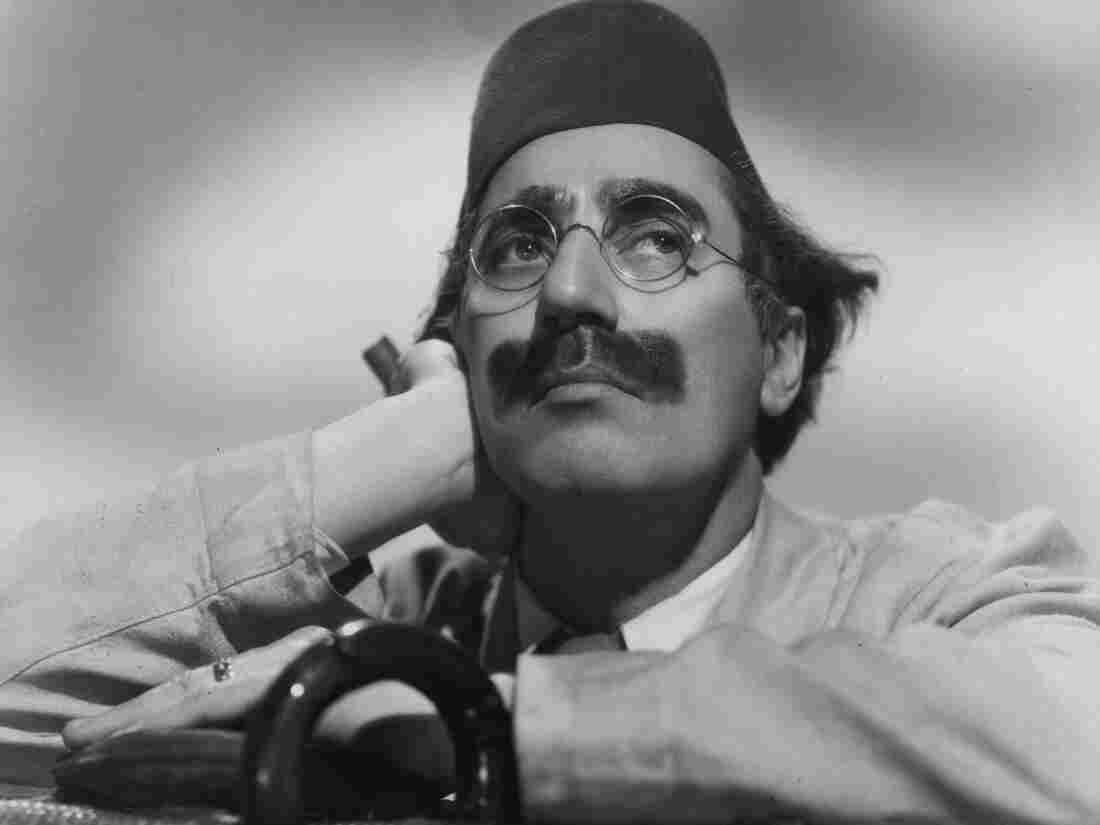
This provocative biography argues that the man who is the ‘central intelligence’ of the Marx Brothers indulged in radical, nihilistic truth-telling that masked his insecurity. Seriously?
Karl Whitney
Wednesday 20 April 2016
In 1967 Groucho Marx made what now seems an unlikely appearance on conservative pundit William F Buckley’s TV show Firing Line. The show typically consisted of Buckley, a starchy, uncomfortable screen presence, who gave the impression of looking down his nose at the camera, politely putting what were often quite barbed questions to that week’s guest. Whatever Buckley’s politics, it was serious television, with a solemn atmosphere somewhere between a civics lesson and a Sunday mass. To add to the formality, the discussion was moderated by a chairman. The subject Buckley and Marx would discuss: “Is the world funny?”
The programme was an hour long, and began amiably, if stiffly, as Buckley introduced his guest. Then in his mid-70s, Groucho, whose casual attire of a blue jacket, polo neck and grey plaid trousers contrasted with Buckley’s businesslike suit and tie, was still recognisable from his heyday, when as a member of the Marx Brothers he had leered and delivered comic non sequiturs (“One morning I shot an elephant in my pyjamas. How he got in my pyjamas I don’t know”) over the course of vaudeville shows, Broadway productions and a run of classic, and some not so classic, comedy movies.
When he sat down to debate with Buckley, the greasepaint moustache and bushy eyebrows were long gone, but he was smoking his trademark cigar. He began to answer questions quite seriously, and it turned out that Groucho didn’t think the world was funny after all. Was he serious or funny? Where did the persona stop and the real Groucho begin? Lee Siegel wrestles with these questions in his provocative and perverse short critical biography of the man he calls the Marx Brothers’ “central intelligence”.
Siegel identifies a moment in the Buckley interview where Groucho goes on the attack by pointing out that the host blushes “like a young girl”. Groucho’s comedy, Siegel insists, is actually radical, nihilistic truth-telling that masks the great comedian’s insecurity; its origins lie in his childhood, with his domineering mother and weak father, and his thwarted intellectual ambitions. A quiet middle child born as Julius Marx to European Jewish emigrants, who lived on the upper east side of Manhattan, Groucho wanted to be a doctor, but instead had to leave school young to join his brothers in show business.
You might think that consistently arguing that the Marx Brothers aren’t funny is a difficult trick to pull off, and you’d be right, but it is central to Siegel’s theory that the Marxes were the same onscreen as they were off, that there was “a seamless continuity between their actual personas and their stage personas … fusing their entertainment selves with their real selves”. Instead of making riotous film comedies that seemed to fizz from the screen, they “dissolved the boundary between life and art, public and private”. It is difficult to decide whether his is a strongly held belief or a confrontational pose.
Putting aside the obvious differences between Groucho, Chico and Harpo in and out of character (Groucho’s moustache was fake; Chico, of course, wasn’t Italian; and Harpo could speak), there is considerable evidence that elements of the stage personae – Groucho’s stinginess, Chico’s gambling and womanising, and Harpo’s, well … harp playing – were the brother’s real-life attributes. After all, the stage names originated as nicknames reputedly given to them by the performer Art Fisher during a card game in 1915. The names stuck, onstage and off.
I have been a fan of the Marx Brothers since I was a child, in the early 1980s, when television stations used to fill blank spaces in the schedule with Duck Soup or Animal Crackers or A Night at the Opera, and I am as guilty of idealising their act as anyone. But even I can see the plausibility of Siegel’s version of Groucho as not a nice, avuncular figure but rather an asshole telling everyone what he really thinks of them. Where I would differ from Siegel would be in finding an asshole telling everyone what he really thinks of them funny, especially within the structure of a 1930s comedy movie.
As a child I loved the Marx Brothers’ wild energy, the way they bounced around the creaky confines of their films, intersecting awkwardly with banal, romantic subplots and subverting the musical numbers through bad dancing and off-key singing. There is no doubt that something about them had an effect on me that was more potent than the spell cast by Chaplin or, say, Abbott and Costello. Could that something have been the “shocking truthfulness” that Siegel identifies in their work?
Perhaps. But Siegel’s insistence on their unfunniness leads him into some fairly reductive and unconvincing analyses. In one memorable scene from Duck Soup, Harpo, playing a peanut vendor, teams up with Chico to infuriate a rival lemonade seller, driving him to the brink of madness. Siegel, rather unexpectedly, points out that the lemonade salesman “has done nothing wrong”, and claims that Duck Soup, supposedly an anti-fascist satire, is “actually a tour de force of undemocratic, even antidemocratic, sentiments”.
He compares their comedy unfavourably with the satire of Jonathan Swift, finding in their work no moral framework, “no stable point … from which the satire is made. Every position is invalidated, exposed to derision”. But surely such unstable, hedonistic and destructive derision is the fuel that drives their comedy? Morality seems irrelevant.
After the relative commercial failure of Duck Soup, which cut back on musical numbers and romantic subplot, the brothers moved from Paramount to MGM, where they made A Night at the Opera and A Day at the Races – crowd-pleasing, well-made films that embedded the brothers in a social situation and prioritised the dreaded boy-girl storyline. One would think Siegel, who criticises Groucho’s general inability to appear “in a specific social context”, would be happy. But, no: “unfunny”.
Yet he is extremely sharp on why the Marxes were so successful as a comedy team: “at a time of rapid transition from vaudeville to silent film to talkies, [they] comprised an original synthesis of all three styles”. He is also good when addressing Groucho’s tetchiness about his origins, and his prickly relationship with high culture, especially the literary world (he conducted a passive-aggressive correspondence with TS Eliot).
There is a joke that dates back to the Marx Brothers’ Broadway play I’ll Say She Is!. Chico says: “The garbage man is here”, and Groucho replies: “Well, tell him we don’t want any.” Siegel writes that it’s “not funny”, but when, during his interview with Groucho, Buckley repeats the gag, the previously silent Firing Lineaudience laughs. Surely the joke is bombproof if even the staid Buckley can raise a chuckle with it? Groucho began the show by admitting that he is a “sad man”, but as the discussion progressed, he started to arch his back, wave the cigar, joke with the chairman and play to the audience. It is as if a switch has been flipped, and the old Groucho character has come to life again.
Perhaps the Groucho persona was just an act. In the late 1940s, as the Marx Brothers’ film career ground to a halt, Groucho began to host the quiz show You Bet Your Life, first on radio and then on TV. Siegel sees this as the point at which his personality and persona “merged comfortably, definitively, in full public view”. Yet when the producers of the show asked Groucho to wear the greasepaint and frock coat, he told them “the hell I will. That character’s dead. I’ll never go into that again.”
Subscribe to:
Posts (Atom)