Wednesday, 17 February 2016

Terry Kelly Remembered

Roger Garfitt remembers Terry Kelly

The man who was waiting for me at Newcastle Central Station a couple of years ago when I returned to the North East to read at the Lit Phil looked just as lean and fit as the student who had brought his concentrated stride into my workshop almost forty years ago when I was Writing Fellow at Sunderland Polytechnic. That's because he really was fit – Terry used to run three times a week – but it also reflected an inner intensity, the quality that enabled him to sustain a close engagement with contemporary poetry while working full-time as a journalist on the local paper. Many people let the passions of their student years die back into reminiscence once the pressures of the working life take over. Terry didn't do that. He was actively engaged, for example, in setting up The Bridge, the Bob Dylan magazine that now has an international readership, and on his visit to the States – the visit on which, ironically, he contracted the mystery virus that brought about his early death – he was invited to lunch with Christopher Ricks.

The first impact of the Morden Tower Readings, when Tom and Connie Pickard enabled a new generation to rediscover the poetry of Basil Bunting, was over by the time Terry came of age. But he absorbed something of those energies through his older brother Tom, who has published six collections with the Red Squirrel Press, and he kept his ear tuned to the particular possibilities of North Eastern speech. I was grateful to him for alerting me to the fine lyrics Tom Pickard was able to strike from that speech in The Dark Months of May. It was Terry who chaired the launch of Hoyoot, Tom Pickard's Collected Poems and Songs at the Lit Phil. He also, as it happened, shared a newspaper office with Barry MacSweeney, and he contributed a brief memoir of that time to the volume edited by Paul Batchelor, Reading Barry MacSweeney.

D.M. Thomas once told me that he and his friends had been amusing themselves by inventing collective nouns for the various denizens of the literary world. They had come up with "an advance of publishers" and "a vanity of poets". What would they have found for critics? "A crossfire of critics"? None of that would have been true of Terry, who was modest about his own poetry but passionate about his criticism, relishing the chance The London Magazine and The Next Review were giving him to stretch out in extended pieces on the life's work of major figures that were always thoroughly researched and carefully considered. That concentrated stride I had first glimpsed in 1978 was finally paying off and it is a real loss that it should have been brought to such an abrupt end.

Monday, 15 February 2016

Bede's World Closes

The spiritual home of two permanent FNBs and two more satellite members (and we're talking about the team who won the museum its 1988 award in the days when it was The Bede Monastery Museum) has been closed...


And here's what you can do...

Dr Sarah Semple of Durham University says:

The closure may be temporary. We do, however, need as much support as possible. I would ask anyone who has visited or led field visits with students or lectured for the Friends to consider helping us by writing in support and encouraging their organisations to do so as well. Letters or e-mails should be directed to the Leader of South Tyneside Council and copied to the Chief Executive.

The key messages we need to get across are that any new venue must retain the educational purpose of Bede's World and should continue to serve as an educational resource for all levels - from schools through to university students and adult education; we also need to emphasise that the complex and museum must retain a connection to Bede and the early medieval monasteries.

Please write if you can and please share this widely and with any mailing lists relevant to early medieval archaeology or to the region.

Leader of South Tyneside Council - Iain Malcolm and CE of South Tyneside Council - Martin Swales can both be reached via democraticservices@southtyneside.gov.uk

Just like the good old days...

Bede's World visitor attraction in Jarrow closes due to cash problems
Famous South Tyneside visitor attraction Bede's World closed on Friday after being deemed no longer financially viable

Tony Hendersdon
12 February 2016

A major Tyneside visitor attraction closed its doors on Friday amid speculation over its future.

Bede’s World in Jarrow celebrates the life of the Venerable Bede, born in 673 and who from the twin monastery site of Wearmouth-Jarrow became one of Europe’s greatest scholars and whose works are still in print today.

The site includes an 11-ace Anglo-Saxon farm, complete with animals and replica buildings, and a museum which was opened by the Queen in 2000 as the latest development in the £9m Bede’s World complex.

It was only five years ago that it was part of the Government’s submission of the Wearmouth-Jarrow twin monastery as the UK’s next world heritage site.

But on Friday the Bede’s World Trust, which runs the site was wound up after a meeting and South Tyneside Council secured the site.

The move came as a shock to the 27 staff at Bede’s World.

Mike Smith, chairman of the trustees, confirmed that discussions were taking place with insolvency experts on what would happen next.

He said: “It is absolutely terrible but we have had no choice while we look at how best to transfer the operation of Bede’s World into a different form. We are still in negotiations with insolvency practitioners.

“It was something that needed to be addressed with some urgency,” said Mr Smith.

He said the closure came against the backdrop of what was a “question of funding”.

Farm Buildings and dwellings at Bede's World

Mike Benson, who was director of Bede’s World, left last month to take up a new job with the National Coal Museum in Wakefield.

A South Tyneside Council spokesperson said: “Despite receiving substantial support from South Tyneside Council, Bede’s World is closing.

“This is because it is not currently financially viable and the charitable trust which managed the attraction has gone into liquidation.

“We can confirm that ownership of the land and buildings will revert to the council under the terms of the existing leases.

“The council is currently looking at a range of options for the site, and most importantly, to find a more affordable way to keep the facility open in the long term.”

Arrangements are being made for the care of the farm animals.

Farm Buildings and dwellings at Bede’s WorldFarm Buildings and dwellings at Bede’s World

Bede’s World’s neighbour is the Seventh Century St Paul’s Church, whose adjacent monastic remains where excavated in a series of digs in the 1960s by Durham University’s Prof Rosemary Cramp. It remains open.

Bede’s world evolved from the late 18th Century Jarrow Hall, which became the original Bede Monastery Museum from 1974 and now houses the site’s café.

Photos of Bede's World in Jarrow which is closing

It was in 2011 that then Culture Minister Jeremy Hunt put forward the Wearmouth-Jarrow twin monastery as a candidate world heritage site.

He said then: “The twin monastery of Wearmouth-Jarrow had a profound influence on learning in the Middle Ages and played a huge part in the emergence of European identity.

The outstanding library and teaching assembled at Wearmouth-Jarrow by founder Benedict Biscop was unlike anything else available in its day and it became the primary intellectual centre of Western Europe.

“The monastery’s cultural reputation owes much to the work of the well known scholar Bede a member of the community, born locally, whose writings helped establish England’s identity. Parts of the monastic churches that are still in use today date from Bede’s lifetime.”

In 2013 Bede’s World was awarded a Heritage Lottery Fund grant of £311,700 to improve the visitor experience at its Anglo-Saxon museum and farm, which included the building of a replica wooden amphitheatre, based on evidence of the structure at the 7th Century Ad Gefrin royal site at Yeavering Bell, near Wooler in Northumberland.

In 2014 Bede’s World staged a spectacular exhibition of treasures on loan from the British Museum.

It was also the first museum in the UK to have its own radio station – Radio Hive.
http://www.chroniclelive.co.uk/news/north-east-news/bedes-world-closure-hundreds-take-10890914


One for Dave...

Bede's World closure: Hundreds take to social media after shock shutting of Jarrow attraction
The South Tyneside heritage centre site closed its doors unexpectedly on Friday after charitable trust was wound up

Tony Henderson
15 February 2016

Hundreds of people took to social media to lament the loss of Bede’s World in Jarrow after the heritage centre suddenly closed on Friday.

They also backed spontaneous plans to rescue the centre, whose charitable trust has been wound up amid financial problems.

Ben Summerson said: “I can tell you that your campaign has gone international. The state of Government heritage funding in England at the moment is a disgrace.”
St Paul's Church is, of course, still open

Graeme Tallboys said: “Flabbergasted. I ran the education department for four years and we were always heavily oversubscribed. That funding should dry up for such an important centre of learning - historically and contemporarily - is an absolute disgrace and indicative of the anti-intellectualism of current times. Sad news indeed.”

Keith Hemmer said: “As one who until recently was employed there can I say thank you all very much for your support. The news came out of the blue, no warning at all. We had schools booked in that were cancelled. We are all emotionally attached to BW.

“I broke my heart yesterday saying goodbye to the animals. They were the highlight of the visit for many thousands of the region’s school kids. Now it’s all gone.”

Ian Campbell said: “Very sad, Have been keeping bees here for five years now, Lots of good people & apprentices lost their jobs today. I really hope there is an alternative to permanent closure.

Heartbreaking to have to move the hives from such a lovely location especially on a sunny day with them just emerging from winter.”

Dorothy Freeman said: “Jarrow is Bede ...it’s like cutting the heart out of the town.”

Deborah Swan said: “Surely with its religious and historical significance the Church could step in and stop it from happening. It should really be a protected heritage site surely. We were there all day on Tuesday on a school trip and the staff had no clue.”

Katie Myers said: “It’s a place of great history and hope either English Heritage or the National Trust would be interested.”

Anne Curtis said: “I absolutely love this museum - in my view it’s a beautiful little gem and so important to our cultural heritage. How more important can you get than Bede for goodness sake?”

Iris Walls said: “I‘m furious and sad at the same time about this closure.”

Some urged a joining of forces with the bid to save the DLI Museum in Durham from closure.

Simone Martin said: “It’s the DLI Museum and art gallery all over again” while Stephen Elliott posted: “It may be worthwhile linking up with savethedli.org.uk for the sharing of ideas etc to save these two vital cultural sites.”

Hannah Stefanski said: “Why was something not made public before now to inform the public of how much they were struggling? Had they done this I’m sure it would of ensured a brighter future for Bede’s World. Just from the comments it’s clear how well loved this place is to so many people.”

Many people fondly recalled visit to the sites, such as Annie Bennett: “We had so many happy days at Bede’s world, seeing the animals and exploring the buildings. It would be a great loss to see it close.”

Norma Meers said: “Hope this amazing place can be saved for the public. It’s such a shame.”

Sandra Jack said: “Can’t believe this precious history has been closed down.”

Alison Cox said: “Closure of Bedes World greatly saddens me. It’s a wonderful educational asset to the area and a crying shame it’s closed due to lack of funding.”

Gill O’Donnell posted a letter to MPs for people to download, which said: “The closure was announced unexpectedly, with staff only being told of the immediate closure that morning. The venue employs 27 staff and is supported by numerous volunteers and attracts around 70,000 visitors a year, of which almost a third are schoolchildren who benefit from the unique educational facilities on offer.

“Local residents, schools and other interested parties such as those who hire the venue for events, were given no prior notice of this impending closure and only informed later that day. This lack of warning means that a number of already booked events will have to be cancelled.

“However, a greater concern is the fact that closing this venue is going to rob the country of a valuable and internationally recognised cultural and educational resource and will considerably impoverish the life of the local community.

“The loss of this valuable resource will lead to cultural and community impoverishment. “

http://www.chroniclelive.co.uk/news/north-east-news/bedes-world-closure-hundreds-take-10890914

Sunday, 14 February 2016

Delacroix and the Rise of Modern Art at the National Gallery - review

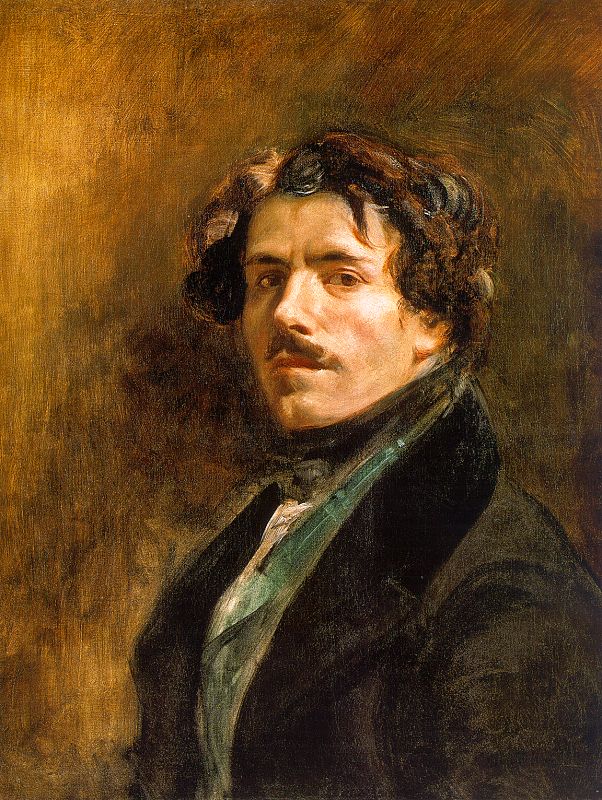
Self Portrait (1837)

Damnation, Dante and decadence: why Eugène Delacroix is making a hero’s return
From Van Gogh to Cézanne to Picasso, Delacroix was revered by the very artists who would come to overshadow him. Now his pessimistic vision looks set for critical acclaim once again

Michael Prodger
Friday 5 February 2016

Eugène Delacroix today holds, for many people, a somewhat peripheral place in the pantheon of 19th-century artists. That he was a powerful influence on the likes of Manet, the impressionists and Seurat is taken for granted, but so too is the idea that they went on to outstrip him. For the poet and art critic Charles Baudelaire, however, such a reversal of reputation was inconceivable. Delacroix, in his eyes, was peerless. In his review of the Salon exhibition of 1845 he stated startlingly and unequivocally: “M Delacroix is decidedly the most original painter of ancient or modern times. That is how things are, and what is the good of protesting?”

What made him such an original was not just his artistic range – from crucifixions to portraits to tigers to vast mythological ceiling paintings – and the fluidity of his colour and drawing, but his personality. Delacroix, said Baudelaire, was “a volcanic crater artfully concealed behind bouquets of flowers” and as fascinating for his enigmatic aloofness as for his art. His contemporaries also saw in this Anglophile dandy someone who remained stubbornly and defiantly true to himself despite the disdain of officialdom and the brickbats that were frequently directed at his work from the academy. His indifference and determination to survive outside critical and state support were, for younger painters, inspirational.

This admiration for the person as much as the painter was tangible. Odilon Redon recalled stalking Delacroix at a ball in 1859 and overhearing him being introduced to a Bonaparte princess who wanted “to see a great artist”: “You see,” countered Delacroix, “he’s not very big.” In physical stature perhaps not – he had life-long ill health and a bit of a stoop – in every other way though successors viewed him as a giant. “We all paint in Delacroix’s language,” said Cézanne. “That bastard. He’s really good,” grudgingly admitted Picasso – not a man who willing acknowledged having equals.

Delacroix and the Rise of Modern Art, the National Gallery’s new exhibition, sets out to restore the painter to his 19th-century eminence by presenting him as the missing link of modernism. The starting point of modern art is often too tidily dated to 1863 and the Salon des Refusés when France’s avant-garde painters, spurned by the art establishment, held an exhibition of their own. The National’s show will have none of that: Delacroix, who died, aged 65, the year of the Refusés, is the key figure and the exhibition traces the course of his influence through to 50 years after his death.

The case is hard to argue against. The impressionists, post-impressionists, pointillists, symbolists, expressionists and modernists all drew on Delacroix. The individual artists that owe him a debt form an impressive roster: Van Gogh,Gauguin, Seurat, Signac, Fantin-Latour, Redon, Monet, Cézanne, Whistler, Manet, Gustave Moreau, Matisse, Picasso and more. As do the writers, among them Stendhal, Gautier, Proust and Henry James. There could nevertheless be a matching exhibition of equal validity, Delacroix and the End the Grand Tradition, since he was the heir to a type of grand, public art that had been prevalent since the Renaissance. The critic Lorenz Eitner called Delacroix “the last great European painter to use the repertory of humanistic art with conviction and originality”. He was the preeminent religious and mythological painter of the 19th century and he almost never depicted the modern world – and when he did, he painted it as allegory. When once praised enthusiastically as the quintessential Romantic artist, he responded: “You are mistaken sir, I am a pure classicist.”


Delacroix’s distinctiveness was in part due to the circumstances of the time. He was born in 1798 at the end of the French Revolution, the son of Charles-François Delacroix, ambassador to the Netherlands, and Victoire Oeben, the daughter of a celebrated cabinet maker. Since Eugène arrived seven months after Charles had undergone a major testicular operation, his natural father was widely thought to be the éminence grise statesman Charles-Maurice de Talleyrand, a friend of the family and a minister under five successive regimes. Such parentage would perhaps help explain where Delacroix got his patrician airs.

Delacroix entered the studio of the neoclassical painter Pierre-Narcisse Guérin, but the greatest impact on his style came from studying the old masters in the Louvre, in particular Rubens and the Venetians, and from more senior contemporaries such as Antoine-Jean Gros and Théodore Géricault. Taken together these influences gave him an interest in colour, movement, imagination and grand historical and literary topics. This heady hotchpotch was intensified by his adulation for the work of Shakespeare, Walter Scott and Byron – indeed, as an adolescent, Delacroix wrote two historical novellas and a play.

Delacroix’s early manhood coincided with the end of the Napoleonic adventure and the return of the Bourbon monarchy, the unloved dynasty that famously “forgot nothing but learned nothing”. The young painter was faced with the dilemma that so many of his generation had to contend with: how to live a heroic life in an unheroic age. It was the problem that obsessed both Géricault and Stendhal. Delacroix’s response was to turn backwards for his themes but to paint them in a forwards-looking way.
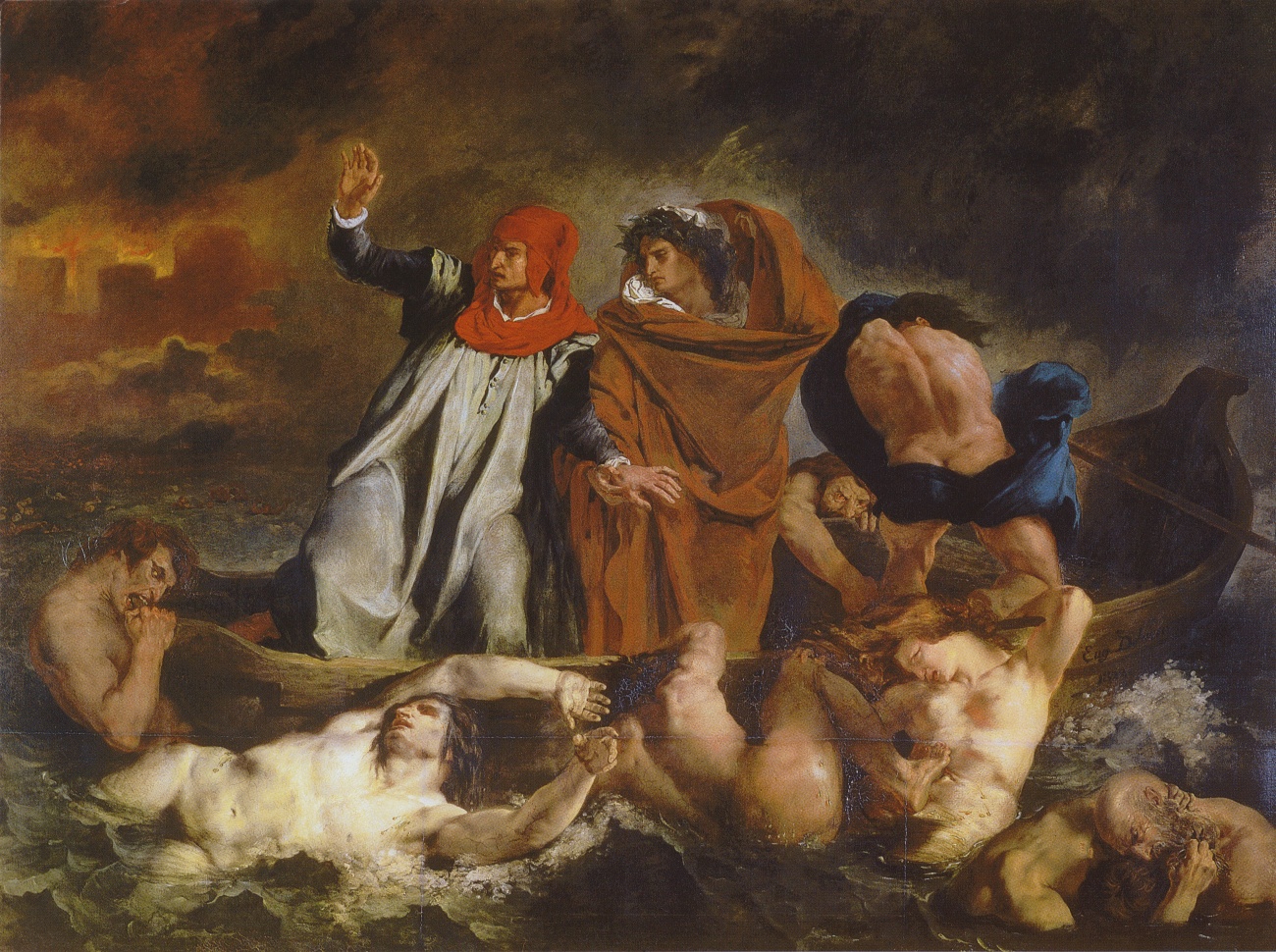
The Barque of Dante (1822)

In his first Salon submission, The Barque of Dante (1822), he already showed the characteristics that Baudelaire isolated as defining his art: “the atmosphere of the human drama and the state of the creator’s soul”. It also showed him to be a formidable colourist and theoretician of colour – the water drops on the bodies of the damned souls who menace Dante and Virgil as they cross the Styx are formed of separate touches of green, yellow and red that blend not on the canvas but in the viewer’s eye.
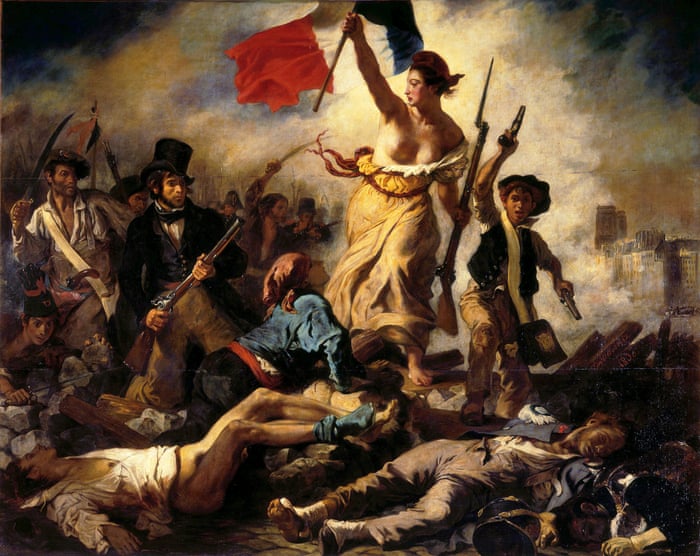
Liberty Leading the People (1831)

Unlike many of the Romantics, Delacroix actively sought state patronage and acceptance, although the latter was late in coming – he had to apply seven times to join the Académie des Beaux Arts before he was finally accepted. The Barque of Dante was bought by the state, as was Liberty Leading the People (1831). This painting, depicting the July Revolution of 1830 which toppled Charles X and brought the “Bourgeois King” Louis-Philippe to the throne, was the closest Delacroix came to being a painter of modern life. Even here, though, his particular take on the heroic tradition is obvious and it has no room for the ideal. The popular uprising may be a noble moment in history, but the insurgents that follow the lead of Marianne, the French Revolutionary goddess of liberty, are a coarse and ramshackle group. Delacroix felt little sympathy for his fellow citizens (the mob was not his thing and nor were the middle classes with their “wholly new barbarism”). He wrote to his brother, a general, that, while he had not “conquered for the fatherland, he would at least paint for it”.
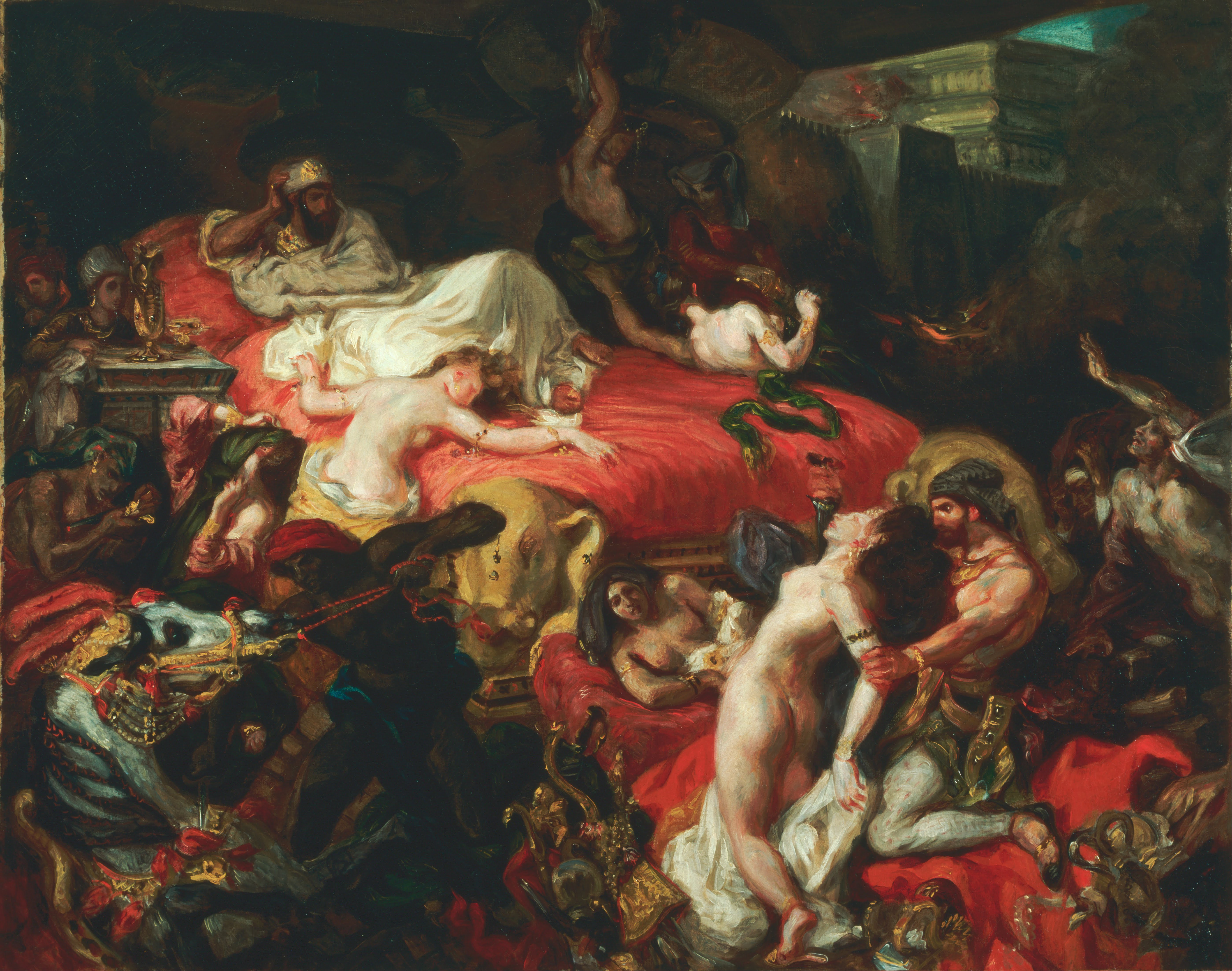
The Death of Sardanapalus (1846)

The picture, which was later returned to him for being “too revolutionary”, was in part an attempt by Delacroix to overcome his true instincts. These had been paraded in 1827 in the huge and provocative The Death of Sardanapalus, a painting that was widely vilified. The subject, taken from a play by Byron (the man who inspired in him “that insatiable longing to create”), shows the cruel and jaded Assyrian potentate sitting on a bed atop his funeral pyre as his enemies storm Nineveh and close in on him. He will not go up in flames alone, however, and orders all his royal chattels – concubines, horses, jewels, slaves – to join him in immolation. Quite what Delacroix thought he was up to in painting this vortex of luxury and death is unclear. Brilliantly and rapidly assembled, the picture was nevertheless castigated as aberrant in both technique (“a potboiler with neither top nor bottom”) and in taste, and the painter received an official warning. Sardanapalus, a voyeur at the heart of this maelstrom of slaughter, also has uncomfortable overtones of self-portraiture.

Joris-Karl Huysmans, the “decadent” author of Against Nature, never met Delacroix but he had Sardanapalus in mind when he summed up the painter: “Strange man, almost always imperfect, ill-tempered and languid, superb when his fever burns, theatrical and melodramatic when it smoulders, he has been a titanic force against the comatose in art, strychnine electrifying the old julep prescribed by the recipes of the dyers of grand art.”

If Sardanapalus was an essay in literary Orientalism, Delacroix came face to face with the real thing when he visited north Africa in 1832 as part of a diplomatic mission led by the Comte de Mornay. In Morocco and Algeria Delacroix encountered a world “As beautiful as antiquity … The heroes of [Jacques-Louis] David and Co, with their rose pink limbs, would cut a sorry figure beside these children of the sun, who wear the dress of classical antiquity with a nobler air.” He sketched and painted watercolours obsessively, his subjects ranging from parading Arab horsemen and ecstatic religious processions to a Jewish wedding and the harem: “I am like a man in a dream,” he wrote, “seeing things he fears will vanish from him.”
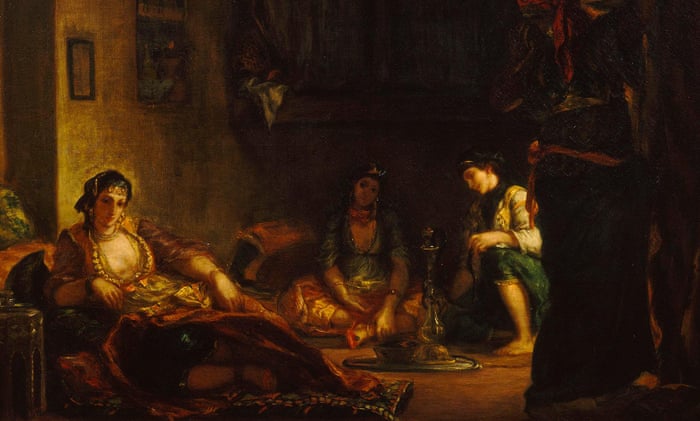
A detail from Women of Algiers (1847-9)

On his return to France, these sketches and visual memories formed a rich repertoire: nearly 80 oil paintings and innumerable drawings, lithographs and etchings grew out of them. The most potent subject, perhaps, was the women’s apartments he had managed to see in a Muslim house in Algeria. He glimpsed this forbidden world through the indulgence of a Christian turned Muslim convert who was working for the French and who allowed the artist into his own home: “It is beautiful! Like the age of Homer,” said the wonderstruck painter. Women of Algiers in Their Apartment of 1834, of which he painted two versions, is an exercise in subdued eroticism. Exotic, otherworldly, sensual, richly patterned with colour and light, the picture is a subtle and personal melding of external reality and internal feeling.

Women of Algiers was a sensation at the Salon and harbinger of a slew of “harem” pictures by lesser artists which coarsened Delacroix’s vision of art for art’s sake. Here, mood and beauty of form, rather than narrative, are paramount, producing what he called “the music of painting”. Cézanne was among the younger artists for whom the picture was a revelation: “All this luminous colour – it seems to me that it enters the eye like a glass of wine running into your gullet and it makes you drunk straight away.” The picture later obsessed Picasso who painted 15 variants – one of which last year became the most expensive work of art ever sold at auction when it fetched $179.4m (£125m) – and drew and etched almost 60 more. Curiously, Picasso, Delacroix’s most obsessive “modern” adherent, falls outside the scope of the National Gallery’s exhibition.

What Delacroix found in north Africa was confirmation of his painterly principles. The last entry in the Journal that he kept properly from 1847 reads: “The first merit of a painting is to be a feast for the eye … it’s like beautiful verses; nothing in the world will prevent them from being bad if they shock the ear.” Literalism was his bugbear: “The forms of the model, whether it is a tree or a man, are only the dictionary where the artist goes to give renewed force to his fugitive impressions.” For Delacroix, a painting should bring forth the viewer’s own memories of nature. He was implacably opposed to the “petty details” and “the love of exactitude, which most people take for truth” and the “pernicious archaism” of his artistic opposite Ingres. “Cold exactitude is not art,” he said, “The feigned conscientiousness of our majority of painters is only perfection applied to the art of being boring.” For all his icy self-control, Delacroix was never boring.
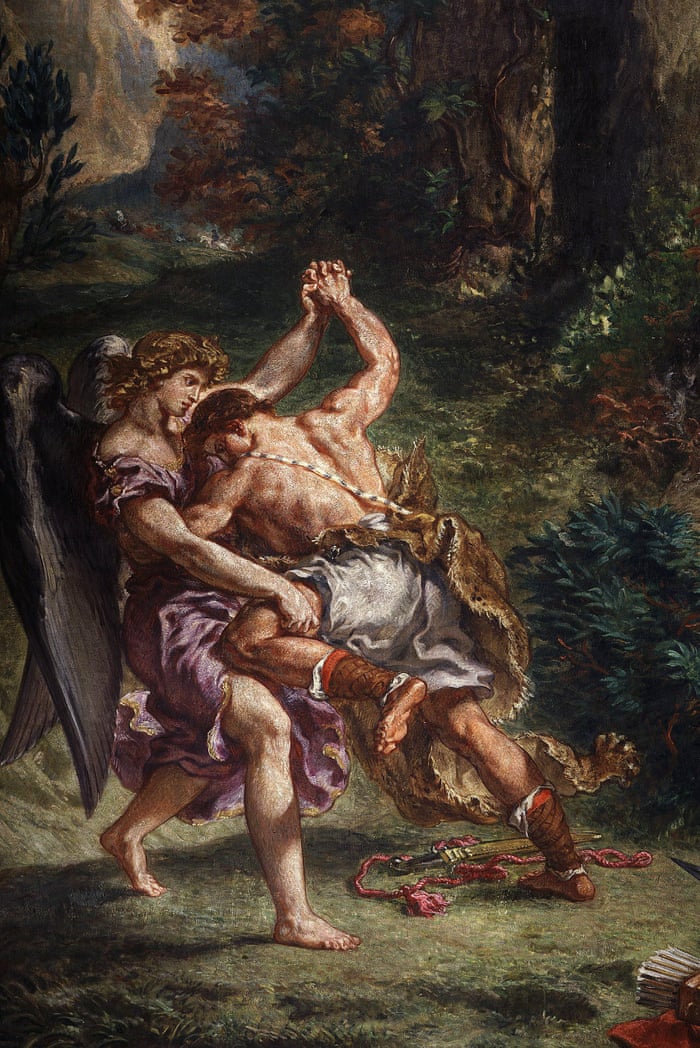
A fresco detail from Jacob Wrestling the Angel (1855-61)

The artist did eventually find establishment acceptance. In 1855 he was given a pavilion at the Exposition Universelle and, with the help of his friend the prime minister, Adolphe Thiers, was awarded mythological commissions for various government buildings around Paris. And in the Chapelle des Saints-Anges in Saint Sulpice he painted the last great religious mural cycle in western art, with its key image of Jacob Wrestling the Angel a metaphor for his own artistic struggles. Nevertheless, just as he was not a believer in the modern world, so he was a religious agnostic: what followed life, he believed, was “Night, dreadful night.”

If fellow painters emulated his doubt, his pessimism and his style, where they couldn’t follow him was in his emotional life. Delacroix, said Baudelaire, “was passionately in love with passion” – but not, it seems, in affairs of the heart. He never married, there is no record of love affairs and his closest female companion was his housekeeper. His emotional life, the natural realm for a man of his sensibilities, was a void. It was perhaps in this, the acceptance of his own contradictions, that he was at his most modern.

•Delacroix and the Rise of Modern Art is at the National Gallery, London WC2N, from 17 February.

http://www.theguardian.com/artanddesign/2016/feb/05/damned-souls-decadence-eugene-delacroix-hero

http://www.nationalgallery.org.uk/delacroix

Friday, 12 February 2016

Walter Becker on Steely Dan and Circus Money...


Walter Becker: Steely Dan man sees the light
Walter Becker talks to Adam Sweeting about his adventurous new solo album and the rollicking return of the band that made him

Adam Sweeting
17 July 2008

In the Seventies, Steely Dan's founding duo, Walter Becker and Donald Fagen, were musical satirists, chastising an imperfect world with irony and black humour.

Their occasional interviews resembled clues from an insoluble crossword. In lesser bands, they inspired awe and reverence, laced with fear.

But nearly 30 years after the Gaucho album brought the curtain down on Steely Dan's original era, Becker and Fagen have thawed somewhat. The new millennium has seen a rebuilt Dan releasing two albums, the triple Grammy-winner Two Against Nature and Everything Must Go.

Previously allergic to live performance, they've become a regular touring attraction, playing shows that swoop across their catalogue - from oldies such as Showbiz Kids and My Old School to Deacon Blues, Hey 19 and beyond. Armed with a rollicking four-piece horn section and the brilliant lead guitarist Jon Herington, the 21st-century Dan is scintillating to behold.

As Walter Becker explains, touring has become vastly more attractive than it was 30 years ago. "We started touring with one guy who humped all the gear," he recalls, sitting in a small dressing room at New York's Beacon Theatre during Steely Dan's recent six-night stint. "We used to try to get our gear on to airplanes as baggage and try not to pay for it, so if stuff got bumped off the plane you were f---ed. But now we have trucks and crew members, and a giant swathe of rainforest has been cut down so we can do what we're doing."

As a bonus for Dan-o-philes, Becker has completed a second solo album, Circus Money. It has little in common with his first, 11 Tracks of Whack (1994), and derives its character from Becker's fascination with Jamaican music from the Sixties and Seventies. He'd spent years amassing Jamaican recordings. At first he planned to use authentic Jamaican backing tracks and graft new instrumentation and lyrics over them, but gave up that idea when multitrack tapes proved impossible to find.

"The Jamaican tracks were the starting point, but what you end up writing may be completely different," he says. "A lot of songs on this record don't sound like Jamaican music, and a couple have dub sections and repeats and a real Jamaican combination of elements. Downtown Canon was based on a very well-known dub track that goes by various names, but all we took was the tempo and the bass rhythm: the harmonies were completely changed."

Becker has few pretensions as a vocalist (he growls like a film-noir detective), but Larry Klein, his producer and co-writer, has provided guidance. "My singing could be worse, and it probably will be in time. Singing for me means singing as loud as I can. Larry said, 'Why don't you try not singing as loud as you can?' That was helpful."

Becker's songwriting has acquired a reputation for darkness and cynicism, but in songs such as Downtown Canon or Paging Audrey he sounds nostalgic or even sentimental. Nevertheless, reviewers keep portraying him as some sort of emotional pervert.

"I've wondered about that, too," he nods. "It's like reading a recycled review of [Steely Dan's] Royal Scam. For instance, the song Door Number Two has a gentle, musing quality, but the reviewer in Rolling Stone said it was about a game show host trying to seduce a contestant. This is stated as fact. I thought, 'Wow, where did they find a guy so literal-minded he'd believe that?'?"

Becker wanted to make Circus Money with live musicians, rather than resort to the obsessive overdubbing and re-recording that plagued late-Seventies Steely Dan albums. Jazz enthusiasts Becker and Fagen were trying to create their own version of classic big bands like Duke Ellington's, but circumstances made that impossible.

"We got more and more into a manufactured recording mode," says Becker. "I had nothing to do during this incredibly tedious process, except to think about things that were wrong with it, the biggest being that nobody was playing with anybody else and there was no musical ebb and flow."

So he and Donald had a frank exchange of views? "That's right, and to some extent each of us was persuaded by the other. Part of it is about letting things be what they are, and is good better or is perfect better? To me, good is better, and perfect is the enemy of good in this case."

It's 40 years since Walter and Donald first met at college. After periods in Hawaii and Los Angeles Becker is back in New York, though he finds the city increasingly hard work. Maybe it's time for Dan! - The Musical, a kind of Jersey Boys with more complicated chords.

"Well, sure!" Walter agrees. "Maybe in a few years. If this thing is gonna be bastardised and turned out like a five-dollar ho', then I certainly want to break in on that five dollars." Spoken like a true professional.

http://www.telegraph.co.uk/culture/music/3556548/Walter-Becker-Steely-Dan-man-sees-the-light.html

Thursday, 11 February 2016

Last night's set lists

At The Habit, York: -

Ron Elderly: -
Make You Feel My Love
Just My Imagination
Need Your Love So Bad

Da Elderly: -
Love Song
Falling
On The Way Home

The Elderly Brothers: -
The Price Of Love
Crying In The Rain
He'll Have To Go
The Boxer
You Really Got A Hold On Me

After last week's madness, Wednesday night was, on balance, a bit of a let down. Full and full-ish until about 11pm, the audience thinned out considerably thereafter, but those who remained were attentive and responsive. The after-show acoustic session covered side 1 of After The Gold Rush and as much of The Beatles (White Album) as was feasible and recoverable from the memory banks.

Wednesday, 10 February 2016

F. Scott Fitzgerald Interview from 1936

F Scott Fitzgerald
'One blow after another ... and finally something snapped'
This is an edited version of "The Other Side of Paradise, Scott Fitzgerald, 40, Engulfed in Despair" by Michel Mok, first published in the New York Post, September 25 1936

Michel Mok

Tuesday 18 September 2007

Long ago, when he was young, cocksure, drunk with sudden success, F Scott Fitzgerald told a newspaper man that no one should live beyond 30. That was in 1921, shortly after his first novel, This Side of Paradise, had burst into the literary heavens like a flowering Roman candle.

The poet-prophet of the post-war neurotics observed his 40th birthday yesterday in his bedroom of the Grove Park Inn here. He spent the day as he spends all his days - trying to come back from the other side of paradise, the hell of despondency in which he has writhed for the last couple of years.

He had no company except his soft spoken, Southern, maternal and indulgent nurse and this reporter. With the girl he bantered in conventional nurse-and-patient fashion. With his visitor he chatted bravely, as an actor, consumed with fear that his name will never be in lights again, discusses his next starring role. He kidded no one. There obviously was as little hope in his heart as there was sunshine in the dripping skies, covered with clouds that veiled the view of Sunset Mountain.

Physically he was suffering the aftermath of an accident eight weeks ago, when he broke his right shoulder in a dive from a 15- foot springboard. But whatever pain the fracture might still cause him, it did not account for his jittery jumping off and on to his bed, his restless pacing, his trembling hands, his twitching face with its pitiful expression of a cruelly beaten child.

Nor could it be held responsible for his frequent trips to a highboy, in a drawer of which lay a bottle. Each time he poured a drink into the measuring glass on his bedside table, he would look appealingly at the nurse and ask, "Just one ounce?"

Each time the nurse cast down her eyes without replying. Fitzgerald, for that matter, did not attempt to make his injury an excuse for his thirst.

"A series of things happened to papa," he said, with mock brightness. "So papa got depressed and started drinking a little."

What the "things" were he refused to explain.

"One blow after another," he said, "and finally something snapped."

Before coming to North Carolina, however, his visitor had learned something of Fitzgerald's recent history from friends in Baltimore, where he lived until last July.

The author's wife, Zelda, had been ill for some years. There was talk, said his friends, of an attempt at suicide on her part one evening when the couple were taking a walk in the country outside Baltimore. Mrs Fitzgerald, so the story went, threw herself on the tracks before an oncoming express train. Fitzgerald, himself in poor health, rushed after her and narrowly saved her life.

There were other difficulties. Mrs Fitzgerald finally was taken to a sanatorium near this city, and her husband soon followed her, taking a room in the rock-built Park Grove Inn, one of the largest and most famous resort hotels in America.

But the causes of Fitzgerald's breakdown are of less importance than its effects on the writer. In a piece entitled Pasting It Together, one of three autobiographical articles published in Esquire, which appeared in the March issue of that magazine, Fitzgerald described himself as "a cracked plate".

"Sometimes, though," he wrote, "the cracked plate has to be retained in the pantry, has to be kept in service as a household necessity. It can never again be warmed on the stove nor shuffled with the other plates in the dishpan; it will not be brought out for company, but it will do to hold crackers late at night or to go into the ice box under the leftovers.

"Now the standard cure for one who is sunk is to consider those in actual destitution or physical suffering - this is an all-weather beatitude for gloom in general and fairly salutory daytime advice for every one. But at three o'clock in the morning ... the cure doesn't work - and in a real dark night of the soul it is always three o'clock in the morning, day after day. At that hour the tendency is to refuse to face things as long as possible by retiring into an infantile dream - but one is continually startled out of this by various contacts with the world.

"One meets these occasions as quickly and carelessly as possible and retires once more back into the dream, hoping that things will adjust themselves by some great material or spiritual bonanza. But as the withdrawal persists there is less and less chance of the bonanza - one is not waiting for the fade-out of a single sorrow, but rather being an unwilling witness of an execution, the disintegration of one's own personality ..."

Yesterday, toward the end of a long, rambling, disjointed talk, he put it in different words, not nearly as poetic but no less moving for that reason:

"A writer like me," he said, "must have an utter confidence, an utter faith in his star. It's an almost mystical feeling, a feeling of nothingcan- happen-to-me, nothing-can-harm-me, nothing-can-touch-me.

"Thomas Wolfe has it. Ernest Hemingway has it. I once had it. But through a series of blows, many of them my own fault, something happened to that sense of immunity and I lost my grip."

In illustration, he told a story about his father.

"As a boy, my father lived in Montgomery County, Maryland. Our family has been mixed up quite a bit in American history. My greatgrandfather's brother was Francis Scott Key who wrote The Star- Spangled Banner; I was named for him. My father's aunt was Mrs Suratt, who was hanged after the assassination of Lincoln because Booth had planned the deed in her house - you remember that three men and a woman were executed.

"As a youngster of nine, my father rowed spies across the river. When he was 12 he felt that life was finished for him. As soon as he could, he went west, as far away from the scenes of the civil war as possible. He started a wicker-furniture factory in St Paul. A financial panic in the 90s struck him and he failed.

'We came back east and my father got a job as a soap salesman in Buffalo. He worked at this for some years. One afternoon - I was 10 or 11 - the phone rang and my mother answered it. I didn't understand what she said but I felt that disaster had come to us. My mother, a little while before, had given me a quarter to go swimming. I gave the money back to her. I knew something terrible had happened and I thought she could not spare the money now.

"Then I began to pray. 'Dear God,' I prayed, 'please don't let us go to the poorhouse; please don't let us go to the poorhouse.' A little while later my father came home. I had been right. He had lost his job.

"That morning he had gone out a comparatively young man, a man full of strength, full of confidence. He came home that evening, an old man, a completely broken man. He had lost his essential drive, his immaculateness of purpose. He was a failure the rest of his days."

Fitzgerald rubbed his eyes, his mouth, quickly walked up and down the room.

"Oh," he said, "I remember something else. I remember that when my father came home my mother said to me, 'Scott, say something to your father.' I didn't know what to say. I went up to him and asked, 'Father, who do you think will be the next president?' He looked out of the window. He didn't move a muscle. Then he said: 'I think Taft will.'

"My father lost his grip and I lost my grip. But now I'm trying to get back. I started by writing those pieces for Esquire. Perhaps they were a mistake. Too much de profundis. My best friend, a great American writer - he's the man I call my artistic conscience in one of the Esquire articles - wrote me a furious letter. He said I was stupid to write that gloomy personal stuff."

"What are your plans at the moment, Mr Fitzgerald? What are you working on now?"

"Oh, all sorts of things. But let's not talk about plans. When you talk about plans, you take something away from them."

Fitzgerald left the room.

"Despair, despair, despair," said the nurse. "Despair day and night. Try not to talk about his work or his future. He does work, but only very little - maybe three, four hours a week."

Soon he returned. "We must celebrate the author's birthday," he said gayly. "We must kill the fatted calf or, at any rate, cut the candled cake." He took another drink. "Much against your better judgment, my dear," he smiled at the girl.

Heeding the nurse's advice, the visitor turned the talk to the writer's early days and Fitzgerald told how This Side of Paradise came to be written.

"I wrote it when I was in the army," he said. "I was 19. I rewrote the whole book a year later. The title was changed, too. Originally, it was called, The Romantic Egotist.

"Isn't This Side of Paradise a beautiful title? I'm good at titles, you know. I've published four novels and four volumes of short stories. All my novels have good titles - The Great Gatsby, The Beautiful and Damned and Tender Is the Night. That's my latest book. I worked on it four years.

"Yes, I wrote This Side of Paradise in the army. I didn't go overseas - my army experience consisted mostly of falling in love with a girl in each city I happened to be in.

"I almost went across. They actually marched us on to a transport and then marched us right off again. Influenza epidemic or something. That was about a week before the armistice.

"We were quartered at Camp Mills, in Long Island. I sneaked out of bounds into New York - there was a girl concerned, no doubt - and I missed the train back to Camp Sheridan, Alabama, where we had been trained.

"So this is what I did. Went to the Pennsylvania station and commandeered an engine and a cab to take me to Washington to join the troops. I told the railroad people I had confidential war papers for President Wilson. Couldn't wait a minute. Couldn't be entrusted to the mails. They fell for my bluff. I'm sure it's the only time in the history of the United States army that a lieutenant has commandeered a locomotive. I caught up with the regiment in Washington. No, I wasn't punished."

"But how about This Side of Paradise?"

"That's right, I'm wandering. After we were mustered out I went to New York. Scribners turned my book down. Then I tried to get a job on a newspaper. I went to every newspaper office with the scores and lyrics of the Triangle shows of the two or three previous years under my arm. I had been one of the big boys in the Triangle Club at Princeton and I thought that would help. The office boys were not impressed."

One day, Fitzgerald ran into an advertising man who told him to stay away from the newspaper business. He helped him to get a job with the Barron Collier agency, and for some months Fitzgerald wrote slogans for street car cards.

"I remember," he said, "the hit I made with a slogan I wrote for the Muscatine Steam laundry in Muscatine, Iowa - 'We keep you clean in Muscatine.' I got a raise for that. 'It's perhaps a bit imaginative,' said the boss, 'but still it's plain that there's a future for you in this business. Pretty soon this office won't be big enough to hold you.'"

In This Side of Paradise, Fitzgerald had one of his principal characters take a crack at the popular authors of the period - some of whom are popular still - in these words:

"Fifty thousand dollars a year! My God look at them, look at them - Edna Ferber, Gouverneur Morris, Fannie Hurst, Mary Roberts Rinehart - not producing among 'em one story or novel that will last 10 years. This man Cobb - I don't think he's either clever or amusing - and what's more, I don't think many people do, except the editors. He's just groggy with advertising. And - oh, Harold Bell Wright and Zane Grey, Ernest Poole and Dorothy Canfield try, but they are hindered by their absolute lack of any sense of humour."

And the lad wound up by saying, it was no wonder that such English writers as Wells, Conrad, Galsworthy, Shaw and Bennett depended on America for over half their sales. What does Fitzgerald think of the literary situation in this country today?

"It has improved a lot," he said. "The whole thing broke with Main Street. Ernest Hemingway, I think, is the greatest living writer of English. He took that place when Kipling died. Next comes Thomas Wolfe and then Faulkner and Dos Passos.

"Erskine Caldwell and a few others have come up just a bit after our generation, and they haven't done quite so well. We were products of prosperity. The best art is produced in times of riches. The men who came some years after us didn't have the chance we had."

Has he changed his mind on questions of economics? Amory Blaine, the hero of This Side of Paradise, predicted the success of the Bolshevik experiment in Russia, foresaw eventual government ownership of all industries in this country.

"Oh, but I made an awful boner," said Fitzgerald. "Do you remember I said publicity would destroy Lenin? That was a fine prophecy. He became a saint. My views? Well, in a pinch they'd still be pretty much towards the left."

Then the reporter asked him how he felt now about the jazz-mad, gin-mad generation whose feverish doings he chronicled in This Side of Paradise. How had they done? How did they stand up in the world?

"Why should I bother myself about them?" he asked. "Haven't I enough worries of my own? You know as well as I do what has happened to them. Some became brokers and threw themselves out of windows. Others became bankers and shot themselves. Still others became newspaper reporters. And a few became successful authors."

His face twitched.

"Successful authors!" he cried. "Oh, my God, successful authors!"

He stumbled over to the highboy and poured himself another drink.

Copyright the New York Post, 1936. Excerpts from the New York Post are reprinted courtesy of the New York Post.
http://www.theguardian.com/books/2007/sep/18/classics.fscottfitzgerald

Tuesday, 9 February 2016

Monday, 8 February 2016

Post-Punk in the Marvel style...


Superheroes of rock’n’roll 

Kathryn Bromwich
4 April 2015

Graphic designer by day, cartoonist by night, Butcher Billy has a soft spot for dual-identity superheroes. While growing up, the Brazilian artist was influenced by Saturday morning TV cartoons and the music on his radio. “I’m a huge fan of comics, cinema, music, games, art,” he says. “Salvador Dali, Tim Burton, David Bowie, Andy Warhol, Stanley Kubrick populate my mind all at the same time, and the weird thing is it makes total sense.” In his latest series, Post-Punk Marvels, he combines favourite musicians with superheroes who match their personality. “Musicians were my heroes when I was a kid, just like comic characters were.”

Robert Smith as Nightcrawler: “Robert is this weird and dark guy that prefers the shadows - but he is also romantic and good-hearted.”

John Lydon as Wolverine: “Lydon has an aggressive and impulsive nature. He’s hot-tempered, but he’s still the best there is at what he does.”


Ian Curtis as Spider-Man: “The Spider-Man from the 60s and 70s was actually very tragic. There was love, death and failure in those stories.”

Morrissey as the Hulk: “I’ve always seen a duality in Moz that was interesting to explore: he can be both sweet and sour.”


Mark Mothersbaugh as Iron Man: “Mark, from Devo, always strikes me as a pioneering tech-genius nerd that has lots of fun doing his own thing.”


Siouxsie Sioux as Scarlet Witch: “Siouxsie is a powerful woman who has always been kind of magical.”

http://www.theguardian.com/artanddesign/gallery/2015/apr/04/superheroes-of-rocknroll-in-pictures

Billy's own excellent website with many, many more works (including DC stuff for all you fanboys) is at https://www.behance.net/butcherbilly

Sunday, 7 February 2016

John Irving on writing, wrestling, politics and bears...

John Irving on Donald Trump, Caitlyn Jenner – and the right way to wrestle an angry bear
At 73, John Irving has lost none of his fighting spirit. The writer and ex-wrestler lets rip at Trump, US politics, Caitlyn Jenner’s critics – and the ‘extreme patriotism’ of the Great American Novel. Then he throws our interviewer to the floor

Stephen Smith
Wednesday 3 February 2016

John Irving, much-loved novelist, Oscar-winning screenwriter, and the last Great American Author standing, hooks me in a headlock and slams his heel down on my toes. A noise in an unfamiliar register escapes me. Irving’s publicist winces and shrinks into her boutique sofa. This wasn’t on the book-tour itinerary.

Before he became rich and famous, the author of The Hotel New Hampshire and A Prayer for Owen Meany subsidised his writing career and raised his family with a second job in wrestling. He grappled and he coached. But he’s 73 now: I’ve got two decades on him, and I’ve challenged him to show me a few moves. As we feint and weave around a London hotel suite, my half-remembered research comes back to me like a terrible reproof. Irving hasn’t touched a drop of alcohol in years and has regained the fighting trim he boasted when he was still in his storied leotard.

“If I have an opponent who’s as tall as you,” he says, “I’m thinking your legs are vulnerable. You have more legs to protect.” We crunch into each other like rutting stags, or as much like rutting stags as two men of mature years are going to get when there are things like creased trousers to bear in mind. Irving’s pecs are pressed against mine. Is that his wheezing lungs I can hear through his chocolate sports coat, I wonder rather shamefully, or is it the ringing in my ears?

“I can’t do anything in this position because of your height advantage,” he says.

“Yes,” I reply, “whereas I could chest-bump you.”

“Your stance should be lower,” he grunts. Like a punch-drunk palooka, I fall for this piece of gamesmanship. No sooner have I dipped my head than it’s accelerating towards my knees, propelled by the flying anvil of Irving’s elbow.

Forty years ago, Sylvester Stallone’s Rocky Balboa was a raw contender on the streets of Philly and Irving was making a name for himself with his fourth novel, The World According to Garp. In 2016, Stallone could win an Oscar for Creed, a return to form for his long-running prizefight franchise, while Irving is still very much in the game with his 14th work of fiction, Avenue of Mysteries. There’s a touch of sentimentality about the reception given to both of these ageing warriors.

In Irving’s case, his tale of a Mexican slumdog called Juan Diego, who becomes a successful author in the US, hasn’t met with unqualified acclaim (“One holy mess,” said the Spectator). But his loyal readers love his unvarnished, warm-hearted storytelling. He has sold in excess of 12m books in 35 languages, and bagged an Oscar of his own in 2000 after adapting his bestseller The Cider House Rules into a film starring Michael Caine and Charlize Theron.

“Avenue of Mysteries,” says Irving, “is about a Mexican-American. He’s 54 but seems much older. He takes a trip to the Philippines and everything he sees there reminds him of his childhood in Mexico, which he left as a teenager and has never gone back to. But in his dreams and memories, he is more alive in the past, specifically at the age of 14.”

There are elements of magical realism in the story, as well as the lurid iconography of Latin American Catholicism. “Juan Diego is a man who has been touched by many miracles – among them religious miracles, which this novel is built around. I wanted to make the point that, while he has always been suspicious of the man-made institution of the Catholic church, he is always seeking to believe.”

One by one, Irving’s old sparring partners have been counted out: Saul Bellow, Norman Mailer and John Updike are dead, while Philip Roth has announced his retirement. Irving’s the last of the great white writers, an endangered species on the reading lists of English faculties in the US. Not that he could care less. An admirer of Britain’s 19th-century yarn-spinners such as Hardy and especially Dickens, he has no interest in being “an intellectual”. As he says: “I have a hard time seeing myself in the portrait gallery of American writers. Given how most American writers behave, and what their subject matter is, I’m not very American.”

He points out that his first book, Setting Free the Bears, was a historical novel set in Vienna under the Nazis and later the Soviets. “Most of my literary models weren’t American. I didn’t grow up on Hemingway, Fitzgerald and Faulkner.” The old grappler even launches an audacious flying squirrel at the Great American Novel. “I never wanted to write it. It always struck me as an act of patriotic extremism that anyone would care to write the Great American Novel. How about just a good one?’

Irving has been married to his second wife, Janet Turnbull, for almost 30 years. She’s also his agent. He’s the father of three sons. For a two-fisted author who makes the macho Hemingway look like a whining benchwarmer, he’s been widely praised for his sensitive handling of such subjects as abortion and sexual identity. “Forty years ago, the most sympathetic, least intemperate character in The World According to Garp was a transgender character.”

We discuss the athlete Bruce Jenner, now known as Caitlyn. “If something positive comes out of Caitlyn Jenner’s experience and exposure, that’s a good thing. Whatever your personal level of approval or disapproval, you have to admire the courage of undertaking gender reassignment surgery. That takes a self-confidence and a self-examination that few of us are capable of.” What does he think of Germaine Greer’s claim that a transgender person can’t be a real woman? “I don’t take – and never have taken – Germaine Greer seriously. She doesn’t know what she’s talking about.”

Irving follows US politics from his home in Canada. “My theory about why so many American voters are apathetic and don’t vote is that they just get worn out, they get tired. At precisely the moment when they should be interested, they’ve had enough. I’ve already had enough. Every election I feel this way. I mean, do I really have to be this invested in the Iowa caucuses?”

Although Republican weather-maker Donald Trump was humbled in Iowa, if he has his way, the likes of Irving’s Juan Diego would never make it to the Land of the Free, because a huge wall will be in their path. “I don’t take what Trump says seriously,” says Irving, “but I am seriously worried about the number of people who are as angry, as ignorant, as misinformed or shallowly informed as he is. I feel very badly for Mrs Merkel, who I believe has tried to do the right thing by assisting asylum-seekers. It’s tragic that people who perpetrated violence against women in Cologne have caused a backlash. This is working against the heartfelt instinct to help these people who have nowhere to go and are in peril. Are some dangerous people among them? Yes, probably – but we have responsibilities.”

Irving’s own experience of the migrant life has been much happier. Although the New Hampshire-born writer now lives in Toronto, he also has a home in Vermont – two places where he can enjoy the great outdoors. When he says that Leonardo DiCaprio’s film The Revenant includes the most authentic bear-on-man action ever committed to celluloid, he knows what he’s talking about. He has come face to terrifying face with an ornery brown bruin himself, and called upon decades of ringcraft to survive the encounter.

“The bear is almost blind but one thing he will see is your eyes,” he says, in best shiver-making, frontiersman-mode. “So you must never make direct eye contact. Avert your gaze.” He suddenly transforms into a cringing courtier and adds: “Retreat slowly from the bear and allow him gangway. Above all, don’t run. A bear will outrun a horse over a short distance. They chase and kill deer. Look at the way they’re built, with a powerful upper body, like a sprinter’s.”

Somehow you can’t imagine picking up hard-won backwoods tips like these from Julian Barnes. Nor is Irving done yet with my wrestling lesson. With footwork that wouldn’t discredit the young Michael Flatley, he tips me backwards over his cocked leg and leaves me sprawled across a couch. I haven’t put so much as a hold on him. Whatever the critics say about Irving’s latest novel, the man himself is unputdownable.

Avenue of Mysteries is published by Doubleday. 

http://www.theguardian.com/books/2016/feb/03/john-irving-interview-avenue-of-mysteries-politics-wrestling-great-american-novel