Sunday, 24 January 2016

An interview with Donald Fagen: Sunken Condos and Steely Dan


Shanah Tova from Donald Fagen
The genius of Steely Dan talks Blacks, Jews, and Lenny Bruce—and his new record, Sunken Condos

By David Yaffe
16 October 2012

Donald Fagen reclines awkwardly on a hotel sofa. We are in a one-bedroom suite at the Hotel Wales on the Upper East Side. He is surprisingly without shades, but he seems to have found something on the ceiling to stare at. He’s in his usual attire—that is, a going-to-the-bodega look: tucked-out shirt, a few days’ worth of stubble, and attitude to spare. He finally settles on a position he can tolerate, leaning sideways, looking very much like he does at the keyboard. Without fellow Steely Dan co-founder Walter Becker to trade quips with, today he instead has Michael Leonhart, who co-produced Fagen’s new album, Sunken Condos, which sounds more like a Steely Dan album than anything since Gaucho (1980), the band’s 42-musician, 8-song farewell. (Steely Dan reunited on the road in ’93 and recorded two albums in the 21st century—the Grammy-winning Two Against Nature [2000] and Everything Must Go [2003]. Both albums have their greatness—the latter including the superb jazz pianist Bill Charlap—but they don’t sound quite like Steely Dan albums.)

Sunken Condos explores the rich bass and warmth of the last days of vinyl. It turns out that making an album that sounds like Aja (1977) isn’t as impossible as putting another man on the moon. The album opens with “Slinky Thing,” sort of a pre-post-script to the later “Hey, Nineteen,” except that the guy not only gets the chick who is way too young for him, but he broods about it with a funky beat. (“I think rock ’n’ roll is, you know, cars and girls are good subjects,” is all Fagen would say about it.) Fagen name checks Al Gore in the funkadelic “The Weather in My Head,” and adds some campy nasality to Isaac Hayes’ “Out of the Ghetto,” which has got to be the comedy track of the decade so far. He keeps the funk going, with a rich (sometimes upright) bass and a mixture of blues and kvetching. Along with Leonhart—son of bassist-humorist Jay Leonart and a serious trumpet player—we are having this meeting on Rosh Hashanah, and one of us had to mention that we were a troika of bad Jews sullying this holy day.

But then again, that’s what Steely Dan, who, on the spur of the moment, named themselves after a dildo from William S. Burroughs’ Naked Lunch, have been about for the past four decades; these guys must have laughed themselves silly when, at the beginning of their songwriting career, they sold a song, “I Mean to Shine,” to Barbra Streisand, recorded for her Barbra Joan Streisand album, released in 1971, shortly after Fagen graduated from Bard College (and Becker didn’t). They revere Mort Sahl and Charles Mingus and other icons, but they also gleefully trampled over taboos across the board. Fagen and Becker have always been bad Jews and badasses who have written, gleefully, about incest (“Cousin Dupree”) and a child molester (“Everyone’s Gone to the Movies”), and recycled, in a repeated motif on “Show Biz Kids,” Lenny Bruce’s gag of referring to Las Vegas as “Lost Wages.” On Sunken Condos, Fagen is still irreverent. Singing of a May-December romance with a mixture of desire and insecurity:

Today we were strolling
By the reptile cage
I thinkin’ that she needs somebody
Who’s closer to her own age
Try not to worry
What tomorrow may bring
I’m just gonna do my best to
Hold onto that slinky thing

Fagen’s wisps of hair are mostly gray now, but he’s not through being nasty. When he sings, he opens his mouth wide enough for root canal (and it’s not a pretty sight: You see the dental work and those adenoids that get that funky sound out). When he speaks, he seems so contemptuous at his need to communicate to the outside world, he swallows his vowels and grunts in an almost encrypted argot that only Becker, or a devoted fan like yours truly, would take the trouble to decipher. He shares a homophone with Dickens’ Fagin, who is perhaps the most extravagant act of literary anti-Semitism since Shylock.

Steely Dan’s debut Can’t Buy a Thrill came out in 1972. The Dan is now 40. No one—with the exception of Joni Mitchell, whom they love—in post-rock-’n’-roll pop music has staked out the same harmonic territory. Fagen and Becker had attention spans too short for Miles’ Bitches Brew or John McLaughlin’s Mahavishnu Orchestra, which was maybe for meditating. These guys had jazz chops in a rock-’n’-roll era, which Fagen credits to years of going to jazz clubs, listening to DJs like Mort Fega and Symphony Sid, and spending a summer at the Berklee School of Music. The Dan found modal jazz—hanging out too long on one chord—rather dull, at least outside of Miles’ Kind of Blue (1959), which they loved. Yet when they heard that Coltrane’s A Love Supreme (1964)—with its long solos and few chord changes—had become the Bible, they were depressed. They thought it spelled the end of chromatic harmony.

“We thought jazz was on its way out,” recalled Fagen, finding anywhere to look other than at the guy in front of him. “For one thing, it was that the aggressive political stance that the black community was taking was affecting the music in a way that was not particularly positive. I thought that it was becoming a political music and, as much I as I could sympathize with the political positions, I just didn’t like what was happening to the music. On the other hand, that was the most creative time for black music in the pop field. There was Motown, there was Memphis, there was Muscle Shoals. Getting into the ’70s, you had Sly and the Family Stone, you had Isaac Hayes, and we were very taken with Laura Nyro, and we used to listen to Eli and the Thirteenth Confession over and over again in Walter’s dorm room.”

Producer Gary Katz believed that these two weirdos straight out of Annandale—so pale it seemed they had never seen daylight—possessed the potential for a rock band in them. It was perhaps as eclectic and extravagant a year as rock ’n’ roll would ever see. 1972 was the year of Randy Newman’s Sail Away, Joni Mitchell’s For the Roses, Paul Simon’s eponymous debut solo album, Stevie Wonder’s Music of My Mind, David Bowie’s Ziggy Stardust, and Lou Reed’s Transformer. Fagen’s voice was an amalgam of familiar sources with an unfamiliar delivery. His Dylanesque nasality combined with the timing of Lenny Bruce, all while wishing he could be Marvin Gaye. He was a whiny Jew who wished for soul and got irony instead. This could describe the condition of 1965-66 Dylan as well, but in 1972, one could be more up front about cultural contradictions.

Steely Dan reluctantly toured, made an appearance with Bill Cosby on Midnight Special, and had two hits: “Do It Again,” which had perhaps the suavest electric sitar solo committed to vinyl, and “Reeling in the Years,” which, like “Do It Again” had a long afterlife on Classic Rock radio. “Do It Again” could really mean only one thing for a couple of smart-asses in their early 20s; “Reeling in the Years” was a classic Dylanesque put down to a girl who broke up with the songwriter with a smoking guitar solo by Denny Dias, but it made no concessions to popular taste.

Fagen and Becker were committed to jazz harmonies, pop hooks, and rock intensity. Their initial 8-year run was an adventure with vocabulary foreign to rock ears, yet they still had big, fat guitar solos and, between 1972 and 1980, big hits from each album. Their success could only have happened with an industry filled with eclecticism and loads of cash. Although they mixed jazz and rock ’n’ roll, they were not a fusion band. Their songs were as driven by their often obscure narratives as they were by their chord progressions, which looked like charts for Art Blakey. They didn’t fuse, they morphed, and they also transfigured rock’s harmonic soundscape forever.

That harmonic soundscape certainly altered me at 14, when I was just the right age to be impressionable. I could play through all the rock ’n’ roll fake books, which contained chords that were usually some variation of 1-4-5 or 1-6-2-5. I thought I could play anything with little effort. Then came Steely Dan. G over A? C Minor over F? E Sus? (“Sus,” I would learn, is for suspended.) And so I entered a new harmonic universe to which the band gave me clues, like paying homage to Bird on “Parker’s Band,” paying homage to Duke (the year he died) on their version of “East St. Louis Toodle-Oo,” and having their dream saxophonist Wayne Shorter—whose 1960s compositions laid out much of the chromatic territory they followed—solo on “Aja” against the mind-blowing triplets of drummer Steve Gadd (author of the “Fifty Ways to Leave Your Lover” beat). Steely Dan were my gateway drug to jazz, so much so that when I finally did learn jazz piano and jazz repertoire, I was instructed to stop listening to rock ’n’ roll and instead only take in the best jazz pianists so I could swing, because you really don’t want to solo on a Monk tune and sound like Elton John. And so, Steely Dan receded into the distance.

But they eventually came back into my musical rotation. I got more of the jokes and more of their satirical vision, way beyond my initial discovery of at age 14. I could hear more clearly that there was something distinct about their America, viewed through the lens of racial appropriation and aspiration, and through satire and irony. When I was 14 in 1987, Steely Dan had been defunct since Gaucho (1980), they hadn’t played a concert since 1974, and there was nothing new from either Becker or Fagen but Fagen’s The Nightfly (1982), a poignant nostalgia trip that nevertheless showed that Becker was perhaps the irony behind the band. I admired their sloth: Silence, exile, and cunning, I later learned from Stephen Dedalus, are potent weapons.

Becker and Fagen loved rock ’n’ roll along with the harmonic language of jazz, and they didn’t think it was out of place to throw in a few very, very dark jokes, which Fagen says was definitely a Jewish thing for him. Macabre shtick was certainly connected to the world of his fathers—and his mother, too. “Major themes in my life,” Fagen said reconciling the Holocaust, Jewish identity, and a humor as dark as Kafka’s. “We were, through the jazz connection, also into Lenny Bruce. My older cousins used to have subscriptions to Paul Krassner’sThe Realist. My mother used to stomp around the neighborhood for Adlai Stevenson. She knew all the standards and showtunes, but when I was a kid, I bought the single to ‘Jailhouse Rock.’ But then again Elvis seemed like the kind of guy who used to beat the shit out of me in high school, so I never had much of a connection.”

George and Ira Gershwin, Richard Rogers, Cole Porter, Irving Berlin—these were not the kind of guys who would beat the shit out of Fagen. This was the liturgy played by his mother, and I bet she camped it up for whoever was listening, out in Passaic, N.J., about 20 minutes—and half a world—from the New York City he and Becker would honor and defile throughout their career. When they set up shop in Manhattan’s Brill Building, there was almost no one left to listen, but they did get discovered as songwriters anyway. A short stint with Jay & The Americans, and, based on some demos in which they both sang, they were signed to ABC records, which had been putting out The Mamas and the Papas and John Sebastian. Fagen did not look ready to play the frontman—he still doesn’t—but he underestimated his own game.

“I didn’t think I was gonna be the lead singer,” he recalled. “Walter and I wanted a real singer for the band. We already had a band and a record contract, but neither of us wanted to sing. Jeff Baxter, who was in the band, said he knew this guy David Palmer from Boston and he said, ‘Hey, he looks like Roger Daltrey.’ So, he came out to California and rehearsed with him. But after a few songs, we realized that he didn’t have the attitude. We didn’t like him that much anyway. We didn’t like the sound of his voice that much. Walter and I really just wanted to play.” They should have fired him on the spot but the prospect of facing an audience was too terrifying. (Palmer would later write the lyrics for Carole King’s execrable “Jazzman.”)

“I knew I had the right attitude, but I didn’t think I was technically equipped or psychologically equipped,” Fagen continued. “I just never felt confidence in it. I admired people like Steve Winwood. I like Marvin Gaye, you know. Coming from the jazz world, I wanted to hear a real singer, someone who dealt some shit out. But I improved over the years. I took vocal coaching. I used to start out real soft. Walter had a stronger voice, but it always came out a hair flat. Can’t Buy a Thrill was the first professional singing I ever did. I thought of Dylan as a fabulous singer. I could never hope to sing as good as he could.” And Randy Newman? “Randy Newman seemed like an even worse singer than me. I liked Ray Charles, Levi Stubbs, Jack Jones, Joe Tex, Wilson Pickett.”

Fagen sounds like he has listened to these people, but he doesn’t sound anything like them. Put him in front of a piano and he sounds more like a straight-ahead jazz guy. But Fagen never actually tries to sound black. His vocals are a comedy about a neurotic member of the Tribe dishing out one-liners and bleak prophecy. “I would love to tour the southland on a traveling minstrel show,” sang Fagen on “Pretzel Logic”; Fagen and Becker were not actually yearning to restage blackface. They were staging Jewface, willing to acknowledge, in their ironic way, that many white singers imitate black singers, and that in their case it was going to be parody, it was going to be history, and it would not sound like anyone else.

“Haitian Divorce,” from The Royal Scam (1976) is a number the Dan still churns out in concerts today, sometimes with Becker singing lead. It’s about a Scarsdale-type Jewish woman—even named Babs—who has a tourist’s fling with a local dude on a West Indian vacation. Of the product of their union, Fagen, hamming it up, sings, “Semi-Mojo. Who’s this kinky so-and-so?” The guitar, through a phaser, is adenoidal. The reggae beat is taunting. Fagen settles for “semi-Mojo” in his journey through blackness. He sounds like a comedian making the most out of cultural incongruity. We never liked Steely Dan because they were good imitators or smooth performers. We dug the raunchy irony, chord changes intense enough, in their rock ’n’ roll context, to be a moment in jazz that never quite happened. We dug the nasty characters and we dug the artifice.

The band still tours every year (an odd sight for a band that famously gave up touring for most of their original run), and while they are worth seeing, the studio perfectionism cannot possibly be reproduced on a rock ’n’ roll stage. (Becker has a droll monologue in the middle of “Hey, Nineteen” that is worth the price of admission.) But what could one possibly expect for a collective that’s survived so much? The band named after a sex toy can still give pleasure. The back-up singers are there to look decorative and to add depth to Fagen’s increasingly attenuated voice (richer and stronger on Sunken Condos). Becker has switched from bass to guitar after being a mostly silent partner in the studio years, and you can hear the soul in his playing that Fagen identified in their funky college days, when he first overheard his future partner playing the blues and Fagen thought he was black.

But Fagen never pretended to be anything other than he was. Even now, as he turns Isaac Hayes’ already clever “Out of the Ghetto” into some funky-ass stand up, he can only be that guy on his way to the bodega. But the guy knows stuff you’d never expect from a pop musician. When he saw that I was carrying a copy of Henry James’ Portrait of a Lady, he said, “Oh, man, I really dug the novel James wrote about politics and conspiracy. What was it called?” “The Princess Casamassima?” I ventured. “Yeah, man, that’s it. I never understood why it wasn’t more appreciated.” Shanha tova, indeed. It would be difficult to imagine having this conversation with, say, Doobie Brother Michael McDonald. “You know some obscure shit, man,” he said. After all that Steely Dan had given to me, I couldn’t have imagined a grander compliment.

http://www.tabletmag.com/jewish-arts-and-culture/music/114035/shanah-tova-from-donald-fagen

Friday, 22 January 2016

The Odeon Cinema, Pilgrim Street, Newcaste

interior
On the Unfortunate Fate of Newcastle’s Old Odeon Cinema

Tom Draper
16 January 2016

In lamenting the loss of Newcastle’s historic art-deco Paramount Cinema (also known as the Old Odeon), it is difficult to escape a comparison with the work of T. Dan Smith – that name which still draws anger and exasperation from residents of the city – the engineer of destruction of much of Tyneside’s extraordinary architectural heritage. While one could say that T. Dan Smith, as forward-thinking progressive (at least until charges of embezzlement and accepting bribes emerge) arguably wanted the best for the city, in the form of his now notorious ‘Brasilia of the North’ developmental fantasy, it is clear that the Reuben Brothers’ decision to allow the Paramount to rot lacks all the high-minded rhetoric of that former leader of the city council.

Recalling the fate of Old Eldon Square, plans for the demolition of the Paramount and Commercial Union House – its unsightly neighbour and home to many of the artists and bohemians of the city – could revolve around the vision of the East Pilgrim St. Project, a proposal which would join Newcastle’s principal shopping areas – Northumberland St. and the redeveloped intu Eldon Square – more or less together. Harvey Nichols and Selfridges were once proposed as possible tenants for the future site, department stores which may one day overlook a rejuvenated, pedestrianised Pilgrim St.

Yet, all the evidence for such a scheme derive from articles written in the Chronicle in 2010, with few revisions in subsequent years. And as information from local news journalism and other sites dedicated to the crumbling building is limited to say the least, all that can surely be said is that the Reuben Brothers’ intentions for the space remain opaque and vague. What we do know, however, is that the Paramount will be demolished in a matter of years, if not months.

When I was doing preliminary research for this piece, I found that everyone had a different story about the building in its current form. Some suggested that the walls were lined with asbestos, and that this prohibited redevelopment, while others pointed towards the damp visible on the facade of the building – and the sheer mass of water surely sitting in the auditorium – and the hundreds of pigeons who have made the cinema their home. Proposals for its redevelopment were also numerous. Some argued that the cinema could have become an IMAX, a museum, a photographic gallery or a theatre. But in the end, most accepted that nothing could be done about the building now, and that its demolition was inevitable.


One of my bugbears: the state of Pilgrim Street. It's the main way into the city (okay, drivers crossing the Tyne Bridge ought to take a right and head up the motorway and enter the city that way, but you know what I mean) and it's a mess: cleaned up (but boarded up) buildings and others that have been allowed to fall into disrepair or are virtually empty, as well as that dreadful eyesore on stilts, Commercial Union House.

The east side of the street is considerably worse than the west and the closure of the fire station and Market Street Police Station have just muddied the situation further. The west side at least has the Northern Goldmiths, the Tyneside Cinema, Leaf, the two Italian bars, John Gerard and Alderman Fenwick's House. I'd like to add the Monkey Bar (soon to expand into the old Steel Wheels building, God forbid) to this mix but common sense says this isn't a good idea because it remains a pretty wretched dive, no matter how many times it's been 'polished.'

As for the Odeon itself... stripped of the assets that entitled it to be a listed building, it's now an empty shell and a dirty, large one at that. Talk of regenerating this area ought to be taken with a pinch of salt because there isn't the money to go around. Regenerating the Quayside (for the second time in 20 years) has led to closures, half-empty bars along Sandhill and businesses complaining that they're cut off from the rest of the city; a recent refurb of Haymarket Metro Station has left empty units; the once thriving Bigg Market is rundown and some bars no longer open (though that might not be a bad thing) - and if you walk through there in daylight, you'll see how much of a dump it actually is.

The penny doesn't seem to have dropped that by encouraging investment in one area - especially in times of economic hardship - successive city councils have only hastened the demise of another. While Grey Street and the Monument Mall area bloom, that other entrance to the city, Grainger Street, is awash with thrift shops and has come to rival its poorer cousin, Clayton Street. Maybe East Pilgrim Street should be demolished, grassed over and turned into a city park.

Could be worse, of course. At least Newcastle from the distance doesn't resemble a high-rise prison block like Gateshead.

Wednesday, 20 January 2016

The Letters of Raymond Chandler


Raymond Chandler, a master letter-writer too

Edwin McDowell
The New York Times
31 August 1981

DURING the long, insomniac evenings after his wife had gone to bed, Raymond Chandler sat in the study of his home in Southern California and corresponded with people from all over the world. For almost 20 years he expressed a wide range of opinions to editors, publishers, agents, authors and admirers of his detective fiction.

Chandler, author of ''The Big Sleep,'' ''Farewell, My Lovely'' and ''The Long Goodbye'' and creator of the fictional detective Philip Marlowe, had harsh words for Alfred Hitchcock's treatment of screenwriters, lectured E. Howard Hunt on the ethics of plagiarizing from oneself, declared that the only writing school necessary is to ''analyze and imitate'' and fulminated against ''the literary life'': ''all this desperate building of castles on cobwebs, the long-drawn acrimonious struggle to make something important which we all know will be gone forever in a few years.''

Chandler's passions and prejudices are on full display in ''Selected Letters of Raymond Chandler,'' edited by Frank MacShane, which Columbia University Press will publish on Oct. 26. Mr. MacShane, author of ''The Life of Raymond Chandler'' and ''The Life of John O'Hara,'' writes in the introduction that Chandler, who died in 1959, was ''one of the finest letter writers American literature has produced over the last 200 years.'' He adds that Chandler wanted to express his thoughts and feeling to whoever would write him in return.

One who did was Ian Fleming, who sent him a letter after Chandler reviewed ''Moonraker'' for The Sunday Times of London. Chandler replied: ''I thought my review was no more than you deserved and I tried to write it in such a way that the good part could be quoted and the bad parts left out. After all, old boy, there had to be some bad parts. I think you will have to make up your mind what kind of a writer you are going to be.'' Cops and Crooks

To Eric Partridge, the English literary critic and lexicographer, Chandler wrote: ''Incidentally, it doesn't follow that a man who has been in stir writes the best prison lingo any more than it follows that a man who has been a police officer writes the best detective stories. Cops and crooks are readers of crime literature, and I have no doubt that many a Western sheriff has ornamented his language and perhaps even his costume from a study of six-gun literature.''

Seeking an interview, Chandler wrote to Luciano Lucania, who was known as ''Lucky Luciano'' and who was living in Naples after having been deported from the United States for criminal activities. ''Some of my questions to you may be rather brutal,'' he said, ''but if you decline to answer them, there will be no record that they have been asked. There will be nothing published by me which you do not say, but of course, I cannot be responsible for editorial comment.'' Chandler's sympathetic article based on that interview, titled ''My Friend Luco'' and written for The Sunday Times of London, was never published.

In a 1950 letter to W. Somerset Maugham, Chandler said: ''I think it's rather a pity that somewhere along the line, seeing you have had time for so many things, you did not write a detective story. Not only would it have given us something to shoot at, but it would have quieted my long annoyance with those who gabble about the 'classic' detective story. We should have had at least one specimen to which the term might be applied without idiocy.'' 'Vicious Propaganda'

He returned to the subject in a letter to Maugham the following year, remarking on a recent visit from J.B. Priestley, who told Chandler that he wrote well and that he should write a straight novel. ''Of course I have heard this before in other connections,'' Chandler said. ''If you write well, you should not be writing a mystery. Mysteries should only be written by people who can't write. I regard this as vicious propaganda from the Edmund Wilson crowd. Obviously you can't expect detective fiction to be anything but subliterary, to use Edmund Wilson's word, if you insist on weeding out from that field anyone who shows any pretentions to skill or imagination in the use of words.''

But Chandler reserved much of his contempt for Hollywood, where he helped write screenplays, including the one for James M. Cain's ''Double Indemnity.'' When he had earned enough to leave, he and his wife, Cissy, moved to La Jolla, where they lived for most of the rest of their lives.

''Like every writer, or almost every writer, who goes to Hollywood, I was convinced in the beginning that there must be some discoverable method of working in pictures which would not be completely stultifying to whatever creative talent one might happen to possess,'' he lamented to Hamish Hamilton, his English publisher. ''But like others before me I discovered that this was a dream. It's nobody's fault; it's part of the structure of the industry. Too many people have too much to say about a writer's work. It ceases to be his own. And after a while he ceases to care about it. He has brief enthusiasms, but they are destroyed before they can flower. People who can't write tell him how to write.'' A Waste of Time

Chandler wrote but never mailed an embittered letter to Alfred Hitchcock, who disregarded Chandler's suggestions for the script of ''Strangers on a Train'': ''If you wanted something written in skim milk, why on earth did you bother to come to me in the first place?'' he asked. ''What a waste of money! What a waste of time! It's no answer to say that I was well paid. Nobody can be adequately paid for wasting his time.''

One of the most unusual Chandler letters was written in 1952 to Mr. Hunt, who later became an aide to President Richard M. Nixon and served 32 months in prison for his part in the Watergate conspiracy. Mr. Hunt has written more than 50 novels, many of them paperbacks under a pseudonym, but his current hardcover novel, ''The Gaza Intercept'' (Stein & Day), was recently published under his own name. However, at the time Chandler wrote to him, Mr. Hunt was assigned to the American Embassy in Mexico City.

When the editors of Pocket Books sent Chandler a letter that Mr. Hunt had sent to them, accusing Chandler of plagiarizing from his own articles in a detective magazine of the 1930's, the author replied that he had a perfect right to use them. ''I am the copyright owner, I can use my material in any way I see fit,'' he declared. He then added that ''a wide selection of opinions on the subject'' had persuaded him to use them because a whole generation might possibly want to read those stories that had been written for an ephemeral publication.

The last five years of Chandler's life, after his wife's death in 1954, were marked by frantic attempts to find a solution to loneliness, Mr. MacShane writes. One month before his death he wrote to Maurice Guinness, an English detective novelist, who suggested that Philip Marlowe marry. Chandler disagreed. ''I think he will always have a fairly shabby office, a lonely house, a number of affairs, but no permanent connection.'' he replied. ''I think he will always be awakened at some inconvenient hour by some inconvenient person to do some inconvenient job. I see him always in a lonely street, in lonely rooms, puzzled but never quite defeated.''

http://www.nytimes.com/1981/08/31/books/raymond-chandler-a-master-letter-writer-too.html

Tuesday, 19 January 2016

Glenn Frey RIP


Glenn Frey, Eagles guitarist, dies aged 67
The founding member of the US rock band had been suffering from intestinal problems for several months

Chris Johnston and Andy Welch
Monday 18 January 2016

Glenn Frey, Eagles guitarist, has died at the age of 67 in New York.

The founding member of the US rock group had been suffering from intestinal problems for several months and had surgery in November.

Frey co-wrote and sang some of the Eagles’ best-known songs, including Heartache Tonight, Take It Easy, and Lyin’ Eyes, and co-wrote Hotel California and Desperado with Don Henley.

The band announced his death on their website.

“Glenn fought a courageous battle for the past several weeks but, sadly, succumbed to complications from rheumatoid arthritis, acute ulcerative colitis and pneumonia,” a statement read.

“The Frey family would like to thank everyone who joined Glenn to fight this fight and hoped and prayed for his recovery.

“Words can neither describe our sorrow, nor our love and respect for all that he has given to us, his family, the music community and millions of fans worldwide.

“Glenn was the one who started it all,” Henley wrote. “He was the spark plug, the man with the plan. He had an encyclopedic knowledge of popular music and a work ethic that wouldn’t quit. He was funny, bullheaded, mercurial, generous, deeply talented and driven.

“I’m not sure I believe in fate, but I know that crossing paths with Glenn Lewis Frey in 1970 changed my life forever, and it eventually had an impact on the lives of millions of other people all over the planet. It will be very strange going forward in a world without him in it. But, I will be grateful, every day, that he was in my life.”

Frey and Henley later became estranged and that rift kept the band apart in the 1980s. Henley had vowed Eagles would reunite only when “hell freezes over”, which became the name of the subsequent 1994 album.

Tributes flowed for Frey on Twitter. Musician Ryan Adams tweeted: RIP, Glenn Frey. Travel to the stars safely, bro.

Musician Huey Lewis tweeted:Glenn Frey. I’m shocked. A brilliant songwriter and a really good guy. Talented, funny, cynical and sweet. - Huey

Beats 1 and former Radio 1 presenter Zane Lowe tweeted: All those incredible songs we grew up with. Thank you Glenn Frey. R.I.P.
Frey was born in Detroit in 1948 and moved to Los Angeles with his then girlfriend in the late 1960s and began writing songs and performing. He briefly shared an apartment with Jackson Browne, with whom he wrote many songs.

After meeting Henley in 1970, the pair formed Eagles and released their self-titled debut two years later.

The band was wildly successful in the 1970s, selling some 100m albums in the US alone, and a further 50m worldwide.

The 1976 release Hotel California is perhaps their best known, although the Greatest Hits album of the same year was, for a time, the best-selling album in US music history, certified platinum 29 times..

Frey had a successful solo career in the 1980s with hits including The Heat Is On, which featured on the soundtrack to the Eddie Murphy film Beverly Hills Cop, and You Belong to the City from the TV show Miami Vice.

His most recent album, After Hours, was released in 2012.
http://www.theguardian.com/music/2016/jan/18/glenn-frey-eagles-founder-dies-aged-67

Singing my favourite Eagles' song:


One more::


And another:


And one for that long road...

Monday, 18 January 2016

Terry Kelly interviews Michael Dickman


A Conversation between Terry Kelly and Michael Dickman

(TK) Michael, I begin my review by sketching your fairly rapid and successful US poetic 'career' to date, and that of your twin brother, Matthew. How have you handled the inevitable positive and negative critical reactions engendered by such publicity?

(MD) I should say that there were a lot of things out of my brother’s and my hands when it came to the attention, both positive and negative, paid to our first books.

By accident our books came out within months of each other, not planned in any way at all. My first book had been bought two years beforehand. Matthew’s had won a prize, which published within the year. Also, we are identical twins. Because of being twins, and poets, a writer named Rebecca Mead, interested in sibling relationships, wrote a profile about us for The New Yorker. Now all of that was a perfect storm for possibly too much attention. Of course, positive attention feels better than negative attention, but you can't write poems from either place. And because it’s poetry in the US it didn't change our lives financially or professionally. After the article in The NYer came out I was still working as a prep cook in the basement of a bar. And my brother still worked at a grocery store.

Still, for a while there it was pretty loud and many people felt they needed to weigh in on our worth as poets and sometimes as people. One thing the negative attention led to, as it was mostly on social media platforms or blogs, is that now I don’t participate in any social media. I’m not on Facebook, Twitter, Instagram, and don't write a blog or maintain a website, and never have and never will. That has been, I believe, a great boon for my health! It also gives me more time to read and write.

I feel that your latest collection, Green Migraine, is your boldest book to date, asking more of readers, in poems that are less anchored to recognisable memory and the here and now. Would you agree?

I think one of the ways Green Migraine differs from my other books is that it is devoid of people, except for John Clare, and in the last and longest poem in the book, my baby son. It is, I think, a book committed to the natural world. A book largely about animals and trees and butterflies and water and psychic pain. I think you’re right that despite the actual natural world in them they can feel less connected to a feeling or narrative of the “here and now”. They can be a little jumpy. On the other hand they are a secret or not-so-secret book of sonnets. Every section of every poem is 14 lines with a volta of some kind and rhyme that comes and goes. And so I hope there are some formal elements underpinning the more erratic or unrecognizable elements of the poems. Whether a reader is completely conscious of it or not. I do like to feel off balance as a reader, and don't mind writing something a little off balance too, apparently. The art I am most interested in is the kind that asks me to participate. I don’t care too much for things that come out 100% to meet me.

How do you think your recent self-confessed obsession with the English rural poet John Clare influenced Green Migraine?

John Clare’s speed and commitment to looking and really seeing what was in front of him, in his own backyard, or field, or fen, acted as a kind of lightning-rod and tuning fork. He reminded me at times of some of my favorite punk bands. He can start and stop on a dime. He can go from 0 to 90-mpr in seconds flat. He is as intense about his wife as he is a bird, about his friends as he is a fern. It's also true that I started reading him around the time that my wife was pregnant and would read those poems to her and to the baby not yet born. After my son was born I would read Clare poems to him early in the morning, making coffee, while his mother slept. Both that reading event of discovering Clare for myself and the event of becoming a father led to the poems in GM.

No less than five poems in the new collection, including the title poem, are named after types of coloured migraine. What's the significance of this?

It's true that I suffer from Migraines. So did my grandmother. Happily I only get one about once or twice a year. They often last for two days. In an effort to better understand them I read Oliver Sacks’ great early work ‘MIGRAINE’ and learned that the two most common migraines we think of are called ‘White’ and ‘Red’ migraines. I wrote two poems to start based on those. A friend then suggested I make up some migraines. And so over a couple years I ended up writing ‘Black’, ‘Yellow’, and ‘Green’ migraines as well.

In a New Yorker podcast, you described your poetic approach as ‘guided by voices’, with disparate pieces of language ‘calling to each other, like magnets’. With this in mind, do you think your poetry is becoming less linear and more experimental?

It may be less linear than a lot of poetry, including poems from my first book, but really I think it just gets closer and closer to how I experience the world, and I'm not alone I don’t think. Things are much more circular, chaotic, strange, beautiful, and surprising than we give our lives credit for. Poetry can be a difficult way to express this because poetry often wants something compact, clean, balanced, etc... Even a great and messy poem like Allen Ginsberg's HOWL is formally very controlled. And so I guess what I want is to be surprised at what I write. And the myth of a straight narrative doesn’t really have a place in it. At least right now. That said, I don't feel like what I'm making is purposefully experimental. I'd like it to be experiential. Or hyper-real.

Finally, Michael, could you say anything about the content of Brother, the forthcoming collection from Faber & Faber, which will introduce your poetry to a UK audience next year?

Brother is a book of elegies written for and about my older brother, Darin Hull, who committed suicide almost 10 years ago. The book will consist of 10 poems from myself and 10 poems from my twin brother, Matthew. Our styles are so different one from the other, our voices also accomplish different things, and yet together I hope something powerful and unique emerges about loss and love and being human.

http://www.thenextreview.co.uk/

Saturday, 16 January 2016

Michael Dickman: Green Migraine - review by Terry Kelly

Double Trouble Terry Kelly
Green Migraine by Michael Dickman (Copper Canyon Press, pbk, £10.40) 
The Next Review

In the costive, cliquey, but largely unpaid world of contemporary poetry, where careerism is quietly embraced but often publicly denounced, the rapid ascent of American poetic twins Matthew and Michael Dickman has been remarkable. An early New Yorker profile, a clutch of literary prizes, a teaching job at Princeton (Michael), being nephews of leading US poet Sharon Olds and even a dual cameo role in Steven Spielberg's Minority Report have, almost inevitably, triggered the green-eyed monster in US literary circles.

In truth, the poetic wunderkinds from the Lents neighbourhood of Portland, Oregon, who collaborated on a wacky poetic travelogue called 50 American Plays (2012), have received almost as many brickbats as bouquets for their work. William Logan, infamous literary assassin-in-chief for the New Criterion, who specialises in pointed put-downs, called many of the poems in Michael Dickman's second collection, Flies, ‘undernourished’ and harbouring ‘mean little ambitions’, while slamming the poet’s elegies for his dead older brother as ‘cartoon strips’ and ‘thought balloons’. Comparing Dickman unfavourably to Swift, Logan sneers that Dickman is ‘just some guy with creepy fantasies’. The final acidic flourish of Logan's hatchet job is filled with patronising, ad hominem venom: ‘You worry about him, this demon kid whose poems are scrawled in fingerprints or fiddled on an Etch-A- Sketch’. Clearly not a critic to pull his punches, Logan has not been much kinder to Matthew Dickman. Reviewing Mayakovsky's Revolver (2013), Logan called the other poetic twin ‘a master of Frank O'Hara lite’, in thrall to ‘some hipster method of throwing lines together’.

But the case for the defence has been equally strong. Franz Wright, a US poet admired by both brothers, has been fulsome in his praise of Michael Dickman, saying he possesses a ‘style like no one else’s’, his work giving ‘a voice to the real life sorrows, horrors, and indomitable joys which bind together the vast human family’. Influential Irish poet Paul Muldoon has personally endorsed Dickman and welcomed several of his poems at the New Yorker, where he is poetry editor. Apart from teaching on Princeton’s creative writing programme, Dickman has attracted a considerable following in the US, set to be boosted this winter by the publication there of his latest collection, Green Migraine, by Copper Canyon Press. Meanwhile, Faber & Faber will introduce his work to an even wider readership with the UK publication of Brother, in 2016.

So much for literary politics: what about the poetry? The first thing to say, given the Dickman brothers’ dual literary fame, is that their respective work is a study in contrasts. Matthew Dickman is a post-Beat celebrator, a Whitmanesque embracer of life. His fast-flowing, breakneck verse, thirsty for MacNeice’s “drunkenness of things being various”, makes him a reborn Frank O’Hara for the 21st Century. Long, often madcap lines gallop towards and beyond the right side of the page, impatient for new kicks. (Tony Hoagland has characterised his poetry as ‘lusty, full of sensuous aspiration’). An instructive poem in this respect is ‘The World is Too Huge to Grasp’:

It’s not the world
with its ten-zillion things we should be grasping,
but the sincerity of penguins, the mess we made of the roses.

In contrast, Michael Dickman’s poems are shaped by verbal control, haunted by the past and gripped by an almost oppressive elegiac sense. Themes of loss and familial trauma inform wide-eyed, thin-skinned poems contrasting innocence and experience, composed in alternating short and long lines, often unravelling over several pages, but constantly turning back on and circling over themselves, using repeated motifs, images and lines. His debut, The End of the West (2009) and his second collection, Flies (2011) are populated by scary parents, a deceased brother, dead dogs, childhood friends, drug buddies, maple trees, insects and the strangely resonant fixtures and fittings of suburbia. Following the example of W.S. Merwin, Dickman eschews conventional punctuation in favour of white space, line and stanza breaks and enjambment, as in the title poem of Flies:

Ten thousand eyes
opening and closing
at once

There there They begin to sing 

The worst part is over

As Dickman stressed in a New Yorker podcast, this lack of punctuation gives his poems the freedom to develop in more than one direction. And in their constant repetitions, the poems can also be read as secular prayers. ‘Flies’ again:

Put on your wings I put on my wings
Slide into your legs
I slide

In the same podcast, Dickman also explains to Paul Muldoon his ‘guided by voices approach’ to poetic construction, in which each new line is a journey of discovery – for the poet and the reader – as notebook phrases and disparate pieces of language ‘start calling to each other, like magnets’.

Dickman again employs this intuitive poetic approach to brilliant effect in his latest collection, Green Migraine. Arguably his boldest book to date, the collection asks even more of its readers, the poems being less tethered to the here and now or recognisable memory. Exploring his own daring version of pastoral, Dickman’s recent obsession with John Clare pays rich but often disturbing dividends. The opening poem, ‘Bee Sting’ (previously ‘My Honeybee’ when read for the New Yorker), sets the almost ethereal tone:

Crying in the cosmos that doesn’t sound like you

Crying in our arms
in the cosmos

arms

Missile static and afterburn in the petals

While often filled with light and colour, Dickman’s latest poems also summon up as much darkness from nature as his disturbing earlier explorations of childhood, the honeybee being finally transmuted into

Invisible death's-head
turning on and off
In the dark

The painful neurological condition migraine is registered in the book’s title and the poems ‘White Migraine’, ‘Red Migraine’, ‘Yellow Migraine’, and ‘Black Migraine’, as they explore extreme sensory and physical discomfort. In ‘White Migraine’, bodily pain becomes an out-of-body experience – ‘The Matterhorn/in my shoulders ruptures/in the toilet//My mouth walks down a hallway in a hospital’ – while a redbreast becomes a sensory metaphor in ‘Red Migraine’, perched ‘behind your left eye/behind your right and cleans/its babies with/its beak’. People and the animal kingdom, meanwhile, become entangled in nightmarish scenarios, requiring the reader to follow fractured narratives and to take more of the poems on trust. In a disjointed poetic landscape, ‘Frog eggs get bigger and bigger and bigger until they are a full moon and don’t/fit anywhere//They don’t fit inside a washing machine’ (‘Frog Labor’), while nature is often a malign force, where, in an image recalling a Joni Mitchell album sleeve, ‘Two boys carry a snake between them like a live extension cord’ (‘From the Canal’). Meanwhile, the apparently innocent world of nursery rhyme takes on a much darker hue in ‘Where We Live’, which reads like a Blakean version of ‘There was an old woman who lived in a shoe’ by Mother Goose: ‘I used to live/in a mother now I live/in a sunflower.’

Dickman has commented that he remembers and registers the world through images, which do his ‘thinking’ for him, and there are many striking examples in Green Migraine. At his best, Dickman is a sui generis phrase-maker, memorable lines studding his poems, encouraging the reader to look at the world with fresh eyes

– ‘Sonic drag/and television snow/in the rhododendrons’ (‘Butterflies’) – or employing his unique poetic music in one of his trademark long lines to enrich the senses: ‘It peels the skin back from the roof of your mouth in metal petals that taste/like snow.’

Apart from its unusual imagery, Dickman’s work invites us to make imaginative leaps with the poet, as he juxtaposes and stretches ideas to their limit: ‘Some riddle from before we were born that sounds like a river and spreads on/toast’ (‘Bee Sting’). Although less obviously autobiographical than its predecessors,

Green Migraine is still informed by the experience of fatherhood (Lullaby') and aspects of the past, with remembered pet dogs looming large in the poet’s imaginative landscape as symbols of mortality – ‘They did not disappear into/the trees one day’ (‘Dog Vertigo’) – or as signifiers of the lost physical intimacy of childhood:

In dreams
some of the boys
kiss them on the mouth

Their mouths are clean and their noses are pink

All the dogs I grew up with are gone
‘JOHN CLARE’

As stated previously, Michael Dickman has a collection forthcoming from Faber & Faber next year. It's difficult to guess how his work will be received by UK poetry reviewers more used to carefully calibrated ironies. Perhaps his poetry will be judged by the old Lowellian ‘cooked and raw’ criteria. Perhaps some critics will be unwilling to give his more extreme flights of fancy or free form language the benefit of the doubt. Perhaps his work will not travel easily across the Atlantic. But Green Migraine is a remarkably brave book, pushing back the limits of what modern verse can do. And it's clear that the Dickman twins, who turned forty this year, represent one of the most striking double acts in contemporary poetry.

Wednesday, 13 January 2016

Terry Kelly

Brother, cousin and friend.

Dorothy L. Sayers - Gaudy Night reviewed

Gaudy Night by Dorothy L Sayers – a weighty novel that still thrills
This is a mystery that encompasses large questions of life and love – and your verdict on the case will swing my judgment of you

Sarah Crown
Wednesday 6 January 2016

Books, as I’m sure you all realise, make the perfect gifts. Firstly, as anyone who found themselves unwrapping a paperback can attest, they’re economically efficient: stick to paperbacks and you can furnish someone with a world entire for under a tenner. Secondly, they’re easy to wrap. Thirdly, and crucially, they’re a brilliant means of expressing regard: by matching your recipient with just the right book, you’re demonstrating how well you know them, and how much you care.

The best book presents are those that say something about, and to, the person doing the opening; the acme of my own book-gifting career came when I gave my dad – a socialist with a geography degree – a copy of Jared Diamond’s Guns, Germs and Steel for Christmas. Almost a decade later, he’s still finding new ways to work it into conversation.

To give a book, then, is an unselfish, outward-looking act – but to share one is something quite different. The act of sharing a book you love is fraught with anxiety and risk: you are, in effect, deliberately creating a test situation for your share-ee, on which your long-term view of them will depend. The books you share say little about the person with whom you’re sharing them, beyond the fact that you view them as worthy of the test. These are the books that say something about you.

I first came across Dorothy L Sayers’ Gaudy Night about a decade ago, when my ex-boyfriend’s father pressed a copy on me. “You’ll like this,” he said, pulling it off a bookshelf as we were leaving after a weekend’s visit. I’d never heard of Sayers before; I wasn’t much of a crime aficionado (I’m still not), and my acquaintance with Golden Age detective fiction to that point had been limited to the 1980s TV series of Miss Marple, which my grandma used to let me stay up to watch. When he gave me the book, therefore, I thanked him vaguely and forgot all about it until, halfway through the train journey home and in lieu of alternative entertainment (this was during the pre-smartphone era), I dug it out and cracked the spine.

The book feels so fundamental to me, now, that I find it hard to cast my mind back to a time when I hadn’t read it, and harder still to explain what it’s about, because it seems to be about everything. It’s a novel about work and the moral value of work; the importance – indeed the necessity – of finding the job you’re fitted for and doing it to the very best of your abilities. It’s about truth, and the need, in a slippery, shifting world, to find the one true thing you’re willing to defend, no matter what the personal cost. It’s about friendship, and how it ebbs and flows as you yourself grow – or stop growing. It’s about writing: what it means to write well and how to do it. It’s about love and integrity, and the thought and work and consideration that must go into establishing and maintaining a relationship of equality and mutual respect. It’s about class and sex and society between the wars. And above all, it’s about the age-old question (which at the time of writing was a fresh, new one) of whether it’s possible for a woman to have it all: to have a life of the mind and of the heart, and to do equal honour to them both.

All of which makes the book sound like very heavy weather – but it isn’t, not at all. Though it carries all of those things with it, Gaudy Night is also a cracking detective story: a locked-room mystery in which the room is the fictional Oxford women’s college of Shrewsbury, the suspects the college’s staff and senior members, and the crime not a nice, neat murder, but a spiteful, sticky jumble of vicious pranks and poison pen letters. The book is the 10th in Sayers’ series of novels featuring Lord Peter Wimsey, her aristocratic amateur sleuth, but the first to be told entirely from the point of view of Harriet Vane, herself an author of detective fiction. She was introduced in an earlier novel in which she was saved from the hangman’s noose by Lord Peter after being mistakenly charged with the murder of her former lover. Peter fell in love with her during the trial and proposed to her. But scared, scarred and aware that her gratitude to him would put any relationship on a profoundly unequal basis, she refused. She crops up again in Have His Carcase, in which the pair find an easier footing as they solve a murder case together. But Gaudy Night marks a significant gear-change for the series, in terms of Harriet’s move to centre stage and the fact that, having liberated herself from the point of view of her hero, Sayers is also free to shrug off the constraints of efficiency and emotional absence imposed by the detective genre itself.

As Harriet attempts to solve the crime that has set her old college by the ears, while grappling with her feelings for Peter and struggling with the possibility of introducing psychological realism into her own orderly and (metaphorically) bloodless crime novels, Sayers is busily doing the same. “You haven’t yet written the book you could write if you tried,” Peter says to Harriet halfway through the novel. “And you’ll get no peace until you do.” This is Sayers’ own attempt at fulfilling her potential as a writer – and the result is raw, provocative and deeply moving.

Really, I messed things up by reading this book first out of the Lord Peter Wimsey novels. I wish now that I’d started at the beginning and built up to it, in order to feel its full impact in the context of the series. When I turned greedily to the earlier books I was disappointed. They’re clever and amusing and well-written, but in the wake of Gaudy Night they seemed to me to be depthless: all head, no heart. While the novel has its critics (Golden Age purists notoriously view Harriet as a Yoko Ono figure who lured Sayers away from the true path) and is, even to my eyes, not without flaws. The lazy assumptions around class are jarring, but it’s nevertheless the most honest, rigorous and robustly feminist interrogation of love and work that I’ve come across. I can think of few books that I love more.

Over the years, I’ve been extremely selective about whom I’ve shared Gaudy Night with; the idea of someone I love responding to it in a lukewarm fashion is distressing. But by the same token, when it comes to people who really matter to me, I’m unable to keep it to myself. The stakes are high, but I need to know how they feel about it, so that I know how to feel about them. So please, before you comment, bear this in mind. I’ve shared this book with you, and like it or not, I’ll be judging you on what you say about it.

http://www.theguardian.com/books/booksblog/2016/jan/06/gaudy-night-by-dorothy-l-sayers-a-weighty-novel-that-still-thrills

Tuesday, 12 January 2016

Jack Kirby: Genius in a Box

The New Gods

Genius in a Box
A legend among comics fans, Jack Kirby was the gifted, overworked illustrator who made Marvel Comics possible. Two recent exhibitions reveal his artwork as an inventive “side-channel” within pictorial modernism.

Alexi Worth
1 January 2016

The world of traditional comics is a zone of unfettered rhetoric—of superpowers, alliterative epithets and triple exclamation points. So non-comics people might look skeptically at the grandiose claims made for Jack Kirby (1917-1994), the prolific draftsman behind the rise of Marvel Comics. Fans often call Kirby the “Picasso of comic books.” Was he also, as Charles Hatfield, the curator of a recent Kirby retrospective, puts it, “one of the chief architects of the contemporary American imagination”?1 Hatfield may have been thinking partly about Kirby’s posthumous film legacy—including recent blockbusters like The Avengers, Captain America, Fantastic Four, The Incredible Hulk, Iron Man and Thor. Their breathtaking effects and billion-dollar box office receipts have turned Kirby’s inventions of the 1960s into the global face of American culture. But Hatfield’s exhibition, “Comic Book Apocalypse: The Graphic World of Jack Kirby,” focused squarely on Kirby’s actual pencil and ink drawings. And last winter, a highly praised show at the Rhode Island School of Design included Kirby images alongside paintings by established figures like Elizabeth Murray and Jim Nutt.2 The curator, Dan Nadel, describes Kirby as a “visionary” who has “never received his proper due as an American artist.”3 Together, Hatfield’s and Nadel’s exhibitions may mark the beginning of a wider appreciation of Kirby’s achievement.
The Fantastic Four

Born Jacob Kurtzberg on the (then) squalid streets of New York’s Lower East Side, Kirby was a James Cagney-ish figure—a short, tough, talented kid who never finished high school. In his early 20s, Kirby turned bitter memories of ethnic street fights into the idealistic anti-Nazi pugilism of Captain America, his first comic book success.4Only a few years later, he was drafted and sent to battle actual Nazis in France. After the war, Kirby weathered the ups and downs of the comics industry, finally triumphing in the glory years of the early 1960s, when he and writer/editor Stan Lee created a string of wildly imaginative characters and plots—the Marvel superhero universe. Kirby was the main force in the collaboration, but he worked as a freelancer, without royalties. Upstaged and underpaid, Kirby finally left Marvel for DC Comics, where he was given free rein to write and draw his magnum opus, four interwoven comics that outlined a dazzling quasi-biblical science-fiction epic. Beloved by aficionados, Kirby’s “Fourth World” tetralogy did something unexpected at the newsstands: it flopped. Undaunted, Kirby continued to invent new titles, but the caliber of his work gradually changed. His drawings grew coarser, his stories and dialogue more oddly preadolescent. In his later years, Kirby became, as Jonathan Lethem has described him, a kind of “primitivist genius,” 5 sadly out of step with the field he had once dominated. The Kirby story is something of a melodrama, and it’s easy to see why it has inspired essays, biographies, at least two plays and a Pulitzer prize-winning novel, Michael Chabon’s The Amazing Adventures of Kavalier & Clay. Meanwhile, there is a vast online universe of Kirbyana, including a digital archive, the Jack Kirby Museum and Research Center, which is methodically collecting thousands of pages of his original drawings.
2001: A Space Odyssey

But importing Kirby into the actual museum world is a tricky proposition. Like all comics artists, Kirby worked for reproduction. His penciled drawings were overdrawn by inkers, letterers and colorists. What survives today are either sketches or commercial teamwork. Worse, Kirby’s terrain was kids’ stuff: superhero and science fiction stories—some of them lovably preposterous, some just preposterous. Possibly worst of all, Kirby was, as Hatfield delicately puts it, “a consummate jobber,” in other words, a hack. Kirby’s estimated 35,000 lifetime pages make him possibly the most prolific draftsman in the history of our species. Many of those pages are visibly rushed, and it’s fair to wonder whether his lean, impatient style reflects the looming deadlines that governed his week. Some of the most basic things we expect from artists—freedom, touch, fevered concentration on single images—do not apply to Kirby.
The Mighty Thor

And yet, Kirby’s weaknesses were also his strengths. His over-productivity, for instance, almost certainly explains the gradual development of an eccentric shorthand style that has no obvious precedents, and seems to have emerged from the demands of the medium itself. From early on, friends and colleagues described Kirby starting at the top of a page and drawing continuously, without hesitation or erasure. But it wasn’t until the 1960s that the breakneck pace of his plots and the increasing demands of Marvel’s production schedule conspired to accelerate Kirby’s hand. The result was a “breathless, bounding” choreography, in Hatfield’s apt phrase, and with it an increasingly odd vision of how human bodies look.


Unpublished Surf Hunter, 1956

For what it's worth, I think the article's definition of Kirby's glory years is too narrow and doesn't take in some of that fantastic strip art he did in the 50s. And... I'm not the biggest fan of his DC work.Something began to give in Jack's art - at least his figure drawing - in the late 60s and while there are moments of real glory (the early New Gods,his initial take on 2001 and his Captain America's Bicentennial Battles for example), I think the consistency was gone. I also think that if you look at his earlier work, even in the early-mid 60s, there was, indeed, attention paid to anatomy. It was loose, impressionistic even, but nowhere near as loose (post-impressionistic, if you will) as it became - and it was unfortunate that as his art loosened up, more 'realistic' versions of anatomy were becoming the norm. I think this turned off a lot of people when he returned to Marvel in the mid-70s: little, blocky people filling up (or bursting out of) small square panels with awkwardly dynamic poses.

Monday, 11 January 2016

David Bowie RIP


David Bowie obituary
Artist who blazed a trail of musical trends and pop fashion, reinventing himself, his music and media across many decades

Adam Sweeting
Monday 11 January 2016

Until the last, David Bowie, who has died of cancer, was still capable of springing surprises. His latest album, Blackstar, appeared on his 69th birthday on 8 January, and showed that his gift for making dramatic statements as well as challenging, disturbing music had not deserted him.

Throughout the 1970s, Bowie was a trailblazer of musical trends and pop fashion. Having been a late-60s mime and cabaret entertainer, he evolved into a singer-songwriter, and a pioneer of glam-rock, then veered into what he called “plastic soul”, before moving to Berlin to create innovative electronic music.

In subsequent decades his influence became less pervasive, but he remained creatively restless and constantly innovative across a variety of media. His capacity for mixing brilliant changes of sound and image underpinned by a genuine intellectual curiosity is rivalled by few in pop history. Blackstar was proof that this curiosity had not diminished in his later career.

Bowie was born David Robert Jones in Brixton, south London. His mother, Peggy, had met his father, John, after he was demobilised from second world war service in the Royal Fusiliers. John subsequently worked for the Barnardo’s children’s charity. They married in September 1947, eight months after David’s birth, when John’s divorce from his first wife, Hilda, became absolute.

In 1953 the family moved to Bromley, Kent, where David attended Burnt Ash junior school and showed aptitude in singing and playing the recorder. Later, after he failed his 11-plus exam, he went to Bromley technical high school and studied art, music and design. His half-brother, Terry Burns, nearly a decade older than David, introduced him to jazz musicians, such as John Coltrane and Miles Davis, and in 1961 David’s mother bought him a plastic saxophone, introducing him to an instrument that would become a recurring ingredient in his music.

After a 1962 schoolyard punch-up, the pupil in David’s left eye remained permanently dilated, having the serendipitous effect of lending him a vaguely unearthly appearance (the thrower of the punch, George Underwood, remained a close friend and later designed Bowie’s album artwork).

At 15, David formed his first band, the Kon-rads, a primitive rock’n’roll combo that contained a fluctuating number of members, including Underwood. He quickly became disillusioned with his band’s lack of ambition and quit to form a new outfit, the blues-influenced King Bees. They released a single called Liza Jane, but when it disappeared without trace, David jumped ship again and joined the Manish Boys. Named after a Muddy Waters track, they too were blues-orientated. Their single I Pity the Fool proved no more chart-friendly than Liza Jane had done, after which the restless Davy Jones was on the move once more.

His next port of call was the Lower Third, an R&B band from Margate, Kent. The group thought they were auditioning for a singer and equal member, but once they had hired David, they were taken aback when he issued a press statement saying: “This is to inform you of the existence of Davie [sic] Jones and the Lower Third.” Moreover, David, abetted by his new manager Ralph Horton, a former tour manager for the Moody Blues, decreed that the band should be decked out in fashionable mod attire, in emulation of the Who. Fellow members of the Lower Third could not help noticing David’s flamboyant, even effeminate performing style. They released a Jones-penned single, the aptly named You’ve Got a Habit of Leaving, but despite receiving a handful of radio plays, it failed to chart.

It was clear that David’s talents and ambition dictated that he should go solo, and Horton provoked a split with the Lower Third by announcing that there was not enough money to pay their fees. David now adopted the name Bowie to avoid confusion with Davy Jones of the Monkees, and put together a new group via an advertisement in Melody Maker, specifying that he wanted musicians “to accompany a singer”. The new band was named the Buzz.

He dropped Horton after a botched music publishing deal, and in his place hired Ken Pitt, a far more substantial figure who had had success with Mel Tormé and Manfred Mann. Pitt secured an album deal for Bowie with Decca’s Deram label, which resulted in an LP entitled simply David Bowie, released in June 1967. It was preceded by the novelty single The Laughing Gnome, a flop at the time but a top 10 hit when reissued in 1973. Bowie later said of his debut album: “I didn’t know if I was Max Miller or Elvis Presley.” But within its disjointed mix of styles, it found Bowie reflecting on issues such as childhood, sexual ambiguity and the nature of stardom. By the time the album was released, Bowie had already got rid of the Buzz, again citing lack of money.

For a time he studied theatre and mime with the dancer Lindsay Kemp, and in 1969 he started a folk club at the Three Tuns pub in Beckenham, Kent. This developed into the Beckenham Arts Lab, and a variety of future stars, including Peter Frampton, Steve Harley, Rick Wakeman and Bowie’s future producer Tony Visconti, performed there.

In July 1969 Bowie released Space Oddity, the song that would give him his initial commercial breakthrough. Timed to coincide with the Apollo 11 moon landing, it was a top five UK hit. The accompanying album was originally called Man of Words / Man of Music, but was later reissued as Space Oddity.

The following year was a momentous one for Bowie. His brother Terry was committed to a psychiatric institution (and would kill himself in 1985), and his father died. In March, Bowie married Angela Barnett, an art student. He dumped Pitt and recruited the driven and aggressive Tony DeFries, prompting Pitt to sue successfully for compensation.

Artistically, Bowie was powering ahead. The Man Who Sold the World was released in the US in late 1970 and in the UK the following year under Bowie’s new deal with RCA Victor, and with its daring songwriting and broody, hard-rock sound, it was the first album to do full justice to his writing and performing gifts. The title track remains one of his most atmospheric compositions, and songs such as All the Madmen and The Width of a Circle were formidably inventive and accomplished. The album’s themes included immortality, insanity, murder and mysticism, evidence that Bowie was a songwriter who was thinking way beyond pop’s usual boundaries.

The Man Who Sold the World was significant in other ways too. Its producer, Visconti, became a long-term ally, and in the guitarist Mick Ronson and the drummer Woody Woodmansey, Bowie had found the core of what would become the Spiders from Mars. The UK cover pictured Bowie lounging in a long dress and bearing a striking resemblance to Lauren Bacall, playing on the theme of sexual ambiguity that he would exploit so successfully.

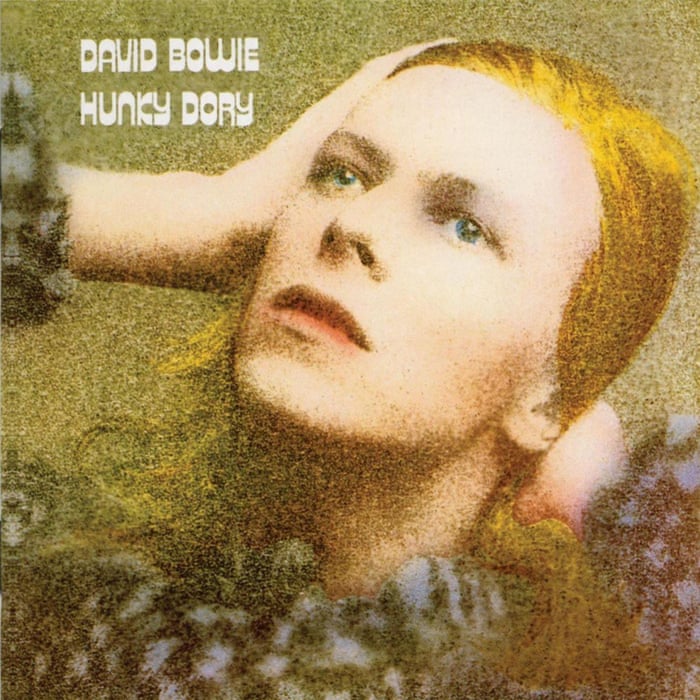
He followed it with Hunky Dory (1972), a mix of wordy, elaborate songwriting (The Bewlay Brothers or Quicksand), crunchy rockers (Queen Bitch) and infectious pop songs (Kooks). It was an excellent collection that met with only moderate success, but that all changed with The Rise and Fall of Ziggy Stardust and the Spiders from Mars later that year.

This time, Bowie emerged as a fully fledged science-fiction character – an intergalactic glam-rock star visiting a doomed planet Earth – and the album effectively wrote the script for his own stardom.


The hit single Starman brought instant success for the album, while Bowie’s ravishing stage costumes and sexually provocative performances (following his carefully timed claim in a Melody Maker interview that he was gay) triggered fan enthusiasm unseen since Beatlemania. Seeing Bowie perform as Ziggy on Top of the Pops was a life-changing experience for a generation of pop listeners in glum 70s Britain.

Everything Bowie touched turned to gold, such as his song All the Young Dudes which provided a career-reviving hit for Mott the Hoople, or Lou Reed’s album Transformer, which he co-produced with Ronson. He scored his first UK No 1 album with Aladdin Sane (1973), which generated the hit singles The Jean Genie and Drive-in Saturday. But Bowie was already planning fresh career moves, and in July 1973 he shocked his audience at the Hammersmith Odeon by announcing the retirement of Ziggy Stardust.

He made Pin Ups, a transitional album of cover versions, before embarking on the sinister concept album Diamond Dogs, intended as a musical version of George Orwell’s 1984. Bowie’s commercial instincts remained in fine working order, however, and the album brought further hit singles with the title track and Rebel Rebel.

He took his new music to the US in 1974 with the elaborately theatrical Diamond Dogs tour, which was filmed by the BBC’s Alan Yentob for the documentary Cracked Actor. However, professional pressures and an escalating cocaine habit were making Bowie paranoid and physically emaciated.


His increasing interest in funk and soul music came to the fore on the deliciously listenable Young Americans (1975), which gave him a US chart-topper with Fame (featuring John Lennon as a guest vocalist) and earned him a slot on the American TV show Soul Train. This was Bowie’s so-called “plastic soul” album, which he described as “the squashed remains of ethnic music as it survives in the age of Muzak, written and sung by a white limey”.

But once again, Bowie’s frantic creativity was accompanied by crises in his business life. He fired Defries, which spurred long and tortuous litigation and cost Bowie millions, then hired his lawyer, Michael Lippman, as his manager. A year later he went through the sacking-and-lawsuit process all over again with Lippman.

Yet he was still breaking new musical ground. Station to Station (1976), a euphoric dose of what might be called synthetic art-funk, introduced a new persona, the Thin White Duke, which Bowie had carried over from his headlining performance as Thomas Jerome Newton, the melancholy space traveller, in Nicolas Roeg’s film The Man Who Fell to Earth.
But Bowie’s own connection to terra firma was looking increasingly shaky. He told Rolling Stone magazine about his admiration for fascism, and provoked outrage when his wave to the crowd while arriving in an open-topped Mercedes at Victoria station in London was interpreted as Nazi salute.

He found some breathing space by buying a home in Switzerland, where he rediscovered his interest in art and drawing, but by the end of 1976 he had taken up residence in Berlin, where he was accompanied by Iggy Pop – with whom he was working on Iggy’s album, The Idiot – and Brian Eno, who would be the catalyst for another of Bowie’s musical leaps forward.

The upshot was the so-called “triptych” of Low, Heroes (both 1977) and Lodger (1979), where Bowie mixed Krautrock influences with Eno-driven synthesizer mood-music, with at least some pop accessibility for good measure (such as Low’s Sound and Vision or Lodger’s Boys Keep Swinging). Lodger, though recorded in Montreux and New York, used the same personnel as the previous two, with Eno once again acting as creative ringmaster. Meanwhile, Bowie found time to film another leading movie role, appearing as Count Paul von Przygodski in Just a Gigolo (1978).


Bowie’s relationship with his wife had been disintegrating under the pressures of success and the couple’s hedonistic, promiscuous lifestyle, and they would divorce in 1980. This was a year of further creative triumph, bringing a fine album, Scary Monsters (and Super Creeps) and its spin-off chart-topping single, Ashes to Ashes, followed by Bowie’s well-received stint as John Merrick in The Elephant Man on the Broadway stage. To make the accompanying video for Ashes to Ashes, he went to the Blitz club in London and recruited several leading lights from the New Romantic movement, a collection of bands including Visage and Spandau Ballet, who owed much of their inspiration to Bowie.

With hindsight, Ashes to Ashes can be seen as the point where Bowie’s cutting edge began to lose its sharpness, and he was never again quite the cultural pathfinder he had been in his heyday. This process expressed itself in the way he restlessly bounced between collaborators.

He bagged a No 1 single with his 1981 partnership with Queen, Under Pressure, while becoming increasingly involved in crossovers between different media. He appeared in the German movie Christiane F (1981) and wrote music for the soundtrack, and his lead role in the BBC’s production of Bertolt Brecht’s Baal (1982) was accompanied by his five-track EP of songs from the play. He registered another chart hit with Cat People (Putting Out Fire) from Paul Schrader’s movie Cat People (1982).


Bowie continued to make progress as a screen actor with appearances in The Hunger (alongside Catherine Deneuve) and the second world war drama Merry Christmas, Mr Lawrence, both released in 1983. Musically, this was the year in which he marshalled his forces for an all-out commercial onslaught with the album Let’s Dance and follow-up concerts. With co-production from Chic’s Nile Rodgers, Let’s Dance moulded Bowie into a crowd-friendly global rock star, with the album and its singles Let’s Dance, China Girl and Modern Love all becoming huge international hits.

This was the heyday of MTV, and Bowie’s knack for eye-catching videos fuelled this commercial splurge, while the six-month Serious Moonlight tour drew massive crowds. It was to be the most commercially successful period of his career.

Tonight (1984) could not repeat the trick, though it delivered the hit Blue Jean, whose short accompanying film Jazzin’ for Blue Jean earned Bowie a Grammy. But his profile gained another boost from his appearance at the 1985 Live Aid famine relief concert at Wembley stadium, where he was one of the standout performers. In addition, he teamed up with Mick Jagger to record the fundraising single Dancing in the Street, which sped to No 1.

Bowie then returned to the multimedia trail with an appearance in Julien Temple’s shambolic film Absolute Beginners (1986), from which he salvaged some personal kudos by supplying the winsome title song. He also wrote five songs for Jim Henson’s fantasy film Labyrinth, as well as taking the role of Jareth the Goblin King.

In 1987, a solo album, Never Let Me Down, performed reasonably well commercially, but poor reviews were endorsed by Bowie himself (he described it as “an awful album”). The follow-up Glass Spider tour was castigated for its soulless over-production.

After playing Pontius Pilate in Martin Scorsese’s film The Last Temptation of Christ (1988), Bowie’s next move was the heavy-rock band Tin Machine, with which he sought to appear as a band member rather than as a solo star. Their album Tin Machine (1989) and tour earned a mixture of modest acclaim and howls of outrage. However, by the time they released a second album, Bowie had abandoned the pretence of being “one of the boys” by undertaking 1990’s greatest hits tour Sound + Vision, unashamedly designed to promote the reissue of his back catalogue. Tin Machine dissolved in 1992.

A few days after his appearance at the Freddie Mercury tribute concert at Wembley stadium in April 1992, Bowie married the Somalian model Iman, whom he had met 18 months earlier, and the couple bought a home in New York. This new start in his private life coincided with a search for fresh musical inspiration.

For the album Black Tie White Noise (1993), he reunited with Rodgers and sprinkled elements of soul, electronica and hiphop into the mix. It topped the UK album chart and yielded a top 10 single, Jump They Say.

However, Bowie’s quest for new sounds to plunder began to evince an air of desperation. Outside (1995) found him reunited with Eno and was another commercial success, despite its laborious concept and clumsy adoption of grungy, industrial sounds, while Earthling (1997) borrowed elements of the drum’n’bass style practised by such UK artists as Goldie and Asian Dub Foundation. One of the album tracks was I’m Afraid of Americans, originally written for the movie Showgirls but remade under the auspices of Trent Reznor from Nine Inch Nails. Released as a single, it sat on the US Billboard Hot 100 for four months.

Bowie was demonstrating unexpected forms of creativity in other areas. In 1997 he made history of a sort by launching his Bowie bonds, whereby he netted $55m upfront by surrendering his royalties over the bonds’ 10-year term. In 2000, he delved into online banking with BowieBanc, giving customers an international banking service as well as cheques and debit cards with his picture on them.

New media and technology influenced his recordings too. His 1999 album Hours… was based around music he had written for a computer game called Omikron, in which Bowie and Iman appeared as characters. Some listeners detected a return to the Hunky Dory days in the album’s reflective, self-analytical musings, though the songs could not match those former glories.

As an adopted New Yorker, Bowie was the opening act at the Concert for New York City in October 2001, where he joined Paul McCartney, Jon Bon Jovi, Billy Joel, the Who and Elton John in a benefit show six weeks after the 9/11 attacks. Bowie sang Paul Simon’s song America and his own Heroes.

He played himself in Ben Stiller’s fashion industry spoof Zoolander (2001). The following year, he was artistic director of the Meltdown festival on the South Bank in London, opening the event by performing the first concert of his own Heathen tour, in support of his album of the same name. The work reunited Bowie with Visconti for the first time since Scary Monsters, and sold 2m copies worldwide. It was nominated for the annual Mercury prize.

A re-energised Bowie was back in the studio with Visconti the following year for Reality, another successful outing welcomed for its energy and musical freshness. However, in the midst of his Reality tour in 2004, Bowie was stricken with chest pains while performing at the Hurricane festival in Germany and underwent an emergency angioplasty procedure in Hamburg to clear a blocked artery.

He took the medical emergency as a warning and reduced the pace of his activities. He made a handful of guest appearances, including a couple of live shows with the Canadian band Arcade Fire, then in 2006 announced he would be taking a year off from touring and recording.

Despite this, shortly afterwards he appeared with Pink Floyd’s David Gilmour at the Royal Albert Hall, singing the Floyd classics Arnold Layne and Comfortably Numb. In February that year he was given a Grammy lifetime achievement award, having been inducted into the Rock and Roll Hall of Fame in 1996. In The Prestige (2006), Christopher Nolan’s film about two battling magicians, Bowie featured as the inventor Nikola Tesla. Nolan said he cast Bowie because he wanted somebody “extraordinarily charismatic”.

In 2007 Bowie was curator of the eclectic High Line festival in New York, and included among his choices Arcade Fire, Laurie Anderson and the comedian Ricky Gervais. In 2008 he contributed vocals to a couple of tracks on Scarlett Johansson’s album of Tom Waits cover versions, Anywhere I Lay My Head.

In 2010, a live double CD, A Reality Tour, was released on Bowie’s own ISO Records. Recorded in Dublin in 2003, it was a survey of most of the key moments in his musical career. Reviewers were enthusiastic, but could not help noticing the valedictory feel of the album. “Nobody really knows if Bowie is hanging up the spacesuit for good,” said Rolling Stone. “But if so, this is one hell of an exit.”

But there was more to come. In 2011 he released the album Toy, which dated back to 2001 and comprised tracks from Heathen and their B sides plus versions of older material. Of far greater significance was The Next Day (2013), his first album of new material in a decade. Produced by Visconti, it was preceded by the single Where Are We Now?, which gave him his first UK top 10 hit since 1993. The album topped charts in Britain and around the world, reaching No 2 in the US. In 2014 Bowie was given the Brit Award for Best British Male, making him the oldest British recipient in the awards’ history.


He is survived by Iman, their daughter, Lexi, his stepdaughter, Zulekha, and his son, Duncan (formerly known as Zowie, then Joe), from his first marriage.

• David Bowie (David Robert Jones), singer, songwriter and actor, born 8 January 1947; died 10 January 2016

http://www.theguardian.com/music/2016/jan/11/obituary-david-bowie