Tuesday, 22 December 2015

Posters for Reimagined Movies

The Hangover: "This is the one that makes most people say, ‘Oh, I didn’t know The Hangover was a remake.’ It’s one of the first ones I made. You’ve got the good-looking, asshole type guy, the square nerdy type, the wildcard comedic role and the blonde bombshell. It all just clicked.”

Modern films reimagined as classics of Hollywood's golden era – in pictures

When he was studying film at college, Peter Stults used to come up with imaginary movie ideas and turn them into posters. Fifteen years on, the New York-based graphic designer makes modern films look like old classics in his What If series, using a mix of Photoshop and collage. “People assume I don’t like modern movies – I do,” he says, “But I am attracted to the poster art of the golden age.” He spends weeks, sometimes months, researching directors, actors and studios in a quest to make the posters look as authentic as possible. “I like it when I trick people into thinking the modern movie is a remake of the film in my poster. If I can do that, I’m doing my job right.”


Iron Man: “I did this for a friend who was trying to impress a girl who had a crush on Paul Newman. He was suave, he could play cocky: he could have pulled off this role. The Iron Man outfit in the background is based onDoctor Who’s Cybermen.”

"Kingsman: The Secret Service" (1955) directed by Richard Brooks, starring Cary Grant


Interstellar: “Here, I wanted to create an epic space movie. Cecil B DeMille’s next project after The Ten Commandments was going to be a space exploration film, but he died, so I like to imagine that this is the movie he would have made.”

"Eraserhead" (1932) directed by and starring Charlie Chaplin

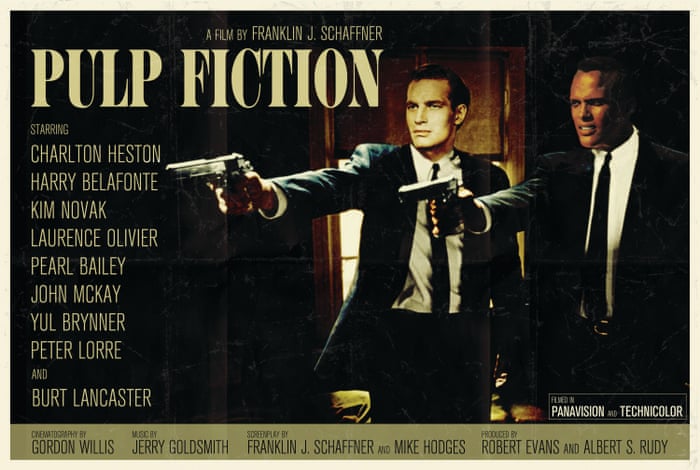
Pulp Fiction: “This was one of the first ones I made. I’m not saying Charlton Heston is like John Travolta, but I was amused by the idea of him doing a Tarantino monologue. In the cast list, I was picking and choosing actors I’d want to see in that film – I’ll let viewers decide which characters they’d play.”

"The Avengers: Age of Ultron" (1944) directed by William Wyler, starring Clark Gable

Drive: “This seemed very obvious to me: a young heartthrob, and the pop culture phenomenon of James Dean dying in a car crash. A lot of people think it should be an action star like Steve McQueen, but actually Drivewas Ryan Gosling’s first action role.”

"The Game" (1966) directed by John Frankenheimer, starring Kirk Douglas

"The Dead Zone" (1957) directed by Roger Corman, starring Vincent Price

Girl with the Dragon Tattoo“This was only my second poster for a silent-era movie and it was a lot of fun to make. I had originally planned on a mid-90s version starring Claire Forlani, or a 60s version with Audrey Hepburn, but this works better.”


After winning audiences over with his role in The Graduate, Dusitn Hoffman appears not just as the protagonist but as the antagonist as well. With supporting roles from Carl Reiner and Mia Farrow, this loose adaption of Dostoyevsky's novel is one not to be missed.

Sunday, 20 December 2015

Jimmy Hill RIP


Jimmy Hill - obituary
Presenter of Match of the Day and former footballer who played a key role in the scrapping of a maximum wage for players

19 December 2015

Jimmy Hill, who has died aged 87, will be best remembered as presenter of Match of the Day and as an opinionated football analyst for the BBC for 25 years; he was also one of the chief architects of the modern game in Britain.

Hill had worked in every capacity in football - as a player, administrator, manager, chairman, commentator, even emergency linesman - and it was his complete absorption in the sport, and his consequent concern for its best interests, that gave rise to many developments in the game now taken for granted.

It was Hill who first introduced all-seater stadia and commercial sponsorship of clubs to football, who pushed for teams to be awarded three points for a win, and who enlivened television coverage by devising the panel of pundits. He was even involved in the gallant attempt to awaken America to the joys of the beautiful game. Most importantly of all, however, it was Hill who led the campaign to abolish the maximum wage for players, so transferring the balance of power from the clubs to those who actually generated their revenue.

In 1957, Hill, then a bossy midfielder with Fulham, was elected chairman of the Professional Footballers Association (PFA), the players’ union. At the time the maximum weekly wage for footballers was capped at £20, although the best teams could draw crowds of 60,000 every Saturday afternoon. Stars such as John Charles were being tempted to leave the British game for Italy, where there were no limits on pay, while some clubs were paying illicit bonuses to players to persuade them to stay.

The confrontation between the Football League and the PFA began when the former suspended some Sunderland players suspected of taking under-the-counter payments. Hill worked successfully to have them reinstated, and then challenged the League to end the wage cap and to allow footballers to move freely when their contracts ended. Astutely using television to win over public opinion, Hill – who always had something of the barrack room lawyer about him – took his union to within four days of an all-out strike in January 1961 before the League was forced to capitulate. The lid of Pandora’s Box had been forced open, and football would never be the same again.

James William Thomas Hill was born in Balham, south London, on July 22 1928, the son of a milkman and failed bookmaker. Jimmy’s mother had been married before and widowed during the First World War.

Her two children from this marriage were the cause of fresh sorrow to her while Jimmy was still a schoolboy. His half-sister, who had played cricket for England, was killed in a motorcycle accident and a few years later, during the Second World War, his half-brother was fatally injured in a fall while serving in Iraq. Hill later attributed his determination to make something of his life to wanting to make up for his mother’s loss of her other children.

His first success was winning a scholarship to a grammar school, Henry Thornton’s, in Clapham. There he blossomed into a good cricketer (football being discouraged) and was a stalwart of the Boys’ Brigade, whose regimented outlook was to leave its mark on a character which, while not without a good deal of individualism and eccentricity, was also strongly drawn to tradition.

At 16, Hill left school, hoping to become a journalist or a footballer. Instead he found himself a stockbroker’s clerk in the City. From this he was saved by National Service, where he fetched up in a unit containing nine professional footballers. His own game quickly improved, and he began playing as an amateur under Ted Drake at Reading. In 1949 he signed for Brentford, and three years later moved to Fulham.

Hard-running and well-organised though he was, Hill was never more than a journeyman player, and certainly not in the same class as such Fulham teammates as Johnny Haynes and Bobby Robson. Beginning as a midfielder before belatedly becoming a forward, he spent most of his career in the Second Division, only enjoying a couple of seasons in the top flight at the end of his playing days.

The highlights of these were an FA Cup run in 1958 in which Hill scored in every round, including the semi-final that Fulham lost to Manchester United, and the five goals Hill scored in an away match at Doncaster the same season, a league record that was not equalled for another 40 years. The following year, Fulham having been promoted to the First Division, Hill scored 25 goals, his best tally for a season, but in 1961, at the age of 33, he suffered a knee injury stretching for a ball at Goodison Park and was forced to quit the game, having played almost 300 matches for the club.

His campaign against the maximum wage had put him in the public eye, however, and he was offered the general manager’s job at Coventry City, then struggling at the foot of the Third Division. Hill rapidly showed once more that he had a sure grasp of the direction soccer should move in, bringing commercial sponsorship to a club for the first time and devising such marketing schemes as dances for the children of fans. It was also Hill who changed the team’s colours to sky blue, and who penned a new club anthem, to the tune of the Eton Boating Song. By 1967, he had taken the team into the First Division. He demanded as his reward a 10-year contract, was offered five, and abruptly resigned.

His career then took an unexpected turn when, quite to his surprise, he was asked to become head of sport at London Weekend Television. There Hill’s first task was to find something to broadcast, as all the principal sports were contracted to the BBC. The consequence was the introduction to television of darts and wrestling, as well as such oddities as artistic cycling and Canadian log-chopping.

More significantly for the future coverage of football, for the 1970 World Cup Hill instituted the first panel of pundits – Malcolm Allison, Paddy Crerand and Derek Dougan – whose lively mutual animosity for the first time brought ITV more viewers than the BBC for the tournament.

Although Hill was appointed LWT’s deputy controller of programmes in 1972, he was by then becoming better known as a forthright (if often verbose) analyst alongside Brian Moore on The Big Match. Hill’s experiences with the PFA had taught him the value of television exposure, and he became an accomplished self-publicist; on one occasion coming out of the stands at Highbury to deputise for an injured linesman.

In 1973, he became the joint presenter with Bob Wilson of Match of the Day, a position he held for 15 years until the arrival of Des Lynam saw him moved sideways once more into the analyst’s chair.

Hill’s most obvious trait as a broadcaster was his refreshing willingness to say what he thought, even if he gave offence. Although he had shed most of his London accent, he was never particularly articulate (“It’s as if there’s a laser beam in his chest attracting the ball” was one observation), but he was enthusiastic about the game, and his conviction that he was always right made for watchable television, especially late in his career when he began to be challenged by younger pundits such as Alan Hansen and Terry Venables.

Outside television, Hill maintained strong links with the administration of football. From 1971 until 1976 he was on the Sports Council, and from 1975 until 1983 he was managing director and then chairman of Coventry, where he brought in all-seating as a way of combating hooliganism. The idea backfired however when visiting Leeds fans found the wooden seats made handy missiles. Hill was later chairman of Fulham from 1987 until 1997, his most important contribution being to secure the club’s ownership of their Craven Cottage ground.

In 1976, Hill landed a lucrative contract to raise the standard of football in Saudi Arabia. This liaison did not last long, but Hill sunk the substantial profits from the transaction into the fledgling American league. Yet despite the presence of ageing stars such as Pele and Cruyff the sport did not catch the American public’s imagination, and Hill was reported to have lost himself and Coventry some £2 million.

In 1996, he admitted having lost a further £100,000 in a car business run by two of his sons, and after he was released by the BBC in 1998 he confessed that it was his need to keep earning money that had prompted him to accept a presenter’s job with Sky. Nonetheless, Hill lived in a certain amount of style, owning homes in France and Spain, and at Hurstpierpoint, West Sussex. He enjoyed golf and tennis, and until his sixties (when he was treated for cancer of the colon) he rode to hounds.

Jimmy Hill was a most curious mix of personalities. As a young man he had taken on the Establishment, yet as he aged he espoused increasingly conservative values. He could be pedantic, irksomely patriotic and too fond of his fame, but he knew how to make fun of himself, and of his prominent chin, which was for many years ill-concealed by a beard until he shaved it off for charity.

He was a shrewd survivor in television and, as his autobiography, The Jimmy Hill Story, revealed in 1998, an accomplished adulterer during his first two marriages. Yet for someone who had spent much of his life in the public eye, in private he seemed oddly unaware of his public image as an somewhat out-of-touch eccentric. He was appointed OBE in 1995.

His first two marriages were dissolved. He is survived by his third wife, Bryony, whom he married in 1991, and by two sons and a daughter of his first marriage and by a son and a daughter of the second.

Jimmy Hill, born July 22 1928, died December 19 2015

http://www.telegraph.co.uk/news/obituaries/12059721/Jimmy-Hill-obituary.html

It's 1972 and Jimmy escorts Racquel Welch to Stamford Bridge to watch Chelsea play Leicester for "a stunt dreamed up by promoter Greg Tesser and celebrity photographer and Chelsea fan Terry O’Neill."

Raquel Welch shouts from the Stamford Bridge terraces, accompanied by Jimmy Hill
Welch waves to fans as Hill protects her from the rain as he hold an umbrella over her head
Jimmy intercedes as a young autograph hunter hassles Welch:
After the Leicester match a young fan insists on getting Welch's autograph, but she refuses and Hill steps in
The result:
Welch controls the ball as she is snapped with a holster and gun around her waist


Meanwhile, we move on to 1977 and here's Jimmy waving to Sunderland fans and, unfortunately, being met with the kind of shameful response you would expect from the Wearside Dorothy Parkers, who still hold him accountable for 'relegating' their team, as if the woeful rest of the season simply didn't exist..


Friday, 18 December 2015

David Bowie - Blackstar review

File:Blackstar album cover.jpg
David Bowie's Blackstar album: 'An unexpected left turn that deepens the mystery' – first-listen review
Blackstar doesn’t carry quite the same element of surprise as The Next Day – but it is the sound of an unknowable artist steadfastly ignoring his own past

Alexis Petridis
Friday 18 December 2015

Next month, David Bowie’s 25th album arrives in a manner not unlike that of his 2013 comeback, The Next Day. Like Where Are We Now?, the single that announced Bowie’s re-entry into the recording world, Blackstar is released on his birthday, 8 January. As with The Next Day, a degree of secrecy has surrounded the project – in October, a British newspaper story professing to reveal details about the album was tetchily dismissed as “inaccurate reporting” on Bowie’s Facebook page – and Bowie himself seems happy to remain at a considerable remove from his own album release.


The promotional interviews have once more been handled by his longstanding producer, Tony Visconti, sleeve designer Jonathan Barnbrook and one of the supporting musicians, Donny McCaslin, the New York-based saxophonist who appeared on the 2014 single Sue (Or in a Season of Crime) and whose electro-acoustic quartet – best known for covering tracks by electronica artists Boards of Canada and Aphex Twin – makes up the core of Bowie’s Blackstar backing band. This time, Bowie doesn’t even appear on his own album sleeve – a career first.

You can see why Bowie might want to replicate the release of The Next Day. The sudden, unheralded appearance of Where Are They Now? might well have been the single most innovative thing about the album, and certainly proved the most influential: everyone from BeyoncĂ© to U2 subsequently attempted to mimic it, with varying degrees of success. Equally, you can understand why there’s noticeably less secrecy about this album than its predecessor: Bowie himself hinted at its appearance in two statements last year, while its making has been the subject of lengthy cover stories in two UK rock magazines. Both features emphasise the project’s leftfield nature (as, in fact, did that story dismissed for its inaccurate reporting): the message that Blackstar is made of different and far more experimental stuff to its predecessor is clearly one that Bowie is keen to get across, albeit from a distance.

To that end, the album has been trailed by its three least commercial tracks, which in addition make up the bulk of its first half. Sue (Or in a Season of Crime) offered pained vocals and skronking jazz over a rhythm based on an obscure late-1990s drum’n’bass track that may well have piqued Bowie’s interest because it was by Plastic Soul, the name he gave to the sound of 1975’s Young Americans. The version on Blackstar is noticeably less heavy-going than the single, its performance more streamlined and guitar heavy. Its B-side, ’Tis A Pity She Was a Whore, has also undergone a substantial revamp, although in the opposite direction the rerecording features the pummelling, hugely impressive sound of McCaslin’s quartet playing at full pelt.

The episodic, 10-minute title track, meanwhile, is alternately gorgeous, disturbing and utterly confounding – although one interpretation of its meaning has been suggested by McCaslin, who claimed it was inspired by the rise of Isis. That would certainly fit the Arabic drones that open the track, the talk of executions in the lyrics and the track’s intermittent sense of dread: it’s certainly not beyond the bounds of possibility that the blackstar of the lyrics is Abu Bakr al-Baghdadi, “treading on sacred ground” by announcing a worldwide caliphate.


Whatever the song is about, the fact that it’s clustered together with Sue and ’Tis Pity She Was a Whore at the album’s beginning – broken up by the more conventional, emotive Lazarus – sends out the same message to the listener as the one imparted in interviews by Visconti. “This is fresh. This came from a different space,” he has said. “[On The Next Day] definitely we did reference older things when we weren’t sure … The Next Day started out trying to do something new, but something old kept creeping in. Not this album. David on purpose used Donny so that wouldn’t happen.”

The rest of Blackstar isn’t as challenging as that – the ballad Dollar Days is just limpidly beautiful – but on first listen, it’s certainly far less immersed in Bowie’s past than The Next Day, which from its cover to its lyrics kept alluding to the singer’s history, as if part of his preparation for re-emergence involved reminding himself of the artist he had once been. Nevertheless, Visconti’s assertion that nothing on Blackstar recalls Bowie’s back catalogue isn’t quite right. The lyrics that appear over the robotic rhythm track of Girl Loves Me are packed with Nadsat, the slang Anthony Burgess invented in 1962 for A Clockwork Orange, an abiding obsession of Bowie’s in the Ziggy Stardust era (Visconti has also suggested they’re inspired by Polari, the slang language used in gay subcultures with which Bowie peppered his interviews in the early 1970s).


More obviously, the introduction to I Can’t Give Everything Away offers a direct musical lift from A New Career in a New Town, the instrumental that closed the first side of 1977’s Low with a burst of breezy optimism and forward motion at odds with the gloom and paranoia elsewhere on that album. Whether it’s there to link Blackstar with the experimentation of Bowie’s lauded Berlin Trilogy or to suggest that Bowie sees himself pressing on into the unknown is an intriguing question, one which the title and lyrics suggest isn’t going to get a straight answer any time soon. “Saying no but meaning yes, that is all I ever meant, that’s the message that I sent,” he sings, sounding rather proud of how unknowable he’s become, at the end of an album that counts as unexpected left turn, executed with enviable aplomb, that only deepens the mystery further.

http://www.theguardian.com/music/musicblog/2015/dec/18/david-bowie-blackstar-album-first-listen-review
http://davidbowie.com/blackstar/

Wednesday, 16 December 2015

The Importance of Elsewhere: Philip Larkin's Photographs - review by Terry Kelly


Faithful and Disappointing
The Importance of Elsewhere - Philip Larkin’s Photographs, Richard Bradford, Frances Lincoln, 2015, 208pp, £25 (hardcover)

Terry Kelly
The London Magazine 
December/January 2016

Memorability is one of the most striking features of Philip Larkin’s poetry. Certain lines and images from his work remain indelibly fixed in the minds of his many admirers. From the philosophically elevated - ‘What will survive of us is love’ - to the starkly demotic - ‘They fuck you up, your mum and dad’ - Larkin’s lines are permanently lodged in our imaginative memories. As the critic Ian Hamilton stated, ‘More often than any other English poet since the war, Larkin gave us lines that it is unlikely we’ll be able to forget.’ But apart from creating verse which repeatedly passes the quotability test, Larkin was also a lifelong keen amateur photographer, lavishing on his pictures the same kind of care and attention and eye for detail he brought to his verse. And these photographic qualities helped nur- ture his poetry, adding to its often picture-sharp memorability. While he was certainly no Cartier-Bresson or Bill Brandt, Larkin’s skilful pictures undoubtedly influenced his poetry, while also providing insights into his literary imagination. Plus, the numerous formal and informal pictures he took of family members, including his long-suffering mother, Eva, lovers Monica Jones, Maeve Brennan and Betty Mackereth, as well as university colleagues and the various places where he lived and worked, represent an unrivalled visual commentary on his life. All these qualities make Richard Bradford’s book a welcome addition to the Larkin canon. Although some may accuse accuse Bradford of barrel-scraping or bloating the already considerable posthumous Larkin estate, devotees of the poet will welcome this visual treasure trove from one of the twentieth century’s greatest lyric poets. Many of the dozens of photographs in the volume, drawn from the 5,000-strong Larkin photographic archive at Hull History Centre, will be new to even his most dedicated readers, making the book essential reading for his huge readership.

In a perceptive foreword, Mark Haworth-Booth, former curator of photographs at the Victoria and Albert Museum, reveals that Larkin’s father, Sydney, gave his son his first camera, a Houghton-Butcher Ensign Carbine no. 5, now preserved at Hull History Centre. A diligent student of photography, Larkin kept up to date with the art form through magazines such as Lilliput and Picture Post. (While Librarian at the University of Hull, Larkin acquired a complete run of Picture Post, from 1938 to 1957). Although many of Larkin’s photographs are of domestic scenes, there was a wider, documentary aspect to his work with a camera, which in turn inspired his poetry. Haworth-Booth: ‘Larkin used photography to sharpen his connection with the broader social landscape towards which he was simultaneously reaching in his poems’. This fruitful chemistry between the visual and poetic is evident in the memorable exterior images outside the train carriage immortalised in ‘The Whitsun Weddings’ or the panoramic sweep of a poem like ‘Here’: ‘Swerving east, from rich industrial shadows/ And traffic all night north...’ A photograph of Rooney’s the jewellers in Dublin was taken during Larkin’s creatively productive sojourn in Belfast, which resulted in a poem which gives Bradford’s book its title. Haworth-Booth speculates that Larkin’s evocative street study was the inspiration for the much later poem, ‘Dublinesque,’ about an Irish funeral. There are even more direct visual-poetic links between snaps Larkin took at the Bellingham Country Show in Northumberland and ‘Show Saturday,’ a poem added very late in the day to High Windows (1974), the poet’s final collection. A Larkin picture of wrestlers grappling with one another was later transmuted into an image of amateur sportsmen involved in ‘long immobile strainings that end in unbalance.’

The book is divided into two sections, the first providing a biographical backdrop to Larkin’s photographs ‘Before Hull’ - including family, friends, early girlfriend Ruth Bowman, Oxford, Wellington, Leicester, Belfast, Monica Jones - and the second looking at ‘Hull and Elsewhere,’ featuring Maeve Brennan, poets, Hull scenes and holiday snaps. As the book reveals, Larkin often cropped his photographs with great skill to emphasise an aspect of a scene, or, as in the case of his famous self-portrait at the border town Coldstream, to underline the essential Englishness of his subject matter. Significantly, given the influence he had on the poet’s life, ‘Before Hull’ opens with one of his earliest photographs, of his father, Sydney, taken at 1 Manor Road, Coventry, when Larkin was just eleven. In a nice, ironic twist, Sydney is captured simultaneously taking a photograph of his young son. The book features several pictures of Sydney in domestic or relaxed outdoor contexts, softening the rather severe image we have of Larkin’s father. Early images also feature the Larkin family holidaying in Germa- ny and Folkestone in the 1930s. There are even several pictures of Kitty, Larkin’s rather shadowy sister.

Bradford thinks Larkin ‘tried desperately to reinvent himself’ at Oxford, turning into the kind of louche aesthete we find in Evelyn Waugh’s Decline and Fall. The poet also set about photographing his talented contemporar- ies at wartime Oxford, lifelong friend Kingsley Amis included. After failing conscription because of his poor eyesight, Bradford believes Larkin assumed ‘the role of visual elegist, roaming through St John’s with a camera he had brought from Coventry, once his father’s, and photographing friends and contemporaries, some of whom he hardly knew.’ According to Bradford, the captions Larkin composed for pictures of these wartime friends ‘invite comparison with a ‘lost in action’ reference in dispatches, or even a gravestone.’ The intense relationship which developed at Oxford between Larkin and Kingsley Amis has already been explored by Brad- ford in a previous book and he suggests in The Importance of Elsewhere that Amis ‘had effectively taken control of Larkin’ at this stage in their lives. The book features numerous pictures of Amis and his girlfriend and future wife, Hilly, who is captured in voluptuous, seductive poses by Larkin. The portraits in the new book are testament to the flirtatious relationship between Larkin and Hilly. (Larkin would later take similar pictures of his on-off girlfriend, Patsy Strang.)

Larkin’s friend and early publisher Jean Hartley always maintained that it was Maeve Brennan, not Monica Jones, who was the great love of Larkin’s life. Certainly, the photographs the poet took of both women are a study in contrasts. A typical early portrait of Monica in the book shows the flamboyant university lecturer in her office at Leicester in 1947; arms folded assertively, a cigarette between her fingers, while directing her trademark unflinching stare at the camera. At least early on in their relationship, Larkin would carefully construct his portraits of Monica, including a highly stylised photograph in the garden of her Leicester flat. The picture prompted Larkin to reveal, in a letter to his lover in January 1951, that the dress she wore ‘arouses the worst in me’. But it’s also fair to say that as Monica aged and gained weight, Larkin’s photographs of her became more casual and less erotically charged. (A quotation from his poem, ‘Lines on a Young Lady’s Photograph Album,’ is relevant here: ‘But o, photography! as no art is,/Faithful and disappointing!’) In stark contrast, Larkin’s pictures of Maeve are far less obviously sexual, presenting his later love interest as pure, like an idealised, muse-like figure. Although the pictures are warm and intimate, they also capture something of the personal and moral reticence of the devout Roman Catholic. For example, Larkin photographed Maeve staring through long grass in 1961, suggesting her reserved, unobtainable quality. For Bradford, Maeve was ‘plain, bright enough but unsophisticated,’ speculating the poet was attracted to his library colleague precisely because of her objections to sex outside marriage. Contrasting the two women in Larkin’s life, Bradford believes that ‘Monica challenged him, intellectually and emotionally, while Maeve mirrored the parts of his temperament that he had largely concealed or subdued, particularly his crippling anxiety, shyness and insularity.’ The author believes Maeve is often photographed ‘in an Edwardian time warp,’ adding, rather cruelly, that ‘Larkin took care to capture a physiognomy that was not classically handsome, one which combined the combative features of maleness with a weary acceptance of middle age’ In fact, some of the pictures of Maeve in the book contradict this blunt estimate. In most of the photographs featured, Maeve is smiling naturally and unaffectedly for the camera, for example, in a hotel in Hornsea or in the countryside. While Bradford calls Maeve ‘happily uncultured’ in such pictures, there is an undeniable emotional warmth in the portraits, as though Larkin is also smiling behind the camera. But it’s difficult to find a photograph of a smiling Monica.

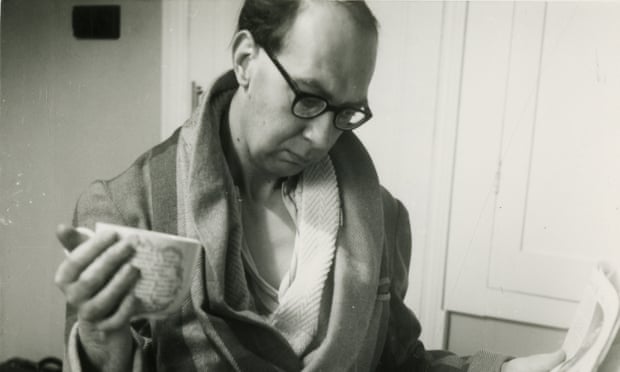
Larkin’s photographic self-portraits possess a haunted, Hopperesque quality. Never at ease with his own appearance, this physical disquiet is reflected in his pictures. But he persisted in taking photographs of himself with a timer, suggesting either an abiding need for self analysis, a desire to sharpen his camera skills or simple egotism. In one of his earliest self-portraits, taken in his room at St John’s, Oxford, Larkin is reflected in a mirror, the young poet looking suitably introspective. When not taking bleak, existential pictures of his empty bedrooms in Belfast or Pearson Park, Hull - which are almost visual evocations of the poem ‘Mr Bleaney’ - a typically glum Larkin is pictured holding a wicker rabbit, in a picture sequence taken by Monica in 1962. But good as some of Larkin’s interior shots and portraits are, his pictures of street scenes are some of the strong- est images in the book. These include an evocative study - inscribed ‘To the Match’- taken in 1949, showing Leicester City fans on their way to the Filbert Street ground, wrapped in a ghostly half-light. Larkin’s time in Belfast proved extremely fruitful for both his poetry and photography. There are several pictures of mass marches through the streets of Belfast and of the Walls of Derry. A return visit to Ireland by Larkin in 1969 produced more striking images, including a colour shot of Belfast before the 12 July festivities. Also featured are some of the idyllic rural scenes Larkin photographed in the East Riding countryside, including Laxton, Yokefleet, Kilpin and Faxfleet, the images providing a lush, visual complement to lyrically upbeat poems such as ‘Cut Grass’ and ‘The Trees.’

But there’s also a sense that as Larkin’s poetic muse abandoned him, his interest in photography also waned. Some of the final pictures in Brad- ford’s book have a casual, almost throwaway quality. And the starkness of Larkin’s later verse, most notably the death-obsessed ‘Aubade,’ finds a visual equivalent in the book’s final, echoing images. One photograph shows the older Monica Jones, wearing a rather frumpy dress, staring blankly out of a window, while the adjacent picture captures Larkin’s mother, Eva, shortly before her death, staring stoically into space. Both images could reasonably be captioned with these lines from ‘Aubade:’ ‘The sure extinction that we travel to/ And shall be lost in always.’ Collectively, the photographs in The Importance of Elsewhere provide numerous visual insights into Larkin’s life and poetry.

http://www.thelondonmagazine.org/

Tuesday, 15 December 2015

Monday, 14 December 2015

Ally May - The Last Week in November

The last week in November

I have lived out by the Cobalt Park
and by the Silverlink.

I have been drunk in the Bridge Hotel
the New Bridge
and the Bridge Tavern.

I saw the gleam in the middle of the afternoon
on Grainger Sreet
in the last week of November

Seeing you in my dreams 
is better than not
seeing you at all.

ALLY MAY

Sunday, 13 December 2015

Happy 99th birthday to Kirk Douglas


Is there another actor where a histrionic impersonation has replaced the real thing in the minds of the public? There's a tendency to forget just how great Douglas could be on the screen and the occasion of his 99th birthday (actually 9 December, so we hope you had a good one) seems like an excuse - not that any is needed = to remind you.... Though being FNB readers, the assumption is that you already have class, taste and style and that you're already aware of this. Still,  for the Philistimes and Burt Lancaster fans out there, here we go...


Last year, on his 98th birthday we blogged a piece from The Huffington Post in which Douglas picked - in no particular order, his own top twelve, which were: The Strange Love of Martha Ivers, Champion, Ace in the Hole, The Bad and the Beautiful, Act of Love (picked because he met his wife making it - ge admits he doesn't know whether it's a good film or not), 20,000 Leagues Under the Sea, The Indian Fighter, Lust for Life (an underrated film with a really shitty poster), Paths of Glory, Spartacus (a role model for many a FNB), Lonely Are the Brave (his personal favourite - and mine too; and the inspiration behind Randy Newman's Cowboy, which, for our younger readers, has nothing to do with Toy Story), Seven Days in May (with the aforementioned Mr Lancaster). And for good measure, he threw in One Flew Over the Cuckoo's Nest, a film he had the rights too, but then passed to his son, Michael, who produced it and the film took five Oscars that year and won rave reviews.


For the same post, in true FNB style, I added another ten films that hadn't figured in his list that I thought were worthy of note; in fact, without wishing to argue with the great man, I think three are top twelve material. Again, in no particular order: Out of the Past, Last Train from Gun Hill, Posse, Gunfight at the OK Corral, The Big Sky, The Heroes of Telemark, The Fury, Young Man with a Horn, I Walk Alone, Detective Story.

http://fridaynightboys300.blogspot.co.uk/2014/12/kirk-douglas-favourite-kirk-douglas.html

Fast forward to now and the British Film Institute has compiled a list of 10 'essential' Douglas films to celebrate his 99th birtday.

Kirk Douglas: 10 essential films
On his 99th birthday we celebrate one of the last surviving great actors of Hollywood’s golden age, with a look at some of Kirk Douglas’s finest movies.

Christina Newland
9 December 2015

Angular of face and macho of disposition, Kirk Douglas is one of the remaining living greats of the studio era. Whether in sword and sandals epics, heroic westerns or contemporary dramas, the actor always approached his career choices thoughtfully. Born Issur Danielovitch to first-generation Jewish immigrants, Douglas lived a genuine rags-to-riches story – going from abject poverty to Oscar nominations in a decade.

The star readily admitted that he’d “made a career playing sons of bitches”. In reality, he was remarkably flexible – with a face to match. Depending on lighting and mood, the planes of his face could suggest a stalwart hero with marble-like strength – or a villain of sculpted cruelty. The endless dimensions he manifested made him one of Hollywood’s greatest leading men; he used that power to form his own production company in 1955. Here are 10 career highlights.


Out of the Past (1947)
Director Jacques Tourneur

Douglas is a controlling playboy in this cornerstone of film noir, hiring old pal Robert Mitchum to retrieve his runaway girlfriend (Jane Greer) from her hideout in Mexico. His role is relatively minimal by comparison to the leads, but it certainly set up his rep as an utter heel. Oozing with sleazy charisma, Douglas begins as the svengali to his femme fatale and winds up on the receiving end of a bullet. James Woods plays a version of the villain in 1984 remake Against All Odds – a worthy expansion of Douglas’s devious original.


Champion (1949)
Director Mark Robson

The actor received his first Academy Award nomination in this classic boxing drama, starring as hungry, ambitious prizefighter ‘Midge’ Kelly. Penned by High Noon screenwriter Carl Foreman, the narrative works in flashback to reveal Kelly’s background as a penniless vagrant. His refusal to return to the breadline breeds a streak of vicious determination in him, and he becomes a champ at the expense of anyone who’s helped him along the way. Douglas brings a dogged tenacity to his role, suggesting the perils of the ‘American Dream’ mythos in this sports-film-as-political-allegory.

The Bad and the Beautiful (1952)
Director Vincente Minnelli

Vincente Minnelli’s three-act melodrama tells the story of megalomaniacal Hollywood producer Jonathan Shields, a conniving and ruthless character said to be loosely based on David O. Selznick. Lana Turner shares the screen as a fading star/alcoholic floozy hopelessly in love with the producer. Like Hollywood itself, Shields’ reputation outlasts his misdeeds; he serves as the perfect metaphor for the whole corrupt and glamorous system. The characters in the film remain fascinated hangers-on in spite of the injury he causes – much like the audience, they can’t seem to shake the stars from their eyes.


Ace in the Hole (1951)
Director Billy Wilder

On-screen journalists rarely come as acidic or bad-bottomed as Douglas’s Chuck Tatum. In one of Billy Wilder’s most scathingly misanthropic films, the tabloid hack exploits a mine collapse with a worker trapped inside. He orchestrates a media frenzy around the tragedy, intentionally sabotaging rescue attempts in order to prolong the excitement. Douglas is toweringly monstrous here – a vulture appealing to the public’s worst impulses. In fact, he may be the scumbag journo against which all others are measured. He makes J.J. Hunsecker in Sweet Smell of Success (1957) look like a pushover.


Gunfight at the O.K. Corral (1957)
Director John Sturges

John Sturges, a renowned director of westerns, creates a memorable portrayal of the legendary Tombstone shootout in this glossy film. The elaborate Technicolor production utilised the star chemistry between pals Burt Lancaster and Douglas, as lawman Wyatt Earp and gunslinger Doc Holliday respectively. The star brings a strutting fatalism to the role, with both playful bravado and an occasional tubercular cough.


Paths of Glory (1957)
Director Stanley Kubrick

Set during a near impossible offensive by the French military during the First World War,Stanley Kubrick’s anti-war film dedicates itself to the purgatorial idiocy and shocking arrogance of military middle-management. The officers here are self-satisfied, wealthy men belonging to a crumbling imperial age. They’re the sort who believe that common soldiers are dispensable and that any slight unwillingness to die like a dog is an act of treasonous cowardice. The only man to seemingly see through this charade is Colonel Dax, played with decency and simmering passion by Kirk Douglas. Dax fights to protect his men from a court martial, but the fundamental absurdity of the war machine is overwhelming.


Spartacus (1960)
Director Stanley Kubrick

A bronzed Douglas is in peak form as the defiant and doomed rebel leader in this Roman slave revolt epic. As portrayed in the recent biopic Trumbo (2015), Douglas’s Bryna Productions had most of the creative control, and the star was involved in hiring Dalton Trumbo. This public show of support would ultimately put a nail in the coffin of the blacklist – and, fittingly enough, the film serves as a perfect allegory for political tyranny and the solidarity of the oppressed.


Lonely Are the Brave (1962)
Director David Miller

This late-period, low-budget western adopts the same elegiac tone as other end-of-the-frontier narratives from around the same time. Again written by Dalton Trumbo, Lonely Are the Brave is an offbeat contemporary variation on the theme. Jack Burns is a likable New Mexico cowboy and drifter. He has no ID, no fixed address, and no regard for modern trappings – cheerfully moseying across busy highways on horseback. Though the narrative sags somewhat in the middle portion, its rain-drenched conclusion is striking. Trumbo mourns the decimation of the old outlaw soul, made an anachronism in the bold new world of the 60s. Douglas called the film his personal career favourite.


Two Weeks in Another Town (1962)
Director Vincente Minnelli

Kirk’s third collaboration with Vincente Minnelli melds The Bad and the Beautiful with La dolce vita (1960) – focusing again on the cutthroat, rarified moviemaking business, with all the internal politics therein. Set in the starry glamour of early 60s Rome, Two Weeks in Another Town is peopled with a constellation of fabulously-dressed starlets – and Cyd Charisse to boot. Douglas is a movie star whose life has hit the skids, asked to work with veteran director (Edward G. Robinson). It’s a bitter, self-consciously cynical film, grounded by Douglas’s presence as the desperate, ageing screen lover (salaciously rumoured to have another real-life basis: Tyrone Power.) 


Seven Days in May (1964)
Director John Frankenheimer

John Frankenheimer’s eerily prescient political thriller explores the possibility of a secret military coup against the president – and was made with the implicit support of John F. Kennedy, who felt that the current military-industrial complex warranted the scenario. The story follows Douglas as a veteran military officer working directly beneath Burt Lancaster’s General Scott, an increasingly outspoken critic of nuclear disarmament. Suspecting that his superior is plotting something, he is forced to turn informer in a high-stakes game where government overthrow is at risk. Filmed in a televisual style, Seven Days in May features a talky ensemble cast and a piercingly direct take on contemporary foreign policy.

http://www.bfi.org.uk/news-opinion/news-bfi/lists/kirk-douglas-10-essential-films


I've never quite appreciated Gunfight at the OK Corral at the level some critics do. I don't think it's as stunning and engaging a piece of cinema as Ford's My Darling Clementine; nor is it as accurate (or as good) as Kasdan's ludicrously underrated Wyatt Earp. Sturges, himself, returned to the scene of the crime ten years later with the low key, brutal and more 'realistic' (and underrated at the time but subsequently appreciated) Hour of the Gun with James Garner and Jason Robards as Earp and Holliday hunting down the remainder of the Clanton gang.


In no particualr order, this is my own preferred ten, : Lonely Are the Brave, Paths of Glory, Out of Our Past (the quintessential film noir), Spartacus, Posse (directed by our man and described by the late Philip French as a Nixonian Western, with Douglas in the Tricky Dicky-type role and also starring the hugely undervalued Bruce Dern), Seven Days in May, Ace in the Hole, Champion, Last Train from Gun Hill, The Bad and the Beautiful.

Happy birthday, Mr Douglas. Cool as hell. Even when he was a bad guy.