Monday, 17 August 2015

Clive James - Latest Readings review

Latest Readings by Clive James review – a life in books
Clive James displays all his artistry and swagger in these moving reflections on books he has long loved – and those he has at last begun

Tim Adams
Sunday 16 August 2015

Clive James was diagnosed with the leukaemia that will sooner or later be the death of him in 2010. Given his talents, his gift of the gab, it is fitting and fabulous that his goodbye is still going strong. So far James’s refusal to go gently into that long Saturday night has produced two volumes of verse, a fine translation of The Divine Comedy, a book of notes on his favourite poets, and this new volume of short essays. He’s written more in the shadow of death than many writers manage in a procrastinating lifetime.

This book, he says, by way of introduction, came from a simple invitation from the editors at Yale: write about the books you are reading (perhaps, the invitation went without saying, the last ones you will read). When he first got his diagnosis James was at a loss to know if he would open a book at all. Boswell’s Life of Johnson cured him of that lack of purpose. The question of what to read was obvious: he should reread all the books he’d loved, and read all the ones he thought he might love but had never got round to, with as much Johnsonian urgency as he could muster.

A move from his London flat back to the proximity of family in Cambridge necessitated the culling of half of his library. He has spent much of the time since building it all back up again, trawling the tables of Hugh’s bookstall in the university city’s market square for bargains. James has always been possessed of a journalist’s omnivorous curiosity, which, he says, has only been sharpened in the past five years: “The childish urge to understand everything doesn’t necessarily fade when the time approaches for you to do the most adult thing of all: vanish.”

His bucket reading list draws him in the first instance back to the literary fetishes of his youth. Hemingway bookends his reading, the life force of the early work giving way to broken promises of the self-destructive end. The mortal trajectory itself changes the way James approaches the remembered pleasures of The Sun Also Rises; he finds himself disapproving of the ways Hemingway eventually squandered his talent and his life; living fast and dying – relatively – young holds less allure.

He can’t help but be inspired, instead, by the completer finishers of the canon, the trilogy writers, the serial novelists – Olivia Manning and Edward St Aubyn become new favourites. In his summer garden he devours again the whole of Anthony Powell like a box set. As a critic, James has been capable of sustained rigour; here it is mostly his old brilliance for epithet and concision that is to the fore. Of Powell’s crumbling social order, he suggests “the great solvent of course was World War II and I now see that nobody ever wrote of it better”.

In James’s reading, all roads lead him back to that particular year zero. He has often described himself as a child of the war – his father died on the return journey from a Japanese POW camp before he knew him – and you could see all of his literary enthusiasms, perhaps all of his competitive intelligence also, as a way of making sense of the unknowable conflict that marked him from birth.

In his decline he finds time to keep up with the latest volumes attempting to explain Hitler’s rise to power as well as for biographies of British generals. He has some fun skewering a factual error about flying saucers in James Lucas’s Last Days of the Reich, and the sometimes wrong-headedness of WG Sebald’s Luftkrieg und Literatur. As ever, in these instances and elsewhere, James wears his erudition not quite lightly. He has rarely been shy, as a writer, of reminding you, gently, of just how much he knows. You forgive him absolutely in this instance. As he says, “we won’t be taking our knowledge any further, but it brought us this far”.

Another strain of James’s life has been that of intrepid traveller; for a while, he was among many other things the most credible heir to Alan Whicker. Beached by his illness, he is drawn above all to tales of the sea. He finds a collection of Patrick O’Brian’s novels at his daughter’s house, and goes through them as if they were Hornblowers. His touchstone, though, as he nears the end, is Joseph Conrad. He seems to stop short of Heart of Darkness, but his readings of Lord Jim, Nostromo and Victory haunt the rest of this volume, in their fragile paradises, and knowledge of nothingness. Some writers he is drawn to “like plates of grapes and sweets”; Conrad refuses niceties, though. “Time felt precious and I would have preferred to spend less of it with him,” James writes, “but he wouldn’t let me go.”

Latest Readings by Clive James (Yale University Press, £12.99). 

http://www.theguardian.com/books/2015/aug/16/latest-readings-clive-james-review#comment-57664795

Not a great first sentence...

Sunday, 16 August 2015

Vittorio de Sica Retrospective at the BFI


Why Vittorio de Sica is one of Europe’s greatest tragic film-makers
While his 1960s sex comedy Yesterday, Today and Tomorrow, is charming, Vittorio De Sica’s early films offer marvellous explorations of defeat. A forthcoming retrospective season shows how the Italian director captured people as they are

Michael Newton
Saturday 8 August 2015

Vittorio De Sica’s films contain much of the aching sadness of life, and much of the beauty, too. It is one of the small mysteries of cinema how De Sica, a lightweight actor (and very handsome man) accustomed to playing sentimental leads, should go on to become one of Europe’s greatest tragic film-makers. It’s as if Hugh Grant were to suddenly metamorphose into Ken Loach. Yet links remain between the comedic ham and the neorealist tragedian. De Sica enthusiastically carried his actor’s talent into his directing style, instructing his amateur performers on the way to perform, enacting the parts to show them how things should be done. There is a story that he once played Sophia Loren’s part, joining Marcello Mastroianni on set in bed; lying underneath the attractive star, he demonstrated to the two of them how they should kiss.

Though De Sica went on to work with Mastroianni and Montgomery Clift, Loren and Jennifer Jones, there are no film stars in his first masterpieces, those extraordinary works of the late 1940s and early 50s. Denying movie-star glamour, De Sica was casting according to the authenticity of a face. Lamberto Maggiorani, Bicycle Thieves’s gaunt leading man, was a factory worker; Carlo Battisti, who played Umberto D, was a retired university professor in real life. No big-name actor could have lived on screen as these people do. After all, as De Sica asserted, there are millions of characters, but only 50 or 60 movie stars; it seemed to him a strange illusion that so few people could faithfully embody the experience of so many. Yet for all the appeal of this approach, that factory worker and the university professor become players, as much bound up in artifice as Cary Grant or Spencer Tracy. For these are films that tell the truth about the contemporary world not as documentation, but through the conjured illumination of poetry.
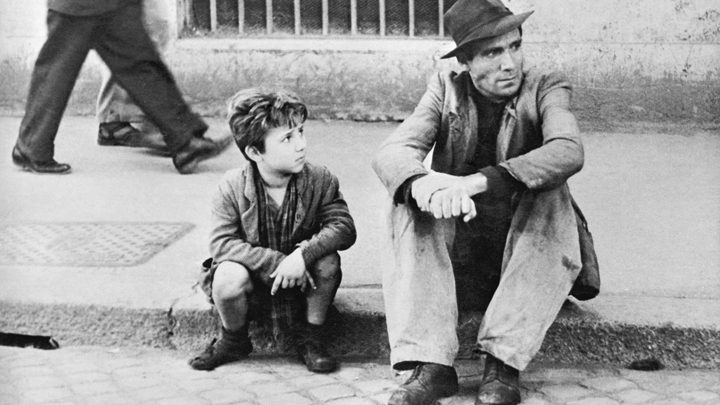
Bicycle Thieves
His early films – especially Shoeshine (1946), Bicycle Thieves (1948), andUmberto D (1952) – are among the glories of European cinema. They are all tragedies of miscommunication. In Shoeshine, events turn first on a deception, and then on the separation of two boys, great friends placed in different cells when confined to prison. Apart from one other, each loses trust; words miscarry and cannot be understood. Here, as elsewhere, De Sica presents people who cannot reach each other through language, but stand hopeless and encased in their position in the world. They try to enlist or persuade others, find help, a loan, or support in their loneliness, but no help comes. Acts of charity short-circuit; sympathy fails to find its aim. De Sica was an expert on the subject of being disregarded. His characters are invisible persons made visible to us. The lack of what would be, to others, very small sums of money drives them to desperation; the loss of a bicycle can destroy a whole life. Harried by oppression and poverty, his protagonists fall into acts of moral compromise; the heroes must become that which their conscience condemns – a snitch, a bully and thief, a beggar. His people are too flawed to be the pitiable saints some repute them to be. The sadness here is not inevitable; it is a consequence of a social structure, a political pathos.

At the same time as Arthur Miller’s Death of a Salesman was receiving its first performances in the US, in Italy De Sica was also exploring the troubling radiance of failure. In Umberto D and Bicycle Thieves, we are taken inside the particular life, and yet never lose sight of the fact that even now such tragedies are playing out somewhere. The central figures embody a general defeat, and yet remain absolutely unique. This impression of the individual life finds itself in De Sica’s eye for detail, etched into the surface of things like the scratches on the kitchen wall where, in Umberto D, each morning the pregnant housemaid strikes the matches to light the gas. They are great urban films, leading us within what is, to middle-class audiences, the unseen city of the poor: the pawn shops; the cramped and ramshackle apartments; the fortune teller’s boudoir; the markets; soup kitchens and social clubs. The films permit us to penetrate both this teeming metropolitan world and also enter the individual life, drawing us in by an attentiveness to sorrows to which we might otherwise fail to attend. The films lay a claim on us, with the unemphatic persuasion that we ought to bear witness to such tragedies.

In the midst of these harrowing and marvellous explorations of defeat, De Sica and his hugely talented collaborator, the screenwriter Cesare Zavattini, turned to making a fairytale. The very funny fantasy film, Miracle in Milan (1951), gives us Totò (Francesco Golisano) and Edvigie (the adorable Brunella Bovo), two improbably sweet holy fools; De Sica’s films often looked into the depths that abide in simplicity. He liked human beings most when they are unguarded, naive and possessed by a simple faith in life. He wanted to manifest a kind of trust before things, one that often fails, but at least is there to fail. It’s in the shoeshine boys’ love for the horse they save up to buy, in Umberto D’s feeling for a lonely pregnant girl and for his pet dog; it’s the compassionate openness that allows us to love others. Yet he also shows the endearing selfishness in simplicity, too, the childlike egoism, the guiltless need for small indulgences. Few film-makers help us to share so completely the pleasure of food; in Bicycle Thieves, every time I watch the son lingering over the mozzarella in carozza, I get hungry. Everywhere in his movies, De Sica communicates a democratic delight in what delights everyone; his films presuppose that outdated concept, the normal heart, one that finds a natural sympathy with children, the old, and life’s discarded ones. Miracle in Milan may be a film obsessed with numbers – lottery numbers, times tables, the price of a bid or a bribe, the figure that might express the imagination’s largest possible fortune – but in the end it sides with what cannot be counted, but can only, for all its fragility and its inability to find a place in the world, be counted on.

Some might recoil at the prospect of having their hearts warmed in this way. Yet the film never forgets how hard life is, and how in the end the only escape for the poor is to leave the confines of the Earth altogether. In film this provides a fairytale uplift; in contemporary Athens, for example, it would be harder to pull off. Zavattini and De Sica know that the film provides consolations that only a work of art could offer. We are shown people paying to watch a sunset – that stereotypical end of the classic Hollywood movie – or handing over 100 lire to be told by a charlatan reader of faces that they are amazing people: “who knows what you’ll become!”. This plays like a necessary moment of cinematic self-critique, the film telling us that it knows such flattery is what cheap films perennially offer us. Yet De Sica himself very rarely falls into this trap; rather his pictures affirm human dignity without insinuating (as Hollywood might) that this means we shall receive extraordinary rewards.

In De Sica’s films people go unrewarded; the story takes us beyond the moment of loss, and leaves us only with the small resolution to keep going that sometimes comes in loss’s wake. At the close of Bicycle Thieves, when driven beyond despair, the father and son take each other’s hands as they move among the anonymous crowd, it’s a symbol of human compassion and solidarity that proves almost unbearably moving. Yet as they walk on, they are lost from view. They have each other, but are gone. At the end of Indiscretion of an American Wife (Stazione Termini, 1953), we are taken into the extremity of separation; the married woman remains on the train, while her lover is thrown from it, and sprawls on the station platform. Someone comes to help him up. “Are you hurt?” he asks. “No,” says the lover, and walks on down the platform, going forwards as there is nowhere else to go, and with that the film abruptly ends. For De Sica, there is an answer to everything, except death. When the worst thing has happened, life nonetheless goes on.

Indiscretion of an American Wife is a strange paradox, a bad “very good film”. The producer, David O Selznick (the husband of the film’s female star, Jennifer Jones), butchered it. Almost nothing in it properly works, yet it has long haunted me in ways that few other movies have. In it, two illicit lovers wander Rome’s central railway station, alternately endeavouring to be noble, or giving themselves up to their mutual desire. Yet wherever they go, there’s no place for them to express their love; they are constantly watched, spied on, interrupted. These are lives under surveillance; it’s a film of glances, whether lascivious, mocking, pitying or reproachful. It is a companion piece to a film that De Sica acted in that same year, Max Ophüls’s truly wonderful Madame De … , in which De Sica and Danielle Darrieux play innocent adulterers, almost childlike in their helpless twinned passion. As an actor, De Sica is at his best here (along with his very different role in Roberto Rossellini’s Il Generale della Rovere of 1959), summoning an affable but passionate dignity. Yet Ophüls requires the husband (played by Charles Boyer) to perform the role of the sophisticated villain; in De Sica’s film, there are no bad guys, only the impossibility of circumstances.

De Sica’s genius was for tragedy, though as the 50s turned into the 60s, he tried his hand at popular comedy. The best of his Loren and Mastroianni films are charming and likable pictures, as long as we banish the thought that they were made by the same man who made Bicycle Thieves. The best and funniest of them is Yesterday, Today and Tomorrow (1963), which won the Oscar for best foreign film. It’s an early swinging 60s comedy about the frustration of sex, carried by Loren’s mesmerising self-confidence (her tantalising striptease is one of the most sensual moments in cinema), and her three-fold unmanning of Mastroianni, an actor who was always at his greatest when at his most feckless.

A nostalgia for a lost Italy impregnates De Sica’s best late films, even though he never forgets how fascism had compromised and stained that past. Nonetheless, a dissatisfaction with the country in the era of economic reconstruction, the boom years of the late 50s and 60s, is palpable. The only values now are cash values; the cities have been stifled with the arrival of the tower blocks; the heart has grown small. De Sica’s late masterpiece The Garden of the Finzi-Continis (1970) is most suffused with nostalgia; based on Giorgio Bassani’s melancholy novel, it’s a study of what WB Yeats described as “that monstrous thing, returned and yet unrequited love”. Here De Sica frames another mire of miscommunication in a movie of frustrations and incompleteness. It’s a self-consciously beautiful work, replete with that early 70s Euro-emptiness: stylish, sexualised and somehow vacant. As filmed, the garden itself doesn’t exist, though in Ferrara people still search for it; it’s a constructed setting, pieced together through the art of film. This luscious place, from which the hero finds himself exiled, represents a fragile beauty soon to be crushed by the Holocaust. To connect Auschwitz, as the film does, to the small anguish of a frustrated love affair, might invite accusations of kitsch. But it seems to me an assertion of what is constant in human experience, the petty losses and sorrows of the personal life pitched against the enormous horror of the camps. In dwelling on the life that was lost, with all its heartbreak and yearning, the film memorialises the vanished even as they were: ambivalent and troubled. That was long the motivating impulse of De Sica’s art, one that portrays the world and people as they are, with all their failings, and yet knows the value and beauty of their being there, and of the faint, tender links that connect us.

• Vittorio De Sica: Realism and Romance runs at the BFI Southbank, London SE1 until 31 August.
‘It is not reality. It is reality filtered through poetry, reality transfigured’ De Sica on neo-realism.

Now best known for Bicycle Thieves and other neo-realist classics made with writer Cesare Zavattini, De Sica was a matinee idol long before he began directing in 1940. Even before Shoeshine in 1946 – shot on location with a non-professional cast and dealing with social injustice – De Sica had demonstrated, in The Children Are Watching Us and The Gate of Heaven, his skill with actors and a passion for social, psychological and emotional authenticity. His finest films, like his best performances (Il Generale della Rovere is one such) offer a persuasive impression of spontaneous ‘reality’, notwithstanding the preparation and artifice involved in their making. And by steering clear of sentimentality, De Sica rendered many of his films almost unbearably moving.

Here, then, is an opportunity to discover a highly rewarding body of work too rarely seen in recent years.

Geoff Andrew, Senior Film Programmer

https://whatson.bfi.org.uk/Online/default.asp?BOparam::WScontent::loadArticle::permalink=vittoriodesica

Friday, 14 August 2015

Wednesday night's set lists

At The Habit, York: -

Ron Elderly: -
Dock of the Bay
Here, There And Everywhere
Cry To Me
Tell Me

Da Elderly (debuting the new toy - a guitar-banjo): -
Too Far Gone
How Can We Say Goodbye?
Bouquet Of Roses
Are You Ready For The Country?

The Elderly Brothers: -
Proud Mary
Medley: Sweet Caroline/Hi Ho Silver Lining
I Saw Here Standing There
Then I Kissed Her
Lucille

A busy night with, in the end, a surfeit of players. A lively crowd were treated to the usual mix of eclectic sounds. The introduction of the 6-string guitar-banjo was well received, considering the banjo's ability to divide opinion. Another first in the set-list was Eddy Arnold's 1948 weepie, Bouquet Of Roses. The after-show jam was, as always, a delight!

Simon and Garfunkel: Think Too Much and Live in Vancouver 22 August 1983

A re-post - if you scroll to the bottom, you'll see why...

Think Too Much: The Simon and Garfunkel Album That Wasn't

Robin Platts
Analog Planet 
1 January 2011

August 22, 1983. A packed concert at the newly constructed BC Place stadium in Vancouver, British Columbia. Paul Simon and Art Garfunkel are halfway through a set on the last leg of their North American tour, billed as “A Summer Night with Simon and Garfunkel.”

The summer tour is the latest phase of a successful reunion that began with the 1981 Concert in Central Park. The next step is a new album, titled Think Too Much, Simon and Garfunkel’s first full-length studio collaboration since 1970’s Bridge Over Troubled Water.

The first half of the Vancouver concert has gone smoothly, packed with hits from “Cecilia” to “El Condor Pasa,” with a couple of new tunes and respective solo offerings thrown in; but things hit a slight bump in the road as the duo launch into the title track from the Think Too Much album: both miss their entrance and neglect to sing the first line of the song. Then one tries to sing the first line as the other attempts to catch up by singing the second. They are back together in time for the voices to blend on “The fact is you don’t think as much as you could,” which Simon follows with a spoken “huh…yeah.”

Twenty-six years ago, that simple “huh…yeah,” sounded like nothing more than a jokey acknowledgement of an onstage screw-up. Today, listening back to a bootleg recording of the Vancouver concert, the aside sounds loaded, perhaps rueful. Maybe that’s just a hindsight-tainted temptation to read too much into it, but the fact is that, on that summer night, Paul Simon had a lot on his mind. One thing weighing on him was the fate of the new Simon and Garfunkel album. Publicly, the Think Too Much LP was expected out following the tour; privately, it was dead in the water, and Simon and Garfunkel’s partnership, which had been on-again and off-again for almost three decades, was about to enter another “off-again” phase.

As 1982 turned into 1983, the reunion sparked by the Central Park show had looked less and less like a one-off thing and more like an ongoing partnership. The surest sign of this direction was the revelation that there was a new album in the works: Think Too Much, a studio collection of new material, Simon-penned songs to feature the classic Simon/Garfunkel vocal blend.

In some respects, the project was doomed from the start. The songs intended for the Think Too Much album hadn’t been written with Simon and Garfunkel in mind – they were written for Simon’s next solo LP, a follow-up to the unjustly overlooked One-Trick Pony. Immediately after the Central Park concert, Simon had started recording his new solo album.

With Lenny Waronker co-producing, Simon recorded several of his news songs, including “The Late Great Johnny Ace,” “Song About the Moon” and “Allergies.” Waronker left the project in 1982 after becoming president of Warner Bros.

In the meantime, the success of the Central Park concert brought demand for further reunion shows, and Simon and Garfunkel obliged, touring Japan and Europe in 1982. The success of the reunion, combined with pressure from Warner Bros, caused Simon to consider the idea of a new Simon and Garfunkel studio album. In interviews in the spring of 1982 Simon and Garfunkel were suggesting that a reunion album was a possibility. Simon was by this point roughly halfway through recording his solo album, so the logical route was to simply bring Garfunkel in and turn it into a Simon and Garfunkel album.

The reunion album project was fraught with tension from the beginning. One source of unease for Simon was the fact that this particular set of songs was very personal to him.

“These new songs are too much about my life - about Carrie [Fisher] - to have anybody else sing them,” he told Playboy in 1984. Garfunkel countered that he understood the emotions behind the songs and that, as a singer, he could interpret them. Simon agreed to give it a try, on the condition that he would produce the album alone. On the duo’s earlier efforts, Simon shared production duties with Garfunkel and Roy Halee. Halee did reunite with Simon and Garfunkel to work on the new album, eventually credited as the album’s co-producer and chief engineer.

Simon’s demand for production autonomy frustrated Garfunkel, but he reluctantly agreed and then began the task of devising his own vocal parts for Simon’s new songs. This included some solo vocal parts – such as the bridges of “Cars Are Cars” and “Song About the Moon” – as well as the trademark harmonies. However, Simon’s new melodies didn’t lend themselves as readily to Garfunkel’s harmonies as their ‘60s counterparts had done.

“[The songs] weren’t written for us both to sing,” Simon pointed out in a Spokane Chronicle interview conducted just before the 1983 tour kicked off. “We have to solve the problem of singing these songs with two voices that weren’t written with that in mind... They’re not as harmonically uncomplicated as they were in the ‘60s. Simply two-part doesn’t apply as much as it did then.”

Garfunkel took his time writing his vocal parts, to the point where Simon had already finished recording his own vocals and Garfunkel wasn’t ready, still wanting more time to work out his parts. To make matters worse, Garfunkel countered Simon’s solo-production decree by requesting to record his vocal parts without Simon present in the studio.

Eric Korte was one of a dozen or so engineers who worked on the Think Too Much/Hearts and Bones sessions, a second engineer, assisting Roy Halee.

”Art wanted more creative input, rather than just being a background singer on Paul’s songs,” says Korte, and to that end, Garfunkel “had booked some sessions to come up with his own vocal parts.” Korte recalls that at a playback session to review Garfunkel’s efforts, Simon didn’t seem thrilled.

“Paul was a super-perfectionist about what he wanted,” Korte says, “and he was in the mood to take his time on the project and try a lot of different stuff.” As far as working with Garfunkel, “Paul was willing to give it a try, but he was in a different headspace.”

Korte recalls that the best moments came when Simon and Garfunkel got on the mic and sang together “That was very special,” Korte recalls. “When they went on mic together and Paul was in charge; but Art wanted to go beyond that and Paul just wasn’t digging it.”

Work dragged on over the course of a year or so. The goal was to get Think Too Much into record stores in advance of the summer 1983 North American tour. As the shows drew closer, it became increasingly apparent that Simon and Garfunkel wouldn’t have the album ready in time. With hindsight, that missed deadline was more than a missed chance to move a few more units off the back of the live shows; it was the last chance to get the album out before the old acrimony resurfaced over the summer.

Without a new album to promote, Simon and Garfunkel hit the road in July 1983, starting in Akron, Ohio, at the Rubber Bowl Stadium. The Akron show featured a quartet of songs from the still unfinished album – “Song About the Moon,” “Allergies,” “Think Too Much” and “Johnny Ace” – mixed in with S&G hits, respective solo offerings and a new cover version of “One Summer Night.” The set list varied somewhat throughout the tour, with “Song About the Moon” and “Allergies” dropped partway through and replaced with “Cars Are Cars.”

As the tour stopped in Pittsburgh, the local paper’s review of the concert speculated about the upcoming reunion LP: “Whether Paul Simon and Art Garfunkel can be a valid musical entity in the future... will be decided with the next album, their first recording of original music since 1970. The disc is tentatively titled Think Too Much and targeted for a fall release.”

In interviews during July, the duo sounded increasingly confident about the album, and spoke of it as though it was almost finished. Media reports at that time suggested Think Too Much was on track for release at the end of August.

However, a profile by Robert Hilburn that ran in the Sarasota Herald Tribune made it clear that it had not been an easy process. “Things did not go all that smoothly when they got into the studio this year,” Hillburn noted. “They even ended up working in separate studios.”

In the Hilburn piece, Simon confessed to feeling pressure about the album. “People kept asking, ‘Are you going to make an album together?’ or ‘God, it would be great if you made an album together’. And I felt Artie wanted to be involved in it very much. I also realized that by including him on it I would probably improve the overall quality, certainly would improve the sales and would satisfy a lot of people. I also knew we’d end up in some terrific fights over points I really didn’t want to fight about. And that’s exactly what happened.”

“The truth is,” Simon explained, “I had a very hard time emotionally turning it over to make it a Simon and Garfunkel album.”

“I didn’t write for Artie’s voice,” Simon told Hilburn in mid-July. Depsite the fact that album was still supposedly going ahead, Simon’s comments to Hilburn suggested he was already well on his way to talking himself out of the reunion album idea. “I was writing a group of songs that seemed very special to me. I think, in a certain way, he improves my records. He makes the sound of them more agreeable to many, many people. But I don’t care. It’s an odd situation. I essentially see myself as a writer, and I don’t want to obscure the writing. I think my voice is a good vehicle for my writing, even with its flaws.

Garfunkel was more positive about the project, enthusing in a Spokane Chronicle article, “I’m so keyed up. This morning, I think I found the harmony that is just what I want for ‘Cars Are Cars All over the World.’ I’m on the tips of my toes with the sense of readiness to see if I can slip it into the tape the way I want.”

“I think people are going to be knocked out by Paul’s new tunes, which are very autobiographical and very accessible,” he told the Milwaukee Sentinel.

In a July interview with the Modesto Bee, Garfunkel said “We’ve almost finished the new album, which is very exciting to me. It’s a valid Simon and Garfunkel album, with all-new Paul Simon songs that are better than ever.” Garfunkel acknowledged there had been “difficulties” with the project, but said “I believe again that it’s coming along nicely.”

Simon had a somewhat different view of the project: In August, as the North American tour neared its conclusion, he called Garfunkel to inform him of two things. Garfunkel recalled the phone call in a 1990 interview with Time: “He does things that I could never understand. He called me up one day and said, 'Artie, I'm dropping your vocals on “Hearts and Bones.” It's not turning into the kind of album I want it to. And by the way, I'm marrying Carrie on Tuesday, and I want you to come.' "

Once the project reverted to a solo album, all of Garfunkel’s vocals were meticulously wiped from the multi-track tapes. “We had to make sure all Art’s vocal parts were erased from the master tapes,” recalls engineer Eric Korte.

In late September, following the North American dates, Simon and Garfunkel wound up their tour with two shows at the Ramat Gan Stadium outside Tel Aviv, Israel. According to a newspaper story at the time, the Tel Aviv shows were “billed as their last,” and that the visit coincided with Simon visiting Israel with Carrie Fisher on their honeymoon.

Arlen Roth, one of the two guitarists in S&G’s ’83 band recalls encountering a dejected-looking Garfunkel prior to one of the Tel Aviv shows. “I asked him what was wrong and he said, ‘Well, how would you feel if you just found out you'd been erased from an entire album?”

After Tel Aviv, the duo went their separate ways, and would not work together again for many years. Garfunkel has admitted that his removal from the album was a very sore point.

Fans looking out for the new Simon and Garfunkel LP were no doubt confused by the November 1983 release of the new Paul Simon album, titled Hearts and Bones. A quick scan of the track listing revealed that the album included all the tracks touted for inclusion on the Simon and Garfunkel album. The planned S&G title track, “Think Too Much,” appeared in two incarnations. Even in those long-ago pre-Internet days, when updates about your favourite rock musicians were few and far between, the message was clear: the Simon and Garfunkel album had been scrapped and replaced by Hearts and Bones.

Russ Titelman commented in an article in the Palm Beach Post in October 1983, “Paul never really decided if he wanted the album to be his own or Simon and Garfunkel’s”

What is the point of this story? What information pertains? The fact is, in an age when every inch of notable tape from every rock legend has somehow leaked out, Simon and Garfunkel’sThink Too Much album remains locked in a vault somewhere.

But what is on the tape? Certainly not a finished, mixed and mastered album. There’s definitely a rough mix of the album with Garfunkel on it, although whether or not he appears on the whole album is unclear, as is the question of whether or not his vocals were actually finished.

The only firm evidence is a bootleg of studio rough mixes, on which Garfunkel’s voice is clearly discernable on two tracks – his harmonies on “Train in the Distance” and a gorgeous vocal solo (the “laughing boy” section) on “Song About the Moon.” There are also a handful of live recordings from the 1983 tour, on which Garfunkel joins Simon to sing “Cars Are Cars,” “Think Too Much” (the fast version), and “Allergies.

The Think Too Much album would almost certainly have featured the same 10 tracks that appeared on Simon’s Hearts and Bones album. Another contender for the album, “Citizen of the Planet,” a folky tune that recalled the duo’s early ‘60s sound, was considered but had certainly been dropped from the album by the summer of 1983. (“Citizen” finally appeared, a decade later, as a Simon and Garfunkel reunion track on the Old Friends concert album.)

The prospect of hearing the Think Too Much album is a tantalizing (if unlikely) prospect. Dan Nash, one of the dozen or so engineers who worked on the album, says, “The entire thing was finished with Artie on it, without a doubt. I have a copy. When Paul made the decision [to make it a solo album], he had Roy Halee make rough mixes of the whole thing.”

According to Nash, all that was missing was some backing vocals, but the lead vocals by Simon and Garfunkel were complete. “If you heard the rough mixes you’d know all it needs is to be mastered.”

However, Nash isn’t sure whether the duo had agreed on whether the lead vocals were supposed to be final or just “scratch” vocals.

Nash feels that the Simon solo version suffered from an attempt to over-compensate for Garfunkel absence. “[Paul] had a clear sense of the structure of the record. But to make the songs sing, he had to come up with musical accoutrements to make it fly. So there were a lot of extra musical parts added – things that were clever, but that weren’t organic.”

In Nash’s opinion, the Simon and Garfunkel version, even in rough-mix form, is “100 times better than the album that came out.”

“I recall, and still have somewhere, the rough mixes of the album with Artie on it,” says Arlen Roth. “He was on almost every song, as I recall, and we were all so excited about this being a true S&G "reunion" album, as well as reunion tour! Live, we performed 'Cars are Cars", "Allergies" and "Hearts and Bones".”

Mark Linett worked briefly on the album in its early stages, at Warner Bros Recording Studios in Los Angeles. At that point, Linett understood the sessions were for a Paul Simon solo album. Garfunkel was at the sessions but in the role of backing vocalist. Another engineer who worked on the album, Jimmy Santis, remembers it as a Simon solo album and doesn’t recall Garfunkel’s involvement being mentioned.

Korte remembers that during his time on the album, only a few songs appeared to have been finished with Garfunkel.

17 years later, the Think Too Much album surely deserves to be dusted off and unleashed in some form, whether it’s finished or not. It seems unlikely that Paul Simon would have much of an appetite for it, and maybe Garfunkel wouldn’t either; but Simon and Garfunkel fans surely deserve the chance to hear it for themselves - especially for all those who caught the duo on their 1983 tour, heard the new songs and were disappointed when he album didn’t come out.


Legally, of course, we couldn't possibly condone this sort of thing, but lookee here, kids: http://bigozine2.com/roio/?p=2459

Wednesday, 12 August 2015

Buster Keaton comes to Newcastle's Heaton Park Silent Film Night...


Heaton Park to celebrate movie legend Buster Keaton with silent film night

Simon Duke
12 August 2015

There’s a cinematic event taking place this weekend that is aiming to prove that silence is golden.

On Saturday night Heaton Park will host its annual silent film night which this year will pay tribute to Buster Keaton with an evening of the movie legend’s films.

Silent film accompanist, composer and broadcaster [the inestimably clever] Neil Brand (NFT, BBC4 Sound of Cinema and Radio 4 Film Programme regular) has been playing Keaton’s films on piano for 30 years and considers him ‘the greatest manipulator of the film camera and what can be done in front of it’.

He will start the evening with clips from Busters best stunts, his funniest gags, wilder moments and the background to his life’s story.

He'll then take to the keys to breathe life and sound into the 1928 silent feature Steamboat Bill, Jr. – now regarded as a masterpiece of its era and featuring stone-faced Keaton (minus his famous port pie hat) in his single most famous stunt with THAT house falling down around him.

The film follows Bill Junior who returns to his home town to help his father - a cantankerous captain of a tired, Mississippi paddle steamer who’s business is threatened by town rival J.J. King. But to his father’s dismay, Bill Jnr falls for Kitty – his rival’s daughter. When a fierce storm hits, Bill Jnr saves the day – as well as Kitty and both fathers.

The classic film delivers 70 minutes of gags and death-defying stunts - planned and performed by Buster himself - that will literally bring the house down. Now, nearly nine decades after its release, the film is brought to life with live music from Brand, who is considered one of the finest exponents of improvised silent film accompaniment in the world.

The film starts at 8pm. In case of wet weather, the event will move to St Gabriel’s on Heaton Road.

Tickets are £5 and available from Ticket Source.

http://www.chroniclelive.co.uk/whats-on/film-news/heaton-park-celebrate-movie-legend-9839338

Beware, when you click on the link for tickets, it says Wednesday night. And when you click on the ticket site Facebook link, it's about The Cabinet of Dr Calgari on Tuesday. Maybe it's sold out. Maybe The Chronic got the story late. Maybe it used the story late. Maybe the marketing and promotion's as lousy as that of The Sage. Maybe I'm still smarting at missing Graham Parker - sold out before it was publicised in their events booklet...

Tuesday, 11 August 2015

The Orchid House Project - 7 Studio Songs


Born to Fly, Patent Love, Touching the Far Horizon, Arcade Games and Growing Pains, Walk the Wire, In Spite of All the Years and Finding My Way Back Home.

Available now on Amazon Digital music now and ITunes and other stores in a few days!!!

Monday, 10 August 2015

David Nobbs RIP

David Nobbs

David Nobbs dead: 'Reggie Perrin' creator dies, aged 80
In a career spanning six decades, Nobbs wrote 20 novels, including stories about his greatest character, Reginald Perrin

Ian Johnston
Monday 10 August 2015

David Nobbs, the author and comedy writer who created the classic Seventies TV sitcom The Fall and Rise of Reginald Perrin, has died aged 80.

Nobbs, a patron of the British Humanist Association, worked on a string of leading British comedy shows such as That Was The Week That Was, The Frost Report and The Two Ronnies and also wrote for stars including Tommy Cooper, Les Dawson and Frankie Howerd.

Monty Python star John Cleese wrote on Twitter that Nobbs was “a lovely kind, gentle man with a delicious sense of humour”.

“Very sad today to hear of the death of David Nobbs. First worked with him on the Frost Report in 1966; then on many films for Video Arts,” he said.

“He wrote many top-class shows and books. His masterwork: the Reggie Perrin shows.

“I had not seen him for several years, but it is strange how much I miss him today. When I was a beginner, it thrilled me when I made him laugh.”

The British Humanist Association (BHA) said it was “a great privilege to work alongside a talent like David - and our lives were that much richer for knowing him”.

Andrew Copson, the BHA’s chief executive said: “David Nobbs was a very special talent and we were all honoured to have worked with him over his years as a Patron of the BHA.

“David’s writing was always funny, sharp, and acutely aware of what made people tick. David was a passionate individualist – he believed that meaning was something we were all charged with creating in our own lives – and he was a creator of memorable characters.

“At the same time, he wrote beautiful stories which captured the essence of the human experience, tapping into the emotions and experiences we all share. His books and scripts got to the heart of what it is that makes us human.”
Leonard Rossiter as Reginald Perrin
In a career spanning six decades, Nobbs wrote 20 novels, including stories about his greatest character, Reginald Perrin. They became the basis of the famous TV series starring Leonard Rossiter, which was recreated recently with Martin Clunes in the starring role.

Nobbs also wrote A Bit of a Do, a Yorkshire Television sitcom starring David Jason, which was watched by an audience of nearly 15 million in the 1980s.

He is survived by his wife, Susan, four stepchildren, eight step-grandchildren and two step-great-grandchildren.

The Office creator Ricky Gervais, borrowing a catchphrase from Perrin's tyrannical boss CJ, wrote on social media: "I didn't get where I am today by not knowing what a genius David Nobbs was. RIP."

Little Britain star Matt Lucas wrote: "Reggie Perrin and A Bit Of A Do were masterpieces. David Nobbs leaves the world a richer place."

And Irvine Welsh, author of Trainspotting, added: “Very sad to hear of the death of inspirational David Nobbs, who I had quite a few laughs with. A comic genius and an excellent human being."

http://www.independent.co.uk/news/people/david-nobbs-dead-reggie-perrin-creator-dies-aged-80-10447751.html


David Nobbs's Reginald Perrin: 'a stealth drama riding on the wheels of a sitcom'
From mother-in-law gags to existential angst, The Fall and Rise of Reginald Perrin by the late David Nobbs was brilliantly funny, emotional and absurd

David Quantick
Monday 10 August 2015

David Nobbs’s Reginald Perrin, in these lazier times of clip shows and false memory, tends to be lumped in with Basil Fawlty and Victor Meldrew as a Great Sitcom Character. Which, of course, he is. And Perrin is a classic sitcom: it has great catchphrases – “Great!”; “Super!”; “I didn’t get where I am today …”; “Morning Joan, 15 minutes late, escaped panther at Bridgend”; “Tricky chap, Johnny Foreigner”; “I’m not a people person,” and so brilliantly on – farcical situations and fantastic, unbeatable humour. But there was a lot more to it than that.

The Fall and Rise of Reginald Perrin was originally a novel called, significantly, The Death of Reginald Perrin. After being remodelled for television by Nobbs with Ronnie Barker in mind for the lead (Nobbs also being a writer for The Two Ronnies), it retained not only its humour but also, amazingly, its central melancholy. This was a show about a man who killed himself in the opening credits – or at least faked his own death in the manner of then postmaster general John Stonehouse. And he did so not because of his wife or the funny neighbours, but because he was enduring an existential crisis – not a situation ever faced by Stan from On the Buses.

Overwhelmed by the meaninglessness of his life, the corporate culture he was immersed in – “Here lies Reginald Iolanthe Perrin. He didn’t know the names of the trees and the flowers, but he knew the rhubarb crumble sales figures for Schleswig-Holstein”, read his gravestone – and his increasingly stale marriage, Reggie is coming apart at the seams. With a perfect central performance by Leonard Rossiter, a man who could make the concept of jittery look calm, The Fall and Rise of Reginald Perrin is, if you like, a stealth drama. It rides on the wheels of sitcom (it even had a brilliant mother-in-law gag), but it is a far deeper, darker vehicle.

Unlike almost any other show from its era, Perrin doesn’t particularly feel as though it is from the 1970s. It is shot through with the imagery of its day – the awful suits, the terrible food and drink – but Nobbs wasn’t interested in writing a time capsule, such as Man About the House or even The Good Life. (This is perhaps why one of Nobbs’s biggest admirers, Jonathan Coe, sought him out to adapt What a Carve Up! for radio.) Instead, Nobbs took the already overfamiliar character of the Little Man – used by everyone from the Grossmiths to Charlie Chaplin – and did something different. Rather than making Reggie a hapless cog in a machine, he made him intelligent and aware of how ridiculous everything was. Self-aware characters rarely work in comedy, the humour generally coming from their own self-delusion. Reggie, though, was not only very conscious of being a rat in a maze – a rat who realised that the world is insane and the only way to beat them is to join them – but he was also hilarious about it.

What Nobbs did in his work that no one could do better was to combine the human and emotional with the surreal and absurd (anyone who hasn’t read Nobbs’s epic, heart-twisting Henry Pratt novels should do at once). When I first met him a few years ago, it was to interview him about one of his heroes, the comic playwright NF Simpson, whose absurdist sensibilities informed Nobbs’s own. You can see Simpson’s beliefs reflected in the moment when Reggie finds even words themselves to be ridiculous: “‘Parsnip’. ‘Coffee’. What does it matter what we call things?” Add to this the fact that Reggie (and his wife Elizabeth, his secretary Joan, his brother-in-law Jimmy and even his oppressive boss CJ) is a human being, set adrift in the dark like the rest of us, and you have something new and unique.

Now David Nobbs has gone and we won’t see his like again. Reggie Perrin, though, is still with us in a fantastic series of novels and television adaptations. He was even resurrected in the 21st century with a new TV version written by Nobbs and Simon Nye. But, with all due respect, the Perrin I will remember is the tightly wound man making his way down Coleridge Close, past Tennyson Avenue and Wordsworth Drive into Station Road, with a rolled-up umbrella in one hand and, in the other, a briefcase bearing the initials RIP.

http://www.theguardian.com/tv-and-radio/tvandradioblog/2015/aug/10/david-nobbs-reginald-perrin-drama-sitcom

Sunday, 9 August 2015

Michael Hofmann - Where Have You Been? Selected Essays reviewed by Terry Kelly


No Filler, Only Killer

Where Have You Been? Selected Essays, Michael Hofmann, Faber & Faber, 2015, 304pp, £30 (hardback) 

The poet and translator Michael Hofmann is one of the most charismatic figures on the contemporary literary scene. This latest volume, the eagerly awaited follow-up to his highly lauded critical debut, Behind the Lines (2001), again demonstrates Hofmann’s highly individual, take-no-prison- ers, epigrammatic critical style. The Anglo-German writer is an equally strong witness for the defence and prosecution, expressing literary dis- pleasure with an almost ad hominem acidic relish (‘Stefan Zweig just tastes fake. He’s the Pepsi of Austrian writing’), while elsewhere lavishing praise on a revered former English Poet Laureate (‘Hughes is at least arguably the greatest English poet since Shakespeare’ – adding, seemingly just for the sake of literary fisticuffs – ‘what’s the competition? Milton, Pope, Keats, Wordsworth, Tennyson, Hardy, (maybe) Larkin.’)

Since his first collection, Nights in the Iron Hotel (1983), Hofmann has been writing poetry distinguished by what Joseph Brodsky called ‘a high resolution vision of modern reality rendered in the monochrome of con- sciousness.’ Early on, it was a poetry marked by ellipsis, a strong sense of dislocation, written out of an almost hip, urban grot milieu, populated by existential lovers seeking shelter from the storm. The poet’s canvas later widened, incorporating often unforgiving studies of his father, the German novelist Gert Hofmann, in the celebrated Acrimony (1986), followed by the culturally and geographically various Corona, Corona (1993), before the often bleak, but arguably more sympathetic poetic pen portraits of his late father, besides much else, in the scorching Approximately Nowhere (1999.) Although his Selected Poems (2008) featured a modest selection of new work, no further individual collection has appeared, and Hofmann is cur- rently better known as a translator – notably, of Joseph Roth, Hans Fallada and Franz Kafka – and as a reviewer in journals such as the London Review of Books, Poetry and The New York Review of Books, where many of the essays in his new book first appeared. Hofmann’s almost talismanic liter- ary reputation was confirmed with The Palm Beach Effect (2013), a Fest- schrift which saw leading poets, critics and academics lining up to praise one dubbed by David Wheatley ‘our impossible strong enchanter.’

For undergraduates or the serious reader, Where Have You Been? offers exemplary essays on some of Hofmann’s literary touchstones. Revisiting Ian Hamilton’s poetry, Hofmann’s praise is unreserved, noting that ‘(his) slender oeuvre is worth others ten times as bulky ... Ian’s poems are an education in poetry. Reading them trains and civilises one’s nerves ... No filler, only killer.’ Yet Hofmann’s admiration is tempered by his highly at- tuned critical sense that, to quote Hamilton himself, the later poems are occasionally ‘bruised rewrites’ of the earliest work contained in The Visit (1970.) But while noting how Hamilton’s life as a professional man of let- ters often overshadowed his verse, Hofmann rightly concludes that ‘the pearls are the poems.’

A lifelong advocate of the troubled Robert Lowell, Hofmann relishes seeing sparks fly in the ground–breaking correspondence of Lowell and Elizabeth Bishop, published as Words in Air (2008.) Reaching for physical equivalents to describe the famous poets’ intense epistolary relationship, Hofmann writes: ‘It’s a rat-a-tat-tat Ping Pong rally, an artillery exchange, a story told in fireworks, a trapeze show.’ Gradually, we sense the tecton- ic plates of reputation, in Hofmann’s eyes, moving in favour of Bishop. Hofmann concedes Lowell does have some ‘wonderful passages, but they seem – compared to hers – so utterly planned and worked ... Lowell under- stood that there was an agility and a naturalness in Bishop that he would never have; he and most of the rest of his generation were manufactured.’ Dissecting the relationship of the two famous poetic contraries, Hofmann again demonstrates the highly quotable nature of his literary portraiture, expressing displeasure at the stock definition of Bishop as ‘a perfectionist slow coach,’ while skewering what he terms Lowell’s ‘swaggering inex- actitude.’

Reviewing Hofmann’s 2001 critical collection, Behind the Lines, Candida Clark in The Observer called the book’s language ‘rich and endlessly sur- prising.’ These qualities are again evident in Where Have You Been? Often leavening his judgements with German phrases (nature in Ted Hughes is ‘a sort of Tinguely-cum-Brueghel Weltmaschine of everything-that-is-the- case’), the cumulative effect of Hofmann’s criticism is like drinking a new and unexpectedly heady cocktail. Meanwhile, the vividness of Hofmann’s language can also incorporate an oddball, comic element, as in this de- scription of Northumbrian poet Basil Bunting: ‘Imagine Tintin not as a supposed journalist with a cowlick but Haddock-bearded and a rare poet, and you get Bunting.’ Testing the poems of James Schuyler on his nerves, Hofmann harbours the ‘heretical thought’ that he may prefer the work to that of his cherished Lowell. His admiration for Schuyler’s airy but pared- down lyricism evokes one of the book’s many arresting critical epiphanies: “Arches” is the poem of someone with his glasses off, or his brain decou- pled, of the infinitely delicate return of matter, manner, humour, humanity.’

Julian Stannard, a co-editor of the Hofmann Festschrift, commented in the TLS recently that being panned by the Anglicized German writer is ‘almost a compliment.’ But this depends on who and what is being panned. Hof- mann can be an effusive literary advocate – the book’s instructive title is aimed at both author and prospective readers – but a vicious prosecution attorney. Apart from his demolition of Stefan Zweig (‘just putrid through and through’), Hofmann also performs a clinical dissection of the collected work of leading Polish poet Zbigniew Herbert, as translated by one Alissa Valles. Hofmann, for whom bad translating appears to be on a par with animal cruelty, pulls no punches: ‘Reading her is an awful instruction in how even a great poet can be humbled by carelessness and thoughtlessness. She doesn’t write even passably good English ... Alissa Valles’s Herbert is slack, chattersome, hysterical, full of exaggeration, complacency, and reaching for effect. This Collected Poems is a hopelessly, irredeemably bad book.’ Elsewhere, Hofmann establishes his own commandments of good translation, admitting that ‘I translate to try to amount to something ... us- ing the full range of Englishes, the different registers, the half-forgotten words, the tricks of voice, the unexpected tightenings and loosenings of grammar.’

Although Where Have You Been? also explores cinema, art and European fiction, the book’s overarching concerns are poets and poetry. Eliot in The Sacred Wood suggested ‘the critic and the creative artist should frequently be the same person.’ In this respect, Hofmann is the ideal reader. His unique insights into contemporary poetry persuade us to follow his often unusual trains of thought, making most conventional literary criticism seem bland and stunted in comparison. On Frederick Seidel, Hofmann dreamily specu- lates the poems could have been written on a 1970s device ‘called a Dymo Tape, mostly used for pricing goods in stores, where letters were printed out onto a sort of plastic tickertape ... They are printed, without being written’, and he is not afraid to back a new name in the poetry game. So the Cana- dian Karen Solie ‘is indeed the one by whom the language lives.’ But Hof- mann also devotes ample space to established masters, such as the ‘gifted, energetic, and sprawling poet’ Les Murray. Hofmann’s a poet, first and last, for whom the big, important books are significant events in his life, not just in literature. He hopes his criticism can attain ‘the condition of literature,’ by investigating, animating and making poetry and fiction resonate. Where Have You Been? is a stunning, endlessly surprising book of criticism, sug- gesting Michael Hofmann has more than achieved his objectives.

Terry Kelly

Saturday, 8 August 2015

Dish of the Day

Unfortunately, the woman refused to pay "that kind of money" and he left empty-handed.