Thursday, 21 October 2010
Wednesday, 20 October 2010
Tom Bosley RIP
The star, who had been suffering from lung cancer, passed away at his home just outside Palm Springs, his family said in a statement.
Henry Winkler, who played The Fonz in Happy Days, paid tribute to the actor.
"He was our television father on the sound stage, but a father figure in real life," he said.
"My last conversations with Tom reflected the love of life and peace of mind that he always maintained throughout his full and rewarding life. I miss him already”
"He was a loving husband, a doting father and a fantastic grandfather. He will be so missed but never forgotten by the Winkler Family or the world."
Film director Ron Howard, who played Bosley's son in the show, said: "Tom's insight, talent, strength of character and comic timing made him a vital central figure in the Happy Days experience.
"A great father and husband, and a wonderful artist, Tom led by example, and made us all laugh while he was doing it.
"My last conversations with Tom reflected the love of life and peace of mind that he always maintained throughout his full and rewarding life. I miss him already."
Marion Ross, who played his wife Marion Cunningham on the show for 11 years, said: "He was so smart he could fix the end of a joke or a scene on the spot.
"We made a perfect couple. I played piccolo to his tuba."
Scott Baio, best known for playing Chachi Arcola in the popular sitcom, said Bosley took "tremendous pride" in playing the part of Richie Cunningham's father.
"He loved it and I think it was one of the true loves of his life was doing that character. He was a wonderful, suffering, sort of jovial, happy guy and he took to it like a fish takes to water."
After Happy Days, Bosley had a string of roles in TV shows, most notably as a crime-solving priest in The Father Dowling Mysteries.
Angela Lansbury played Bosley's unfaithful wife in the 1964 Peter Sellers film The World of Henry Orient.
Then, from 1984 to 1988, Bosley played a recurring role in Lansbury's long-running TV series, Murder, She Wrote.
"He was a wonderfully interesting actor, and very much a part of the early success of Murder, She Wrote," Lansbury said.
"Working with him in the early days of the show gave me tremendous confidence."
Happy Days began in 1974 and ran for 11 series, becoming a worldwide hit.
In an interview in 2000, Bosley said he thought the key to the show's success had been because "kids were watching their parents grow up, and parents were watching themselves grow up".
Bosley initially turned down the Happy Days role, but after re-reading the pilot script he had a change of heart.
"I changed my mind because of a scene between Howard Cunningham and Richie. The father/son situation was written so movingly, I fell in love with the project," he once said.
In 2004, Bosley's Howard Cunningham character was listed at number nine in a list of the 50 Greatest TV Dads of All Time by TV Guide.
Before his TV career took off, Bosley had started out on Broadway and his Fiorello! performance eventually earned him the best actor in a musical Tony award.
For two years, Bosley stopped the show every night when he sang in several languages.
The production was also awarded with the Pulitzer Prize.
It was not until 1994 when Bosley returned to Broadway, when he originated the role of Belle's father in Disney's production of Beauty and the Beast.
Bosley married dancer Jean Eliot in 1962 and the couple had one child, Amy.
Two years after his wife's death in 1978, Bosley married actress-producer Patricia Carr, who had three daughters from a previous marriage.
http://www.bbc.co.uk/news/entertainment-arts-11578530
Zero History by William Gibson
By SCARLETT THOMAS
ZERO HISTORY
By William Gibson
404 pp. G. P. Putnam’s Sons. $26.95
When I first heard that the Department of Homeland Security had brought in a group of science fiction writers to brainstorm new ways that terrorists might attack America, something changed for me forever. I realized this was one of the first news stories I had ever totally believed — in part because it was like something from fiction. Even if it hadn’t happened yet, it could happen, and therefore probably would. In a late-capitalist marketplace where you can buy or sell almost anything, including artificial islands in Dubai (Angelina Jolie and Brad Pitt apparently bought one in the shape of Ethiopia), nothing feels impossible. And in a world where fiction is becoming indistinguishable from reality, as the philosopher Baudrillard suggested, the flow of “truth” goes both ways. It’s just as likely that fiction will come true as it is that the truth will turn out to have been fiction all along.
This borderland territory between unlikely truths and likely falsehoods is where William Gibson’s fiction has always resided, since his first novel, “Neuromancer,” was published in 1984. In that novel, Gibson imagined (and named) cyberspace, long before most people had even contemplated the kind of computer networks we have today. But since then, the time it takes an idea to travel from fiction through uncertainty to reality has shrunk drastically. Gibson used to write about an imagined future; now he writes about a half-imagined, half-real present in which it is almost impossible to tell the difference between what is real and what is imagined. When he name-checked the Adidas GSG9 boot in a recent novel, one interviewer assumed it was made up. But it is real, and genuinely named after the German special forces. Such is fashion — but we’ll come to that. The “Matrix” films, which were partly inspired by Gibson’s early work, proposed the idea that it would be impossible for humans to tell the difference between fiction and reality if one resembled the other to the point of a perfect simulacrum. Of course, in those films, humans saw “glitches” in the Matrix: patterns that existed because the world wasn’t simply random but had been programmed. Among other things, Gibson’s recent fiction explores the idea that our world now is also programmed, in the sense that most of it is encoded as “information” in zeroes and ones, and therefore has patterns and glitches of its own. The logical machine that will encode the world is already here, but it doesn’t send bots to fly around shooting at people as it does in the films. Instead, it emotionlessly captures every Google search, every product anyone buys on eBay and, disturbingly, every recorded image of people walking around public places — especially in Britain, where closed-circuit TV cameras are ubiquitous and where Gibson has set his new novel, “Zero History.”
Since everything is wired up to everything else, it becomes possible to see glitches, connections, coincidences and all kinds of “trending” around mass-market commodities like pop music, soft drinks, sportswear and, of course, fashion, which is the main subject of Gibson’s new novel. But significant cultural nodes aren’t always exactly where you’d expect to find them, and in “Zero History” there is an interesting intersection between military clothing and fashion. Hubertus Bigend wants to get involved, somehow, in marketing apparel to the newly unfashionable United States military. “Having invented so much of contemporary masculine cool in the midcentury,” Gibson explains, “they found themselves competing with their own historical product, reiterated as streetwear. They needed help.”
“Zero History” is Gibson’s third novel to feature Bigend, the Belgian micromanagement freak who runs the viral marketing and coolhunting agency Blue Ant, and who is interested in what “fascinates” people. He made his first appearance in “Pattern Recognition” (2003), in which he hired the brand-phobic Cayce Pollard to investigate some mysterious Internet film clips. In “Spook Country” (2007), Bigend employed Hollis Henry, former lead singer of the fictional ’90s band the Curfew, to investigate “locative” technologies.
Now, in “Zero History,” Henry reluctantly accepts a second commission from Bigend, to track down the designer behind the super-fashionable but anti-fashion “secret brand” Gabriel Hounds. She finds herself working alongside a reclusive ex-addict named Milgrim, whom Bigend spookily “owns” after paying for his long rehabilitation in Switzerland. Into this mix comes Heidi Hyde, the Curfew’s old drummer, who has just dumped her husband, and Hollis’s love interest, Garreth, a former base-jumper who is good at logistics. The novel stands alone, although there are good reasons to read “Pattern Recognition” and “Spook Country” first. Particular nuances of characterization are built up over all three books, and one of the main payoffs in “Zero History” makes complete sense only if you’ve read “Pattern Recognition.”
As always, Gibson’s writing is thrillingly tight. One chapter begins with this: “Inchmale’s spirit-beast, the narcoleptic stuffed ferret, still frozen in nightmarish dream-waltz amid the game birds, was waiting near Cabinet’s grumbling lift.” This is a disorientating world of nouns, mirroring our own world, where nouns — things, that is — are dizzyingly paramount. This prompts interesting questions. Does “patination” make things more valuable? Is the market constantly undermining itself? And if all things were knowable, where would that leave us? The only other writer who is as good at chronicling our contemporary milieu, in which the world of things eats itself like an ouroboros, is Douglas Coupland. To read Gibson is to read the present as if it were the future, because it seems the present is becoming the future faster than it is becoming the past.
When I was a teenager, I used to play records and imagine that, because of probability and the fact that the world was so vast, some other teenager on the other side of the globe was listening to the same thing at the same time. Then the Internet came along and disillusioned me. It wasn’t so much that the Web created a “global village,” but it did make the world seem a lot smaller: it became obvious that some things just didn’t exist, and that there were thousands of phrases that no one was tweeting or Googling. No one was necessarily listening to the same record as I was. One of the great things Gibson does is put some romance back into the digital world. His characters, as they roam darknets, monitor trends, observe ghostbranding and so on, find that there is always someone listening to the same record, or wearing the same jacket. Whether or not one should care about a piece of denim is a question Gibson is asking, certainly. But he is also celebrating a world where people do still care about something.
http://www.nytimes.com/2010/09/12/books/review/Thomas-t.html
Tuesday, 19 October 2010
A History of Horror with Mark Gatiss - episode 2
Three-part series in which actor and writer Mark Gatiss (The League of Gentlemen, Doctor Who, Sherlock) celebrates the greatest achievements of horror cinema.
Mark uncovers stories behind the films of his favourite period - the 1950s and 60s - which fired his lifelong enthusiasm for horror. These mainly British pictures were dominated by the legendary Hammer Films, who rewrote the horror rulebook with a revolutionary infusion of sex and full-colour gore - all shot in the English Home Counties.
Mark meets key Hammer figures to find out why their Frankenstein and Dracula films conquered the world, making international stars of Christopher Lee and Peter Cushing. He looks at the new boom of horror that followed in Hammer's wake, including the ravishing Italian movie Black Sunday, and talks to the influential American producer Roger Corman about his disturbing and dreamlike Edgar Allan Poe films. He also explores the intriguing cycle of British 'folk horror' films, such as The Wicker Man and Mark's personal favourite, Blood on Satan's Claw.
Mark also speaks to leading horror ladies Barbara Steele and Barbara Shelley about their most famous roles, makes a pilgrimage to Whitstable, home of Peter Cushing, and finds out why Dracula's bedroom activities got the British censor steamed up.
13 days left to watch this on BBC iPlayer: http://www.bbc.co.uk/i/vffvs/
Monday, 18 October 2010
William Martin RIP

William Martin
Roger Garfitt
The Guardian
Sunday 17 October 2010
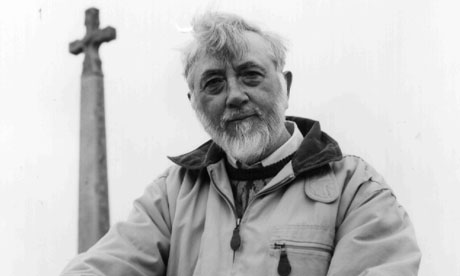
My friend the poet William Martin, who has died aged 85, was a socialist who never lost his vision of what society might be. He was born in Silksworth, near Sunderland, one of the pit villages in the Durham coalfield – and in his poetry he told the story of the slogan bread, the loaves brought by miners to their comrades on strike and laid out in slogans on the hillside. His work also remembered the Miners' Gala in 1951, the year of the Easington disaster, and the "thronged, comforting hush" when the banner, draped in black crepe, was carried down on to the racecourse.
Married to Winsome, a schoolteacher, he worked as an audiology technician at the Sunderland Royal Infirmary and maintained a warm presence as father and grandfather, while his imagination ranged far and wide, drawing on the Gnostic gospels, the Black Madonna of Montserrat and the Babylonian goddess Tiamat, who embodied for him the suppressed feminine principle.
His first pamphlet, Easthope, came out from the Ceolfrith Press in 1970, followed by two collections from Taxus Press, Cracknrigg (1983) and Hinny Beata (1987), and two collections from Bloodaxe Books, Marra Familia (1993) and Lammas Alanna (2000), to which he added his own lettering and artwork. The beauty of these books is an expression of Bill's underlying concern as a poet, to restore the collective symbols, releaf the ikons with gold.
In the same way, his readings began to take on an aural dimension which grew naturally out of the rich song tradition of the north-east, which Bill knew from his own childhood and from the many evenings he spent at the folk club at Birtley, Tyne and Wear, run by the Elliott family. He had always been a remembrancer, patiently polishing the common coins of nursery rhymes, street games and calendar customs, and putting them back into circulation. But when, at the height of a reading, he actually broke into song, he became something more: a figure with an almost priestly power, a cantor for his community.
He is survived by Win, by his sons Graham and Keith, and by his five grandchildren.
http://www.guardian.co.uk/theguardian/2010/oct/17/william-martin-obituary
http://williammartinpoet.com/
http://www.bloodaxebooks.com/titlepage.asp?isbn=1852243694
Gauguin at Tate Modern
Tate Modern, London
Laura Cumming
The Observer
Sunday 3 October 2010
There is a painting in this momentous exhibition that stops you dead. It shows a large chunk of ham on a salver. An ordinary enough subject, except that a fierce orange wallpaper is blazing behind it, sending out sparks, and a glass of black liquid is skulking beside it. And reflected in that chilly surface is the beginning of a row of pale shallots issuing across the canvas like mysterious speech bubbles.
You look for their source, which is none other than the ham itself, now beginning to resemble a severed head. The picture turns out to be as circular as the salver. What had seemed a seductive still life, as sensuously painted as anything by Manet, becomes its opposite: a living head still arguing with everything around it in this astonishing outburst of a picture.
The Ham feels practically on fire. No reproduction can prepare you for its energy and colour. And the same is true of nearly every work in this show, which spans Gauguin's career from the early days in Paris to Martinique, Brittany, Tahiti, Arles and eventually the Marquesas, where he died of syphilitic heart failure in 1903 at the age of 54.
This is the first full-dress show in Britain for half a century. People who know the legend of the stockbroker turned artist who abandoned his family and took the banana boat to Tahiti for free food and sex, may never have had a chance to see the paintings at all. And even for those who have, there will be revelations: the portrait of Gauguin's sleeping child from Copenhagen, anxious dreams unfurling in the air around him; the spectral riders approaching a cobalt Styx in Moscow's The Ford (Flight); the self-portrait as a vermilion-haired Christ in the garden of olives, flown in from Palm Beach, Florida. This is Gauguin's pictorial imagination at full stretch, the show of a lifetime.
Now you could view this mass gathering of almost 200 paintings, drawings, prints and sculptures as resounding proof of Gauguin as the pioneer modernist, his statuesque Tahitians forefathers to Picasso's early figures, his tendrils and curlicues twining their way through Matisse, his wild and dissonant colours a palette for the fauves. This is the exemplary Gauguin, the conceptual painter who decouples line from description and colour from nature, the sophisticated savage who ferries his art books to the jungle, whose line is so supple, strong and incisive, sometimes soothing, sometimes whipping his earthy forms into shape.
This version of art history, as many of us received it, conveniently bypassed all sorts of embarrassment, from Gauguin's brute behaviour to that of his frequently inscrutable paintings.
But what's so remarkable about this show, as the title declares, is its emphasis on Gauguin as maker of myths, narratives and tall stories, notably his own well-burnished legend. The opening gallery sets the scene, superbly condensing both the life and the art in a sequence of self-portraits. From the young loner in his garret, a conventional archetype in a conventional style; to the prophet unrecognised in Paris, a Tahitian odalisque glowing behind him in the cold studio; right up to the shorn and spectacled invalid staring out of the blue twilight of his days. It is not just that Gauguin changes, it is that art changes too, in his intimidating hatchet of a face.
All the aspects of Gauguin's life that might have been side-stepped are thus examined through the art – the boorishness, drink and grotesque self-pity; the absurd outrage, on arriving in Tahiti, that Christian missionaries had got there before him so that he would have to mock up his own carved idols, smuggling them into the paintings as ancient artefacts.
Here are the carvings, the mythical friezes and the acid caricatures of friends and foes. Here are the thumbnail diagrams of deliberately hazy allegories. Tate Modern even has the carved façade of Maison-du-Jouir, Gauguin's last house in the Marquesas with its lewd, screw-you name intended to affront the local clergy. Above all, this focus on narrative makes one look more keenly at the content of the pictures, which sometimes seems buried beneath the pressure of colour. And this is a crucial opportunity.
For the elements of Gauguin's mystique are apparent enough: a portentousness of pose or motif, a figure catching one's eye with a look of grave interrogation, a woman foursquare and impassive as an oceanic statue. Figures distanced, isolated, backs turned or in profile, squatting, crouching, lying face down or flat on their back, stiff-limbed as dolls. Strange fruit, haunted clearings, statues that appear alive, living people as immobile as statues: and all carefully placed in a time-stopped Eden.
But what is really going on? That raven perched above the Tahitian girl in Nevermore: is it a harbinger, a real bird, a heavy allusion to Edgar Allan Poe? Why is this woman repudiating that woman? What is happening in this silent standoff? The mysteries are sustained in Gauguin's titles, those fragments of Tahitian dialect that materialise on the canvas like overheard speech one can never understand; those ambiguous questions (mortal or rhetorical?): what are we? where are we going?
Writing about the "deliberately sombre" colours of Nevermore, Gauguin observed that "sadness is my key", which will be news to anyone who associates him with chromatic heat and hedonism. But his true intent was never for our simple delight. Against all the optical pleasures of his art runs a tide of darkness and pain; and within that a strain of sardonic humour. Sometimes it is hard to tell the difference.
Gauguin, big drinker, hams it up with a self-portrait in the form of a Toby jug, eyes closed as if dozing. But there are rivulets of blood pouring down his face, as if to say go ahead and drink my blood: everyone else does. And look at The Loss of Virginity, with its naked girl laid flat beneath a crimson landscape, a torn blossom in one hand, fondling a vulpine critter. It has to be a joke, doesn't it, a parody of violation and shame? But perhaps Gauguin is serious – exaggeration in the service of truth.
The tone of his art is so hard to catch. But there is no sense of duplicity here. Rather it feels as if Gauguin, irrepressible, cannot help his perverse and rebellious tendencies. The famous Yellow Christ, with its peasant women worshipping a crucifix outdoors in the Breton fields, sings with pure high notes of colour that may imply grace, or even ecstasy. But then there's that little man, Brueghelesque, legging it over the wall in the background in low pursuit of some ladies.
Despite the heavy perfume of ease and eroticism some associate with Gauguin, these paintings are among the most thoroughly calculated in art. Look at the reproductions of Delacroix, Toulouse-Lautrec and Cézanne conspicuously inserted into self-portraits and still lifes; look at the overt homage to Hokusai and Degas. Gauguin's instinctual look is sophisticated, hardwon. And that dichotomy is repeated in the canvases themselves. Up close, the paint is pressed flat into the warp and weft: laborious, dry and even crude. But stand a few inches away and somehow these brushstrokes resolve into images of supersmooth power.
This is a stunning show, almost overpoweringly various in idea, theme and medium. But the focus upon narrative gives it, so to speak, a guiding light. Once you have seen Gauguin depicting himself as hero, martyr, even as Christ betrayed, you begin to see that his art is a continuum, a proliferating mythology in which all people and places are equal. Bible stories may be transposed to Brittany or Polynesia, Tahitian girls can double as goddesses or water sprites so that life's experience may be expressed as timeless, primitive, essential. For Gauguin the myth-maker, all stories are true.
http://www.guardian.co.uk/artanddesign/2010/oct/03/paul-gauguin-maker-myth-tate-modern-review
Sunday, 17 October 2010
Letters to Monica
The letters Philip Larkin wrote to his lover Monica Jones provide a fascinating insight into his personality and a window on the the 'fond struggle' that was their relationship
Adam Mars-Jones
The Observer
Sunday 17 October 2010
Nearly 500 pages of misanthropy, glumness, cowardice and hypochondria (the only sort of prophecy that converges on the truth) from someone both spineless and prickly – it sounds like too much of a good thing, but Letters to Monica offers a very full and satisfying portrait of Philip Larkin in all his (negative) moods: "Honestly I don't think I did anything I wanted ALL DAY except go to the lavatory… Mother's electric blanket broke, & I have 'mended' it, so she may be practising suttee involuntarily before long…" (26 December 1962). What could better capture the spirit of the season or better beguile the Christmas market?
The 1992 volume of Selected Letters (also edited by Anthony Thwaite) hurt Larkin's reputation by giving space to his seedy side, shown particularly in letters to Robert Conquest, with whom he shared tastes in pornography, and Kingsley Amis. On many of those pages bigotry seemed to be practised as a competitive sport.
The Larkin-Amis correspondence and the Larkin-Jones have complementary leitmotifs. Most letters to Amis end ritually with "bum", most letters to Monica Jones begin with "bun". Larkin and Jones had a cult of the fluffy rodent, in a running joke that acquired its own seriousness. He wrote in September 1959: "I do deeply feel 'somehow' there is a rabbit there too, doing the things you do; even lecturing on Hopkins. It is a strange fancy. I can't explain it. I think perhaps the rabbit takes your place at times… Of course I know it doesn't really! but I feel loth to say 'there is no rabbit'." They liked Beatrix Potter even when she strayed beyond bunnies, with Larkin declaring that he would sacrifice Joyce, Proust and Mann (foreigners all, admittedly, and he had become scrupulously xenophobic) for The Tailor of Gloucester.
The Selected Letters printed parts of perhaps a dozen letters to Monica. This large book represents a heroic effort of whittling, since a total of 7,500 pages was sold by her estate to the Bodleian. Thwaite quotes from her side of the correspondence only to provide explanatory context, but even so it's obvious that she wasn't any sort of pushover, and 20-page letters from her were not unusual. She was a formidable but not threatening reader, making it clear that her admiration for Larkin's poetry functioned separately from her personal feeling for him.
This is a stirring book, despite the absence of uplift, because these were people who lived in their letters. Larkin refers to what he is doing in his letters as "talking to you", rather than writing. The one-way medium, not immediately reflexive, seems to liberate him. Interactivity doesn't suit everyone.
The great myth of the relationship, to which both parties subscribed most of the time, was that he was spoiling her life by holding back from marriage, without leaving her free to pursue other prospects. Larkin sometimes dissents from this, feeling that they are as odd as each other, and that Monica likes people at large even less than he does. In his assessment they are similar but not complementary. Love means release from one's beliefs, not confirmation in them.
This was a sexual relationship, if not a very fluent one. Its eroticism announces itself in a bat's squeak or a librarian's whisper. The bicycle-clip cries out to the garter-belt, but softly, softly. Larkin asks for pointers on technique, Monica asks for emotional reassurance. He tries to oblige, but the words he chooses are, "I don't mean, of course, that I don't like making love with you." In this fond struggle between two passive-aggressive types, each of them trying to finesse some decisiveness out of the other, she must have known that a double negative was the most she could hope for. When she points out that he tends to be chilly in letters after a successful meeting, as if to re-establish distance, he does better. His next communication at such a juncture is downright warm.
Over time there is modest experimentation, and an attempt to synthesise Larkin's courtly and kinky sides. Some incidents are relatively easy to reconstruct: "I felt deprived of you, & the love making that hadn't really been concluded. I was a fool to bring those pants – I can't think where to hide them. My cleaner will think I am robbing clothes lines." Others keep their secrets. There are a couple of cryptic references in October 1958, starting with: "I hope you are better now – I fear I didn't treat you very considerately! We had a fine large cavalier time, though, and I look back on it with delight…" The next letter amplifies the mystery: "I'm sorry too that our encounter had such unhappy results for you! I really didn't expect such a thing, though I suppose it might have been predicted. I am sorry. It does rather spoil the incident, even at best, which was very exciting for me anyway…" What can the complication have been, damaging her but not him? Spontaneous combustion? Prolapse?
Philip Larkin was a committophobe's committophobe, king of the ditherers, and his inadequacy was the only thing he was sure of. Yet what good company he is on these pages, this man who kept such poor company with himself! He gave Monica his inadequacy in full measure, pressed down and running over. He held none of it back.
The most extraordinary letters are ones where he is listening to a record or the radio (The Messiah, for instance, or The Critics) and transmutes the experience even before it has finished. In March 1958 he riffs lovingly on Handel's Solomon as if the characters were all rabbits. At times like this his letters take on the shapely frenzy of the jazz he so loved. It's like the automatic writing at a séance or surrealist soirée, expressive but absolutely untethered, coming very close to that unimaginable thing, a disinhibited Larkin. Never mind that he was relying on the faux spontaneity of drink. It was probably the only kind he trusted.
He might be a bad bargain, but the relationship with Monica was stable as long as she had the exclusivity on it. Unfortunately there was evidence (letters received while on holiday with her, for instance) that he was being inadequate with other women. For Philip Larkin to display a talent for sexual intrigue would be roughly as surprising as someone getting work as a juggler without being able to tie his shoelaces. When Monica was deeply upset, he played his top trump in this game of misère: "I've always tried to get you to see me as unlikeable, and now I must be getting near success."
In fact the dwindling flow of letters wasn't the result of estrangement but the opposite. When Larkin's mother moved into a nursing home in 1972 he was able to see Monica more often, both women being based in Leicester. When in 1982 Monica fell downstairs in her Haydon Bridge cottage, he took her in and looked after her. This has elements of both happy ending and nemesis – the belated commitment coming without dignity or real freedom of choice. It's hard not to feel that their relationship was more securely founded on separation. At one point in 1973 he laments that he hasn't written to her for a while ("sign we have been together"), as if the letter was the primary encounter. Third parties like ourselves are bound to feel that way, but perhaps despite everything Monica Jones did too.
http://www.guardian.co.uk/books/2010/oct/17/philip-larkin-letters-monica-jones-review
Saturday, 16 October 2010
THE MANY LETTERS OF PHILIP LARKIN...
Philip Larkin’s letters to Monica Jones, his muse and longest-term lover, shed new light on her involvement in his creative process.
By Anthony Thwaite
03 Oct 2010
Monica Jones met Philip Larkin in 1946, when she was a lecturer in English literature at Leicester University, and he was a librarian there. They were both 24. Over the 40 years that followed, they fell in love – and corresponded. She was his muse and his critic – both literary expert and lover (one of the unmarried Larkin’s many, although Monica, according to another of his lovers, Betty Mackereth, was his “soulmate”).
“Monica was his sounding-board,” says Anthony Thwaite, Larkin’s friend and the editor of Philip Larkin: Letters to Monica. “From soon after getting to know her in the late 1940s, she was the person he showed his poems to – before that it had been Kingsley Amis, a contemporary of Larkin’s at Oxford. But as he began to know Monica’s mind, judgment and sensitivity, he started trying out his poems on her. And, as you can see from the letters, he is often found agonising over his work.”
Although their affair lasted four decades, Philip and Monica only actually lived together in the four years prior to Larkin’s death in 1985. Jones, who was too consumed with grief to attend his funeral, subsequently became his executor and destroyed, at Larkin’s behest, all of his diaries. She continued to live in the house they had shared in Hull until her own death in 2001, and afterwards 7,500 pages of letters to her from Larkin were discovered. They form the most revealing and detailed chronicle of Larkin’s intimate life, and are seen here for the first time.
What follows is a series of exchanges that focus on the couple’s discussion of Larkin’s work as he was producing it, and which, many years later, Monica Jones taught her students.
November 20 1950 Queen’s Chamber’s, Queen’s University, Belfast, where Larkin is now working as a sub-librarian
Dearest Monica,
Here with the six anticlimaxes. [The poems Larkin sent Monica on November 20 were Wedding-Wind, Spring, Wires, Coming, Modesties, and The Dedicated.]
[…] I do seem to have created a bad impression lately: I’m awfully sorry about “hostility” - it’s quite unintentional & must spring from being a bit rushed & my natural subsarcastic way of talking sounding much nastier when written down. But trying to remember what I wrote doesn’t enable me to recall any real hostile intention, quite the reverse. I thought recent letters had been confidential and affectionate.
November 21 1950 Monica to Philip
I like best Wedding-Wind & Spring, & I don’t like the Wild West one at all – it’s all right, but I don’t like it at all . . . Wedding-Wind I like extremely, it’s a lovely title, breathing Hardy & Housman; and, marvellously, breathing a genuine rusticity – that’s a horrid word for it – a real countrified air, like you was bred & born in it. Stables, horses & chicken-pail anyone could do; but candlelight, floods, the girl’s apron – these are the real close intimate touches.
November 26 1950 Queen’s Chambers, Belfast Sunday night. 10.45.
Dearest M,
Grateful acknowledgements of your mild judgments on my six things (as Kingsley [Amis] would call them: somebody – Browning, perhaps – always spoke of his poems as “his things”; since when KWA [Amis] has also done so, with comico-sardonico-ambiguous effect): you are very lenient. Not of course that I am not prepared to raise my hackles in defence of my chickens, illogically: however, I won’t, because it’s all a question of ear, really. The prairie one [referred to by Monica as “the Wild West one”] was the only Belfast one – written straight off before breakfast in pyjamas. Wind is about the oldest – 1947 or so. Dedicated is fairly old, too. The other 3 are all Dixon Drivers [written when Larkin was living in Dixon Drive, Leicester, 1948–50]. Spring last spring. On the whole I think Wind is the best: I wish I could write more like that, fuller, richer in reference: I am quite pleased with the to-me successful use of the floods & the wind as fulfillment & joy. Shouldn’t write like that now! Then I like Modesties. Spring is “smart”. The Dedicated is just but faint. And the prairies – well, just a little verse: no wings. I do tremble, though, to think of your getting your claws on the real rubbish!
January 13 1951 Queen’s Chambers, Belfast
Dearest Monica,
I think there were one or two misapprehensions of my last: certainly I don’t want to be bucked up with little talks on the Duty of Happiness. I was just saying that most of my miseries didn’t deserve the solicitude you show for them. And my poem was really an attempt to capture my feeling on returning here: a sense of amazement that what we wait for so long & therefore seems so long in coming shouldn’t take a proportionally long time to pass – instead of zipping away at the same speed as everything else:
it’s
No sooner present than it turns to past
We think each one will heave to and unload
All good into our lives, all we are owed
For waiting so devoutly and so long:
Right to the last
We think each one will heave to and unload
All good into our lives, all we are owed
For waiting so devoutly and so long:
But we are wrong.
Only one ship is seeking us, black-
Sailed . . .
Undistinguished-looking stuff, now I write it down in longhand. […] I can hear it raining – you realise my room sticks out like a promontory, like the front of a ship, catching all the weather that’s going. But the blessed quiet! I can go to bed at midnight now, & know I shan’t hear that booted ape blundering about overhead. Sleep! Sleep!
June 19 1951 Queen’s Chambers, Belfast
Dearest Monica,
A word. I sit at nearly 10.30pm, reading lamp perched on my side-ended travelling-trunk, looking out of my west-facing window, where the redness of the sky has subsided to grey – the low meandering solid grey of the hills, and the watercolour streaky grey of the sky. […] Hay fever hovers around. Waves of sadness occur, like the fine breath of a garden.
I think the prosaic quality you censure in verse is beautifully exemplified in a bit of Spender which I believe runs
For you are no Orpheus,
She no Eurydice:
She has truly packed and gone
To live with someone
Else . . .
At this point the poem falls blubbering to its knees. I expect I do it sometimes, though I don’t find it at the spot you indicate in At Grass – would you prefer a comma after sky? Truly I have no theories about poetry at all, but I do think that most fascinating effects are got by playing off the rhythm and language of speech against the rhythm and language of poetry. They are not long, the weeping and the laughter [from Ernest Dowson] – And when she wakes she will not think it long [from Christina Rossetti] – Everybody else, then, going, And I still left where the fair was? [from Thomas Hardy] – such lines are so successful to me that some other poets fade to nothingness beside them in entirety. […] And by the way I send no poems because I do not find any I have the face to make known to you. They are all just dull, or frivolous, or incompetent. And there is no social conscience about them!
July 30 1953 Monica to Philip
As for yr complaint – I might as well deal with it once for all & never no more – about “the wood of my conservatism” as you call it, if you really can’t stand a bit of that, you need never hear it again [. . .] I certainly thought you didn’t care either way, & imagining that speech was free thought you could equally well hear me talk as anybody else; I certainly never knew you fancied yrself a Socialist, & I must say you’ve kept it pretty dark . . . It seems to me that either you’ve intended to conceal it or you don’t know much about it, for you certainly don’t talk like it. All politics preys on the basest sides of human character, relies on it, brings it out; I don’t like it any more than you do.
August 5 1953 Belfast. Philip to Monica
You know, I’m sure you’ll hoot, but what prompted your remarks about politics, my thoughts on’t? Did I say “wood of conservatism”? Or write it? I can’t place it at all – what was it in connexion [sic] with? Wood? Babes in the? Bowls? Beer from the? Really, I know I say my poor old brain is, etc., but I hope I’m not forgetting something of the last 14 days. No: or perhaps I’m turning into the type – the Montherlant type – who “does not forgive, but forgets – really forgets – . . .” I hope not. Anyway, I don’t mind what you say: all reasonable enough, surely, & the idea of my brooding and fretting over your political opinions is enough to make a Staffordshire cat laugh. You know I don’t care at all for politics, intelligently. I found that at school when we argued all we did was repeat the stuff we had, respectively, learnt from the Worker, the Herald, Peace News, the Right Book Club (that was me, incidentally: I knew these dictators, Marching Spain, I can remember them now) and as they all contradicted each other all we did was get annoyed. I came to the conclusion that an enormous amount of research was needed to form an opinion on anything, & therefore I abandoned politics altogether as a topic of conversation. It’s true that the writers I grew up to admire were either non-political or Left-wing, & that I couldn’t find any Right-wing writer worthy of respect, but of course most of the ones I admired were awful fools or somewhat fakey, so I don’t know if my prejudice for the Left takes its origin there or not. But if you annoy me by speaking your mind in the other interest, it’s not because I feel sacred things are being mocked but because I can’t reply, not (as usual) knowing enough. […]
By the way, of course I’m terribly conventional, by necessity! Anyone afraid to say boo to a goose is conventional.
I’ve written a tiny little poem since returning, hardly a poem at all:
What are days for?
Days are where we live.
They come, they wake us
Time and time over.
They are to be happy in:
Where can we live but days?
And to seek where they join
Brings the priest and the doctor
In their long coats
Running over the fields.
Don’t take it seriously, but it’s a change from the old style. […]
[The above lines are a draft for Days, eventually collected in The Whitsun Weddings (1964).]
November 14 1954 Belfast. Philip to Monica
I’m not keeping “the rabbit one” from you [“rabbit”, “bunny” or “bun” were Larkin’s terms of endearment for Monica]: it’s only that in it I kill the rabbit, which makes it totally out of character & rather like a piece of journalism. I’ll transcribe it:
Blind sightless
Caught in the centre of a  soundless field
As hot, inexplicable hours go by
What trap is this? Where were its teeth concealed?
You seem to ask.
I make a brief reply;
Then clean my stick. I’m glad I can’t explain
Just in what jaws you were to suppurate:
You may have thought things would come right again
If you could only keep quite still and wait.
It’s not much of a poem. But of course I felt strongly enough about it. I hardly dare ask what you think of it. I strove (queer word) to give the essential pathos of the situation without getting involved in argument. Give me your opinion on sightless/soundless. I believe rabbits are both blind and deaf, so either wd do – a field with no sights or sounds in. Oh dear. Is this “using” the rabbits? Honestly, my motives are really good – better than the poem, I’m afraid.
[The above lines are variants in Myxomatosis, which Larkin appeared to have completed in its final form on September 28 1954.]
August 18 1955 Monica to Philip
I like your poetry better than any that I ever see – oh, I am sure that you are the one of this generation! I am sure you will make yr name! yr mark, do I mean – really be a real poet, I feel more sure of it than ever before, it is you who are the one, I do think so. Oh, Philip – I don’t know what to say! You will believe me because you know it doesn’t make any difference to me whether you are or not, I shouldn’t think any less of your value if yr poems seemed to me bad & if everybody said so; and because I’ve never said to you this is magnificent, this is greatness triumphant, in yr hands the thing becomes a trumpet.
September 26 1955 200 Hallgate, Cottingham, E. Yorks [Larkin is now head librarian at the University of Hull]. Philip to Monica
Dearest,
Back to this dreary dump,
East Riding’s dirty rump,
Enough to make one jump
Into the Humber –
God! What a place to be:
How it depresses me;
Must I stay on, and see
Years without number?
– This verse sprang almost unthought-of from my head as the train ran into Hull just before midday. I’m sure no subsequent verse could keep up the high standard. Pigs & digs rhyme, of course, likewise work & shirk, & Hull & dull, but triple rhymes are difficult. Anyway, it gives an indication of how I’m feeling. Fearful change from life as it was lived on the island. [. . .]
I suppose in sum I miss you, and the happy life we led on Sark, & dislike being back at work & in these sluttish surroundings, and having said that much (!) I should really pipe down, rather than list feeble grumbles. But o, ’tis true, ’tis true.
February 12 1956 Cottingham. Philip to Monica
Dearest,
I’m absolutely sick of my tomb poem [An Arundel Tomb] & thought I wd send it you unfinished as a token for St Valentine’s Day. Not that it’s in any sense a valentine, but to give you something special from me on that day. It’s complete except for the last verse, which I can’t seem to finish: but I can’t feel it is very good, even as it stands. It starts nicely enough, but I think I’ve failed to put over my chief idea, of their lasting so long, & in the end being remarkable only for something they hadn’t perhaps meant very seriously. Do let me know what you think of it.
April 18 1971 Hull. Philip to Monica
Dearest bun,
Thanks for the welcoming letter, very kind of you. I really don’t know that I’ve much to report. […] Talking of pwetry, as Kingsley used to call it, I suggest
They fill you with the faults they had
And add some extra, just for you.
I think this is better. Or do you think
They foist on you the faults etc?
That might be better. Causons, causons, mon bon. “Foist” is faintly farcical, wch is good – better than “fill”. Shall it be foist? (The last shall be foist.) No: there is then too much emphasis on the two yous.
THIS BE THE VERSE
They ---- you up, your mum and dad;
They may not mean to, but they do.
They hand on all the faults they had,
And add some fresh ones just for you.
But they were ----ed up in their turn
By fools in old-style hats and coats
Who half the time were soppy-stern
And half at one anothers’ throats.
Man hands on misery to man;
It deepens like a coastal shelf.
Get out as early as you can,
And don’t have any kids yourself.
http://www.telegraph.co.uk/culture/books/philip-larkin/8039083/Philip-Larkin-letters-to-Monica-Oh-I-am-sure-that-you-are-the-poet-of-this-generation.html
Friday, 15 October 2010
Sixties Gold at The Sage, Gateshead - review by Terry Kelly
Sixties Gold
SHOWS like Sixties Gold do exactly what it says on the tin.
The formula sees bands and singers who were major pop stars several decades ago
treading the boards for - mostly - the people who bought their records the first time around.
The latest incarnation to reach Tyneside featured ex-Tremeloes lead singer and sometime writer Chip Hawkes, what was left of the The Searchers, Gerry and the Pacemakers and the former trouser-ripping wildman of rock, PJ Proby.
I'll be honest and say that Proby was the main reason I made the trip to The Sage, which boasted a capacity crowd, despite these recessionary times.
The tall Texan, now sporting a shock of white hair, is one of rock music's greatest vocalists.
Although he's had a personally and professionally erratic life, PJ can still shake the rafters with his unique version of Somewhere from West Side Story.
Proby looked resplendent in a white suit and blew some mean harmonica on the Everly Brothers' Price of Love, but still revealed some Texan spirit when he grumbled about not being able to sing all his old songs.
Gerry Marsden, who nowadays looks like a Scouser version of John Prescott, with a dry wit to match, brought the house down with his classics Don't Let the Sun Catch You Crying, Ferry Cross the Mersey and the arm-waving closer, You'll Never Walk Alone.
Opening act Chip Hawkes was in fine voice on the Trems' Here Comes My Baby, Even the Bad Times Are Good and pop evergreen Silence Is Golden.
The two original members of The Searchers brought the nostalgic gig to a close with the likes of Sweets For My Sweet and a suitably jangly guitar version of Mr Tamborine Man.
TERRY KELLY
Thursday, 14 October 2010
Subscribe to:
Posts (Atom)